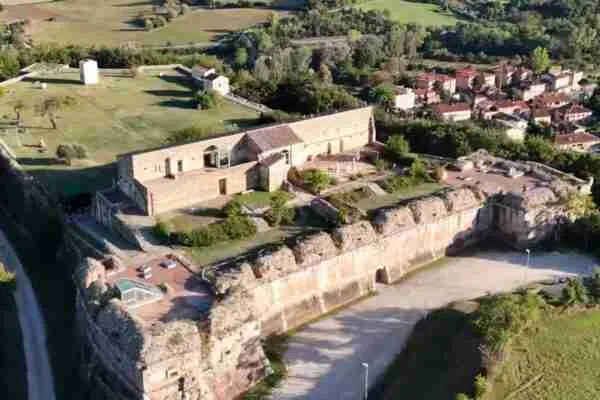
The Transition to Gunpowder Fortification: Giuliano da Sangallo’s Bastioned Masterpiece at Poggio Imperiale Designed by Giuliano da Sangallo for Lorenzo de’ Medici around 1488, the Poggio Imperiale Fortress above Poggibonsi represents one of the earliest and most deliberate applications of trace italienne bastioned fortification in Italy — a pentagonal circuit […]
Read MorePost Tagged with: "renaissance military architecture"
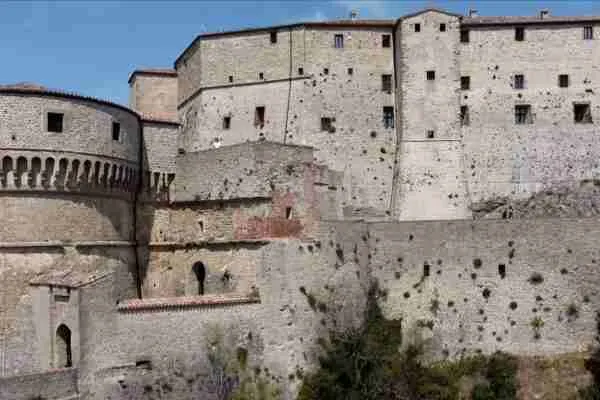
The Geometry of the Malatesta and Montefeltro Shield: Renaissance Bastion Evolution, Scarped Bulwarks, and Francesco di Giorgio Martini’s Inventions at the Fortress of San Leo Rimini
The Geometry of the Malatesta and Montefeltro Shield: Renaissance Bastion Evolution, Scarped Bulwarks, and Francesco di Giorgio Martini’s Inventions at the Fortress of San Leo Perched on an isolated rock promontory above the Val Marecchia, the Fortress of San Leo encodes in its layered masonry the transformation that early gunpowder […]
Read MoreThe Geometry of Defiance: Francesco di Giorgio Martini’s Ballistic Engineering at Mondavio Pesaro
The Geometry of Defiance: Francesco di Giorgio Martini’s Ballistic Engineering at Mondavio Among the fortresses commissioned across the Duchy of Urbino in the final decades of the fifteenth century, the Mondavio Fortress — known in Italian as the Rocca Roveresca di Mondavio — occupies a singular position: it is the […]
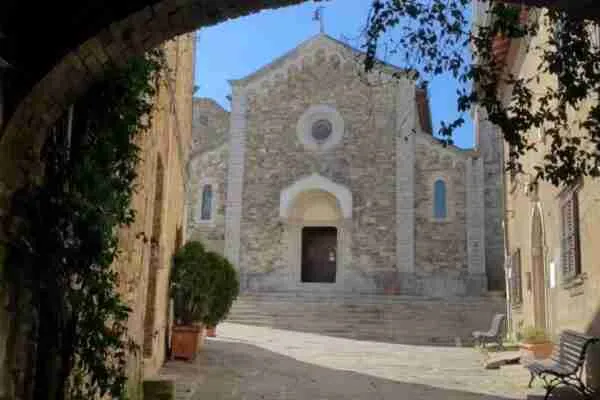
Read MoreSubterranean Defense Lines: The Underground Volte Tunnel and Sangallo’s Bastions in Castellina in Chianti
Subterranean Defense Lines: The Underground Volte Tunnel and Sangallo’s Bastions in Castellina in Chianti In the hills between Florence and Siena, the small Tuscan town of Castellina in Chianti hides one of the more unusual defensive structures of the Italian Renaissance: a vaulted, semi-underground passage built directly into the inside […]
Read MoreThe Iron Boundary: Structural Fortification, Bastion Mechanics, and Spatial Hegemony at Breno Castle Brescia
The Iron Boundary: Structural Fortification, Bastion Mechanics, and Spatial Hegemony at Breno Castle On a ridge of natural rock rising approximately 120 metres above the Oglio River, the Castello di Breno occupies the strategic fulcrum of the Val Camonica corridor. Its layered fabric — a 9th-century Lombard chapel foundation, 12th-century […]
Read MoreFortresses and Frontiers: Francesco di Giorgio Martini’s Military Masterpieces in Le Marche
Fortresses and Frontiers: Francesco di Giorgio Martini’s Military Masterpieces in Le Marche The rolling hills of Le Marche conceal one of the Renaissance’s most extraordinary architectural legacies: nearly seventy fortifications designed by Francesco di Giorgio Martini, the Sienese polymath who revolutionized military engineering. Commissioned by Federico da Montefeltro, Duke of […]
Read More