Stretching over 4,300 miles along South America’s western edge, this continental marvel crosses seven nations from Venezuela to Argentina. Its snow-capped summits and deep valleys form a dramatic divide between coastal plains and inland basins, shaping weather patterns and cultures for millennia.
Beyond its sheer scale, the region hosts one of Earth’s most diverse ecosystems. High-altitude plateaus transition into misty cloud forests, sheltering rare species like spectacled bears and Andean condors. These landscapes also cradle archaeological wonders, including cultural treasures that reveal ancient civilizations’ deep connection to their environment.
Modern travelers will discover how local communities thrive in harmony with these extremes. From potato farmers using ancestral terraces to vibrant festivals celebrating mountain deities, human ingenuity flourishes here. Conservation efforts now work to protect fragile habitats while supporting sustainable tourism.
This guide explores the range’s geological forces, ecological marvels, and living traditions. Whether you seek adventure on rugged trails or quiet moments in timeless villages, prepare to encounter a world where nature and culture collide in breathtaking ways.
Key Takeaways
- Spans 4,300 miles across seven South American countries
- Hosts ecosystems ranging from glaciers to tropical forests
- Contains UNESCO sites preserving indigenous heritage
- Influences continental climate patterns
- Supports unique wildlife found nowhere else
- Offers both adventure travel and cultural immersion
- Contact us for a comfortable and personalized itinerary (Free Service)
The Majesty of the Andean Mountains: An Introduction
Carving through seven South American nations, this colossal spine of rock and ice hosts Earth’s most dramatic elevation changes. From tropical rainforests to windswept glaciers, its terrain shapes climates and cultures across the continent.
Overview of Andean Landscapes and Peaks
The Andes mountains boast extremes that stagger the imagination. Argentina’s Mount Aconcagua pierces the sky at 22,837 feet – taller than any other summit in the Americas. Three distinct zones define the mountain range:
Northern volcanic highlands steam with geothermal activity. Central regions reveal mineral-rich valleys, while Patagonia’s southern reaches shelter untouched glacial fields. These landscapes create microclimates where orchids bloom near snowlines.
Historical and Cultural Significance
Ancient empires thrived in these rugged mountains, mastering terrace farming and stone construction. The Inca’s Machu Picchu remains a testament to their architectural genius, perched high above sacred valleys.
Today, Quechua-speaking communities preserve traditions like quinoa cultivation and alpaca herding. Their spiritual connection to the land endures, visible in colorful festivals honoring mountain spirits.
Andean Mountains: Majestic Peaks and Rich Biodiversity
This iconic range serves as a living showcase of nature’s adaptability. Its vertical slopes create distinct ecological layers, each hosting specialized communities of plants and animals. From mist-shrouded forests to windswept plateaus, these zones function like interconnected habitats.
Key Highlights of Natural Wonders
Elevation shapes the region’s ecological drama. Tropical lowlands teem with orchids and hummingbirds, while higher slopes shelter polylepis forests – Earth’s highest-altitude trees. At extreme heights, cushion plants form living insulation against freezing winds.
| Elevation Zone | Key Features | Signature Species |
|---|---|---|
| 3,000-6,000 ft | Cloud forests | Spectacled bear, quetzal |
| 6,000-12,000 ft | Highland grasslands | Vicuña, giant lupine |
| 12,000+ ft | Puna ecosystem | Andean flamingo, yareta plant |
Unique Biodiversity Features
Evolution works overtime here. The Andean cat developed thick fur for subzero nights, while flamingos filter microbes from alkaline lakes. Nearly 40% of plant species grow nowhere else, including ancient quinoa relatives.
These habitats form biological highways. Migratory birds use valley corridors, while seed-spreading rodents connect plant populations across slopes. Such interactions make the region a global conservation priority for maintaining ecological balance.
Geography and Climate in the Andes
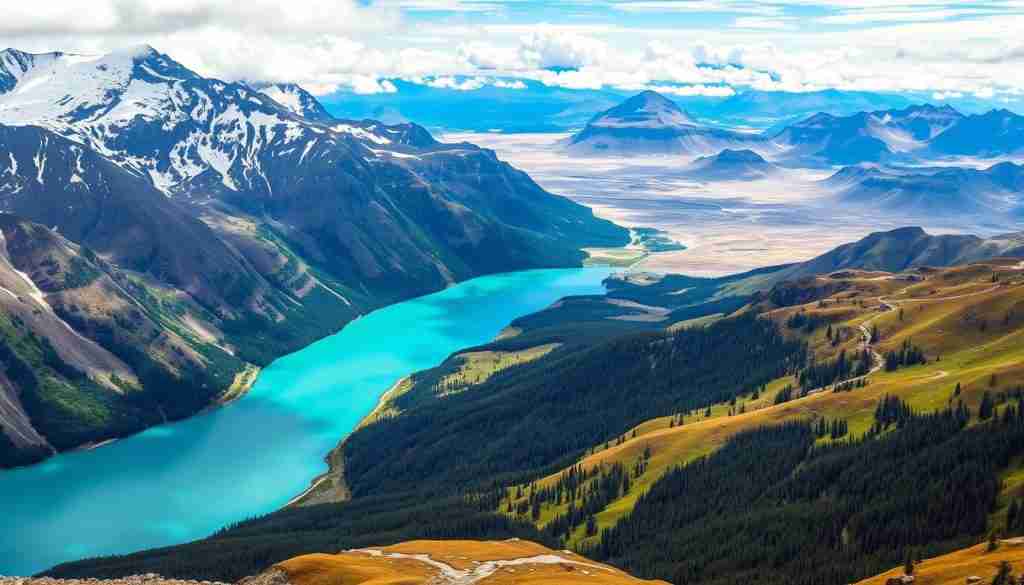
Spanning three distinct zones, this continental backbone creates a tapestry of climates where tropical humidity collides with polar winds. Northern volcanic slopes steam under equatorial rains, while southern ice fields endure Antarctic blasts. Between these extremes lie arid plateaus where thin air challenges both life and agriculture.
Regional Climate Dynamics and Glacial Retreat
The climate shifts dramatically across elevations. In Peru’s Cordillera Blanca, glaciers once stored water for 30 million people. Now, rapid melting creates short-term floods followed by long droughts. “Glaciers are our natural reservoirs,” explains a Lima hydrologist. “Their loss disrupts everything from farming to hydroelectric power.”
Seasonal weather patterns grow unpredictable. Traditional planting cycles falter as rains arrive late or vanish entirely. Communities adapt by reviving ancient irrigation systems, blending innovation with ancestral knowledge.
Key Geographical Landmarks
Each region boasts defining features. The Altiplano plateau cradles Lake Titicaca, Earth’s highest navigable lake. Argentina’s Aconcagua towers over vineyards, while Ecuador’s Avenue of Volcanoes draws hikers to snow-lined craters.
Deep valleys like Peru’s Sacred Valley reveal how topography shapes microclimates. These fertile basins host archaeological wonders and top destinations where travelers witness living history amid changing conditions.
Biodiversity and Ecosystem Diversity
Layered like a living tapestry across elevation gradients, these habitats showcase nature’s vertical ingenuity. Three distinct forest belts create ecological staircases where life adapts to shifting temperatures and moisture levels.


Iconic Flora and Fauna
The wax palm dominates skyward, reaching 200 feet – a record-breaking height for palm species. These giants share space with quinine trees, whose bark revolutionized malaria treatment. Epiphytes drape branches in floral curtains, filtering nutrients from mist.
Creatures here master niche survival. Glass frogs lay translucent eggs on waterfall-side leaves, while mountain tapirs navigate slopes with sure-footed grace. Over 600 bird species fill the air, including rainbow-beaked toucans.
From Cloud Forests to High-Altitude Valleys
Moisture defines these ecosystems. Cloud forests intercept 90% of passing fog, creating suspended wetlands. Descend 1,000 feet, and sunlight pierces through to valleys where rare orchids bloom.
| Forest Zone | Elevation Range | Key Features |
|---|---|---|
| Pre-Montane | 1,000-1,500m | Warm temperatures, diverse palms |
| Montane | 1,500-2,500m | Epiphyte-rich cloud forests |
| Upper-Montane | 2,500-3,000m | Moss-draped dwarf forests |
Each layer performs vital roles. Cloud forests capture 20% more rainwater than lowland ecosystems, supplying rivers that sustain millions downstream. Root networks prevent erosion on steep slopes where coffee plantations now embrace shade-grown methods.
Cultural Heritage and Adventure Tourism
Where ancient stone pathways meet modern hiking boots, South America’s highlands reveal living history alongside thrilling exploration. The Peruvian Andes cradle archaeological wonders and vibrant communities maintaining traditions unchanged for generations.
Ancient Civilizations and Indigenous Communities
Machu Picchu’s terraced ruins showcase Inca engineering mastery, built without mortar yet standing strong for 600 years. Nearby, Quechua families still farm potatoes and quinoa using ancestral methods. “Our llamas are family,” shares a Cusco-based farmer. “They carry traditions forward.”
Festivals like Inti Raymi transform Cusco each June. Dancers in elaborate costumes reenact sun worship ceremonies, their chants echoing across sacred valleys.
Popular Trekking Routes and Adventure Activities
The Inca Trail remains South America’s most iconic hike, winding past cloud forests to Sun Gate viewpoints. For solitude, the Salkantay Trek offers glacial lakes and star-filled nights near 20,000-foot peaks.
Mountaineers test skills on Huascarán’s icy faces or Alpamayo’s perfect pyramid shape. These Andes mountain challenges demand preparation but reward with unmatched vistas.
The Impact of Climate Change on Andean Landscapes
Rising temperatures are rewriting the ecological story of South America’s high-altitude regions. Ice sheets that shaped landscapes for thousands of years now vanish at alarming speeds, disrupting water cycles and livelihoods.
Glacial Meltdown and Water Resource Challenges
Nearly 50% of tropical glaciers worldwide exist in this region, but they’re shrinking 10 times faster than in the 1980s. “Our ancestral snow-capped guardians are disappearing,” notes Quechua hydrologist Marisol Quispe. “This change threatens every aspect of life downstream.”
| Glacier | Location | Retreat Rate | Key Impact |
|---|---|---|---|
| Quelccaya Ice Cap | Peru | 200 ft/year | Threatens Lima’s water supply |
| Chacaltaya | Bolivia | Disappeared 2009 | Lost ski resort & hydro resources |
| Pastoruri | Peru | 50% loss since 1995 | Reduced river flows in dry season |
Effects on Local Communities and Agriculture
Farmers face impossible choices as weather patterns shift. Potato yields in some areas dropped 30% last decade. “Our planting calendar no longer matches the rains,” explains Julio Mamani, a fourth-generation quinoa grower near Lake Titicaca.
Three critical challenges emerge:
- Erratic rainfall causing simultaneous floods and droughts
- Declining soil quality from intense UV exposure
- Loss of ancestral crop varieties unable to adapt
Indigenous communities, comprising 30% of the region‘s rural populations, face cultural erosion as traditional practices collide with modern climate realities. Infrastructure damage from landslides now costs governments $150 million annually.
Conservation Efforts and Sustainable Practices
Across South America’s highlands, a quiet revolution unfolds as diverse stakeholders unite to protect fragile ecosystems. Strategic interventions blend modern science with ancestral wisdom, creating models for environmental resilience that benefit both land and people.
Reforestation and Protected Areas Initiatives
Native tree planting drives transform degraded land. Polylepis saplings – adapted to thin soils – now reclaim high-altitude forests, stabilizing slopes while storing carbon. Protected areas like Peru’s Manu Biosphere Reserve safeguard critical habitats, ensuring clean water flows to 1.5 million downstream users.
Community-Driven Conservation Programs
Local communities lead innovative partnerships. Through Payment for Ecosystem Services schemes, farmers receive tools for sustainable agriculture in exchange for watershed protection. This activity reduces deforestation rates by 38% in participating areas while boosting food security.
These collaborative efforts prove ecological health and human prosperity are intertwined. By supporting such initiatives, travelers help preserve forests and cultural traditions for generations – leaving footprints of hope across this evolving landscape.
