Washington DC Best Tours & Walking Routes 2026: Complete Travel Guide
Washington DC offers extraordinary touring and walking opportunities across monuments, museums, and historic neighborhoods, with options ranging from free self-guided routes along the National Mall to expert-led specialty tours exploring Capitol Hill, Georgetown, and beyond. The city’s compact layout and exceptional public transportation make it ideal for walking exploration, while professional tour operators provide insider access to government buildings, comprehensive historical context, and efficient routing that maximizes your time in the nation’s capital.
Key Takeaways for Washington DC Tours 2026
- Budget Planning 2026: Tour costs range from free self-guided walks to guided experiences costing $60-90 for full-day bus tours, $29-39 for small-group walking tours, and $300-500 for private custom tours, with most National Mall monuments and memorials accessible 24 hours daily at no charge
- Booking Strategy 2026: Reserve U.S. Capitol tours up to 90 days in advance through the official website, secure Washington Monument tickets early for guaranteed access, and book popular guided tours at least one week ahead during peak spring and summer months
- Route Efficiency 2026: The complete National Mall walking loop covers approximately two miles from the Capitol to Lincoln Memorial, requiring three to five hours to explore properly, while Georgetown and Capitol Hill neighborhood walks each span about two miles with moderate terrain
- Seasonal Considerations 2026: Cherry blossom season in late March through mid-April brings spectacular blooms and massive crowds requiring advance tour reservations, while fall weather from September through November offers ideal walking conditions with fewer visitors and comfortable temperatures
- Transportation Integration 2026: Metro stations at Smithsonian, Federal Triangle, Capitol South, and Foggy Bottom provide convenient access to major touring areas, with unlimited-ride day passes at $13 offering cost-effective transportation for visitors taking multiple tours across different neighborhoods
- Tour Type Selection 2026: Choose guided bus tours for comprehensive city overviews and elderly or mobility-limited travelers, walking tours for detailed historical immersion and photography opportunities, night tours for illuminated monument views without daytime crowds, and bike tours for covering maximum distance efficiently
People Also Ask About Washington DC Tours 2026
How much do Washington DC tours cost in 2026?
Washington DC guided bus tours cost $59-89 for full-day experiences in 2026. Small-group walking tours range $29-39 for specialized neighborhood experiences, while pay-what-you-want walking tours let visitors name their price with suggested donations of $20-30 per person. Private custom tours cost $300-500 for groups up to 11 people. Many National Mall monuments remain free to visit independently, and the Smithsonian museums offer free admission, making self-guided touring an excellent budget option. Hop-on hop-off trolley passes cost approximately $55-75 for 24-hour access with unlimited reboarding.
What’s the best walking route for first-time visitors to Washington DC in 2026?
The classic National Mall walking route starts at the U.S. Capitol, proceeds west past Smithsonian museums along the two-mile grassy corridor, and culminates at the Lincoln Memorial, with detours south to the Tidal Basin memorials including Jefferson, FDR, and Martin Luther King Jr. monuments. This route covers approximately three miles total and requires three to five hours depending on museum stops and monument exploration time. Begin early morning around 8 AM to avoid crowds and heat, bring water as shade is limited, and wear comfortable walking shoes as you’ll cover significant distance on paved paths and gravel trails.
Do you need to book Washington DC tours in advance for 2026?
U.S. Capitol tours require advance reservations through the official website up to 90 days before your visit, with same-day passes sometimes available but not guaranteed. Washington Monument tickets need advance booking online, released 90 days ahead with additional same-day tickets available at 8:30 AM on-site. Popular guided tours from major operators should be reserved at least one week in advance during spring and summer peak season, while shoulder season fall and winter visits often allow booking just a few days ahead. Night tours and cherry blossom specialty tours frequently sell out weeks in advance.
What’s the difference between bus tours and walking tours in Washington DC for 2026?
Bus tours in Washington DC cover more geographic territory in less time, typically visiting 15-20 major sites over six to eight hours with brief photo stops at each monument, making them ideal for first-time visitors wanting comprehensive city overviews or those with mobility limitations. Walking tours cover shorter distances over two to three hours but provide deeper historical context, insider stories, and more time at fewer locations, perfect for photography enthusiasts and history buffs wanting detailed exploration. Bus tours include climate-controlled transportation and seated rest between stops, while walking tours require moderate physical fitness and weather-appropriate clothing but offer more intimate group sizes typically limited to 10-15 participants versus 40-50 on buses.
Extended multi-day tours – 5+ days
Featured Eastern Usa Multi-Day Tour Packages
3 days
Eastern Usa 3-Day Discovery Tour
- ✓ Comprehensive Eastern Usa experience
- ✓ Expert local guides included
- ✓ All accommodation included
- ✓ Transportation provided

5 days
Eastern Usa 5-Day Highlights Experience
- ✓ Comprehensive Eastern Usa experience
- ✓ Expert local guides included
- ✓ All accommodation included
- ✓ Transportation provided

7 days
Eastern Usa 7-Day Cultural Journey
- ✓ Comprehensive Eastern Usa experience
- ✓ Expert local guides included
- ✓ All accommodation included
- ✓ Transportation provided

10 days
Eastern Usa 10-Day Complete Adventure
- ✓ Comprehensive Eastern Usa experience
- ✓ Expert local guides included
- ✓ All accommodation included
- ✓ Transportation provided
Multi-day tour packages powered by TourRadar. Prices and availability subject to change.
Introduction: Experiencing Washington DC Through Tours and Walking Routes in 2026
Washington DC presents one of America’s most walkable and tour-friendly cities, designed with intentional grandeur by Pierre L’Enfant in 1791 to showcase democratic ideals through monumental architecture and open public spaces. The Federal Triangle anchored by the U.S. Capitol, White House, and National Mall creates a compact touring district where world-class museums, presidential memorials, and government buildings cluster within comfortable walking distance. This geographic concentration, combined with year-round 24-hour monument access and free Smithsonian admission, makes the nation’s capital uniquely accessible for self-guided exploration while simultaneously supporting a thriving professional tour industry offering specialized expertise and insider access.
The 2026 touring landscape in Washington DC balances traditional guided experiences with innovative self-guided technologies, as app-based audio tours proliferate alongside established walking tour companies and long-running bus operators. Major infrastructure improvements for the nation’s 250th anniversary celebration in July 2026 have enhanced accessibility across the National Mall, with upgraded pathways, improved signage, and renovated facilities making walking routes more comfortable for visitors of all abilities. These improvements coincide with expanded tour offerings focusing on previously underrepresented histories, including enhanced African American heritage tours, women’s history walks, and LGBTQ+ historical routes that complement traditional monument and memorial circuits.
Understanding tour options and walking routes before arrival allows visitors to match experiences with interests, physical abilities, and schedule constraints. First-time visitors often benefit from comprehensive guided bus tours providing broad orientation before detailed self-guided exploration, while return visitors might prefer specialized walking tours diving deep into specific neighborhoods like Georgetown’s Federal-era mansions or Capitol Hill’s architectural evolution. Budget-conscious travelers can design exceptional self-guided itineraries using free resources and public transportation, while those prioritizing convenience and expertise invest in private tours offering customized routing and skip-the-line access to ticketed attractions.
Washington DC’s touring appeal extends beyond famous monuments to encompass vibrant neighborhoods, hidden historical sites, and evolving cultural districts that reveal layers of American history from colonial tobacco ports through Civil Rights struggles to contemporary political power. This guide examines all major touring options for 2026, from iconic National Mall walks to specialized neighborhood explorations, providing practical route details, current pricing, booking strategies, and insider tips for maximizing your experience in the nation’s capital whether you prefer guided expertise or independent exploration.
Guided Bus Tours in Washington DC 2026
Guided bus tours provide comprehensive city overviews covering 15-20 major landmarks in six to eight hours, offering climate-controlled comfort and seated rest between stops that makes them ideal for elderly visitors, families with young children, or anyone wanting maximum coverage with minimum physical exertion.
Full-Day Comprehensive Bus Tours 2026
Full-day guided bus tours in Washington DC cost $69-89 for adults in 2026 (check official operator websites for current rates as pricing may vary). These tours typically operate from 9 AM to 4 PM or 10 AM to 5 PM, departing from centrally located meeting points near Union Station or downtown hotels. The standard itinerary includes the White House exterior, U.S. Capitol exterior, Lincoln Memorial, World War II Memorial, Vietnam Veterans Memorial, Korean War Veterans Memorial, Martin Luther King Jr. Memorial, Jefferson Memorial, and Washington Monument, with brief stops at each location for photos and guide commentary lasting 10-15 minutes per site.
Premium full-day tours offered by USA Guided Tours and similar operators include entry to the National Museum of African American History and Culture or reserved-entry Capitol tours, raising prices to $89-109. These enhanced experiences provide skip-the-line access to museums that often require months-advance timed-entry reservations for independent visitors, delivering significant value through exclusive access rights negotiated with federal institutions. Tour buses feature luxury amenities including leather seating, panoramic windows, air conditioning, onboard restrooms on some vehicles, and complimentary water bottles.
Expert local guides employed by top-rated companies bring monuments alive through historical anecdotes, architectural explanations, and connections between different memorials that casual visitors often miss. The professionally narrated experience transforms what might be a series of photo stops into cohesive American history lessons, with guides highlighting details like the changing stone color on Washington Monument marking the Civil War construction pause, the deliberate symbolism in Lincoln Memorial’s 36 columns representing states at his death, and the controversial 1982 dedication of Maya Lin’s Vietnam Veterans Memorial.
Half-Day Morning and Afternoon Tours 2026
Half-day bus tours in Washington DC run $55-69 for three to four hours, focusing either on National Mall monuments during morning departures or expanding to Arlington National Cemetery and neighborhood highlights during afternoon options. Morning tours typically begin at 8:30 AM or 9 AM, covering core monuments when crowds are lighter and temperatures cooler, finishing around noon perfect for independent afternoon museum exploration. Afternoon tours departing at 1 PM or 2 PM often include Arlington National Cemetery’s Changing of the Guard ceremony at the Tomb of the Unknown Soldier, the Kennedy gravesites, and Memorial Amphitheater before returning to downtown monuments for evening illumination.
The abbreviated format sacrifices some interior stops and detailed exploration time but costs 20-23% less than full-day tours while still providing professional narration and organized transportation. These tours work well for visitors with limited Washington DC time, those already familiar with the city wanting guided updates on recent additions, or travelers who prefer splitting their day between guided touring and independent activities. Many operators offer morning monument tours packaged with afternoon Smithsonian museum visits or evening dining experiences for comprehensive day-long packages priced around $95-120.
Night Tours and Illumination Experiences 2026
Evening bus tours showcasing illuminated monuments cost $59-79 for three to four hours departing around 6 PM or 7 PM depending on season. The nighttime monument experience transforms familiar daytime sites into dramatically lit architectural sculptures, with the white marble memorials glowing against dark skies and reflecting pools doubling the visual impact. Crowds thin considerably after 8 PM except during peak summer season, allowing more leisurely stops and better photo opportunities without tourist congestion.
Monuments by Moonlight tours offered by multiple operators follow the same National Mall circuit as daytime experiences but at a relaxed pace capitalizing on reduced visitor traffic and romantic lighting effects. The Lincoln Memorial interior, with its massive seated statue illuminated by indirect lighting, creates particularly powerful nighttime atmosphere complemented by inscribed Gettysburg Address and Second Inaugural Address texts. The World War II Memorial’s fountains illuminated from below, the reflective black granite of the Vietnam Veterans Memorial capturing monument lighting, and the Jefferson Memorial’s columned rotunda glowing across the Tidal Basin offer photographic opportunities impossible during daylight hours.
Some operators provide glass-top or convertible bus options for night tours, allowing unobstructed upward views of monuments while maintaining comfortable seating and protection from weather. These specialty vehicles command $10-15 premiums over standard bus tours but deliver enhanced viewing experiences particularly appreciated by photographers and first-time visitors wanting memorable perspectives.
Guided Walking Tours in Washington DC 2026
Small-group walking tours limited to 10-15 participants provide intimate historical immersion with expert guides leading detailed explorations of specific districts, offering slower pacing that accommodates questions, photography, and spontaneous detours impossible on bus tours.
National Mall Walking Tours 2026
Guided National Mall walking tours in Washington DC cost $29-39 for two to three hours in 2026. These tours typically begin at the Lincoln Memorial or Washington Monument, proceeding east along the Reflecting Pool to World War II Memorial before exploring Tidal Basin monuments including Jefferson, FDR, and Martin Luther King Jr. memorials. The route covers approximately two miles on mostly flat, paved paths, requiring moderate physical fitness and weather-appropriate clothing as there’s minimal shade across the open Mall terrain.
Premium National Mall walking tours include reserved Washington Monument tickets, adding $20-30 to base prices but providing guaranteed access to the 555-foot observation deck that independent visitors often struggle to secure. The elevator ride to the top takes 70 seconds, with spectacular 360-degree city views revealing the layout of L’Enfant’s planned capital and extending 25 miles on clear days to Maryland and Virginia suburbs. Tours incorporating monument access typically limit group size to 10-12 participants matching ticket availability and elevator capacity.
Pay-what-you-want walking tours operated by Free Tours by Foot and DC by Foot allow visitors to name their price with suggested contributions of $20-30 per person. The Memorials and Moonlight evening walking tour operates year-round on a tip-based model, meeting at the Lincoln Memorial around sunset for two-hour explorations of illuminated monuments. While technically free to join, quality guides depend on fair compensation through gratuities, with most satisfied participants tipping $25-35 per person based on group size and tour quality.
Capitol Hill Walking Tours 2026
Capitol Hill guided walking tours cost $39-59 for two to three hours exploring America’s legislative district, including exterior views of the U.S. Capitol, Supreme Court, and Library of Congress, with some tours including interior access to the Capitol Rotunda, Crypt, and National Statuary Hall through reserved-entry passes. Tours typically begin at Union Station, proceed past Senate office buildings and the Supreme Court, enter the Library of Congress’s magnificent Jefferson Building featuring Renaissance Revival architecture and murals, then conclude with Capitol interior visits where federal guides conduct official tours of congressional chambers and ceremonial spaces.
The architectural focus of Capitol Hill walks reveals layers of American design history from William Thornton’s original 1793 Capitol plans through Thomas U. Walter’s 1850s dome expansion to modern congressional office buildings. Expert guides explain the symbolism embedded in Capitol architecture including Constantino Brumidi’s frescoed Apotheosis of Washington in the dome, the Rotunda’s historical paintings depicting moments from Columbus’s arrival through Wright Brothers’ first flight, and the intricate tile work in Library of Congress reading rooms described as “the most beautiful room in America.”
Small-group Capitol Hill tours limited to 12-15 participants provide more intimate access and question opportunities than large tour groups, with guides able to adjust pacing and emphasis based on group interests. Morning departures around 9 AM or 10 AM work best for Capitol interior visits before congressional sessions begin and tourist crowds peak. Tours including Capitol access require advance booking to secure reserved-entry passes, typically needing one to two weeks lead time during busy spring and summer seasons.
Georgetown Historic Walking Tours 2026
Georgetown walking tours cost $29-39 for two to two and a half hours exploring Washington’s oldest neighborhood, founded in 1751 as a tobacco port 40 years before the federal capital’s establishment. The tours wind through brick sidewalks past Federal-era townhouses, cobblestone streets, historic churches, Georgetown University’s Gothic architecture, and the C&O Canal towpath revealing the neighborhood’s transformation from commercial port to prestigious residential enclave.
Georgetown’s historical significance extends beyond Presidential residences and society mansions to encompass important African American heritage sites including the First Baptist Church of Georgetown founded by formerly enslaved persons and the remnants of Herring Hill, once a thriving Black community. Contemporary guides increasingly emphasize these previously overlooked narratives alongside traditional stories of Kennedy-era glamour and Georgetown’s role as political salon for Washington’s elite.
The neighborhood’s hilly terrain requires moderate physical fitness as tours climb and descend streets connecting the waterfront commercial district with residential areas on elevated terrain. Comfortable walking shoes are essential given cobblestone sections and uneven historic brick sidewalks. Tours typically end in Georgetown’s M Street and Wisconsin Avenue shopping district, convenient for lunch at local restaurants or continued exploration of boutiques and galleries.
Specialty Theme Walking Tours 2026
Specialty walking tours in Washington DC exploring focused themes cost $35-49 for two to three hours. Popular options include Lincoln Assassination tours visiting Ford’s Theatre and the Petersen House where Lincoln died, Civil Rights history walks covering pivotal sites from 1960s protests and the 1963 March on Washington, women’s history tours highlighting often-overlooked female figures in American government, and ghost tours combining historical facts with supernatural legends around haunted Capitol buildings and Georgetown mansions.
Food and culinary walking tours exploring Georgetown bakeries and cafes cost $65-85 including tastings at five to seven stops, covering pastries, artisan coffee, gelato, and chocolate from local vendors. These morning tours typically begin at 8 AM or 9 AM before crowds arrive, offering insider perspectives on neighborhood food culture while satisfying breakfast and mid-morning snack needs through included samples.
Photography-focused walking tours designed for enthusiasts seeking optimal shooting locations and lighting conditions cost $45-65 for three-hour sessions. Expert photographer guides lead participants to prime vantage points for monument photography, explain camera settings and composition techniques, and time stops to capitalize on golden hour lighting at sunrise or sunset. These specialized tours accommodate tripods and extended photo stops impossible on standard sightseeing tours.
Private and Custom Tour Options in Washington DC 2026
Private tours customized for individual groups cost $300-500 for half-day experiences up to five hours, accommodating up to 11 passengers in luxury vans or SUVs with dedicated drivers and expert guides. These exclusive experiences allow complete itinerary flexibility, adjusting routes based on group interests, energy levels, and time constraints impossible with scheduled public tours.
Private Van Tours 2026
Private van tours in Washington DC cost $350-450 for four to five hours in 2026, including luxury vehicle transportation, professional driver, expert guide, and customized routing covering client-specified sites. Typical itineraries combine major National Mall monuments with neighborhood explorations like Georgetown or Capitol Hill, embassy district drives, Arlington National Cemetery visits, or expanded coverage to Mount Vernon or Alexandria based on group preferences. The private format accommodates special requests including extra time for photography, visits to lesser-known sites, meal breaks at preferred restaurants, or accessibility modifications for elderly or mobility-limited participants.
Groups of six to eleven people find private tours cost-competitive with individual guided tour tickets when factoring in scheduling flexibility, personalized pacing, and ability to modify routes spontaneously. Families with young children particularly benefit from private touring’s flexibility to adjust for nap times, restroom breaks, and varying attention spans across different age groups. Business groups and VIP visitors appreciate discretion and efficiency maximizing limited Washington DC time.
Advance booking of two to four weeks recommended for peak season private tours, though many operators accommodate last-minute requests during slower fall and winter periods. Clear communication of interests, mobility constraints, and time limitations during booking ensures guides prepare appropriate routes and pace expectations.
Private Walking Tours 2026
Private walking tours cost $200-350 for two to three hours with expert guides providing personalized district explorations. These intimate experiences work particularly well for couples seeking romantic anniversary trips, serious history enthusiasts wanting deep-dive discussions beyond standard tour commentary, or photographers needing extended time at specific locations without group constraints.
The private format allows specialized focus impossible with general public tours, such as architectural details tours for design professionals, Civil War history deep-dives examining Washington’s role as Union capital, or literary walks exploring neighborhoods featured in novels and memoirs. Guides tailor depth and technical level to group expertise, from casual tourist overviews to graduate-level historical discussions for academic visitors.
Private walking tours accommodate accessibility needs including slower pacing for elderly participants, wheelchair-accessible routing avoiding stairs and steep grades, or breaks for rest and hydration more frequent than standard tours provide. Guides arrange skip-the-line access at ticketed sites where possible and suggest optimal times for visiting popular locations to avoid crowds.
Hop-On Hop-Off Tours in Washington DC 2026
Hop-on hop-off trolley and bus tours cost $55-75 for 24-hour passes and $85-110 for 48-hour access in 2026, providing unlimited reboarding at designated stops across the National Mall, Georgetown, Capitol Hill, and downtown districts. These self-paced experiences combine guided narration during transit portions with freedom to exit at sites of interest, explore independently, then catch subsequent vehicles on 20-30 minute intervals.
Route Coverage and Stop Locations 2026
Hop-on hop-off routes in Washington DC typically include 15-20 designated stops covering all major monuments on the National Mall, White House viewing areas, Georgetown waterfront and shopping district, Capitol Hill, Union Station, National Cathedral, and Embassy Row. Complete loop circuits take 90-120 minutes without exiting, with recorded or live narration providing historical context and orientation as vehicles progress through the city.
The flexibility to design custom itineraries within the route network appeals to visitors wanting guided overview combined with extended independent exploration at preferred sites. Families might hop off at the National Air and Space Museum for two-hour visits then reboard to continue monument touring, while history enthusiasts could exit at Lincoln Memorial for hour-long contemplation before catching later vehicles to Georgetown. The system accommodates varying energy levels across group members, allowing some to rest aboard vehicles while others explore each stop.
Open-top trolley and bus options provide unobstructed views and photography opportunities during fair weather, with climate-controlled enclosed vehicles available during rain or cold conditions. Some operators offer convertible-top vehicles adjusting to weather throughout the day. Tiered stadium seating on trolleys ensures unobstructed views from all seats, important for photography and monument visibility.
Booking and Usage Strategy 2026
Hop-on hop-off passes activate on first use rather than purchase date, providing scheduling flexibility for visitors uncertain about exact touring dates within their Washington DC trip. Twenty-four hour passes prove sufficient for many visitors doing concentrated one-day touring, while 48-hour passes better accommodate more relaxed exploration schedules spreading monument visits across two days with museum time and dining breaks interspersed.
Start early around 8:30 AM or 9 AM when first vehicles depart to maximize day-long access, completing full circuit loops before exiting at priority sites later when you’ve oriented to city layout. The initial complete loop provides excellent city overview and helps identify sites deserving extended visits during subsequent stops. Morning boarding also means lighter crowds at popular monuments before 10 AM peak visitor arrival times.
Download operator mobile apps providing real-time vehicle tracking, estimated arrival times at each stop, and updated route information addressing temporary closures or special events. GPS-enabled apps show your current location relative to nearest stops and approaching vehicle positions, minimizing wait times and improving routing efficiency.
Self-Guided Audio Walking Tours in Washington DC 2026
Self-guided audio tours accessed through smartphone apps cost $7-13 per person in 2026, providing professionally narrated walking routes with GPS-triggered commentary activating automatically as you approach monuments and historical sites. These technology-enabled experiences combine the affordability of independent exploration with expert historical context typically available only through guided tours.
National Mall Audio Tour Apps 2026
Self-guided National Mall audio tours available through apps like UCPlaces and National Park Service’s official app cover the two-mile Capitol-to-Lincoln Memorial route with 15-25 narrated stops. The GPS-triggered system recognizes your location and automatically plays relevant audio segments explaining monument history, architectural features, and cultural significance as you walk the route at your own pace.
Audio tour apps provide flexibility impossible with scheduled guided tours, allowing pauses for extended photography sessions, spontaneous detours to discover unexpected sites, or breaks for rest and refreshment without group pressure to maintain pace. The app-based format works particularly well for early risers wanting 6 AM monument visits before crowds arrive, late-evening explorations after guided tours conclude, or winter visits when limited tour schedules reduce guided options.
Professional narration quality varies significantly across apps, from basic factual recitation to engaging storytelling incorporating historical anecdotes, architectural analysis, and connections between different sites. Premium apps like HistoricAmerica and DC by Foot’s audio tours feature experienced local guides recorded in studio quality, while free National Park Service apps provide accurate but less entertaining ranger-style presentations.
Neighborhood Audio Tours 2026
Georgetown, Capitol Hill, and Embassy Row self-guided audio tours expand beyond the National Mall to explore Washington’s diverse neighborhoods through app-based narration. These specialized routes cost $8-15 per person, guiding visitors through residential districts, historic churches, diplomatic compounds, and architectural highlights typically missed on monument-focused tours.
The self-paced format proves ideal for neighborhood exploration where interesting sites cluster within compact walkable areas but lack the iconic recognition driving scheduled tour demand. Audio narration provides historical context transforming Georgetown’s brick townhouses from attractive buildings into understood artifacts of specific architectural periods, social movements, and neighborhood transformations.
Offline audio downloads available through most premium apps ensure functionality without cellular data usage or signal reliability concerns. Download complete tours over hotel WiFi before departing to avoid streaming data charges and guarantee uninterrupted audio playback throughout your walk.
Bicycle Tours in Washington DC 2026
Guided bicycle tours in Washington DC cost $45-65 for three-hour daytime rides and $55-75 for evening tours covering monuments efficiently through pedal power. The cycling format covers more territory than walking tours while maintaining intimate small-group sizes of 10-15 riders, combining exercise with sightseeing in environmentally friendly transportation.
National Mall Bike Tours 2026
Three-hour guided bike tours departing from central rental shops near the National Mall cover all major monuments plus extended routes to Tidal Basin memorials, Roosevelt Island, Arlington National Cemetery, and Georgetown waterfront areas impossible to include in time-constrained walking tours. The bicycle touring pace allows covering eight to ten miles comfortably with frequent stops at each monument for guide commentary, photography, and exploration.
Bike tour operators provide comfortable hybrid bicycles suitable for recreational riders, helmets, water bottles, and bike locks for monument stops where walking exploration makes more sense than wheeled access. Most companies accommodate varying fitness levels through optional electric-assist bikes available for $10-15 supplements, allowing less-experienced cyclists to keep pace with stronger riders without exhaustion.
The extended range of bicycle tours enables comprehensive city coverage in single sessions, visiting sites from Capitol Hill through National Mall monuments to Georgetown in three to four hours that would require full days through walking or multiple transportation segments. Bike tours work particularly well for active families with teenage children, couples seeking romantic monument experiences, and environmentally-conscious travelers preferring carbon-neutral sightseeing.
Night Monument Bike Tours 2026
Evening bicycle tours departing around 6 PM or 7 PM cost $55-75 for three-hour illuminated monument rides. The cooler temperatures and dramatic lighting make night biking especially pleasant during summer months when daytime heat reaches 90-95°F with oppressive humidity. Reduced vehicle traffic after 8 PM improves cycling safety and comfort on shared roadways around monuments.
Bike-mounted LED lights and reflective safety vests provided by tour operators ensure visibility to motorists and other cyclists. Group sizes typically limited to 12-15 riders allow guides to maintain safe cohesion while stopping frequently for monument illumination photography and historical narration at each site. The smaller night tour groups create more intimate experiences than daytime rides, with guides able to answer individual questions and adjust pacing to group preferences.
Specialty Transportation Tours in Washington DC 2026
Alternative transportation tours using electric carts, Segways, pedicabs, and boats provide novelty touring experiences combining monument sightseeing with unique vehicles appealing to specific interests and abilities.
Electric Cart and Golf Cart Tours 2026
Open-air electric cart tours cost $70-95 for two to three hours accommodating four to six passengers per vehicle in small convoy formations led by guide carts. The seated touring format works well for elderly visitors or those with mobility limitations unable to manage extended walking but wanting more intimate experiences than large bus tours provide. Electric carts access bike paths and pedestrian areas closed to full-sized buses, approaching closer to monuments while maintaining comfortable seating and weather protection through optional canopies.
Eco-friendly electric propulsion eliminates engine noise allowing clear guide narration and peaceful monument contemplation impossible aboard rumbling diesel buses. The open-air design provides unobstructed photography angles and fresh air circulation particularly pleasant during mild spring and fall weather. Some operators offer premium cushioned seating and sound systems for enhanced comfort during extended tours.
Pedicab and Rickshaw Tours 2026
Pedicab tours operated by Adventure DC Tricycle Tours and similar companies provide customized monument experiences with pedal-powered three-wheeled vehicles accommodating two passengers plus driver. The intimate format allows complete route flexibility and personalized pacing, with drivers providing historical narration while cycling between sites based on passenger interests and stamina levels.
Pedicab touring works particularly well for couples seeking romantic sunset rides, elderly visitors wanting door-to-door monument access without walking, or families with very young children needing flexible schedules accommodating nap times and snack breaks. The vehicles are pet-friendly and wheelchair-accessible through special equipment, making them unusually inclusive transportation options for visitors with diverse needs.
Pricing for pedicab tours typically runs $100-150 per hour with customized routing and duration negotiated between passengers and operators. The higher per-hour cost compared to group tours reflects personalized service and vehicle dedication to individual parties rather than shared transportation.
Potomac River Boat Tours 2026
Seasonal boat tours on the Potomac River operate mid-March through mid-October, costing $30-50 for one-hour cruises providing water-level perspectives on monuments and memorials lining the Tidal Basin and riverbanks. The boat-based viewpoint reveals different architectural proportions and monument relationships impossible to appreciate from ground level, with Jefferson Memorial’s columned dome appearing particularly elegant when viewed across water approaches matching designer John Russell Pope’s intended aesthetic.
Combination land-and-water tours pairing bus or walking monument exploration with Potomac cruises cost $85-120 for full-day packages. These hybrid experiences provide variety breaking up extended walking or bus riding with relaxing water interludes and alternative perspectives on familiar landmarks. Sunset dinner cruises departing around 6 PM or 7 PM combine monument illumination viewing with onboard meals and live entertainment for $95-140 per person.
Free Self-Guided Walking Routes in Washington DC 2026
Independent walking routes following established paths between monuments allow budget-conscious visitors to experience Washington DC’s major sites at no cost beyond Metro transportation and optional museum donations, with detailed routing information available through free National Park Service resources and mapping apps.
National Mall Walking Route: Capitol to Lincoln Memorial
The classic National Mall self-guided walk begins at the U.S. Capitol’s West Front terrace, proceeds along the two-mile grassy corridor past Smithsonian museums, and culminates at the Lincoln Memorial with extended loops incorporating Tidal Basin monuments. This comprehensive route covers approximately three to five miles depending on detours and museum visits, requiring three to five hours for proper exploration without rushed pacing.
Eastern National Mall: Capitol to Washington Monument
Start at the U.S. Capitol building accessible via Metro’s Blue, Orange, or Silver lines to Capitol South station, exiting to face the iconic white dome rising 288 feet above the city. The Capitol’s West Front terrace, where presidential inaugurations occur, provides spectacular views west along the National Mall’s axis toward the Washington Monument obelisk two miles distant. Free Capitol Visitor Center tours explore the building’s interior rotunda, crypt, and National Statuary Hall showcasing each state’s contributed sculptures, though advance reservations strongly recommended for guaranteed access.
Descend the Capitol’s western steps to the National Mall’s eastern terminus, where the grassy expanse stretches toward the Washington Monument bordered by Smithsonian museums on both north and south sides. The National Museum of the American Indian, with its curved limestone walls and surrounding water features, anchors the Mall’s eastern end on the south side. Cross to the north side to visit the National Gallery of Art’s sculpture garden before continuing west past the National Air and Space Museum, displaying the Wright Brothers’ 1903 Flyer, Spirit of St. Louis, and Apollo 11 command module.
The Smithsonian Institution Building, known as “The Castle” for its distinctive red sandstone Norman architecture, serves as an excellent orientation point midway along the Mall. Stop inside for visitor information, restrooms, and exhibits explaining Smithsonian history before continuing west past the National Museum of Natural History housing the Hope Diamond and dinosaur fossils. The Washington Monument rises ahead, its white marble obelisk standing 555 feet tall as the world’s tallest predominantly stone structure when completed in 1884. Color variations halfway up mark a 23-year construction pause during the Civil War.
Western National Mall: Washington Monument to Lincoln Memorial
From the Washington Monument, walk south to access the Tidal Basin loop featuring Jefferson, FDR, and Martin Luther King Jr. memorials set around the cherry tree-lined waterfront. The Jefferson Memorial’s white marble rotunda, modeled after Rome’s Pantheon, offers interior views of Thomas Jefferson’s 19-foot bronze statue and excerpted quotations from the Declaration of Independence. Continue north along the Tidal Basin’s western shore to the FDR Memorial’s four outdoor “rooms” chronologically representing Roosevelt’s presidential terms through sculptures, waterfalls, and inscribed quotations.
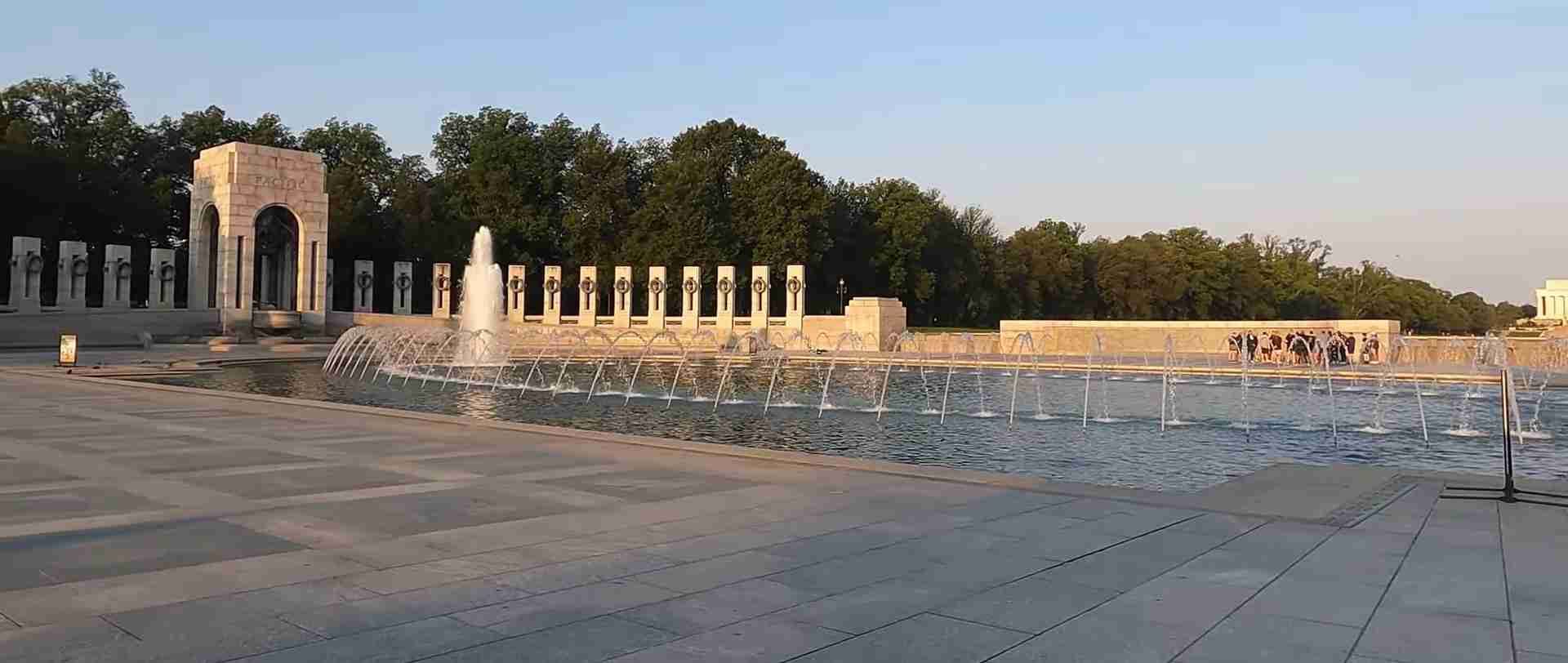
The Martin Luther King Jr. Memorial’s 30-foot Stone of Hope sculpture, depicting Dr. King emerging from solid granite, stands as the Tidal Basin’s newest addition dedicated in 2011. Walk north from King Memorial to rejoin the National Mall at the World War II Memorial, where 56 granite pillars representing U.S. states and territories surround a central fountain plaza. The memorial’s Rainbow Pool provides spectacular reflection photography opportunities with the Lincoln Memorial’s columned facade visible at the Mall’s western terminus.
Proceed west along the Reflecting Pool’s 2,029-foot length toward the Lincoln Memorial, with the Washington Monument visible in reverse perspective framing the eastern view. The Lincoln Memorial’s 36 Doric columns symbolize states in the Union at Lincoln’s death, with interior chambers containing Daniel Chester French’s 19-foot seated Lincoln statue and inscribed texts of the Gettysburg Address and Second Inaugural Address. The memorial’s steps, where Martin Luther King Jr. delivered his “I Have a Dream” speech in 1963, offer commanding views east across the Reflecting Pool toward the Washington Monument and distant Capitol dome.
Additional Tidal Basin Monuments
The Korean War Veterans Memorial north of the Reflecting Pool features 19 stainless steel statues representing a squad on patrol, with a granite wall inscribed “Freedom Is Not Free.” Walk north to the Vietnam Veterans Memorial’s black granite walls listing 58,318 names of Americans killed or missing in Vietnam, designed by Maya Lin in her Yale undergraduate senior project. The memorial’s reflective surface captures visitors’ faces alongside inscribed names, creating powerful emotional connections that made this initially controversial design one of Washington’s most visited monuments.
Complete the Tidal Basin circuit by walking south from the Lincoln Memorial past the Martin Luther King Jr. Memorial to the George Mason Memorial’s small columned garden honoring the Virginia statesman who authored the Virginia Declaration of Rights influencing the U.S. Bill of Rights. The Franklin Delano Roosevelt Memorial spreads across 7.5 acres with four outdoor galleries representing Roosevelt’s four presidential terms, incorporating waterfalls, sculptures, and quotations addressing Depression-era struggles and World War II leadership.
Georgetown Historic Walking Route 2026
Georgetown’s self-guided walking route begins at Washington Harbour waterfront, climbs through historic residential streets lined with Federal-era townhouses, explores Georgetown University’s Gothic campus, and concludes at the C&O Canal towpath revealing the neighborhood’s 18th-century commercial origins. This two-mile circular route requires two to three hours allowing time for architectural appreciation and photo stops along cobblestone streets.
Waterfront to M Street Commercial District
Start at Washington Harbour where the Potomac River waterfront meets K Street, accessible via Metro’s Blue, Orange, or Silver lines to Foggy Bottom station followed by 15-minute walks west. The modern mixed-use development contrasts sharply with Georgetown’s historic architecture, providing orientation to the neighborhood’s transformation from industrial port to upscale residential and commercial district. Walk east along K Street to 30th Street, then north uphill to M Street’s shopping and dining corridor.
M Street and Wisconsin Avenue intersection forms Georgetown’s commercial heart, where the former PNC Bank building’s golden dome catches sunlight above street-level retail establishments. This 1920s Neoclassical structure anchors the shopping district stretching several blocks in each direction, with boutiques, restaurants, and historic townhouses converted to commercial uses. Turn west on M Street toward Georgetown University, noting the Francis Scott Key Memorial Bridge visible ahead spanning the Potomac River.
Residential Georgetown and University Campus
Turn north on 36th Street climbing into residential Georgetown, where Federal-era brick townhouses dating to the early 1800s line narrow streets with original brick sidewalks and cobblestone sections. The steep terrain rising from the waterfront created natural social stratification, with wealthy merchants and politicians building grand homes on elevated lots commanding Potomac views while working-class neighborhoods occupied lower terrain near commercial docks and warehouses.
Georgetown University’s main gates open onto 37th and O Streets, with Healy Hall’s Gothic Revival towers dominating the hilltop campus founded by Jesuits in 1789. The university’s architecture blends Collegiate Gothic styles popular in 19th-century American academia with modern facilities serving 19,000 students. Walk through campus grounds open to public exploration, noting the astronomical observatory, historic Old North Building, and campus chapels.
N Street Historic Corridor and C&O Canal
Exit Georgetown University’s eastern gates to N Street, one of the neighborhood’s most architecturally significant corridors where meticulously preserved Federal townhouses showcase early American residential architecture. Number 3307 N Street housed John F. Kennedy and Jacqueline Kennedy before his presidency, while neighboring houses sheltered prominent journalists, diplomats, and politicians drawn to Georgetown’s social prestige during the 1950s-60s Kennedy era.
Walk east on N Street to Wisconsin Avenue, then south down the commercial corridor to the C&O Canal towpath at the base of the hill. The Chesapeake and Ohio Canal operated from 1831 to 1924 transporting coal and agricultural products between Georgetown and Cumberland, Maryland, along 184.5 miles of hand-dug waterway. Today’s tree-shaded towpath provides peaceful walking and biking routes popular with locals, with restored canal locks and interpretive exhibits explaining 19th-century transportation systems.
Capitol Hill Neighborhood Walking Route 2026
The Capitol Hill self-guided walk explores America’s legislative district from Union Station through Supreme Court and Library of Congress to residential Eastern Market neighborhood, covering approximately two miles on mostly flat terrain requiring two to three hours for complete exploration including building interior visits.
Union Station to Capitol Complex
Begin at Union Station’s main entrance hall, itself worth exploring for spectacular Beaux-Arts architecture featuring 96-foot barrel-vaulted ceiling, gold leaf detailing, and marble floors. Exit the east doors facing the U.S. Capitol dome visible three blocks ahead. Walk south on First Street past Senate office buildings toward the Capitol complex, noting the Supreme Court’s white marble facade modeled after classical Greek temples.
The Supreme Court building, completed in 1935 to designs by Cass Gilbert, features 252-foot-wide facade with Corinthian columns supporting the pediment inscribed “Equal Justice Under Law.” Interior courtroom visits welcome public observers when court is in session from October through June, with free lectures explaining judicial processes offered hourly when court is not sitting. The building’s architecture deliberately invokes classical authority, with marble extracted from Vermont, Georgia, and Alabama quarries creating a national monument to America’s judicial system.
Library of Congress Jefferson Building
Cross First Street to the Library of Congress’s Thomas Jefferson Building, one of Washington’s most ornate interiors rivaling European palace architecture in decorative splendor. The 1897 Italian Renaissance Revival building features Great Hall with marble columns, mosaic floors, and painted allegorical murals representing human knowledge domains. The Main Reading Room under a 160-foot dome displays Thomas Jefferson’s original 6,500-volume library collection purchased by Congress in 1815 to replace volumes British troops burned during the War of 1812.
Free self-guided tours explore exhibition halls displaying rare books including Gutenberg Bibles, Jefferson’s handwritten documents, and rotating special collections. The building’s exterior staircases and fountain plaza offer exceptional photo opportunities with the Capitol dome framed in background views. Most visitors spend 45 minutes to one hour exploring this architectural and cultural treasure, making it essential for Capitol Hill walking routes.
Eastern Market and Residential Streets
Walk east from the Capitol complex along Pennsylvania Avenue to Eastern Market, a historic covered market operating since 1873 selling fresh produce, meats, baked goods, and crafts. The weekend farmers market and flea market transform surrounding blocks into vibrant community gathering spaces popular with Capitol Hill residents. The neighborhood surrounding Eastern Market features rows of brick townhouses lining tree-shaded streets representing middle-class Washington residential architecture from the 19th and early 20th centuries.
Barracks Row on 8th Street southeast of Eastern Market showcases restored commercial buildings now housing restaurants, boutiques, and cafes serving the neighborhood’s residential population. This area, named for nearby Marine Barracks Washington established in 1801, represents Capitol Hill’s successful transformation from decaying 1970s-era neighborhood to thriving residential and cultural district.
Transportation and Accessibility for Washington DC Tours 2026
Washington DC’s comprehensive Metro system, extensive bus network, and walkable district geography make tours accessible through various transportation options matching different mobility levels and budget constraints. Understanding transportation connections between tour starting points, monument clusters, and neighborhoods allows efficient routing maximizing sightseeing time while minimizing transit frustration.
Metro Access to Tour Starting Points 2026
The Metro’s six color-coded lines provide convenient access to all major touring areas in Washington DC. The Blue, Orange, and Silver lines’ Smithsonian station exits directly onto the National Mall midway between the Washington Monument and Capitol, making it the most useful stop for monument touring. The Federal Triangle station on the same lines places visitors near the White House and Pennsylvania Avenue, while Capitol South station serves Capitol Hill tours.
Metro fares cost $3-6 per trip depending on distance and peak versus off-peak travel times, with unlimited-ride day passes priced at $13 offering value for visitors taking three or more trips daily. The Metro operates Sunday-Thursday from 5 AM to 11:30 PM and Friday-Saturday from 5 AM to 1 AM, with reduced hours on major holidays. Purchase rechargeable SmarTrip cards at station kiosks for $2 card fees plus desired fare amount, or use contactless credit cards with tap-to-pay functionality at all turnstiles.
Georgetown lacks Metro stations due to community opposition during system construction, requiring bus connections or 15-20 minute walks from Foggy Bottom station. The DC Circulator bus system provides dedicated routes connecting Metro stations to Georgetown waterfront and M Street shopping areas for $1 flat fare, operating every 10 minutes during peak hours.
Accessibility Considerations for Mobility-Limited Visitors 2026
Washington DC’s monuments and memorials offer wheelchair accessibility through ramped entrances, paved pathways, and elevator access where stairs exist, though National Mall distances between sites challenge visitors with limited walking endurance. Guided bus tours provide the most accessible touring option for elderly or mobility-limited visitors, offering seated comfort with driver drop-offs near monument entrances minimizing required walking.
Private tours accommodating wheelchairs and walkers cost $350-450 for half-day experiences with handicapped-accessible vans and guides experienced in accessible routing. These customized tours adjust pacing, select wheelchair-friendly monument approaches, and arrange accessible restroom access at each stop impossible with standard group tours maintaining fixed schedules.
The Metro system provides elevator access at all stations with tactile platform edges, audible announcements, and priority seating areas for elderly and disabled passengers. Station attendants assist with wheelchair boarding and train operators announce stops for visually impaired travelers. Metro’s accessibility information hotline provides pre-trip planning assistance for visitors with specific needs.
Seasonal Touring Considerations for Washington DC 2026
Washington DC’s four distinct seasons create varying touring conditions affecting comfort, crowd levels, and monument access, with spring cherry blossoms and summer peak season contrasting sharply with pleasant fall weather and quiet winter months.
Spring Cherry Blossom Season 2026
The National Cherry Blossom Festival typically runs late March through mid-April when 3,000 cherry trees around the Tidal Basin bloom in spectacular displays of pale pink blossoms. Peak bloom dates vary annually based on winter temperatures and spring weather patterns, with 2026 predictions suggesting late March to early April timing. This three-week period attracts massive crowds creating significant challenges for touring, with Tidal Basin paths jammed shoulder-to-shoulder and tour reservations booking months in advance.
Specialized cherry blossom tours offered by major operators cost $75-95 for two to three hour experiences focusing on optimal blossom viewing locations, photography opportunities, and historical context explaining Japan’s 1912 gift of original trees. These limited-availability tours require booking six to eight weeks ahead during peak bloom period, with demand far exceeding supply during the festival’s busiest weekend days.
Early morning visits before 7 AM or evening visits after 7 PM provide the best crowd avoidance during cherry blossom season, with sunrise and sunset offering optimal photography lighting on blossoms. The bloom period’s unpredictability makes scheduling challenges for visitors planning trips months in advance, though late March trips capture blossoms in most years while early April visits usually catch tail-end blooming even during early springs.
Summer Heat and Humidity Challenges 2026
Washington DC summers from June through August feature temperatures regularly reaching 90-95°F with oppressive humidity creating heat index values exceeding 100°F during afternoon hours. These conditions make extended outdoor touring uncomfortable and potentially dangerous for elderly visitors, young children, and anyone with heat sensitivity. Early morning tours starting at 8 AM or 9 AM complete outdoor monument visits before peak afternoon heat, while evening tours departing at 6 PM or 7 PM avoid hottest periods entirely.
Air-conditioned bus tours provide climate-controlled comfort during summer touring, though photo stops at each monument still expose participants to outdoor heat during brief exits. Walking tours during summer months should incorporate frequent water breaks, shade rest periods, and realistic pacing expectations acknowledging heat impacts on energy levels. Wear light-colored, breathable clothing, wide-brimmed hats for sun protection, and carry at least one liter of water per person for two to three hour walks.
Summer coincides with peak tourism season bringing maximum crowds to monuments and museums alongside maximum heat, creating challenging touring conditions offset partially by extended daylight hours allowing early morning and late evening exploration avoiding both heat and crowds.
Fall Optimal Touring Season 2026
September through November represents ideal Washington DC touring weather with comfortable temperatures in the 60-75°F range, lower humidity than summer, and beautiful fall foliage coloring trees across parks and monuments. Crowds thin considerably after Labor Day except during October school field trip season, making fall the best overall touring period balancing weather comfort, crowd levels, and operational access.
Fall foliage in Washington DC peaks mid-October through early November as deciduous trees transform Mall green spaces and Georgetown residential streets into golden and red landscapes complementing monument white marble. Photography during this period benefits from dramatic color contrasts and pleasant shooting conditions without summer heat haze or winter bare branches.
Tour operators maintain full schedules through October before reducing frequency during November as tourism slows approaching winter. Shoulder season pricing occasionally appears during November with some operators discounting 10-15% off peak summer rates while maintaining quality experiences and smaller group sizes.
Winter Quiet Season Advantages 2026
December through February brings cold temperatures averaging 35-45°F with occasional snow and ice creating challenging walking conditions offset by dramatically reduced crowds and exceptional monument access. Winter touring requires appropriate cold-weather clothing including insulated jackets, gloves, and warm hats, but rewards hardy visitors with intimate monument experiences impossible during crowded peak seasons.
Many tour operators reduce schedules during winter months, though major companies including USA Guided Tours and Free Tours by Foot maintain year-round operations with modified departure times. Winter tour groups average 8-12 participants compared to summer capacities of 15-20, creating more intimate experiences with guides able to answer individual questions and adjust pacing to group preferences.
Indoor attractions including Smithsonian museums, Capitol tours, and Library of Congress visits gain appeal during winter weather, making hybrid touring strategies splitting time between outdoor monuments and indoor cultural sites ideal for cold-weather visits. The holiday season from late November through early January decorates monuments and buildings with lights and wreaths creating festive atmosphere complementing traditional historical touring.
Photography Tours and Optimal Shooting Locations 2026
Washington DC’s white marble monuments, dramatic architecture, and symbolic landscapes create exceptional photography opportunities enhanced through expert guidance on optimal locations, lighting conditions, and technical camera settings for capturing professional-quality images.
Golden Hour Monument Photography
Sunrise and sunset golden hour periods offer the most dramatic monument photography lighting as low-angle sun creates warm color temperatures and long shadows emphasizing architectural details. Lincoln Memorial photography benefits particularly from sunrise shooting when eastern light illuminates the seated statue’s face while western views toward the Washington Monument capture golden reflections on the Reflecting Pool’s surface.
The Jefferson Memorial photographs beautifully during sunset when western light floods the interior rotunda creating soft illumination on the bronze statue while the Tidal Basin waters reflect pink and orange sky colors. Winter sunsets around 5 PM allow golden hour shooting without waiting until late evening, while summer’s 8 PM sunsets require patience but deliver extended shooting time with changing light quality.
Night Photography Locations and Techniques
Monument illumination transforms familiar daytime scenes into dramatic nighttime compositions emphasizing architectural forms through artificial lighting. The World War II Memorial’s fountain plaza illuminated from below creates spectacular long-exposure photography opportunities with moving water captured as silky flows against static granite pillars. Use tripods for exposure times of 1-4 seconds at ISO 400-800 and apertures of f/8-f/11 for sharp foreground-to-background depth of field.
The Lincoln Memorial’s interior lighting emphasizes the statue’s contemplative expression while reducing tourist visibility in wider architectural shots. Frame compositions including both the illuminated memorial interior and Reflecting Pool reflections for classic nighttime images. The Vietnam Veterans Memorial’s black granite reflects monument lighting and visitor faces creating emotionally powerful photographs impossible during daylight hours when sun glare overwhelms the polished surface.
Architectural Detail Photography
Washington DC’s monument and building architecture rewards close-up detail photography examining decorative elements, inscriptions, and construction materials often overlooked in wide establishing shots. The Library of Congress Jefferson Building’s interior offers exceptional architectural detail subjects including mosaic floors, painted ceiling panels, marble column capitals, and bronze doorway sculptures worthy of extended photography sessions.
The U.S. Capitol’s sculptural elements including pediment reliefs, bronze Columbus Doors, and Rotunda friezes provide subjects for telephoto detail work isolating specific artistic elements from complex compositions. Bring 70-200mm zoom lenses for flexibility capturing both overall architectural forms and isolated decorative details from various distances determined by security restrictions and public access limitations.
Food and Dining During Washington DC Tours 2026
Washington DC tours lasting four or more hours require planning for meals and snacks, with food availability varying significantly between the tourist-heavy National Mall area and diverse neighborhood restaurant districts in Georgetown, Capitol Hill, and downtown.
National Mall Food Options 2026
The National Mall itself offers limited food choices concentrated around Smithsonian museums and seasonal food truck clusters along Independence and Constitution Avenues. Food trucks selling hot dogs, sandwiches, pretzels, and beverages cost $8-15 per person for basic lunches, operating daily from 11 AM to 3 PM or 4 PM depending on weather and customer traffic. Quality varies significantly, with most trucks offering mass-produced tourist fare rather than distinctive local cuisine.
Smithsonian museum cafeterias provide better food quality at similar prices, with the National Museum of African American History and Culture’s Sweet Home Cafe offering Southern cuisine celebrating African American culinary traditions for $12-18 entrees. The National Museum of the American Indian’s Mitsitam Cafe features indigenous-inspired dishes from five Native American regions for $15-22 main courses. These museum dining options require navigating security screening to enter buildings, adding 15-20 minutes to meal breaks during busy periods.
Packed lunches purchased from grocery stores or prepared at hotels allow budget-conscious touring while avoiding limited National Mall food options. The Mall’s grassy areas welcome picnickers, with shaded spots near museum buildings and trees offering relief from sun exposure during outdoor dining. Bring more water than you think necessary as the exposed Mall terrain without shade causes rapid dehydration during warm weather.
Georgetown Dining Options 2026
Georgetown’s M Street and Wisconsin Avenue commercial corridors offer extensive dining choices from casual cafes to upscale restaurants, making the neighborhood ideal for lunch breaks during walking tours or post-tour dining. Prices range from $12-18 for casual lunch spots to $25-40 for sit-down restaurant entrees, with Ethiopian, Italian, French, and contemporary American cuisines well-represented.
The Georgetown Waterfront along K Street features outdoor dining with Potomac River views at restaurants and cafes popular for weekend brunch and weekday lunch. Reservations recommended for sit-down restaurants during peak lunch hours from noon to 2 PM, though many establishments accommodate walk-ins with short waits. Allow 60-90 minutes for restaurant meals including ordering and service, versus 20-30 minutes for cafe and counter-service options.
Capitol Hill Neighborhood Dining 2026
Eastern Market and Barracks Row on Capitol Hill provide diverse dining options convenient for post-tour meals or lunch breaks during extended Capitol area explorations. The Eastern Market covered market sells fresh foods, prepared meals, and baked goods ideal for picnic assembly, operating Tuesday through Sunday from 7 AM to 6 PM with extended weekend hours.
Barracks Row restaurants along 8th Street SE offer casual American, Thai, Mexican, and Mediterranean cuisines for $15-25 entrees in relaxed atmospheres popular with Capitol Hill residents and congressional staffers. The neighborhood’s authentic local dining scene contrasts with touristy National Mall food trucks, providing better quality and value alongside opportunities to observe Washington residential life beyond federal monument tourism.
Booking Strategies and Advance Planning for Washington DC Tours 2026
Successful Washington DC touring requires advance planning for ticketed attractions, popular guided tours, and optimal scheduling across monuments, museums, and neighborhood explorations balancing time efficiency with enjoyable pacing avoiding exhaustion.
Priority Booking Timeline for 2026
U.S. Capitol tours require the longest advance planning, with reservations opening 90 days before visit dates through the official visitthecapitol.gov website. Book Capitol tours immediately when your 90-day window opens for peak spring and summer visits, as slots fill completely weeks in advance during busy seasons. Fall and winter Capitol tours show more availability, often bookable one to two weeks ahead, though early booking still recommended to secure preferred times.
Washington Monument tickets similarly require advance planning through the National Park Service recreation.gov website, releasing 90 days before visit dates. Same-day tickets become available at 8:30 AM daily at the monument’s 15th Street entrance, but lines form by 7 AM during busy seasons making this option unreliable for guaranteed access. Book monument tickets concurrent with Capitol reservations to secure both ticketed attractions for your visit dates.
Popular guided tours from established operators should be booked one to two weeks in advance during peak April through September season, with cherry blossom specialty tours requiring six to eight weeks lead time. Fall and winter tours often accommodate bookings just a few days ahead, though early reservations still prudent for securing preferred dates and times. Private tours need two to four weeks advance notice for peak season, one week for shoulder season.
Optimal Daily Touring Schedules 2026
Start touring days early, with 8 AM to 8:30 AM departures for guided tours or self-guided monument walks allowing completion of outdoor exploration before midday crowds and heat peak. Morning monument visits provide optimal photography lighting, smaller crowds enabling better views and less queue time, and comfortable temperatures during summer months before afternoon heat becomes oppressive.
Schedule museum visits during midday heat when outdoor monument touring becomes least pleasant, particularly during summer when afternoon temperatures exceed 90°F. Smithsonian museums open at 10 AM with last entries at 5:30 PM, providing seven and a half hours of air-conditioned exploration opportunity. Reserve museum time for afternoon heat peak from 1 PM to 4 PM, returning to outdoor monuments during evening hours when temperatures moderate and sunset lighting enhances photography.
Build realistic daily schedules acknowledging touring fatigue and weather impacts on energy levels. Attempting to visit every monument and multiple museums in single days leads to exhaustion and diminished enjoyment. Quality touring experiences exploring fewer sites thoroughly surpass rushed superficial coverage trying to see everything. Plan one major activity per day segment morning, afternoon, evening rather than multiple ambitious full-day programs.
Weather Contingency Planning 2026
Washington DC weather changes rapidly with summer thunderstorms, winter snow, and spring cold fronts disrupting outdoor touring plans. Build scheduling flexibility allowing activity shifts from outdoor to indoor focus when weather turns unfavorable. The Smithsonian museums, Library of Congress, and Capitol interior tours provide excellent rainy day alternatives when monument walking becomes unpleasant.
Most tour operators continue guided experiences during light rain with participants expected to bring umbrellas and rain jackets, but severe thunderstorms, snow, or ice force cancellations and rescheduling. Review cancellation policies when booking, with most established companies offering full refunds or free rescheduling for weather cancellations announced at least two hours before tour departure. Purchase travel insurance for expensive private tours or multi-day vacation packages where weather disruptions could cause significant financial losses.
Family-Friendly Touring Strategies for Washington DC 2026
Washington DC touring with children requires modified pacing, age-appropriate activity selection, and realistic expectations acknowledging young attention spans and physical limitations differ dramatically from adult capabilities.
Age-Appropriate Tour Selection 2026
Children under age 8 typically struggle with historical content and extended walking distances characterizing adult-focused monument tours, making specialized family tours emphasizing interactive elements and shorter durations better choices. The National Air and Space Museum, Natural History Museum’s dinosaur exhibits, and Interactive exhibits at American History Museum engage younger children more effectively than memorial monuments and presidential history requiring sophisticated contextual understanding.
Guided family tours designed for children aged 6-12 incorporate games, scavenger hunts, and activity sheets maintaining engagement through hands-on learning rather than passive listening to guide narration. These specialized programs cost $35-50 per child with accompanying adults touring free or at reduced rates. Duration typically limited to 90 minutes to two hours matching children’s attention spans rather than three to four hour adult tours.
Teenagers respond better to standard adult tours when content connects to school curriculum covering American history, government structure, or architecture, though even engaged teens benefit from tour durations capped around three hours before fatigue and distraction increase. Private family tours offer advantages for mixed-age groups including young children, elementary students, and teenagers by allowing guides to adjust content complexity and activity level dynamically based on real-time family engagement and energy levels.
Pacing and Break Strategies with Children 2026
Plan bathroom and snack breaks every 60-90 minutes during touring with children, as young bladders and blood sugar fluctuations create behavior problems when ignored. Most monuments offer restrooms, with facilities at Lincoln Memorial, Jefferson Memorial, FDR Memorial, and Washington Monument Lodge serving National Mall touring routes. Bring portable snacks including protein bars, fruit, and crackers maintaining energy levels between proper meals.
Break touring days into shorter activity segments separated by rest periods at hotels or quiet park areas rather than attempting continuous full-day programming. Morning monument walks from 8 AM to 11 AM followed by hotel pool time or rest, then afternoon museum visits from 2 PM to 5 PM create sustainable schedules preventing complete child meltdowns from exhaustion. Accept that young families will see fewer sites than adult groups but can still have excellent educational experiences when properly paced.
Engaging Children with Historical Content 2026
Prepare children before visits through age-appropriate books, videos, and discussions about monuments and historical figures they’ll encounter. The National Park Service offers Junior Ranger programs at monuments where children complete activity books earning badges, creating goal-oriented engagement more compelling than abstract history lessons. Download free activity guides from park service websites before visits.
Connect historical content to children’s interests and prior knowledge rather than expecting sustained attention to unfamiliar topics. Lincoln Memorial visits gain resonance when children recognize penny images featuring the memorial’s design, while World War II Memorial tours connect to grandparent or great-grandparent family histories many children have heard. Let children photograph monuments on their own devices, creating personal engagement through creative framing and perspective choices.
Frequently Asked Questions About Washington DC Tours 2026
What’s the best time of year to visit Washington DC for touring in 2026?
Fall from September through November offers ideal Washington DC touring conditions combining comfortable temperatures in the 60-75°F range, beautiful autumn foliage, reduced crowds compared to summer peak season, and full tour operator schedules with excellent availability. Spring cherry blossom season from late March through mid-April provides spectacular scenery but brings massive crowds requiring advance reservations for all tours and challenging monument access. Summer from June through August features maximum daylight hours and complete tour availability offset by oppressive heat and humidity frequently exceeding 95°F heat index, making early morning or evening touring essential. Winter from December through February rewards cold-tolerant visitors with intimate uncrowded monument experiences and reduced tour prices, though some operators limit schedules and snow occasionally disrupts touring plans.
How many days do you need for Washington DC tours in 2026?
First-time visitors need minimum three full days properly experiencing Washington DC’s major monuments, government buildings, and Smithsonian museums without rushed pacing. A comprehensive visit covering National Mall monuments, Capitol Hill government buildings, Georgetown historic district, multiple museums, and evening illumination tours requires four to five days allowing quality exploration with sustainable pacing. Extended week-long visits enable deeper neighborhood exploration, day trips to Mount Vernon or Arlington Cemetery, specialized museum time, and relaxed schedules avoiding tourism exhaustion. Single-day visits focusing exclusively on National Mall monuments and one or two Smithsonian museums provide worthwhile abbreviated experiences for travelers with limited time, though miss government building interiors and neighborhood character essential to understanding Washington beyond tourist monuments.
Are Washington DC tours suitable for elderly visitors or those with mobility limitations in 2026?
Washington DC offers excellent touring accessibility for elderly and mobility-limited visitors through guided bus tours providing seated comfort with minimal walking, wheelchair-accessible monuments with ramped entrances and paved pathways, and Metro stations featuring elevator access eliminating stair climbing. Guided bus tours prove most practical for visitors unable to manage extended walking, offering climate-controlled comfort with driver drop-offs minimizing required walking distances at each monument. Private tours accommodating wheelchairs and walkers cost $350-450 for customized half-day experiences with handicapped-accessible vans and experienced guides adjusting routes for accessibility. National Mall monuments provide wheelchair accessibility through ramped approaches and paved paths, though the two-mile Capitol-to-Lincoln Memorial distance challenges visitors with limited endurance requiring Metro transportation or vehicle drop-offs at multiple points rather than continuous walking routes.
Can you visit Washington DC monuments without taking paid tours in 2026?
All National Mall monuments and memorials remain free and accessible 24 hours daily, allowing comprehensive self-guided touring at no cost beyond Metro transportation. The National Park Service provides free mobile apps with GPS-triggered audio content explaining monument history as you walk routes independently, delivering guided tour context without paid tour fees. Smithsonian museums offer free admission year-round, though some special exhibitions require timed-entry passes reservable online at no charge. Free Capitol tours provided by congressional staff explain legislative building architecture and history when reserved through official channels, though availability limits access during peak seasons. Independent touring saves $69-89 per person compared to guided bus tours while providing complete schedule flexibility, though sacrifices expert guide insights, efficient routing knowledge, and reserved access to ticketed attractions included in premium tour packages.
What should you bring on Washington DC walking tours in 2026?
Comfortable broken-in walking shoes prove essential for Washington DC tours covering two to five miles on paved paths and occasional cobblestone sections causing blisters with inadequate footwear. Bring at least one liter of water per person for tours lasting more than two hours, as the National Mall’s exposed terrain offers minimal shade and Washington humidity causes rapid dehydration. Weather-appropriate clothing including sun hats and sunscreen for summer touring or insulated jackets and gloves for winter visits ensures comfort across DC’s temperature extremes ranging from 25°F winter lows to 95°F summer highs. Pack small backpacks or crossbody bags carrying water, snacks, phone chargers, and personal medications, noting that large bags face security screening delays at government buildings and museums. Bring fully charged smartphones with mobile ticketing apps, mapping applications, and photography capabilities, plus portable charger batteries sustaining phone power through full-day touring when navigation and ticketing apps drain batteries rapidly.
Do Washington DC tours run in bad weather during 2026?
Most Washington DC tour operators continue guided experiences during light to moderate rain with participants expected to bring umbrellas and rain jackets maintaining tour schedules regardless of precipitation. Severe thunderstorms, heavy snow, or ice conditions force tour cancellations for safety reasons, with operators contacting registered participants via email and text offering full refunds or free rescheduling to alternative dates. Indoor-focused tours visiting Capitol buildings, Library of Congress, and Smithsonian museums proceed regardless of weather conditions since primary activities occur in climate-controlled environments. Bus tours continue during rain providing climate-controlled transportation between sites, though photo stops at monuments become brief when heavy precipitation limits outdoor comfort. Review cancellation policies when booking tours, with most established operators offering full refunds for weather cancellations announced at least two hours before scheduled departure times, while some budget operators apply stricter cancellation terms requiring 24-48 hours advance notice.
How far in advance should you book Washington DC tours for 2026?
U.S. Capitol tours require 90-day advance reservations through official government websites, with peak season spring and summer slots filling completely within days of becoming available necessitating immediate booking when your desired date enters the reservation window. Washington Monument tickets similarly need 90-day advance booking for guaranteed access during busy seasons, though same-day tickets sometimes available for walk-up visitors willing to queue at 7 AM. Popular guided tours from major operators should be reserved one to two weeks ahead during peak April through September season ensuring availability on preferred dates and times, while fall and winter touring often allows booking just days in advance though early reservations still prudent. Cherry blossom specialty tours require six to eight weeks advance booking due to extreme demand during limited bloom periods, frequently selling out entirely for peak bloom weekends. Private custom tours need two to four weeks lead time during peak season for operator scheduling and vehicle arrangements, reducing to one week for shoulder season fall and winter bookings.
What’s the difference between hop-on hop-off tours and guided bus tours in Washington DC for 2026?
Hop-on hop-off tours provide 24-hour or 48-hour unlimited reboarding passes costing $55-110 allowing visitors to design custom itineraries exiting at sites of interest then catching subsequent vehicles on 20-30 minute intervals, creating self-paced flexibility impossible with guided bus tours following fixed schedules. Guided bus tours cost $69-89 for six to eight hour comprehensive experiences with expert guides providing historical narration, interior building access at some sites, and organized group management ensuring efficient coverage of 15-20 major landmarks in single sessions. Hop-on hop-off appeals to independent travelers wanting flexible schedules allowing extended time at preferred sites balanced with brief stops at less interesting locations, while guided bus tours better serve first-time visitors wanting comprehensive orientation and those valuing expert historical context over schedule flexibility. Guided tours typically include reserved-entry access to Capitol or museums impossible for independent hop-on hop-off users to arrange day-of, delivering premium value through insider access negotiated by tour operators.
Can you take Washington DC tours with young children in 2026?
Washington DC tours accommodate families with young children though success requires age-appropriate tour selection, realistic pacing expectations, and modified schedules accounting for shorter attention spans and physical limitations compared to adult capabilities. Specialized family tours designed for children aged 6-12 cost $35-50 per child, incorporating games, scavenger hunts, and interactive activities maintaining engagement through hands-on learning rather than passive lecture formats typical of adult tours. National Air and Space Museum, Natural History Museum dinosaur exhibits, and hands-on displays at American History Museum engage young children more effectively than memorial monuments requiring sophisticated historical context understanding. Private family tours offer flexibility adjusting content complexity and activity level dynamically based on real-time child engagement, allowing bathroom and snack breaks every 60-90 minutes preventing behavior problems from exhaustion or hunger. Most monuments provide family restrooms and many museums offer nursing rooms and diaper changing facilities supporting very young children, though touring with infants and toddlers requires realistic expectations accepting limited daily coverage compared to adult-only groups.
What are the best free activities and tours in Washington DC for 2026?
All National Mall monuments and memorials remain free and accessible 24 hours daily including Lincoln Memorial, Washington Monument exterior grounds, World War II Memorial, Vietnam Veterans Memorial, Korean War Veterans Memorial, Jefferson Memorial, and Martin Luther King Jr. Memorial, allowing comprehensive self-guided monument touring at no cost. Smithsonian museums offer free admission year-round to world-class collections at Air and Space Museum, Natural History Museum, American History Museum, African American History and Culture Museum, and ten other facilities spanning art, culture, and science exhibitions. Free U.S. Capitol tours reservable through official congressional websites provide guided explorations of Rotunda, Crypt, and National Statuary Hall explaining legislative building architecture and American political history. Free pay-what-you-want walking tours operated by DC by Foot and Free Tours by Foot welcome participants to name their price including zero-dollar options, though quality depends on fair gratuity compensation with most satisfied visitors tipping $25-35 per person. The National Park Service offers free ranger-led programs at monuments and memorials covering historical topics through 30-45 minute talks scheduled throughout days during peak seasons.