Visiting the Vatican Museums & Sistine Chapel: Complete Guide
The Vatican Museums house one of humanity’s most extraordinary art collections, spanning centuries of papal patronage and encompassing masterpieces from ancient civilizations through the Renaissance to modern times. This sprawling complex of 54 galleries culminates in Michelangelo’s Sistine Chapel, where visitors stand beneath frescoes that forever transformed Western art and continue to inspire millions annually.
Key Takeaways
- The Vatican Museums contain over 70,000 works across 54 galleries, requiring strategic planning to see highlights like the Sistine Chapel, Raphael Rooms, and Gallery of Maps in a single visit
- Opening hours run Monday-Saturday 8:00 AM to 8:00 PM with last entry at 6:00 PM, while the last Sunday of each month offers free admission from 9:00 AM to 2:00 PM
- Standard admission costs €20 plus €5 online booking fee, with reduced rates of €8 plus €2 booking fee for visitors aged 6-18 and students under 26
- Early morning arrival at 8:00 AM provides the calmest experience before tour groups arrive after 10:00 AM, while late afternoon after 3:00 PM offers another quieter window
- The Sistine Chapel prohibits all photography and requires complete silence, with guards actively enforcing these rules to preserve both artwork and contemplative atmosphere
- Audio guides available for €8 provide essential historical and artistic context that transforms the visit from visual spectacle to deep cultural understanding
People Also Ask About Visiting the Vatican Museums
How much time do you need to visit the Vatican Museums?
A thorough visit to the Vatican Museums requires 3-4 hours minimum to see major highlights including the Sistine Chapel, Raphael Rooms, Gallery of Maps, and principal sculpture collections without feeling rushed. Art enthusiasts and those wishing to explore secondary galleries should allocate 5-6 hours or plan multiple visits. The museums span 7 kilometers of exhibition space, with over 70,000 works displayed across 54 distinct galleries. A focused 2-hour visit covering only the Sistine Chapel, Raphael Rooms, and Gallery of Maps is possible but sacrifices substantial portions of the collection. The Vatican Museums reward slower exploration, as many masterpieces reveal intricate details and symbolic meanings that quick passage overlooks entirely.
Can you visit the Sistine Chapel without seeing the Vatican Museums?
No separate entry exists for the Sistine Chapel alone, as it forms an integral part of the Vatican Museums complex requiring full museum admission for access. The Sistine Chapel sits at the conclusion of the Vatican Museums route, designed as the culminating experience after progressing through earlier galleries. This routing reflects both architectural reality and curatorial philosophy, positioning the chapel as the pinnacle of the artistic and spiritual journey through papal collections. All visitors holding Vatican Museums tickets receive automatic Sistine Chapel access included in admission, with no additional fee beyond the standard museum entry. Third-party operators occasionally advertise “Sistine Chapel tickets,” but these always include full Vatican Museums admission and simply market the chapel as the primary attraction.
What is the dress code for the Vatican Museums?
Vatican Museums enforce a modest dress code requiring shoulders and knees covered for all visitors, with enforcement particularly strict in the Sistine Chapel due to its active religious function. Sleeveless shirts, shorts above the knee, miniskirts, and low-cut tops result in denied entry regardless of ticket type or tour booking. Security personnel positioned at museum entrances inspect clothing before admitting visitors, and those dressed inappropriately must either change clothing or forfeit entry without refund. Lightweight shawls or scarves can cover shoulders, while longer shorts or skirts meeting the knee satisfy lower-body requirements. Hats must be removed before entering the Sistine Chapel specifically, though they’re permitted in other museum sections. The dress code applies equally during summer months despite heat, as religious site protocols supersede comfort considerations.
Is photography allowed in the Vatican Museums?
Photography without flash is permitted throughout most Vatican Museums galleries for personal, non-commercial use, allowing visitors to document their experience of masterpieces in the Raphael Rooms, Gallery of Maps, and sculpture collections. The Sistine Chapel enforces an absolute photography prohibition, with guards actively monitoring visitors and requesting deletion of captured images. This restriction protects delicate 16th-century frescoes from flash damage accumulated over millions of annual visitors, while also preserving the contemplative atmosphere essential to the chapel’s religious function. Video recording follows identical rules: permitted in general galleries without flash, completely forbidden in the Sistine Chapel. Tripods and professional photography equipment require special permits obtained weeks in advance through official Vatican channels, unavailable for standard tourist visits.
Extended multi-day tours – 5+ days
Featured Vatican City Multi-Day Tour Packages

3 days
Vatican City 3-Day Discovery Tour
- ✓ Comprehensive Vatican City experience
- ✓ Expert local guides included
- ✓ All accommodation included
- ✓ Transportation provided

5 days
Vatican City 5-Day Highlights Experience
- ✓ Comprehensive Vatican City experience
- ✓ Expert local guides included
- ✓ All accommodation included
- ✓ Transportation provided

7 days
Vatican City 7-Day Cultural Journey
- ✓ Comprehensive Vatican City experience
- ✓ Expert local guides included
- ✓ All accommodation included
- ✓ Transportation provided

10 days
Vatican City 10-Day Complete Adventure
- ✓ Comprehensive Vatican City experience
- ✓ Expert local guides included
- ✓ All accommodation included
- ✓ Transportation provided
Multi-day tour packages powered by TourRadar. Prices and availability subject to change.
Introduction
The Vatican Museums represent more than simple art galleries. These sprawling collections embody five centuries of papal patronage, Catholic Church history, and humanity’s artistic achievements from ancient civilizations through contemporary periods. Founded in the early 16th century when Pope Julius II placed classical sculptures in the Cortile del Belvedere, the museums grew exponentially as successive pontiffs acquired masterpieces, commissioned new works, and opened their collections to public viewing. Today, the Vatican Museums rank among the world’s most visited cultural institutions, attracting over 6 million annual visitors who journey through 7 kilometers of galleries to witness treasures spanning 5,000 years of human creativity.
The museum complex occupies former papal palaces and purpose-built exhibition spaces within Vatican City’s 110-acre territory. Visitors progress through interconnected galleries showcasing ancient Egyptian sarcophagi, classical Greek and Roman sculpture, Renaissance paintings, Baroque masterpieces, and modern religious art. The Sistine Chapel, Michelangelo’s transcendent achievement, stands as the undisputed highlight—a space where artistic genius and spiritual contemplation converge beneath frescoes that revolutionized Western painting. Yet the journey to reach the Sistine Chapel reveals countless additional treasures: Raphael’s frescoed apartments, the 120-meter Gallery of Maps displaying 16th-century Italy, and sculpture galleries containing the Laocoön and Apollo Belvedere that inspired Renaissance artists.
Navigating this vast cultural landscape requires strategic planning. The museums’ scale overwhelms unprepared visitors, who often find themselves exhausted before reaching major highlights or rushing past masterpieces due to crowd pressure. Understanding opening hours, ticket options, optimal visiting times, gallery layouts, and essential visitor protocols transforms what could become a stressful ordeal into an enriching encounter with human artistic achievement. The physical demands alone—hours of walking on marble floors, navigating stairs, managing crowds—necessitate preparation beyond simply purchasing admission.
This comprehensive guide provides the practical knowledge essential for maximizing your Vatican Museums experience. From booking strategies that avoid multi-hour queues to identifying must-see galleries worthy of extended contemplation, from understanding Sistine Chapel protocols to navigating the complex route through interconnected spaces, this resource equips visitors with information that converts a basic museum visit into meaningful cultural engagement. Whether you’re an art history enthusiast planning days of study or a general tourist allocating several hours to see highlights, the guidance that follows ensures your Vatican Museums visit achieves its full potential.
Planning Your Visit: Hours and Timing
The Vatican Museums operate Monday through Saturday from 8:00 AM to 8:00 PM, with final admission at 6:00 PM and security guards beginning to clear galleries 30 minutes before closing at 7:30 PM. These generous hours provide flexibility, though arrival timing dramatically affects the quality of your experience. The museums remain closed on Sundays except the last Sunday of each month, when free admission operates from 9:00 AM to 2:00 PM with final entry at 12:30 PM. Major religious holidays trigger additional closures: January 1 and 6, February 11, March 19, Easter Monday, May 1, June 29 (Feast of Saints Peter and Paul), August 15, November 1, December 8, and December 25-26.
Early morning arrival at the 8:00 AM opening delivers the museums’ finest experience. The first admission wave encounters virtually empty galleries for the initial 90 minutes before organized tour groups flood spaces after 10:00 AM. This window allows unhurried contemplation of masterpieces, optimal photography conditions in permitted areas, and peaceful progression through the Sistine Chapel before crowds transform it from contemplative space to packed venue. Visitors arriving at 8:00 AM who follow efficient routes reach the Sistine Chapel by 8:30-9:00 AM, experiencing Michelangelo’s frescoes in relative solitude—an opportunity unavailable during midday hours.
The peak crowding period extends from 10:00 AM through 3:00 PM, when multiple tour groups, cruise ship excursions, and general admissions converge. During these hours, popular galleries like the Raphael Rooms and Gallery of Maps become shoulder-to-shoulder spaces where forward movement depends on crowd flow rather than personal pace. The Sistine Chapel reaches maximum capacity, with hundreds of visitors packed beneath the ceiling frescoes while guards continuously remind people to maintain silence and prohibit photography. This period offers the least favorable experience for independent exploration or contemplative viewing.
Late afternoon visits after 3:00 PM provide a second optimal window. Tour groups typically conclude by mid-afternoon, thinning crowds substantially in the final hours before closing. Visitors entering at 5:00-5:30 PM (allowing buffer before 6:00 PM final admission) experience quieter conditions, though time constraints limit comprehensive exploration. This timing suits return visitors focusing on specific galleries or those combining Vatican Museums with other Rome attractions earlier in the day. The trade-off involves reduced available time, as guards actively encourage movement toward exits after 7:00 PM.
Seasonal patterns influence crowding independent of daily timing. April through October represents peak tourist season, when summer weather and European school holidays drive maximum visitation. These months require early arrival or late afternoon timing to mitigate crowds. November through March offers relatively calmer conditions, though Christmas holiday weeks remain busy. The absolute worst day for visiting is the free-admission last Sunday of each month, when local residents and budget-conscious tourists create overwhelming crowds that often prevent late arrivals from gaining entry before the 12:30 PM cutoff.
Weekly patterns favor Tuesday, Thursday, and Friday visits over Monday (when many Rome museums close, redirecting visitors to the Vatican), Wednesday (when papal audiences draw crowds to Vatican City), and Saturday (weekend tourist peaks). The difference between optimal Tuesday morning and crowded Saturday midday visits feels like experiencing different institutions entirely—one offering contemplative art appreciation, the other resembling theme park-level crowding.
Weather conditions merit consideration despite the museums’ indoor nature. Rainy days concentrate visitors indoors rather than distributing them across Rome’s outdoor attractions, potentially increasing Vatican Museums crowds unexpectedly. Conversely, exceptional weather in shoulder seasons sometimes thins crowds as visitors prioritize outdoor Rome experiences. These patterns prove less predictable than time-of-day and day-of-week factors but can influence crowd levels at the margins.
Tickets and Entry Options
Standard Vatican Museums admission costs €20 for adults, with a mandatory €5 online booking fee bringing total cost to €25 per person when purchased through the official Vatican Museums website at tickets.museivaticani.va. This comprehensive ticket provides access to all 54 permanent galleries including the Sistine Chapel, Raphael Rooms, Pinacoteca, Gallery of Maps, Pio-Clementino Museum, Egyptian Museum, and all other regular collections. The €5 booking fee secures a timed entry slot that allows you to bypass the on-site ticket purchase queue, which during peak seasons can extend to 2-4 hour waits.
Reduced-rate tickets at €8 plus €2 online booking fee (€10 total) apply to visitors aged 6-18 and students under 26 with valid student identification. Children under 6 enter free, though advance booking is still recommended to secure family time slots. Proof of eligibility must be presented upon entry—international student ID cards, university enrollment letters with photographs, or government-issued identification showing birth date. Visitors arriving without proper documentation must purchase full-price tickets even if they hold reduced-rate reservations, with no refunds issued for the original purchase.
Free admission operates on the last Sunday of each month from 9:00 AM to 2:00 PM, with final entry at 12:30 PM. This popular option attracts massive crowds, often creating entry lines that prevent late arrivals from gaining admission before cutoff. Free Sundays do not apply when the last Sunday coincides with Easter, June 29 (Saints Peter and Paul), December 25, December 26, or December 31. Advance booking is unavailable for free admission days—entry operates strictly on first-come, first-served basis through the standard entrance queue.
Audio guides rent for €8 and provide detailed commentary on major works throughout the museums, dramatically enhancing comprehension for visitors without art history backgrounds. Available in multiple languages, these handheld devices offer 100+ stops covering the Sistine Chapel ceiling interpretation, Raphael Rooms symbolism, classical sculpture significance, and Gallery of Maps cartographic achievements. The investment transforms the visit from visual spectacle to educational experience, revealing layers of meaning, historical context, and artistic technique invisible to uninformed viewing.
Official guided tours through the Vatican Museums cost €38-45 including admission and booking fees. Led by Vatican-authorized guides, these 2-3 hour experiences cover primary highlights with expert commentary, headset systems allowing clear hearing in crowded spaces, and sometimes privileged access to less-trafficked routes. Small-group tours limiting participants to 15-20 people provide more personalized experiences and easier mobility through congested galleries compared to mass tour groups of 40-50 people.
Combination tickets bundling Vatican Museums with other attractions offer convenience for comprehensive Vatican City visits. Vatican Museums plus St. Peter’s Basilica tours include direct passage from museums to the basilica through a restricted corridor, avoiding the separate basilica security line that often extends 1-2 hours during peak periods. Vatican Gardens tours combine museums admission with guided or open-bus garden exploration, adding 1-2 hours to the total experience and requiring separate booking well in advance.
Third-party operators market “skip-the-line” tickets at €35-60, though official Vatican Museums tickets purchased online already skip the ticket purchase line. These higher-priced options often provide minimal additional benefit beyond what official booking delivers, though some include valuable extras like small-group guided tours or early-morning access before standard opening. Scrutinize what “skip-the-line” actually means—it never skips mandatory security screening, which affects all visitors equally and can require 15-30 minutes during busy periods.
Booking tickets 60 days in advance when the Vatican Museums opens the reservation window is essential during peak season (April-October). Popular time slots, particularly 8:00-9:00 AM entries, sell out weeks ahead. Last-minute availability occasionally appears as tour operators release unused allocations, but relying on this possibility risks finding no admission slots on your preferred dates. Off-season visits (November-February excluding Christmas holidays) maintain better last-minute availability, though advance booking remains advisable.
The official Vatican Museums website represents the only authorized online ticket source. Numerous unofficial websites mimic the official site’s appearance while charging inflated prices or selling invalid tickets. Verify you’re at tickets.museivaticani.va before entering payment information. The website accepts major credit cards and processes transactions in euros, with your bank handling currency conversion if paying in other currencies.
Ticket confirmations arrive via email as PDF documents containing QR codes scanned at museum entrances. Save these to mobile devices or print physical copies—admission requires presenting the QR code at entry kiosks. Names on tickets must match government-issued identification (passport, driver’s license, national ID card) presented at entry. This anti-fraud measure prevents ticket resale and ensures persons who booked actually receive admission.
Getting to the Vatican Museums
The Vatican Museums entrance sits on Viale Vaticano on the northern edge of Vatican City, several blocks from St. Peter’s Square and requiring deliberate navigation to locate. First-time visitors frequently confuse St. Peter’s Basilica (in St. Peter’s Square) with the Vatican Museums (on Viale Vaticano)—these represent separate attractions with distinct entrances located 800 meters apart. Understanding this geography prevents the common error of queuing at St. Peter’s Basilica when holding Vatican Museums tickets.
Metro Line A to Ottaviano-San Pietro station provides the most convenient public transportation option, depositing passengers 650 meters (8-10 minute walk) from the museums entrance. Exit the metro station, turn right onto Via Ottaviano, walk four blocks to Viale Giulio Cesare, turn left, and follow Viale Giulio Cesare which curves to become Viale Vaticano. The distinctive Vatican walls appear on your left, with the museums entrance marked by long queues (ticket purchase line) and white-canopy tents (priority entry for pre-booked tickets). Clear signage in multiple languages guides pedestrians along this route.
Multiple bus lines serve Vatican Museums vicinity: 49 stops directly at the museums entrance on Viale Vaticano, while 32, 81, and 982 stop nearby on Piazza del Risorgimento, 300 meters from the entrance. Bus 64, though not closest to the museums, connects Termini Station to the Vatican area and stops at Piazza San Pietro, from which a 15-minute walk reaches the museums entrance. Rome’s buses accept tickets purchased at tobacco shops (tabacchi), metro stations, or newsstands—validate tickets in the yellow machines upon boarding.
Taxis to “Musei Vaticani, Viale Vaticano” deliver passengers to the museums entrance, eliminating navigation uncertainty for those unfamiliar with Rome’s transit system. Expect €15-25 from central Rome hotels depending on traffic and precise origin point. Licensed white taxis display official taxi signs and meters—avoid unmarked vehicles approaching tourists near train stations, which charge inflated rates. Uber and other ride-sharing services operate in Rome, though traditional taxis remain more prevalent.
Walking from central Rome hotels requires 30-60 minutes depending on starting location. The route from Piazza Navona crosses the Tiber River via Ponte Vittorio Emanuele II, continues up Via della Conciliazione toward St. Peter’s Basilica, then curves right around Vatican City walls to reach the museums entrance on Viale Vaticano. This approach allows morning exploration of Trastevere or historic center neighborhoods before arriving at the museums.
Private drivers and hotel shuttles drop passengers at the museums entrance but cannot park directly in front due to security restrictions and traffic flow requirements. Brief stops for passenger discharge are permitted, with vehicles then circling the area or parking in nearby structures.
Arriving 15-30 minutes before your booked entry time accommodates security screening, queue navigation, and ticket validation without risking late arrival that could forfeit your timed reservation. The museums enforce entry time windows strictly—arriving more than 15 minutes after your booked slot may result in denied admission. This policy maintains crowd flow management and prevents overcrowding within galleries.
Upon arrival, two distinct queues appear: the long ticket purchase line extending along Viale Vaticano walls for visitors without pre-purchased tickets, and the shorter priority entry under white canopy tents for visitors holding online reservations. Pre-booked ticket holders proceed to the tents, present email confirmation QR codes at automated kiosks or staff stations, receive printed admission tickets, then advance to security screening. This process typically requires 10-20 minutes versus 1-4 hours in the ticket purchase queue during busy periods.
Security screening mirrors airport procedures: bags pass through X-ray machines, visitors walk through metal detectors, and prohibited items (large bags, sharp objects, liquids over 100ml) are confiscated. No coat check or luggage storage exists—items that don’t pass security cannot be retrieved later. Compact bags, camera equipment, and water bottles in appropriate sizes pass screening without issue. The security process, though unavoidable, proceeds efficiently with multiple screening lanes processing hundreds of visitors hourly.
What to See: Major Collections and Galleries
The Vatican Museums’ 54 galleries divide into distinct collections reflecting different civilizations, artistic periods, and acquisition histories. Understanding major highlights allows strategic time allocation, ensuring you experience the most significant works without exhausting yourself attempting to see everything. The museums’ one-way routing system channels visitors through interconnected galleries, though shortcuts and alternative paths exist for those knowing the layout.
The Cortile della Pigna, a monumental courtyard near the entrance, features a 4-meter bronze pine cone dating to Roman times and provides initial orientation. This space introduces the museums’ scale through architectural grandeur and offers the famous double-helix staircase designed by Giuseppe Momo in 1932—though visitors typically see this spiral upon exiting rather than entering.
The Egyptian Museum (Museo Gregoriano Egizio), founded by Pope Gregory XVI in 1839, displays over 5,000 years of Egyptian art and artifacts including sarcophagi, mummies, papyri, and monumental sculpture. The collection spans predynastic period through Christian Coptic Egypt, with highlights including the basalt statue of Queen Tuya (mother of Ramses II) and a remarkably preserved mummy case with polychrome decorations. This relatively compact museum can be thoroughly explored in 30-45 minutes, providing fascinating context for ancient Mediterranean civilizations.
The Pio-Clementino Museum contains the Vatican’s premier classical sculpture collection, assembled primarily during the 18th century under Popes Clement XIV and Pius VI. The Laocoön group, discovered in Rome in 1506 and immediately acquired by Pope Julius II, ranks among antiquity’s most celebrated sculptures—a Hellenistic masterpiece depicting the Trojan priest and his sons being killed by sea serpents. The Apollo Belvedere, considered an ideal of classical beauty that influenced Renaissance artists profoundly, stands in the same octagonal courtyard. Additional treasures include the Belvedere Torso, studied extensively by Michelangelo, and the massive porphyry sarcophagi in the Sala della Biga. Allow 45-60 minutes for this gallery’s highlights.
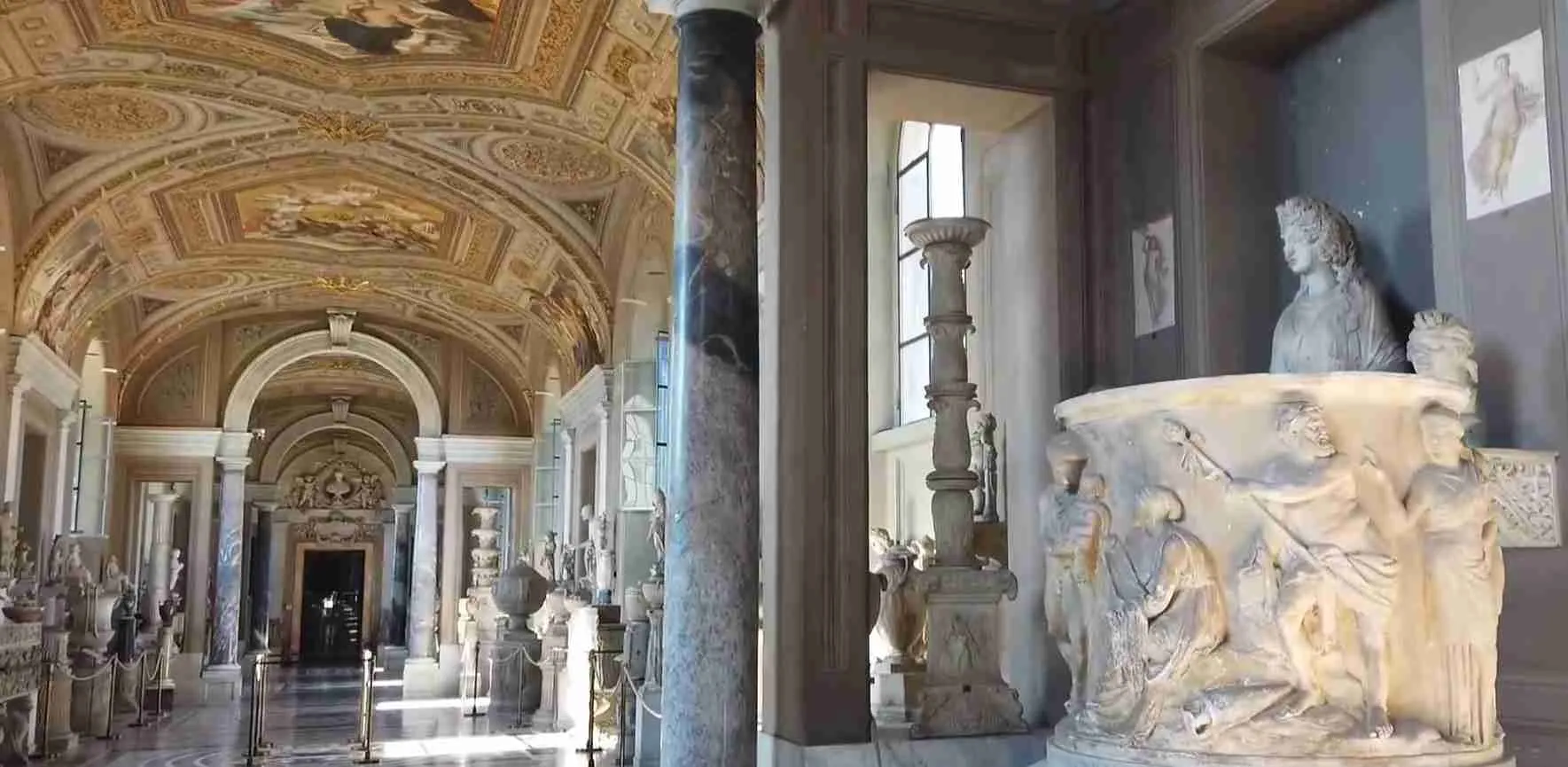
The Gallery of Maps (Galleria delle Carte Geografiche) extends 120 meters along a corridor frescoed with 40 topographical maps of Italian regions and papal territories commissioned by Pope Gregory XIII between 1580-1585. Geographer Ignazio Danti supervised the project, creating cartographic works of artistic beauty and geographical accuracy remarkable for their period. The gallery’s barrel-vaulted ceiling features elaborate frescoes depicting historical events and religious scenes associated with each region. This spectacular space requires 15-20 minutes for passage, though detailed examination of individual maps rewards longer contemplation.
The Raphael Rooms (Stanze di Raffaello) comprise four chambers frescoed by Raphael and his workshop between 1508-1524, rivaling the Sistine Chapel in Renaissance art significance. Pope Julius II commissioned Raphael to decorate his private apartments, resulting in masterpieces including The School of Athens (depicting ancient philosophers), The Disputation of the Holy Sacrament, The Parnassus, and The Liberation of Saint Peter. Each room contains multiple frescoes integrating complex theological, philosophical, and political themes through idealized Renaissance composition. The Stanza della Segnatura, completed entirely by Raphael himself, represents the pinnacle of High Renaissance fresco painting. These rooms demand 30-45 minutes minimum, with art enthusiasts easily spending an hour analyzing compositional details, symbolic references, and technical execution.
The Sistine Chapel, addressed comprehensively in its own section below, represents the museums’ undisputed climax and requires 20-45 minutes depending on crowd levels and individual contemplation needs.
The Pinacoteca (Vatican Picture Gallery) houses the papal painting collection spanning 12th through 19th centuries across 18 rooms organized chronologically. This often-overlooked gallery contains masterpieces by Giotto, Fra Angelico, Raphael, Leonardo da Vinci, Caravaggio, and Titian. Raphael’s Transfiguration, his final painting left incomplete at his death in 1520, hangs in Room VIII. Caravaggio’s Deposition, with its dramatic chiaroscuro and emotional intensity, occupies Room XII. Leonardo da Vinci’s unfinished St. Jerome displays his anatomical precision and psychological insight. The Pinacoteca rewards 45-60 minutes of exploration for those appreciating Renaissance and Baroque painting beyond the more famous frescoes.
The Collection of Modern Religious Art, inaugurated in 1973 under Pope Paul VI, displays 20th-century works by Matisse, Dalí, Chagall, Kandinsky, and other modern masters creating religious-themed art. This unexpected collection demonstrates the Church’s continued artistic patronage and willingness to engage contemporary aesthetic movements. Allow 30 minutes if modern art interests you, or skip this section when time is limited.
The Vatican Historical Museum, the Ethnological Missionary Museum, and the Carriage Pavilion occupy separate buildings and receive far fewer visitors despite containing interesting collections. The Historical Museum displays papal ceremonial objects, armor, and carriages. The Ethnological Museum houses religious artifacts from global missionary activities. The Carriage Pavilion contains historic papal vehicles including sedan chairs and automobiles. These specialized collections appeal primarily to dedicated enthusiasts and are typically omitted from standard itineraries.
The Sistine Chapel: What to Expect
The Sistine Chapel stands as the Vatican Museums’ culminating masterpiece—a sacred space where Michelangelo’s ceiling frescoes (1508-1512) and The Last Judgment altar wall (1536-1541) converge to create what many consider Western art’s supreme achievement. This rectangular chapel, measuring 40.9 meters long by 13.4 meters wide by 20.7 meters high, serves as the papal conclave location where cardinals elect new popes. Its dual function as active religious site and public museum creates unique visiting protocols that frequently surprise unprepared visitors.
Michelangelo’s ceiling frescoes illustrate nine scenes from Genesis, beginning with the Separation of Light from Darkness and culminating in the Drunkenness of Noah. The central panels include the iconic Creation of Adam, where God’s outstretched finger nearly touches Adam’s, an image reproduced countless times yet retaining its power when viewed in original context. The ceiling’s architectural framework creates illusionistic effects, with painted figures appearing to inhabit spaces extending beyond the physical surface. Ignudi (nude youths), prophets, sibyls, and ancestors of Christ fill the surrounding spaces in a complex iconographic program reflecting Renaissance theological and humanistic synthesis.
The Last Judgment covering the altar wall depicts Christ’s second coming and the final judgment of souls. Painted 25 years after the ceiling, this darker, more turbulent work reflects both Michelangelo’s artistic evolution and the changed religious climate of Counter-Reformation Rome. Christ appears as judge surrounded by saints, with the saved ascending to heaven on the left and the damned descending to hell on the right. Michelangelo included his own self-portrait in the flayed skin held by Saint Bartholomew—a haunting detail suggesting the artist’s spiritual and psychological state.
Earlier frescoes by 15th-century masters including Botticelli, Perugino, Ghirlandaio, and Rosselli cover the chapel’s side walls, depicting scenes from the lives of Moses and Christ. These accomplished Renaissance works would command attention in any other setting but inevitably exist in Michelangelo’s overwhelming shadow. The chapel’s proportions allegedly replicate Solomon’s Temple in Jerusalem, with dimensional relationships carrying theological symbolism.
Photography and video recording are strictly forbidden in the Sistine Chapel—an absolute prohibition that guards enforce continuously. This rule protects delicate frescoes from cumulative flash damage across millions of annual visitors while preserving contemplative atmosphere. Guards monitor visitors constantly, requesting immediate deletion of any captured images. Attempting surreptitious photography risks ejection from the museums entirely. Respecting this restriction demonstrates cultural sensitivity and recognition that some experiences transcend documentation.
The chapel requires complete silence. Guards stationed throughout the space continuously remind visitors to maintain quiet, occasionally using firm vocal commands when noise levels rise. This silence serves both conservation purposes (vibrations from voices can affect fragile surfaces) and spiritual respect for an active religious site where cardinals have elected popes for centuries. The contemplative atmosphere allows deeper engagement with the art compared to typical museum environments where conversation and audio guides create constant noise.
Seating benches line the chapel’s perimeter walls, providing rest for weary museum walkers and viewing platforms for extended ceiling contemplation. During peak hours, bench space becomes scarce, with visitors occupying them briefly before yielding to others. Standing in the chapel’s center offers optimal ceiling viewing, though guards discourage stopping in traffic flow and encourage continuous circulation when crowds are heavy. Early morning visits provide better opportunity for unhurried seated contemplation before masses arrive.
The one-way museum routing system funnels visitors into the Sistine Chapel after progressing through prior galleries, with the chapel’s exit leading either toward St. Peter’s Basilica (for those on combined tours) or the museums’ final sections and exit. This positioning makes the chapel the visit’s emotional and artistic climax, though it also means crowds accumulate here as multiple entry time slots converge. The chapel accommodates hundreds of simultaneous visitors, creating sardine-like conditions during peak hours that contrast sharply with the transcendent art overhead.
Understanding the chapel as pilgrimage destination rather than mere tourist attraction enhances appreciation. Catholics view this as holy ground where the Holy Spirit guides papal elections. Secular visitors can still recognize the space’s spiritual dimension beyond its artistic significance. The silence, the upward gazes, the sense of awe—these represent genuine responses to confronting something that transcends ordinary experience. Whatever one’s beliefs, the Sistine Chapel demands acknowledgment that human creativity can reach heights that inspire, overwhelm, and humble.
Recent conservation work during January-March 2026 involves scaffolding around The Last Judgment for extraordinary maintenance, though the chapel remains open with the ceiling fully visible. This periodic intervention helps preserve these irreplaceable works against environmental stress from massive visitation.
Raphael Rooms: Renaissance Perfection
The Raphael Rooms consist of four interconnected chambers serving as Pope Julius II’s private apartments, decorated between 1508-1524 by Raphael Sanzio and his workshop. These frescoes represent High Renaissance ideals of harmony, proportion, and humanistic learning, executed with technical brilliance that established Raphael as Michelangelo’s contemporary rival for papal patronage. While Michelangelo worked on the Sistine Chapel ceiling, Raphael created these complementary masterpieces a short distance away—a remarkable artistic parallel.
The Stanza della Segnatura, the first room completed (1508-1511), presents Raphael’s most celebrated works. The School of Athens depicts ancient philosophers gathered in an idealized classical setting, with Plato and Aristotle conversing at the center. Raphael included portraits of contemporary figures: Leonardo da Vinci as Plato, Michelangelo as Heraclitus (added after Raphael saw the Sistine Chapel ceiling in progress), and a self-portrait among the philosophers at right. The Disputation of the Holy Sacrament on the opposite wall presents Christian theological truth, creating dialogue between faith and reason. The Parnassus shows Apollo and the Muses with poets ancient and modern, while the Cardinal Virtues depicts theological and cardinal virtues with historical exemplars.
The Stanza di Eliodoro (1512-1514) contains more dramatic, emotionally charged frescoes reflecting Julius II’s political struggles. The Expulsion of Heliodorus from the Temple shows divine intervention protecting temple treasures, with Julius II himself portrayed as witness. The Mass at Bolsena depicts a 13th-century Eucharistic miracle, again including the pope’s portrait. The Liberation of Saint Peter employs sophisticated nighttime lighting effects showing the apostle’s miraculous prison escape.
The Stanza dell’Incendio di Borgo (1514-1517), largely executed by Raphael’s assistants under his supervision, depicts events from earlier papal history. The Fire in the Borgo shows Pope Leo IV extinguishing a conflagration through papal blessing, with figures in the foreground recalling classical sculpture in their heroic poses. Raphael’s workshop handled increasing execution during this period as the master balanced multiple commissions.
The Sala di Costantino (1517-1524), completed after Raphael’s death in 1520 by his students Giulio Romano and Gianfrancesco Penni, depicts Emperor Constantine’s conversion and victory. Though less impressive than rooms Raphael personally frescoed, it completes the iconographic program connecting classical civilization, Christian triumph, and contemporary papal authority.
Ceiling decorations in each room complement wall frescoes through corresponding themes and symbolic references. Architectural elements painted in trompe-l’oeil create illusionistic depth, making flat surfaces appear three-dimensional. Color harmonies throughout demonstrate Raphael’s sophisticated palette and understanding of how hues interact across large surfaces and varied lighting conditions.
The rooms’ relatively compact size allows close viewing impossible with the Sistine Chapel ceiling. Details like individual expressions, gestures, architectural elements, and symbolic objects reveal themselves through patient observation. The frescoes’ narrative clarity makes their intellectual content accessible—even viewers without extensive art historical knowledge can follow the depicted scenes and appreciate the compositional skill.
Crowds in the Raphael Rooms fluctuate throughout the day. Early morning and late afternoon provide the best viewing conditions, while midday congestion can make detailed examination difficult. The one-way museum route channels all visitors through these spaces, creating unavoidable human traffic. Benches and periodic alcoves offer rest points, though guards discourage prolonged stopping when rooms fill to capacity.
Comparing Raphael’s approach with Michelangelo’s contemporary Sistine ceiling illuminates Renaissance artistic diversity. Where Michelangelo emphasizes muscular energy, emotional intensity, and sculptural form, Raphael achieves graceful harmony, intellectual clarity, and balanced composition. Both reached supreme heights through different paths—a reminder that artistic excellence manifests through varied aesthetic philosophies.
Gallery of Maps: Cartographic Splendor
The Gallery of Maps presents 40 large-scale topographical frescoes depicting Italian regions, papal territories, and major cities as they existed in the late 16th century. Commissioned by Pope Gregory XIII between 1580-1585, these cartographic artworks combine geographical accuracy with artistic beauty, creating a unique fusion of science and aesthetics. The gallery extends 120 meters along a corridor whose vaulted ceiling features elaborate painted decorations depicting historical events and religious scenes associated with each mapped region.
Mathematician and geographer Ignazio Danti supervised the project, applying contemporary cartographic knowledge to create maps of unprecedented detail and precision. Each map orients with west at the top—opposite modern convention but reflecting the viewer’s perspective when standing in Rome and looking toward each region. The Adriatic Sea separates maps on the left wall (northern and eastern Italy) from those on the right (central and southern Italy, Sicily), with the actual Adriatic visible through windows on the corridor’s sea-facing side.
The maps’ remarkable accuracy for their period reflects Danti’s mathematical expertise and the Renaissance synthesis of artistic skill with scientific observation. Coastlines, mountain ranges, rivers, cities, and even individual buildings appear in surprisingly correct relative positions. Annotations identify significant sites, while small illustrations show regional products, naval battles, and historical events. These details transform the maps from mere geographical tools into comprehensive regional encyclopedias.
The ceiling frescoes complement the maps through depicting historical events from each region: battles, religious miracles, famous councils, and other significant occurrences. A team of painters worked simultaneously on ceiling and wall components, creating unified decorative schemes for each section. The barrel-vaulted ceiling’s gilded stucco frames divide the space into panels filled with painted figures, architectural elements, and ornamental details.
Conservation work completed in recent decades cleaned centuries of soot and grime from the frescoes, revealing original vibrant colors. The maps’ blues (depicting seas and lakes) now appear particularly brilliant, while the ceiling gilding gleams as it did when newly completed. This restoration transformed what had become a relatively dark corridor into a luminous gallery demonstrating Renaissance decorative arts at their most sophisticated.
The gallery’s length means visitors typically traverse it relatively quickly, pausing briefly at a few maps rather than examining all 40 in detail. This rapid passage serves crowd management but prevents full appreciation of the cartographic and artistic achievement. Visitors interested in historical geography, Renaissance science, or decorative arts should allocate extra time for closer study. The maps’ inscriptions appear in Latin, though the visual information communicates effectively regardless of linguistic knowledge.
Strategic positioning between earlier galleries and the Raphael Rooms makes the Gallery of Maps feel transitional rather than terminal—a corridor to pass through en route to greater destinations. Yet approaching it as an achievement in its own right reveals remarkable sophistication in how Renaissance culture integrated multiple knowledge domains into unified aesthetic expression. Maps ceased being purely functional documents and became objects of contemplation worthy of papal palace decoration.
Photography in the gallery is permitted without flash, allowing documentation of these remarkable cartographic artworks. The long corridor’s perspective creates dramatic photographic opportunities, especially during less crowded morning hours when compositional clarity isn’t compromised by human crowds. The interplay of map details, ceiling decorations, and architectural framework rewards careful photographic attention.
Pio-Clementino Museum: Classical Sculpture Collection
The Pio-Clementino Museum houses the Vatican’s premier collection of Greek and Roman sculpture, assembled primarily during the 18th century under Popes Clement XIV and Pius VI, from whom the museum takes its name. These galleries display classical works that profoundly influenced Renaissance and Neoclassical artists, establishing ideals of beauty, proportion, and artistic achievement that shaped Western aesthetic traditions for centuries.
The Octagonal Courtyard (Cortile Ottagono) contains the collection’s most celebrated sculptures. The Laocoön group, unearthed in Rome in 1506 near the site of Emperor Nero’s Golden House, depicts the Trojan priest Laocoön and his sons being killed by sea serpents sent by the gods. This Hellenistic masterpiece’s dynamic composition, emotional intensity, and anatomical precision made it immediately influential—Michelangelo rushed to see it upon discovery. Modern scholarship debates whether the sculpture represents a Greek original or Roman copy, though its artistic impact remains undisputed regardless of precise origins.
The Apollo Belvedere, considered the ideal of classical male beauty throughout the Neoclassical period, stands in an adjacent niche. This Roman marble copy of a Greek bronze original depicts the god Apollo in contrapposto stance, his weight shifted onto one leg in relaxed yet dynamic pose. The sculpture’s proportions, idealized features, and graceful movement established aesthetic standards that dominated European art academies into the 19th century. Though modern taste sometimes finds such perfection cold, understanding this work’s historical influence illuminates how artistic canons develop and perpetuate.
The Belvedere Torso, a fragmentary Hellenistic sculpture showing a muscular male torso without head or limbs, fascinated Michelangelo, who studied it extensively and refused requests to restore missing portions. The sculpture’s powerful anatomy and implied movement influenced the Sistine Chapel ceiling’s ignudi figures and other Michelangelo works. This fragment’s elevation to masterpiece status demonstrates how incompleteness can enhance rather than diminish artistic power—the missing elements force viewers’ imaginations to complete the form.
The Round Room (Sala Rotonda), modeled on the Pantheon with a coffered dome and central oculus, displays colossal sculpture and monumental porphyry objects. The massive floor mosaics came from ancient Roman buildings, while the room’s perimeter holds portrait busts of emperors, gods, and mythological figures. The Barberini Candelabra, Roman marble ornaments standing over 5 meters tall, flank the entrance. Enormous porphyry basins, nearly impossible to carve from the extremely hard stone, demonstrate ancient technical capabilities that Renaissance artists admired but couldn’t replicate.
The Greek Cross Room contains the porphyry sarcophagi of Saint Helena (Emperor Constantine’s mother) and Constantia (Constantine’s daughter), carved with intricate reliefs showing military victories and Christian symbolism. These early Christian monuments demonstrate the transition from pagan Rome to Christian empire, with decorative traditions adapting to serve new religious purposes. The room’s floor mosaics and architectural decoration complement the monumental sarcophagi.
The Gallery of Statues and Gallery of Busts contain hundreds of smaller classical sculptures: gods, heroes, athletes, philosophers, emperors, and private citizens. These works demonstrate the variety of ancient sculpture beyond monumental masterpieces—portrait heads showing realistic features, idealized deity figures, and copies of famous Greek originals that survived only through Roman reproductions. Walking through these galleries reveals how thoroughly classical culture permeated Roman society, with sculpture serving religious, commemorative, decorative, and propagandistic functions.
The Animal Room displays sculptures of various creatures: dogs, bulls, horses, mythological hybrids, and naturalistic animal studies. Many incorporate ancient fragments with 18th-century restorations, a common practice when the museum was formed. Understanding this intervention history helps modern viewers distinguish original ancient portions from later additions created to complete damaged works.
Exploration of the Pio-Clementino Museum requires 45-60 minutes for highlights or 90 minutes for comprehensive viewing. The concentration of masterpieces in the Octagonal Courtyard allows brief visits to see the most significant works, while extended time enables appreciation of the broader collection demonstrating ancient sculpture’s range and influence. Audio guides provide valuable context for understanding individual works’ significance, mythological references, and art historical impact.
Pinacoteca: Vatican Picture Gallery
The Pinacoteca houses the Vatican’s painting collection across 18 rooms organized chronologically from Medieval through 19th-century works. Opened in its current building in 1932 after earlier locations proved inadequate, this purpose-built gallery provides ideal conditions for viewing masterpieces by Giotto, Fra Angelico, Raphael, Leonardo da Vinci, Caravaggio, Titian, and other giants of Western painting. Despite containing works of supreme quality, the Pinacoteca receives fewer visitors than the frescoed apartments, offering quieter contemplation of panel paintings and canvases.
Room I contains Medieval painting including Byzantine-influenced works and early Italian masters. These pre-Renaissance paintings demonstrate artistic conventions before perspective, anatomical realism, and classical revival transformed European art. Gold backgrounds, flattened space, hierarchical scaling, and symbolic rather than naturalistic representation characterize this period. Understanding these traditions illuminates what Renaissance innovations overturned.
Rooms II-IV progress through early Renaissance painting, with works by Fra Angelico, Filippo Lippi, and Benozzo Gozzoli showing increasing naturalism, spatial depth, and humanistic subject matter. Fra Angelico’s scenes from the life of Saint Nicholas demonstrate how devotional subjects could incorporate Renaissance compositional principles while maintaining spiritual focus.
Room VIII contains Raphael’s Transfiguration, his final painting left incomplete at his death in 1520. This monumental work depicts Christ’s transfiguration on Mount Tabor in the upper section, while the lower portion shows the Apostles attempting to heal a possessed boy—a contrast between divine miracle and human limitation. The painting’s dramatic composition and emotional range show Raphael moving beyond earlier harmonious classicism toward more complex expressive modes. It hung above his body during his funeral, marking the conclusion of a brief but supremely influential career.
Room IX displays Leonardo da Vinci’s unfinished St. Jerome in the Wilderness, showing the saint in penitential self-mortification. Leonardo’s anatomical precision appears in the neck musculature and skeletal structure, while the psychological intensity in Jerome’s expression demonstrates the artist’s interest in human emotion. The painting’s unfinished state reveals Leonardo’s working method, with detailed portions contrasting against sketchy underpainting.
Room XII houses Caravaggio’s Deposition, painted for the Chiesa Nuova in Rome around 1600-1604. This masterpiece of Baroque drama shows Christ’s body being lowered into the tomb, with disciples and holy women arranged in dynamic diagonal composition. Caravaggio’s revolutionary chiaroscuro—dramatic contrasts between light and shadow—creates powerful emotional impact and focuses attention on key elements. The painting’s naturalism, including Christ’s corpse-like pallor and the strain visible in disciples’ faces, represented radical departure from idealized Renaissance treatments.
Additional highlights include Titian’s Madonna of San Niccolò dei Frari, Veronese’s Vision of Saint Helena, Guido Reni’s Crucifixion of Saint Peter, and works by other Venetian, Bolognese, and Roman masters. The collection demonstrates how painting evolved through successive periods, with each generation building upon or reacting against predecessors’ achievements.
The Pinacoteca’s relatively small scale compared to the museums’ vast frescoed spaces creates intimate viewing conditions ideal for detailed examination. Visitors can approach within inches of painting surfaces (without touching), observing brushwork, glazing techniques, underdrawing, and other technical details invisible in frescoes. This proximity reveals how masters achieved their effects through specific materials and methods.
Lighting in the Pinacoteca balances conservation needs (minimizing light exposure to protect pigments) with visibility requirements. Natural light through windows combines with carefully positioned artificial illumination to approximate how paintings appeared in their original settings while preventing cumulative light damage.
Allocating 45-60 minutes for the Pinacoteca allows viewing major highlights without exhaustion. Art enthusiasts or those particularly interested in Renaissance and Baroque painting might spend 90 minutes examining works in detail. The gallery rewards slower, more contemplative viewing than the crowded frescoed spaces, offering respite from the museums’ overwhelming scale and pace.
Egyptian and Etruscan Collections
The Gregorian Egyptian Museum, founded by Pope Gregory XVI in 1839, displays artifacts spanning 5,000 years of ancient Egyptian civilization from predynastic periods through Coptic Christian Egypt. This compact collection demonstrates papal collecting that extended beyond classical Greece and Rome to embrace older Mediterranean cultures.
The museum’s nine rooms progress chronologically through Egyptian history. Early rooms contain predynastic pottery, tools, and funerary objects showing cultural development before pharaonic dynasties unified Egypt. Middle Kingdom and New Kingdom periods appear through statuary, reliefs, papyri, and funerary equipment. The collection includes complete mummification equipment: canopic jars for organs, amulets, shabti figures, and elaborately decorated sarcophagi with hieroglyphic inscriptions.
Highlights include the basalt statue of Queen Tuya, mother of Ramses II, demonstrating New Kingdom sculptural sophistication. The colossal seated statues of Egyptian deities show how monumental scale enhanced religious awe. Painted wooden sarcophagi reveal Egyptian funerary art’s vibrant colors and intricate decoration. Papyrus fragments display hieroglyphic and hieratic scripts, though visitors without reading knowledge can still appreciate the visual beauty of Egyptian writing systems.
The Hemicycle, a semicircular courtyard adjoining the Egyptian rooms, contains Roman copies of Egyptian sculptures and decorative objects. These demonstrate how Egyptian art influenced Roman culture, with obelisks, sphinxes, and deity figures appearing throughout the empire after Augustus conquered Egypt in 30 BCE.
The Gregorian Etruscan Museum, occupying 18 rooms, displays artifacts from Etruscan civilization that flourished in central Italy before Roman conquest. Founded by Gregory XVI alongside the Egyptian collection, this museum contains funerary objects, bronze work, pottery, and jewelry excavated from Etruscan sites.
The Regolini-Galassi Tomb contents from Cerveteri (7th century BCE) constitute the collection’s core. This aristocratic burial contained elaborate gold jewelry, bronze vessels, silver ornaments, and ceramic ware demonstrating Etruscan metalworking excellence. The gold fibula (brooch) with its intricate granulation technique shows craftsmanship that remained unsurpassed for centuries.
Black-figure and red-figure Greek pottery imported by Etruscans fills several rooms, illustrating trade networks connecting Etruria with Greek world. These vases influenced Etruscan ceramic production and provide insight into Greek vase-painting that often survives better in Etruscan tombs than in Greece itself.
Bronze sculpture including the famous Mars of Todi (4th century BCE) demonstrates Etruscan sculptural achievement. Votives, mirror backs with engraved mythological scenes, and utilitarian bronze objects show how Etruscans excelled in metalwork across functional and artistic categories.
Both Egyptian and Etruscan collections appeal primarily to visitors specifically interested in these civilizations. Casual tourists pressed for time typically skip them in favor of classical sculpture, Renaissance frescoes, and the Sistine Chapel. However, those with archaeological interests or desire for comprehensive historical context find these collections valuable for understanding Mediterranean cultural interactions that shaped classical civilization.
The collections’ relative unpopularity creates advantages: minimal crowding, quiet contemplative conditions, and ability to examine objects closely without jostling. These galleries offer respite from the Vatican Museums’ intense tourism pressure while maintaining high-quality artifacts and informative labeling.
Allocating 30-45 minutes per museum allows viewing highlights without exhaustion. Enthusiasts might spend longer examining specific object categories in detail. Audio guides provide essential context for understanding objects from cultures whose symbolic systems and religious beliefs differ substantially from familiar Western traditions.
Navigating the Museums: Recommended Routes
The Vatican Museums’ vast scale and one-way routing system require strategic navigation to maximize meaningful experiences while minimizing fatigue and confusion. Understanding the layout and selecting appropriate routes based on time constraints and interests prevents the common experience of exhausted wandering that characterizes many visitors’ memories.
The museums operate primarily on one-way circulation, channeling visitors through interconnected galleries toward the Sistine Chapel. This system manages crowds but limits flexibility—once past certain points, returning to earlier galleries requires extensive backtracking through crowded spaces. Planning becomes essential rather than optional.
A comprehensive 4-hour route covering major highlights follows this sequence: entrance → Egyptian Museum (30 minutes) → Pio-Clementino sculpture galleries (45 minutes) → Gallery of Candelabra (15 minutes) → Gallery of Tapestries (15 minutes) → Gallery of Maps (20 minutes) → Raphael Rooms (40 minutes) → Sistine Chapel (30 minutes) → Pinacoteca (45 minutes) → exit. This intensive itinerary provides exposure to the museums’ range while emphasizing essential masterpieces. Reduce time in secondary galleries when compressed schedules demand faster progression.
A focused 2.5-hour express route targets absolute highlights: entrance → bypass Egyptian Museum → Pio-Clementino sculpture courtyard only (Laocoön, Apollo Belvedere, Belvedere Torso – 20 minutes) → Gallery of Candelabra (quick passage) → Gallery of Tapestries (quick passage) → Gallery of Maps (15 minutes) → Raphael Rooms (30 minutes) → Sistine Chapel (25 minutes) → exit without Pinacoteca. This abbreviated approach sacrifices breadth for depth in the most celebrated works.
First-time visitors should follow the standard one-way route without attempting shortcuts or alternative paths. Color-coded floor markings guide visitors through the designated sequence: purple, red, green, and yellow routes of varying lengths. The shortest route requires approximately 90 minutes at quick pace, while the longest extends to 4+ hours. Most visitors select routes based on directional flow rather than conscious choice, following crowds through interconnected galleries.
Repeat visitors or those with specific interests can strategically skip certain sections. Passing quickly through the Gallery of Candelabra, Gallery of Tapestries, and Gallery of Maps allows more time in the Raphael Rooms or Pinacoteca. Bypassing the Egyptian and Etruscan museums concentrates attention on classical and Renaissance collections. However, skipping requires active decision-making and sometimes swimming against crowd flow—most visitors simply follow the path of least resistance through all spaces.
The Pinacoteca sits in a separate building reached via a corridor after exiting the Sistine Chapel. Many visitors, exhausted from the main museums and unaware of the Pinacoteca’s quality, skip it entirely. This neglect creates unfortunate missed opportunities to see Raphael’s Transfiguration, Leonardo’s St. Jerome, and Caravaggio’s Deposition in quieter conditions than the crowded frescoed spaces. Reserving energy for the Pinacoteca rewards those willing to extend their visit.
Directional signage appears throughout the museums, though it can prove confusing in complex gallery transitions. Large arrows marked “Sistine Chapel” provide the clearest guidance, as most visitors share this destination. Following these signs ensures progression through appropriate galleries without accidental detours into closed sections or staff areas.
Restrooms appear at intervals throughout the museums, with major facilities near the entrance, midway through the standard route, and after the Sistine Chapel. Identifying these locations early prevents desperate searching later. Cafeterias and bars offering refreshments operate near the entrance and at midpoint rest areas, allowing recuperation during extended visits.
Bench seating varies by gallery, with some rooms providing ample rest opportunities and others offering none. The Sistine Chapel’s perimeter benches and the Pinacoteca’s gallery seating accommodate weary visitors, while high-traffic corridors like the Gallery of Maps provide minimal rest options. Planning rest stops around available seating prevents accumulated fatigue.
Children and elderly visitors particularly benefit from strategic rest scheduling. The museums’ marble floors and extensive walking distances challenge anyone with mobility limitations. Wheelchairs are available at the entrance, and elevators provide access to upper-level galleries. However, the sheer scale means even able-bodied visitors experience fatigue—comfortable shoes and realistic time allocation become essential.
Visitor Guidelines and Etiquette
Vatican Museums maintain strict visitor protocols reflecting both art conservation needs and respect for their status as Vatican City cultural institutions. Understanding and following these guidelines prevents conflicts with security staff, ensures admission despite reservation holdings, and contributes to positive experiences for all visitors.
The dress code requires shoulders and knees covered for all visitors regardless of age, gender, or weather conditions. Security personnel stationed at entrances deny admission to anyone wearing sleeveless shirts, tank tops, shorts above the knee, short skirts, or low-cut tops. This conservative standard applies year-round including summer months when temperatures exceed 30°C. Lightweight scarves or shawls can cover shoulders if clothing proves inadequate, while longer shorts or skirts meeting the knee satisfy lower-body requirements. The restriction extends to children—families should ensure even young children meet coverage standards.
Hats must be removed upon entering the Sistine Chapel specifically, though they’re permitted in other museum areas. This marks the chapel’s sacred status as active religious site where cardinals gather for papal conclaves. Visitors removing hats before security requests demonstrates cultural awareness and respect.
Large bags, backpacks, and suitcases are prohibited inside the museums, with security confiscating oversized items at entrance screening. No luggage storage exists—items that fail security cannot be retrieved. Standard day bags, purses, and camera equipment in moderate-sized bags pass inspection without issue. Travelers arriving directly from hotels should leave large luggage at accommodation or train station storage rather than attempting Vatican Museums entry with full travel gear.
Food and beverages are prohibited throughout the museums except water in sealed bottles. Security allows reasonable water bottle sizes (under 1 liter) necessary for hydration during multi-hour visits. Cafeterias and bars within the museums provide designated eating areas—consuming food in galleries results in staff intervention. This policy protects artworks from food-related contamination and pest attraction.
Touching artwork, sculptures, walls, or any displayed objects is absolutely forbidden. Guards monitor galleries continuously for hands-on contact, immediately stopping violators. Even accidental touches from reaching for balance or gesturing while speaking warrant correction. The oils, dirt, and acids from human hands cause cumulative damage across millions of annual touches—maintaining no-touch discipline preserves works for future generations.
Flash photography damages artwork through cumulative exposure, making it prohibited throughout the museums. Modern digital cameras and smartphones function adequately in the museums’ lighting conditions without flash. Visitors employing flash despite restrictions face repeated staff intervention and potential ejection. The Sistine Chapel’s absolute photography prohibition supersedes general museums permission—no images of any kind are permitted in the chapel.
Noise levels should remain moderate throughout galleries, with conversation volumes kept low to respect others’ experiences. The Sistine Chapel requires complete silence, with guards frequently shushing visitors whose whispers accumulate into disruptive noise. Groups should avoid blocking corridors or gallery entrances while gathering for guide commentary—moving to room edges or less-trafficked spaces accommodates continuing visitor flow.
Audio guides and smartphone use for museum applications are permitted and encouraged, providing educational context that enhances understanding. However, speakerphone use is prohibited—headphones or earbuds prevent your audio from disturbing others. Phone conversations should be brief and conducted in quieter areas rather than directly before major artworks.
Strollers are permitted and even provided at entrances for families with young children. However, crowded galleries make stroller navigation challenging during peak hours. Parents might consider baby carriers as more maneuverable alternatives, particularly in the Raphael Rooms and Sistine Chapel where dense crowds make stroller passage difficult. Nursing mothers may feed infants anywhere in the museums, with staff providing assistance locating quieter spaces if desired.
Timed entry tickets must be presented within the specified window—arriving more than 15 minutes past your booked slot risks denied admission. Museums staff enforce timing strictly to manage crowd levels and prevent overcrowding. Earlier arrival is encouraged and permitted, but late arrival forfeits your reserved slot.
Security staff and museum guards enforce all these protocols consistently. They’re not being arbitrary or unreasonable—they’re protecting irreplaceable cultural patrimony and ensuring positive experiences for all visitors. Cooperation when staff provide guidance demonstrates respect for both artwork and fellow visitors sharing these extraordinary spaces.
Photography Rules and Restrictions
Photography policies in the Vatican Museums balance visitors’ desires to document their experiences with conservation requirements protecting delicate artworks from cumulative light damage. Understanding where photography is permitted, what restrictions apply, and why these rules exist prevents conflicts and disappointed expectations.
Photography without flash is permitted in most Vatican Museums galleries for personal, non-commercial use. This includes the Pio-Clementino sculpture galleries, Egyptian Museum, Etruscan Museum, Gallery of Maps, Gallery of Tapestries, Raphael Rooms, Pinacoteca, and most other spaces. Visitors may photograph paintings, sculptures, frescoes, architectural details, and gallery views using smartphones, compact cameras, or professional equipment without flash.
The Sistine Chapel enforces absolute prohibition on all photography and video recording. No images of any kind are permitted—not without flash, not with flash disabled, not with smartphones, not with professional cameras. This strict rule serves multiple purposes: protecting Michelangelo’s frescoes from cumulative light damage across millions of photographs, preserving the chapel’s contemplative atmosphere, and honoring its status as sacred space where papal conclaves occur.
Guards stationed throughout the Sistine Chapel monitor visitors continuously, calling out anyone raising cameras or phones. Violators must immediately cease photography and may be required to delete captured images. Persistent violations result in ejection from the museums entirely. The enforcement appears strict because the rule is absolute—no exceptions exist regardless of visitor status, photographic equipment, or claimed special circumstances.
The photography prohibition’s historical context adds perspective: until 1980, photography was completely forbidden throughout the entire Vatican Museums complex. Nippon Television Network Corporation sponsored a major restoration of the Sistine Chapel frescoes in the 1980s-90s, receiving exclusive photographic and video rights in exchange. After this copyright expired, the Vatican maintained the chapel’s photography ban citing conservation and spiritual considerations. While debate continues about these justifications, visitors must respect current policy regardless of personal agreement.
Flash photography remains strictly prohibited throughout all museums areas where general photography is permitted. Flash generates bright, concentrated light that accelerates pigment fading and material deterioration. A single flash causes negligible damage, but cumulative effect across millions of annual photographs would significantly harm artworks. Modern digital cameras and smartphones perform adequately in museum lighting without flash—the prohibition causes minimal practical limitation while providing substantial conservation benefit.
Tripods and professional lighting equipment require special permits obtained weeks in advance through official Vatican channels. Casual tourists cannot use tripods or stabilization equipment, though this restriction poses little practical limitation given modern image stabilization technology. Professional photographers, filmmakers, and researchers seeking specialized documentation must contact Vatican Museums administration regarding permits, fees, and approved shooting schedules.
Video recording follows identical rules: permitted without flash in general galleries, absolutely prohibited in the Sistine Chapel. Smartphone video capabilities make enforcement challenging, as devices can capture video while appearing to simply point at artworks. Guards remain vigilant for tell-tale signs of recording—careful attention to screens, sustained holding of devices, or obvious camera orientation.
The no-photography rule in the Sistine Chapel proves particularly challenging for modern tourists accustomed to documenting experiences. Many visitors struggle to simply observe without photographing, missing the opportunity for unmediated engagement with Michelangelo’s achievement. The forced absence of cameras arguably enhances experience—freed from documentation impulse, visitors can simply look, absorb, and remember without screen mediation.
Enforcement varies in stringency throughout non-chapel galleries. Some guards actively monitor for flash use and intervene immediately, while others focus on major violations and ignore subtle infractions. This inconsistency shouldn’t encourage rule-breaking—the policies exist regardless of enforcement variations, and respectful visitors comply with stated regulations rather than testing boundaries.
Personal-use photography explicitly excludes commercial applications. Publishing photographs from the Vatican Museums in books, magazines, websites, or any commercial context requires separate permissions and often licensing fees. Social media posts generally fall under personal use, though monetized accounts or sponsored content likely requires permissions. The Vatican Museums maintain robust intellectual property protection for their collections, with legal teams pursuing unauthorized commercial uses.
Alternative documentation options exist for visitors wanting Sistine Chapel memories. The Vatican Museums gift shops sell high-quality photographic reproductions, books, and digital media featuring professional documentation superior to tourist snapshots. These authorized materials provide better visual references than smartphone photos while respecting conservation policies and property rights.
Facilities and Services
The Vatican Museums provide comprehensive visitor facilities addressing practical needs during multi-hour cultural experiences. Understanding available services, their locations, and operating procedures helps visitors plan comfortable, well-supported explorations of the extensive collections.
Audio guides rent for €8 at the entrance, offering multilingual commentary covering approximately 100 significant works throughout the museums. Available in English, Italian, Spanish, French, German, Portuguese, Chinese, Japanese, and other languages, these devices provide detailed historical and artistic context that transforms viewing from aesthetic experience to educational engagement. The audio guide investment particularly benefits visitors without art history backgrounds, revealing layers of meaning, symbolism, and technique invisible to uninformed viewing. Return audio guides at designated stations near the exit—failure to return results in additional charges to the credit card used for rental.
Wheelchair accessibility throughout most museums includes ramps, elevators, and designated routes avoiding stairs. Wheelchairs are available free of charge at the entrance with refundable deposit. Visitors with disabilities should notify staff upon arrival to access priority entrance and receive assistance navigating the complex. Certain areas like the upper levels of some galleries may have limited wheelchair access due to historic building constraints, though the vast majority of collections remain accessible.
Restroom facilities appear at entrance, midpoint, and near Sistine Chapel locations. These clean, well-maintained facilities accommodate the museums’ massive daily visitor numbers, though queues develop during peak hours. Identifying restroom locations early and utilizing them strategically prevents desperate searching later. Baby changing tables exist in select restrooms, with staff providing guidance to appropriate facilities.
Cafeterias and refreshment bars operate at the entrance level and midway through the standard route. These facilities offer coffee, soft drinks, sandwiches, pastries, and light meals at prices elevated compared to outside Rome but reasonable for museum dining. The self-service cafeteria provides air-conditioned respite during summer visits, with both indoor and outdoor courtyard seating. Quality varies from adequate to uninspired, with many visitors preferring to complete their museum visit and seek better dining options in surrounding neighborhoods.
Gift shops near the entrance and exit stock extensive selections of museum publications, religious items, reproductions, jewelry, clothing, and souvenirs. The Vatican Museums produce excellent scholarly catalogs and photographic books documenting collections in greater depth than practical during actual visits. These publications reward later study and provide superior documentation compared to tourist photographs. Prices reflect museum shop premiums, though unique items unavailable elsewhere justify costs for dedicated shoppers.
First aid stations throughout the museums provide medical assistance for visitors experiencing health issues during their visit. The physical demands of multi-hour museum tours—extensive walking on hard floors, climbing stairs, navigating crowds, summer heat—occasionally overwhelm visitors. Staff respond quickly to medical emergencies, with protocol for summoning outside medical assistance when necessary. Visitors with health conditions should carry necessary medications and notify companions of any concerns before entering.
Coat check services operate seasonally, allowing visitors to store jackets, umbrellas, and small bags free of charge. This facility proves particularly valuable during cooler months when winter coats become burdensome after hours in climate-controlled galleries. Large luggage remains prohibited and cannot be checked—only items passing security screening qualify for coat check storage.
Wi-Fi connectivity exists throughout most museums areas, allowing visitors to access online resources, messaging applications, and social media during their visit. Network quality varies by location and user load, with stronger signals near entrance and major galleries. The Wi-Fi proves useful for researching additional information about works you’re viewing, coordinating with separated group members, or sharing experiences in real-time.
Guided tour services book separately from admission tickets through the official Vatican Museums website or authorized tour operators. Group sizes range from large (30-40 people) to small (10-15 people), with corresponding price variations. Tours typically last 2-3 hours, covering major highlights with expert commentary. Small-group tours offer more personalized experiences and easier mobility through crowded spaces. Some tours include privileged access to less-visited areas or special after-hours visits outside standard operating hours.
The Vatican Gardens require separate tickets and guided tours, as they’re not included in standard museums admission. These tours depart from inside the museums and last approximately 2 hours, exploring the 23 hectares of landscaped grounds, Renaissance fountains, and papal monuments. Combined tickets bundling museums admission with garden tours provide comprehensive Vatican experiences for visitors with sufficient time and interest.
Tips for an Exceptional Visit
Maximizing your Vatican Museums experience requires strategic planning extending beyond simply purchasing tickets and arriving. The following recommendations, developed from visitor experiences and practical observations, help transform what could become an overwhelming ordeal into a memorable cultural encounter.
Book tickets exactly 60 days in advance when the Vatican Museums opens reservations, particularly for peak season visits (April-October). The earliest morning time slots (8:00-8:30 AM) sell out weeks ahead, as do weekend slots. Setting calendar reminders for the 60-day booking window ensures optimal time selection before popular slots disappear. Last-minute availability sometimes appears as tour operators release unused allocations, but relying on this possibility risks disappointment.
Arrive 15-20 minutes before your booked entry time to accommodate security screening and ticket validation without stress. The museums strictly enforce entry windows—arriving late risks forfeiting your reservation entirely. Buffer time also prevents the anxiety of rushing through security worried about missing your slot. Early arrivals can enter before their designated time if earlier slots have availability, though this isn’t guaranteed.
Wear comfortable walking shoes suitable for hours on marble floors. The museums span 7 kilometers of exhibition space, with most visitors walking 5-8 kilometers total including backtracking and gallery exploration. Fashion-forward footwear causes painful regret after the first hour. Running shoes or supportive walking shoes prove far superior to dress shoes, sandals, or high heels. Cushioned insoles provide additional comfort during extended standing and walking.
Bring a refillable water bottle to stay hydrated during multi-hour visits. Water fountains exist throughout the museums, allowing bottle refills without purchasing expensive bottled water from cafeterias. Rome’s summer heat combined with crowded indoor spaces creates dehydration risk, particularly for elderly visitors and children. Adequate hydration prevents fatigue, headaches, and reduced concentration that diminish the experience.
Download offline maps or photograph museum layout maps near the entrance to maintain orientation throughout your visit. The museums’ complex architecture and interconnected galleries create confusion, particularly in the Pio-Clementino sculpture sections and around the Raphael Rooms. Having reference maps prevents wrong turns, wasted time backtracking, and accidentally missing intended galleries. Many visitors photograph the large wall maps near entrances for later reference.
Rent audio guides even if you consider yourself reasonably art-literate. The Vatican Museums’ collections span 5,000 years across multiple civilizations—nobody commands comprehensive knowledge without assistance. Audio guide commentary reveals symbolism, historical context, artistic techniques, and cultural significance that dramatically enhance understanding. The €8 investment transforms passive viewing into active learning, with information retention far exceeding simple visual observation.
Prioritize the Sistine Chapel and Raphael Rooms if time constraints limit comprehensive exploration. These represent the museums’ absolute highlights and justify Vatican Museums visits by themselves. Reaching them early, before crowds accumulate, allows contemplative viewing impossible during midday congestion. Visitors pressed for time can focus exclusively on these spaces plus the Laocoön/Apollo Belvedere in the sculpture courtyard, accepting that comprehensive museums coverage requires multiple visits.
Take strategic rest breaks rather than powering through until exhaustion forces collapse. The museums provide benches in major galleries, courtyard spaces, and cafeteria seating areas. Sitting for 10 minutes every hour prevents accumulated fatigue that ruins the final portions of visits. Many visitors report feeling utterly exhausted after 2-3 hours, missing the Pinacoteca entirely despite its exceptional quality. Pacing yourself through scheduled breaks maintains energy across the full visit.
Visit the Pinacoteca after completing the main museums route even if fatigued. This frequently skipped gallery contains masterpieces by Raphael, Leonardo, and Caravaggio in quieter conditions than the crowded frescoed spaces. The investment of 30-45 additional minutes rewards visitors with world-class paintings viewed in relative peace. Many who skip the Pinacoteca later regret missing these exceptional works after learning what they missed.
Avoid the last Sunday of each month unless budget constraints make free admission essential. The crowds on free-entry days transform the experience from cultural enrichment to endurance challenge. The €25 standard admission represents reasonable value for the extraordinary collections accessed—saving this amount by visiting free Sundays extracts high cost in reduced enjoyment, massive crowds, and potential inability to enter before the 12:30 PM cutoff.
Consider guided tours if you’re a first-time visitor seeking structured introduction to highlights. Expert guides provide historical context, point out easily-missed details, and navigate the complex layout efficiently. Small-group tours (under 15 people) offer better experiences than mass tours of 40+ people, with easier movement through crowds and more opportunity for questions. The higher cost relative to independent visits buys valuable expertise and orientation.
Schedule Vatican Museums visits early in your Rome itinerary rather than saving them for final days. Early visits inform your understanding of Rome’s broader artistic and historical landscape, as many city churches, palaces, and museums contain works by the same artists featured in Vatican collections. Understanding Raphael, Michelangelo, and Bernini through Vatican Museums experiences enhances appreciation when encountering their works elsewhere in Rome.
Photograph permitted artworks for later study rather than assuming you’ll remember everything. Memory of specific works fades surprisingly quickly after intensive museum visits. Photographs, even smartphone snapshots, provide valuable references for identifying pieces you want to research further, locations of works that particularly moved you, and overall documentation of your experience. Organize and review photos promptly while memories remain fresh.
Accept that comprehensive coverage requires multiple visits. The Vatican Museums’ scale precludes thorough exploration in any single day. First visits should target major highlights without attempting exhaustive coverage. Return visits allow deeper engagement with specific collections—focusing on the Pinacoteca one day, the Egyptian Museum another, or secondary galleries passed quickly during initial visits.
Respect the Sistine Chapel’s contemplative atmosphere and photography restrictions. The forced absence of cameras and required silence create opportunity for unmediated engagement with Michelangelo’s achievement. Many visitors report their Sistine Chapel experience as deeply moving precisely because documentation impulses were suppressed, allowing pure observation and emotional response. The photographs you didn’t take become memories you’ll actually retain.
Frequently Asked Questions
How far in advance should I book Vatican Museums tickets?
Book Vatican Museums tickets exactly 60 days in advance when reservations open, particularly for peak season visits from April through October and for preferred early morning time slots. The museums release tickets 60 days ahead of each date, with the earliest morning entries (8:00-8:30 AM) and weekend slots selling out within days or even hours of becoming available. Setting a calendar reminder for 60 days before your intended visit date ensures access to optimal time selections. Off-season visits (November-February excluding Christmas holidays) maintain better last-minute availability, though advance booking still proves advisable to guarantee entry on your preferred date. Last-minute tickets occasionally appear as tour operators release unused allocations, but relying on this possibility risks finding no available slots.
Can I bring a backpack or large bag into the Vatican Museums?
Small to medium-sized backpacks and day bags are permitted through Vatican Museums security screening, while large backpacks, suitcases, and oversized bags are prohibited and confiscated at entrance without storage options. Security staff make final determinations about acceptable bag sizes, generally permitting standard school backpacks and typical tourist day bags while rejecting hiking backpacks, large luggage, and anything exceeding approximately 40x30x15 centimeters. No luggage storage facility exists at the museums—items rejected at security cannot be retrieved, creating potential loss of belongings. Travelers arriving directly from hotels or train stations should leave large luggage at accommodation or station storage rather than attempting entry with full travel gear. The prohibition serves both security purposes and practical crowd management, as oversized bags in packed galleries create safety hazards and obstruct other visitors’ movement.
Is the Sistine Chapel included in the Vatican Museums ticket price?
Yes, standard Vatican Museums admission automatically includes Sistine Chapel access with no additional fee or separate ticket required. The Sistine Chapel forms an integral part of the Vatican Museums complex rather than functioning as separate attraction, positioned as the culminating experience after progression through earlier galleries. No separate Sistine Chapel tickets exist—all visitors enter through the Vatican Museums using standard admission tickets. Third-party operators occasionally market “Sistine Chapel tours” or “Sistine Chapel tickets,” but these invariably include full Vatican Museums admission and simply emphasize the chapel as the primary attraction. The one-way museum routing system channels all visitors toward the Sistine Chapel, making it essentially unavoidable for anyone purchasing Vatican Museums tickets. Attempting to visit only the Sistine Chapel without seeing other galleries proves impossible under current access protocols.
What is the best time of day to visit the Vatican Museums?
The optimal time to visit the Vatican Museums is precisely at the 8:00 AM opening, when the first admission wave encounters virtually empty galleries for 90 minutes before organized tour groups arrive after 10:00 AM. This early window allows unhurried contemplation of masterpieces, optimal photography conditions in permitted areas, and peaceful progression through the Sistine Chapel before crowds transform it into a packed venue. Visitors arriving at opening and following efficient routes reach the Sistine Chapel by 8:30-9:00 AM, experiencing Michelangelo’s frescoes in relative solitude unavailable during later hours. The secondary optimal window occurs late afternoon after 3:00 PM, when tour groups conclude and crowds thin substantially in the final hours before 6:00 PM final admission, though reduced available time limits comprehensive exploration. Avoid the peak period from 10:00 AM through 3:00 PM, when galleries reach maximum capacity with shoulder-to-shoulder crowds in popular spaces like the Raphael Rooms and Gallery of Maps.
Are audio guides worth the €8 rental fee?
Audio guides represent excellent value at €8, providing detailed historical and artistic context across approximately 100 significant works that dramatically enhances comprehension beyond what uninformed viewing delivers. The Vatican Museums span 5,000 years across multiple civilizations—even art-literate visitors lack comprehensive knowledge without assistance. Audio guide commentary reveals symbolism, historical context, artistic techniques, patron relationships, and cultural significance that remain invisible to eyes alone. The investment transforms passive aesthetic experience into active learning engagement, with information retention far exceeding simple visual observation. Multilingual availability in 10+ languages ensures accessibility for international visitors, while the devices’ user-friendly interfaces allow self-paced exploration without rigid tour schedules. The €8 cost equals approximately one Roman coffee and pastry—a trivial expense that multiplies visit value substantially through education that persists long after the museum exit.
Can I visit St. Peter’s Basilica using my Vatican Museums ticket?
Standard Vatican Museums tickets do not include St. Peter’s Basilica access, as the basilica functions as a separate attraction with distinct entrance procedures and free admission. The Vatican Museums entrance sits on Viale Vaticano on the northern Vatican City perimeter, while St. Peter’s Basilica occupies St. Peter’s Square 800 meters away—these represent distinct locations with separate security screenings. However, specific guided tours offer direct passage from the Vatican Museums to St. Peter’s Basilica through a restricted corridor, avoiding the separate basilica security line that often extends 1-2 hours during peak periods. This privileged access requires booking combined tours explicitly advertising basilica inclusion, typically costing €50-75 versus €25 for standard museums admission. Independent visitors must exit the Vatican Museums, walk to St. Peter’s Square, and join the basilica entrance queue for free admission—a process adding 30-90 minutes depending on basilica line length.
What happens if I arrive late for my timed entry ticket?
Arriving more than 15 minutes past your booked entry time risks denied admission entirely, as Vatican Museums staff enforce timing windows strictly to manage crowd levels and prevent gallery overcrowding. The timed entry system assigns specific slots (8:00 AM, 8:30 AM, 9:00 AM, etc.) with 15-minute grace periods—tickets booked for 9:00 AM remain valid until 9:15 AM but may be refused after that threshold. Museums staff maintain discretion to admit slightly late arrivals during off-peak periods when crowd pressure is minimal, but this flexibility should never be assumed or relied upon. Tickets purchased for specific time slots represent reserved capacity—late arrivals who miss their windows cannot simply join later slots, as those periods may be fully booked with other visitors. No refunds are issued for missed entry windows caused by late arrival, even with valid justifications like transportation delays. Building 15-20 minute buffer time before your booked slot ensures accommodation of security screening and ticket validation without stress or admission risk.
Is photography allowed in the Raphael Rooms?
Yes, photography without flash is permitted in the Raphael Rooms for personal, non-commercial use, allowing visitors to document these Renaissance masterpieces while respecting conservation requirements protecting delicate frescoes. Visitors may photograph The School of Athens, The Disputation of the Holy Sacrament, The Liberation of Saint Peter, and other Raphael Room frescoes using smartphones, compact cameras, or professional equipment provided flash remains disabled. The flash prohibition serves essential conservation purposes—intense light accelerates pigment fading and material deterioration, with cumulative effect across millions of annual photographs causing significant damage despite each individual flash’s negligible impact. Modern digital cameras and smartphones perform adequately in the Raphael Rooms’ natural and artificial lighting without flash supplementation. Guards monitor for flash use and intervene when violations occur, though enforcement proves less stringent than the Sistine Chapel’s absolute photography prohibition. Tripods and professional stabilization equipment require advance permits unavailable to casual tourists, though this restriction poses minimal practical limitation given modern image stabilization technology.
How long does it take to see everything in the Vatican Museums?
Comprehensive exploration of all 54 Vatican Museums galleries requires multiple full days, as the collection spans 7 kilometers of exhibition space containing over 70,000 displayed works across diverse civilizations and periods. Most visitors allocate 3-4 hours for a satisfying first visit covering major highlights including the Sistine Chapel, Raphael Rooms, Gallery of Maps, Laocoön and Apollo Belvedere sculptures, and Pinacoteca masterpieces. Art enthusiasts or those seeking deeper engagement might spend 5-6 hours in a single visit focusing on specific collections, though museum fatigue typically limits effective viewing beyond this duration. Express visits concentrating exclusively on the Sistine Chapel, Raphael Rooms, and key sculpture pieces can be completed in 2-2.5 hours, though this abbreviated approach sacrifices breadth and depth. The Vatican Museums reward slower, contemplative viewing over rushed passage attempting to see everything in limited time. First visits should target essential works without attempting exhaustive coverage, accepting that truly comprehensive familiarity requires return visits focusing on secondary galleries and collections passed quickly during initial exploration.
Are there restaurants inside the Vatican Museums?
The Vatican Museums operate a self-service cafeteria and refreshment bar providing coffee, soft drinks, sandwiches, pastries, pizza slices, salads, and hot meals at elevated prices compared to outside Rome but reasonable for institutional dining. The main cafeteria sits approximately midway through the standard museum route, offering air-conditioned indoor seating and outdoor courtyard tables beneath shade structures. Food quality ranges from adequate to uninspired, with most items representing standard Italian cafeteria fare rather than memorable culinary experiences. Prices reflect museum venue premiums—expect €3-5 for coffee drinks, €8-12 for sandwiches, €12-18 for hot meals. Many visitors prefer completing their museum exploration and seeking superior dining in surrounding Prati neighborhood restaurants, where better quality and value await. However, the cafeteria serves essential functions for visitors requiring mid-visit sustenance, families with children needing regular meal schedules, or anyone experiencing low blood sugar during intensive walking and standing. Bringing outside food violates museum policies, though sealed water bottles are permitted throughout galleries.