Visiting the Egyptian Museum in Turin: Complete Guide
Turin’s Museo Egizio stands as the world’s oldest museum dedicated exclusively to ancient Egyptian civilization, housing over 40,000 artifacts that span from the Predynastic Period through the Roman era. Founded in 1824, this extraordinary institution preserves one of the most comprehensive Egyptian collections outside Cairo, featuring intact tombs, monumental statuary, and the world’s most important papyrus archive.
Key Takeaways
- The Museo Egizio is the oldest museum in the world dedicated solely to Egyptian archaeology, established in 1824 when King Carlo Felice acquired the Drovetti collection of 5,268 artifacts
- The museum houses over 40,000 Egyptian artifacts across four floors, making it the second-largest collection dedicated exclusively to Egyptology after the Egyptian Museum in Cairo
- The Tomb of Kha and Merit represents the museum’s crown jewel—an almost perfectly preserved 18th Dynasty burial discovered intact in 1906, offering unparalleled insights into non-royal ancient Egyptian life
- The collection includes world-class holdings of monumental statuary in the Gallery of Kings, the Royal Canon of Turin (Turin King List), the Temple of Ellesiya, and one of the world’s finest papyrus collections with over 700 complete manuscripts
- The museum underwent major renovations in 2015, creating a modern chronological display across four floors with state-of-the-art lighting, climate control, and accessibility features
- Located in Turin’s historic center at Via Accademia delle Scienze 6, the museum opens Monday 9:00-14:00 and Tuesday-Sunday 9:00-18:30, with online ticket reservations required for all visitors
People Also Ask About the Egyptian Museum Turin
Why does Turin have one of the world’s greatest Egyptian museums?
Turin’s Egyptian Museum originated from early 19th-century European Egyptomania following Napoleon’s campaigns in Egypt. In 1824, King Carlo Felice of Sardinia purchased the massive collection of Bernardino Drovetti, a French consul in Egypt who assembled 5,268 artifacts during his diplomatic service. This acquisition, combined with the House of Savoy’s existing Egyptian antiquities, created the foundation for the first museum in the world dedicated exclusively to Egyptian civilization. Italian archaeological missions in the early 20th century, particularly Ernesto Schiaparelli’s expeditions between 1900 and 1920, significantly expanded the collection through scientific excavations at sites including Deir el-Medina and the Valley of the Queens. The museum’s importance grew through systematic collecting and scholarly research, establishing Turin as a major international center for Egyptological study despite being far from Egypt itself.
What makes the Tomb of Kha and Merit so significant?
The Tomb of Kha and Merit stands as one of the most important archaeological discoveries of ancient Egypt because it was found almost completely intact in 1906 by Italian archaeologist Ernesto Schiaparelli. Unlike royal tombs that were plundered in antiquity, this burial of a royal architect and his wife from the 18th Dynasty (approximately 1400 BCE) preserved its complete funerary equipment, offering extraordinarily rare insights into non-royal Egyptian life. The tomb contains sarcophagi, furniture, mummified food, clothing, cosmetics, jewelry, wigs, and everyday objects that reveal the couple’s social status, daily habits, and deeply held beliefs about the afterlife. Merit’s makeup box with khol, combs, and jewelry remains perfectly preserved, while Kha’s professional tools and furniture demonstrate the material comfort of a prosperous craftsman class. This completeness makes the tomb second only to Tutankhamun’s in terms of intact funerary assemblages, yet it provides insights into a different social stratum of ancient Egyptian society.
How long does it take to properly visit the Egyptian Museum?
A comprehensive visit to the Egyptian Museum requires 3 to 4 hours to view the main highlights and permanent collection across four floors. Visitors particularly interested in Egyptology or who wish to read detailed exhibit information should allocate 4 to 5 hours, while those seeking an in-depth experience examining the extensive papyrus collection, smaller artifacts, and contextual information could easily spend a full day. The museum’s chronological layout guides visitors from the Predynastic Period through Late Antiquity, with each floor containing substantial collections that merit attention. The ground floor’s Gallery of Kings and Temple of Ellesiya, the first floor’s tomb collections and late period artifacts, the second floor’s Middle and New Kingdom materials, and the basement’s Nubian collection each offer distinct experiences. Rushing through the collection in less than 2 hours means missing significant artifacts and the nuanced storytelling that makes the museum exceptional. Visitors with limited time should prioritize the Tomb of Kha and Merit on the first floor, the Gallery of Kings on the ground floor, and the Royal Canon of Turin among the papyri.
Is photography allowed inside the Egyptian Museum?
Photography for personal use is permitted throughout most of the Egyptian Museum without flash or tripods. Visitors may photograph the permanent collection including statues, sarcophagi, mummies, and most displays for non-commercial purposes. Flash photography is strictly prohibited as it can damage ancient pigments and delicate materials, particularly on painted surfaces, papyri, and textiles. Temporary exhibitions may have specific photography restrictions that vary by show, so visitors should check signage upon entry to special exhibition spaces. The museum prohibits professional photography equipment including tripods, monopods, and external lighting without prior written authorization. Video recording follows the same guidelines as still photography—permitted for personal use without flash or professional equipment. Visitors should respect other guests by avoiding photography that blocks pathways or creates crowding around popular displays.
Extended multi-day tours – 5+ days
Featured Turin Multi-Day Tour Packages
3 days
Turin 3-Day Discovery Tour
- ✓ Comprehensive Turin experience
- ✓ Expert local guides included
- ✓ All accommodation included
- ✓ Transportation provided
5 days
Turin 5-Day Highlights Experience
- ✓ Comprehensive Turin experience
- ✓ Expert local guides included
- ✓ All accommodation included
- ✓ Transportation provided

7 days
Turin 7-Day Cultural Journey
- ✓ Comprehensive Turin experience
- ✓ Expert local guides included
- ✓ All accommodation included
- ✓ Transportation provided
10 days
Turin 10-Day Complete Adventure
- ✓ Comprehensive Turin experience
- ✓ Expert local guides included
- ✓ All accommodation included
- ✓ Transportation provided
Multi-day tour packages powered by TourRadar. Prices and availability subject to change.
Introduction
The Museo Egizio in Turin represents a remarkable convergence of historical collecting, scientific archaeology, and modern museology. Since its founding nearly two centuries ago, this institution has evolved from a royal curiosity cabinet into one of the world’s premier centers for Egyptian archaeology and research. The museum’s collections tell multiple stories simultaneously: the narrative of ancient Egyptian civilization across three millennia, the history of European Egyptology and its colonial entanglements, and the evolution of archaeological methodology from treasure hunting to scientific excavation.
What distinguishes Turin’s Egyptian Museum from other major collections is its exclusive focus on a single civilization, allowing for unparalleled depth and specialization. Unlike encyclopedic museums where Egyptian galleries compete with Greek, Roman, and other collections for space and attention, the Museo Egizio dedicates its entire four-story palazzo to presenting Egyptian material culture in comprehensive chronological and thematic contexts. This specialization has made Turin a magnet for Egyptological research, attracting scholars who utilize the museum’s extensive archives, conservation laboratories, and study collections alongside the public galleries.
The 2015 renovation transformed the museum from its partially 19th-century presentation into a contemporary exhibition space that balances aesthetic impact with scholarly rigor. The redesign emphasized object provenance, archaeological context, and material culture while creating dramatic moments of visual spectacle in galleries like the Gallery of Kings. Modern climate control protects delicate organic materials including papyri, textiles, and mummified remains, while strategic lighting reveals details invisible in earlier installations. Digital infrastructure including audio guides, interactive displays, and online collection databases extends the museum experience beyond physical visits, making Turin’s Egyptian holdings accessible to global audiences.
For visitors, the Egyptian Museum offers an immersive journey through one of humanity’s most influential civilizations. The collections encompass monumental temple architecture, royal statuary, intimate personal possessions, literary and administrative texts, and the complete equipment of daily life from cookware to children’s toys. This breadth allows the museum to present ancient Egypt not as a gallery of spectacular treasures but as a complete society with complex religious beliefs, sophisticated artistic traditions, technological innovations, and social hierarchies that evolved over three thousand years.
Historical Background and Founding
The origins of Turin’s Egyptian Museum trace to 1628 when Carlo Emanuele I of Savoy acquired the Mensa Isiaca, a bronze tablet decorated with Egyptian motifs that became the first Egyptian artifact in what would eventually become the royal collection. This single curiosity sparked interest in Egyptian antiquities among the Savoy dynasty, though systematic collecting would not begin for another two centuries. The catalyst for the museum’s formal creation came through the ambitious collecting activities of Bernardino Drovetti, a Piedmontese diplomat who served as French consul in Egypt during the Napoleonic era and its immediate aftermath.
Drovetti assembled his collection during a period of intense European interest in Egyptian antiquities following Napoleon’s Egyptian campaign and the publication of the Description de l’Égypte. Between 1803 and 1824, Drovetti accumulated an extraordinary 5,268 objects ranging from monumental statuary to papyri, sarcophagi, mummies, and everyday artifacts. His collecting methods combined purchases from local dealers, acquisitions from Egyptian authorities, and excavation activities that would be considered archaeological plunder by modern standards. When Drovetti offered his collection for sale, King Carlo Felice of Sardinia purchased the entire assemblage in 1824 for 400,000 Lire, viewing it as both a scholarly resource and a symbol of royal cultural patronage.
The Drovetti collection formed the nucleus of the Museo Egizio when it opened in 1824 in the building that still houses the institution today—the 17th-century Palazzo dell’Accademia delle Scienze. This founding date makes Turin’s Egyptian Museum the oldest in the world dedicated exclusively to Egyptian civilization, predating even the Egyptian Museum in Cairo. The museum’s early years focused on organizing and cataloging the Drovetti materials, though the collection continued growing through additional purchases and donations. A second major Drovetti collection was later acquired by the Louvre, while a third went to Berlin, distributing his vast acquisitions among Europe’s major museums.
The museum’s character transformed in the early 20th century through the scientific excavations of Ernesto Schiaparelli, who directed the museum from 1894 to 1928 and conducted systematic archaeological missions in Egypt. Schiaparelli’s expeditions between 1900 and 1920 focused on sites including Deir el-Medina (the workers’ village that built the Valley of the Kings), the Valley of the Queens, and various Theban tombs. His methodological approach emphasized complete excavation of archaeological contexts rather than selective removal of spectacular objects, resulting in comprehensive assemblages that preserved the relationships between artifacts. Schiaparelli’s most famous discovery came in February 1906 when he found the intact Tomb of Kha and Merit, which remains the museum’s most celebrated holding.
These Italian archaeological missions fundamentally distinguished Turin’s collection from those assembled primarily through purchase and acquisition. The museum holds extensive material from specific, well-documented excavations, providing archaeological context that enhances scholarly value. Objects from Schiaparelli’s Deir el-Medina excavations include not only elite burials but also the tools, documents, and domestic artifacts of the craftsmen who built royal tombs, offering insights into working-class life rarely preserved in Egyptian collections focused on royal and elite materials.
The museum’s 20th-century history involved gradual expansion of research facilities, conservation laboratories, and educational programs while maintaining its core exhibition spaces. By the early 21st century, however, the aging infrastructure and outdated presentation necessitated comprehensive renovation. The museum closed portions of its galleries for a major redesign completed in 2015, which doubled the exhibition space, reorganized the collection chronologically, improved accessibility, installed modern climate control, and created dramatic new presentations including the theatrically lit Gallery of Kings. This renovation positioned the Museo Egizio as a contemporary museum while preserving the historic palazzo architecture and honoring its nearly two-century legacy of Egyptian scholarship.
Understanding the Collection: Scope and Significance
The Museo Egizio houses over 40,000 Egyptian artifacts spanning from the Predynastic Period (circa 4000 BCE) through the Coptic Period (7th century CE), making it one of the world’s largest collections dedicated exclusively to ancient Egyptian civilization. Of this vast assemblage, approximately 6,500 objects appear in the permanent public galleries, while the remainder constitute study collections accessible to researchers, items in storage rotation, and materials undergoing conservation. This depth allows the museum to present comprehensive chronological coverage while maintaining extensive reserves for scholarly research and temporary exhibitions.
The collection’s significance derives from multiple factors beyond sheer size. First, the museum’s exclusive focus on Egyptian material culture allows for specialized depth impossible in encyclopedic institutions where Egyptian holdings compete with other civilizations for space and resources. Turin can display complete sequences of coffin development across dynasties, extensive pottery typologies, comprehensive tool assemblages, and multiple examples of object types that might appear as single specimens elsewhere. This breadth supports both scholarly research into technological and stylistic evolution and public understanding of how Egyptian material culture changed over three millennia.
Second, significant portions of the collection derive from scientifically documented archaeological excavations rather than antiquities market acquisitions. The museum holds extensive materials from Italian missions at Deir el-Medina, the Valley of the Queens, and various Theban sites, where excavators recorded findspots, contextual relationships, and architectural associations. This archaeological provenance provides scholarly value far exceeding that of comparable objects with unknown origins. Researchers can study complete tomb assemblages, analyze relationships between artifact types, and reconstruct ancient practices because the excavation context survived alongside the objects themselves.
Third, the collection includes several categories of material where Turin holds unparalleled resources. The papyrus collection contains over 700 complete or reconstructed manuscripts plus more than 17,000 fragments, making it among the world’s most important papyri repositories. These documents include funerary texts, administrative records, literary works, magical formulae, and even satirical drawings, providing unmatched insights into Egyptian literacy, bureaucracy, and religious beliefs. The Royal Canon of Turin, listing all pharaohs from the First Dynasty through the New Kingdom, represents one of the most important sources for Egyptian chronology and remains unique in its comprehensiveness.
The statuary collection encompasses works from all periods of Egyptian history, including monumental royal sculptures, divine images, private statuary, and architectural elements. The Gallery of Kings displays some of the museum’s most imposing pieces, including colossal granite statues of Ramesses II, Amenhotep I, and the lion-headed goddess Sekhmet. These sculptures demonstrate the evolution of Egyptian artistic conventions while serving as powerful symbols of royal and divine authority. Smaller-scale statuary includes exquisite wooden figures, bronze cult images, and stone private statues that reveal the artistic sophistication applied to works intended for limited audiences in tomb chapels and temples.
The museum’s funerary collection includes multiple complete burial assemblages beyond the famous Tomb of Kha and Merit. Coffin collections span from simple Middle Kingdom rectangular coffins through elaborately decorated anthropoid coffins of the Late Period, illustrating changing beliefs about death, burial practices, and the afterlife journey. Mummy collections include both human and animal remains, with 24 human mummies currently displayed as part of the Mummy Conservation Project and 17 animal mummies including cats, fish, birds of prey, bulls, and crocodiles. These remains, studied through modern scientific techniques including CT scanning and DNA analysis, reveal information about ancient health, diet, disease, and mummification technologies.
Material culture collections demonstrate daily life across social classes and time periods. Furniture from elite tombs includes beds, chairs, chests, and game boards showing sophisticated woodworking and decorative arts. Jewelry ranges from royal pieces in gold and precious stones to faience and bronze ornaments worn by ordinary Egyptians. Tools and agricultural implements document technological capabilities, while ceramic collections show pottery development from handmade Predynastic wares through wheel-thrown New Kingdom vessels and Ptolemaic mass production. Textile fragments preserve weaving techniques and decorative traditions, including rare examples with intact pigments.
The collection’s geographical range extends beyond Egypt proper to include Nubian materials from sites flooded by the Aswan High Dam. The Temple of Ellesiya, a complete 15th-century BCE Nubian rock temple, was donated to Italy by Egypt in 1966 in recognition of Italian participation in the UNESCO campaign to save Nubian monuments. Reconstructed in a dedicated gallery, it provides visitors with the experience of entering an ancient temple space. Other Nubian materials document cultural exchange, Egyptian colonization, and the independent Nubian kingdoms that emerged in later periods.
Architectural elements throughout the collection include column capitals, architraves, door jambs, and wall reliefs that convey the scale and grandeur of Egyptian temple and tomb architecture. While the museum cannot display complete structures, these fragments preserve carving techniques, pigment applications, and hieroglyphic texts that illuminate ancient construction practices and religious iconography. Combined with reconstructed tomb chambers and the Temple of Ellesiya, they help visitors understand how individual objects functioned within larger architectural contexts.
Museum Layout and Exhibition Organization
The Museo Egizio occupies four main exhibition levels within the Palazzo dell’Accademia delle Scienze, organizing the collection chronologically to guide visitors through Egyptian history from prehistoric settlements through the Coptic Period. This vertical arrangement creates a coherent narrative journey, though visitors can access floors independently based on specific interests. The museum’s 2015 redesign created clear circulation paths while allowing flexibility for visitors to spend varying amounts of time on different periods or return to favorite galleries.
The ground floor introduces visitors to the museum through ticketing and orientation spaces before leading into the Gallery of Kings, one of the most theatrically designed spaces in the institution. This dramatic gallery displays monumental statuary against dark walls with precise spotlighting that emphasizes sculptural details and creates powerful visual impact. The colossal statue of Ramesses II in black granite dominates the space, surrounded by other royal and divine figures including Amenhotep I and multiple representations of Sekhmet. The gallery’s design references traditional museum presentation while incorporating contemporary lighting techniques that transform the statues into dramatic presences rather than static displays.
Also on the ground floor, the reconstructed Temple of Ellesiya provides an immersive architectural experience. This complete Nubian rock temple, carved during the reign of Thutmose III, was cut from its original cliff location and reassembled in Turin. Visitors can enter the temple’s chambers, experiencing the progression from sunlit entrance through dimmer halls to the sanctuary, understanding how ancient Egyptians manipulated light and space for religious purposes. Relief carvings on the temple walls preserve their original positions and relationships, demonstrating how iconographic programs unified individual carved blocks into coherent narrative and symbolic systems.
The ground floor’s Nubian Room contextualizes the Temple of Ellesiya within broader Egyptian-Nubian relations, displaying artifacts from Nubian sites and explaining the complex dynamics of trade, colonization, and cultural exchange between Egypt and its southern neighbors. Materials include Nubian pottery, weapons, jewelry, and burial goods that demonstrate both indigenous Nubian traditions and Egyptian influences, showing how these cultures interacted across millennia.
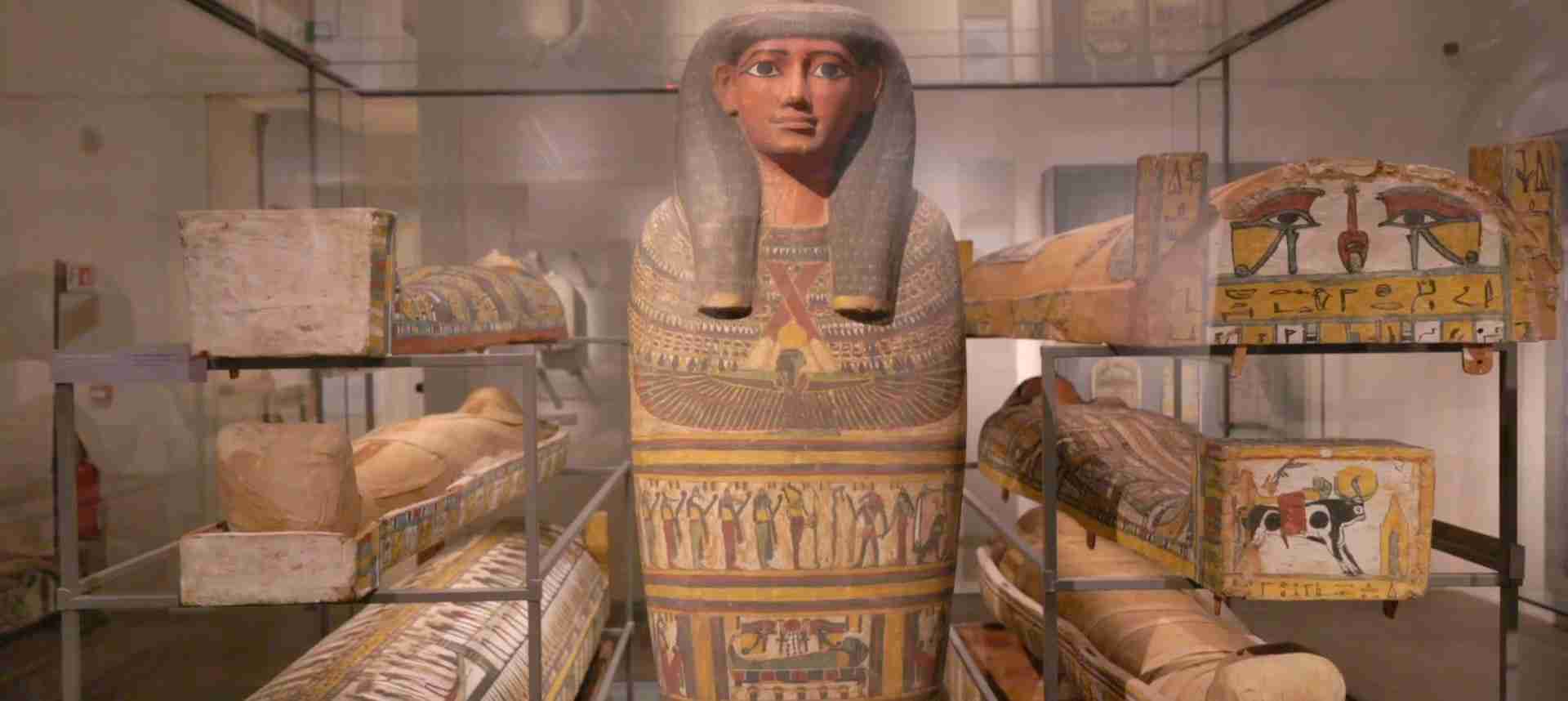
The first floor focuses on the Late Period, Ptolemaic Period, Roman Period, and Late Antiquity, chronologically concluding the Egyptian story. This floor includes the stunning Coffin Gallery, where dozens of elaborately decorated sarcophagi and anthropoid coffins line the walls in a dramatic presentation that emphasizes the artistry of funerary equipment. The variety of decorative programs, hieroglyphic texts, and protective imagery demonstrates the evolution of burial customs and religious beliefs about the afterlife journey. Painted scenes on coffin exteriors depict the deceased’s transformation, protective deities, and funerary rituals with extraordinary detail and color preservation.
The first floor also houses the Tomb of Kha and Merit in a dedicated gallery that has become the museum’s most popular destination. The display presents the tomb’s contents in cases that allow 360-degree viewing of many objects, revealing details that would be invisible in traditional wall-mounted exhibitions. Furniture, jewelry, cosmetics, linens, food offerings, and funerary equipment fill multiple large cases, demonstrating the comprehensive nature of Egyptian tomb preparation. Kha’s sarcophagi nest inside one another in the traditional manner, while Merit’s burial goods include her perfectly preserved makeup and wig boxes. The gallery’s design emphasizes the intimacy of these personal possessions, connecting visitors with individuals who lived 3,400 years ago through objects they touched, wore, and valued.
The Restoration Area on the first floor offers views into the museum’s conservation laboratories where specialists work on mummy preservation and artifact restoration. Visible through glass walls, conservators can be seen performing delicate work on organic materials including textiles, papyri, and mummified remains. This transparency demystifies museum work and demonstrates the scientific expertise required to preserve ancient materials for future generations. Display cases in the Restoration Area present animal mummies including cats, fish, birds of prey, bulls, and a crocodile, showing the range of creatures Egyptians mummified for votive purposes.
The second floor presents the museum’s richest concentrations of artifacts from the Predynastic Period, Old Kingdom, Middle Kingdom, and New Kingdom—the core periods of pharaonic civilization. Chronological organization allows visitors to trace artistic and technological developments as they progress through the galleries. Predynastic materials include pottery, stone tools, and early burial goods that reveal the foundations of Egyptian culture before the unification of Upper and Lower Egypt. Old Kingdom galleries feature materials from the pyramid age, including reserve heads, offering bearers, and tomb reliefs that established Egyptian artistic conventions.
Middle Kingdom materials on the second floor demonstrate the artistic refinement and literary achievements of Egypt’s classical period. Sculptures display the more naturalistic portraiture that distinguished Middle Kingdom royal art from the idealized representations of earlier periods. Coffins from this era show the development of Coffin Texts, precursors to the New Kingdom Book of the Dead, covering coffin interiors with spells to protect and guide the deceased.
New Kingdom galleries contain some of the museum’s most spectacular objects beyond the Tomb of Kha and Merit. Materials from Deir el-Medina, the workers’ village excavated by Schiaparelli, include not only elite burials but also the tools, ostraca (limestone flakes used for writing practice and informal documents), and domestic artifacts of the craftsmen who built the Valley of the Kings tombs. These materials provide rare insights into working-class life, literacy among non-elite populations, and the organization of royal construction projects. Painted ostraca include both official texts and informal sketches, revealing artistic practice and even humor in ancient Egyptian society.
The second floor also displays the museum’s exceptional papyrus collection in climate-controlled cases designed to protect these fragile documents. Highlights include funerary papyri with elaborate vignettes illustrating the Book of the Dead, administrative documents recording temple accounts and tax records, literary works preserving classical Egyptian literature, and magical texts containing spells for protection and healing. The Royal Canon of Turin appears in a dedicated case with interpretation explaining its crucial importance for Egyptian chronology. This fragmentary papyrus, written during the reign of Ramesses II, lists all pharaohs from the First Dynasty through the early New Kingdom, providing scholars with a native Egyptian king list that has proven invaluable for reconstructing the historical timeline.
Throughout all floors, the museum employs consistent design principles established during the 2015 renovation. Soft gray backgrounds allow colorful painted surfaces to stand out while reducing eye strain during extended visits. Strategic lighting reveals sculptural details and painted decorations without causing damage to light-sensitive materials. Glass cases use anti-reflective glazing that minimizes barriers between viewers and objects, creating more intimate viewing experiences. Labels in Italian and English provide object identification, dating, provenance, and interpretive context, though audio guides and digital resources offer more extensive information for visitors seeking deeper understanding.
The chronological organization supports multiple visiting strategies. First-time visitors can follow the prescribed route from ground floor through second floor, experiencing Egyptian history in sequence from monumental architecture and divine kingship through daily life and burial customs. Visitors with specific interests can target particular floors: those fascinated by funerary customs might concentrate on the first floor’s coffins and the Tomb of Kha and Merit, while architecture enthusiasts could focus on the ground floor’s Temple of Ellesiya and monumental statuary. Return visitors can explore different sections on subsequent trips, as the collection’s depth rewards multiple visits focused on specific periods or object types.
Must-See Highlights: The Tomb of Kha and Merit
The intact tomb of the architect Kha and his wife Merit represents the Egyptian Museum’s most celebrated holding and one of the most complete non-royal burials ever discovered from ancient Egypt. Found by Ernesto Schiaparelli in February 1906 at Deir el-Medina, the workers’ village west of Thebes, this 18th Dynasty tomb (approximately 1400 BCE) survived antiquity without plunder, preserving the complete funerary equipment that elite Egyptians accumulated for the afterlife. The discovery’s importance is exceeded only by the tomb of Tutankhamun, yet Kha’s burial offers insights into a different social stratum—prosperous craftsmen rather than divine kings.
Kha served as “Chief of Works” during the reigns of Amenhotep II, Thutmose IV, and Amenhotep III, supervising construction projects in the Theban necropolis where kings, queens, and nobles built their tombs. His professional status provided wealth that allowed elaborate tomb preparation, yet his non-royal rank meant tomb security focused on concealment rather than guarded monuments. The tomb’s hidden location in a cliff face above Deir el-Medina, sealed and undisturbed for 3,300 years, preserved everything Kha and Merit assembled for eternal life.
The tomb contained nested sarcophagi for both Kha and Merit, with wooden outer coffins and inner anthropoid coffins decorated with hieroglyphic texts, protective deities, and scenes of the afterlife journey. Kha’s mummy, still within its wrappings, wore a golden mask that covered his face, demonstrating that such funerary masks were not exclusively royal prerogatives. Merit’s burial included similarly elaborate coffins and funerary goods, showing that women of her status received equivalent burial preparation to their husbands. Modern CT scanning has revealed the mummies’ remains without unwrapping them, showing both individuals in middle age with no signs of violent death or serious disease.
The furniture assemblage demonstrates the material comfort of prosperous Egyptian homes. The tomb contained beds, chairs, stools, tables, chests for storage, and a game board for the game of senet, which held religious significance as a model of the soul’s journey through the afterlife. The furniture exhibits sophisticated joinery techniques, with mortise-and-tenon construction, decorative inlays, and carved details that reveal high craftsmanship standards. Several pieces show wear from actual use before burial, confirming that elite Egyptians included their personal possessions rather than creating funerary-specific furniture.
Merit’s personal effects offer extraordinary insights into ancient Egyptian women’s lives and concerns with appearance. Her cosmetics box contained kohl for eye makeup, applicators, mirrors, combs, and hair accessories, all preserved in usable condition. Wigs made from human hair rest in wig boxes, demonstrating that elaborate hairstyles documented in tomb paintings required separate hairpieces rather than natural growth. Jewelry including necklaces, bracelets, earrings, and rings show both precious materials (gold, semi-precious stones) and more common substances (faience, bronze), suggesting she wore different ornaments for different occasions and contexts.
Textiles from the tomb survive in remarkable condition due to Egypt’s dry climate and the tomb’s sealed environment. Linen sheets, clothing, and decorated fabrics preserve weaving techniques and dye applications, including complex patterns achieved through careful thread counting and color management. Merit’s wardrobe included multiple dresses, shawls, and undergarments that demonstrate how elite Egyptian women dressed in private versus public contexts. The preservation of organic materials including leather sandals, basketry, and cordage provides evidence for craft techniques that leave minimal archaeological traces in less favorable preservation environments.
Food offerings filled multiple containers and baskets throughout the tomb, including bread, dried fish, meat joints, fruit, and wine. These provisions, intended to sustain Kha and Merit through eternity, preserve ancient foodways and agricultural practices. Wine jars carry hieratic labels indicating vintage years and vineyard sources, showing sophisticated wine production and quality control. The presence of complete meals, not just symbolic offerings, underscores Egyptian beliefs that the afterlife replicated earthly existence and required concrete sustenance rather than purely spiritual nourishment.
The tomb contained Kha’s professional equipment, linking his earthly occupation with his eternal identity. Measuring cubes, levels, and other surveying tools identify him as an architect even in death, suggesting Egyptians expected to continue their professions in the afterlife. Papyri including sections of the Book of the Dead provided Kha with magical spells and guidance for navigating the afterlife’s challenges, demonstrating literacy and religious knowledge among the skilled craftsman class. These texts, personalized with Kha’s name and titles, show that funerary literature extended beyond royal and priestly circles to prosperous non-royal Egyptians.
Ushabti figures—small statuettes intended to perform labor for the deceased in the afterlife—fill multiple containers in the tomb. Kha possessed over 100 of these servant figures, ensuring he would not face agricultural labor or construction work in eternity. The ushabi’s presence across social classes (though in varying quantities and qualities) demonstrates widespread Egyptian beliefs about afterlife conditions and the desire to avoid manual labor even in paradise.
The tomb’s lighting and environmental conditions in the museum display protect these delicate materials while allowing visitors intimate viewing access. Cases surround objects on multiple sides, enabling 360-degree observation that reveals construction techniques, decorative details, and wear patterns invisible in traditional flat displays. Interpretive materials explain the function of each object category, contextualizing cosmetics, furniture, and food offerings within ancient Egyptian daily life and funerary beliefs. The gallery’s success lies in balancing archaeological documentation, object preservation, and public engagement, allowing visitors to understand both the scholarly significance and the deeply human dimensions of this 3,400-year-old burial.
Gallery of Kings and Monumental Statuary
The Gallery of Kings creates the museum’s most dramatic visual experience, presenting colossal royal and divine statuary against black walls with precisely directed spotlighting that transforms ancient sculptures into commanding presences. This theatrical presentation consciously contrasts with the museum’s other galleries, using design elements reminiscent of 19th-century museum installations while incorporating contemporary lighting technologies. The result emphasizes the power and majesty these statues originally conveyed in temple contexts, where massive stone figures manifested royal authority and divine presence.
The gallery’s centerpiece, a colossal seated statue of Ramesses II in black granite, measures over 2 meters in height despite depicting the pharaoh seated, conveying the monumental scale at which Egyptian sculptors worked. Ramesses II, who ruled for 66 years during the 19th Dynasty (1279-1213 BCE), commissioned more statuary and architecture than any other pharaoh, and this Turin example demonstrates the artistic sophistication applied to these mass-produced royal images. The statue’s surface polish achieves mirror-like reflectivity despite the hard granite, requiring thousands of hours of grinding and polishing with abrasive powders. Hieroglyphic inscriptions on the throne and base identify Ramesses by his five royal names and principal titles, establishing his identity for eternity.
Multiple statues of the lion-headed goddess Sekhmet line the gallery, creating an overwhelming impression of divine power. Sekhmet embodied destructive and protective aspects of royal authority—as the pharaoh’s defender she could annihilate enemies, yet her rage required careful management through ritual and offerings. The multitude of Sekhmet statues in Egyptian temples served both decorative and ritual functions, with hundreds of identical images filling temple courtyards where they received daily offerings. The Turin collection includes examples from various temples showing consistent iconography: the goddess seated with a sun disk and uraeus (rearing cobra) on her head, holding the ankh symbol of life and a papyrus scepter, her leonine face combining feline and human features.
The statue of Amenhotep I demonstrates the New Kingdom’s artistic conventions for representing living gods on earth. Amenhotep I ruled during the 18th Dynasty (approximately 1525-1504 BCE) and received posthumous worship as the patron deity of Deir el-Medina, the workers’ village. His statue shows the standardized posture Egyptian artists employed for standing royal figures: left foot advanced, arms at sides, idealized facial features conveying eternal youth rather than individual personality. The white limestone preserves traces of original pigments, reminding viewers that ancient Egyptian sculpture was brilliantly painted rather than bare stone. Red-brown skin tones, black hair, white clothing, and colorful jewelry would have transformed this now-monochrome statue into a vibrant, lifelike presence.
The statue of Seti II in gray granite demonstrates Late New Kingdom royal sculpture, when increased realism began modifying the eternal idealization of earlier periods. Seti II’s brief reign in the late 19th Dynasty (1203-1197 BCE) came during a troubled period of succession disputes and declining Egyptian power. His statue maintains traditional frontal posture and regalia but introduces subtle facial modeling that suggests individual portraiture rather than purely conventional representation. This evolution toward realism would intensify in later periods, particularly during the Ptolemaic Period when Greek artistic influences merged with Egyptian conventions.
Architectural elements throughout the gallery—column capitals, door jambs, architraves—convey the scale and decorative richness of Egyptian temple architecture. A palmiform column capital demonstrates how Egyptian architects transformed natural forms (palm fronds) into architectural elements through stylization and geometric regularity. These capitals, when multiplied across temple hypostyle halls containing hundreds of columns, created forest-like environments where stone palm fronds appeared to support the sky itself. Hieroglyphic inscriptions on architectural elements preserve temple foundation texts, royal titularies, and religious hymns that activated the building’s sacred function.
The gallery’s limestone relief fragments preserve temple wall decorations showing pharaohs performing rituals before gods. These carved and painted scenes documented the reciprocal relationship between divine and royal power: pharaohs maintained cosmic order through proper ritual performance, while gods sustained pharaonic authority and Egypt’s prosperity. Relief carving techniques visible on these fragments demonstrate the precision Egyptian sculptors achieved, cutting crisp hieroglyphs and detailed human figures into hard limestone with copper and bronze tools plus abrasive quartz sand. Remaining pigments on some reliefs show the vibrant color schemes that transformed temple interiors into environments saturated with symbolic meaning through precisely applied mineral and organic pigments.
The black wall treatment throughout the Gallery of Kings serves multiple functions beyond dramatic visual impact. Black backgrounds eliminate visual competition between objects, allowing each statue to command attention without neighboring distractions. The darkness also evokes the sacred dimness of Egyptian temple sanctuaries, where limited light entering through high clerestory windows created mysteriously illuminated spaces unlike the bright Mediterranean sunlight outside. Spotlighting replicates how sunlight would have struck specific statues during particular times of day or year, creating changing visual experiences tied to solar cycles.
This gallery demonstrates how museum presentation actively shapes visitor experience and object meaning. The theatrical darkness and precise lighting create emotional responses of awe and intimidation that align with the statues’ original functions as manifestations of overwhelming divine and royal power. Yet this presentation also risks romanticizing or exoticizing Egyptian civilization, creating an atmosphere of mystery rather than historical understanding. The gallery’s success depends on balancing these aesthetic and educational goals—using visual drama to capture attention and convey power dynamics while providing interpretive materials that contextualize these objects within specific historical, political, and religious systems.
Papyri and Historical Documents
The Museo Egizio holds one of the world’s most important papyrus collections, comprising over 700 complete or reconstructed manuscripts plus more than 17,000 fragments that illuminate ancient Egyptian literacy, administration, religious beliefs, and literary culture. This concentration of written material makes Turin a crucial resource for textual scholars, as the papyri preserve everything from monumental Book of the Dead scrolls to informal notes scratched on pottery sherds. The collection’s formation reflects both the Drovetti acquisition, which included significant papyri, and Schiaparelli’s excavations at literate communities like Deir el-Medina where scribes and craftsmen generated extensive written records.
The Royal Canon of Turin (Turin King List) represents the collection’s most historically significant document despite its fragmentary condition. This hieratic papyrus, written during the reign of Ramesses II in the 19th Dynasty (approximately 1279-1213 BCE), originally listed all pharaohs from the First Dynasty through the early New Kingdom, providing regnal years for each ruler. The papyrus arrived in Turin from the Drovetti collection badly fragmented, and attempts at reconstruction in the 19th century both preserved surviving pieces and caused additional damage through improper handling. Modern scholars have reassembled much of the text, creating the most complete native Egyptian king list available to researchers.
The Royal Canon’s importance for Egyptology cannot be overstated. Unlike monumental king lists carved on temple walls, which could be modified for political purposes and often omit rulers considered illegitimate, this administrative papyrus appears to record a comprehensive chronological sequence maintained in palace or temple archives. The document includes not only recognizable pharaohs but also obscure rulers, short-lived kings, and the Hyksos foreign dynasties that dominated northern Egypt during the Second Intermediate Period. The regnal years attached to many entries allow calculation of approximate dates for early Egyptian history, providing anchors for the chronological framework upon which all Egyptian historical study depends.
Funerary papyri constitute a major collection category, with dozens of Book of the Dead scrolls demonstrating the evolution of Egyptian funerary literature from the Old Kingdom Pyramid Texts through Middle Kingdom Coffin Texts to the standardized New Kingdom Book of the Dead. These texts provided the deceased with spells, incantations, and guidance for navigating the afterlife’s challenges, particularly the judgment scene where the heart was weighed against the feather of truth. The Turin papyri include both luxurious versions with elaborate vignettes painted in red, blue, green, and gold pigments, and simpler copies with minimal illustration, showing how different economic classes accessed funerary literature.
The Papyrus of Iuefankh, at 1847 centimeters in length, represents the museum’s longest preserved papyrus and demonstrates the scroll format’s potential for extended texts. This enormous document contains multiple funerary texts and elaborate illustrations showing the deceased’s journey through the underworld, encounters with deities, and ultimate transformation into an immortal blessed spirit. The papyrus’s preservation in such exceptional length results from burial in a tomb environment that protected organic materials from moisture and biological decay, conditions that destroyed most papyri in less favorable archaeological contexts.
Literary papyri preserve classical Egyptian literature including the Tale of Sinuhe (an adventure story about an official who fled Egypt and later returned), wisdom literature providing ethical and practical advice, love poetry revealing Egyptian romantic sensibilities, and satirical compositions that subvert official ideology through humor and irony. These texts demonstrate that Egyptian literacy served entertainment and intellectual exploration beyond administrative and religious functions. The preservation of multiple copies of popular works like Sinuhe shows these tales circulated widely, copied by scribal students as handwriting practice and enjoyed by literate Egyptians across the social spectrum.
Administrative papyri document the bureaucratic systems that governed Egyptian agriculture, taxation, construction projects, and temple operations. Temple accounts record offerings made to gods, priestly salaries, agricultural production from temple estates, and commodity prices in various regions. Tax records list individual landholdings, crop yields, and payment obligations, revealing economic organization at local levels. Letters between officials discuss administrative problems, construction supervision, worker management, and political intrigues, providing narrative details absent from official monumental inscriptions. These mundane documents illuminate how Egyptian state and religious institutions actually functioned rather than idealized representations in royal and divine propaganda.
The collection includes ostraca—limestone flakes and pottery sherds used for informal writing—that preserve everything from scribal exercises to work records, personal letters, and quick sketches. The Deir el-Medina ostraca particularly demonstrate literacy among skilled workers who left extensive written records of daily life, labor organization, legal disputes, love poems, and even bawdy humor. These informal texts reveal aspects of Egyptian culture rarely documented in formal monuments, including workers’ complaints about late payment, neighborhood disputes, marriage negotiations, and medical remedies.
Magical papyri contain spells for protection against disease, dangerous animals, supernatural threats, and human enemies. These texts blend Egyptian religious beliefs with practical medicine, prescribing both magical incantations and herbal remedies for various ailments. Medical papyri document Egyptian understanding of anatomy, disease diagnosis, and surgical procedures, showing sophisticated medical knowledge alongside magical healing approaches. The combination reflects Egyptian conceptual frameworks that did not sharply distinguish natural and supernatural causation but understood health as depending on both physical treatments and spiritual protection.
The papyrus collection’s display presents unique conservation challenges, as these organic materials degrade when exposed to light, humidity fluctuations, and pollutants. The museum employs climate-controlled cases maintaining stable temperature and humidity while using low-level lighting that allows viewing without causing photochemical damage. Papyri are displayed in rotation, with particularly fragile or valuable documents exhibited for limited periods before returning to dark storage. Digital imaging allows researchers access to texts without handling fragile originals, while online collection databases make the papyri accessible to global scholarly communities.
For visitors, the papyrus galleries provide intimate encounters with ancient Egyptian thought through the actual documents individuals created, read, and preserved. Unlike monumental architecture and sculpture intended for eternity, these papyri served immediate practical, religious, and literary functions before burial or discard. Reading translated excerpts displayed alongside the original hieratic or hieroglyphic texts connects visitors with Egyptian scribes across millennia, revealing shared human concerns with death, justice, love, bureaucratic frustration, and the search for meaning that transcend cultural and temporal boundaries.
Temple of Ellesiya and Architectural Displays
The Temple of Ellesiya provides the Museo Egizio’s most immersive architectural experience, presenting a complete Nubian rock temple carved during the reign of Thutmose III in the 15th century BCE. Originally located in Nubian territory (modern Sudan) near the village of Ellesiya, this small temple was cut from its cliff face and donated to Italy by the Egyptian government in 1966 as gratitude for Italian participation in the UNESCO campaign to save Nubian monuments threatened by the Aswan High Dam. The temple’s reconstruction in Turin allows visitors to enter an authentic ancient sacred space, experiencing how Egyptians manipulated architecture, light, and carved decoration to create religious environments.
The temple comprises three main chambers carved progressively deeper into the cliff, creating a spatial sequence from public accessibility to sacred privacy. The entrance hall, partially open to natural light, features carved and painted reliefs showing the pharaoh performing rituals before various deities. These scenes establish the temple’s purpose: maintaining proper relationships between human and divine realms through royal intermediation. Thutmose III appears in traditional pharaonic regalia presenting offerings to Horus, Satet, Anuket, and other deities associated with the Nile’s cataract region where the temple stood, linking specific geographic location with appropriate divine patronage.
Moving deeper into the temple, visitors enter progressively dimmer spaces culminating in the sanctuary, the most sacred chamber where the cult statue would have resided. This progression from light to darkness mirrors Egyptian cosmological beliefs about sacred space, with temple interiors representing the primordial darkness from which creation emerged. The sanctuary’s restricted access (limited to priests performing daily cult rituals) contrasts with the more accessible outer chambers where broader participation occurred during festivals when the divine image emerged from its dark sanctuary into public view.
Relief carving throughout the temple demonstrates the artistic conventions and technical capabilities of mid-18th Dynasty sculptors. Figures appear in the canonical Egyptian style: heads in profile with eyes frontal, torsos frontal with legs in profile, creating the composite view that characterizes Egyptian two-dimensional art. Hieroglyphic texts identify the deities, record royal titles, and preserve offering formulae that activated the temple’s ritual function. The integration of text and image shows how Egyptian art operated simultaneously on visual and linguistic registers, with hieroglyphs functioning both as phonetic writing and symbolic imagery.
Original pigments survive on many relief surfaces, preserving the temple’s color scheme of red-brown skin tones for male figures, yellow-cream for female figures, blue for hair and divine beards, green for vegetation, and white for clothing. These colors carried symbolic meanings beyond realistic representation: red-brown associated with life force and vitality, yellow-cream with golden eternal flesh of deities, blue with the life-giving Nile and celestial realm. The pigments’ survival results from the temple’s original cliff location protecting carved surfaces from weathering and the sealed museum environment preventing further deterioration.
The temple’s compact size (compared to massive constructions like Karnak or Luxor Temple) reflects its function as a provincial shrine rather than major state sanctuary. Yet the quality of carving and completeness of decorative program demonstrate that even modest temples received sophisticated artistic attention. This accessibility allows visitors to comprehend temple architecture and decoration at human scale rather than the overwhelming monumentality of Egypt’s largest religious complexes.
The Temple of Ellesiya’s installation in Turin required meticulous documentation, cutting, transportation, and reassembly—an early example of monument salvage archaeology that would become standard practice in the Nubian campaign. Engineers photographed every carved block, numbered all pieces, cut the rock-hewn chambers into transportable sections, shipped them to Italy, and reconstructed the temple within the museum using the original stones. This process preserved not only the temple’s artistic content but also its architectural relationships, allowing modern visitors to experience spatial sequences as ancient worshippers did.
Beyond the Temple of Ellesiya, the museum displays architectural elements from various sites: column capitals showing papyrus, lotus, and palm forms translated into stone; door jambs carved with protective texts and royal names; architraves from temple entrances; offering tables where priests presented food and drink to gods; and stele recording temple dedications, royal decrees, and votive offerings. These fragments cannot recreate complete buildings, yet they convey architectural scale, decorative richness, and the integration of architecture, sculpture, and hieroglyphic texts into unified sacred environments.
The Nubian Room contextualizes the Temple of Ellesiya within broader Egyptian-Nubian relations spanning three millennia. During the New Kingdom, when the temple was carved, Egypt controlled Nubian territory as far south as the Fourth Cataract, extracting gold, ivory, exotic animal products, and enslaved labor while establishing Egyptian religious cults throughout the colonized region. The temple demonstrates how Egypt imposed its religious architecture and iconography on Nubian landscapes, yet Nubian materials elsewhere in the museum show indigenous cultural resistance and eventual political independence when Nubian kings conquered Egypt in the 25th Dynasty (747-656 BCE), becoming pharaohs who ruled both regions.
This complex history of conquest, colonization, cultural exchange, and ultimate reversal when Nubia controlled Egypt demonstrates that ancient cultural boundaries were permeable and power relationships shifted over time. The Temple of Ellesiya, originally a symbol of Egyptian imperial presence in Nubia, now resides in Italy as a result of modern dam construction and international cooperation to preserve threatened heritage. Its multiple displacements—from cliff to museum, from ancient religious function to modern educational display, from African to European context—raise questions about cultural property, colonial archaeology, and the circulation of ancient objects in contemporary museum systems.
Daily Life and Material Culture Collections
The Egyptian Museum’s strength lies partly in its extensive holdings of everyday objects that illuminate ancient Egyptian daily life beyond the royal and elite focus of many collections. These materials derive particularly from Schiaparelli’s Deir el-Medina excavations, which recovered complete household assemblages, tools, clothing, food remains, and personal items from the workers’ village that housed craftsmen building royal tombs. This material culture demonstrates Egyptian technological capabilities, domestic organization, craft specialization, and the daily routines that sustained one of antiquity’s most successful civilizations.
Furniture collections include complete assemblages showing how Egyptians furnished homes across social classes. Elite pieces from tombs like Kha and Merit’s demonstrate sophisticated joinery, decorative inlay, and ergonomic design principles. Chairs employ mortise-and-tenon construction with reinforcing elements, creating stable structures from wood—a precious material in largely treeless Egypt. Decorative elements include carved lion legs, geometric inlays of ivory and ebony, and gilded surfaces that transformed functional furniture into luxury objects displaying wealth and taste. Simpler furniture from non-elite contexts shows the same construction principles applied with less expensive materials and minimal decoration, confirming that basic furniture types spanned social hierarchies.
Beds from various periods demonstrate sleeping arrangements and the importance Egyptians placed on comfortable rest. Wooden frames support woven rush mattresses, with headrests (rather than pillows) supporting the neck while protecting elaborate hairstyles during sleep. Footboards prevented sleepers from sliding off angled mattresses, while some elite examples include decorative panels showing protective deities. The uniformity of bed design across many centuries shows how successfully Egyptian craftsmen solved ergonomic challenges, creating furniture types that persisted with minimal modification through millennia.
Game boards for senet and other games appear throughout the collection, demonstrating Egyptian leisure activities and the religious symbolism attached to gaming. Senet, played on a grid of 30 squares with pieces moving according to throw-stick or knucklebone randomizers, served both entertainment and religious functions as a metaphor for the soul’s journey through the afterlife. Scenes in tombs showing the deceased playing senet against invisible opponents represent the afterlife journey as a game where correct moves ensured favorable outcomes. Game equipment ranges from simple scratched boards on pottery sherds to elaborate inlaid examples from elite tombs, showing how universal activities manifested differently across social classes.
Tool collections document Egyptian technological capabilities across craft specializations. Carpentry tools include copper and bronze saws, chisels, adzes, drills, and axes that enabled sophisticated woodworking despite metal’s relative scarcity. Stone-working tools demonstrate how Egyptians carved granite, limestone, and sandstone with copper implements, abrasive quartz sand, and tremendous labor investment. Agricultural implements including hoes, sickles, and winnowing fans show farming technologies that sustained Egypt’s agricultural surplus, the foundation of its complex civilization. The preservation of wooden tool handles, rope bindings, and other organic elements provides evidence for hafting techniques and material combinations rarely surviving in archaeological contexts.
Pottery collections trace ceramic technology development from handmade Predynastic vessels through wheel-thrown New Kingdom production to mass-produced Ptolemaic and Roman wares. Storage jars for wine, oil, grain, and water show form variations responding to contents and transport requirements. Fine tableware demonstrates Egyptian aesthetic preferences and technical capabilities in producing thin-walled vessels, complex shapes, and decorative surface treatments. Hieratic labels on jar shoulders identify contents, origins, and vintage years, showing literate control of commodity storage and distribution.
Textile collections preserve weaving techniques, fiber processing, and clothing construction across Egyptian history. Linen, produced from flax cultivated in Egypt’s agricultural regions, provided fibers for everything from coarse sacks to gossamer-thin royal garments. The museum holds examples spanning this quality range, demonstrating weaving sophistication that produced fabrics with thread counts approaching modern cotton sheets. Pleating techniques created decorative effects on elite clothing, while dyes including indigo, madder, and various mordanted colors added visual interest despite linen’s natural resistance to pigment absorption.
Basketry and cordage collections show Egyptian rope-making and coiled basket construction, crafts that produced essential containers, architectural elements, and binding materials. Techniques visible in preserved examples demonstrate how craftspeople transformed palm leaves, reeds, and papyrus into durable, functional objects. Some baskets retain their original contents—grain, fruit, nuts—providing direct evidence of ancient foodways and storage practices.
Jewelry collections range from royal pieces in gold, lapis lazuli, turquoise, and carnelian to faience and bronze ornaments worn by ordinary Egyptians. Necklaces, bracelets, earrings, rings, and anklets demonstrate Egyptian metalworking, stone-cutting, and decorative arts while revealing aesthetic preferences and symbolic meanings attached to specific colors and materials. Amulets in various forms (scarabs, djed pillars, wadjet eyes, deities) provided magical protection alongside decorative functions, showing how Egyptians merged practical adornment with spiritual safeguarding.
Cosmetics and personal care items illuminate Egyptian attention to appearance and hygiene. Makeup palettes for grinding and mixing pigments, kohl tubes for storing eye makeup, mirrors of polished bronze or copper, combs in wood and ivory, razors for hair removal, and tweezers for various grooming tasks demonstrate sophisticated personal care practices. The extensive evidence for cosmetics among both men and women across social classes shows this was not vanity but cultural expectation, with clean-shaven faces, lined eyes, and oiled skin marking civilized Egyptian identity against foreign “others” who neglected such refinements.
Children’s toys including dolls, balls, toy animals, and miniature furniture show Egyptian childhood and the transmission of adult roles through play. Dolls with movable limbs, carved animal figures, and spinning tops demonstrate both craft skill and understanding of children’s developmental needs. These objects humanize ancient Egypt by showing parental love and children’s lives, connecting modern visitors with universal experiences of childhood play despite vast temporal and cultural distances.
Food remains preserved through desiccation provide direct evidence of ancient diet, cooking methods, and agricultural products. Bread loaves, dried fish, meat joints, fruit, vegetables, and nuts from tombs intended as afterlife sustenance document Egyptian cuisine and food preservation techniques. Wine jars with hieratic labels record vineyards, vintage years, and quality assessments, showing sophisticated viticulture and consumer preferences for particular wine regions and ages.
These daily life materials collectively demonstrate that ancient Egyptians were not exotic others but people managing universal human needs: feeding themselves, clothing their bodies, furnishing homes, caring for children, pursuing leisure, adorning themselves, and organizing labor. The museum’s extensive holdings allow comprehensive reconstruction of Egyptian material culture, showing how technologies, crafts, and daily practices evolved over three millennia while maintaining recognizable continuities that defined Egyptian cultural identity.
Planning Your Visit: Practical Information
The Museo Egizio maintains a straightforward admission system requiring advance online ticket purchase for all visitors. The museum opens Monday from 9:00 AM to 2:00 PM, with last entry at 12:00 PM. Tuesday through Sunday, hours extend from 9:00 AM to 6:30 PM, with last entry at 4:00 PM. Timed entries occur every 30 minutes throughout operating hours, helping manage visitor flow and ensure comfortable viewing conditions. The museum closes January 1 and December 25, though extraordinary openings or closures may occur on other special holidays—always verify current schedules on the official website before visiting.
Standard admission tickets grant access to the permanent collection across all four floors plus any temporary exhibitions currently installed. Reduced admission rates apply for children ages 6-14, while children under 6 enter free. Additional free admission categories include severely disabled visitors plus one accompanying person, ICOM members, and holders of the Turin Museum Card or Torino+Piemonte Card. The museum offers special promotional admission on specific days: free entry on visitors’ birthdays (present ID at ticket office), two-for-one admission for couples on Valentine’s Day, free admission for women on International Women’s Day, free admission for fathers accompanied by children on Father’s Day, and free admission for mothers accompanied by children on Mother’s Day.
Audio guides available in multiple languages (Italian, English, French, German, Spanish) enhance the visit by providing detailed object information, historical context, and thematic tours beyond the label text available in galleries. The museum’s smartphone app offers similar content with the advantage of personal device use, though audio guide rentals support visitors without appropriate devices or who prefer dedicated equipment. Guided tours led by museum educators operate on scheduled times for individual visitors who book in advance, while private groups can arrange custom tours in various languages.
The museum recommends allocating 3 to 4 hours for a comprehensive visit covering the permanent collection’s highlights across all floors. Visitors particularly interested in Egyptology or who read extensive label information should plan 4 to 5 hours, while those seeking to examine the collection in depth could easily spend an entire day. The chronological layout supports efficient navigation, beginning on the ground floor and ascending to the second floor before returning to exit through the ground floor shop and café. Visitors with limited time should prioritize the Tomb of Kha and Merit (first floor), Gallery of Kings (ground floor), and papyrus collection (second floor) as the museum’s most distinctive holdings.
Accessibility features accommodate visitors with mobility limitations throughout the museum. Elevators connect all public floors, wheelchair-accessible restrooms serve each level, and the building meets contemporary accessibility standards following the 2015 renovation. Wheelchairs are available for loan at the entrance. Gallery floors feature smooth surfaces suitable for wheeled mobility aids, while case heights and sightlines consider seated viewers. Visitors requiring specific accessibility arrangements should contact the museum in advance to ensure appropriate accommodations.
The museum café Pausa Caffè operates on the first floor near the Tomb of Kha gallery, offering coffee, light meals, snacks, and beverages for visitors needing mid-visit refreshment. This location allows breaks between floors without exiting the museum, particularly valuable for extended visits. The café’s proximity to seating areas provides rest opportunities for visitors experiencing fatigue during their tour. Outside food and beverages are not permitted in galleries due to conservation concerns, making the café the only location for refreshment within the museum building.
Coat check and locker facilities near the entrance accept backpacks, large bags, umbrellas, and outerwear that cannot be brought into galleries. Storage is complimentary and ensures both visitor comfort and artifact protection by preventing accidental contact with objects or cases. The museum prohibits large bags and backpacks in exhibition spaces regardless of contents, requiring use of storage facilities. Smaller personal items including purses and small camera bags may accompany visitors through galleries.
The museum shop near the exit offers extensive selections of books on Egyptology, Egyptian art reproductions, jewelry inspired by ancient designs, papyrus replicas, games based on ancient Egyptian recreation, and children’s educational materials. The shop remains accessible even without a museum ticket, allowing purchases without full museum visits. Online shopping through the museum website extends retail access to those unable to visit in person or who wish to continue collecting after returning home.
Tickets and Admission Details
All visitors must purchase tickets online in advance through the museum’s official ticketing platform at egizio.museitorino.it. Walk-up ticket sales at the museum entrance are not available, making advance online booking mandatory for all admission categories. This system manages visitor capacity, reduces crowding, and ensures comfortable viewing conditions throughout galleries. Tickets include a specific entry time in 30-minute intervals, and visitors should arrive within their designated window to ensure admission.
Standard adult admission provides access to all permanent galleries and current temporary exhibitions. Check the official museum website for current pricing, as rates may vary and special promotions occasionally offer reduced admission during specific periods. The museum accepts major credit cards and digital payment methods through the online booking system. Confirmation emails containing tickets with QR codes arrive immediately after purchase—visitors should either print these confirmations or display them on smartphones at the entrance for scanning.
Reduced admission tickets serve specific visitor categories including children ages 6-14, students up to age 25 with valid student identification, adults over 70, and journalists with valid press credentials. Free admission extends to children under 6, severely disabled visitors plus one accompanying person, ICOM members presenting current membership cards, and holders of the Turin Museum Card or Torino+Piemonte Card. These city tourism cards include free museum admission among other benefits for visitors planning to see multiple Turin attractions, potentially offering significant savings compared to individual ticket purchases.
School groups receive special admission rates and must arrange visits through the museum’s educational services department. Kindergarten groups pay €1 per child for guided visits, while primary, middle, and upper secondary school groups pay €3 per student for basic admission. School groups must book guided tours or educational programs in advance through the reservations system, as drop-in school visits are not accommodated. Teachers and accompanying adults enter free when supervising official school groups.
Guided tour packages for small groups (1-6 people) cost €70 for 60-minute tours or €100 for 90-minute tours, plus standard admission tickets for all participants. Tours are available in English, French, German, and Spanish beyond standard Italian options. Larger groups (7-20 people) pay €95 for 60-minute tours, €120 for 90-minute tours, €145 for 120-minute tours, €200 for 180-minute tours, or €260 for 240-minute tours, plus admission tickets. All guided tours require advance booking through the museum’s reservations phone line or email. Groups accompanied by external tourist guides pay a €10 reservation fee plus €1 per person for required group audio devices that protect gallery acoustics while ensuring all participants can hear their guide.
Special event tickets occasionally offer unique experiences beyond standard admission. The “Be the First” early access program allows visitors to enter the museum before regular opening hours, enjoying the collection in calm conditions while the museum prepares for the public day. These special tickets, typically priced at €25, include access one hour before regular opening plus complimentary coffee and pastry in the café. Special event tickets are offered during limited periods—check the museum website for current availability and booking information.
Ticket modifications and cancellations follow the museum’s stated policies available on the booking website. Visitors unable to attend during their designated time slot should review cancellation procedures and request refunds or rescheduling according to the terms of purchase. The museum generally accommodates reasonable rescheduling requests when provided adequate advance notice, though specific policies may vary based on ticket type and timing.
Third-party tour operators and ticket resellers offer Egyptian Museum packages often combined with other Turin attractions, skip-the-line access, or guided tour services. While these options provide convenience, visitors should verify that third-party tickets include official museum admission rather than simply queue-jumping services requiring separate ticket purchase. Official museum tickets purchased directly through the museum website ensure valid admission while supporting the institution directly rather than paying commissions to intermediaries.
Location and Getting There
The Museo Egizio occupies the Palazzo dell’Accademia delle Scienze at Via Accademia delle Scienze 6 in Turin’s historic center, placing it within easy walking distance of the city’s major landmarks and central transportation hubs. The museum’s central location allows integration into broader Turin sightseeing itineraries, with the Royal Palace, Palazzo Madama, Piazza San Carlo, and other significant sites all within a 5-10 minute walk. This concentration of cultural attractions makes Turin’s historic center ideal for visitors interested in museums, architecture, and urban heritage.
Visitors arriving by train at Torino Porta Nuova, the city’s main rail station, can walk to the museum in approximately 10 minutes via Via Roma, Turin’s primary shopping and pedestrian street. This direct route passes through Piazza San Carlo, one of Turin’s most elegant baroque squares, making the walk itself a pleasant introduction to the city’s architectural character. Alternatively, tram line 4 or bus line 11 from the station area reach Piazza Castello, a short walk from the museum. Those preferring minimal walking can take taxis from the station rank directly to the museum entrance, though the short distance makes walking the most practical option for most visitors.
Travelers arriving at Torino Caselle Airport, located approximately 16 kilometers north of the city center, can use the SADEM shuttle bus service connecting the airport with Turin’s main train stations (Porta Susa and Porta Nuova). Buses depart every 30 minutes during peak periods, providing affordable and convenient airport access. From either station, the museum is easily reachable by foot or public transport following the directions above. Taxis and ride-sharing services also operate from the airport, offering direct service to the museum or city center hotels for those preferring private transportation.
Visitors driving to Turin face limited parking options in the historic center due to pedestrian zones and restricted traffic areas. The museum itself operates no dedicated parking facility, requiring use of public parking garages. The nearest options include the Roma-San Carlo underground parking garage, located approximately 5 minutes’ walk from the museum beneath Piazza San Carlo, and Parking Bolaffi, another nearby facility. Both charge standard hourly rates for central Turin parking. Visitors should note that driving in Turin’s historic center requires familiarity with Italian limited traffic zones (ZTL – Zona Traffico Limitato), where unauthorized vehicles face automatic fines. Hotels in central locations can often provide parking permits or guidance on navigating these restrictions.
Public transportation within Turin relies on an integrated system of trams, buses, and metro lines operated by GTT (Gruppo Torinese Trasporti). Single-ride tickets cost €1.70 and remain valid for 90 minutes of travel on any combination of transport modes. Day passes offering unlimited travel cost €5, providing value for visitors making multiple trips. Tickets must be purchased before boarding from tobacco shops (tabacchi), newsstands, automatic machines at metro stations, or the GTT mobile app. Validators inside vehicles must stamp tickets upon boarding—failure to validate results in fines if inspectors check tickets during travel.
The museum’s central location makes it easily combinable with other Turin attractions in a single day. The Royal Palace stands literally five minutes away, allowing visitors to experience both institutions on a single itinerary. Palazzo Madama, housing Turin’s civic art museum, occupies Piazza Castello immediately adjacent to the Egyptian Museum’s vicinity. The Mole Antonelliana, home to the National Cinema Museum and Turin’s most distinctive architectural landmark, rises just a 10-minute walk from the Egyptian Museum. This concentration supports efficient multi-attraction visits for travelers with limited time in Turin.
Neighborhood amenities around the museum include numerous cafés, restaurants, shops, and services catering to both tourists and local professionals working in central Turin. The Quadrilatero Romano, Turin’s historic market district, offers authentic trattorias, wine bars, and artisan food shops within easy walking distance, ideal for lunch or dinner before or after museum visits. Piazza San Carlo’s grand cafés provide classic Turin experiences including bicerin (a traditional chocolate-coffee-cream drink) and elaborate pastries in elegant historic settings. Via Roma’s shopping arcades house both international retailers and historic Turin boutiques for those combining cultural visits with retail therapy.
Visitor Guidelines and Etiquette
Photography for personal, non-commercial use is permitted throughout the museum’s permanent collection without flash or tripods. Visitors may photograph artifacts, gallery installations, and architectural elements using smartphones or cameras, though flash photography is strictly prohibited due to its potential to damage light-sensitive materials including pigments, textiles, papyri, and organic remains. Tripods, monopods, selfie sticks, and professional lighting equipment cannot be used without advance written permission from museum administration, as these items obstruct gallery circulation and create hazards for other visitors and artifacts.
Temporary exhibitions may impose specific photography restrictions depending on loan agreements with lending institutions or copyright concerns related to contemporary artists. Visitors should check signage at temporary exhibition entrances and respect any photography prohibitions. Video recording follows the same guidelines as still photography—permitted for personal use in permanent galleries without flash or professional equipment, potentially restricted in temporary exhibitions. Commercial photography or filming requires advance authorization and typically involves fees to compensate the museum for commercial use of its collections and spaces.
Social media sharing of personal photographs taken in the museum is encouraged, helping promote the institution and Egyptian cultural heritage to broader audiences. Visitors often tag the museum’s official accounts (@museoegizio on Instagram and other platforms) when posting visit photographs, contributing to the museum’s digital presence and connecting with community members worldwide who share interests in ancient Egypt. The museum periodically features visitor photographs on official channels, creating dialogue between institution and public.
Gallery etiquette requires maintaining respectful distances from display cases and never touching protective barriers, glass surfaces, or artifacts. While most objects appear behind protective glazing, some architectural elements and larger sculptures may be accessible without physical barriers. Visitors must never touch these objects, as skin oils, dirt, and mechanical contact cause cumulative damage to ancient materials. Parents should supervise children to prevent accidental contact with cases or artifacts and ensure young visitors understand the fragility and irreplaceability of museum holdings.
Speaking voices should remain at conversational levels to maintain pleasant acoustic environments for all visitors. The museum’s stone architecture and hard surfaces create reverberant acoustics that amplify noise, making loud conversations disruptive to surrounding visitors. Mobile phones should be silenced or set to vibrate, with phone conversations taken outside galleries to avoid disturbing others. Educational groups, school visits, and guided tours naturally generate higher noise levels, though educators and guides should monitor group volume and encourage respectful behavior.
Food and beverages are prohibited in all gallery spaces due to spill risks, pest attraction, and crumb accumulation that threatens artifact preservation. Visitors must consume refreshments exclusively in designated areas including the museum café and outdoor spaces. Water bottles may be carried if properly sealed and stored in bags rather than openly displayed, though drinking in galleries is not permitted. The museum enforces these policies to protect collections from beverage spills and food residues that could cause irreversible damage.
Backpacks, large bags, and umbrellas must be checked at coat storage facilities rather than carried through galleries. This requirement protects both artifacts and visitors, as bags swung while turning can strike cases or other visitors, while umbrellas pose similar hazards in crowded galleries. Small purses and camera bags may accompany visitors, though shoulder bags should be moved to front-carry positions in congested galleries to prevent inadvertent contact with displays or other visitors. Strollers face size restrictions in some galleries with narrow circulation paths—check with admission staff for current policies and possible stroller parking locations.
Sketching and drawing are welcomed throughout the museum as traditional artistic practices and educational activities. Artists should use dry media (pencils, charcoal, pastels) rather than wet media (watercolors, inks) that could damage galleries or artifacts if spilled. Easels and large drawing boards may be restricted in crowded conditions, though lap-sized sketchbooks can be used freely. The museum periodically offers sketching events and drawing workshops, encouraging artistic engagement with the collection.
Visitors experiencing accessibility needs should contact museum staff for assistance. Wheelchairs available for loan at the entrance serve visitors with mobility limitations who arrive without personal equipment. Staff can provide information about accessible routes, elevator locations, and seating areas throughout the building. Visitors requiring specific accommodations beyond standard accessibility features should contact the museum in advance to arrange appropriate support.
Museum fatigue affects most visitors during extended cultural experiences. Symptoms including decreased attention, physical exhaustion, and reduced enjoyment indicate the need for breaks. The museum café provides rest opportunities without exiting the building, while seating throughout galleries allows brief rests between sections. Visitors should pace their tours according to personal stamina, perhaps splitting the collection across multiple shorter visits rather than attempting comprehensive coverage in a single exhausting session. The museum’s annual membership programs support return visits for those living in Turin or visiting frequently, making multiple shorter visits more practical than marathon single-day tours.
Nearby Attractions and Combining Visits
The Royal Palace of Turin (Palazzo Reale) stands five minutes’ walk from the Egyptian Museum at Piazza Castello, offering complementary insights into a different kind of power—European royal dynasties rather than ancient pharaohs. The Savoy family’s official residence from 1646 to 1865, the palace preserves baroque and rococo state apartments, throne rooms, ballrooms, and private quarters demonstrating absolute monarchy’s architectural and decorative expression. The Royal Armory within the palace complex houses one of the world’s finest arms and armor collections, while the Royal Gardens provide green space for outdoor respites between indoor cultural experiences. Combined visits to the Egyptian Museum and Royal Palace create contrasts between ancient and early modern royal cultures, showing how different civilizations expressed power through material culture and architecture.
Palazzo Madama dominates Piazza Castello immediately adjacent to the Royal Palace, housing Turin’s civic art museum in a building whose architecture spans from Roman foundations through medieval castle to baroque palace façade. The museum’s collections emphasize Italian decorative arts, ceramics, jewelry, and paintings, complementing the Egyptian Museum’s archaeological focus with later artistic traditions. The palace’s baroque staircase by Filippo Juvarra represents one of European architecture’s masterpieces, worth seeing even for visitors who skip the museum collections.
The Mole Antonelliana, Turin’s most distinctive architectural landmark, rises ten minutes’ walk from the Egyptian Museum and houses the National Cinema Museum celebrating film history and technology. Originally designed as a synagogue in 1863, this 167-meter tower now offers panoramic city views from its observation platform plus innovative museum installations exploring cinema’s evolution from 19th-century optical experiments through contemporary digital filmmaking. The museum’s location inside the Mole’s vast interior volume creates dramatic vertical spaces that complement the Egyptian Museum’s more traditional horizontal galleries. Film enthusiasts particularly appreciate the Cinema Museum’s extensive collections, though even casual visitors enjoy the unique combination of architectural spectacle and cultural content.
Piazza San Carlo, three minutes’ walk from the Egyptian Museum, epitomizes Turin’s baroque urbanism with symmetrical arcaded buildings, twin churches, and central equestrian monument creating one of Europe’s most harmonious civic spaces. The square’s historic cafés including Caffè San Carlo and Caffè Torino serve bicerin (Turin’s signature chocolate-coffee-cream beverage), elaborate pastries, and traditional Piedmontese savories in elegant interiors preserving 19th-century décor. These cafés function as cultural institutions themselves, maintaining traditions of refined café culture that have characterized Turin since the Savoy court established the city as a sophisticated European capital.
The Quadrilatero Romano preserves Turin’s Roman street grid and medieval market character just minutes from the Egyptian Museum, offering authentic trattorias, wine bars, artisan food shops, and the Porta Palazzo market. This neighborhood provides antidotes to museum-heavy itineraries through culinary experiences, street life, and market vitality. Small food shops sell regional specialties including hazelnuts from Langhe, rice from Vercelli, cheeses from alpine valleys, and truffles from Piedmont forests, allowing visitors to taste the agricultural landscape surrounding Turin. Traditional restaurants serve Piedmontese classics including agnolotti pasta, vitello tonnato, bagna cauda (hot anchovy-garlic dip), and brasato al Barolo (beef braised in Barolo wine), demonstrating that Turin’s cultural heritage extends beyond museums to living food traditions.
The Chapel of the Holy Shroud (Cappella della Sindone), while currently closed for restoration following a 1997 fire, remains part of Turin’s cultural identity as the repository of Christianity’s most controversial relic. The Shroud itself (preserved in climate-controlled storage and rarely displayed) allegedly bears the crucified Christ’s image, though carbon dating suggests medieval origin rather than first-century Palestine. The chapel’s baroque architecture by Guarino Guarini represents geometric and structural virtuosity even without its famous relic. The Cathedral of San Giovanni Battista adjacent to the chapel offers free admission and preserves important Renaissance and baroque art, while its archaeological museum in the basement explores Turin’s Roman origins.
The Automobile Museum (Museo dell’Automobile) appeals to automotive enthusiasts and design aficionados with comprehensive collections documenting Italian automobile manufacturing and the global automobile industry’s development. Located farther from central attractions requiring public transport or driving, this museum complements cultural itineraries focused on design, engineering, and industrial history. Turin’s identity as Italy’s automotive capital (home to FIAT and numerous related industries) makes automobile heritage integral to understanding the city’s 20th-century development.
The Basilica di Superga crowns a hill east of Turin, offering spectacular views across the city toward the Alps plus baroque architecture by Filippo Juvarra housing Savoy royal tombs. Reachable by historic rack railway from the Sassi terminus, Superga functions as both pilgrimage destination and scenic viewpoint. The combination of religious architecture, royal burial site, alpine vistas, and charming railway journey creates an excursion complementing central cultural itineraries with landscape and transportation heritage.
Day trip options from Turin include the Venaria Reale, a vast baroque palace complex and UNESCO World Heritage Site located 10 kilometers from the city center. Once a Savoy hunting lodge and royal residence, Venaria now operates as a museum complex with restored state apartments, contemporary art exhibitions, and 60 hectares of formal gardens. The palace’s scale exceeds Turin’s central museums, requiring several hours to explore properly. Combined ticketing with the Egyptian Museum occasionally offers savings for visitors planning to see both institutions, though verify current combination ticket availability.
Strategic itinerary planning allows visitors to experience multiple Turin attractions efficiently. A cultural-focused day might combine the Egyptian Museum in the morning, lunch in the Quadrilatero Romano, and the Royal Palace or Cinema Museum in the afternoon. Architecture enthusiasts could tour the Egyptian Museum, walk to Palazzo Madama, continue to the Cathedral and Shroud Chapel, and conclude at Piazza San Carlo’s historic cafés. Food-focused itineraries might intersperse museum visits with market visits, traditional cafés, wine bars, and restaurants showcasing Piedmontese gastronomy. Turin rewards multiple-day visits allowing deeper exploration of specific interests rather than rushed attempts to see everything superficially.
Seasonal Considerations and Best Times to Visit
The Egyptian Museum operates year-round regardless of season, making it a reliable cultural destination during any Turin visit period. Climate-controlled galleries maintain consistent temperatures regardless of outdoor conditions, creating comfortable viewing environments whether visiting during Turin’s cold winters or warm summers. This environmental stability particularly benefits summer visitors escaping afternoon heat, as the museum offers air-conditioned respite during periods when outdoor sightseeing becomes uncomfortable. Winter visitors appreciate indoor cultural activities when short daylight hours and occasional snow make extended outdoor touring less appealing.
Visitor volume fluctuates seasonally and weekly, affecting museum crowding and viewing conditions. Summer months (June-August) attract peak tourist numbers as international visitors combine Turin with broader Italian itineraries during traditional vacation periods. Spring (April-May) and fall (September-October) shoulder seasons offer moderate temperatures and smaller crowds, creating optimal conditions for museum visits requiring concentration and contemplation. Winter months (November-March) see the lowest tourist numbers, providing the most spacious and quiet viewing conditions, though some visitors prefer experiencing Turin when outdoor café culture and piazza life are most active.
Weekend visits (Saturday-Sunday) consistently draw larger crowds than weekday visits as both tourists and local residents visit the museum during non-working days. The museum’s Sunday hours (9:00 AM to 6:30 PM) make this a popular day for family outings and group visits. Visitors seeking quieter experiences should target weekday visits, particularly Tuesday through Thursday when both tourist and local visitor numbers typically decline. Morning entry times (9:00-10:30 AM) generally encounter fewer crowds than midday or afternoon slots when tour groups and casual visitors concentrate visits.
Monday presents unique circumstances as the museum closes at 2:00 PM with last entry at 12:00 PM, creating a compressed visiting window. This truncated schedule reduces Monday’s suitability for comprehensive visits requiring 3-4 hours, though visitors with specific interests in particular collection sections can accomplish focused tours during the available morning hours. The Monday schedule reflects museum operations including staff training, conservation work, and collection maintenance that benefit from afternoon closures.
School group visits peak during the academic year (September-June), with particularly heavy concentrations during fall and spring when educational programs schedule field trips. Schools typically visit mornings and early afternoons Tuesday through Friday, creating periods of elevated gallery noise and crowding. Individual visitors preferring quieter conditions should avoid these peak school hours or target late afternoons when school groups have departed. Summer months (June-August) see reduced school visits as academic calendars conclude, though international student groups on educational tours partially offset this decline.
Special exhibitions and temporary installations influence visiting patterns when blockbuster shows attract audiences beyond the museum’s regular visitors. Major exhibitions may increase overall attendance, create specific crowding around temporary exhibition spaces, and extend average visit durations as visitors allocate time to both permanent and temporary displays. The museum announces major exhibitions months in advance through its website and publicity campaigns, allowing visitors to time their trips to coincide with or avoid particular temporary shows based on personal interests.
Cultural events including museum late-night openings, lecture series, family programs, and special events create periodic variations in standard visiting conditions. These programs sometimes restrict access to certain galleries or create crowding in specific areas, though they also offer unique experiences including curator talks, musical performances, and educational programs beyond standard self-guided tours. The museum’s events calendar published on its website allows advance planning around programs of particular interest or avoidance of periods when special events might disrupt typical museum experiences.
Turin’s broader cultural calendar affects museum visitation through city-wide events drawing tourists who incorporate museum visits into their stay. The Turin Book Fair in May, Torino Film Festival in November, and various food and wine events throughout the year increase general tourism, potentially creating museum crowding during event weekends. Conversely, these events create vibrant cultural atmospheres enhancing overall Turin experiences even if they complicate museum visiting logistics through increased crowds.
Weather patterns in Turin, characterized by hot summers, cold winters, and transitional spring and fall seasons, influence tourist patterns and outdoor sightseeing comfort. Summer visitors escaping midday heat often concentrate museum visits during hottest periods (1:00-4:00 PM), creating afternoon crowding as outdoor touring becomes uncomfortable. Winter’s limited daylight hours concentrate tourist activities into shorter daily windows, potentially increasing museum crowding during the limited hours when weather and light permit pleasant outdoor touring. Spring and fall’s moderate temperatures distribute visitors more evenly throughout days as outdoor and indoor activities remain equally pleasant across daylight hours.
Conservation and Research at the Museo Egizio
The Egyptian Museum functions as both public cultural institution and active research center conducting conservation, archaeological missions, scholarly publishing, and educational programs that advance Egyptological knowledge while preserving collections for future generations. The visible public galleries represent only a fraction of the institution’s activities, with extensive laboratories, study collections, archives, and library facilities supporting scholarly work invisible to most visitors. This dual mission—serving both general public audiences and specialist research communities—characterizes major museums worldwide but assumes particular importance at institutions holding unique materials like the Turin papyrus collection.
Conservation laboratories visible through glass walls in the Restoration Area demonstrate the scientific expertise required to preserve ancient organic materials including textiles, papyri, wood, and mummified remains. Conservators combine traditional craft skills with modern analytical techniques including microscopy, spectroscopy, CT scanning, and DNA analysis to understand artifact composition, deterioration mechanisms, and optimal preservation treatments. The Mummy Conservation Project exemplifies this integrated approach, applying non-invasive imaging technologies to study mummification techniques, health conditions, and individual identities without unwrapping or destroying irreplaceable human remains.
Climate control throughout the museum maintains stable temperature and humidity levels protecting artifacts from the dramatic fluctuations that accelerate deterioration. Papyri, textiles, painted wood, and other moisture-sensitive materials require particularly precise environmental management, as humidity variations cause expansion and contraction cycles that fracture pigments, split fibers, and weaken structural integrity. The 2015 renovation installed state-of-the-art HVAC systems and display cases with microclimate controls creating optimal preservation conditions while remaining invisible to visitors who experience only the comfortable gallery environments these systems maintain.
Lighting design balances visibility requirements against photochemical damage that ultraviolet and visible light inflict on organic materials and pigments. LED lighting technologies allow precise control over light intensity, color temperature, and UV emission, creating dramatic display effects while protecting light-sensitive materials. Fiber-optic systems deliver cool light without heat emission that traditional incandescent sources generate. Light levels vary by material sensitivity, with textiles and papyri receiving minimal illumination while stone sculptures tolerate brighter lighting. Automated dimming systems reduce light exposure when galleries are empty, further extending artifact lifespan.
Archaeological missions continue the museum’s tradition of field research established by Schiaparelli’s early 20th-century excavations. Contemporary Egyptian Museum missions employ modern archaeological methodologies emphasizing comprehensive site documentation, multi-disciplinary teams, collaborative projects with Egyptian colleagues, and ethical frameworks addressing colonial archaeology’s problematic legacies. Current missions focus on sites including Saqqara, Luxor, and Aswan, conducting excavations, conservation projects, and survey work that expands scholarly knowledge while training the next generation of Egyptian and international archaeologists.
The museum’s library houses rare Egyptological publications, excavation reports, historical archives documenting the institution’s collecting history, and contemporary scholarly journals serving researchers worldwide. Special collections include Schiaparelli’s original excavation diaries, correspondence between early Egyptologists, and historical photographs documenting archaeological discoveries. These archival materials support research into museum history, provenance studies examining artifact acquisition circumstances, and archaeological reconstructions drawing on excavation documentation not fully published in formal reports.
Digital initiatives extend collection access beyond physical visits through online databases photographing and documenting thousands of artifacts. The museum’s digital collections allow scholars worldwide to study objects without traveling to Turin, search collections by various criteria, and access detailed technical information including measurements, material analyses, and provenance records. High-resolution photography captures surface details invisible to naked eye viewing, while 3D modeling creates virtual objects that can be manipulated, measured, and studied without handling fragile originals. These digital resources democratize access while protecting physical artifacts from excessive handling.
Educational programs serve audiences from young children through specialized scholars. School programs tailored to different age groups introduce ancient Egypt through hands-on activities, guided tours emphasizing age-appropriate content, and workshops exploring specific topics including writing systems, daily life, or burial customs. University partnerships support undergraduate and graduate research, internships placing students in conservation and curatorial departments, and collaborative research projects advancing specialized knowledge. Public lectures, symposia, and publications translate scholarly research for general audiences, maintaining dialogue between specialist and public constituencies.
Exhibition development applies current research to gallery presentations, ensuring displays reflect contemporary scholarly understanding rather than outdated interpretations. Temporary exhibitions explore specific themes, periods, or recent discoveries, providing dynamic programming beyond the permanent collection’s relative stability. These focused shows allow detailed examination of topics impossible to address comprehensively in chronologically organized permanent galleries, whether exploring specific pharaohs, artistic techniques, regional variations, or thematic subjects like ancient Egyptian medicine, magic, or music.
Frequently Asked Questions
Can I purchase tickets at the museum entrance without advance booking?
No, the Museo Egizio requires all visitors to purchase tickets online in advance through the official website at egizio.museitorino.it. Walk-up ticket sales at the museum entrance are not available under any circumstances. This mandatory online booking system manages visitor capacity, prevents overcrowding, and ensures optimal viewing conditions throughout the galleries. Tickets include specific entry times in 30-minute intervals, and visitors should arrive during their designated window. The online booking requirement applies to all admission categories including standard tickets, reduced rates, and free admission holders, though those qualifying for free entry still must reserve timed tickets through the online system.
How much time should I allocate for a complete museum visit?
A comprehensive visit covering the permanent collection’s major highlights across all four floors requires 3 to 4 hours for most visitors. Those with particular interest in Egyptology who wish to read extensive label information, examine smaller artifacts closely, and fully appreciate the papyrus collection should plan 4 to 5 hours. Visitors seeking to explore the collection in scholarly depth examining specific object categories, archaeological contexts, or thematic relationships could easily spend an entire day without exhausting the museum’s offerings. Conversely, those with limited time focusing only on the most famous highlights—the Tomb of Kha and Merit, Gallery of Kings, and Royal Canon of Turin—can accomplish a selective visit in 2 to 2.5 hours, though this abbreviated approach necessarily omits significant portions of the collection.
Is the museum suitable for young children and families?
Yes, the Egyptian Museum welcomes families with children and offers features making it accessible and engaging for younger visitors. Children under 6 receive free admission, while reduced rates apply for children ages 6-14. The museum’s collection naturally appeals to children’s fascination with mummies, ancient civilizations, and archaeological discoveries, particularly the Tomb of Kha and Merit with its preserved food, cosmetics, and furniture that make ancient life tangible. Educational programs designed for various age groups provide structured learning experiences beyond self-guided visits. The museum’s accessibility features include elevators connecting all floors, allowing stroller access throughout the building, though some galleries with narrow circulation paths may restrict large strollers during crowded periods. Family restrooms serve parents with young children, while the café offers rest and refreshment opportunities during extended visits. Parents should supervise children closely to prevent touching display cases or artifacts and help young visitors understand museum etiquette including appropriate voice levels and careful movement around valuable objects.
Are guided tours available in English and other languages?
Yes, guided tours in English, French, German, and Spanish are available through the museum’s official tour program beyond standard Italian language tours. Small group tours for 1-6 people cost €70 for 60-minute tours or €100 for 90-minute tours plus admission tickets for all participants. Larger groups of 7-20 people have multiple duration options ranging from 60 minutes (€95) through 240 minutes (€260), all requiring additional admission tickets. Tours must be booked in advance through the museum’s reservations phone line (011 4406903) or email ([email protected]). Private groups can arrange custom tours with specific themes or focuses beyond the standard tour content. Audio guides in multiple languages provide self-guided alternatives for visitors preferring independent exploration with enhanced information beyond gallery labels. The museum’s smartphone app offers similar content allowing visitors to use personal devices rather than renting dedicated audio guide equipment.
What are the museum’s accessibility features for visitors with disabilities?
The Museo Egizio provides comprehensive accessibility features ensuring visitors with disabilities can experience the collection fully. Elevators connect all public floors, allowing wheelchair access throughout the building’s four exhibition levels. Wheelchair-accessible restrooms serve each floor. Gallery floors feature smooth surfaces suitable for wheeled mobility aids, while display case heights and viewing angles consider seated viewers. Wheelchairs are available for loan at the museum entrance for visitors arriving without personal equipment. Severely disabled visitors receive free admission along with one accompanying person. Visitors requiring specific accommodations beyond standard accessibility features should contact the museum in advance through the accessibility information line to arrange appropriate support. The museum staff can provide information about accessible routes, elevator locations, seating areas, and any temporary exhibition-specific accessibility considerations. The 2015 renovation prioritized accessibility throughout the building, ensuring contemporary standards apply to historic architecture.
Can I bring food and drinks into the museum galleries?
No, food and beverages are strictly prohibited in all museum galleries and exhibition spaces. This policy protects artifacts from spill damage, prevents pest attraction that food residues create, and maintains clean environments essential for preserving ancient materials. Visitors must consume all refreshments exclusively in designated areas including the museum café on the first floor. The café provides coffee, light meals, snacks, and beverages during museum hours, allowing mid-visit refreshment without exiting the building. Water bottles may be carried in closed bags but cannot be consumed in galleries. The museum enforces these policies consistently to ensure collection preservation, and staff will direct visitors carrying food or open beverages to appropriate consumption areas. Visitors should plan meal timing around museum visits or utilize the café for breaks between gallery exploration.
Does the museum offer combination tickets with other Turin attractions?
The Turin Museum Card and Torino+Piemonte Card provide combined admission to the Egyptian Museum along with numerous other Turin and Piedmont region attractions, potentially offering significant savings compared to individual ticket purchases. These cards include free admission to participating museums plus unlimited public transportation use during the card’s validity period (typically 1, 2, 3, or 5 days). Beyond the Egyptian Museum, participating institutions include the Royal Palace, Palazzo Madama, National Cinema Museum in the Mole Antonelliana, Automobile Museum, and many other cultural sites. Visitors planning to see multiple Turin museums should compare combination card costs against individual admission prices to determine whether cards provide value for their specific itinerary. The cards can be purchased online or at tourist information offices, museums, and some hotels. Specific museum combination tickets pairing the Egyptian Museum with particular other institutions occasionally become available—check the museum’s official website for current combination ticket offers.
What happens if I arrive outside my designated entry time?
The museum enforces timed entry tickets to manage visitor flow and maintain comfortable viewing conditions. Visitors should arrive within their designated 30-minute entry window to ensure admission. Those arriving slightly before their scheduled time may be admitted if capacity permits, while those arriving after their designated window concluded may face delays or denial of entry depending on current gallery occupancy. The museum maintains flexibility for reasonable delays (10-15 minutes late) when crowding permits immediate entry, though visitors arriving significantly late risk being unable to enter or requiring extended waits for available capacity. Visitors unable to arrive during their designated time should contact the museum in advance to request rescheduling according to ticket modification policies. Planning adequate transit time and arriving slightly early ensures stress-free entry without rushing or missing designated admission windows.
Are there restrictions on what bags I can bring into the museum?
Yes, the museum prohibits large bags, backpacks, and umbrellas from entering galleries due to potential damage to artifacts and other visitors from bags swung while turning or umbrellas extended in crowded spaces. Coat check and locker facilities near the entrance accept all oversized items that cannot be brought into exhibition areas. This complimentary storage ensures both visitor comfort and artifact protection. Small personal items including purses, small camera bags, and personal belonging pouches may accompany visitors into galleries. Shoulder bags should be moved to front-carry positions in congested areas to prevent inadvertent contact with display cases or other visitors. Visitors carrying necessary medical equipment, infant care items, or disability-related supplies should inform admission staff who can provide guidance on bringing essential items into galleries while checking non-essential bags. The storage requirement applies to all visitors regardless of bag contents, and refusal to check prohibited items results in denial of gallery access.
Can I sketch or draw the artifacts during my visit?
Yes, sketching and drawing are encouraged throughout the museum as traditional artistic practices and valuable educational activities. Artists have sketched museum collections for centuries, and the Egyptian Museum continues this tradition by welcoming visitors who wish to draw artifacts. Sketchers should use dry media (pencils, charcoal, colored pencils, pastels) rather than wet media (watercolors, inks, markers) that could damage galleries or artifacts if spilled or smeared. Lap-sized sketchbooks can be used freely throughout galleries, though large easels and drawing boards may be restricted during crowded periods when they obstruct circulation paths or create hazards for other visitors. Artists should position themselves to avoid blocking other visitors’ views of popular objects and should move if staff indicate their location impedes gallery flow. The museum occasionally offers organized sketching events and drawing workshops providing structured opportunities for artistic engagement with the collection under expert guidance. Photography of completed sketches made in galleries is permitted for documentation purposes.