Visiting St. Peter’s Basilica & Climbing the Dome: Complete Guide
St. Peter’s Basilica rises from Vatican City’s heart as Christianity’s most monumental church, where Michelangelo’s soaring dome crowns 120 years of Renaissance genius spanning Bramante’s original vision through Bernini’s theatrical Baroque additions. This complete guide navigates free basilica entry alongside the challenging dome climb, reveals masterpieces from Michelangelo’s Pietà to Bernini’s bronze baldachin, and provides practical strategies for experiencing both sacred architecture and panoramic Roman vistas without wasting hours in security queues.
Key Takeaways
- St. Peter’s Basilica offers free entry to the main church, though security screening creates queues extending one to two hours during peak periods, while dome access requires separate tickets costing €8-10 on-site or €17-22 when reserved online with audio guide included
- The dome climb involves 551 total steps when ascending entirely by stairs or 320 steps after taking the elevator to the first terrace level, with the final narrow spiral staircase unsuitable for visitors with claustrophobia, mobility limitations, or pregnancy
- Opening hours vary seasonally with the basilica accessible from 7:00 AM to 6:00 PM year-round, while dome hours shift between 7:30 AM to 5:00 PM in winter and 7:30 AM to 6:00 PM in summer, with both closed Wednesday mornings during Papal Audiences
- Michelangelo’s dome reaches 136 meters high with a 42-meter diameter, providing 360-degree panoramic views across Vatican City, St. Peter’s Square, the Tiber River, and Rome’s distant hills from the observation level circling the lantern
- Strict dress codes prohibit shorts, sleeveless tops, and revealing clothing for both basilica and dome access, with enforcement at security checkpoints resulting in entry denial without refunds for inappropriately dressed visitors
- A comprehensive visit requires two to three hours minimum when combining the basilica’s artistic treasures with the dome climb, while visiting the basilica alone takes one to two hours depending on crowd conditions and desired exploration depth
People Also Ask About St. Peter’s Basilica and the Dome
Is entry to St. Peter’s Basilica free?
Entry to St. Peter’s Basilica is completely free with no admission charge for accessing the main church, chapels, papal tombs in the Vatican Grottoes, or viewing the artistic masterpieces including Michelangelo’s Pietà and Bernini’s baldachin. However, free entry requires passing through mandatory security screening that creates substantial queues, often extending one to two hours during peak tourist seasons and morning hours when crowds concentrate. The dome climb requires separate paid tickets regardless of free basilica access, as does entry to the treasury museum displaying liturgical objects and sacred relics. Guided tours charging fees provide priority access through dedicated entrances but cannot bypass security screening, which applies universally to all visitors entering Vatican City’s sacred spaces.
How difficult is climbing St. Peter’s dome?
Climbing St. Peter’s dome presents moderate to challenging physical difficulty depending on fitness levels and chosen route. The complete stair ascent involves 551 steps across uneven surfaces with the final 320 steps following a narrow, claustrophobic spiral staircase where walls slope inward following the dome’s curve. Taking the elevator reduces the climb to 320 steps but eliminates no difficulty from the cramped final spiral where visitors must navigate tight turns while potentially encountering descending traffic in confined passages. The climb typically requires 45 minutes to one hour depending on pace and crowding, with rest opportunities limited to small landing platforms. The experience is unsuitable for visitors with mobility impairments, severe claustrophobia, heart conditions, pregnancy, or significant fitness limitations, as no exit points exist once the spiral staircase begins and descent requires navigating the same confined passages.
What are the opening hours for St. Peter’s Basilica and dome?
St. Peter’s Basilica maintains consistent opening hours from 7:00 AM to 6:00 PM throughout the year regardless of season, with last entry typically 30 minutes before closing time. The dome operates shorter seasonal hours, opening at 7:30 AM daily but closing at 5:00 PM during winter months from October 26 through March 28 and extending to 6:00 PM closure during summer season from March 29 through October 25. Both basilica and dome close Wednesday mornings when Papal Audiences occur, typically reopening at 12:30 PM though specific Wednesday schedules vary throughout the year and should be verified before planning visits. During exceptionally busy periods, dome ticket sales may cease 30 minutes before stated closing time to allow final visitors adequate climbing time before staff departure, making early arrival particularly important during peak summer months and religious holidays.
What can you see from the top of St. Peter’s dome?
The dome’s summit observation deck provides complete 360-degree panoramic views across Vatican City, Rome, and surrounding landscapes from 136 meters elevation. Looking down reveals the geometric perfection of Bernini’s St. Peter’s Square with its elliptical colonnade embracing the piazza, the obelisk marking the central axis, and crowds reduced to moving patterns on the pavement below. Northward views extend across Vatican Gardens’ manicured landscapes toward Vatican Museums and the distinctive Sistine Chapel roof. Eastward perspectives follow the Tiber River’s serpentine course through Rome with major landmarks including Castel Sant’Angelo, the Pantheon dome, and the Victor Emmanuel Monument’s white marble mass marking Capitoline Hill. Westward vistas stretch toward modern Rome’s residential districts with the distant Apennine Mountains creating hazy horizons on clear days. The observation deck also permits close examination of the dome’s exterior construction, the lantern’s decorative details, and the golden cross crowning the summit just meters overhead.
Extended multi-day tours – 5+ days
Featured Vatican City Multi-Day Tour Packages
3 days
Vatican City 3-Day Discovery Tour
- ✓ Comprehensive Vatican City experience
- ✓ Expert local guides included
- ✓ All accommodation included
- ✓ Transportation provided
5 days
Vatican City 5-Day Highlights Experience
- ✓ Comprehensive Vatican City experience
- ✓ Expert local guides included
- ✓ All accommodation included
- ✓ Transportation provided
7 days
Vatican City 7-Day Cultural Journey
- ✓ Comprehensive Vatican City experience
- ✓ Expert local guides included
- ✓ All accommodation included
- ✓ Transportation provided
10 days
Vatican City 10-Day Complete Adventure
- ✓ Comprehensive Vatican City experience
- ✓ Expert local guides included
- ✓ All accommodation included
- ✓ Transportation provided
Multi-day tour packages powered by TourRadar. Prices and availability subject to change.
Introduction
St. Peter’s Basilica stands as Renaissance architecture’s supreme achievement, where construction spanning 120 years from 1506 to 1626 united successive popes’ ambitions with history’s greatest architects’ genius to create Christianity’s most monumental church. Rising from the site where tradition places Saint Peter the Apostle’s crucifixion and burial in 64 CE, the basilica replaced a fourth-century church commissioned by Emperor Constantine that served pilgrims for over a millennium before Renaissance ambitions demanded grander architectural expression of papal authority and Catholic faith.
Pope Julius II initiated the current basilica’s construction in 1506, commissioning architect Donato Bramante to design a structure rivaling ancient Rome’s architectural glory while surpassing all contemporary churches in scale and magnificence. Bramante’s original centralized plan featuring a massive dome over a Greek cross layout established principles that subsequent architects Raphael, Antonio da Sangallo, Michelangelo, Carlo Maderno, and Gian Lorenzo Bernini would modify, expand, and embellish across the following century. Each architect’s contributions layered Renaissance ideals with emerging Baroque sensibilities, creating the stylistically complex masterpiece visitors encounter today.
Michelangelo’s dome dominates both the building’s exterior profile and its spiritual symbolism, rising 136 meters above the pavement to crown the crossing directly over Saint Peter’s tomb in the crypt below. Designed when Michelangelo assumed chief architect responsibilities at age 72, the dome represents his final architectural masterwork though he died before its completion. Engineers Giacomo della Porta and Domenico Fontana executed Michelangelo’s vision between 1588 and 1590, creating the world’s tallest dome until modern construction techniques enabled greater heights. The dome’s interior surface displays elaborate mosaic decoration depicting Christ, apostles, and angels across its curved expanses, while climbing passages within the double-shell construction allow visitors to ascend toward observation decks offering unparalleled Roman panoramas.
The basilica’s interior encompasses approximately 15,000 square meters of floor space decorated with marble revetment, gilded stucco, Renaissance and Baroque sculpture, monumental papal tombs, and devotional chapels housing precious relics. Michelangelo’s Pietà sculpture, created when the artist was just 24, occupies the first chapel on the right as visitors enter, protected behind glass following vandalism in 1972 but still radiating the technical mastery and emotional depth that established Michelangelo’s reputation. Bernini’s bronze baldachin rises 29 meters above the papal altar, its twisted columns and architectural canopy creating Baroque theater within the Renaissance structure while marking the vertical axis connecting altar, dome, and Saint Peter’s tomb below.
Modern visitors encounter St. Peter’s as both functioning religious center and major tourist destination, where daily Masses, papal ceremonies, and pilgrimage devotions occur simultaneously with millions of annual tourists photographing artistic treasures and climbing the dome for views. This dual identity creates practical challenges including substantial security screening queues, strict dress code enforcement, crowd management systems, and temporal restrictions during religious events. Understanding these operational realities alongside the basilica’s artistic and spiritual significance enables visitors to maximize their experience while respecting the sacred nature of Christianity’s most important church.
History: From Constantine’s Basilica to Renaissance Masterpiece
The basilica’s history begins with Saint Peter’s martyrdom around 64 CE during Emperor Nero’s persecution of Christians in Rome. Early Christian tradition holds that Peter was crucified inverted at his own request in Nero’s Circus, located on Vatican Hill’s southern slope where the basilica now stands. Burial occurred in a nearby necropolis, with Peter’s grave becoming a pilgrimage destination as Christianity spread despite periodic persecutions. Archaeological excavations beneath the current basilica during the 1940s uncovered extensive Roman burial grounds and structures identified as Constantine’s original fourth-century church, though debate continues regarding the precise location of Peter’s actual grave.
Emperor Constantine commissioned the first St. Peter’s Basilica around 326 CE following Christianity’s legalization throughout the Roman Empire. This original structure followed typical Roman basilica form with a long nave flanked by double aisles, transepts creating a cross plan, and an apse containing the altar positioned directly above Peter’s identified tomb. The Constantinian basilica measured approximately 120 meters long, dwarfing contemporary Christian churches and establishing Vatican Hill as Christianity’s western spiritual center competing with Jerusalem’s eastern primacy. For over 1,100 years this basilica served as Rome’s primary pilgrimage destination and papal ceremonial space, accumulating artistic treasures, architectural modifications, and sacred associations that made its eventual demolition deeply controversial.
By the early 15th century, the ancient basilica showed serious structural deterioration from centuries of inadequate maintenance, foundation settling, and architectural additions straining the original walls. Pope Nicholas V initiated planning for comprehensive renovation or replacement around 1450, commissioning architect Bernardo Rossellino to prepare designs, though Nicholas’s death in 1455 halted the project before significant work began. Pope Julius II revived replacement plans in 1505, motivated partly by desire to construct an appropriate tomb for himself designed by Michelangelo and recognizing the old basilica could no longer accommodate such a monument. Julius’s decision to demolish rather than restore Constantine’s venerable church sparked opposition from those valuing historical continuity over architectural grandeur.
Donato Bramante won the commission to design the new basilica, presenting plans for a centralized Greek cross building crowned by a massive dome inspired by Rome’s ancient Pantheon. Bramante’s revolutionary design abandoned medieval Latin cross elongation favoring Renaissance ideals of geometric perfection, symmetry, and centralized focus on the dome as both structural and symbolic center. Construction began April 18, 1506, with Julius II laying the foundation stone for the first pier supporting the future dome. Bramante demolished substantial portions of the old basilica to clear space for the new structure, destroying ancient mosaics, Constantine-era architectural elements, and historical fabric that preservationists mourned even as Renaissance enthusiasts celebrated architectural progress.
Following Bramante’s death in 1514 and Julius II’s in 1513, successive architects modified the original design as construction progressed fitfully depending on papal patronage and available financing. Raphael and Antonio da Sangallo proposed variations maintaining the centralized concept, while Fra Giocondo and Giuliano da Sangallo contributed structural engineering solutions for the unprecedented dome scale. Michelangelo assumed chief architect responsibilities in 1546 at Pope Paul III’s request, aged 72 but still possessing unmatched artistic vision and technical understanding. Michelangelo simplified previous designs, eliminated unnecessary elaboration, and focused energy on completing the dome and exterior walls during his remaining 18 years before death in 1564 left the project incomplete.
Giacomo della Porta and Domenico Fontana completed Michelangelo’s dome between 1588 and 1590 under Pope Sixtus V’s urgent patronage, requiring just 22 months for the engineering feat that Michelangelo had carefully planned but not lived to execute. Carlo Maderno received commission in 1602 from Pope Paul V to extend Michelangelo’s Greek cross into a Latin cross by adding three bays to create a longer nave, responding to liturgical requirements and accommodating larger congregations. Maderno’s extension also included the facade, whose width partially obscures the dome when viewed from St. Peter’s Square, though it creates the monumental entrance Julius II originally envisioned. Gian Lorenzo Bernini provided the final major contributions between 1624 and 1667, designing the bronze baldachin over the papal altar, the Cathedra Petri sculptural ensemble in the apse, and the elliptical colonnade defining St. Peter’s Square. Official consecration occurred November 18, 1626, exactly 120 years after construction commenced.
Architecture and Design: Renaissance Vision and Baroque Grandeur
St. Peter’s Basilica measures 187 meters long internally, creating the world’s largest church by interior volume though several other churches exceed it in various dimensional measurements. The facade extends 114.69 meters wide and rises 45.44 meters high, fronted by Bernini’s elliptical piazza measuring 240 meters wide at its maximum breadth. The central nave soars 44 meters to its barrel vault ceiling, while the dome interior reaches 119 meters above the floor at its apex. These dimensions create overwhelming spatial impact enhanced by proportional harmony preventing the vast scale from becoming oppressive or chaotic despite accommodating crowds exceeding 60,000 during major papal events.
The basilica’s plan follows a Latin cross configuration resulting from Carlo Maderno’s nave extension to Michelangelo’s centralized Greek cross core. The main entrance on the east opens into a long narthex connecting five portals leading into the nave, with the central bronze doors dating to the old Constantinian basilica and enlarged to fit the new opening. The nave extends westward through four bays before reaching the crossing beneath the dome, where transepts extend north and south creating the cross arms. The sanctuary and apse continue west beyond the crossing, terminating in Bernini’s apsidal sculptural composition housing the symbolic Chair of Saint Peter elevated above the altar.
Massive pilasters with Corinthian capitals organize the nave’s vertical divisions, rising from floor level to support the entablature from which the barrel vault springs. The ceiling’s coffered decoration combines stucco reliefs with gilded details creating visual richness without overwhelming the architectural clarity. Natural light enters through clerestory windows above the aisles and through the dome’s lantern, though Bernini’s baldachin and other Baroque additions reduce illumination levels below what the Renaissance architects originally intended. The marble floor features intricate inlay patterns incorporating colored stones in geometric designs, with bronze markers indicating the comparative lengths of other major churches worldwide emphasizing St. Peter’s supremacy.
The dome rises from a circular drum supported by four enormous piers, each measuring 71 meters in circumference and containing passageways, spiral stairs, and small chapels within their mass. Pendentives transition from the square crossing to the circular drum, decorated with mosaic medallions depicting the four evangelists. Sixteen ribs divide the dome’s inner surface into segments filled with mosaic decoration showing ranks of angels, saints, and heavenly beings ascending toward the lantern where God the Father appears in glory. The dome’s double-shell construction places an outer weather-protective shell over the decorated inner surface, with the space between containing the passages and stairs allowing access to the lantern and observation decks.
Bernini’s colonnade frames St. Peter’s Square with 284 Doric columns arranged in four rows creating covered walkways around the piazza’s perimeter. The colonnade’s arms extend from the facade like welcoming embrace, as Bernini described his design intent symbolizing the Church gathering believers into protective enclosure. An ancient Egyptian obelisk stands at the square’s center, brought to Rome by Emperor Caligula in 37 CE and relocated to its current position by Pope Sixtus V in 1586. Two fountains complete the piazza’s symmetrical design, with the northern fountain created by Carlo Maderno and the southern matching fountain added by Bernini to balance the composition. Approaching the basilica through this Baroque spatial sequence creates theatrical experience of anticipation and revelation as the dome emerges progressively while traversing the colonnaded embrace toward the facade.
Michelangelo’s Dome: Engineering Marvel and Spiritual Symbol
Michelangelo’s dome represents the basilica’s defining feature visible across Rome’s skyline, its profile so iconic that countless subsequent churches worldwide adopted similar designs acknowledging St. Peter’s as the architectural prototype. The dome measures 42.34 meters in internal diameter, slightly smaller than the Pantheon’s 43.3-meter dome that Michelangelo studied intensively while developing his design. However, St. Peter’s dome rises far higher than the ancient Roman structure, reaching 136 meters from ground level to the cross atop the lantern, creating vertical emphasis absent in the Pantheon’s hemispherical form.
Michelangelo modified his predecessors’ dome designs by introducing a more vertical profile featuring a pointed arch rather than pure hemisphere, reducing lateral thrust on the supporting piers while increasing interior height and exterior visibility. The dome’s ribs create sixteen structural divisions visible externally as paired columns rising from the drum to converge at the lantern base. Between the ribs, the dome surface features decorative elements including windows illuminating the interior and medallions containing inscriptions praising Saint Peter and proclaiming Catholic faith. The external lead sheathing protects the structural brickwork while reflecting sunlight across Rome, making the dome visible from distant viewpoints and serving as navigational landmark for generations of pilgrims approaching the city.
Interior decoration transforms the dome’s structural surface into spiritual vision depicting the celestial hierarchy ascending toward divine presence. Mosaic artists executed designs by Cavalier d’Arpino between 1603 and 1613, covering the curved expanses with over 8,000 square meters of tesserae arranged in concentric rings. The lowest register shows figures of popes and apostles, above which angels and saints populate successive levels leading toward the lantern where God the Father appears surrounded by angelic choirs and heavenly radiance. Latin inscriptions circle the dome’s base proclaiming “From here a single faith shines throughout the world” and “From here the unity of the priesthood arises,” establishing the dome as theological statement claiming universal Catholic authority emanating from Peter’s tomb below.
The dome’s double-shell construction allows circulation between the structural exterior and decorated interior, with passages beginning at the drum level accessible via staircases from the basilica floor. The climbing route ascends initially through conventional stairs before entering the narrow gap between shells where the dome’s curve forces passages to slope inward. The confined space between shells contains the structural framework of iron chains and brick ribs preventing the dome from spreading under its own weight, engineering solutions that Michelangelo specified but Della Porta and Fontana refined during actual construction. These passages eventually emerge onto the external walkway circling the drum’s top, providing the first observation level before final stairs climb the lantern to the summit.
Engineering challenges in constructing the dome exceeded anything attempted since ancient Roman times, requiring innovative solutions for lifting materials to unprecedented heights and supporting the massive weight on medieval foundations. Wooden centering supported the dome during construction, with the timber framework removed only after the lantern’s weight locked the structural elements into stable configuration. Iron chains embedded within the masonry at several levels prevent lateral spreading, while the dome’s pointed profile reduces thrust compared to hemisphere designs. Modern engineering analysis confirms the structure’s stability though conservators continuously monitor for stress cracks and movement, implementing subtle reinforcements when required while preserving Michelangelo’s original design integrity visible in every architectural detail.
Artistic Treasures: Michelangelo’s Pietà to Bernini’s Baldachin
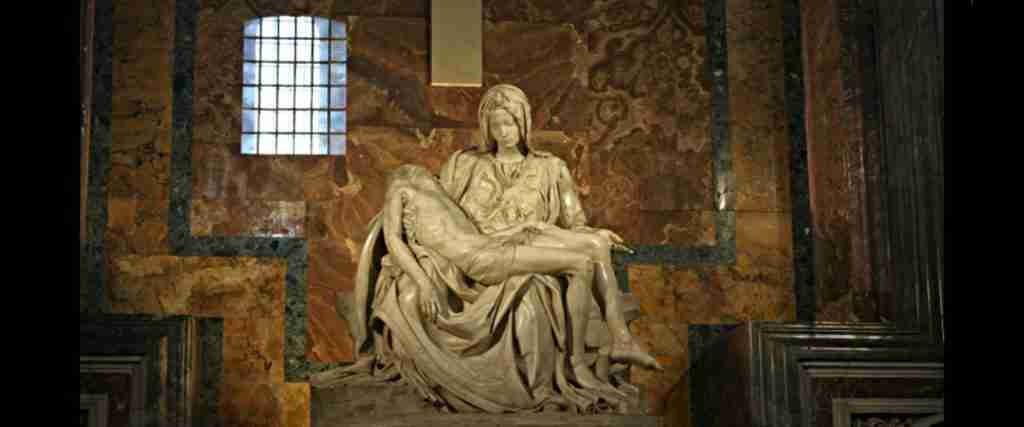
Michelangelo’s Pietà occupies the first chapel on the right as visitors enter through the basilica’s main portal, positioned in a protective niche behind bulletproof glass following damage inflicted by a vandal’s hammer in 1972. Created between 1498 and 1499 when Michelangelo was just 24 years old, the sculpture depicts the Virgin Mary cradling Christ’s dead body after the Crucifixion, carving both figures from a single block of Carrara marble with technical mastery that established Michelangelo’s reputation. The Virgin’s youthful face contrasts with her son’s adult body, a deliberate choice representing Mary’s eternal purity while Christ’s idealized anatomy demonstrates Michelangelo’s understanding of human form derived from anatomical studies.
The Pietà’s surface finish achieves luminous polish that makes marble appear soft as flesh, particularly evident in the drapery folds cascading across Mary’s lap and Christ’s lifeless limbs. Michelangelo employed sophisticated carving techniques varying surface texture from high polish on skin to rougher treatment on clothing, creating visual variety enhancing the sculpture’s emotional impact. The work represents the only piece Michelangelo ever signed, with his signature carved across the sash crossing Mary’s chest reading “MICHEL.ANGELUS BONAROTUS FLORENT.FACIEBAT” (Michelangelo Buonarroti, Florentine, made this), reportedly added after the artist overheard visitors attributing the masterpiece to another sculptor.
Bernini’s bronze baldachin rises above the papal altar at the crossing, directly beneath the dome and over Saint Peter’s tomb in the grottoes below. Commissioned by Pope Urban VIII in 1624 and completed in 1633, the baldachin stands 28.74 meters tall, creating Baroque architectural sculpture functioning as both symbolic canopy and dramatic focal point. Four twisted bronze columns support an elaborate canopy decorated with sculpted angels, papal emblems, bronze drapery, and architectural elements combining real and illusionistic forms. The twisted column design references ancient columns from Constantine’s basilica believed to have come from Solomon’s Temple in Jerusalem, appropriating Old Testament authority while demonstrating Baroque sculptural virtuosity.
The baldachin’s bronze derived partly from ancient Roman monuments, with bronze stripped from the Pantheon’s portico providing raw material alongside metal from Urban VIII’s own artillery. This repurposing of ancient materials sparked controversy summarized in the contemporary quip “What the barbarians didn’t do, the Barberini did,” referencing Urban VIII’s family name while criticizing the practice of cannibalizing Rome’s classical heritage for papal glorification. The baldachin’s base features four marble pedestals decorated with the Barberini coat of arms including the family’s bee motif, while the canopy top supports cross and orb symbolizing Christ’s triumph and papal authority extending across the Christian world.
The Cathedra Petri occupies the apse beyond the papal altar, designed by Bernini between 1656 and 1665 to enshrine a wooden chair tradition claims belonged to Saint Peter himself, though modern analysis dates the actual chair to the 9th century. Bernini’s monumental sculpture surrounds the ancient relic with an elaborate bronze throne supported by four Doctors of the Church rendered in bronze at larger-than-life scale. Above the throne, angels and putti support papal insignia while a dove representing the Holy Spirit appears in a golden glory surrounded by sculpted clouds and rays creating supernatural illumination enhanced by a hidden window providing actual light from behind the composition.
Numerous papal tombs and monuments occupy chapels, niches, and wall spaces throughout the basilica, ranging from simple floor markers to elaborate sculptural ensembles by major artists including Bernini, Canova, and Algardi. Pope Alexander VII’s tomb by Bernini features an elaborate marble composition with allegorical virtues surrounding the praying pope while a bronze skeleton emerges from beneath red jasper drapery holding an hourglass symbolizing mortality. Antonio Canova’s neoclassical monument to Pope Clement XIII depicts the kneeling pope flanked by allegorical figures of Religion and Death rendered in pristine white marble contrasting with the surrounding Baroque exuberance, demonstrating how successive artistic styles layered across centuries within the basilica’s evolving interior decoration.
Entry Procedures and Security Screening
St. Peter’s Basilica entry requires passing through airport-style security screening regardless of whether visiting the free basilica or purchasing dome tickets. Security checkpoints process all visitors through metal detectors and bag scanners positioned at the colonnade perimeter before allowing access to St. Peter’s Square and the basilica entrance. Guards prohibit large backpacks, rolling luggage, sharp objects, and containers exceeding standard carry-on dimensions, with no luggage storage available meaning oversized items must be left at hotels or lockers outside Vatican City boundaries.
Queue lengths vary dramatically based on time, season, and day of week, ranging from 20-30 minutes during quiet periods to exceeding two hours during peak summer months and religious holidays. Morning hours between 9:00 AM and 12:00 PM typically show heaviest crowding as tour groups concentrate visits during standard sightseeing hours, while afternoon entry after 2:00 PM generally encounters lighter crowds. Wednesday mornings require special consideration due to Papal Audience events that close the basilica until approximately 12:30 PM, creating concentrated crowds once reopening occurs as morning visitors merge with afternoon arrivals.
The right-hand security entrance in St. Peter’s Square provides wheelchair-accessible screening without stairs, while the standard left-hand entrance involves steps that wheelchair users cannot navigate. Visitors requiring accessibility should proceed directly to the designated accessible entrance where staff provide assistance through the screening process and into the basilica. The accessible route continues inside the church with ramps allowing wheelchair users to view most ground-floor areas, though the dome and certain chapels remain inaccessible due to stairs.
Multiple security lines converge at the screening checkpoints, with no separate express lanes for ticket holders or tour groups. Guided tour participants receive no preferential security treatment, though experienced guides understand optimal arrival times and positioning strategies minimizing wait duration. Independent visitors can reduce screening time by arriving at 7:00 AM opening when queues are shortest, though this requires early wake-up calls and potentially missing hotel breakfast service. Late afternoon entry around 4:00 PM similarly avoids peak crowding, providing approximately two hours before the 6:00 PM closure though insufficient time for thorough basilica exploration plus dome climbing.
Security staff enforce strict prohibited item rules including refusing entry to visitors carrying pocket knives, scissors, tools, aerosol containers, tripods, selfie sticks, and professional camera equipment beyond standard tourist photography gear. Confiscated items are not stored for later retrieval but rather permanently seized, making careful packing essential before approaching security. Small bags, purses, and daypacks receive thorough inspection with contents potentially examined individually if scanners detect questionable objects. The screening process mirrors airport security rigor, reflecting Vatican City’s status as sovereign territory requiring protection against both theft and potential security threats targeting the Pope, artistic treasures, and millions of annual visitors.
Dress Code Requirements and Enforcement
St. Peter’s Basilica enforces strict dress codes applicable to all visitors regardless of age, gender, nationality, or religious affiliation. Shoulders and knees must be covered completely, prohibiting shorts, miniskirts, sleeveless tops, tank tops, low-cut shirts, and clothing revealing midriff or excessive skin. The requirements apply equally to basilica entry and dome climbing, with guards stationed at entry points turning away inappropriately dressed visitors before they pass security screening. No exceptions exist for hot weather, casual touring, or claimed ignorance of requirements widely publicized through guidebooks and official websites.
Enforcement occurs at multiple checkpoints creating sequential opportunities for guards to reject improperly dressed visitors. Initial screening at security checkpoints catches obvious violations, while secondary inspection at the basilica entrance door provides final verification before allowing interior access. Guards demonstrate consistency in enforcement regardless of circumstances, refusing entry to visitors attempting to argue exceptional cases or claiming special status. No covering garments are provided, requiring rejected visitors to leave Vatican City, purchase appropriate clothing from nearby shops, and return through security screening losing substantial time from their visit schedules.
Appropriate clothing for men includes long pants or knee-length shorts paired with shirts having sleeves of any length covering shoulders. Women should wear pants, knee-length skirts or dresses, and tops covering shoulders through sleeves, high necklines, or layered garments. Sheer fabrics providing only transparent coverage fail to meet standards despite technically covering skin. During summer heat, lightweight cotton or linen garments in loose cuts provide comfort while satisfying requirements, with many experienced visitors carrying large scarves or shawls allowing quick shoulder coverage when needed for churches after dressing more casually for outdoor sightseeing.
The dress code reflects St. Peter’s ongoing function as an active place of worship rather than merely tourist attraction, with daily Masses, religious services, and pilgrimage activities occurring simultaneously with tourist traffic. Catholic tradition emphasizes modest dress in sacred spaces, considering revealing clothing disrespectful to the religious significance and sanctity of churches housing consecrated altars and sacred relics. The requirements also aim to maintain appropriate atmosphere for the millions of pilgrims visiting St. Peter’s as spiritual destination rather than secular monument, preventing tourist informality from overwhelming the space’s religious character.
Violations result in immediate ejection with no refunds for advance-purchased dome tickets or tour bookings, creating potential financial loss beyond mere inconvenience. Tour operators typically emphasize dress code requirements during booking and through reminder emails, understanding that a single participant’s inappropriate dress can delay or disrupt entire group schedules. Independent visitors bear sole responsibility for compliance, with no appeals process or alternative accommodation available once guards reject entry. Planning appropriate clothing before reaching Vatican City prevents embarrassment, wasted time, and financial losses while demonstrating respect for Catholic traditions and the sacred nature of Christianity’s most important church.
Dome Climb: Tickets, Routes, and Physical Requirements
Dome climbing tickets are purchased at a dedicated kiosk located in the basilica’s portico to the right after passing through security screening and approaching the church entrance. The ticket office operates during dome opening hours, selling tickets on a first-come, first-served basis with no advance reservations available on-site though online booking through the official basilica website allows reserved time slots. On-site prices range from €8 for the all-stairs route to €10 for the elevator-assisted climb, while online bookings cost €17 for stairs or €22 with elevator, including digital audio guides for basilica exploration before the dome ascent.
The elevator route begins at ground level, ascending 231 steps worth of elevation to the first terrace level at the dome’s base where an interior walkway circles the inside perimeter. This walkway provides views down into the basilica from 80 meters above the floor, revealing the papal altar, baldachin, and nave’s full length from an unusual perspective emphasizing the building’s vast scale. The mosaic decoration covering the dome’s interior appears at close range from this level, allowing examination of individual tesserae and artistic techniques invisible from the floor. A gift shop, restrooms, and small cafe occupy this terrace level, providing final amenities before the challenging climb resumes.
From the interior walkway, the remaining 320 steps ascend through narrow passages between the dome’s double shells, following the dome’s curve as walls slope increasingly inward creating the confined conditions causing difficulties for claustrophobic visitors. The stairway begins relatively wide but progressively narrows, eventually reaching points where walls nearly touch and visitors must navigate tight spiral turns in near-darkness punctuated by small windows providing occasional glimpses outward. Bidirectional traffic in these confined passages creates congestion as ascending and descending visitors negotiate passage, sometimes requiring one direction to pause while the other passes through particularly tight sections.
The summit emerges onto the circular observation deck surrounding the lantern base, providing 360-degree views at 136 meters elevation with protective railings preventing accidents while allowing unobstructed sightlines. The deck measures approximately three meters wide, allowing comfortable circulation though crowding occurs when multiple visitor groups arrive simultaneously. Weather conditions at this height can differ significantly from ground level, with strong winds common even on calm days below and temperatures often cooler than the plaza. The descent follows the same route back down, requiring careful footing on worn marble steps and patience during congested moments in the narrow spiral passages.
Physical requirements for the dome climb are substantial despite the availability of elevator assistance for the initial ascent. The final 320 steps cannot be avoided regardless of fitness level, making the climb unsuitable for visitors with significant mobility limitations, heart conditions, respiratory problems, severe claustrophobia, pregnancy, or anyone requiring assistive walking devices. No rest areas exist within the confined spiral stairway, though small landing platforms allow brief pauses. The entire climb typically requires 45 minutes to one hour depending on pace and crowding, with additional time needed for viewing from the summit before descending. Comfortable walking shoes with good traction are essential, as polished marble steps worn smooth by millions of visitors can become slippery, particularly during descent when downward momentum increases slip risk.
Vatican Grottoes: Papal Tombs Beneath the Basilica
The Vatican Grottoes occupy the space beneath St. Peter’s Basilica’s main floor, located at the level of the old Constantinian basilica’s floor before Carlo Maderno’s nave extension raised the new church’s pavement approximately three meters higher. This underground chapel network houses papal tombs, sacred relics, and architectural fragments from the demolished ancient basilica, creating a historical and spiritual counterpoint to the Renaissance grandeur above. Entry to the grottoes is free and included with basilica admission, accessed via stairs descending from the basilica floor near the crossing.
Approximately 91 popes are buried in the grottoes, ranging from early medieval pontiffs through modern popes including John Paul II before his remains were moved upstairs to a chapel following beatification. The tombs vary from simple floor markers to elaborate sculptural monuments, with many featuring the deceased pope’s coat of arms, Latin epitaphs summarizing their reign, and architectural frames matching the period’s artistic styles. The grottoes’ low vaulted ceilings and subdued lighting create solemn atmosphere appropriate for contemplating papal succession spanning nearly two millennia from Saint Peter through contemporary pontiffs.
Chapel dedicated to the Madonna della Bocciata, Clementine Chapel housing Popes Gregory the Great and Pius VII, and numerous smaller burial spaces radiate from the central corridor following the basilica’s floor plan above. Remnants from Constantine’s basilica include columns, capitals, decorative fragments, and architectural elements salvaged during Renaissance demolition and preserved in the grottoes as historical artifacts. These ancient pieces provide material evidence of the original church’s appearance, helping scholars reconstruct fourth-century Christian architecture through surviving fragments supplementing written descriptions.
The confessio, a sunken area directly beneath the papal altar, provides the closest approach to Saint Peter’s traditional tomb location in the ancient necropolis deeper below. A niche contains the Pallium Niche where newly appointed metropolitan archbishops receive their pallia (liturgical vestments symbolizing authority) from the Pope during ceremonies conducted at the papal altar above. This vertical alignment of altar, confessio, and tomb creates the basilica’s spiritual axis where liturgical celebration connects to apostolic foundation through physical proximity to Peter’s burial place sanctifying the church’s religious authority.
Access to the deeper Vatican Necropolis beneath the grottoes requires separate advance booking through the Vatican’s Excavations Office, as these archaeological spaces accommodate only small groups due to preservation concerns and confined passages. The necropolis visit descends to the original ground level, revealing Roman-era tombs, Christian burial sites, and structures identified as Constantine’s memorial to Saint Peter built around the apostle’s original grave marker. These excavations conducted during the 1940s provided archaeological evidence supporting traditional beliefs about Peter’s burial location, though scholarly debate continues regarding definitive proof of the tomb’s occupant’s identity.
Planning Your Visit: Timing, Duration, and Combination Strategies
A comprehensive St. Peter’s Basilica visit including dome climb requires minimum two to three hours for visitors maintaining moderate pace without rushing key highlights. The basilica interior alone deserves 60 to 90 minutes for viewing major artworks including Michelangelo’s Pietà, walking the full nave length, examining Bernini’s baldachin and Cathedra Petri, and visiting several chapels displaying Renaissance and Baroque art. The dome climb adds another 60 minutes including ascent, summit viewing time, and descent, while Vatican Grottoes exploration requires an additional 20 to 30 minutes if visiting papal tombs interests you.
Early morning arrival at 7:00 AM opening provides optimal conditions with minimal security queues, empty basilica allowing contemplative viewing of artistic treasures without crowds, and sufficient time for thorough exploration plus dome climbing before midday heat and tour group influx. Summer sunrise occurs early enough that 7:00 AM entry provides good natural lighting through the basilica’s windows, while winter’s later dawn means early visitors experience dimmer interior illumination until eastern windows catch morning sun. Early visitors can complete entire visits by 10:00 AM, leaving afternoons free for Vatican Museums, Rome sightseeing, or simply avoiding midday heat.
Late afternoon entry around 4:00 PM encounters reduced crowds as morning visitors depart and tour groups conclude daily schedules. However, the two-hour window before 6:00 PM closure permits only abbreviated visits, potentially insufficient for both basilica and dome if security queues extend 30 to 45 minutes. Late entry works better for repeat visitors focusing on specific artworks or those content viewing highlights without comprehensive exploration. The late afternoon light creates dramatic illumination through western windows, though the dome closes at 5:00 PM in winter and 6:00 PM in summer, eliminating dome climbing for visitors entering after 3:30 PM due to the time required for the complete ascent and descent.
Combining St. Peter’s with Vatican Museums and Sistine Chapel creates full-day Vatican itineraries covering both complexes. However, these attractions occupy opposite sides of Vatican City with no internal connection for general visitors, requiring walking around the exterior walls consuming approximately 20 minutes between the basilica’s St. Peter’s Square entrance and the Vatican Museums’ entrance on Viale Vaticano. Guided tours can access a direct passage from the Sistine Chapel into St. Peter’s, bypassing security lines though not eliminating the screening all visitors must undergo. The Vatican Museums typically require three to four hours minimum, making combined visits demanding days requiring early starts and sustained walking stamina.
Wednesday morning Papal Audiences close the basilica until approximately 12:30 PM, eliminating morning visiting hours and creating concentrated afternoon crowds when closure ends. Visitors should avoid Wednesday mornings entirely unless attending the Papal Audience itself, which requires free tickets obtained through official channels or tour operators. Papal Audience attendance provides unique opportunities to see the Pope deliver addresses and blessings to assembled crowds in St. Peter’s Square, though the event focuses on ceremonial experience rather than artistic viewing and prevents basilica touring during the morning hours. The dome remains closed during Audiences, reopening alongside the basilica once the ceremony concludes.
Photography Guidelines and Restrictions
Photography without flash is permitted throughout most of St. Peter’s Basilica, allowing visitors to document artistic treasures, architectural details, and their visit experience through personal images. Flash photography is strictly prohibited as the intense light potentially damages delicate artwork surfaces, disturbs other visitors, and creates inappropriate atmosphere in the sacred space. Professional camera equipment including tripods, monopods, and lighting gear cannot be brought into the basilica, with security screening rejecting oversized camera bags and equipment cases exceeding standard tourist camera dimensions.
Michelangelo’s Pietà permits photography from the viewing area in front of the protective glass barrier, though the enclosure’s placement and lighting create challenges for amateur photographers attempting to capture the sculpture’s details without reflections. The glass barrier installed following 1972 vandalism reflects overhead lighting, camera flashes (if anyone violates the prohibition), and surrounding architectural elements, requiring careful positioning and sometimes waiting for other visitors to clear from reflection zones. Professional photographers understand that morning side-lighting provides better illumination than afternoon conditions, making early visits optimal for Pietà photography beyond crowd avoidance benefits.
The dome’s interior walkway and summit observation deck permit photography capturing both downward views into the basilica and outward panoramas across Rome. The confined spiral staircase between levels creates difficulties for photography due to narrow passages, poor lighting, and continuous visitor traffic preventing pauses for careful composition. The observation deck’s 360-degree access allows comprehensive panoramic sequences, though protective railings appear in all images unless carefully framed through gaps. Smartphone cameras perform better than large DSLRs in the tight spiral passages, being easier to position and operate while navigating stairs.
The Vatican Grottoes maintain the same no-flash photography policy as the basilica above, though the underground spaces’ low ambient lighting creates challenges for capturing tomb details and architectural fragments without flash or tripod support. Modern cameras with effective high-ISO performance produce acceptable results, while smartphone computational photography algorithms increasingly compensate for difficult lighting through multiple-exposure blending. The grottoes’ narrow corridors and visitor traffic make tripod use impractical even if permitted, requiring either braced handheld shooting or accepting limitations inherent in available-light underground photography.
During religious services including daily Masses and special ceremonies, photography is discouraged out of respect for worshippers and liturgical solemnity. While enforcement varies, considerate visitors avoid photographing during active services, recognizing that the basilica’s primary function as place of worship takes precedence over tourist documentation. The sound of camera shutters, viewfinder glow, and movement required for positioning shots disrupts contemplative atmosphere and disturbs participants focused on spiritual rather than touristic experience. Guards may request visitors to cease photography during services, with compliance expected despite general permission for photography existing outside liturgical times.
Accessibility for Visitors with Disabilities
St. Peter’s Basilica provides wheelchair accessibility to the main floor through the designated accessible entrance on the right side of St. Peter’s Square’s security screening area. This entrance avoids stairs present at standard entry points, featuring ramps allowing wheelchair users to pass through security and enter the basilica without assistance beyond what companions can provide. Once inside, the main floor is largely accessible via ramps at level changes, allowing wheelchair users to view Michelangelo’s Pietà, approach the papal altar, and circulate through the nave and transepts experiencing the basilica’s primary artistic treasures.
The dome climb presents complete inaccessibility for wheelchair users and visitors with severe mobility impairments, as the elevator only ascends partway before stairs become unavoidable. The final 320 steps include narrow passages incompatible with any mobility assistance devices, creating absolute barriers preventing access to upper levels and summit views. Alternative elevated viewpoints exist at the Castel Sant’Angelo observation terrace and various Roman hills, though none match the dome’s unique perspective or proximity to St. Peter’s Square. Visitors unable to climb stairs can experience the basilica’s ground-level treasures thoroughly without missing essential artistic elements concentrated on the main floor.
The Vatican Grottoes require descending stairs from the basilica floor, presenting barriers for wheelchair users and those unable to navigate stairways. No elevator or lift access exists to the underground level, as the historical structure predates modern accessibility requirements and underground conditions prevent retrofitting equipment. The grottoes’ papal tomb collection and architectural fragments remain inaccessible to mobility-impaired visitors, though the grottoes represent supplementary rather than essential components of the basilica experience.
Visitors with visual impairments benefit from the basilica’s tactile architectural elements and scale permitting close approach to many sculptures and decorative details not isolated behind barriers. However, no comprehensive tactile models or audio description systems exist providing detailed verbal explanations of artistic elements. Guided tours can provide verbal descriptions, though standard group tours move too quickly for detailed explanation satisfying thoroughly blind visitors’ needs. Private tours arranged in advance allow customized pacing and extensive verbal description, offering better accommodation than independent visits or standard group experiences.
Hearing-impaired visitors encounter no inherent barriers to visual appreciation of the basilica’s artistic treasures, though audio guides and guided tour commentary become inaccessible without captioning or sign language interpretation. The official basilica audio guide available through smartphone apps lacks captioning features, limiting utility for deaf visitors. Written guidebooks and information panels provide alternative information sources, though these lack the comprehensive coverage audio guides deliver. Private tours employing guides with sign language skills or providing written materials alongside verbal commentary accommodate deaf visitors more effectively than standard offerings.
Combining St. Peter’s with Vatican Museums
St. Peter’s Basilica and Vatican Museums occupy opposite ends of Vatican City, separated by approximately 20 minutes walking distance around the exterior walls for visitors without internal passage access. The museums’ entrance on Viale Vaticano and the basilica’s entrance via St. Peter’s Square require circumnavigating the perimeter walls, as no public pathway cuts through Vatican gardens or internal courtyards connecting the two complexes. This separation means combined visits require substantial walking beyond the extensive distances covered within each attraction, challenging visitors with limited stamina or mobility constraints.
Guided tours can access a direct passage from the Sistine Chapel into St. Peter’s Basilica, bypassing the external walk and avoiding basilica security queues by entering through a restricted doorway. However, this privilege applies only to organized tour groups with accredited guides, not independent visitors purchasing museum tickets separately from basilica visits. Tour access saves significant time and walking distance, making guided combinations attractive despite higher costs compared to independent exploration. The Sistine-to-basilica passage deposits visitors inside St. Peter’s, allowing exit through the main doors but preventing return to the museums without walking around to re-enter through the Viale Vaticano entrance.
Vatican Museums visits require three to four hours minimum for viewing major galleries including the Raphael Rooms, Gallery of Maps, and Sistine Chapel without excessive rushing past lesser galleries. Adding St. Peter’s with dome climb creates six to seven-hour combined itineraries requiring early starts, sustained walking stamina, and potentially missing detailed appreciation of either complex’s treasures through fatigue. Full-day Vatican visits work best with early museum entry at 9:00 AM opening, museum touring through early afternoon, lunch break, then late afternoon basilica visit around 3:00 or 4:00 PM when crowds lighten though dome climbing becomes impossible due to closure times.
Tickets for Vatican Museums must be purchased separately from basilica entry, which remains free. Museum tickets cost €20 for full admission plus €5 online reservation fee when booking through the official Vatican website, with various discounts applying to children, students, and other categories. The online reservation system prevents walk-up ticket purchases, requiring advance booking hours or days ahead depending on season and day of week. Skip-the-line tickets and guided tours cost more but eliminate the lengthy standard entry queues that can extend to two hours during peak summer months and holiday periods.
Strategic timing maximizes combined visit efficiency by recognizing that Vatican Museums become progressively more crowded from opening through midday before lightening late afternoon, while St. Peter’s Basilica shows opposite patterns with morning crowds concentrating around tour group schedules. Starting with museums at opening allows progression through galleries while crowds remain relatively light, then visiting the basilica later afternoon encounters fewer visitors than morning basilica entry would face. However, this strategy eliminates dome climbing unless accomplished before museum entry, requiring very early arrival completing dome ascent before 9:00 AM museum opening to accommodate full itinerary within daylight hours.
Nearby Attractions and Extended Itineraries
Castel Sant’Angelo stands approximately 10 minutes walking from St. Peter’s Square along Via della Conciliazione, originally constructed as Emperor Hadrian’s mausoleum in 139 CE before medieval conversion into papal fortress and prison. The cylindrical structure connected to Vatican City via elevated Passetto corridor allowing popes emergency escape during invasions, with the fortified passage still visible running above street level. Castel Sant’Angelo houses a museum displaying papal apartments, weapon collections, Renaissance frescoes, and offering observation terrace views across the Tiber toward St. Peter’s dome, providing reciprocal sightlines to the basilica’s summit observation deck.
The Borgo neighborhood surrounding Vatican City contains medieval streets, restaurants serving Roman cuisine, souvenir shops, and artisan workshops clustered around the pilgrimage routes that historically accommodated millions of visitors approaching St. Peter’s. Via Borgo Pio preserves relatively authentic character compared to Via della Conciliazione’s Mussolini-era Fascist architecture, featuring narrow lanes with trattorias offering lunch breaks between morning Vatican Museums visits and afternoon basilica touring. The neighborhood’s proximity makes it convenient for meals, though prices typically run higher than restaurants in Trastevere or central Rome due to tourist concentration.
Piazza Navona occupies the site of ancient Domitian’s Stadium, located approximately 15 minutes walking east from St. Peter’s Square through medieval streets crossing the Tiber River at Ponte Sant’Angelo. The elongated piazza preserves the Roman racetrack’s outline, surrounded by Baroque architecture including Borromini’s Sant’Agnese church and featuring Bernini’s Fountain of the Four Rivers as the central sculptural ensemble. The piazza’s cafes, street artists, and architectural grandeur create pleasant afternoon destinations following morning Vatican visits, though restaurant prices reflect prime tourist location rather than local pricing.
Trastevere’s medieval neighborhood extends south across the Tiber from Vatican City, reached via 20-25 minute walks through winding cobblestone streets lined with Renaissance palaces, artisan shops, and traditional restaurants favored by Romans over tourist-oriented establishments. The neighborhood’s Santa Maria church contains medieval mosaics, while narrow lanes preserve authentic character despite increasing gentrification and tourist traffic. Evening visits to Trastevere following full-day Vatican itineraries provide atmospheric dining options and Roman nightlife experiences beyond Vatican City’s sacred atmosphere.
Villa Borghese gardens and Galleria Borghese museum occupy extensive parklands approximately 30 minutes walking northeast from Vatican City, though Metro Line A provides efficient public transit connection. The gallery requires advance ticket reservations due to visitor caps protecting Bernini sculptures, Caravaggio paintings, and ancient Roman statuary within the cardinal’s former villa. Combining Villa Borghese with Vatican visits creates extremely ambitious full-day itineraries possible only for energetic visitors willing to traverse Rome’s distances through walking or efficient Metro connections between widely separated attractions.
Frequently Asked Questions
Can I visit St. Peter’s Basilica for free?
St. Peter’s Basilica entry is completely free with no admission charge for the main church, though visitors must still pass through mandatory security screening that can create queues extending one to two hours during peak seasons. The dome climb requires separate paid tickets costing €8-10 on-site or €17-22 when reserved online with included audio guide. The Vatican Grottoes beneath the basilica also offer free access included with main church entry. Guided tours charge fees for expert commentary and potential time savings, though they cannot bypass security screening applying universally to all visitors entering Vatican City.
Is the dome climb worth the effort?
The dome climb provides unparalleled 360-degree panoramic views across Vatican City, Rome, and surrounding landscapes from 136 meters elevation, revealing perspectives impossible from ground level including the geometric perfection of Bernini’s St. Peter’s Square and comprehensive city vistas extending to distant hills. However, the climb requires navigating 320 steps through increasingly narrow, claustrophobic spiral passages after taking the elevator, or 551 total steps climbing entirely by stairs. The physical challenge and confined conditions make the experience unsuitable for visitors with mobility limitations, severe claustrophobia, pregnancy, or significant fitness concerns, though most reasonably fit visitors complete the ascent without serious difficulty and report the summit views justify the effort.
How early should I arrive to avoid crowds?
Arriving at 7:00 AM opening time provides optimal crowd avoidance with minimal security queues, nearly empty basilica interiors allowing contemplative viewing, and sufficient time for thorough exploration plus dome climbing before midday tour group influx. Early arrival requires sacrificing hotel breakfast and potentially encountering less dramatic interior lighting before full sunrise, but saves substantial time otherwise spent in security and dome ticket queues. Alternative timing around 4:00 PM late afternoon encounters reduced crowds as morning visitors depart, though the limited hours before 6:00 PM closure restrict comprehensive visits and eliminate dome climbing when closing occurs at 5:00 PM or 6:00 PM depending on season.
What happens if I’m wearing shorts or sleeveless clothing?
Guards stationed at security checkpoints and basilica entrance doors turn away visitors wearing shorts, miniskirts, sleeveless tops, or revealing clothing that violates the strict dress code requiring covered shoulders and knees. Rejection occurs before passing through security screening, with no exceptions granted for weather, ignorance of requirements, or attempted negotiation. No covering garments are provided or available for borrowing, requiring rejected visitors to leave Vatican City, purchase appropriate clothing from nearby shops, and return through security screening losing significant time from their visit schedule. Advance-purchased dome tickets or tour bookings provide no refunds when dress code violations prevent entry.
Can I take photos inside St. Peter’s Basilica?
Photography without flash is permitted throughout most of the basilica, dome climb passages, observation deck, and Vatican Grottoes, allowing documentation of artistic treasures and personal visit experiences. Flash photography is strictly prohibited as it potentially damages artwork, disturbs other visitors, and creates inappropriate atmosphere in sacred spaces. Tripods, monopods, selfie sticks, and professional lighting equipment cannot be brought inside, with security screening rejecting oversized camera gear. During religious services including Masses and ceremonies, photography is discouraged out of respect for worshippers and liturgical solemnity, with guards potentially requesting visitors to cease photographing during active services despite general permission existing outside liturgical times.
How long does the entire visit take?
A comprehensive visit including the basilica interior exploration and dome climb requires minimum two to three hours for visitors maintaining moderate pace. The basilica alone deserves 60 to 90 minutes for viewing Michelangelo’s Pietà, Bernini’s baldachin and Cathedra Petri, walking the full nave length, and examining several chapels. The dome climb adds 60 minutes including ascent through elevator or stairs to first terrace, final 320 step spiral climb to summit, observation deck viewing time, and complete descent. Vatican Grottoes add another 20 to 30 minutes if visiting papal tombs interests you, creating potential total durations of three to four hours when exploring all available areas thoroughly.
Is there wheelchair access to the dome?
The dome climb provides no wheelchair accessibility, as the elevator only ascends partway before 320 stairs become unavoidable including narrow spiral passages incompatible with wheelchairs or mobility assistance devices. The confined final spiral between the dome’s double shells measures barely wide enough for single-file pedestrian traffic, creating absolute barriers preventing any wheeled access. The basilica’s main floor provides good wheelchair accessibility via the right-side accessible entrance featuring ramps instead of stairs, allowing wheelchair users to view ground-level artistic treasures including Michelangelo’s Pietà, Bernini’s baldachin, and complete nave circulation. The Vatican Grottoes also remain inaccessible to wheelchair users due to stairs without elevator alternatives descending from the basilica floor.
When are Papal Audiences, and how do they affect visits?
Papal Audiences typically occur Wednesday mornings in St. Peter’s Square or Paul VI Audience Hall, closing both the square and basilica until approximately 12:30 PM when the ceremony concludes. The specific schedule varies throughout the year with summer breaks, papal travel, and religious calendar affecting consistency. Visitors should avoid Wednesday mornings entirely unless specifically attending the Papal Audience, which requires free tickets obtained through official Vatican channels, embassies, or tour operators weeks in advance. Wednesday afternoon entry after 12:30 PM reopening encounters concentrated crowds as morning visitors merge with afternoon arrivals, creating above-average congestion compared to other weekdays. The dome also closes during Papal Audiences, reopening alongside the basilica once ceremonies complete.
Can I access St. Peter’s directly from the Sistine Chapel?
Organized guided tours can access a direct passage from the Sistine Chapel into St. Peter’s Basilica through a restricted doorway unavailable to independent visitors. This tour-only passage saves approximately 20 minutes walking around Vatican City’s exterior walls and bypasses basilica security queues by entering through an internal door. However, the privilege applies exclusively to accredited tour groups, not museum ticket holders exploring independently. The passage operates one-way from Sistine Chapel to basilica, allowing exit through St. Peter’s main doors but preventing return to Vatican Museums without walking around to re-enter through the Viale Vaticano entrance. Independent visitors must complete Vatican Museums tours before exiting to the street, then walk around the exterior walls to reach St. Peter’s Square and basilica entrance separately.
Are there guided tours combining the basilica and dome?
Numerous guided tours combine St. Peter’s Basilica exploration with dome climbing, providing expert commentary explaining artistic treasures, architectural history, and religious significance while managing group logistics through security screening and dome ticket purchases. Tour prices range from €25 to €60 depending on group size, duration, additional inclusions like Vatican Museums access, and whether priority entrance benefits apply. Some tours include the Vatican Grottoes papal tombs alongside basilica and dome, creating comprehensive three-hour experiences covering all publicly accessible areas. Specialized tours focus exclusively on St. Peter’s with deeper architectural and artistic analysis than general Vatican tours attempting to cover multiple sites within limited timeframes, appealing to visitors particularly interested in Renaissance and Baroque architecture rather than dispersing attention across Vatican Museums’ extensive galleries.