Visiting The Last Supper by Leonardo da Vinci: Complete Guide
Leonardo da Vinci’s The Last Supper stands as one of the world’s most celebrated and fragile masterpieces, housed in the refectory of Santa Maria delle Grazie in Milan. Viewing this Renaissance marvel requires advance planning, strict reservation protocols, and precisely timed entry, as only 40 visitors spend 15 minutes with the painting per session. This guide provides comprehensive information on securing tickets, understanding Leonardo’s revolutionary technique, navigating the booking process, and maximizing your brief yet powerful encounter with this UNESCO World Heritage artwork.
Key Takeaways
- Advance reservation is mandatory for all visitors including children and infants, with tickets released quarterly and selling out within hours during peak periods
- Viewing is strictly limited to 15 minutes per group of 40 visitors in climate-controlled conditions to preserve Leonardo’s fragile experimental tempera technique
- Standard admission costs €15 with reservations through the official website, phone booking, or guided tours ranging €65-159 when individual slots sell out
- Leonardo painted The Last Supper between 1495-1498 using an experimental dry technique rather than traditional fresco, causing deterioration within his own lifetime
- Only 42-50% of Leonardo’s original paint remains after centuries of damage, with the 21-year restoration (1978-1999) revealing authentic details beneath layers of overpainting
- The painting is accessible via M1 metro to Conciliazione station (5-minute walk) or Tram 16 directly to the church entrance in Milan’s Corso Magenta district
People Also Ask About Visiting The Last Supper
Can you visit The Last Supper without advance booking?
No, walk-up visits are not possible at The Last Supper Museum. All admissions require advance reservation through the official booking system, guided tour operators, or authorized partners. The strict timed-entry system admits only 40 visitors every 15 minutes to protect the painting’s fragile condition, making spontaneous visits impossible. The museum’s on-site desk validates existing reservations but does not sell new tickets. Even free admission days (first Sunday of each month) require advance reservation, with tickets released the preceding Wednesday at noon and selling out within 20 minutes.
Why is viewing time limited to 15 minutes?
The 15-minute viewing limit exists to protect Leonardo’s deteriorating masterpiece from environmental damage caused by human presence. Leonardo’s experimental dry tempera technique created an extremely fragile surface vulnerable to humidity, temperature fluctuations, and particulate matter. Each visitor exhales moisture and generates heat, and even minimal increases in humidity cause condensation that accelerates paint deterioration. The climate-controlled refectory maintains precise air quality standards, and limiting visitor numbers and duration prevents exceeding safe humidity and temperature thresholds. This preservation strategy balances public access with conservation, ensuring the painting survives for future generations despite its inherent fragility.
How much of the original painting survives today?
Between 42% and 50% of Leonardo da Vinci’s original paint surface remains on The Last Supper today. The painting began deteriorating within Leonardo’s lifetime, with documentation from 1517 noting decay. Centuries of environmental damage, inappropriate restoration attempts, war exposure, and Leonardo’s experimental technique resulted in extensive paint loss. The 21-year restoration (1978-1999) removed layers of overpainting and previous restoration work to reveal Leonardo’s surviving original details, including the Assisi embroidery on the tablecloth and gold lettering on Judas’s robe. What viewers see today represents the authentic fragments of Leonardo’s work rather than reconstructed interpretations, making the experience both powerful and poignant.
What makes Leonardo’s Last Supper technique revolutionary?
Leonardo revolutionized wall painting by rejecting traditional fresco technique in favor of an experimental approach using tempera and oil on dry plaster. Standard fresco painting applies pigment to wet plaster, bonding permanently as it dries, but Leonardo wanted more working time to perfect facial expressions and complex details. He painted on a prepared gesso layer over dry plaster, allowing extended revision and subtle gradations impossible with quick-drying fresco. This innovation enabled Leonardo to capture unprecedented psychological depth and emotional nuance in each apostle’s reaction to Jesus’s betrayal announcement. However, the technique proved catastrophically unstable, as the gesso layer contracted and detached from the wall, causing paint to flake away within decades of completion.
Extended multi-day tours – 5+ days
Featured Milan Multi-Day Tour Packages

3 days
Milan 3-Day Discovery Tour
- ✓ Comprehensive Milan experience
- ✓ Expert local guides included
- ✓ All accommodation included
- ✓ Transportation provided

5 days
Milan 5-Day Highlights Experience
- ✓ Comprehensive Milan experience
- ✓ Expert local guides included
- ✓ All accommodation included
- ✓ Transportation provided

7 days
Milan 7-Day Cultural Journey
- ✓ Comprehensive Milan experience
- ✓ Expert local guides included
- ✓ All accommodation included
- ✓ Transportation provided
10 days
Milan 10-Day Complete Adventure
- ✓ Comprehensive Milan experience
- ✓ Expert local guides included
- ✓ All accommodation included
- ✓ Transportation provided
Multi-day tour packages powered by TourRadar. Prices and availability subject to change.
Introduction
The Last Supper occupies a singular position in Western art history, representing both Leonardo da Vinci’s greatest compositional achievement and a perpetual conservation crisis. Painted between 1495 and 1498 on the refectory wall of the Convent of Santa Maria delle Grazie in Milan, this monumental mural depicts the dramatic moment when Jesus announces that one of his twelve apostles will betray him, capturing each disciple’s psychological reaction with unprecedented emotional intensity and narrative sophistication.
Commissioned by Ludovico Sforza, Duke of Milan, as part of renovations transforming the convent into a planned family mausoleum, the painting measures 460 cm × 880 cm (15 feet 1 inch × 28 feet 10 inches), making it Leonardo’s largest work aside from the Sala delle Asse. Leonardo’s ambitious decision to use experimental dry painting techniques rather than traditional wet fresco allowed him to work slowly and revise extensively, achieving extraordinary detail in facial expressions, gestures, and spatial arrangement that revolutionized religious narrative painting.
This technical innovation, however, sealed the painting’s tragic fate. The experimental tempera and oil application on dry plaster began failing almost immediately, with deterioration documented as early as 1517, just 19 years after completion. Five centuries of environmental assault, misguided restoration attempts, structural damage, and wartime exposure reduced the original paint to approximately 42-50% survival. The painting endured a door being cut through Jesus’s feet in 1652, Napoleon’s troops using the refectory as stables in 1796, flood damage and mold growth in the early 1800s, and Allied bombing in World War II that destroyed the refectory’s roof while miraculously sparing the wall containing the mural.
The most recent and extensive conservation effort, a 21-year restoration led by Pinin Brambilla Barcilon from 1978 to 1999, fundamentally changed how we see The Last Supper. Rather than repainting lost areas as previous restorers had done, Brambilla Barcilon meticulously removed centuries of overpainting, grime, and harmful previous restoration work to reveal the surviving authentic fragments of Leonardo’s original brushwork. The result, unveiled in May 1999, presents a brighter, more chromatically vibrant but also more visibly damaged painting, showing what truly remains of Leonardo’s hand versus centuries of accumulated interventions.
Today’s visitor experience reflects this conservation reality. Since the 1999 restoration, strict protocols govern access to minimize further deterioration. Climate control systems maintain precise temperature and humidity levels, air filtration removes particulates, and visitor numbers are severely restricted. Only 40 people enter the refectory every 15 minutes, moving through an airlock system that prevents outside air contamination. These measures, while limiting accessibility, represent the only way to slow the painting’s ongoing decay while allowing public viewing of one of humanity’s greatest artistic achievements.
Visiting The Last Supper today requires understanding this unique situation. The painting is not housed in a traditional museum where casual drop-in visits work. Instead, it remains in its original 15th-century location, protected by conservation measures that demand advance planning, precise timing, and acceptance of brief viewing duration. The experience rewards preparation: understanding Leonardo’s technique, knowing what details to observe, recognizing the painting’s historical context, and appreciating the miracle that any original paint survives at all after five centuries of assault.
This guide addresses every aspect of planning and experiencing a Last Supper visit, from navigating the notoriously difficult ticket booking system to understanding what you’re seeing during your precious 15 minutes in the refectory. Whether you’re securing tickets months in advance through official channels, booking guided tours when individual slots sell out, or arriving in Milan from international destinations, comprehensive preparation transforms a brief museum visit into a profound encounter with Leonardo’s genius and the fragile survival of irreplaceable cultural heritage.
Historical Background and Significance
The Last Supper emerged from a specific historical moment in late 15th-century Milan when Leonardo da Vinci worked under the patronage of Ludovico Sforza, Duke of Milan, who commissioned the painting as part of extensive renovations to the Church and Dominican Convent of Santa Maria delle Grazie. Sforza intended to transform the church complex into his family’s mausoleum, and Leonardo’s commission for the refectory wall represented one component of this ambitious architectural and decorative program.
Leonardo began work around 1495 and completed the painting in 1498, working during the same period he explored engineering projects, urban planning, and scientific investigations for the Milanese court. The painting’s subject—Jesus announcing his betrayal during the Last Supper with his twelve apostles—was a traditional choice for monastery refectory decoration throughout Renaissance Italy, allowing monks to take their meals symbolically in Christ’s presence during his final earthly meal.
Leonardo’s interpretation, however, departed radically from conventional Last Supper depictions. Rather than portraying a serene, symmetrical gathering with clear visual distinction between Jesus and Judas, Leonardo captured the explosive psychological moment immediately after Jesus’s announcement “One of you will betray me,” as recorded in the Gospel of John (13:22). Each apostle reacts distinctly, forming four groups of three figures that surge with movement, gesture, and emotional expression while maintaining overall compositional balance through Leonardo’s mastery of mathematical perspective and spatial organization.
The painting’s physical scale emphasizes its dramatic impact. At nearly 29 feet wide and 15 feet high, The Last Supper dominates the refectory’s north wall, creating an illusionistic extension of the dining hall’s architectural space through Leonardo’s sophisticated use of linear perspective. The vanishing point aligns precisely with Jesus’s right temple, drawing viewer attention to Christ’s calm, isolated figure at the composition’s center while the apostles’ agitated reactions radiate outward in carefully orchestrated waves of movement and emotion.
Leonardo spent unprecedented time developing the composition, making numerous preparatory drawings of individual heads, hands, and drapery studies. Contemporary accounts describe his working method as unconventional: he would arrive at dawn and paint intensely for hours, or alternatively appear briefly to add a few brush strokes before disappearing for days. This deliberate, contemplative approach contradicted traditional fresco technique, which requires rapid application to wet plaster, and motivated Leonardo’s experimental decision to paint on dry plaster with tempera and oil.
The painting achieved immediate recognition as a masterpiece. By the early 16th century, artists traveled to Milan specifically to study Leonardo’s composition, and copies proliferated throughout Europe. The work influenced religious art for centuries, establishing new standards for narrative complexity, psychological realism, and spatial sophistication in depicting sacred subjects. Writers from Giorgio Vasari in 1568 to Mary Shelley in 1844 documented both admiration for Leonardo’s achievement and concern about its accelerating deterioration.
In September 1980, The Last Supper, together with the Church of Santa Maria delle Grazie and its convent complex, received UNESCO World Heritage designation, with the citation emphasizing that “The Last Supper has exerted a considerable influence, not only on the development of an iconographic theme but also on the destiny of painting” and declaring “it is no exaggeration to say that this painting opened up a new era in art history.” This recognition acknowledges both the artistic achievement and the universal cultural significance that makes preservation efforts essential despite extraordinary challenges.
The painting’s survival through five centuries of assault represents a kind of miracle. Beyond the inherent technical fragility from Leonardo’s experimental method, The Last Supper endured catastrophic historical events that should have destroyed it completely. When Allied bombs struck the convent during World War II on August 15, 1943, the explosion collapsed the refectory’s roof and one entire wall, exposing the interior to weather and debris. The wall containing The Last Supper remained standing, protected only by sandbags and a wooden framework erected earlier in the war, and the painting survived months of exposure before temporary rebuilding allowed basic protection from the elements.
Understanding this historical context—Leonardo’s innovative technique, immediate contemporary recognition, centuries of deterioration and damage, wartime survival, and modern conservation efforts—transforms the viewing experience from a brief museum encounter into a profound meditation on artistic genius, cultural heritage, and the fragile impermanence of even humanity’s greatest achievements. The 15 minutes in the refectory gain depth when visitors recognize they’re seeing authentic fragments of Leonardo’s hand that somehow survived against overwhelming odds across five centuries.
Leonardo’s Revolutionary Painting Technique
Leonardo da Vinci’s decision to abandon traditional fresco technique for The Last Supper represents one of art history’s most brilliant innovations and greatest technical failures. Understanding why Leonardo chose this experimental approach—and why it failed so catastrophically—illuminates both his genius and the conservation challenges that define today’s visitor experience.
Traditional fresco painting, the standard technique for wall murals throughout the Renaissance, involves applying water-based pigments directly to wet plaster. As the plaster dries, a chemical reaction bonds the pigments permanently into the wall surface, creating a durable, stable painting that becomes literally part of the architecture. Michelangelo’s Sistine Chapel ceiling, painted just 14 years after Leonardo’s Last Supper, demonstrates fresco’s remarkable durability when executed properly with compatible materials and ideal environmental conditions.
Leonardo rejected fresco for compelling artistic reasons. Fresco demands rapid execution while plaster remains wet, typically requiring painters to complete each section in a single day before the plaster dries. This speed contradicts Leonardo’s meticulous working method. Contemporary accounts describe him arriving at the refectory, studying the painting intensely for hours without touching a brush, then making minimal additions before leaving, or alternatively painting furiously for days before disappearing for weeks to contemplate the next stage. This contemplative, revisionist approach was impossible with wet plaster fresco.
Leonardo wanted time. He needed extended working periods to perfect the subtle facial expressions, complex hand gestures, and psychological nuances that make each apostle’s reaction to Jesus’s betrayal announcement individually distinct and emotionally convincing. Fresco’s technical demands would have forced compromise on the very qualities Leonardo considered most important: the careful gradations of light and shadow (chiaroscuro) that model forms, the delicate color transitions that suggest depth and atmosphere, and above all, the penetrating characterization that allows viewers to read each apostle’s inner turmoil through external expression.
Leonardo’s solution involved applying tempera paint (pigments bound in egg yolk) and oil directly to a specially prepared dry wall surface. He first covered the refectory’s stone wall with a layer of gesso (calcium sulfate) mixed with mastic (plant resin) and pitch to create a smooth, stable base. Over this preparatory layer, he painted using his tempera and oil mixture, working as if creating a panel painting but on architectural scale. This technique allowed unlimited working time, extensive revision, and the subtle tonal effects impossible with traditional fresco.
The method produced Leonardo’s desired artistic results. The Last Supper demonstrates unprecedented psychological depth through facial expressions, gestures, and compositional relationships that reward extended study. Leonardo achieved complex spatial illusion through atmospheric perspective, subtle color gradations, and sophisticated chiaroscuro that creates sculptural three-dimensionality. The apostles’ varied reactions—shock, denial, anger, grief, confusion—read as individually characterized human responses rather than generic religious types, fulfilling Leonardo’s stated goal of depicting “the motions of the soul” through physical expression.
But Leonardo’s experimental technique began failing almost immediately. The preparatory gesso layer, which should have bonded firmly to the stone wall, instead contracted as it dried and cured. This contraction created microscopic gaps between the paint layers and the wall surface. Over time, these gaps widened through temperature fluctuations, humidity variations, and structural movement in the building. Paint began flaking away, adhesion failed, and colors faded as the unstable tempera and oil mixture deteriorated under environmental stress.
Documentation of the deterioration began shockingly early. In 1517, just 19 years after completion, Antonio de Beatis noted that the painting was “beginning to decay.” Giorgio Vasari, writing in 1568, described it as so degraded “we cannot make out anything more than a glowing stain.” By 1625, Cardinal Federico Borromeo observed “falling flakes of paint.” Leonardo’s technical experiment had failed within a single generation, though the compositional power remained recognizable even as the surface disintegrated.
Environmental factors accelerated the technical failure. The refectory occupied a low-lying area prone to flooding, with the exterior wall Leonardo painted absorbing ground moisture. Steam and smoke from the adjacent kitchen pervaded the dining hall, depositing damaging residues on the painting’s surface. Candles used during meals contributed additional heat and particulates. The combination of Leonardo’s unstable technique and unfavorable environment created a perfect storm of deterioration.
Modern scientific analysis reveals the painting’s complex material structure and helps explain both its beauty and fragility. Infrared reflectography and microscopic examination show Leonardo built up his images through multiple thin layers, using translucent glazes to create atmospheric effects and modeling forms through accumulated layers rather than opaque blocking. This sophisticated technique produced extraordinary visual refinement but multiplied structural instability, as each layer had different contraction rates and adhesion properties.
Leonardo’s Last Supper thus represents a paradox: revolutionary artistic achievement founded on technical failure. The painting’s psychological power, compositional innovation, and influence on subsequent art history remain undeniable. Yet the very techniques that enabled Leonardo’s artistic breakthroughs guaranteed the painting’s physical deterioration. Viewers today see both Leonardo’s genius and the consequences of his experimental ambition, making The Last Supper simultaneously a masterpiece and a cautionary tale about artistic innovation, technical risk, and the impermanence of human creation.
Conservation Challenges and the 21-Year Restoration
The Last Supper’s conservation history spans five centuries of interventions ranging from well-intentioned efforts to catastrophic damage, culminating in the comprehensive 21-year restoration (1978-1999) that fundamentally changed how we see and preserve Leonardo’s fragile masterpiece.
Early restoration attempts, beginning in the 18th century, followed a philosophy of “restoration as reconstruction” that involved extensively repainting deteriorated areas to complete the composition and maintain visual coherence. Restorers working before modern conservation principles saw their role as recreating what Leonardo painted, filling gaps and losses with their own interpretations based on surviving fragments and copies. These interventions, however well-meaning, gradually obscured Leonardo’s original work beneath layers of foreign paint that altered colors, distorted figures, and introduced stylistic elements inconsistent with Leonardo’s technique.
Several particularly damaging restoration attempts illustrate pre-20th century conservation philosophy. In 1796, immediately after Napoleon’s troops vacated the refectory following their occupation of Milan, Giuseppe Mazza attempted restoration using harsh chemical washes and iron scraping tools, believing The Last Supper was a traditional fresco. His sodium hydroxide solution and mechanical abrasion caused severe surface damage before his dismissal from the project.
Stefano Barezzi’s 1821 intervention represents the most catastrophic restoration attempt. Convinced The Last Supper was a conventional fresco that could be transferred to canvas, Barezzi began cutting the painting from the wall. Upon realizing his error—Leonardo’s tempera technique created no bond between paint and plaster—Barezzi attempted to glue the loosened sections back, causing extensive flaking, tears in the pictorial surface, and color loss. His subsequent work between 1853-1855 involved cleaning the entire surface and removing plaster above the painting, revealing lunettes painted by Leonardo depicting Ludovico Sforza’s coat of arms, but also applying colored stucco patches that further obscured original details.
The painting survived major structural crises beyond restoration interventions. In 1652, a door was cut through the refectory wall directly through the painting’s lower section, destroying the area depicting Jesus’s feet and the floor beneath the Last Supper table. This architectural modification, made for practical access between spaces, permanently removed portions of Leonardo’s composition. During the 19th century, a flood damaged the refectory, causing mold growth that attacked the painting’s surface and introduced biological agents that continued degrading the unstable paint layers.
World War II brought the gravest threat to The Last Supper’s survival. Allied bombing on August 15, 1943 struck the Santa Maria delle Grazie complex, collapsing the refectory’s roof and one wall while leaving the north wall containing Leonardo’s mural miraculously standing. The painting remained exposed to weather, temperature extremes, and debris for several months before temporary rebuilding could provide basic protection. Sandbags and a wooden protective structure erected before the bombing prevented direct explosive damage, but the extended exposure to elements caused additional deterioration in an already fragile painting.
Mauro Pelliccioli conducted three restoration sessions between 1947 and 1954, representing the last major intervention before modern scientific conservation methods. Pelliccioli removed 18th-century repainting, consolidated flaking paint by brushing shellac over the surface and injecting casein behind loose areas, and revealed many original details including Assisi embroidery on the tablecloth and gold lettering on Judas’s robe. While his work stabilized the painting and uncovered authentic Leonardo details obscured by previous restoration, the materials used—shellac and casein—were later recognized as potentially harmful in long-term preservation.
The Soprintendenza per i Beni Artistici e Storici di Milano ordered a complete scientific examination in 1976, recognizing that previous restoration approaches had created a palimpsest of interventions obscuring Leonardo’s surviving original paint. The examination revealed that only approximately 42-50% of the visible surface represented Leonardo’s actual brushwork, with the remainder consisting of 18th and 19th-century overpainting, Pelliccioli’s consolidations, grime accumulation, and areas of complete paint loss filled with stucco and repainting.
Pinin Brambilla Barcilon was appointed to lead a comprehensive restoration in 1977, with work beginning in 1978. Her mandate differed fundamentally from previous restoration philosophy: rather than reconstructing or completing the painting, Brambilla Barcilon would uncover and preserve Leonardo’s authentic surviving fragments while making losses visually apparent. This approach reflected modern conservation ethics emphasizing historical authenticity over aesthetic completion.
The restoration employed advanced scientific technologies unprecedented in art conservation. Infrared reflectography revealed Leonardo’s underdrawing beneath surface paint, mapping his compositional process and helping distinguish original work from later additions. Ultraviolet fluorescence photography identified different material layers through their varied fluorescent responses. Microscopic examination determined pigment composition and layer structure. Core samples analyzed the wall’s composition and the binding media Leonardo used. These diagnostic methods created a detailed map of what remained authentically Leonardo versus centuries of accumulation.
Brambilla Barcilon’s team built a custom-engineered scaffold system allowing precise, non-invasive access to all painting areas at appropriate heights and distances. The actual restoration work proceeded in tiny sections, with conservators using solvents applied on small cotton swabs to gently remove grime, varnish, and overpainting while preserving Leonardo’s original paint below. This painstaking process required distinguishing between similar-appearing paint layers, determining where to stop cleaning to avoid damaging Leonardo’s fragile original surface, and constantly cross-referencing scientific imaging to guide decisions.
The cleaning process alone consumed years of the 21-year timeline. Each square centimeter required individual attention, testing, and decision-making about how thoroughly to clean without causing damage. Areas where Leonardo’s paint had completely vanished were filled with neutral-toned watercolor applied in a distinctive hatching pattern called tratteggio, making repairs easily distinguishable from original work while providing visual coherence at viewing distance. This reversible technique allows future conservators to remove and replace the fill if better methods develop.
The restoration also addressed the painting’s structural stability and environmental protection. Climate control systems were installed in the refectory to maintain consistent temperature (20°C/68°F) and relative humidity (50%), preventing the fluctuations that cause expansion and contraction in paint layers. Air filtration removes particulates that could deposit on the painting’s surface. An airlock entrance system prevents outside air from entering directly, maintaining stable conditions inside the viewing chamber.
When The Last Supper was unveiled to the public on May 28, 1999, after 21 years of closure, the result sparked immediate controversy. Critics observed that the painting appeared brighter, more colorful, but also more damaged than the familiar pre-restoration appearance. This reaction reflected the revelation that much of what people had known as “The Last Supper” was actually 18th and 19th-century repainting. Removing these additions exposed Leonardo’s authentic but fragmentary surviving work, making paint losses visually obvious for the first time.
Art historian James Beck of Columbia University and Michael Daley of ArtWatch UK became vocal critics, arguing the restoration had removed too much material and altered the painting’s appearance beyond justification. Supporters countered that earlier views showed overpainting rather than Leonardo, and that seeing authentic fragments, however damaged, provides more historical truth than viewing later reconstructions. This debate continues, highlighting tensions between aesthetic wholeness and historical authenticity in conservation philosophy.
Post-restoration monitoring employs sophisticated non-invasive technologies to track the painting’s condition. Laser scanning creates detailed three-dimensional surface models, detecting microscopic shifts or deformations over time by comparing current scans against baseline data from 2000. Multispectral and hyperspectral imaging capture information across multiple wavelengths, identifying early signs of discoloration, pigment changes, or hidden deterioration invisible to normal vision. These technologies support proactive conservation, allowing intervention before problems become visually apparent or structurally advanced.
Visitor access policies directly support conservation goals while maintaining public access to this cultural heritage. The 15-minute viewing limit and maximum 40 visitors per session prevent humidity and temperature increases that would damage the painting. Each person exhaling in the enclosed refectory adds moisture and heat; limiting numbers and duration keeps these factors within safe parameters. Mandatory advance reservations allow precise visitor scheduling that maintains optimal environmental conditions throughout operating hours.
The restoration’s success lies not in recreating Leonardo’s original appearance—impossible given the paint loss—but in revealing what authentically survives while providing structural stability and environmental protection that slows further deterioration. Visitors today see Leonardo’s actual brushwork in surviving areas, understand clearly where paint is lost, and experience the painting’s compositional power despite its fragmented state. This honest presentation, combined with rigorous preservation measures, represents modern conservation’s best response to the challenges Leonardo’s experimental technique created five centuries ago.
Understanding Ticket Prices and Reservation Requirements
Accessing The Last Supper requires navigating a complex reservation system designed to limit visitor numbers for conservation purposes while maintaining public access to this UNESCO World Heritage artwork. All admissions operate on mandatory advance booking through timed-entry slots, with no walk-up ticket sales available at any time.
Standard adult admission costs €15 per person, with this fee including the mandatory reservation charge for a specific 15-minute viewing slot. EU and EEA citizens aged 18-25 qualify for reduced admission at €2 per person. Children under 18 enter free of charge, but every visitor regardless of age—including infants held in arms—must hold a confirmed reservation with an assigned time slot. The museum does not offer family passes or group discounts for standard admission, though educational groups meeting minimum size requirements can arrange special booking through the group email system.
Official guided tours available through the museum system add a €10 supplement to the base €15 admission, totaling €25 per person for adult participants. These guided tours operate in Italian or English, provide expert commentary on the painting’s history and artistic significance, and include the same 15-minute viewing duration as independent visits. The guided tour supplement represents the museum’s official interpretation service, distinct from private tour operators who charge higher fees for more comprehensive experiences combining The Last Supper with other Milan attractions.
First Sunday of each month brings free admission to The Last Supper as part of Italy’s national cultural heritage access program. However, this free access requires the same advance reservation system, with tickets released online the preceding Wednesday at 12:00 noon. These free slots typically sell out within 20 minutes of release, making them accessible primarily to local residents monitoring the booking system or visitors with flexible schedules able to respond immediately when tickets become available.
The booking system releases tickets on a quarterly basis, with each three-month period going on sale approximately six weeks before the period begins. This staggered release creates specific windows when tickets for particular months become available. Recent release schedules show February-April tickets going on sale in mid-December, May-July tickets releasing in mid-March, August-October tickets opening in mid-June, and November-January tickets becoming available in mid-September. These release dates occur at 12:00 noon Central European Time, with the exact date announced on the official museum website several weeks in advance.
Peak travel periods see tickets selling out within hours or even minutes of release. Summer months (June-August), Christmas holidays, Easter week, and all weekends throughout the year represent highest-demand periods when securing tickets requires accessing the booking system within the first few hours of availability. Standard weekdays outside major holidays and summer season offer slightly better availability but still typically sell out within days of release.
A small supplementary batch of tickets releases each Wednesday at 12:00 noon for the following week, providing limited last-minute opportunities for visitors already in Milan or with flexible travel dates. These Wednesday releases typically include only a few dozen slots across the week’s schedule, making them accessible primarily through immediate booking when they appear but offering genuine possibility for determined visitors monitoring the system.
When official individual admission slots show as sold out, the booking system maintains a separate inventory for guided tours that often remains available longer than standard tickets. Switching the search filter from “Admission” to “Guided Tours” reveals this alternate inventory, allowing visitors to secure access for a €10 premium when individual slots have vanished. This separate allocation means sold-out dates for independent visits may still offer guided tour availability, providing a reliable backup option for essential bookings.
Third-party tour operators offer another access route when official tickets sell out, though prices increase substantially. Guided tours from established operators like GetYourGuide, Viator, and Walks of Italy range from €65 to €159 per person depending on tour length and additional sites included. These tours purchase blocks of museum admission separately from the public booking system, maintaining inventory when individual reservations show unavailable. Prices reflect both the Last Supper admission and the tour operator’s guided service, transportation between sites, and booking convenience.
Tour length substantially affects pricing. One-hour focused tours concentrating exclusively on The Last Supper with brief historical context cost €65-75 per adult. Three-hour walking tours combining The Last Supper with Milan’s Duomo, Sforza Castle, and Galleria Vittorio Emanuele II range €99-119 per person. Premium small-group experiences limited to 6-10 participants cost €149-159 per adult while providing more personalized attention and avoiding large group dynamics. Full-day comprehensive Milan tours including The Last Supper alongside multiple museums and architectural sites reach €159 per person but provide complete city introduction for first-time visitors.
Age-based pricing for tours varies by operator, with most offering reduced rates for children aged 4-14 (typically €45-75 depending on tour length) while children under 4 enter free when accompanied by paying adults. Senior discounts are uncommon in the tour market, with most operators charging standard adult rates regardless of age above 18. Student discounts similarly remain rare except through specialized educational tour companies serving school groups.
Combined tickets pairing The Last Supper with other Milan attractions exist through authorized museum partners but maintain separate reservation requirements for each venue. Packages combining Last Supper admission with Pinacoteca Ambrosiana or Milan Duomo access provide modest savings versus purchasing tickets separately but require securing timed slots at both venues on the same day, limiting scheduling flexibility. These combinations work best for visitors spending multiple days in Milan who can coordinate timing across multiple advance reservations.
Cancellation and modification policies impose strict limitations protecting the museum’s capacity management system. Tickets booked through official channels cannot be cancelled, modified, or refunded under any circumstances once the reservation is confirmed. This policy exists because releasing cancelled tickets back into the booking system creates technical complications and potential overbooking, while the strict capacity limits mean each unused reservation represents lost public access opportunity. Visitors facing unavoidable schedule changes must forfeit their tickets and book new reservations if availability permits.
Third-party tour operators offer more flexible cancellation terms, with many providing full refunds for cancellations made 24 hours or more before the scheduled visit time. This flexibility carries the cost premium reflected in higher tour prices but provides essential trip insurance for visitors whose Milan schedules remain uncertain. Comparing the €15 non-refundable official ticket against €65-75 refundable tour options shows the true cost of booking security versus price minimization.
Accessibility considerations apply to all ticketing categories. The museum provides wheelchair access through ramped entrances and an accessible viewing route through the refectory, with tactile models of The Last Supper available for visitors with visual impairments. However, standard reservation and pricing apply regardless of accessibility needs—no separate accessible booking system or reduced pricing exists for visitors requiring accommodations. Advance notification of accessibility requirements is recommended when booking tours to ensure appropriate arrangements.
Group bookings for 10 or more visitors follow a separate process through email contact ([email protected]) rather than online booking. Minimum group size is 10 people, with maximum 40 per time slot matching the general capacity limit. Group coordinators can reserve by phone (+39 02 92800360) for groups up to 9 people or by email for larger parties, with pricing matching individual rates (€15 per adult, €2 per EU youth 18-25, free for under-18) but requiring single payment for the entire group at time of booking.
Understanding this pricing and reservation structure is essential for successful visit planning. The €15 official ticket represents true cost for visitors who secure reservations during quarterly releases and accept non-refundable terms. The €25 official guided tour provides museum-quality interpretation for €10 additional when independent slots sell out. Third-party tours costing €65-159 deliver convenience, flexibility, and comprehensive Milan experiences but represent substantial premiums over base admission. Choosing appropriately among these options depends on booking timeline, schedule flexibility, budget constraints, and desired experience depth—but all share the fundamental requirement of advance reservation securing one of the limited daily viewing slots.
Securing Tickets Successfully
Successfully booking Last Supper tickets requires understanding the quarterly release system, monitoring specific release dates, and having backup strategies ready when preferred slots sell out. The booking process demands precision timing and persistence, particularly for high-demand travel periods.
The official booking platform operates through Vivaticket, the authorized museum partner managing all Last Supper reservations. Accessing the English-language booking interface requires navigating to lastsupper.shop, where the calendar displays all available dates within the currently open booking quarter. The site defaults to Italian language, but language selection in the upper right corner provides English, Spanish, French, and German interfaces for international visitors.
Setting calendar reminders for quarterly release dates represents the single most effective booking strategy. The museum announces each quarter’s release date approximately four weeks in advance on the official website cenacolovinciano.org, always scheduling releases for Wednesday at 12:00 noon Central European Time. Visitors seeking summer travel should monitor announcements in late January and early February for the April release opening May-July bookings. Fall travel requires watching in April-May for the June release covering August-October dates. Winter holiday bookings open in September for November-January access.
When the booking system opens at noon on release day, having preparations completed beforehand saves critical seconds in the competitive booking environment. This preparation includes creating a Vivaticket account in advance with payment information stored, deciding preferred visit dates and times before the system opens, and having multiple date options ready since first-choice slots may sell within minutes. Opening the booking site at 11:50 AM and refreshing at noon positions visitors to access newly released inventory immediately.
Selecting specific time slots balances personal schedule preferences against strategic availability patterns. Morning slots (8:15 AM-10:00 AM) remain available longest as many visitors prefer midday or afternoon timing. Late afternoon slots (4:00 PM-6:30 PM closing) also show better persistence than peak midday periods. Weekend mornings sell fastest, with Saturday 10:00 AM-12:00 noon representing the most competitive booking window. Weekday afternoons outside major holidays offer best combination of availability and convenient timing for most visitor schedules.
The booking interface requires selecting date, time slot, ticket quantity, and category (adult/youth/child) before proceeding to payment. The system holds selections for 10 minutes during payment completion, releasing the reservation if payment doesn’t process within this window. Having payment information ready and entering it quickly prevents timeout-triggered reservation loss. Credit cards and PayPal work as payment methods, with immediate confirmation and email ticket delivery following successful payment.
Confirmation emails arrive within minutes of successful booking, containing critical information visitors must retain: reservation code, barcode for entry, exact visit date and time, and instructions for arrival and check-in procedures. Printing this confirmation or having it accessible on mobile devices is mandatory for museum entry—the ticket office requires seeing the barcode to validate reservations and will not admit visitors who cannot produce their confirmation.
When quarterly releases show sold out for desired dates, the Wednesday noon supplementary release provides limited rescue opportunities. These small batches typically contain 20-40 slots distributed across the following week, released each Wednesday at 12:00 noon for the week beginning the following Monday. Visitors already in Milan or arriving within the next 10 days can monitor Wednesday releases as last-resort booking chances, though success requires accessing the system within minutes of release as these limited slots vanish quickly.
Alternative booking through guided tours becomes essential when independent admission sells out. Switching the booking filter from “Admission” to “Guided Tours” on the Vivaticket platform reveals separate inventory allocation for museum-organized guided visits. These tours cost €25 (€15 admission plus €10 guide supplement) and operate in Italian or English, providing expert commentary while securing guaranteed access when independent slots show unavailable. The guided tour option represents official museum alternative rather than third-party operator, maintaining price transparency and direct museum relationship.
Third-party tour operators maintain separate ticket allocations purchased in bulk from the museum, explaining why commercial tours show availability when official booking shows sold out. Major platforms including GetYourGuide, Viator, Walks of Italy, and TourScanner aggregate multiple operators offering Last Supper access combined with various Milan attractions. Comparing prices across platforms is essential, as identical tours may appear at different prices depending on operator markup and platform commission structures.
Reading tour descriptions carefully prevents booking disappointment. All tours include 15 minutes in the refectory viewing The Last Supper—no tour operator can extend this duration beyond museum regulations. Tours claiming “skip-the-line” access mean the tour operator handles ticket collection and entry logistics, not that participants avoid the mandatory reservation system or enter faster than independent visitors with confirmed bookings. “Priority access” similarly refers to having guaranteed reservations rather than special queue privileges, since all visitors enter through the same timed-slot system.
Evaluating tour value requires assessing total experience beyond Last Supper access. One-hour tours focusing exclusively on the painting with minimal additional context justify their €65-75 cost primarily through securing access when official tickets sell out. Three-hour tours adding Milan’s Duomo, Galleria Vittorio Emanuele II, and Sforza Castle provide legitimate value by combining multiple attractions with expert guidance, reducing the premium over base admission. Full-day comprehensive tours represent genuine city introductions rather than pure Last Supper access premiums.
Checking multiple booking platforms simultaneously when official sales open provides backup options if primary booking fails. Having the Vivaticket official site open in one browser tab, GetYourGuide in another, and Viator in a third allows rapid switching if technical difficulties arise or capacity fills on one platform before others. This redundancy proves valuable during high-demand releases when server traffic can cause delays or errors on individual platforms.
Same-day ticket availability occasionally appears through last-minute cancellations or tour group reductions, though depending on this possibility risks disappointment. The museum’s ticket office opens 30 minutes before first daily entry and can check real-time availability, but walk-up tickets are never guaranteed and remain unavailable on most days. Visitors without advance reservations face near-certain denial unless extremely lucky with timing a cancellation exactly when they appear.
Booking far in advance creates risk of schedule changes conflicting with non-refundable reservations, while waiting until closer to travel dates risks complete sellout. The optimal strategy balances these concerns by booking immediately when quarterly sales open for rough preferred dates, then using tour operator flexibility as backup if schedule changes require different timing. The €15 savings from official booking justify some schedule inflexibility, while the cancellation policies offered by commercial tours provide insurance against unavoidable changes.
Understanding this booking landscape transforms ticket acquisition from luck-based to strategy-based. Visitors who set quarterly release reminders, prepare booking information in advance, maintain flexibility on visit timing, and have tour operator backups ready achieve near-certain access regardless of travel dates or booking timeline. Those attempting last-minute booking without preparation or backup options face high probability of exclusion from this essential Milan cultural experience.
What to Expect During Your Visit
The Last Supper viewing experience follows strict protocols designed to protect the painting while allowing meaningful public access. Understanding these procedures, time limitations, and environmental restrictions ensures visitors maximize their brief encounter with Leonardo’s masterpiece.
Arrival timing is critical and non-negotiable. Visitors must arrive at the museum entrance—located at Piazza Santa Maria delle Grazie 2, adjacent to but separate from the church entrance—at least 20 minutes before their reserved time slot. This advance arrival allows time for ticket collection, security procedures, and group formation. Late arrivals forfeit their reservations without refund or rescheduling, as the museum cannot disrupt timed-entry schedules for delayed individuals. The 15-minute viewing window begins precisely on schedule whether visitors are present or not, making punctuality essential.
The ticket office requires photo identification matching the name on the reservation confirmation for all visitors, including children. Acceptable identification includes passport, national identity card, or driver’s license—paper copies are not accepted. Tour participants must bring ID even when the tour operator collected payment, as the museum validates all entries independently. This security measure prevents ticket scalping and ensures reservation accuracy for capacity management purposes.
After ticket validation, visitors proceed through a security screening similar to airport procedures, with bags inspected and prohibited items identified. Large backpacks, suitcases, and oversized bags are not permitted in the refectory and must be stored in provided lockers at no charge. Umbrellas, food, beverages, and sharp objects are similarly prohibited. Photography equipment beyond standard smartphones and compact cameras is forbidden—tripods, professional lighting, and video recording equipment cannot enter the viewing chamber.
The climate control airlock represents a critical conservation measure visitors must pass through before entering the refectory. This double-door chamber prevents outside air from entering the climate-controlled viewing space, maintaining stable temperature and humidity protecting the painting. Visitors enter the airlock in groups of up to 40 people, wait while the outer door seals, then proceed through the inner door only when environmental equilibrium is achieved. This process takes 2-3 minutes and cannot be bypassed or rushed regardless of visitor impatience.
Audio guides are available for €5 through a deposit system requiring leaving photo identification at the collection desk. The audio guide device must be returned after the viewing to reclaim the ID document. These guides provide detailed commentary on the painting’s history, Leonardo’s technique, conservation challenges, and compositional details, enriching the viewing experience substantially. The approximately 12-minute audio program fits comfortably within the 15-minute viewing window while allowing time for silent observation and photograph taking.
Upon entering the refectory, visitors encounter the painting on the far north wall, visible immediately but best appreciated from the center of the room where Leonardo’s perspective construction focuses. The space is dim—illumination is carefully controlled to protect the fragile pigments from light damage while providing adequate visibility for viewing. Natural light from windows is filtered, and artificial lighting uses conservation-grade fixtures minimizing harmful ultraviolet and infrared radiation.
The 15-minute viewing period begins when the last visitor enters through the airlock, signaled by museum staff who monitor timing precisely. This duration accommodates approximately 5 minutes for initial orientation and audio guide setup, 8-10 minutes of focused viewing and photography, and 1-2 minutes for final observations before exit instructions. Museum guards stationed in the refectory maintain order, prevent visitors from approaching within 3 meters of the painting, and enforce the time limit by directing exit when the 15-minute period concludes.
Photography is permitted using personal smartphones and compact cameras without flash. Visitors may photograph The Last Supper freely during their viewing window, though professional equipment, tripods, and flash are strictly prohibited. The lighting conditions require modern smartphone cameras or higher-quality compact cameras to achieve good results—older phone models may struggle with the low-light environment. Museum policy allows personal photography for private use but prohibits commercial photography without advance permission and fee payment.
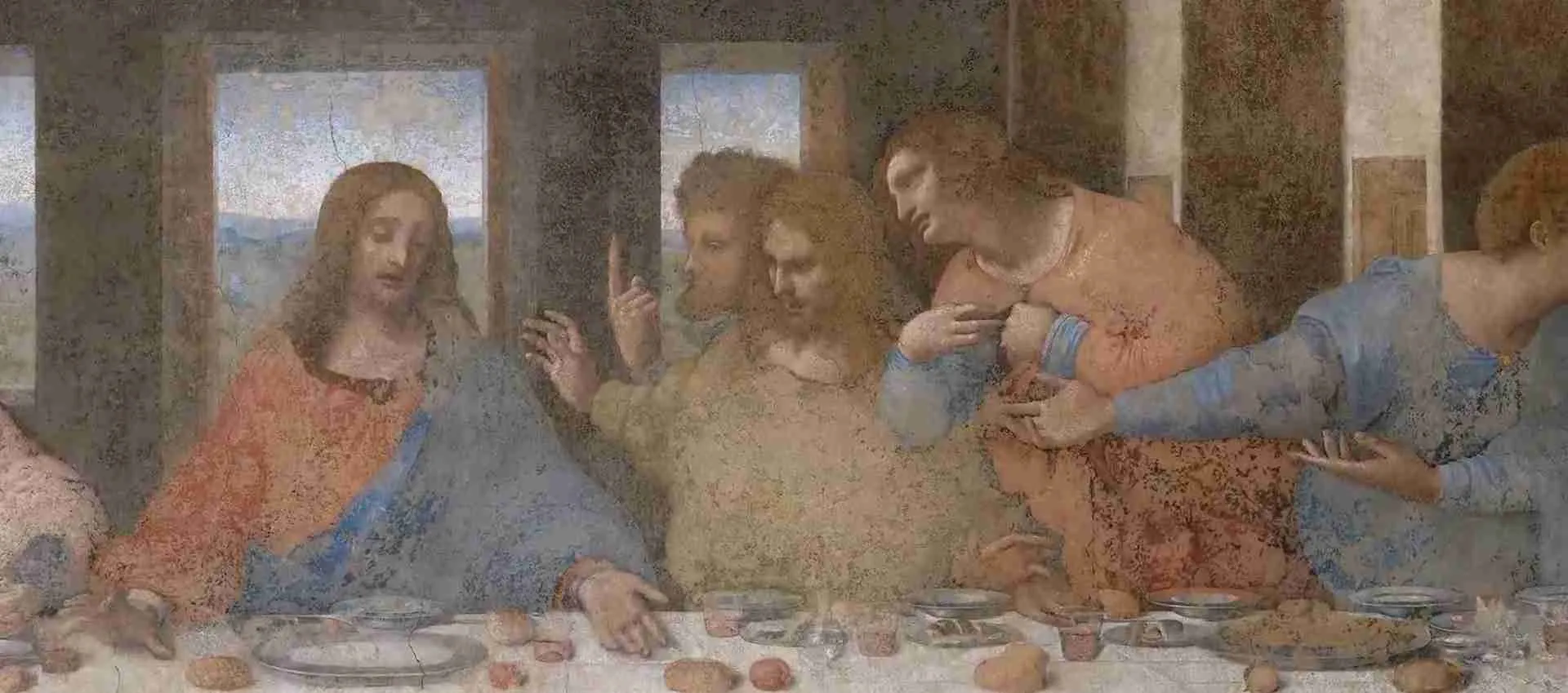
Viewing the painting rewards strategic observation of specific details visitors should prioritize within the time constraint. The central figure of Jesus draws immediate attention, his isolated position and calm expression contrasting with the apostles’ agitated reactions. Jesus’s right hand reaches toward a wine cup while his left gestures outward, creating the compositional center toward which all other figures relate. The perspective lines of the ceiling beams, side walls, and table edges converge on Jesus’s right temple, establishing him as the vanishing point of Leonardo’s spatial construction.
The apostles cluster in four groups of three figures each, with distinct characterization in every face and gesture. From left to right: Bartholomew, James the Lesser, and Andrew form the leftmost group, rising from their seats in shocked response. Next, Judas, Peter, and John create the most psychologically complex grouping, with Judas recoiling into shadow while clutching the money bag of his betrayal, Peter leaning forward aggressively with a knife visible in his hand, and John appearing to swoon. Philip, James the Greater, and Thomas occupy the right-center position, with Thomas raising his pointed finger in questioning gesture. Matthew, Jude Thaddeus, and Simon complete the right end, engaged in animated discussion.
Details visible in post-restoration viewing include the Assisi embroidery pattern on the tablecloth, gold lettering on Judas’s robe, individual bread rolls on the table, glass vessels reflecting light, and subtle expressions in faces that repay extended study. The painting’s deteriorated state is evident in areas of paint loss, particularly along cracks in the wall and in the lower sections where water damage was most severe. The restoration’s neutral-tone infilling shows clearly where Leonardo’s paint is completely lost, making the fragmentary survival obvious but allowing the compositional power to remain readable.
The opposite wall features Giovanni Donato da Montorfano’s Crucifixion fresco from 1495, completed the same year Leonardo began The Last Supper. This conventional fresco demonstrates the traditional technique Leonardo rejected and shows far superior preservation due to proper fresco methodology. Comparing the two works illustrates both Leonardo’s revolutionary ambition and the conservation cost of his experimental approach. Small figures of the Sforza family painted by Leonardo as additions to Montorfano’s composition occupy the lower corners but have deteriorated almost completely, showing even more severe damage than The Last Supper itself.
When the 15-minute period concludes, museum staff direct visitors to exit through a different airlock chamber, maintaining environmental separation from the next entering group. The exit process requires passage through climate control chambers similar to entry, preventing outside air contamination and maintaining stable conditions. Visitors cannot linger or delay exit—the next group’s timed entry depends on prompt clearing of the refectory, and museum procedures enforce strict adherence to the schedule.
After exiting, visitors can explore the Santa Maria delle Grazie church freely without additional admission charge. The church’s Renaissance architecture by Donato Bramante, including the drum-shaped dome and Chiostro delle Rane (Frog Cloister), represents significant artistic achievement beyond The Last Supper. The church interior features frescoes, chapels, and architectural details worth examining, providing extended cultural experience beyond the brief Last Supper viewing. No photography restrictions apply in the church, and visitors can spend unlimited time exploring without the rushed constraint of the museum visit.
Understanding these visit procedures and time constraints helps visitors prepare psychologically for an experience that feels both privileged and hurried. The 15 minutes pass quickly, creating pressure to absorb maximum information while mentally recording details for later reflection. Pre-visit preparation—studying the painting’s composition, understanding the historical context, identifying specific details to observe—transforms brief viewing time into focused encounter rather than rushed confusion. The experience rewards those who arrive prepared, punctual, and strategically focused on what matters most during their limited access to one of art history’s greatest achievements.
Guided Tours vs Independent Visits
Choosing between independent admission with self-guided viewing and organized guided tours involves balancing cost, convenience, educational depth, and booking reliability. Each approach offers distinct advantages depending on visitor priorities, schedule flexibility, and interest level in comprehensive interpretation.
Independent admission priced at €15 provides the most economical access to The Last Supper for visitors who successfully secure tickets during quarterly releases. This option requires no additional fees beyond base admission, allows complete control over visit timing within the chosen 15-minute slot, and permits viewing at personal pace without following a guide’s commentary or group movement. Independent visitors can focus exclusively on aspects that interest them most, spend the entire 15 minutes in silence absorbing the painting’s visual impact, or use the optional €5 audio guide at their own rhythm.
The primary disadvantage of independent visits lies in booking difficulty and inflexibility. Tickets must be secured months in advance through competitive quarterly releases, require precise timing during the release window, and cannot be modified or refunded after booking. Visitors whose schedules change or who arrive in Milan on short notice face high probability that independent admission slots have sold out completely, forcing either abandonment of Last Supper viewing or acceptance of substantially more expensive tour alternatives.
Official museum guided tours adding €10 to base admission for a €25 total provide reliable booking backup when independent slots sell out while maintaining reasonable pricing. These 60-minute tours conducted in Italian or English include the same 15-minute refectory viewing as independent visits but add approximately 45 minutes of expert commentary covering Leonardo’s technique, the painting’s historical context, conservation challenges, and compositional analysis. The museum’s guides possess specialist knowledge and present information with academic authority lacking in many commercial tour operations.
Official guided tours represent excellent value for visitors wanting educational depth without commercial tour premiums. The €10 supplement over independent admission buys genuine expertise and often provides the only available access during sold-out periods. However, these museum tours focus exclusively on The Last Supper without visiting other Milan attractions, limiting their appeal for visitors seeking comprehensive city introduction or multi-site itineraries within a single tour experience.
Commercial guided tours priced €65-159 deliver convenience, flexibility, and comprehensive Milan experiences but carry substantial cost premiums over base admission. These tours purchase Last Supper tickets in bulk allocation separate from public booking, explaining their continued availability when official channels show sold out. The premium pricing reflects not only Last Supper access but also additional services including expert local guides, skip-the-line coordination at multiple venues, walking tour routes connecting major attractions, and cancellation flexibility unavailable through official channels.
One-hour focused tours concentrating solely on The Last Supper cost €65-75 and provide similar experience to official €25 guided visits but with commercial operator convenience and booking reliability. These tours justify their price primarily through securing access when official tickets sell out, rather than delivering substantially different experience from museum-organized alternatives. Visitors comparing options should recognize that the €40-50 premium over official guided tours pays primarily for booking flexibility and last-minute availability rather than enhanced interpretation or longer viewing time.
Three-hour combination tours priced €99-119 deliver better value by pairing Last Supper access with Milan’s Duomo Cathedral, Sforza Castle, Galleria Vittorio Emanuele II, and historical walking routes connecting these sites. These tours provide comprehensive city introduction with expert guidance, eliminating need for separate attraction bookings while offering educational context relating The Last Supper to Milan’s broader Renaissance heritage. The higher total cost compared to independent Last Supper admission makes sense when calculating savings from bundled attractions versus separate ticket purchases and the added value of guided interpretation across multiple sites.
Small-group tours limited to 6-10 participants cost €149-159 but create qualitatively different experiences through personalized attention, easier question opportunities, and intimate group dynamics. These premium tours allow more interaction with guides, reduce the anonymity of large group participation, and typically move more efficiently between sites by avoiding unwieldy group coordination delays. Visitors valuing personal attention and social comfort over cost minimization find small-group tours worth the substantial premium over standard group experiences.
Tour timing flexibility represents a major advantage of commercial operations. Official museum bookings require selecting specific date and time during quarterly releases months in advance, while commercial tours often allow booking just days or weeks ahead with multiple daily departure times. This flexibility suits travelers whose Milan schedules remain uncertain, those making spontaneous decisions, and visitors extending stays who want to add Last Supper viewing after arrival. The cost premium buys scheduling freedom impossible through official channels.
Cancellation policies distinguish commercial tours from official bookings. Museum tickets booked directly cannot be cancelled or refunded under any circumstances, while most commercial operators offer full refunds for cancellations made 24 hours or more before scheduled departure. This cancellation protection provides valuable insurance for uncertain schedules, illness, travel delays, or changed plans. Evaluating true cost differences requires factoring in the value of this flexibility—a non-refundable €15 ticket carries hidden risk that a refundable €75 tour eliminates.
Educational quality varies significantly across commercial tour operators. Established companies including Walks of Italy, Context Travel, and LivTours employ professionally trained art historian guides who deliver university-level interpretation, while budget operators may use generalist guides with superficial knowledge. Reading reviews carefully, checking guide qualifications, and comparing sample itineraries helps identify tours delivering genuine educational value versus those simply facilitating access. The highest-quality tours justify premium pricing through expert guides whose knowledge and presentation skills transform the experience.
Group size dramatically affects experience quality beyond the stated maximum of 40 visitors in the refectory. Tours advertising “small group” without specific numbers may include 20-30 participants, while those limiting to 6-12 people create genuinely intimate experiences. In the refectory’s confined space, smaller groups allow better positioning to view the painting, reduce crowding and jostling, and make guide commentary more easily audible. Paying premium for authentically small groups provides tangible experience improvements justifying higher costs.
Audio guide rental for €5 at the museum represents the most economical interpretation option, delivering detailed commentary covering all major aspects of the painting for price of a coffee. The 12-minute audio program fits comfortably within the 15-minute viewing window and can be paused for extended observation of specific details. Independent visitors using audio guides achieve similar educational outcome as basic guided tours while maintaining autonomy and schedule control. The only disadvantage compared to live guides is inability to ask questions or request clarification on specific points of interest.
Accessibility considerations affect tour selection. The museum provides wheelchair access and tactile models for visually impaired visitors, but tours vary in accommodation quality. Independent admission allows visitors with mobility challenges or other access needs to move at comfortable pace without group pressure. Some commercial operators specifically accommodate accessibility requirements when notified during booking, while others struggle with group coordination complicating special needs support. Visitors requiring accommodations should communicate clearly when booking and confirm operator capabilities.
The optimal choice depends on individual priorities. Budget-focused visitors who book months in advance and accept schedule inflexibility benefit from €15 independent admission. Those wanting reliable access with modest interpretation choose €25 official guided tours. Travelers seeking comprehensive Milan introduction with Last Supper highlight select €99-119 combination tours. Visitors prioritizing personalized attention and cancellation flexibility justify €149-159 small-group premium tours. Understanding these trade-offs allows informed decisions matching tour selection to specific needs, schedule constraints, and budget realities.
Location and Transportation Options
The Last Supper Museum (Museo del Cenacolo Vinciano) occupies the refectory of the Convent of Santa Maria delle Grazie at Piazza Santa Maria delle Grazie 2 in Milan’s Corso Magenta district, approximately 1.5 kilometers west of the city’s historic Duomo Cathedral. The central location makes the site easily accessible through Milan’s comprehensive public transportation network, though driving faces restrictions and parking challenges in the congestion-charging Area C zone.
Metro access provides the fastest and most reliable transportation to Santa Maria delle Grazie, with two stations serving the site at different walking distances. The M1 Red Line’s Conciliazione station sits 5 minutes walking distance from the museum entrance, making it the most direct metro option. Trains on the M1 line operate every 2-3 minutes during peak hours and every 5-7 minutes during off-peak periods, running from approximately 6:00 AM to 12:30 AM daily with extended hours to 2:00 AM on Friday and Saturday nights.
From Milan’s Duomo station, travelers take the M1 Red Line directly toward Rho Fieramilano for four stops to Conciliazione, with journey time of approximately 8 minutes. Upon exiting Conciliazione station, Via Carducci leads north for 350 meters to Corso Magenta, where turning right proceeds 100 meters to the church and museum entrance. Clear street signage marks the route, and Google Maps navigation provides turn-by-turn walking directions eliminating any possibility of disorientation.
The M1 Red Line’s Cadorna station provides an alternative metro access point requiring 8-9 minutes walking distance. Cadorna serves as a major interchange connecting M1 Red Line and M2 Green Line services plus regional rail services from Malpensa Airport and northern destinations. Visitors arriving from Milano Centrale main railway station or Milano Porta Garibaldi station use the M2 Green Line to Cadorna, then either transfer to M1 for one stop to Conciliazione or walk 8-9 minutes to Santa Maria delle Grazie.
Tram 16 stops directly in front of Santa Maria delle Grazie at the Magenta S. Maria delle Grazie stop, creating the most convenient public transport option for visitors already in the city center. This tram route operates from Monte Velino to San Siro Stadium, passing through central Milan including stops near the Duomo Cathedral. Trams depart every 8-10 minutes during daytime hours, with service running from approximately 5:00 AM to 2:00 AM. Journey time from Duomo to Santa Maria delle Grazie takes approximately 12 minutes by Tram 16.
Tram 10 provides an alternative tram route stopping at Via Ariosto 19 prima di via Mascheroni, requiring 5 minutes walking to reach the museum. This line serves Milano Porta Garibaldi station and northern districts, offering direct connection for visitors staying in those areas. Trams 19 and several other lines serve nearby stops within 5-8 minutes walking distance, providing backup options when Tram 16 experiences delays or route alterations.
Multiple bus lines serve the Conciliazione M1 stop located 6 minutes walk from Santa Maria delle Grazie, including routes 50, 58, 67, 68, and 85 during daytime hours plus night buses N50, NM1, NM2, N25, and N26 serving overnight hours when metro and tram services stop. Bus service operates continuously 24 hours, with daytime buses running approximately every 10-15 minutes and night buses operating hourly from midnight to 5:00 AM. These buses connect Santa Maria delle Grazie to Milano Centrale, Cadorna, and other major stations.
Single tickets valid for 90 minutes across all public transport modes (metro, tram, bus) cost €2 per person for standard adult fare. These tickets allow unlimited transfers between transport types within the 90-minute validity period, making the €2 cost cover complete door-to-door journeys rather than single-vehicle trips. Children under 14 travel free when accompanied by paying adult, while reduced fares exist for specific categories including seniors over 65 (consult ATM Milano website for current age-based discount eligibility).
Tickets must be purchased before boarding any public transport and validated in yellow machines upon first use. Purchase points include metro station ticket offices, automated vending machines at metro and tram stops, tobacco shops (tabacchi) identified by “T” signs, and newspaper kiosks throughout the city. Milan’s public transport authority ATM operates all services, with the ATM logo identifying authorized ticket sales points. Mobile ticketing through the ATM Milano app provides convenient purchase and validation option avoiding need to locate physical sales points.
Walking from the Duomo Cathedral to Santa Maria delle Grazie takes approximately 20 minutes covering 1.6 kilometers through Milan’s historic center. The most direct route follows Via Meravigli northwest to Corso Magenta, passing elegant residential streets with Renaissance and Baroque architecture. This walk suits visitors with time to explore between major attractions and provides opportunity to experience Milan’s street life beyond tourist sites. However, visitors with mobility challenges or time constraints benefit from public transport’s speed and accessibility.
Arriving from Milano Centrale main railway station requires metro connection, as the 3.5-kilometer distance makes walking impractical for most visitors. The fastest route takes M3 Yellow Line from Centrale to Duomo (one stop, 2 minutes), then transfers to M1 Red Line for four stops to Conciliazione (8 minutes), with total journey time of approximately 15-20 minutes including transfer time. Alternative routing uses M2 Green Line from Centrale to Cadorna (direct, 6 minutes) followed by 8-minute walk or M1 transfer to Conciliazione.
Travelers arriving from Milano Malpensa Airport access Santa Maria delle Grazie through Malpensa Express train service to Milano Cadorna station followed by 8-minute walk or one-stop M1 metro ride to Conciliazione. The Malpensa Express operates every 30 minutes with 40-minute journey time costing approximately €13 per person. Alternative routing through Milano Centrale using Malpensa Express to Centrale then metro connections adds approximately 15 minutes total journey time but serves visitors staying near Centrale station.
Driving to Santa Maria delle Grazie faces substantial disadvantages including Milan’s Area C congestion charge, extremely limited street parking, and traffic congestion in the historic center. The museum sits within Area C boundaries, requiring all private vehicles to pay €5 daily charge for entry privileges Monday-Friday 7:30 AM-7:30 PM. Payment must be made online or through authorized retailers before or within 48 hours of entry to avoid fines significantly exceeding the charge amount.
Street parking near Santa Maria delle Grazie consists primarily of residents-only zones (blue lines) requiring permits unavailable to visitors, with the few metered spaces (white lines) typically occupied and expensive at €2-3 per hour. Paid parking garages including Garage alle Grazie on Corso Magenta and Parking Cadorna near Cadorna station charge €3-5 per hour with daily maximum rates reaching €30-40. These garages offer only secure option for visitors arriving by car, though the combined costs of Area C charge plus parking fees substantially exceed public transport alternatives.
The museum operates within pedestrian-priority zones where walking enjoys right-of-way over vehicles, and narrow historic streets make navigation challenging for unfamiliar drivers. Milan strongly encourages public transport use within the center through pricing incentives, parking restrictions, and congestion charging, making metro, tram, or bus the logical choice for all visitors regardless of vehicle availability.
For visitors with mobility challenges, the museum provides wheelchair-accessible entry through ramped access points and elevator service. The M1 metro line features elevator-equipped stations including Conciliazione and Cadorna, while accessible trams serve some routes including Tram 16. Visitors requiring accessibility should plan routes carefully using ATM Milano’s accessibility information and consider taxi services as supplements where public transport presents challenges. Milan’s accessible taxis can be pre-booked through the Taxiblu number (+39 02 4040) for guaranteed wheelchair-accessible vehicle availability.
Understanding Milan’s transportation options and selecting appropriate routes based on origin point, time constraints, mobility needs, and budget priorities ensures stress-free arrival at Santa Maria delle Grazie with adequate time for the punctual entry required by the reservation system. Public transport’s reliability, frequency, and low cost make it the clearly superior choice over driving for nearly all visitors, while the variety of metro, tram, and bus options provides backup alternatives if primary routes experience disruptions.
Maximizing Your 15-Minute Viewing Experience
The brief 15-minute viewing window demands strategic preparation and focused observation to extract maximum value from limited time with Leonardo’s masterpiece. Understanding what to observe, where to position yourself, and how to balance photography with direct viewing transforms rushed confusion into meaningful encounter.
Pre-visit study of the painting’s composition, historical context, and specific details allows visitors to enter the refectory with clear observation priorities rather than facing overwhelming complexity without preparation. Examining high-resolution images online before visiting helps identify compositional structure, apostle positioning, and specific details worth seeking during the actual viewing. Understanding the biblical narrative—Jesus announcing “One of you will betray me” and each apostle’s distinct reaction—provides essential framework for reading the psychological drama Leonardo depicted.
Positioning yourself centrally in the refectory, approximately 5-7 meters from the painting’s center, provides optimal viewing angle matching Leonardo’s perspective construction. The vanishing point of all architectural lines converges on Jesus’s right temple, creating strongest compositional focus from this central viewing position. Standing closer to either end of the painting creates distorted perspective reducing Leonardo’s intended spatial illusion, while excessive distance diminishes ability to read facial expressions and subtle details.
The first 2-3 minutes should focus on overall compositional understanding: Jesus’s isolated central position contrasted with the apostles’ agitated clustering, the perspective construction creating illusionistic depth, and the four groups of three disciples forming the lateral arrangement. Observing how Leonardo balanced the composition through gesture, eye direction, and spatial positioning establishes foundation for detailed examination of individual figures and specific passages.
Systematic examination of the apostle groups from left to right allows comprehensive observation within time constraints. The left group—Bartholomew, James the Lesser, and Andrew—shows rising motion and gestures of disbelief. The left-center group surrounding Jesus contains the three psychologically most complex figures: Judas recoiling into shadow while clutching the money bag, Peter leaning forward with knife visible, and John appearing to swoon. The right-center group—Philip, James the Greater, and Thomas—displays questioning gestures including Thomas’s raised pointing finger. The right group—Matthew, Jude Thaddeus, and Simon—engages in animated discussion.
Specific details reward focused attention during the remaining minutes: the Assisi embroidery pattern on the tablecloth revealed by restoration, gold lettering on Judas’s robe, individual bread rolls and glass vessels on the table reflecting light, and subtle variations in each apostle’s facial expression. The painting’s deteriorated condition becomes evident in vertical crack patterns, areas of complete paint loss filled with neutral-tone restoration, and the fragmentary survival of once-continuous passages.
Photography timing requires strategic decision-making. Taking photos during the first 3-4 minutes risks missing optimal direct observation time, while delaying photography until final minutes creates pressure when guards begin directing exit. The most effective approach involves taking a few overall composition photos during initial minutes, then focusing on direct viewing for the middle period, and capturing detail shots of specific passages during final minutes. This sequence balances photographic documentation with meaningful visual engagement.
Smartphone cameras require specific settings for low-light museum conditions. Disabling flash (mandatory museum policy), maximizing ISO sensitivity, and using HDR mode when available improves image quality in the refectory’s controlled lighting. Holding the phone steady for 1-2 seconds during exposure reduces blur, while taking multiple shots of the same view increases probability of sharp results. Photos serve memory documentation rather than professional reproduction—accept that museum lighting and distance prevent matching published professional photography.
Audio guide rental enhances understanding substantially for visitors willing to dedicate 5-7 minutes of their viewing window to guided commentary. The approximately 12-minute program covers Leonardo’s technique, conservation history, compositional analysis, and interpretation of specific figures. Using the audio guide requires accepting that time spent listening reduces time for independent observation, but the educational depth provided by expert commentary often reveals details and connections visitors would miss through uninformed looking.
Observing Montorfano’s Crucifixion on the opposite wall provides valuable comparison illustrating both traditional fresco technique’s superior preservation and Leonardo’s experimental approach’s tragic fragility. The conventional fresco shows far better condition despite being painted the same year Leonardo began The Last Supper, demonstrating that Leonardo’s deterioration resulted from technical choice rather than inevitable aging. The comparison takes only 1-2 minutes but dramatically illuminates the conservation crisis requiring today’s strict access limitations.
The final 2-3 minutes deserve silent contemplation rather than frantic detail-hunting. After systematic observation and photography, standing quietly before the painting allows absorption of its overall impact, psychological power, and historical resonance. This concluding silence provides mental space for processing the experience and forming personal response to Leonardo’s achievement—responses that continue evolving through subsequent reflection and memory.
Post-visit reflection benefits from reviewing photos, researching details observed but not fully understood, and reading scholarly analyses deepening comprehension. The 15-minute viewing plants seeds for extended engagement through memory, study, and continued investigation. Many visitors report that their Last Supper experience grows richer over time as later study illuminates aspects noticed but not grasped during the brief viewing window.
Realistic expectations prevent disappointment. The painting’s deteriorated state shocks some visitors expecting pristine Renaissance masterpiece rather than fragmentary survival. The 15-minute limit frustrates those hoping for extended contemplation. The small refectory crowds with 40 simultaneous viewers reducing personal space. Accepting these realities rather than resenting them allows appreciation of what remains rather than mourning what’s lost—both in paint survival and access generosity.
The viewing experience rewards preparation, focus, and acceptance of limitations while offering profound encounter with artistic genius despite conservation constraints. Visitors who study beforehand, observe systematically, balance photography with direct viewing, and allow final moments for silent contemplation transform brief museum visit into significant cultural experience whose impact extends far beyond 15 minutes in a converted monastery refectory.
Santa Maria delle Grazie: Beyond The Last Supper
The Church of Santa Maria delle Grazie represents one of Milan’s finest examples of Renaissance architecture, with the building’s historical and artistic significance extending far beyond its role as The Last Supper’s housing. Understanding the church’s construction history, architectural features, and relationship to Milan’s Renaissance cultural context enriches the overall visit experience.
Construction began in 1463 under architect Guiniforte Solari, commissioned by Count Gaspare Vimercati who donated a frescoed chapel to the Dominican order. The original design followed Gothic architectural principles typical of mid-15th century Lombard religious buildings, with three-aisled nave, ribbed vaulting, and vertical emphasis characteristic of the style. This initial phase was completed in 1469, creating a functional Dominican monastery church serving the religious community.
Ludovico Sforza, Duke of Milan, intervened in the 1490s to transform the church into his intended family mausoleum, commissioning architect Donato Bramante to redesign the apse and add the magnificent drum-shaped dome that became the church’s defining architectural feature. Bramante’s Renaissance intervention contrasted dramatically with Solari’s Gothic nave, creating a hybrid building documenting the stylistic transition from Gothic to Renaissance architectural language occurring throughout northern Italy during the late 15th century.
Bramante’s dome represents one of Renaissance architecture’s most sophisticated achievements in spatial harmony and geometric proportion. The circular drum surrounded by columned arcade supports the hemisphere dome creating centralized space whose perfect geometry embodies Renaissance mathematical ideals. The design influenced later architects including Bramante’s own work on St. Peter’s Basilica in Rome, making Santa Maria delle Grazie an important precedent for High Renaissance ecclesiastical architecture.
The Chiostro delle Rane (Frog Cloister) adjacent to the church demonstrates the architectural refinement characterizing the entire monastic complex. Five terracotta arches supported by columns with marble capitals create an elegant square courtyard whose proportions and decorative details reflect Renaissance aesthetic principles. The cloister’s name derives from small frog sculptures decorating the fountain, though these features have been lost or relocated over centuries.
Interior frescoes beyond The Last Supper include significant works by multiple Renaissance masters. The Baroque chapel features elaborate decoration from later periods when the church underwent modernization. Various side chapels commissioned by Milanese nobility during the late 15th and early 16th centuries contain frescoes by artists including Antonello da Messina and Gaudenzio Ferrari, though many were damaged or destroyed during World War II bombing.
The church interior is accessible free of charge during regular visiting hours separate from Last Supper museum admission, allowing extended exploration without the time pressures and reservation requirements governing refectory access. Visitors can spend unlimited time examining the architecture, viewing surviving frescoes, and experiencing the sacred space in contemplative silence. Photography is permitted throughout the church without flash, allowing documentation of architectural details and decorative elements.
World War II devastation transformed the church complex dramatically. The August 15, 1943 Allied bombing collapsed the left side of the church including several chapels, destroyed the library containing valuable manuscripts, and severely damaged the refectory where The Last Supper miraculously survived on the one wall remaining standing. Post-war reconstruction restored the church’s basic structure but many lost decorative elements and frescoed surfaces could not be recovered, leaving simplified interior spaces where elaborate Renaissance decoration once existed.
UNESCO World Heritage designation awarded in September 1980 recognized not just The Last Supper but the entire church and monastery complex as representing “a unique artistic achievement, of an exceptional universal value that transcends all historical contingencies.” The citation specifically highlights the synthesis of Gothic and Renaissance architecture visible in the building’s fabric and the integration of Bramante’s architectural masterpiece with Leonardo’s painted one creating an ensemble of international cultural significance.
Visiting the church before or after The Last Supper viewing provides valuable architectural context for Leonardo’s painting. The refectory where Leonardo worked was part of this larger monastic complex, and understanding the church’s Renaissance transformation under Sforza patronage illuminates the cultural environment producing both Bramante’s architectural innovation and Leonardo’s pictorial revolution. The two masterpieces—architectural and painted—represent parallel Renaissance achievements by artists working simultaneously for the same patron.
The church’s location in the quiet Corso Magenta residential district contrasts with tourist-heavy zones surrounding the Duomo and Castello Sforzesco, offering more contemplative visiting experience. The neighborhood’s 19th-century elegance, tree-lined streets, and local cafes provide pleasant environment for extending visits beyond the brief Last Supper viewing. Several restaurants and cafes within 5-minute walk serve refreshments in authentically Milanese rather than touristy atmosphere.
Opening hours for the church typically run 7:00 AM-12:00 noon and 3:00 PM-7:00 PM Monday-Saturday, with reduced Sunday hours 7:30 AM-12:15 PM and 3:30 PM-9:00 PM, though visitors should verify current schedules on the church website as times vary seasonally and for religious observances. The Last Supper museum maintains separate hours (8:15 AM-6:45 PM Tuesday-Sunday, closed Mondays) requiring distinct planning for visitors wishing to experience both the painting and the complete church complex.
Combining church exploration with Last Supper viewing creates comprehensive cultural experience spanning architecture, painting, sculpture, and religious history across multiple centuries. Visitors allocating 45-60 minutes for church exploration beyond their scheduled 15-minute Last Supper slot gain deeper appreciation for the integrated Renaissance cultural achievement the UNESCO designation recognizes and the historical layers accumulating across five centuries of continuous religious use.
Planning Your Milan Itinerary Around The Last Supper
Integrating The Last Supper into a comprehensive Milan visit requires strategic scheduling balancing the fixed reservation time against other major attractions, geographical positioning of sites, and realistic time allocation for transportation and viewing durations.
The Last Supper’s fixed reservation time serves as anchor point for daily scheduling, with other activities arranged before or after the timed entry rather than treating the painting as flexible component within a fluid itinerary. Visitors who book 10:00 AM Last Supper slots should plan morning activities concluding by 9:30 AM to allow travel time and punctual arrival, while afternoon reservation times permit morning visits to other attractions ending with sufficient buffer for Santa Maria delle Grazie arrival.
Morning Last Supper reservations (8:15-11:00 AM time slots) work well for visitors wanting to complete this essential experience early before dedicating afternoon hours to other Milan attractions without schedule pressure. Starting days with The Last Supper provides psychological benefit of accomplishing the trip’s primary cultural objective while fresh and focused, then proceeding to secondary sites with the satisfaction of having secured the most important viewing. Morning light in the refectory also provides optimal photography conditions for visitors prioritizing image documentation.
Afternoon reservations (1:00-4:00 PM) suit visitors preferring morning hours for other activities, particularly sites like the Duomo Cathedral whose rooftop access offers better photography earlier in the day before afternoon sun creates harsh shadows. Afternoon Last Supper timing allows leisurely morning exploring central Milan, lunch in characteristic restaurants near the Duomo, then proceeding to Santa Maria delle Grazie for the reserved viewing before concluding days with evening activities.
Late afternoon reservations (4:00-6:30 PM) accommodate visitors maximizing daytime hours at outdoor attractions before transitioning to indoor museum experiences. This timing works particularly well during summer when extended daylight allows morning and midday exploration of parks, markets, and architectural sites before retreating to climate-controlled museum environments during hottest hours. Late slots also benefit visitors who prefer fewer crowds, as final daily entries typically experience lighter attendance than peak midday periods.
Geographical proximity between Santa Maria delle Grazie and other major Milan attractions influences efficient itinerary construction. The Castello Sforzesco sits 12 minutes walking distance (950 meters) from the church, making it logical pairing for visitors with morning or afternoon Last Supper reservations. Viewing Leonardo’s Sala delle Asse frescoes in Castello Sforzesco before or after The Last Supper creates thematic Leonardo-focused day exploring the master’s Milan works.
The Duomo Cathedral occupies the city center approximately 20 minutes walk or 10 minutes by public transport from Santa Maria delle Grazie, positioning it as natural complement for Last Supper visits. Visitors can explore the cathedral’s Gothic architecture, rooftop terraces, and archaeological zone beneath the building as morning activity before afternoon Last Supper viewing, or reverse the sequence based on reservation timing and personal preference. Combined Duomo and Last Supper itineraries represent classic “essential Milan” day for first-time visitors.
Multiple museums cluster in areas accessible from Santa Maria delle Grazie through short public transport connections. The Pinacoteca di Brera (10 minutes by metro) houses outstanding Italian Renaissance painting collection including works by Mantegna, Raphael, and Caravaggio, creating art-focused day pairing two major museums. The Museo del Novecento near the Duomo displays Italian 20th-century art in architecturally significant palazzo, offering modernist counterpoint to Renaissance masterpieces.
Timing buffer requirements depend on transportation reliability and individual punctuality comfort levels. Risk-averse visitors should allow 45-60 minutes between concluding previous activities and Last Supper entry time, accounting for transportation delays, wayfinding challenges, and security procedures. More comfortable travelers familiar with Milan’s geography and public transport can reduce this buffer to 30 minutes when using reliable metro connections, though maintaining some safety margin protects against unexpected delays triggering reservation forfeiture.
Meal scheduling around Last Supper reservations requires realistic assessment of Italian restaurant timing and service duration. Traditional Italian lunch service peaks 12:30-2:00 PM with restaurants often closing 3:00-7:00 PM before dinner service begins. Visitors with 1:00-2:00 PM Last Supper reservations face challenges securing restaurant lunch beforehand, making light cafe snacks or post-viewing lunch more practical. Dinner reservations work well after late afternoon Last Supper slots, providing natural daily conclusion combining cultural and culinary experiences.
Multi-day Milan itineraries benefit from distributing major attractions across days rather than attempting comprehensive coverage in single intensive sessions. Dedicating one day to The Last Supper, Santa Maria delle Grazie church, and nearby Castello Sforzesco creates focused Renaissance art and architecture theme, while reserving separate days for the Duomo, modern museums, shopping districts, and neighborhood exploration prevents exhausting marathon touring that diminishes appreciation through fatigue.
Realistic time estimates for Milan’s major attractions help construct achievable itineraries: Duomo Cathedral interior and rooftop 2-3 hours, Castello Sforzesco museums 2 hours, Pinacoteca di Brera 2-3 hours, Galleria Vittorio Emanuele II 30 minutes, La Scala opera museum 1 hour. Adding transportation time between sites plus meal breaks produces daily schedules typically accommodating 2-3 major attractions comfortably versus attempting to compress 4-5 sites creating stressful rushing.
Weather considerations influence optimal scheduling, particularly for attractions with significant outdoor components. The Duomo rooftop terraces, Castello Sforzesco courtyards and park, and walking tours perform best during clear weather, making them logical choices for sunny days while reserving indoor museums including The Last Supper for rainy or extremely hot conditions. However, fixed Last Supper reservations prevent complete weather-dependent flexibility, requiring backup plans accommodating various conditions.
First-time Milan visitors typically prioritize The Last Supper, Duomo Cathedral, and La Scala opera house as essential experiences, with these three sites forming core 1-2 day itinerary. Adding Castello Sforzesco and Pinacoteca di Brera extends this to comprehensive 3-day cultural program. Visitors with 4-5 days can include neighborhood exploration (Brera district, Navigli canals), specialized museums (Museo Poldi Pezzoli, Bagatti Valsecchi), and day trips to nearby destinations (Lake Como, Bergamo).
Understanding that The Last Supper viewing consumes only 15 minutes plus perhaps 30 minutes total for arrival, security, and departure helps visitors avoid dedicating excessive schedule blocks to this single attraction. Unlike major museums requiring 2-3 hour visits, The Last Supper fits efficiently into broader itineraries with minimal time commitment despite its cultural importance. This efficiency allows pairing with substantial morning or afternoon activities rather than treating it as all-day excursion.
Frequently Asked Questions
Can I take photographs of The Last Supper?
Photography is permitted inside the refectory using personal smartphones and compact cameras without flash, tripods, or professional equipment. Visitors can freely photograph The Last Supper during their 15-minute viewing window for personal use, though commercial photography requires advance permission and fee payment. The museum’s low-light conditions necessitate modern smartphone cameras or quality compact cameras for acceptable results, as older devices may struggle to produce clear images in the controlled lighting environment designed to protect the fragile pigments from light damage.
How far in advance should I book tickets?
Booking tickets 2-3 months in advance provides optimal balance between planning certainty and schedule flexibility for most travel periods. High-demand seasons including summer months (June-August), Christmas holidays, Easter week, and all weekends require booking immediately when quarterly sales open, typically 6-8 weeks before the booking period begins. Standard weekdays outside peak periods remain available for 4-6 weeks after release but eventually sell out. Last-minute availability exists occasionally through Wednesday noon supplemental releases or guided tour operators maintaining separate inventory, but relying on last-minute options risks complete unavailability.
What happens if I arrive late for my reservation?
Late arrivals forfeit their reservations without refund or rescheduling opportunity, as the museum’s timed-entry system cannot accommodate delayed individuals without disrupting the entire schedule. Visitors must arrive at least 20 minutes before their reserved time slot to complete ticket collection, security screening, and group formation procedures. The 15-minute viewing window begins precisely on schedule whether late arrivals are present or not, and museum policy strictly prohibits entry after the scheduled time passes. This inflexibility protects all visitors’ reserved slots and maintains the conservation-driven capacity limitations, making punctual arrival essential for successful viewing.
Is The Last Supper suitable for children?
The Last Supper can engage children with appropriate preparation and realistic expectations about the brief viewing duration and quiet museum environment. Children of all ages require their own reservation including infants, and must maintain appropriate behavior during the 15-minute viewing without running, loud talking, or disruptive activity that disturbs other visitors or threatens the painting’s conservation. Pre-visit education about the biblical story, Leonardo’s artistic achievement, and the painting’s fragile condition helps children appreciate what they’re seeing rather than experiencing confused boredom. Many families find that children aged 10 and older with art or history interest benefit most from the experience, while younger children may struggle with the combination of standing still, viewing from distance, and appreciating artwork in deteriorated condition.
Why is the painting deteriorating despite restoration?
The painting continues deteriorating because Leonardo’s experimental technique using tempera and oil on dry plaster created inherently unstable structure that cannot be permanently stabilized through restoration. The paint layers lack proper bonding to the wall surface, existing in perpetual state of microscopic detachment that worsens through unavoidable temperature and humidity fluctuations. Modern conservation slows this deterioration through climate control, visitor limitations, and environmental monitoring but cannot reverse the fundamental technical failure built into Leonardo’s chosen method. The 21-year restoration (1978-1999) consolidated surviving paint and removed damaging previous interventions, but the painting remains fragile and continues requiring constant protective measures to prevent accelerated decay.
Can I visit Santa Maria delle Grazie church without a Last Supper ticket?
The Santa Maria delle Grazie church is accessible free of charge during regular hours without Last Supper museum admission, allowing visitors to explore the Renaissance architecture, view surviving frescoes, and experience the sacred space independently of the painting. The church and Last Supper museum maintain separate entrances, operating hours, and admission requirements, with the church typically open 7:00 AM-12:00 noon and 3:00 PM-7:00 PM Monday-Saturday plus reduced Sunday hours. Visitors can spend unlimited time in the church without reservations, though they cannot access the refectory containing The Last Supper without valid museum tickets. The church visit provides valuable architectural and historical context enriching overall appreciation even when Last Supper viewing proves impossible due to sold-out tickets.
What is the best time of day to visit?
Morning time slots (8:15-10:00 AM) offer advantages of cooler refectory temperatures, better natural lighting through windows, and psychological benefit of completing the essential cultural experience early before dedicating afternoon hours to other activities. Late afternoon slots (4:00-6:30 PM) typically experience fewer crowds as many visitors prefer earlier times, though lighting conditions shift as natural light fades. Midday slots (11:00 AM-2:00 PM) coincide with peak visitor flow but integrate easily into broader sightseeing itineraries. The 15-minute viewing duration means time-of-day differences affect primarily surrounding logistics rather than viewing experience itself, making schedule coordination with other Milan attractions more important than optimizing Last Supper slot timing.
Are audio guides worth renting?
Audio guides deliver substantial value for €5 rental fee by providing expert commentary covering Leonardo’s technique, conservation history, compositional analysis, and interpretation of specific figures during the 15-minute viewing window. The approximately 12-minute program can be paused for extended observation of details, allowing visitors to balance listening with independent viewing. The guided commentary reveals connections and details most visitors would miss through uninformed looking, while costing significantly less than guided tours. Visitors wanting educational depth without commercial tour premiums find audio guides offer excellent return on minimal investment, though those preferring silent contemplation or who have extensively studied the painting beforehand may find the narration redundant or intrusive.
Can I buy tickets at the museum entrance?
Walk-up ticket purchase is not available at The Last Supper Museum, as all admissions require advance reservation through the official booking system or authorized tour operators. The museum’s on-site ticket office validates existing reservations and provides information but does not sell new tickets for same-day or future viewing. This policy exists because the strict capacity limitation of 40 visitors per 15-minute slot fills through advance bookings, leaving no unreserved capacity for walk-up sales. Very rarely, same-day cancellations may create last-minute availability that the ticket office can provide to visitors inquiring in person, but depending on this possibility risks disappointment, as most days show complete advance sellout without any available slots.
How does The Last Supper compare to other Leonardo works?
The Last Supper represents Leonardo’s largest and most ambitious narrative composition, demonstrating his revolutionary approach to depicting psychological drama, spatial illusion, and human emotion on architectural scale impossible in panel paintings like the Mona Lisa. While the Mona Lisa showcases Leonardo’s mastery of portraiture, subtle expression, and atmospheric perspective in intimate format, The Last Supper displays his ability to organize complex multi-figure composition with unprecedented sophistication in gesture, grouping, and spatial construction. However, the experimental technique causing The Last Supper’s deterioration contrasts with the Mona Lisa’s remarkably stable oil-on-panel technique, making direct quality comparison complicated by radically different preservation states. The Last Supper’s fragmentary survival despite its compositional brilliance versus the Mona Lisa’s near-perfect preservation illustrates how technical choices profoundly affect both immediate artistic achievement and long-term cultural legacy.