
Visiting Orvieto: Cathedral & Underground Guide
Orvieto rises dramatically atop a 150-meter volcanic tuff cliff in Umbria, Italy, where its magnificent Gothic cathedral dominates a medieval cityscape concealing an astonishing labyrinth of 1,200 underground caves. This comprehensive guide explores both the soaring artistry of the Duomo di Orvieto—among Italy’s most spectacular cathedrals—and the Etruscan-era underground city carved into the cliff over 2,500 years, offering visitors the complete Orvieto experience from cathedral pinnacle to subterranean depths.
Key Takeaways
- Orvieto Cathedral represents the pinnacle of Italian Gothic architecture with its golden mosaic facade, Maitani’s intricate bas-reliefs, and Luca Signorelli’s revolutionary Chapel of San Brizio frescoes depicting the Last Judgment
- The underground city comprises over 1,200 hand-carved caves, tunnels, and chambers spanning Etruscan, Roman, and medieval periods, revealing ancient olive oil production, pigeon farming, and water collection systems
- Orvieto appears on UNESCO’s Tentative List (since 2006) for its exceptional medieval urban structure and the symbiotic relationship between the natural tufa cliff and the overlying city dominated by the cathedral
- The cathedral was commissioned following the Miracle of Bolsena in 1263 and took over three centuries to complete, with construction beginning in 1290 under Pope Nicholas IV
- Combined cathedral and underground exploration provides the most comprehensive understanding of Orvieto’s vertical history—from Etruscan foundations carved deep into the cliff to medieval and Renaissance masterpieces soaring above
- Both attractions operate guided tours with specific seasonal hours and require advance booking during peak periods to guarantee entry
People Also Ask About Orvieto Cathedral and Underground
What makes Orvieto Cathedral architecturally significant?
Orvieto Cathedral stands as the supreme masterpiece of Italian Gothic architecture, distinguished by Lorenzo Maitani’s golden mosaic facade featuring intricate marble bas-reliefs depicting biblical narratives from Creation through the Last Judgment. The facade combines Romanesque horizontal striping with Gothic vertical emphasis through elaborate sculptural pillars, creating what art historians consider the finest example of Italian decorative Gothic. The cathedral interior houses Luca Signorelli’s Chapel of San Brizio frescoes (1499-1504), which directly influenced Michelangelo’s Sistine Chapel ceiling and represent one of the Renaissance’s most ambitious pictorial cycles. The construction spanned over three centuries (1290-1600s) under five principal architects including Arnolfo di Cambio and Andrea Orcagna, who created the magnificent rose window, resulting in a harmonious synthesis of Romanesque, Gothic, and early Renaissance architectural elements.
How extensive is the underground cave system beneath Orvieto?
The underground cave system beneath Orvieto comprises over 1,200 documented cavities extending throughout the entire volcanic tuff cliff foundation, though only a carefully selected portion remains accessible to visitors through guided tours. Systematic speleological exploration beginning in the late 1970s revealed this forgotten labyrinth carved over approximately 2,500 years of continuous human habitation from Etruscan times through the medieval period. The caves served multiple functions across different historical periods: Etruscan-era water cisterns and wells that allowed the city to withstand a 24-month Roman siege, Roman-period storage chambers, medieval olive oil production facilities with intact grinding stones and presses, and elaborate pigeon farming operations (colombaie) that provided both food and fertilizer. The network extends across multiple levels with interconnecting tunnels, wells reaching depths exceeding 30 meters, and chambers large enough to house complete industrial operations, all carved by hand from the friable volcanic stone.
Is Orvieto a UNESCO World Heritage Site?
Orvieto currently holds status on Italy’s UNESCO Tentative List, where it was inscribed in 2006, but has not yet achieved full UNESCO World Heritage designation. The tentative listing recognizes Orvieto’s exceptional medieval urban structure that has remained essentially unchanged since the 13th and 14th centuries, along with the unique symbiosis between the imposing tufa cliff and the overlying city dominated by the cathedral’s mass. UNESCO’s tentative designation specifically cites Orvieto Cathedral as “the prime masterpiece of Italian decorative Gothic” and acknowledges the city’s importance as an Etruscan metropolis (ancient Velzna) that later became a significant papal residence. While tentative listing represents international recognition of Orvieto’s outstanding universal value and positions the city for potential future full inscription, visitors should understand that Orvieto does not yet carry the official UNESCO World Heritage Site designation that nearby Assisi received in 2000.
How long should I allocate for visiting both the cathedral and underground?
A comprehensive visit exploring both Orvieto Cathedral and the underground caves requires approximately 3 to 4 hours minimum to experience both attractions meaningfully without rushing. The cathedral visit alone deserves 60 to 90 minutes to properly examine the facade details, explore the main nave, spend adequate time in the Chapel of San Brizio appreciating Signorelli’s frescoes, and visit the cathedral’s own underground chambers included in the admission. The Underground Orvieto guided tour operates on a fixed approximately 60-minute schedule moving through selected caves, tunnels, and the medieval olive oil mill. Adding transition time between the two locations (both departing from Piazza del Duomo), potential queue time for tour departures, and a reasonable margin for photographing the cathedral’s exterior at different lighting angles, a realistic half-day allocation of 4 to 5 hours allows for unhurried exploration of both attractions plus a brief pause in the historic center.
Extended multi-day tours – 5+ days
Featured Rome Multi-Day Tour Packages
3 days
Rome 3-Day Discovery Tour
- ✓ Comprehensive Rome experience
- ✓ Expert local guides included
- ✓ All accommodation included
- ✓ Transportation provided

5 days
Rome 5-Day Highlights Experience
- ✓ Comprehensive Rome experience
- ✓ Expert local guides included
- ✓ All accommodation included
- ✓ Transportation provided

7 days
Rome 7-Day Cultural Journey
- ✓ Comprehensive Rome experience
- ✓ Expert local guides included
- ✓ All accommodation included
- ✓ Transportation provided
10 days
Rome 10-Day Complete Adventure
- ✓ Comprehensive Rome experience
- ✓ Expert local guides included
- ✓ All accommodation included
- ✓ Transportation provided
Multi-day tour packages powered by TourRadar. Prices and availability subject to change.
Introduction: Orvieto’s Vertical History From Etruscan Depths to Gothic Heights
Orvieto presents one of Italy’s most dramatic urban spectacles—a complete medieval city perched impossibly atop a sheer volcanic cliff rising 150 meters above the surrounding Umbrian plains, visible for kilometers in every direction. This commanding natural fortress attracted continuous human settlement for over 2,500 years, from the Etruscan civilization that carved the cliff’s interior into a honeycomb of functional chambers to the medieval builders who crowned its summit with one of Christianity’s most magnificent cathedrals. The relationship between stone and city defines Orvieto: the same friable volcanic tuff that allowed ancient inhabitants to excavate extensive underground networks provided the foundation for Gothic spires reaching toward heaven.
Modern visitors experience this vertical history in reverse chronological order, beginning at the cliff summit where Orvieto Cathedral’s golden facade dominates Piazza del Duomo before descending into the underground labyrinth where Etruscan engineering created a self-sufficient subterranean city. This dual exploration reveals complementary aspects of human achievement—the underground caves demonstrate practical ingenuity in water management, food production, and defensive strategy, while the cathedral soaring above represents spiritual aspiration expressed through architectural and artistic mastery. Together, they illustrate how successive civilizations adapted the same volcanic plateau to serve radically different purposes while maintaining profound respect for the dramatic natural setting.
The cathedral’s construction history spans over three centuries from its 1290 foundation to final decorative completions in the 1600s, encompassing the transition from Romanesque to Gothic to early Renaissance artistic movements. Its commissioning followed directly from the Miracle of Bolsena in 1263, when Pope Urban IV instituted the Feast of Corpus Christi and ordered construction of a worthy shrine to house the miraculous blood-stained corporal cloth. Five principal architects, dozens of master sculptors, and generations of mosaic artists contributed to creating what became the paradigmatic example of Italian Gothic cathedral architecture—more exuberant in decorative richness than French Gothic, yet more structurally disciplined than later Baroque excess.
The underground city beneath reveals even deeper historical layers. When Orvieto served as the Etruscan city of Velzna, it functioned as the religious and political center of the Etruscan League, hosting the federal sanctuary Fanum Voltumnae where representatives from twelve Etruscan city-states convened. The extensive cave system allowed Velzna to resist Roman siege for nearly two years through sophisticated water collection and storage networks. After the Roman conquest in 264 BC, the underground spaces transitioned to storage and small-scale industrial uses, a pattern that continued through medieval times when mills, wine cellars, and pigeon farms occupied the carved chambers. The systematic rediscovery of this forgotten underground world began only in the late 1970s when local speleologists investigating cliff openings uncovered the extent of the subterranean labyrinth.
Today’s Orvieto functions simultaneously as a living medieval town and a major cultural destination, attracting visitors drawn by the cathedral’s artistic treasures and the underground city’s archaeological fascination. The compact historic center clustered around Piazza del Duomo retains its 13th-century street pattern, with narrow medieval lanes revealing sudden panoramas across the Umbrian countryside. The city’s elevation on the isolated cliff creates a remarkably preserved medieval atmosphere—modern development clustered in the valley below while the historic core remained spatially constrained by the cliff’s perimeter. This geographical isolation that once provided defensive advantage now offers visitors an unusually coherent medieval urban experience centered on two complementary attractions: the spiritual magnificence of the cathedral and the pragmatic ingenuity of the underground city.
UNESCO Tentative List Status and Significance
Orvieto received inscription on Italy’s UNESCO Tentative List in 2006, a designation recognizing sites that nations consider worthy of nomination for full World Heritage status pending further documentation and comparative analysis. The tentative listing specifically identifies Orvieto’s outstanding universal value in two interconnected aspects: the exceptional preservation of its medieval urban structure dating primarily from the 13th and 14th centuries, and the unique symbiotic relationship between the natural tufa cliff foundation and the architectural fabric of the city dominated by the cathedral’s imposing mass. This recognition acknowledges Orvieto as representing a distinctive Italian medieval city type where natural geology and human construction achieve remarkable integration.
The UNESCO tentative designation emphasizes that Orvieto can be distinguished from other Italian cities retaining medieval structure through the conscious symbiosis between the imposing tufa tableland and the overlying urban development. Where cities like Siena or San Gimignano occupy more gradually sloping terrain allowing organic expansion, Orvieto’s development was absolutely constrained by the cliff’s perimeter, creating what UNESCO describes as “a single, very particular image” of city and natural support forming an integrated whole. The cathedral’s position and scale amplify this effect—visible from the surrounding plains for kilometers, it creates an iconic silhouette where architectural pinnacle and geological foundation merge into a unified visual statement.
Orvieto Cathedral receives particular attention in the tentative listing as “the prime masterpiece of Italian decorative Gothic,” distinguished by what UNESCO characterizes as “lesser formal linearity, the great variety of materials used, as well as” the exuberant decoration covering every surface. This assessment positions the cathedral within the broader narrative of Gothic architecture’s regional variations—where French Gothic emphasized soaring vertical space and structural logic, Italian Gothic (exemplified by Orvieto) prioritized rich surface decoration, polychrome materials, and harmonious proportions. The facade’s golden mosaics, marble bas-reliefs, and elaborate sculptural programs represent Italian Gothic at its most accomplished, creating a template subsequently adapted at cathedrals throughout central Italy.
The tentative listing also acknowledges Orvieto’s significance as an Etruscan urban center, identifying the city’s origins in the powerful metropolis of Velzna (also known as Volsinii Vetus), which served as the religious and political nucleus of the Etruscan confederation between the 6th and 3rd centuries BC. Archaeological evidence including extensive necropolises surrounding the cliff, the underground cave networks revealing sophisticated hydraulic engineering, and artifact collections in local museums substantiate Orvieto’s importance in Etruscan civilization prior to Roman conquest in 264 BC. This deep historical stratification—from Etruscan to medieval to Renaissance layers—contributes to the site’s universal value as testimony to continuous human occupation adapting the same dramatic natural setting across millennia.
The medieval period receives emphasis in the tentative listing through documentation of Orvieto’s transformation from a strategic fortress-commune into an important papal city. Between the 12th and 14th centuries, multiple popes resided in Orvieto, escaping conflicts in Rome and governing the Papal States from the security of the cliff-top city. This papal presence directly influenced urban development—the construction of grand palaces adjacent to the cathedral, the expansion of defensive walls, and the attraction of major artists including Arnolfo di Cambio, Lorenzo Maitani, and later Luca Signorelli. The urban structure dating from this medieval florescence has remained essentially unchanged, with Orvieto’s 13th-century street pattern, defensive perimeter, and architectural fabric surviving substantially intact into the 21st century.
Tentative listing represents the preliminary stage of UNESCO recognition, indicating that Italy considers Orvieto worthy of eventual full World Heritage inscription but has not yet submitted a formal nomination dossier for evaluation by the World Heritage Committee. As of 2025, Italy maintains 31 sites on its tentative list while already possessing 61 inscribed World Heritage Sites—the largest national total worldwide. Orvieto competes for nomination priority with other outstanding Italian sites, and progression from tentative to inscribed status depends on Italian government priorities, completion of required management plans, and demonstration of adequate protection measures. Recent precedents including Mantua’s 2008 inscription demonstrate that tentative sites can eventually achieve full recognition, though the timeline remains uncertain.
For visitors, the tentative listing provides international validation of Orvieto’s exceptional cultural significance while acknowledging that the city does not yet hold the official UNESCO World Heritage designation. Nearby Assisi, inscribed as a World Heritage Site in 2000 for its association with Saint Francis and its ensemble of Franciscan religious monuments, offers comparison—both cities occupy dramatic hilltop settings, both contain outstanding Italian medieval and Renaissance art, yet only Assisi has achieved full UNESCO status. Understanding this distinction helps frame Orvieto’s position within Italy’s extraordinary density of cultural heritage sites while recognizing the international acknowledgment that tentative listing represents.
Cathedral History and Construction
Orvieto Cathedral’s foundation stone was laid in 1290 under Pope Nicholas IV, initiating a construction campaign that would span over three centuries and engage five principal architects along with generations of specialized craftsmen. The cathedral’s commissioning followed directly from the Miracle of Bolsena in 1263, an event that transformed Orvieto from a prosperous commune into a major pilgrimage destination. During Mass in the nearby town of Bolsena, a Bohemian priest named Peter of Prague who harbored doubts about transubstantiation witnessed the consecrated host bleeding onto the corporal cloth. Pope Urban IV, then residing in Orvieto, declared this a genuine miracle and instituted the Feast of Corpus Christi in 1264, ordering the blood-stained corporal enshrined in Orvieto and demanding construction of a cathedral worthy of housing such a precious relic.
The cathedral site occupied the ruins of two earlier churches—the ancient Church of Santa Maria Prisca (also known as Santa Maria de Episcopatu), which served as Orvieto’s original cathedral dating from the 11th century, and the adjacent Church of San Costanzo. This location at the cliff’s center, in the highest and most prominent position within the medieval city, symbolized continuity with earlier Christian worship while allowing ambitious expansion. The new cathedral would dwarf its predecessors, requiring demolition of existing structures and excavation of foundations deep into the volcanic tuff—work that revealed pre-Christian Etruscan remains and necessitated the first of many underground chambers that would eventually extend beneath the entire cathedral complex.
The initial architectural design has been attributed to Arnolfo di Cambio, the Florentine architect also responsible for Florence Cathedral’s original plan and the Palazzo Vecchio. Arnolfo’s contribution established the cathedral’s fundamental proportions and the decision to employ a basilica plan with three naves rather than the centralized plans sometimes favored in earlier Romanesque architecture. However, Arnolfo’s tenure proved brief, and the project’s defining architectural vision emerged under Lorenzo Maitani, a Sienese architect-sculptor who assumed direction around 1310 and remained involved until his death in 1330. Maitani’s revolutionary contribution focused on the facade, where he synthesized Sienese Gothic sensibility with innovative structural and decorative solutions.
Maitani’s facade design created a great triptych structure—three pointed gables corresponding to the three interior naves—executed in alternating horizontal bands of white travertine and greenish-gray basalt that acknowledge the Tuscan Romanesque tradition exemplified by Pisa and Siena while introducing Gothic verticality through elaborate sculptural pillars. These four massive pillars flanking the three portals carry Maitani’s masterwork: marble bas-relief panels depicting biblical narratives from Creation through the Last Judgment with extraordinary sculptural refinement. The decision to cover available surfaces with golden mosaic backgrounds represented a departure from French Gothic’s emphasis on glass and light, creating instead an effect of overwhelming decorative richness that became paradigmatic for Italian Gothic cathedral design.
Construction proceeded through the 14th century under successive architects who maintained Maitani’s vision while contributing their own innovations. Andrea Pisano (not to be confused with the sculptor Andrea Pisano of Pisa) oversaw work around 1347-1350, focusing on the interior and particularly the Chapel of the Corporal, built to house the miraculous relic that had inspired the cathedral’s construction. Andrea Orcagna, the Florentine artist-architect, created the magnificent rose window between 1354 and 1380, its double ring of columns with intersecting arches framing a central representation of Christ the Redeemer surrounded by mosaic work depicting the four doctors of the Church. This rose window became one of Gothic architecture’s most celebrated examples, achieving perfect balance between structural clarity and decorative elaboration.
The facade mosaics, which give the cathedral its distinctive golden appearance, required continuous work across multiple centuries as original 14th-century mosaics deteriorated and required replacement. Major campaigns in 1795 following lightning damage, and extensive 19th-century restorations attempting to approximate the medieval aesthetic using neo-Gothic techniques, mean that much of the current mosaic work dates from relatively recent periods. Nevertheless, these later interventions followed documented evidence of original designs, maintaining iconographic continuity with Maitani’s conception. The mosaics depict scenes from the life of the Virgin Mary to whom the cathedral is dedicated—the Assumption, Nativity, Coronation, Annunciation, and other Marian mysteries—creating a comprehensive visual catechism readable by illiterate medieval pilgrims.
The interior received elaboration across the 15th and 16th centuries as Renaissance aesthetics gradually replaced Gothic sensibilities. The Chapel of San Brizio (also called the Cappella Nuova), begun by Fra Angelico in 1447 and magnificently completed by Luca Signorelli between 1499 and 1504, represents the cathedral’s Renaissance culmination. Signorelli’s frescoes depicting the Last Judgment, the Antichrist, and apocalyptic scenes established new standards for monumental narrative painting and directly influenced Michelangelo’s later Sistine Chapel ceiling. Other Renaissance and Baroque additions including elaborate altarpieces, carved choir stalls, and sculptural programs continued into the 17th century, creating the rich layering of artistic periods that characterizes the current cathedral interior.
The cathedral endured various threats across its long history including earthquakes that created visible structural cracks, lightning strikes that damaged the facade, and the potential for wartime destruction. A celebrated 1944 incident saw British pilot Albert Newman, ordered to bomb Orvieto as a suspected German position, instead diverting to strike a military train at nearby Allerona, deliberately sparing the historic center and cathedral. This decision, later commemorated by the grateful city, ensured that the cathedral survived World War II intact to continue its role as Orvieto’s defining monument and Italy’s supreme example of Gothic cathedral architecture.
Cathedral Architecture and Facade Details
The cathedral facade functions as an enormous vertical triptych divided into three sections by four massive sculptural pillars, each section corresponding to one of the three interior naves and terminating in a pointed gable. This tripartite division creates both structural logic and symbolic meaning—the three portals representing different paths to salvation, the three gables echoing the Trinity, and the overall composition suggesting a great altarpiece executed in stone and mosaic rather than painted panels. The facade measures approximately 52 meters wide, providing enormous surface area for the decorative program that makes Orvieto Cathedral instantly recognizable.
The most striking visual element comprises the golden mosaic backgrounds covering every surface not occupied by architectural structure or sculptural relief. These mosaics, executed in Byzantine-influenced technique using small gold-backed glass tesserae, create a shimmering effect that changes dramatically with natural light throughout the day—subdued in morning shadow, brilliant in midday sun, glowing warmly at sunset. The extensive use of gold mosaic represents a distinctly Italian Gothic choice, contrasting with French Gothic cathedrals like Chartres or Reims where stained glass provides coloristic richness. Italian architects working with intense Mediterranean sunlight opted for reflective exterior surfaces rather than light-transmitting glass, creating facades that function as enormous gilded altarpieces visible across the landscape.
Lorenzo Maitani’s bas-relief pillars constitute the facade’s sculptural masterwork, narrating biblical history from Creation through Last Judgment across four vertical panels. The first pillar depicts Genesis scenes including the Creation of Adam and Eve, the Temptation, and the Expulsion from Paradise, carved with remarkable naturalism showing Maitani’s awareness of contemporary developments in Sienese sculpture. The second pillar continues Old Testament narrative including the Tree of Jesse showing Christ’s genealogy. The third pillar illustrates New Testament scenes from the Annunciation through the Passion. The fourth pillar presents the Last Judgment with extraordinary detail—souls rising from graves, the saved ascending to heaven, the damned descending to hell, all rendered with psychological intensity unusual for early 14th-century sculpture.
The horizontal banding of white travertine and greenish-gray basalt creating zebra-like striping across the facade references Tuscan Romanesque traditions visible at Pisa, Siena, and Florence while providing structural clarity to the composition. These alternating stone courses continue around the cathedral’s exterior, wrapping the entire building in distinctive polychrome patterning. The choice of local travertine and imported basalt demonstrates medieval Orvieto’s economic prosperity and willingness to invest enormous resources in cathedral construction—the basalt required quarrying and transport from distant sources while the travertine came from quarries in the nearby territory.
Andrea Orcagna’s rose window crowning the central section represents Gothic architectural engineering at its most sophisticated. The design employs a double ring of slender columns creating intersecting arches, with the central oculus framing a representation of Christ surrounded by mosaic work showing the four Doctors of the Church—Saints Ambrose, Augustine, Gregory, and Jerome. The structural challenge of supporting such an enormous circular opening while maintaining the necessary strength to resist wind loads and seismic forces required precise calculation of stone dimensions and careful integration with the surrounding wall mass. The rose window’s successful execution influenced subsequent cathedral designs throughout central Italy.
The three bronze portals provide functional entry while contributing to the decorative program. The central portal, largest of the three, features elaborate bronze doors added in modern times (the original wooden doors having deteriorated) depicting scenes from cathedral history and the Miracle of Bolsena. The pointed arches above each portal continue the vertical emphasis characteristic of Gothic architecture, their profiles enriched with carved moldings and decorated tympana. The side portals, slightly smaller and simpler than the central entrance, maintain proportional harmony while clearly establishing the central axis as the primary approach.
Numerous later additions enriched the original 14th-century design. Bronze statues placed on the facade pinnacles in the 16th and 17th centuries include representations of the Twelve Apostles and various saints, creating a populated architectural landscape suggesting the communion of saints. Decorative spires and crockets (carved ornamental hooks characteristic of Gothic architecture) punctuate the roofline and gable edges, their vertical thrust emphasizing the facade’s upward movement toward heaven. These accumulated decorative elements from different periods create exceptional richness without producing visual chaos—testimony to successive generations of artists respecting and extending Maitani’s foundational design rather than imposing contradictory visions.
The facade’s condition today reflects extensive conservation work undertaken across centuries. The problematic nature of outdoor mosaics exposed to weathering, thermal expansion, and pollution necessitated periodic replacement campaigns, particularly in the 18th and 19th centuries. Modern conservation employs advanced techniques including laser cleaning to remove pollution deposits from marble surfaces without damaging underlying stone, consolidation treatments to stabilize deteriorating mosaic tesserae, and structural monitoring to detect potentially dangerous movements in the facade plane. These interventions ensure that the facade continues to present the golden, richly decorated appearance that has characterized Orvieto Cathedral since medieval completion while protecting its artistic and structural integrity for future generations.
Cathedral Interior and Architectural Features
The cathedral interior presents a striking contrast to the exuberant facade decoration—a relatively austere basilica plan employing three naves separated by cylindrical columns supporting semicircular arches in the Romanesque tradition rather than the pointed Gothic arches that dominate the exterior. This conservative interior architecture reflects the design’s origins in the late 13th century when Romanesque forms still influenced Italian church building, creating what architectural historians classify as a Romanesque-Gothic hybrid where Gothic elements appear selectively rather than systematically. The central nave rises significantly higher than the side aisles, allowing clerestory windows to illuminate the interior with diffused natural light that emphasizes the space’s vertical proportions and linear perspective toward the high altar.
The floor treatment employs polychrome marble in geometric patterns characteristic of cosmati work, the Roman-influenced decorative tradition using precisely cut colored stones to create intricate designs. These floor mosaics, though simpler than those at contemporary Roman churches, demonstrate Orvieto Cathedral’s connection to broader Italian ecclesiastical artistic traditions rather than pure French Gothic influence. The nave columns, executed in alternating bands of dark and light stone echoing the facade’s striping, create rhythmic progression toward the altar while their substantial diameter provides structural clarity lacking in the more slender pier clusters favored in French Gothic cathedrals.
The wooden choir stalls occupying the presbytery area represent elaborate Renaissance woodcarving installed in the 16th century, featuring intricate inlay work (intarsia) depicting architectural perspectives and symbolic objects. These stalls replaced earlier medieval choir furniture, illustrating the cathedral’s continuous artistic evolution as successive generations updated furnishings to reflect contemporary aesthetic preferences. The high altar, though modified across centuries, maintains its position as the liturgical and architectural focus, elevated above the nave floor and backed by the apse where additional frescoes and decorative elements create visual richness balancing the nave’s relative simplicity.
Stained glass windows, though less extensive than in French Gothic cathedrals, provide color accents throughout the interior. The most important windows occupy the clerestory level where their height above the floor protects them from damage while allowing maximum light penetration. These windows depict saints, biblical scenes, and heraldic devices of families and guilds that contributed to cathedral construction or subsequent decoration. The colored light filtering through these windows creates shifting patterns across the marble floor, animating the interior space with chromatic variation that changes throughout the day as sun angles shift.
The baptismal font, located near the entrance in accordance with Christian liturgical tradition symbolizing baptism as entry into the Church, features carved marble decoration and bronze elements. Renaissance and Baroque additions including side altars dedicated to various saints, confessional booths with elaborate wooden canopies, and paintings by regional artists accumulated across centuries, creating the dense artistic layering characteristic of Italian churches with long continuous use. Each side altar received patronage from wealthy families or religious confraternities who commissioned altarpieces, sculptures, and decorative programs to honor their particular devotions.
The massive pipe organ, one of the cathedral’s most imposing fixtures, occupies a position above the entrance, its elaborately carved wooden case featuring Renaissance architectural motifs and supporting an instrument whose pipes produce sound filling the entire cathedral volume. The organ’s construction and subsequent modifications across centuries reflect evolving musical practices in Catholic liturgy, with Renaissance and Baroque organs emphasizing different tonal characteristics than modern instruments. Regular organ concerts held in the cathedral allow visitors to experience the acoustic properties of the Gothic space filled with complex polyphonic music.
Beneath the cathedral extends a crypt area containing burial monuments of bishops who served the Orvieto diocese across centuries. This underground space, accessed through a separate entrance, features 14th and 15th-century frescoes in various states of preservation, along with stone markers bearing the names and dates of deceased prelates. The crypt’s cool, dim atmosphere contrasts sharply with the light-filled nave above, creating a contemplative environment appropriate for prayer and remembrance. More extensive underground chambers accessible through the Museo dell’Opera del Duomo reveal construction-period storage areas, structural supports carved from the tuff foundation, and passages connecting to the broader underground network beneath Orvieto’s historic center.
Chapel of San Brizio Masterpieces
The Chapel of San Brizio (also known as the Cappella Nuova or New Chapel) houses one of the Italian Renaissance’s most significant fresco cycles, Luca Signorelli’s Last Judgment executed between 1499 and 1504. This chapel, located in the cathedral’s right transept and separated from the main space by iron gates allowing controlled viewing, represents the cathedral’s supreme artistic treasure and ranks among the most influential Renaissance painting cycles for its revolutionary treatment of the human figure, unprecedented iconographic complexity, and direct impact on Michelangelo’s subsequent Sistine Chapel ceiling. The chapel’s relatively modest size—approximately 8 by 11 meters—intensifies the frescoes’ impact, creating an immersive environment where apocalyptic imagery surrounds viewers from floor to vault.
The commission’s complex history began in 1447 when cathedral authorities engaged Fra Angelico, the Dominican friar-painter already celebrated for his spiritual frescoes in Florence, to begin decorating the chapel. Fra Angelico, assisted by Benozzo Gozzoli, completed only the vault sections depicting Christ in Glory, the Virgin and Child, apostles, and prophets before departing Orvieto, leaving the vast wall surfaces undecorated for over fifty years. This fragmentary beginning established the chapel’s celestial ceiling program, but the dramatic narrative development would await Signorelli’s arrival. When Luca Signorelli accepted the commission in 1499, he was already an accomplished painter known for his mastery of foreshortening and anatomical precision, skills developed through intense study of both classical sculpture and contemporary innovations in Florentine and Umbrian painting.
Signorelli’s fresco cycle depicts the Last Judgment and events preceding the world’s end across six main narrative sections covering the chapel walls. The most celebrated section, the Resurrection of the Flesh, shows muscular nude figures rising from the earth in varied poses demonstrating Signorelli’s anatomical knowledge and his ability to depict the human body from multiple viewpoints with unprecedented naturalism. These resurrected figures, rendered with sculptural solidity through careful modeling and foreshortening, influenced Michelangelo’s later treatment of similar themes on the Sistine ceiling—the connection so direct that art historians consider Signorelli an essential bridge between 15th-century Florentine painting and Michelangelo’s mature style.
The Damned Consigned to Hell presents a nightmarish vision of torment where demons drag screaming sinners toward eternal punishment, their expressions and gestures conveying psychological horror that extends beyond purely physical suffering. Signorelli populated this scene with extraordinary variety—young and old, male and female, clergy and laity all subjected to damnation with democratic impartiality that communicated stark moral lessons to contemporary viewers. The visceral intensity of these damned souls, their contorted bodies and anguished faces rendered with unsettling realism, created an apocalyptic vision matching the most terrifying medieval descriptions while employing fully Renaissance pictorial means.
The Blessed Entering Paradise provides visual counterpoint to the damned, showing the saved ascending to heaven assisted by angels, their serene expressions and graceful poses contrasting with the tortured damned. This section demonstrates Signorelli’s equal facility with beauty and horror, his idealized blessed figures displaying the same anatomical precision as the suffering sinners but employed toward completely different expressive ends. The composition creates clear spatial separation between heaven’s peaceful realm and hell’s chaos while maintaining visual unity across the chapel’s continuous narrative.
The Preaching of the Antichrist depicts the false messiah who will appear before the world’s end, shown delivering sermons while demons whisper in his ear, surrounded by believers deceived by his apparent miracles. This complex theological subject, less frequently represented in Renaissance art than the Last Judgment itself, allowed Signorelli to explore contemporary concerns about religious corruption and false prophecy. Art historians have identified numerous portrait likenesses among the assembled figures, suggesting that Signorelli embedded commentary on late 15th-century Orvieto society within the eschatological narrative. The architectural background, rendered with precise linear perspective, demonstrates Signorelli’s command of spatial construction complementing his figural mastery.
The End of the World shows the apocalyptic destruction of the earth through divine judgment, with collapsing architecture, fleeing crowds, and cosmic upheaval rendered with dramatic foreshortening and dynamic composition. This section’s visual intensity rivals the damned section, creating a comprehensive vision of universal catastrophe that communicated religious teaching through overwhelming artistic impact. The careful organization of chaotic elements—Signorelli’s ability to create readable compositions from scenes of utter destruction—demonstrates sophisticated pictorial intelligence directing raw artistic skill.
The chapel’s lower registers contain individual figure paintings of classical poets (Dante, Virgil, Ovid, Lucan, Horace) and allegorical representations, reflecting Renaissance humanism’s integration of pagan classical culture with Christian doctrine. These figures occupy painted architectural niches executed with trompe l’oeil effects creating illusionistic three-dimensionality. Their inclusion alongside apocalyptic Christian imagery exemplifies the Renaissance synthesis of ancient wisdom and medieval faith, positioning classical poetry as preparation for Gospel truth rather than opposition to it.
Signorelli’s technique employed true fresco (buon fresco) executed on fresh wet plaster, requiring rapid confident execution with limited possibility for correction. The exceptional preservation of large fresco sections testifies to Signorelli’s technical mastery alongside his compositional brilliance. Recent conservation campaigns including late 20th and early 21st-century interventions removed centuries of accumulated candle soot and pollution, revealing the frescoes’ original vibrant colors and clarifying details obscured by darkened surfaces. These restorations confirmed art historians’ assessments of Signorelli’s revolutionary achievement while allowing contemporary viewers to experience the chapel approximately as early 16th-century audiences encountered it—an apocalyptic vision of overwhelming power rendered with unprecedented naturalism.
Cathedral Admission and Visiting Details
Cathedral admission costs €8 per person and includes access to the Duomo itself, the Emilio Greco Museum housing modern sculpture, and the cathedral’s underground chambers extending beneath the main structure. This comprehensive ticket provides excellent value by combining multiple attractions under a single admission, with audio guides included in the ticket price at no additional charge. The audio guide, available through a dedicated mobile app downloadable from the App Store or Google Play, offers detailed commentary on the facade, interior architectural features, the Chapel of San Brizio frescoes, and other artistic treasures, enhancing visitor understanding significantly beyond what unaided observation provides. A combined ticket adding the Claudio Faina Etruscan Museum costs €11 total (€3 additional), worthwhile for visitors interested in Orvieto’s pre-Roman history and seeking panoramic views of the cathedral facade from the museum’s upper-floor windows.
Opening hours vary seasonally to accommodate changing daylight and visitor patterns. During the peak season from April through October, the cathedral generally opens at 9:30 AM and closes at 7:00 PM, allowing extended afternoon visiting that captures the facade’s appearance in changing light conditions. Winter months from November through March typically see reduced hours of 9:30 AM to 5:00 PM, reflecting shorter daylight periods and lower visitor volumes. Last entry occurs 30 to 45 minutes before closing time to allow adequate viewing before staff close the building. These standard hours are subject to modification for liturgical celebrations, religious holidays, and special events, making advance verification through the official cathedral website (duomodiorvieto.it) essential for planning.
The ticket office occupies a dedicated building in Piazza del Duomo directly facing the cathedral facade, making it easily identifiable for arriving visitors. Tickets can be purchased on-site with cash or card payment, though online advance booking through the official website proves advantageous during peak summer months and weekend periods when queue times at the physical ticket office can extend to 30 minutes or longer. Online purchasers receive QR code tickets delivered via email, allowing direct entry without queueing at the ticket office. For visitors with limited time or those arriving during particularly busy periods (especially July and August weekends), advance online purchase represents worthwhile convenience despite the identical pricing.
Access restrictions apply during active liturgical services at the high altar and in the Chapel of San Brizio, when tourist visits to those specific areas temporarily suspend to respect religious celebrations. Mass schedules appear posted near the cathedral entrance and on the official website, typically occurring in early morning and evening hours that minimally impact daytime visiting. Major religious celebrations including Easter, Christmas, and the Feast of Corpus Christi (particularly significant in Orvieto given the cathedral’s connection to this feast’s origin) may involve extended closure or modified visiting arrangements. The cathedral remains a functioning place of worship, not merely a museum, meaning that visitors must always respect ongoing religious activities even when general tourist access continues.
Dress code requirements consistent with Catholic church standards require covered shoulders and knees for entry. Tank tops, sleeveless shirts, shorts above the knee, and short skirts face denial of admission regardless of ticket purchase. Light scarves or shawls prove useful for covering bare shoulders, particularly during summer when warm weather encourages revealing clothing. Modest dress demonstrates respect for the cathedral’s sacred character and ensures smooth entry without last-minute clothing adjustments. Cathedral staff monitor adherence to these standards at entry points and may refuse admission to inadequately dressed visitors.
Photography policies allow personal non-flash photography throughout the cathedral except in the Chapel of San Brizio, where photography prohibitions protect the delicate frescoes from cumulative light damage. Visitors wishing to photograph Signorelli’s masterwork must content themselves with postcard and publication reproductions available in the cathedral bookshop. Flash photography damages fresco pigments through repeated light exposure and causes disturbance to other visitors, making the prohibition both conservation measure and courtesy requirement. Video recording faces similar restrictions, permitted in general cathedral areas but prohibited in the Chapel of San Brizio.
Accessibility provisions include ramped access to the cathedral’s main level, though the underground chambers accessible through the cathedral ticket involve stairs that may prove challenging for visitors with mobility limitations. Wheelchair users can access the nave, side aisles, and most chapels on the main floor, experiencing the cathedral’s architectural grandeur and viewing most artistic treasures except those in the underground sections. The cathedral provides limited seating throughout the nave for visitors requiring rest breaks during extended viewing. Large groups benefit from advance notification allowing cathedral staff to organize entry timing that minimizes congestion, particularly important for the Chapel of San Brizio where limited space restricts simultaneous visitor numbers.
Underground Orvieto Tour Information
Underground Orvieto (Orvieto Sotterranea) operates mandatory guided tours costing €7 per person for adults, with children under 6 admitted free and reduced €6 pricing for visitors age 65 and older or traveling in organized groups. The guided tour format proves essential given the underground labyrinth’s complexity and the need to control access for visitor safety and archaeological preservation—independent exploration is not permitted. Tours last approximately 60 minutes, moving through carefully selected sections of the vast underground network that demonstrate different historical periods and functional uses while avoiding the most deteriorated or dangerous passages. The relatively modest admission price reflects local commitment to making this unique attraction accessible to broad audiences while generating revenue supporting ongoing archaeological research and conservation.
Tour departure times follow a fixed schedule operating year-round with increased frequency during peak summer months. Standard departure times include 11:00 AM and 12:15 PM morning tours, with afternoon departures at 4:00 PM and 5:15 PM. During July and August high season, additional tours may depart every 30 minutes to accommodate increased demand, while winter months may see reduced frequency with tours departing only at the standard times. English-language tours typically operate at 12:15 PM, though multilingual guides can accommodate Italian, French, Spanish, German, and Russian-speaking visitors at other departure times. The fixed schedule necessitates advance planning—arriving at Piazza del Duomo shortly before intended departure time ensures placement on the desired tour, while late arrivals must wait for the next scheduled departure.
Booking arrangements strongly encourage advance reservation, particularly during spring and summer visiting seasons and on weekends throughout the year. Reservations can be made via email to [email protected] or by telephone to +39 0763 340688 or +39 339 7332764, providing preferred date, time, number of participants, and language requirements. Online booking through the official website orvietounderground.it offers the most convenient reservation method with immediate confirmation. Walk-up visitors without reservations face potential disappointment if tours have reached capacity, a common occurrence during peak periods when advance bookings fill available spaces days or even weeks ahead. The booking office occupies a location in Piazza del Duomo at number 23, adjacent to the cathedral and easily identified by signage.
The tour route descends from the Piazza del Duomo starting point into selected sections of the underground network, beginning with Etruscan-period wells and cisterns demonstrating ancient water management engineering. These deep shafts, some exceeding 30 meters depth, were hand-carved from volcanic tuff to capture and store rainwater, providing the self-sufficient water supply that allowed ancient Velzna to resist extended Roman siege. The wells’ sophisticated design includes drainage channels, settling basins to remove sediment, and access stairs spiraling down the shaft walls—engineering accomplishments predating Roman aqueduct technology by centuries and comparable to contemporary Etruscan achievements at other sites including Perugia’s Etruscan Well.
Medieval-period sections reveal transformed uses of ancient spaces, particularly the extensive pigeon and dove farming operations (colombaie) that occupied hundreds of cave chambers. These elaborate pigeon houses feature small entry holes pecking into exterior cliff faces, allowing birds to enter and nest within carved niches lining the chamber walls. Pigeons provided both meat and valuable fertilizer (guano) for Orvieto’s agricultural economy, making these underground farms economically significant. The tour includes one of the best-preserved colombaie where visitors can observe the systematic organization of hundreds of nesting niches creating honeycomb patterns across chamber walls and understand the substantial food production these installations represented.
The tour’s highlight for many visitors comprises the complete medieval olive oil mill preserved underground with grinding stones, pressing mechanisms, fireplace, and animal stalls intact. This industrial complex demonstrates sophisticated medieval production technology—olives harvested from Orvieto’s surrounding hillside groves were brought underground where consistent cool temperatures and protection from weather allowed year-round processing. The massive grinding stones, turned by donkeys walking circular paths, crushed olives into paste subsequently pressed to extract oil. Storage vessels, work areas, and living quarters for mill workers create a complete underground industrial landscape revealing daily life aspects rarely preserved in above-ground medieval structures.
Tunnels connecting different underground chambers, some dating to Etruscan times and others carved during medieval expansions, create the labyrinthine quality that characterizes Orvieto’s subsurface. The tour follows well-lit, maintained pathways through selected tunnels, though guides emphasize that the accessible route represents only a tiny fraction of the documented 1,200+ underground cavities extending beneath the entire historic center. Small windows cut through the cliff face provide ventilation and occasional glimpses of the countryside far below, creating vertiginous moments when visitors realize they’re walking through passages carved into the cliff’s interior with open air just beyond thin rock walls.
Physical requirements for the tour include ability to navigate uneven surfaces, climb and descend stairs, and negotiate passages with limited headroom in some sections. The route is not wheelchair accessible, and visitors with significant mobility limitations should carefully consider whether they can manage the approximately one-hour walking tour through underground spaces. Comfortable closed-toe shoes with good traction prove essential—fashion footwear or sandals create safety hazards on potentially slippery surfaces and uneven stone floors. The underground temperature remains constant at approximately 14-16°C (57-61°F) year-round, making light jackets or sweaters advisable even during summer when surface temperatures reach 30°C or higher.
Tour group sizes typically range from 15 to 25 participants depending on season and demand, creating intimate experiences where all participants can hear guide commentary and view features clearly. Guides provide detailed historical context, archaeological explanations, and engaging anecdotes bringing the underground city to life. The mandatory guided format ensures visitors understand what they’re seeing—the cave functions, construction techniques, historical periods, and broader significance would be largely incomprehensible without expert interpretation. Visitors consistently rate the knowledgeable, passionate guides as the underground tour’s greatest strength, transforming what could be a confusing trudge through dark passages into a fascinating journey through millennia of human ingenuity.
Orvieto’s Etruscan Heritage and Archaeological Sites
Orvieto’s history extends more than two millennia before the cathedral’s construction, originating as Velzna (also called Volsinii Vetus), one of the Etruscan civilization’s most powerful city-states between the 9th and 3rd centuries BC. The city’s strategic position atop the isolated volcanic cliff provided natural defensive advantages that allowed Velzna to develop into the religious and political center of the Etruscan League, hosting the federal sanctuary Fanum Voltumnae where representatives from twelve Etruscan city-states convened for religious ceremonies and political negotiations. This pre-Roman prominence makes Orvieto among Italy’s most significant Etruscan archaeological sites, with evidence of continuous occupation from the 9th century BC through the present creating exceptional historical stratification.
The extensive necropolises surrounding the cliff’s base provide the richest Etruscan archaeological evidence, particularly the Necropolis of Crocifisso del Tufo located approximately one kilometer from the historic center. This monumental cemetery, accessible to visitors, contains hundreds of chamber tombs arranged in systematic blocks like a city of the dead, each tomb constructed from tufa blocks and many bearing carved inscriptions identifying aristocratic families. The tombs’ layout reveals sophisticated urban planning concepts—rectangular blocks separated by perpendicular streets create a grid pattern reflecting contemporary living city organization. Excavated tomb contents including pottery, bronze vessels, jewelry, and weapons now reside in Orvieto’s archaeological museums, illustrating the wealth and artistic refinement of Etruscan Velzna’s elite.
The Necropolis of Cannicella, another major Etruscan burial ground, features a sanctuary dedicated to a female deity whose cult significance extended beyond funerary contexts. Archaeological excavations revealed architectural remains and votive offerings suggesting this sanctuary served as an important religious center attracting worshippers from surrounding territories. The necropolis combines burial functions with religious activities, demonstrating the Etruscan integration of death rituals with broader spiritual practices. The site’s ongoing excavation continues revealing new information about Etruscan religious beliefs and burial customs.
The Claudio Faina Museum, housed in a Renaissance palace facing the cathedral in Piazza del Duomo, contains one of Italy’s most important Etruscan ceramic collections alongside Greek pottery imported by wealthy Etruscan families. The museum’s holdings include exquisite painted pottery showing mythological scenes, bronze vessels demonstrating sophisticated metalworking techniques, and jewelry revealing Etruscan goldsmithing mastery. Particularly significant are the numerous Attic vases—Greek pottery found in Etruscan tombs indicating extensive trade networks connecting Velzna to Mediterranean commercial routes. The museum’s upper floors provide exceptional views of the cathedral facade while the collections offer context for understanding the sophisticated civilization that preceded Roman and medieval Orvieto.
The National Archaeological Museum occupies the Bishop’s Palace adjacent to the cathedral, housing architectural fragments from the Temple of Belvedere (a major Etruscan sanctuary) and finds from the Fanum Voltumnae excavations. The temple architectural terra cottas—decorative roof elements sculpted in elaborate forms—demonstrate the artistic accomplishment of Etruscan sacred architecture. Archaeologists long sought the Fanum Voltumnae location, and recent excavations in the Campo della Fiera zone below the cliff have yielded evidence supporting identification of this crucial religious site where the Etruscan League conducted ceremonies and where Roman conquest was sealed in 264 BC when Velzna finally fell after protracted resistance.
The underground cave networks themselves constitute major Etruscan archaeological evidence, revealing the engineering capabilities that allowed Velzna to achieve water self-sufficiency critical for withstanding siege. The deepest wells extend over 30 meters through solid tuff, hand-carved with spiral staircases providing maintenance access—accomplishments requiring sophisticated surveying to ensure vertical alignment and structural stability. These water management systems allowed Velzna to resist Roman siege for approximately 24 months, an exceptional defensive feat made possible by Etruscan hydraulic engineering. The Roman conquest’s eventual success came through starvation rather than water shortage, testament to the effectiveness of the underground water infrastructure.
Etruscan Velzna’s ultimate fate arrived in 264 BC when Roman forces finally captured the city, destroyed its defensive capabilities, and relocated the population to a new site (Volsinii Novi, modern Bolsena) on Lake Bolsena’s shores. This forced relocation—a standard Roman practice for subjugating resistant cities—ended Velzna’s independence but could not erase the archaeological legacy embedded in Orvieto’s cliff. The abandoned Etruscan site remained sparsely occupied through the late Republican and Imperial Roman periods, with new settlement developing only gradually during the early Middle Ages when the cliff’s defensive advantages again proved relevant during invasions and political instability.
Modern archaeological research continues revealing new aspects of Etruscan Orvieto through ongoing excavations in the historic center, the surrounding necropolises, and recently identified sanctuary zones. These investigations employ advanced techniques including ground-penetrating radar to map underground structures without excavation, geophysical surveys to locate buried remains, and scientific analysis of artifacts to determine production techniques and trade patterns. The combination of extensive visible remains (necropolises, museum collections, underground infrastructure) and ongoing discoveries makes Orvieto essential for understanding Etruscan civilization’s achievements and its eventual incorporation into the expanding Roman state.
Medieval and Papal Orvieto
Following centuries of reduced importance after the Etruscan city’s Roman conquest, Orvieto reemerged as a significant political and religious center during the Middle Ages when the cliff’s natural defensive advantages again proved valuable during the political fragmentation following the Western Roman Empire’s collapse. Around the year 1000, a new settlement called Ourbibentos developed on the cliff, its name evolving through linguistic changes to Urbs Vetus (“Old City”) and eventually to the modern Orvieto. The transformation from defensive refuge to prosperous commune occurred rapidly—by 1137, Orvieto achieved status as a free commune, joining other Italian cities asserting independence from feudal overlords and conducting self-government through elected magistrates and councils.
The commune period (12th-14th centuries) brought rapid economic expansion based on agricultural production from the surrounding fertile territory, craft manufactures including ceramics and textiles, and strategic position controlling routes between Rome and northern Italy. This prosperity funded ambitious building campaigns that created Orvieto’s current urban structure—defensive walls following the cliff’s natural perimeter, prestigious family tower-houses asserting aristocratic power, churches serving different neighborhood parishes, and ultimately the magnificent cathedral dominating the civic center. The city’s physical growth reached maximum extent during the 13th and 14th centuries, with the urban fabric essentially complete by 1350 and remaining fundamentally unchanged into the modern era.
Papal residence transformed medieval Orvieto from merely prosperous commune into major political center with international significance. Multiple popes, seeking refuge from Roman factional conflicts or escaping summer heat, established court in Orvieto during the 13th and 14th centuries, bringing administrative apparatus, diplomatic missions, and cultural patronage that elevated the city’s status. Pope Urban IV’s 1263-1264 residence proved particularly consequential—his declaration of the Miracle of Bolsena as genuine and institution of the Corpus Christi feast directly led to cathedral commissioning. Later papal residences continued the connection, with various pontiffs overseeing cathedral construction progress and contributing to urban embellishment.
The Bishop’s Palace complex adjacent to the cathedral, commissioned by Pope Benedict VII in 977, served as primary papal residence and administrative center during these periods. The palace’s massive stone construction, defensive towers, and commanding position immediately beside the cathedral created a unified religious-political authority center typical of medieval and Renaissance Italian cities where secular and sacred power intertwined. Today the palace houses the National Archaeological Museum, its Renaissance-era rooms providing elegant settings for Etruscan artifacts while the building itself testifies to Orvieto’s medieval papal importance.
Palazzo Soliano (also known as the Palace of Boniface VIII), another papal construction dating from the late 13th century, adjoins the cathedral complex and currently houses both the Emilio Greco Museum displaying modern sculpture and portions of the Museo dell’Opera del Duomo containing cathedral-related art and artifacts. This palace’s original function as papal residential and administrative space demonstrates the scale of infrastructure required to host the papal court with its bureaucracy, diplomatic corps, and household staff. The concentration of multiple grand palaces around the cathedral created an ecclesiastical quarter dominating Orvieto’s medieval urban landscape.
The Rocca Albornoziana fortress, constructed in 1364 under papal authority during a period when popes sought to consolidate control over territories in central Italy, represents military architecture expressing papal temporal power. The fortress’s quadrilateral plan with corner towers provided strongpoint controlling the historic center while symbolizing papal authority over the nominally independent commune. Though only perimeter walls and towers survive from the original structure—much of the fortress interior was dismantled during less militarized periods—the ruins now transformed into public gardens illustrate medieval military architecture adapted to Orvieto’s clifftop topography.
Church construction proliferated during the medieval flowering, with numerous parish and monastic churches serving different neighborhoods and religious orders. San Giovenale, dating from 1004, ranks among Orvieto’s oldest churches, built over earlier Etruscan temple and early Christian building remains in continuous-use sacred site pattern common throughout Italy. Sant’Andrea, another significant medieval church, preserves Romanesque architectural elements and hosts important medieval frescoes. These churches, distributed throughout the historic center, created the dense sacred landscape characteristic of prosperous medieval Italian cities where religious institutions dominated urban life economically, socially, and spatially.
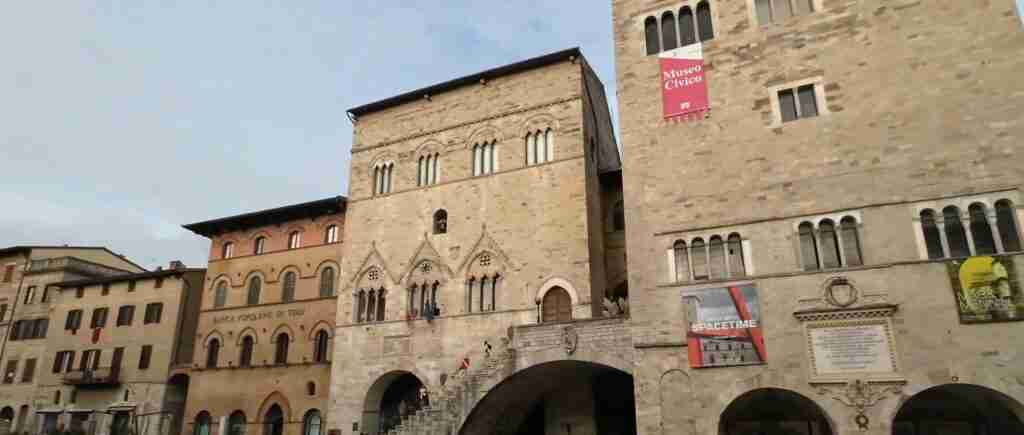
Medieval civic architecture including the Palazzo del Popolo (People’s Palace) in Piazza del Popolo demonstrates Orvieto’s development of republican governmental institutions balancing ecclesiastical power. This impressive public building, constructed in tufa and travertine with crenellated towers, served as seat of communal government and public assembly space where citizens gathered for political deliberations. The palace’s architectural grandeur, comparable to contemporary civic buildings in Siena, Florence, and other independent communes, expresses Orvieto’s self-conception as autonomous political entity despite periodic papal dominance. The building’s survival and continued use into modern times preserves tangible connection to medieval civic traditions.
Visiting Logistics and Practical Information
Reaching Orvieto requires understanding the geographic relationship between the modern railway station located in the valley below and the historic center perched atop the cliff, necessitating vertical transportation that adds a distinctive element to the visiting experience. Orvieto’s railway station, served by frequent regional and intercity trains on the Rome-Florence main line, occupies valley-floor position approximately 150 vertical meters and 1 kilometer horizontal distance from Piazza del Duomo. The funicular railway (funicolare), departing from a station approximately 5 minutes’ walk from the main railway station, provides the primary connection, ascending the cliff face in a 3-minute ride delivering passengers to the upper town at Piazza Cahen just outside the historic center’s defensive walls. The funicular operates approximately every 10 minutes from 7:15 AM to 8:30 PM with slightly extended hours during summer, priced at €1.30 for a single ride.
Alternative access via automobile involves driving the winding road ascending the cliff’s northern face, though parking within the historic center faces severe limitations due to the medieval street pattern never designed for vehicle traffic. Large parking areas exist outside the defensive walls including Campo della Fiera near the funicular base station, with shuttle bus service transporting parked visitors to Piazza del Duomo. Parking fees range from €1-2 per hour depending on location and proximity to the center. Visitors staying overnight in Orvieto’s historic center hotels should verify parking arrangements in advance, as many hotels lack dedicated parking and must arrange access to limited public or private lots.
The walk from funicular upper station to Piazza del Duomo covers approximately 800 meters (10-12 minutes) through the historic center via Corso Cavour, the main east-west axis bisecting the medieval city. This level walking route passes shops, cafes, and notable buildings while building anticipation for the cathedral’s sudden appearance as Piazza del Duomo opens. Alternatively, bus service (Line A) operates from the funicular station to Piazza del Duomo, convenient for visitors with mobility limitations or those preferring to minimize walking before beginning cathedral and underground tours. Combined funicular-bus tickets available at €1.30 provide economical integrated transport.
Optimal visiting timing considers seasonal factors, crowd patterns, and special events influencing the Orvieto experience. Spring months (April-May) and early autumn (September-October) offer the ideal combination of pleasant weather, manageable tourist crowds, and fully operational attractions without summer peak-season congestion. Summer months (June-August) bring largest visitor volumes, extended attraction hours, and guaranteed weather but also heat that makes underground tour temperatures welcome relief and crowded conditions requiring patience. Winter visits (November-March) face trade-offs—minimal crowds and atmospheric medieval ambiance versus reduced hours, potential rain, and some restaurants and shops closing for low season.
Time allocation for comprehensive Orvieto exploration should account for both major attractions plus the appealing historic center deserving leisurely wandering. A minimum half-day visit (4-5 hours) allows cathedral exploration including the Chapel of San Brizio (90 minutes), Underground Orvieto tour (60 minutes), and basic historic center orientation. A full day enables more relaxed pacing with time for the Claudio Faina Etruscan Museum, lunch at a traditional trattoria, visits to secondary churches, the scenic cliff-edge walk (Anello della Rupe), and browsing ceramics workshops and wine shops. Overnight stays unlock early morning and evening periods when the historic center empties of day-trippers, revealing Orvieto’s quieter character.
Dining in Orvieto emphasizes Umbrian cuisine specialties including wild boar, truffles (both black and white varieties depending on season), handmade pasta, and the city’s signature white wine Orvieto Classico. Traditional trattorias concentrate around Piazza del Duomo and along medieval lanes, with outdoor seating providing cathedral views during warm months. Lunch timing typically runs 12:30-2:30 PM, with many restaurants closing between lunch and dinner service (7:30-10:00 PM). Reservations prove advisable for weekend dining and summer evenings when popular restaurants fill completely. Local wine shops offer tastings of Orvieto Classico and other regional wines, often conducted in atmospheric underground cantinas carved into the tuff.
Accommodation options within the historic center range from simple rooms in family-run pensioni to luxury suites in converted Renaissance palaces, with mid-range hotels occupying former convents and noble residences. Staying within the walls eliminates transportation concerns and allows experiencing the medieval city’s transformation from day-visitor destination to quiet residential community each evening. Hotels outside the historic center in the valley town provide lower rates and easier parking but sacrifice atmospheric immersion and require funicular use for cathedral visits. Advance booking proves essential for spring and fall weekends when limited accommodation fills rapidly.
Tourist information services include an official information point in Piazza del Duomo providing maps, attraction schedules, and assistance with practical questions. The office also coordinates guided city tours combining cathedral, underground, and historic center exploration in comprehensive 2-3 hour experiences. Self-guided exploration using maps highlighting significant buildings, viewpoints, and artisan workshops proves perfectly feasible given the compact historic center’s walkable scale. Mobile connectivity throughout the historic center enables real-time schedule checking and online ticket booking for attractions requiring reservations.
Regional Context and Day Trip Combinations
Orvieto’s strategic position in southern Umbria places it within easy reach of numerous significant destinations, making the city ideal for day trip combinations or as a base for exploring the broader region. The location approximately equidistant between Rome (90 kilometers south) and Florence (160 kilometers north) on the main railway line connecting these major cities creates excellent transportation connectivity, with frequent train service allowing spontaneous travel to either destination. This accessibility makes Orvieto feasible as either a day trip destination from Rome or Florence or as a touring base for travelers preferring smaller-city accommodation while exploring central Italian attractions.
Assisi, Umbria’s most famous destination and a UNESCO World Heritage Site since 2000, lies approximately 80 kilometers northeast of Orvieto, reachable in about 90 minutes by car or via rail connections requiring a change at Orte. The two cities offer complementary experiences—Assisi’s Franciscan religious heritage, Giotto’s famous frescoes in the Basilica of San Francesco, and mountain-slope setting contrast with Orvieto’s Gothic cathedral, Etruscan underground city, and cliff-top drama. Combining both destinations in a single Umbrian itinerary provides comprehensive introduction to the region’s medieval religious and artistic patrimony.
The town of Bolsena, 20 kilometers northwest on the shores of Lake Bolsena (Italy’s largest volcanic lake), connects directly to Orvieto’s history through the 1263 Miracle of Bolsena that initiated cathedral construction. The church of Santa Cristina in Bolsena preserves the Cappella del Miracolo (Miracle Chapel) where the eucharistic bleeding allegedly occurred, with marble stains supposedly marking the exact location. Visiting this origin site adds historical context to Orvieto Cathedral’s significance, while Lake Bolsena offers recreational opportunities including swimming, sailing, and waterfront dining providing contrast to hilltop medieval exploration.
Civita di Bagnoregio, dubbed “the dying city” due to ongoing cliff erosion threatening its existence, perches dramatically on an eroding tufa pinnacle 18 kilometers north of Orvieto. This tiny medieval hamlet, accessible only via a modern pedestrian bridge spanning the eroded ravine, presents an even more extreme version of Orvieto’s cliff-top isolation. The settlement’s precarious existence, shrinking resident population, and atmospheric medieval lanes make it among central Italy’s most photographed locations. The proximity to Orvieto makes combination visits logical, often accomplished as half-day excursions from an Orvieto base.
Umbrian wine routes including the Strada dei Vini Etrusco Romana wind through territories surrounding Orvieto, connecting vineyard estates producing Orvieto Classico and other regional wines. Wine tourism infrastructure includes cellar tours, tastings, and agriturismo accommodations on working farms, providing immersion in rural Umbrian culture and landscape. These wine routes offer pleasant countryside driving through rolling hills planted with vines and olives, punctuated by hilltop medieval villages preserving traditional character. Dedicated wine tourists can base themselves in Orvieto while making day trips to specific estates, or incorporate wine visits into broader regional touring.
Perugia, Umbria’s capital and largest city, lies approximately 90 kilometers northeast, offering urban culture, important art museums including the Galleria Nazionale dell’Umbria, Etruscan heritage at the Etruscan Well and city gates, and vibrant student atmosphere from the large university. The city’s medieval core contains important paintings by Perugino and Pinturicchio, while the Rocca Paolina fortress preserves intact medieval streets within its substructure. Perugia provides the regional capital’s cultural institutions and commercial vitality, complementing smaller Orvieto’s more intimate medieval character.
Todi, another remarkably preserved Umbrian hill town 45 kilometers east, centers on Piazza del Popolo, one of Italy’s most harmonious medieval squares surrounded by the Romanesque cathedral, Palazzo dei Priori, and Palazzo del Capitano. The town’s compact historic center, medieval walls, and commanding hilltop position create an experience similar to Orvieto on smaller, quieter scale with fewer tourists. Todi appeals particularly to visitors seeking atmospheric medieval settings without major monuments or crowds, prioritizing ambiance over specific artistic treasures.
Rome, while significantly larger and more complex than these Umbrian destinations, remains within practical day-trip range at approximately 90 minutes by frequent direct train service. Many travelers using Rome as accommodation base visit Orvieto as a day trip escaping the capital’s intensity for Umbrian tranquility. The reverse journey—day-tripping to Rome from Orvieto accommodation—proves less practical given Rome’s vastness but remains feasible for focused visits to specific sites. The easy rail connection between the two cities allows flexible itinerary planning combining Vatican art, ancient Roman monuments, and Renaissance Rome with Umbrian medieval heritage.
Photography Guide to Cathedral and Historic Center
Photographing Orvieto Cathedral presents both exceptional opportunities and specific challenges requiring technical knowledge and timing considerations to achieve optimal results. The facade’s dramatic golden mosaics respond dramatically to changing natural light throughout the day, creating vastly different photographic effects from morning through sunset. Early morning light (7:00-9:00 AM) arrives from the east, illuminating the facade from the side and creating strong relief that emphasizes Maitani’s sculptural details while the mosaics remain relatively subdued. This side-lighting reveals the three-dimensional qualities of the bas-relief pillars and architectural elements, ideal for detail-focused compositions emphasizing sculptural texture.
Midday light (11:00 AM-2:00 PM) strikes the facade most directly, producing the brightest mosaic glow as gold tesserae reflect maximum sunlight. However, harsh overhead sun also creates strong shadows and high contrast that can prove challenging for camera sensors to capture simultaneously in a single exposure. Midday photography benefits from exposure bracketing or HDR techniques combining multiple exposures to preserve both shadow detail in portal recesses and highlight detail in brilliant mosaic surfaces. Cloud cover during midday hours actually improves photographic conditions by providing softer, more even illumination reducing extreme contrast.
Late afternoon and sunset light (4:00-7:00 PM depending on season) produces the cathedral’s most magical photographic moments as golden hour illumination intensifies the mosaic warmth, creating glowing amber tones that make the facade appear luminous. The western light angle during these hours provides optimal illumination while softening as the sun descends, eventually bathing the facade in warm sunset colors moments before shadow engulfs the piazza. Photographers should arrive at least 30 minutes before sunset to capture the progression from warm direct light through the brief “blue hour” when the sky’s deep blue contrasts with artificially-lit golden facade.
Compositional approaches to the facade vary based on photographer intentions and available lenses. The classic frontal view from Piazza del Duomo’s opposite side requires wide-angle lenses (16-35mm on full-frame cameras, 10-24mm on crop sensors) to capture the complete facade from the relatively confined piazza. Shorter focal lengths introduce perspective distortion requiring correction in post-processing, while stepping back to minimize distortion is often impossible given the piazza’s size. Detail photography isolating specific facade elements—individual mosaic panels, sculptural details, the rose window, bronze door decorations—employs telephoto lenses (70-200mm or longer) compressing perspective and eliminating surrounding context to emphasize particular features.
Interior cathedral photography faces technical challenges from extreme contrast between bright windows and dark interior, low ambient light requiring high ISO settings or long exposures, and photography restrictions in the Chapel of San Brizio. Wide-angle lenses (16-35mm) prove essential for capturing nave architecture and spatial relationships, though the resulting perspective distortion requires correction to maintain architectural verticality. A sturdy tripod allows long exposures at low ISO for maximum image quality, though tripod use may face restrictions during busy periods. Flash photography’s prohibition means relying on available light from windows and ambient interior illumination, requiring patient exposure technique and potentially exposure bracketing for difficult high-contrast scenes.
Underground photography during Orvieto Sotterranea tours faces even more challenging lighting conditions with limited ambient light, prohibition on tripods that would impede tour group movement, and active environments where long exposures capture motion blur. Modern cameras with excellent high-ISO performance (ISO 3200-6400 or higher) prove essential, accepting increased noise as necessary compromise for properly exposed images. Fast lenses (f/1.4-f/2.8) gather maximum available light, reducing required shutter speeds and ISO values. Many underground chambers feature strategic lighting highlighting architectural features and historical elements, though this artificial illumination creates yellow-orange color casts requiring careful white balance adjustment in post-processing.
Panoramic views of Orvieto’s dramatic cliff-top setting require external vantage points outside the historic center. The best overlook locations occupy the cliff’s opposite side, accessible via the Anello della Rupe cliff-base path circumnavigating the volcanic plateau. These viewpoints capture the complete vertical drama of the tuff cliff rising from the valley floor to the cathedral-crowned summit, creating iconic compositions showing Orvieto’s geological and architectural integration. Sunset photography from these external viewpoints yields spectacular results as the cathedral’s illuminated facade glows against deepening blue sky while the cliff face catches warm sunset light.
Street photography within Orvieto’s medieval lanes benefits from the atmospheric character of stone buildings, shadowed alleyways, and sudden panoramic views through medieval gates. The narrow streets create dramatic light-and-shadow contrasts ideal for black-and-white photography emphasizing texture and architectural geometry. Human scale elements—residents conducting daily activities, visitors exploring lanes, outdoor cafe scenes—add narrative interest to architectural documentation. Respectful interaction with local residents when they appear in photographs, seeking permission for obvious portraits while being discreet with candid street photography, maintains ethical standards and positive visitor-local relationships.
Seasonal considerations influence photographic opportunities significantly. Spring brings flowering vegetation softening stone architectural severity, while autumn foliage in the surrounding countryside creates warm color palettes framing distant hilltop views. Summer’s intense light and tourist crowds present challenges but guarantee clear weather for reliable shooting conditions. Winter’s low-angle sun creates long dramatic shadows and golden light lasting much of the day, though rain and clouds introduce unpredictability. Photographers should consult weather forecasts and plan cathedral facade photography around predicted clear periods when mosaic illumination reaches maximum brilliance.
Orvieto’s Contemporary Cultural Life
Beyond its historical monuments and archaeological heritage, contemporary Orvieto maintains vibrant cultural life through festivals, artistic events, and traditions connecting medieval past with modern present. The city’s cultural calendar extends throughout the year with events leveraging the cathedral, underground spaces, and historic center’s atmospheric settings as venues for performances and celebrations that would be impossible in conventional modern spaces. These contemporary cultural activities ensure Orvieto functions as a living city rather than merely a museum preserving medieval architecture, creating opportunities for visitors to experience Italian cultural traditions in authentic contexts.
The Corpus Christi celebration each June holds special significance in Orvieto given the cathedral’s direct connection to this feast’s 1264 institution following the Miracle of Bolsena. The annual Procession of the Corporal, first conducted in 1338 and continuing without interruption for nearly seven centuries, features the elaborate reliquary containing the miraculous blood-stained cloth carried through Orvieto’s streets from the cathedral through the historic center and back, accompanied by clergy, civic authorities, and residents in historical costume. This religious procession represents living medieval tradition adapted to contemporary practice, drawing both local participants maintaining centuries-old devotion and visitors seeking authentic Catholic ritual in its historical setting.
Umbria Jazz Winter, held each December-January as the summer Umbria Jazz festival’s companion event, brings international jazz performances to Orvieto’s churches, palaces, and the cathedral itself. The acoustic properties of medieval sacred spaces create unique listening environments for jazz concerts, while the contrast between contemporary musical forms and ancient architectural settings produces memorable aesthetic experiences. The festival attracts both dedicated jazz enthusiasts and general audiences drawn by the unusual combination of internationally-renowned musicians performing in venues of exceptional historical and artistic significance.
The Orvieto Città Slow designation (part of the international Slow Cities movement promoting quality of life, environmental sustainability, and traditional culture) influences the city’s contemporary character through policies favoring pedestrian areas, local food products, traditional crafts, and measured tourism development. This philosophical approach maintains Orvieto’s atmospheric medieval character while accommodating modern visitor infrastructure, creating a balance between cultural heritage preservation and economic vitality dependent on tourism. Visitors sensitive to overtourism and commercialization of historic centers appreciate Orvieto’s relatively measured development approach maintaining authentic local character.
Ceramic production, a traditional Orvieto craft with medieval origins, continues in contemporary workshops concentrated along Via dei Magoni and other artisan lanes near the cathedral. These workshops produce both functional pottery and decorative pieces employing traditional techniques and contemporary designs, often incorporating medieval decorative motifs adapted to modern aesthetic sensibilities. Visiting working workshops allows observing production processes from clay preparation through wheel-throwing, glazing, and kiln firing, providing insight into craft continuity connecting medieval ceramic traditions with contemporary artistic practice. Many workshops welcome visitors and accommodate custom commissions, creating opportunities for acquiring unique pieces documenting Orvieto visits.
Wine culture remains central to Orvieto’s contemporary identity, with Orvieto Classico DOC wine production continuing on hillside vineyards visible from the cliff’s edge. The city’s enotecas (wine bars) concentrate expertise on local and regional wines, offering tastings that educate visitors about Umbrian viticulture while the wine shops sell bottles for takeaway or shipping. Many enotecas occupy medieval cellars carved into the tuff, creating atmospheric settings where wine appreciation occurs in the same underground spaces that stored wine centuries earlier. The annual wine harvest celebration each September includes public tastings, vineyard visits, and cultural events connecting contemporary wine production to centuries-old agricultural traditions.
The Museo Emilio Greco, included in cathedral admission, displays modern sculpture by the Sicilian artist Emilio Greco (1913-1995) who created the cathedral’s bronze doors in the 1960s. The museum’s collection of Greco’s bronze and marble figures, primarily female nudes and religious subjects, demonstrates 20th-century artistic engagement with classical themes and forms. This modern art collection within the medieval palace complex illustrates Orvieto’s continuing artistic patronage extending beyond preservation of historical treasures to support contemporary creative production. The cathedral doors’ modern artistic execution proves surprisingly harmonious with the Gothic facade’s medieval decoration, demonstrating thoughtful integration of 20th-century artistic contribution to centuries-old monument.
Local gastronomy beyond wine includes specialties like wild boar stew, black and white truffles (depending on season), handmade umbricelli pasta (thick hand-rolled spaghetti), and porchetta (spit-roasted pork). Traditional trattorias maintain recipes passed through generations while contemporary restaurants reinterpret Umbrian ingredients using modern techniques and plating styles. The Orvieto food scene accommodates both traditionalists seeking authentic medieval-recipe cuisine and modernists interested in innovative regional cooking, creating dining diversity unusual in a city of Orvieto’s modest size. Markets held in Piazza del Popolo on Thursday and Saturday mornings sell local produce, cheeses, and prepared foods, allowing visitors to experience the commercial life sustaining local residents beyond the cathedral-focused tourism economy.
Frequently Asked Questions
Can I visit Orvieto Cathedral for free or is admission always required?
Admission to Orvieto Cathedral requires the €8 ticket that includes the Duomo, Emilio Greco Museum, and cathedral underground chambers, with no free general visiting hours. The cathedral functions as both an active place of worship and a major cultural monument, with ticket revenue supporting ongoing conservation, staff costs, and building maintenance. However, visitors attending Mass or other religious services can enter the cathedral for worship purposes without purchasing a tourist ticket, though access during these times is limited to areas not disrupting liturgical activities and the Chapel of San Brizio remains closed. Mass attendance provides the only free access opportunity, though visitors should respect the religious service rather than treating it as a sightseeing opportunity. The cathedral bookshop near the entrance sells illustrated guides, postcards, and religious items without requiring cathedral admission.
How physically demanding is the Underground Orvieto tour?
The Underground Orvieto tour involves moderate physical demands including navigating stairs, uneven surfaces, and low-ceiling passages that require basic mobility and balance but does not constitute strenuous activity for visitors in normal health. The approximately 60-minute route descends and ascends approximately 40-50 vertical meters through stairs connecting different cave levels, with most stairways featuring handrails for support. The passages maintain relatively level walking surfaces between stair sections, though the hand-carved floor can be uneven with occasional puddles from water infiltration. Several passages require ducking slightly to avoid low overhead rock, though none necessitate crawling or extreme stooping. The tour pace allows for rest breaks and photograph opportunities, preventing continuous exertion. Visitors with knee problems, balance issues, or cardiovascular conditions should carefully evaluate whether they can manage repeated stair climbing in relatively confined spaces, while wheelchair users and those with severe mobility limitations cannot access the underground routes. Proper footwear—closed-toe shoes with slip-resistant soles—proves essential for safe navigation of potentially slippery stone surfaces.
Is it worthwhile visiting both the cathedral and underground, or should I choose just one?
Visiting both attractions provides the most complete and rewarding Orvieto experience, as the cathedral and underground represent complementary rather than redundant aspects of the city’s multifaceted history and appeal. The cathedral showcases medieval and Renaissance artistic achievement through Gothic architecture, golden mosaics, and Signorelli’s revolutionary frescoes, offering spiritual magnificence and aesthetic refinement. The underground reveals practical ingenuity through Etruscan water engineering, medieval industrial installations, and the physical infrastructure supporting life atop an isolated cliff, providing archaeological fascination and engineering appreciation. Together, they illustrate the vertical dimension of Orvieto’s history from subterranean foundations to soaring cathedral spires, creating a comprehensive understanding impossible from either attraction alone. Time-constrained visitors forced to choose should select based on personal interests—art and architecture enthusiasts favor the cathedral, while those drawn to archaeology and ancient engineering prefer the underground. However, the modest admission costs (€8 cathedral, €7 underground), reasonable time requirements (approximately 90 minutes each), and close proximity (both departing from Piazza del Duomo) make visiting both attractions feasible and worthwhile for all but the most severely time-limited visitors.
What is the Miracle of Bolsena and why was it so important?
The Miracle of Bolsena occurred in 1263 when a Bohemian priest named Peter of Prague, who harbored doubts about the Catholic doctrine of transubstantiation (the belief that consecrated bread and wine become Christ’s actual body and blood), witnessed the Host bleeding onto the corporal cloth during Mass at Santa Cristina church in Bolsena, a town approximately 20 kilometers from Orvieto. According to tradition, the priest brought the blood-stained corporal to Pope Urban IV, who was residing in Orvieto at the time. The Pope declared the event a genuine miracle confirming transubstantiation doctrine and, in 1264, instituted the Feast of Corpus Christi celebrating the Real Presence of Christ in the Eucharist. This new feast required appropriate liturgical celebration, and Urban IV commissioned construction of a grand cathedral in Orvieto to house the miraculous corporal and serve as the primary shrine for the newly established feast. The miracle’s significance extended beyond Orvieto to influence Catholic liturgy worldwide, as Corpus Christi became one of the Church’s major feasts observed annually with elaborate processions. For Orvieto specifically, the miracle transformed the city from one prosperous commune among many into a major pilgrimage destination and prompted construction of the magnificent cathedral that defines the city’s identity. The blood-stained corporal remains preserved in an elaborate reliquary within the cathedral’s Cappella del Corporale, and the annual Corpus Christi procession through Orvieto’s streets perpetuates seven centuries of uninterrupted devotion to the miraculous event.
Are there guided tours combining the cathedral and underground in a single experience?
Combined guided tours integrating cathedral exploration and underground visits in comprehensive 2-3 hour experiences are available through various tour operators and can be booked through the tourist information office in Piazza del Duomo, online travel platforms, or directly with local guide services. These combined tours provide the advantage of expert commentary connecting Orvieto’s above-ground and underground histories, explaining relationships between medieval cathedral construction and the Etruscan engineering underlying it, and offering historical context difficult for independent visitors to glean from monuments alone. Tour operators typically limit group sizes to 15-20 participants, maintaining intimate experiences where all participants can hear guide commentary and ask questions. Combined tours usually include all admission fees in a single package price (typically €40-60 per person depending on tour company and inclusions), eliminating need to separately purchase cathedral and underground tickets. The tours generally operate on fixed schedules with morning and afternoon departure times, requiring advance booking particularly during peak spring and summer seasons when popular tours fill days or weeks ahead. Independent visitors preferring to explore at their own pace without group constraints can purchase separate cathedral and underground tickets and follow self-guided visits enhanced by audio guides and printed materials, though they sacrifice the insights and historical connections that experienced guides provide.
What other attractions besides the cathedral and underground are worth visiting in Orvieto?
Beyond the cathedral and underground, several other Orvieto attractions merit visiting time depending on visitor interests and available duration. St. Patrick’s Well (Pozzo di San Patrizio), a remarkable 16th-century engineering work commissioned by Pope Clement VII, descends 62 meters into the cliff via two independent spiral staircases (one for descent, one for ascent) that never intersect, allowing pack animals to carry water from the deep well to the surface without encountering animals traveling the opposite direction. The well’s double-helix design and impressive depth make it an engineering marvel complementing the Etruscan underground engineering. Torre del Moro, the medieval civic tower rising above Corso Cavour, offers panoramic views across Orvieto and the surrounding Umbrian countryside from its 47-meter-high viewing platform, reached by climbing 250 steps through the tower’s interior. The Claudio Faina Archaeological Museum, housed in a Renaissance palace facing the cathedral, contains exceptional Etruscan ceramics, Greek imported pottery, and bronze artifacts illuminating pre-Roman Orvieto. The Anello della Rupe, a scenic walking path circling the cliff base, provides external perspective on Orvieto’s dramatic geological setting through a 5-kilometer route requiring approximately 90 minutes and revealing cliff-face openings to underground chambers. The historic center’s medieval lanes, independent of specific monuments, reward wandering through atmospheric stone streets revealing craftsmen’s workshops, wine cellars, and sudden panoramic views through defensive gates.
When is the best time of day to visit the cathedral for optimal light and fewer crowds?
The optimal visiting time balancing favorable light conditions with manageable crowds is early morning immediately at opening (9:30 AM) or late afternoon during the final 90 minutes before closing, avoiding the midday peak when tour groups and independent visitors converge simultaneously. Early morning visits encounter the cathedral before large groups arrive, providing quieter contemplation of the interior and better access to the Chapel of San Brizio without waiting for previous viewer groups to exit. Morning side-lighting on the facade creates dramatic sculptural relief emphasizing Maitani’s bas-relief details, though mosaic brilliance remains subdued compared to later hours. Late afternoon visits, particularly in the two hours before sunset, capture the golden mosaic facade at its most spectacular as lowering sun angles intensify the gold tesserae while visitor numbers decline as day-trippers depart. The Chapel of San Brizio’s north-facing position means interior lighting changes less dramatically than the south-facing facade, making chapel viewing timing less critical than facade photography. Midday visits (11:00 AM-2:00 PM) face maximum crowds when the cathedral interior can become congested and Chapel of San Brizio access may require brief queuing, though mosaic brilliance reaches its daily peak. Seasonal variations influence crowd patterns—summer middays see largest volumes while winter middays remain relatively quiet, allowing more flexibility in timing visits for favorable conditions.
Is Orvieto suitable for visiting with young children?
Orvieto accommodates family visits with children generally well, though certain aspects require consideration of children’s ages, attention spans, and physical capabilities. The cathedral’s visual drama—particularly the golden mosaic facade—captures children’s attention more effectively than many medieval churches, while the Chapel of San Brizio frescoes depicting apocalyptic scenes may prove either fascinating or frightening depending on individual children’s sensibilities and ages. The cathedral visit requires approximately 60-90 minutes of relatively quiet behavior respecting the sacred space, potentially challenging for very young children. The Underground Orvieto tour proves more actively engaging for children interested in caves and underground exploration, though the physical requirements (stairs, confined passages, 60-minute duration) may exceed very young children’s capabilities and the historical commentary targets adult comprehension levels. Parents with children under 6 (who enter the underground free) should honestly assess whether their children can manage the physical and behavioral requirements or whether one parent should tour while the other remains above with young children. School-age children generally enjoy both attractions, particularly if parents frame visits as adventures (exploring underground caves, discovering golden cathedrals) rather than cultural education. The historic center’s compact scale, pedestrian streets free from vehicle traffic, gelato shops, and public gardens near the Rocca Albornoziana provide child-friendly amenities between cultural visits. Family-friendly restaurants accommodating children’s dietary preferences and offering outdoor seating are common around Piazza del Duomo.
Does Orvieto require an overnight stay or can it be fully experienced as a day trip?
Orvieto’s compact size and concentrated attractions make comprehensive day-trip visits feasible from Rome (90 minutes by train), Florence (2 hours), or other Umbrian cities, though overnight stays unlock additional benefits and more relaxed pacing. A focused day trip (8-9 hours including travel) allows cathedral exploration, underground tour, brief historic center wandering, and a restaurant meal before departing—covering the essential highlights but limiting opportunities for spontaneous exploration, multiple museum visits, or extended photography sessions. Day-trippers arriving mid-morning and departing late afternoon experience Orvieto during peak visiting hours when crowds are densest and atmospheric evening light is missed. Overnight stays (one or two nights) eliminate schedule pressure, allowing early morning cathedral visits before crowds, sunset facade photography, evening dining when the historic center empties of day visitors, and flexibility to explore secondary attractions like St. Patrick’s Well, Torre del Moro, archaeological museums, and the Anello della Rupe cliff walk. Staying overnight also enables morning visits to surrounding destinations like Civita di Bagnoregio or wine estate tours in the countryside. The decision ultimately depends on broader itinerary constraints—travelers visiting multiple destinations may lack time for overnight stays, while those seeking deeper engagement with individual locations benefit from at least one night experiencing Orvieto’s evening and early morning tranquility when the city reveals its character as a living medieval town rather than merely a tourist destination.
How does Orvieto compare to other Italian hill towns like San Gimignano or Siena?
Orvieto occupies a distinctive position among Italian hill towns through its dramatic cliff-top isolation, exceptional Gothic cathedral, and extensive underground archaeology, differentiating it from the more numerous gradual-hill-slope towns that characterize Tuscan and Umbrian landscapes. San Gimignano’s medieval towers, intact defensive walls, and Tuscan Romanesque churches create a preserved medieval townscape that, while atmospheric, lacks a singular monument of Orvieto Cathedral’s artistic importance or the underground city’s archaeological fascination. San Gimignano also suffers more severely from tourist commercialization with dense concentrations of souvenir shops diminishing authentic character, while Orvieto maintains somewhat better balance between tourism infrastructure and genuine local life. Siena, substantially larger than either Orvieto or San Gimignano, offers a broader range of attractions including the magnificent Piazza del Campo, the Duomo’s Piccolomini Library frescoes by Pinturicchio, and the Palio horse race tradition, but lacks the geological drama of Orvieto’s cliff-top setting or equivalent underground archaeology. Orvieto’s advantage lies in concentrated impact—the combination of dramatic natural setting, supreme Gothic cathedral, Signorelli frescoes rivaling any Renaissance painting cycle, and extensive Etruscan underground creates memorable experiences despite the city’s modest size. Visitors preferring comprehensive museum collections, extended shopping opportunities, or multiple major monuments favor larger centers like Siena, while those valuing dramatic settings, focused artistic masterpieces, and archaeological uniqueness appreciate Orvieto’s more concentrated but exceptional offerings.