Trevi Fountain & Rome’s Iconic Fountains Guide: Baroque Masterpieces & Hidden Gems
Rome’s fountains represent the pinnacle of Baroque artistry, transforming practical water infrastructure into theatrical masterpieces that have captivated visitors for centuries. From the monumental splendor of the Trevi Fountain to hidden Renaissance gems tucked into quiet piazzas, these water features tell the story of papal ambition, artistic genius, and Rome’s mastery of hydraulic engineering across two millennia.
Key Takeaways
- The Trevi Fountain, completed in 1762, stands as Rome’s largest Baroque fountain and one of the world’s most photographed monuments, featuring Neptune commanding the seas amid intricate allegorical sculptures
- Gian Lorenzo Bernini and Francesco Borromini dominated Rome’s 17th-century fountain landscape, creating masterpieces like the Four Rivers Fountain and Triton Fountain that blend sculpture, architecture, and water dynamics
- Rome’s fountains served dual purposes throughout history: practical water distribution through the ancient aqueduct system and powerful symbols of papal authority and artistic patronage
- Lesser-known fountains like the Turtle Fountain and Fontana dell’Acqua Paola offer equally impressive artistry without the crowds that surround major landmarks
- The coin-throwing tradition at Trevi Fountain, generating over €1.5 million annually for charity, originated from the 1954 film “Three Coins in the Fountain” and has become one of Rome’s most enduring customs
- Strategic fountain walking routes allow visitors to experience Rome’s hydraulic heritage chronologically, from ancient Roman engineering to Baroque theatrical design
People Also Ask About Rome’s Fountains
What Makes the Trevi Fountain Architecturally Significant?
The Trevi Fountain represents the culmination of Baroque fountain design, integrating architecture, sculpture, and water movement into a unified theatrical experience. Nicola Salvi’s design seamlessly merges the fountain with the Palazzo Poli facade, creating the illusion that Neptune and his attendants emerge directly from the palace architecture. The 26-meter-high, 49-meter-wide monument employs travertine stone quarried from Tivoli, the same material used in the Colosseum. The fountain’s architectural innovation lies in its integration of the palazzo’s Corinthian pilasters and niches into the sculptural program, blurring the boundary between building and fountain. Water flows from multiple levels, cascading over artificial rocks into a semi-circular basin, with the central jet reaching heights that vary throughout the day based on water pressure from the Acqua Vergine aqueduct.
Who Designed Rome’s Most Famous Baroque Fountains?
Gian Lorenzo Bernini dominated Rome’s fountain landscape in the 17th century, creating the Fontana dei Quattro Fiumi in Piazza Navona, the Fontana del Tritone in Piazza Barberini, and the Fontana della Barcaccia at the Spanish Steps. His rival Francesco Borromini contributed architectural elements to several fountains, though his direct fountain work was limited. Nicola Salvi designed the Trevi Fountain, while Giacomo della Porta created numerous Renaissance fountains including the Turtle Fountain. Carlo Maderno contributed fountain designs in the early Baroque period, and Pietro da Cortona designed the Fontana del Tritone’s companion piece. The artistic rivalry between Bernini and Borromini shaped Rome’s Baroque identity, with each artist pushing the boundaries of sculptural expression and hydraulic engineering to create increasingly dramatic water features.
How Did Ancient Roman Aqueducts Supply Rome’s Fountains?
Rome’s fountains depend on the ancient aqueduct system, with eleven major aqueducts constructed between 312 BCE and 226 CE bringing water from sources up to 92 kilometers away. The Aqua Virgo (Acqua Vergine), built in 19 BCE by Marcus Agrippa, remains the only ancient aqueduct in continuous use, supplying the Trevi Fountain and many others in central Rome. The system functioned entirely by gravity, with precise gradients averaging 1-3 meters per kilometer ensuring steady water flow without pumping. Stone and concrete channels, often running underground for protection, delivered approximately one million cubic meters of water daily at the system’s peak. Distribution basins called “castella” divided water among public fountains, baths, and private connections. The Renaissance and Baroque popes restored and expanded these aqueducts, with Pope Nicholas V rebuilding the Acqua Vergine in 1453 and Pope Paul V constructing the Acqua Paola in 1612, enabling the fountain-building programs that transformed Rome’s urban landscape.
What Symbols Appear in Rome’s Fountain Sculptures?
Rome’s fountains employ a consistent symbolic vocabulary drawn from classical mythology and Christian allegory. Neptune appears frequently as the god of water and seas, often commanding horses or tritons representing tamed natural forces. River gods personify major waterways, as seen in Bernini’s Four Rivers Fountain where allegorical figures represent the Nile, Ganges, Danube, and Rio de la Plata. Tritons, half-human sea creatures, symbolize the power of water and frequently appear blowing conch shells to produce water jets. Dolphins represent good fortune and safe passage, while turtles symbolize patience and longevity. Obelisks, particularly in Bernini’s work, reference papal authority and the connection between ancient Roman power and Catholic Rome. Papal coats of arms feature prominently, asserting the patron’s identity and reinforcing the Church’s role in urban beautification. Allegories of seasons, virtues, and continents appear in more elaborate fountain programs, creating complex iconographic narratives that educated Renaissance and Baroque viewers would have understood immediately.
Extended multi-day tours – 5+ days
Featured Rome Multi-Day Tour Packages
3 days
Rome 3-Day Discovery Tour
- ✓ Comprehensive Rome experience
- ✓ Expert local guides included
- ✓ All accommodation included
- ✓ Transportation provided
5 days
Rome 5-Day Highlights Experience
- ✓ Comprehensive Rome experience
- ✓ Expert local guides included
- ✓ All accommodation included
- ✓ Transportation provided
7 days
Rome 7-Day Cultural Journey
- ✓ Comprehensive Rome experience
- ✓ Expert local guides included
- ✓ All accommodation included
- ✓ Transportation provided
10 days
Rome 10-Day Complete Adventure
- ✓ Comprehensive Rome experience
- ✓ Expert local guides included
- ✓ All accommodation included
- ✓ Transportation provided
Multi-day tour packages powered by TourRadar. Prices and availability subject to change.
Introduction
Rome’s fountains constitute one of the world’s most remarkable urban art collections, transforming the city into an open-air museum where water becomes both medium and message. These monuments represent far more than decorative water features; they embody the evolution of Western art from the Renaissance through the Baroque period, document the technological achievements of ancient and early modern hydraulic engineering, and express the political and religious aspirations of popes who ruled Rome for centuries. Walking through Rome’s piazzas and streets means encountering a continuous dialogue between water, stone, and urban space that spans more than two thousand years.
The story of Rome’s fountains begins with practical necessity. Ancient Rome required massive quantities of fresh water to sustain a population that reached one million inhabitants at the empire’s height. The famous aqueduct system, one of antiquity’s greatest engineering achievements, delivered water from distant sources to distribution points throughout the city. While the ancient fountains served primarily utilitarian purposes, providing drinking water and marking the termini of aqueduct branches, they also functioned as symbols of imperial power and civic beneficence. The elaborate nymphaea and monumental fountain facades that adorned Rome in the imperial period established precedents that Renaissance and Baroque artists would later transform into the spectacular water theatres we see today.
Following Rome’s medieval decline, when the city’s population dwindled to perhaps 20,000 and the great aqueducts fell into ruin, the Renaissance popes initiated an ambitious program of urban renewal. Pope Nicholas V’s restoration of the Acqua Vergine in 1453 marked the beginning of fountain construction that would accelerate through the 16th and 17th centuries. The Counter-Reformation popes, particularly those from the Barberini and Pamphili families, employed fountains as instruments of urban propaganda, asserting papal authority through monuments of unprecedented scale and artistic sophistication. Gian Lorenzo Bernini emerged as the dominant artistic figure of this era, creating fountains that revolutionized the relationship between sculpture, architecture, and water.
The Trevi Fountain represents the culmination of this artistic tradition. Commissioned in 1732 and completed thirty years later, it transformed a relatively modest Renaissance fountain at the Acqua Vergine terminus into Rome’s largest and most scenographic water feature. Nicola Salvi’s design merged the fountain with the Palazzo Poli facade, creating an architectural-sculptural ensemble that epitomizes Baroque theatricality. The monument’s enduring popularity, drawing millions of visitors annually and generating substantial charitable donations through the coin-throwing tradition, demonstrates how effectively Baroque artists created works that continue to engage contemporary audiences.
Beyond the famous monuments that attract tourist crowds, Rome preserves numerous lesser-known fountains that reward exploratory visitors. Small neighborhood fountains, Renaissance masterpieces in quiet piazzas, and 19th-century additions to the city’s hydraulic infrastructure create a layered fountain landscape where every era of Roman history remains visible. The Turtle Fountain in the Jewish Ghetto, the Acqua Paola on the Janiculum Hill, and countless wall fountains scattered through Trastevere and Monti demonstrate that fountain artistry extended beyond the major papal commissions to embrace the entire urban fabric.
Understanding Rome’s fountains requires attention to multiple dimensions: the hydraulic engineering that makes them function, the artistic traditions they embody, the religious and political symbolism they communicate, and the urban design principles they express. This guide explores these dimensions in depth, examining major monuments and hidden gems, analyzing artistic techniques and iconographic programs, and providing practical guidance for experiencing Rome’s fountain heritage. Whether you seek to understand Bernini’s revolutionary approach to sculptural water effects, trace the path of ancient aqueducts through the modern city, or simply find the best perspectives for fountain photography, the following sections offer comprehensive information grounded in art historical scholarship and field research.
Understanding Rome’s Fountain Heritage
Rome’s fountains reflect distinct artistic periods, each with characteristic styles and purposes. Ancient Roman fountains prioritized function over form, though late imperial nymphaea demonstrated increasing decorative ambition. Medieval Rome produced few new fountains, instead maintaining remnants of ancient infrastructure. The Renaissance initiated systematic fountain building, with architects like Giacomo della Porta creating elegant designs that balanced classical restraint with innovative water effects. The Baroque period transformed fountains into theatrical spectacles, employing dynamic sculpture, dramatic lighting effects, and complex water choreography to create immersive experiences.
Baroque fountain design, which reached its apex in 17th-century Rome, followed several key principles. Sculptural elements appeared to interact dynamically with water rather than simply supporting or framing it. Figures twist, reach, and gesture, creating movement that water jets and cascades emphasize. Scale increased dramatically, with fountains occupying entire piazza faces or building facades. Integration with architecture became paramount, as fountains merged with palace walls, church facades, and urban infrastructure. The theatrical principle of the “bel composto” governed design decisions, seeking total unity of sculpture, architecture, painting, water, and light.
The symbolic vocabulary of Rome’s fountains draws from classical mythology, with Neptune and Oceanus representing control over water and seas. River gods personify specific waterways, appearing as reclining male figures with attributes identifying their geographical origins. Tritons and nereids populate fountain compositions as attendants to major deities. Dolphins, shells, and maritime vegetation reinforce aquatic themes. Papal heraldry asserts patronage and political authority. Obelisks reference both ancient Roman imperial power and its claimed succession by the papacy. Allegories of virtues, continents, and seasons create complex iconographic programs requiring educated interpretation.
Water itself functions as sculptural material in Rome’s fountains. Jets vary in height, thickness, and trajectory, creating vertical accents or cascading effects. Sheet falls produce glassy surfaces that reflect light. Turbulent spills over rocks create sound and visual texture. Still pools provide mirror surfaces contrasting with active water features. Baroque fountain designers choreographed these effects carefully, understanding how different water behaviors interact with sculptural forms and viewing angles. The best examples create perpetually changing compositions as water catches sunlight, produces sound, and moves in response to varying pressure levels throughout the day.
Rome’s fountain distribution follows patterns established by the ancient aqueduct system and reinforced by papal urban planning. Major fountains mark aqueduct termini, asserting control over water resources. Secondary fountains distribute water to neighborhoods, often incorporating simpler designs but maintaining artistic quality. Wall fountains attached to buildings provide local access points while economizing on space. Drinking fountains called “nasoni” (big noses) serve utilitarian functions while contributing to the city’s hydraulic infrastructure. This hierarchical system ensures that fountain artistry reaches all social levels and urban contexts.
Conservation challenges affect Rome’s fountains significantly. Travertine and marble suffer from pollution, biological growth, and calcium deposits. Water chemistry requires careful management to prevent algae while protecting stone surfaces. Vandalism and tourist impact demand ongoing maintenance. Modern restoration techniques balance historical authenticity with practical durability. Climate change affects water availability, particularly during summer months when pressure in the Acqua Vergine drops noticeably. Several major fountains undergo periodic restoration, with protective barriers sometimes obscuring views but preserving monuments for future generations.
Trevi Fountain: History & Architecture
The Trevi Fountain occupies the site where the Acqua Vergine aqueduct terminated in ancient Rome, a location that has featured water distribution infrastructure for over two millennia. Marcus Agrippa constructed the original aqueduct in 19 BCE, bringing water 21 kilometers from springs near Salone to supply his baths in the Campus Martius. The aqueduct name derives from legend: a young virgin (virgo) supposedly revealed the spring location to Roman soldiers. Throughout the imperial period, a modest basin marked the terminus, serving the surrounding neighborhood.
Pope Nicholas V initiated the fountain’s monumental transformation in 1453 by restoring the Acqua Vergine and commissioning Leon Battista Alberti to design a new fountain featuring a simple wall with three spouts above a basin. This Renaissance fountain served the area for nearly three centuries until Pope Clement XII launched the competition for a grander monument in 1730. Sixteen architects submitted proposals, with Nicola Salvi winning selection despite limited prior experience. Political connections to the Corsini family, Clement XII’s relatives, likely influenced the decision.
Construction began in 1732 and proceeded slowly due to funding constraints, technical challenges, and Salvi’s perfectionism. The architect died in 1751 with the project incomplete, and Giuseppe Pannini assumed direction until the fountain’s inauguration in 1762 under Pope Clement XIII. The thirty-year construction period allowed for refinements and modifications that enhanced the final design’s coherence. Total costs reached approximately 17,647 scudi, equivalent to roughly €2.5 million in current value, funded through unpopular taxes on wine that generated public resentment.
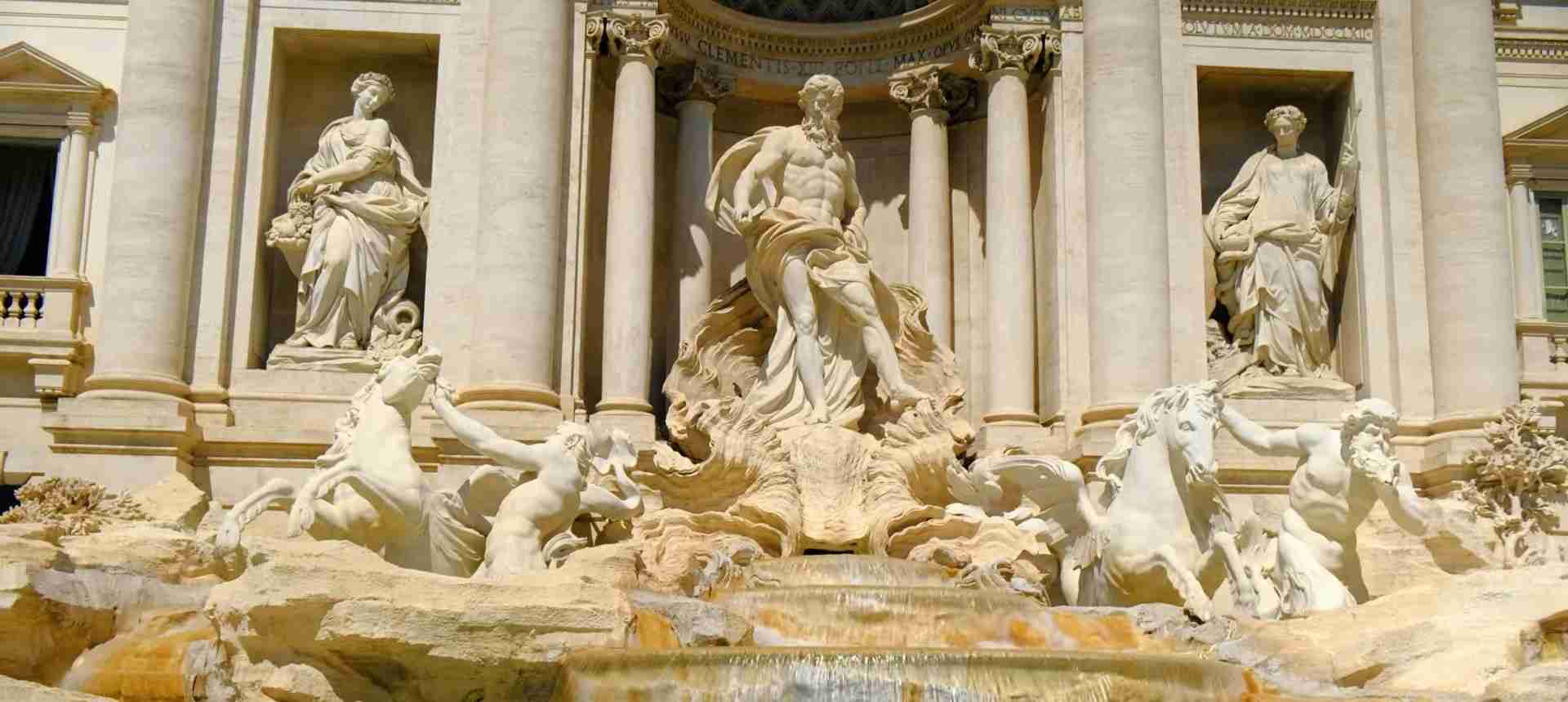
Salvi’s architectural conception integrated the fountain completely with the Palazzo Poli facade, creating an inseparable ensemble. The triumphal arch motif governs the design, with a central arched niche flanked by rectangular niches, all framed by Corinthian pilasters and topped by an attic story bearing Latin inscriptions. The composition measures 26 meters in height and 49 meters in width, occupying nearly the entire palazzo face. Travertine stone from Tivoli quarries provides the primary material, chosen for durability and visual harmony with Rome’s ancient monuments. The architectural framework establishes a stage for the sculptural program, with niches, pedestals, and the basin creating performance spaces for allegorical figures.
The fountain’s hydraulic system draws directly from the Acqua Vergine, which continues to function using gravity flow from the original Roman aqueduct path. Water enters the fountain at the attic level, flowing through concealed channels to emerge at multiple points. The central cascade originates beneath Neptune’s feet, pouring over artificial rocks into the large semi-circular basin below. Side jets contribute secondary water effects. The original design included illumination from torches, though modern lighting has replaced open flames. Daily water volume reaches approximately 80,000 cubic meters, though flow varies seasonally based on source spring output and maintenance requirements.
The fountain’s placement transforms a modest piazza into a theatrical space, with the Palazzo Poli providing a built backdrop and surrounding buildings framing the viewing area. Salvi designed the approach carefully, with visitors emerging from narrow streets into the piazza to encounter the fountain suddenly and dramatically. This theatrical revelation exemplifies Baroque urban design principles, manipulating circulation patterns to maximize emotional impact. The fountain’s scale relative to the piazza creates an overwhelming presence, filling the visual field and dominating the acoustic environment with cascading water.
Trevi Fountain: Artistic Details & Symbolism
The central figure of Oceanus, god of the world’s waters, dominates the Trevi Fountain’s sculptural program. Pietro Bracci executed this colossal marble figure between 1759 and 1762, depicting the deity standing in a shell-shaped chariot pulled by sea horses. Oceanus raises his right arm in a commanding gesture while his left hand grips a staff, asserting control over the aquatic realm. The muscular, bearded figure exemplifies late Baroque sculptural style, with dynamic contrapposto and theatrical presence. The chariot emerges from the central arch as if bursting from the palazzo itself, creating the illusion of divine manifestation.
Two tritons guide the sea horses, representing water’s contrasting aspects. The left triton struggles with a wild, rearing horse symbolizing the sea’s turbulent nature. The right triton leads a calm, docile horse representing tranquil waters. This dualism extends throughout Baroque iconography, expressing humanity’s relationship with natural forces requiring both respect for power and confidence in mastery. The tritons’ muscular physiques and strained poses demonstrate Bernini’s influence on later Baroque sculpture, particularly his emphasis on physical exertion and emotional intensity.
The lateral niches contain allegorical statues personifying abundance and health. The left niche features Abundance (Agrippa Statue), executed by Filippo della Valle in 1735, holding a cornucopia from which water once flowed. The right niche presents Health (Salubrity), also by della Valle, accompanied by a snake drinking from a cup, the ancient medical symbol. Above these figures, relief sculptures depict episodes from the virgin legend: soldiers discovering the spring and Agrippa approving the aqueduct construction. These historical narratives legitimize the fountain’s function while connecting 18th-century Rome to its imperial past.
The attic story features Clement XII’s coat of arms, prominently displaying the papal tiara and keys of Saint Peter flanked by allegorical figures. The Latin inscription reads: “Clemens XII Pont Max Aquam Virginem Copia Et Salubritate Commendatam Cultu Magnifico Ornavit Anno Domini MDCCXXXV Pontif VI” (Pope Clement XII, in the sixth year of his pontificate, adorned this water, esteemed for its abundance and wholesomeness, with magnificent decor, 1735). This inscription asserts papal authority over water resources and urban beautification, presenting the fountain as an act of benevolent governance.
The fountain’s rock work, carved from travertine to resemble natural formations, supports the sculptural program while directing water flow. These artificial cliffs create multiple levels, with water cascading from various heights into the basin. The rocks’ weathered appearance suggests natural erosion, integrating the monument into a larger mythological landscape. Shells, marine vegetation, and coral formations carved into the stone reinforce aquatic themes. This naturalistic element contrasts with the architectural framework’s classical formality, creating tension between order and wildness that characterizes Baroque aesthetics.
Symbolic plants and creatures populate the fountain’s decorative program. Palm fronds suggest eternal life and victory. Marine flora including seaweed and algae emphasize the underwater realm. Small lizards and other creatures inhabit rock crevices, adding naturalistic detail. These elements demonstrate the Baroque interest in scientific observation combined with allegorical meaning, as each plant and animal carries symbolic weight beyond mere decoration. The comprehensive iconographic program transforms the fountain into a readable text communicating messages about water, power, health, abundance, and papal authority.
Trevi Fountain: Traditions & Legends
The coin-throwing tradition constitutes the Trevi Fountain’s most famous custom, attracting millions of participants annually and generating substantial charitable revenue. Legend holds that throwing a coin over the left shoulder while facing away from the fountain guarantees a return to Rome. Throwing two coins supposedly leads to romance with an attractive Italian, while three coins result in marriage. This tradition originated relatively recently, popularized by the 1954 film “Three Coins in the Fountain,” though earlier practices of tossing coins into wells and springs for good fortune provided historical precedent.
The municipality collects approximately €1.5 million in coins annually from the fountain’s basin. Roman authorities sweep the fountain every night, typically gathering 3,000 euros in coins during peak tourist seasons. Italian law designates these funds for charitable purposes, specifically supporting Caritas, a Catholic charity serving Rome’s homeless and economically disadvantaged populations. This modern philanthropic function adds contemporary significance to an 18th-century monument, demonstrating how historic sites adapt to serve present needs.
Drinking from the “lovers’ fountain” represents another tradition, though less widely known than coin-throwing. Two small side jets called “fontanelle degli innamorati” (lovers’ little fountains) emerge from the fountain’s right side. Couples who drink from these jets supposedly ensure eternal fidelity. This tradition lacks historical documentation and likely represents modern tourist mythology, though the jets themselves formed part of Salvi’s original design as auxiliary drinking water sources serving the local population before the fountain became primarily a tourist attraction.
The virgin legend underlying the fountain’s water source has generated various versions over centuries. The standard account describes Roman soldiers searching for water during their campaign, guided by a young maiden who revealed the spring location. Alternative versions identify the virgin as a goddess or water nymph rather than a human girl. Some tellings emphasize the water’s particular purity and healthful properties. While historically dubious, these legends served important functions in Roman culture, connecting contemporary infrastructure to mythological time and sanctifying water sources through divine association.
Proposals and romantic gestures occur frequently at the Trevi Fountain, reinforcing its association with love and romance despite the religious and political symbolism dominating the original design. The fountain appears in numerous films beyond “Three Coins in the Fountain,” including Federico Fellini’s “La Dolce Vita” (1960), where Anita Ekberg’s famous fountain bathing scene created an iconic image of Roman glamour. These cinematic representations shaped international perceptions of Rome, transforming a Baroque monument into a symbol of romance, sophistication, and la dolce vita lifestyle.
Strict regulations now govern fountain use and visitor behavior. Bathing in the fountain, legal until the late 20th century, now carries fines up to €500. Sitting on the fountain’s edge incurs smaller penalties. Authorities employ these restrictions to protect the monument from accelerated deterioration and to manage tourist crowds. Periodic controversies emerge when officials enforce regulations, with some arguing that strict rules diminish the fountain’s accessibility and spontaneous use. The tension between conservation and public engagement continues to shape policies governing Rome’s most popular monument.
Fontana dei Quattro Fiumi (Four Rivers Fountain)
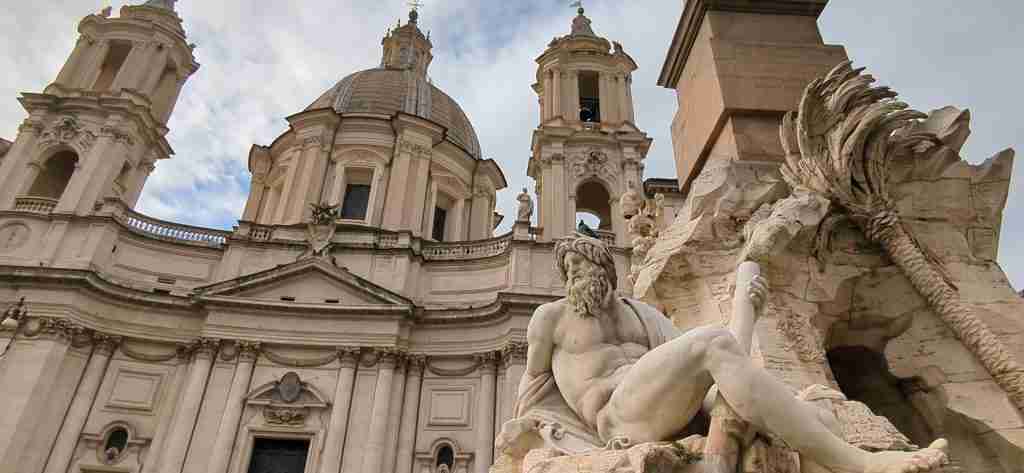
Gian Lorenzo Bernini’s Fontana dei Quattro Fiumi, completed in 1651, occupies the center of Piazza Navona and represents the pinnacle of Baroque fountain design. Pope Innocent X commissioned the work as part of his family’s aggrandizement campaign, transforming the piazza adjacent to Palazzo Pamphili into a showcase for papal magnificence. Bernini created an unprecedented fusion of sculpture, architecture, and water, establishing new standards for fountain artistry that influenced European design for centuries.
The fountain’s central feature, a 16-meter Egyptian obelisk erected atop a hollowed travertine mountain, creates a daring structural and visual effect. The obelisk, originally from the Circus of Maxentius on the Appian Way, weighs approximately 300 tons. Bernini’s engineering solution, supporting this massive weight on a seemingly hollow base pierced by four large openings, demonstrates both technical mastery and theatrical audacity. The mountain contains hidden internal supports, but from street level appears impossibly light and precarious, exemplifying Baroque delight in virtuoso effects.
Four colossal marble figures personify rivers from the four known continents. The Nile, by Giacomo Antonio Fancelli, represents Africa and covers his head, referring to the river’s then-unknown source. The Ganges, by Claude Poussin, symbolizes Asia and holds an oar indicating navigability. The Danube, by Antonio Raggi, represents Europe and reaches toward the papal coat of arms. The Rio de la Plata, by Francesco Baratta, personifies the Americas and appears startled by a pile of coins, suggesting New World wealth. Each river god embodies stereotypical characteristics of his continent while displaying the dynamic poses and emotional intensity characteristic of Baroque sculpture.
Animals and plants from each continent populate the fountain’s base, creating an encyclopedic natural history display. A lion accompanies the Nile, a horse serves the Danube, a crocodile lurks near the Ganges, and an armadillo appears with the Rio de la Plata. Palm trees, cacti, and various flora reinforce geographical specificity. These naturalistic elements reflect contemporary European interest in global exploration and natural science, transforming the fountain into a didactic monument teaching viewers about world geography through allegorical representation.
Water emerges from multiple sources throughout the fountain, creating varied effects. The central grotto beneath the obelisk contains a basin from which water flows through the mountain’s openings. Side jets produce arching streams. The river gods’ poses suggest interaction with water, with some appearing to shield themselves from spray or gesture toward flowing currents. Sound varies throughout the day as water pressure changes, creating an acoustic dimension that complements visual effects. Bernini understood water as sculptural material, choreographing its movement as carefully as marble forms.
The fountain’s placement in Piazza Navona, built atop the ancient Stadium of Domitian, connects Baroque Rome to its imperial past. The elongated piazza retains the stadium’s shape, with the fountain occupying the former competition ground’s center. Innocent X’s commission intentionally rivaled the Trevi project and other major fountain works, asserting Pamphili family prestige through artistic patronage. The fountain faces the church of Sant’Agnese in Agone, designed by Francesco Borromini, creating a dynamic dialogue between Bernini’s sculpture and Borromini’s architecture despite their artistic rivalry.
Fontana della Barcaccia (Barge Fountain)
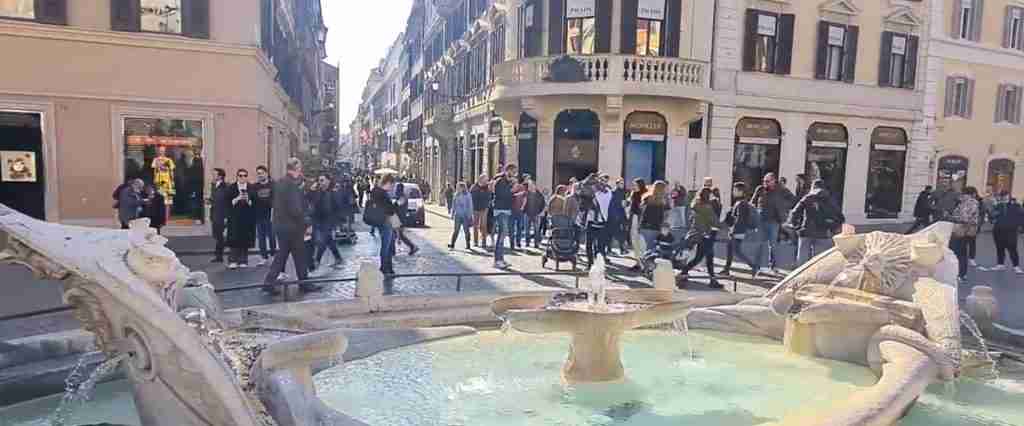
The Fontana della Barcaccia at the base of the Spanish Steps represents Pietro Bernini’s response to challenging hydraulic conditions and demonstrates the innovative solutions Renaissance and early Baroque fountain designers employed when working with low water pressure. Completed in 1627 for Pope Urban VIII, the fountain takes the form of a half-sunken barge, sinking into an oval basin with water lapping over the sides. This unique design emerged from practical necessity: the location’s relatively low elevation meant insufficient pressure for vertical jets, leading Pietro Bernini and his son Gian Lorenzo (who likely contributed to the design despite attribution remaining disputed) to create a horizontal water feature where low pressure became an aesthetic asset.
The barge form references a historical flood legend, though evidence for this connection remains ambiguous. According to tradition, a devastating Tiber flood in 1598 deposited a barge in this location as waters receded. The fountain supposedly commemorates this event, transforming disaster into artistic expression. Alternative interpretations suggest the barge represents the Church as a vessel navigating worldly troubles, a common Counter-Reformation metaphor. The Barberini family coat of arms, featuring three bees, decorates both the bow and stern, asserting Urban VIII’s patronage and connecting the fountain to his extensive artistic programs throughout Rome.
Water emerges from multiple points in the design: from a central spout rising slightly above the gunwales, from the bow and stern where sun faces spout water, and from the barge’s sides where it overflows into the basin. The gentle flowing creates a soothing acoustic environment contrasting with the Spanish Steps’ tourist commotion. The basin itself sits slightly below street level, creating an intimate scale that encourages close viewing and interaction. This accessibility made the fountain popular with Romans and travelers as a drinking source before modern restrictions prohibited direct contact.
The fountain’s proportions and detailing demonstrate early Baroque attention to naturalistic representation within classical frameworks. The barge appears weathered and worn, with realistic timber detailing carved in travertine. The oval basin’s organic form contrasts with the geometric regularity typical of Renaissance fountain design, suggesting the emerging Baroque preference for dynamic, irregular compositions. The integration with the Spanish Steps, though the steps were constructed later (1723-1725), creates one of Rome’s most iconic urban ensembles, with the horizontal fountain providing visual balance to the vertical staircase.
The Barcaccia occupies a critical position in Rome’s urban fabric, marking the transition between the Trinità dei Monti church above and the shopping district below. The fountain’s modest scale and accessible water source made it a neighborhood gathering point before mass tourism transformed the area. Pietro Bernini’s design influenced subsequent fountain designers, particularly in demonstrating how constraints (low water pressure, limited space, existing architectural contexts) could generate innovative solutions rather than limiting artistic expression.
Conservation challenges affect the Barcaccia significantly due to its accessibility and tourist pressure. Sitting on the fountain’s edge was permitted for centuries but now incurs fines. Vandalism incidents, including a 2015 attack by Dutch football supporters that damaged travertine carvings, prompted increased surveillance and protective measures. The fountain undergoes periodic cleaning to remove algae, calcium deposits, and pollution damage. Despite these challenges, the Barcaccia remains one of Rome’s most beloved fountains, offering intimate encounter with Baroque artistry in one of the city’s busiest tourist zones.
Fontana del Tritone (Triton Fountain)
Gian Lorenzo Bernini’s Fontana del Tritone, completed in 1643 in Piazza Barberini, represents his first independent fountain commission and established design principles he would develop throughout his career. Pope Urban VIII Barberini commissioned the work as part of his family’s artistic patronage campaign, creating a monument that celebrates both mythological power and Barberini dynastic ambitions. The fountain introduced revolutionary approaches to integrating sculpture with water and to creating dynamic, three-dimensional compositions designed for viewing from multiple angles.
The fountain’s structure features four dolphins supporting an open scallop shell upon which a muscular Triton kneels, blowing water through a conch shell held high above his head. This vertical composition creates a powerful upward thrust, with the water jet extending several meters into the air before falling back into the basin. Bernini carved all elements from travertine rather than using expensive marble, demonstrating that material choice matters less than artistic conception and execution. The dolphins intertwine their tails, creating a stable base while suggesting aquatic movement and energy.
The Triton figure exemplifies Bernini’s approach to sculptural water effects. The creature’s cheeks bulge with effort as he blows through the conch, creating a believable source for the water jet. His muscular torso twists dynamically, with the contrapposto emphasizing physical exertion and movement. The tail curves and coils beneath him, filling the shell and creating visual weight that balances the upward thrust. This figure established a type that Bernini would repeat and refine in subsequent fountain works, demonstrating his understanding of how sculpture and water could reinforce each other’s effects.
Barberini family symbols dominate the fountain’s iconography. The papal tiara and keys appear prominently on the scallop shell’s exterior. Three bees, the Barberini coat of arms, decorate the dolphins’ tails. These heraldic elements transform a mythological subject into a dynastic monument, asserting Urban VIII’s authority through artistic magnificence. The fountain’s placement in front of Palazzo Barberini reinforced the family’s control over this area of Rome, with the Triton serving as a permanent sentinel announcing Barberini power and patronage.
The fountain’s relationship to its urban context has changed significantly since the 17th century. Originally, the piazza featured a more intimate scale, with the fountain serving as a local water source and social gathering point. Modern traffic transformations converted Piazza Barberini into a major intersection, isolating the fountain on a traffic island and altering viewing conditions. Despite these changes, the fountain retains its architectural and artistic significance, demonstrating Bernini’s genius for creating monuments that remain compelling across changing urban contexts.
The Triton Fountain influenced European fountain design extensively, with the vertical composition type appearing in cities from Paris to Madrid to Vienna. Bernini’s solution to creating dramatic height within a relatively compact footprint proved especially influential, as did his integration of heraldic elements into mythological compositions. The fountain demonstrates how Baroque artists balanced classical subject matter with contemporary patronage requirements, creating works that functioned simultaneously as mythological narratives and political statements.
Fontana delle Tartarughe (Turtle Fountain)
The Fontana delle Tartarughe in Piazza Mattei represents late Renaissance fountain design at its most elegant and refined. Giacomo della Porta created the architectural framework in 1581-1584, while Taddeo Landini executed the bronze sculptures. The fountain demonstrates Renaissance ideals of proportion, balance, and classical restraint, creating a monument that contrasts sharply with later Baroque theatrical exuberance. Its modest scale and jewel-like quality make it one of Rome’s most beloved hidden gems, rewarding visitors who venture into the Jewish Ghetto’s narrow streets.
The fountain’s structure features a circular basin supporting a smaller raised basin on marble pedestals. Four bronze ephebes (young male figures) stand on the lower basin’s edge, each balancing gracefully while supporting a marble dolphin. The youths’ outstretched arms reach toward the upper basin, where they originally helped support the structure before later additions. The composition’s symmetry and geometric clarity reflect Renaissance mathematical ideals, with proportional relationships governing all elements. The white marble and dark bronze create striking color contrasts, enhanced by water flowing from dolphins’ mouths and rippling in the basins.
The turtles that give the fountain its name represent a later Baroque addition, likely added during a 1658-1659 restoration often attributed to Bernini, though documentation remains inconclusive. Four bronze turtles appear on the upper basin’s rim, positioned so the ephebes seem to help them climb toward the water. This charming detail softens the fountain’s formality while adding a whimsical narrative element characteristic of Baroque sensibility. The turtles’ addition demonstrates how Renaissance and Baroque aesthetics could merge successfully, with later artists enhancing rather than overwhelming earlier work.
The fountain’s placement in the intimate Piazza Mattei creates an ideal viewing environment. The enclosed piazza, surrounded by ocher and rose-colored buildings, provides a theatrical setting that enhances the fountain’s jewel-like quality. The scale relationship between fountain and piazza differs markedly from monumental works like the Trevi or Four Rivers, creating instead a domestic atmosphere where the fountain serves as neighborhood focal point rather than papal propaganda. This human scale allows detailed appreciation of the bronze figures’ graceful poses and refined modeling.
Water behavior in the Turtle Fountain emphasizes gentle movement rather than dramatic effects. Dolphins spout modest arcs into the upper basin, where water ripples before overflowing back to the lower basin. The sound remains subtle, creating a soothing background to piazza conversations rather than dominating the acoustic environment. This restrained water choreography reflects Renaissance ideals of decorum and appropriate expression, avoiding the Baroque preference for overwhelming sensory impact.
The fountain underwent comprehensive restoration in 2018-2019, removing centuries of pollution damage, calcium deposits, and biological growth. Conservators cleaned the bronze and marble, repaired structural issues, and restored the water system’s functionality. The restoration revealed the fountain’s original chromatic richness, with the bronze ephebes’ dark patina contrasting beautifully against white marble and clear water. The project demonstrated how careful conservation can recover historic monuments’ aesthetic qualities while ensuring their survival for future generations.
Lesser-Known Fountain Treasures
The Fontana dell’Acqua Paola on the Janiculum Hill represents one of Rome’s most spectacular yet undervisited fountains. Pope Paul V commissioned Giovanni Fontana and Flaminio Ponzio to create this monumental water display marking the Acqua Paola aqueduct’s terminus in 1612. The fountain’s theatrical facade, 114 meters wide, features five arches supported by granite columns recycled from the original St. Peter’s Basilica. Water cascades from the arches into a large basin, creating a sheet effect that reflects light dramatically. The fountain’s elevated position provides panoramic Rome views, making it popular with locals but often overlooked by tourists focused on city center monuments.
The Fontana delle Api (Bee Fountain), another Bernini work from 1644, occupies a quiet corner near Piazza Barberini. This small wall fountain features an open scallop shell from which water flows into a basin below. Three bronze bees, the Barberini symbol, decorate the shell’s lip. Despite its modest size, the fountain demonstrates Bernini’s ability to create compelling designs at any scale. The inscription commemorates Urban VIII and notes that the fountain provides water for public use and animal watering, illustrating how Rome’s fountains served practical functions beyond aesthetic display.
The Fontana dei Libri (Book Fountain) in Sant’Andrea della Valle area represents a quirky Renaissance addition to Rome’s fountain landscape. Created in 1927 by Pietro Lombardi, this small wall fountain features stone books carved to appear stacked beneath a flowing spout. The design references the nearby Sapienza University and bookshops, demonstrating how fountain iconography adapted to specific neighborhood characteristics. The fountain embodies the tradition of fontanelle – small wall fountains serving local water needs while contributing to Rome’s artistic heritage.
The Fontana dell’Acqua Felice (Moses Fountain) at Piazza San Bernardo, completed in 1587, marks the terminus of Pope Sixtus V’s restored Acqua Felice aqueduct. Domenico Fontana designed the monumental facade featuring a central statue of Moses striking the rock to produce water, flanked by Egyptian lions. The Moses sculpture, executed by Prospero Antichi and Leonardo Sormani, attracted immediate criticism for awkward proportions and stiff pose, earning the mocking nickname “The Ridiculous Moses.” Despite these aesthetic controversies, the fountain’s scale and symbolic program influenced subsequent Baroque fountain design, particularly the Trevi Fountain’s integration with building facades.
The Fontana di Piazza Farnese features two identical basins created from Egyptian granite bathtubs excavated from the Baths of Caracalla. The Farnese family installed these ancient tubs as fountains in the late 16th century, with Girolamo Rainaldi adding the upper decorative elements in 1626. Water flows from central fleur-de-lis spouts into the massive basins before overflowing back to street level. The fountains’ symmetrical placement frames the Palazzo Farnese facade, creating an architectural ensemble that demonstrates Renaissance urban design principles. The reuse of ancient materials exemplifies Rome’s continuous transformation and recycling of its imperial heritage.
Trastevere’s wall fountains represent a distinct category of lesser-known treasures. Small spouts and basins attached to building facades throughout this neighborhood provided local water access while allowing artistic expression within constrained spaces. Examples include the Fontana in Piazza Sant’Egidio, decorated with a carved stone amphora, and numerous unnamed fontanelle featuring simple iron spouts and stone basins. These utilitarian fountains, numbering in the hundreds throughout Rome, constitute an essential but often overlooked dimension of the city’s hydraulic heritage, demonstrating how fountain artistry extended beyond monumental papal commissions to serve everyday neighborhood needs.
Photography Guide: Capturing Rome’s Fountains
Photographing the Trevi Fountain successfully requires strategic timing and positioning due to overwhelming tourist crowds and challenging light conditions. Early morning hours between 6:00-7:30 AM offer the best opportunity for relatively crowd-free shots, though arriving by 6:00 AM increases chances significantly. The fountain faces southeast, receiving direct morning light that illuminates the sculptural details beautifully. Evening photography works well after sunset, when illumination creates dramatic effects and crowds thin slightly, though weekends remain perpetually busy. Position yourself at the fountain’s left side for diagonal compositions emphasizing depth and the relationship between Neptune and architectural elements.
The Four Rivers Fountain in Piazza Navona presents different photographic challenges and opportunities. The circular fountain allows 360-degree compositions, though the best angle positions the Egyptian obelisk against Borromini’s Sant’Agnese in Agone church facade. Shoot from low positions to emphasize the river gods’ monumentality and the obelisk’s vertical thrust. Midday light works well here, as the fountain receives relatively even illumination in the open piazza. Blue hour photography captures the fountain with dramatic sky while LED illumination highlights sculptural details. Include surrounding architecture and piazza activity to provide scale and context, transforming the fountain from isolated monument into living urban space.
The Barcaccia at the Spanish Steps benefits from elevated viewpoints. Climb several steps to shoot downward, capturing the fountain’s oval basin and relationship to the surrounding piazza. The fountain’s horizontal orientation suits landscape format compositions. Avoid midday when harsh overhead light creates unflattering shadows; instead, shoot during morning or late afternoon when angled light models the travertine details. The fountain’s intimate scale allows close-up photography of individual decorative elements: sun faces, Barberini bees, and water flows. Consider black and white processing to emphasize texture and form without the distraction of tourist crowds’ colorful clothing.
Fountain photography technical considerations include managing water movement and reflection. Fast shutter speeds (1/500 second or faster) freeze water droplets, creating detailed captures of individual streams and splashes. Slow shutter speeds (1/4 to 2 seconds) blur water into silky flows, emphasizing movement and creating ethereal effects. Use tripods for slow shutter work, essential for evening shots. Polarizing filters reduce water surface glare and enhance color saturation in basins, though they also reduce light transmission, requiring shutter speed adjustments. Shoot in RAW format to maximize post-processing flexibility for exposure and color correction.
Architectural detail photography rewards patient observation of Rome’s fountains. Focus on individual sculptural elements: tritons’ muscular torsos, dolphins’ graceful curves, allegorical figures’ expressive faces, heraldic elements’ crisp carving. Telephoto lenses (85mm-200mm) isolate details from cluttered contexts, while wide-angle lenses (16mm-35mm) capture complete compositions including architectural settings. Look for water interaction with sculpture: streams flowing through figures’ hands, spray catching backlighting, reflections in calm basin surfaces. These micro-compositions often prove more satisfying than conventional full-fountain views.
Fountain conservation documentation provides meaningful photographic projects. Compare historical photographs with current conditions to identify deterioration patterns. Document biological growth, calcium deposits, pollution damage, and vandalism marks. Photograph restoration work in progress, capturing scaffolding, cleaning techniques, and revealed original surfaces. This documentary approach contributes to heritage preservation while creating photographic portfolios with scholarly value. Contact local conservation authorities before extensive documentation, as some restoration projects welcome photographic collaboration while others restrict access for security reasons.
Fountain Walking Routes
The Baroque Fountain Circuit covers Rome’s major 17th-century masterpieces in a logical walking sequence. Start at Piazza Barberini with Bernini’s Triton Fountain and the adjacent Bee Fountain, establishing the Barberini family’s artistic patronage theme. Walk to Piazza Navona via Via del Tritone and Corso, arriving at the Four Rivers Fountain. Continue to the Pantheon area, observing the Fontana del Pantheon (1575) in front of Agrippa’s ancient temple. Proceed to the Trevi Fountain via Via del Corso and narrow side streets, timing arrival for late afternoon when crowds thin slightly. This circuit covers approximately 3 kilometers walking distance over 2-3 hours, allowing time for detailed fountain observation and necessary photograph stops.
The Trastevere Fountain Walk explores lesser-known treasures in Rome’s most atmospheric neighborhood. Begin at the Fontana dell’Acqua Paola on Janiculum Hill, appreciating panoramic views before descending into Trastevere. Walk to Piazza Santa Maria in Trastevere, where the restored 1692 fountain features an octagonal basin and central decorative element. Explore small wall fountains throughout the neighborhood’s narrow streets: Via della Scala, Vicolo del Piede, and Piazza Sant’Egidio all contain examples. Cross the Tiber to reach the Turtle Fountain in Piazza Mattei, concluding the circuit. This route covers approximately 4 kilometers over 3-4 hours, with opportunities to explore Trastevere’s churches, shops, and restaurants between fountain stops.
The Aqueduct Heritage Route traces ancient water infrastructure’s path through modern Rome. Start at the Fontana dell’Acqua Felice (Moses Fountain) at Piazza San Bernardo, marking the Acqua Felice aqueduct terminus. Walk along Via XX Settembre to the church of San Carlo alle Quattro Fontane, where four small corner fountains from 1588-1593 mark a major intersection. Continue to the Trevi Fountain, terminus of the Acqua Vergine aqueduct. This educational route connects fountains through their hydraulic infrastructure, demonstrating how ancient Roman engineering continues serving the modern city. The circuit covers approximately 2.5 kilometers over 2 hours, suitable for visitors interested in engineering history and urban planning.
The Renaissance to Baroque Transition Walk chronicles stylistic evolution across fountain design periods. Begin at the Turtle Fountain (1581-1584), exemplifying late Renaissance restraint and proportion. Walk to the nearby Fontana della Terrina in Campo de’ Fiori (1590), though the current version dates from 1889 reconstruction. Continue to Piazza Farnese’s twin fountains, demonstrating ancient material reuse. Proceed to Piazza Navona’s Four Rivers Fountain (1651), experiencing the dramatic shift to Baroque theatricality. Conclude at the Trevi Fountain (1762), representing late Baroque monumentality. This circuit provides comprehensive fountain style education within approximately 2.5 kilometers walking distance over 2-3 hours.
The Hidden Fountains Discovery Route seeks out overlooked treasures away from major tourist circuits. Start at the Fontana delle Anfore in Testaccio, a 1927 Pietro Lombardi work featuring ceramic amphorae referencing the ancient Mount Testaccio pottery shard deposit. Walk to the Fontana della Pigna (Pinecone Fountain) in Vatican Museums courtyard, featuring a massive 1st-century bronze pinecone. Continue to the Fontana dei Cavalli Marini at Villa Borghese entrance. Explore wall fountains along Via Giulia, Rome’s Renaissance-era straight street. This specialized route covers approximately 5 kilometers over 4-5 hours, requiring moderate fitness and strong interest in fountain architecture beyond the famous monuments.
All walking routes benefit from early morning or late afternoon timing to avoid midday heat and tourist crowds. Carry water, wear comfortable walking shoes, and allow flexibility for spontaneous discoveries of unnamed wall fountains and neighborhood water features. Rome’s fountain heritage extends far beyond mapped monuments, with hundreds of small fountains serving as local landmarks and gathering points throughout the historic center and outlying neighborhoods.
Understanding Fountain Conservation
Rome’s fountains face multiple deterioration threats requiring ongoing conservation interventions. Atmospheric pollution deposits sulfates, nitrates, and particulate matter on stone surfaces, creating black crusts that obscure carved details and accelerate erosion. Biological growth including algae, mosses, and lichens damages stone through chemical secretions and physical expansion. Calcium carbonate deposits accumulate from hard water, creating unsightly white encrustations. Vandalism, both historical (graffiti, deliberate damage) and recent (tourist impact, unauthorized climbing), requires periodic repair. Climate change affects water availability and introduces new thermal stress patterns as temperature extremes increase.
Conservation approaches balance multiple competing priorities: historical authenticity, structural stability, aesthetic presentation, public accessibility, and financial sustainability. Minimal intervention principles guide most projects, preserving original material wherever possible rather than replacing damaged elements with new stone. Cleaning techniques vary based on deterioration type and stone condition, ranging from gentle water washing to laser ablation for stubborn deposits. Consolidation treatments strengthen weakened stone without altering appearance. Protective coatings remain controversial, with some conservators advocating barriers against pollution while others argue coatings trap moisture and cause additional damage.
Major restoration projects follow established protocols beginning with comprehensive documentation. Photographic surveys record existing conditions from multiple angles and scales. Stone analysis identifies original materials and deterioration patterns. Hydraulic system testing evaluates water pressure, flow rates, and pipe conditions. Structural assessment examines internal supports and connections. This diagnostic phase informs treatment plans balancing ideal conservation with practical constraints including budget, timeline, and public access requirements. The Trevi Fountain’s 2014-2015 restoration, funded by Fendi fashion house at €2.18 million, exemplifies comprehensive modern conservation practice.
Water chemistry management prevents many deterioration problems but requires constant attention. Regular basin draining and cleaning removes organic matter that supports biological growth. Chemical treatments inhibit algae without damaging stone or harming public health. pH monitoring ensures water neither acidifies (promoting erosion) nor becomes too alkaline (accelerating calcium deposits). Filtration systems remove particulates before water enters decorative circuits. These preventive measures prove more cost-effective than reactive restoration, though they require dedicated staff and resources often stretched across Rome’s hundreds of fountains.
Public education represents an essential but often neglected conservation dimension. Visitor behavior significantly impacts fountain preservation, with climbing, coin throwing beyond designated basins, trash disposal, and physical contact all contributing to deterioration. Signage explaining conservation needs and appropriate fountain interaction helps modify behavior while deepening visitor appreciation. Some fountains now feature informational panels describing restoration work, deterioration threats, and conservation techniques. This transparency builds public support for preservation funding while educating about cultural heritage stewardship responsibilities.
Climate change introduces new conservation challenges requiring adaptive strategies. Reduced rainfall and increased summer heat stress Rome’s aqueduct system, particularly the gravity-dependent Acqua Vergine supplying many central fountains. Water rationing during drought periods has led to temporary fountain shutdowns, raising questions about long-term sustainability. Temperature extremes accelerate freeze-thaw cycles in winter and promote biological growth in summer. Conservation planners increasingly incorporate climate projections into treatment decisions, selecting materials and techniques that will remain effective under changing environmental conditions rather than preserving solely for current climate.
Frequently Asked Questions
Can you drink water from Rome’s fountains?
The small fountain spouts called “nasoni” throughout Rome provide safe, potable drinking water drawn directly from the aqueduct system and regularly tested for quality. These cylindrical cast-iron fountains with curved spouts dispense fresh water continuously, and Romans and knowledgeable tourists drink from them regularly. However, the decorative monumental fountains including the Trevi, Four Rivers, and others contain recirculated water treated with chemicals to prevent algae growth, making them unsuitable for drinking. Signs marked “non potabile” (not drinkable) identify fountains not intended for drinking. When in doubt, use nasoni or bottled water rather than drinking from decorative basins.
Why are coins thrown into the Trevi Fountain?
The coin-throwing tradition originated from the ancient practice of making offerings to water spirits and gods to ensure safe journeys and future returns. The modern Trevi custom was popularized by the 1954 film “Three Coins in the Fountain,” which established the legend that throwing one coin over your left shoulder while facing away from the fountain guarantees a return to Rome. The tradition has become self-perpetuating, with an estimated 3,000 euros deposited daily during peak tourist seasons. Italian law designates all collected coins, totaling approximately €1.5 million annually, for charitable purposes through Caritas, transforming a tourist ritual into philanthropy supporting Rome’s homeless and disadvantaged populations.
Who designed the Trevi Fountain?
Nicola Salvi won the 1730 design competition launched by Pope Clement XII and served as the primary architect until his death in 1751. Giuseppe Pannini completed the project following Salvi’s plans, overseeing construction until the fountain’s inauguration in 1762. Several sculptors contributed figures, with Pietro Bracci executing the central Oceanus statue and Filippo della Valle creating the allegorical statues of Abundance and Health. The lengthy thirty-year construction period allowed for refinements and modifications that enhanced the design’s coherence, though Salvi never witnessed his masterpiece’s completion. His innovative integration of the fountain with the Palazzo Poli facade established new standards for architectural-sculptural unity.
What is the best time to photograph the Trevi Fountain without crowds?
The optimal window for relatively crowd-free Trevi Fountain photography occurs between 6:00-7:30 AM, with arrival by 6:00 AM significantly improving chances of capturing the monument without massive tourist groups. The fountain faces southeast, receiving beautiful morning light that illuminates the sculptural details from favorable angles. Evening photography after 10:00 PM offers a second option, with LED illumination creating dramatic effects, though summer weekends remain consistently crowded regardless of timing. Winter months generally feature fewer tourists than peak season (April-October), though no time guarantees empty views at Rome’s most visited monument. Patience and strategic positioning maximize photographic opportunities even in crowded conditions.
How does water reach Rome’s fountains?
Rome’s fountains depend on the ancient aqueduct system, with eleven major aqueducts constructed between 312 BCE and 226 CE bringing water from sources up to 92 kilometers distant. The Aqua Virgo (Acqua Vergine), built in 19 BCE by Marcus Agrippa, remains the only ancient aqueduct in continuous use, supplying the Trevi Fountain and many others in central Rome through gravity flow. The system functions without pumping, relying on precise gradients averaging 1-3 meters per kilometer to maintain steady water flow. Stone and concrete channels, mostly underground, delivered approximately one million cubic meters daily at the system’s peak. Renaissance and Baroque popes restored and expanded this infrastructure, with Pope Nicholas V rebuilding the Acqua Vergine in 1453 and Pope Paul V constructing the Acqua Paola in 1612, enabling the fountain-building programs that transformed Rome’s urban landscape.
Are there entrance fees for viewing Rome’s fountains?
All of Rome’s public fountains, including the Trevi Fountain, Four Rivers Fountain, and others in piazzas and streets, are accessible free of charge at all hours. The fountains constitute public urban infrastructure rather than enclosed monuments, allowing unrestricted viewing from surrounding spaces. Some fountains located within museums or paid sites require admission: the Fontana della Pigna in Vatican Museums courtyard, fountains within Villa Borghese gardens, and those in private palazzo courtyards may have associated entrance costs. However, the vast majority of Rome’s fountain heritage remains freely accessible, embodying the democratic principle that public art should serve all citizens and visitors regardless of economic means.
What symbols appear most frequently in Rome’s fountain sculptures?
Neptune and Oceanus, gods of water and seas, appear most frequently as central figures commanding aquatic realms. River gods personify specific waterways, depicted as reclining male figures with attributes identifying geographical origins. Tritons, half-human sea creatures, symbolize water’s power and typically appear blowing conch shells to produce water jets. Dolphins represent good fortune, safety, and playfulness, while turtles (as in the Turtle Fountain) symbolize patience and longevity. Obelisks reference both ancient Roman imperial power and its succession by papal authority. Papal coats of arms, featuring tiaras, keys, and family symbols, assert patronage and political control. Allegories of virtues (abundance, health), continents, seasons, and rivers create complex iconographic programs communicating religious and political messages through classical mythology.
How often are Rome’s fountains cleaned and maintained?
Maintenance schedules vary based on fountain size, tourist impact, and conservation needs. The Trevi Fountain receives nightly cleaning when municipal workers sweep deposited coins and remove debris, with more intensive basin cleaning and minor repairs occurring monthly. Major fountains undergo comprehensive restoration every 10-20 years, involving complete drainage, stone cleaning, structural repair, and system overhaul. The Trevi’s last major restoration occurred in 2014-2015. Smaller neighborhood fountains may receive less frequent attention, with annual or seasonal cleaning supplemented by repairs as needed. Water chemistry requires constant monitoring across all fountains to prevent algae growth and mineral deposits. Budget constraints mean some fountains receive inadequate maintenance, leading to visible deterioration that conservators identify as ongoing concerns requiring increased municipal investment.
What was Bernini’s contribution to Rome’s fountain heritage?
Gian Lorenzo Bernini revolutionized fountain design in 17th-century Rome, creating works that integrated sculpture, architecture, water, and urban space with unprecedented sophistication. His major commissions include the Four Rivers Fountain in Piazza Navona (1651), the Triton Fountain in Piazza Barberini (1643), the Barcaccia at the Spanish Steps (possibly assisted by his father Pietro Bernini, 1627), and the Moor Fountain in Piazza Navona (1654). Bernini understood water as sculptural material, choreographing jets, cascades, and still pools to enhance marble forms. His fountains feature dynamic figures in action poses, creating theatrical narratives that engage viewers emotionally and intellectually. The integration of patron imagery (particularly Barberini family symbols) with mythological subjects established patterns that subsequent designers followed. Bernini’s influence extended across Europe, with his Roman fountains serving as models for fountain design in Paris, Vienna, Madrid, and other major cities.
Can you bathe in Rome’s fountains?
Bathing in Rome’s fountains is now strictly prohibited, with violations incurring fines up to €500 and potential additional penalties for damaging monuments. This represents a significant change from historical practice when fountain bathing was tolerated or even common during summer heat. The 1960 film “La Dolce Vita,” featuring Anita Ekberg’s famous Trevi Fountain scene, captured the era when such behavior was permissible. Current regulations emerged from conservation concerns, as foot traffic and physical contact accelerate stone deterioration, and from tourism management needs, as bathing encourages crowds and inappropriate fountain use. Police and municipal authorities actively enforce these rules, particularly at major monuments like the Trevi and Four Rivers fountains. Sitting on fountain edges also incurs fines at some locations, though enforcement varies. These restrictions protect monuments while managing tourist behavior in increasingly crowded urban spaces.