Visiting Montepulciano: Ultimate Planning Resource & Travel Guide 2026
Montepulciano is a Renaissance hill town in southern Tuscany that rewards visitors with one of Italy’s greatest DOCG wines, some of the region’s most accomplished 16th-century architecture, and panoramic views stretching across Val di Chiana toward the Val d’Orcia UNESCO landscape. This 2026 planning guide covers everything from transport connections and parking logistics to budget tiers, seasonal timing, and wine-tasting itineraries — so you arrive prepared and leave nothing on the table.
- Key Takeaway 1 — Know your daily budget before you go: Budget travelers spending two nights in a shared B&B need approximately €70-100 per person per day; mid-range visitors should plan €160-235 per person per day (two sharing a hotel or agriturismo). A three-night mid-range stay runs approximately €480-705 per person all-in.
- Key Takeaway 2 — A car makes all the difference: Montepulciano is reachable by a train-plus-bus combination (Florence → Chiusi-Chianciano Terme by regional train, then an Autolinee Toscane bus to town), but renting a car unlocks the surrounding cantinas, Pienza, Montalcino, and Cortona with ease.
- Key Takeaway 3 — The wine is the reason to come: Vino Nobile di Montepulciano DOCG — made from at least 70% Prugnolo Gentile (the local name for Sangiovese) — was among Italy’s first wines to receive DOCG status in 1980. Multiple historic cantinas inside the walls offer free cellar visits and paid tastings.
- Key Takeaway 4 — Climb the tower early, beat the crowds: The tower of the Palazzo Comunale (€5) opens at 10:00 and gives a 360-degree view spanning Pienza, Montalcino, and Monte Amiata. On clear mornings before 11:00, the terrace is almost always uncrowded.
- Key Takeaway 5 — Book ahead for the Bravìo delle Botti: The barrel-rolling race between Montepulciano’s eight historic districts falls on the last Sunday of August. The surrounding week is the busiest of the year; accommodation within 30 km sells out months in advance.
- Key Takeaway 6 — Respect the ZTL: The historic center operates a restricted traffic zone. Park in one of the terraced car parks below the walls and use the electric minibus or the public elevator to reach Piazza Grande without a fine.
People Also Ask About Visiting Montepulciano 2026
How much does a trip to Montepulciano cost in 2026?
Budget travelers need approximately €70-100 per person per day (two sharing a budget B&B or hostel room). Mid-range visitors should budget €160-235 per person per day (two sharing a 3-star hotel or quality agriturismo). A three-night mid-range trip costs approximately €480-705 per person. Luxury villa and boutique hotel stays outside the walls push costs to €325-570 per person per day. Key attraction entry fees verified for 2025 and likely stable into 2026: Palazzo Comunale tower €5, museum (Museo Civico Pinacoteca Crociani) €6 full price, combined tower-plus-museum ticket €8, and Tempio di San Biagio €5. Check official sites for current rates as pricing may vary.
How do you get to Montepulciano by public transport in 2026?
The most reliable public transport route is a regional train from Florence S.M.N. to Chiusi-Chianciano Terme (approximately 90 minutes, around €10-16 depending on service), followed by an Autolinee Toscane bus to Montepulciano (approximately 50 minutes, under €5). Direct bus connections also run from Siena (approximately 1.5-2 hours, around €8-10). Note that Montepulciano’s own train station sits roughly 10 km outside the town with very limited onward connections; arriving via Chiusi-Chianciano Terme is strongly preferred. Once in town, the electric minibus and a public elevator connect the lower car parks to the historic center.
When is the best time to visit Montepulciano in 2026?
April through May and September through October offer the optimal balance of mild temperatures, manageable visitor numbers, and vivid landscape color. July and August bring heat and the peak festival season — culminating in the Bravìo delle Botti barrel race on the last Sunday of August — but also the year’s highest hotel rates and busiest streets. November through March is the quietest and most affordable period; the historic center is largely to yourself, though some countryside agriturismi close entirely and several attraction hours are reduced. The 2026 Bravìo will fall on Sunday, 30 August 2026 (the last Sunday of August), which is the single date for which accommodation should be secured earliest.
What wine is Montepulciano famous for in 2026?
Montepulciano’s signature wine is Vino Nobile di Montepulciano DOCG, a structured Tuscan red built primarily on Prugnolo Gentile, the local biotype of Sangiovese, which must comprise at least 70% of the blend. The wine received DOCG status in 1980 alongside Brunello di Montalcino and Barolo, making it one of Italy’s first three guaranteed-origin wines. Standard bottlings age for a minimum of two years (at least one in oak); Riserva wines age for at least three years. The more accessible Rosso di Montepulciano DOC is made from the same grapes with shorter aging requirements. Do not confuse either wine with Montepulciano d’Abruzzo, which takes its name from a different grape variety grown in a different region entirely.
Extended multi-day tours – 5+ days
Featured Montepulciano Multi-Day Tour Packages

6 days
6 Day Florence & Tuscany Culinary Tour Package
- ✓ Comprehensive Montepulciano tour
- ✓ Expert local guides included
- ✓ All accommodation arranged
- ✓ Transportation provided
5 days
The Ultimate Tuscany Escape: Florence, San Gimignano, Val D'Orcia & Chianti | 5 Days
- ✓ Booking needs min. 2 travelers

6 days
The Heart of Tuscany (Florence, Siena and Montalcino) – Medieval Towns, Wines and Landscapes
- ✓ Booking needs min. 2 travelers
7 days
Tuscany Walking, Cooking & Yoga Tour
- ✓ Comprehensive Montepulciano tour
- ✓ Expert local guides included
- ✓ All accommodation arranged
- ✓ Transportation provided
Multi-day tour packages powered by TourRadar. Prices and availability subject to change.
Introduction: Montepulciano in 2026 — A Tuscan Classic Worth the Climb
Montepulciano rises to approximately 600 metres above sea level on a narrow limestone ridge in the southern Province of Siena, its walls and towers visible for kilometres across the patchwork of vine rows and cypress allées that define this corner of Tuscany. The view from the top says everything: to the west, the gentle hills of the Val d’Orcia (a UNESCO World Heritage landscape since 2004) roll toward Pienza and Montalcino; to the east, the flat agricultural plain of the Val di Chiana extends toward Cortona and the Umbrian hills. Sitting almost exactly between these two valleys, Montepulciano has always occupied a strategic and contested position — and the architecture of its main street reflects that history in a procession of Renaissance palazzi built by families eager to demonstrate their Florentine connections and civic ambitions.
The town’s Latin name, Mons Politianus, gave it its most celebrated native son: Angelo Poliziano (1454–1494), the poet and humanist scholar who was tutor and protégé to Lorenzo de’ Medici. The connection to Florence runs through the town’s stones: the Palazzo Comunale, renovated from the 1440s to the design of the Florentine architect Michelozzo, deliberately echoes the Palazzo della Signoria in its crenellated profile — a deliberate statement of political alignment. A century later, Antonio da Sangallo the Elder was commissioned to design the Tempio di San Biagio on the meadows below the walls, producing a travertine masterpiece of High Renaissance proportion that draws architects and art historians alongside every other category of visitor.
For most tourists, however, the primary draw is the wine. Vino Nobile di Montepulciano has been praised in print since at least the seventeenth century — the poet Francesco Redi famously declared in 1685 that “Montepulciano d’ogni vino è il Re!” (“Montepulciano is king of all wines”). The DOCG designation arrived in 1980 and today encompasses dozens of producers, from centuries-old family cantinas with cellars carved directly beneath Piazza Grande to biodynamic estate wineries in the surrounding hills. What follows is a comprehensive 2026 planning guide — logistics, costs, attractions, seasons, and practical advice — organised so that you can move directly to the sections most relevant to your trip.
Getting to Montepulciano in 2026
Montepulciano has no direct international transport connection. Every arrival strategy involves a transfer of some kind, and the car remains the most flexible option by a considerable margin. That said, the train-and-bus combination from Florence is entirely manageable for the car-free traveller willing to organise connections in advance.
By Car (Recommended)
From Florence, take the A1 Autostrada del Sole southbound and exit at Valdichiana-Bettolle; follow the SS327 for approximately 30 km to Montepulciano. Journey time from Florence is approximately 1 hour 45 minutes without traffic, longer in summer on Friday afternoons and Sunday evenings. From Rome, take the A1 northbound and exit at Chiusi-Chianciano Terme, then follow signs for Montepulciano via Chianciano Terme; journey time from Rome is approximately 2 hours 30 minutes. From Siena, the SR2 and connecting roads place Montepulciano approximately one hour away by road. A car rental from Florence Airport (FLR, approximately 120 km from Montepulciano) is the standard approach for international visitors flying into the region. Car rental agencies are available at Chiusi-Chianciano Terme station, which also lies about 30 minutes from town, though Sunday closures are reported by some agencies there — check operating hours when booking.
By Train and Bus
The practical public transport route is straightforward. Take a Trenitalia regional train (unreserved, no seat reservation needed) from Florence S.M.N. to Chiusi-Chianciano Terme. The journey takes approximately 90 minutes on the direct regional service and costs around €10-16 depending on service type; check trenitalia.it for current fares and timetables. At Chiusi-Chianciano Terme station, walk out of the main entrance and look for the Autolinee Toscane buses lined up outside. The bus to Montepulciano takes approximately 50 minutes and costs less than €5; buy tickets at the station bar/tobacconist or via the Autolinee Toscane app. The bus makes two stops in Montepulciano — an earlier stop near Porta Farina toward the upper town, and the final stop at the main bus station (Autostazione) near the lower town. The elevator and electric minibus connect the bus station to the historic center.
A second option is the direct bus from Siena, operated by Autolinee Toscane. Journey time is approximately 1.5-2 hours; check at-bus.it for current schedules, as the Siena service runs fewer times per day than the Chiusi connection. The Siena bus is most useful if you are already based in Siena and making a day trip.
Montepulciano Stazione — the town’s own train station — is located approximately 8-10 km from the historic center. Bus connections from this station to town are very infrequent and taxi availability is unreliable; this station is not recommended as an arrival point. Always route through Chiusi-Chianciano Terme instead.
Nearest Airports in 2026
Florence Peretola Airport (FLR, approximately 120 km) is the closest major international gateway, with connections to numerous European cities and limited long-haul routes. Pisa Galileo Galilei Airport (PSA, approximately 200 km) serves more international routes and is well connected to Florence by train. Perugia Sant’Egidio Airport (PEG, approximately 70 km) is the closest airport but serves only a handful of seasonal routes; it is useful primarily if you are flying from Rome Fiumicino on a connection. Rome Fiumicino (FCO, approximately 240 km) and Milan Malpensa (MXP, approximately 380 km) are common entry points for long-haul arrivals who then pick up a car or take the train south. From any of these airports, a rental car is the most practical option; road signage to Montepulciano from the A1 is clear.
Getting Around Montepulciano in 2026
ZTL Restrictions and Parking
The historic center of Montepulciano operates a Zona a Traffico Limitato (ZTL) — a restricted traffic zone — that prohibits private cars from entering without an authorisation permit. Visitors who drive into the ZTL without a permit are fined automatically by cameras. Do not attempt to drive to Piazza Grande in a private vehicle. Instead, park in one of the designated car parks positioned below the town walls. Multiple terraced car park areas (typically designated A, B, C on local signage) are located around the perimeter of the historic center; some are free, some charge an hourly rate. Signs directing you to parcheggio (parking) begin as you approach the town from any direction. During peak summer weekends and the Bravìo festival week, car parks fill early in the morning; arriving before 10:00 on busy days is advisable.
Electric Minibus and Elevator
From the main bus station at the lower end of town, a public electric minibus (orange, designated line A) runs a loop through the main streets of the historic center up toward the Piazza Grande area, offering relief from the steep climb. The minibus is free or very low cost, and stops are marked throughout the town. Alternatively, a public elevator (ascensore) connects the lower town — near the parking areas below the walls — directly to the public gardens at the top of the town, a short walk from Piazza Grande. The elevator is a practical option for those with luggage, limited mobility, or simply tired legs after a full day of sightseeing.
Walking the Corso
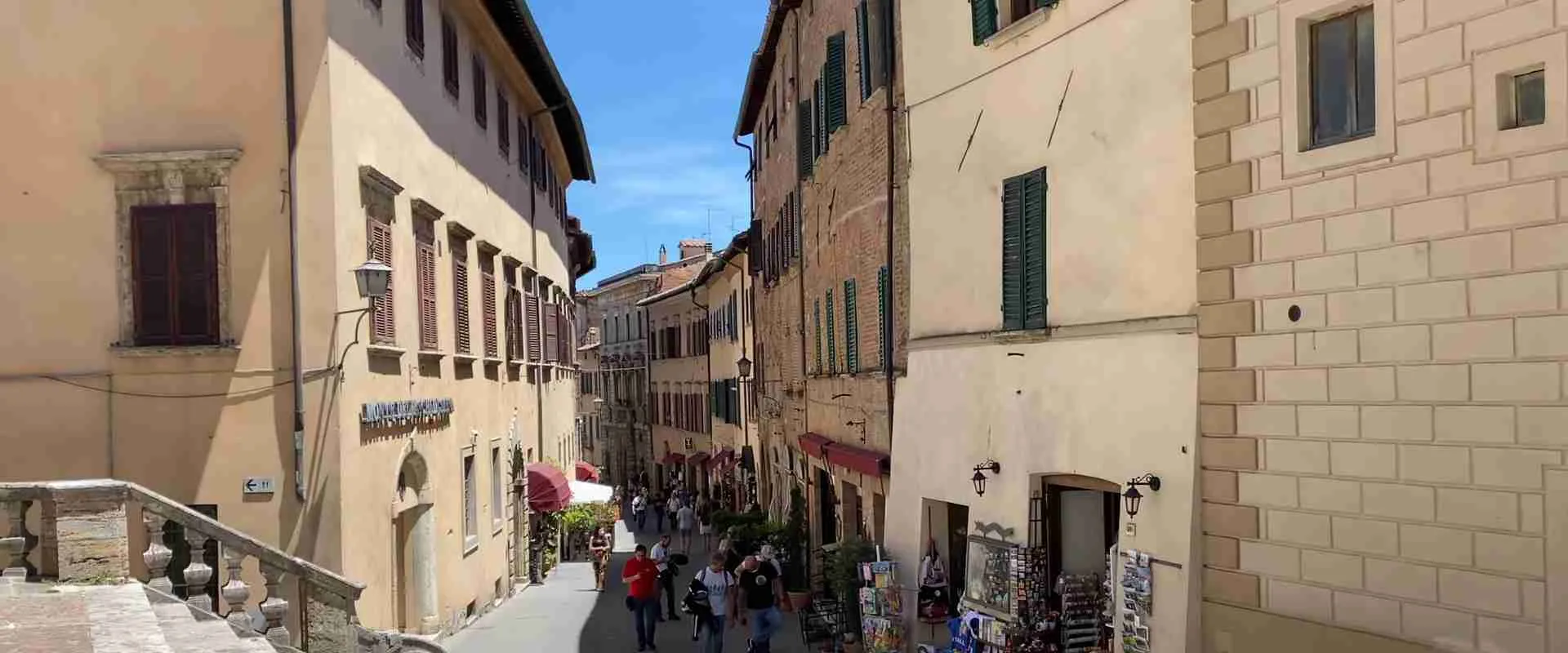
The main street of Montepulciano changes names four times as it climbs from the northern gate to Piazza Grande — passing through Via di Gracciano nel Corso, Via di Voltaia nel Corso, Via dell’Opio nel Corso, and finally Via Poliziano — but locals and guidebooks simply call it “il Corso.” The climb from Porta al Prato (the main northern gate) to Piazza Grande covers approximately 200 metres of altitude over roughly one kilometre of steeply inclined stone street, passing wine shops, ceramics studios, bakeries, and Renaissance palazzi along the way. Walking the Corso top to bottom and back is the central experience of any visit; count on 20-30 minutes each way and more if you stop to browse. The electric minibus is there for the return journey if legs give out.
Where to Stay in Montepulciano 2026
Budget Accommodation in Montepulciano 2026
Budget options in Montepulciano and the immediately surrounding countryside run to B&Bs, small family-run hotels, and agriturismi (farmhouse stays) where rooms begin around €70-90 per night for a double. Options such as Hotel Marvin, Hotel Tre Stelle, and various B&Bs along the main access road offer simple, clean rooms with easy access to parking. Several agriturismi within 10-15 km of the historic center offer even lower rates while providing the quintessential Tuscan countryside setting — vineyards, olive groves, and a swimming pool — at budget prices, though a car is essential to reach them. Budget travelers sharing a room pay approximately €35-45 per person per night for accommodation. Check official booking platforms for current rates, as prices vary significantly by season.
Mid-Range Hotels and Agriturismi 2026
The mid-range category covers rooms from approximately €100-180 per night and includes the most characterful options: 3-star hotels in restored historic buildings inside the walls, well-maintained agriturismi with pools within 5-15 km of town, and boutique B&Bs in carefully renovated medieval and Renaissance structures. Hotel Panoramic on the edge of the historic center offers countryside views and included parking. Borgo Tre Rose, a few kilometres outside the walls, is a popular choice combining agriturismo atmosphere with reliable standards and a restaurant. Fattoria San Martino is a highly rated eco-renovated 18th-century villa with only four rooms, an excellent vegetarian/vegan restaurant, and sweeping views — book well in advance in peak season. Per person (two sharing a mid-range room), accommodation costs approximately €60-90 per night.
Luxury Properties Near Montepulciano 2026
The luxury segment in the Montepulciano area is anchored by a group of exceptional villa hotels and estate properties set in the surrounding hills. Villa Poggiano, a boutique hotel just outside the walls, offers rooms in a historic palazzo with vineyard views and an intimate atmosphere. Precise Tale Poggio alla Salla, approximately 20 minutes’ drive from town, is a sprawling neoclassical villa converted into a resort with three pools, a spa, and an Italian restaurant; rooms begin around €250-500+ per night depending on season and room type. Several more intimate luxury agriturismo estates in the hills combine high design with working vineyards, offering private pools, cooking classes, and direct cellar access. Luxury travelers sharing rooms pay approximately €125-250 per person per night for accommodation alone, with full costs per person per day running €325-570. Always verify current rates directly or through booking platforms, as luxury properties in Tuscany are highly seasonal.
Where to Stay: Inside or Outside the Walls?
Staying inside the historic center means immediate access to Piazza Grande, the Corso, and all the cantinas — and no car needed once parked. The downside is that rooms inside the walls are often smaller and pricier for what you get, parking requires the ZTL workaround, and summer nights can be noisy on festival weekends. Staying outside the walls (within 5-15 km) typically delivers better value, more space, and often a pool, but requires a car for every trip into town. For wine-focused visitors with a car, an agriturismo in the surrounding hills is the classic choice. For first-time visitors or those arriving without a car, accommodation inside or immediately adjacent to the historic center is more practical.
Top Attractions and Sights in Montepulciano 2026
Piazza Grande — The Heart of Montepulciano
Piazza Grande sits at the highest point of the town and serves as its civic, social, and ceremonial center. The square is not large by Italian standards, but it is one of the most coherent architectural ensembles in Tuscany, ringed by the Palazzo Comunale, the unfinished facade of the Duomo, the Palazzo del Capitano del Popolo, and the Palazzo Contucci (where one of the oldest cantinas has its entrance). The paving is plain, the proportions are serious, and the effect is of a space that has not been prettified for tourists. The Pozzo dei Grifi e dei Leoni — the well at one end of the square, decorated with griffins and Marzocco lions representing Montepulciano and Florence respectively — dates to the 16th century. The piazza is free to visit at any hour and functions as the town’s living room from morning espresso to late-evening aperitivo. It also served as a filming location in the 2009 Twilight sequel New Moon, in which it stood in for the fictional Italian city of Volterra.
Palazzo Comunale Tower — The Best View in Town
The Palazzo Comunale on the south side of Piazza Grande is the town’s historic seat of government, still functioning as the municipio (town hall). The building was constructed in the 13th century and renovated from 1440 onward to a design by Michelozzo, the prominent Florentine architect whose commission is documented by a letter of October 1440 preserved in the local archive. The resulting castellated facade deliberately echoes the Palazzo della Signoria in Florence — a signal of political alignment between Montepulciano and the Medici — and scholarly attribution to Michelozzo, supported by the documented 1440 commission letter and widely accepted in scholarly literature, is not disputed. The ground floor courtyard (free to enter) contains a stone well and commemorative inscriptions; the terrace and tower above are ticketed. Tower access costs €5; terrace access €2.50; a combined tower-and-museum ticket (with the Museo Civico) costs €8 for adults. The tower is open daily April through November, 10:00-18:00, closed during adverse weather conditions. From the top, on clear days, you can see Pienza, Montalcino, the towers of Siena, and Monte Amiata to the southwest, while the flat Val di Chiana with its lakes stretches to the east.
Tempio di San Biagio
The Tempio di San Biagio stands in an open meadow below the town walls, approximately 10 minutes’ walk from the Porta di Grassi gate along a cypress-lined road. It is, by almost universal consensus, one of the most accomplished buildings of the Italian High Renaissance. Construction began in 1518 to a design by Antonio da Sangallo the Elder, who adopted the Greek cross central plan — each arm of equal length radiating from a central dome — that was simultaneously at the heart of Bramante’s and Michelangelo’s original designs for St Peter’s in Rome. Sangallo’s model was his brother Giuliano da Sangallo’s Basilica of Santa Maria delle Carceri in Prato, completed a generation earlier. The entire exterior and interior of San Biagio is faced in travertine from quarries at Sant’Albino nearby; the material gives the building its warm amber colour and allows it to read as a unified sculptural object set against its meadow setting rather than embedded in an urban context. Sangallo died in December 1534 and construction continued under other superintendents; the church was consecrated in 1537. The building retains two bell-tower positions — only the left one was fully completed — and includes a small canonical house with a double loggia, also attributed to Sangallo and built around 1550. Entry to the interior costs €5 (check for current rates). Even visitors who do not enter will find the exterior deeply satisfying from every angle.
Museo Civico Pinacoteca Crociani
Housed in the Palazzo Neri-Orselli on Via Ricci — a rare surviving example of 14th-century Sienese civic architecture adapted over centuries of use — the Museo Civico Pinacoteca Crociani is Montepulciano’s main museum and a worthwhile hour for anyone interested in local and regional art history. The collection is divided into four main sections across four floors: an archaeological section covering Etruscan and Roman finds from the surrounding territory, a Montepulciano section documenting the town’s history, a Della Robbia section featuring glazed terracotta works, and an art gallery (pinacoteca) on the upper floors with panel paintings and canvases spanning the Sienese school through the 19th century. A notable highlight is a painting long attributed to the circle of Caravaggio, which has attracted scholarly attention. The museum also hosts temporary exhibitions; in 2025 it presented “Porsenna tra storia e leggenda,” exploring the Etruscan king Porsenna’s historical and legendary connections to Montepulciano. Entry costs €6 for adults, €4 for reduced; combined ticket with the Palazzo Comunale tower is €8/€6. Open daily except Tuesdays, April through October 10:00-18:00 (to 19:00 in summer high season). Check the museum’s official website at museocivicomontepulciano.it for current hours and exhibitions.
The Corso and Historic Palazzi
Walking the Corso from Porta al Prato upward is a free architectural education in late 15th and 16th-century Tuscan civic building. Several notable palazzi line the route. The Torre di Pulcinella, near the bottom of the Corso, is a medieval tower whose summit carries the town clock and an unusual statue of Pulcinella (Punch of the commedia dell’arte tradition), added by local tradition at the behest of a bishop with Neapolitan origins. The Palazzo Avignonesi and Palazzo Cocconi are among the grander Renaissance structures along the Corso’s middle section, their travertine facades presenting the restrained classical vocabulary typical of the late Quattrocento. Higher up, the Palazzo Nobili-Tarugi faces the Pozzo dei Grifi e dei Leoni on Piazza Grande. Multiple sources associate several of these palazzi with Antonio da Sangallo the Elder or his circle, though individual attribution claims should be understood as scholarly assessments rather than certainties in every case. A stroll from the gate to the piazza and back, taking detours down side streets toward the town walls, covers the town’s essential architectural character in about 90 minutes.
Underground Montepulciano — Città Sotterranea
Beneath the historic palazzi runs an extensive network of underground passages, wells, Etruscan-era sections, and wine-aging cellars carved into the volcanic tufa and clay beneath the town. The Ercolani family’s cantina, accessible through a guided route marketed as the Città Sotterranea (Underground City), offers visitors a tour of tunnels running beneath the foundations of several noble palaces along with visits to barrel rooms where Vino Nobile and Vin Santo continue to age. The route includes passages, cool underground chambers, hidden crypts, and connections to the town’s Etruscan-era occupation layer. This experience suits visitors who want to combine wine tasting with a genuine sense of the town’s subterranean archaeology. Tours run from the historic center; check current booking details locally as tour availability varies by season.
The Duomo (Cathedral of Santa Maria Assunta)
The Duomo on Piazza Grande presents a severe, unfinished travertine facade that has never received the decorative treatment its designers planned — a plainness that makes it oddly compelling given its prominence on the main square. The interior is more elaborate, and the principal reason to enter is the altarpiece: the Assumption polyptych by Taddeo di Bartolo, completed in 1401, a monumental multi-panel work in gold and tempera that dominates the high altar. The font in the right nave contains a terracotta baptismal relief, and the left nave retains further 14th and 15th-century works in the Sienese tradition. Entry is free, as is standard for functioning Italian Catholic churches. Dress codes apply: shoulders and knees must be covered.
Wine Tasting in Montepulciano 2026
Understanding Vino Nobile di Montepulciano DOCG
Vino Nobile di Montepulciano DOCG is produced entirely within the municipality of Montepulciano, from vineyards situated between 250 and 600 metres above sea level. The denomination’s grape regulations require a minimum of 70% Prugnolo Gentile — the local biotype of Sangiovese that has adapted over centuries to Montepulciano’s particular soils of clay, sand, and tufa — with the remaining 30% made up of other permitted native and international varieties, though many producers today vinify closer to 100% Sangiovese. The wine must age for at least two years from January 1 following the harvest, with a minimum of one year in oak barrels; Riserva wines require three years of aging, one of which must be in barrel with six months additional in bottle. The wine received DOCG status in 1980, one of the first three Italian wines to achieve this designation alongside Brunello di Montalcino and Barolo. Typical flavour profiles for Vino Nobile include black cherry, plum, violet, and dried herbs when young, developing toward leather, tobacco, and spice with additional age. A good standard Vino Nobile is approachable on release but benefits from five to ten years of cellaring in better vintages. The 2021 vintage has attracted strong critical notices from multiple sources for its balance and freshness.
Rosso di Montepulciano DOC
Rosso di Montepulciano DOC uses the same Prugnolo Gentile-based blend as Vino Nobile but is released earlier, after a minimum aging period of six months. It is typically lighter-bodied, fresher in fruit character, and considerably more affordable than Vino Nobile — a natural choice for wine-by-the-glass at lunch or a first bottle to taste during a cantina visit. The two wines are complementary rather than competitive: Rosso at the trattoria table, Vino Nobile in the serious glass. Do not confuse either with Montepulciano d’Abruzzo, a wine made from the Montepulciano grape variety (a completely different variety from Sangiovese) in the central Italian region of Abruzzo, which does not share a border with Tuscany. The naming coincidence causes persistent confusion for wine buyers worldwide.
Best Cantinas for Wine Tasting in Montepulciano 2026
Several historic cantinas are reachable on foot from Piazza Grande without a car, making in-town tasting accessible for all visitors. Cantina Contucci, one of the oldest wine-producing families in Montepulciano, has its cellars carved beneath Palazzo Contucci directly on Piazza Grande. The cellar visit is self-guided and free of charge; a formal tasting with local food products can be arranged in advance by email ([email protected]) or at the enoteca upstairs. The Cantine Storiche De’ Ricci, steps from Piazza Grande, are described by consistent visitor accounts as one of the most atmospheric cellar spaces in the town — cathedral-like in scale and dramatically lit. Book ahead for guided tastings, especially in summer. Fattoria della Talosa, just off the Corso, pairs its historic cantina with a modern rooftop terrace offering panoramic valley views; their Riserva wines are particularly well regarded. La Combàrbia, outside the town center (a car is needed), runs intimate guided tastings of four wines for €20 per person and requires advance booking given their small-group policy — consult their website for current scheduling.
Avignonesi, one of the largest and most internationally recognized estates in the denomination, is located approximately 15 minutes’ drive from the town and conducts daily morning and afternoon tours with wine-bar access for walk-ins. The estate is certified biodynamic and organic, which is a significant point of differentiation. Salcheto, Boscarelli, and Poliziano are other frequently cited quality-focused producers; most require a car for visits to their estate facilities, though Poliziano’s wines are available at in-town enoteche. The Consorzio del Vino Nobile di Montepulciano maintains a tasting room on Piazza Grande (check their website for current hours) that provides a convenient overview of multiple producers under one roof.
Booking Wine Experiences in 2026
For peak summer months (June through September), advance booking is essential for any guided cellar tour or seated tasting. Most cantinas accept reservations by email or through their official websites; same-day walk-ins may be possible for simpler tastings at smaller producers during quieter months. If a private wine tour is your primary goal for the visit, consider booking a half-day guided experience through local operators who secure access to multiple estates — these typically cost €60-100 per person including all tastings and transport within the area, and can be found through reputable Montepulciano-based tour companies.
Dining in Montepulciano 2026 — Where and What to Eat
Local Specialties Worth Ordering
Montepulciano’s kitchen belongs firmly to the Sienese culinary tradition, which means pork, game, legumes, bread-based soups, and handmade pasta. Pici — thick, hand-rolled spaghetti made without egg — is the essential local pasta and appears on almost every trattoria menu, typically paired with cinghiale (wild boar) ragù, with aglione (a mild giant-clove garlic sauce characteristic of Val di Chiana), or with a simple fresh tomato sauce. Bistecca di Chianina — the T-bone steak from the white Chianina cattle raised in the Val di Chiana below the town — is one of Tuscany’s premier beef experiences; look for it sold by weight (per etto, per 100g) on menus that serve it. Pecorino di Pienza (sheep’s milk cheese from the neighbouring village of Pienza) appears on every antipasto board. Cinta Senese pork products — from the indigenous Tuscan breed — are exceptional in salami and braised preparations. From October through December, truffle (tartufo) appears on pasta and on bruschetta; prices for truffle dishes rise accordingly during this period.
A standard sit-down lunch in Montepulciano at a mid-range trattoria involves a pasta course and a secondo (main course), totalling €20-30 per person including a glass of wine and water. A full dinner at a good restaurant with two courses, wine, and dessert runs €40-55 per person. For budget meals, the Corso has multiple spots serving panini, pizza by the slice, and filled focaccia for €5-12 per person — adequate for a quick lunch between attractions.
Restaurant Recommendations by Budget 2026
At the affordable end, Osteria Acquacheta on Via del Teatro is one of the most consistently praised trattorias in town — informal, busy, and focused on pici, Chianina T-bone, and local wine. Note that it is closed on Tuesdays and Wednesdays. Osteria del Conte near the Fortezza offers outdoor seating, generous portions, and good value; closed on Wednesdays. Lieviti Pizzeria, housed in cave-like vaulted cellars beneath the Corso, is the consensus pick for pizza — Neapolitan style with creative seasonal toppings and a convivial atmosphere. Trattoria Rosso Rubino on Via Opio nel Corso is a very small, intimate spot with simple, high-quality cooking at honest prices. For a more elegant dinner, Il Teatro below Piazza Grande offers modern interpretations of Tuscan classics in a white-tablecloth setting. All of these restaurants fill up on summer evenings and weekends; reservations are recommended from June through September and essential in August.
Markets, Cafés, and Food Shops
The Enoteca La Dolce Vita on Via di Voltaia nel Corso is one of the most comprehensive wine shops in town — hundreds of Vino Nobile labels plus a full tasting service — and also serves bruschetta and simple plates alongside wine by the glass, making it a practical budget lunch option as well as a retail destination. A weekly market sets up in Piazza Grande and the surrounding streets on Thursday mornings, selling local produce, cheeses, cured meats, and household goods. The market is the best opportunity to buy pecorino, local honey, olive oil, and seasonal truffles directly from small producers. Most alimentari (delicatessens) along the Corso also sell vacuum-packed cinghiale salami and pici pasta for transport home.
Events and Festivals in Montepulciano 2026
Bravìo delle Botti 2026 — Last Sunday of August
The Bravìo delle Botti is Montepulciano’s defining annual event: a barrel-rolling race between the eight historic districts (contrade) of the town that takes place every year on the last Sunday of August, with a week of preliminary events beginning approximately ten days earlier. In 2026 the race will fall on Sunday, 30 August 2026. The race itself involves two pushers (spingitori) from each contrada propelling an 80-kilogram wooden wine barrel for approximately 1,800 metres uphill through the medieval streets of the historic center, finishing in front of the Duomo in Piazza Grande. The eight competing contrade are Cagnano, Collazzi, Coste, Gracciano, Poggiolo, San Donato, Talosa, and Voltaia. The winning district receives the Bravìo — a painted cloth banner depicting the city’s patron saint, San Giovanni Decollato. Entry into the historic center during the race requires a ticket (€3.50 per the 2025 edition; check for 2026 rates). The preliminary week includes the Proclama del Gonfaloniere on the Saturday before the race and the evocative Corteo dei Ceri procession on the Thursday night, both free to watch from the streets.
The origins of the Bravìo in its horse-race form are documented in the Municipal Statute of 1373; the barrel-rolling format was introduced in 1974 at the initiative of parish priest Don Marcello Del Balio, and the event has grown steadily in international visibility since. The week of the Bravìo is the busiest of the entire year for accommodation throughout the surrounding area. Anyone planning to attend in 2026 should book accommodation no later than January-February of that year. Prices in the final two weeks of August are at their annual peak across all tiers.
Other Annual Events in Montepulciano 2026
The Festival di Pasqua (Easter Music Festival) takes place across approximately three weeks in April-May, with around 18 concerts held in palazzi, churches, and historic spaces throughout the town. The programme typically features classical chamber music and baroque ensembles in exceptional acoustic settings; check the Pro Loco Montepulciano website for the 2026 programme, which is usually announced in spring. Cantine Aperte (Open Cellar Day) is a national wine event in which participating producers open their estates to the public; Montepulciano producers typically participate on the last Sunday of May and again in October — an excellent opportunity to visit estates that normally require appointments. The Cantine in Piazza event in August brings wine producers directly to Piazza Grande for an open-air tasting evening, usually in the third week of August as a curtain-raiser to the Bravìo festival period.
Day Trips from Montepulciano 2026
Montepulciano’s location in the southern Tuscan hills places it within comfortable day-trip distance of several exceptional destinations, most of which require a car to reach conveniently. Allow at least half a day for each destination below; the closest are easy afternoon excursions, while Siena deserves a full day.
Pienza (12 km — 20 minutes by car)
Pienza is the closest major day trip and one of the most rewarding in Tuscany. The town was comprehensively redesigned in the 1460s by Pope Pius II (Enea Silvio Piccolomini, who was born here) as an idealized Renaissance settlement — the first deliberately planned “ideal city” in Italy, as the town presents itself. The cathedral, Palazzo Piccolomini, and Palazzo Comunale on the central piazza were all built within a few years by the Florentine architect Bernardo Rossellino, creating a unified Renaissance ensemble. The town was inscribed as a UNESCO World Heritage Site in 1996 as “Pienza, City of the Renaissance” — a separate designation from the Val d’Orcia cultural landscape, which received its own UNESCO inscription in 2004. Pienza is also the source of Pecorino di Pienza — the aromatic sheep’s milk cheese sold in wheels of various ages from every shop along the main street. Allow two to three hours for the town. Entry to the Cathedral and Palazzo Piccolomini are ticketed separately (check current rates on site).
Montalcino (37 km — 45 minutes by car)
Montalcino is the home of Brunello di Montalcino DOCG, Italy’s most internationally celebrated Sangiovese and a wine that commands prices well above those of Vino Nobile. The town itself is small and charming, with a 14th-century fortress (Fortezza) that functions as a cantina enoteca — you can taste Brunello from multiple producers inside the fortress walls. The Museo della Civiltà del Vino Primitivo (check local listings for current status) and various Brunello producer visits within and around town make Montalcino a natural complement to a Montepulciano wine visit. Be aware that Brunello is aged for a minimum of five years before release (seven for Riserva); bottles are considerably more expensive than Vino Nobile. The surrounding Abbey of Sant’Antimo, approximately 10 km south of Montalcino, is a beautifully preserved Romanesque church in a valley setting — one of the finest Romanesque interiors in Tuscany — and easily included in the same day trip.
Siena (65 km — 1 hour by car)
Siena deserves a full day rather than a rushed afternoon excursion. The medieval city is a UNESCO World Heritage Site with one of the most striking urban ensembles in Europe: the Piazza del Campo (the sloping shell-shaped main square), the Duomo with its striped marble facade and interior, the Museo Civico in the Palazzo Pubblico (with the famous Lorenzetti frescoes of Good and Bad Government), and the Pinacoteca Nazionale all justify a very long day. From Montepulciano, Siena is accessible by bus (Autolinee Toscane, approximately 1.5-2 hours) or by car (approximately one hour). If travelling by bus, check timetables carefully as the return service is limited. A car is more flexible. Parking in Siena requires using one of the official car parks on the city’s periphery; do not attempt to drive into the ZTL.
Chiusi (30 km — 35 minutes by car)
Chiusi is one of the great Etruscan cities — known in antiquity as Clevsin or Clusium — and retains an exceptional Etruscan collection in the Museo Nazionale Etrusco di Chiusi (check for current hours and ticket prices). The museum holds cinenary urns, bucchero pottery, painted sarcophagi, and other Etruscan material from the extensive necropolises in the surrounding hills; visits to several of the labyrinthine underground Etruscan tomb systems are organized from the museum. The Cathedral of San Secondiano, in the town center, has a mosaic floor and a notable 4th/5th-century Christian baptistery cistern beneath it. Chiusi is also the nearest mainline train station to Montepulciano and functions as the arrival-transfer point for most public transport routes, making it naturally visited on arrival or departure days.
Cortona (35 km — 40 minutes by car)
Cortona sits on a steep hillside above the Val di Chiana in the Province of Arezzo, with Umbrian hill towns visible across the Trasimeno basin. The Museo dell’Accademia Etrusca e della Città di Cortona (MAEC) holds one of central Italy’s richest Etruscan collections alongside an outstanding art collection. The views from Cortona’s upper terraces over the Val di Chiana are among the finest in the region. The town gained considerable international attention following the publication of Frances Mayes’ Under the Tuscan Sun (1996) and its film adaptation (2003), shot partly in Cortona and partly in Montepulciano itself. Cortona’s steep streets and lack of a central flat parking area make it physically demanding but visually spectacular.
Budget Planning for Montepulciano 2026
Budget Travelers in Montepulciano 2026 (€70-100 per person per day)
Budget travelers sharing a B&B room or budget hotel room (€70-90 per night) pay approximately €35-45 per person per night for accommodation. Add an espresso and pastry breakfast at a bar (€3), a panino or pizza lunch (€10-15), and a simple trattoria dinner with house wine (€17-25), and daily food costs run €30-43. Budget €5-10 for transport and attractions — the Palazzo Comunale tower at €5 gives maximum value for money, the Museo Civico costs €6, and many cantina cellar visits are free. Total daily cost for budget travelers: approximately €70-100 per person per day (two sharing a budget room). A three-night budget stay costs approximately €210-300 per person. Free activities abound: Piazza Grande costs nothing, walking the full length of the Corso is free, the Duomo is free to enter, and most in-town cantinas welcome walk-in visitors for a self-guided cellar look without charge.
Mid-Range Travelers in Montepulciano 2026 (€160-235 per person per day)
Mid-range travelers sharing a hotel or agriturismo room (€120-180 per night) pay approximately €60-90 per person per night for accommodation. A café breakfast at €5-8, a sit-down trattoria lunch at €20-30, and a restaurant dinner with a glass of Vino Nobile at €40-52 add up to €65-90 in daily food costs. Budget €35-55 for transport (a shared rental car day, a local bus excursion, or a combination) plus attraction entry (Tower €5, Museum €6 or combined €8, San Biagio €5) and a guided wine tasting at €15-20. Total daily cost for mid-range travelers: approximately €160-235 per person per day (two sharing). A three-night mid-range trip costs approximately €480-705 per person. At this budget level, travelers can eat very well twice daily, visit all the key monuments, conduct a proper wine tasting at one of the historic cantinas, and take a half-day car excursion to Pienza or Chiusi.
Luxury Travelers in Montepulciano 2026 (€325-570 per person per day)
Luxury travelers sharing a villa-hotel or boutique agriturismo room (€250-500 per night) pay approximately €125-250 per person per night for accommodation. Fine dining at a multi-course restaurant dinner with cellar wine costs €100-150 per person daily. A private car or hired driver adds €40-70 per day; premium experiences such as a private Avignonesi estate tour, a cooking class with a local chef, or a truffle hunting excursion with lunch run €60-100 per person. Total daily cost for luxury travelers: approximately €325-570 per person per day (two sharing). A three-night luxury trip costs approximately €975-1,710 per person. This tier unlocks Montepulciano’s genuine depth — access to vintages not poured at standard tastings, meals at estate restaurants overlooking the vineyards, and the kind of unhurried visit where the landscape itself becomes the entertainment.
Sample Three-Night Cost Breakdowns
Budget (per person, two sharing): Accommodation three nights at approximately €35-45 per person per night; meals three days at approximately €30-43 per day; transport and attractions three days at approximately €5-10 per day. All items combined: approximately €210-300 per person for the three-night stay.
Mid-Range (per person, two sharing): Accommodation three nights at approximately €60-90 per person per night; meals three days at approximately €65-90 per day; transport, attractions, and wine tastings three days at approximately €35-55 per day. All items combined: approximately €480-705 per person for the three-night stay.
Luxury (per person, two sharing): Accommodation three nights at approximately €125-250 per person per night; fine dining three days at approximately €100-150 per day; private transport and premium experiences three days at approximately €100-170 per day. All items combined: approximately €975-1,710 per person for the three-night stay.
Hidden Costs and Fees to Know in 2026
Tourist tax (tassa di soggiorno) is charged by the municipality of Montepulciano and most surrounding municipalities; amounts typically range from €1.50-3 per person per night depending on accommodation category, payable directly to the property and not included in booking platform prices. Always ask at check-in whether the tourist tax is included in your quoted rate. ZTL fines — typically €75-150 per violation — are issued automatically if a private vehicle is photographed inside the restricted zone; rental car companies pass these fines to the renter. Parking in the terraced car parks below the walls costs approximately €1-2 per hour. At restaurants, a coperto (cover charge) of €1.50-3.50 per person is standard and appears on the bill as a separate line item; it covers bread and table setting and is not equivalent to a service charge. Tipping is not obligatory in Italy, though leaving a few euros at the end of a good meal is appreciated. Cash is still preferred at many smaller cantinas, agriturismi, and market stalls, though credit cards are accepted at most hotels and restaurants.
Money-Saving Strategies for Montepulciano 2026
Visit in April-May or September-October when accommodation prices are 20-35% below August peaks and the town has room to breathe. Book accommodation well in advance for any stay in July-August; last-minute summer bookings at any budget tier are scarce and expensive. Eat lunch at the trattoria and keep dinner lighter — a glass of Vino Nobile and a board of local cheeses and salumi at an enoteca costs a fraction of a full restaurant dinner. Buy wine at the cantina rather than at restaurants; most historic cellars in town sell bottles at producer prices. Many cantina cellar visits are free of charge and include a brief complimentary tasting; save the paid guided experiences for one property where the wines genuinely interest you. The combined Palazzo Comunale tower-plus-museum ticket at €8 costs less than the two entries purchased separately (€5 + €6 = €11), saving €3. Walk everywhere within town — the town is compact and the distances manageable — and use the electric minibus only for the uphill approach from the car parks. Self-catering from the Thursday market or an alimentari (for one meal per day) can reduce food costs significantly for travelers with apartment access.
Best Time to Visit Montepulciano in 2026
Spring 2026 (April-May)
Spring is arguably the most beautiful season in the Montepulciano countryside: the Val di Chiana turns bright green, the Val d’Orcia glows with wheat and wild flowers, and temperatures range from approximately 15-22°C during the day. Crowds are moderate in April, increasing toward May as the Italian spring-break and international travel peak begins. Cantinas welcome visitors without the summer queue pressure. The Easter Music Festival animates the town across three weeks in April-May. Accommodation is readily available and priced below summer levels; booking two to four weeks ahead is usually sufficient outside public holidays. This is the ideal season for wine visits, day trips, and extended countryside drives without the August heat or congestion.
Summer 2026 (June-August)
Summer brings the year’s highest temperatures (averaging 28-33°C in July and August), maximum crowds, maximum prices, and maximum festival activity. June is still manageable and relatively pleasant. July through mid-August sees the town busiest, with the Corso crowded in the evenings, cantina queues, and accommodation at its scarcest. The final week of August — the Bravìo delle Botti period — is both the most expensive and the most spectacular time of year to visit. Anyone targeting the Bravìo should book accommodation for the nights of 28-31 August 2026 many months in advance; expect to pay a significant premium above standard summer rates for any property within 30 km of the town. If you visit in summer outside the Bravìo week, aim for early mornings at the main sights (tower, San Biagio) and late afternoons for wine and dining, when the midday heat has eased and the light is spectacular.
Autumn 2026 (September-October)
Autumn is many experienced visitors’ first choice. September sees the harvest — la vendemmia — underway at most cantinas from mid-month onward, and the landscape takes on its characteristic bronze and amber tones. Temperatures drop to a comfortable 18-24°C in September and 12-18°C in October. Crowds thin notably after the first week of September, and accommodation prices fall from summer peaks. October brings the truffle season (both white and black truffles are found in the area), which enhances restaurant menus and local markets significantly. The Cantine Aperte autumn edition typically occurs in October, opening many estates to walk-in visitors. Autumn light is particularly favorable for photography of the surrounding landscape.
Winter 2026 (November-March)
Winter in Montepulciano is quiet, cold (3-10°C on average), and occasionally misty but never truly harsh. The town takes on a different character: far fewer international tourists, locals reclaiming their streets and piazza, and accommodation at its lowest prices of the year. Several agriturismi outside town close between November and March; most hotels in the historic center remain open but operate reduced hours. Attraction opening hours for the Palazzo Comunale tower may be limited between November and April. The Christmas season (mid-December through early January) sees special events and illuminations in the piazza. January and February are the emptiest months of the year; ideal for a very private, unhurried visit at minimum cost, though the countryside and cantinas may feel withdrawn by comparison. Budget travelers who are flexible with dates should seriously consider a winter visit.
Practical Travel Tips for Montepulciano 2026
Language and Communication
English is spoken at most hotels, the larger cantinas, and tourist-oriented restaurants in Montepulciano, but falls away quickly in smaller trattorias, local shops, and the weekly market. A few key Italian phrases — buongiorno (good morning), un tavolo per due (a table for two), il conto per favore (the bill, please), una degustazione (a tasting) — go a long way toward establishing goodwill. Most cantinas and museum staff in Montepulciano are accustomed to international visitors and manage basic English; the Pro Loco tourist office on the Corso can assist with translation issues and provides free maps and listings in multiple languages.
Accessibility
Montepulciano presents genuine challenges for visitors with limited mobility. The Corso is steeply inclined and paved in stone; the side streets are steeper still. Many historic buildings have uneven floors and no lift access. The public elevator connecting the lower town to the upper gardens reduces but does not eliminate the challenge of the climb. The electric minibus covers the main Corso route and can reduce walking distances significantly. Visitors with mobility limitations should book accommodation in the upper part of the historic center (closest to Piazza Grande) to minimize walking on arrival and departure, and discuss specific access requirements directly with their chosen accommodation before booking. Several of the cantinas with ground-floor tasting rooms are accessible; those in deep underground cellars are not.
Safety and Emergency Information
Montepulciano is a low-crime environment by any measure. Standard urban precautions — keeping valuables out of sight, using hotel safes for documents — apply as in any tourist destination, but the town does not have the pickpocketing culture of larger Italian cities. The nearest hospital with emergency facilities is in Montepulciano and in Chianciano Terme. The emergency services number throughout Italy is 112 (combines police, ambulance, and fire). The Pro Loco tourist office on the Corso, open during summer season, can assist with practical emergencies including lost property and transport disruptions.
Money, Tipping, and Payments
The euro (€) is the currency throughout Italy. ATMs (Bancomat) are available in the historic center; the main banks are accessible from the Corso. Credit cards (Visa and Mastercard) are accepted at virtually all hotels, most restaurants, and the major cantinas; smaller B&Bs, market vendors, and some traditional trattorias remain cash-only. Always carry €20-40 in cash as a buffer. Tipping is not a cultural obligation in Italy: Italians rarely tip beyond rounding up the bill, and the coperto (cover charge) already contributes to server compensation. Leaving €2-5 for excellent service at a sit-down dinner is appreciated but entirely at your discretion.
What to Pack
Comfortable walking shoes with good grip are essential — cobblestones in Montepulciano are polished, steep, and unforgiving on smooth soles. Pack a light layer even in summer, as the hilltop can be breezy in the evenings. A compact umbrella is useful in spring and autumn. Dressing respectfully for churches (shoulders and knees covered) matters at both the Duomo and San Biagio; a light scarf or wrap in your bag resolves this without planning changes. Sunscreen and a hat are essential for summer visits. A small daypack allows comfortable carrying of water, maps, and market purchases. Bring your physical driving license — car rental agencies in Italy require a physical licence and some do not accept digital versions — and an international driving permit if your licence is not in a Latin alphabet.
Frequently Asked Questions About Visiting Montepulciano 2026
1. Can I visit Montepulciano as a day trip from Florence or Siena in 2026?
Yes, but a day trip without a car requires careful planning. From Florence, take a regional train to Chiusi-Chianciano Terme (around 90 minutes) then an Autolinee Toscane bus to Montepulciano (around 50 minutes); the round trip consumes 3-4 hours of travel, leaving approximately five to six hours in the town. From Siena by bus, the journey is approximately 1.5-2 hours each way. A car makes the day significantly more comfortable and allows inclusion of Pienza or another stop. Given travel time costs, an overnight stay allows a far more relaxed experience and is recommended whenever possible.
2. Is Montepulciano suitable for families with young children in 2026?
Yes, with realistic expectations. The Corso’s steep gradient is manageable by older children but challenging with prams or pushchairs. The electric minibus and elevator help considerably. Children generally engage well with the narrow streets, towers, and underground cellar visits. The weekly Thursday market is an enjoyable and free experience. Free-entry churches and Piazza Grande keep costs down. Several agriturismi outside the walls with pools and open grounds are the most family-friendly accommodation option. Avoid the Bravìo delle Botti week unless the children are specifically interested in the festival — August crowds and heat can be difficult for young children.
3. Do I need to book wine tastings in advance in 2026?
For peak season (June through September) and for any guided, seated, or food-paired tasting experience, yes — advance booking is strongly recommended, as places fill. Many cantinas now accept or even require online reservations; check each producer’s official website. For a simple cellar walk-in visit at Contucci or a glass at an enoteca, no advance booking is required. For estate visits outside the town walls (Avignonesi, Salcheto, Boscarelli), always verify whether walk-ins are welcomed on the day you plan to visit.
4. What are the opening hours for the Palazzo Comunale tower in 2026?
The tower is open daily from April 1 through November, 10:00-18:00 (with possible closures during adverse weather conditions). The tower is also open during the Christmas period. Entry costs €5 for the tower; €2.50 for the terrace below. The combined ticket with the Museo Civico costs €8 for adults. These hours and prices are verified for 2025 and are expected to remain stable in 2026, but confirm on the Pro Loco Montepulciano website or at the site before visiting, as adjustments do occur.
5. What is the difference between Vino Nobile and Brunello di Montalcino?
Both are DOCG wines from southern Tuscany built primarily on Sangiovese, both received DOCG status in 1980, and both reward aging. The key differences are grape composition (Brunello must be 100% Sangiovese Grosso; Vino Nobile allows blending with other native varieties, though many producers opt for near-100% Prugnolo Gentile), minimum aging (Brunello requires at least five years from harvest before release, Vino Nobile two years), and price (Brunello from established producers is significantly more expensive). Vino Nobile is typically lighter in body, more approachable young, and represents strong value for quality. The two wines are complementary rather than competitive; visiting Montepulciano and Montalcino on the same trip allows direct comparison.
6. Is the Tempio di San Biagio worth visiting if I only have a few hours in Montepulciano?
Yes — it is arguably the single most important building in the area and takes only 30-45 minutes to visit properly. It lies approximately 10 minutes’ walk below the town walls (or a short drive with parking available nearby). The exterior alone — set in its meadow, in travertine that catches the afternoon light brilliantly — justifies the detour even without entering the interior. Entry to the interior is €5. The adjacent canonical house and well add texture to the visit. If time is genuinely short and you must choose between the tower and San Biagio, experienced Italy travelers tend to prioritise San Biagio as the rarer architectural experience; the Piazza Grande views from street level are already spectacular without paying the tower fee.
7. How many days should I spend in Montepulciano in 2026?
Two nights (two full days) covers the essentials comfortably: the Corso, Piazza Grande, the tower, Museo Civico, San Biagio, one or two cantina tastings, and a good dinner. Three nights allows the addition of a full day trip to Pienza and Montalcino, a morning at the Thursday market (if timing allows), and more unhurried wine exploration. Four or more nights suits visitors who want to explore the full wine road (Strada del Vino Nobile), include Siena as a full-day trip, or simply settle into the countryside rhythm at an agriturismo. A single day trip from Florence, while possible, leaves very little time after accounting for travel.
8. Where can I buy Vino Nobile to take home in 2026?
Directly from the producing cantinas is the best source for quality, provenance, and producer prices. Most cantinas in the historic center have a retail section attached to their tasting rooms and will pack bottles for safe transport. Enoteca La Dolce Vita on the Corso carries hundreds of labels and is the best single-stop shop for comparing multiple producers side by side. The Consorzio del Vino Nobile tasting room on Piazza Grande also retails wines from consortium members. If flying home, note that airline liquid restrictions apply to hand luggage; checked-luggage wine carriers (soft padded bags available in many wine shops) protect bottles in hold baggage. Italian rail and bus services impose no restrictions on carrying wine bottles.
9. What is the ZTL and how do I avoid a fine in Montepulciano in 2026?
The Zona a Traffico Limitato (ZTL) is a restricted traffic zone covering the historic center of Montepulciano, enforced by cameras at each entry point. Private vehicles without a valid permit (which visitors will not hold) may not enter the ZTL during operating hours — typically daytime hours during the tourist season, but verify locally as times may change. Park in the designated terraced car parks on the perimeter of the historic walls, follow the brown “parcheggio” signs approaching from any direction, and use the electric minibus or elevator to enter town. Rental car companies pass ZTL fines — typically €75-150 per infraction — directly to the renter. If you are staying at a hotel inside the walls, your hotel can advise you on any temporary access permit and where to unload luggage before parking outside the zone.
10. What else is there to see near Montepulciano that is often overlooked in 2026?
Several nearby sites receive a fraction of the visitors they deserve. The Abbazia di Sant’Antimo, approximately 10 km south of Montalcino, is a serene 12th-century Romanesque abbey in a valley setting, with an interior of exceptional simplicity and quality. The Necropoli di Sarteano, approximately 20 km south of Montepulciano, holds Etruscan tomb chambers with remarkable painted decorations; visits are run by the local museum and require advance booking. The medieval village of Montefollonico, just 7 km northeast of Montepulciano, is almost entirely unknown to international visitors and offers a glimpse of an unreconstructed Sienese hill village. The lake at Montepulciano (Lago di Montepulciano), at the foot of the town, is a nature reserve important for migratory birds and a pleasant low-key half-hour detour for birdwatchers and walkers.