Montepulciano Best Tours & Walking Routes 2026: Secret Spots & Lesser-Known Treasures
Montepulciano rewards those who slow down. The hilltop town sits at 605 metres on a volcanic ridge between the Val d’Orcia and the Val di Chiana, its single kilometre-long main street climbing through five centuries of Renaissance architecture before reaching the most spectacular open square in southern Tuscany. This guide covers every walking route, underground cellar tour, e-bike experience, and guided excursion available in 2026 — including the quieter corners and overlooked viewpoints that most visitors walk straight past on their way to Piazza Grande.
Key Takeaways
- Montepulciano’s entire historic centre follows one central axis — il Corso — which changes name four times across its roughly one-kilometre ascent from Porta al Prato to Piazza Grande; walking it is the single most rewarding way to experience the town.
- The town sits inside a ZTL (limited-traffic zone), so visitors must park outside the walls and either walk up il Corso or ride the connecting minibus (€1) to Piazza Grande at the summit.
- The most popular guided experience in Montepulciano is the underground cellar tour: the medieval historic centre is built over a network of tufa tunnels and vaulted wine cellars that pre-date some of the palaces above them; De’Ricci Cantine Storiche on Via Ricci charges €25 per person for a guided 90-minute tour and tasting of six wines and should be booked well in advance.
- Climbing the Palazzo Comunale tower costs €5 and delivers a 360-degree panorama taking in the Val d’Orcia, Val di Chiana, Lake Trasimeno, Monte Amiata, and — on the clearest days — the towers of Siena; the tower is open 10:00–18:00 from April to November.
- Urban Bikery (Via Ricci 2) offers self-guided and guided e-bike experiences into the surrounding countryside, including routes to Monticchiello and Pienza, with rentals from €25 for two hours and full-day packages with wine tastings also available.
- The Bravio delle Botti — Montepulciano’s ancient barrel-pushing race between eight town districts — takes place on the last Sunday of August each year and transforms the upper streets of the historic centre into a spectacle of medieval pageantry worth planning a trip around.
People Also Ask About Montepulciano Tours 2026
What are the best walking tours of Montepulciano in 2026?
Montepulciano’s most rewarding walking experience is the free self-guided ascent of il Corso from Porta al Prato to Piazza Grande — roughly one kilometre of Renaissance palaces, hidden side streets, and wine bars. For a structured guided alternative in 2026, private walking tours with a local English-speaking guide start from around €25–30 per person for a two-hour walk through the historic centre including a wine tasting in one of the underground cellars. The most comprehensive guided option combines a town walk with visits to two underground cellars and costs €49 per person through local operators such as Valdichiana Living (Piazza Grande 7). For those who want to cover more ground, the official tour office of Montepulciano (Pro Loco, Piazza Don Minzoni) publishes six signed walking routes covering between 650 metres and 1.2 kilometres, ranging from the main Corso walk to a panoramic route down to the Temple of San Biagio. Digital app-based self-guided tours (such as those on the Questo platform) are also available and use GPS navigation to guide visitors at their own pace.
How much does a wine cellar tour in Montepulciano cost in 2026?
Wine cellar tour prices in Montepulciano in 2026 vary by operator and format. At De’Ricci Cantine Storiche (Via Ricci 11), the guided 90-minute tour of the underground cellar with a tasting of six wines, bruschetta, extra-virgin olive oil, Tuscan cheese, and cold cuts costs €25 per person; non-drinkers pay €10. Valdichiana Living offers a tasting tour of two underground cellars starting from Piazza Grande for €49 per person, running Thursday to Sunday (10:30–13:00) and Tuesdays (16:00–18:30). The Ercolani Underground City (Via Gracciano del Corso 82) offers open access to its network of tufa tunnels including Etruscan tombs and oak barrels, with tasting options available on request. The Contucci and Talosa cantinas on and near Piazza Grande offer walk-in tastings with no compulsory booking, making them practical choices for impromptu visits. For a wine tour that combines cellar visits with two rural estate stops and a light lunch, expect to pay from €59 per person (without transport) through Valdichiana Living.
What is the best way to see Montepulciano and the Val d’Orcia in 2026?
The combination of a morning walking tour of the historic centre and an afternoon e-bike or Vespa excursion into the Val d’Orcia countryside gives the fullest picture of what makes this region distinctive in 2026. Walking the Corso and climbing the Palazzo Comunale tower covers the town’s Renaissance architecture and panoramic views in two to three hours. The e-bike option through Urban Bikery (Via Ricci 2) then takes visitors into the rolling countryside to visit rural wineries and reach villages such as Monticchiello and Pienza that are difficult to appreciate from a car; rental costs start at €25 for two hours and rise to €65 for a full day. For a higher-level overview, day trips from Florence combining Montepulciano and Pienza with lunch and wine tasting at a vineyard run by multiple operators via Viator and GetYourGuide, typically departing at 8–9 AM and returning late afternoon. Private tours from Siena are shorter in transit and often include a stop at a winery before arriving in town.
When is the best time to walk Montepulciano to avoid crowds in 2026?
Early morning and early evening are the least crowded times to walk Montepulciano in 2026. Day-trip coaches from Florence and Rome typically arrive between 10:30 AM and noon, filling il Corso through the early afternoon; arriving before 9:30 AM gives access to Piazza Grande and the Palazzo Comunale terrace in near-silence, with morning light on the travertine facades particularly striking in spring and autumn. Late afternoon — after 5 PM when most coach tours have departed — is the other low-crowd window and coincides with the best light for photography from the Palazzo Comunale tower. June, July, and August are the busiest months overall, though Montepulciano never reaches the saturation levels of Florence or Siena. October is widely regarded as the optimal month for combining comfortable temperatures, uncrowded streets, and the harvest energy of the surrounding wine estates. For the Bravio delle Botti festival (last Sunday of August) crowds peak significantly, so advance booking of cellar tours and accommodation is essential if visiting that week.
Extended multi-day tours – 5+ days
Featured Montepulciano Multi-Day Tour Packages

6 days
6 Day Florence & Tuscany Culinary Tour Package
- ✓ Comprehensive Montepulciano tour
- ✓ Expert local guides included
- ✓ All accommodation arranged
- ✓ Transportation provided
5 days
The Ultimate Tuscany Escape: Florence, San Gimignano, Val D'Orcia & Chianti | 5 Days
- ✓ Booking needs min. 2 travelers

6 days
The Heart of Tuscany (Florence, Siena and Montalcino) – Medieval Towns, Wines and Landscapes
- ✓ Booking needs min. 2 travelers
7 days
Tuscany Walking, Cooking & Yoga Tour
- ✓ Comprehensive Montepulciano tour
- ✓ Expert local guides included
- ✓ All accommodation arranged
- ✓ Transportation provided
Multi-day tour packages powered by TourRadar. Prices and availability subject to change.
Introduction: Why Montepulciano Repays Every Layer of Attention
Most visitors come to Montepulciano for two things: wine and views. They walk up il Corso, reach Piazza Grande, look out over the Val d’Orcia, drink a glass of Vino Nobile, and feel satisfied — and they should, because those are genuinely among the best experiences available in southern Tuscany. But the town withholds something from everyone who doesn’t stay longer or wander further.
Beneath the palaces, the medieval tufa tunnels that underpin the entire historic centre contain some of the most atmospheric wine cellars in Italy — the vaulted nave of De’Ricci rivals a Romanesque cathedral for sheer architectural presence, and it was carved by hand centuries before the palace above it existed. On the side streets running west of il Corso, there are panoramic terraces at Piazza San Francesco with sunset views that beat the tower, free of charge and almost always deserted. On Via Ricci, three minutes from Piazza Grande, there is a viewpoint looking north toward Lake Trasimeno that most visitors never find because it involves looking back — away from the famous valleys.
The countryside beyond the walls is equally multi-layered. The Val d’Orcia, inscribed as a UNESCO World Heritage Cultural Landscape in 2004 for its iconic Renaissance-planned scenery, begins at the foot of Montepulciano’s southern slopes. Cycling through it on an e-bike to reach the walled village of Monticchiello, or threading through the cypress-lined roads toward Pienza, delivers a direct physical experience of the landscape that no car ride quite matches.
This guide is organised around movement: walking routes from easiest to most overlooked, underground tours that go below street level, guided and self-guided experiences for every budget and interest, and practical information for getting the logistics right in 2026.
Understanding Montepulciano’s Layout for 2026 Visitors
Before walking anywhere, it helps to understand the fundamental shape of the town. Montepulciano occupies a narrow volcanic ridge running roughly northwest to southeast. The historic centre is enclosed by 13th-century walls, and almost the entire visitor experience takes place along or just off its single main axis: il Corso.
Il Corso runs for approximately one kilometre from Porta al Prato at the northern end of the town to Piazza Grande at the southern summit. Confusingly, it changes name four times without changing direction — starting as Via di Gracciano nel Corso, then becoming Via di Voltaia nel Corso, then Via dell’Opio nel Corso, and finally Via del Poliziano before emerging into Piazza Grande. All wayfinding guides simply call the whole thing il Corso, and so should you.
The slope is steady but manageable for most visitors; the steeper sections are in the lower and upper thirds. For those who find the climb unwelcome, the electric town minibus runs from Piazza Don Minzoni (beside the main car park at Porta al Prato) to the summit for €1. The popular strategy is to ride the minibus up and walk back down, taking time to stop at shops, cantinas, and viewpoints on the descent.
The historic centre operates as a ZTL (Zona a Traffico Limitato), meaning private vehicles are essentially banned. Visitors arrive by car and park in one of the car parks outside the walls — the most convenient is Parcheggio Don Minzoni near Porta al Prato, with paid parking; Parcheggio 8 (free) is also close by. From the San Biagio end of town there is parking near the temple, but from here the walk up to Piazza Grande takes roughly 20–25 minutes on steep gradient. The shuttle bus runs from multiple car park stops.
Getting to Montepulciano by public transport is possible but requires planning. The nearest train station is Chiusi-Chianciano Terme, approximately 12 kilometres away, with a connecting bus; the journey from Siena by bus takes about 90 minutes and from Florence around two hours. Most independent visitors with a week in southern Tuscany use a hire car, which also gives access to the countryside vineyards that sit outside the ZTL.
The Classic Corso Walking Route 2026: From Porta al Prato to Piazza Grande
The main Corso walk is Montepulciano’s Route 1 (marked in green on the official town walking map) and covers approximately one kilometre at a gentle uphill gradient from the main gate to the summit square. Allow at least 90 minutes for the walk itself, and considerably more if stopping at cantinas, churches, and shops along the way. The walk described here proceeds uphill from north to south, which is the traditional approach; walking it in reverse (downhill from Piazza Grande) is equally valid and gives different sightlines.
Stage 1: Porta al Prato to Piazza Michelozzo
The walk begins at Porta al Prato, the main town gate, a solid medieval arch that announces the historic centre with no ceremony whatsoever — it simply opens onto the Corso and the climb begins. Directly inside the gate, in the small piazza to the right, stands the Colonna del Marzocco, a marble column topped by a heraldic lion. The Marzocco was the symbol of Florentine civic power, and its placement here at the entrance to Montepulciano signals the town’s historical allegiance: after a long contest between Florence and Siena, Montepulciano formally aligned with Florence in 1511, and the Medici family left a comprehensive architectural signature across the town that is still visible at every significant building.
A short walk up the Corso brings you to Palazzo Avignonesi, one of the most refined late-Renaissance facades in the town. The Avignonesi family were among Montepulciano’s most prominent wine producers for centuries; the building is privately owned and not generally accessible, but the facade repays attention — its proportions and the quality of the stonework set the standard for much of what follows.
Further up, the Corso arrives at Piazza Michelozzo, a small square named for the Florentine architect Michelozzo di Bartolomeo (c. 1396–1472), who left a profound mark on Montepulciano during the 15th century. The square contains the Chiesa di Sant’Agostino, which Michelozzo was commissioned to redesign from 1437 onward. The original church was founded in 1285; it is the oldest extant church in Montepulciano. Michelozzo designed the travertine facade in a characteristic early-Renaissance style: the lower register presents elegantly proportioned pilasters and a central portal, above which a terracotta lunette — one of Michelozzo’s own sculptural works — depicts the Madonna and Child flanked by Saints John the Baptist and Augustine. The upper section was left incomplete when funding ran out after 1429 and was finally finished only in 1791, which accounts for the slight visual discontinuity between the registers. The interior contains a large polychrome wooden crucifix on the high altar that sources attribute tentatively to Donatello, though the attribution remains uncertain.
Standing in Piazza Michelozzo, directly across from Sant’Agostino, is the Torre di Pulcinella — a clock tower topped by a small bronze figure striking the hours. Pulcinella is the masked commedia dell’arte character from the Neapolitan theatrical tradition; his presence in a Tuscan hilltop town is unexpected enough that he has become something of a town mascot. Local tradition holds that the figure was placed here by a bishop who had Neapolitan origins and wished to honour his roots, though this account is not formally documented and should be taken as colourful folklore rather than fact.
Stage 2: Piazza Michelozzo to Piazza delle Erbe
Continuing uphill from Piazza Michelozzo, the Corso becomes Via di Voltaia nel Corso and passes some of the town’s best wine bars and food shops. At no. 27 sits Caffè Poliziano, a historic bar opened in 1868 whose art nouveau interior and panoramic balcony looking west over the Val di Chiana have made it a landmark. Federico Fellini was among its admirers; the director reportedly likened it to a great central European café. The terrace is an ideal spot for an aperitivo in late afternoon. Lunch here runs to crostini, salads, and cold cuts at reasonable prices.
A few steps further up on the right, the enoteca La Dolce Vita at no. 80 operates partly underground in a tufa-cut wine bar, offering a glimpse at the building traditions below street level that the dedicated cellar tours examine in depth. The cantina here doubles as a bruschetteria; in summer, tables extend onto the street.
At number 73 on Via di Gracciano nel Corso (just below Piazza Michelozzo in the lower section of the Corso), Palazzo Bucelli presents one of the most unusual facades in Montepulciano: its lower courses are set with a mosaic of Etruscan urns, cinerary containers, and inscribed fragments from ancient burials. The collection was assembled by Pietro Bucelli, an 18th-century antiquarian and collector, who used his own palazzo wall as a permanent display case. Montepulciano stands on an ancient Etruscan site and the surrounding territory is rich in Iron Age and early Etruscan finds; Palazzo Bucelli makes that deeper stratigraphy visible in the most literal way possible.
Between Via di Voltaia and Via dell’Opio, the Corso passes through a slightly broader section near Piazza delle Erbe (the old herb and vegetable market). This was historically the commercial heart of the lower town and is still lined with a mix of artisan shops and food merchants. The ceramics on sale throughout the Corso are produced by local workshops following traditional Tuscan patterns; copper and leather goods are also locally made at several shops.
Stage 3: Via dell’Opio to Piazza Grande
The final stretch of il Corso — through Via dell’Opio and then Via del Poliziano — becomes progressively steeper as it approaches Piazza Grande, and the buildings along it correspondingly grander. Several of the palaces lining this upper section belong to the great Montepulciano families who built and owned the underground cantinas: the Contucci, the Tarugi, the Neri Orselli. Through open doorways and courtyard gates you can glimpse the private worlds behind the elegant facades.
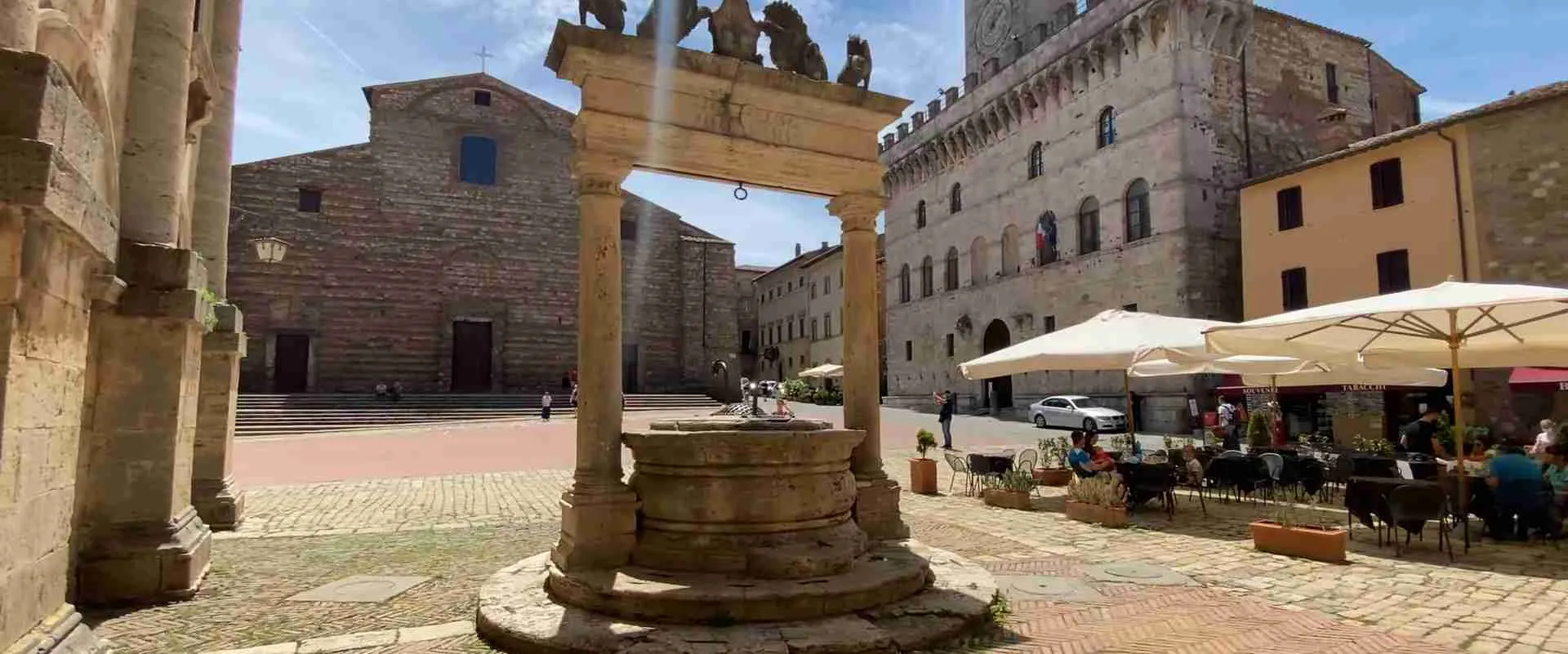
Piazza Grande itself is Montepulciano’s summit and heart. It is a relatively small square by the standards of Tuscany’s major towns — more intimate than Siena’s Campo and far less trafficked than Florence’s Piazza della Signoria — which gives it an unusual quality of concentration and civic dignity. The square is surrounded on four sides by buildings of exceptional quality.
The Palazzo Comunale on the western side is the dominant presence. The building dates from the 14th century in Gothic style and was redesigned in the 15th century by Michelozzo, whose unmistakable Florentine influence is visible in the rusticated facade and the battlemented cornice, modelled closely on the Palazzo Vecchio in Florence. The similarity was not coincidental: according to multiple sources, Cosimo I de’ Medici specifically requested that the civic hall of his new allied town should echo the Florentine seat of power. The ground floor courtyard, which houses an ancient well and frescoed arcades, can be entered freely. Climbing to the terrace costs €2.50; climbing all the way to the top of the tower costs €5 (children under 10 free). The tower ticket is worth every euro: from its summit the view extends over the Val d’Orcia to Monte Amiata and southward to Lake Trasimeno, while in the opposite direction the Val di Chiana opens toward Arezzo. On exceptionally clear days the towers of Siena are visible on the northern horizon. The tower is open 10:00–18:00 from April through November, with extraordinary openings around Christmas. A combined ticket covering both the tower and the Civic Museum (Museo Civico Pinacoteca Crociani) on Via Ricci costs €8 full or €6 reduced.
The Duomo (Cattedrale di Santa Maria Assunta) occupies the eastern side of the square with an unfinished stone facade that has never received the marble cladding originally intended. The interior is free to enter and contains the principal artistic treasure of Montepulciano: the Assumption triptych by Taddeo di Bartolo, a 15th-century Sienese painter whose gold-ground altarpiece dominates the high altar with an authority that the plain facade does nothing to prepare you for.
Palazzo Contucci and Palazzo Tarugi flank the square to the south and east respectively. The Contucci, built in the early 16th century for Cardinal Antonio Maria Ciocchi del Monte, has been home to the Contucci winemaking family for over five centuries; their cellars beneath the palazzo are open for walk-in tastings. The Pozzo dei Grifi e dei Leoni — the Well of the Griffins and Lions — stands in the square’s eastern corner, its travertine arch topped by two lions bearing the Medici crest and two griffins.
Secret Spots and Hidden Walking Routes in Montepulciano 2026
The sections below describe the corners of Montepulciano that most day visitors miss — some because they are literally off the main Corso axis, others because they require walking slightly further, arriving at the right time, or simply looking in the wrong direction from the famous viewpoints.
Piazza San Francesco and the Via Ricci Viewpoint
One of the most consistently overlooked viewpoints in Montepulciano is not on Piazza Grande, not in the Palazzo Comunale tower, and not visible from il Corso. It is on Via Ricci, the street that descends south from Piazza Grande toward the Civic Museum and eventually the Temple of San Biagio. About 100 metres down Via Ricci, the street passes Piazzale San Francesco — a quiet elevated terrace tucked against the town wall, flanked by the small church of the same name, with a bench and a view over the northern side of the town looking toward Lake Trasimeno. The Civic Museum building (Palazzo Neri Orselli) is directly beside it. At sunset, when the light comes from the west and turns the tufa and travertine facades amber, this terrace delivers photographs that would be impossible from any of the more obvious positions — without another tourist in sight.
A few steps further down Via Ricci, the street bends right and another brief opening in the wall presents a direct view northeast toward Lake Trasimeno and its islands, a view that is virtually absent from guidebooks and almost never mentioned by the walking tours. Both viewpoints are free, accessible from Piazza Grande on foot in under five minutes, and typically empty in the early morning and late afternoon.
Via del Borgo Buio: The Back Route Less Traveled
Montepulciano’s official Route 2 (marked in blue on the town walking map, 1.2 kilometres, medium-high difficulty) enters the historic centre from Car Park 5 at the bus station through a back sequence of streets: Via delle Lettere, Via di Gozzano, and then Via di Borgo Buio — literally “Dark Alley” — before rejoining the main Corso. The name is accurate: Via di Borgo Buio is a narrow, shaded lane running through one of the least-visited residential quarters of the old town, its walls unmarked by tourist signage, its only shops a handful of local businesses. The route eventually rejoins the Corso midway up and can be continued to Piazza Grande in the usual way.
This back route is not the most scenic option, but it is the most likely to deliver an unmediated encounter with the ordinary working life of the town — washing lines, parked scooters, doorways with handwritten notices — that the polished Corso does not reveal. It is best walked early in the morning or in the hour before the day-trip coaches depart, when the quieter streets feel genuinely inhabited.
The San Biagio Walk: Route 6 from Piazza Grande
The official Route 6 (yellow, approximately 1 kilometre, no significant difficulty) descends from Piazza Grande along Via Ricci and then Via di San Biagio to reach the Temple of San Biagio on the meadow below the walls. Most visitors reach San Biagio by car or shuttle bus, and those who walk it typically do so from the car park beside the temple uphill into town (the reverse direction). Walking downhill from Piazza Grande takes around 10–15 minutes on a steady descent through a panoramic section of wall road, arriving at the temple from above: the first view of San Biagio’s dome against the cypress-lined meadow, with the Val d’Orcia horizon behind it, is one of the great architectural arrivals in Tuscany.
The Temple of San Biagio was built between 1518 and the 1540s to designs by Antonio da Sangallo the Elder, considered his finest work. The church was built of travertine from the Sant’Albino quarries nearby and follows a Greek cross plan with a central dome. Construction of the second of the two originally planned bell towers was never completed; only the left-hand tower was finished, giving the church its slightly asymmetrical profile. The interior holds a 14th-century Sienese fresco of the Madonna di San Biagio, the miraculous image that prompted the temple’s construction, framed in a monumental marble high altar produced by the Albertini brothers in 1584. A small fee is charged for entry to the interior. The adjoining rectory and the well on the forecourt are also Sangallo’s work.
From the meadow around San Biagio, the view back up to the town — the walls rising steeply above the green slopes, the Palazzo Comunale tower visible at the summit — is the classic Montepulciano postcard image. The afternoon and early evening, when the light comes from the west, are the best times for it. The return to Piazza Grande can be made on foot (20–25 minutes of steep uphill) or by the shuttle bus that stops near the temple.
Piazza Grande After Dark
One of the best-kept open secrets of Montepulciano is that Piazza Grande in the evening — after the day-trip coaches have departed and the tourist shops have closed — becomes an entirely different experience. By 8 PM in summer, the square belongs largely to local residents: families with children, elderly couples on benches, groups of young people gathered at the outdoor tables of the cantinas. The Palazzo Comunale is flood-lit, the Duomo facade glows amber, and the whole square settles into the easy rhythms of an Italian town that happens to be extraordinarily beautiful. There are no admission fees, no audio guides, no tour groups. Simply arriving at Piazza Grande with a glass of Vino Nobile and no agenda is one of the most pleasurable experiences Montepulciano offers, and it costs precisely the price of the wine.
Underground Montepulciano 2026: Wine Cellar Tours Beneath the Streets
One of the defining physical facts about Montepulciano is that the entire historic centre is built over a network of tunnels, vaulted chambers, and underground wine cellars cut into the volcanic tufa on which the town sits. The cellars pre-date many of the Renaissance palaces above them; some incorporate spaces that archaeological evidence suggests have been in continuous use since the Etruscan period. This underground layer is not a tourist construction — it is the actual working infrastructure of the Vino Nobile wine production, where the oak barrels in which the wine ages sit in the same rock-cut chambers they have occupied for centuries. Visiting it is not a re-enactment; it is a direct encounter with how the wine gets made.
De’Ricci Cantine Storiche: The Cathedral of Wine
De’Ricci Cantine Storiche on Via Ricci 11, three minutes downhill from Piazza Grande, is the most celebrated underground cellar in Montepulciano and one of the most architecturally extraordinary wine spaces in Italy. The cellar is entered by descending an equestrian staircase from the courtyard of Palazzo Ricci, a Renaissance palace built for the Ricci family. The underground chamber that opens at the bottom of the stairs is organised in three longitudinal naves defined by massive brick piers supporting wide vaulted arches — the comparison with a Romanesque Gothic cathedral is not hyperbolic. Rows of enormous Slavonian oak barrels and French barriques fill the central nave; branching tunnels cut further into the tufa to reveal additional spaces including a circular chamber that pre-dates the Renaissance construction above it, possibly of Etruscan origin.
Tours run for approximately 90 minutes and include a guided walk through the cellar with explanations of the Vino Nobile production process, followed by a tasting of six wines — typically a Rosso di Montepulciano, two vintages of Vino Nobile, and a Vino Nobile Riserva — paired with bruschetta, extra-virgin olive oil from the estate, Tuscan cheese, and cured meats. The price is €25 per person (check the official website for current rates). Non-wine drinkers pay €10. Children under 3 are admitted free. The cellar is booked around 43 days in advance on average during the high season; booking ahead through the De’Ricci website (via Ricci 11, Montepulciano) is strongly recommended. The cellar is in the ZTL no-car zone; recommended car parks are Parcheggio San Donato or Parcheggio P8.
Ercolani’s Underground City: Etruscan Tombs and Barrel Vaults
Via Gracciano del Corso 82 — midway up the main Corso — is the address of what the Ercolani family call the Underground City: a monumental route of 15th-century cellars running beneath the historic palaces Tarugi, Avignonesi, Del Pecora, and Batignani. The sequence of vaulted rooms, tufa passages, and descending stair sections includes two authentic Etruscan tombs incorporated within the cellar structure, ancient wells, and arched chambers where the family’s Vino Nobile ages in large casks. The family has installed three small museums within the underground circuit covering the history of cellars, the art of viticulture, and a display of fossil material recovered from the tufa — evidence of the marine deposits from which this hill was formed millions of years before it became a hilltop town.
The underground route is open daily (except Christmas), with tastings of Vino Nobile, grappa, and vin santo available on request. The self-guided circuit takes approximately 20 minutes; longer accompanied visits and group tastings can be arranged by reservation. The Ercolani cantina is less frequently mentioned in international guides than De’Ricci and therefore tends to be less crowded — it makes an ideal first stop on the Corso before beginning the climb to Piazza Grande.
Contucci and Talosa: Walk-In Tastings on Piazza Grande
For visitors who want to taste Vino Nobile without booking in advance, two cantinas close to Piazza Grande offer walk-in access. Palazzo Contucci opens its commercial enoteca and adjoining cellar to visitors during normal business hours; the Contucci family have been producing wine in Montepulciano since the Renaissance era and their cellar beneath the Piazza Grande palazzo is accessible from the palace’s ground floor. The atmosphere is more formal than the underground city tours but correspondingly quieter, and the quality of the wines is among the highest in the DOCG zone. Cantina Talosa, a short walk from Piazza Grande on Via del Teatro 1, is another well-regarded option with walk-in tastings and a cellar that dates from the 12th century; the cellars here rest partly on Etruscan foundations.
Vino Nobile Estate Tours 2026: Vineyards and Cellars Beyond the Walls
The underground cellars within the historic centre show where the wine is aged and bottled; the estate vineyard tours show where it begins. The Vino Nobile DOCG zone extends across the hills surrounding Montepulciano, and the majority of the production estates are clustered within a few kilometres of the town walls. Several operators run half-day and full-day vineyard tours in 2026 that combine driving or cycling through the estates with guided tastings and, in most cases, a meal.
What Makes Vino Nobile DOCG Special
Vino Nobile di Montepulciano DOCG is produced primarily from Prugnolo Gentile, a local clone of the Sangiovese grape that has been cultivated in this territory since at least the early Middle Ages. The wine is aged for a minimum of two years, with at least one year in oak; Riserva wines extend this to three years. The resulting wine is fuller and more structured than most Chianti but somewhat softer than Brunello di Montalcino; its characteristic aromas run through dried cherry, tobacco, and earthy mineral notes. Rosso di Montepulciano DOC is the younger, less demanding sibling of the same grape, aged for only a few months and typically more accessible and affordable. Both wines are produced throughout the vineyards visible from the town walls in every direction, particularly on the slopes facing south and southeast toward the Val d’Orcia.
Guided Vineyard Tours 2026: Operators and Prices
Valdichiana Living (Piazza Grande 7, tel. 0578 717484) is the most conveniently located tour operator in Montepulciano and offers the widest range of wine-focused experiences in 2026. Their Vino Nobile vineyard tour visits two estates in the countryside surrounding Montepulciano, with a guided walk through the vineyards, an explanation of the production process from vine to bottle by the producers themselves, and a guided tasting of Rosso di Montepulciano DOC and Vino Nobile DOCG; the second winery visit includes a traditional Tuscan light lunch served in the cellar. The price starts from €59 per person without transport; transport to the estates is available upon request at an additional cost. Tours run from January through January 2033, making them available year-round. Booking through the Valdichiana Living website or by email ([email protected]) is recommended for the high season.
For independent wine lovers, several estates close to the town walls accept visits with advance booking. Avignonesi, situated between Montepulciano and Arezzo and known particularly for its rare Vin Santo, operates an upscale tasting room and offers estate tours; their Vin Santo is produced by a labour-intensive traditional method and is considered one of the benchmark examples of this Tuscan sweet wine. Fattoria Madonna della Querce near the town is a smaller, family-run operation that earns consistently high reviews for the authenticity of its farm tour and lunch experience. Podere Montale Winery and Podere della Bruciata are among several boutique estates offering smaller group visits with a more intimate atmosphere than the better-known names.
The harvest season — roughly late September through October, varying by year — is the most atmospheric time to visit the estates. The air in the vineyards carries the fermenting must from the cellars, the leaves are turning, and many estates accept visitors who want to observe or participate in the picking. Most bookings during harvest week are made months in advance.
Guided Walking Tours of Montepulciano 2026: Top Experiences and Operators
Montepulciano’s guided tour market in 2026 divides broadly into three categories: private walking tours of the historic centre, combined town-and-cellar tours, and food-and-wine walking experiences that integrate multiple tastings into the walk itself. All are available in English and can be booked through Viator, GetYourGuide, or directly through the operators.
Private Guided Town Walks 2026
Private walking tours of the historic centre run for approximately two hours and cover the main Corso route from Porta al Prato to Piazza Grande, with extended time at the key monuments and commentary on the history and architecture of the Renaissance palaces, churches, and civic buildings. Most tours end with a wine tasting in one of the underground cantinas; the tour includes the guide’s introduction and a glass of wine but visitors pay their own cellar entry if applicable. Prices for private tours vary by group size and operator; the most reviewed private tour in Montepulciano currently on Viator includes a guided walk through the historic centre, a visit to the Palazzo Comunale tower (tower ticket extra), and a cellar tasting. Group tours with a maximum of 8–12 participants are available at lower per-person cost and run on fixed departures. For families, private tours allow the guide to adapt the pace and focus. The guides most consistently praised in recent reviews include Chiara, who leads the private tour listed on Viator (d27742-208802P5), and multiple guides working through Let’s Andiamo Private Tours and similar operators.
Food and Wine Walking Tours 2026
Montepulciano’s gourmet walking tour format combines the architecture walk with scheduled stops at a local deli, a traditional restaurant, and an underground cantina. Participants taste local cheeses and cured meats — pecorino stagionato from nearby Pienza, finocchiona salami, hand-sliced prosciutto — alongside two or three wines matched by a sommelier, followed by a plate of fresh handmade pasta. This format is offered by several operators including Valdichiana Living and independent guides listed on Viator; prices typically run €65–95 per person including food and wine. For the most focused food experience, a cooking class at the farm cooking school operated by chef Giacomo in the Montepulciano hills covers fresh pasta, sauces, and tiramisu with a tasting of the finished meal and local wines; this runs as a small group of up to 12 participants and is bookable through Viator and GetYourGuide.
Self-Guided Tours 2026: Digital Options and Vouchers
For visitors who prefer to walk at their own pace, Aurea Travel offers a self-guided Montepulciano experience at €25 per party (one ticket sufficient for two people): a 30-page digital itinerary with detailed maps and tips, combined with a voucher for a tasting of local products and Vino Nobile in a historic cellar, and an introduction to the underground city. The package is available between May and October and can be booked through the Aurea Travel website (aurea-travel.com). GPS-guided routes on the Questo app cover the historic centre and pass the main landmarks including the Palazzo Comunale, the Temple of San Biagio, and the Porta dei Grassi; routes run 1–3 hours at a comfortable pace and require no booking in advance.
E-Bike and Vespa Tours 2026: Exploring Val d’Orcia from Montepulciano
The countryside around Montepulciano is among the most scenically celebrated in Tuscany, but its enjoyment from a car window is limited by the inability to stop freely, the impossibility of crossing the small dirt roads and farm tracks that thread between the vineyards, and the sheer speed of passing what deserves to be approached slowly. E-bikes and Vespas solve all three problems, and both are available in Montepulciano in 2026 from operators within the ZTL.
Urban Bikery: E-Bike Rentals and Tours 2026
Urban Bikery at Via Ricci 2 — 10 metres from the corner of Piazza Grande — is the best-reviewed active-travel operator in Montepulciano and operates a fleet of electric fat-tyre bikes designed for the mixed terrain of the Val d’Orcia: tarmac sections, gravel farm roads, and the occasional steep vineyard track. Rentals include a GPS app loaded onto a phone mounted on the handlebars, a helmet, a backpack with safety gear, a lock, and a support van available by WhatsApp throughout the day in case of mechanical problems.
E-bike rental prices start from €25 for two hours, €45 for a half day, and €65 for a full day. For the full countryside experience, the Wine Tour E-Bike Experience includes the bike rental, two wine tastings and cellar visits at selected rural wineries, and a GPS route through the countryside to Monticchiello and Pienza; this package is bookable through Viator and runs at approximately €165–185 per person depending on the season (check the official website at urbanbikery.it for current pricing, as this may vary). An optional guide can be added to any rental for €150 for a group of up to four, plus €25 per additional person — worth considering if the terrain is unfamiliar or if the group includes inexperienced cyclists, since the route involves both paved sections and steeper gravel climbs that require some confidence on a bike.
Urban Bikery has been operating since 2017 and consistently earns the highest reviews of any experience provider in Montepulciano on both Tripadvisor and Viator. The most common description in recent traveller reviews is that it was the best single day of an entire trip to Italy. The routes pass through terrain that is genuinely difficult to access by car — the narrow track between Monticchiello and Pienza used in the classic Tuscany landscape images and as a filming location for several major films passes through private vineyard land that the e-bike route navigates with the cooperation of the landowners. Booking in advance is strongly advised, particularly in July and August when Urban Bikery has been reported as fully booked for the entire week.
Vespa Tours 2026: Val d’Orcia by Scooter
For visitors who want to cover more distance at higher speed while retaining the freedom to stop anywhere, Vespa tours of the Val d’Orcia are available from several operators. The experience involves renting a classic Vespa scooter (with the option to ride solo or as a passenger with a guide-driver) and following a pre-set route through the Val d’Orcia or around Lake Trasimeno, with stops for photographs and a wine tasting at a cellar. The format is offered by at least one operator listed on Viator under “Discover the Hidden Gems of Val d’Orcia by Vespa” with departure from Montepulciano. Prices and availability should be verified at booking. A valid motorcycle licence is required for solo riding; pillion passengers need no licence. The Vespa tour covers more ground than the e-bike experience in the same time but offers less flexibility for off-road sections and vineyard tracks.
Seasonal Tours and Special Events in Montepulciano 2026
Montepulciano’s events calendar shapes the experience of the town significantly — and arriving for the right event can transform a pleasant visit into something genuinely memorable. Two events in particular are worth planning around: the Bravio delle Botti in late August and the wine harvest season in late September and October.
Bravio delle Botti: The August Barrel Race
The Bravio delle Botti is Montepulciano’s ancient inter-district competition, held annually across the final ten days of August and culminating on the last Sunday of the month. Eight town contrade (districts) compete by pushing heavy wooden wine barrels uphill through the narrow streets of the historic centre from the Colonna del Marzocco at the lower end of il Corso to Piazza Grande at the summit — a distance of roughly one kilometre against a consistent uphill gradient. Two “pushers” per contrada roll their barrel; the fastest to arrive at Piazza Grande wins the Bravio, a painted cloth banner depicting the town’s patron saint, San Giovanni Decollato.
The race itself takes place on the last Sunday of August (in 2025 this was August 31; the 2026 date will follow the same pattern — typically the last Sunday of the month). The ten days preceding the race fill the town with events: the opening “Cantine in Piazza” evening on the first Friday, when producers set up tasting tables across Piazza Grande; the Proclamation of the Gonfaloniere ceremony on the Saturday, with the town’s flag-throwers and drummers processing by torchlight; Monday evening barrel-pushing trials by each contrada; and the evocative Candlelit Procession on the Thursday before race day. During race week, the contrada kitchens open to the public each evening, offering neighbourhood dinners in a convivial atmosphere that is as close as visitors can get to experiencing the town from the inside.
On race day, entry to the historic centre from 2:30 PM costs €3.50 (free for children under 6). The race itself starts at 6:30 PM; spectators line the upper streets and the sides of Piazza Grande. The atmosphere is genuinely charged — this is not a tourist performance but a competition that residents care about intensely. Accommodation in Montepulciano fills up weeks or months in advance for the Bravio weekend; booking a base in a nearby agriturismo or in Pienza or Chiusi is a practical alternative.
The historical roots of the Bravio extend to 1373, when Montepulciano’s municipal statute first established the contest in honour of San Giovanni Decollato. The original race was run on horseback and continued in that form until the 17th century, when it was suppressed for public order reasons. The modern barrel version was created in 1974 by a local parish priest, Don Marcello Del Balio, who revived the tradition with the substitution of wine barrels for horses — a detail perfectly suited to a town whose identity is inseparable from its wine.
Spring Wine Events and Harvest Season
The Vino Nobile Anteprima, held each year in February at the Fortezza Medicea, is the annual presentation of the new vintage by producers from the DOCG consorzio. The event is primarily a trade and press occasion but opens to the public for tasting on certain days; check the Consorzio del Vino Nobile website for the current year’s schedule. The Fortezza Medicea itself — the Medici fortress at the southern tip of the historic centre — is home to the Enoliteca del Vino Nobile, a sleekly designed wine bar and shop inside a centuries-old fortress that stocks the full range of DOCG producers and is open to the public year-round.
The Cantiere Internazionale d’Arte is Montepulciano’s annual arts festival, held each July and drawing musicians, composers, and theater companies to perform in the town’s historic spaces including the Teatro Poliziano, the piazzas, and occasionally the open meadow around San Biagio. The festival was co-founded by composer Hans Werner Henze and maintains an adventurous programming tradition; the H. W. Henze Music Institute remains active in the town.
The harvest period from late September through October is the most atmospheric time to visit the surrounding estates. Most rural wineries welcome visitors during harvest week, many with the option to participate in picking. The town itself is quieter than in summer, the temperatures are mild, and the vine leaves have turned; a walk on the Route 6 path down to San Biagio in October light, with the hills behind the temple bright with autumn colour, is one of the better arguments for travelling off-season.
Practical Tips for Walking and Touring Montepulciano in 2026
Getting There and Parking
Montepulciano is most practically reached by car. From Florence, the journey takes approximately 1 hour 45 minutes via the A1 autostrada to the Valdichiana exit and then the SS146 and SP4. From Siena, the distance is around 65 kilometres and takes about 1 hour. From Rome, the journey via the A1 to Chiusi takes approximately 2 hours 30 minutes.
The main car park near Porta al Prato is Parcheggio Don Minzoni (Piazza Don Minzoni), a paid car park immediately outside the main gate with the minibus connection. Parcheggio 8 (also referred to as Parking P8) is the recommended free car park for the De’Ricci and Urban Bikery venues; it is slightly further from Porta al Prato but closer to Via Ricci in the upper town. Parking near the Temple of San Biagio at the base of the town is free and convenient if visiting San Biagio first before riding or walking up.
By public transport, the closest train station is Chiusi-Chianciano Terme on the Florence–Rome main line, connected to Montepulciano by bus (Tiemme lines, approximately 25–30 minutes). The LFI bus from Siena also serves Montepulciano with connections from Florence via Siena. Timetables are available at the Siena Mobilità and LFI websites.
ZTL Zone and the Town Minibus
Montepulciano’s historic centre operates as a full ZTL (Zona a Traffico Limitato) for private vehicles. Residents and authorised vehicles only are permitted inside the walls; tourists who drive inside risk an automatic fine issued by the ZTL cameras. Hotel guests staying within the historic centre can normally obtain a temporary access code from their accommodation; confirm this in advance.
The town minibus (€1 per ride) connects the Piazza Don Minzoni car park to Piazza Grande with stops at several points along the way. Buses run frequently during the tourist season; timetables are posted at the stops. The bus makes the ascent feel less formidable if the full Corso walk is not on the agenda, but the walk itself is genuinely enjoyable and provides opportunities to stop at shops, cantinas, and churches that the bus does not.
What to Book in Advance
De’Ricci Cantine Storiche books approximately 43 days in advance on average during the high season; attempting a walk-in visit during July or August is likely to be unsuccessful. Book through the De’Ricci website or through GetYourGuide. Urban Bikery e-bikes are reported as fully booked for entire weeks during July and August; booking at least two to four weeks ahead is strongly advised. For the Bravio delle Botti weekend, accommodation and any cellar tours should be booked as far in advance as possible. The Valdichiana Living tours (underground cellars and vineyard visits) are available year-round but limited group sizes mean advance booking is worthwhile in summer.
The Palazzo Comunale tower does not require advance booking; tickets are purchased on site at the first floor of the building. The Civic Museum is open daily except Tuesdays from April through October, 10:00–19:00 (last entry 18:00). The Temple of San Biagio is open to visitors during daylight hours with a small entry fee for the interior.
Walking Conditions and What to Wear
Montepulciano is an uphill town. The ascent from Porta al Prato to Piazza Grande is approximately 1 kilometre with an average gradient that becomes noticeably steeper in the upper third; the walk to San Biagio from Piazza Grande involves a reverse gradient of similar intensity on the return climb. Comfortable, low-heeled walking shoes with grip are strongly recommended; the Corso’s stone paving can become slippery after rain. Sandals are technically manageable on the Corso but unsuitable for the e-bike routes or any countryside walk.
Montepulciano’s elevation (605 metres above sea level) means temperatures are consistently several degrees cooler than the valley towns in summer, making it a practical choice for hot July and August days. In spring and autumn the weather can change quickly; a light jacket for evenings is useful year-round. Sunscreen and water are essential for any outdoor activity in June, July, and August. Dress modestly for church visits — shoulders and knees covered — particularly for Sant’Agostino and the Duomo, both of which are active places of worship.
Frequently Asked Questions About Montepulciano Tours & Walking Routes 2026
How long does it take to walk il Corso from Porta al Prato to Piazza Grande?
The pure walking time is 20–30 minutes for a fit adult walking at a steady pace. Most visitors take between 60 and 90 minutes to complete the walk one way, factoring in stops at wine cantinas, churches, and shops. Adding a visit to the Palazzo Comunale tower and time to explore Piazza Grande, a complete walk from gate to summit and back down takes a comfortable half day. If visiting on a day trip with limited time, the minibus up and walk down is the most efficient approach.
Do I need to book a wine cellar tour in advance in Montepulciano?
For De’Ricci Cantine Storiche, advance booking is strongly recommended and often essential; the cellar books an average of 43 days ahead during the high season. The Valdichiana Living two-cellar tasting tour also benefits from advance booking, particularly in summer. Contucci and Talosa offer walk-in access without booking during normal opening hours. The Ercolani Underground City on the Corso accepts walk-in visitors. For any visit between June and September, booking at least one to two weeks ahead avoids disappointment.
Is the Temple of San Biagio worth visiting in 2026?
Yes, and the walk there is as worthwhile as the destination itself. The Temple of San Biagio is one of the masterworks of Italian Renaissance architecture, built by Antonio da Sangallo the Elder from 1518 in locally quarried travertine on a Greek cross plan with a central dome. Its isolated position in the meadow below the town walls — visible from Piazza Grande above and from the Val d’Orcia road below — gives it a quality of pure architectural drama that churches embedded in urban fabric cannot achieve. Allow 30–45 minutes for the walk down from Piazza Grande and the same for the interior visit; the return uphill takes 20–25 minutes for most walkers, or can be made by the shuttle bus that stops near the temple.
What is the best way to visit Montepulciano’s wine cellars without a car?
All of the historic underground cellars in Montepulciano sit within the ZTL historic centre and are accessible entirely on foot from the main car parks outside the walls. De’Ricci (Via Ricci 11), Ercolani (Via Gracciano del Corso 82), Contucci (Piazza Grande), and Talosa (Via del Teatro 1) can all be reached within 10–15 minutes’ walk from Porta al Prato or Piazza Don Minzoni. The town shuttle bus (€1) also reaches the upper town close to De’Ricci and Urban Bikery. For the countryside vineyard tours that visit rural estates, transport is available upon request from Valdichiana Living and other operators for an additional cost, making them accessible even without a hire car.
How much does it cost to visit Montepulciano’s main attractions in 2026?
Several of the most significant attractions are free: the Duomo interior, the ground-floor courtyard of the Palazzo Comunale, and the Temple of San Biagio exterior involve no charge. The Palazzo Comunale tower costs €5 per adult (terrace only €2.50; children under 10 free). The Civic Museum is €6 full, €4 reduced. A combined tower and museum ticket is €8 full, €6 reduced. Wine cellar tours at De’Ricci run €25 per person for the full tasting experience; Ercolani and Contucci offer free or low-cost access with tastings available at modest additional cost. For those confining themselves to the self-guided Corso walk, the Palazzo Comunale tower, and a walk to San Biagio, the total spend on admissions can be as low as €5–8 per person.
Is the e-bike tour from Urban Bikery suitable for non-cyclists?
Urban Bikery’s routes are designed for visitors of varied fitness levels, and the electric assist on the fat-tyre bikes means that hills that would be challenging on a conventional bicycle become manageable for most adults. The team at Via Ricci 2 provides a briefing and a short practice area before departure and are available by WhatsApp throughout the ride. The routes combine paved provincial roads with gravel farm tracks; riders must be comfortable handling a bicycle on loose surfaces at low speeds, and some sections require genuine effort even with electric assist. The operator specifies that riders must be at least 155 cm tall; there is no upper age limit, and the experience is frequently described by riders in their 60s and 70s as one of the highlights of their trip. Booking well in advance is essential, particularly in July and August.
What is the Bravio delle Botti and how do I attend in 2026?
The Bravio delle Botti is Montepulciano’s annual barrel-pushing race, held across the final ten days of August and culminating on the last Sunday of the month. Eight town districts compete by rolling heavy wooden barrels uphill through the historic centre from the Marzocco Column to Piazza Grande. The week includes evening processions, flag-throwing displays, district dinners, and the dramatic Candlelit Procession on the Thursday before the race. Entry to the historic centre on race day costs €3.50 from 2:30 PM. There is no single ticket for the week’s events — most of the preliminary activities are free and simply require being in the right place. The 2026 dates follow the same last-Sunday-of-August pattern; check the official Bravio delle Botti website (braviodellebotti.com) in early summer for the confirmed programme and dates.
Are there tours of Montepulciano suitable for families with children?
Montepulciano is a manageable destination for families, though the uphill walking is tiring for young children. The minibus (€1) solves the ascent problem. The Palazzo Comunale tower is accessible by lift to the first floor and then by stairs; the very narrow, steep final section to the summit is not recommended for small children. The underground cellar tours are generally well-received by older children who respond well to the atmosphere of the tufa tunnels and barrel vaults; De’Ricci charges €10 for non-drinkers and admits children under 3 free. The horseback riding tours available through local stables (bookable via Viator) are described by operators as suitable for all levels including beginners and are family-friendly. The Cinta Senese farm tour south of Montepulciano — featuring a visit to the farm’s pigs, an olive grove walk, and a tasting of farmhouse products — is a popular choice for families with young children.
What hidden viewpoints in Montepulciano are worth seeking out?
Three lesser-known viewpoints stand out. Piazza San Francesco on Via Ricci, five minutes south of Piazza Grande, is a quiet terrace against the town wall with a free sunset view over the northern valley toward Lake Trasimeno that most visitors walk straight past. A further 50 metres down Via Ricci, a gap in the wall provides a direct line of sight toward Lake Trasimeno and its islands — rarely photographed because it requires looking away from the more famous valleys. The viewpoint from the Fortezza Medicea at the southern tip of the historic centre looks directly down to the Temple of San Biagio and across the Val d’Orcia toward Monte Amiata; the Enoliteca wine bar inside the fortress provides another reason to seek this end of town. All three are free and accessible on foot from Piazza Grande without descending to the car parks.
What should I eat and drink in Montepulciano besides Vino Nobile?
The signature pasta of southern Tuscany is pici — a thick, hand-rolled spaghetti made without egg, characteristic of the Siena province, typically served with a rich wild boar ragu (cinghiale) or a simple garlic and breadcrumb sauce (all’aglione). Most trattorie in Montepulciano make fresh pici daily. Pecorino di Pienza — the semi-aged sheep’s milk cheese made in nearby Pienza — appears on every tagliere (charcuterie board) and can be bought to take home from the deli shops along the Corso. Bruschetta with the local cold-pressed olive oil is another fundamental: the oil from the Montepulciano hills has a peppery, grassy character distinct from lighter oils further north. For a lighter option, the Caffè Poliziano at Via di Voltaia nel Corso 27 does reliable light lunches from crostini and cold cuts to salads; the panoramic balcony over the Val di Chiana is included in the price of a coffee.