
Visiting Modena: Ultimate Planning Resource & Travel Guide 2026
Modena sits at the heart of Italy’s most celebrated food and automotive heritage region, offering visitors the rare chance to stand in a UNESCO World Heritage piazza at breakfast, absorb four centuries of Este dynasty masterworks before noon, and stand within inches of a Formula 1 championship Ferrari by afternoon. This complete guide to visiting Modena in 2026 covers current admission prices, where to eat and stay at every budget level, precise daily cost breakdowns, and the day trips that make this compact Emilian capital one of northern Italy’s most rewarding bases.
Key Takeaways
- UNESCO World Heritage status confirmed 1997: The Cathedral, Torre Civica and Piazza Grande complex holds UNESCO designation under criteria (i), (ii), (iii), and (iv); the Cathedral and Piazza Grande are free to enter, while the Ghirlandina Tower charges €6 adults (€4 reduced) since May 2025.
- Budget travelers spend approximately €65-95 per person daily in 2026 (two sharing budget accommodation), or around €455-665 for a full week.
- Mid-range travelers spend approximately €140-220 per person daily (two sharing a mid-range hotel), or around €980-1,540 for a week.
- Luxury travelers invest approximately €265-450 per person daily (two sharing a luxury or boutique hotel), or around €1,855-3,150 for a week.
- Ferrari Museums: the Museo Enzo Ferrari in Modena and Museo Ferrari Maranello each cost €27 (October–April) or €32 (May–September); the combined Musei Ferrari Pass covers both for €38-42 and saves approximately 30-34% versus buying separately (check ferrari.com for current rates).
- Getting here is easy: Bologna–Modena regional trains depart every 15-20 minutes, cover the 37 km in 18-22 minutes, and cost €5-6; Modena sits directly on the A1 motorway, 160 km from Milan and 105 km from Florence.
People Also Ask About Visiting Modena 2026
How much does it cost to visit Modena in 2026?
Daily costs in Modena 2026 range from €65-95 per person (budget travelers sharing a budget hotel) to €140-220 per person (mid-range) and €265-450 per person (luxury), all figures based on two sharing accommodation. Major paid attractions include the Ghirlandina Tower at €6, the Galleria Estense at €8, and the Museo Enzo Ferrari at €27-32 depending on season. The Cathedral, Piazza Grande, Mercato Albinelli, and many churches are free. Food costs are the main variable: a coffee costs €1.50-2, a full trattoria lunch runs €15-25, and a dinner at a quality restaurant costs €30-50 per person before wine. Budget-conscious visitors who stick to bar lunches, free heritage sites, and aperitivo culture can make a day work for well under €80 including accommodation.
How many days do you need to visit Modena in 2026?
Two full days cover Modena’s essential sights comfortably: the UNESCO complex, Galleria Estense, Mercato Albinelli, Museo Enzo Ferrari, and a thorough exploration of the historic center. Three to four days allows time for day trips to Maranello (Ferrari Museum), Bologna, and Parma, plus balsamic vineyard visits and a more leisurely gastronomic immersion. Visitors combining Modena with the broader Motor Valley — including Lamborghini, Pagani, and Ducati — benefit from five to seven days based in the city.
What is Modena most famous for?
Modena holds an extraordinary concentration of global claims to fame: it is home to a UNESCO World Heritage Cathedral complex (inscribed 1997), the birthplace of the Ferrari brand and Enzo Ferrari himself, the origin city of traditional balsamic vinegar DOP (aged a minimum of twelve years), the birthplace of tenor Luciano Pavarotti, and one of Italy’s top gastronomic cities with the highest density of Michelin-starred restaurants per capita in Emilia-Romagna. Maserati was founded and headquartered in Modena, and the surrounding Motor Valley hosts Lamborghini, Pagani, and Ducati all within 40 km.
Is Modena worth visiting in 2026?
Modena delivers a depth of experience that few Italian cities of similar size can match. The UNESCO heritage complex is one of the most architecturally significant Romanesque ensembles in Europe. The food culture is exceptional and largely authentic — tortellini in brodo here bears no resemblance to any export version. The Ferrari connection draws enthusiasts from every continent, and the Museo Enzo Ferrari is one of the best-designed automotive museums in the world. Crucially for 2026, Modena remains dramatically less crowded than Florence, Venice, or Rome, meaning the sites are accessible at all hours without the queue management that dominates larger cities.
Extended multi-day tours – 5+ days
Featured Modena Multi-Day Tour Packages
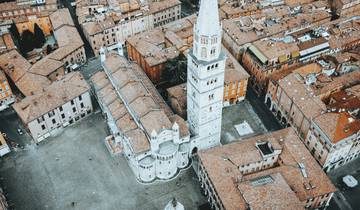
2 days
2-Day Private Ferrari Experience: Speed & Italian Excellence
- ✓ Comprehensive Modena tour
- ✓ Expert local guides included
- ✓ All accommodation arranged
- ✓ Transportation provided
7 days
From the Canals of Venice to Renaissance-infused Mantua
- ✓ Comprehensive Modena tour
- ✓ Expert local guides included
- ✓ All accommodation arranged
- ✓ Transportation provided
5 days
Emilia Private Experience: food, art and cars
- ✓ Booking needs min. 2 travelers
4 days
Bologna Gourmet, Good Food and History 4 Days Tour
- ✓ Comprehensive Modena tour
- ✓ Expert local guides included
- ✓ All accommodation arranged
- ✓ Transportation provided
Multi-day tour packages powered by TourRadar. Prices and availability subject to change.
Introduction to Modena in 2026
Modena occupies a privileged position on the Via Emilia, the ancient Roman road that still anchors the economic spine of northern Italy. At approximately 185,000 inhabitants, it is a city of serious substance rather than surface spectacle — the kind of place where residents eat better on a Tuesday evening than most travelers manage on a honeymoon. The Po Valley plain stretches north to the river; the Apennine ridge rises to the south, crisscrossed with routes to Tuscany. This geography shaped everything: the clay used in Romanesque construction, the fog that concentrates the acetic fermentation in the attic balsamic cellars, the engineering culture that produced cars designed for speed on flat, straight roads.
For 2026 visitors, Modena presents a combination that is genuinely rare: an intact medieval core that functions as a living city rather than a museum zone, a food tradition that is actively practiced and defended at every price point, and a set of world-class museums that have not yet attracted the overcrowding that compromises the experience in the more famous destinations to the south. The city’s UNESCO heritage site requires advance reservation for the Ghirlandina Tower but is otherwise immediately accessible. The Ferrari museums are popular and benefit from online booking, but rarely sell out more than a few days in advance outside of Grand Prix weekends and August peak season.
2026 is a particularly good year to visit for automotive enthusiasts: Modena remains the operational center of the broader Motor Valley cluster, and the circuit of Ferrari, Lamborghini, Pagani, and Ducati museums now operates with coordinated ticketing options that reward visitors combining multiple sites in a single trip. The city’s food calendar runs year-round with seasonal highlights — white truffle season in autumn, the Festival Filosofia in September transforming the city into an open-air philosophy symposium, and the deeply local celebration of the patron saint San Geminiano in January.
Getting to Modena in 2026
Modena connects to the rest of Italy and Europe efficiently by rail, road, and air. The city’s central position on the main Milan–Bologna–Florence railway corridor means it sits on one of Italy’s busiest transport arteries, with frequent high-speed and regional services throughout the day.
By Train to Modena in 2026
Modena’s main station (Stazione di Modena) stands 700 meters north of the city center, a twelve-minute walk from Piazza Grande. Regional trains operated by Trenitalia and TPER connect Bologna Centrale to Modena roughly every fifteen to twenty minutes from early morning until late at night. The journey takes 18-22 minutes on the fastest services and costs €5-6 for a standard regional ticket. There is no need to reserve a seat on regional trains; tickets are available at station machines and the Trenitalia app. High-speed Frecciarossa trains also call at Modena on the Milan–Rome axis, covering the Milan–Modena route in around forty-five minutes; tickets on this service cost €15-40 depending on booking lead time but worth considering for those arriving from Milan without a rail pass.
From Florence, the most practical route involves taking the Frecciarossa or Frecciargento to Bologna (35-50 minutes) and connecting to a regional Modena service. Direct intercity trains also run the Florence–Modena route in approximately ninety minutes. From Rome, the journey to Modena takes two to two and a half hours on high-speed services via Bologna. The Ferrari Shuttle service — a combined train and bus package available through Trenitalia/TPER and Ferrari’s booking system — connects Modena station to the Museo Ferrari Maranello and is worth checking for visitors whose primary purpose is the Ferrari museums.
By Car to Modena in 2026
Modena sits at the junction of the A1 Milan–Naples motorway and the A22 Brennero–Modena motorway. From Milan, the drive takes approximately ninety minutes (160 km). From Florence, allow ninety minutes to two hours (105 km). The A1 toll from Milan to Modena costs approximately €10-14. Parking in the historic center is complicated by the ZTL (Zona a Traffico Limitato) restricted traffic zone that covers the medieval center; driving into the ZTL without authorization results in an automatic fine. Visitors driving to Modena park in the peripheral car parks — Parcheggio Novi Sad (adjacent to the old city walls, free evenings and weekends), Via Buon Pastore, and Via Jacopo Berengario — and walk or take a bus into the center. These peripheral car parks are free or charge €1-2 per hour.
By Air to Modena in 2026
Modena has no commercial airport. Bologna Guglielmo Marconi Airport (IATA: BLQ), located 45 km away, serves as the closest major hub with connections across Europe and intercontinental services. From Bologna airport, the Aerobus shuttle runs to Bologna Centrale station (approximately twenty minutes, €9), from where regional trains continue to Modena in under twenty-five minutes. Total journey from plane to Modena center runs ninety minutes to two hours allowing for connections. Verona Villafranca Airport (VRN), 100 km north on the A22, offers a secondary option for travelers arriving from northern Europe on routes that serve Verona but not Bologna.
Getting Around Modena in 2026
Modena’s historic center is compact and almost entirely walkable. Piazza Grande to the Galleria Estense is a five-minute walk; from the Galleria Estense to the Museo Enzo Ferrari is twelve minutes on foot. City buses operated by SETA connect the station to all major neighborhoods; single tickets cost €1.50 and are purchased before boarding. The city operates a well-developed cycling infrastructure with bike-sharing stations throughout the center. For the Pavarotti Museum and the Maranello Ferrari Museum — both outside the city — taxis and the Ferrari Shuttle bus are the practical options. The municipality has agreed a maximum taxi tariff from Modena center or station to the Pavarotti Museum of €20 one-way (€40 round trip including one hour of waiting).
When to Visit Modena in 2026
Modena rewards visits at every season, but the shoulder months of April–May and September–October offer the best balance of weather, crowd levels, and event programming. Summer brings reliable warmth and the Motor Valley festival season; winter reveals the city at its most local, with few tourists and extraordinary food.
Spring in Modena 2026 (March–May)
Spring is arguably Modena’s finest season for visitors. Temperatures in April and May reach 18-22°C, the flat Emilian light is clear and beautiful, and the city’s outdoor life — the portico promenades, the aperitivo terraces on Via Emilia — comes fully back to life. The Motor Valley Fest takes place in May, filling central Modena with vintage and contemporary supercars from Ferrari, Lamborghini, Maserati, and Pagani in a free outdoor exhibition that is one of the most visually spectacular automotive events in Europe. Hotels book up during Motor Valley Fest week, so reservations two to three months in advance are advisable. Spring is also peak balsamic vinegar production season, and acetaie across the province welcome visitors for tastings.
Summer in Modena 2026 (June–August)
Summer brings the Ferrari high season, with the Museo Enzo Ferrari and Museo Ferrari Maranello charging their higher tariff of €32 per adult (versus €27 in low season). Temperatures regularly reach 30-35°C and occasionally exceed 37°C in July and August; the Po Valley humidity makes heat feel more intense than Tuscany or the coast. The city center empties of residents in August as Modenesi depart on holiday, but the museums remain open. Hotel rates are highest in summer, particularly during Formula 1 race weekends when prices across the region spike significantly. The Ferrari Shuttle sees its highest demand in summer; booking museum tickets in advance during July and August is strongly recommended.
Autumn in Modena 2026 (September–November)
September is the single best month to visit Modena. The Festival Filosofia — an internationally recognized three-day philosophy festival held annually in mid-September across Modena, Carpi, and Sassuolo — transforms the city with hundreds of free lectures, performances, and events in piazzas, courtyards, and streets. The program attracts leading European intellectuals and is entirely free to the public. White truffle season begins in October, and restaurants across Emilia-Romagna add truffle-inflected specials to menus. Temperatures in September and October settle into the 16-23°C range — ideal for walking. Accommodation prices begin to soften from their August peak.
Winter in Modena 2026 (December–February)
Winter in Modena is cold, foggy, and surprisingly rewarding for the food-focused visitor. The fog (nebbia) is a permanent feature of Po Valley winters and creates an atmospheric quality in the medieval streets that no other season replicates. The feast of San Geminiano (January 31) is the city’s most important civic celebration, with a traditional market on Piazza Grande that has operated on this date for over a thousand years. Winter restaurant prices are at their most competitive, accommodation rates drop significantly, and the Ferrari museums are quieter than at any other time of year. Snow falls occasionally in January and February but rarely disrupts travel significantly.
Key Events and Festivals in Modena 2026
The Palio di San Geminiano on January 31 is a historic competition between the city’s neighborhoods, preceded by the Sant’Agata fair on Piazza Grande — one of the oldest continuously held markets in Italy. The Motor Valley Fest in May occupies the city center with free automotive exhibitions. The Festival Filosofia in September (held across three consecutive days in the third week of the month) brings Modena international recognition. The Modena Smart Life festival in June focuses on innovation and digital culture. The Festival Internazionale di Musica Medievale e Rinascimentale runs across autumn with concerts in the Cathedral and historic buildings. Check visitmodena.it for precise 2026 dates, as several events publish final scheduling in January of the year.
Top Attractions and Admission Prices in Modena 2026
Modena’s attractions span three categories: the UNESCO heritage complex, the art and history museums in the Palazzo dei Musei complex, and the Motor Valley cultural sites. The city’s walkability means most attractions are within fifteen minutes of each other on foot, making it possible to move between medieval Romanesque architecture, Renaissance painting, and Formula 1 engineering in a single morning.
UNESCO Heritage Complex (Cathedral, Torre Civica, Piazza Grande) 2026
The Cathedral of Modena (Duomo di Modena) is free to enter; opening hours are 7:00–12:30 and 15:30–19:00 daily. The Ghirlandina Tower charges €6 for adults, €4 reduced (Modena residents, students 13-26, over 65); children under 12 enter free. Tower visits run on timed slots with a maximum of 25 visitors per session and require advance reservation through visitmodena.it or the tourist office — same-day booking is possible when slots are available but not guaranteed during peak months. Note that the tower is accessible to the Sala dei Torresani (the guardian’s room at the fifth floor) but not to the very summit, in accordance with current safety regulations. The Piazza Grande is a public square with no admission charge.
Galleria Estense 2026
The Galleria Estense occupies the upper floor of the Palazzo dei Musei and holds one of Italy’s most important non-Florence Renaissance collections: Velázquez’s Portrait of Francesco I d’Este, Correggio’s Madonna col Bambino, El Greco’s altarpiece, Bernini’s marble bust of Francesco I d’Este, and the extraordinary Arpa Estense (1581), the only instrument of its type surviving from the sixteenth century. Admission is €8 for adults; under 18 enter free; the combined ticket covering Galleria Estense, Museo Civico, and the Gipsoteca Graziosi costs €10 and remains valid for one year (check gallerie-estensi.beniculturali.it for current rates, as free entry applies on national holiday weekends). The gallery opens Tuesday–Sunday 8:30–19:30; Monday hours vary seasonally.
Museo Enzo Ferrari 2026
The Museo Enzo Ferrari stands in the city center at Via Paolo Ferrari 85, directly adjacent to the house where Enzo Ferrari was born in 1898. The iconic building — a sweeping yellow aluminum canopy designed by studio Future Systems — shelters over 2,500 square meters of exhibition space. Admission is €27 per adult from October through April, rising to €32 from May through September (check ferrari.com for current rates). Under 19 accompanied by a family member pay €9. The combined Musei Ferrari Pass, covering both this museum and the Museo Ferrari Maranello, costs €38 in low season and €42 in high season — a saving of approximately 30% versus separate tickets in low season and approximately 34% in high season. Opening hours are 9:30–19:00 April through October and 9:30–18:00 November through March.
Palazzo Ducale (Accademia Militare) 2026
The Palazzo Ducale, the enormous Baroque residence built by the Este dynasty and now home to the Italian Military Academy, faces Piazza Roma with one of the most imposing Baroque façades in northern Italy. Public access is limited to periodic guided tours organized through the local tourist office and Modenatur. Tours of the grand ceremonial rooms and the original Este apartments run on selected Saturdays; check visitmodena.it for 2026 scheduling. When not on a formal tour, the courtyard and exterior are free to view.
Mercato Albinelli 2026
The Mercato Albinelli, Modena’s covered market built in 1931 in an ornate Liberty style, opens Monday through Saturday from 06:30 to 14:00 (Friday also 16:30-19:30). Entry is free. The market is one of the finest food markets in Emilia-Romagna: vendors sell Parmigiano Reggiano wheels of different ages, wheels of traditional balsamic vinegar (Aceto Balsamico Tradizionale di Modena DOP), culatello, mortadella, fresh handmade pasta, and seasonal produce from the plains and Apennine foothills. It functions as a working market for residents and is not a tourist attraction in the conventional sense — prices reflect local retail rather than tourist margins, and vendors expect customers to buy rather than browse.
Casa Museo Luciano Pavarotti 2026
The Luciano Pavarotti Home Museum occupies the villa the tenor built in the Modenese countryside — Stradello Nava 6, approximately 15 km south of the city center — where he lived from the mid-1980s until his death in 2007. Admission is €12 for adults, €10 reduced, free for children under 12; tickets include a multilingual audioguide (Italian, English, French, German, Spanish, Portuguese, Russian, Chinese). The museum opens daily 10:00–18:00, last admission 17:00, closed January 1 and December 24-25. Pre-booking is required through casamuseolucianopavarotti.it. The visit takes approximately ninety minutes and includes the main villa rooms (kept as Pavarotti left them), the stage costume collection, personal letters from Frank Sinatra, Bono, and Princess Diana, and the restored motor workshop from the Ferrari owned by his father Alfredo. The museum is not reachable on foot from central Modena; a taxi costs a maximum of €20 from the city center under the municipality’s agreed tariff, or €40 for a return including one hour of waiting.
Acetaia Comunale and Palazzo Comunale Historic Rooms 2026
The municipal balsamic vinegar cellar (Acetaia Comunale) occupies the top floor of the Palazzo Comunale in Piazza Grande — an extraordinary detail, that the city hall roof produces one of the world’s most prized condiments. Guided tours of the acetaia and the adjacent historic rooms of the Palazzo Comunale cost €5 per person (from May 2025). Tours run on fixed schedules; current times and booking through visitmodena.it. The acetaia itself holds dozens of traditional battery sets with barrels of juniper, chestnut, cherry, mulberry, and oak at different stages of the minimum twelve-year ageing process.
Other Cultural Sites in Modena 2026
The Musei del Duomo (Cathedral Museums), housed in the adjacent cloister and tower rooms, hold the original Wiligelmo metopes and other medieval sculptural fragments removed from the Cathedral exterior for conservation. Admission is separate from the Cathedral itself (check visitmodena.it for current pricing). The Museo Civico di Modena, sharing the Palazzo dei Musei with the Galleria Estense, houses archaeological collections tracing the city from its Roman foundation as Mutina through the medieval period. The Ex-Albergo Diurno (former day hotel) in the tunnels under Piazza Mazzini, a perfectly preserved 1930s establishment with original barbershop, changing rooms, and shoeshine stations, opens for periodic guided visits; check the city calendar for 2026 dates. The Panini Motor Museum in Lesignana (about 10 km from center), containing one of the world’s finest collections of Maserati racing and road cars, rounds out the automotive heritage picture; admission €15 adults.
Modena’s UNESCO World Heritage Complex: A Guide for 2026 Visitors
The Cathedral, Torre Civica and Piazza Grande ensemble in central Modena received UNESCO World Heritage inscription in 1997 under reference number 827, meeting all four outstanding universal value criteria (i) through (iv). The inscription recognized the complex as a supreme example of early Romanesque art, a principal forming ground for a new figurative language in European medieval sculpture, and one of the finest examples of a site where religious and civic values are combined in a medieval Christian town.
The Cathedral (Duomo di Modena)
Construction began in 1099 when the citizens of Modena, under Bishop Lanfranco’s leadership, began dismantling an early Christian basilica to build a larger church to house the remains of San Geminiano, the city’s fourth-century patron saint. The architect Lanfranco — one of the first named architects in medieval European history, documented by contemporary inscriptions within the building — completed the main structural shell in just seven years before his death. The sculptural program was entrusted to Wiligelmo, whose relief panels on the Cathedral façade represent one of the breakthrough moments in the revival of monumental figurative stone sculpture in the Latin West. Wiligelmo’s four principal reliefs, depicting scenes from Genesis, are unique documents of the transition from the flat, hieratic forms of early medieval art toward the expressive weight of the Romanesque figure — an innovation whose influence spread throughout the Po Valley and northward to Provence.
The building’s interior preserves a twelfth-century rood screen (pontile), an early Gothic ambo, a crypt housing San Geminiano’s reliquary, and the accumulated patronage of seven centuries of Este rule. The Campionesi masters, a family of itinerant builders from the Lake Lugano area, arrived in the late twelfth century and continued the project, adding the lateral portals and the bas-relief lunettes whose narrative density and spatial sophistication mark a decisive step beyond Wiligelmo’s achievement. The Cathedral opens at 7:00 and charges no admission; the central nave is open to visitors throughout the day except during liturgical ceremonies.
The Ghirlandina Tower
The campanile of the Cathedral, the Torre Civica — universally known as the Ghirlandina after the marble balustrades (ghirlande, garlands) that ring its upper section — reaches 89.32 meters, making it one of the tallest Romanesque bell towers in Italy. Construction began alongside the Cathedral around 1099 and continued for over two centuries, producing a building that concentrates the entire arc of Modena’s medieval stylistic development: plain Romanesque marble ashlar at the base, increasingly elaborate blind arcading through the middle floors, and a delicate Gothic octagonal spire added by Enrico da Campione in 1319. The tower also houses a celebrated historical relic: a medieval wooden bucket (secchia) taken as a trophy of war from Bologna in 1325 during the Battle of Zappolino, immortalized in Alessandro Tassoni’s seventeenth-century mock-heroic poem La Secchia Rapita (The Stolen Bucket) — still a touchstone of the Modena–Bologna rivalry that animates regional identity to this day.
Visits to the Ghirlandina proceed in groups of maximum 25 persons per timed slot, guided by the tower’s staff. The visit reaches the Sala dei Torresani at the fifth floor (the historic guardians’ room) but not the spire summit, which remains closed for safety reasons. The 200-step climb is steep but manageable for most visitors in reasonable physical condition. Advance reservation through visitmodena.it is mandatory, particularly from April through October.
Piazza Grande
Piazza Grande, the broad public square to the south of the Cathedral, has served as Modena’s civic center since it was laid out in the twelfth century. It is bounded to the south by the Palazzo Comunale (city hall) with its distinctive Renaissance loggia, and the square’s proportions and framing create the visual setting that gives the UNESCO complex its civic completeness: neither cathedral nor tower reads fully without the open space and the answering mass of the Palazzo that creates the piazza’s southern wall. The Preda Ringadora — the stone ledge built into the Palazzo’s loggia from which medieval public proclamations were read and condemned citizens exposed to public shame — survives intact. The piazza hosts the Fiera di Sant’Agata market on January 31, which has met on this spot annually since the thirteenth century, and functions as the city’s living gathering space throughout the year.
Motor Valley and Ferrari Museums in Modena 2026
Modena is the operational capital of Italy’s Motor Valley — the 80-km corridor along the Via Emilia between Modena and Bologna that contains the greatest concentration of performance vehicle manufacturing in the world. Ferrari, Lamborghini, Pagani Automobili, Maserati, and Ducati all operate within 40 km of Modena’s center. For 2026 visitors, the two Ferrari museums are the anchor experience, supplemented by the Lamborghini Museum in Sant’Agata Bolognese, the Pagani Museo in San Cesario sul Panaro, and the Ducati Museum in Bologna.
Museo Enzo Ferrari Modena 2026
The Museo Enzo Ferrari at Via Paolo Ferrari 85 in central Modena celebrates the life and vision of the founder. The museum’s architectural signature is the sweeping yellow aluminum canopy by studio Future Systems (architect Jan Kaplický, completed posthumously in 2012), which envelops and preserves the original house and workshop of Alfredo Ferrari — Enzo’s father — at the center of the composition. Inside, the main pavilion presents the Ferrari story chronologically through a rotating collection of exceptional cars, with an immersive cinema that projects the ninety-year arc of Enzo Ferrari’s life across the pavilion walls every thirty minutes. The Casa Natale (birth house) to the rear preserves Enzo’s own family rooms, restored to their early twentieth-century condition. Admission is €27 (October–April) or €32 (May–September) for adults; under 19 with a family member pay €9 year-round. Booking is possible at the door but online reservation at ferrari.com is recommended from May through September. The museum connects to the Maranello museum via the Ferrari Shuttle bus, a service available through ferrari.com booking.
Museo Ferrari Maranello 2026
The Museo Ferrari at Via Alfredo Dino Ferrari 43 in Maranello, 18 km south of Modena, is the original factory museum, surrounded by the active Ferrari production facility and the private Fiorano test track. The Sala delle Vittorie (Hall of Victories) houses the helmets, trophies, and championship cars of the Scuderia Ferrari Formula 1 programme from 1999 to the present. The permanent collection covers road cars and racing prototypes chronologically with exceptional depth. The optional factory and Fiorano circuit bus tour (€25 additional, bookable at the museum) provides a 45-minute panoramic drive through the factory precinct — visitors remain on the bus, but the visual access to the facility is substantial. Admission pricing matches the Modena museum: €27 (October–April) or €32 (May–September). Free parking is available at Parcheggio P4, Via Madonna del Sagrato, with shuttle access to the museum entrance.
Musei Ferrari Pass 2026
The Musei Ferrari Pass combines admission to both the Modena and Maranello museums for €38 (October–April) or €42 (May–September) per adult — a saving of approximately 30% in low season and 34% in high season versus purchasing separate tickets. Under 19 accompanied by a family member pay €12 for the combined pass year-round. The two museums must be visited within 48 hours of each other. The pass is purchased at either museum box office or in advance at ferrari.com. Trenitalia–TPER regional train ticket holders receive a further reduction to €20 per museum or €32 for the combined pass — a significant saving for visitors arriving by train from Bologna.
Other Motor Valley Destinations 2026
The Museo Automobili Lamborghini at Sant’Agata Bolognese (26 km from Modena) covers the full history of the Sant’Agata manufacturer from the original Lamborghini 350 GT through current Urus and Revuelto production. Admission is approximately €15 adults; verify at lamborghini.com. The Pagani Museo at Via dell’Industria 1, San Cesario sul Panaro (15 km from Modena) is a smaller but extraordinary facility covering the design and handcraft process of the Zonda and Huayra lineages; admission approximately €15. The Ducati Museum in Bologna (45 km from Modena) is free with a factory tour booked through ducati.com. The Panini Motor Museum in Lesignana, about 10 km from Modena, operates independently and requires separate booking; it holds one of the world’s most comprehensive Maserati collections with approximately 200 cars.
Modena Food Culture and Gastronomy Guide 2026
Modena’s gastronomy is not merely good Italian cooking — it occupies a category of its own. The city holds more Michelin stars per capita than any other city in Emilia-Romagna, anchored by Massimo Bottura’s Osteria Francescana (three stars, consistently ranked among the world’s top restaurants), but the true depth of Modenese food culture lies in the osterie, acetaie, and pescherie that feed the population daily. Visitors who understand the food architecture of the city eat far better and far more economically than those who default to tourist restaurant strips.
Traditional Balsamic Vinegar of Modena (Aceto Balsamico Tradizionale DOP)
The Aceto Balsamico Tradizionale di Modena DOP (Protected Designation of Origin) is one of the most legally and gastronomically defined products in Italy. It is not vinegar in any conventional sense and has almost nothing in common with the commercial balsamic vinegar sold in supermarkets worldwide. The traditional product begins with cooked must (mosto cotto) from Trebbiano and Lambrusco grapes, which undergoes slow fermentation and acetification before entering a battery (batteria) of graduated barrels in decreasing volumes — typically seven or twelve barrels per battery, made of different woods: juniper, chestnut, cherry, mulberry, and oak. The minimum ageing period is twelve years; the Extravecchio category requires a minimum of twenty-five years. The finished product is dense, complex, sweet-acidic, and produced in tiny quantities — a single battery produces at most 600 millilitres per year after full evaporation through the wood.
For 2026 visitors, the most direct way to encounter traditional balsamic vinegar is through a tour of a working acetaia. The Acetaia Comunale atop the Palazzo Comunale in Piazza Grande runs guided tours for €5 per person and includes access to the historic rooms. Private acetaie — Acetaia Giusti (oldest in the world, founded 1605), Acetaia Malpighi, and Acetaia San Giacomo — offer tours and tastings by appointment; prices range from €15-35 per person depending on the depth of tasting included. The Consorzio Produttori Aceto Balsamico Tradizionale di Modena maintains a list of certified producers open to visitors at consorzioabm.it. Commercial balsamic vinegar labeled “Aceto Balsamico di Modena IGP” is a different and far less expensive product; the DOP label on small apothecary-style bottles signals the genuine article. Expect to pay €30-60 for a 100ml bottle of twelve-year product and €80-150+ for twenty-five-year Extravecchio.
Essential Modenese Dishes and Foods
Tortellini in brodo are the city’s defining dish and bear no resemblance to the pasta sold under the same name outside Emilia-Romagna. The authentic Modenese tortellino — a tiny ring of egg pasta filled with a mixture of pork loin, raw ham, mortadella, Parmigiano Reggiano, egg, and nutmeg — is served in a rich, clear capon broth that is as important as the pasta itself. Gnocco fritto is the Modenese fried dough, served hot with cured meats (salumi) and cheese as an antipasto or casual lunch; its combination of crunch, fat, and salt is deeply satisfying. Tigelle are small round flatbreads of the Apennine tradition, served split and filled with lard and rosemary (cunza), crescenza, or cured meats. Tagliatelle al ragù is the broader Emilian classic present on every menu; the Modenese version differs subtly from the Bolognese in its proportions of pork to beef and the inclusion of local Lambrusco in the sauce. The cotechino — a large fresh pork sausage made with skin (cotenna), typically served with lentils — is a winter specialty of serious local pride.
Parmigiano Reggiano, produced in the provinces of Parma, Reggio Emilia, Modena, and parts of Mantua and Bologna, reaches its finest expression in the 24-month and 36-month aged versions. The Modena province produces approximately 15% of total Parmigiano Reggiano DOP output; visits to local caseifici (dairy cooperatives) are available through Modenatur. The 4 Madonne Caseificio dell’Emilia on Via Panni, north of the city center, conducts daily production tours including a cheese tasting (check their website for current pricing and schedules).
Best Markets and Food Experiences in Modena 2026
The Mercato Albinelli (via Albinelli, open Monday–Saturday 6:30–14:00, Friday also 16:30–19:30, closed Sunday) is the essential Modena food experience and costs nothing to enter. Arrive before 8:00 to see the market at its operational best, when tradespeople, cooks, and local buyers work the stalls. The covered Liberty-style hall dates to 1931 and is one of the best-preserved urban food markets in northern Italy. The Fiera di Sant’Agata on January 31 in Piazza Grande is the oldest market in the city, with food, craft, and agricultural products. For table food experiences, the Consorzio del Parmigiano Reggiano authorizes multiple farms and caseifici in the Modena province for visits; many include a breakfast with fresh cheese and must.
Restaurant Guide by Budget Tier in Modena 2026
Budget dining centers on the osteria and trattoria tradition. A full lunch at a working-class osteria — primo piatto (pasta), secondo (meat or fish), and a quarter-liter of Lambrusco — costs €18-28 per person. Notable value options include the streets around the university and the Albinelli market, where lunch menus (pranzo fisso) of two courses with wine run €12-16. Mercato Albinelli vendors also sell prepared foods at counter; a panino of local salumi costs €4-7. Evening gnocco fritto at any of the established friggitorie around the center costs €8-14 for a full spread of fritto, cheese, and salumi.
Mid-range dining puts visitors in the classic Modenese trattoria stratum: full three-course meals with regional wine cost €35-55 per person. The streets of the centro storico — Via Emilia, Via Farini, and the side streets toward Piazza Grande — contain the highest density. Trattoria Ermes (Via Ganaceto 89) is one of the city’s most celebrated institutions for tortellini in brodo; it opens lunchtimes only Tuesday through Saturday and requires advance reservation weeks ahead in peak season. Trattoria La Franceschetta (Via Vignolese 58) is Massimo Bottura’s affordable sister restaurant, serving traditional Emilian dishes at mid-range prices (approximately €40-50 per person).
Luxury dining in Modena reaches its absolute peak at Osteria Francescana (Via Stella 22), where a tasting menu costs approximately €270-350 per person before wine. Bottura’s third-ranked restaurant in the world (as of the most recent World’s 50 Best rankings) requires reservation months in advance and represents the apex of Italian haute cuisine; it is not interchangeable with any other dining experience in the city. At the step below, Trattoria da Enzo (Via Colombo 47), Il Fantino (Viale Jacopo Berengario 33), and Osteria Strada Facendo offer creative takes on Emilian tradition at €55-80 per person with wine. Aperitivo culture, a northern Italian tradition at its most refined in Emilia-Romagna, provides an entry-level luxury: standing at the bar of one of the center’s enotecas for aperitivo hour (18:30-20:30) costs €8-12 for a drink and substantial free food, a ritual that functions as both social institution and budget dinner option.
Wine: Lambrusco and the Emilian Tradition
Lambrusco — the sparkling red wine produced from Lambrusco grape varieties across the Modena and Reggio Emilia provinces — is one of the world’s most misunderstood wines. The version exported globally is a simplified, sweetened industrial product; the genuine article (particularly Lambrusco di Sorbara DOP and Lambrusco Grasparossa di Castelvetro DOP) is dry, tannic, cherry-forward, and refreshing, with a persistent mousse that cuts through the fat of Emilian salumi and pasta. A full bottle at a restaurant costs €8-18 for house Lambrusco; premium producers (Cantina della Volta, Cleto Chiarli, Paltrinieri) with aged Lambrusco can reach €25-50. At the Mercato Albinelli, bottled Lambrusco from local cooperatives sells for €4-8 per bottle, making it an exceptional value purchase.
Where to Stay in Modena 2026
Modena’s accommodation market centers on the historic city center and the ring of neighborhoods immediately surrounding it. The city has no single tourist ghetto; staying anywhere within twenty minutes’ walk of Piazza Grande puts visitors within sensible range of all attractions. Accommodation prices track seasonality closely, with a pronounced peak in summer (particularly August and Formula 1 race weekends) and a secondary peak in March during industry trade fairs at Modena Fiere.
Best Neighborhoods for Accommodation in Modena 2026
The centro storico — the area enclosed by the old city walls, centered on Piazza Grande, Via Emilia, and Piazza Roma — puts visitors in walking distance of all heritage sites and the best restaurants. Hotels here occupy historic palazzi, many with limited parking access due to ZTL restrictions. San Faustino and San Donnino, immediately west and south of the center, offer good value accommodation with easy pedestrian access to the core; these are the areas where local residents live alongside business travelers and provide the most authentic neighborhood experience. For visitors primarily focused on the Ferrari museums in Maranello, hotels along the southern approaches to the city (or in Maranello itself) provide convenient access, though they are less walkable to the historic center.
Budget Accommodation in Modena 2026
Budget accommodation in Modena runs €65-90 per room per night for a clean, simple two-star hotel or B&B. The Ostello San Filippo Neri (Via Sant’Orsola 48), a hostel in a converted convent near the city center, offers dormitory beds at the lower end of the budget range; it is one of the most centrally located budget options in the city and books quickly during busy periods. Several family-run B&Bs in the San Faustino neighborhood offer double rooms at €60-80 with shared or private bathrooms; booking platforms show good availability outside peak season. B&B chains including B&B Hotel and Ibis have properties on the city periphery at rates from €59-75 per room, though these locations require buses or cars to reach the center.
Mid-Range Hotels in Modena 2026
Mid-range hotels in Modena offer exceptional quality relative to price compared with comparable accommodation in Florence or Rome. Three-star and four-star properties in and around the center charge €100-150 per room per night outside peak season, rising to €140-200 in summer. The Hotel Canalgrande (Corso Canal Grande 6) occupies a beautifully restored historic palazzo five minutes’ walk from Piazza Grande, with a garden courtyard and consistently positive guest reviews; expect to pay €120-160 per double room. The Hotel San Geminiano (Via Vignolese 22) provides a quiet, competent mid-range option with parking, ten minutes from the center, at €90-130. The RMH Modena Des Arts (Via Emilia Est 58) combines a central position with modern design at €110-150 per room. The Phi Hotel Canalgrande (Via Emilia Ovest 50) provides a well-located option at €100-140.
Luxury Hotels and Boutique Stays in Modena 2026
Modena’s luxury accommodation operates at a level well above what the room count might suggest. The Hotel Rua Frati 48 (Rua Frati Minori 48), housed in a historic palace in the old ghetto district minutes from Piazza Grande, is the city’s only five-star property and regularly earns the highest guest satisfaction ratings on booking platforms; rates run €250-400 per room depending on season. Palazzo Montagnani (Via Giardini 5), a recently restored boutique property in a Baroque palace, offers rooms at €180-280 per night with individually designed interiors. La Struttura (Via Ganaceto 63) is a well-regarded boutique option in the center with rates from €160-240. Villa Corte dei Sogni on the city periphery provides a country house alternative with pool and grounds at €140-220 per room.
Seasonal Price Variations for Accommodation in Modena 2026
Accommodation in Modena shows significant seasonal variation. February and November are the cheapest months, when three-star central hotels can be found for €70-90 per room. March spikes sharply due to trade fairs at Modena Fiere, with city-wide rate increases of 40-60% over baseline. May through September is the primary tourist season, with rates 20-40% above the autumn baseline. August is counterintuitively mixed: the city partly empties as residents leave on holiday, which mutes demand somewhat, but Ferrari museum tourism sustains hotel occupancy. Motor Valley Fest in May and Formula 1 race weekends (spread across spring and autumn) cause acute demand spikes; booking four to six weeks ahead is essential around these dates. The Festival Filosofia weekend in September does not cause hotel rate increases of the same magnitude.
Complete Budget and Daily Costs in Modena 2026
The following cost breakdowns are per person per day, assuming two people sharing accommodation. All accommodation costs are divided between two travelers before addition to per-person costs. Figures reflect 2026 pricing based on verified current rates and are expressed as ranges reflecting low-to-high variability within each tier.
Budget Travelers in Modena 2026 (€65-95 Per Person Daily)
Budget travelers sharing a simple B&B or two-star hotel (€65-80/room/night, per person share €32-40) can experience Modena’s best without financial strain. A typical budget day: accommodation share €32-40, bar breakfast (cornetto and cappuccino) €3-5, Mercato Albinelli lunch (panino and local salumi) €8-12, dinner at a neighborhood osteria (pasta, secondo, quarter-liter Lambrusco) €18-25, city transport on foot with occasional bus €1-4, one paid attraction per day averaged over a trip (Ghirlandina €6, Galleria Estense €8, free sites on other days) €3-6, coffees and gelato throughout the day €4-6. Budget travelers who cook occasional meals using Albinelli market produce, visit free sites (Cathedral, Piazza Grande, Palazzo Comunale exterior, Parco XXII Aprile), and take advantage of free museum Sundays (first Sunday of the month at the Galleria Estense) can manage consistently at the lower end of the range. Total: approximately €65-95 per person daily, or €455-665 for a week.
Mid-Range Travelers in Modena 2026 (€140-220 Per Person Daily)
Mid-range travelers sharing a three-star or quality four-star hotel (€100-150/room, per person share €50-75) experience the full range of Modena with comfort. A typical mid-range day: accommodation share €50-75, café breakfast with full colazione €6-10, trattoria lunch (two courses with wine) €22-32, dinner at a quality restaurant (three courses with local wine) €38-55, transport including taxis for museum visits €6-15, one or two paid attractions per day (Ferrari museum day €27-32, Ghirlandina + Galleria combination day €14) averaging €15-25 daily over a trip, aperitivo and extras €12-20. Mid-range visitors who book the Museo Enzo Ferrari and Museo Ferrari Maranello as a combined Musei Ferrari Pass (€38-42) rather than separate tickets save approximately €14-22 over two museum visits. Total: approximately €140-220 per person daily, or €980-1,540 for a week.
Luxury Travelers in Modena 2026 (€265-450 Per Person Daily)
Luxury travelers sharing a four-star boutique or five-star property (€180-280/room, per person share €90-140) access a version of Modena centered on private experiences, premium gastronomy, and unhurried cultural depth. A typical luxury day: accommodation share €90-140, hotel breakfast and artisan café €15-25, long lunch at a quality trattoria or Bottura’s La Franceschetta €45-65, dinner at a Michelin-starred establishment (excluding Osteria Francescana, which operates in a separate price category) €80-120, transport by taxi and private transfers €22-40, premium experiences including private acetaia tours, personalized Ferrari museum visits, or private heritage guides €45-70, aperitivo and incidentals €20-40. Visitors who wish to dine at Osteria Francescana should add €270-350 per person for the tasting menu on that evening, creating a day total that exceeds the ranges above. Total: approximately €265-450 per person daily, or €1,855-3,150 for a week.
Sample 3-Day Budget Itinerary Costs in Modena 2026
The following day-by-day sequence is designed for mid-range travelers and serves as a practical planning reference. Day 1 (UNESCO and Galleries): Ghirlandina Tower €6, Cathedral free, Piazza Grande free, Galleria Estense €8, lunch at Mercato Albinelli area €20, aperitivo at a centro storico bar €10, dinner at a traditional trattoria €40. Day 1 accommodation share €50-75. Day 1 subtotal approximately €134-159 per person. Day 2 (Motor Valley): Museo Enzo Ferrari in Modena €27 (low season) or €32 (high season), Ferrari Shuttle or taxi to Maranello, Museo Ferrari Maranello €27-32 (or combined Musei Ferrari Pass €38-42), lunch near Maranello €18-25, return to Modena, dinner at a quality centro storico restaurant €45. Day 2 accommodation share €50-75. Day 2 subtotal approximately €163-199 per person (using combined pass in high season at the high end). Day 3 (Food and City): Mercato Albinelli (free), Acetaia Comunale tour €5, Palazzo Comunale interior €5, Parmigiano Reggiano caseificio visit (transport + entry approximately €20-30), long traditional lunch €35, afternoon walk through historic center, dinner at a neighborhood osteria €30. Day 3 accommodation share €50-75. Day 3 subtotal approximately €145-170 per person. Three-day mid-range total: approximately €440-530 per person, consistent with the €140-220 daily range across three days.
Hidden Costs and Fees to Budget For in Modena 2026
Coperto (table cover charge) is standard in Modena restaurants and costs €1.50-3 per person per meal; it is legal, expected, and listed on menus, but surprises visitors accustomed to countries without this charge. Tipping is optional in Italy and never obligatory; rounding up the bill or leaving €2-5 on the table after a good meal is appreciated but not structurally expected. ZTL fines for driving into the historic center without authorization arrive by post weeks after the visit and amount to €60-100 plus administrative fees; check hotel advice carefully before attempting to drive to a centro storico property with a personal vehicle. Parking at peripheral car parks costs €1-2 per hour or uses fee-free evening and weekend periods; budget approximately €8-15 per day if arriving by car. Ferrari Museum simulator experiences cost €25-30 for 10 minutes if included; the factory bus tour at Maranello adds €25. Guided tours of the Acetaia Comunale or private acetaie run €5-35 depending on depth. International telephone roaming charges remain a consideration for non-EU visitors; Italian SIM cards are available at phone shops and tabacchi for approximately €10-20 including initial data allowance.
Money-Saving Strategies for Visiting Modena 2026
The Trenitalia-TPER regional train ticket discount is the single most valuable saving available: arriving in Modena by regional train and showing the ticket at either Ferrari museum reduces admission from €27-32 to €20 per museum, or from €38-42 to €32 for the combined pass — a saving of €7-10 per museum that more than offsets any transport cost advantage of arriving by car. The first Sunday of each month brings free admission to all Gallerie Estensi properties including the Galleria Estense; planning around this date saves €8 per person. The combined Galleria Estense + Museo Civico ticket at €10 provides two museums valid for one year — worth purchasing even if a second visit seems unlikely, since it can be used across two separate trips by different visitors. Lunch at Modenese osterie is dramatically cheaper than dinner at the same establishments: a two-course lunch with wine at a quality local restaurant costs €20-28 per person, while the same restaurant at dinner charges €45-65. The aperitivo circuit (bar snacks with drinks from 18:30-20:30) substitutes adequately for a full dinner several evenings per week at €8-12 per person.
Day Trips from Modena in 2026
Modena’s central position in Emilia-Romagna places it within easy day-trip range of some of the most rewarding cities and landscapes in northern Italy. Regional trains, the A1 motorway, and the A22 connect efficiently to all the destinations below.
Bologna (25 km from Modena)
Bologna is the easiest and most rewarding day trip from Modena: 25 km by motorway, 18-22 minutes by regional train (€5-6), and a city of extraordinary depth. The porticoes of Bologna, extending 62 km through the city center and declared UNESCO World Heritage in 2021, provide one of the world’s great walking environments. The Pinacoteca Nazionale holds Raphael’s Ecstasy of St Cecilia and works by Guido Reni, the Carracci, and Guercino. The Basilica di San Petronio is one of the largest churches ever begun in Italy (never completed; Michelangelo’s design for the facade was rejected). The Santuario della Madonna di San Luca, reached via a 3.5-km covered portico up Monte della Guardia, provides a panoramic view of the Po Valley. Bologna’s own food market, the Quadrilatero, is among the finest in Italy. A full day in Bologna costs approximately €60-90 per person (transport, one paid museum, food).
Parma (56 km from Modena)
Parma lies 56 km west on the Via Emilia, reachable in forty-five minutes by regional train (approximately €6-8 one way). The city’s Romanesque Cathedral and Baptistery form an ensemble that rivals Modena’s UNESCO complex for sheer architectural quality, though they remain less internationally known. The Camera di San Paolo — Correggio’s celebrated painted room in the former convent of the Abbess Giovanna da Piacenza — is one of the secret masterworks of Italian Renaissance painting. Parma’s food identity includes Parmigiano Reggiano (produced here in its heartland province), Prosciutto di Parma DOP, and a local pasta tradition closely related to but distinct from Modena’s. A full day in Parma, including the Cathedral, Baptistery, Camera di San Paolo, a market visit, and lunch, costs approximately €50-80 per person.
Maranello and the Ferrari Factory Town (18 km from Modena)
Maranello, though reachable by the Ferrari Shuttle bus from Modena station (check ferrari.com for schedules and pricing), functions as a dedicated day trip for those visiting the Museo Ferrari Maranello without combining it with the city’s Museo Enzo Ferrari. The factory town itself is small but concentrated: the Ferrari Store on Viale Enzo Ferrari opposite the factory entrance, the restaurant Il Cavallino (the factory canteen elevated to a quality dining destination), and the access point for the factory and Fiorano track bus tour all sit within 200 meters of the museum entrance. This is not a general sightseeing destination in the way that Bologna or Parma are; it is primarily for automotive and Ferrari enthusiasts. For those combining both Ferrari museums in a single day using the Musei Ferrari Pass, the day cost including transport, museum admission (€38-42 combined), and lunch at Maranello runs approximately €70-90 per person.
Reggio Emilia (24 km from Modena)
Reggio Emilia (correctly Reggio nell’Emilia, locally called Reggio) lies 24 km west on the Via Emilia, twelve minutes by regional train (approximately €4-5). The city’s Piazza del Tricolore commemorates the birthplace of the Italian national flag (the tricolore was first adopted here in January 1797); the civic collection in the Musei Civici holds significant archaeological and art historical material including a substantial collection of Luca Cambiaso bronzes. Reggio Emilia is the geographic and production heart of Parmigiano Reggiano DOP — visiting a caseificio here brings visitors to the cheese’s heartland. The city’s street food scene, centered on Lambrusco Reggiano (distinct from the Modena varieties) and fried gnocchi fritto, closely mirrors the Modenese tradition.
Vignola and the Apennine Foothills (18 km from Modena)
Vignola, 18 km south of Modena on the Panaro River, rewards a half-day excursion primarily for its Rocca di Vignola — a fourteenth-century castle with exceptional fifteenth-century fresco cycles in the Cappella Contrari, among the finest late Gothic interior paintings in Emilia-Romagna. The castle opens Tuesday–Sunday with admission approximately €6-8 adults; check comune.vignola.mo.it for current schedules. The drive south from Vignola into the Apennine foothills passes through cherry orchards (Vignola’s Ciliegio di Vignola is a DOP-registered cherry variety, celebrated in May) and hill towns with excellent agriturismi. The Museo Pagani in San Cesario sul Panaro (between Modena and Vignola) fits naturally into a southern day trip.
Carpi (15 km from Modena)
Carpi, 15 km north of Modena on the Po Plain, contains one of the finest planned Renaissance urban piazzas in Italy: Piazza dei Martiri, a vast rectangle with the Castello dei Pio at its end, was laid out by the Pio signori family in the early sixteenth century as a deliberate ideal-city exercise. The Castello holds municipal museums including the Museo Deportazione, commemorating the wartime transit camp through which deported Italian Jews and political prisoners passed. The nearby Campo di Fossoli, 5 km from Carpi, is the site of the original concentration camp and an important memorial landscape. A half-day visit to Carpi costs approximately €10-20 per person including transport and museum admission.
Practical Information for Visiting Modena in 2026
The following practical details cover the most common visitor needs and situations in Modena 2026. Italy’s systems are well-developed and largely predictable; the main friction points are the ZTL driving restrictions and the need to validate bus tickets before boarding.
ZTL Zones and Parking in Modena 2026
Modena’s Zona a Traffico Limitato (Limited Traffic Zone) covers the medieval historic center bounded roughly by the old city walls. Cameras at entry points record all license plates; unauthorized entry results in an automatic fine of €60-100 that arrives by post. Hotels in the ZTL can in principle authorize registered guests for access, but the process requires advance coordination; always confirm with accommodation before driving to a centro storico address. The safest approach for visitors arriving by car is to park at a peripheral lot (Novi Sad adjacent to the walls, Via Buon Pastore, or the railway station forecourt) and walk or take a bus. Free parking is available in the western ring roads evenings and weekends. Paid parking meters in the ZTL-adjacent streets operate 8:00-20:00 weekdays and cost €1-2 per hour.
Currency, Tipping, and Payment Methods
Italy uses the Euro (€). Card payment is accepted at all museums, most restaurants, and most hotels; however, smaller bars, market vendors, and some smaller osterie remain cash-preferred or cash-only. ATMs (Bancomat) are abundant throughout the center. Tipping is not structurally expected in Italy and is not calculated as a percentage; leaving spare change or rounding up the bill by €2-5 after a satisfying meal is the cultural norm. Restaurants charge a coperto (table cover) of €1.50-3 per person, which is not a tip but a fixed charge listed on the menu and legally required to be shown before ordering.
Language and Cultural Etiquette
Modena is a working Italian city rather than a tourist resort; English is spoken at hotels, at Ferrari museums, and in many restaurants, but is less common in local bars, markets, and smaller shops. A few words of Italian — buongiorno, per favore, grazie, il conto per favore (the bill please) — go a significant distance. Dress codes in religious sites (Cathedral and churches) require covered shoulders and knees; the Cathedral’s main entrance provides shawls for visitors who need them. Lunch in Modena runs 12:30-14:30 and is the city’s social anchor; dinner begins at 20:00 and restaurants rarely seat new guests after 21:30. Arriving for dinner at 19:00 marks the visitor as unmistakably foreign.
Health, Safety, and Emergency Contacts
Modena is a safe city by any European standard. The Pronto Soccorso (emergency room) at the Azienda Ospedaliero-Universitaria Policlinico di Modena is at Via del Pozzo 71 (tel. 059 4222111). The European emergency number 112 connects to police, fire, and medical services. EU visitors with a European Health Insurance Card receive free or reduced-cost treatment at public healthcare facilities. Non-EU visitors should carry comprehensive travel insurance covering emergency medical costs, which can be significant without coverage. The municipal police (Polizia Municipale) is reachable at 059 2031111. Pharmacies (marked by a green cross) are abundant throughout the city; at least one operates on a 24-hour rotation each night, with the schedule posted in all pharmacy windows.
Accessibility in Modena 2026
Modena’s historic center presents accessibility challenges typical of Italian medieval cities: cobblestone streets, narrow doorways, and historic buildings with limited adaptation. However, both the Museo Enzo Ferrari and the Museo Ferrari Maranello are fully wheelchair accessible, as is the Galleria Estense (via elevator in the Palazzo dei Musei). The Cathedral is accessible at ground level; the Ghirlandina Tower, with its 200-step spiral stair, is not accessible to visitors with mobility impairments. The Casa Museo Luciano Pavarotti is fully wheelchair accessible via elevator. The visitmodena.it website maintains an accessibility map of the historic center with detailed information for mobility-impaired visitors under the “Modena per Tutti” section. SETA city buses are equipped with low-floor access; the main train station has step-free access to all platforms via elevator.
Frequently Asked Questions About Visiting Modena in 2026
Can I visit Modena as a day trip from Bologna in 2026?
Yes. The Bologna–Modena regional train takes 18-22 minutes and costs €5-6 each way, making a day trip fully practical. A focused day visit covers the Cathedral and Piazza Grande (free), the Ghirlandina Tower (€6 with advance booking), the Galleria Estense (€8), and the Museo Enzo Ferrari (€27-32). Allow thirty minutes on each end for train station transfers and walking time. Visitors with a primary interest in Ferrari should note that the Museo Ferrari Maranello in Maranello cannot comfortably be combined with the Modena museum and central city sights in a single day trip from Bologna; this combination works better as an overnight visit.
Do I need to book Modena attractions in advance in 2026?
The Ghirlandina Tower requires advance booking (free reservation, payment on day, through visitmodena.it or the tourist office). The Casa Museo Luciano Pavarotti requires advance booking. The Ferrari museums benefit strongly from online pre-booking during May through September, when same-day availability for preferred time slots cannot be guaranteed. The Galleria Estense, Cathedral, and Mercato Albinelli require no advance booking. Trattoria Ermes, one of the city’s most celebrated lunch institutions for tortellini in brodo, requires reservation weeks in advance during busy periods.
What is traditional balsamic vinegar and where can I taste it in Modena in 2026?
Aceto Balsamico Tradizionale di Modena DOP is cooked grape must aged for a minimum of twelve years (up to twenty-five years for Extravecchio) in a decreasing battery of wooden barrels. It is sweet-acidic, dense, and served in drops rather than pours — the correct serving is two to four drops on Parmigiano Reggiano, grilled meat, or strawberries. The commercial balsamic sold in most supermarkets is a different product entirely. In Modena, the Acetaia Comunale in the Palazzo Comunale offers guided tours for €5. Private acetaie including Acetaia Giusti (founded 1605, the oldest in the world) and Acetaia Malpighi offer tours by appointment at €15-35 per person. The Mercato Albinelli sells small certified DOP bottles from €30-60 for 100ml of twelve-year product.
What is the best time of year to visit the Ferrari Museums in Modena in 2026?
The optimal time is October through April (low season), when admission costs €27 per museum or €38 for the combined pass, versus €32 and €42 in the May–September high season. Crowds are also lighter from October through April, and the Trenitalia–TPER regional train discount (reducing admission to €20 per museum or €32 for the combined pass) applies year-round. Formula 1 Grand Prix weekends throughout the season bring sharp crowd and price spikes; check the F1 calendar when planning. August is the busiest month at the Ferrari museums, with visitor numbers from international tourism at their peak; pre-booking at least a week in advance is essential in August.
Is Modena expensive compared to Florence or Rome in 2026?
Modena is meaningfully more affordable than Florence or Rome at all budget levels. Hotel rooms of comparable quality cost 20-35% less than equivalent properties in Florence’s historic center. Restaurant prices are similar to Florence for mid-range and luxury dining, but the density of outstanding value osterie and trattatorie in Modena is significantly higher — a well-executed three-course lunch at a genuine local restaurant costs €20-28 per person here versus €30-40 in Florence. Museum admissions are comparable or cheaper. The absence of mass tourism infrastructure (tourist menus, queue management, timed entry to every attraction) reduces the transactional overhead of visiting.
How do I get from the Modena train station to the city center in 2026?
Modena’s main train station (Stazione di Modena) on Piazza Dante is 700 meters north of the city center. The walk to Piazza Grande takes twelve to fifteen minutes through a flat, pleasant urban streetscape. City buses 7 and 11 connect the station forecourt to the city center stops (€1.50 per journey, ticket purchased before boarding at tabacchi or station machines). Taxis queue at the station forecourt; a ride to Piazza Grande costs approximately €8-10. The Museo Enzo Ferrari stands midway between the station and Piazza Grande and is reachable in seven minutes’ walk from the station.
Can I combine a visit to Modena with the Parma Food Valley in 2026?
Parma lies 56 km west of Modena on the Via Emilia, reachable in forty-five minutes by regional train. A two-city trip combining Modena and Parma in a three to four day visit is one of the finest gastronomic circuits in Europe: Modena for balsamic vinegar, Lambrusco, tortellini, and the Ferrari connection; Parma for Parmigiano Reggiano production visits (caseifici tours available through the Consorzio), Prosciutto di Parma DOP factories, the Cathedral’s Correggio frescoes, and the Camera di San Paolo. A full day in each city with accommodation at a mid-range hotel in one or both, transport by regional train, and generous eating runs approximately €180-280 per person for three days total.
What free attractions does Modena offer in 2026?
Modena’s free attractions are substantial. The Cathedral (Duomo di Modena) — a UNESCO World Heritage masterwork — charges no admission. Piazza Grande, the adjacent civic piazza with the Palazzo Comunale loggia and the Preda Ringadora, is a public space. The Mercato Albinelli is free to enter. The Palazzo Ducale exterior and courtyard can be viewed without charge. The Parco XXII Aprile, the city’s main park, is a pleasant afternoon alternative. The first Sunday of each month brings free admission to the Galleria Estense. The Festival Filosofia in September offers hundreds of free lectures and events. The Motor Valley Fest in May fills the center with free public automotive exhibitions.
Is Modena suitable for families with children in 2026?
Modena works well for families. Children under 12 enter the Casa Museo Luciano Pavarotti free; children under 12 also receive free admission at the Ghirlandina Tower; under-19 Ferrari museum tickets cost €9 (or €12 for the combined pass). The Ferrari museums are the city’s most immediately appealing experience for children and teenagers — the cars, the F1 simulator, and the thirty-minute panoramic cinema in the Museo Enzo Ferrari are specifically designed to engage young visitors. The Mercato Albinelli provides an immersive food education and the opportunity to buy ingredients for a picnic. The Centro Sportivo Acqua e Arte (city public pool and sports complex near the Parco XXII Aprile) provides an alternative afternoon activity in summer heat.
What should I not miss in Modena in 2026 regardless of my budget?
The five experiences that define Modena regardless of budget: standing in Piazza Grande in morning light and reading the relationship between Cathedral, Ghirlandina, and Palazzo Comunale as a unified medieval composition; climbing the Ghirlandina Tower and seeing the Po Valley plain from above; eating tortellini in brodo at a genuine Modenese osteria (not necessarily the famous names — any local lunch establishment around the Via Emilia will serve it correctly); visiting the Mercato Albinelli before noon on a weekday and tasting a drop of twelve-year traditional balsamic on a sliver of Parmigiano Reggiano; and spending thirty minutes in the Galleria Estense’s Sala VI standing in front of Velázquez’s portrait of Francesco I d’Este, one of the great paintings of the seventeenth century displayed without queues, without bulletproof glass, and without a time limit on how long you look.