
Modena Best Tours & Walking Routes 2026: Secret Spots & Lesser-Known Treasures
Modena packs UNESCO Romanesque masterworks, Motor Valley legends, and one of Italy’s most formidable food cultures into a city center compact enough to cross on foot in twenty minutes — yet most visitors see only the cathedral façade and rush on. In 2026 the city offers an expanded Ghirlandina Tower visitor program, a relocated and newly enlarged Maserati collection, and a flourishing circuit of balsamic acetaia tours stretching from private family lofts to an extraordinary free vinegar loft hidden in the attic of the very palace that overlooks Piazza Grande. This guide maps every route: the essential UNESCO walking circuit, the lesser-known courtyards and buried bathhouses, and the automotive pilgrimage trail that no other Italian city can match.
Key Takeaways
- UNESCO Core: The Cathedral, Ghirlandina Tower, and Piazza Grande — inscribed in 1997 under criteria ii, iii, and iv — form Italy’s finest intact Romanesque ensemble; Ghirlandina admission is €6 for adults in 2026, with reduced rates of €4 for residents, students aged 13–26, and over-65s (check visitmodena.it for current official rates), and advance booking is mandatory.
- Motor Valley in One Day: The Museo Enzo Ferrari costs €27 in low season (November–April) and €32 in high season (May–September); the Maserati Factory Tour runs €50 per adult for the 75-minute plant experience; the Umberto Panini Maserati Collection at its June 2025 Marzaglia site offers free entry to the world’s largest private Maserati collection (check ferrari.com and maseratifactorytour.modenatur.it respectively for current rates).
- Balsamic Gold: Guided acetaia tours start from €31 per person at family producers; the Acetaia Comunale in the Palazzo Comunale attic provides a guided tasting of both 12-year and 25-year aged Traditional Balsamic Vinegar DOP for €5 — Modena’s most underrated food experience, steps from Piazza Grande.
- Hidden Gems: The Ex Albergo Diurno is a complete 1929 Art Nouveau bathhouse preserved underground beneath Piazza Mazzini, free to enter daily 9:30–19:00 and unknown to the vast majority of foreign visitors; the Palazzo Ducale ceremonial interiors open on guided visits by reservation.
- Art Without Crowds: The Galleria Estense holds a Bernini bust, a Velázquez portrait, and a Correggio for €8 per adult (free the first Sunday of every month), receiving far fewer visitors than its collection quality merits.
- Logistics: The entire historic center is walkable in under 25 minutes end-to-end; a single well-planned day covers the UNESCO complex, the Galleria Estense, the Mercato Albinelli, and the Ex Albergo Diurno without public transport.
People Also Ask About Modena Tours and Walking Routes 2026
What are the best walking tours in Modena in 2026?
The best guided walking experiences in Modena in 2026 fall into two categories. For heritage depth, the Ghirlandina Tower thematic tours — run every last Saturday of the month and included in the standard €6 admission — cover subjects ranging from the Campionese Masters’ architecture to the legend of the stolen bucket. For food immersion, operator-led city food walking tours combine Piazza Grande’s landmarks with balsamic vinegar stops and Mercato Albinelli tastings in 2.5–4 hour circuits; these run €80–139 per person through platforms such as GetYourGuide and Viator. For self-directed walkers, visitmodena.it distributes a free audio guide route compatible with any smartphone. The most rewarding single self-guided route begins at Piazza Grande, follows Via Emilia east through the commercial historic core, loops into the Jewish Quarter and Piazza Mazzini, and ends at the Palazzo dei Musei — roughly 3.5 kilometers covering the city’s greatest concentration of heritage sites with a combined world-class art gallery, an underground Art Nouveau bathhouse, and a medieval civic square all within an easy half-day walk.
How much do Modena tours cost per person in 2026?
Admission to the Ghirlandina Tower costs €6 per adult, €4 for residents of Modena, students aged 13–26, and over-65 visitors; children under 12 enter free. The Museo Enzo Ferrari charges €27 in low season and €32 in high season; visitors under 19 accompanied by a family member pay €9 year-round. Guided balsamic acetaia tours run €31–90 per person for visits to family producers, and €80–139 per person for structured food walking tours that include market stops and multiple tastings. The Maserati Factory Tour costs €50 per adult for the full 75-minute plant experience. The Galleria Estense charges €8 for adults, with a combined ticket covering the Museo Civico on the same floor available for €10; both are free on the first Sunday of each month. The self-guided historic center walking route — including Piazza Grande, Modena Cathedral, Via Emilia, Mercato Albinelli, and the Giardini Ducali — costs nothing.
What hidden gems should I not miss in Modena in 2026?
The single greatest hidden gem in Modena in 2026 is the Ex Albergo Diurno, a 1929 Art Nouveau public bathhouse preserved in its entirety beneath Piazza Mazzini, open free of charge with guided tours bookable at visitmodena.it. The Acetaia Comunale in the attic of the Palazzo Comunale is the city’s best-kept food secret: a working balsamic vinegar loft where three named barrel sets age under the roofline of the building overlooking Piazza Grande, accessible only on a guided tour for €5 per person. For automotive enthusiasts, the Umberto Panini Maserati Collection at its new Marzaglia site offers free entry to the world’s most comprehensive private Maserati archive, including Fangio’s 1957 championship 250F, yet draws only a fraction of the visitors that the Museo Enzo Ferrari receives. Art travelers who resist the pull of better-publicized galleries will find the Galleria Estense — a Velázquez, a Correggio, a Bernini, and an extraordinary Renaissance harp — regularly uncrowded even in peak season.
How do I book the Ghirlandina Tower climb in 2026?
Booking for the Ghirlandina Tower is mandatory and must be done in advance at visitmodena.it. Groups enter in slots of up to 25 visitors per hour; the reservation secures only the time slot, and payment of €6 (or €4 reduced) is made at the tower’s ticket desk on the day of the visit. Telephone and email booking are also available during the tower’s opening hours by contacting [email protected] or calling +39 059 2032660; an email inquiry without confirmed acknowledgment from the tourist office does not constitute a valid reservation. Since May 2025 the tower opens seven days a week with continuous daytime hours; for confirmed times on your visit date, check visitmodena.it directly. The climb involves 200 steps to the Sala dei Torresani with panoramic views over the Po Valley; visitors with mobility difficulties should note that no elevator is available inside the tower.
Extended multi-day tours – 5+ days
Featured Modena Multi-Day Tour Packages

3 days
Modena 3-Day Discovery Tour
- ✓ Comprehensive Modena experience
- ✓ Expert local guides included
- ✓ All accommodation included
- ✓ Transportation provided
5 days
Modena 5-Day Highlights Experience
- ✓ Comprehensive Modena experience
- ✓ Expert local guides included
- ✓ All accommodation included
- ✓ Transportation provided

7 days
Modena 7-Day Cultural Journey
- ✓ Comprehensive Modena experience
- ✓ Expert local guides included
- ✓ All accommodation included
- ✓ Transportation provided
10 days
Modena 10-Day Complete Adventure
- ✓ Comprehensive Modena experience
- ✓ Expert local guides included
- ✓ All accommodation included
- ✓ Transportation provided
Multi-day tour packages powered by TourRadar. Prices and availability subject to change.
Introduction: Why Modena Rewards the Curious Traveler in 2026
Modena sits in the broad Po Valley of Emilia-Romagna, founded as the Roman colony of Mutina in 183 BCE at the crossroads of the Via Aemilia — the great consular road linking Piacenza to Rimini, still running straight through the city center as Via Emilia — and the route north toward the Brenner Pass. For most of its long subsequent history the city flourished under the Este dynasty, the same family whose collections, architecture, and patronage transformed both Ferrara and Modena into centers of art and scholarship disproportionately ambitious for their size. That heritage survives in extraordinary concentration: a UNESCO World Heritage Site occupying the city’s historic core, one of Italy’s finest dynastic art galleries on the fourth floor of a largely overlooked palazzo, and a culinary culture that produced both the world’s most imitated condiment and one of its greatest tenors.
In 2026 Modena occupies an interesting position in Italian tourism. Consistently overshadowed in tourist itineraries by Bologna, Parma, and Florence, it offers world-class heritage encounters without the overcrowding and premium pricing of more saturated destinations. The changes of the past twelve months have made the city both more accessible and more layered as a visitor experience. The Ghirlandina Tower — Modena’s defining vertical landmark and the centerpiece of its UNESCO designation — now opens seven days a week with continuous daytime hours following its tenth anniversary of public access in May 2025, a milestone that brought 67,300 visitors through its door in 2024 alone. The Umberto Panini Maserati Collection relocated to larger, purpose-designed premises at Marzaglia in June 2025, emerging from its Hombre Farm origins as a more visible Motor Valley anchor that remains entirely free to enter. And the city’s balsamic acetaia tour circuit has matured into a genuine network of experiences from the five-euro municipal visit to full-day combination packages pairing vineyard walks with cheese-making and seated lunches in the countryside.
What consistently surprises first-time visitors to Modena is the density of the historic center: the distance from the train station to the Ghirlandina Tower is barely 1.1 kilometers; the walk from the tower to the Galleria Estense takes ten minutes; the Ex Albergo Diurno — the subterranean bathhouse that most foreign visitors have never heard of — sits five minutes from Piazza Grande. This guide navigates that density, from the three essential UNESCO elements to the buried bathhouse and the palace interiors that even many Italians have never seen.
Modena’s UNESCO World Heritage Complex: How to Tour It in 2026
The UNESCO inscription of 1997 covers three components inseparable in their urban logic: Modena Cathedral, the Ghirlandina Tower, and Piazza Grande. The site was recognized under criteria ii, iii, and iv — for its formative influence on Romanesque art and architecture across the Po Valley and beyond, for bearing exceptional witness to 12th-century northern Italian urban culture, and for its unique synthesis of religious and civic values in a single monumental ensemble. The architect Lanfranco and the sculptor Wiligelmo created the cathedral from 1099 onward, and explicit inscriptions in the building itself document their collaboration — one of the first partnerships of its kind in European architectural history to leave named evidence. Construction of the tower ran parallel and continued for over two centuries, reaching completion in 1319 with the octagonal Gothic spire designed by Enrico da Campione.
The most instructive approach to the complex is a circumnavigation of the cathedral before entering. Walking clockwise from the main west façade, the four Wiligelmo Genesis Reliefs — stone slabs carved around 1106–1120 depicting scenes from the Book of Genesis, positioned flanking the central and lateral portals — are among the most significant surviving works of early medieval European sculpture and frequently passed without recognition by visitors moving directly toward the entrance. The south portal, the Porta dei Principi, carries an architrave relief of exceptional quality showing episodes from the life of San Geminianus, Modena’s patron saint; the carved details reward examination at close range. The Porta Regia on the southern flank and the east apse show the later work of the Campionese Masters — the consortium of architects and sculptors from Campione d’Italia who maintained the cathedral building works from the late 12th century through the early 14th — whose more elaborate decorative sensibility contrasts with the formal gravity of Wiligelmo’s original program.
Inside the cathedral, the spatial logic of the Romanesque interior — nave, side aisles, false transept, raised choir — is best appreciated from the west door before moving into the building. The crypt below the choir holds the relics of San Geminianus alongside a Pietà grouping of life-size terracotta figures attributed to Guido Mazzoni, working around 1450–1528, in polychrome stone that stops visitors with its psychological directness. The nave above preserves the essential character of the 1099 construction despite centuries of additions; the raised choir and vaulted ceiling of the central nave date from the Campionese campaign of the late 12th and early 13th centuries.
The Musei del Duomo: The Metopes and the Treasury
The Musei del Duomo — Cathedral Museums — operate from the south side of the complex and are entered separately from the main cathedral; they are the essential companion to any serious visit of the UNESCO site. The principal treasure of the museum is the collection of the eight Metopes: monumental Romanesque sculptures of monstrous hybrid beings — a mermaid, a man-serpent, figures in combat with beasts — carved around the late 12th century by an unknown master and displayed on the cathedral’s interior cornice until 1950, when conservation concerns led to their replacement by copies in situ. These eight figures, now occupying their own dedicated room, represent the medieval cartographic imagination made stone: the creatures that populated the margins of medieval world-maps, placed in the margins of the sacred building as architectural reminder of the boundary between the Christian world and the unknown. Brussels tapestries from the 16th century and the episcopal treasury complete a collection whose quality makes the separate admission charge a straightforward value.
Climbing the Ghirlandina Tower in 2026
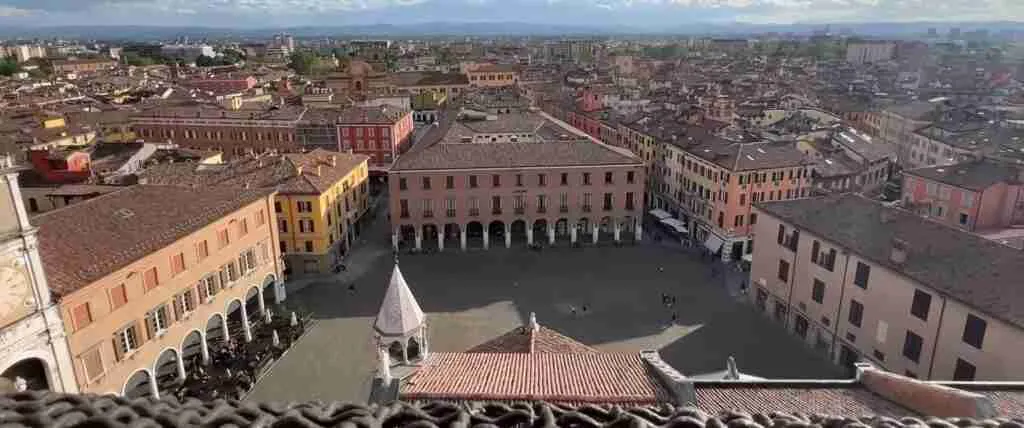
The Ghirlandina — named for the two marble ghirlande, or decorative garlands, near its summit — rises 89.32 meters beside the cathedral apse and has stood as Modena’s defining vertical landmark since the medieval commune used it simultaneously as watchtower, civic treasury, and symbol of communal authority. The tower first opened to the public in May 2015 and from May 2025 operates seven days a week with continuous daytime hours, a program expansion directly responding to the 3.85 percent year-on-year visitor growth that brought 67,300 visitors through the door in 2024.
Admission costs €6 for adults and €4 for Modena residents, students aged 13–26, and over-65 visitors; children under 12 enter free. Advance booking is mandatory through visitmodena.it; only the time slot is reserved at that stage, with payment made at the tower ticket desk on the day of the visit. Groups enter in sessions of up to 25 persons per hour. The 200-step climb reaches the Sala dei Torresani, the vaulted chamber where the tower’s resident guardians once lived and which commands panoramic windows over the Po Valley. One level below, the Sala della Secchia preserves 15th-century frescoes and a copy of the wooden bucket whose theft by Modenese raiders from the Bolognese in 1325 sparked the Battle of Zappolino and furnished the subject of Alessandro Tassoni’s 17th-century mock-heroic poem La secchia rapita — still among the most celebrated works of Italian comic literature. Access to the external summit is closed under current safety regulations.
The last Saturday of each month, a themed guided tour is included in the standard admission price: subjects in 2025 have ranged from the architectural history of the Campionese Masters to the lives of the torresani themselves to the story of the stolen bucket. These thematic sessions fill quickly; book at visitmodena.it as soon as the monthly dates are announced. For day-of visitors unable to secure a thematic slot, the regular climb with the standard orientation material is still among the most rewarding 45 minutes in the city.
Piazza Grande: Reading the Medieval City
Piazza Grande is not simply a cathedral forecourt: it is the physical expression of the urban social contract between religious institution and civic commune that UNESCO identified as the site’s deepest significance. The Preda Ringadora, a block of red ammonite marble from Verona placed in the northwest corner of the square, served as the medieval speaking platform from which public announcements, judicial sentences, and civic orations were delivered; it is one of the most overlooked pieces of architectural history in northern Italy, embedded in the paving without interpretation beyond a small marker. The Palazzo Comunale on the east side of the square incorporates building campaigns from the 12th through the 18th centuries; its exterior staircase, ceremonial portal, and the medieval clock tower above give the square its civic counterbalance to the cathedral. Inside the palace, the Sale Storiche — the historic ceremonial rooms on the first floor — can be visited on a free guided tour bookable through visitmodena.it; the painted halls and municipal insignia document the exercise of communal government from the medieval period forward and complement the cathedral visit by showing the civic side of the ensemble that UNESCO inscribed as an integrated whole.
The Essential Modena Walking Tour 2026: A Self-Guided Route Through the Historic Center
Modena’s historic center is flat, compact, largely pedestrianized during the day, and dense with heritage without being exhausting to navigate. The self-guided route below covers approximately 3.5 kilometers and can be completed at a comfortable pace in two to three hours, excluding time spent inside individual attractions. The visitmodena.it portal distributes a free audio guide formatted for any smartphone; printed route maps are available at the Tourist Information Office at Palazzo Comunale, Piazza Grande 14.
Stage 1: Piazza Grande to Via Emilia (30 minutes)
Begin at Piazza Grande and read the square’s geometry before entering any building. The cathedral’s alignment is deliberately oblique to the surrounding street grid: the 1099 building was oriented not to the Roman-derived block plan of Mutina but to the cardinal directions and to the site of the bishop’s earlier church, creating the distinctive angle that visitors notice as they arrive from Via Emilia to the south. Walk south from the piazza and turn right onto Via Emilia. This road was laid in 187 BCE by the Roman consul Marcus Aemilius Lepidus as the Via Aemilia, the strategic road linking Piacenza to Rimini; it has functioned as the city’s commercial spine without interruption for over two thousand years. For the next several blocks east, the street passes the porticoed palazzi of the 18th-century commercial center; the ground floors carry pharmacies, pasticcerie, and delicatessens that have occupied these premises in succession since the Renaissance.
Stage 2: Piazza XX Settembre and the Museo della Figurina
Walking east along Via Emilia, Piazza XX Settembre opens on the left after the first major intersection. This quieter square receives almost no tourist traffic despite its handsome proportions and good street-level cafés; it represents the daily life of central Modena more accurately than the more photographed Piazza Grande. Continue east along Via Emilia to Palazzo Santa Margherita, where the Museo della Figurina occupies the upper floors. Dedicated entirely to the history of trading cards, collectible stickers, illustrated paper figurines, and the broader culture of printed paper ephemera from the 19th century to the present, this museum is the world’s only institution of its kind — a direct expression of Modena’s role as the birthplace of the Panini sticker empire. Admission is modest; confirm current opening days and hours at visitmodena.it before visiting, as they follow seasonal exhibition cycles.
Stage 3: Piazza Mazzini and the Ex Albergo Diurno
Return west along Via Emilia and turn north onto Corso Canalchiaro to reach Piazza Mazzini, a formal 19th-century square dominated by an equestrian monument to the patriot Ciro Menotti. The square’s northeast corner gives access via a staircase to the Ex Albergo Diurno, a 1929 Art Nouveau public bathhouse operating underground in the basement level of the piazza. The building provided baths, barbering, laundry services, shoeshine stands, a telegraph office, and safe deposit facilities for the middle-class travelers and commuters using the nearby train station in an era before private bathrooms were standard urban amenities. The complex was in continuous operation until the 1980s. A careful subsequent restoration preserved the original mosaic tiling, the partitioned bath stalls, the mahogany woodwork, the period plumbing fixtures, and the original advertising signage intact; the space now functions as a free cultural venue and orientation point. Open daily 9:30–19:00; free entry; guided tours available by booking at visitmodena.it. Reserve 30–45 minutes inside. The visitor population is overwhelmingly local; foreign tourists remain almost entirely unaware of the site’s existence.
Stage 4: Palazzo Ducale and Giardini Ducali
From Piazza Mazzini, walk west along Via Università to the Palazzo Ducale, now serving as the Accademia Militare — Italy’s principal officer training academy — and for this reason closed to casual entry. The building was begun in 1634 by Francesco I d’Este under the architect Bartolomeo Avanzini and expanded significantly in the 18th century; it ranks among the finest Baroque civil palaces in northern Italy. Guided visits to the ceremonial interiors — the monumental staircase, the painted reception halls, and the formal entrance sequence — open on designated dates bookable through visitmodena.it; the schedule is irregular and should be checked well before any planned visit. Even from the street, the courtyard façade visible through the main gate reward attention for the quality of their proportions and the contrast between the austerity of the red-brick exterior and the detail of the internal courtyard elevations. The adjacent Giardini Ducali, the formal gardens laid out in the 17th century and now publicly accessible, provide the best free green space in the city center and the most useful view of the palace’s garden front.
Stage 5: Palazzo dei Musei, the Jewish Quarter, and Return
Walk south from the ducal complex along Viale Vittorio Veneto to Largo Porta Sant’Agostino, where the Palazzo dei Musei houses both the Galleria Estense and the Museo Civico. From the museum entrance, a short eastward detour leads into the streets of the former Jewish quarter: the area bounded roughly by Via Coltellini, Via Rua Pioppa, and Via Taglio. The quarter retains its compressed medieval street scale and the intimacy of a neighborhood that functioned as a partially self-contained urban world within the larger city from at least the 15th century. The Museo Ebraico and the historic synagogue open for visits on a schedule posted on the Comune di Modena website; the lanes of the ghetto are walkable at any hour and remain almost entirely clear of tourist traffic. Return west along Via Emilia to Piazza Grande to complete the circuit.
Balsamic Vinegar and Food Tours in Modena 2026: Tasting the Black Gold
Traditional Balsamic Vinegar of Modena DOP — Aceto Balsamico Tradizionale di Modena DOP — is among the most misunderstood luxury food products in the world. The commercial “balsamic vinegar of Modena” that lines supermarket shelves globally bears almost no relationship to the DOP product: the genuine article is made exclusively in the Province of Modena from cooked Trebbiano or Lambrusco grape must, aged for a minimum of twelve years through a decreasing series of wooden barrels made from different woods including oak, cherry, chestnut, and mulberry, and drawn in small quantities from the final barrel in a process of natural concentration that produces a condiment of extreme complexity, density, and sweetness. Bottles of 100ml of extra-aged 25-year DOP sell at producer prices of €80–150 and beyond. Understanding this distinction — and tasting both categories side by side — is the most formative single food experience the city offers.
The Acetaia Comunale: Modena’s Best-Kept Food Secret
Hidden in the attic of the Palazzo Comunale directly overlooking Piazza Grande, the Acetaia Comunale is a working balsamic vinegar loft housing three named sets of barrels: the Secchia (six barrels, named for the Secchia river), the Panaro (six barrels, named for the Panaro river), and the Torre Ghirlandina (ten barrels, named for the tower). Guided visits are led by Master Tasters from the Consorteria dell’Aceto Balsamico di Spilamberto, the traditional governing body of Modenese balsamic production, and include a structured comparative tasting of both 12-year aged and 25-year extra-aged Traditional Balsamic Vinegar DOP — the full quality spectrum from the certified DOP product. The tour costs €5 per person (check visitmodena.it for current rates) and must be booked in advance through visitmodena.it. This is an experience of genuine producer quality at a fraction of private acetaia prices, located steps from the most-visited square in the city, yet known to almost no independent foreign traveler.
Family Acetaie Tours Around Modena in 2026
For a more immersive experience of balsamic production than the municipal tour provides, Modena’s network of family-run acetaie gives visitors access to private barrel rooms and the full arc of the production narrative from vineyard to finished product. Several producers stand out for consistent quality and accessibility:
- Acetaia Marchi: Family producer on the periphery of the city; offers customized group tours through the production rooms, including tastings of IGP, Organic IGP, Traditional DOP, and balsamic condiments. Book at acetaiamarchi.com.
- Acetaia Leonardi: Tours combined with optional hands-on cooking classes; one program pairs a full balsamic tour with a lesson in traditional Emilian tortelloni-making under chef guidance. Book at acetaialeonardi.it.
- Acetaia Malagoli Daniele: Small family producer known for a warm personal welcome; frequently combined with a Parmigiano Reggiano farm visit for a complete Food Valley morning. Book through GetYourGuide or direct with the producer.
- Villa San Donnino: A liberty-style villa just outside Modena; combines architectural interest with production tours and DOP tastings. Book through villasandonnino.it.
- Giuseppe Giusti: Founded in 1605 and operating continuously since — the oldest balsamic vinegar producer in the world still in production — Giusti maintains a historic shop on Via Farini in the city center and offers tastings and guided experiences alongside retail. Contact giusti.it for current tour availability.
Guided Food Walking Tours in Modena 2026
Structured food walking tours combine the balsamic visit with other Modena food experiences — Parmigiano Reggiano tastings at Mercato Albinelli, Lambrusco pairings, gnocco fritto sampling, and Modenese pasta at a historic restaurant — in a single half-day circuit of the historic center. Tours on the major booking platforms in 2026 start from approximately €31 per person for a self-guided individual balsamic tasting experience. Operator-led group walking tours of 2.5–4 hours run €87–139 per person (check GetYourGuide and Viator for current pricing and availability; these offerings change seasonally). Full-day packages combining Parmigiano farm visits, balsamic production, and a seated lunch cost approximately €215 per person; these are worth considering for dedicated food travelers with an entire day available.
A critical booking note: when comparing food tour offerings, establish whether the balsamic tasting includes DOP Traditional Balsamic Vinegar (minimum 12 years aged) or only IGP-category vinegar (the industrially produced, commercially priced version). Many tour operators default to IGP; the tours that include a proper DOP tasting at a certified producer deliver a fundamentally different and more informative experience and are worth the premium.
Motor Valley Tours in Modena 2026: Ferrari, Maserati, and the Automotive Heritage Route
Modena is the undisputed capital of Italy’s Motor Valley, a corridor of Emilia-Romagna that gave birth to Ferrari, Maserati, Lamborghini, De Tomaso, and Pagani within a radius of roughly 40 kilometers. The concentration reflects specific postwar conditions: precision artisanal engineering traditions inherited from the metalworking and agricultural machinery sectors, a pool of racing talent and mechanical education centered on the region’s technical schools, and an entrepreneurial culture that rewarded the ambition of individuals willing to build the automobile of their imagination regardless of commercial sense. In 2026 the full Motor Valley circuit from Modena is more coherent than at any point in recent years, with the Museo Enzo Ferrari anchoring the city center experience and the Umberto Panini Maserati Collection emerging — now free, in larger premises — as one of the most compelling automotive pilgrimages in Italy.
Museo Enzo Ferrari Modena
The Museo Enzo Ferrari at Via Paolo Ferrari 85 — a seven-minute walk north from Modena Centrale train station — is among the most architecturally distinctive museum buildings in Italy and one of the most effective automotive museums in Europe. Jan Kaplický’s 2012 design for Future Systems placed a 2,500-square-meter aluminum-clad pavilion in the shape of a racing car engine hood directly over the site where Enzo Ferrari was born in February 1898, physically enveloping both his restored birth house and his father Alfredo’s original metalworking workshop within the new structure. The pavilion’s interior holds a curated selection of Ferrari automobiles spanning from early pre-war racing machines through decades of Formula One development to contemporary hypercars, displayed around a cinema theater where nineteen high-definition projectors transform the entire hangar every thirty minutes into an immersive film experience tracing Enzo Ferrari’s life from his first attendance at a race as a ten-year-old to his death in 1988.
Admission costs €27 per adult in low season (November through April) and €32 per adult in high season (May through September); visitors aged under 19 accompanied by a family member pay €9 year-round (check ferrari.com for current rates). The museum opens daily: April through October 9:30–19:00; November through March 9:30–18:00. An on-site Ferrari Store, bookshop, and restaurant are included within the building. Budget approximately 1.5–2 hours for a full visit, including the film presentation.
The Musei Ferrari Pass, combining the Modena museum with the Ferrari Museum at Maranello (20 kilometers south), costs €38 in low season and €42 in high season, with both visits to be completed within 48 hours of each other. A shuttle bus service connects the two museums on selected days; details and current pricing are at ferrari.com. The combination of the two museums in a single day — Modena in the morning for Enzo’s personal story, Maranello in the afternoon for the full racing history — constitutes the definitive Motor Valley day for any Ferrari enthusiast.
Maserati Factory Tour in 2026
The Maserati Factory Tour at Viale Ciro Menotti 322 in central Modena takes visitors inside an active vehicle manufacturing plant that has served as the Trident’s production headquarters for over 80 years. In its current configuration the factory produces the MC20, GranTurismo, GranCabrio, and the new MCPura and GT2 Stradale; the 75-minute standard tour leads through the engine assembly department, the production line, and the Fuoriserie bespoke customization area, ending at the showroom where current production models are displayed. A shorter 40-minute showroom-only option focuses on brand history and current range without accessing the production floor.
The standard factory tour costs €50 per adult; visitors aged 7–17 pay €35 and must be accompanied by an adult; children under 7 are not admitted for safety reasons on the production floor (check maseratifactorytour.modenatur.it for current rates). Tours operate Monday through Friday on selected production dates, with available slots published one week in advance. Reservation is mandatory and must be made through maseratifactorytour.modenatur.it; the platform accepts payment by credit card at the time of booking. Tours are conducted in Italian, English, French, German, and Spanish; confirm language preference at booking. Cancellations made more than seven days before the tour date receive a full refund minus a €5 per ticket handling fee; cancellations within seven days are non-refundable.
The Umberto Panini Maserati Collection: World-Class and Free
The most remarkable free automotive experience in Modena — and among the most remarkable free automotive experiences anywhere in Italy — is the Umberto Panini Maserati Collection, which relocated in June 2025 from its historic Hombre Farm site to purpose-built new premises at Via dell’Aeroporto 140, Marzaglia, on the southwestern periphery of Modena. Entry remains entirely free. The collection opens Monday through Sunday, 9:30–13:00 and 14:30–18:00.
The collection was assembled by Umberto Panini — known globally as the founder of the Panini sticker empire, the printing innovation that transformed the family’s small Bologna-area business into a multinational consumer brand — following his intervention at a 1996 London auction at which Maserati’s own museum collection was to be dispersed. Panini purchased the entire lot, returning fourteen cars to Modena in what the city still regards as an act of civic patrimony. The collection in its current form is the world’s most comprehensive private archive of historic Maserati automobiles, now housed in a building designed to recall a historic railway station.
The crown jewel is the Maserati 250F, the open-wheel Grand Prix car with which Juan Manuel Fangio won the 1957 Formula One World Championship in one of the most celebrated drives in motor racing history. Alongside it: the Maserati 6C-34 of 1934 associated with Tazio Nuvolari; the Birdcage Tipo 61 with its revolutionary lightweight tubular spaceframe chassis; the one-off 420M/58 Eldorado of 1958, built for the International 500 Miglia di Monza and notable as the first motorsport vehicle in history to carry commercial sponsorship from a company outside the racing world; the A6GCS Berlinetta by Pininfarina, produced in only four examples; and a near-complete series of Maserati road cars from the first A6G of 1954 through the Ghibli, Bora, and Merak to contemporary prototypes including the Alfieri and MC20. QR codes provide digital multilingual descriptions for each vehicle. The collection is not easily reached by public transport; a taxi from the historic center costs approximately €15 each way. Modenatur can also include the Panini Collection within organized Motor Valley tour itineraries.
Planning Your Motor Valley Day from Modena in 2026
A practical single-day Motor Valley itinerary from Modena city center: begin at the Museo Enzo Ferrari when it opens at 9:30, allowing two hours for the full visit including the film presentation; take a taxi or walk to the Maserati Factory for a pre-booked midday tour (the 11:00 or 12:00 time slot); return to the historic center for a late lunch at Mercato Albinelli or a nearby trattoria along Via Emilia. Spend the afternoon at the Ghirlandina Tower (pre-booked) and Piazza Grande. The Umberto Panini Collection at Marzaglia is best reserved for a second day or combined with a morning visit to a Parmigiano Reggiano dairy on the city’s southern periphery, where several producers offer tours and farm-gate purchases. For travelers with only a single day, the combination of the Museo Enzo Ferrari and the Ghirlandina Tower delivers the highest density of world-class experience in the time available.
Galleria Estense and the Hidden Museums of Modena
The Galleria Estense occupies the fourth floor of the Palazzo dei Musei at Largo Porta Sant’Agostino 337, a ten-minute walk from Piazza Grande through streets that receive a fraction of the traffic of the main tourist axis. It is, without qualification, one of the great dynastic art collections in Italy: assembled by the Este dukes across three centuries of acquisitions ranging from medieval Flemish panels to Baroque ceiling paintings and diplomatic portrait commissions, and displayed today in four large rooms and sixteen smaller galleries that reward two hours of unhurried attention. Visitor numbers remain a fraction of those at comparable collections in Florence, Venice, or Milan, making it among the most genuinely under-visited masterpiece collections in the north of Italy.
Admission is €8 for adults; visitors aged 18–25 pay €2; those under 18 enter free. The first Sunday of every month offers free entry for all visitors. Opening hours run Tuesday through Saturday 8:30–19:15 and Sunday and public holidays 10:00–18:00; the museum is closed on Mondays except public holidays, when Monday closures are transferred to the following Tuesday. Guided tours led by Prospectiva are included in the admission price without additional charge and require no advance reservation; they begin at intervals during opening hours. The combined ticket covering both the Galleria Estense and the Museo Civico on the floor below is available for €10, valid for one year from date of purchase.
Key Works in the Galleria Estense
The collection opens with Renaissance and 17th-century bronze and marble portraiture before moving into the painted galleries. The Bust of Francesco I d’Este by Gian Lorenzo Bernini, carved around 1650, is a marble of supreme technical ambition: the duke faces in three-quarter turn with his collar and drapery in dynamic movement, capturing a moment of psychological engagement that Baroque portraiture rarely achieves in three dimensions. Positioned nearby, Velázquez’s Portrait of Francesco I d’Este — painted during the duke’s visit to Rome and representing the same sitter in the formal idiom of the Spanish court — offers a direct comparison between the two greatest portrait media of the 17th century. El Greco’s portable altarpiece triptych, Correggio’s Madonna with Child, Guido Reni’s Crucifixion, works by Tintoretto, Veronese, Guercino, and Dosso Dossi represent the full span of Italian painting from the 14th through the 18th centuries. The Estense Harp of 1558 — a musical instrument 130 centimeters tall, decorated across its entire surface by Sebastiano Filippi known as the Bastianino, and for twelve years the image reproduced on Italian thousand-lire banknotes — occupies its own alcove as a unique object at the intersection of music, craft, and 16th-century decorative ambition.
Museo Civico and Musei del Duomo
The Museo Civico di Modena on the third floor of the Palazzo dei Musei covers the city’s archaeology from the Roman period through the medieval era and into the modern. The Roman lapidary in the building’s courtyard holds inscriptions, architectural fragments, and relief carvings that document the urban life of ancient Mutina in direct, material terms. The combined ticket with the Galleria Estense for €10 covers both museums and remains valid for twelve months; for any visitor spending more than an hour or two with Modena’s collections, the combined purchase is straightforward value.
The Musei del Duomo operate from the south flank of the cathedral complex and must be visited separately from the Galleria Estense, using a different entrance and admission. Beyond the Metopes — already described in the UNESCO section of this guide as the essential reason to visit — the collection includes the six Brussels tapestries of the 16th century depicting scenes from the life of San Geminianus, woven for the cathedral and among the finest textile works of the period surviving in any Emilian church. The vestments and liturgical objects of the episcopal treasury add further context to the cathedral visit.
Secret Modena: The Lesser-Known Spots Most Visitors Walk Past
Modena’s greatest secret is how little of the city beyond Piazza Grande and the cathedral façade most visitors ever encounter. The following sites require more curiosity and occasionally more planning, but deliver encounters with the city’s history that no standard itinerary reaches.
The Ex Albergo Diurno: A Belle Époque World Underground
The Ex Albergo Diurno beneath Piazza Mazzini is the most extraordinary hidden heritage site in Emilia-Romagna, and almost certainly the least-known intact Art Nouveau interior in northern Italy. Built in 1929 to serve travelers arriving at the adjacent train station, the underground complex provided baths in private marble-lined stalls, barbers, laundry and pressing services, shoeshine stands, a telegraph counter, and safe deposit boxes — all the infrastructure of movement and personal presentation that the early-20th-century traveler needed in a city where hotel accommodation was expensive and domestic bathrooms were rare. The business operated continuously until the early 1980s, after which the building was sealed and its contents preserved in abandonment. A careful restoration in the 2000s and 2010s returned the original mosaic floor tiles, the mahogany partition woodwork, the period plumbing fixtures, the enameled signage, and the decorative ironwork to public view without reconstruction or simulation: the space is the original space, its aging visible in the patina of the surfaces. Open daily 9:30–19:00; free entry; guided visits available at visitmodena.it. The visitor population inside on any given weekday is predominantly local; foreign visitors remain almost entirely unaware of the site’s existence.
Palazzo Ducale Interiors by Reservation
The Palazzo Ducale at Piazza Roma serves as the Accademia Militare, Italy’s principal officer-training academy, a function that keeps its extraordinary Baroque interiors closed to casual visitors while making occasional public access available on designated dates. The guided tours bookable through visitmodena.it lead visitors through the formal entrance sequence, the ceremonial staircase flanked by marble trophy-of-arms compositions, and the painted reception halls of the Este period. The palace was designed from 1634 by Bartolomeo Avanzini for Francesco I d’Este and expanded in successive campaigns through the 18th century; the combination of its scale, the quality of its interior decoration, and its near-inaccessibility gives it a rarity that comparable ducal palaces open daily to tourists in other cities rarely carry. Booking well in advance is necessary when a visit date becomes available; these slots go quickly.
The Jewish Quarter: Intimate Medieval Scale
The former Jewish quarter occupies a compact area northeast of Piazza Grande, bounded roughly by Via Coltellini, Via Rua Pioppa, and Via Taglio. The Este dukes maintained one of the more tolerant relationships with their Jewish community by the standards of pre-Enlightenment Italian politics, and the quarter functioned as an essentially intact neighborhood from the 15th century through the 19th-century emancipation that ended its formal legal separation. The Museo Ebraico in the quarter is small and well-organized; the historic synagogue, still in liturgical use, opens for guided visits on a schedule posted by the Comunità Ebraica di Modena. The streets themselves — Via Coltellini, Via Rua Pioppa, Via Taglio, and their connecting lanes — retain their compressed medieval proportions and are entirely free of tourist infrastructure, even on summer weekends when Piazza Grande receives organized tour groups. Walking these streets in the early morning is among the few ways to experience a genuinely unhurried Modena.
Sant’Agostino Church
The church of Sant’Agostino, on the street of the same name near Largo Porta Sant’Agostino, holds one of the more remarkable Baroque interiors in the city center, including a notable cycle of paintings in the main nave and a terracotta group in the sacristy. The church is open for visits outside liturgical hours and receives almost no tourist traffic; its interior is worth fifteen minutes of any visitor’s time who arrives at the Palazzo dei Musei with energy to spare.
The Mercato Albinelli and Modena’s Living Food Market Culture
The Mercato Albinelli on Via Albinelli — a five-minute walk from Piazza Grande on the eastern side of the historic center — is Modena’s covered municipal market, built in 1931 in a functional Art Nouveau style with a glass-and-iron roof and a tiled entrance portal. It opens Monday through Friday from approximately 6:30 to 14:00 and on Saturday from 6:30 to 19:30; the market is closed on Sundays. Entry is free. It operates as a working food market serving the city’s residents rather than a tourist attraction, which gives it its primary value as a visitor experience: the prices are genuine local prices, the vendors are modenesi selling to modenesi, and the produce reflects what is actually in season in the Po Valley rather than what appears most photogenic.
The market’s permanent stalls cover the full range of Modenese food production. Fresh pasta vendors cut tagliatelle and hand-fill tortellini at the counter; Parmigiano Reggiano stands offer wheels at multiple aging stages, from the standard 24-month minimum required for DOP certification to specialist 36-month and 40-month maturation; whole haunches of Prosciutto Crudo di Modena DOP — a distinct product from the more internationally known Parma equivalent, cured at higher altitude with specific differences in salting and aging technique — are sliced to order. Fishmongers supply the city’s restaurants with the Adriatic and river catches; seasonal fruit and vegetable stalls in summer carry the stone fruits, particularly peaches and nectarines, for which the Po Valley is regionally celebrated.
The most rewarding Albinelli morning for a food-focused visitor involves two consistent stops: the Parmigiano stall currently offering tasting samples of aged cheese (this changes daily and is announced informally at the counter), and whichever bar at the market’s periphery is serving the day’s first batch of gnocco fritto — the fried dough pillows served with prosciutto crudo that constitute Modena’s defining casual food pairing. Most organized food tours that operate in Modena in 2026 include Albinelli in their itinerary; if booking such a tour, confirm that market time includes actual tastings and engagement with vendors rather than simply passing through the building.
Independent visitors without a guide can purchase directly from stalls without any challenge; vendors at Albinelli are accustomed to tourists and some speak basic English. The market’s peak activity hours are 7:00–11:00 on weekday mornings; by 13:00 on Mondays through Fridays, stalls begin to close and the selection thins. Saturday morning is the most lively and most comprehensive experience, with the full range of stalls operating through the afternoon.
Casa Museo Luciano Pavarotti: A Musical Pilgrimage in 2026
Luciano Pavarotti was born in Modena in October 1935, educated in the city’s choral and operatic tradition, and remained — across a career that made him the most recognizable operatic tenor of the 20th century — a committed modenese who defended local food culture in international forums, organized benefit concerts for the city, and built the villa that became his home on the southern edge of the city he never truly left. The Casa Museo Luciano Pavarotti at Stradello Nava 6 is the four-story villa he designed and inhabited in the final decades of his life, opened as a museum following his death in 2007 and now constituting one of the most emotionally immediate celebrity house museums in Italy — not only for opera enthusiasts but for any visitor interested in how an extraordinary individual organized his daily world.
Admission is €12 for adults and €10 for reduced-rate visitors (over 65, ages 12–18, groups of 20 or more, university students, FAI members, and disabled visitors with companions); children under 12 enter free (check casamuseolucianopavarotti.it for current rates). The museum opens daily from 10:00 to 18:00, with last admission at 17:00; it closes January 1, December 24, and December 25. The full visit covers four floors and takes 50–60 minutes. The collection includes stage costumes and production wear from major international productions across Pavarotti’s career; gold records and awards; personal correspondence and manuscripts; photographs spanning his professional and private life; and an extensive audiovisual archive of filmed performances and documentary material. The house itself — designed by Pavarotti to his own specifications and lived in continuously until near his death — retains the quality of a domestic interior rather than a formal exhibition space.
The museum is not reachable on foot from the city center in any practical sense; the location approximately 4 kilometers south of Piazza Grande requires a taxi or car. A municipal agreement fixes the maximum taxi fare from center or train station to the museum at €20 for the outward journey, and €30 for the return from museum to center or station. The Pavarotti museum and the Museo Enzo Ferrari — both slightly outside the historic center, both personally intimate institutions dedicated to the memory of exceptional modenesi — form a natural pairing for a second day in the city: the Ferrari museum in the morning for the story of a man who built an industrial empire from mechanical obsession, the Pavarotti house in the afternoon for the story of a man who built a global career from the voice he was born with two months before Enzo Ferrari died.
Practical Tour Booking Guide for Modena 2026
Modena’s visitor infrastructure concentrates most booking around the official tourist portal at visitmodena.it, which handles reservations for the Ghirlandina Tower, the Acetaia Comunale guided tour, the Sale Storiche del Palazzo Comunale, Ex Albergo Diurno guided visits, Palazzo Ducale interior tours, and many other municipal cultural offerings. The portal operates in Italian and English. Creating an account before arriving in Modena makes on-the-day slot management substantially easier; many experiences allow same-day booking if places remain available, but popular weekend slots for the Ghirlandina and the Acetaia Comunale fill several days to several weeks in advance during the high season.
What Requires Advance Booking in Modena 2026
The following experiences require reservation and sell out in peak season if left to the last minute:
- Ghirlandina Tower: Mandatory booking through visitmodena.it; payment at desk on the day. Reserve at minimum one week ahead in summer; two to three weeks for Saturday morning slots from June through August.
- Maserati Factory Tour: Mandatory through maseratifactorytour.modenatur.it; available slots appear one week in advance. Monday–Friday only; confirm language preference at booking.
- Acetaia Comunale: Book through visitmodena.it; limited places per guided session.
- Palazzo Ducale interior visits: Available on irregular scheduled dates; check visitmodena.it regularly and book as soon as a suitable date is published.
- Private acetaia tours: Book directly with producers at least one week ahead; family operations run only a few tour slots per week and appreciate advance notice even for small parties.
- Operator-led food walking tours: These can frequently be booked same-day through GetYourGuide or Viator outside peak season, but popular morning slots in June–September should be reserved at least 48–72 hours ahead.
What Requires No Advance Booking
- Modena Cathedral: Free and open for individual visitors at all times outside liturgical services. Group visits (10 or more) require a free advance time-slot booking at visitmodena.it.
- Piazza Grande: Open 24 hours, no booking or admission charge.
- Galleria Estense: Walk-in admission; included guided tours start without reservation at intervals during opening hours.
- Museo Enzo Ferrari: Walk-in or online purchase at ferrari.com; online purchase provides faster entry on busy days and allows time-slot selection.
- Umberto Panini Maserati Collection: Walk-in, free entry, no reservation required.
- Mercato Albinelli: Walk-in, free entry, Monday–Saturday.
- Ex Albergo Diurno: Walk-in, free entry; guided tours by arrangement at visitmodena.it.
Getting to and Around Modena in 2026
Modena Centrale station sits on the main Milan–Bologna–Florence high-speed and regional rail axis; regional trains from Bologna Centrale take approximately 25–35 minutes, departing every 15–30 minutes, at fares around €4–5 per person (check Trenitalia or Tper for current rates). This makes Modena a comfortable day trip from Bologna and an easy intermediate stop on any longer Emilia-Romagna itinerary. From Milan, Frecciarossa services take approximately one hour; from Florence, approximately 75 minutes. Travelers arriving by car should note the ZTL (Zona a Traffico Limitato) covering the historic center during daytime hours; parking is available at various points on the ring road and the Piazza Roma underground garage is the most central.
Within the city, the entire historic center is walkable; all core attractions sit within a 1.5-kilometer radius of Piazza Grande. For the Pavarotti museum, the Umberto Panini Maserati Collection, and the private acetaie in the surrounding countryside, taxis are the most practical option. Ride-sharing apps operate in Modena and in practice outperform taxi ranks in response time. City bicycle sharing schemes connect the train station to the historic center and extend to some peripheral attractions; Modenatur (modenatur.it) organizes guided tours, transfers, and Motor Valley itineraries for visitors who prefer not to arrange individual components separately.
Frequently Asked Questions About Modena Tours and Walking Routes 2026
What is the single best thing to do in Modena in 2026?
The Ghirlandina Tower climb is Modena’s most irreplaceable experience in 2026. The combination of 200 steps through Romanesque and Gothic architecture dating from 1099 to 1319, the panoramic view from the Sala dei Torresani windows over the Po Valley, the medieval civic history embedded in the building’s chambers — the Sala della Secchia with its frescoes and the famous wooden bucket, the story of the torresani who lived and worked inside the tower — delivers a density of historical encounter that no museum exhibit can replicate. Book through visitmodena.it well in advance; high-season weekend slots fill within days of becoming available. Adults pay €6; children under 12 enter free.
Can I visit Modena as a day trip from Bologna in 2026?
Yes. Regional trains run between Bologna Centrale and Modena every 15–30 minutes; the journey takes 25–35 minutes and costs approximately €4–5 per person each way (check Trenitalia for current fares and schedules). A well-planned 8-hour day trip from Bologna allows for the full UNESCO complex — Cathedral, Ghirlandina climb, and Piazza Grande — the Galleria Estense, a late-morning visit to Mercato Albinelli, and either the Museo Enzo Ferrari or the Maserati Factory Tour, but not both in a single visit. Travelers combining Modena with the Ferrari Museum at Maranello should add 20–25 minutes by taxi or car south from Modena. Modena is equally accessible as a day trip from Milan (approximately one hour by Frecciarossa) and as a stopping point on any Emilia-Romagna itinerary that includes Bologna, Parma, or Ferrara.
How do I book a balsamic vinegar tour in Modena in 2026?
The most accessible balsamic experience in Modena is the Acetaia Comunale in the Palazzo Comunale attic, bookable at visitmodena.it for €5 per person; this should be the first booking any food-focused visitor to Modena makes. For private family acetaia tours, book directly with Acetaia Marchi (acetaiamarchi.com), Acetaia Leonardi (acetaialeonardi.it), or Acetaia Malagoli Daniele (available through GetYourGuide); all three operate tours in English with advance booking. Operator-led food walking tours combining balsamic stops with Parmigiano tastings and market visits are bookable through GetYourGuide and Viator from approximately €31 per person for individual balsamic tastings to €87–139 per person for structured 2.5–4 hour group tours. Always confirm before booking whether the tasting includes DOP Traditional Balsamic Vinegar (12-year minimum aging) or only IGP-category vinegar; the difference in what you taste and learn is considerable.
What is the Umberto Panini Maserati Collection and how do I visit it in 2026?
The Umberto Panini Maserati Collection is the world’s most comprehensive private archive of historic Maserati automobiles, relocated in June 2025 to new premises at Via dell’Aeroporto 140, Marzaglia, on the southwestern periphery of Modena. Entry is free. The collection opens every day of the week, 9:30–13:00 and 14:30–18:00. Its holdings include Juan Manuel Fangio’s 1957 Formula One championship 250F, the 1958 Eldorado (the first commercially sponsored racing car in history), the Birdcage Tipo 61, the A6GCS Pininfarina Berlinetta produced in only four examples, and a near-complete series of Maserati production cars from 1954 to the present. The most practical access from the city center is by taxi, approximately €15 each way; the collection is also includeable in Motor Valley itineraries organized through Modenatur.
Is Modena’s historic center easy to navigate on foot in 2026?
The Modena historic center is among the most physically easy city centers to walk in northern Italy: entirely flat, largely pedestrianized during the day, and small enough to cross end-to-end in under 20 minutes at a gentle pace. The ZTL restricted traffic zone covers most of the core area between 7:00 and 20:00, meaning the streets where tourists walk are shared primarily with pedestrians and cyclists rather than cars. The main surfacing material in the historic core is smooth stone paving on the principal thoroughfares and cobblestone in the narrower lanes; pushchairs and wheelchairs navigate the major routes without significant difficulty. The distance from the train station to Piazza Grande is 1.1 kilometers, a 15-minute walk; from Piazza Grande to the Galleria Estense at Palazzo dei Musei is under 10 minutes.
When is the best time of day to visit Piazza Grande in 2026?
Piazza Grande changes character dramatically across the day. Before 9:00 in the morning the square is quiet and the early light falls directly on the cathedral’s west façade, producing the best conditions for photography and for reading the Wiligelmo reliefs without crowds. By late morning in June through August, organized tour groups and independent visitors fill the square. From 13:00 to 15:00 the square empties somewhat as visitors take lunch. Evening — particularly the hour before sunset in spring and autumn, when the honey-colored Botticino marble of the cathedral façade turns amber in the declining light and the Ghirlandina casts its shadow across the square at a low angle — is the most atmospheric time of day for the UNESCO site. The piazza functions as the social center of the city throughout the day and evening, with the café terraces of Palazzo Comunale active from morning through to late night, giving it a quality of lived civic use that tourist sites in more heavily managed cities have lost.
Are there free things to see in Modena in 2026?
Many of Modena’s best experiences carry no admission charge. Modena Cathedral is free for individual visitors at all times outside church services. Piazza Grande is open and freely accessible around the clock. The Ex Albergo Diurno Art Nouveau bathhouse is free daily 9:30–19:00. The Umberto Panini Maserati Collection is free throughout the year. The Giardini Ducali are a free public park adjacent to the Palazzo Ducale. The Galleria Estense is free to all visitors on the first Sunday of every month. Mercato Albinelli charges no admission Monday through Saturday. The self-guided historic center walking route available from visitmodena.it involves no cost beyond any purchases visitors choose to make. On the national Domenica al Museo (Museum Sunday), the first Sunday of every month, state-owned museums across Italy waive admission fees; the Galleria Estense, as a state collection, participates in this program.
What languages do Modena’s guided tours operate in in 2026?
Guided experiences in Modena operate primarily in Italian with English as the standard second-language option for individually booked tours and most operator-led experiences. The Maserati Factory Tour is conducted in Italian, English, French, German, and Spanish depending on the group’s composition; confirm language preference when booking through modenatur.it. Major family acetaie — including Acetaia Marchi and Acetaia Leonardi — offer English-language tours with advance booking. Ghirlandina thematic tours held on the last Saturday of each month are conducted in Italian only; the regular climb with orientation material is available in Italian and English. The self-guided audio route downloadable from visitmodena.it is available in Italian and English. Private guides for fully customized English-language walking tours of the historic center, the UNESCO site, or the Motor Valley circuit are available through Modenatur at modenatur.it.
How do I visit the Galleria Estense and what should I prioritize in 2026?
The Galleria Estense is on the fourth floor of the Palazzo dei Musei at Largo Porta Sant’Agostino 337, a ten-minute walk from Piazza Grande. Walk-in admission is €8 for adults (€2 for ages 18–25, free under 18, free the first Sunday of each month); the combined ticket covering the Museo Civico on the third floor is €10. Opening hours are Tuesday through Saturday 8:30–19:15 and Sunday 10:00–18:00; closed Monday. Guided tours led by Prospectiva are included in the admission price and start at intervals during the day without advance booking. Works not to miss: Bernini’s marble bust of Francesco I d’Este, Velázquez’s portrait of the same duke, El Greco’s portable triptych, Correggio’s Madonna with Child, and the Estense Harp of 1558 — the only surviving example of its type, once reproduced on Italian currency. Allow at least 90 minutes for a thorough visit of the main galleries.
What is the best food to eat in Modena in 2026?
Modena’s food culture produces several specialties that are extremely difficult to find in authentic form outside the province. Traditional Balsamic Vinegar DOP is the city’s defining product; taste it first through the Acetaia Comunale or a certified family producer tour rather than purchasing from a shop, since understanding the DOP product firsthand makes subsequent purchasing decisions much more meaningful. Gnocco fritto — fried dough pillows served with prosciutto crudo di Modena — is the city’s essential street snack, available at Mercato Albinelli from early morning. Tigella or crescentina, a small leavened flatbread cooked between clay stones, is served filled with lard and rosemary or local cheese at the city’s traditional eating places. Tortellini in brodo — the signature stuffed pasta of the Emilian tradition, served in a clear capon or beef broth of remarkable depth — is the dish that most completely expresses what makes Modenese cooking exceptional. Lambrusco wine, sparkling and slightly tannic in its authentic Modenese form, bears no resemblance to the sweet export versions sold internationally and is the correct pairing for every part of a meal in Modena from aperitivo to dessert.