Vienna to Budapest Day Trip 2026: Travel Planning Guide
Budapest ranks among Europe’s most rewarding day trips from Vienna, offering a complete contrast to Austrian imperial elegance with its dramatic Danube setting, thermal bath culture, and distinctive Eastern European character. Modern high-speed trains cover the 214-kilometer journey in just 2 hours 20 minutes, making it feasible to experience Hungary’s captivating capital and return to Vienna the same evening, all while enjoying comfortable rail travel through Central European landscapes.
Key Takeaways: Vienna to Budapest Day Trip 2026
- Train Travel: Direct Railjet, EuroCity, and RegioJet trains depart Vienna Hauptbahnhof hourly, taking 2h 20-40m with tickets from €9-30 depending on class and advance booking
- Optimal Schedule: Depart Vienna 7-8 AM, explore Budapest 10 AM-6 PM, return by 7-8 PM for a comprehensive 8-9 hour visit covering major attractions
- Must-See Highlights: Chain Bridge and Danube views, Buda Castle District, Parliament Building, thermal baths, Great Market Hall, and Ruin Bars if evening time permits
- Budget Expectations: €50-75 per person including round-trip train, public transport day pass, lunch, one major attraction, and thermal bath entry
- Best Season 2026: April-June and September-October offer pleasant temperatures (15-25°C) and manageable crowds; summer provides longest daylight but peak tourism
- Transportation Options: Choose from premium Railjet (€20-30, fastest, most comfortable), standard EuroCity (€12-18, reliable), or budget RegioJet (€9-15, excellent value with complimentary coffee)
People Also Ask About Vienna to Budapest Day Trip 2026
Is Budapest worth visiting as a day trip from Vienna in 2026?
Budapest absolutely justifies a day trip from Vienna, delivering a dramatically different cultural experience just 2.5 hours away by train. The Hungarian capital offers stunning architecture including the neo-Gothic Parliament Building and Buda Castle, unique thermal bath culture in historic spa complexes, vibrant food markets showcasing Central European cuisine, and distinctive Eastern European atmosphere contrasting with Vienna’s imperial character. While an overnight stay allows deeper exploration, a focused day trip captures Budapest’s essential highlights—Parliament viewing, Chain Bridge walk, Castle District exploration, and thermal bath experience—providing rich cultural immersion and memorable photographic opportunities unavailable in Austria.
How much does a Vienna to Budapest day trip cost in 2026?
A complete Vienna to Budapest day trip costs €50-75 per person for comfortable experience. This includes round-trip train tickets (€18-30 for standard class with advance booking), Budapest public transport day pass (€6-7 covering unlimited metro/bus/tram), lunch at mid-range restaurant (€12-18), one major attraction like Buda Castle or thermal bath (€12-18), and coffee or snacks (€5-10). Budget travelers can reduce costs to €35-45 by choosing RegioJet trains (€18-22 round-trip), bringing packed lunch, using free attractions (Parliament exterior, Chain Bridge walks, Great Market Hall browsing), and limiting paid admissions. Premium experiences with guided tours, fine dining, and first-class train travel range €100-150 per person.
Can I see enough of Budapest in one day from Vienna in 2026?
A well-planned one-day visit covers Budapest’s essential highlights though not comprehensively. Realistic 8-9 hour itinerary includes Chain Bridge and Danube riverside walk (45 minutes), Buda Castle District exploration (1.5-2 hours), Parliament Building exterior and surrounding area (30-45 minutes), lunch at Great Market Hall or traditional restaurant (1-1.5 hours), thermal bath experience (2-2.5 hours) OR St. Stephen’s Basilica and downtown exploration, and Heroes’ Square if time permits. You’ll capture Budapest’s distinctive character, major architectural landmarks, and one immersive experience (baths or museums). However, you’ll miss deeper neighborhood exploration, evening ruin bar culture, multiple museum visits, and relaxed pacing that overnight stays allow. Consider the day trip as comprehensive introduction potentially inspiring future longer visits.
What’s the best train from Vienna to Budapest in 2026?
Railjet represents the best overall choice, offering fastest journey times (2h 20-26m), most modern trains with leather seats, free WiFi, power outlets at every seat, spacious interiors, and restaurant car serving meals and draught beer. Standard class tickets cost €20-30 with advance booking, while Business class (€35-45) provides 2+1 seating configuration, complimentary drinks, and at-seat meal service. RegioJet provides excellent value for budget travelers at €9-15 with complimentary coffee, onboard food service at reasonable prices, and comfortable seating, though slightly longer journey times (2h 30-35m). EuroCity trains (€12-18) offer reliable middle-ground option with decent comfort. For luxury experience, Railjet Business class delivers premium travel; for maximum savings, RegioJet Low Cost class provides remarkable value.
Extended multi-day tours – 5+ days
Featured Budapest Multi-Day Tour Packages

3 days
Hungary: Christmas Markets in Budapest
- ✓ Booking needs min. 2 travelers
7 days
A Piece of Europe GO
- ✓ Comprehensive Budapest tour
- ✓ Expert local guides included
- ✓ All accommodation arranged
- ✓ Transportation provided
5 days
Highlights of Budapest & Danube Bend – 5 Days
- ✓ Comprehensive Budapest tour
- ✓ Expert local guides included
- ✓ All accommodation arranged
- ✓ Transportation provided
6 days
6 Day Vienna, Salzburg, Budapest, Bratislava, and the Danube Valley
- ✓ Comprehensive Budapest tour
- ✓ Expert local guides included
- ✓ All accommodation arranged
- ✓ Transportation provided
Multi-day tour packages powered by TourRadar. Prices and availability subject to change.
Introduction: Exploring Budapest from Vienna
Vienna and Budapest sit just 214 kilometers apart along the historic route connecting Western and Eastern Europe, yet the two capitals present strikingly different atmospheres, architectures, and cultural traditions. While Vienna embodies Austrian imperial elegance with its baroque palaces and coffee house refinement, Budapest offers dramatic Danube panoramas, thermal bathing culture inherited from Ottoman occupation, and distinctive Hungarian character shaped by centuries of complex history.
The ease of modern train connections makes Budapest accessible as a rewarding day trip from Vienna, though many visitors find the experience so compelling they wish they’d allocated more time. High-speed trains complete the journey in just over two hours, departing Vienna’s main station every hour throughout the day and delivering passengers directly to Budapest’s city center. This frequency provides flexibility in scheduling—depart early for maximum exploration time, or choose mid-morning departure for a more relaxed pace.
What makes the Vienna-Budapest day trip particularly appealing is the dramatic change of scenery and culture achieved in such short distance and time. You begin the day in elegant Austrian surroundings, spend two hours watching Central European countryside roll past train windows, and arrive in a capital that feels distinctly different—more dynamic, edgier, with architectural grandeur combined with socialist-era remnants and contemporary creativity. The contrast itself becomes part of the experience.
Budapest’s compact historic center concentrates major attractions within walkable distances or short metro rides, making day trip logistics manageable. The Chain Bridge spanning the Danube, Buda Castle rising on its hilltop, the massive neo-Gothic Parliament Building, historic thermal baths, and vibrant market halls all lie within efficient touring circuits. With strategic planning and realistic expectations, a single day captures Budapest’s essential character while leaving you inspired to return for deeper exploration.
Train Options Vienna to Budapest 2026
Railjet: Premium Speed & Comfort
Austrian Railways (ÖBB) operates Railjet trains as the flagship service between Vienna and Budapest, representing the fastest and most comfortable option. These sleek red trains complete the journey in 2 hours 20-26 minutes, departing Vienna Hauptbahnhof every 2-3 hours throughout the day. Railjets feature modern design with spacious interiors, large windows ideal for scenery viewing, and amenities typically associated with premium travel.
Economy class (2nd class) provides comfortable seating in 2+2 configuration across the car width, with foldable tables, footrests, reading lights, and power outlets at most seats. Free WiFi operates throughout the train, though connection quality varies depending on location. The restaurant car serves hot meals, snacks, drinks, and remarkably draught beer on tap—a unique touch adding to the journey’s pleasure. Attendants take orders at seats in first class or you can visit the restaurant car directly.
First class upgrades to leather seats arranged 2+1 across car width, providing solo seats ideal for individuals and pairs of seats perfect for couples. The configuration offers more personal space and reduced noise, though for a 2.5-hour journey the economy class provides perfectly adequate comfort for most travelers. Food and drinks from the restaurant menu can be delivered to first-class seats.
Business class represents the premium option, featuring reclining leather seats, complimentary drinks and newspapers, at-seat meal service, and maximum legroom. Tickets cost €35-45 with advance booking (check official website for current rates), worthwhile for those seeking luxury travel experience or working during the journey. However, the significant price premium over standard class makes business class optional rather than essential for enjoying the Vienna-Budapest journey.
Railjet ticket prices vary by booking timing and demand. Advance purchase (3-6 months ahead) secures lowest fares: €20-30 standard class, €30-40 first class. Last-minute purchases at the station may cost €40-50 or more, though Railjet maintains more consistent pricing than some budget carriers. Book through the ÖBB website, rail booking platforms, or at Vienna Hauptbahnhof ticket offices.
RegioJet: Budget-Friendly Quality
RegioJet, a Czech private railway company, operates Vienna-Budapest trains as an extension of their successful Prague-Vienna service. These distinctive yellow trains offer remarkable value: Low Cost class starts at €9, Standard class €11.90, Relax €13.90, and Business €15.90 (check official website for current rates). Unlike many budget services, RegioJet maintains quality while undercutting major carriers’ prices.
All RegioJet tickets include assigned reserved seats eliminating the stress of finding seating. Standard class and above receive complimentary Illy coffee and water—a nice touch appreciated on morning departures. The onboard attendant service offers additional food and drinks at reasonable prices, including sushi sets (€3), wine, beer, and snacks ordered via the RegioJet app or directly from staff.
Business class on RegioJet provides exceptional value at €15.90, featuring private compartments with just 4-6 seats, complimentary Czech sparkling wine, superior comfort, and attentive service rivaling more expensive premium trains. For the small price premium over Standard class, RegioJet Business delivers luxury experience at budget prices—arguably the best value for premium comfort on the Vienna-Budapest route.
Journey times run slightly longer than Railjet at 2 hours 30-35 minutes, but the difference rarely matters for day trippers. RegioJet trains depart Vienna 3-4 times daily (typically morning, midday, and evening), requiring more precise scheduling than hourly Railjets but still offering practical departure options. Check the RegioJet website for exact schedules on your travel date.
The only caveat involves potential language barriers—RegioJet staff may have less English proficiency than ÖBB employees, though this rarely causes problems given modern trains’ intuitive design and digital information displays. For budget-conscious travelers or those seeking excellent value, RegioJet represents an outstanding choice delivering comfort and service at prices significantly below traditional carriers.
EuroCity: Reliable Middle Option
EuroCity trains, primarily operated by Hungarian Railways (MÁV), provide a middle-ground option between Railjet’s premium pricing and RegioJet’s budget approach. These trains use modernized Hungarian rolling stock with bright, clean interiors, air conditioning, WiFi, and adequate comfort for the 2.5-hour journey. Ticket prices range €12-18 for standard class with advance booking.
EuroCity trains depart several times daily, filling gaps in the schedule between Railjets and RegioJets to create an approximately hourly combined service throughout the day. Journey times average 2 hours 30-40 minutes—slightly longer than Railjets but comparable to RegioJet. The trains lack restaurant cars on most services, making onboard food options limited to occasional refreshment trolleys or bringing your own provisions.
Seating arrangements follow standard European train configuration: 2nd class with 2+2 seating, tables-for-four sections suitable for groups, and generally comfortable though not luxurious. First class offers 2+1 seating with more space, though the brief journey duration makes the upgrade optional unless seeking maximum comfort or quiet workspace.
For practical purposes, EuroCity serves well when Railjet schedules don’t align with your preferred times or when seeking middle pricing between budget and premium options. The trains deliver reliably without special amenities or distinctive features—solid, functional transport getting you between Vienna and Budapest efficiently.
Booking Strategy & Timing
Book train tickets 3-6 months in advance for lowest prices across all operators. Prices increase as departure date approaches and popular trains fill, particularly during summer months, holidays, and weekends. The ÖBB website handles bookings for Railjets and EuroCity trains; RegioJet uses its own dedicated booking platform.
For maximum day trip time in Budapest, choose trains departing Vienna between 6:30-8:30 AM, arriving Budapest by 9-11 AM. Return trains departing Budapest 6-8 PM deliver you back to Vienna by 8:30-10:30 PM, providing 7-9 hours in the Hungarian capital—sufficient for comprehensive sightseeing with strategic planning.
Weekend trains fill faster than weekdays, especially Saturday departures when both tourist and local traffic peaks. Book earlier for weekend travel or consider Friday/Monday timing for better availability and pricing. Summer high season (July-August) demands advance booking, while shoulder seasons (April-June, September-October) offer more flexibility.
Consider purchasing open or flexible tickets if your schedule remains uncertain, though these cost significantly more than advance-purchase fixed tickets. For day trips, the return journey timing matters—missing your booked return train may require purchasing new tickets at potentially high walk-up prices. Build schedule buffer allowing relaxed return to Budapest-Keleti station.
Budapest Day Trip Itinerary 2026
Morning: Buda Castle District (9:30 AM – 12:30 PM)
Begin your Budapest exploration in the historic Buda Castle District, a UNESCO World Heritage site occupying the hilltop on the Danube’s western bank. Take the funicular railway (sikló) from Clark Ádám Square at the Buda end of Chain Bridge—the short ride delivers you to the castle grounds while offering excellent Danube and Pest-side views. Funicular tickets cost approximately €6-8 round-trip (check official site for current rates).
The Royal Palace complex houses the Hungarian National Gallery and Budapest History Museum, both worthy of 1-2 hours each if time permits. For day trippers, focus on exterior architecture and panoramic terraces rather than museum interiors unless specific exhibits particularly interest you. The palace’s baroque and neo-baroque facades photograph beautifully, and the forecourt provides sweeping Danube vistas encompassing the Parliament Building, Chain Bridge, and Pest riverside.
Matthias Church, with its distinctive colorful tiled roof and Gothic architecture, represents the Castle District’s highlight. The interior features stunning frescoes, medieval stonework, and royal artifacts. Adjacent Fisherman’s Bastion offers fairy-tale towers and arcades framing perfect views across the Danube to Parliament—one of Budapest’s most photographed perspectives. Entry to Fisherman’s Bastion upper terraces costs €4-6, though lower sections remain free.
Walk the cobblestone streets of the Castle District admiring pastel-colored buildings, charming cafés, and craft shops. The preserved medieval street pattern creates intimate atmosphere contrasting with Pest’s grand boulevards. Allow 2.5-3 hours total for the Castle District: funicular ride, palace exterior and terraces (30 minutes), Matthias Church visit (30-45 minutes), Fisherman’s Bastion and photography (45-60 minutes), and walking exploration (30-45 minutes).
Midday: Chain Bridge & Danube Riverside (12:30 PM – 1:00 PM)
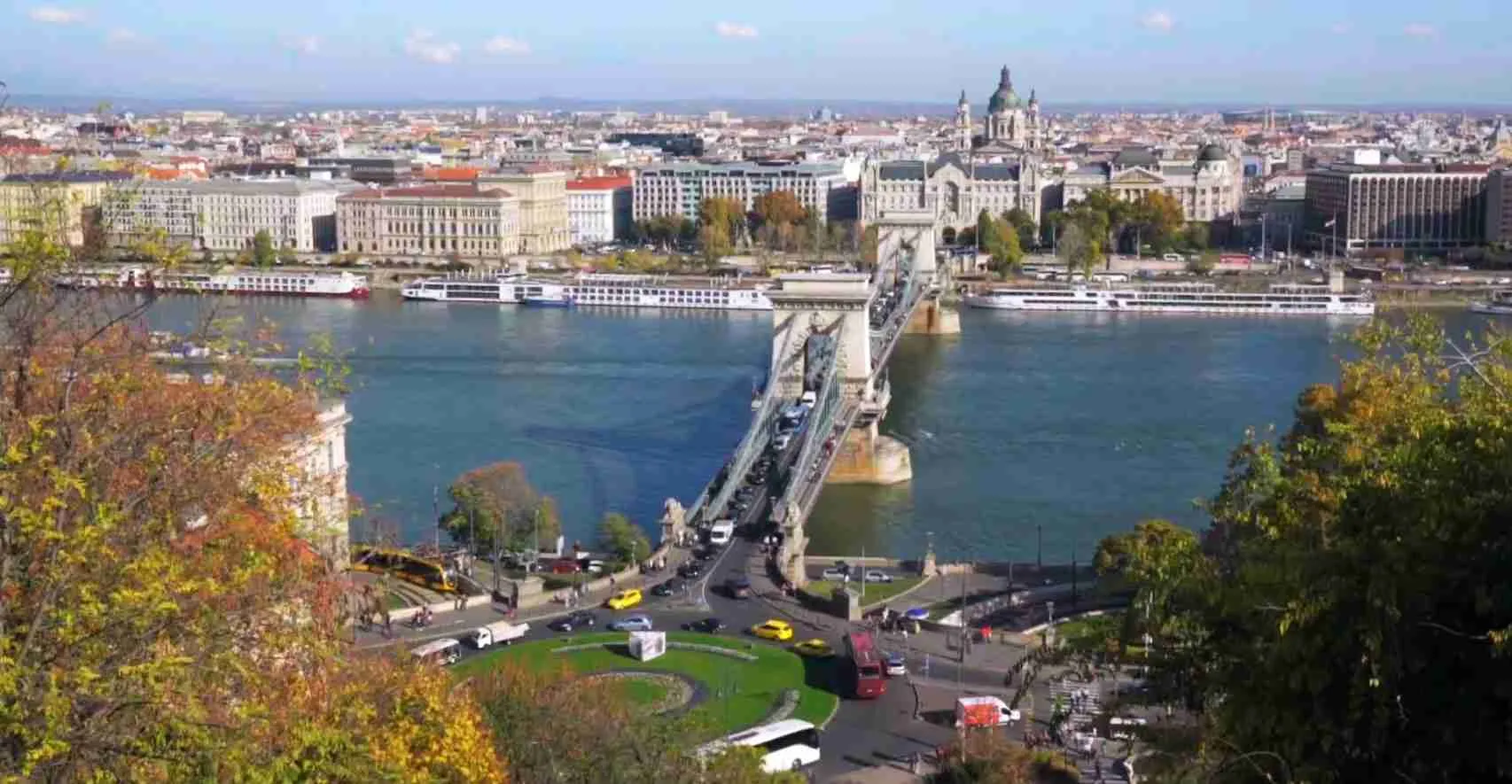
Descend from Castle Hill via the funicular or walking paths to Chain Bridge (Széchenyi Lánchíd), Budapest’s iconic suspension bridge connecting Buda and Pest. Built in 1849, this engineering marvel created the first permanent crossing between the two cities that would merge into Budapest in 1873. The bridge’s stone lion sculptures and lamp posts create romantic atmosphere particularly beautiful when illuminated in evening.
Walk across the bridge from Buda to Pest, enjoying Danube views and observing daily life in the Hungarian capital. The 10-15 minute crossing provides photography opportunities, fresh air, and transition between the two city sections. The Pest side delivers you to Roosevelt Square near the Hungarian Academy of Sciences and Gresham Palace—prime location for beginning Pest-side exploration.
Afternoon Part 1: Parliament & St. Stephen’s (1:00 PM – 3:30 PM)
From Chain Bridge, walk or take tram along the Danube embankment toward the Parliament Building, one of Europe’s largest and most photogenic legislative buildings. The massive neo-Gothic structure features 691 rooms, a central dome 96 meters high, and elaborate facade decoration incorporating Hungarian crown symbolism and historical figures. While interior tours exist (requiring advance booking), viewing the exterior and riverside location impresses most day-trippers without time commitment.
The Parliament area includes Kossuth Square with statues and monuments, the Ethnographic Museum in an impressive building facing Parliament, and riverside promenades perfect for walking and photography. Across from Parliament, Margaret Island sits in mid-Danube—pleasant for strolling if time permits, though perhaps better saved for longer Budapest visits.
Grab lunch at one of several options: the historic Great Market Hall (10-minute walk south) for authentic Hungarian food hall experience with food stalls, sit-down restaurants, and produce vendors; restaurants along Váci Street (pedestrian shopping zone); or traditional Hungarian spots near St. Stephen’s Basilica. Expect to spend €12-18 for sit-down lunch with drink, €6-10 for market hall food stall meals.
After lunch, visit St. Stephen’s Basilica, Budapest’s largest church and co-equal tallest building (96 meters matching the Parliament). The neo-Renaissance interior impresses with marble, gold decoration, and the preserved right hand of St. Stephen (Hungary’s first king) in a reliquary chapel. Climb the dome for panoramic city views (€6-8, 364 steps or elevator available). Allow 30-45 minutes for basilica visit, 20-30 minutes for dome ascent and viewing.
Afternoon Part 2: Thermal Bath Experience (3:30 PM – 6:00 PM)
Budapest’s thermal bath culture represents one of the city’s unique experiences unavailable in Vienna. The capital boasts numerous historic baths fed by natural hot springs, offering therapeutic bathing in stunning architectural settings. For day-trippers, choose between Széchenyi Baths in City Park (outdoor pools, grand yellow buildings, accessible via metro Line 1) or Gellért Baths near Freedom Bridge (Art Nouveau interiors, sophisticated atmosphere).
Széchenyi Baths provide the classic Budapest thermal experience: outdoor pools ranging from cool to hot where locals play chess on floating boards, elaborate neo-baroque buildings, steam rising into air on cool days, and social bathing culture. Entry costs approximately €20-25 weekdays, €22-28 weekends (check official website for current rates). The setting appeals to photography and casual bathing rather than exclusively therapeutic focus.
Gellért Baths offer Art Nouveau splendor with decorative tiles, columns, and stained glass in the main pool area. The more refined atmosphere attracts those seeking aesthetic beauty and quieter bathing, though it costs similarly to Széchenyi (€20-28 depending on timing and services). Located at the Buda foot of Gellért Hill, the baths combine easily with citadel or Liberty Statue visits for those energetic enough after bathing.
Thermal bathing requires 2-2.5 hours to experience properly—changing, showering, moving between pools of different temperatures, relaxing in steam rooms, and absorbing the unique atmosphere. This represents significant time in a day trip but delivers quintessentially Hungarian cultural experience impossible to replicate. If bathing doesn’t appeal, substitute Heroes’ Square, Andrássy Avenue strolling, Hungarian State Opera House (exterior), or additional museum time.
Evening: Return Journey (6:00 PM – 6:30 PM)
Allow 30 minutes transit from your final Budapest location to Budapest-Keleti railway station for return trains to Vienna. Metro Line 2 (red line) serves Keleti directly from central locations; trams and buses provide alternative routes. Arrive at the station 10-15 minutes before departure to locate your platform and board comfortably.
The evening train journey provides time to reflect on the day’s experiences, process photographs, or simply rest after extensive walking and exploration. The return trip feels shorter than morning outbound—the excitement of arrival replaced by satisfied tiredness and memories of a full day discovering Budapest’s unique character.
Alternative Itinerary Options 2026
Culture-Focused Route
For museum and art enthusiasts, substitute thermal bathing with Hungarian National Museum (comprehensive Hungarian history from pre-Magyar times through modern era, 2 hours, €6-8), Museum of Fine Arts (impressive European art collection including Spanish masters, 2 hours, €8-12), or House of Terror (sobering exhibition on fascist and communist terror in 20th-century Hungary, 1.5-2 hours, €8-10). This approach delivers deeper understanding of Hungarian culture and history while sacrificing the unique bathing experience.
Photography-Focused Tour
Photographers might reorganize timing to capture specific lighting: sunrise or early morning from Fisherman’s Bastion (requires very early Vienna departure), golden hour along the Danube embankment (stay until 5-6 PM then quick bath visit or skip baths entirely), and evening blue hour at Parliament with illumination (catching 7-8 PM return train). This schedule maximizes photographic opportunities while accepting reduced time at individual attractions.
Food & Market Experience
Culinary-focused visitors could build itinerary around Great Market Hall exploration (1-1.5 hours browsing, tasting, purchasing paprika and foodstuffs), traditional Hungarian lunch at market restaurant, Central Market Area cafés and pastry shops, and Jewish Quarter exploration including Gozsdu Court restaurant complex. This approach emphasizes Budapest’s distinctive food culture and delivers delicious, memorable experiences while reducing architectural sight-seeing.
Ruin Bar Evening (If Staying Late)
If catching a later return train (8-9 PM), consider brief ruin bar experience in the Jewish Quarter. These unique bars occupy former abandoned buildings, courtyards, and commercial spaces transformed into eclectic drinking establishments with mismatched furniture, creative decoration, and vibrant atmosphere. Szimpla Kert, the original and most famous, offers authentic experience though heavily touristic. This adds distinctive Budapest nightlife flavor impossible to find in Vienna’s more refined drinking culture, though it requires very late return (arriving Vienna near midnight).
Practical Information 2026
Budapest Public Transport
Budapest’s efficient public transport network includes metro (4 lines), trams, buses, and trolleybuses operating throughout the city. A 24-hour travel card costs approximately 2,500 HUF (€6-7) and provides unlimited travel on all BKK (Budapest transport) services (check official BKK website for current rates). This represents excellent value for day-trippers planning to use metro, trams, and buses multiple times.
Purchase transport passes at BKK ticket offices in Budapest-Keleti station upon arrival, from purple ticket machines in metro stations, or at newspaper kiosks throughout the city. Single tickets (€1.30-1.50) work for very limited exploration but become uneconomical after 4-5 trips. The day pass eliminates ticket purchasing stress and allows spontaneous transport use.
Metro Line 2 (red) runs from Keleti station through central Budapest including Deák Ferenc tér (transfer hub) and continues to Batthyány tér (Buda side near Chain Bridge and Parliament). Metro Line 1 (yellow), the historic Millennium Line, runs from Deák Ferenc tér to Heroes’ Square and City Park (Széchenyi Baths). Trams 2 and 2A run along the Pest riverside offering scenic Danube views.
Validate single tickets in orange machines before entering metro or boarding trams/buses. Inspectors conduct regular checks; ticketless travel results in hefty fines. The 24-hour pass doesn’t require validation per trip—just carry it and show if requested by inspectors.
Currency & Money Matters
Hungary uses the Hungarian Forint (HUF) with approximate exchange rate €1 = 385-395 HUF (rates fluctuate). Most tourist establishments accept credit cards, but carry some cash for small purchases, market stalls, public transport ticket machines (some accept only cash or Hungarian cards), and traditional establishments.
ATMs are widely available throughout central Budapest, offering reasonable exchange rates (better than exchanging cash at currency offices). Withdraw forints upon arrival at Budapest-Keleti station or anywhere in the city center. Many establishments quote prices in both forints and euros for tourist convenience, though forints provide better value.
Budget approximately €50-75 total spending in Budapest: public transport day pass €6-7, lunch €12-18, one major attraction (baths or museum) €12-18, coffee/snacks €5-10, funicular or small entry fees €6-8, and buffer for purchases or additional expenses. This assumes you’ve already purchased round-trip train tickets from Vienna.
Language Considerations
Hungarian is the local language and among Europe’s most challenging for foreigners—unrelated to neighboring German, Czech, or Romanian languages and featuring complex grammar and pronunciation. However, Budapest’s tourism infrastructure operates well in English, German, and other major languages. Most restaurant menus include English translations, museum information appears in multiple languages, and younger service staff speak functional English.
Learn basic phrases (hello: szia; thank you: köszönöm; please: kérem; excuse me: elnézést) as courtesy, though these aren’t essential for practical tourism. Translation apps help with menus, signs, or conversations in establishments catering primarily to locals. The language barrier rarely creates problems in tourist areas but may appear in residential neighborhoods or traditional markets.
Safety & Common Sense
Budapest ranks as generally safe for tourists with normal urban caution. Watch for pickpockets in crowded tourist areas (Castle District, Great Market Hall, busy metro stations), particularly during summer peak season. Keep valuables secured and remain aware of surroundings in crowded situations.
Avoid unlicensed taxis that may overcharge tourists—use official taxi companies, ride-sharing apps (Bolt operates in Budapest), or public transport. Walking between major sights feels safe during daylight hours; evening street life remains active and secure in central areas, though quiet side streets deserve more caution late at night.
Tap water is safe to drink throughout Budapest. Public restrooms in metro stations, museums, and attractions typically charge small fees (100-200 HUF/€0.30-0.50). Carry small change for these facilities and tipping in restaurants (10-15% customary for good service, often not automatically included in bills).
What to Bring
Essential items for Budapest day trip: comfortable walking shoes (expect 8-12 kilometers of walking), day backpack for carrying purchases and supplies, water bottle (refillable at public fountains), sunscreen and hat for summer visits, light jacket (even summer evenings can cool, especially near the Danube), camera or smartphone for photography, and power bank for devices.
If planning thermal bath visit: swimsuit (required—nude bathing not permitted), towel (or rent at baths for €2-4), flip-flops, plastic bag for wet items, small lock for locker (or use built-in locks at most baths), and basic toiletries. Most baths provide hair dryers; some offer shower gel and shampoo, but bring your own to be certain.
Download offline maps of Budapest before departure (Google Maps allows offline area downloads) in case mobile data proves unreliable. Consider Budapest tourism app or transport app for real-time information and navigation assistance.
Weather & Seasonal Considerations
Budapest experiences continental climate with distinct seasons. Summer (June-August) brings warmest temperatures (25-35°C), longest daylight hours (extended sightseeing time), peak tourism crowds, and highest prices. Thermal baths offer welcome cooling during summer heat. Occasional summer storms can disrupt outdoor plans—bring compact umbrella or rain jacket.
Spring (April-June) and autumn (September-October) provide optimal visiting conditions: mild temperatures (15-25°C), manageable crowds, blooming flowers or autumn colors, and comfortable walking conditions. These shoulder seasons deliver great value with pleasant weather and authentic local atmosphere as tourism pressure eases.
Winter (December-February) presents cold temperatures (0-10°C, occasionally below freezing), short daylight hours (limiting sightseeing time), fewer crowds, and lower prices. Thermal baths become especially appealing in winter—steaming outdoor pools in cold air create magical experience. Christmas markets add festive charm to winter visits. Be prepared for potential snow or ice affecting walking conditions.
Maximizing Your Day Trip Experience
Pre-Trip Planning
Research Budapest attractions 1-2 weeks before travel to decide priorities matching your interests. History enthusiasts might emphasize Castle District, museums, and Parliament; architecture lovers focus on Art Nouveau and historic buildings; food-focused travelers plan market visits and traditional restaurants; relaxation seekers prioritize thermal baths. Understanding personal priorities prevents trying to do everything and allows deeper engagement with selected experiences.
Book any admission-required attractions requiring advance reservations: Parliament interior tours (highly recommended if including), thermal bath entry during peak season (Széchenyi and Gellért can sell out summer weekends), and special museum exhibitions. Many attractions allow walk-up entry, but advance booking guarantees access and often provides skip-the-line benefits.
Check opening hours for selected attractions—some museums close Mondays, thermal baths have varying hours by day of week, and seasonal schedules affect opening times. Plan accordingly to avoid arriving at closed attractions or rushed visits before closing.
Arrival Strategies
Upon arriving Budapest-Keleti station, immediately purchase 24-hour BKK transport pass at ticket office or machine before exiting the station. Study the metro map and determine which line serves your first destination—this orientation saves time and reduces confusion in the city center.
If carrying significant luggage for multi-city travel, use luggage storage at Budapest-Keleti station (left luggage office near platforms) to avoid dragging bags throughout the city. Storage costs approximately €4-6 per bag per day—worthwhile investment in comfort and flexibility.
Start your exploration at the most distant or time-sensitive attraction first, working back toward the station throughout the day. This prevents stressful rushing at the end of the visit when you need to catch your return train.
Pacing & Energy Management
Budapest day trips involve substantial walking—8-12 kilometers typical for comprehensive sightseeing. Take short breaks every 2-3 hours: coffee at traditional café, rest on park bench, or seated attraction visit. This prevents exhaustion and allows absorption of experiences rather than rushed rushing between sights.
Balance active exploration (Castle District climbing, walking tours) with relaxed experiences (thermal bath soaking, river cruise if including, café breaks). The thermal bath particularly provides rejuvenating rest after morning walking, preparing you for continued afternoon/evening exploration.
Accept that one day doesn’t allow comprehensive Budapest coverage. Choose 4-6 major experiences rather than attempting every attraction mentioned in guidebooks. Quality engagement with selected sights creates more satisfying experience than superficial racing through exhaustive checklist.
Photography Tips
Budapest offers exceptional photography across multiple subjects: Chain Bridge and Danube panoramas from Fisherman’s Bastion, Parliament Building’s elaborate Gothic Revival details, colorful Castle District streets, Art Nouveau architecture throughout Pest, vibrant Great Market Hall interiors, and thermal bath steam rising against baroque buildings.
Best lighting occurs early morning (7-9 AM, requiring very early Vienna departure) and golden hour (5-7 PM summer, 3-5 PM winter). The Fisherman’s Bastion provides excellent sunrise perspectives over the Danube and Parliament. Evening illumination of Parliament and bridges creates romantic night photography opportunities, though catching return trains requires sacrificing these shots unless staying very late.
Respect photography restrictions in churches, museums, and thermal baths. Many locations prohibit flash photography to protect artifacts or commercial photography without permits. Ask permission before photographing people in thermal baths or markets—not everyone appreciates camera attention during bathing or shopping.
Frequently Asked Questions
Should I book train tickets to Budapest in advance for 2026?
Advance booking provides significant advantages: lower prices (potentially saving 30-50% compared to day-of purchase), guaranteed seating on preferred trains, and less stress on travel day. Book 3-6 months ahead for best prices, especially for summer travel, weekends, or holidays when trains fill quickly. Last-minute booking risks high prices and limited availability, particularly for comfortable Railjet services. However, if your schedule remains uncertain, some operators offer flexible tickets allowing date/time changes for fee—balancing advance purchase savings with scheduling flexibility.
Can I visit both Vienna and Budapest in one day?
While technically possible to be in both cities the same day (starting in Vienna, day-tripping to Budapest, returning evening), this doesn’t allow meaningful Budapest exploration—you’d have just 4-6 hours after accounting for 5 hours total train time. Consider staying overnight in Budapest instead, allowing full day and evening exploration, or accept that a Vienna-Budapest day trip means limited Vienna time that day (departing early, returning late). Multi-city day trips sound appealing but create rushed, unsatisfying experiences. Focus on one city per day for quality engagement.
Is it better to take the train or bus from Vienna to Budapest?
Trains dramatically outperform buses for Vienna-Budapest travel: faster journey times (2.5 hours vs 3-4 hours by bus), more comfortable seating with ability to walk around, power outlets and WiFi, less motion sickness risk, more reliable arrival times, and convenient station locations in both city centers. Buses cost slightly less (€10-20 vs €15-30 for trains) but the small savings don’t justify substantially longer, less comfortable journey. Trains represent the clear superior choice unless budget constraints are absolutely critical.
What if I miss my return train to Vienna?
If you miss your booked return train, go immediately to the ticket office at Budapest-Keleti station. Depending on ticket type, you may be able to change to the next available train for a fee (typically €10-20 change charge plus any fare difference) or may need to purchase entirely new ticket at potentially higher walk-up price. This is why building 20-30 minute buffer before your booked train is wise—allows relaxed arrival at the station without panic rushing. Check train schedules before your trip to know backup options if delays occur.
Do I need Hungarian forints or can I use euros in Budapest?
While some tourist-oriented establishments accept euros (restaurants near major attractions, souvenir shops), you’ll get poor exchange rates and receive change in forints anyway. It’s far better to withdraw forints from ATMs upon arrival in Budapest or exchange euros at legitimate exchange offices (avoid airport exchange bureaus with terrible rates). Budget €50-75 worth of forints for day trip covering transport, meals, attractions, and incidentals. Credit cards work widely in restaurants and major attractions but carry cash for public transport ticket machines, market stalls, and small purchases.
Is Budapest safe for day-trippers in 2026?
Budapest presents no unusual safety concerns for day-trippers exercising normal urban caution. Watch for pickpockets in crowded tourist areas (Castle District, Great Market Hall, busy metro stations), use official taxis or ride-sharing rather than unlicensed cabs, stay aware of surroundings in unfamiliar neighborhoods, and avoid displaying expensive jewelry or electronics carelessly. Central Budapest maintains active street life through evening, making returning to Keleti station for late trains safe. The city welcomes millions of tourists annually without significant crime issues affecting visitors who take basic precautions.
Can I store luggage in Budapest if I’m traveling to other cities?
Budapest-Keleti station offers luggage storage (left luggage office) near the platforms, costing approximately €4-6 per bag per day. This allows comfortable day exploration without dragging suitcases between attractions—essential if continuing to other destinations that evening. Arrive at the station, store luggage immediately, then begin your Budapest visit bag-free. Return to collect bags before your onward train departure. Some hotels also offer luggage storage for former guests, worth asking if you’re arriving from multi-night Budapest stay.
What’s the best thermal bath for day-trippers: Széchenyi or Gellért?
Széchenyi Baths offer the quintessential Budapest thermal experience with outdoor pools, grand yellow buildings, chess-playing bathers, and social atmosphere—ideal for first-time visitors and photography. Gellért provides more refined Art Nouveau elegance, sophisticated interiors, and quieter bathing but less iconic outdoor atmosphere. For day-trippers with limited Budapest knowledge, Széchenyi represents the safer choice delivering “classic” thermal bath experience everyone imagines. Gellért appeals to those who’ve visited before, prefer quieter settings, or particularly value Art Nouveau architecture. Both cost similarly (€20-28) and require similar time commitment (2-2.5 hours).
Should I take a guided tour or explore Budapest independently?
Independent exploration offers maximum flexibility, allowing you to pace yourself, skip attractions that don’t interest you, and linger at places you love—ideal for experienced travelers comfortable navigating new cities. Guided tours provide historical context, insider knowledge, and efficient routing but cost more (€40-80 for half-day tours) and force group pacing. For one-day visits, independent exploration using this guide’s suggested itinerary provides good balance—you have structure but flexibility to adapt. Consider audio guides at major sites (Castle District, Parliament) for historical background without group tour constraints.
How much walking is involved in a Budapest day trip?
Expect 8-12 kilometers (5-7.5 miles) of walking throughout a full Budapest day trip—Castle District exploration, Chain Bridge crossing, riverside walks, city center wandering, and general navigation between attractions. Wear very comfortable, broken-in walking shoes. Those with mobility limitations should plan reduced itineraries focusing on fewer attractions with more metro/tram use between sites. Thermal bath visits provide welcome seated/reclining rest after morning walking. Consider the funicular to Castle Hill rather than walking steep paths, and use public transport rather than walking longer distances between neighborhoods.