Valencia to San José Caves Day Trip 2027: Underground River Navigation & Sierra de Espadán Access
Fifty-five kilometers north of Valencia, beneath the first limestone ridges of the Sierra de Espadán, lies one of Europe’s most unusual natural attractions: a navigable underground river that visitors explore entirely by boat. The San José Caves in Vall d’Uixó hold the longest navigable subterranean river on the continent, and the whole experience — including an optional afternoon combining the surrounding natural park and a Roman-era water system in the town center — fits comfortably into a single day from Valencia in 2027. This guide covers every practical decision, from booking your boat slot to choosing between a car rental and an organized coach transfer.
Key Takeaways
- Admission to San José Caves costs €18 for adults and €12 for children aged 3–12 in 2027; book online in advance since the system closes approximately 24 hours before your intended visit slot.
- The cave interior holds a constant temperature of 20–21°C year-round, so a light fleece or jacket is appropriate regardless of the season outside.
- Drive time from Valencia via the A-7 highway is approximately 40–55 minutes depending on traffic; organized guided coach tours depart at 8:15 AM from Torres de Serranos for €69 per adult including transport and cave entry.
- Budget travelers using their own car and a packed lunch can complete the cave day trip for €30–40 per person; mid-range travelers using a car rental and a restaurant lunch spend approximately €65–90 per person.
- The PR-CV 164 trail from Vall d’Uixó offers a loop hike of 13.6 km into Sierra de Espadán Natural Park; plan a half-trail section of 5–7 km if combining it with the cave visit in one day.
- The San José Aqueduct in the town center, whose origin is presumed Roman though three of its central arches date from a 14th-century reconstruction, adds 30–45 minutes to a visit and costs nothing to see.
People Also Ask About Valencia to San José Caves Day Trip 2027
How long is the drive from Valencia to San José Caves in 2027?
The drive from central Valencia to the San José Caves visitor center in Vall d’Uixó covers approximately 55 km and takes between 40 and 55 minutes via the A-7 (Autovía del Mediterráneo), the free motorway that runs north along the Mediterranean coast. Traffic through the Valencia metropolitan ring road adds 10–15 minutes on weekday mornings; a weekend departure before 8 AM typically keeps the journey under 45 minutes. The caves are signposted from the main road once you reach the Vall d’Uixó municipal area. Visitors wishing to avoid any possible tolled sections can navigate entirely on the free A-7 rather than the parallel AP-7.
How much do San José Caves boat tickets cost in 2027?
Standard admission in 2027 is €18 per adult (ages 18 and over), €12 per child between 3 and 12 years old, and €14 for pensioners, students, and accredited guides. Children aged 0–2 enter free of charge; staff check heights at the entrance and children under 1.01 meters also enter free. An alternative speleokayak experience, available for visitors aged 10 and above, runs approximately 90 minutes and allows paddling through the cave on single or double kayaks rather than the group flat-bottomed boat; this is booked separately through the cave and runs for approximately €45 per person depending on the operator. Check the official website at covesdesantjosep.es for current prices and availability before confirming your visit.
Can I combine San José Caves with Sierra de Espadán hiking in 2027?
Yes, with careful timing. The certified PR-CV 164 loop trail from Vall d’Uixó runs 13.6 km with 680 meters of ascent and takes approximately five hours at a moderate pace — too long to combine with the full cave visit on the same day without an early start. The practical solution for a combined 2027 day trip is to hike the first 5–7 km of the PR-CV 164 toward Font del Nogueret before driving to the caves for a morning slot, or to take the afternoon slot at the caves and hike a shorter section of the trail after lunch. Sierra de Espadán Natural Park has free entry and no timed booking requirement; the PR-CV 164 trailhead leaves from the northern outskirts of Vall d’Uixó along the CV-230 road toward Alfondeguilla.
What should I wear to San José Caves in 2027?
The cave maintains a constant interior temperature of 20–21°C throughout the year, which feels pleasantly cool in summer but mild in winter — a light fleece or jacket over a T-shirt is the standard choice. Footwear should have closed toes and grippy soles, as the walking section of the dry gallery has stone paving that can become slippery in areas of natural drip. Most of the visit is completed seated in the boat, so there are no significant mobility requirements for the standard tour beyond boarding and disembarking. During the 250-meter walking section of the dry gallery the ground is paved but can be wet; waterproof shoes are useful in the winter months.
Extended multi-day tours – 5+ days
Featured Valencia Multi-Day Tour Packages

3 days
Valencia 3-Day Discovery Tour
- ✓ Comprehensive Valencia experience
- ✓ Expert local guides included
- ✓ All accommodation included
- ✓ Transportation provided

5 days
Valencia 5-Day Highlights Experience
- ✓ Comprehensive Valencia experience
- ✓ Expert local guides included
- ✓ All accommodation included
- ✓ Transportation provided

7 days
Valencia 7-Day Cultural Journey
- ✓ Comprehensive Valencia experience
- ✓ Expert local guides included
- ✓ All accommodation included
- ✓ Transportation provided

10 days
Valencia 10-Day Complete Adventure
- ✓ Comprehensive Valencia experience
- ✓ Expert local guides included
- ✓ All accommodation included
- ✓ Transportation provided
Multi-day tour packages powered by TourRadar. Prices and availability subject to change.
Introduction: San José Caves, Sierra de Espadán & the Vall d’Uixó Day Trip Corridor in 2027
The municipality of Vall d’Uixó sits at the southern edge of the Sierra de Espadán range, in the Plana Baixa district of Castellón province, roughly equidistant between Valencia and Castellón de la Plana. Though the town itself numbers around 30,000 inhabitants and has a well-preserved historic core, its international reputation rests almost entirely on a geological accident: the Río Belcaire, the river that runs through the valley, disappears underground at the edge of the limestone hills and resurfaces several kilometers away, creating a karst cave system of extraordinary length.
The San José Caves — officially the Coves de Sant Josep in Valencian — contain approximately 3,000 meters of mapped galleries in total, of which around 800 meters are navigable by flat-bottomed boat. This makes the system the longest navigable underground river in Europe, a distinction that draws visitors from throughout Spain and from international tourist groups based in Valencia. The caves sit at the foot of the rocky outcrop that bears the Sant Josep Archaeological Settlement, a stratified site occupied continuously from the Bronze Age through the Iberian, Roman, and Andalusian periods, and the combination of natural spectacle below and historical remnant above gives the immediate area an unusual density of interest for a half-day excursion.
For 2027, the practical case for making this a day trip from Valencia is strong. The drive is under an hour on the free A-7 motorway, organized guided coach transfers depart daily from the city center, and the main attraction — the cave boat tour — is timed, meaning visitors arrive at a specific slot rather than queuing unpredictably. Booking the boat slot in advance is the single most important logistical step: online tickets close approximately 24 hours before the visit time, and on busy summer weekends the remaining box-office slots sell out quickly after 10 AM. Travelers who book a week ahead, arrive for a morning slot, and build in time for the archaeological settlement tour, a short hike into Sierra de Espadán, a town lunch, and a look at the aqueduct on the return walk will have filled a genuinely full and varied day.
This guide is organized to match the actual sequence of decisions a 2027 visitor faces: how to get there, when to book, what the cave experience involves, what to see in the town center on the way back, and how to structure the cost at each budget level. Equally important, this guide provides the geological background that transforms a boat ride through illuminated rock into an intelligible encounter with a specific landscape — the hydrological connection between the sierra, the cave, and the town that has shaped human settlement in the Belcaire valley since the Palaeolithic period.
Understanding the San José Cave System: Geological Background for 2027 Visitors
The San José Caves formed through karst dissolution — the process by which mildly acidic rainwater slowly dissolves limestone over geological timescales, hollowing out chambers and galleries along structural weaknesses in the rock. The limestone massif that underlies the western edge of the Plana Baixa plain is part of the Mesozoic rock sequence of the Iberian Range, and the cave system developed along fracture lines in this soluble rock over a period measured in hundreds of thousands of years. The Río Belcaire, the small surface river that runs through the Vall d’Uixó valley, provided the active hydrological agent: as the land uplifted gradually over geological time, the river progressively cut deeper into the limestone, abandoning older upper galleries (now dry) and creating the currently active navigable lower level through which visitors travel today.
The result is a cave system with a total documented length of approximately 3,000 meters of galleries, of which the 800-meter navigable section represents only the accessible inner portion. The geological formations encountered during the visit — stalactites hanging from the ceiling, stalagmites rising from the floor, flowstones coating wall surfaces, and calcite curtains in certain gallery sections — are all produced by the same slow dissolution process operating in reverse: calcium-rich water seeping through the cave ceiling loses carbon dioxide as it drips into the cave atmosphere, precipitating calcite in forms that accumulate at rates measured in millimeters per century. The formations visible during a 40-minute boat tour therefore represent thousands of years of deposition and provide a readable, if slow-moving, geological archive of the cave’s internal climate history.
The cave’s location at the foot of the Sierra de Espadán — whose red sandstone (rodeno) geology contrasts visibly with the grey-white limestone of the cave massif — is not incidental: the two rock types represent different geological epochs and different formation environments. The sierra’s sandstone is older Triassic material; the cave’s limestone is Jurassic-Cretaceous in origin. The river that flows underground through the cave system originates in the sierra’s higher terrain and carries water through both geological units, emerging at the cave mouth as the spring that historically supplied Vall d’Uixó’s water system via the aqueduct network still partially standing in the town center. Understanding this hydrological connection between the mountain, the cave, and the human settlement anchors the day trip’s three components — the cave, the sierra hike, and the aqueduct — as parts of a single physical system rather than unrelated stops.
Transport Options 2027: Direct Coach Transfers vs. Car Rental via the A-7 Highway
The transport choice for 2027 comes down to three realistic options: driving on the A-7 in a rental car or own vehicle; taking the official guided day tour organized by Valencia tourism; or traveling independently by bus. Each has a clearly different profile in terms of cost, flexibility, and total time commitment.
Getting There by Car: A-7 Route, Drive Times & Parking Options in 2027
The fastest and most flexible way to reach the San José Caves from Valencia in 2027 is by car via the A-7 Autovía del Mediterráneo. From the city center, follow the A-7 north toward Castellón de la Plana; after approximately 45 km the road passes the area of Sagunto, and from there the exit toward Vall d’Uixó (or Nules-Burriana for the parallel AP-7) leads onto local roads through the Plana Baixa flatlands to the town and caves. Total distance from Valencia’s northern ring road is approximately 50–55 km; in light traffic the journey takes 40 minutes. In heavy morning traffic on weekday departures, budget closer to 55 minutes.
The A-7 is a free motorway for the entire relevant stretch. Drivers wishing to save a few minutes can use the parallel AP-7 toll road instead; the toll for the relevant section is approximately €3–5 depending on the exit. For a two-person day trip, the toll saving relative to time is rarely worth the calculation, but for early-morning departures aimed at securing a 10 AM cave slot, the AP-7 can make the margin comfortable.
Parking at the San José Caves is available in a dedicated area adjacent to the visitor center at Paraje de Sant Josep. Spaces are generally adequate outside peak summer weekends. The parking area is free of charge, which meaningfully reduces the per-person cost relative to city attractions with paid underground garages. Visitors planning to continue to the Sierra de Espadán trailhead for PR-CV 164 after the cave can drive the short distance to the trailhead on the CV-230 road toward Alfondeguilla without repositioning their vehicle more than 10 minutes.
Car rental from Valencia city center in 2027 is available through all major agencies at Valencia Airport and in the center; small economy cars typically cost €45–70 per day including basic insurance, making a shared rental €22–35 per person for two travelers. Fuel for the round trip of approximately 110–120 km costs an additional €13–18 in total, or €7–9 per person when split between two. Fuel prices in Spain in 2027 should be confirmed closer to your visit date through fuel price comparison sites.
Coach Transfers and Public Transport from Valencia to Vall d’Uixó in 2027
The most structured option for 2027 is the organized guided day excursion sold through the official Valencia tourism portal (visitvalencia.com). The excursion departs daily at 8:15 AM from the Torres de Serranos meeting point in central Valencia — with additional pickup points at NH Valencia Center and the Ciutat de la Justícia — and returns by midday, making it a true half-day format. The adult price in 2026 was €69 per person including round-trip coach transport, cave admission, and an official bilingual guide in Spanish and English. Italian-language guidance is available on Mondays, Wednesdays, and Fridays. The children’s rate for ages 3–12 was €35. These prices may change for 2027: verify current rates at covesdesantjosep.es or visitvalencia.com before booking.
The organized tour includes a visit to the Sant Josep Archaeological Settlement after the cave, making it a more complete cultural experience than an independent car trip that skips the settlement. The limitation is the rigid schedule: the tour returns to Valencia by early afternoon, leaving no time for Sierra de Espadán hiking or the town center aqueduct visit. Travelers wanting the full combined program — caves, trail, aqueduct, and lunch in town — are better served by the car option, which allows them to decide on-site how to allocate the remaining afternoon hours.
Independent public transport to Vall d’Uixó from Valencia is possible but less straightforward. Regional bus services (ALSA and local Castellón operators) connect Valencia Bus Station on Avenida Menéndez Pidal with towns in the Plana Baixa, including stops near Vall d’Uixó. Journey time is typically 60–80 minutes including stops, and the service frequency is limited outside commuter hours. Visitors using public transport should confirm the onward connection from Vall d’Uixó bus station to the caves (approximately 2.5 km, walkable in 30 minutes on a flat road, or a short taxi) and the return bus schedule before committing to this option. Schedules change seasonally; consult the ALSA website or the Castellón regional transport authority for current times and fares in 2027.
Booking Boat Slot Passes: Timing Strategy for the Subterranean River Route in 2027
The single most important logistical step for a successful 2027 day trip to the San José Caves is booking your boat slot online before you arrive. The cave operates a timed-entry system with slots running throughout the day; online ticket sales close approximately 24 hours before each slot. This means that if you plan to visit on a Saturday morning, you must complete the online purchase no later than Friday morning. On the day itself, only a limited number of box-office tickets are available, and the cave recommends arriving at opening (9:45 AM) if you intend to purchase on-site — arriving later risks finding the morning slots already sold out, particularly on summer weekends between June and September.
Group visitors (minimum 20 adults or 20 children) follow a slightly different process: group reservations require tickets to be collected at the box office at least 30 minutes before the reserved entry time. Individual visitors and small groups can show digital tickets from their mobile devices; printing is not required. No reservations can be made by phone or email for any visit type.
The cave website is covesdesantjosep.es. The booking interface shows available slots and remaining capacity. For summer 2027 high season (July and August), booking one to two weeks in advance is strongly advisable; outside peak season, three to five days ahead is usually sufficient. A private boat for a group of up to 10 people requires purchasing all 10 tickets at the full individual price — the cave does not offer a dedicated private hire rate separate from this full-boat purchase.
For timing strategy, the 9:45 AM or 10:00 AM first-available slot has two advantages: the cave is at its quietest before the day-tripper peak at noon, and it leaves the entire afternoon free for the Sierra de Espadán hike, town lunch, and aqueduct visit. Alternatively, if arriving from Valencia by organized coach (departing 8:15 AM), the tour schedule typically places visitors in the cave between 9:30 and 10:30 AM without any individual slot management required.
Cave Microclimate & What to Pack for the 20–21°C Underground Environment
The interior of the San José Caves maintains a verified constant temperature of 20–21°C throughout the year, according to the cave’s own recorded climate data. This is a genuinely pleasant temperature — equivalent to a mild spring day — that makes the cave equally comfortable in the deep Valencian summer, when the exterior temperature regularly exceeds 35°C, and in winter, when the cave feels slightly warm rather than cold. The microclimate results from the cave’s deep karst structure, which insulates the interior completely from surface temperature fluctuations.
Despite the moderate temperature, humidity inside the cave is high (the cave contains an active flowing underground river), and the sensation of cool dampness is more noticeable than the thermometer reading suggests. A lightweight fleece, thin jacket, or long-sleeved layer over a T-shirt is the standard sensible packing choice for any season. Avoid heavy winter coats in summer — you will carry them the entire boat ride and they become cumbersome in the seating.
For footwear, the official guidance calls for comfortable shoes that facilitate boarding and disembarking. The walking section of the dry gallery is paved but can be wet from natural drip; closed-toe shoes with non-slip soles are appropriate. Sandals and heeled shoes are discouraged. A small daypack to hold the jacket during the cave visit is useful, as is a waterproof phone sleeve or case for the photography section — the cave’s humidity can affect lenses with heavy condensation, particularly when moving from cold exterior air into the warm damp interior in winter.
The cave does not permit flash photography in certain sections; the official photographer’s point is designated at a specific gallery location. Slow shutter speeds and stabilization are more useful than flash in any case, given the gentle ambient illumination along the route.
Combining the Caves with a Hiking Loop in Sierra de Espadán Natural Park
Sierra de Espadán Natural Park is the second-largest protected natural area in the Valencian Community, covering the inland hill ranges of Castellón province from Vall d’Uixó in the south to the Sierra itself and the municipalities of Artana, Eslida, Aín, Chóvar, and Alcudia de Veo further north. The park is dominated by red sandstone (rodeno) geology that produces a distinctive russet landscape particularly vivid in low autumn and winter light, and by extensive cork oak (alcornoque) forests that are harvested by traditional methods still practiced today. For 2027 visitors to the caves looking to extend their day into the hills, the park’s accessibility on foot from Vall d’Uixó is one of its strongest practical assets.
The certified PR-CV 164 trail — officially titled La Vall d’Uixó — Font del Nogueret — Font de Cabres — is a 13.6 km circular route with 680 meters of total ascent and a rated walking time of approximately four hours and fifty minutes. The Federació d’Esports de Muntanya i Escalada de la Comunitat Valenciana (FEMECV) rates the route at difficulty level 2 (moderate) with a fitness requirement of 3 (good fitness needed). Key landmarks include the Font del Nogueret spring at around 2 km, the high point of the Font de Cabres peak at 631 meters elevation, and the Coll de Bledar col before the descent back to town. The route passes through pine forests mixed with abandoned dryland farms before reaching the cork oak and holm oak zones of the upper slopes, where panoramic views of the Plana Baixa coastal plain and the Columns of Alfondeguilla valley open to the south and east.
For a combined cave-and-hike day in 2027, the realistic choices are: (a) complete a morning half of the PR-CV 164 (approximately 5–7 km to the Font del Nogueret area and back, roughly two to two-and-a-half hours walking) before a noon cave slot, leaving the afternoon for the town and aqueduct; or (b) take the earliest available cave slot (9:45 AM, approximately one hour inside), then drive the short distance to the trailhead on CV-230 toward Alfondeguilla and hike for two to three hours in the afternoon before returning to Valencia. Option (b) makes the logistics tighter but allows the cave visit to be completed in its freshest morning state.
The PR-CV 164 trailhead departs from the northern edge of Vall d’Uixó. Parking along CV-230 is available at informal roadside areas near the trail start. There is no entry fee for the Natural Park, and no timed booking system is required for hiking. Walkers should carry water for the ascent (approximately 2 liters per person is sensible for the full loop), a trail map downloaded from the FEMECV website, and sun protection for the exposed upper sections, which receive full afternoon sun from late spring through early autumn.
What to Expect Inside San José Caves: The 40-Minute Underground River Journey
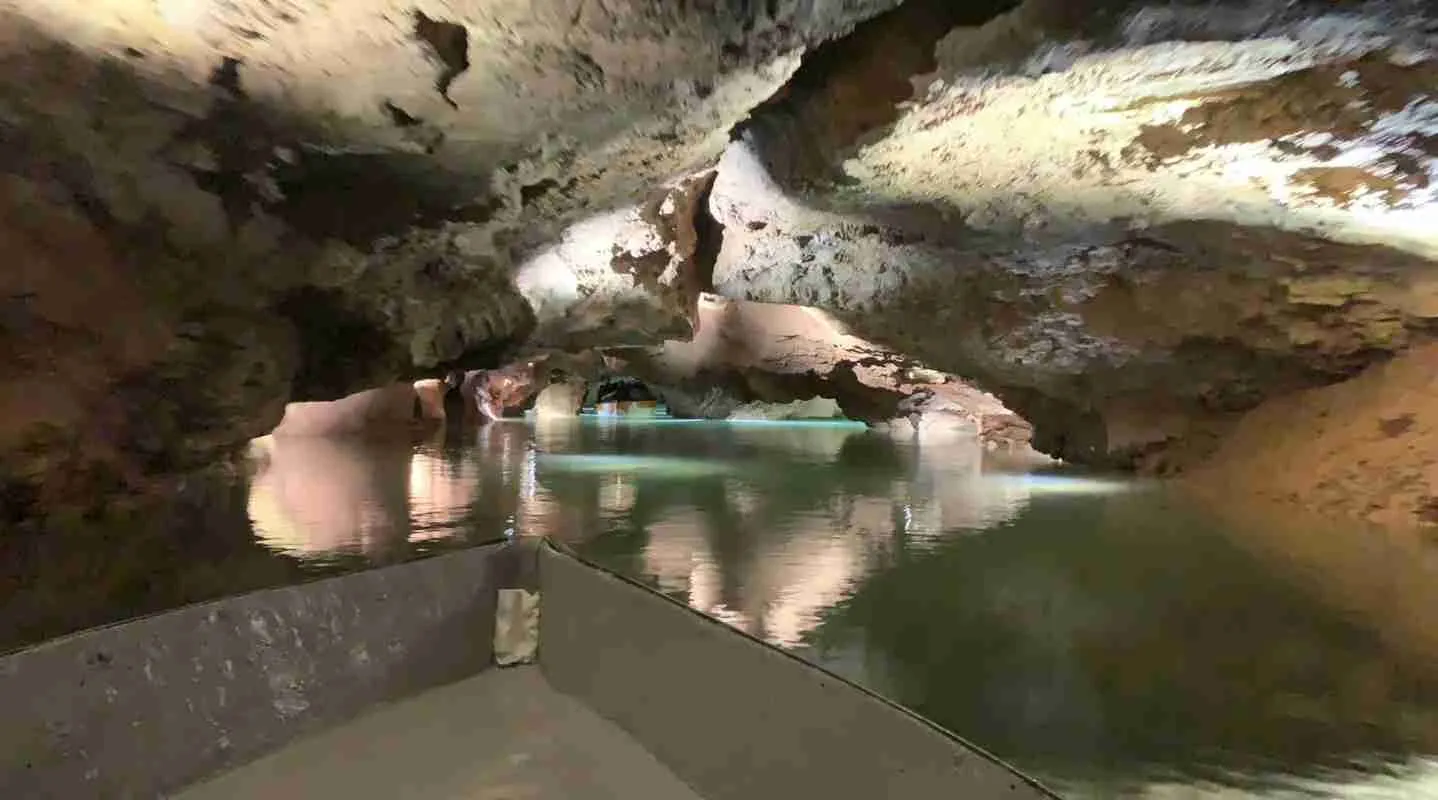
The standard cave visit lasts approximately 40–50 minutes and combines two distinct phases: a 250-meter walking section through dry galleries and a 800-meter boat section along the navigable underground river. The flat-bottomed boats are guided manually by trained boatpeople using poles along the river’s walls and ceiling; the experience is entirely different from typical boat rides on open water, as the sense of enclosure, the close proximity of karst formations to the boat, and the controlled cave lighting create an atmosphere that is difficult to replicate in other European natural attractions.
The cave system is illuminated along the route with carefully positioned lights that emphasize the stalagmites, stalactites, flowstone curtains, and gallery walls without disturbing the cave environment. The lighting design draws particular attention to the cave’s named chambers — notably The Cathedral (a high, vaulted chamber that justifies its name through proportional scale rather than architecture), the Bat Room (home to a resident colony of bats visible near the ceiling), and the Blue Lake (a pool in a deeper section where the water color reflects the lighting with particular clarity). Photography is welcomed at the designated Photo Point, where the mask or jacket restriction from the post-pandemic period has been relaxed and visitors can capture the full interior view.
The Cathedral, the Bat Room & the Blue Lake: Key Cave Highlights
First-time visitors consistently cite the transition from the walking gallery into the navigable river section as the most dramatic moment of the visit. After entering through the cave mouth and walking the dry gallery — which gives a clear sense of the cave’s geological structure, the natural drip formations, and the sound of running water before the river becomes visible — the boat embarkation area opens onto the active river channel. The ceiling height in the first navigable section is low in places, requiring visitors to lean back slightly in the boat as it passes under rock shelves.
As the route progresses deeper, the galleries open and the cave’s most notable formations become visible. The Cathedral chamber is the largest single space on the route, with a ceiling height that creates an impression of genuine architectural scale; the acoustic properties of the space are noticeable even in the presence of other visitors. The Bat Room houses a colony visible near the upper walls; the light is deliberately subdued in this section to minimize disturbance to the animals. The Blue Lake is reached toward the back of the navigable section, and its reflective qualities — the result of the water depth, the surrounding calcite walls, and the lighting angle — make it the most photographed spot of the visit.
Speleokayak Alternative: A Deeper Cave Experience in 2027
For visitors aged 10 and above who want a more physically engaged experience of the cave system, the speleokayak option allows navigation of the same galleries in single or double kayaks over approximately 90 minutes. The kayak format puts visitors much closer to the cave walls and water surface than the group boats, and the physical engagement of paddling through the illuminated chambers produces a significantly more intimate experience of the geological environment. A minimum age of 10 is the official recommendation; adult supervision is required for the age minimum participants. The speleokayak experience is offered through the cave’s own booking channels and requires separate reservation from the standard boat tour; contact the cave at [email protected] or consult the official website for current 2027 pricing and scheduling.
Return Transit Stop 2027: Exploring the San José Aqueduct & Roman-Era Remains of Vall d’Uixó
After completing the cave visit and any planned Sierra de Espadán walking, a return route through the historic center of Vall d’Uixó adds approximately 30–60 minutes to the day and costs nothing beyond any lunch or café stop. The town’s most significant architectural remnant, the San José Aqueduct, stands in the Plaza Duques de Segorbe area near the old quarter and is the outstanding element of a broader historic water management system that once transported water from the cave springs to the settlement upstream.
According to the official English-language tourist guide produced by the Valencian tourism authority, the San José Aqueduct was “presumably built by the Romans, although the three central pointed arches are clearly a reconstruction from around the 14th century.” The Alcudia Aqueduct, a smaller adjacent structure formed by a single semicircular arch, represents a later medieval phase of the same system. The ensemble, which in its full historic extent carried water from the Coves de Sant Josep spring along an aqueduct trace that local historical sources describe as “probably traced by the Romans,” is one of the more tangible links between the cave’s long geological history and the human occupation that depended on its water output for centuries. Two historic mills that date from medieval times stand near the same waterway. The cluster of structures is freely accessible and well labeled in Spanish; no guided access is needed.
Adjacent to the aqueduct area, the “Fábrica de la Luz” — a late 19th- to early 20th-century electrical generating plant that used the water flow — stands as an industrial archaeology layer atop the Roman and medieval hydraulic infrastructure and is earmarked as the future home of the local archaeological museum.
The Sant Josep Archaeological Settlement: Iberian-Roman History Above the Caves
The Sant Josep Archaeological Settlement occupies the rocky hilltop directly above the cave entrance — the same hill that conceals the underground river system. The site has been declared a Site of Cultural Interest (Bien de Interés Cultural, BIC) by the Spanish state administration and documents two principal phases of occupation. The Iberian phase, which the Comunitat Valenciana official documentation dates between the 6th and 2nd centuries BC, is visible in the remains of a stone defensive wall, watchtower bases, residential structures, and street alignments. The Late Roman phase, documented from the 4th to the 5th century AD, represents a later reoccupation of the same strategic hilltop. Bronze Age traces from an even earlier human presence in the Belcaire valley area have also been documented at the site.
A guided one-hour tour of the settlement is available year-round, priced at €5 per person, through the official Valencian tourism network. The guide explains the Iberian acropolis layout, the defensive wall construction methods, and the site’s position controlling both the cave water source and the valley entrance — a combination that made the hilltop continuously valuable across multiple civilizations. The organized Valencia day tour (the €69 adult excursion) includes the settlement visit as part of the program; independent visitors reaching the cave by car can add the settlement tour by purchasing separately at the cave visitor center or through the Comunitat Valenciana booking system.
Planning the Vall d’Uixó Town Visit: Lunch, Walking Routes & Return Timing in 2027
The town of Vall d’Uixó is compact and navigable on foot from the cave visitor center to the historic core in approximately 25–30 minutes. The municipal tourist office is located near the caves at Paraje Coves de Sant Josep and provides maps of the town walking circuit. Lunch options in the town center include restaurants serving traditional Castellón and Valencian cuisine, with menus del día (set lunch menus, typically three courses with a drink) generally running €12–18 per person in local establishments during weekday lunchtime. Weekend lunches may be priced slightly higher or require reservations at more popular spots. Typical local dishes include arroz empedrat (a regional rice and legume preparation) and the local sweet known as manjòvena, which is worth seeking out at the covered municipal market.
For the drive back to Valencia, the return via A-7 south is a straightforward reversal of the morning route. Departing Vall d’Uixó by 5 PM consistently avoids the northern suburbs of Valencia at rush hour; a 6 PM or later departure can extend the journey to 70–80 minutes in heavy commuter traffic on the ring road approaches.
Day Trip Budget Guide 2027: San José Caves Complete Cost Breakdown
All costs below are expressed per person and assume independently organized travel rather than a package tour, except where the guided coach option is specified. No hotel division applies — this is a single-day itinerary with no overnight accommodation. Fuel and toll costs assume two adults sharing a vehicle.
Budget Day Trip 2027: Own Car & Packed Lunch (€30–40 per person)
The most economical version of the day uses an own vehicle and home-prepared food. Cave entry: €18. Fuel share for the round trip (approximately 120 km at current Spanish fuel rates, split between two people): €7–9. Parking at the cave is free. Packed lunch and snacks: €3–5. Optional Sant Josep Settlement guided tour: €5. Total: approximately €30–40 per person depending on whether the settlement tour is added and the exact fuel price on the day. The cave ticket is the only non-negotiable fixed cost; everything else can be compressed or expanded. Budget travelers skipping the optional archaeological tour and carrying a full lunch achieve the lower end of the range.
Mid-Range Day Trip 2027: Car Rental & Restaurant Lunch (€65–90 per person)
The mid-range version adds the cost of a daily car rental split between two travelers and replaces the packed lunch with a sit-down menu del día in Vall d’Uixó. Car rental share: €22–35 per person. Fuel share: €7–9. Cave entry: €18. Restaurant lunch (menu del día): €14–18. Parking: free at caves. Optional settlement tour: €5. Total: approximately €65–90 per person. The range spans the difference between the cheapest rental category and a slightly more comfortable vehicle, and between the most affordable local restaurant and a more tourist-oriented venue. Most mid-range travelers land at €70–80 if they book a compact rental category and eat at a local mid-tier restaurant.
Guided Coach Tour from Valencia 2027 (€80–90 per person)
The organized excursion offered through the official Valencia tourism portal costs €69 per adult in 2026 pricing (verify current 2027 rates at visitvalencia.com before booking). This price includes round-trip coach transport from Valencia, cave admission, and the services of an official bilingual guide, plus the Sant Josep Settlement visit. Own lunch is not included in the excursion price. Adding a restaurant lunch in Vall d’Uixó: €14–18. Total: approximately €83–87 per person, rounded to €80–90. The guided tour is the most cost-effective option for solo travelers who would otherwise pay the full car rental cost alone rather than splitting it. It is also the appropriate choice for first-time visitors who prefer a structured program without logistical decisions.
Seasonal Strategy 2027: Best Months & Crowd Patterns for San José Caves
The cave’s constant interior temperature of 20–21°C makes it a genuinely weather-independent attraction in one sense — the cave itself is identical in January and August. The exterior context, crowd levels, and the Sierra de Espadán hiking conditions vary significantly across the year, however, and the best month for a combined day trip depends on what aspects of the experience matter most.
Peak Season 2027: June Through August
Summer brings the largest visitor numbers to the San José Caves, driven both by domestic Spanish tourism and by the concentration of European visitors in Valencia during the warm months. The cave’s capacity is fixed and the timed-entry system means that even in peak season the experience inside is controlled, but the box-office ticket supply for walk-in visitors can be exhausted before 11 AM on busy July and August Saturdays. Pre-booking one to two weeks in advance is strongly advisable for any summer 2027 visit.
On the positive side, summer is when the cave’s temperature advantage is most dramatic: stepping from 35°C Valencian summer heat into a 20°C cave is immediately refreshing and is itself part of the appeal for Spanish domestic visitors treating the excursion as a cooling escape. Sierra de Espadán hiking in July and August is hot above the treeline and best confined to early morning; the trail’s forest sections remain tolerable through mid-morning. A summer day structure of early morning trail walk (7–9 AM), mid-morning cave visit (10 AM slot), and afternoon town visit and lunch keeps all three activities within comfortable conditions.
Off-Season Advantages: Autumn, Winter & Spring Visits in 2027
From October through March, crowd levels at the San José Caves drop substantially and same-week or even same-day ticket booking (at the box office) becomes viable outside school holidays. The cave interior is unchanged, but the surrounding landscape of Sierra de Espadán takes on a different character: autumn brings a richer palette of russet and gold in the cork oak zones, winter walks in the park are crisp and uncrowded, and spring adds wildflower cover to the lower slopes. These are the months when hikers with serious interest in the Natural Park find the PR-CV 164 most rewarding.
Spring (April–May) and autumn (October–November) are arguably the best seasons for the combined day trip: the cave booking pressure is reduced, hiking conditions in the Natural Park are ideal, and the town center of Vall d’Uixó can be explored at a gentle pace without summer crowds. School holiday periods — particularly Easter, November All Saints’ Day, and December around Christmas — can temporarily reintroduce peak-level demand, so checking availability during these windows is still advisable. Spring brings wildflowers to the Sierra de Espadán’s lower slopes and is the season when the cork oak forests are most actively managed and visually distinctive; visitors planning the PR-CV 164 hike in April or May will find the trail surface in its best condition after winter rainfall has settled and before summer heat dries the ground. Autumn has the additional advantage of the local grape harvest season in the broader Castellón region, making it easy to extend the trip with a visit to a local winery on the return journey toward Valencia.
Photography Inside San José Caves: Practical Guide for 2027
The cave allows photography throughout the standard route, with a designated Photo Point in one of the galleries where visitors are explicitly invited to stop and take their time. The underwater river sections, the boat approach to major chambers, and the gallery wall formations are all permitted subjects; flash photography should be avoided in the Bat Room section out of respect for the resident colony. The cave does not enforce a blanket no-photography policy, which distinguishes it from some comparable underground attractions in Spain.
Practical challenges inside the cave relate primarily to light and movement. The ambient illumination is sufficient for the cave’s visual atmosphere but significantly below the level that allows hand-held photography at fast shutter speeds without high ISO. Useful settings for camera users: ISO 1600–3200, aperture f/2.8–4.0, shutter speed 1/30–1/60 second, with image stabilization active. Smartphone cameras in night or pro modes perform adequately in the better-lit chambers; the Bat Room and the more deeply shadowed gallery sections will tax any camera system. A small gorilla-pod or tabletop tripod is allowed and useful if the guide permits a brief pause at the Photo Point.
The most common photographic regret among visitors is not shooting during the boat ride: the slow movement of the boat creates short windows of stable composition that pass quickly. Anticipating the approach of notable formations — particularly The Cathedral and the Blue Lake — and framing in advance of reaching them is more effective than reacting in the moment. The cave’s 20–21°C temperature creates lens condensation in winter when visitors move from cold exterior air inside; giving the camera lens 10–15 minutes to acclimatize inside before photographing is advisable in January and February.
Building Your Perfect Day Itinerary 2027: Caves + Sierra de Espadán + Aqueduct
The following sample itinerary works for travelers arriving by car from Valencia targeting the morning cave slot. It is designed for two adults and assumes a weekday visit with no exceptional traffic.
7:30 AM: Depart Valencia by car, following the A-7 north. The journey to the PR-CV 164 trailhead on CV-230 (toward Alfondeguilla, just north of Vall d’Uixó) takes approximately 50 minutes in morning traffic.
8:20–10:00 AM: Walk the first section of PR-CV 164 toward Font del Nogueret (approximately 4 km out, turning back at the spring for a total of 8 km, about two hours). This covers the pine forest and early limestone terrain with views over the coastal plain, without committing to the full 13.6 km loop that would prevent the cave visit.
10:15 AM: Drive from the trailhead parking area (5–10 minutes) to the San José Caves visitor center. Present pre-booked tickets for the 10:30 AM or 11:00 AM slot. The cave visit itself runs 40–50 minutes.
11:00 AM – 12:00 PM: Optional Sant Josep Archaeological Settlement guided tour (€5, one hour), available from the visitor center. This adds the Iberian-Roman hilltop context and panoramic views of Sierra de Espadán from above the cave entrance.
12:30 PM: Drive into Vall d’Uixó town center (5 minutes). Walk to the San José Aqueduct and Alcudia Aqueduct in Plaza Duques de Segorbe for a brief self-guided visit (30 minutes).
1:15–2:30 PM: Lunch at a local restaurant. Menu del día costs €12–18 per person. Larger groups may need a reservation; smaller groups typically find walk-in availability at midday.
3:00 PM: Depart Vall d’Uixó via A-7 south toward Valencia. Arrive Valencia city center by 3:45–4:00 PM in light afternoon traffic.
This itinerary requires a 7:30 AM Valencia departure, which is easily manageable from a city center hotel. The cave booking is the only time-dependent commitment; the hiking, aqueduct, and lunch components are all flexible and can be shortened or extended to fit.
Practical Tips 2027: Safety, Accessibility & Essential Planning Notes
Online booking is the most important single action. The cave’s online ticket system closes approximately 24 hours before each time slot, and summer mornings sell out at the box office by mid-morning. Book through covesdesantjosep.es at least three days ahead outside peak season and one to two weeks ahead between June and September.
Accessibility. Most of the cave visit involves sitting in the boat, which makes it accessible to visitors who cannot walk long distances; the walking section is 250 meters on paved ground. Visitors with significant mobility limitations should contact the cave directly ([email protected]) before booking to confirm current arrangements, as the boarding and disembarking process requires some physical agility. Children under 1.01 meters in height enter free of charge, and there is no upper age limit.
Altitude sensitivity and enclosed spaces. The cave’s relative humidity and cave odor (earthy, mineral, and slightly cool) can be noticeable for visitors sensitive to enclosed environments. The cave path is wide enough that claustrophobia is not a typical issue, but visitors with anxiety about enclosed spaces should note that the route passes through a few low-ceilinged stretches during the boat section. The exit is a short return walk from the boat disembarkation, and the total distance traveled underground is manageable for visitors comfortable with metro or tunnel environments.
No phone booking. The cave does not accept reservations by phone or email, for either individual or group visits. The website is the only booking channel for advance tickets; box-office tickets are available on the day from 9:45 AM until they sell out.
Fueling strategy for car drivers. Fuel stations are plentiful along the A-7 in the Valencia metropolitan area and in Vall d’Uixó itself. Refueling in Valencia before departure is both straightforward and typically marginally cheaper than roadside stations en route.
Mobile signal. The town of Vall d’Uixó and the cave car park have full coverage on Spanish major networks. Inside the cave, there is no mobile signal; download offline maps of the Sierra de Espadán trail before leaving the car.
Food and drink at the cave site. The cave visitor area has a small gift shop and rest facilities. There is no full restaurant at the cave itself; a café or snack point may be available depending on the season. Plan for lunch in the town center rather than at the cave site.
Frequently Asked Questions
Is San José Caves worth visiting in winter in 2027?
Yes — the cave itself is completely season-independent, maintaining its constant 20–21°C throughout the year. Winter visits in 2027 offer the significant advantage of very low crowd levels, meaning same-week booking is usually possible and the cave is at its quietest. The exterior landscape of Sierra de Espadán is visually interesting in winter, with the red sandstone geology and cork oak woodland particularly clear of summer haze. The main practical consideration for winter is dress: the 20°C interior will feel warm compared to a cold January exterior, meaning the jacket you carry into the cave may be more than you need inside.
Can children visit the San José Caves safely in 2027?
Yes, and children are among the most enthusiastic visitors. Infants up to age 2 and children under 1.01 meters in height enter free. The standard boat tour requires sitting in a flat-bottomed boat for the majority of the journey; the seating is stable and the water is calm throughout the navigable route. Children aged 10 and above can alternatively book the speleokayak option for a more active experience. Official guidance recommends that adults over 70 or individuals with cardiorespiratory difficulties discuss the visit with the cave team before booking, particularly given the high humidity inside.
How do I book the Sant Josep Archaeological Settlement tour in 2027?
The guided settlement tour (€5, one hour) is available year-round and can be booked through the official Comunitat Valenciana tourism system at comunitatvalenciana.com, or through the cave visitor center on arrival. The tour is conducted in Spanish; English-language guided options should be verified with the booking system at time of reservation. Visitors arriving on the organized Valencia coach tour (the €69 excursion) will typically receive the settlement visit as part of the included program without needing a separate booking.
What is the best time of day to arrive at San José Caves to avoid queues in 2027?
The first slot of the day — typically around 9:45 AM or 10:00 AM — is the least crowded and leaves the fullest afternoon for supplementary visits. The cave sees its heaviest on-the-day traffic between 11:30 AM and 2:00 PM as day-trippers from Valencia and Castellón arrive mid-morning and coincide with the main visiting window. Booking an online ticket for the first slot of the morning is the most reliable way to avoid queuing at the box office and to experience the cave before it reaches its daily peak capacity.
Is it necessary to book PR-CV 164 hiking in advance in 2027?
No. Sierra de Espadán Natural Park hiking requires no booking and no entry fee for the standard trail network. The PR-CV 164 is a freely accessible certified trail with no visitor caps. Hikers should download the official trail GPX from the FEMECV website (senders.femecv.com) before visiting, carry water, wear sun protection for the upper sections, and check weather forecasts for the hill range in winter, when the upper elevations occasionally receive fog and rain that do not affect the coastal plain. Trail markers are in place along the route but signage can be sparse in some junctions; an offline digital map is more reliable than following physical markers alone.
Are there restaurants in Vall d’Uixó suitable for a day-trip lunch in 2027?
Vall d’Uixó has a genuine local restaurant scene centred on traditional Valencian and Castellón cuisine rather than tourist-facing menus. Menus del día (three-course set lunches) are available in most local restaurants at approximately €12–18 per person on weekdays; weekend pricing can be slightly higher. The covered municipal market in the town center is worth visiting briefly for regional products and the local speciality sweet, manjòvena. Reservations are not generally required for weekday lunch walk-ins at most local establishments; busy summer Saturdays and Sundays benefit from a quick phone reservation with the restaurant.
Can I drive into Valencia city center after the day trip in 2027?
Valencia operates a Low Emission Zone (LEZ) in its central area, with access restrictions that apply to older and higher-emission vehicles depending on their environmental classification. For 2027, travelers using rental cars should confirm their vehicle’s DGT environmental classification sticker with the rental agency before entering the central zone on the return from Vall d’Uixó. Zero- and low-emission vehicles have no restrictions; vehicles classified B or above face hour-based access controls in the most restricted central streets. Parking garages outside the restricted zone near Jardines del Turia or the Mestalla area are reliable drop-off points if the rental agency is not in the city center.
Are tours of the San José Caves available in English in 2027?
Yes. The official organized excursion from Valencia runs with bilingual Spanish-English guidance daily, and Italian on Mondays, Wednesdays, and Fridays. Independent visitors booking directly through the cave (covesdesantjosep.es) may encounter Spanish-only guides for some time slots; check with the booking system when selecting your slot if English guidance is important to you. Alternatively, the cave’s visual experience — the geological formations, the river, and the illuminated chambers — is self-evident enough that language is a secondary concern for the boat ride itself; the value of an English-language guide is highest for the geological and historical explanations rather than the navigation of the route.
What other attractions are close to Vall d’Uixó for a combined 2027 excursion?
Sagunto, approximately 30 km south of Vall d’Uixó, combines a well-preserved Roman theatre and amphitheatre with a medieval castle and historic Jewish quarter and adds a natural second stop to a day beginning at the caves (approximately 30 minutes’ drive south). The coastal beaches of the Plana Baixa — particularly the Grao de Moncofa and Chilches areas — are 10–15 minutes east of Vall d’Uixó and can be added as an afternoon stop in summer. Montanejos, a canyon swimming spot in the interior Castellón hills known for its warm spring water river, is approximately 40 minutes northwest and represents a natural companion to a caves-and-canyon format day trip rather than the Sierra de Espadán focus described in this guide.
Does Vall d’Uixó have accommodation for a two-day visit in 2027?
The town’s accommodation options are limited and primarily oriented to commercial travellers rather than tourists; the most comfortable overnight option in the immediate area is the Balneario de Villavieja thermal spa, approximately 5 km from Vall d’Uixó in the La Vilavella municipality, which offers hotel rooms and access to its thermal facilities. Budget accommodation in Vall d’Uixó town center is available at the Hotel Belcaire (Avenida Europa). Most visitors to the cave treat it as a day trip from Valencia, where the accommodation options are substantially more varied; only visitors who plan to do the full PR-CV 164 trail on a separate day benefit from staying overnight in Vall d’Uixó itself.