
Uyuni Salt Flats from San Pedro de Atacama 2026: 3-Day Cross-Border Tour
Key Takeaways for Your 2026 Cross-Border Tour
- Three-day tours from San Pedro de Atacama to Uyuni cost $180-350 USD per person in 2026, including transportation, accommodation, meals, and border crossing assistance
- The journey crosses some of South America’s most spectacular landscapes: colored lagoons, active geysers, flamingo colonies, and the world’s largest salt flat
- Tours depart San Pedro daily at 7:30-8:00 AM, arriving in Uyuni on day three around 6:00 PM
- The Hito Cajón border crossing adds 1-2 hours to the journey—bring your passport and any required visas
- Altitude reaches 4,800+ meters—arrive in San Pedro at least 2 days early for acclimatization
- Book 1-2 weeks in advance during peak season (June-August and December-February) for guaranteed departure
Introduction to the Cross-Border Tour 2026
The three-day journey from San Pedro de Atacama to Bolivia’s Salar de Uyuni ranks among South America’s most spectacular overland adventures. This cross-border tour combines Chile’s lunar landscapes with Bolivia’s high-altitude wonders, traversing remote terrain that few travelers experience. For those planning their 2026 trip, this route offers an efficient and breathtaking way to connect two of the continent’s most remarkable destinations while exploring the wild Altiplano that lies between them.
Beginning in the tourist-friendly town of San Pedro de Atacama—Chile’s adventure capital—the tour climbs through the Andes before crossing into Bolivia at the remote Hito Cajón border post. From there, the journey unfolds through the Eduardo Avaroa Andean Fauna National Reserve, passing surreal colored lagoons, steaming geothermal fields, and wildlife-rich wetlands before culminating at the vast white expanse of Salar de Uyuni, the world’s largest salt flat.
This route appeals to travelers who want to maximize their South American experience without backtracking. Rather than flying from San Pedro to La Paz and then to Uyuni, the cross-border tour transforms transit into adventure. The landscapes encountered over these three days rival anything in Patagonia or the Amazon—yet remain far less visited due to their remote location and challenging access. This comprehensive 2026 guide covers everything you need to plan this unforgettable journey.
People Also Ask About the San Pedro to Uyuni Tour 2026
How much does the San Pedro to Uyuni tour cost in 2026?
Three-day tours from San Pedro de Atacama to Uyuni cost $180-350 USD per person in 2026 (check with tour operators for current rates as pricing may vary). Budget tours start at $180-220 USD with basic shared refuges and standard meals. Mid-range tours run $250-300 USD with upgraded accommodation and smaller groups. Premium options with salt hotel nights cost $350-450 USD. Prices include transportation, two nights accommodation, all meals, and guide services. Additional costs include Bolivia park entrance fee ($22 USD) and optional tips.
How long is the San Pedro to Uyuni tour in 2026?
The standard tour takes three days and two nights. Day one: San Pedro to Laguna Colorada via border crossing and multiple lagoons. Day two: Geysers, hot springs, and more lagoons, ending near the salt flats. Day three: Salar de Uyuni exploration before arriving in Uyuni town by 6:00 PM. Some operators offer four-day versions with additional stops and a more relaxed pace for $250-400 USD.
Is the San Pedro to Uyuni tour worth it in 2026?
Yes, this tour offers exceptional value for adventurous travelers. The landscapes are genuinely otherworldly—colored lagoons, active geysers, flamingo colonies, volcanic peaks, and the surreal salt flats create an unforgettable sequence. The tour efficiently connects Chile and Bolivia without expensive flights or backtracking. While conditions are basic and altitude is challenging, most travelers consider this a highlight of their South American journey.
Can I do the tour from Uyuni to San Pedro instead in 2026?
Yes, the reverse direction (Uyuni to San Pedro) is equally popular and follows the same itinerary in reverse order. Tours depart Uyuni at 7:00-7:30 AM, arriving San Pedro on day three around 1:00-2:00 PM. Prices and inclusions are identical. The reverse direction visits the salt flats on day one, building toward the border crossing and San Pedro arrival. Choose based on your overall South America itinerary.
Extended multi-day tours – 5+ days
Featured Bolivian Altiplano Multi-Day Tour Packages
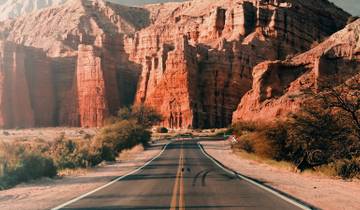
12 days
Salta to La Paz Travel Pass
- ✓ Comprehensive Bolivian Altiplano tour
- ✓ Expert local guides included
- ✓ All accommodation arranged
- ✓ Transportation provided
4 days
Uyuni Salt Flats & Desert Adventure 4D/3N (Atacama to Atacama)
- ✓ Comprehensive Bolivian Altiplano tour
- ✓ Expert local guides included
- ✓ All accommodation arranged
- ✓ Transportation provided
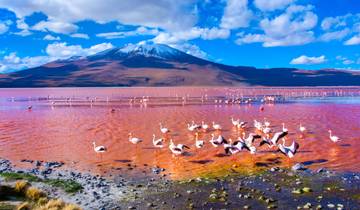
10 days
10 Days Essential and natural Bolivia: from Santa Cruz to the salar de Uyuni
- ✓ Comprehensive Bolivian Altiplano tour
- ✓ Expert local guides included
- ✓ All accommodation arranged
- ✓ Transportation provided
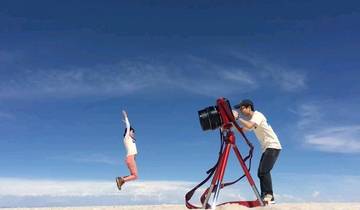
4 days
From La Paz: Uyuni Salt Flats ending in Atacama
- ✓ Comprehensive Bolivian Altiplano tour
- ✓ Expert local guides included
- ✓ All accommodation arranged
- ✓ Transportation provided
Multi-day tour packages powered by TourRadar. Prices and availability subject to change.
Complete Tour Itinerary 2026
Day 1: San Pedro de Atacama to Laguna Colorada 2026
Morning Departure (7:30-8:00 AM)
Tours begin with pickup from your San Pedro accommodation. Vehicles load at the tour operator’s office around 7:00 AM before beginning the climb out of San Pedro toward the Bolivian border. The route ascends through the Atacama’s barren landscapes, passing the turnoff to Laguna Chaxa and climbing steadily toward the high Andes.
Border Crossing at Hito Cajón (10:00-11:30 AM)
The Hito Cajón border crossing sits at approximately 4,400 meters elevation in stark, windswept terrain. Chilean exit formalities occur first—present your passport, receive your exit stamp, and ensure your Chile entry paperwork is processed correctly. The Bolivian immigration post lies a short drive beyond. Foreign visitors pay no entry fee for Bolivia, though US citizens must show their pre-purchased visa ($160 USD). The entire border process takes 1-2 hours depending on queues.
Eduardo Avaroa Reserve Entry (12:00-1:00 PM)
After border formalities, vehicles enter Bolivia’s Eduardo Avaroa Andean Fauna National Reserve. The entrance fee of 150 BOB ($22 USD) is collected here—bring cash in Bolivianos or US dollars. This protected area covers 7,147 square kilometers of high-altitude desert, lagoons, and volcanic landscapes.
Laguna Verde and Laguna Blanca (1:00-2:00 PM)
The first major stops showcase two stunning lagoons at the foot of Licancabur Volcano. Laguna Verde’s emerald-green waters (caused by arsenic and mineral content) contrast against the white shores of adjacent Laguna Blanca. The 5,868-meter Licancabur provides a dramatic backdrop. Temperatures here often drop below freezing despite bright sunshine—bundle up for photographs.
Afternoon Lagoons (2:00-5:00 PM)
The route continues north through increasingly spectacular terrain. Stops include Salvador Dalí Desert—named for rock formations resembling the surrealist painter’s melting landscapes—and smaller lagoons dotted with flamingo colonies. Laguna Hedionda (Stinking Lagoon, named for its sulfurous smell) often hosts hundreds of flamingos despite its name.
Laguna Colorada and Overnight (5:00-7:00 PM)
Day one culminates at Laguna Colorada (Red Lagoon), one of the Altiplano’s most striking sights. The lagoon’s red coloration comes from algae and mineral content, while white borax islands dot the surface. Thousands of flamingos—including rare James’s flamingos—feed in the shallow waters. Sunset here is spectacular as red lagoon meets orange sky.
Accommodation: Basic refuge near Laguna Colorada. Expect dormitory-style rooms with 4-8 beds, limited electricity (generator hours only), no heating, and basic shared bathrooms. Dinner included—simple but filling Bolivian fare.
Meals: Lunch (packed or at border area), dinner at refuge. Snacks and bottled water during stops.
Day 1 Summary: Border crossing fees included in tour price, park entrance $22 USD, personal snacks/extras $5-10 USD. Total additional day cost: $27-32 USD per person (meals and accommodation included in tour).
Day 2: Geysers, Hot Springs, and Lagoons 2026
Pre-Dawn Geyser Visit (4:30-6:00 AM)
Day two begins before sunrise with the drive to Sol de Mañana geyser field at 4,800 meters elevation—the tour’s highest point. Arriving in darkness, you’ll witness the geothermal activity intensify as morning light approaches. Fumaroles blast steam into the frigid air, mud pots bubble violently, and sulfur vents create an otherworldly landscape. Walk carefully on marked paths—the thin crust conceals boiling mud.
Temperatures at dawn range from -15 to -5°C. Wear every layer you brought and keep camera batteries warm in your pockets. The combination of steam clouds and early light creates remarkable photography opportunities, though sulfur smell permeates everything.
Hot Springs at Polques (6:30-7:30 AM)
After the frozen geyser experience, the thermal pools at Polques provide welcome relief. These natural hot springs maintain temperatures around 38-40°C despite the freezing air. Basic changing facilities exist, but many swimmers simply strip at the pool’s edge. The experience of soaking in steaming water while surrounded by snow-capped peaks and frozen landscape ranks among the tour’s highlights.
Bring swimwear, a quick-dry towel, and waterproof sandals. The walk from changing area to pool crosses cold ground. Sunrise over the mountains while floating in warm water is unforgettable.
Breakfast and Morning Journey (7:30-12:00 PM)
Breakfast at a refuge near the hot springs provides energy for the day’s driving. The morning route crosses the Valley of Rocks (Vallé de Rocas), where wind-sculpted formations create a surreal gallery of natural sculpture. The Stone Tree (Árbol de Piedra) stands as the area’s most photographed formation—a seven-meter rock balanced on a narrow base.
Midday Lagoons (12:00-3:00 PM)
The journey continues past additional high-altitude lagoons, each with unique characteristics. Laguna Cañapa hosts flamingo colonies in a tranquil setting. Smaller lagoons dot the route, their colors shifting from turquoise to emerald depending on mineral content and lighting. Lunch stops at a small village or refuge break up the driving.
Approach to Salt Flats (3:00-6:00 PM)
Late afternoon brings the first views of Salar de Uyuni in the distance—a seemingly infinite white line on the horizon. The transition from rocky Altiplano to salt flat edge creates dramatic landscapes as the terrain flattens and whitens.
Accommodation: Salt hotel or improved refuge near the salt flat edge. Salt hotels offer rooms constructed entirely from salt blocks—walls, floors, and furniture carved from the surrounding resource. Electricity and heating are more reliable than day one’s refuge.
Meals: Breakfast at refuge, lunch en route, dinner at accommodation.
Day 2 Summary: Hot springs entrance (sometimes included, otherwise $5-10 USD), personal snacks $5-10 USD, optional tips $5-10 USD. Total additional day cost: $15-30 USD per person (meals and accommodation included in tour).
Day 3: Salar de Uyuni and Arrival in Uyuni 2026
Sunrise on the Salt Flats (5:30-7:00 AM)
The final day begins with sunrise over Salar de Uyuni—10,582 square kilometers of crystalline salt stretching to every horizon. During dry season, geometric hexagonal patterns cover the surface as the salt crust contracts. During wet season, shallow water creates the famous mirror effect. Either way, sunrise paints the landscape in extraordinary colors as the first light touches the white expanse.
Morning Exploration (7:00-12:00 PM)
The tour dedicates significant time to salt flat exploration. Major stops include:
Isla Incahuasi (Fish Island): This rocky outcrop rises from the salt flat’s center, covered in giant cacti that can exceed 10 meters in height. A hiking trail climbs to the island’s summit, providing 360-degree views of the endless white landscape. Entrance fee: 30 BOB ($4.50 USD). The thousand-year-old cacti create fascinating compositions against the salt backdrop.
Photography Session: The featureless white landscape eliminates depth perception, enabling the famous forced perspective photographs. Groups spend 30-60 minutes creating creative images—dinosaur toys appearing to chase people, bottles appearing enormous, and other optical illusions. Bring colorful props and creative ideas.
Salt Extraction Areas: Near the town of Colchani, local workers extract and process salt using traditional methods. Piles of drying salt create geometric white pyramids across the landscape. Some tours stop at Colchani’s salt processing facilities and souvenir shops selling salt carvings and llama products.
Afternoon Completion (12:00-6:00 PM)
The tour crosses the salt flats toward Uyuni town, with additional stops including:
Train Cemetery: Just outside Uyuni, a collection of rusting steam locomotives from the early 20th century creates a hauntingly photogenic graveyard. These trains once transported minerals from Bolivia’s mines before the industry collapsed. The orange rust against blue sky offers excellent photography.
Arrival in Uyuni town occurs around 5:00-6:00 PM. Tour operators drop passengers at their offices or requested accommodations. The journey concludes in Uyuni’s main square, where connections to La Paz, Potosí, and Sucre await.
Meals: Breakfast at accommodation, lunch on salt flats, snacks throughout.
Day 3 Summary: Isla Incahuasi entrance $4.50 USD, personal snacks $5 USD, souvenirs $10-30 USD (optional), tips for driver/guide $10-20 USD. Total additional day cost: $29.50-59.50 USD per person (meals included in tour).
Tour Costs and Budget Breakdown 2026
Standard Tour Pricing 2026
Budget operators charge $180-220 USD per person for the three-day journey (check operators for current rates as pricing may vary). This includes transportation in shared 4×4 vehicles (typically six passengers), two nights basic refuge accommodation, all meals, and guide services. Budget tours use older vehicles, simple accommodation, and group sizes at maximum capacity.
Mid-range tours cost $250-300 USD with improvements including newer vehicles, smaller groups (4-5 passengers), upgraded refuges or basic salt hotel nights, and better meal quality. Guides often speak better English and provide more detailed information about landscapes and wildlife.
Premium tours range $350-450 USD for private or semi-private vehicles, guaranteed salt hotel accommodation, higher-quality meals, and experienced bilingual guides. Some premium options include photography-focused itineraries with flexibility for lighting conditions.
Additional Costs Not Included 2026
Bolivia park entrance fee: 150 BOB ($22 USD) per person, payable in cash at reserve entrance. Isla Incahuasi entrance: 30 BOB ($4.50 USD) per person, cash only. Hot springs entrance (if not included): 10-20 BOB ($1.50-3 USD). Tips for driver and guide: $10-30 USD total is customary for good service. Personal snacks, water, and alcoholic beverages: $20-40 USD for the tour period. Chilean exit fee: None (eliminated). Bolivia visa for US citizens: $160 USD (must be obtained in advance or paid at border).
Complete Budget Examples 2026
Budget Traveler Total:
Budget tour: $190 USD. Park entrance: $22 USD. Isla Incahuasi: $4.50 USD. Tips: $15 USD. Personal expenses: $25 USD. Total: $256.50 USD per person.
Mid-Range Traveler Total:
Mid-range tour: $275 USD. Park entrance: $22 USD. Isla Incahuasi: $4.50 USD. Tips: $25 USD. Personal expenses: $40 USD. Total: $366.50 USD per person.
Premium Traveler Total:
Premium tour: $400 USD. Park entrance: $22 USD. Isla Incahuasi: $4.50 USD. Tips: $40 USD. Personal expenses: $60 USD. Total: $526.50 USD per person.
Accommodation During the Tour 2026
Night 1: Laguna Colorada Refuges 2026
First-night accommodation consists of basic mountain refuges near Laguna Colorada at approximately 4,200 meters elevation. Conditions are rustic: dormitory rooms with 4-8 beds, mattresses with basic bedding, no heating, shared bathrooms with limited hot water, and electricity from generators running limited hours (typically 7-10 PM).
Temperatures inside refuges drop to 0-5°C overnight. Bring a sleeping bag rated to -10°C for comfortable sleep. Most travelers sleep in thermal layers, wool socks, and hats. Hot water for showers is inconsistent—some travelers skip showers entirely given the cold.
Budget tours use the most basic refuges with maximum capacity. Mid-range tours secure rooms with fewer beds or better-maintained facilities. Meal quality varies but typically includes soup, main course, and hot drinks.
Night 2: Salt Hotels or Improved Refuges 2026
Second-night accommodation varies more significantly by tour price level. Budget options use similar refuges to night one, located near the salt flat edge. Mid-range and premium tours include salt hotel accommodation—unique structures built entirely from salt blocks.
Salt hotels offer private or semi-private rooms with salt-block walls, floors, and furniture. Heating is more common, electricity more reliable, and bathrooms better maintained. The experience of sleeping in a building made of salt, with views over the flats at sunset and sunrise, justifies the price difference for many travelers.
Notable salt hotels on the tour route include Palacio de Sal (luxury, $200+ per night independently), Luna Salada (mid-range), and various smaller salt accommodations. Tour pricing reflects accommodation quality significantly.
Border Crossing Information 2026
Chile to Bolivia at Hito Cajón 2026
The Hito Cajón border crossing operates daily during daylight hours. The crossing sits at approximately 4,400 meters elevation on a desolate plateau between the countries. No services, ATMs, or facilities exist beyond the immigration posts themselves.
Chilean Exit: Present your passport and the tourist card (PDI form) received upon entry to Chile. Officers stamp your passport with an exit stamp. The tourist card must be surrendered—if lost, delays may occur while paperwork is processed. Keep your tourist card safe throughout your Chile visit.
Bolivian Entry: Most nationalities receive free entry stamps valid for 90 days. US citizens must show proof of pre-purchased visa or pay $160 USD at the border. Visa requirements include passport photos, proof of yellow fever vaccination (for travel to lowland areas), and completed forms. Processing takes 15-45 minutes depending on volume.
Tour guides manage most border logistics, ensuring all passengers complete procedures efficiently. Keep passport and any required documentation easily accessible—the process involves exiting and re-entering vehicles multiple times.
Documentation Requirements 2026
Essential documents include: valid passport with at least six months validity, Chilean tourist card (given upon entry to Chile), Bolivia visa for US citizens (or $160 USD cash for border purchase), and sufficient blank passport pages for stamps. Recommended additional documents: travel insurance documentation, yellow fever vaccination certificate, and emergency contact information.
Digital copies of all documents stored on your phone or email provide backup if originals are lost. The border area has no phone signal, so download copies before departure.
Best Time for the Cross-Border Tour 2026
Dry Season Tours (May-November) 2026
Dry season offers the most reliable travel conditions for the cross-border tour. Clear skies, minimal rain, and stable roads ensure tours operate without weather-related disruptions. The salt flats display their classic geometric patterns—hexagonal shapes formed by dried salt crystals stretching to infinity.
June through August brings coldest temperatures but also peak visibility and dramatic lighting. Night temperatures at Laguna Colorada drop to -15°C or lower, requiring serious cold-weather preparation. Daytime temperatures remain pleasant (5-15°C) under intense high-altitude sun.
September through November provides warmer conditions while maintaining dry-season clarity. This shoulder period often offers lower prices and fewer crowds while still delivering excellent conditions.
Wet Season Tours (December-April) 2026
Wet season transforms Salar de Uyuni into a giant mirror—but also introduces complications for cross-border tours. Rain can make roads impassable, canceling or rerouting tours without refunds. Tour operators monitor conditions daily, sometimes altering itineraries to avoid flooded areas.
When conditions cooperate, wet-season tours deliver the mirror effect: a thin layer of water covering the salt creates perfect reflections of sky and clouds. This phenomenon draws photographers worldwide but requires weather luck.
January through March sees heaviest rainfall and greatest disruption risk. December and April offer better odds of mirror conditions with fewer complete washouts. Temperatures are warmer (0-15°C nights) but weather is less predictable.
What to Pack for the Tour 2026
Essential Clothing 2026
Temperature ranges from -15°C to +20°C over the three days, demanding layered clothing for all conditions. Essential items include: thermal base layers (top and bottom), fleece or down mid-layer, warm down jacket, windproof outer shell, warm hat covering ears, thermal gloves, wool or thermal socks (multiple pairs), comfortable hiking shoes, and warm sleepwear for cold refuges.
Swimwear is essential for the hot springs stop. Quick-dry towel, waterproof sandals, and a bag for wet items make the experience more comfortable. Many travelers change poolside given minimal facilities.
Photography and Electronics 2026
Camera equipment faces extreme conditions: cold drains batteries rapidly, salt dust damages mechanisms, and bright reflective landscapes challenge exposure. Essential items include: camera with manual exposure control, extra batteries (minimum 3x normal usage), lens cleaning supplies, polarizing filter, waterproof camera bag or case, memory cards, and colorful props for forced perspective photography.
Power bank for phone charging is essential as refuges have limited outlets and electricity hours. Universal adapter for South American outlets (type C). Download offline maps and entertainment as no phone signal exists during the tour.
Health and Comfort Items 2026
Altitude sickness medication (acetazolamide/Diamox) should be started 1-2 days before the tour. High-SPF sunscreen (50+) and quality sunglasses protect against intense UV radiation. Bring lip balm with SPF, moisturizer for dry conditions, hand sanitizer, and personal medications.
Cash in US dollars and Bolivian Bolivianos covers park fees, optional expenses, and tips. ATMs don’t exist on the route. Budget $100-150 USD cash beyond tour payment.
Headlamp is essential for pre-dawn activities and refuge navigation. Toilet paper and wet wipes supplement basic bathroom facilities. Small daypack keeps daily essentials accessible during stops.
Booking Strategies for 2026
Where to Book Your Tour 2026
San Pedro de Atacama’s main street (Caracoles) hosts dozens of tour operators offering the Bolivia crossing. Walking the street and comparing options yields the best prices—operators compete aggressively, especially for next-day departures. Booking in San Pedro (rather than online before arrival) saves 10-30% on tour costs.
Major operators include Flamingo Travel, Lickana, Chile Andino, and numerous smaller agencies. Quality varies less than pricing—most use the same Bolivian partners for the actual tour operation. Focus on recent reviews, vehicle condition, and group size when selecting.
Hostels and hotels in San Pedro also book tours, sometimes at commissions. Direct operator booking typically offers better prices. Spend an afternoon visiting 3-5 operators before deciding.
Timing Your Booking 2026
Peak season (June-August and December-February) requires booking 1-2 weeks in advance for guaranteed departure dates with preferred operators. Last-minute spots exist but may mean joining lower-quality tours or waiting extra days.
Shoulder season (April-May and September-November) allows flexible booking 2-7 days ahead. Walk-in booking yields good prices and availability. Weekday departures sometimes offer slight discounts.
Forming groups before booking reduces costs. Most vehicles carry six passengers—a pre-formed group of 4-6 travelers can negotiate private vehicle rates or ensure compatible travel companions.
Questions to Ask Operators 2026
Before booking, confirm these details: Maximum group size (6 is standard, some promise smaller groups), vehicle age and condition (request to see the actual vehicle if possible), accommodation type for each night (basic refuge vs. salt hotel), meal quality and dietary accommodation, guide language abilities, departure and arrival times, and cancellation/weather policies.
Read recent reviews on Google, TripAdvisor, and Booking.com. Ask to speak with recent customers if possible. Request written confirmation of inclusions before payment.
Health and Safety Considerations 2026
Altitude Preparation 2026
The tour reaches 4,800 meters at Sol de Mañana geysers, with most areas above 4,000 meters. Proper acclimatization is essential. Spend at least 2-3 days at altitude before the tour—San Pedro de Atacama (2,400m) provides good preparation though isn’t as high as the tour reaches.
Altitude sickness symptoms include headache, nausea, fatigue, shortness of breath, and dizziness. Mild symptoms are normal and manageable. Severe symptoms (confusion, severe headache, difficulty breathing) require descent. Inform guides immediately if symptoms worsen.
Prevention strategies: Hydrate heavily (3-4 liters daily), avoid alcohol, eat light meals, rest adequately, and consider acetazolamide (Diamox) starting 1-2 days before the tour. Coca tea and coca leaves help many travelers—available throughout Bolivia.
Sun and Cold Protection 2026
High-altitude UV radiation is extreme. The combination of thin atmosphere, reflective salt and snow, and prolonged outdoor exposure creates sunburn risk even on cloudy days. Apply SPF 50+ sunscreen every two hours, wear quality UV-blocking sunglasses, and use a wide-brimmed hat.
Cold temperatures pose risks of hypothermia if underprepared. Night temperatures at refuges require serious warm clothing and a quality sleeping bag. Daytime can be warm in the sun but drops rapidly in shade or wind. Layer clothing to adjust throughout the day.
Medical Considerations 2026
No medical facilities exist on the tour route. Guides carry basic first aid and oxygen bottles for altitude emergencies. Bring personal medications, pain relievers, anti-diarrheal medicine, and any prescription medications. Stomach issues are common—eat carefully at refuges and drink only bottled water.
Travel insurance covering high-altitude activities and emergency evacuation is strongly recommended. Some policies exclude activities above certain elevations—verify coverage before departure.
Connecting Your Journey 2026
Arriving in San Pedro de Atacama 2026
San Pedro de Atacama is accessible via Calama airport (100km away) with shuttle services ($15-25 USD per person) connecting to town. Buses from Santiago (22 hours, $40-70 USD), Arica (12 hours, $25-40 USD), and other Chilean cities arrive at San Pedro’s terminal.
Allow at least 2 nights in San Pedro before the Bolivia tour—this provides acclimatization time, tour booking opportunity, and buffer for travel delays. San Pedro offers excellent attractions including Valle de la Luna, El Tatio geysers, and various lagoons for pre-tour exploration.
Continuing from Uyuni 2026
After arriving in Uyuni, connections continue to major Bolivian destinations. Flights to La Paz depart daily (50 minutes, $80-150 USD). Buses connect to La Paz (10-12 hours, $15-25 USD), Potosí (4-5 hours, $8-12 USD), and Sucre (9-10 hours, $18-25 USD).
Many travelers overnight in Uyuni before continuing—budget hotels cost $15-35 USD, mid-range options $50-90 USD. The town offers limited attractions but adequate services for transit.
Popular onward routes include: La Paz and Lake Titicaca, Sucre’s colonial architecture, Potosí’s mining history, or continuing south to Argentina via Villazón.
Frequently Asked Questions About the San Pedro to Uyuni Tour 2026
Is the San Pedro to Uyuni tour difficult in 2026?
The tour is physically demanding due to altitude (reaching 4,800m), cold temperatures (-15°C at night), and basic accommodation. However, no hiking or extreme activity is required—most time is spent in vehicles or walking short distances at stops. Anyone with reasonable fitness and proper acclimatization can complete the tour. Those with serious respiratory or cardiac conditions should consult doctors before booking.
What happens if weather cancels the tour in 2026?
Weather cancellations are most common during wet season (December-April). Policies vary by operator—some offer full refunds, others reschedule, and some provide partial refunds only. Confirm cancellation policies before booking. Travel insurance may cover disruptions if policies exclude operator refunds. Dry season tours rarely face weather cancellations.
Can I bring luggage on the tour in 2026?
Yes, but space is limited. Most operators accept one backpack or small suitcase (15-20kg) per person plus a daypack. Larger luggage can often be stored at San Pedro accommodations for pickup later. Pack only essentials for the three days—excess items add hassle in limited vehicle space.
Is food included, and can dietary needs be accommodated in 2026?
All meals are included: lunch on day one, dinner and breakfast at refuges, and lunch on the final day. Meals are simple—soups, rice dishes, pasta, bread, and hot drinks. Vegetarian options are available with advance notice. Vegan, gluten-free, and other specific requirements should be confirmed before booking and reminded at tour start. Quality varies significantly by tour price level.
Are tips expected on the tour in 2026?
Tips are customary but not mandatory. For satisfactory service, $10-20 USD total for driver and guide is appropriate. For exceptional service, $20-30 USD shows appreciation. Tips are typically collected at the tour’s end and split between crew members. Cash in US dollars or Bolivianos is preferred.
Can I extend the tour to four days in 2026?
Yes, four-day tours are available for $250-400 USD. The extra day typically includes additional lagoons, more time at each stop, and a more relaxed pace. Four-day tours are especially valuable for photographers wanting optimal lighting at multiple locations. Ask operators about four-day options when booking.
What if I get altitude sickness during the tour in 2026?
Guides carry oxygen bottles for acute altitude symptoms. Mild symptoms (headache, fatigue) are normal—rest, hydration, and coca tea help most travelers. Severe symptoms require descent to lower elevation, which may mean ending the tour early. There’s no refund for medical evacuation. Proper acclimatization before the tour significantly reduces risk.
Is it safe to drink the water during the tour in 2026?
No—drink only bottled water provided during the tour or purchased beforehand. Don’t brush teeth with tap water at refuges. Avoid ice and raw vegetables washed in local water. Stomach issues are common even with precautions—bring anti-diarrheal medication just in case.
Can I charge my devices during the tour in 2026?
Limited electricity exists at refuges—generators typically run 7-10 PM only. Outlets are few and shared among all guests. Bring a power bank with sufficient capacity for three days. Some salt hotels have more reliable power. USB car chargers may be available in vehicles—ask your driver.
Should I bring Bolivian currency before the tour in 2026?
Yes, bring some Bolivianos (200-300 BOB) for park fees, hot springs, and small purchases. US dollars are also widely accepted. ATMs don’t exist on the route, and San Pedro’s ATMs may have high fees or limited function. Exchange currency in San Pedro before departure—rates are reasonable at town exchange offices.