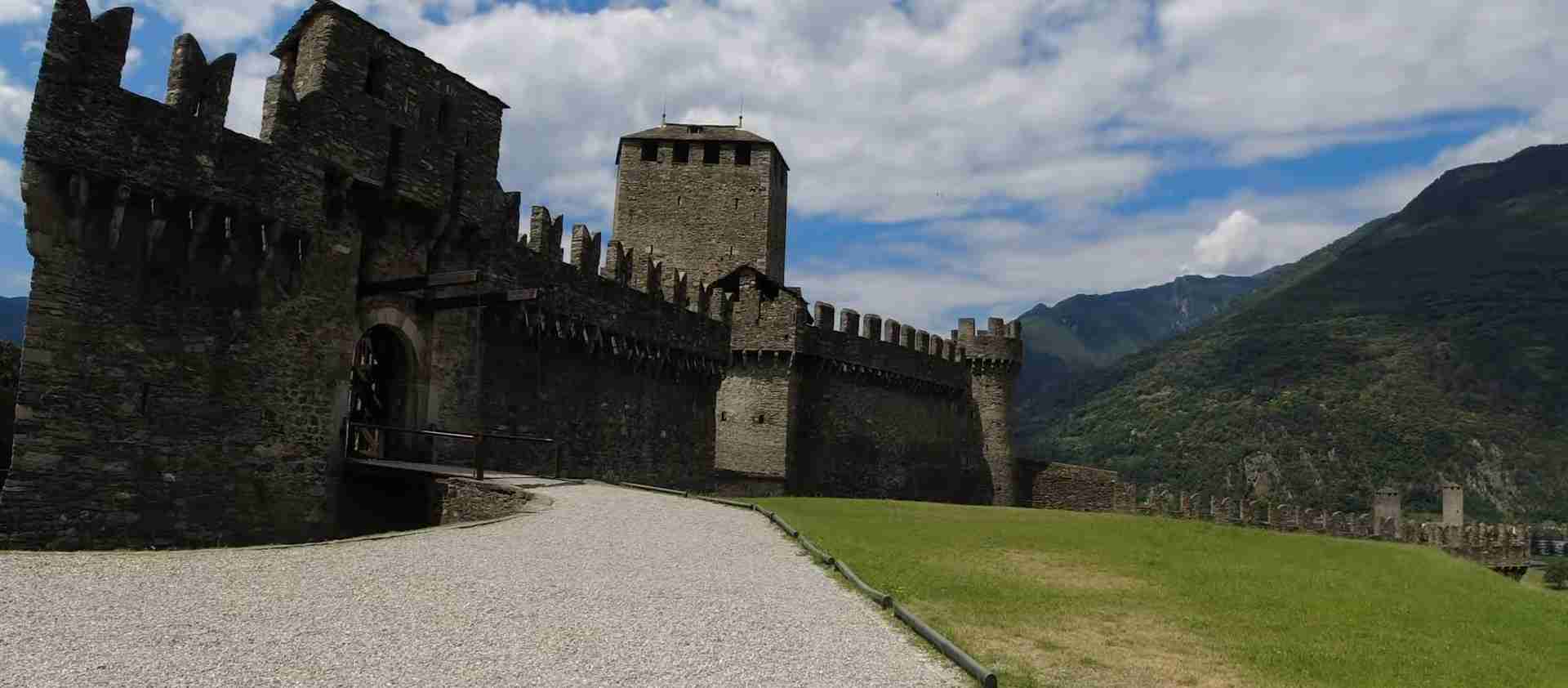
Three Castles of Bellinzona: Complete UNESCO World Heritage Guide
Rising dramatically from the Swiss Alpine foothills, the fortified ensemble of Bellinzona stands as the sole surviving example of comprehensive medieval military architecture in the entire Alpine arc. These three imposing castles — Castelgrande, Montebello, and Sasso Corbaro — together with their connecting defensive walls and ramparts, protected the strategic Ticino Valley for centuries and earned UNESCO World Heritage status in recognition of their exceptional preservation and architectural significance.
Key Takeaways
- Unique Alpine Fortification: The Three Castles of Bellinzona represent the only visible example in the entire Alpine Arc of medieval military architecture comprising multiple castles linked by defensive walls that once closed off the entire Ticino Valley.
- UNESCO Recognition: Inscribed as a UNESCO World Heritage Site in November 2000, the fortifications earned recognition under criterion (iv) as an outstanding example of late medieval defensive structure guarding a key strategic Alpine pass.
- Strategic Importance: Positioned where the Ticino and Moesa rivers meet, Bellinzona controlled several critical Alpine pass routes connecting northern to southern Europe, including the St. Gotthard, Nufenen, Lukmanier, and St. Bernard passes.
- Three Distinct Castles: Castelgrande stands on a rocky peak overlooking the valley with fortifications dating to the 4th century, Montebello forms an integral part of the town’s defensive walls at 90 meters elevation, and Sasso Corbaro occupies an isolated promontory at 230 meters offering commanding valley views.
- Milanese Architecture: Built primarily under the Visconti (1277-1447) and Sforza dynasties (1450-1535) of Milan, the fortifications showcase 15th-century Italian Renaissance military engineering adapted to mountainous terrain.
- Accessible Heritage: All three castles house museums and exhibitions, with the Fortezza Pass providing comprehensive access to the fortifications, towers, archaeological collections, and temporary exhibitions throughout the complex.
People Also Ask About Bellinzona Castles
Why Were the Three Castles of Bellinzona Built?
The origin of Bellinzona’s fortifications is linked to the strategic situation of the site that controls the Ticino Valley access to the principal Alpine passes constituting the passage into the Milanese, effectively controlling movement between northern Italy and regions north to the Danube and beyond. Bellinzona has always occupied an important geographic location in the Swiss Alps, situated where the Ticino and Moesa rivers meet with several key Alpine pass routes connecting northern to southern Europe. The Dukes of Milan recognized this chokepoint’s value for defending their northern territories and controlling lucrative trans-Alpine trade routes, investing enormous resources in creating an impenetrable defensive system that could block the valley entirely and protect both military forces and the civilian population.
What Makes Bellinzona Castles Unique in Alpine Architecture?
The fortified ensemble of Bellinzona is the only visible example in the entire Alpine Arc of medieval military architecture comprising several castles linked by a wall that once closed off the whole Ticino Valley, along with ramparts that surrounded the town for the protection of the civilian population. Bellinzona constitutes an exceptional case among the greatest fortifications of the 15th century, both by the dimension of its architecture influenced by the site and topography and by the excellent state of conservation of the ensemble. Unlike isolated fortress structures common elsewhere in the Alps, Bellinzona created an integrated defensive system where multiple castles at different elevations worked together with connecting walls to create overlapping fields of fire and multiple defensive lines, representing a sophistication of military planning unmatched in the region.
Which Castle Should First-Time Visitors Prioritize?
Castelgrande is the largest castle and stands right in the town center, making it the most accessible and comprehensive introduction to Bellinzona’s medieval fortifications. The castle houses the Castelgrande Museum where exhibits testify to 6,500 years of human presence on the hill, from the first Neolithic village to the 20th century, including a nucleus of 144 tempera drawings on paper from around 1470. For visitors with limited time, Castelgrande provides the most complete experience with its archaeological museum, imposing towers, extensive ramparts, and central location accessible directly from the train station via a panoramic elevator. The combination of historical depth, architectural grandeur, and convenient access makes it the essential starting point for understanding the fortress complex.
How Are the Three Castles Connected?
The defensive walls of the old town originate at Montebello and join up with those from San Michele hill, with parts of both branches protecting the north and south sides of the fortress still remaining. Castelgrande is located on a rocky peak overlooking the valley with a series of walls that protect the old city and connect to Montebello, while Sasso Corbaro is located on an isolated rocky promontory south-east of the other two. Visitors can walk along portions of the original defensive walls between castles, following pathways that medieval soldiers once patrolled. The ascent from Castelgrande to Montebello takes approximately 25 minutes on foot, while reaching Sasso Corbaro from Montebello requires another 30 minutes of uphill hiking, though a tourist train and bus service provide alternatives to walking the entire network.
Extended multi-day tours – 5+ days
Featured Bellinzona Multi-Day Tour Packages
3 days
Bellinzona 3-Day Discovery Tour
- ✓ Comprehensive Bellinzona experience
- ✓ Expert local guides included
- ✓ All accommodation included
- ✓ Transportation provided
5 days
Bellinzona 5-Day Highlights Experience
- ✓ Comprehensive Bellinzona experience
- ✓ Expert local guides included
- ✓ All accommodation included
- ✓ Transportation provided

7 days
Bellinzona 7-Day Cultural Journey
- ✓ Comprehensive Bellinzona experience
- ✓ Expert local guides included
- ✓ All accommodation included
- ✓ Transportation provided
10 days
Bellinzona 10-Day Complete Adventure
- ✓ Comprehensive Bellinzona experience
- ✓ Expert local guides included
- ✓ All accommodation included
- ✓ Transportation provided
Multi-day tour packages powered by TourRadar. Prices and availability subject to change.
Introduction: Switzerland’s Greatest Medieval Fortress
The fortress of Bellinzona stands as one of medieval Europe’s most ambitious and successful defensive projects, a testament to the strategic importance of controlling Alpine passage routes between the Italian peninsula and central Europe. Located in the Italian-speaking Canton of Ticino in southern Switzerland, this fortified ensemble represents the culmination of 15th-century military architecture, combining topographical advantages with sophisticated engineering to create an impenetrable barrier across the Ticino Valley.
The Three Castles, Defensive Wall and Ramparts of the Market-Town of Bellinzona were inscribed on the UNESCO World Heritage List in 2000 as site number 884 under criterion (iv), which recognizes properties as outstanding examples of a type of building, architectural or technological ensemble or landscape that illustrates significant stage in human history. The site’s official description highlights it as an outstanding example of a late medieval defensive structure guarding a key strategic Alpine pass, emphasizing its role in protecting the Ticino Valley and controlling access between northern Italy and the Swiss Alps.
What distinguishes Bellinzona from countless other medieval fortifications across Europe is the comprehensive nature of its defensive system. Rather than relying on a single fortress, however imposing, the Dukes of Milan created a layered defense in depth that combined three major castles at different elevations, extensive curtain walls connecting the fortifications, a massive transverse wall (the Murata) that blocked the valley floor entirely, and protective ramparts surrounding the civilian population in the town below. This integration of multiple defensive elements into a unified system specifically designed to exploit the natural topography represents medieval military engineering at its most sophisticated.
The fortress complex controlled access to several critical Alpine passes including the St. Gotthard, Nufenen, Lukmanier, and St. Bernard routes, making it the key to northern Italy’s security. Bellinzona’s strategic position at the crossroads of the alpine routes connecting the North to the South is the reason why around the year 400 an important defensive project with three castles, towers and city walls was built. For the Duchy of Milan, losing Bellinzona would have opened the heartland of Lombardy to invasion from the Swiss Confederation and the Holy Roman Empire, making the fortifications worth any investment required to maintain their impregnability.
Today, these fortifications serve an entirely different purpose, welcoming visitors from around the world to explore exceptionally preserved medieval military architecture and learn about the centuries of conflict, diplomacy, and cultural exchange that shaped the Alpine region. The museums housed within the castle walls showcase archaeological treasures spanning millennia, from Neolithic settlements to Renaissance artworks, while the ramparts and towers offer sweeping panoramas across the Ticino Valley that explain at a glance why this location held such strategic significance.
UNESCO World Heritage Designation and Significance
The three castles of Bellinzona, together with the walls and ramparts, joined the ranks of prestigious UNESCO World Heritage sites on November 30, 2000, with the wording that the fortifications of Bellinzona are an extraordinary example of a late-medieval defensive structure located at a key strategic point on the Alpine pass. This recognition placed Bellinzona alongside the world’s most significant cultural landmarks, acknowledging both its architectural merit and its exceptional state of preservation.
The UNESCO inscription covers the entire fortified ensemble under the official title “Three Castles, Defensive Wall and Ramparts of the Market-Town of Bellinzona.” The three castles, the Murata and the buffer zone are protected by the Degree of 18 May 1926 and amended on 23 October 1962 by the Council of State of the Canton of Ticino, with all the fortifications shown in the land development plan for the territory of the Bellinzona Commune as monuments of cantonal and national interest, thus benefitting from all the instruments of protection provided in both federal and cantonal legislation in force.
This ensemble holds broader cultural and historical significance as the best-preserved late medieval defensive system in the Alpine region, exemplifying 15th-century Milanese fortification techniques developed under the Dukes of Milan to secure their territories against Swiss incursions. The fortifications, constructed primarily between 1460 and 1500, represent a pioneering integration of Italian Renaissance military architecture into mountainous terrain.
The criterion (iv) designation specifically recognizes Bellinzona’s importance in illustrating a significant stage in human history through its architectural ensemble. The fortifications demonstrate the transition from medieval high-walled castles to Renaissance fortifications designed to withstand artillery bombardment, showcasing how military architecture evolved in response to gunpowder technology. The low, sloped walls and angular bastions at key points reduced vulnerability to cannon fire while maintaining defensive effectiveness, a departure from traditional vertical medieval keeps.
Equally significant is the fortifications’ excellent state of conservation. Many medieval defensive structures across Europe survive only as ruins or have been heavily reconstructed, but Bellinzona’s three castles and defensive walls retain their original form and structure to a remarkable degree. This authenticity allows visitors and scholars to study late medieval military architecture in its original context rather than attempting to reconstruct designs from fragmentary remains.
A Convention concerning the management of the Bellinzona castles, signed by the Council of State of the Canton of Ticino, the town of Bellinzona and the Bellinzona Tourism Board, grants the Tourism Board the responsibility for the management of the castles according to a coordinated concept of use that aims to valorise the heritage monuments from a cultural and a tourism perspective. This collaborative management structure ensures professional stewardship of the UNESCO site while making it accessible to the public and sustainable for future generations.
Strategic Geographic Position: Gateway to the Alps
Understanding Bellinzona’s fortifications requires understanding the geography that made this location strategically vital for over a millennium. The site sits at a natural bottleneck where the Ticino Valley narrows dramatically, creating a chokepoint that any military force moving between northern Italy and central Europe had to traverse.
Bellinzona is situated a few kilometres south of Arbedo, where the Ticino and Moesa rivers meet, with several key Alpine pass routes connecting northern to southern Europe converging at this point. From the north, travelers and armies approaching from the St. Gotthard Pass descended into the Ticino Valley directly at Bellinzona. Those using the Nufenen, Lukmanier, or San Bernardino passes similarly converged on this location, making it the unavoidable gateway controlling access to the Lombardy Plain and the wealthy cities of Milan, Como, and Pavia.
The valley’s topography provided exceptional defensive advantages. Rocky promontories rise sharply on the eastern side of the valley floor, offering elevated positions for fortifications that commanded the entire passage. The Ticino River runs along the western edge, providing a natural barrier that limited approach routes and created marshy ground that impeded siege operations. Between the river and the rocky heights, the valley floor narrows to less than 300 meters at certain points, a constriction that allowed a properly fortified position to block passage entirely.
For the Duchy of Milan, controlling this bottleneck meant controlling access to its northern territories and protecting the heartland of Lombardy from invasion. The Swiss Confederation, expanding southward from the central Alps throughout the 14th and 15th centuries, repeatedly attempted to seize Bellinzona specifically because capturing it would open the route to northern Italy and the lucrative trade that flowed through these passes. The strategic stakes were so high that both sides invested enormous resources in either fortifying or attacking this single location.
The commercial importance matched the military significance. Trans-Alpine trade represented one of medieval Europe’s most profitable enterprises, with goods moving between Italian cities and markets in Germany, France, and the Low Countries. The Gotthard Pass in particular became a major trade route after its path was improved in the 13th century, and Bellinzona controlled who could use this route and what taxes they paid for the privilege. The revenues from controlling this trade helped fund the massive construction projects required to build and maintain the fortifications.
Even after losing military significance following Switzerland’s adoption of neutrality in the 16th century, Bellinzona remained an important transportation hub. Today’s modern highways and railway lines follow essentially the same routes through the valley that medieval merchants and armies once traveled, confirming that the geographic advantages that made this location strategically vital centuries ago continue to shape transportation patterns in the modern era.
Historical Development: From Roman Outpost to Swiss Fortress
The strategic importance of Bellinzona’s location was recognized long before medieval castles crowned its heights. The Castelgrande hill was first settled around 5,500 BC, with archaeological evidence revealing millennia of continuous human occupation. Exhibits in the Castelgrande Museum testify to 6,500 years of human presence on the hill, from the first Neolithic village to the 20th century.
The first fortification at Castelgrande was built as early as the 4th century, with various architectural eras leaving their traces on its walls over the following millennium. Roman legions recognized the site’s defensive potential and constructed an early fortification to guard the valley passage, establishing a pattern of military occupation that would continue for the next 1,600 years.
The medieval period brought systematic fortification development. The Montebello castle complex was constructed during the 13th and 14th centuries. Most probably, Montebello was built by the Rusca family of Como who kept it for a long period of time, even during the rule of the Visconti. These early medieval structures established the basic defensive framework that would later be expanded and strengthened under Milanese control.
The Visconti dynasty of Milan gained control of Bellinzona in 1340, though they did not receive formal feudal rights until 1396 when granted by King Wenceslaus. The orderly growth of Bellinzona was threatened in 1402 when Duke Gian Galeazzo Visconti died, leading to a succession crisis. In 1403 Bellinzona was taken under the control of Alberto di Sacco of Val Mesolcina, who held it until 1419 when it was taken over by Uri and Obwalden which had expanded into the Leventina Valley.
Milan attacked the city in 1422 after an offer to buy it was rejected by the Swiss Confederation, and troops from Uri and Obwalden were quickly driven from the city and later defeated at the Battle of Arbedo on June 30, 1422. This defeat temporarily discouraged Swiss expansionist intentions toward Lake Maggiore, allowing Milan to consolidate control and begin the major fortification projects that would create the defensive ensemble visible today.
Following the death of Duke Filippo Maria Visconti in 1447, Bellinzona was in the middle of a succession crisis that lasted nearly three years until Francesco I Sforza seized power in Milan. The Sforza dynasty brought the stability and resources needed for major construction projects. The external courtyards with towers and the Rivellino at Montebello were built by Sforza engineers in the second half of the 15th century.
The peace was broken again in 1478 when the Swiss once again attacked Bellinzona unsuccessfully, though Swiss pride was restored by the Battle of Giornico which followed, where a force of 600 Swiss soldiers defeated 10,000 Milanese troops. This military pressure prompted the most dramatic expansion of Bellinzona’s defenses. The Sasso Corbaro fortress was built on the orders of the Duke of Milan in only six months in 1479. Following the attack, Milan built Sasso Corbaro on the site of a tower which had been built nearly a century before, while the other two castles were strengthened and the Murata wall across the valley was rebuilt.
The fortifications’ first major test came during the Italian Wars when French forces allied with Milan against the Swiss. Ludovico Sforza captured Bellinzona and, fearing an attack by the Swiss, fortified Castelgrande with 1,000 troops. Throughout the winter of 1499/1500 unrest in Bellinzona grew until January when an armed revolt of the citizens drove the French troops from the city. Following the capture of Ludovico Sforza in April 1500 and seeking protection from France, Bellinzona joined the Swiss Confederation on April 14, 1500.
Bellinzona remained under the joint administration of Uri, Schwyz and Unterwalden until the creation of the Helvetic Republic after the French invasion of Switzerland in 1798. In 1506 the three castles were divided between the Swiss Confederates of Uri, Schwyz and Nidwalden. Now that Bellinzona’s castles were no longer needed to defend against the Swiss, the walls were allowed to fall into disrepair.
A severe flood of the Ticino River in 1515, the “Buzza di Biasca,” destroyed part of Castlegrande’s Murata, but this was quickly repaired. When flooding in 1515 destroyed part of the Murata the damage was not repaired, as the defensive walls had lost their strategic importance. Each canton occupied one of the three castles with a small garrison of troops and outdated artillery.
By the middle of the 19th century all three castles were in a state of disrepair, and the Canton of Ticino tried to sell the Castlegrande in 1881. The first of a series of continuous restorations began just after 1900, with intensive efforts lasting from 1920-1955, and archaeological and restoration work continues at the castles to this day.
Castelgrande: The Ancient Foundation
Castelgrande is the largest of the three castles that make up the Fortress of Bellinzona, standing on a hill that has been inhabited for over 6,000 years. This imposing structure dominates the town center, its massive walls and towers rising from the rocky promontory that has served as a fortified position since Roman times. As the oldest and most extensively developed of the three castles, Castelgrande represents the historical core of Bellinzona’s defensive system.
Records from the 11th to 15th centuries as well as archeological evidence indicate that the castle grounds were once full of buildings, however most of these were pulled down by the Dukes of Milan to free up interior space. The open space was divided into three large baileys which served to provide temporary housing for troops that could be stationed in Bellinzona. This cleared interior space allowed the castle to accommodate large military forces during times of conflict while maintaining the defensive strength of the perimeter walls.
Under the Dukes of Milan, the outer fortifications were extended and strengthened with walls raised and extended while towers were added. The western walls were wholly rebuilt and connected to the city walls. These improvements transformed Castelgrande from a medieval fortress into a sophisticated defensive structure capable of withstanding artillery bombardment.
The castle’s most distinctive features are its two massive towers. The elegance of the 27-meter-high White Tower (1250-1350) and the impressiveness of the 28-meter-high Black Tower (1310) are particularly noteworthy. The Torre Bianca (White Tower) dates to the 13th century and stands as the tallest tower of Castelgrande, located in the center of what was the old keep. The Black Tower houses an amusing “Escape Room” dedicated to the Rabadan Carnival, Bellinzona’s historic event which is one of Switzerland’s largest carnival celebrations.
The walls that separate the three baileys all radiate from the 14th-century Torre Nera (Black Tower), which is located in the center of the castle. This central positioning allowed defenders to maintain control over the entire castle complex and respond quickly to threats from any direction.
The battlements are divided into three sections, one of which still descends right into the town center, and at the time of the Visconti, this remaining bulwark reached down as far as the river Ticino. The defensive wall was built in the late 14th century and fortified by the Sforza dukes of Milan between 1486 and 1489. Walking these battlements provides spectacular views across the valley and demonstrates how the fortifications integrated with the town’s defensive perimeter.
Architect Aurelio Galfetti carried out the latest extensive restorations in 1984-1991, with the inner courtyard, the entrances, the elevator and the steps leading down to the town center representing a stunning exemplification of the castle’s transformation. These sensitive modern interventions make the castle fully accessible while preserving its historical character, including a panoramic elevator that lifts visitors from the Piazza del Sole directly into the castle courtyard.
The museum is located over two floors of the south wing of Castelgrande in the ducal fortress restored by architect Aurelio Galfetti between 1980-91. In the archaeological history section, there is a brief presentation of the 6,500 years of human presence on the hill, from the first Neolithic villages to the 20th century, including a collection of coins from the 16th century providing evidence of a mint for three primitive cantons.
In the historical-artistic section of the museum, a nucleus of 144 tempera drawings on paper from around 1470 is presented, which originally adorned the wooden ceiling of a magnificent 15th-century residence in the town center. These remarkable artworks provide insight into the artistic culture of late medieval Bellinzona and the wealth that flowed through this strategic trading point.
The Arsenal Hall within Castelgrande regularly hosts temporary exhibitions on various themes, ensuring that the castle remains a vital cultural venue rather than merely a historical monument. A guide in four languages, which can be downloaded to smartphones, accompanies visitors on their tour of the exhibition.
Castelgrande’s central location makes it the most accessible castle in the ensemble, positioned just five minutes on foot from Bellinzona’s train station. The combination of easy access, comprehensive museum collections, impressive architecture, and panoramic views from the battlements makes it the essential foundation for any visit to the Bellinzona fortifications.
Montebello: The Connecting Fortress
The second castle in Bellinzona is located on the hill of Montebello about ninety meters above the level of the city, dominating Castelgrande from above. This intermediate position between Castelgrande and Sasso Corbaro made Montebello the crucial link in Bellinzona’s defensive system, able to support either castle while commanding the valley approaches.
Montebello is the name of the hill on which the castle stands, 90 meters above Castelgrande, and the defensive walls of the old town originate here and join up with those from San Michele hill. There are still parts of both branches of these walls protecting the north and south sides of the fortress. Walking these surviving wall sections demonstrates how Montebello served as the anchor point for the town’s defensive perimeter, integrating the castle into a comprehensive fortification system.
The internal nucleus of the castle dates back to the 13th/14th century and has been restored several times. This medieval core preserves the original defensive layout created when local noble families first fortified the hill, providing insight into how castle architecture evolved over the subsequent centuries.
Most probably, Montebello was built by the Rusca family of Como who kept it for a long period of time, even during the rule of the Visconti. The Rusca were powerful nobles who controlled much of the region around Lake Como, and their fortification of Montebello represented an assertion of local power in competition with Milan’s expanding influence. The Visconti eventually absorbed these local powers into their duchy, but the fortress the Rusca built remained valuable for defending Milanese territory.
The external courtyards with the towers and the Rivellino were built by Sforza engineers in the second half of the 15th century. These outer defenses represent the most sophisticated military architecture at Montebello, incorporating lessons learned from decades of Italian warfare and designed specifically to resist artillery bombardment. The Rivellino (an outer defensive work) created additional protective layers that attackers had to breach before reaching the castle’s main walls.
During the period of Swiss control, the castle took on different names reflecting its various occupants. During Swiss occupation, the castle was called Castello di Svitto but it was renamed Castello di San Martino when Ticino became an independent canton. Today it is universally known as Montebello, the name of the hill it occupies.
The castle houses the Archeologia Montebello exhibition, which showcases archaeological findings from the Bellinzona region. This museum complements the broader historical collection at Castelgrande by focusing specifically on material culture and archaeological evidence, providing tangible connections to the people who lived in and around these fortifications across the centuries.
The Montebello Festival takes place here every year, organized by the city of Bellinzona in cooperation with the local tourist office. The festival first kicked off in 2005 and brings together international guests and artists for a special musical event in unique atmosphere. These contemporary cultural events demonstrate how the castle continues to serve as a living cultural venue rather than merely a preserved historical site.
Reaching Montebello from Castelgrande requires a 25-minute uphill walk through the old town, following paths that medieval soldiers once patrolled between the two fortifications. This walking connection between castles allows visitors to experience the integrated nature of the defensive system, understanding how forces could be shifted between strongpoints as tactical situations demanded.
The views from Montebello’s ramparts encompass both Castelgrande below and Sasso Corbaro above, illustrating the castle’s intermediate position in the defensive hierarchy. From these battlements, commanders could observe the entire valley floor and coordinate defensive responses across all three castles simultaneously.
Sasso Corbaro: The High Sentinel
Sasso Corbaro’s name in Italian means “Raven rock” from the dialect word “corbatt,” because it stands on a rock as dark as the feathers of a crow. Sasso Corbaro is a typical fortress in the Sforza style, with thick walls reduced to the simplicity of a geometric figure. This austere, functional design reflects its construction during a military emergency when speed and defensive effectiveness took priority over architectural elaboration.
The Sasso Corbaro fortress was built on the orders of the Duke of Milan in only six months in 1479. Built between 1479 and 1482, the fortification is mainly characterized by its watch tower as well as the massive main tower. This remarkably rapid construction followed the 1478 Swiss attack on Bellinzona, which revealed vulnerabilities in the existing defensive system. The Duke of Milan recognized that controlling the heights above Montebello was essential to preventing Swiss forces from establishing positions that could bombard the lower castles.
Sasso Corbaro’s dominant position 230 meters above the town meant better protection of the Ticino Valley. Thanks to its exposed position, Sasso Corbaro offers a panoramic view of the other castles, the town of Bellinzona and the surrounding countryside with Lake Maggiore in the distance. This commanding elevation meant that no enemy force could establish artillery positions overlooking the fortress complex, eliminating the threat of bombardment from above.
The castle, starkly geometrical in shape, stands in a square courtyard enclosed by high walls which are as much as 7 meters thick at the point where they join the keep on the northern side. These massive walls were designed to absorb cannon fire, representing the latest Renaissance military architecture adapted to mountainous terrain. The lookout tower on the southern side is still almost intact.
Its geometrical shape makes Sasso Corbaro a typical Sforza castle, reflecting the standardized military architecture that Milanese engineers developed and applied across their territory. Unlike Castelgrande and Montebello, which evolved over centuries incorporating multiple architectural periods, Sasso Corbaro was conceived and executed as a unified design, giving it an architectural coherence that the other castles lack.
Sasso Corbaro was built with a strategic vision that the intention was to secure controlling posts on the heights to complement the entire complex. The castle was never intended to operate independently but rather to complete a defensive system where three mutually supporting strongpoints at different elevations could concentrate fire on any force attempting to force the valley passage.
During early Swiss occupation, the castle was known as the Castle of Unterwalden but was renamed Castle of Santa Barbara in 1818 and today is called Sasso Corbaro or Castello di Cima. It was abandoned in 1798 and started to deteriorate, and it would have fallen into complete disrepair had the Canton not interceded in 1870, handing it over to an organization which planned to turn it into a hotel, and later to three Bellinzona families who transformed it into a summer residence.
The castle now houses temporary exhibitions and conference rooms, making use of the interior spaces while preserving the fortress architecture. Within its thick walls you can find various interesting permanent and temporary exhibitions where you learn more about the history of the castles.
As the highest of the three castles, Sasso Corbaro features the best view, looking north over the city and Riviera valley to Pizzo di Claro. Sasso Corbaro is particularly suitable as the final stop on a castle tour, with those who want to visit all three castles in Bellinzona often finishing with this castle to enjoy a panoramic view which can be particularly atmospheric in the late afternoon or at dusk.
Reaching Sasso Corbaro requires the most effort of the three castles, with a 30-minute uphill walk from Montebello that gains 150 meters of elevation. This climb explains why Sasso Corbaro was considered unassailable from below and why no attacking force ever seriously attempted to storm it directly. Modern visitors can take bus line 4 from Bellinzona station or use the seasonal tourist train to avoid the climb while still enjoying the spectacular views from the ramparts.
The Murata: Valley-Blocking Defensive Wall
The three castles alone could not seal the Ticino Valley against passage. To create a truly impenetrable barrier, the Dukes of Milan constructed a massive defensive wall known as the Murata that stretched across the entire valley floor from the rocky heights where Castelgrande stands to the Ticino River on the western side.
The ensemble comprises three castles and a network of fortifications with towers and defence works that command the Ticino Valley and dominate the town centre, with walls that once closed off the whole Ticino Valley. This transverse wall created a continuous defensive line that no army could bypass, forcing any invasion force to either breach the fortifications directly or abandon the valley route entirely.
The battlements descending from Castelgrande are divided into three sections, one of which still descends right into the town center, and at the time of the Visconti, this remaining bulwark reached down as far as the river Ticino. In its complete form, the Murata created a stone barrier several meters thick and over ten meters high that completely blocked the valley passage, with towers at intervals for defenders and gates that could be closed to prevent passage.
The wall’s construction represented an enormous investment of resources and labor. Thousands of workers quarried stone from the surrounding mountains, transported massive blocks to the construction site, and assembled them into a fortification designed to withstand both assault and artillery bombardment. The engineering challenges of building such a wall across the entire valley floor, including portions built in marshy ground near the river, required sophisticated construction techniques.
Following the 1478 Swiss attack, Milan strengthened the other two castles and the Murata wall across the valley was rebuilt to even more formidable standards. These improvements incorporated lessons learned from the attack, strengthening vulnerable points and adding artillery positions that could rake approaching forces with defensive fire.
When flooding in 1515 destroyed part of the Murata, the damage was not repaired, as the defensive walls had lost their strategic importance after Bellinzona joined the Swiss Confederation. A severe flood of the Ticino River in 1515, the “Buzza di Biasca,” destroyed part of Castelgrande’s Murata. With Switzerland’s adoption of neutrality and the end of conflicts between Milan and the Swiss cantons, maintaining the valley-blocking wall no longer served any defensive purpose, and the costs of rebuilding after flood damage could not be justified.
Today, significant portions of the Murata remain visible, particularly the sections ascending from Castelgrande toward Montebello. These surviving wall sections demonstrate the scale and ambition of the original defensive system, showing how the castles integrated with linear fortifications to create overlapping fields of fire and multiple defensive lines. Walking along the accessible portions of the Murata provides insight into how medieval defenders would have manned these walls and coordinated their defense with forces positioned in the castles above.
The inclusion of the Murata in the UNESCO World Heritage designation recognizes its importance as an integral component of the defensive system. The wall was not merely a supporting element but rather a crucial part of the strategic design, transforming three separate castles into a unified fortress complex capable of controlling the entire valley.
Military Architecture and Defensive Innovation
The fortifications of Bellinzona represent medieval military architecture at a critical transitional moment when gunpowder weapons were transforming warfare. The design solutions employed by Milanese engineers demonstrate how fortification design evolved to counter artillery threats while maintaining defensive effectiveness against traditional siege tactics.
Low, sloped walls and angular bastions at key points reduced vulnerability to cannon fire, a departure from traditional high medieval keeps, while maintaining mobility for crossbowmen and early artillery crews. The vertical walls of earlier medieval castles presented excellent targets for artillery bombardment, with cannonballs striking perpendicular to the wall surface and transferring maximum force. The sloped walls at Bellinzona caused cannonballs to deflect upward, reducing their impact and making breach attempts far more difficult.
The fortifications’ emphasis on controlling valley access points through a network of towers and ramparts that blocked the narrow floor prevented flanking maneuvers and forced invaders into predictable paths under sustained bombardment. This defensive philosophy recognized that the valley’s topography created natural chokepoints that could be exploited through proper fortification placement.
These features represented a pioneering integration of Italian Renaissance military architecture into mountainous terrain, prioritizing horizontal bastioned profiles over vertical towers to counter the era’s evolving gunpowder tactics. Italian engineers, who faced artillery threats earlier and more intensively than their northern European counterparts, developed sophisticated responses that Bellinzona exemplifies.
The defensive system’s layered approach created multiple fallback positions. An attacking force that breached the Murata would still face defended positions in Castelgrande. Forces that somehow captured Castelgrande would then confront Montebello, positioned to command the approaches and supported by Sasso Corbaro from above. This defense in depth meant that even partial success in an assault would leave the attackers exposed to continued resistance from elevated positions they could not easily reach.
The system’s effectiveness was demonstrated in its role repelling the 1478 Swiss Confederation attempt to seize Bellinzona, where the layered defenses and artillery integration held off superior numbers long enough to deny a breakthrough. This success underscored the fortifications’ capacity to deter invasion attempts through the reputation of impregnability rather than requiring constant combat.
The integration of natural and artificial defenses showcased sophisticated military planning. The engineers exploited every advantage the terrain offered, positioning castles on rocky prominences that were difficult to approach and nearly impossible to undermine. The rocky ground prevented sappers from tunneling beneath the walls, eliminating one of the most effective medieval siege tactics. At the same time, the fortifications incorporated cleared fields of fire that exposed approaching forces to defensive bombardment from multiple positions.
Artillery positions within the castles were carefully sited to maximize coverage while minimizing exposure to counter-battery fire. The thick walls absorbed incoming fire while providing stable platforms for defensive artillery. The positioning of castles at different elevations meant that artillery at Sasso Corbaro could engage targets beyond the range of weapons positioned in the valley, giving defenders a significant advantage.
Supply and logistics received careful consideration in the design. Each castle included substantial cisterns to collect rainwater, ensuring supplies during siege conditions. Storage chambers held provisions sufficient to sustain garrisons for months. The open baileys at Castelgrande could accommodate substantial troop concentrations during emergencies, providing shelter and security for forces that might otherwise be vulnerable in field encampments.
Communication between castles was facilitated by clear sight lines that allowed signals to be exchanged rapidly. Defenders at each castle could observe the others and coordinate responses to threats, creating a unified defensive system despite the physical separation between fortifications. This coordination capability meant that forces could be concentrated at threatened points while maintaining observation and security elsewhere.
Cultural and Artistic Heritage
Beyond their military significance, the castles of Bellinzona served as centers of culture and administration during the late medieval and Renaissance periods. The museums housed within the fortifications showcase artistic and cultural treasures that illuminate daily life, artistic production, and the broader cultural context of the region.
In the historical-artistic section of Castelgrande’s museum, a nucleus of 144 tempera drawings on paper from around 1470 is presented, which originally adorned the wooden ceiling of a magnificent 15th-century residence in the town center. These remarkable artworks demonstrate the wealth and artistic patronage present in late medieval Bellinzona, showing that the strategic importance that made the town worth fortifying also generated prosperity that supported artistic production.
The tempera drawings represent a rare survival of domestic decoration from the 15th century. Most such works were lost to fire, water damage, or deliberate destruction during building renovations, making the Bellinzona collection particularly valuable for understanding Renaissance artistic culture beyond the monumental works preserved in churches and palaces. The drawings depict various subjects including mythological scenes, decorative patterns, and representations of daily life, providing insight into the aesthetic preferences and cultural knowledge of Bellinzona’s elite families.
The archaeological collection includes evidence of 6,500 years of human presence on the hill, from the first Neolithic villages to the 20th century, and a collection of coins from the 16th century provides evidence of a mint for three primitive cantons. These numismatic holdings demonstrate Bellinzona’s economic importance and the administrative functions the town served under Swiss control, when it became a center for minting currency for the ruling cantons.
The archaeological exhibits trace the evolution of settlement patterns on the Castelgrande hill across millennia. Neolithic artifacts demonstrate that the site’s defensive advantages were recognized even in prehistoric times, when elevated positions provided safety from wild animals and hostile groups. Bronze Age and Iron Age materials show continuity of occupation through changing cultural periods, while Roman artifacts confirm the site’s military importance during the imperial period.
Medieval artifacts throughout the collections illustrate daily life within the fortifications. Pottery fragments show the types of vessels used for food preparation and storage. Weapons and armor demonstrate the evolution of military technology from the medieval period through the Renaissance. Tools and implements reveal the crafts practiced within the castle walls, from metalworking to leather preparation to textile production.
Temporary exhibitions in all three castles ensure that the cultural programming remains dynamic and responsive to current scholarship. These rotating displays explore specific themes in depth, from particular historical periods to specialized topics like the evolution of military architecture or the role of alpine passes in cultural exchange. The exhibition spaces, particularly the Arsenal Hall at Castelgrande, provide venues for contemporary artistic presentations that connect historical sites to living cultural practice.
The architectural restoration work carried out in the late 20th century represents its own form of cultural heritage, demonstrating how modern interventions can enhance accessibility and interpretation while respecting historical integrity. The panoramic elevator at Castelgrande, designed by Aurelio Galfetti, exemplifies this approach by providing access to mobility-impaired visitors without compromising the castle’s medieval character. The clean, modern design creates a clear distinction between historical fabric and contemporary additions, following conservation principles that maintain authenticity.
Conservation and Restoration Efforts
By the middle of the 19th century all three castles were in a state of disrepair, and the Canton of Ticino tried to sell Castelgrande in 1881, though the attempt failed due to lack of buyers. This period of neglect and deterioration threatened the survival of fortifications that had withstood centuries of conflict. Without military purpose following Switzerland’s adoption of neutrality and with maintenance costs representing a significant burden on cantonal budgets, the castles faced uncertain futures.
In 1893, the canton assumed full ownership and launched systematic restorations during the 1890s and early 1900s, focusing on structural stabilization and partial reconstruction to preserve their medieval integrity. These early conservation efforts established the principle that the fortifications represented cultural heritage worth preserving regardless of military obsolescence, recognizing their value as architectural monuments and connections to the region’s history.
The 20th century saw continued preservation efforts, including intensive repairs from 1920 to 1955 that reinforced walls and towers across the sites. Preparatory conservation work in the 1990s, supported by cantonal legal protections dating to 1926, paved the way for the ensemble’s inscription as a UNESCO World Heritage Site in 2000.
Aurelio Galfetti carried out the latest extensive restorations at Castelgrande in 1984-1991, with the inner courtyard, the entrances, the elevator and the steps leading down to the town center representing a stunning exemplification of the castle’s transformation. Galfetti’s work demonstrated how contemporary architecture could coexist with medieval fortifications, creating necessary modern amenities without falsifying the historical character of the site.
The restoration philosophy applied throughout the conservation work balances preservation of authentic historical fabric with the needs of public access and safety. Where walls had collapsed or deteriorated beyond repair, restoration used materials and techniques consistent with the original construction, allowing experts to distinguish restored sections from original work while maintaining visual continuity. Consolidation of unstable masonry prevented further deterioration while preserving as much original material as possible.
The Canton is responsible for the conservation and surveillance of the monumental complex as a protected cultural property, while the Canton conserves the ownership of the property with its important maintenance costs and allocates an annual lump sum to the management. This funding structure ensures that the necessary resources for ongoing maintenance and conservation are available regardless of tourism revenues, recognizing preservation as a public responsibility rather than a commercial enterprise.
Archaeological work continues to reveal new information about the fortifications’ history and construction. Excavations during restoration projects have uncovered foundations of buildings that existed within the castle courtyards, evidence of earlier fortification phases, and artifacts that illuminate daily life across the centuries of occupation. This ongoing research refines understanding of how the fortifications evolved and how they functioned during different historical periods.
Climate change presents emerging conservation challenges, particularly regarding water infiltration and freeze-thaw cycles that can damage masonry. The exposed positions of the castles subject them to severe weather conditions, with Sasso Corbaro in particular experiencing harsh alpine conditions that accelerate deterioration. Conservation specialists monitor these environmental impacts and develop responses that protect the structures while maintaining their authentic character.
Digital documentation technologies now play important roles in conservation planning. Laser scanning and photogrammetry create precise three-dimensional records of the fortifications’ current condition, establishing baselines for monitoring changes over time and providing detailed information for planning interventions. These digital models also support research and enable virtual access to portions of the sites that cannot safely accommodate public visitation.
Visiting Information and Practical Guide
From late March until early November, all three castles are open from 10:00 to 18:00, while in the remaining months only Castelgrande is open with hours from 10:30 to 16:00. During the winter period, only Castelgrande remains open, while the castles of Montebello and Sasso Corbaro can only be visited in their outer and inner courtyards without access to interior exhibitions. This seasonal closure reflects the practical challenges of maintaining heated exhibition spaces in the higher castles during winter months and the reduced visitor numbers during the off-season.
The Fortezza Pass costs CHF 28 per adult and covers entrance to all three fortresses including their temporary exhibitions. This combined ticket represents the most economical option for visitors planning to explore the complete fortress ensemble, as it includes access to all museums, towers, battlements, and special exhibitions across the three castles.
Swiss Travel Pass holders receive free admission to the castles, while Ticino Ticket holders (available to anyone staying in hotels or other accommodation facilities in Ticino) receive a discount on the Fortezza Pass. A discount of 20% on the Fortezza Pass is available when traveling to Bellinzona on public transport with various Swiss rail passes. These discount programs encourage sustainable tourism by incentivizing train travel over private vehicle use.
Reaching Bellinzona is straightforward by train, with direct connections from major Swiss cities. Travel time from Lugano is 29 minutes, Locarno 17 minutes, Ascona 50 minutes, Lucerne 1 hour 25 minutes, and Zurich 1 hour 40 minutes. Castelgrande is about a 10-minute walk from Bellinzona station, making it easily accessible immediately upon arrival.
For visitors arriving by car, parking is available at several locations. The closest parking to Castelgrande is Autosilo Piazza del Sole, which is accessible by lift connecting directly to the castle. Another option is P+Rail Bellinzona at the train station. Parking spaces are available in the Piazza del Sole and Cervia car parks, with parking also available near the Castles of Montebello and Sasso Corbaro.
Moving between the three castles offers several options depending on visitors’ physical ability and time constraints. Walking the entire route from Castelgrande to Sasso Corbaro takes approximately one hour of uphill hiking, gaining about 230 meters of elevation. From the town center, a 25-minute uphill walk reaches Montebello fortress. The castle of Sasso Corbaro can be reached on foot along the path that connects it with Montebello, with the route estimated to be about a 30-minute walk gaining 150 meters of elevation.
For those preferring not to walk the entire route, bus line 4 towards Sasso Corbaro will take you to the castle from Bellinzona station or from Montebello. The little train will be back in service from April starting the summer season, bringing visitors to Montebello Castle and Sasso Corbaro Castle. The tourist train service is available during the summer season and can comfortably transport 36 passengers who can sit back and enjoy a spectacular view throughout the trip, beginning from the Bellinzona historic city center and ending at Montebello and Sasso Corbaro castles.
The offer allows people to experience a tour of about an hour with short visits to the castles, or to stay longer and visit the exhibits in Sasso Corbaro and Montebello and continue the trip on the next ride. The train operates on a fixed schedule with departures from Piazza Collegiata on Sundays through Fridays at 10:00, 11:20, 13:30, 15:00, and 16:30, with slightly different Saturday schedules.
Visitors should allocate sufficient time to explore the fortress complex properly. A quick visit focusing only on Castelgrande requires a minimum of two hours to tour the museum, climb the towers, and walk the battlements. Visiting all three castles thoroughly takes four to six hours depending on walking speed, time spent in museums, and whether visitors pause to enjoy the panoramic views. Photography enthusiasts and those interested in detailed exploration of the exhibitions should plan for a full day.
The best months to make a trip to the Bellinzona castles are early April to late June and early September to late October when the fortress museums are open, the weather is generally very pleasant, and there are fewer tourists than in July and August. These shoulder seasons offer ideal conditions for exploring outdoor fortifications without summer heat or large crowds, though visitors should note that weather in the Alps can be changeable and bringing layers is advisable.
As large parts of the fortress sites are outdoors, dry weather is best for a trip to the Bellinzona castles, and solid hiking shoes are recommended especially for visitors hiking up to Sasso Corbaro where the last part of the trail can be slippery in rainy weather. The medieval staircases and uneven surfaces within the castles also benefit from appropriate footwear, and some tower climbs involve steep, narrow stairs that may be challenging for visitors with mobility limitations.
Accessibility varies across the three castles. Castelgrande is the most accessible, with the panoramic elevator providing access from the valley floor directly to the main courtyard, and many areas of the castle navigable by wheelchair users. Montebello and Sasso Corbaro present greater accessibility challenges due to their hilltop positions and the medieval architecture not designed for modern accessibility standards, though the courtyards and some exterior areas can be reached by visitors with limited mobility.
Dining options exist within the fortress complex. Since 2011, the Scuola Specializzata Superiore Alberghiera e del Turismo in Bellinzona has been running the catering and banqueting activities at Castelgrande. The newly organized Osteria features a garden terrace and has been expanded with a new intimate hall offering a wide range of culinary delights including grandmother’s cooking, grill specialties, fish, game, risotto, and vegetables complemented by appropriate wines.
Picnic areas with tables and benches are available at Montebello Castle, and picnics can be had in the inner courtyard of Castelgrande. These picnic facilities allow budget-conscious visitors to bring their own meals while still enjoying the atmosphere of dining within medieval fortifications, with spectacular valley views as a backdrop.
Guided tours enhance the visitor experience by providing historical context and architectural details that might otherwise be missed. Public guided tours take place on Saturday mornings at 11:00 with the meeting point at Infopoint Bellinzona. Guided tours for groups in various languages are available with booking required. These tours are conducted by knowledgeable guides who can explain the fortifications’ history, point out architectural features, and answer questions about the site’s significance.
The Three Castles in Swiss and European Context
While Switzerland contains numerous medieval castles, the Bellinzona ensemble stands apart both in scale and in its integrated defensive conception. Most Swiss castles served as administrative centers and residences for local nobility rather than as purely military installations designed to control territorial access. Bellinzona’s focus on comprehensive valley defense created a fortress complex more similar to the great border fortifications of France or the crusader castles of the Levant than to typical Swiss fortified residences.
The fortifications’ importance extends beyond Swiss national heritage to broader European significance. The transition they represent from high medieval castle design to Renaissance fortification principles influenced military architecture across the continent. Italian engineers who worked on Bellinzona’s defenses carried lessons learned to other projects, spreading innovations in bastion design, artillery integration, and the exploitation of topographical advantages.
Bellinzona also illustrates the complex political geography of medieval and Renaissance Europe, where the boundary between Italian and Germanic cultural spheres was constantly contested. The fortifications mark a frontier zone where Italian military architecture met Alpine terrain, where Milanese political ambitions confronted Swiss Confederation expansion, and where Mediterranean cultural influences encountered alpine traditions. This frontier position made Bellinzona a crucible for cultural exchange even as it served as a military barrier.
The preservation of Bellinzona’s fortifications in their original context distinguishes them from many comparable sites across Europe. Numerous medieval fortresses were demolished during later centuries to make way for urban development, transformed beyond recognition by successive rebuilding, or survive only as isolated ruins. Bellinzona retains not just the three castles but also substantial portions of the connecting defensive walls and the urban fabric they protected, allowing visitors to understand the defensive system as an integrated whole rather than as isolated monuments.
This completeness makes Bellinzona invaluable for studying medieval urban defense. Most fortified cities across Europe lost their defensive walls as cities expanded beyond medieval boundaries, but Bellinzona’s walls remain substantially intact, showing how fortifications integrated with urban planning to protect civilian populations while maintaining military effectiveness. The relationship between the castles on their elevated positions and the walled town below demonstrates medieval concepts of layered defense and the protection of civilian infrastructure during conflicts.
Comparison with contemporary fortifications elsewhere in Europe reveals both universal principles and local adaptations. The emphasis on controlling chokepoints appears in fortifications from the Bosphorus to the Pyrenees, wherever geography created natural passages that could be blocked. The integration of artillery into defensive design parallels developments across 15th-century Europe as gunpowder weapons transformed warfare. But the specific solutions Bellinzona’s engineers employed — the positioning of three mutually supporting castles, the valley-blocking Murata, the exploitation of natural rock formations — represent responses to the unique challenges of Alpine defense.
Economic and Social Impact of the Fortifications
The construction and maintenance of Bellinzona’s fortifications represented an enormous economic investment that shaped the region’s development for centuries. The Duchy of Milan devoted substantial resources to building and garrisoning these defenses, recognizing that the security they provided justified extraordinary expense. This investment flowed into the local economy through wages paid to construction workers, procurement of materials from regional quarries and forests, and expenditures by the permanent garrison population.
The presence of fortifications influenced settlement patterns and economic activities in the region. The protection offered by the castles encouraged civilian population concentration in the defended area, spurring urban development within the walls. Merchants and craftsmen established businesses to serve the garrison and take advantage of the security the fortifications provided. The control of Alpine pass routes generated customs revenues that enriched both the ruling powers and local intermediaries who facilitated trade.
Military service in the garrisons provided employment for local men, integrating the fortifications into family economies across generations. Skills learned through military service — weapon handling, construction work, administrative literacy — transferred to civilian occupations when soldiers returned to peacetime pursuits. The social prestige associated with garrison service and the opportunities for advancement through military careers created pathways for social mobility not available in purely agricultural communities.
The transition from Milanese to Swiss control in 1500 brought significant economic and social changes. The Swiss Confederation’s federal structure meant that Bellinzona served as an administrative center for the ruling cantons of Uri, Schwyz, and Unterwalden, with officials rotated from these cantons to govern the territory. This administrative role brought Swiss merchants and officials to Bellinzona, creating economic connections northward across the Alps while partially severing the traditional ties to Milan and the Lombardy Plain.
The loss of military significance in the 16th century following Switzerland’s adoption of neutrality meant that garrison populations declined and military expenditures decreased, creating economic challenges for communities that had depended on fortress-related activities. However, Bellinzona’s position on trans-Alpine trade routes ensured continued economic vitality, with commercial rather than military activities becoming the economic foundation.
In the modern era, heritage tourism has created a new economic role for the fortifications. The UNESCO World Heritage designation raised Bellinzona’s international profile, attracting visitors who might otherwise have bypassed this small Alpine town. Tourism revenues support local hotels, restaurants, shops, and services, providing employment and economic activity that replace the fortress-related economy of earlier centuries. The carefully managed approach to heritage tourism, which prioritizes preservation and authentic visitor experiences over commercialization, maintains the site’s integrity while generating sustainable economic benefits.
Educational Programs and Cultural Events
The castles of Bellinzona function as living cultural venues hosting educational programs, temporary exhibitions, and cultural events that connect historical sites to contemporary cultural life. This activation of heritage spaces prevents them from becoming static museum pieces while creating opportunities for public engagement with history and culture.
Educational programs target school groups and families, using the fortifications as outdoor classrooms for teaching medieval history, military architecture, and regional heritage. Hands-on activities allow children to experience aspects of medieval life, from trying on replica armor to learning about castle construction techniques. These experiential learning opportunities create memorable connections to history that classroom instruction alone cannot achieve.
Temporary exhibitions in the castle museums explore diverse themes beyond the fortifications’ military history. Art exhibitions showcase regional and international artists in settings that create dialogue between contemporary creativity and historical architecture. Historical exhibitions delve into specific aspects of medieval and Renaissance life, from daily activities of castle occupants to the broader political and cultural context of the period. These rotating displays ensure that repeat visitors encounter new content and that the museums remain dynamic cultural institutions.
The Montebello Festival takes place annually, bringing together international guests and artists for a special musical event in a unique atmosphere. This festival transforms the castle into a performance venue where the medieval architecture provides an atmospheric backdrop for contemporary musical presentations. Similar events throughout the year activate different spaces within the fortress complex, from chamber concerts in castle halls to outdoor performances in the courtyards.
The castles also host conferences, corporate events, and civil ceremonies. Conference rooms are available, and the facilities can cater for conferences, assemblies and civil weddings particularly at Sasso Corbaro Castle’s Benedetto Ferrini Hall. Drinks receptions and banquets can be held in castle restaurants at Castelgrande and Sasso Corbaro. These contemporary uses of medieval spaces demonstrate how heritage sites can serve modern community needs while generating revenues that support conservation.
Photography is welcomed throughout the fortifications, with the dramatic architecture and panoramic views providing exceptional subjects for both amateur and professional photographers. The interplay of medieval stone work, alpine light, and mountain landscapes creates compositions that capture the fortifications’ visual impact and aesthetic significance beyond their historical importance.
The castles participate in broader cultural initiatives including European heritage days, international museum days, and collaborative programming with other UNESCO World Heritage Sites. These connections position Bellinzona within networks of cultural institutions that share expertise, develop joint exhibitions, and promote heritage appreciation across borders.
Future Challenges and Opportunities
The management of Bellinzona’s fortifications faces ongoing challenges balancing preservation requirements with public access, sustainable tourism development with heritage protection, and historical authenticity with contemporary expectations. Climate change presents growing conservation challenges, with more intense precipitation events threatening water damage and changing temperature patterns affecting masonry stability. Developing adaptive responses to these environmental changes while maintaining the fortifications’ authentic character represents a significant technical challenge.
Tourism management requires careful calibration to prevent over-visitation that could damage fragile historical fabric or degrade visitor experiences through overcrowding. The UNESCO World Heritage designation attracts increased visitation, creating both opportunities and pressures. Developing carrying capacity assessments, implementing visitor management strategies, and potentially limiting access during peak periods may become necessary to protect the site while maintaining public accessibility.
Digital technologies offer opportunities for enhanced interpretation and virtual access without increasing physical visitation pressures. Augmented reality applications could overlay historical reconstructions onto existing ruins, helping visitors visualize how the fortifications appeared in their complete form. Virtual tours could provide access to areas that cannot safely accommodate large visitor numbers, democratizing access while protecting fragile spaces. The challenge lies in implementing these technologies in ways that enhance rather than replace authentic site experiences.
Ongoing archaeological research continues to reveal new information about the fortifications’ history and evolution. Future excavations may uncover additional evidence about construction techniques, daily life within the castles, and the broader historical context. Integrating this new knowledge into public interpretation requires regular updates to exhibition content and interpretive materials, necessitating sustained investment in museum development.
Educational partnerships with universities and research institutions create opportunities for advanced scholarship while training future heritage professionals. Collaborative research projects bring specialized expertise to conservation challenges while providing educational opportunities for students. These partnerships ensure that management decisions reflect current best practices and that Bellinzona contributes to advancing heritage conservation knowledge internationally.
Community engagement remains essential for sustainable heritage management. Local residents must see tangible benefits from UNESCO World Heritage status and feel ownership of their cultural heritage. Programs that involve community members in heritage activities, educational initiatives that connect local students to their regional history, and economic opportunities generated by heritage tourism all contribute to building local support for conservation efforts.
The fortifications’ future depends on maintaining the commitment to preservation that has protected them for over a century while adapting to changing conditions and expectations. The successful navigation of these challenges will determine whether future generations inherit the Three Castles of Bellinzona in condition comparable to today’s remarkably preserved ensemble.
Frequently Asked Questions
How long does it take to visit all three castles of Bellinzona?
A comprehensive visit to all three castles including their museums, towers, and defensive walls requires four to six hours depending on your walking pace and interest level. Visitors who explore only the exteriors and skip detailed museum visits can complete the circuit in three hours, while photography enthusiasts and history buffs may prefer allocating a full day. The walking distances between castles add approximately one hour total: 25 minutes from Castelgrande to Montebello and 30 minutes from Montebello to Sasso Corbaro. The seasonal tourist train and bus service provide time-saving alternatives to walking the entire route, particularly for the steeper sections approaching Sasso Corbaro.
Can visitors enter the castles for free or is admission charged?
The Fortezza Pass provides comprehensive access to all three castles, their museums, towers, and temporary exhibitions for CHF 28 per adult. Swiss Travel Pass holders receive free admission, while Ticino Ticket holders and visitors arriving by public transport receive discounts. The courtyards and some exterior areas of the castles can be accessed without charge, allowing budget-conscious visitors to experience the fortifications’ exteriors and panoramic views even without purchasing the full admission ticket. During the winter period when only Castelgrande operates full services, admission prices may differ from summer season rates.
Are the castles accessible for visitors with mobility limitations?
Accessibility varies significantly across the three castles due to their medieval architecture and hilltop positions. Castelgrande offers the best accessibility with a panoramic elevator providing access from the Piazza del Sole directly to the main courtyard, and many areas of the castle navigable by wheelchair users. The courtyard areas and some rampart sections accommodate visitors with mobility limitations, though the towers require climbing steep medieval staircases. Montebello and Sasso Corbaro present greater challenges due to their elevated positions reached only by uphill paths, though the courtyards remain accessible to determined visitors. The seasonal tourist train provides an alternative to walking the steepest sections, though boarding may still present challenges for wheelchair users.
When is the best time of year to visit the Bellinzona castles?
The optimal visiting periods are late April through June and September through October when all three castles operate full services, weather conditions are generally pleasant, and visitor numbers remain manageable compared to peak summer months. Summer months from July through August bring warmer weather ideal for outdoor exploration but also the largest crowds and occasional afternoon thunderstorms common in alpine regions. Winter visits from November through March offer the advantage of smaller crowds but with limited access as only Castelgrande maintains full operations while Montebello and Sasso Corbaro restrict access to exterior courtyards only. Photography enthusiasts particularly favor autumn when alpine light quality peaks and fall foliage adds color to valley landscapes.
How do the three castles differ from each other architecturally?
Castelgrande represents the oldest and most architecturally complex fortress, with construction spanning from the 4th century through the Renaissance period creating a palimpsest of different architectural styles and defensive technologies. Its extensive baileys, dual tower system (the White Tower and Black Tower), and integration with town defensive walls demonstrate evolution across centuries of military architecture. Montebello occupies an intermediate position both physically and chronologically, with a 13th/14th-century medieval core expanded by sophisticated Renaissance outer fortifications including the Rivellino defensive work. Sasso Corbaro stands apart as a unified Renaissance design built rapidly in 1479 following a specific architectural plan, exemplifying Sforza military engineering with its geometric layout, massive walls up to seven meters thick, and functional design prioritizing defensive effectiveness over architectural elaboration.
What military conflicts did these fortifications actually defend against?
The fortifications faced their most serious military test during the 1478 Swiss Confederation attack, which the defensive system successfully repelled despite the attackers’ numerical superiority. The layered defenses and artillery positions proved their effectiveness in denying the valley passage to a determined assault force. During the Italian Wars of the late 15th and early 16th centuries, the fortifications changed hands several times through political maneuvering rather than direct assault, demonstrating how the reputation of impregnability sometimes achieved defensive objectives without actual combat. The 1500 revolt of Bellinzona’s citizens against French occupation showed that internal political factors could undermine even the strongest fortifications. After Bellinzona joined the Swiss Confederation in 1500 and Switzerland adopted neutrality following the 1515 Battle of Marignano, the fortifications no longer faced serious military threats and gradually transitioned from active defensive installations to administrative centers and eventually to cultural heritage sites.
Why did the Dukes of Milan invest so heavily in fortifying Bellinzona?
Strategic geography made Bellinzona the indispensable key to defending northern Italy against invasion from across the Alps. The valley’s natural chokepoint meant that properly fortified defenses could block multiple Alpine pass routes simultaneously, preventing Swiss expansion southward and protecting Milan’s northern territories. The enormous economic value of trans-Alpine trade provided revenues that helped fund fortification construction while making control of the passage economically valuable beyond purely military considerations. Political prestige and territorial security concerns motivated the Visconti and Sforza dynasties to demonstrate their power through monumental construction projects, with Bellinzona’s fortifications serving as visible symbols of Milanese strength and engineering capability. The alternative to fortifying Bellinzona — allowing Swiss forces to advance into the Lombardy Plain — threatened Milan’s survival as an independent duchy, making any investment in Bellinzona’s defenses worthwhile compared to the catastrophic consequences of losing control of this strategic position.
What happened to the defensive walls that blocked the entire valley?
The Murata defensive wall that once stretched across the entire Ticino Valley from Castelgrande to the river suffered severe damage during the 1515 flood known as the “Buzza di Biasca” when the Ticino River inundated the valley floor and destroyed portions of the fortifications. Since Bellinzona had joined the Swiss Confederation in 1500 and the defensive system no longer served military purposes, the canton chose not to invest resources in rebuilding the damaged sections. Over subsequent centuries, portions of the Murata were dismantled to provide building materials for other construction projects or removed to facilitate urban expansion and transportation improvements. Substantial sections of the defensive walls connecting Castelgrande to Montebello survive today, allowing visitors to walk portions of the original fortifications and understand how the integrated system functioned, but the complete valley-blocking wall exists only in historical records and archaeological evidence.
Do the castles offer programs specifically for children and families?
Educational programs targeting children and families use the fortifications as interactive learning environments where young visitors can experience medieval history through hands-on activities. The museums design family-friendly exhibition materials that engage children’s interest while providing educational content appropriate to different age levels. Special events during school holidays and heritage celebration days include activities specifically designed for children, from medieval costume workshops to demonstrations of historical crafts and technologies. The dramatic castle architecture and panoramic views naturally appeal to children’s imaginations, transforming history lessons into adventures through spaces that seem straight from fairy tales or adventure stories. Parents should note that the steep medieval staircases, uneven surfaces, and proximity to defensive walls require supervision of younger children for safety, and the extensive walking between castles may challenge very young visitors though the seasonal tourist train provides alternatives to hiking the entire route.
How did Bellinzona transition from Milanese to Swiss control?
The transfer of Bellinzona from Milan to Swiss control unfolded gradually across the late 15th and early 16th centuries through military conflicts, political maneuvering, and the broader collapse of Milanese power during the Italian Wars. The Swiss cantons of Uri and Obwalden first attempted to seize Bellinzona in 1419 but were defeated at the Battle of Arbedo in 1422, temporarily halting Swiss expansion. Renewed conflicts in 1478 again failed to capture the fortifications, but the political chaos following the death of Duke Gian Galeazzo Sforza created opportunities for Swiss intervention. When French forces allied with Milan occupied Bellinzona in 1499, the citizens revolted against French control in January 1500 and requested Swiss protection. Bellinzona formally joined the Swiss Confederation on April 14, 1500, and remained under joint administration of Uri, Schwyz, and Unterwalden until the creation of the independent Canton of Ticino in 1803. The fortifications that had defended Milan against Swiss expansion ironically became Swiss property through political revolution rather than military conquest, demonstrating how internal political factors could achieve what external military pressure had failed to accomplish.