Thessaloniki Byzantine Monuments: Complete UNESCO World Heritage Guide
Thessaloniki preserves an extraordinary collection of 15 Paleochristian and Byzantine monuments inscribed on the UNESCO World Heritage List in 1988, representing an unbroken architectural and artistic evolution spanning eleven centuries from the 4th to the 15th century. These monuments constitute one of the most significant concentrations of early Christian and Byzantine art in the world, showcasing the city’s role as the Byzantine Empire’s second capital and a major center of Christian spirituality, theological innovation, and artistic creation.
Key Takeaways About Thessaloniki’s Byzantine Heritage
- Thessaloniki’s 15 UNESCO-listed monuments represent the largest concentration of World Heritage Byzantine sites in any single Greek city, spanning from the 4th-century Rotunda to 15th-century defensive walls
- The monuments showcase a complete typological evolution of Byzantine church architecture, from early basilica plans through transitional domed basilicas to the sophisticated cross-in-square designs of the late Byzantine period
- The mosaics of the Rotunda, Agios Demetrios, and Hosios David rank among the greatest masterpieces of early Christian art, featuring exceptional technical execution and profound theological symbolism
- Unlike many Byzantine cities, Thessaloniki’s Christian monuments survived Ottoman conquest largely intact, with most churches converted to mosques rather than destroyed, preserving their architectural integrity
- The monuments demonstrate Thessaloniki’s theological importance as a center of hesychasm and home to influential religious figures including Gregory Palamas and the founders of major monastic traditions
- These sites collectively illustrate how Thessaloniki served as an architectural laboratory for Byzantine innovation, with design elements and artistic techniques developed here influencing churches throughout the Orthodox world from the Balkans to Russia
People Also Ask About Thessaloniki Byzantine Monuments
How many UNESCO World Heritage monuments are in Thessaloniki?
Thessaloniki contains 15 Paleochristian and Byzantine monuments inscribed on the UNESCO World Heritage List in 1988 under the designation “Paleochristian and Byzantine Monuments of Thessalonika.” This collection represents the largest number of World Heritage Sites in any single Greek city, surpassing even Athens in the quantity of UNESCO-designated monuments. The 15 monuments span an extraordinary chronological range from the 4th to the 15th century, including churches representing three distinct architectural periods, one Byzantine bath complex, and the city’s elaborate defensive walls system. These monuments were constructed over an eleven-century period during which Thessaloniki functioned as the Byzantine Empire’s second most important city after Constantinople, serving as both a major commercial center and a crucial spiritual hub for Orthodox Christianity.
Why are Thessaloniki’s Byzantine monuments considered so significant?
Thessaloniki’s Byzantine monuments hold exceptional universal value because they constitute a diachronic typological series demonstrating the complete evolution of Byzantine ecclesiastical architecture from the 4th through 15th centuries. The city’s monuments showcase the progression from early Christian basilica plans through transitional domed basilicas to the sophisticated cross-in-square designs that became standard throughout the Orthodox world. Beyond architectural significance, these monuments house some of early Christianity’s greatest artistic achievements, including the magnificent mosaics of the Rotunda depicting saints in architectural landscapes, the mosaic panels of Agios Demetrios showing the patron saint with donors, and the sublime apse mosaic of the Theotokos in Hosios David. The monuments also reflect Thessaloniki’s role as a theological center where hesychasm developed and where major ecclesiastical figures shaped Orthodox spirituality. Their survival through Ottoman conquest, when most were converted to mosques rather than destroyed, preserved an architectural and artistic continuity unmatched in most other Byzantine cities.
What is the oldest Byzantine monument in Thessaloniki?
The Rotunda, constructed in the early 4th century during the reign of Emperor Galerius, stands as Thessaloniki’s oldest structure that later became part of the Byzantine Christian heritage, though it was originally built as a Roman mausoleum or temple. As a Christian monument, the Church of Panagia Acheiropoietos, built in the mid-to-late 5th century, represents the earliest purpose-built Christian basilica among the UNESCO-listed sites. The Rotunda gained its Christian significance when it was converted into a church dedicated to the Archangels or Agios Georgios during the late 4th or early 5th century, receiving its spectacular mosaic decoration that transforms the massive circular interior into a celestial vision. These early monuments established Thessaloniki’s importance as one of Christianity’s first major centers, a position the city maintained throughout the Byzantine millennium as new churches, monasteries, and religious structures were continuously added to create the extraordinary architectural landscape preserved today.
Can you visit all 15 UNESCO monuments in Thessaloniki in one day?
Visiting all 15 UNESCO monuments in a single day is physically possible because most sites cluster within Thessaloniki’s historic center and the Ano Poli district, with a total walking distance of approximately 5-6 kilometers if following an efficient route. However, experiencing these monuments meaningfully requires considerably more time to appreciate their architectural details, study their mosaics and frescoes, understand their historical contexts, and absorb their spiritual atmosphere. A rushed single-day visit allows only brief exterior views and minimal interior exploration, missing the theological symbolism embedded in iconographic programs, the subtle architectural innovations visible in structural details, and the contemplative experience these sacred spaces offer. Most visitors dedicate two full days to the UNESCO monuments, allocating one day to the lower city sites including the Rotunda, Agios Demetrios, Hagia Sophia, Panagia Acheiropoietos, and Panagia Chalkeon, and a second day to the upper city monuments including Vlatadon Monastery, Agios Nikolaos Orphanos, and the defensive walls. This pacing allows time to read interpretive materials, observe how changing light affects mosaics throughout the day, and appreciate how these monuments collectively narrate Thessaloniki’s thousand-year Byzantine story.
Extended multi-day tours – 5+ days
Featured Thessaloniki Multi-Day Tour Packages
3 days
Thessaloniki 3-Day Discovery Tour
- ✓ Comprehensive Thessaloniki experience
- ✓ Expert local guides included
- ✓ All accommodation included
- ✓ Transportation provided
5 days
Thessaloniki 5-Day Highlights Experience
- ✓ Comprehensive Thessaloniki experience
- ✓ Expert local guides included
- ✓ All accommodation included
- ✓ Transportation provided

7 days
Thessaloniki 7-Day Cultural Journey
- ✓ Comprehensive Thessaloniki experience
- ✓ Expert local guides included
- ✓ All accommodation included
- ✓ Transportation provided
10 days
Thessaloniki 10-Day Complete Adventure
- ✓ Comprehensive Thessaloniki experience
- ✓ Expert local guides included
- ✓ All accommodation included
- ✓ Transportation provided
Multi-day tour packages powered by TourRadar. Prices and availability subject to change.
Introduction to Thessaloniki’s Byzantine Heritage
Thessaloniki stands as an open-air museum of Byzantine civilization, preserving within its urban fabric an extraordinary architectural and artistic legacy that chronicles the eleven-century evolution of the Byzantine Empire’s Christian culture. Founded in 315 BC by Cassander of Macedon and named after his wife Thessalonike, sister of Alexander the Great, the city transformed under Roman rule into a major administrative and military hub. When Emperor Galerius established his imperial residence here in the early 4th century, Thessaloniki began its ascent to become the Byzantine Empire’s second capital, a position it maintained until the Ottoman conquest in 1430.
The UNESCO World Heritage designation “Paleochristian and Byzantine Monuments of Thessalonika,” inscribed in 1988, encompasses 15 monuments that collectively demonstrate the city’s pivotal role in the development of Christian architecture, art, and theology. These monuments span the complete Byzantine period, from the 4th-century conversion of the Roman Rotunda into a Christian church through the construction of elaborate defensive walls in the 15th century, just decades before Byzantium’s final collapse. Unlike Constantinople, where centuries of conquest, reconstruction, and conversion have obscured much of the Byzantine architectural record, Thessaloniki preserves a remarkably intact sequence of ecclesiastical buildings representing each major phase of Byzantine architectural evolution.
The city’s importance to early Christianity cannot be overstated. Saint Paul visited Thessaloniki around 50 AD, establishing one of Christianity’s earliest communities and addressing two epistles to the Thessalonians that became part of the New Testament. The martyrdom of Saint Demetrius in 303 AD under Emperor Galerius, occurring in the very bathhouse complex over which the great basilica dedicated to him was later built, established Thessaloniki’s most important cult center and pilgrimage destination. Throughout the Byzantine period, Thessaloniki produced major theological figures, including Gregory Palamas, the 14th-century archbishop whose hesychast teachings shaped Orthodox spirituality, and Nicholas Cabasilas, whose mystical theology influenced both Eastern and Western Christian thought.
The monuments’ architectural significance lies in their demonstration of Byzantine ecclesiastical design evolution. The early five-aisled basilica of Panagia Acheiropoietos represents the Late Antique Christian basilica form inherited from Roman civic architecture. The transitional domed basilica of Hagia Sophia shows how Byzantine architects synthesized basilica plans with domed construction, creating the distinctive Byzantine spatial experience that influenced church design throughout Orthodox lands. The cross-in-square churches of the late Byzantine period, exemplified by the Holy Apostles and Saint Catherine, represent the mature Byzantine architectural vocabulary that spread from Constantinople to the Balkans, Russia, and beyond.
Thessaloniki’s artistic legacy equals its architectural importance. The city preserves mosaic cycles that rank among early Christian art’s supreme achievements. The Rotunda’s dome mosaics, depicting ranks of martyrs and saints standing before elaborate architectural backgrounds rendered with sophisticated spatial illusion, demonstrate the highest technical and artistic standards of 5th-century Christian art. The mosaic panels in Agios Demetrios, showing the patron saint with donors in compositions of formal elegance and spiritual power, reveal how Byzantine art transformed classical portrait traditions into distinctively Christian devotional imagery. The apse mosaic in Hosios David, showing the youthful Christ enthroned within a mystical vision, exemplifies the theological depth and artistic refinement achieved in Paleochristian art.
The survival of Thessaloniki’s Byzantine monuments through Ottoman rule represents a remarkable historical circumstance. When Sultan Murad II conquered the city in 1430 after a brief siege, ending nearly eleven centuries of Byzantine control, the new rulers converted most major churches into mosques rather than demolishing them. This conversion typically involved plastering over figural mosaics and frescoes, adding minarets, and reorienting prayer toward Mecca, but preserved the essential architectural structures and, beneath the plaster, the invaluable artistic programs. When Greece regained Thessaloniki in 1912 during the First Balkan War, systematic restoration campaigns began uncovering these hidden treasures. Major restoration accelerated after 1917, when a devastating fire destroyed much of the historic center, including severely damaging Agios Demetrios, necessitating careful reconstruction and providing opportunities for archaeological investigation.
The defensive walls that encircle Thessaloniki’s historic core constitute the 15th UNESCO monument, representing Byzantine military architecture’s evolution over a millennium. The fortification system incorporates remnants from Hellenistic and Roman walls, major 4th-century Byzantine construction, and continuous modifications through the late Byzantine period. The walls’ 4-kilometer circuit includes approximately 50 towers, massive gates, and the formidable Heptapyrgion fortress on the acropolis, creating one of the Byzantine world’s most impressive defensive systems. These fortifications protected the city through countless sieges by Avars, Slavs, Bulgars, Normans, Crusaders, and eventually Ottomans, only falling to the latter after Byzantium’s power had irreversibly declined.
Modern Thessaloniki functions as a living city where Byzantine monuments remain integrated into contemporary urban life rather than isolated as museum artifacts. Most churches continue as active Orthodox parishes, maintaining unbroken liturgical traditions that connect directly to their Byzantine origins. This continuity allows visitors to experience these monuments not merely as historical artifacts but as functioning sacred spaces where the Byzantine liturgical tradition continues in its original architectural settings. The smell of incense, the glow of oil lamps illuminating ancient icons, and the chanting of Byzantine hymnody in acoustics designed specifically for that purpose create an experiential understanding of these monuments impossible to achieve through observation alone.
The 15 UNESCO-Listed Monuments of Thessaloniki
The UNESCO designation encompasses precisely 15 monuments representing Thessaloniki’s Paleochristian and Byzantine heritage, organized chronologically across three distinct architectural periods. Each monument contributes unique elements to understanding Byzantine civilization’s architectural, artistic, and spiritual evolution.
Early Christian Period Monuments (4th-6th Centuries)
Four monuments represent the formative early Christian period when Thessaloniki emerged as one of Christianity’s most important centers:
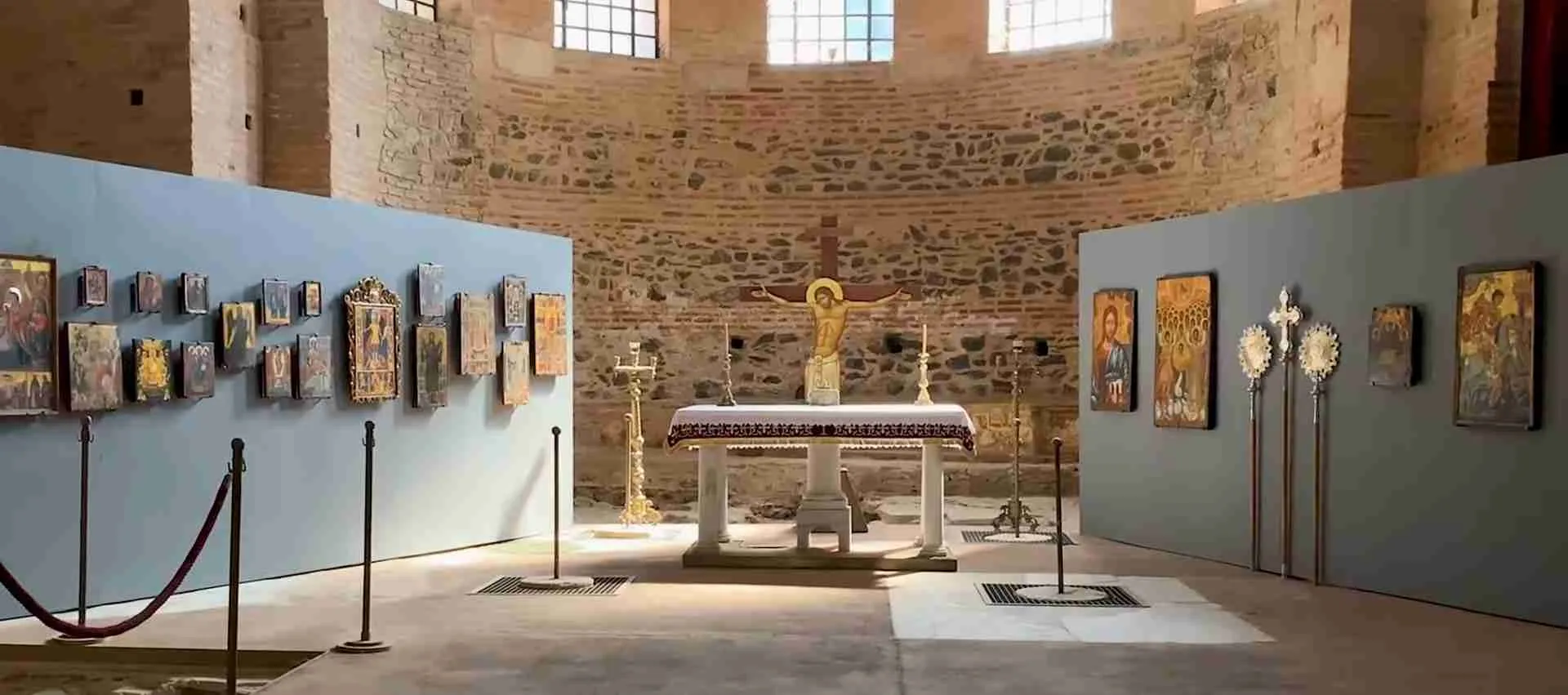
Rotunda (Church of Agios Georgios) – Constructed in the early 4th century as a Roman imperial building, possibly a mausoleum for Emperor Galerius, this massive circular structure was converted to Christian use in the late 4th or early 5th century. The building measures 24.5 meters in diameter with walls 6.3 meters thick, creating an interior space of monumental proportions. The dome retains spectacular 5th-century mosaics depicting martyrs and saints in architectural landscapes, representing some of early Christian art’s finest achievements.
Church of Panagia Acheiropoietos – Built in the mid-to-late 5th century, this five-aisled basilica represents the standard early Christian church plan developed from Roman civic basilica architecture. The name “Acheiropoietos” (not made by hands) refers to a miraculous icon of the Virgin Mary traditionally housed here. The church preserves original 5th-century mosaics in the arcade spandrels showing birds, plants, and geometric patterns, along with an exceptionally intact early Christian basilica structure.
Church of Agios Demetrios – Originally constructed in the mid-5th century over the Roman bath complex where Saint Demetrius was martyred in 303 AD, this basilica became Orthodox Christianity’s most important pilgrimage church dedicated to a military saint. Fire destroyed the original structure in 1917, but reconstruction revealed the foundations and crypt, while preserving the 7th-century mosaic panels showing Saint Demetrius with donors. The current building faithfully reconstructs the five-aisled basilica with transept.
Monastery of Latomos (Hosios David) – This 5th-century church preserves one of early Christian art’s most remarkable mosaics in its apse: the Vision of Ezekiel, showing a youthful, beardless Christ enthroned within a mystical mandorla. The mosaic’s exceptional artistic quality, sophisticated composition, and profound theological symbolism make it a masterpiece of Paleochristian art.
Middle Byzantine Period Monuments (7th-13th Centuries)
Three monuments represent the middle Byzantine period when architectural innovation produced new church types:
Church of Hagia Sophia – Constructed in the late 7th or early 8th century on the site of an earlier 5th-century basilica destroyed by earthquake, Hagia Sophia represents a transitional architectural type combining basilica plans with central domed construction. The church deliberately evokes Constantinople’s Hagia Sophia in both name and architectural ambition. The dome mosaic depicting the Ascension, created in the late 9th century after Iconoclasm’s end, ranks among Byzantine art’s masterworks.
Church of Panagia Chalkeon – Built in 1028 according to a founder’s inscription, this church represents the mature cross-in-square plan that became standard Byzantine church architecture. The name “Chalkeon” (of the coppersmiths) references the artisan quarter where the church stands. The building features the characteristic “hidden brick” construction technique and preserves 11th-century frescoes showing the full iconographic program of middle Byzantine church decoration.
Byzantine Baths – These late 13th-century baths represent Thessaloniki’s only surviving Byzantine secular building among the UNESCO monuments. The bath complex follows the traditional Roman-Byzantine sequence of changing rooms, cold room, warm room, and hot room, demonstrating the continuity of bathing culture from antiquity through the Byzantine period.
Late Byzantine Period Monuments (1204-1453)
Eight monuments represent the late Byzantine period, when Thessaloniki experienced cultural renaissance despite political turmoil:
Church of Saint Panteleimon – Built in the early 14th century, this church served as the katholikon (main church) of a monastery and became a center for hesychast spirituality. The building features the developed cross-in-square plan with sophisticated brick decoration and preserves 14th-century frescoes in the Paleologan style.
Church of the Holy Apostles – Constructed in 1310-1314 as the katholikon of a monastery dedicated to the Virgin Mary, this church exemplifies Paleologan architecture at its finest. The building features elaborate polychromatic brickwork creating decorative patterns on the exterior. The interior preserves a complete fresco cycle by leading 14th-century artists showing the full liturgical year and the life of Christ.
Church of Saint Nicholas Orphanos – Built in the early 14th century as part of Vlatadon Monastery’s dependencies, this church preserves one of Thessaloniki’s most complete late Byzantine fresco cycles. The paintings demonstrate the Paleologan Renaissance style with sophisticated narrative compositions, expressive figures, and architectural backgrounds rendered with spatial depth.
Church of Saint Catherine – Constructed in the late 13th or early 14th century, this church features the cross-in-square plan with enclosed ambulatory ending in two lateral chapels. The building demonstrates the sophisticated brick decoration characteristic of Paleologan architecture, though much of the interior fresco decoration has been lost.
Church of the Transfiguration of the Saviour (Metamorphosis tou Sotiros) – This small 14th-century church represents the reduced scale of late Byzantine ecclesiastical construction while maintaining architectural sophistication. The building features intricate brickwork and preserves fragments of its original fresco decoration.
Vlatadon Monastery – Founded in the mid-14th century by the monks Dorotheus and Markos Vlatis, this monastery became a major center of hesychast spirituality and theological scholarship. The katholikon (main church) represents late Byzantine monastic architecture, while the monastery complex preserves its essential character as a functioning spiritual community.
Church of Prophet Elias (Profitis Ilias) – Built in the 14th century, this church occupies an elevated position near the city walls. The building follows the standard late Byzantine cross-in-square plan with characteristic decorative brickwork, serving the upper city’s population throughout the Byzantine and Ottoman periods.
City Walls – The fortification system encircling Thessaloniki incorporates construction from the 4th century through the 15th century, creating a palimpsest of Byzantine military architecture. The walls include approximately 50 towers, multiple gates, the Heptapyrgion fortress (also known as Yedi Kule), and the Tower of Trigonion, demonstrating the continuous evolution of defensive architecture across the Byzantine millennium.
Architectural Evolution and Typological Development
Thessaloniki’s UNESCO monuments collectively demonstrate the complete typological evolution of Byzantine ecclesiastical architecture, providing a chronological sequence unmatched in any other single location. This architectural development reflects broader changes in Byzantine liturgical practice, theological understanding, and aesthetic sensibilities over eleven centuries.
Early Christian Basilica Form
The earliest Christian churches in Thessaloniki adapted the Roman civic basilica form for Christian worship. Panagia Acheiropoietos exemplifies this type with its five-aisle plan, creating a longitudinal axis terminated by an apse. The aisles are separated by colonnades supporting arcades, allowing large congregations while maintaining clear sight lines to the altar. Natural light enters through clerestory windows above the side aisles, illuminating the central nave. This basilica type, inherited from Roman secular architecture and adapted throughout the early Christian world, proved remarkably successful for Christian liturgical needs, remaining in use even as Byzantine architects developed new forms.
Agios Demetrios represents the basilica type’s most elaborate development in Thessaloniki, with its five aisles and transept creating a cruciform plan. The transept, intersecting the main longitudinal axis, accommodated the saint’s shrine while providing additional space for pilgrims. This combination of basilica and transept became standard for major pilgrimage churches throughout the Christian world, from Rome to Jerusalem.
Transitional Domed Basilica
Hagia Sophia represents the crucial transitional phase when Byzantine architects synthesized the longitudinal basilica plan with central domed construction. This architectural innovation, developed most monumentally in Constantinople’s Hagia Sophia (537 AD), revolutionized church design by creating a vast centralized space crowned by a dome seeming to float on light. Thessaloniki’s Hagia Sophia, built in the late 7th or early 8th century, demonstrates how this architectural concept was adapted for medium-scale urban churches.
The transitional domed basilica combines basilica elements (longitudinal nave, side aisles, narthex) with a central dome supported on pendentives. This fusion creates an architectural experience fundamentally different from the purely longitudinal basilica. The dome draws the eye upward to celestial imagery in the cupola, while the centralized space under the dome serves as the liturgical focus where the mystery of the Eucharist unfolds. This architectural form became the foundation for subsequent Byzantine developments, establishing the principle that the church building itself represents a cosmological image with the dome symbolizing heaven descending to earth.
Cross-in-Square Plan
The cross-in-square plan, which emerged in the 9th century and dominated Byzantine church architecture thereafter, represents Byzantine architectural thinking at its most refined. Panagia Chalkeon (1028) demonstrates the fully developed form, where a central dome rests on four columns or piers, creating a cross-shaped space (nave) surrounded by barrel-vaulted arms. The corners between the arms contain smaller domed or vaulted spaces, creating the “square” that encloses the cross. This compact, efficient plan maximizes vertical volume within a relatively small footprint while creating complex interior spatial sequences.
The late Byzantine churches—Holy Apostles, Saint Panteleimon, Saint Nicholas Orphanos, Saint Catherine—represent sophisticated elaborations of the cross-in-square type. These buildings add enclosed ambulatories wrapping the main church on three sides, creating additional chapel spaces while increasing the exterior mass to support more elaborate superstructures. The result is churches with complex, articulated forms expressing through architectural volumes the hierarchical organization of liturgical space. Vertical proportions become more attenuated, domes rise higher, and the overall effect emphasizes the vertical axis connecting earth to heaven.
Decorative Systems and Construction Techniques
Byzantine builders in Thessaloniki developed sophisticated decorative systems using brick as both structural material and ornamental medium. The “hidden brick” technique, visible in Panagia Chalkeon and later churches, involves recessed brick courses alternating with exposed courses, creating horizontal stripes while reducing the amount of expensive brick needed. Polychromatic brickwork, achieved by using different colored bricks and incorporating glazed ceramic elements, creates elaborate geometric and vegetal patterns on exterior walls.
The Holy Apostles demonstrates Paleologan architectural decoration at its most sophisticated, with exterior walls featuring complex patterns of blind arcading, decorative brick courses arranged in meander patterns, and ceramic plaques creating polychromatic effects. These decorative systems transform the church exterior into a richly patterned surface reflecting interior hierarchies and liturgical significance. The decoration serves not merely as ornament but as theological communication, making visible the church’s sacred character to the surrounding urban environment.
Artistic Treasures: Mosaics and Frescoes
Thessaloniki’s Byzantine monuments preserve mosaic and fresco cycles ranking among the supreme achievements of Christian sacred art. These artistic programs served not as mere decoration but as theological texts rendered visible, communicating complex doctrinal concepts, biblical narratives, and spiritual truths to congregations across literacy levels.
Mosaic Art in the Early Period
The Rotunda preserves the most spectacular mosaic cycle surviving from the 5th century anywhere in the Christian world. The dome decoration, though partially lost, originally showed multiple registers of saints and martyrs standing before elaborate architectural backgrounds. The surviving sections display exceptional technical mastery, with tiny tesserae creating subtle color gradations and sophisticated spatial effects. The architectural backgrounds demonstrate advanced understanding of perspective and spatial illusion, placing figures within three-dimensional architectural settings rendered with remarkable accuracy.
The mosaic panels in Agios Demetrios, though damaged and fragmentary after the 1917 fire, reveal the development of iconic imagery in Byzantine art. These 7th-century panels show Saint Demetrius standing with donors in formal, frontal compositions emphasizing spiritual presence rather than naturalistic representation. The figures appear against gold backgrounds, removing them from earthly space into the timeless realm of sanctity. The transformation from classical naturalism to Byzantine abstraction and spiritual intensity becomes visible in these panels, demonstrating how early Christian artists developed distinctively Christian visual languages.
The apse mosaic in Hosios David stands as perhaps the most remarkable single work of Paleochristian art surviving anywhere. Created in the late 5th century, the mosaic depicts the Vision of Ezekiel with the youthful, beardless Christ enthroned within a rainbow mandorla, flanked by the four apocalyptic creatures (eagle, lion, ox, angel) and the prophets Ezekiel and Habakkuk. The composition’s sophistication, the figures’ expressive power, and the technical mastery displayed in rendering textures, light effects, and spatial relationships mark this as a masterwork by the finest artists of the age. The choice of a rare theological subject, the mystical vision of divine glory, suggests a sophisticated patron and reflects the high theological culture of 5th-century Thessaloniki.
Middle Byzantine Mosaic Tradition
Hagia Sophia’s dome mosaic, depicting the Ascension of Christ, represents middle Byzantine mosaic art at its theological and artistic peak. Created in the late 9th century immediately after Iconoclasm’s defeat, the mosaic articulates the restored iconodule theology through its hierarchical composition. Christ in glory ascends within a mandorla held by angels, while the apostles witness the event from below, and the Virgin Mary stands in the apse as Theotokos (God-bearer). This iconographic program establishes the theological relationships between divine and human, heaven and earth, that structure all subsequent Byzantine church decoration.
The Hagia Sophia Ascension demonstrates the middle Byzantine aesthetic of spiritual abstraction and formal clarity. Figures appear as dematerialized forms defined by linear contours against gold backgrounds, their bodies simplified into geometric shapes while their faces display intense spiritual expression. The composition follows strict hierarchical principles, with Christ occupying the dome’s apex, angels mediating between heaven and earth, and human witnesses arranged in the lower zones. This organized visual theology communicates doctrinal truths about Christ’s divine and human natures, the incarnation’s cosmic significance, and the church’s role as heaven on earth.
Paleologan Renaissance Frescoes
The late Byzantine churches preserve fresco cycles exemplifying the Paleologan Renaissance, the remarkable artistic flowering of the 13th-14th centuries when Byzantine painters achieved new levels of narrative sophistication, emotional expression, and spatial representation. The Holy Apostles contains one of Thessaloniki’s most complete Paleologan fresco cycles, covering the entire interior with biblical narratives, liturgical cycles, and individual saints.
These frescoes demonstrate the Paleologan style’s distinctive characteristics: figures with naturalistic proportions and subtle modeling suggesting volume, architectural backgrounds rendered with sophisticated spatial recession, landscape elements creating environmental context, and narrative compositions showing complex multi-figure interactions. The painters employed a rich palette including blues, greens, ochres, and reds, applied with techniques creating subtle color transitions and luminous effects. Faces receive particular attention, with individualized features, expressive gazes, and psychological depth replacing earlier abstraction.
Saint Nicholas Orphanos preserves an equally remarkable fresco cycle showing the Paleologan style’s full development. The church’s relatively small scale concentrates the artistic program, creating an intense visual experience where every surface communicates theological meaning. The narrative cycles—the life of Christ, the Passion sequence, the liturgical year—unfold across the walls in sophisticated compositions where architecture, landscape, and figures create unified scenes. The painters demonstrated remarkable skill in adapting compositions to awkward architectural surfaces, maintaining narrative clarity while respecting the building’s structural logic.
Iconographic Programs and Theological Meaning
Byzantine church decoration followed systematic iconographic programs expressing complex theological concepts through carefully organized visual hierarchies. The dome typically shows Christ Pantokrator (Ruler of All), the cupola’s highest point representing heaven where divine authority resides. The drum below contains prophets who foretold Christ’s coming, while pendentives show the four evangelists whose gospels proclaim salvation. The apse features the Theotokos enthroned or the Divine Liturgy, connecting the altar’s eucharistic action with the incarnation’s mystery.
Wall decoration follows the liturgical calendar, depicting feast days (Annunciation, Nativity, Baptism, Transfiguration, Crucifixion, Resurrection, Ascension, Pentecost) and the lives of Christ, the Virgin, and relevant saints. This decoration transforms the church interior into a complete visual Bible and liturgical calendar, making scriptural and theological knowledge accessible to illiterate congregants while providing contemplative focus for literate worshippers. The placement of specific images in specific locations follows theological logic: celestial imagery in upper zones, earthly events in middle zones, and individual saints in lower registers where they can receive direct veneration.
Historical Context and Religious Significance
Understanding Thessaloniki’s Byzantine monuments requires grasping the city’s extraordinary historical trajectory and its central role in Byzantine religious life across eleven centuries of continuous Christian presence.
From Roman Provincial Capital to Byzantine Metropolis
Thessaloniki’s transformation from Roman provincial capital to Byzantine metropolis began when Emperor Galerius established his residence here around 300 AD, making the city the eastern Roman Empire’s administrative center for Balkan affairs. Galerius commissioned major building projects including his palace complex, triumphal arch, hippodrome, and the massive Rotunda, transforming Thessaloniki into an imperial city rivaling Rome and Constantinople. This imperial investment established the architectural scale and urban infrastructure that supported Thessaloniki’s subsequent Byzantine development.
The city’s strategic location at the intersection of the Via Egnatia (the main east-west route connecting Rome to Constantinople) and north-south routes into the Balkans made Thessaloniki commercially crucial and militarily vital. As the Byzantine Empire’s second city, Thessaloniki served as the primary base for imperial campaigns into the Balkans, the defensive bulwark against Slavic migrations and invasions, and the commercial hub connecting Constantinople to the Adriatic and western Mediterranean. This political and economic importance attracted imperial patronage, ecclesiastical investment, and wealthy donors who funded the construction and decoration of Thessaloniki’s great churches.
Center of Christian Spirituality and Theology
Thessaloniki’s religious significance extends beyond its political role to encompass major contributions to Christian theology and spirituality. The city produced influential theological figures whose teachings shaped Orthodox Christianity and affected Western Christian thought. Gregory Palamas, archbishop of Thessaloniki in the 14th century, articulated hesychast theology defending the mystical prayer practices of Athonite monks and developing the doctrine of divine energies versus divine essence. His theological synthesis reconciled mystical experience with Orthodox doctrine, influencing Orthodox spirituality into the modern era.
The monasteries of Thessaloniki, particularly Vlatadon founded in the 14th century, became centers of hesychast practice where monks pursued direct experience of divine light through contemplative prayer. This spiritual movement, connecting contemplative monasticism with sophisticated theological reflection, characterized late Byzantine religious culture. Thessaloniki’s churches provided the architectural settings where this spirituality found expression, their intimate scales, sophisticated acoustics, and richly decorated interiors creating environments conducive to mystical contemplation and liturgical immersion.
Cult of Saint Demetrius
The cult of Saint Demetrius, Thessaloniki’s patron saint martyred under Galerius in 303 AD, shaped the city’s religious identity throughout the Byzantine period and beyond. The massive basilica built over his martyrdom site became one of Christendom’s major pilgrimage destinations, attracting devotees from throughout the Orthodox world. Medieval accounts describe the saint’s miraculous interventions protecting Thessaloniki from sieges, earthquakes, and plagues, establishing Demetrius as a military saint with particular power over the city’s defenders.
The shrine’s importance generated enormous wealth through pilgrimage, donations, and the miraculous myrrh reputedly flowing from the saint’s relics. This wealth funded artistic commissions, architectural elaborations, and the church’s maintenance across centuries. The basilica’s crypt, where Demetrius was imprisoned and executed, became a sacred focal point where pilgrims could directly access the site of martyrdom, creating a powerful connection between historical event, sacred space, and continuing spiritual presence. This cult exemplifies how Byzantine religious culture integrated historical memory, miraculous intervention, and liturgical celebration into unified expressions of communal identity.
Survival Through Ottoman Conquest
The Ottoman conquest of Thessaloniki in 1430 marked Byzantine political control’s end but did not destroy the city’s Christian monuments. Sultan Murad II’s decision to convert major churches into mosques rather than demolishing them preserved these buildings’ architectural integrity while transforming their function. The conversion process involved plastering over figural mosaics and frescoes (prohibited in Islamic worship), removing Christian liturgical furniture, adding minarets and mihrab niches oriented toward Mecca, and occasionally making architectural modifications. However, the essential structures survived intact, as did most artistic programs beneath protective plaster layers.
This preservation contrasts sharply with many other Byzantine cities where conquest brought systematic destruction. The Ottoman approach to Thessaloniki’s churches reflected both practical considerations (converting existing buildings proved more economical than new construction) and Islamic legal traditions requiring respect for “People of the Book.” The result was a city where Byzantine architectural heritage survived centuries of Ottoman rule, awaiting eventual restoration when Greece regained Thessaloniki in 1912. The systematic restoration campaigns that began after 1912, intensifying after the devastating 1917 fire, uncovered the hidden artistic treasures and stabilized deteriorating structures, ultimately leading to UNESCO recognition in 1988.
Architectural Details and Construction Techniques
Examining Thessaloniki’s Byzantine monuments reveals sophisticated construction techniques, innovative structural solutions, and refined decorative systems developed across eleven centuries of continuous building tradition.
Structural Engineering and Dome Construction
Byzantine builders in Thessaloniki mastered the challenge of placing domes on square or rectangular plans, developing several solutions that evolved over time. The pendentive, a triangular curved segment filling the corner between square supporting walls and circular dome base, represents Byzantine engineering’s most important innovation. This structural device, visible in Hagia Sophia and all later domed churches, allows circular domes to rise from square bases while distributing weight efficiently to corner piers or walls.
The construction process began with massive foundation work, often incorporating earlier structures or reusing ancient materials. Walls rose using a combination of stone rubble cores faced with brick, creating structures of enormous strength relative to their thickness. The brickwork itself followed systematic patterns, with horizontal courses carefully leveled and vertical joints aligned to create structurally sound masonry. Builders used high-quality lime mortar mixed with crushed ceramic particles (cocciopesto), creating hydraulic mortar that hardened to exceptional strength and durability.
Dome construction employed sophisticated techniques minimizing weight while maintaining structural integrity. Byzantine builders used progressively lighter materials as domes rose, incorporating hollow ceramic tubes in upper sections to reduce load. The dome surface consisted of thin brick shells, their curvature providing inherent structural stability while minimizing dead weight. Windows pierced dome drums not as structural weakness but as carefully calculated openings that both reduced weight and illuminated interiors, creating the characteristic Byzantine effect of domes seeming to float on light.
Brick Decoration and Surface Treatment
Byzantine builders transformed brick from purely functional building material into sophisticated decorative medium. The “hidden brick” or “recessed brick” technique, standard by the 11th century and visible in Panagia Chalkeon, involves laying every other horizontal course recessed behind the face, then filling the recess with thick mortar joints. This creates a distinctive striped appearance while reducing brick consumption and creating deeply shadowed surfaces that emphasize horizontal banding.
Later buildings, particularly those of the Paleologan period like the Holy Apostles, employed increasingly elaborate brick decoration. Builders created geometric patterns (meanders, chevrons, lozenges) by arranging bricks in complex configurations. Blind arcading—non-functional arched recesses—articulated wall surfaces with rhythmic sequences of arches and piers. Decorative brick courses arranged in dog-tooth patterns, basket-weave designs, and other configurations enriched facades. The incorporation of glazed ceramic plaques and tiles, often in green and turquoise, added color accents creating polychromatic effects.
These decorative systems served multiple functions beyond mere ornament. The articulated surfaces shed water more effectively than flat walls, protecting mortar joints from erosion. The visual complexity created by patterned brickwork engaged viewers’ attention, making church exteriors active participants in urban visual culture rather than blank enclosures. The decoration communicated religious and social status, with more elaborate patterns indicating greater patronage and spiritual importance. The techniques themselves demonstrated builders’ skill and the patrons’ resources, making architectural decoration a form of social display and spiritual offering.
Spatial Organization and Liturgical Function
Byzantine church plans responded to evolving liturgical requirements, with architectural forms facilitating specific ritual practices. The naos (main worship space) accommodated the congregation, organized in hierarchical zones: men in the nave, women in side aisles or galleries, and clergy in the sanctuary. The templon—the barrier separating sanctuary from nave, predecessor of the later iconostasis—defined the liturgical threshold between earthly and heavenly realms. This spatial division reinforced theological concepts about sacred mysteries celebrated beyond congregational view, requiring architectural articulation of visible and invisible, accessible and restricted spaces.
The late Byzantine cross-in-square plan created more complex spatial sequences. Enclosed ambulatories provided circulation around the naos while creating subsidiary chapel spaces for private devotion. Narthexes (entrance vestibules) served as transitional zones between secular exterior and sacred interior, where catechumens and penitents participated in portions of the liturgy before dismissal. The sophisticated organization of these spaces reflects Byzantine liturgy’s elaboration, with processions, station liturgies, and hierarchically organized participants requiring architecturally defined zones and circulation paths.
The Byzantine Defensive Walls
Thessaloniki’s defensive walls, the 15th UNESCO monument, represent Byzantine military architecture’s evolution across a millennium of continuous use and modification. The approximately 4-kilometer circuit enclosing the historic city center incorporates construction from the late 4th century through the 15th century, creating an archaeological record of changing defensive technologies and strategic thinking.
Historical Development and Construction Phases
The walls’ foundations incorporate elements from earlier Hellenistic and Roman fortifications, but the major construction phase occurred in the late 4th century under Emperor Theodosius I. This campaign created the essential circuit with thick walls, regular towers, and major gates, establishing the defensive system that protected Thessaloniki throughout the Byzantine period. The walls featured alternating rectangular and triangular towers projecting from the wall line, providing flanking fire along the entire circuit. Major gates, including the Golden Gate at the western entrance and the Kassandreia Gate to the east, controlled access while displaying architectural grandeur appropriate to an imperial city.
Continuous modifications throughout Byzantine history adapted the walls to changing military technology and strategic requirements. The upper city walls, defending the acropolis and Ano Poli district, received particular attention as the highest and most vulnerable sector. The construction of the Heptapyrgion fortress in the late Byzantine period created a formidable citadel capable of independent defense even if lower city walls were breached. Individual towers were modified, heightened, or rebuilt as military requirements evolved, creating the complex palimpsest of construction phases visible today.
The Heptapyrgion Fortress
The Heptapyrgion (Seven Towers fortress), dominating the northeastern corner of the city’s acropolis, represents Byzantine fortification architecture at its most imposing. The name derives from the original seven towers, though subsequent modifications altered the configuration. The fortress consists of multiple defensive lines with towers, gates, and curtain walls creating a complex defensive system capable of withstanding prolonged siege. The strategic position at the circuit’s highest point provided commanding views over the entire city and surrounding territory, making the Heptapyrgion the defensive key to Thessaloniki.
The fortress served military functions throughout Byzantine history and continued as a prison during Ottoman rule and into the modern Greek period, only closing in 1989. This continuous occupation over 1,600 years modified the original Byzantine structure through countless alterations, making archaeological interpretation challenging but creating a remarkable record of evolving military and penal architecture. Recent restoration has opened the Heptapyrgion to visitors, revealing its complex history and providing spectacular views over Thessaloniki and the Thermaic Gulf.
The Tower of Trigonion
The Tower of Trigonion (also called Tower of Alyseos), located where the northeastern walls descend from the acropolis toward the middle circuit, represents 15th-century military architecture built just decades before the Ottoman conquest. This massive circular tower, constructed on foundations of earlier Byzantine work, demonstrates the evolution toward artillery-resistant fortifications as gunpowder weapons transformed siege warfare. The tower’s thick walls, compact design, and strategic position controlling the vulnerable northeastern sector illustrate late Byzantine military engineering adapting to technological change.
Conservation and UNESCO World Heritage Status
The recognition of Thessaloniki’s Paleochristian and Byzantine monuments as UNESCO World Heritage Sites in 1988 formalized international appreciation for their exceptional universal value while imposing responsibilities for conservation and public access.
Conservation Challenges and Approaches
Conserving Byzantine monuments integrated into a living modern city presents unique challenges. Most churches continue as active Orthodox parishes, requiring conservation approaches that respect ongoing liturgical use while protecting architectural and artistic heritage. The monuments face threats from urban pollution, structural instability from earthquakes and age, weathering of brick and mortar, and the pressures of tourism and urban development. The Greek Ministry of Culture, through the Ephorate of Antiquities of Thessaloniki City, coordinates conservation efforts balancing preservation with accessibility and religious use.
Recent conservation campaigns have addressed critical needs across the monument group. The Rotunda’s mosaic consolidation prevented further loss of the spectacular 5th-century decoration, employing advanced techniques to stabilize deteriorating tesserae and reattach sections separating from their backing. Agios Demetrios received extensive structural stabilization following discoveries of foundation instability threatening the massive basilica. The Holy Apostles underwent exemplary restoration earning the Europa Nostra prize, with meticulous consolidation of Paleologan frescoes and structural repairs executed to the highest conservation standards.
Accessibility and Interpretation
UNESCO designation requires balancing preservation with public access and education. Most churches maintain regular opening hours allowing visitors to experience their interiors, though some sites have restricted access due to conservation concerns or active liturgical use. Interpretation varies significantly across the monuments, with some offering detailed on-site information panels and guided tours while others provide minimal context. The Municipality of Thessaloniki has developed a “UNESCO Monuments Route” connecting all 15 sites, though comprehensive interpretation improving visitor understanding remains an ongoing challenge.
The tension between religious function and tourism presents particular challenges. These monuments remain active sacred spaces where Orthodox liturgy continues traditions extending directly to Byzantine origins. Visitors must respect religious protocols including modest dress, quiet comportment, and prohibitions on photography during services. This requirement to balance tourist access with religious sanctity distinguishes Thessaloniki’s UNESCO monuments from purely archaeological sites, demanding sensitivity from both visitors and managers to maintain appropriate respect for living religious traditions while fulfilling UNESCO’s educational mission.
Visiting Thessaloniki’s Byzantine Monuments
Experiencing Thessaloniki’s UNESCO monuments requires planning that accounts for their dispersal across the city, varying accessibility, and the time needed to appreciate their architectural and artistic significance meaningfully.
Geographic Distribution and Walking Routes
The monuments cluster in two main areas: the lower city’s historic center and the upper city (Ano Poli). Lower city monuments—Rotunda, Agios Demetrios, Hagia Sophia, Panagia Acheiropoietos, Panagia Chalkeon, the Byzantine Baths—occupy relatively compact areas within walking distance of each other and central hotels. Upper city monuments—Vlatadon Monastery, Agios Nikolaos Orphanos, Profitis Ilias, Saint Catherine, portions of the city walls—require more effort to reach, often involving uphill walks through Ano Poli’s steep streets.
A logical two-day itinerary dedicates day one to lower city monuments, beginning with the Rotunda and Arch of Galerius, proceeding to Agios Demetrios, continuing to Hagia Sophia and Panagia Acheiropoietos, and concluding with Panagia Chalkeon and the Byzantine Baths. Day two explores upper city sites, starting with Vlatadon Monastery, visiting Agios Nikolaos Orphanos and the nearby churches, and walking portions of the defensive walls including the Heptapyrgion and Tower of Trigonion. This pacing allows adequate time to observe architectural details, study mosaics and frescoes, and absorb the contemplative atmosphere these sacred spaces offer.
Practical Considerations
Opening hours vary significantly across the monuments, with most churches maintaining morning and late afternoon opening (typically 8:00-12:00 and 17:00-20:00) while closing during midday. Some sites close specific days—the Rotunda crypt closes Tuesdays, for example—requiring schedule coordination. Churches serving active parishes may restrict access during liturgical services, particularly Sunday mornings and major feast days. Modest dress (covered shoulders and knees) is required for church entry, strictly enforced at major pilgrimage sites like Agios Demetrios.
Most monuments offer free entry as functioning churches, though some sites with significant archaeological components or museum functions charge modest admission. The Rotunda charges a small fee, as does the Heptapyrgion when special exhibitions are mounted. Photography is generally permitted outside services, though flash photography and tripods are typically prohibited to protect sensitive frescoes and mosaics from light damage. Professional photography often requires special permission from the responsible ephorate.
Optimal Visiting Seasons and Times
Thessaloniki’s Mediterranean climate makes year-round visiting feasible, though different seasons offer distinct advantages. Spring (April-May) and autumn (September-October) provide pleasant temperatures for walking between monuments while avoiding summer’s heat and winter’s occasional cold rain. Summer visits offer longest daylight hours but require early morning starts to avoid midday heat, particularly when walking to upper city sites. Winter provides authentic experience of churches’ atmospheric interiors lit by candles and oil lamps, though reduced daylight hours limit daily visiting time.
Timing visits to coincide with liturgical services allows experiencing these monuments in their intended function, hearing Byzantine chant in acoustics designed for that purpose, witnessing ancient rituals in their original architectural settings. Major feasts like the celebration of Saint Demetrius (October 26) transform Agios Demetrios into a pilgrimage center with special liturgies, processions, and celebrations offering unique cultural insights. However, these occasions also bring crowds reducing accessibility and requiring extra sensitivity to religious protocols.
Thessaloniki’s Byzantine Legacy in Wider Context
Thessaloniki’s Byzantine monuments extend significance beyond the city itself to represent broader patterns in Byzantine civilization’s development and influence on Orthodox Christian culture worldwide.
Architectural Influence and Transmission
The architectural developments pioneered or refined in Thessaloniki spread throughout the Byzantine world and beyond, influencing church construction across the Balkans, Russia, and Mediterranean. The cross-in-square plan demonstrated in Thessaloniki’s 11th-15th century churches became the standard Byzantine ecclesiastical architecture, adopted with local variations from Serbia to Georgia. Paleologan decorative systems—polychromatic brickwork, blind arcading, elaborate geometric patterns—influenced Balkan architecture particularly in Serbia and Bulgaria, where buildings by Greek masters or local architects trained in Byzantine techniques created architectural landscapes strongly evoking Thessaloniki’s monuments.
The transmission occurred through multiple channels: Byzantine architects and artists working abroad on commission from foreign patrons, local craftsmen studying in major Byzantine centers including Thessaloniki, and the spread of pattern books and architectural knowledge through ecclesiastical networks. Thessaloniki’s position as the Byzantine Empire’s second city and a major pilgrimage destination ensured that architectural innovations developed here reached wide audiences of visitors who might later commission similar buildings in their home regions. This architectural influence created a Byzantine Commonwealth united by shared architectural languages and liturgical requirements despite political fragmentation.
Artistic Dissemination and Style Formation
Thessaloniki’s mosaic and fresco workshops influenced Byzantine art across centuries and continents. Artists trained in Thessaloniki’s major projects carried techniques, iconographic formulas, and stylistic approaches to other centers. The Paleologan Renaissance visible in Thessaloniki’s 14th-century frescoes represents a broader phenomenon affecting Constantinople, Mount Athos, Serbia, and beyond, with Thessaloniki serving as one of several interconnected artistic centers where this sophisticated style developed. The specific characteristics of Thessalonian Paleologan painting—the refined naturalism, architectural backgrounds, psychological expressiveness—appear in monuments throughout the late Byzantine world, suggesting either direct artistic connections or participation in shared artistic culture transcending individual cities.
Religious and Cultural Continuity
Perhaps most significantly, Thessaloniki’s monuments preserve living connections to Byzantine religious culture through their continuing function as Orthodox Christian sacred spaces. The liturgy celebrated in these churches today descends directly from Byzantine practice, with minimal changes in the fundamental structure, hymnody, and ritual actions performed over centuries. This continuity allows modern worshippers and visitors to experience Byzantine religious culture not as historical reconstruction but as living tradition, connecting across centuries through unchanged ritual performed in original architectural settings decorated with original sacred art.
This living connection distinguishes Thessaloniki from most Byzantine sites, which survive only as archaeological remains or museums. While such preservation serves crucial scholarly and educational functions, Thessaloniki’s churches maintain the experiential dimension of Byzantine Christianity, where architecture, art, liturgy, music, and sacred atmosphere combine to create the total religious experience Byzantine culture intended. This living tradition ensures that Thessaloniki’s monuments remain not merely historical artifacts but functioning components of ongoing religious and cultural life, their meanings continuously renewed through use while their historical significance deepens with each passing generation.
Frequently Asked Questions About Thessaloniki’s Byzantine Monuments
What makes Thessaloniki’s Byzantine monuments different from those in other Greek cities?
Thessaloniki preserves the most complete chronological sequence of Byzantine architectural development surviving in Greece, with monuments representing every major period from 4th-century early Christian basilicas through 15th-century Paleologan churches. While Athens contains significant Byzantine churches and other cities have individual monuments of great importance, no other Greek location matches Thessaloniki’s comprehensive representation of the full Byzantine architectural and artistic evolution. The city’s status as Byzantium’s second capital meant continuous patronage and construction across the entire Byzantine millennium, creating the architectural density and chronological completeness now recognized through UNESCO designation. Additionally, Thessaloniki’s monuments survived the 1912-1922 period of Greek territorial expansion with less destruction than sites in regions experiencing more intense warfare, preserving structural integrity and artistic programs that elsewhere suffered war damage.
How did Thessaloniki’s monuments survive the Ottoman period?
Ottoman policy toward Byzantine churches varied by location and circumstance, but in Thessaloniki the pattern involved converting major churches to mosques while preserving their essential architectural structures. This conversion served Ottoman practical and religious needs: converting existing buildings proved more economical than new construction, Islamic tradition required respect for earlier monotheistic sacred sites, and the architectural quality of Byzantine churches made them prestigious additions to the Ottoman urban landscape. The conversion process typically involved removing Christian liturgical furniture, covering figural mosaics and frescoes with plaster (Islamic worship prohibiting representational imagery), adding minarets and mihrab niches indicating prayer direction toward Mecca, and occasionally making structural modifications. However, the basic architecture survived intact, as did artistic programs beneath protective plaster layers. This preservation contrasts with Constantinople, where many major Byzantine monuments were destroyed or drastically altered, and with regions where religious conflict brought more systematic destruction of Christian heritage.
What restoration work has been done on the monuments since Greek independence?
Systematic restoration of Thessaloniki’s Byzantine monuments began after Greece regained the city in 1912, intensifying dramatically after the devastating 1917 fire destroyed much of the historic center including severely damaging Agios Demetrios. The reconstruction of Agios Demetrios in the 1920s-1930s established conservation principles still followed today: archaeological investigation before reconstruction, careful documentation of existing structures, preservation of all surviving original material, and reconstruction based on scholarly analysis of the building’s original form. Throughout the 20th century, campaigns addressed specific needs: mosaic consolidation in the Rotunda and other churches to prevent loss of fragile tesserae, structural stabilization addressing earthquake damage and age-related deterioration, removal of Ottoman-era plaster covering Byzantine frescoes, and landscape improvements around monuments. The 21st century has brought more sophisticated conservation employing advanced materials and techniques, including the exemplary restoration of Saint Panteleimon recognized with the Europa Nostra prize. Current conservation philosophy emphasizes minimal intervention, maximum preservation of original fabric, and reversibility of all treatments, ensuring these monuments remain as authentic as possible while being stabilized for future generations.
Can non-Orthodox visitors enter the churches, and are there any restrictions?
All of Thessaloniki’s Byzantine churches welcome visitors regardless of religious background, operating as both active Orthodox parishes and public cultural heritage sites accessible to everyone interested in Byzantine architecture, art, and history. However, visitors must observe certain protocols respecting these buildings’ sacred character. Modest dress is required, meaning covered shoulders and knees; shorts, short skirts, tank tops, and similar revealing clothing will result in denied entry at most churches, with some providing wraps for inadequately dressed visitors. Quiet comportment is expected, particularly if liturgical services are in progress, when visitors should remain silent and avoid moving around the church. Photography is generally permitted outside services but with restrictions: no flash photography (protecting light-sensitive frescoes), no tripods blocking access, and absolutely no photography during liturgies when the sacred ritual takes precedence over tourist interest. Visitors should not approach the iconostasis or sanctuary areas, which are restricted to clergy, and should avoid touching icons, frescoes, or other sacred objects. These protocols, far from restricting access, actually facilitate it by ensuring all visitors can experience these monuments respectfully without conflicts between religious use and cultural tourism.
Which monument should be prioritized if time is limited?
If visiting only a single monument, Agios Demetrios offers the most comprehensive introduction to Thessaloniki’s Byzantine heritage, combining exceptional historical significance as the martyrdom site and cult center of the city’s patron saint, architectural importance as the largest and most impressive early Christian basilica in Greece, and artistic significance through its 7th-century mosaic panels. The church’s crypt preserves the original martyrdom site, creating a direct connection to early Christian history, while the upper basilica demonstrates the monumental scale and sophisticated organization of major pilgrimage churches. The reconstruction after the 1917 fire, though controversial, provides clear understanding of early Christian basilica architecture, and the on-site museum contains artifacts illuminating the site’s long history. If time permits two monuments, add the Rotunda, whose spectacular 5th-century dome mosaics represent the highest achievements of early Christian art and whose conversion from Roman to Christian to Islamic to modern multipurpose monument tells Thessaloniki’s entire history. A three-monument visit should include Hagia Sophia, whose transitional domed basilica architecture and 9th-century Ascension mosaic demonstrate Byzantine architectural and artistic development between the early Christian and late Byzantine periods covered by the other two churches.
How does the architecture of Thessaloniki’s churches compare to those in Constantinople?
Thessaloniki’s churches generally follow architectural developments pioneered in Constantinople, adapting the capital’s innovations to provincial scale and local conditions while occasionally introducing their own refinements. The relationship is neither simple imitation nor complete independence but rather active participation in shared Byzantine architectural culture centered in Constantinople but involving major provincial centers including Thessaloniki. Hagia Sophia of Thessaloniki, built in the 8th century, clearly references Constantinople’s Hagia Sophia (537) in its name, transitional domed basilica type, and spatial concepts, yet reduces scale and modifies proportions for a city church rather than imperial cathedral. Similarly, Thessaloniki’s cross-in-square churches follow types developed in Constantinople while often exhibiting local construction techniques and decorative preferences, particularly in Paleologan brickwork that achieves distinctive effects not found in surviving Constantinople monuments. The relationship represents dialogue rather than hierarchy, with Thessaloniki architects aware of Constantinople developments, selectively adopting innovations while maintaining local building traditions and responding to specific patron requirements and site conditions unique to Thessaloniki.
What role did monasticism play in Thessaloniki’s Byzantine heritage?
Monasticism shaped Thessaloniki’s Byzantine heritage through multiple channels: monastic communities as patrons commissioning churches and funding decoration, monasteries as centers of theological learning and spiritual innovation, and monastic churches introducing architectural types developed specifically for monastic liturgical needs. Vlatadon Monastery, founded in the 14th century, exemplifies these interconnections: its founders, monks Dorotheus and Markos Vlatis, belonged to hesychast movements reshaping late Byzantine spirituality, the monastery became a center for hesychast teaching and practice, and its katholikon represents architectural planning accommodating specific monastic liturgical requirements. The Church of the Holy Apostles, originally the katholikon of a monastery dedicated to the Virgin Mary, shows how monastic patronage produced some of Thessaloniki’s finest architectural and artistic achievements, with its elaborate Paleologan frescoes reflecting the theological sophistication and financial resources of its monastic community. Throughout Byzantine history, the relationship between urban secular churches serving parish communities and monastic churches serving enclosed religious communities created architectural dialogue producing innovations benefiting both traditions, with monastic emphasis on contemplative prayer and sophisticated theology often pushing artistic and architectural programs toward more refined and theologically complex forms that subsequently influenced secular church design.
How did the Great Fire of 1917 affect the Byzantine monuments?
The Great Fire of August 1917 devastated Thessaloniki’s historic center, destroying approximately 32% of the urban area and leaving 70,000 people homeless in what remains one of the most destructive urban fires in modern Greek history. The fire severely damaged Agios Demetrios, burning the wooden roof and causing partial collapse that destroyed much of the interior, though the walls and colonnade survived. Several other Byzantine monuments suffered varying degrees of damage from the fire or from subsequent demolition during post-fire urban reorganization. However, this catastrophe paradoxically advanced Byzantine heritage conservation by necessitating careful reconstruction that involved archaeological investigation, documentation of surviving elements, and scholarly analysis of original forms. The reconstruction of Agios Demetrios in the 1920s-1930s established conservation standards and revealed previously unknown architectural features and early mosaics in the crypt. The post-fire urban planning, while destroying some minor Byzantine structures, also created protective zones around major monuments and established principles of heritage protection in urban planning that continue shaping Thessaloniki’s development today.
What is the significance of the Macedonian School of iconography visible in these monuments?
The Macedonian School of iconography, which flourished in Thessaloniki and surrounding regions during the Paleologan period, represents one of Byzantine art’s most sophisticated regional styles, characterized by intense colors, robust figure modeling, sophisticated spatial representation, and psychological expressiveness surpassing contemporary Constantinople work. The frescoes in churches like the Holy Apostles, Saint Nicholas Orphanos, and Saint Catherine demonstrate this school’s characteristics: figures with naturalistic proportions and subtle three-dimensional modeling, architectural backgrounds rendered with sophisticated perspective, rich color palettes including vibrant blues and greens, and narrative compositions showing complex interactions between multiple figures in coherent spatial environments. This style emerged from Thessaloniki’s position as a major artistic center with wealthy patrons, sophisticated theological culture, and connections to broader Mediterranean artistic currents including Italian developments. The Macedonian School influenced painting throughout the late Byzantine world and the post-Byzantine period, with its naturalism, spatial sophistication, and expressive intensity affecting Orthodox icon painting into the modern era, making these Thessaloniki monuments crucial sources for understanding how Byzantine art evolved in its final flowering before the empire’s collapse.
Are there any special events or celebrations when the monuments are particularly worth visiting?
The feast of Saint Demetrius on October 26 transforms Agios Demetrios into an extraordinary pilgrimage site, with all-night vigils, special liturgies, processions, and massive crowds of devotees creating the authentic Byzantine pilgrimage experience that characterized this church throughout its history. The celebration includes the opening of the crypt with special access to the martyrdom site, liturgies attended by ecclesiastical dignitaries including the Archbishop of Athens, and traditional festivities throughout the city honoring the patron saint. This annual celebration provides unique opportunity to experience Byzantine religious culture at its most vibrant, though the crowds and focus on worship mean reduced opportunity for quiet architectural contemplation. Other significant celebrations include Holy Week and Easter, when Byzantine liturgies unfold in churches designed specifically for these elaborate ritual cycles, and the feast of the Dormition of the Theotokos on August 15, important throughout Orthodox Christianity. Visitors timing their stays to coincide with these celebrations gain insight into how these monuments function within living Orthodox tradition, experiencing the complete integration of architecture, art, liturgy, and communal devotion that defines Byzantine religious culture at its fullest expression.