The Sanctuary in the Rock: The Ancient Pilgrimage Route to Monte Sant’Angelo
Deep within the rugged limestone cliffs of Italy’s Gargano promontory, a natural cave has drawn pilgrims, popes, crusaders, and saints for over fifteen centuries. The Sanctuary of Saint Michael the Archangel at Monte Sant’Angelo is not merely a church — it is a cave consecrated, according to tradition, by divine hands, never touched by human ceremony of dedication, the only such sacred space in Western Christendom. Understanding its history means tracing one of the great pilgrimage roads of the medieval world: the Via Sacra Longobardorum, the sacred highway that carried the faithful across mountains and centuries toward the mountaintop where the Archangel appeared.
Key Takeaways
- Europe’s oldest Archangel shrine: The Sanctuary of Saint Michael the Archangel at Monte Sant’Angelo is the oldest shrine dedicated to Archangel Michael in Western Europe, with origins in the three apparitions recorded between 490 and 493 AD — making it a living place of worship for over 1,500 years.
- UNESCO World Heritage since 2011: The sanctuary forms part of the serial UNESCO property “Longobards in Italy: Places of Power (568–774 A.D.),” inscribed on 25 June 2011. The serial site encompasses seven groups of monuments across Italy, all connected to Lombard cultural and spiritual heritage.
- A cave consecrated by the Archangel: Unlike every other Catholic church or shrine, the grotto of Monte Sant’Angelo was never formally consecrated by a bishop or pope — tradition holds that the Archangel Michael himself consecrated it during his third apparition, making it uniquely sacred in Christian theology.
- The Via Sacra Longobardorum: Medieval pilgrims traveled the Via Sacra Longobardorum — the Sacred Way of the Lombards — a route connecting Northern Europe to the Gargano, passing through San Marco in Lamis, San Giovanni Rotondo, and the Valley of Stignano before ascending to Monte Sant’Angelo.
- A node in the European Archangel’s Path: Monte Sant’Angelo anchors the southern end of the Via Micaelica, a mystical alignment connecting seven Archangel Michael shrines from the Irish coast to the Middle East, including Mont Saint-Michel in France and the Sacra di San Michele in Piedmont.
- Free entry and over two million pilgrims annually: Entry to the sanctuary grotto remains free as an active place of worship. The site receives more than two million visitors and pilgrims per year, while the museum ticket costs €5 (check the official website for current rates).
People Also Ask About the Sanctuary at Monte Sant’Angelo
What are the apparitions of Saint Michael the Archangel at Monte Sant’Angelo?
Three apparitions of the Archangel Michael are recorded in the medieval Latin text Liber de apparitione Sancti Michaelis in Monte Gargano, all set between 490 and 493 AD. In the first, a wealthy landowner named Elvio Emanuele discovered his prize bull sheltering in a cave on Monte Gargano. According to the account, the Archangel appeared to the local bishop, identifying the cave as a place of his choosing. The second apparition, possibly drawn from a separate tradition, relates to a military victory attributed to the Archangel’s intervention against pagan forces. The third and most theologically decisive apparition came when the bishop of Siponto, summoned after further visions, climbed the mountain and found the cave already transformed — lit with supernatural light, adorned with an altar clothed in crimson, bearing the Archangel’s footprints in the rock. The bishop interpreted this as the Archangel having consecrated the cave directly, making human dedication unnecessary. This unique theological claim — that divine rather than episcopal hands sanctified the space — has shaped the sanctuary’s singular status in Catholic tradition ever since.
What is the Via Sacra Longobardorum and who traveled it?
The Via Sacra Longobardorum — the Sacred Way of the Lombards — was one of the busiest pilgrimage arteries of the medieval world, running from Northern Europe southward through the Italian peninsula to the Gargano promontory and Monte Sant’Angelo. The route took its name from the Lombards (Longobardi), the Germanic people who settled Italy from the 6th century and adopted Saint Michael as their patron and protector. Pilgrims traveling the route passed through Lombard-controlled territories, entering the Gargano from the plateau near the former hamlet of San Eleuterio near San Severo, descending through the Valley of Stignano past San Marco in Lamis and San Giovanni Rotondo before the final ascent to Monte Sant’Angelo. Over the centuries, it carried not only Lombard warriors and nobles but also Irish monks, Norse pilgrims, Frankish knights, crusader armies, and rulers from across Christendom — among them numerous popes, the Emperor Otto II, and Saint Francis of Assisi.
Why is Monte Sant’Angelo a UNESCO World Heritage Site?
Monte Sant’Angelo’s sanctuary was inscribed on the UNESCO World Heritage List on 25 June 2011 as one of seven components of the serial property “Longobards in Italy: Places of Power (568–774 A.D.).” The inscription recognises the sanctuary as exceptional testimony to the Lombards’ decisive role in shaping medieval European Christianity. UNESCO’s criteria for the site acknowledge it as a synthesis of Roman, Christian, Byzantine, and Germanic cultural traditions — the architectural and artistic meeting point of late Antiquity and the early Middle Ages. The cave sanctuary is specifically valued for its demonstration of how the Lombards transformed pre-Christian sacred sites and warrior devotion into defining features of Western medieval spirituality, spreading the cult of Archangel Michael across the continent and providing the template for later Archangel shrines including Mont Saint-Michel in Normandy.
How do you reach the sacred cave inside the sanctuary today?
Visitors and pilgrims descend to the cave church via the Angevin staircase, a flight of 86 steps cut through the rock face, built under the patronage of Charles I of Anjou in the 13th century. The entrance is reached through a 13th-century Romanesque-Gothic portal on Via Reale Basilica in Monte Sant’Angelo’s historic centre. A lift is available for those unable to navigate the stairs. The cave itself lies below the surface of the mountain, its interior dimly lit and cool even in summer, its walls bearing centuries of votive inscriptions, devotional graffiti, and medieval murals. The focal point is the main altar with its statue of the Archangel Michael and the ancient marble episcopal throne. The inscription attributed to the Archangel is carved into the rock near the entrance: “Where the rock opens wide, there the sins of men will be forgiven.” Entry to the sanctuary grotto is free; the museum within the complex charges €5 for a full ticket (check the official website for current rates).
Extended multi-day tours – 5+ days
Featured Puglia Multi-Day Tour Packages

7 days
7-Day Puglia Essence: Alberobello, Otranto and Lecce, Private Tour
- ✓ Comprehensive Puglia tour
- ✓ Expert local guides included
- ✓ All accommodation arranged
- ✓ Transportation provided
8 days
Highlights of Puglia
- ✓ Comprehensive Puglia tour
- ✓ Expert local guides included
- ✓ All accommodation arranged
- ✓ Transportation provided

8 days
Highilights of Apulia, 8 day Tour from Bari to Bari
- ✓ Comprehensive Puglia tour
- ✓ Expert local guides included
- ✓ All accommodation arranged
- ✓ Transportation provided
7 days
Taste of Salento-Authentic Culinary Experience
- ✓ Comprehensive Puglia tour
- ✓ Expert local guides included
- ✓ All accommodation arranged
- ✓ Transportation provided
Multi-day tour packages powered by TourRadar. Prices and availability subject to change.
Introduction: The Sacred Mountain at the Edge of Europe
There are places in Europe where geography and faith have fused so completely that separating the spiritual from the physical becomes impossible. Monte Sant’Angelo is one of them. Perched at roughly 800 metres above sea level on the southern flank of the Gargano promontory — that dramatic limestone spur that juts like a spur into the Adriatic Sea from Puglia’s flat interior — the town looks out over immense distances: the broad Tavoliere plain stretching westward toward the Apennines, the blue Adriatic glittering to the east, and below, the ancient roads that for fifteen centuries funnelled human devotion up toward the mountain and its cave.
The Gargano is among the oldest geological formations in Italy, a karst massif that once formed an island before the surrounding plains rose to connect it to the peninsula. Its limestone cliffs and dense forests of holm oak and beech — the Foresta Umbra, still among Italy’s most remarkable woodland reserves — create a landscape that feels apart from the surrounding flatlands, elevated and separate, a promontory that seems to lean toward the sacred. Small wonder that its caves attracted devotion long before Christianity arrived; the specific cave on Monte Gargano that would become the sanctuary shows signs of pre-Christian veneration, and early pilgrims may have overlaid Roman or Italic religious traditions with the emerging Christian cult of Archangel Michael.
What transformed a local sacred cave into one of medieval Europe’s most visited pilgrimage destinations was the arrival of the Lombards. These Germanic newcomers, who swept into Italy in 568 AD and established a kingdom that would endure until 774, found in Archangel Michael a figure who combined the warrior qualities of their own pagan traditions with the new religion they were adopting. Their intense devotion to the Gargano sanctuary, their political promotion of it as a national shrine, and their construction of the pilgrimage infrastructure that made it accessible created the conditions for an international phenomenon. By the 8th century, pilgrims from Ireland, England, Francia, and the German lands were walking to Monte Sant’Angelo alongside Lombard soldiers heading for Jerusalem.
This article traces both the physical place — its cave, its architecture, its medieval town — and the roads that led to it, roads that carried armies and saints, merchants and mystics, across the full length of medieval Europe toward the mountain where an archangel stood guard.
The Three Apparitions: How a Cave Became a Sanctuary
The founding narrative of Monte Sant’Angelo rests on three apparitions of the Archangel Michael, recorded in the medieval Latin hagiographical text known as the Liber de apparitione Sancti Michaelis in Monte Gargano — the Book of the Apparition of Saint Michael on Monte Gargano. The text survives in several manuscript traditions and dates in its earliest recognisable form to the 6th or 7th century, though it claims to describe events of the late 5th century. Scholars have debated the text’s composition and its relationship to historical events, but its central narrative has remained the devotional foundation of the sanctuary for over a millennium.
The first apparition, traditionally dated to around 490 AD, begins with a rich landowner named Elvio Emanuele, whose cattle grazed on Monte Gargano. One of his bulls, a particularly prized animal, was discovered sheltering in a cave on the mountain’s southern slope. When Emanuele attempted to drive the bull out, it refused to move. In anger, he shot an arrow at the bull — but the arrow curved in flight and struck the archer himself. The local bishop, Laurence of Siponto, called to investigate the strange event, spent three days in prayer. The Archangel Michael appeared to him, announcing that the cave was under his protection and should become a place of worship.
The second apparition, recounted in a distinct textual tradition that scholars believe may derive from a separate historical source, takes place around 492 AD during a military conflict. The inhabitants of Siponto, besieged by pagan forces, appealed to the Archangel for protection. Michael appeared to Bishop Laurence, promising victory and instructing the besieged to advance on their enemies at dawn. The battle was won, and gratitude for the miraculous intervention deepened the cult.
The third apparition, theologically the most significant, is dated to 493 AD. Bishop Laurence ascended the mountain with the intention of consecrating the cave to Christian worship through formal episcopal ceremony. Upon reaching the entrance, he found the space already transformed: illuminated by a supernatural light, furnished with an altar draped in crimson silk, bearing upon its rock floor the footprints of the Archangel. A voice told Laurence that consecration by human hands was unnecessary — the cave had already been sanctified by divine presence. This claim that the grotto required no human act of dedication sets Monte Sant’Angelo apart from every other Catholic sacred space: it is, in the theology that grew around it, the only church in the world consecrated directly by an angel.
The theological implications radiated outward for centuries. Pilgrims came not merely to a holy site but to a place where the boundary between the human and the divine had been formally breached — where rock itself had served as the floor of a celestial court. The footprints of the Archangel, visible on an ancient marble slab now preserved near the altar, became one of the most venerated relics in the medieval West: tangible proof of the divine visitation, hardened into stone.
The Lombards and Monte Sant’Angelo: Forging a National Sanctuary
The transformation of a regional sacred cave into a pan-European pilgrimage destination was largely the work of the Lombards — the Germanic people who crossed the Alps in 568 AD under their king Alboin and rapidly conquered most of the Italian peninsula. Their occupation established the Duchy of Benevento as the dominant Lombard power in the south, and when that duchy incorporated the Gargano in 560 AD, it brought one of Europe’s most spiritually charged landscapes under Lombard control.
The Lombards’ identification with Archangel Michael was intense and theologically creative. In their pre-Christian Germanic tradition, the warrior god Wodan — protector of heroes, patron of combat — occupied a devotional space that Michael could credibly fill in a Christian register. The Archangel’s biblical roles as commander of the heavenly armies, defeater of Satan, and guardian of the chosen people aligned with Lombard warrior values in a way that more pacific saints did not. When the Lombards converted to orthodox Christianity in the late 6th and 7th centuries, their devotion to Michael did not diminish but intensified and institutionalised.
Duke Romualdo I of Benevento formalised the sanctuary’s status between 662 and 687 AD, financing the construction of a stairway to reach the cave and establishing the altar above which the Archangel’s image would preside. From this period the sanctuary became what medieval sources describe as the Lombards’ “national sanctuary” — not merely a local pilgrimage site but a symbol of Lombard identity and divine patronage, a sacred anchor for a kingdom that knew itself to be both German and Italian, both warrior and Christian.
The Lombards’ promotion of Michael’s cult at Monte Sant’Angelo had consequences far beyond their own territory. Their missionaries, monks, and nobles carried devotion to the Archangel northward into Francia, across the Alps into the German lands, and westward into the British Isles. When Norman warriors — themselves the spiritual heirs of a tradition shaped partly by Lombard influence — built their own great Archangel sanctuary on a tidal island off the coast of Normandy in the early 11th century, they were consciously replicating the model established at Monte Sant’Angelo. The Abbey of Mont Saint-Michel stands today as perhaps the most celebrated monument to a cult whose definitive form was shaped on the Gargano promontory over a thousand years earlier.
The Lombard contribution to the sanctuary’s physical fabric is now part of the UNESCO inscription’s justification. The site bears witness to the cultural synthesis that defines Lombard heritage: Roman architectural traditions, Christian spiritual content, Byzantine decorative influences, and Germanic warrior spirituality fused into forms that would prove foundational for European medieval culture. When UNESCO’s World Heritage Committee inscribed “Longobards in Italy: Places of Power (568–774 A.D.)” in June 2011, Monte Sant’Angelo’s sanctuary was recognised as the most spiritually potent expression of this synthesis.
The Via Sacra Longobardorum: The Sacred Way of the Lombards
The Via Sacra Longobardorum — the Sacred Way of the Lombards — was among the most traveled pilgrimage roads in medieval Europe, carrying the faithful from northern Italy and beyond across the Apennines and down through the Tavoliere plain to the Gargano promontory and the cave of the Archangel. Its importance rivaled that of the Via Francigena to Rome, the road to Santiago de Compostela, and the routes to Jerusalem — all four destinations that medieval piety considered the great pilgrimage goals of Christendom.
The route entered the Gargano from the plateau to the northwest, near the area of the former hamlet of San Eleuterio, close to what is now San Severo. From there it crossed the Tavoliere, utilizing the only naturally accessible approach to the Gargano massif through a broad opening on the southern flank of the plateau. Pilgrims then entered the Gargano mountains proper, traveling through the Valley of Stignano — a green corridor of farmland and woodland still recognisable today — passing through San Marco in Lamis and San Giovanni Rotondo before the final ascent to Monte Sant’Angelo at 800 metres.
This approach was not simply geographical convenience. The Valley of Stignano and the towns along the route had their own sacred geography. San Marco in Lamis grew around a Benedictine abbey that served as a staging post for pilgrims. San Giovanni Rotondo — later to become famous in the 20th century as the home of Padre Pio — already possessed religious significance for the medieval pilgrim. The landscape itself was read as spiritually charged: the rising altitude of the final ascent, the panoramic views that opened across the Adriatic and the plain, the sudden transition from farmland into forested mountain terrain all contributed to the experience of progressive separation from the everyday world that pilgrimage required.
Along the route, stopping places known as hospitalia or pilgrim hospices provided shelter, food, and spiritual support. The earliest of these grew organically around the cave’s approaches; later, Benedictine monasteries and Norman foundations formalised the infrastructure. The town of Monte Sant’Angelo itself owes its origin to this pilgrim traffic: the first permanent settlements at the base of the cave were shelters built to accommodate the faithful arriving in such numbers that the rocky approaches could not contain them. Houses grew from hostels; a town formed around a sanctuary.
The Via Sacra Longobardorum intersected with the broader network of European pilgrimage routes in ways that made Monte Sant’Angelo a destination within a much larger sacred geography. Crusader armies, assembling at southern Italian ports for the sea passage to the Holy Land, regularly included Monte Sant’Angelo on their pre-departure devotional itinerary. Norman forces consolidating their hold on southern Italy in the 11th century venerated the sanctuary and contributed significantly to its endowment. The route functioned simultaneously as a local pilgrimage path, a trans-European sacred road, and a military highway — roles that reinforced rather than contradicted one another in the medieval mind, where the armed pilgrim and the unarmed devotee traveled the same road toward the same divine protector.
The Via Micaelica: A European Network of Archangel Shrines
Monte Sant’Angelo sits at the southeastern terminus of one of the most remarkable sacred alignments in Europe: the Via Micaelica, also known as the Saint Michael Line or the Archangel’s Path. This notional but devotionally significant alignment connects seven major shrines dedicated to Archangel Michael, running in a near-straight line from the western tip of the British Isles across continental Europe to the Levant.
The shrines on this alignment include Skellig Michael off the coast of County Kerry in Ireland; Saint Michael’s Mount in Cornwall, England; Mont Saint-Michel on the tidal island off Normandy, France; the Sacra di San Michele in the Susa Valley of Piedmont, Italy; Monte Sant’Angelo itself on the Gargano; Delphi in Greece, where the Sanctuary of the Taxiarchs occupies the site of the ancient oracle; and the Monastery of Saint Michael near Bethlehem in the Holy Land. The alignment is not a road in the sense that the Via Sacra Longobardorum is a road — no single medieval traveler would have walked its full length — but it functioned as a conceptual framework within which each sanctuary understood its relationship to the others.
The alignment also holds a curious astronomical dimension: it runs at approximately the same angle as the midsummer sunrise — the sunrise of the summer solstice — when viewed across western Europe. Whether this alignment was intentional or coincidental, whether medieval shrine-builders consciously positioned their foundations on a pre-existing sacred geometry or whether the pattern emerged retrospectively, remains a matter of scholarly debate. What is clear is that from at least the 10th century onward, ecclesiastical networks connecting these shrines were real and active. Norman abbots corresponded with Apulian sanctuaries. Pilgrims who had visited Mont Saint-Michel spoke of their intention to complete their devotion at Monte Sant’Angelo, and vice versa. The mythology of a unified European Archangel landscape was functionally true in the medieval imagination even if the geometry behind it was more approximate than precise.
For the modern pilgrim or traveler, the Via Micaelica has been revived as an actual walking route. Sections of the path through Italy — from the Sacra di San Michele in Piedmont southward through Tuscany, Lazio, Campania, and into Puglia — have been waymarked in recent years as part of a broader European movement to recover medieval sacred pathways as contemporary cultural itineraries. The stretch arriving at Monte Sant’Angelo through the Gargano follows sections of the Via Sacra Longobardorum and forms part of the Via Francigena del Sud, the southern branch of the ancient Canterbury-to-Rome road as it continues toward the Apulian ports.
Architecture of Devotion: Exploring the Sanctuary Complex
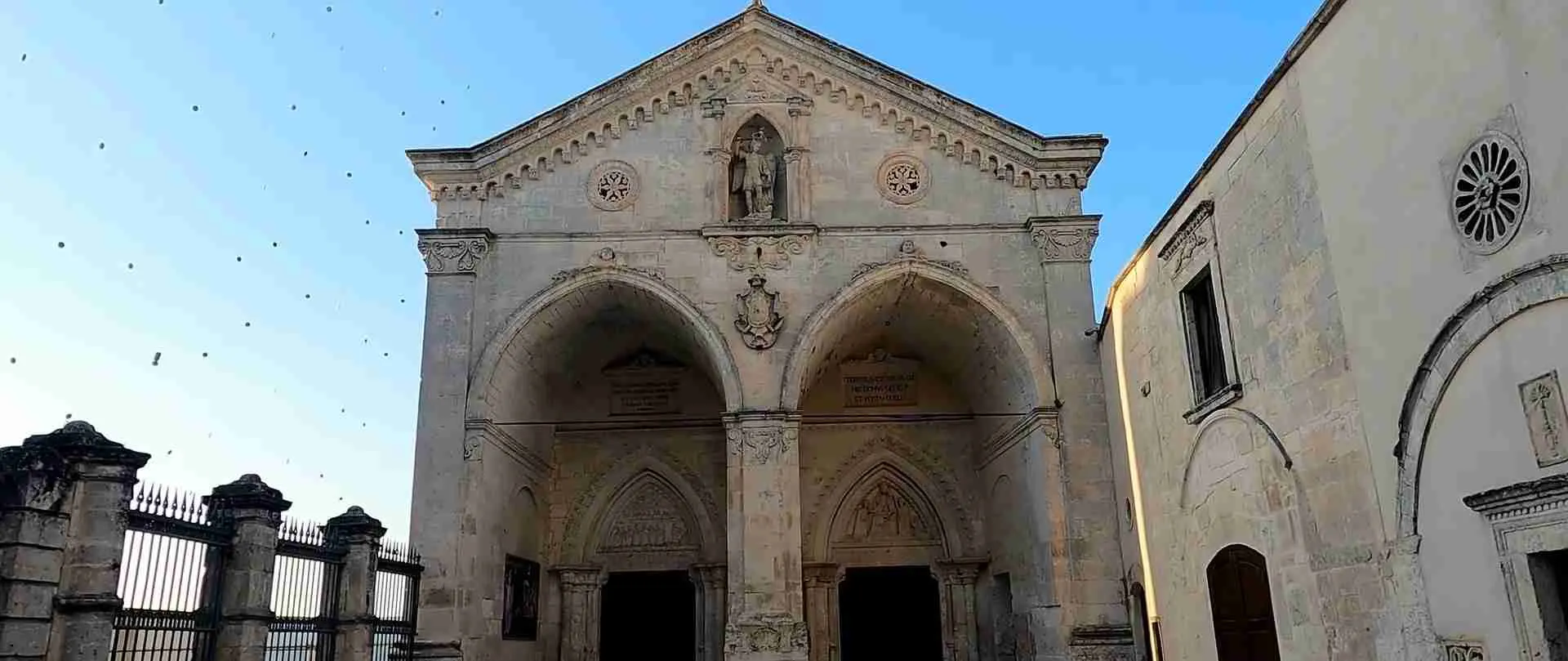
The Sanctuary of Saint Michael the Archangel is architecturally unlike any other Catholic church in the world, for the simple reason that its central and most sacred element is not a building at all: it is a hole in a mountain. The cave is the sanctuary; everything built around it — the portals, the staircase, the bell tower, the sacristy, the museum — exists to frame, protect, and provide access to the natural grotto that remains the spiritual heart of the entire complex.
The approach to the sanctuary begins on Via Reale Basilica in Monte Sant’Angelo’s historic centre, where a broad forecourt opens before a Romanesque-Gothic portal of the 13th century. This entrance, with its distinctive arched gateway of white limestone, establishes the formal threshold of sacred space — the transition from the everyday town to the precinct of the Archangel. To the right of the portal stands the octagonal bell tower, a structure that rewards careful attention: its four upper storeys of blind round arches represent a synthesis of Apulian Romanesque and Norman Gothic influences, while its base incorporates masonry from an earlier watchtower built by the Emperor Frederick II of Hohenstaufen before Charles I of Anjou reconstructed the upper levels in 1282.
Passing through the portal, the visitor enters a vaulted atrium that funnels movement toward the top of the Angevin staircase — the 86 steps descending through the rock to the cave level. The staircase was commissioned by Charles I of Anjou in the 13th century as part of his extensive rebuilding of the sanctuary complex, and it retains the slightly dramatised quality typical of Angevin religious architecture: a processional descent rather than a functional passage, designed to heighten spiritual anticipation. Each step brings the visitor further below ground, further from daylight, further from the noise of the world above.
At the base of the staircase, a pair of magnificent bronze doors marks the entrance to the cave itself. These doors, cast in Constantinople in 1076, represent one of the finest examples of Byzantine metalwork in southern Italy. They were commissioned and donated by the Amalfi nobleman Pantaleone, a member of one of the great merchant families of the era, as an act of extraordinary devotional patronage. The 24 panels of the doors depict scenes from the Old and New Testaments with particular focus on the interventions of angels in human history, the imagery combining Byzantine iconographic tradition with an understanding of the narrative content clearly shaped by Western Romanesque sensibilities. The doors arrived at Monte Sant’Angelo by sea — Pantaleone was well-positioned to arrange their transport from Constantinople to Siponto, the nearby Adriatic port — and their installation transformed the entrance of the sanctuary into a statement of international artistic and theological ambition. A major restoration of the doors was undertaken in recent decades, addressing corrosion and wear through non-invasive cleaning and stabilisation techniques.
Beyond the bronze doors, the cave opens into the sanctuary proper. The interior is a natural karst chamber of irregular shape, its ceiling and walls of living rock occasionally giving way to vaulted masonry additions of various periods. The atmosphere is markedly different from any conventional church: cooler, damper, acoustically unusual — sounds are absorbed by the rock rather than projected, creating an intimacy that large stone basilicas cannot replicate. The main altar, dominated by a marble statue of the Archangel Michael in his militant aspect — armoured, sword raised, trampling a serpent — occupies the eastern end of the cave. An ancient episcopal throne of white marble, attributed to the Norman period, stands nearby. Votive offerings, inscriptions in multiple languages, and a continuous presence of praying pilgrims give the space the quality of active rather than merely preserved devotion.
A small chapel carved into the rock to one side preserves a marble slab believed to bear the Archangel’s footprints — the tangible evidence of the third apparition that made formal episcopal consecration unnecessary. Devotion to this slab has been continuous for over a millennium, and the stone surface shows the wear of countless hands and lips. The cave walls carry inscriptions in Latin, Greek, Old English, Norman French, and other languages, pilgrims from across medieval Europe leaving their names and prayers in the rock itself.
The Byzantine Bronze Doors: A Masterwork of Devotion
The bronze doors of Monte Sant’Angelo stand as one of the great artistic donations of the medieval world. Created in Constantinople in 1076 at the commission of Pantaleone of Amalfi, a merchant of extraordinary means who made similar donations to other major southern Italian sanctuaries including Monte Cassino and the Cathedral of Amalfi, the doors represent the intersection of Byzantine artistic mastery and Western devotional intent that characterised the cultural sphere of Norman-Lombard southern Italy.
The doors consist of 24 individual bronze panels, each depicting a narrative scene from scripture with particular attention to angelic intervention. The craftsmen of Constantinople — working in a tradition of metalwork that had no equivalent in the Latin West at this period — employed a technique of silver inlay against a dark bronze ground that creates shimmering effects under candlelight, the figures appearing to move as flames flicker. The iconographic programme follows Byzantine conventions in its formal hierarchy — Christ and the Virgin in the position of greatest dignity, the Archangel Michael in his role as divine warrior prominently placed — but the specific selection of scenes showing angels acting in human history reflects an understanding of the sanctuary’s particular theological claim: that this cave is a site where divine and human worlds have directly met.
The doors’ very existence at Monte Sant’Angelo says something important about the sanctuary’s medieval status. Pantaleone’s choice to donate equally magnificent doors to Monte Cassino (the most prestigious monastery of the Latin West), Amalfi Cathedral (his city’s principal church), and Monte Sant’Angelo (a cave on a Pugliese mountain) equates these three destinations in terms of cultural prestige — a remarkable statement about the sanctuary’s standing in the 11th-century Mediterranean world. The fact that the doors survive largely intact, having endured nearly a thousand years in a cave environment, is a testament both to the quality of the original workmanship and to the continuity of care that active pilgrimage sites provide: a door that pilgrims venerate does not get neglected.
The Bell Tower, the Angevin Architecture, and the Norman Castle
The sanctuary complex that visitors encounter today is substantially the product of three distinct medieval building campaigns: the Lombard and early medieval development that established the basic form of the cave church; the Norman building activity of the 11th and 12th centuries that gave the complex its wider architectural setting; and the Angevin rebuilding of the 13th century under Charles I of Anjou that created most of the above-ground structures now visible.
The octagonal bell tower, rising immediately to the right of the entrance portal, is one of the most recognisable elements of the Monte Sant’Angelo skyline. Its lower portion incorporates the remains of a watchtower built by Frederick II of Hohenstaufen, the extraordinary Holy Roman Emperor who ruled southern Italy in the first half of the 13th century and whose passion for architecture left hexagonal and octagonal towers across Puglia — Castel del Monte being the most celebrated example. When Charles of Anjou defeated the Hohenstaufen forces in 1266 and took control of southern Italy, he rebuilt the upper sections of Frederick’s tower in the Angevin Gothic style, adding the four upper storeys of blind arcading that now complete the structure. The resulting tower is therefore a palimpsest of political as well as architectural history, its layers recording the succession of powers that sought legitimacy through association with the sanctuary.
The Norman castle of Monte Sant’Angelo stands separate from the sanctuary complex, occupying the highest point of the town’s historic ridge. Built in the 9th century and substantially modified under Norman rule in the 11th and 12th centuries, the castle reflects the political significance of Monte Sant’Angelo as a stronghold controlling the approaches to the Gargano. Its towers look down over the sanctuary precinct and over the Rione Junno below. The castle now houses a small museum and offers panoramic views that in clear conditions extend across the Tavoliere plain to the distant Apennines — the same view that medieval pilgrims ascending from the west would have used to orient their approach.
Pilgrims, Popes, and Crusaders: A Millennium of Sacred Journeys
The documented history of notable pilgrims to Monte Sant’Angelo spans fifteen centuries and includes figures whose significance extends far beyond the merely devotional. Popes, emperors, kings, saints, and military commanders made the ascent to the cave, each visit adding to the sanctuary’s reputation as a site where the highest human authority sought to connect with divine power.
Among the earliest documented pilgrims of prominence are Lombard nobles whose names appear in the sanctuary’s inscriptions and in chronicle sources from the 6th and 7th centuries. The Lombard dukes of Benevento systematically cultivated their relationship with the sanctuary as a form of political theology: the Archangel’s protection guaranteed military success; gifts to his shrine demonstrated the donors’ piety and resources; the sanctuary’s fame projected Lombard prestige across Christendom. Duke Grimoald, who briefly ruled as king of the Lombards in the 660s AD, was among the most generous early patrons, and his donations helped establish the physical infrastructure that made sustained pilgrimage possible.
The Norman conquest of southern Italy in the 11th century brought a new wave of distinguished pilgrims and patrons. Robert Guiscard, the most formidable of the Norman leaders, visited the sanctuary before and after his campaigns, and Norman military success in southern Italy was routinely attributed in part to the Archangel’s favour. The Norman absorption of Lombard religious traditions — including the cult of Michael — was one of the more effective acts of cultural diplomacy in medieval history, legitimising Norman rule among populations that identified Lombard saints and sanctuaries as markers of their own identity.
The Crusades brought Monte Sant’Angelo into the mainstream of international military-religious activity. Armies assembling at Brindisi, Bari, and Otranto for the sea passage to the Holy Land often detoured inland to Monte Sant’Angelo for pre-departure prayers and votive offerings. The sanctuary’s geography made it a natural staging point: the coastal plain was the route of march; the mountain was the last significant elevation before the flat coastal strip leading to the ports; the cave offered both practical shelter and spiritual preparation for the dangers ahead. Many crusaders who died in the Holy Land had left votive inscriptions at Monte Sant’Angelo, and the documentary records of the sanctuary include donations specifying that masses should be said for crusader souls.
Saint Francis of Assisi arrived at Monte Sant’Angelo in 1216. His visit is recorded in Franciscan sources and commemorated in a small chapel near the entrance to the sanctuary complex, where a stone is preserved bearing what tradition identifies as the imprint of Francis’s hand. Whether historically precise or not, the detail reflects a characteristic Franciscan awareness of the body as bearer of spiritual significance — Francis, whose stigmata would come later, was already understood by his followers as a figure in whom the divine left physical marks. His visit to the cave where the Archangel had left footprints in stone was an encounter between two traditions of sacred embodiment.
Pope John Paul II visited Monte Sant’Angelo in 1987, continuing an unbroken tradition of papal pilgrimage to the sanctuary that stretches back to at least the 8th century. Across that span, the Popes who made the journey include figures of dramatically varying historical significance — Gregory the Great sent a delegation rather than coming in person but contributed significantly to the theological elaboration of the cult; Leo IX came in 1053, just months before the Great Schism that divided Eastern and Western Christianity; and numerous medieval popes stopped at the sanctuary as part of their progresses through southern Italy. The continuity of papal attention is itself a form of sacred geography: the mountain has remained a destination worth the effort of supreme spiritual authority for over a millennium.
Rione Junno: The Medieval Town Born from Pilgrimage
Monte Sant’Angelo is not merely a sanctuary surrounded by a modern service town. The historic urban fabric of the place is itself a product of pilgrimage — the town grew from the need to house the faithful arriving in numbers that exceeded the cave’s immediate approaches, and the character of the Rione Junno, the oldest surviving neighbourhood, reflects the specific demands and textures of a medieval pilgrimage economy.
The Rione Junno — whose name derives from a Lombard term for the central district of a settlement — occupies the slopes below and around the sanctuary, its narrow alleys and stairways following the contours of the limestone ridge rather than any regular planned grid. The buildings are of pale local stone, their facades close together, the streets between them sometimes barely wide enough for two people to pass. Terraced houses of two storeys — a basement for storage and animals, an upper floor for living — line the lanes in formations that preserve the essential logic of medieval urban density: maximum shelter, minimum floor space, communal use of shared elements like ovens and wells, several of which remain visible in the neighbourhood today.
The earliest permanent structures in the Rione Junno were pilgrim hospices — temporary shelters that hardened over time into permanent dwellings as their operators settled, married local women, and became part of the community. The town’s population in the medieval period was therefore unusually cosmopolitan: alongside the local Pugliese population were settled families whose origins lay in Amalfi, Naples, France, and the German lands, drawn to the sanctuary’s economic orbit as much as its spiritual field. The architectural diversity of the Rione Junno — buildings that show Romanesque mouldings alongside Byzantine-influenced arches, Gothic doorways beside vernacular limestone construction — reflects this accumulated cosmopolitanism.
Walking through the Rione Junno today is an experience that rewards patience and a willingness to get lost. The main pilgrimage routes from the sanctuary down toward the lower town are marked, but the side alleys leading to small piazzas, votive shrines, and remnant medieval structures reward exploration. The neighbourhood is largely residential and works best approached with the understanding that it is a living community rather than a museum — the pilgrimage economy that built it continues, in modified form, to sustain it.
The Gargano Promontory: A Landscape of Sacred Geography
Monte Sant’Angelo cannot be fully understood without understanding the Gargano that surrounds it. The promontory is a geological outlier — a block of Cretaceous limestone that once lay offshore as an island before the Tavoliere plain rose around it during the Tertiary period, connecting it to the peninsula. Its forests, its cliffs, its lakeland interior, and its dramatic coastal topography create a landscape that reads differently from the flat Puglia surrounding it, a place set apart by elevation and geology that has attracted sacred significance across multiple religious traditions.
The Foresta Umbra — the Shaded Forest — occupies the interior of the Gargano massif and remains among the most impressive old-growth woodland in southern Italy. Ancient beeches, holm oaks, and silver firs create a forest of unusual density and maturity, protected since 1991 within the Gargano National Park. Medieval pilgrims ascending from San Giovanni Rotondo would have entered a version of this forest — darker and more extensive than today — as part of the final approach to Monte Sant’Angelo, the forest itself functioning as a transitional space between the open plain and the sacred summit.
The Gargano coast is defined by dramatic limestone cliffs — the Testa del Gargano at the promontory’s northernmost tip, the sea caves of Vieste and Mattinata further south — and by the two inland lakes, Lago di Lesina and Lago di Varano, separated from the Adriatic by narrow sand bars. These lakes were important resources in the medieval economy, their fish supplementing the diet of pilgrims and residents alike. The coastal towns of Manfredonia — founded near the site of ancient Siponto, the bishop’s seat from which the first apparition narrative begins — and Vieste served as secondary entry points for pilgrims arriving by sea from the eastern Adriatic and beyond.
The Gargano’s position as both a spiritual and a practical node in the medieval Mediterranean world was reinforced by its geography. Visible from considerable distances at sea, the promontory’s elevation made it a navigation landmark for Adriatic shipping. The same elevation that made it a pilgrimage destination also made it a watchtower and a defensive stronghold. The combination of roles — spiritual, military, commercial, agricultural — in a single compact geography explains why Monte Sant’Angelo and the Gargano attracted the sustained attention of every major power in southern Italian history, from the Lombard dukes through the Norman and Hohenstaufen rulers to the Angevins and beyond.
Monte Sant’Angelo in the UNESCO World Heritage: The Longobards in Italy
The inscription of Monte Sant’Angelo’s sanctuary within the UNESCO serial property “Longobards in Italy: Places of Power (568–774 A.D.)” on 25 June 2011 recognised it as the 46th Italian site on the World Heritage List. The serial property comprises seven groups of monuments, each representing a distinct expression of Lombard cultural and political achievement, spread across the Italian peninsula from the far northeast to the deep south.
The seven components are: the Gastaldaga area and Episcopal complex at Cividale del Friuli in Friuli-Venezia Giulia; the monumental area with the monastic complex of San Salvatore-Santa Giulia at Brescia in Lombardy; the castrum with the Torba Tower and the church of Santa Maria foris portas at Castelseprio-Torba in Lombardy; the Basilica of San Salvatore at Spoleto in Umbria; the Clitunno Tempietto at Campello sul Clitunno in Umbria; the Santa Sofia complex at Benevento in Campania; and the Sanctuary of San Michele at Monte Sant’Angelo in Puglia. Together these sites span the full geographical extent of the Lombard kingdoms in Italy, from the northern duchies of Friuli and Brescia through the central territories of Spoleto to the southern Duchy of Benevento and its sacred outpost on the Gargano.
UNESCO’s criteria for the inscription focus on the sites’ collective testimony to the Lombards’ role in the spiritual and cultural development of medieval European Christianity. The Committee specifically noted the Lombards’ synthesis of Roman, Christian, Byzantine, and Germanic traditions — a cultural fusion that marked the transition from late Antiquity to the European Middle Ages — and their critical contribution to the monastic movement that spread across the continent in the 7th and 8th centuries. Monte Sant’Angelo’s sanctuary is the most spiritually prominent component of the serial site, but it gains additional meaning from its place within this wider geography of Lombard heritage.
The inscription has been accompanied by ongoing conservation and enhancement projects. European Union-supported regional funds have backed a project titled “The Sanctuary of San Michele Arcangelo: New Paths for the Pilgrim Between Faith and History,” which has upgraded technological infrastructure within the complex, introduced multimedia interpretive exhibits, improved accessibility for visitors with mobility limitations, and developed sustainable visitor management strategies to protect the cave environment against the impacts of the more than two million annual visitors the site now receives. The balance between active devotional use — the sanctuary remains a living place of Catholic worship, with regular masses and a continuous stream of individual prayer — and heritage conservation is a management challenge unique to sites where religious and cultural values cannot easily be separated.
Walking the Ancient Route Today: A Pilgrim’s Guide
The historic pilgrimage routes to Monte Sant’Angelo are walkable today, though they require advance preparation, good physical condition, and the kind of resigned acceptance of uncertainty that medieval pilgrims would have recognised. The routes cross varied terrain — flat agricultural land on the Tavoliere, the forested hills of the Gargano interior, and the steep final ascent to the town — and pass through a landscape that retains, in places, the character that medieval pilgrims would have encountered.
The principal contemporary walking itinerary follows sections of the Via Francigena del Sud — the southern Via Francigena — which the European Association of the Vie Francigene has worked to certify and waymark in recent years. From Foggia, the main city of the Tavoliere, the route crosses the flat plain northeastward toward San Severo, entering the foothills of the Gargano near Apricena before climbing through the Stignano Valley toward San Marco in Lamis. This section covers approximately 50 kilometres and takes two to three days of walking at a comfortable pace.
From San Marco in Lamis, the route continues through San Giovanni Rotondo — a town now deeply associated with Padre Pio, the Franciscan friar canonised in 2002 whose stigmata, miracles, and extraordinary pastoral ministry made it a major 20th-century pilgrimage destination in its own right — before the final 18-kilometre ascent to Monte Sant’Angelo through increasingly dramatic mountain terrain. The elevation gain on this final section is substantial, rising from approximately 600 metres at San Giovanni Rotondo to 800 metres at Monte Sant’Angelo, with considerable intervening variation. The approach from the west offers views across the Tavoliere that progressively reveal the sanctuary town perched on its ridge, the bell tower visible from a considerable distance on clear days.
For those approaching from the north or along the Adriatic coast, the route from Manfredonia — the port town founded near ancient Siponto — offers an alternative ascent from sea level, climbing approximately 800 metres over 25 kilometres. This route traces the path that maritime pilgrims arriving by sea would have followed, and it retains a more dramatic character than the inland approach, with sudden views back across the Adriatic opening as the path climbs.
The credenziale del pellegrino — the pilgrim’s credential or passport — is available from the sanctuary itself and from the network of pilgrim associations affiliated with the Via Francigena. This document, stamped at each overnight stop, provides a record of the journey and entitles holders to reduced accommodation rates at affiliated pilgrim hostels along the route. It also qualifies pilgrims for the sanctuary’s own certification of completed journey, a tradition that has its roots in the medieval practice of issuing indulgences and certificates to those who had accomplished the pilgrimage in full.
The feast day of Saint Michael the Archangel falls on 29 September and is celebrated at Monte Sant’Angelo with solemn mass, processions, music, and traditional local ceremonies that draw pilgrims from across the region and beyond. A second feast day on 8 May commemorates the dedication of the sanctuary following the apparitions. Both occasions offer the most vivid experience of the site’s living devotional character, though they also bring the largest crowds — the September feast in particular coincides with favourable late-summer weather that makes walking conditions ideal.
Practical Information for Visiting the Sanctuary
The Sanctuary of Saint Michael the Archangel is located on Via Reale Basilica, 127, in the historic centre of Monte Sant’Angelo, in the province of Foggia, Puglia. The town sits on the southern slope of the Gargano promontory at approximately 800 metres above sea level, approximately 35 kilometres northeast of Foggia and 50 kilometres north of Manfredonia.
Entry to the sanctuary grotto is free, as it is an active place of Catholic worship. The museum within the sanctuary complex charges €5 for a full adult ticket, with reduced rates for groups of 30 or more (€4 per person). An audio guide is available for €2 (individual) or €1 per person for groups. A paper guide is available for €4. Check the official website at santuariosanmichele.it for current rates, as pricing may be updated seasonally.
Opening hours vary by season. During peak summer (July through September), the sanctuary opens daily at 7:30 AM and closes at 8:00 PM, with Sunday opening at 7:00 AM. During other months, hours follow a split schedule: typically 7:30 AM to 12:30 PM and 2:30 PM to 7:00 PM (or 6:00 PM in winter). The annual feast on 29 September is celebrated with extended hours and special masses beginning as early as 6:15 AM.
Visitors should dress modestly: shoulders and knees must be covered as a condition of entry to the sacred grotto, in keeping with the site’s status as an active place of worship. The dress code is applied throughout the sanctuary complex, not only in the cave itself. Scarves and covering garments are available for loan at the entrance for those who arrive underprepared.
The descent to the cave via the 86-step Angevin staircase is manageable for most visitors in reasonable physical condition, though the steps are of irregular height and some sections are worn smooth. A lift is available for visitors with mobility limitations or those unable to use the stairs. The cave environment is notably cool year-round — temperatures in the grotto remain around 15–16°C regardless of external conditions — and a layer beyond light summer clothing is advisable even in August.
Monte Sant’Angelo is reached by car from Foggia via the SS272 state road (approximately 40 kilometres), or from the A14 motorway via the San Severo exit and then the SS272. Bus services connect Monte Sant’Angelo to Foggia and Manfredonia, though services are infrequent outside summer months and the journey by bus is considerably longer than by car. There is no railway station in Monte Sant’Angelo itself; the nearest rail connections are at Foggia (main line) and at Manfredonia (regional line). Within the historic centre, parking is available on the outskirts of the town — the streets of the Rione Junno are not accessible by car and must be explored on foot.
The surrounding Gargano National Park offers hiking trails, forest walks, and coastal paths for those who wish to extend their visit beyond the sanctuary itself. The Foresta Umbra visitor centre, approximately 20 kilometres north of Monte Sant’Angelo, provides maps and information on the park’s trail network. Day trips to the Gargano coast — Vieste, Mattinata, and the sea caves of Pugnochiuso — are feasible from a Monte Sant’Angelo base, though the mountainous terrain means that distances are longer in travel time than in kilometres on a map.
Frequently Asked Questions
When were the apparitions of Saint Michael at Monte Sant’Angelo?
The three apparitions of the Archangel Michael are traditionally dated to the years 490, 492, and 493 AD, during the episcopate of Lawrence (Laurence) of Siponto. These events are documented in the Liber de apparitione Sancti Michaelis in Monte Gargano, a Latin hagiographical text that survives in multiple manuscript traditions. Scholars date the earliest layers of the text to the 6th or 7th century, with later additions and elaborations. The third apparition — in which the Archangel was held to have consecrated the cave directly, making episcopal dedication unnecessary — remains the theological foundation of the sanctuary’s unique status in Catholic tradition.
Is the sanctuary at Monte Sant’Angelo free to visit?
Entry to the sanctuary grotto is free, as the site is an active place of Catholic worship. Visitors access the cave church at no charge. The museum within the sanctuary complex charges €5 for adults (€4 for groups of 30 or more). An audio guide costs €2 per individual (€1 per person for groups). The sanctuary gift shops, selling religious objects, books, and souvenirs, are open year-round from 9:00 AM to 12:30 PM and 2:30 PM to 5:00 PM (extended to 7:30 PM in summer). Check the official website santuariosanmichele.it for current rates.
What are the opening hours of the Sanctuary of Monte Sant’Angelo?
During peak summer months (July to September), the sanctuary opens daily from 7:30 AM to 8:00 PM, with Sunday opening at 7:00 AM. From approximately June through October but outside peak summer, hours follow a split schedule of 7:30 AM to 12:30 PM and 2:30 PM to 7:00 PM. In winter months (November to March), hours are approximately 7:30 AM to 12:30 PM and 2:30 PM to 6:00 PM. The sanctuary observes all major Catholic feast days with extended or modified schedules. It is advisable to confirm current hours via the official website before visiting, particularly outside the main summer season.
What is the connection between Mont Saint-Michel in France and Monte Sant’Angelo?
Mont Saint-Michel and Monte Sant’Angelo are the two anchor points of the Via Micaelica — the “Archangel’s Path” — the devotional alignment connecting seven major shrines dedicated to Saint Michael across Europe. The Norman founders of Mont Saint-Michel explicitly modeled their island sanctuary on the Gargano precedent: the Lombards who had dominated Monte Sant’Angelo had carried the cult of Archangel Michael northward into Francia, and Norman devotion to Michael was partly shaped by this Lombard transmission. The two sanctuaries maintained active religious and diplomatic connections throughout the medieval period, with pilgrims frequently including both destinations in a single extended journey. The cave consecrated by the Archangel in Puglia provided the template — theological, architectural, and devotional — that the Normans adapted to their very different Atlantic landscape.
Which famous pilgrims visited Monte Sant’Angelo?
Monte Sant’Angelo’s pilgrimage record spans fifteen centuries and encompasses remarkable diversity. Among the most historically significant visitors: Saint Gregory the Great (590–604), who could not come in person but sent a delegation and contributed significantly to the theological elaboration of the Michael cult; numerous early medieval popes making progresses through southern Italy; the Emperor Otto II in the 10th century; Norman leaders including Robert Guiscard; crusader armies assembling in southern Italian ports throughout the 11th to 13th centuries; Pope Leo IX in 1053; Saint Francis of Assisi in 1216, who left an imprint of his hand in a stone near the sanctuary entrance; and Pope John Paul II in 1987, continuing the papal pilgrimage tradition into the modern era.
How was the town of Monte Sant’Angelo founded?
Monte Sant’Angelo grew directly from the need to shelter pilgrims arriving at the sanctuary cave in numbers too large for temporary camping on the mountain approaches. The earliest permanent structures were pilgrim hospices — simple shelters that hardened into permanent buildings as their operators settled permanently. Over time, a town crystallised around the sanctuary precinct, with houses built into the slope below the cave in the distinctive terraced form visible today in the Rione Junno. The town’s population in the medieval period was cosmopolitan, incorporating settled families from Amalfi, Naples, France, and the German lands alongside the local Pugliese population, all drawn by the economic and spiritual opportunities of a major international pilgrimage destination.
What are the bronze doors of the sanctuary, and who made them?
The bronze doors of the Sanctuary of Monte Sant’Angelo are a masterwork of Byzantine metalwork, cast in Constantinople in 1076 and donated by Pantaleone of Amalfi, a wealthy merchant who made similar donations to Monte Cassino and Amalfi Cathedral. The doors consist of 24 panels depicting scenes from the Old and New Testaments, with particular focus on angelic intervention in human history. The technique of silver inlay against dark bronze creates shimmering effects under candlelight. These are among the finest surviving examples of 11th-century Byzantine metalwork in southern Italy. A significant restoration campaign in recent decades has addressed corrosion and wear, preserving the doors through non-invasive conservation techniques.
Can you walk the Via Sacra Longobardorum today?
Sections of the Via Sacra Longobardorum are walkable today, largely following the certified route of the Via Francigena del Sud. The principal approach from the west crosses the Tavoliere plain from Foggia or San Severo, enters the Gargano through the Valley of Stignano, passes through San Marco in Lamis and San Giovanni Rotondo, and ascends to Monte Sant’Angelo over approximately 50 kilometres from Foggia (two to three days of walking). An alternative coastal approach from Manfredonia climbs 800 metres over 25 kilometres and follows the route used by medieval maritime pilgrims arriving by sea. The European Association of the Vie Francigene provides maps, waymarking information, and lists of affiliated accommodation along the certified route. A pilgrim credential (credenziale del pellegrino) is available from the sanctuary and from affiliated pilgrim associations.
What is the UNESCO World Heritage status of Monte Sant’Angelo?
The Sanctuary of Saint Michael the Archangel at Monte Sant’Angelo was inscribed on the UNESCO World Heritage List on 25 June 2011 as one of seven components of the serial property “Longobards in Italy: Places of Power (568–774 A.D.).” The inscription recognises the sanctuary’s outstanding universal value as testimony to the Lombards’ decisive role in shaping medieval European Christianity, specifically their cultural synthesis of Roman, Byzantine, Christian, and Germanic traditions. The serial property — which also includes monuments at Cividale del Friuli, Brescia, Castelseprio-Torba, Spoleto, Campello sul Clitunno, and Benevento — was the 46th Italian site inscribed on the World Heritage List.
What is the Sacred Line of Saint Michael, and is Monte Sant’Angelo on it?
The Sacred Line of Saint Michael — also called the Via Micaelica or the Archangel’s Path — is a near-linear alignment of seven major shrines dedicated to Archangel Michael, running from the western tip of Ireland across continental Europe to the Levant. Monte Sant’Angelo forms the southeastern European anchor of this alignment, which also passes through Saint Michael’s Mount in Cornwall, Mont Saint-Michel in Normandy, the Sacra di San Michele in Piedmont, Delphi in Greece, and a Michaeline shrine near Bethlehem. The alignment runs at approximately the angle of the midsummer sunrise across western Europe. Whether by design or coincidence, the alignment reflects a real network of active medieval pilgrimage connections — abbots corresponded, pilgrims traveled between the shrines, and devotion to Michael as a European figure was consciously cultivated across all seven sites throughout the medieval period.