The Byzantine and Norman Heartland: Exploring the Hidden Cultural Legacy of Bovino and Troia
In the rolling sub-Apennine foothills of northern Puglia, two small towns guard one of southern Italy’s most underappreciated concentrations of medieval heritage. Bovino and Troia stand roughly thirty kilometres apart in the historic territory of Daunia — a land that passed from Oscan tribes to Roman legions, from Byzantine strategoi to Norman knights, accumulating layers of civilisation at every turn. This guide explores the architecture, art, history, and enduring cultural identity of two towns whose monuments rival anything in Puglia’s more celebrated south, yet draw only a fraction of the visitors.
Key Takeaways
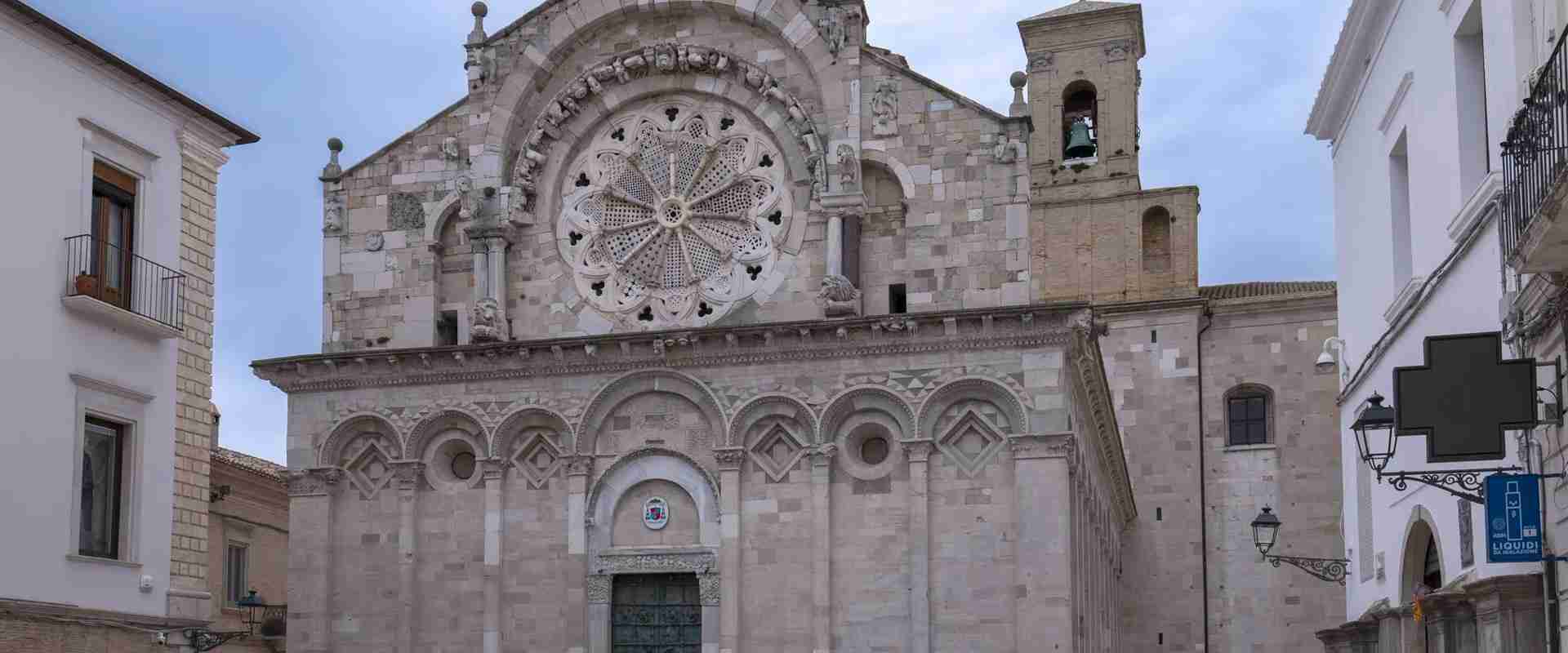
- Troia Cathedral stands as one of the supreme achievements of Apulian Romanesque architecture, its pierced bronze rose window and pair of cast bronze doors by Oderisius da Benevento ranking among the most refined examples of medieval decorative art in all of Italy.
- Bovino is a member of Italy’s exclusive Borghi più belli d’Italia network, its hilltop silhouette, Norman ducal castle, and Romanesque cathedral of Sant’Andrea intact within a medieval urban fabric that has changed little in nine centuries.
- Both towns bear the imprint of Byzantine rule — Troia as a fortified Byzantine stronghold on the Tavoliere plain, Bovino as a key node on the ancient road network linking the Adriatic hinterland — a heritage visible in artistic conventions, ecclesiastical organisation, and architectural detail that survived the Norman conquest.
- The Norman rulers transformed rather than erased the Byzantine and Lombard world they inherited, channelling their enormous wealth into cathedral-building programmes that fused Latin Romanesque structure with Byzantine ornamentation and Saracenic geometric fantasy.
- Daunia remains one of Italy’s least-visited cultural territories, offering encounters with world-class medieval monuments in conditions of remarkable tranquillity — no queues, no crowds, and the opportunity to experience these buildings as their builders intended: as focal points of living communities.
- Together, Bovino and Troia represent the full arc of Daunian civilisation, from pre-Roman Italic settlement through Roman colonisation, Byzantine fortress-building, Norman conquest, and episcopal city culture — a narrative compressed into hilltops and stone that rewards careful, unhurried exploration.
People Also Ask About the Byzantine and Norman Heritage of Bovino and Troia
What makes Troia Cathedral architecturally significant?
Troia Cathedral is considered the most accomplished expression of Apulian Romanesque architecture in northern Puglia, distinguished above all by features that appear nowhere else in the same combination. The great rose window on the western façade is not carved stone but a composition of pierced bronze panels arranged in concentric geometric rings, producing an effect closer to an enormous metal grille than to the glazed tracery common in northern European Gothic. Light passing through its interstices creates a constantly shifting pattern on the interior floor — a quality that has led scholars to identify Saracenic and Byzantine geometric traditions at work alongside the Lombard-Romanesque structural vocabulary. Equally remarkable are the two sets of bronze doors: the smaller door cast in 1119 and the larger ceremonial west doors in 1127, both attributed to Oderisius da Benevento. Each door is divided into panels populated by lions, griffins, bishops, angels, and foliate ornament rendered with a precision of line and a sureness of composition that place them in the very first rank of medieval European metalwork. Internally, the cathedral preserves a twelfth-century ivory episcopal throne, fragments of Byzantine-influenced fresco, and a diocesan treasury of unusual quality. The building as a whole encapsulates the cultural complexity of the Norman South: a space that is simultaneously Latin in its basilical plan, Byzantine in its ornamental instinct, and Arab in its geometric abstraction.
What Byzantine heritage survives in northern Puglia’s hilltop towns?
The Byzantine presence in northern Puglia — the territory historically known as Daunia or Capitanata — left traces that outlasted the political end of Byzantine rule in 1071. In Troia, the town itself was built and fortified by Byzantine military commanders as part of the defensive network protecting the Tavoliere plain against Lombard incursion; its very street plan preserves the logic of a Byzantine castrum. In Bovino, the ecclesiastical traditions of the Greek rite persisted into the early Norman period, and the cathedral chapter maintained connections with the Eastern church long after the Normans imposed Latin ecclesiastical organisation. More broadly, Byzantine artistic conventions — the use of gold in devotional painting, the stylised figural canon of icons, the preference for dense geometric surface decoration — fed directly into the visual vocabulary of the Apulian Romanesque workshops that produced the region’s bronze doors, stone capitals, and painted wooden panels. In both towns, the diocesan museums hold objects that testify to this cultural continuity: Byzantine-influenced ivories, early medieval bronzes, and fragments of Greek liturgical manuscript that survived the transition from Eastern to Western ecclesiastical control.
How did the Norman conquest transform the cultural landscape of Daunia?
When the Normans under Robert Guiscard and his successors completed their conquest of Byzantine Apulia in the 1060s and 1070s, Daunia became one of their most actively developed territories. The Normans were not architectural or cultural nihilists: they recognised the administrative sophistication and artistic excellence of the Byzantine system they were absorbing, and they set about building institutions — above all cathedral chapters and episcopal sees — that channelled local wealth and energy into monumental construction. Troia became the seat of one of the most important Norman-period dioceses in southern Italy, and the cathedral begun there around 1093 under Bishop Elia was a direct expression of Norman patronage at its most ambitious. Bovino similarly was elevated into a Norman county and later a duchy, with the castle rebuilt and expanded as a seat of power. The Norman lords of Daunia populated their territories with Benedictine monasteries, promoted the Latin rite over the Greek, and created the conditions for the building campaigns that produced the regional Romanesque monuments visible today. Yet they did not homogenise what they conquered: the artistic workshops they patronised drew freely on Byzantine craftsmen and Saracenic geometric tradition, producing a synthesis that is at once unmistakably Norman in its hierarchical ambition and unmistakably southern Italian in its ornamental richness.
What is the historical relationship between Bovino and Troia?
Bovino and Troia occupied complementary positions in the geography and political economy of medieval Daunia. Troia sat at the edge of the Tavoliere plain, commanding the approaches to the great cereal-growing flatlands that made Daunia agriculturally wealthy; Bovino occupied a high ridge in the sub-Apennine hills to the south-west, controlling the mountain passes and road routes connecting the Adriatic hinterland with the Tyrrhenian side of the peninsula. Both were episcopal seats — Bovino’s diocese ancient and continuous since late antiquity, Troia’s established or re-established under Norman patronage. Their bishops attended the same councils, their architects and craftsmen almost certainly shared knowledge and workshop traditions, and their ruling families intermarried across the feudal hierarchies of the Norman and subsequently Swabian, Angevin, and Aragonese kingdoms. The two towns experienced the same macro-historical rhythms — Byzantine rule, Norman conquest, the kingdom-building of Roger II and Frederick II, the devastations of the fourteenth-century plague and the seismic events that periodically struck the Apennine frontier. What distinguishes them today is their contrasting topography: Troia’s civic and cathedral life spread across a broad plateau, open to the sky and the plain; Bovino compressed its entire medieval world onto a sharp rocky ridge where every piazza and every palazzo seems to teeter above a precipice. Together they offer a stereo vision of the Daunian Middle Ages.
Extended multi-day tours – 5+ days
Featured Puglia Multi-Day Tour Packages
3 days
Puglia 3-Day Discovery Tour
- ✓ Comprehensive Puglia experience
- ✓ Expert local guides included
- ✓ All accommodation included
- ✓ Transportation provided
5 days
Puglia 5-Day Highlights Experience
- ✓ Comprehensive Puglia experience
- ✓ Expert local guides included
- ✓ All accommodation included
- ✓ Transportation provided
7 days
Puglia 7-Day Cultural Journey
- ✓ Comprehensive Puglia experience
- ✓ Expert local guides included
- ✓ All accommodation included
- ✓ Transportation provided

10 days
Puglia 10-Day Complete Adventure
- ✓ Comprehensive Puglia experience
- ✓ Expert local guides included
- ✓ All accommodation included
- ✓ Transportation provided
Multi-day tour packages powered by TourRadar. Prices and availability subject to change.
The Forgotten Cultural Heartland of Daunia
The name Daunia comes from the Daunians, one of the three Italic-speaking Iapygian peoples who inhabited Puglia before Roman conquest — alongside the Peucetii to the south and the Messapii at the heel. Their territory covered what is now the Province of Foggia, a vast rectangle of land bounded to the east by the Adriatic and the Gargano headland, to the south by the Ofanto river, to the west and north by the Apennine chain. Within this rectangle the landscape divides dramatically: the Tavoliere delle Puglie, the great interior plain, is one of the largest flat expanses in peninsular Italy, a place of immense agricultural productivity and almost theatrical emptiness; and the Sub-Apennine Dauno hills that rise to its west, a corrugated landscape of steep valleys, chestnut forests, and stone-built hilltop towns where the vernacular architecture has not changed in essentials since the twelfth century.
It is in this hill country that Bovino and Troia sit, separated by a journey of forty minutes on winding provincial roads but connected by a shared history that spans three millennia. They are not, by most conventional measures, prominent destinations. Foggia, the provincial capital, receives tens of thousands of annual visitors drawn to the Gargano coast and the pilgrimage sanctuary of San Giovanni Rotondo; the Baroque cities of Lecce and Bari draw the bulk of cultural tourism in Puglia; the trulli of Alberobello and the masserie of the Valle d’Itria capture the popular imagination. Bovino and Troia remain largely unknown outside Italy, and even within Italy are visited primarily by those with a specialist interest in medieval architecture or a loyalty to the traditions of slow, off-route travel.
This obscurity is not a reflection of their importance. Troia Cathedral is, by the considered judgement of Italian art historians from Émile Bertaux to Pina Belli D’Elia, one of the finest Romanesque buildings in Italy — a building that would be mobbed by tourists if it stood in Tuscany or Umbria. Bovino’s castle and cathedral, its intact medieval street plan, and the drama of its hillside position earn it a place among the most beautiful small towns in the country, a recognition now formalised by its membership of the Borghi più belli d’Italia association. What both towns offer, beyond the monuments themselves, is the experience of great medieval art in conditions of almost complete solitude — the cathedral of Troia encountered not as a stop on a bus tour but as a living parish church in a quiet piazza, its bronze doors standing open on a Tuesday morning with no one else in sight.
To understand why these buildings look the way they do — why a rose window in a small Apulian town should be made of pierced bronze rather than stone and glass, why the decoration on a Norman-period capital should contain motifs that recall the geometric abstraction of Islamic tile-work — it is necessary to follow the deep history of Daunia, a history that begins long before the Byzantines or the Normans arrived.
Ancient Foundations — The Daunian and Roman World
The Daunian civilisation that gave the region its name flourished from roughly the eighth century BC until the Roman conquest. It was a culture of remarkable sophistication: the Daunians produced distinctive painted pottery, constructed elaborate necropolises, and built fortified hilltop settlements — the precursors of the medieval towns that would later occupy the same commanding positions. Among the most important Daunian centres was Vibinum, the ancient precursor of Bovino, whose ridge site above the valley of the Cervaro offered both defensive security and commanding views across the surrounding territory. Archaeological evidence from Vibinum and its necropolis reveals a society deeply engaged in the trade networks of the central Mediterranean, importing Attic pottery and exporting agricultural surplus — principally grain and wool — across the Adriatic.
The Roman conquest of Daunia in the third century BC brought the transformation characteristic of Roman assimilation: the hilltop settlements were reorganised as municipia, roads were driven through the landscape, and the agricultural potential of the Tavoliere was maximised through systematic colonisation. The Via Traiana, built under the Emperor Trajan at the beginning of the second century AD as an improvement of the older Via Minucia, passed through Bovino on its route from Benevento to Brindisi — a detail of enormous consequence for the town’s later history, since control of a major Roman road translated directly into economic and military significance in every subsequent era. The town that stood along this route was known in Latin as Vibinum, its name a latinisation of the Daunian original, and it served as an administrative centre for the surrounding territory with all the amenities of a Roman provincial town: forum, baths, temples, amphitheatre.
Troia’s ancient identity is more debated. The site on the edge of the Tavoliere may correspond to the ancient Aecae, a settlement mentioned in classical sources as an important centre of the Tavoliere plain, though the identification is not universally accepted. What is certain is that the elevated position above the plain was occupied continuously from at least the Bronze Age, and that the strategic logic that made it valuable to Byzantine and Norman commanders — commanding the routes between the Apennine hills and the Adriatic coast while overseeing the agricultural production of the Tavoliere — was equally apparent to their Roman predecessors.
The late Roman period saw both towns absorb the new religion of Christianity. Episcopal sees were established at Bovino and at what would become Troia in the fourth and fifth centuries, creating institutional structures — bishops, cathedral chapters, clerical schools — that would prove durable enough to survive every subsequent political upheaval. The diocese of Bovino, whose origins are traced by tradition to the late imperial period, would maintain continuous existence through Byzantine rule, Norman conquest, and the long succession of southern Italian kingdoms until its merger with neighbouring sees in the twentieth century. This institutional continuity is not merely of ecclesiastical interest: the cathedral chapters preserved libraries, maintained artistic workshops, commissioned buildings, and formed the cultural continuity between one era and the next in ways that political upheaval could disrupt but never entirely extinguish.
Byzantine Daunia — The Eastern Empire’s Italian Stronghold
The fall of the Western Roman Empire in 476 AD brought a period of Ostrogothic rule to Italy that, in Apulia, was relatively benign. The Ostrogoths were Romanised enough to maintain the existing administrative apparatus, and the great senatorial families that had prospered under the Empire continued to do so under Theodoric. But the Byzantine reconquest under the Emperor Justinian — a campaign prosecuted with enormous ferocity by the general Belisarius from 535 onward — reintegrated Apulia into the surviving Eastern Roman Empire, and Daunia entered a new phase of its history that would last, in attenuated form, for more than five centuries.
Byzantine rule in Apulia was administered from Bari, the coastal city that served as the seat of the Catapan — the Byzantine governor of southern Italy. The Catapanate of Italy, formalised in 965, was the frontier institution through which Constantinople maintained its hold on the richest agricultural territory still in imperial possession on the Italian mainland. Apulia’s grain, its wool, its olive oil, and the tolls from its ports and roads flowed toward the imperial treasury; in return, the Byzantine state invested in fortification, ecclesiastical organisation, and artistic patronage at a level that shaped the cultural landscape for centuries to come.
In Daunia specifically, the Byzantine presence took the form of a network of fortified towns placed to control the routes across the Tavoliere and the Apennine passes. Troia was one of the most significant of these: Byzantine military engineers recognised the site’s potential as a defensible stronghold at the intersection of roads leading to Bari, Benevento, and the Adriatic ports, and invested in its fortification. Contemporary Byzantine sources refer to the town as a place of strategic importance repeatedly contested between imperial forces and Lombard or Arab raiders. The ecclesiastical dimensions of this fortification were equally important: Byzantine bishops loyal to the Patriarch of Constantinople maintained the Greek rite in Troia’s churches, and the artistic production associated with these churches — devotional icons painted in the Byzantine manner, illuminated manuscripts in Greek, liturgical objects in the tradition of Constantinople’s workshops — established an aesthetic vocabulary that would persist long after the political authority that produced it had disappeared.
Bovino, positioned higher in the hills and closer to the Lombard territories of Benevento, occupied a more ambiguous frontier position. The Lombard Principality of Benevento claimed authority over much of the interior of southern Italy, and the boundary between Byzantine and Lombard control in northern Puglia shifted repeatedly across the seventh, eighth, and ninth centuries. Bovino experienced periods of Lombard control that left traces in its ecclesiastical organisation, its legal traditions, and its architectural vocabulary — the heavy, almost austere quality of certain carved ornaments in the cathedral area owes as much to Lombard stonecutting traditions as to Byzantine refinement. This mixture of influences, this layering of competing cultural claims on the same hilltop, is precisely what makes the town’s built heritage so complex and rewarding to read.
Byzantine artistic practice in Apulia reached its apogee in the ninth and tenth centuries, when the monasteries founded by Greek monks from Calabria and directly from the eastern Mediterranean became centres of manuscript illumination, icon painting, and the production of devotional objects of extraordinary quality. The Basilian monastic tradition — named for the Rule of Saint Basil rather than the Benedictine Rule common in western monasticism — established itself in the caves and cliff faces of Apulia’s river gorges, and its influence extended into the hilltop towns through the movement of monks, artists, and manuscripts. The icons and devotional panels preserved in the diocesan museums of Bovino and Troia bear the imprint of this tradition: figures rendered in the flattened, hieratic style of Byzantine iconography, set against gold backgrounds that declare the sacred nature of the represented subject in terms developed at Constantinople and transmitted through the monastic network of southern Italy.
The Norman Arrival — Conquest, Patronage, and Architectural Ambition
The story of how a group of Norman adventurers from the petty nobility of the Cotentin peninsula in Normandy came to rule southern Italy is one of the most improbable in medieval European history. The process began in the early eleventh century when Norman pilgrims returning from Jerusalem through southern Italy found employment as mercenaries in the endemic warfare between Byzantine, Lombard, and Arab forces. Their reputation for military effectiveness attracted further recruitment, and by the 1030s the Hauteville family — one Norman clan among many, but the most talented and ruthless — had begun to carve out territorial ambitions of its own.
Robert Guiscard, the sixth son of Tancred de Hauteville, emerged as the dominant figure of Norman expansion in southern Italy. In 1059 Pope Nicholas II invested him as Duke of Apulia and Calabria, legitimising what was already a fait accompli and providing the papal blessing that transformed a mercenary land-grab into a feudal polity. The fall of Bari in 1071 — the last Byzantine stronghold on the Italian mainland, besieged by Robert Guiscard after a three-year campaign — ended five and a half centuries of Eastern Roman authority in Apulia. Troia, surrounded by Norman-controlled territory and unable to resist, had already submitted to Norman authority earlier in the conquest, and the transition there was conducted with less violence than in many other Byzantine centres.
The Norman approach to governance in their new territories combined military dominance with a sophisticated cultural pragmatism. They recognised that the Byzantine administrative and ecclesiastical structures were more sophisticated than anything they had brought from Normandy, and they proceeded to reform rather than destroy them. The Greek bishops were gradually replaced by Latin ones loyal to Rome, but the transition was managed over decades rather than imposed overnight, and the artistic workshops associated with the Greek churches were absorbed into the service of the new Latin cathedral chapters without disruption. Norman lords who had grown up in Normandy surrounded by the relatively austere stone carving of Romanesque France found themselves in a world of Byzantine gold, Arab geometric abstraction, and ancient Roman building stock, and their response was not rejection but enthusiastic appropriation.
In Daunia this appropriation produced the building campaigns responsible for the monuments visible today. The Norman policy of establishing or refounding episcopal sees as anchors of ecclesiastical and political authority resulted in massive investment in cathedral construction across the region. Troia, elevated to the seat of a Norman-period diocese of considerable importance — its bishops attended key councils, advised the Norman counts and later kings, and managed the administration of a wealthy agricultural territory — received the cathedral that is its supreme monument. Bovino, similarly reorganised as a Norman county with its own bishop, saw the existing late antique and Byzantine cathedral structures rebuilt and adorned in the new Apulian Romanesque manner.
The Norman kings who unified their southern Italian and Sicilian territories into the Kingdom of Sicily from 1130 onward — above all Roger II and his successors — presided over one of the most culturally productive royal courts of the medieval Mediterranean. Their patronage of architecture, mosaic art, manuscript illumination, and the theoretical sciences drew on Arab, Byzantine, and Latin traditions simultaneously, producing a synthesis sometimes called the Norman Kingdom’s multicultural miracle. The reverberations of this royal patronage reached the provincial workshops of Daunia, equipping the craftsmen who built and decorated Troia and Bovino’s cathedrals with a visual vocabulary richer and stranger than anything available to their contemporaries in northern Europe.
Troia Cathedral — A Masterpiece of the Apulian Romanesque
The Cattedrale di Santa Maria Assunta in Troia occupies a slightly elevated position on the town’s central plateau, its western façade presenting itself across a broad piazza with the directness characteristic of Apulian Romanesque urbanism. Construction began around 1093 under Bishop Elia, an energetic Norman-period prelate who oversaw the transformation of the site from whatever earlier structures had served the Byzantine community, and continued through the first decades of the twelfth century. The cathedral was consecrated — though still unfinished — in the early 1100s, and the great western doors were added in 1119 and 1127, providing the defining ornamental elements that complete the façade as it stands today.
The Architecture and Rose Window of Troia Cathedral
The exterior of Troia Cathedral presents the characteristic Apulian Romanesque idiom at its most refined: a three-aisled basilical structure with a tall nave lit by clerestory windows, the whole wrapped in a skin of warm golden limestone from the local Apennine quarries. The horizontal stringcourses, the blind arcading at the base of the walls, the corbelled roof line with its carved modillion blocks — these are the formal elements shared with other great Romanesque churches of the Norman South, from Bari’s Basilica of San Nicola to the cathedral of Bitonto. What distinguishes Troia is the way these conventional forms are inflected by a decorative imagination of exceptional inventiveness, producing a building that is immediately recognisable within the Apulian Romanesque family and simultaneously unlike any other member of that family.
The western façade divides into three zones. At ground level, the main portal and its flanking blind arches establish a rhythm of rounded arches on slender columns, their capitals carved with foliage, animals, and figural subjects rendered in the somewhat compressed, energetic style characteristic of Apulian Romanesque sculpture. Above this lower register, a blind gallery of interlaced arches creates a screen of stone lacework that mediates between the solid masonry below and the extraordinary element above: the rose window, the central decorative achievement of the entire composition.
The Troia rose window is not, technically, a window in the conventional sense. Northern European rose windows are compositions of stone tracery filled with stained glass; the Troia rose is made entirely of pierced and cast bronze, its surface divided by concentric rings of geometric ornament that reference both the interlaced vine-scroll patterns of Byzantine decorative art and the mathematical abstraction of Islamic geometric design. The panels of the outer rings are filled with a pattern of interlocking stars and hexagons that could be transposed without modification to a Fatimid mosque in Cairo or a Norman palace in Palermo. The inner rings shift to a different register: carved foliage, animals, and human figures inhabit compartments separated by the geometric grid, creating a tension between the abstract and the representational that is one of the defining qualities of the Norman Synthesis at its best.
Light through the bronze rose does not enter as a flood of coloured glass — the effect is subtler and in its way more beautiful. The interstices in the metalwork admit thin fingers of light that move across the cathedral floor as the sun moves across the sky, tracing patterns whose geometry changes with the season and the hour. Early morning light in summer enters almost horizontally through the lower sections of the rose, casting elongated geometric shadows far into the nave; the same light at noon falls as a near-vertical shaft through the central medallion. No photographic reproduction fully conveys this quality, which depends on the specific ratio of solid bronze to open air in the window’s composition — a ratio arrived at empirically by a craftsman whose name is unknown but whose understanding of light, geometry, and the experience of interior space was extraordinarily sophisticated.
The Bronze Doors — Medieval Metalwork of Extraordinary Refinement
The two sets of bronze doors that punctuate Troia Cathedral’s western façade are among the most important surviving examples of medieval metalwork in Europe, comparable in ambition and achievement to the great bronze doors of Hildesheim in Germany, Monte Sant’Angelo on the Gargano, and Ravello on the Amalfi coast. Both sets are attributed to Oderisius da Benevento, a craftsman-artist working in the Norman South in the early twelfth century whose surviving documented works testify to a workshop practice of remarkable consistency and technical excellence.
The smaller door, cast in 1119, was the first to be completed. It serves the south portal of the cathedral and consists of panels arranged in two registers, each panel worked in relief with a combination of figural subjects — bishops, angels, saints, the standing figures of donors — and decorative elements drawn from the same vocabulary of Byzantine and Saracenic ornament visible in the rose window above. The casting technique represents a high point of the a cire perdue (lost-wax) method: the bronze surfaces are sharp and clean, the relief figures modelled with a sensitivity to weight and stance that approaches the sculptural quality of the best Italian Romanesque stone carving, and the decorative elements between the figured panels display a geometric precision that could only be achieved by a craftsman with both mathematical knowledge and extraordinary manual skill.
The larger ceremonial west door, completed in 1127, is the showpiece of the commission. Its twenty-eight bronze panels are organised in two tall leaves, each panel bordered by a twisted rope moulding that frames a self-contained scene or ornamental field. The iconographic programme moves from sacred subjects — the Annunciation, the seated Virgin, figures of apostles and church fathers — to the more ambiguous territory of medieval symbolic imagery: a griffin seizing a deer, a lion confronting a serpent, a pelican in her piety feeding her young with blood from her own breast. These animal subjects were not ornamental afterthoughts; they were drawn from the illustrated bestiaries that circulated through the monastic libraries of the Norman South, and each carried a theological interpretation familiar to a literate medieval audience. The griffin — creature of heaven and earth — signified Christ in his dual nature; the pelican was an ancient symbol of the Eucharist; the lion represented simultaneously the Resurrection and the vigilance of the faithful. The doors were a theological programme pressed into bronze, legible to those who knew how to read it.
The inscription on the larger door records the date of completion and the name of Bishop Guglielmo II, under whose patronage the commission was realised, though Oderisius da Benevento’s identity as the maker is established by a separate documentary reference. The quality of the lettering in the inscription itself — the elegant regularity of the Roman capitals, their slightly archaic character — suggests a craftsman trained in the epigraphic tradition of the Norman court, where the visual culture of imperial Rome was consciously invoked as a legitimising reference for the new Norman kingdom.
Interior Treasures and the Diocesan Museum
The interior of Troia Cathedral is a three-aisled basilica of considerable spatial dignity, its nave carried on columns of varying provenance — some clearly ancient Roman spoils, others carved specifically for the building — topped with capitals whose variety testifies to the collaborative workshop process through which Romanesque cathedrals were built. No single master sculptor’s hand dominates the interior; rather, a community of carvers working within shared conventions produced an ensemble of considerable cumulative richness, in which the quality varies from the workmanlike to the genuinely inspired.
Among the interior’s most significant surviving elements is a twelfth-century episcopal throne in carved ivory, one of the finest examples of medieval ivory carving in southern Italy and a direct reflection of the Byzantine tradition of producing liturgical furniture in precious materials. The throne’s carved surfaces display the same mixture of sacred figural imagery and secular decorative motif — vine scrolls, hunting scenes, heraldic animals — that characterises the bronze doors, suggesting that the craftsmen responsible for different elements of the cathedral’s furnishing programme worked from a shared visual repertoire maintained by the episcopal workshop. Fragments of twelfth and thirteenth-century fresco survive in the side aisles, their damaged condition not entirely obscuring the quality of the original painting, which belongs to the Italo-Byzantine tradition that produced some of the finest wall painting in medieval Europe.
The Diocesan Museum of Troia, housed in the former bishop’s palace adjacent to the cathedral, contains the objects removed from the cathedral and its dependent churches for reasons of conservation. Its collection includes Byzantine-period liturgical vessels, medieval carved ivories, illuminated manuscripts, embroidered vestments, and a series of painted panels ranging from the twelfth to the seventeenth century. For visitors with a specialist interest in the material culture of Byzantine and Norman Apulia, the museum is an essential complement to the cathedral building itself, providing the small-scale objects — the chalices, the reliquaries, the painted diptychs — that filled the cathedral’s treasury and gave the liturgy its visual splendour.
Troia Beyond the Cathedral — Urban Fabric and Episcopal Legacy
The cathedral, magnificent as it is, does not exhaust Troia’s interest. The town itself repays extended exploration on foot, its streets revealing the palimpsest of a settlement that has been continuously inhabited for at least two thousand years. The street plan of the historic centre preserves, in its irregular grid, the outline of what was probably a Byzantine castrum — a military encampment laid out on defensive rather than purely commercial logic, with straight streets within a broadly rectangular perimeter. Over this Byzantine skeleton the medieval town overlaid its piazzas, its episcopal palace, its noble residences, and its parish churches, each addition responding to the existing fabric rather than replacing it, so that the cumulative result is a townscape of organic complexity in which every view contains the trace of a different historical moment.
The Piazza della Repubblica that fronts the cathedral is the social centre of modern Troia as it was of medieval Troia, a space calibrated to the civic scale appropriate to a town of a few thousand inhabitants rather than the monumental grandeur of a metropolitan cathedral close. The buildings flanking it are modest in height but consistent in character — the warm golden limestone of local quarrying, the arched ground-floor openings that once housed merchants’ stalls and workshops, the upper-floor windows with their carved frames. On a weekday morning the piazza is empty enough for the bronze doors of the cathedral to be heard swinging on their ancient hinges when a parishioner enters; on a Sunday after Mass, the same space fills with the relaxed conversational life that has characterised Italian piazza culture since the Middle Ages.
The episcopal palace, built and rebuilt across many centuries but preserving a substantial medieval core, stands to the north of the cathedral and is occasionally open to visitors during the summer months. Its courtyard contains carved architectural fragments removed from various parts of the town during twentieth-century restoration campaigns, forming an informal lapidary museum that provides a useful supplement to the decorated surfaces of the cathedral itself. Among these fragments are sections of carved string-course from destroyed Norman-period buildings, Byzantine-influenced column capitals, and several inscriptions in both Latin and Greek — the latter a tangible reminder of the bilingual culture that characterised Daunian towns in the Byzantine period.
Beyond the cathedral precinct, Troia possesses a number of smaller churches whose modest exteriors conceal interiors of considerable historical interest. The church of San Basilio — named for the founder of Eastern monasticism, a dedication that points directly to the Byzantine-period presence of Basilian monks in the town — preserves traces of its medieval form beneath later additions, and the dedication itself is a significant piece of cultural evidence about the longevity of Greek ecclesiastical tradition in a town that was officially transferred to Latin rite with the Norman conquest. Several other medieval parish churches dot the historic centre, their single-aisled interiors housing devotional paintings, carved wooden altarpieces, and liturgical silver that together constitute a distributed museum of southern Italian religious art from the twelfth to the eighteenth century.
Bovino — The Fortified Jewel of Sub-Apennine Daunia
Fifty minutes south-west of Troia by road — longer on foot across the valleys and ridges of the sub-Apennine hills — Bovino occupies one of the most dramatically sited positions of any historic town in Puglia. The road from Foggia approaches across the Tavoliere plain and then climbs abruptly into the hills; the town appears first as a silhouette on its ridge, the tower of the castle and the cupola of the cathedral against the sky, before the road winds up through olive groves and descends past the lower town to the single car park at the edge of the historic centre. The medieval core is entirely pedestrian — the streets are too narrow and too steep for wheeled traffic of any kind — and the experience of arriving on foot at the castle gate, entering the first piazza, and looking back across the valley to the rolling hills beyond is one of the most affecting spatial experiences in southern Italy.
Bovino’s Ancient Origins and Medieval Foundations
Bovino stands on the site of the ancient Vibinum, a settlement whose pre-Roman origins are attested by Daunian funerary material found in the surrounding territory and whose Roman phase is documented by inscriptions, architectural fragments, and the well-established correlation between the modern town and the Roman municipium mentioned in imperial itineraries as a station on the Via Traiana. The road itself — portions of which survive as paved surface in the surrounding landscape — gave Vibinum its commercial and strategic significance: a settlement controlling a major trans-Apennine route commanded tolls, hospitality provision for travellers, and military chokepoints of considerable value to any power with imperial ambitions.
The late antique and early medieval periods transformed Vibinum as they transformed all southern Italian towns: the Roman public buildings were gradually quarried for building material, the forum became a Christian church, and the episcopal see was established to serve the Christian community that had grown within the town and its territory. The see of Bovino is among the oldest in Apulia, its first historically documented bishops appearing in fifth-century conciliar records, and the institutional continuity it provided — the bishop as the senior authority in the town, the cathedral chapter as the custodian of literacy, land records, and cultural memory — was the thread linking ancient Vibinum to medieval Bovino and modern Bovino without significant rupture.
The Lombard occupation of the interior that accompanied the dissolution of Byzantine control in the seventh century affected Bovino deeply; the town’s position close to the Lombard principality of Benevento made it a frontier station in the long contest between Eastern and Western authority, and its architecture absorbed elements of Lombard building practice — the squat proportions, the use of local rough stone, the preference for linear rather than curvilinear ornament — that differentiate it subtly from towns closer to the Adriatic coast where Byzantine influence remained stronger. The Norman conquest in the second half of the eleventh century brought Bovino into the new political order as a county, its castle rebuilt and its cathedral refounded on a scale appropriate to the episcopal ambitions of the new Latin hierarchy.
The Norman Castle and Its Later History
The castle that dominates Bovino’s skyline from every approach is known as the Castello Ducale — the Ducal Castle — a name reflecting its later medieval history as the residence of successive feudal lords elevated to the dignity of Duke of Bovino. The Norman core of the structure, built in the eleventh century to control the town and the surrounding territory, has been substantially overlaid by additions from the Angevin, Aragonese, and early modern periods, but the fundamental logic of the medieval fortification — a keep on the highest point of the ridge, commanding views in every direction — remains legible beneath the later accretions.
The castle passed through the hands of some of the most powerful feudal dynasties of southern Italy: the Guevara family, Aragonese clients who held the Duchy of Bovino for generations, left the most substantial traces in the existing fabric, transforming what had been a purely military structure into a residence of some elegance with courtyards, loggia, and painted interior spaces reflecting the refined late medieval culture of the Kingdom of Naples. The defensive towers were adapted for residential use; windows were enlarged and given carved frames; the approach to the main gate was reorganised to create a ceremonial sequence appropriate to a ducal court rather than a military outpost. This process of domestication, repeated across hundreds of southern Italian castles during the fifteenth and sixteenth centuries, resulted in the characteristic hybrid buildings that now define the visual identity of so many historic hilltop towns — structures that are simultaneously fortress and palace, military monument and family home.
Today the castle is in private ownership and not regularly open to visitors, but its exterior is fully visible and the approach along the castle road, with views across the valley and the hills beyond, is worth the short walk from the main piazza. The mass of the structure, its stone darkened by centuries of exposure to the particular combination of sunlight, wind, and occasional snow that characterises the sub-Apennine climate, reads as an entirely natural feature of the ridgeline — an impression that reveals how completely the building has been absorbed into the landscape that it was originally built to dominate.
Bovino Cathedral and the Episcopal Tradition
The Cattedrale di Sant’Andrea in Bovino is a Romanesque building of the late eleventh and early twelfth century, its construction contemporary with Troia Cathedral and sharing with it the characteristic Apulian Romanesque vocabulary of warm limestone, blind arcading, and carved figural decoration. It is a smaller building than Troia, its nave proportioned to the compact scale of a hilltop town rather than the grander ambitions of an episcopal seat on a major plain, but its quality of construction is consistently high and its preservation — despite the seismic events that have periodically damaged the surrounding town — remarkably complete for its age.
The western façade presents a composition of considerable restraint: a central portal with carved archivolt and flanking columns, blind arcading at the base level, and above it a series of decorative elements — carved reliefs, ornamental friezes, corbelled cornices — that establish the same vocabulary as Troia’s façade without approaching its spectacular centrepiece. The portal itself is the façade’s most rewarding element, its archivolt carved with a sequence of figures and animals that belongs stylistically to the same Apulian Romanesque workshop tradition responsible for the capitals inside the cathedral and the decorative carvings on several of the town’s surviving medieval buildings. The figural style — somewhat compressed in proportion, energetic in the treatment of drapery and hair, with faces of considerable individual expressiveness — contrasts interestingly with the more Byzantine canon visible at Troia, suggesting either a different craftsman’s background or a later date when the Romanesque figural style had more fully absorbed the northern Italian sculptural tradition.
The interior of Sant’Andrea is a single nave with lateral chapels added in later centuries, its Romanesque structure most clearly legible in the nave arcades, the clerestory windows, and the apse with its carved chancel arch. The columns, like those at Troia, are a mixture of ancient Roman spoils and purpose-carved medieval shafts, their capitals displaying the full range of Apulian Romanesque invention: wind-blown acanthus leaves, confronted birds drinking from a chalice, a standing figure trampling a serpent, geometric interlace patterns derived from the same Byzantine and Saracenic sources that inform the metalwork of Troia’s doors. The medieval frescoes that once covered the apse are known only from documentation; their loss is one of the many casualties of the seismic events and subsequent restorations that have altered the interior several times since the medieval period.
The cathedral treasury, maintained by the cathedral chapter, includes devotional objects of considerable quality spanning the medieval to the early modern period. Among the most significant is a series of medieval liturgical textiles — embroidered vestments and altar frontals — whose iconographic programmes and technical execution place them in the tradition of the great southern Italian textile workshops of the Norman and Swabian periods. These objects were not merely decorative: they formed part of the liturgical performance of the Mass, their figured surfaces creating a visual narrative that complemented the architectural space and the spoken or sung text of the liturgy.
The Medieval Streets and Piazzas of Bovino
The historic centre of Bovino is, by the standards of Italian hilltop towns, unusually complete. The medieval street plan — compressed onto the narrow ridge by the topography, with a single spine road running along the highest line and a series of lateral alleys descending steeply on either side — is substantially intact, and the buildings that line it are predominantly of medieval or early modern construction, their ground floors in the rough-coursed limestone of local building tradition, their upper storeys sometimes enriched with carved frames, balconies of wrought iron, or the occasional Gothic window that reveals the quality of the medieval domestic architecture that once filled the whole town.
The main piazza — modest in scale, intimate in atmosphere — occupies a widening of the spine road at its highest central point, immediately in front of the cathedral façade. A medieval fountain and a series of benches provide the social infrastructure for the conversations that take place here at all hours of the day; the rhythms of the piazza are those of a small Italian town in which the public space functions as an extension of the domestic, a place where children play, old men discuss the news, and the comings and goings of neighbours provide the daily theatre of community life. To sit in this piazza for an hour, with the cathedral façade to one side and the view across the valley to the other, is to experience Italian townscape culture in one of its most unmediated and unselfconscious forms.
The alleyways descending from the spine road are a world of their own: steep stone-paved lanes barely wide enough for two people to pass, their flanking walls hung with climbing plants or whitewashed to reflect the strong southern light, punctuated by sudden views through gateways or across balustrades to the valley far below. Some of these alleys end at small oratories or street shrines, their niches containing terracotta figures of the Virgin or a local saint maintained by the neighbourhood families who have lived beside them for generations. The devotional topography of Bovino — the accumulation of sacred images, ex-votos, and informal shrines distributed across the public spaces of the town — is as much a part of its cultural heritage as the cathedral and the castle, and it is a tradition still very much alive.
Byzantine Art and Its Lasting Imprint on Daunia
The end of Byzantine political authority in Apulia with the fall of Bari in 1071 did not bring the end of Byzantine artistic practice. The craftsmen and painters who had worked under Byzantine patronage did not emigrate en masse; they adapted to the new Norman patrons and continued to produce work in the traditions they had been trained in. The Norman lords, for their part, found Byzantine art entirely acceptable — it was, after all, the art of the most sophisticated civilisation in the Mediterranean world, and the Norman ambition was not to replace sophistication with barbarism but to appropriate sophistication for new purposes.
In Daunia this cultural continuity is most visible in the iconographic programmes of devotional painting and the decorative conventions of architectural ornament. The icons preserved in the diocesan museums of both Bovino and Troia are not purely Byzantine in the strict sense of objects produced for Byzantine patrons in the Byzantine period; they are, rather, expressions of the Italo-Byzantine tradition, works made by painters trained in the Byzantine manner for Latin ecclesiastical patrons who wanted the visual authority of the Eastern tradition associated with their new Norman-patronised churches. The gold backgrounds that distinguish Byzantine from Western medieval painting — gold as the colour of uncreated divine light, the colour of heaven itself — continue in these works; the stylised figural canon, with its elongated proportions, its frontal presentation, and its eyes of exaggerated expressiveness, persists as the convention for representing sacred subjects.
The transition from pure Byzantine to the Italo-Byzantine synthesis — and from there to the more naturalistic tendencies of the later medieval and early Renaissance periods — is nowhere in Italy more gradual or more completely documented than in the scattered objects preserved in the small-town museums and cathedral treasuries of Puglia. The diocesan collection at Troia, taken as a whole, constitutes a teaching collection in this transition: the earliest objects are recognisably Byzantine in their conventions; the twelfth-century objects show the first signs of the Romanesque figural tradition beginning to modify the Eastern canon; the thirteenth and fourteenth-century works reveal an increasing engagement with the sculptural, three-dimensional qualities of the Gothic, while retaining enough of the Byzantine gold and the frontal hieratic pose to be immediately distinguishable from the contemporary art of central or northern Italy.
The persistence of Byzantine convention in Daunian art is not merely an aesthetic phenomenon; it reflects the deep institutional continuity of the episcopal sees, whose collections were accumulated across centuries and preserved the evidence of their own history with the conscientiousness characteristic of institutions that think in centuries rather than decades. The objects in the Troia treasury were not simply decorative acquisitions; they were records of patronage, tokens of pilgrimage, relics of foundation, and instruments of liturgical performance. The fact that a twelfth-century Byzantine-style chalice still sits in the same treasury with a sixteenth-century Baroque monstrance is a testament to the institutional memory that kept both objects safe through the earthquakes, the military incursions, the economic crises, and the administrative upheavals of nine centuries.
The Apulian Romanesque Synthesis — Architecture Between Three Worlds
The term “Apulian Romanesque” is widely used in the art-historical literature but deserves some unpacking, because the buildings it describes are not simply a regional variant of the international Romanesque style that spread across western Europe in the eleventh and twelfth centuries. They are something more complex: a genuinely new synthesis of structural and decorative ideas drawn from Latin Romanesque, Byzantine Greek, and Saracenic Islamic sources, produced under Norman patronage in the specific cultural conditions of the multi-ethnic kingdom of southern Italy and Sicily.
The structural framework of Apulian Romanesque is broadly western European: a basilical plan with a nave, two aisles, and an apse; columns supporting arches carrying the clerestory walls; a timber or masonry roof over the nave. This is recognisably the same architectural logic as the great Romanesque churches of Burgundy, the Rhineland, or Catalonia. But the decorative elaboration of this structure in Apulia is drawn from a different source entirely. The surface decoration of façades and portals — the interlaced arches, the geometric friezes, the carved animals and monsters — has its closest parallels not in the stone carving of France or Germany but in the ivory carving, metalwork, and textile design of the Byzantine and Arab Mediterranean. The lion columns that support the main portals of so many Apulian Romanesque cathedrals — columns resting on the backs of recumbent lions, sometimes shown mauling their prey — derive ultimately from Byzantine and possibly Achaemenid models transmitted through the Norman court’s exposure to the art of the eastern Mediterranean.
The particular contribution of Islamic geometric art to Apulian Romanesque is visible above all at Troia, where the rose window’s geometric panels bear the unmistakable influence of the ornamental tradition that had reached its highest development in the mosques and palaces of the Fatimid and Abbasid caliphates. This influence did not arrive directly: it was mediated through the Norman-period court of Palermo, where Arab craftsmen worked alongside Greek and Latin artists in the production of the extraordinary hybrid art of the Norman kings. The geometric patterns that reached Troia were already twice mediated — first transformed by the Sicilian Norman synthesis, then interpreted by Apulian craftsmen who added them to their own vocabulary of Byzantine figural art and Lombard stone-carving. The result is a visual language without a simple genealogy, a decorative art that is the product of a specific place and time and cannot be fully explained by reference to any single tradition.
The significance of this synthesis for the history of European art is considerable. Apulian Romanesque stands as one of the earliest sustained experiments in cultural fusion in the visual arts — an experiment conducted not by theorists but by craftsmen, bishops, and Norman lords in the process of building the institutions of a new kingdom. The buildings that resulted from this experiment are not simply interesting historical documents; they are beautiful objects, buildings of a quality and distinctiveness that would justify their existence on purely aesthetic grounds even if they had no historical significance at all. Troia Cathedral is, first and last, a magnificent building — the bronze rose window is a work of art that needs no contextualisation to produce wonder.
The Daunia Landscape and the Experience of Place
No account of Bovino and Troia as cultural destinations is complete without attention to the landscape that surrounds them, because the experience of these monuments is inseparable from their physical context in ways that differ fundamentally from the encounter with a great urban cathedral or a museum object. Troia stands at the edge of the Tavoliere, one of the largest agricultural plains in Italy, and the approach to the town across this plain — through fields of grain and sunflower whose colours shift from green to gold to burnt ochre across the agricultural year — conditions the experience of the cathedral in the same way that the approach across the French countryside conditions the experience of Mont-Saint-Michel. The building is seen first as part of the landscape, then as part of the town, before it is encountered as a work of art; each stage of approach adds a layer of meaning.
Bovino’s landscape is entirely different in character: the sub-Apennine hills are a landscape of enclosure and revelation, the road winding between ridges that conceal what lies beyond until each turn of the road opens a new view. Chestnut and oak forest covers the higher slopes; the lower hillsides are terraced for vine and olive; the valley floors carry small streams between banks of willow and alder. This is a landscape that was managed intensively for agriculture in the medieval period — the forest clearances, the terrace walls, the irrigation channels are all medieval or early modern works — and the management has continued, producing the characteristic appearance of a humanised mountain landscape in which the hand of cultivation is everywhere visible but never ostentatious.
The quality of light in both locations deserves mention. Apulia is famous for the intensity of its light — the flat coastal plain and the sea create conditions in which shadows are sharp and colours saturated in a way unusual even by the standards of Mediterranean Italy — but the sub-Apennine hills modify this light considerably. In Bovino, the morning light is often mist-softened before it clarifies toward noon; the afternoon light approaches at a low angle that illuminates the carved surfaces of the cathedral façade from the side, making its ornamental relief visible with unusual distinctness. In Troia, the same afternoon light picks out the metalwork of the bronze doors and the rose window, whose surfaces were designed — consciously or unconsciously — to maximise the play of southern Italian light at its most acute angle. To visit these buildings in afternoon light in autumn, when the angle is lowest and the Tavoliere grain fields are at their most golden, is to see them in something close to the conditions for which they were made.
Visiting Bovino and Troia — A Practical Cultural Guide
Bovino and Troia are most conveniently reached by car, as public transport connections between them and to Foggia — the regional hub — are limited in frequency. The A16 motorway (the Autostrada dei Due Mari connecting Naples and Bari) passes near both towns, with the Bovino exit serving the hill town directly and the exit for Foggia serving as the most practical approach to Troia. The driving distance between the two towns is approximately 35 kilometres on provincial roads; allowing for the winding character of the sub-Apennine route and the usual Italian interpretations of traffic regulation, the journey takes around 40 to 50 minutes.
Troia Cathedral opens for visitors and services daily; the hours vary seasonally and are best confirmed at the entrance or with the local tourist office, as the cathedral is a functioning parish church whose accessibility for non-liturgical visits is managed in conjunction with the needs of the congregation. The Diocesan Museum opens on specific days and is often closed for extended periods outside the main summer season; visits are best planned by contacting the diocesan office in advance. The exterior of the cathedral and the piazza in front of it are freely accessible at all times, and the bronze doors can be examined in detail from the outside even when the interior is closed.
Bovino’s historic centre requires walking from the car park at its edge; sensible footwear is strongly recommended, as the stone-paved alleys are steep and uneven. The cathedral of Sant’Andrea is generally open during morning hours and closed in the afternoon; the castle exterior is always visible but the interior is in private ownership and not open to visitors. The diocesan museum maintains erratic opening hours and advance contact is advisable. Several cafes and a small number of restaurants operate in the historic centre, offering local specialities of the Daunia kitchen — the cooking of northern Puglia, heavier and more Apennine in character than the coastal cuisine of the Salento, featuring cured meats, aged cheeses, legume soups, and the hearty pasta dishes of mountain tradition.
The ideal approach for visitors with serious cultural interests is to combine both towns in a single day trip from Foggia, allowing two to three hours for Troia (cathedral, piazza, museum if open, town exploration) and two hours for Bovino. A leisurely lunch in Bovino between morning and afternoon visits makes natural structural sense. Those with more time and a deeper commitment to the territory might base themselves in one of the agriturismo properties scattered through the surrounding hills, spending a second day exploring the broader Daunian hill town network — Orsara di Puglia, Celle San Vito, Accadia, and Deliceto all reward visits from those who have already absorbed Bovino and Troia.
Hidden Corners and Overlooked Riches
Beyond the headline monuments, both towns contain details and discoveries that reward the attentive visitor willing to move slowly and look carefully. In Troia, the most rewarding exercise is a systematic circuit of the town’s minor churches — Sant’Antonio, the Annunziata, San Basilio — each of which preserves some element of its medieval or early modern fabric amid the later alterations. The church of Sant’Eligio, patron of metalworkers, is a reminder that Troia’s tradition of metalwork excellence extended beyond the cathedral workshop into the broader craft culture of the town; devotion to the patron saint of smiths and craftsmen in a town that produced the finest bronze metalwork in Norman Apulia is not coincidental.
In the streets around the cathedral, look for architectural fragments incorporated into the walls of later buildings — not a Troia speciality only, but a practice visible throughout southern Italy, where the ready availability of carved ancient or medieval stone led builders for centuries to incorporate old material into new constructions without concern for the context from which it came. A carved Byzantine capital reused as a window sill; a section of Roman inscription embedded in a medieval house wall; a fragment of carved Norman-period string-course forming the lintel of a door that was inserted into a building built three centuries after the carving was made: these fragments are scattered across the urban fabric of Troia like displaced letters from a text that has been partially destroyed and partially shuffled, legible in pieces to those who know what they are looking at.
Bovino offers the particular pleasure of its panoramic views, which are among the most extensive available from any town in the sub-Apennine Dauno. From the terrace beside the cathedral, the view southwest encompasses the deep valleys of the sub-Apennine chain leading toward the Campanian border; from the castle road, the view northeast opens across the Tavoliere toward the Adriatic, on clear days reaching as far as the Gargano headland and occasionally the outline of the mountains of the Gargano Massif. These views are not simply picturesque; they define the geopolitical logic of Bovino’s existence, explaining in immediate physical terms why this hilltop was worth fortifying, why controlling it was worth the effort of military conquest, and why the bishops of Bovino looked out from their ridge and saw themselves as the masters of a territory extending to every horizon.
The village of Orsara di Puglia, a short drive further into the hills from Bovino, extends the Daunian hilltop experience into territory even less visited, with a medieval centre of considerable charm and a local food tradition that has attracted some national attention for its commitment to the peasant cooking of the sub-Apennines. The territory between Bovino and Orsara contains several small churches and sanctuaries of medieval origin — the Sanctuary of Santa Maria della Neve, the chapel of San Nicola at the edge of an ancient beech forest — that reward those with sufficient time and willingness to drive on unpaved tracks into the hills.
The landscape itself, in the hour before sunset on a clear autumn day, becomes something worth seeking out for its own sake: the long shadows of the ridge towns falling across the golden stubble of the Tavoliere, the chestnut forests catching the low light on their crowns while their valleys remain in blue shadow, the first stars appearing over the eastern horizon while the western sky remains lit with the particular deep amber of the Apulian sunset. Travel writing risks excessive enthusiasm for natural beauty, but the light of this landscape is genuinely exceptional — it was not an accident that the Byzantine monks who founded their communities in the caves of Daunia’s gorges chose this landscape for their contemplative life.
Frequently Asked Questions
Is Troia Cathedral a UNESCO World Heritage Site?
Troia Cathedral is not individually designated as a UNESCO World Heritage Site, though it is among the most significant Romanesque monuments in southern Italy and has been classified as a national monument under Italian cultural heritage legislation. Several Romanesque cathedrals of comparable quality in Puglia have been the subject of UNESCO designation proposals at various points; the Castel del Monte, a Frederick II-era fortress in the same regional context, is listed on the World Heritage List. Troia Cathedral’s level of artistic and historical significance would justify World Heritage consideration on the merits, and it is protected at the highest level available under Italian law.
How does Troia Cathedral compare to other Romanesque churches in Puglia?
Puglia is extraordinarily rich in Romanesque architecture, and Troia Cathedral occupies a specific and distinctive position within that wealth. The Basilica of San Nicola in Bari, begun in 1089, is the founding monument of the Apulian Romanesque style — larger, more architecturally ambitious, and historically significant as the prototype from which all later Apulian Romanesque derives. The cathedrals of Bari, Bitonto, Trani, and Ruvo di Puglia are all major achievements of the same tradition. What distinguishes Troia is not its architectural scale — it is smaller than most of these — but the exceptional quality of its metalwork decoration, and specifically the rose window, which has no true parallel anywhere in medieval European architecture. The combination of pierced bronze window and cast bronze doors by a single named craftsman at the same building makes Troia’s façade unique in kind as well as quality.
What is the best season to visit Bovino and Troia?
Both towns are rewarding throughout the year, but the conditions that best serve the monuments differ slightly by season. Spring brings the Tavoliere grain fields to their most vivid green, providing the richest visual context for the approach to Troia, and the moderate temperatures make extended walking through Bovino’s steep streets comfortable. Autumn — September through November — offers perhaps the most beautiful light conditions of the year, the low sun angle ideal for reading the carved surfaces of both cathedrals, combined with the harvest activity that fills the agricultural landscape around them with life and colour. Summer is hot by any standard and very hot by northern European standards; morning visits before midday are strongly recommended, and the afternoon heat makes the hilltop position of Bovino, caught by every breeze, more pleasant than the plain-side position of Troia. Winter brings occasional snow to the sub-Apennine hills and transforms the appearance of Bovino dramatically; the cathedral in snow, seen from the valley approach, is a memorable sight.
Who was Oderisius da Benevento?
Oderisius da Benevento is documented in twelfth-century sources as the craftsman responsible for the bronze doors of Troia Cathedral (1119 and 1127) and for bronze doors at Monte Sant’Angelo on the Gargano, Benevento Cathedral, and possibly other commissions in the Norman South. He worked in the tradition of Byzantine metalwork transmitted through the Norman kingdom’s court workshops, and his identified oeuvre places him among the most accomplished bronze-casters of medieval Europe. The name “da Benevento” indicates either birth or workshop origin in the Lombard principality of Benevento, which itself had strong connections to both Byzantine artistic tradition and the emerging Norman South — a fitting biographical origin for a craftsman whose work fuses these traditions with such fluency. Nothing is known of his life beyond the documented monuments, a typical situation for medieval craftsmen whose names survive only when patrons chose to record them in inscriptions.
Can you visit the interior of Bovino Castle?
The Castello Ducale of Bovino is in private ownership and not open to public visits in regular circumstances. The exterior and the castle road leading to it are fully accessible and provide excellent views of the castle’s mass and its relationship to the town and landscape. Occasionally the castle opens for special cultural events — summer concerts, heritage weekends, and similar occasions — during which limited interior access is offered. The local Pro Loco (tourist association) can provide information about any scheduled opening events. The castle’s exterior is the subject of excellent photography from multiple viewpoints in and around the historic centre, and the tower is visible from considerable distances in the surrounding landscape.
Are there guided tours available for Troia Cathedral?
Guided visits to Troia Cathedral are available through the diocesan administration and through several Foggia-based cultural tour operators who include the cathedral in broader Daunian heritage itineraries. Advance booking is advisable, particularly for the Diocesan Museum, whose staff resources are limited. In summer, the Italian cultural heritage weeks (Settimana dei Beni Culturali) typically include free guided visits to Troia Cathedral among their programme events. Individual visitors with no prior booking can generally examine the exterior and the bronze doors without limitation at any time, and the interior is usually accessible during morning hours on days when no services are scheduled. The doors themselves — the primary artistic attraction for most visitors — are best examined in the morning light, when the sun falls directly on the western façade.
What other Daunian hilltop towns are worth visiting alongside Bovino and Troia?
The sub-Apennine Dauno territory contains several other hilltop towns of considerable interest for cultural visitors. Orsara di Puglia, a short drive from Bovino, has a medieval centre of considerable charm and a notable food culture rooted in the peasant cooking of the sub-Apennines. Accadia preserves an intact medieval street plan with Norman and Angevin period buildings. Deliceto has a well-preserved castle and a Franciscan convent of the fourteenth century. Alberona, one of the smallest of the Borghi più belli d’Italia members, is an almost perfectly preserved medieval village with extraordinary panoramic views. Faeto and Celle San Vito are unique in Italy as the only communities where a form of Franco-Provençal language survived — brought by French-speaking colonists in the thirteenth century — into the present day, adding a linguistic dimension to the cultural complexity of the territory. For visitors with a week to spend in northern Puglia, the combination of these towns with Bovino and Troia, the Romanesque cathedrals of the Foggia plain, and the Gargano National Park provides one of the richest and most varied cultural itineraries in southern Italy.
What is the food culture of Daunia, and where do people eat in Bovino and Troia?
The cuisine of Daunia occupies a specific position within the broader panorama of Puglian food culture, shaped by the sub-Apennine position between coast and mountain. The cooking is heavier and more meat-centred than the coastal cuisine of the Salento — pork products cured in the traditional manner of the hill country, lamb and kid prepared in the Apennine tradition, game from the forests of the sub-Apennine Dauno, and legume soups of considerable depth and complexity. Local pasta formats include the broad flat noodles and ear-shaped orecchiette common across Puglia, but also the slightly thicker, more rustic pasta shapes that reflect the mountain tradition. In Bovino, several small restaurants and trattorias in or immediately below the historic centre serve these local specialities; the quality is consistently good and the prices modest by any Italian urban standard. In Troia, the restaurant offer is broader but equally rooted in local tradition. The local wines — above all the Nero di Troia grape, which takes its name from the town — are among the most distinctive of Puglia, producing full-bodied red wines of considerable character that pair naturally with the robust local cooking.
How does the Daunian cultural territory fit into the broader heritage of medieval southern Italy?
Daunia and the broader territory of the medieval Capitanata form a crucial but underappreciated component of the Norman South’s cultural landscape. The standard narrative of southern Italian cultural heritage tends to focus on the coast — the great Romanesque cathedrals of Bari, Trani, and Bitonto on the Adriatic; the Byzantine cave churches of the Gravina and the Materan interior; the Norman palace chapels of Palermo — while the interior hill territories are relegated to supporting roles. This narrative is misleading. The sub-Apennine hilltop towns of Daunia were economically productive, strategically important, and culturally active participants in the Norman kingdom, and their monuments reflect the same patronage ambitions and the same artistic quality as those of the better-known coastal and royal sites. Troia Cathedral’s bronze doors are artistically equal to the celebrated doors of Amalfi Cathedral commissioned from Constantinople; Bovino’s intact medieval fabric is as rare and valuable as the surviving medieval quarters of far more celebrated Italian cities. The relative obscurity of these monuments is a historical accident — the result of earthquake damage, economic marginalisation, and inadequate heritage promotion — not a reflection of their intrinsic importance.