The High Murge Backroads Itinerary 2026: Exploring Puglia’s Stone Canyons Far From the Sea Crowds
The Alta Murgia — Apulia’s elevated limestone plateau — harbours a Puglia most visitors never see: ancient ravines plunging forty metres through chalky rock, cave churches frescoed by Byzantine hermits, a UNESCO-inscribed octagonal castle, and Norman cathedral towns where the smell of freshly baked semola bread drifts through flagstone lanes. This five-day driving itinerary connects the plateau’s most rewarding towns and wilderness landscapes, from the Neanderthal bones of Altamura to the dinosaur tracks outside the city walls, the stone canyons of Gravina, and Frederick II’s extraordinary castle — all without once touching the crowded Adriatic coast.
Key Takeaways
- Dual UNESCO Distinction: Castel del Monte (UNESCO World Heritage Site since 1996, inscription reference 398, criteria i, ii, iii) and the Alta Murgia National Park (UNESCO Global Geopark from September 2024 — the first in Puglia and twelfth in Italy) give this itinerary two layers of international recognition rare in any Italian region.
- A Car Is Essential: Public transport between plateau towns is limited and infrequent. An economy rental car from Bari Karol Wojtyla Airport — approximately €25-40 per day in shoulder season, split between two travelers — is the only practical way to follow this route.
- Budget Travelers 2026: Travelers sharing a B&B or budget agriturismo room spend approximately €90-140 per person daily, including accommodation, all meals, car rental split two ways, and admission fees. A five-day trip costs approximately €450-700 per person.
- Mid-Range Travelers 2026: Staying at a masseria or agriturismo with breakfast included costs approximately €145-220 per person daily (two sharing). A five-day itinerary runs approximately €725-1,100 per person.
- Luxury Travelers 2026: A luxury restored masseria with fine dining and private tours costs approximately €270-455 per person daily (two sharing). Budget approximately €1,350-2,275 per person for five days.
- Best Months to Visit: April through June and September through October offer ideal conditions — wildflowers on the plateau, mild temperatures for canyon walks, and olive harvest activity in autumn. July and August bring extreme heat on exposed limestone and peak car rental rates.
People Also Ask About the High Murge Backroads Itinerary 2026
How much does a five-day High Murge itinerary cost per person in 2026?
Budget travelers sharing accommodation spend approximately €90-140 per person daily, making a five-day trip approximately €450-700 per person including all costs. Mid-range travelers staying at an agriturismo with breakfast included spend approximately €145-220 per person daily, bringing the five-day total to approximately €725-1,100 per person. All figures include a rental car split between two travelers, meals, and attraction admissions. Renting an economy vehicle from Bari airport adds approximately €12-20 per person daily when costs are shared. Castel del Monte admission — the itinerary’s main paid attraction — costs €10 per adult in 2026.
Do you need a car to explore the Alta Murgia?
Yes. Public transport between the plateau towns is limited and rarely reaches sites within the national park. A rental car from Bari Karol Wojtyla Airport is the practical foundation for all five days of this itinerary; economy cars are available from approximately €25-40 per day in shoulder season. Driving distances between the main stops — Altamura, Gravina in Puglia, Castel del Monte, Minervino Murge, and Ruvo di Puglia — range from 20 to 50 kilometres, making each day’s driving manageable without fatigue. GPS coverage is reliable across the plateau. Travelers who strongly prefer public transport can base themselves in Altamura and reach Gravina by FAL regional train, but Castel del Monte, Minervino Murge, and the park interior remain inaccessible without a car.
Is Castel del Monte worth visiting in 2026?
Castel del Monte is the itinerary’s most internationally recognized landmark — a UNESCO World Heritage Site inscribed in 1996 for its perfection of form and its unique synthesis of Norman, Islamic, and classical architectural traditions built by Emperor Frederick II around 1240. Admission costs €10 for adults in 2026 (€2 for EU citizens aged 18-25; free for under-18s and on the first Sunday of each month). Timed entry is required; tickets sell out on peak summer days, so booking at least a week in advance through the official Ministero della Cultura system is necessary during July and August 2026. Outside summer, walk-up availability is usually good on weekdays.
What makes the Alta Murgia different from coastal Puglia in 2026?
Coastal Puglia — the Salento, the Valle d’Itria, the Gargano — draws millions of visitors to beaches and whitewashed villages. The Alta Murgia offers the opposite: a sparsely populated limestone plateau between 300 and 686 metres above sea level, dissected by dramatic karst ravines called gravine, sheltering ancient cave churches and prehistoric sites of global significance. The park’s September 2024 UNESCO Global Geopark designation — recognising its exposed Cretaceous carbonate platform, karst doline landscapes, and paleontological record — confirms its standing as a destination of outstanding international value entirely separate from the coastal tourism economy. In practical terms, the Alta Murgia in 2026 means thinner crowds, more authentic prices, and a different, deeper layer of Puglia.
Extended multi-day tours – 5+ days
Featured Puglia Multi-Day Tour Packages
3 days
Puglia 3-Day Discovery Tour
- ✓ Comprehensive Puglia experience
- ✓ Expert local guides included
- ✓ All accommodation included
- ✓ Transportation provided
5 days
Puglia 5-Day Highlights Experience
- ✓ Comprehensive Puglia experience
- ✓ Expert local guides included
- ✓ All accommodation included
- ✓ Transportation provided
7 days
Puglia 7-Day Cultural Journey
- ✓ Comprehensive Puglia experience
- ✓ Expert local guides included
- ✓ All accommodation included
- ✓ Transportation provided
10 days
Puglia 10-Day Complete Adventure
- ✓ Comprehensive Puglia experience
- ✓ Expert local guides included
- ✓ All accommodation included
- ✓ Transportation provided
Multi-day tour packages powered by TourRadar. Prices and availability subject to change.
Why the High Murge Deserves Its Own Itinerary in 2026
The Murge plateau begins approximately fifty kilometres inland from Bari and rises steadily until it reaches its highest point — Torre Disperata at 686 metres near Minervino Murge — before descending in dramatic scarps and ravines toward the Basento valley and the Basilicata border. From below, the plateau appears as a simple agricultural table; from within, it reveals a landscape of extraordinary geological complexity and historical richness that has accumulated over 130 million years.
This is limestone country. Cretaceous carbonate rock underlies every village, every olive grove, every strada bianca leading to a solitary masseria. Rainwater has carved the plateau’s surface into an intricate karst system: doline (collapse sinkholes) appear suddenly in flat fields, some thirty metres deep; underground rivers created vast cave networks that human communities occupied for millennia; erosion along fault lines produced the gravine — deep, vertical-walled canyons that gave Gravina in Puglia its name and sheltered one of Puglia’s most intact rupestral civilisations.
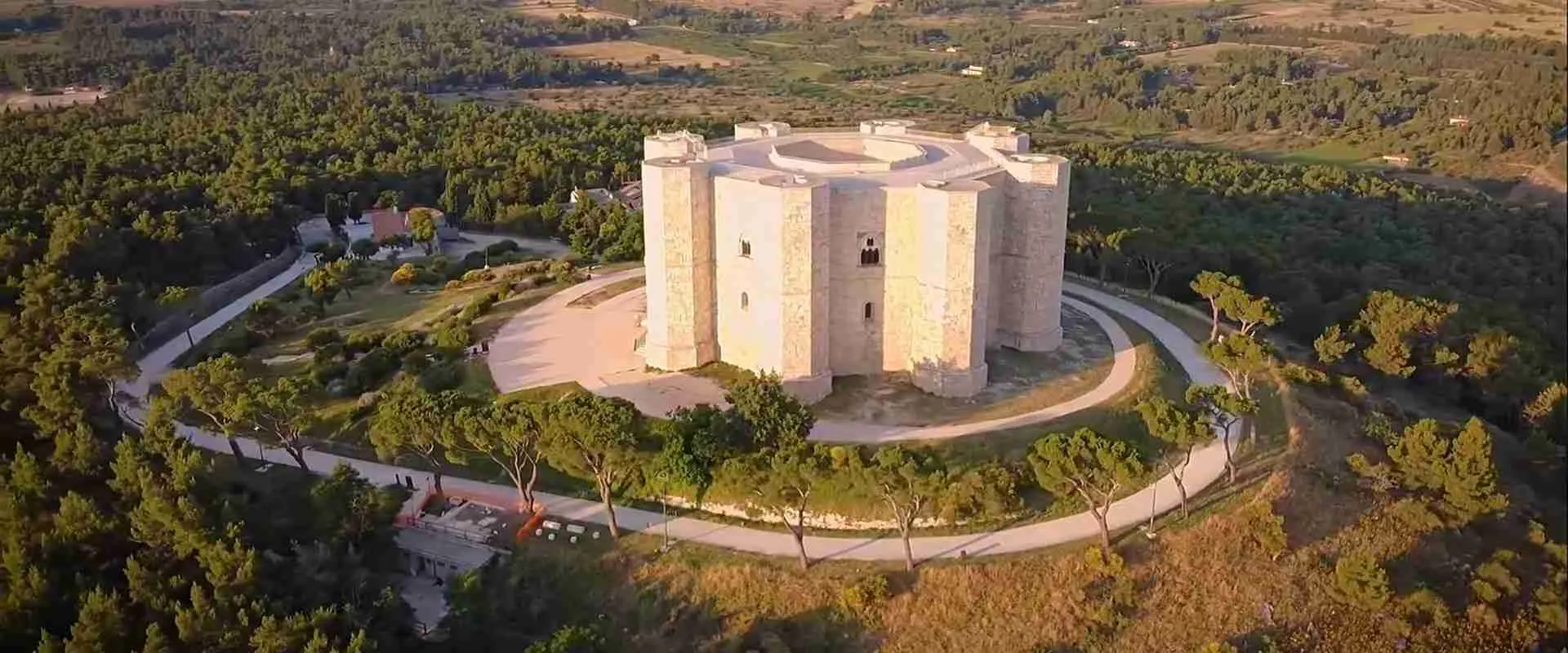
Into this landscape, the Holy Roman Emperor Frederick II of Hohenstaufen placed his most architecturally enigmatic building around 1240: Castel del Monte, an octagonal castle on a hill at 540 metres whose eight rooms, eight towers, and mathematical precision still defy complete explanation. UNESCO inscribed it in 1996 under cultural criteria (i), (ii), and (iii), calling it “a unique masterpiece of medieval military architecture.” But the plateau’s history runs far deeper. In the Grotta di Lamalunga near Altamura, a Neanderthal skeleton approximately 130,000-150,000 years old remains embedded in calcite rock — the most complete H. neanderthalensis specimen known to science. Five kilometres from that grotto, an abandoned limestone quarry preserves approximately 30,000 dinosaur footprints from the Cretaceous period, the largest such deposit identified in the world. These two sites alone place the Alta Murgia among Italy’s most significant paleontological territories.
In September 2024, the Alta Murgia National Park was designated a UNESCO Global Geopark — the twelfth in Italy and the first in Puglia — for the exceptional quality of its geological heritage and its preservation of a stable, undeformed sector of the Adriatic Plate, a continental fragment of geological rarity. The announcement, made on 9 September 2024 at the UNESCO World Council of Geoparks meeting in Vietnam, confirms what geologists have long known: this plateau is, in geological terms, a window onto deep time.
For visitors, the result is a destination where a five-day driving itinerary passes through cave cathedrals, prehistoric quarries, Norman bread towns, wild steppe pasturelands, and the eerily perfect geometry of a medieval emperor’s most ambitious building — without once touching the Adriatic coast.
Planning Your High Murge Road Trip in 2026
The Alta Murgia sits between Bari (50 km) and Matera (approximately 30 km from Altamura), connected to both by regional roads. Bari Karol Wojtyla Airport is the standard entry point for international travelers; domestic connections also run through Brindisi (90 km to the south) or Taranto (80 km from the southern plateau edge). The FAL regional railway connects Bari Centrale to Altamura in approximately one hour (€4-5) and to Gravina in Puglia in approximately 70 minutes — making a car-free arrival in either base town straightforward. All other movement within the itinerary requires a rental car.
Renting a Car for the Alta Murgia in 2026
Bari Karol Wojtyla Airport hosts all major rental agencies including Europcar, Maggiore, Sixt, and Avis. Economy cars (Fiat Panda, Volkswagen Polo category) are available from approximately €25-35 per day in shoulder season (April-June, September-October), rising to €40-60 per day during peak summer (July-August). A five-day rental of an economy car costs approximately €125-175 in shoulder season; split between two travelers, the daily per-person car cost runs €12-17. Fuel for a five-day, 700-800 km itinerary adds approximately €85-100 in total, split to €42-50 per person for the trip.
Driving within the park is straightforward on paved provincial roads. Some of the most atmospheric routes — roads connecting isolated masserie and bauxite mines to the main network — run on unpaved tratturi and strade bianche; a standard hatchback handles these comfortably in dry conditions. After significant rainfall, a few interior tracks become muddy; consulting local conditions before venturing off paved roads in winter or early spring is prudent. GPS coverage is reliable across the plateau.
Fuel stations are available in Altamura, Gravina in Puglia, Ruvo di Puglia, and Andria. Smaller towns like Poggiorsini and Minervino Murge each have a single station. Fill up in Altamura or Gravina before heading deep into the park. Diesel prices hover around €1.65-1.75 per litre; the equivalent petrol price is slightly higher.
When to Visit the High Murge in 2026
April, May, and early June deliver the plateau at its best: wildflowers cover every roadside bank and rocky outcrop, the stone canyons of Gravina catch spring light beautifully, Altamura’s bakeries operate at full volume, and temperatures range from 15°C to 25°C — ideal for canyon walks and extended time at open-air sites. September and October bring cooler air after the summer drought, grape harvest in the Nero di Troia wine country surrounding Andria and Corato, and mushroom season in the Foresta Mercadante. The plateau’s autumn palette of burned ochre and russet stone against grey limestone is exceptional.
July and August are manageable but demanding: temperatures on exposed limestone regularly reach 35-38°C, the grassland steppe appears parched, Castel del Monte attracts its highest visitor numbers, and car rental rates increase significantly. Arrive at outdoor sites before 10:00 and after 17:00 to avoid peak heat. November through March brings quiet, low prices, and dramatic atmospheric light; some agriturismi close during this period, so confirm accommodation availability before booking a winter trip.
Where to Base Yourself in 2026
Altamura is the most practical base for the first three days of the itinerary: it has the widest range of accommodation and restaurants, connects easily to Gravina by road, lies midway between the plateau and Matera (a possible day trip), and has the bakeries and market life that make early mornings worth experiencing. Gravina in Puglia works as an alternative base for visitors prioritising canyon walks and the rupestral zone. Masserie around Castel del Monte and Andria suit travelers wanting to be on the doorstep of the UNESCO castle for the best morning light. For Days 4-5, a masseria near Spinazzola or a B&B in Ruvo di Puglia avoids backtracking.
Day 1 of the High Murge Itinerary 2026: Altamura – Bread, Cathedrals, and Ancient Bones
Altamura announces itself through smell before sight: the warm, nutty fragrance of semola rimacinata baking in wood-fired ovens drifts through the old town lanes from early morning, rising from the stone-barrel-vaulted bakeries that have supplied the city since the medieval period. Altamura’s pane DOP — the only bread in Italy to hold a Protected Designation of Origin — uses exclusively twice-milled durum wheat semolina from a defined Alta Murgia growing zone, natural yeast (lievito madre), sea salt, and water. The resulting loaf — a large round with a hard, golden crust and dense, moist crumb — keeps fresh for up to a week without refrigeration, a quality that sustained the masseria workforce for centuries.
The Cathedral of Santa Maria Assunta
The cathedral dominates Piazza Duomo with one of Puglia’s finest Romanesque portals — a double-arched entrance dating to Frederick II’s rebuilding campaign of around 1232, flanked by carved stone lions and bas-reliefs depicting scenes from Old and New Testament narratives. The Emperor reconstructed an older Norman church using master craftsmen who combined local Murgian limestone with marble details suggesting Mediterranean workshop contacts. The portal’s carvings include a Last Supper, an Annunciation, and figurative panels of exceptional quality for the period and region. The bell tower, added in the 14th century, rises above a skyline substantially unchanged since the early modern period. Entry to the cathedral is free; allow 30-45 minutes to examine the portal carvings at ground level.
The Claustri of Altamura
Altamura’s historic centre preserves an unusual urban form not found intact elsewhere in Puglia: the claustri, enclosed residential courtyards reached through narrow arched passages called vichi or androni, each courtyard serving as a semi-private communal space for the surrounding dwellings. This arrangement combines defensive logic with a communal residential structure dating to the Norman and Swabian periods. Walking the claustri independently is possible — the old centre is compact and well-signed — but local guide associations offer one-hour tours for approximately €10-12 per person that illuminate the social history behind the architecture and open courtyards not otherwise accessible.
The Uomo di Altamura and the Museo Archeologico Nazionale
The Museo Archeologico Nazionale di Altamura houses one of the Mediterranean’s most significant prehistoric exhibits. In 1993, speleologists discovered a Neanderthal skeleton in the Grotta di Lamalunga, 15 kilometres from the city centre: an essentially complete H. neanderthalensis specimen approximately 130,000-150,000 years old, the most complete Neanderthal specimen known to science, still encased in calcite flowstone within the cave. Because extracting it would destroy the skeleton’s structural integrity, researchers left it in situ; the cave itself is closed to the public to preserve the fossil. The museum instead offers a full-scale reconstruction by Dutch palaeoartists Adrie and Alfons Kennis — some of the world’s most skilled practitioners in their field — and a multimedia documentation suite showing the cave in detail. The museum’s permanent collection also covers the Peucezia civilisation (the pre-Roman inhabitants of the Alta Murgia) through the Archaic, Classical, and Hellenistic periods.
Museum hours: Monday, Wednesday, Saturday and Sunday 8:30-13:30; Tuesday, Thursday, Friday 8:30-19:00. Admission applies; check museipuglia.cultura.gov.it for current rates before visiting, as this is the official source for the state museum network.
The Cava Pontrelli Dinosaur Footprint Site
Five kilometres from the city centre toward Santeramo in Colle, the abandoned limestone quarry known as Cava Pontrelli preserves what researchers identify as the world’s largest deposit of dinosaur footprints: approximately 30,000 tracks from multiple species, printed in Cretaceous limestone approximately 70 million years ago and discovered in 1999. The site is visitble through the Rete Museale Uomo di Altamura network (dinosauridialtamura.it); guided visits run approximately €8-10 per person. Booking in advance via the network website is advisable on weekends and in spring, when school groups are active. The visit takes approximately 90 minutes and combines the quarry site with a visit to the Centro Visite for contextual exhibits.
The Pulo di Altamura
On the northern outskirts of the city, the Pulo di Altamura is a large circular doline — a karst collapse sinkhole approximately 550 metres in diameter and 30 metres deep — visible from a short path off the Altamura-Gravina road. The sinkhole walls expose the full stratigraphic sequence of the Murge limestone and contain Bronze Age settlement traces. The perimeter path is freely accessible and takes approximately 30 minutes to walk; this is one of the Alta Murgia’s signature geological features and is an appropriate late-afternoon stop after the museum and dinosaur site visits.
Day 1 Evening: Dinner in Altamura
Altamura’s restaurant scene is ingredient-driven and unpretentious. Trattorie serve orecchiette al ragù d’agnello (pasta with slow-braised local lamb), lampascioni in agrodolce (wild hyacinth bulbs in sweet-sour sauce), and grilled meats from the surrounding masserie. Budget on €15-22 per person for a full meal with wine at a traditional trattoria; the better-appointed restaurants in the old town range from €28-42 per person. A glass of local Primitivo or Nero di Troia accompanies dinner at virtually every table.
Day 2 of the High Murge Itinerary 2026: Gravina in Puglia – Stone Canyons and the Underground City
Twenty-five kilometres southwest of Altamura, Gravina in Puglia presents the Alta Murgia’s most dramatic geological statement: the entire historic city was built on the rim of a deep limestone ravine — the gravina proper — with rupestral churches, cave dwellings, and Byzantine frescoes carved directly into the canyon walls below the urban floor. The gravina (the word means ‘ravine’ or ‘deep gorge’) is a 30-50 metre deep slit cut by Pleistocene watercourses through the plateau’s Cretaceous limestone. After the water table dropped, the exposed canyon walls became the foundation of a rupestral civilisation that persisted from the early Christian period through the late medieval era. Gravina in Puglia is the headquarters of the Alta Murgia National Park and one of the most visually striking towns in inland Puglia.
The Ponte Acquedotto (Viaduct Bridge)
The most iconic view in Gravina is from — or of — the Ponte Acquedotto, a double-arched viaduct built between 1743 and 1778 to carry water across the canyon from the city’s central district to the older rupestral quarters on the far cliff. At its base, the canyon walls expose decades of habitation: on the far side, the remnants of cave dwellings, carved doorways, and inscriptions in the tufo rock; in the gorge bottom, a dry streambed flanked by worked stone from centuries of construction. The bridge viewpoint is free and accessible at all hours; late afternoon delivers the best light for photography, when the canyon walls glow amber and the cave-door outlines sharpen in raking sun.
The Rupestral Churches
Gravina’s ravine contains dozens of rock-cut churches, chapels, and hermitage complexes carved into tuff by early Christian and Byzantine communities. The most significant sites are accessible through the Centro Visite Chiese Rupestri (via Calata San Michele delle Grotte 2; tel. approximately 350 081 8462), which manages guided access to the rupestral zone. Individual church admissions cost €3 per site; combined tours covering multiple sites run €8-15 per person depending on the itinerary selected. The Associazione Culturale Benedetto XIII (benedetto13.it) organises specialist guided tours and is the most reliable way to access sites that are otherwise locked.
Two sites stand out above the others. The church of San Michele delle Grotte is a five-naved space carved directly into the canyon cliff face, accessible by stone stairs from the rim. Its remarkable nave-and-apse layout — entirely excavated from living rock, without a single constructed wall — served as both a place of worship and, in the medieval period, a collective ossuary. The bones of Gravina’s citizens killed in a Saracen raid in 999 AD were preserved here for centuries. Madonna della Stella is a smaller rock church of striking intimacy, reached through a walled garden with old stone benches used as pilgrim resting places; its interior fresco of a Byzantine Madonna retains colour and delicacy that time has treated gently.
Gravina Sotterranea
Beneath the historic streets, a network of cisterns, tunnels, cellars, and passages known as the Gravina Sotterranea provides a subterranean perspective on the city’s layered construction. Guided tours of the accessible section last approximately 30-40 minutes and cost €10 per person; booking through the IAT tourist office at Largo Plebiscito 6 or via online operators is recommended in spring and early summer when visitor numbers are higher.
The Cathedral (Basilica Concattedrale di Santa Maria Assunta)
Gravina’s cathedral rises from a Norman foundation dated to approximately 1000 AD. Its facade carries a large rose window of refined proportions; the interior, substantially rebuilt in the Baroque period, contains marble altars of considerable workmanship. The crypt predates the current building and preserves fragments of Romanesque stonework that document the continuity of the site from the early medieval period. Entry is free.
The Pulicchio di Gravina
Seven kilometres northeast of Gravina, the Pulicchio di Gravina is a larger and deeper doline than Altamura’s Pulo: a vertical-walled sinkhole approximately 150 metres in diameter and approaching 100 metres in depth, accessible via an unpaved track off the road toward Poggiorsini. The rim path is freely accessible within the national park and takes approximately 45 minutes to walk; few natural features in Puglia produce this combination of depth, vertical walls, and silence. Visit in the morning when light enters the hollow obliquely.
Botromagno Archaeological Park
On the edge of the gravina opposite the historic centre, the Botromagno site documents settlement of the canyon rim from the Neolithic through the Daunian period (8th-3rd centuries BC) and into Roman times. The park is freely accessible; the Museo Fondazione Ettore Pomarici Santomasi in the city centre (admission approximately €3-5) holds the material finds and provides the interpretive context for the open-air site.
Day 2 Evening: Dinner in Gravina
Gravina’s trattorie serve cavatelli al sugo di pomodoro fresco, cicorie selvatiche con fave (wild chicory with pureed fava beans), and grilled lamb from the plateau farms. The city’s cold-pressed olive oil — from Coratina and Ogliarola cultivars grown on the canyon slopes and plateau terraces — appears at every table. Dinner prices align with Altamura: €15-20 per person at a simple trattoria, €25-40 at a better-appointed restaurant in the old centre.
Day 3 of the High Murge Itinerary 2026: Castel del Monte – The UNESCO Castle of Frederick II
The third day is dedicated entirely to the itinerary’s most visited site and its surrounding plateau landscape. Castel del Monte rises on a rocky hill at 540 metres above sea level in the territory of Andria, 45 kilometres from Altamura. Approaching on the SS170 from the Andria direction or the provincial road from Corato, the perfect octagon resolves from the plateau’s horizon with an authority disproportionate to its dimensions — a small building that reads, in this setting, as an enormous philosophical statement.
Frederick II and the Castle’s Background
Frederick II of Hohenstaufen (1194-1250), Holy Roman Emperor and King of Sicily, chose the Alta Murgia for his most architecturally ambitious building. Born in Iesi (Marche), raised in Norman-Arab Sicily, fluent in six languages, and a patron of scholars from the Greek, Arab, Italian, and Jewish intellectual traditions, Frederick brought to Castel del Monte a conception of architecture as applied mathematics and cosmology. Construction was completed around 1240; the Emperor is documented in residence by 1246. Its precise purpose remains disputed: the castle has no water cisterns sufficient for a garrison, no agricultural outbuildings of a hunting lodge, and interiors of a refinement inconsistent with purely defensive use. The most persistent scholarly reading positions it as a symbolic monument of imperial power and intellectual ambition.
UNESCO inscribed Castel del Monte in 1996 under three cultural criteria — (i), (ii), and (iii) — at the 20th Session of the World Heritage Committee. Reference number 398. The inscription statement describes it as “a unique masterpiece of medieval military architecture, a successful blend of elements from classical antiquity, the Islamic Orient and north European Cistercian Gothic.” The castle appears on the Italian one-cent euro coin, the design selected to represent Italy’s medieval architectural heritage.
Visiting Castel del Monte in 2026
Castel del Monte is managed by the Italian Ministry of Culture through the Puglia directorate (museipuglia.cultura.gov.it). Timed-entry tickets are required; booking is made through the official novaapulia.it booking system or directly at the castle ticket office, subject to availability in the next time slot. During July and August 2026, advance booking at least one week ahead is advisable; timed slots regularly sell out on summer weekends. Outside peak season, walk-up availability is reliable on weekdays.
Admission in 2026: €10 for adults, €2 for EU citizens aged 18-25, free for EU citizens under 18 years, free for all visitors on the first Sunday of each month, and free on November 4. Check the official site (casteldelmonte.beniculturali.it) for current prices and any special opening conditions, as this is the authoritative source.
Opening hours: October to March, daily 9:00-18:30 (ticket office closes 18:00); April to September, daily 10:15-19:45 (ticket office closes 19:15). Closed December 25 and January 1. A shuttle bus (navetta) runs between the car park — approximately 900 metres from the castle — and the entrance; the return fare is approximately €1 per person. The site has no on-site café; a picnic area near the car park serves visitors who bring food. Bring water, particularly between May and September.
Inside the Castle
The interior comprises 16 trapezoidal rooms — eight on the ground floor, eight on the upper level — arranged around a central octagonal courtyard whose floor is surfaced in the original coral-coloured crushed limestone. Each room is covered by a Gothic cross-vault; the column capitals and vault bosses that survive carry carved human figures, animals, and dense foliate motifs of exceptional Mediterranean craft quality. The castle’s upper-floor rooms retain traces of their original marble revetment (most of the marble was stripped in subsequent centuries) and evidence of a sophisticated plumbing system — channels and basins fed by rainwater collected from the roof — that provided running water to the latrines, a remarkable amenity for the 13th century. A slab fragment representing a parade of knights and a surviving piece of floor mosaic in the eighth ground-floor room are worth locating. Allow 1.5-2 hours for a complete self-guided visit.
Around Castel del Monte: Wine Estates and the Plateau Landscape
The plateau surrounding the castle falls within the Castel del Monte DOC wine zone, which produces Nero di Troia — a deep, tannic red of considerable character when made by a skilled producer — along with white and rosé wines from Bombino Bianco. Several small estates and cantiniers around Andria and Corato offer tastings by appointment; stopping at one adds an unhurried afternoon dimension to the UNESCO day. Degustazioni (tastings) run approximately €8-15 per person for 3-4 wines poured with local cheese, cured meats, and taralli.
Andria: Overnight Option for Day 3
Andria, 18 kilometres north of Castel del Monte, is the nearest substantial city and the practical overnight stop for travelers wanting early morning access to the castle. Its Norman-origin cathedral contains the tomb of Isabella of England, Frederick II’s second wife, and the underground Ipogei di Sant’Andrea preserve rock-cut chapels of Byzantine and early medieval origin comparable in scope to those of Gravina. Dinner options range from local trattorie (€18-28 per person) to the dining room of a nearby masseria.
Day 4 of the High Murge Itinerary 2026: Minervino Murge, Spinazzola, and the Plateau Wilderness
Day 4 traverses the Alta Murgia’s most sparsely populated zone: the northern plateau stretching from Minervino Murge toward Spinazzola, where the limestone steppe gives way to scrub oak, ancient drove-road ruts, isolated castle ruins, and — entirely unexpectedly — the vivid red opencast pits of historic bauxite mines. This is the itinerary’s wildest day, with the longest stretches of empty plateau road and the fewest visitor facilities.
Minervino Murge: The Balcony of Puglia
Minervino Murge sits at the northwestern edge of the Alta Murgia plateau at approximately 445 metres above sea level — lower than its surrounding plateau countryside in elevation terms, but positioned at a point where the land falls suddenly and steeply toward the Ofanto plain. From the town’s principal belvedere, known as the Balcone di Puglia (Balcony of Puglia), the view on clear days extends west to the Apennine mountains of Campania, southwest to the silhouette of Vesuvius on the distant horizon, and east across the Murge to the Bari coastline. Few viewpoints in the Puglia interior achieve this combination of altitude and exposure; the Balcone di Puglia earns its name.
The town’s Norman-medieval core centres on a 14th-century castle and the Cathedral of Santa Maria Assunta, which contains a venerated Byzantine icon of the Madonna di Minervino around which an important local festival is celebrated each September. A small archaeological museum in the centre displays material from the Daunian and Roman settlements that preceded the medieval town. Entry to the belvedere and town is free; the castle museum charges approximately €2-3.
The Grotta di San Michele
A few kilometres outside Minervino’s centre, the Grotta di San Michele is a modest cave complex associated with the cult of the Archangel Michael — a devotional tradition shared across the Puglia plateau with the far more famous sanctuary at Monte Sant’Angelo on the Gargano. The grotto shows evidence of prehistoric use; in Christian times it became a pilgrimage destination. Access requires asking locally for current conditions, as the site sits on private land with informal public access. No admission charge.
The Castle of Garagnone
On the open plateau between Minervino Murge and Spinazzola, the remains of the medieval Castello di Garagnone rise from an isolated hill beside an unpaved track off the SP167. A Norman fortification built from local rock in the 11th or 12th century, it controlled a wide sector of the western plateau and served as a waypoint for the transhumant herds moving between the Apennine summer pastures and the Apulian lowlands. The ruin is freely accessible; no admission is charged. The surrounding grassland in spring is carpeted with Murge orchids and the endemic pasque flowers that make the park one of Italy’s richest botanical zones in April-May.
Spinazzola and the Bauxite Mines
Spinazzola is a small medieval town with a Romanesque church and traces of a Norman castle; its main distinction lies outside the centre in the abandoned bauxite mines of the Murgetta locality. Bauxite — aluminium ore — was extracted here through most of the 20th century; the abandoned workings left vivid red-ochre pit walls rising against the pale grey limestone plateau, a colour contrast of geological drama. The site is within the Alta Murgia National Park and is one of its most photographed industrial heritage landscapes; the rust and crimson of weathered bauxite against white limestone creates an otherworldly colour field that no other site in Puglia replicates.
The Bosco di Acquatetta immediately surrounding the mine sites is one of the plateau’s largest woodland areas — over 1,000 hectares of roverella oak and Mediterranean scrub classified within the national park as a high-value naturalístic zone. Walking tracks through the woodland take 1-3 hours; the forest is freely accessible and provides welcome shade in summer months. A fontanile (stone water trough, once used by transhumant herds) marks a rest point on the track between the mine area and the forest interior.
Day 4 Evening: Options
Spinazzola has a handful of traditional restaurants serving agnello al forno (oven-baked lamb), cicorie selvatiche, and the distinctive local orecchiette made with a semola flour close to Altamura’s. For a wider choice of accommodation, returning to Altamura or Gravina (45-55 minutes by plateau roads) is easy. An overnight at an agriturismo near Spinazzola or Minervino keeps the next morning’s Ruvo di Puglia visit manageable without an early start.
Day 5 of the High Murge Itinerary 2026: Ruvo di Puglia, San Magno, and the Road Back to Bari
Day 5 works north and east from the plateau toward the coastal plain and Bari, with two stops of considerable cultural weight: the Romanesque cathedral of Ruvo di Puglia — one of the Alta Murgia’s finest architectural achievements — and the Jatta family collection of ancient Greek and Apulian pottery, one of southern Italy’s great museum holdings.
Ruvo di Puglia: Cathedral and Civic Identity
Ruvo di Puglia descends from the plateau toward the coastal plain, its historic centre preserving some of the Alta Murgia’s most refined medieval architecture. The Cathedral of Santa Maria Assunta (12th-13th centuries) presents a facade with a compact, tight-petalled rose window and a portal flanked by carved columns resting on stone lions — the canonical Puglia-Romanesque gateway composition, here executed with particular finesse. The interior, relatively austere and undisturbed by later Baroque overlay, contains a crypt of early Christian origin, a carved wooden choir, and several Romanesque column capitals of high quality. Entry is free. Allow 45-60 minutes.
Museo Jatta
The Palazzo Jatta on Ruvo di Puglia’s main square houses one of southern Italy’s most important and least-visited collections of ancient Greek and Apulian pottery, assembled by the aristocratic Jatta family during the 19th century from excavations in and around Ruvo. The collection of approximately 2,000 pieces spans Corinthian, Attic black-figure, Attic red-figure, and Apulian red-figure ware of the 6th-4th centuries BC; the Ruvo area was part of the Peucezian cultural zone and an active centre for Apulian ceramic production during the 4th century. The collection occupies the family’s original rooms, giving it a domestic atmosphere distinctly different from the institutional museums of Bari or Naples — ceramics displayed in glass cases in furnished rooms where the Jatta family also lived.
The museum is a state heritage site managed by the Ministry of Culture; admission is typically free or at minimal cost (check museipuglia.cultura.gov.it for current conditions). It generally opens Tuesday to Sunday mornings.
The San Magno Necropolis and Church
A few kilometres north of Ruvo di Puglia, between Corato and the park interior, the Necropolis of San Magno preserves a field of Iron Age tumulus burials — earth mounds over stone cist graves — from the Daunian-Peucezian cultural horizon of the 7th-5th centuries BC. This is the material culture that produced much of the Jatta collection’s content; standing in the same landscape that produced the pottery seen an hour earlier in the palazzo gives the objects an immediacy that museum displays alone cannot. A small Baroque church dedicated to San Magno and a historic fontanile mark the site. Freely accessible from the road; allow 30-45 minutes.
Return to Bari
From Ruvo di Puglia, Bari Karol Wojtyla Airport is approximately 35 kilometres — a 40-minute drive on the SS98 and SP231, bypassing Bitonto. The route passes through the coastal plain’s olive groves, a landscape shift from the austere plateau that registers immediately as a transition back to sea-level Puglia. Ruvo’s small railway station also connects to Bari Centrale on the FAL line (approximately 45 minutes, €3-4) for travelers returning car keys at the airport or city station before a flight.
Where to Stay in the High Murge 2026
The Alta Murgia has no dedicated resort infrastructure of the coastal type. Accommodation divides into three categories: historic masserie and agriturismi (the most authentic choice), B&Bs and guesthouses in the town centres, and a small number of town hotels. For a backroads itinerary of this kind, a masseria stay adds an experiential layer — early morning light on white limestone walls, estate-produced breakfast, and direct contact with the plateau’s agricultural culture — that no town-centre property replicates.
Masserie and Agriturismi
The masseria is the fortified stone farmstead that has anchored the Alta Murgia agricultural landscape since the 15th century. Most surviving masserie are constructed in dressed limestone with a central courtyard, a chapel tower, and agricultural outbuildings; the better-restored examples convert these spaces into bedrooms and dining rooms without losing the proportional severity that makes the architecture remarkable. Properties range from family-run agriturismi with simple rooms to fully restored historic estates with swimming pools, wine cellars, and concierge services.
Budget agriturismi in the Altamura, Cassano delle Murge, and Gravina countryside start from approximately €60-90 per room per night, many with a colazione rustica (rural breakfast) included — homemade bread, local ricotta, jams, seasonal fruit, and coffee. This breakfast removes the need for a separate mid-morning meal and its value exceeds what a town café provides for a similar outlay. Notable properties include the Agriturismo Murà (between Altamura and Cassano delle Murge, inside the national park, approximately 8 km from Altamura) and Masseria Chinunno (in the Altamura countryside, with mountain views).
Mid-range agriturismi and masserie charge approximately €110-160 per room per night, with breakfast included and a dinner service drawing on estate-produced olive oil, seasonal vegetables, and local meat. The Relais Albergo I Luoghi di Pitti — a 16th-century fortified masseria 10 minutes from Altamura — starts from approximately €110 per room and occupies one of the Alta Murgia’s most architecturally compelling rural structures. The Agriturismo Masseria Sant’Angelo in the Gravina countryside is a good base for the canyon visits of Day 2.
Luxury masserie — fully restored historic estates with refined room finishes, private pools, dedicated concierge, and dining programs built around Slow Food principles — charge from approximately €200-350 per room per night for double occupancy. These properties provide not merely accommodation but an immersive plateau experience; some arrange guided walks, access to archaeological sites off the public circuit, private wine tastings, and olive oil tours unavailable to day visitors.
Town-Centre B&Bs and Hotels
Altamura’s historic centre has a range of B&Bs in restored buildings close to the cathedral, starting from approximately €45-75 per room per night. The Nido dei Falchi B&B, B&B del Duomo, and the San Francesco B&B are among the consistently well-reviewed options. The Saurus Hotel on the city’s outskirts is a modern 4-star property from approximately €55-70 per room. In Gravina in Puglia, town-centre B&Bs run from approximately €50-80 per room; the accommodation supply is smaller than Altamura’s but adequate for a two-night base.
Agriturismo Dinner as a Meal Strategy
An agriturismo fixed-menu dinner — a progression of two or three antipasti, a pasta, a secondi of grilled or roasted estate meat, local cheese, and wine — runs approximately €25-35 per person and covers the evening meal entirely. For budget travelers, treating the agriturismo dinner as the day’s primary dining investment and eating more simply at lunch (pane di Altamura with local cheese from the market, or a trattoria menu del giorno at €12-18) produces a satisfying and economical food day. For mid-range and luxury travelers, estate dining is frequently the best meal of the trip.
Dining, Wine, and Local Food in the High Murge 2026
The Alta Murgia’s food culture is built on agricultural self-sufficiency: bread, durum wheat pasta, lamb from free-range plateau flocks, wild vegetables from the limestone scrub, olive oil from century-old trees, and wine from Nero di Troia and Primitivo vines. None of these products carries the international brand recognition of, say, Burrata from Andria or Primitivo di Manduria from the Salento, but several reach a quality level that makes them extraordinary in context.
Pane di Altamura DOP
Altamura’s bread holds a Protected Designation of Origin — one of the very few breads in the world to do so. The specification requires twice-milled durum wheat semolina (semola rimacinata) grown within a defined Alta Murgia zone, natural lievito madre starter, sea salt, and water; baking takes place in wood-fired stone ovens. The resulting loaves — sold in rounds (tondo) or the elongated form called a cappidde de prèvete (priest’s hat) — develop a hard, golden crust over a dense, ivory-toned crumb of considerable depth of flavour. The bread keeps fresh for up to five days. The historic bakeries of the old town — several of which have operated in the same vault-ceilinged premises for generations — bake continuously through the day. A quarter-loaf purchased warm at 7:00 am, eaten with local olive oil and a slice of fresh cacioricotta, constitutes one of the better breakfasts available in southern Italy. Expect approximately €2-4 for a small loaf.
Key Dishes of the Alta Murgia
Orecchiette al ragù d’agnello is the plateau’s canonical pasta: the shell-shaped pasta of Puglia’s hand-rolling tradition, served with a slow-braised ragù from local lamb. The Alta Murgia lamb is lean, free-range, and fed on wild plateau herbs — a flavour profile substantially different from the coastal or Salento equivalent. Lampascioni in agrodolce are wild hyacinth bulbs preserved or braised in a sweet-sour reduction; an acquired taste that becomes immediately addictive and appears on virtually every antipasto table between March and November. Cicorie selvatiche con fave — braised wild chicory served with pureed fava beans — achieves extraordinary flavour from extreme agricultural simplicity. Gnummareddi are lamb offal parcels wrapped in intestine and grilled over embers, a masseria tradition of complete economic use that produces a smoky, intensely flavoured result. Fungi cardoncelli — the wild mushroom of the Alta Murgia (Pleurotus eryngii var. ferulae), fruiting on the plateau in autumn — appears grilled, in pasta, or as a secondi from September through November.
Wine
The Alta Murgia sits within the Castel del Monte DOC zone, which produces Nero di Troia — a deep, moderately tannic Pugliese red of considerable character when produced by a skilled estate — alongside white and rosé wines from Bombino Bianco. Estate-direct purchases around Andria and Corato deliver the best value: Nero di Troia wines from smaller producers run approximately €6-12 per bottle. The local Primitivo grown at the Altamura and Santeramo zone elevations is lighter in alcohol and more herbaceous than the famous Primitivo di Manduria from the hotter coastal plain; it pairs particularly well with the lamb-based dishes of the plateau trattoria.
Practical Dining Notes
Restaurant lunch in Altamura and Gravina at a traditional trattoria: expect to pay €15-25 per person for a two-course meal with wine. Dinner at similar establishments: €20-40 per person. In Ruvo di Puglia and Andria, weekday menù del giorno (fixed-price lunch menus) at €12-18 per person deliver outstanding value. Roadside masseria agriturismo dinners with a full multi-course spread of estate produce run €25-35 per person including wine. Street food — a slice of focaccia altamurana from a bakery, a paper cone of lampascioni fritti from a market stall — costs €1.50-4 and constitutes lunch on moving days.
Budget Breakdown for the High Murge 2026: Complete Cost Guide
The following daily cost estimates apply per person, per day, assuming two people sharing accommodation. Hotel and masseria room rates are divided by two before inclusion in any daily total. All figures are in EUR; Italy is part of the eurozone and no currency conversion applies. Castel del Monte (€10 adult admission) and the Gravina rupestral church tours (€3-10 per person) are the main attraction costs; most other natural sites, viewpoints, and town centres are freely accessible.
Budget Travelers 2026
Budget travel in the Alta Murgia means B&B rooms or basic agriturismi (€60-90 per room), simple trattoria meals, and an economy rental car split two ways. Accommodation per person (two sharing): €30-45. Meals — breakfast at a bar or bought from a bakery (€4-8), lunch at a trattoria or from a bakery (€10-15), dinner at a simple osteria (€15-22): €29-45. Car rental and fuel split two ways: €18-26. Attraction admissions and entry fees: €8-14. Miscellaneous costs (parking, coffees, market purchases): €5-8. Total: approximately €90-140 per person daily.
A five-day budget trip costs approximately €450-700 per person, including all accommodation, meals, a car, and admissions. This is a comfortable budget for rural Puglia, not a shoestring; the quality of food, accommodation, and experiences available in the €90-140 daily range in the Alta Murgia is high relative to comparable destinations in northern or western Europe.
Mid-Range Travelers 2026
Mid-range travel means a masseria or agriturismo with breakfast included (€110-160 per room), full restaurant meals for lunch and dinner, a compact or mid-range rental car, and paid guided tours of the rupestral sites and dinosaur quarry. Accommodation per person (two sharing): €55-80. Meals — breakfast included with agriturismo; lunch at a good trattoria (€15-25); dinner at a proper restaurant with local wine (€28-42): €43-67. Car rental and fuel split two ways: €24-34. Attraction admissions and guided tours: €15-25. Miscellaneous: €8-12. Total: approximately €145-220 per person daily.
A five-day mid-range trip costs approximately €725-1,100 per person. At the upper end of this range, travelers stay in a historic masseria with full-board evening meals, visit every paid site on the itinerary with a local guide, and take a day excursion to Matera from Altamura or Gravina.
Luxury Travelers 2026
Luxury travel in the Alta Murgia centres on the plateau’s best restored masserie — historic estates with private pools, dedicated concierge, and estate dining at the level of the best southern Italian tables. Accommodation per person (two sharing): €100-175, breakfast included. Meals — upscale lunch at a masseria restaurant or select trattoria (€30-50); estate or fine-dining dinner with premium wine pairing (€55-90): €85-140. Premium rental car and fuel split two ways: €35-50. Private guided tours, wine estate visits, and premium admissions: €30-55. Miscellaneous (high-quality local products, spa treatments): €20-35. Total: approximately €270-455 per person daily.
A five-day luxury trip costs approximately €1,350-2,275 per person. At this level, private archaeological access, a full-day private driving guide, and a dedicated olive oil and wine program transform the itinerary into a curated experience of the plateau’s cultural depth.
Sample Day Cost: Mid-Range Day at Castel del Monte (Day 3)
This example covers one mid-range traveler’s costs for the Castel del Monte day: agriturismo room share €65, breakfast included at the agriturismo, packed lunch from Altamura bakery (focaccia and bread) €8, Castel del Monte admission €10, wine estate tasting €12, dinner in Andria €35, car and fuel share €28, miscellaneous €5. Total for the day: approximately €163 per person — within the mid-range daily band of €145-220.
Money-Saving Tips for the High Murge in 2026
The Alta Murgia is already one of southern Italy’s better-value destinations; these strategies reduce costs further without diminishing the experience.
Visit Castel del Monte on the first Sunday of any month for free admission — the Italian Domenica al Museo initiative applies here as it does across state museum sites. Combining a free-admission Sunday with a slightly longer weekend trip saves €10 per adult and can be planned in advance by checking the official Ministry of Culture calendar.
Buy bread and cheese from Altamura’s market and bakeries for self-catered lunches rather than restaurant meals every day. A quarter-loaf of pane di Altamura, local cacioricotta, lampascioni from the market, and fresh fruit from a vendor costs approximately €5-8 for two people — less than a single trattoria starter. Eating this way for two of the five lunch days significantly reduces the trip total without any sacrifice of local flavour.
Book the rental car before arriving in Italy — advance web bookings from UK, German, or US comparison sites consistently yield lower rates than airport walk-ups, particularly in spring and early summer. A five-day economy car booked 3-4 weeks in advance costs 20-35% less than the equivalent walk-up rate at Bari airport.
Gravina’s rupestral church tours are guided by volunteers associated with Associazione Culturale Benedetto XIII; the tour charge (€3-8 per person) covers access to otherwise locked sites. Attempting to visit independently — without the key-holding volunteer — means standing outside locked gates. Contact the association by phone or email before arriving to confirm weekend availability, particularly in winter when services are less frequent.
An agriturismo that includes breakfast eliminates the cost of a morning café stop and provides better food. For travelers staying at least two nights at the same agriturismo, requesting a dinner on the second night at the estate rate (€25-35 per person, covering a full multi-course meal) saves €5-15 per person compared with restaurant dining in the nearest town.
The Alta Murgia National Park’s natural sites — the Pulo di Altamura, Pulicchio di Gravina, San Magno Necropolis, Garagnone castle, Bosco Acquatetta, and the plateau tratturi — are freely accessible without admission charges. Building the itinerary with a free-access natural site each afternoon after paid morning attractions avoids consecutive double-entry cost days.
Practical Information for High Murge Visitors in 2026
Mobile phone coverage across the Alta Murgia is strong on the major network providers (TIM, Vodafone IT, WindTre) in all of the itinerary’s towns; coverage drops to minimal or zero on some of the more remote plateau tracks between Poggiorsini and Spinazzola. Download offline maps (Google Maps or Maps.me) covering the full Alta Murgia area before leaving Altamura or Bari.
Parking in Altamura and Gravina in Puglia is available in paid municipal car parks at the edge of the historic centres (approximately €1-2 per hour) and in free zones on the outer streets. At Castel del Monte, the car park is free but the shuttle to the castle entrance costs approximately €1 per return trip. In Ruvo di Puglia and Minervino Murge, free street parking is available within a short walk of the main sites.
The Alta Murgia National Park’s visitor infrastructure in 2026 includes several designated trekking and cycling routes. The Ciclovia 01 Alta Murgia — the Jazzo Rosso-San Magno-Castel del Monte circular route of approximately 67 kilometres — connects Ruvo di Puglia, Corato, Andria, and Castel del Monte on a network of seven paths accessible to mountain bikes, road bikes on the paved sections, and hikers. The park authority (parcoaltamurgia.it) maintains a current map and conditions report. E-bike hire is emerging in Andria and Altamura for visitors wanting to cover plateau distances without a full cycling commitment.
Water is drinkable from mains supply in all towns. On open plateau trails, carry at least 1.5 litres per person in summer; the landscape has no reliable natural water sources between settlements. Sun protection is essential from April onwards; the plateau’s open limestone reflects considerable ultraviolet even in spring. In winter and early spring, the plateau can be wet and windy; pack a waterproof layer for canyon walks at Gravina.
The closest hospitals are the Ospedale della Murgia in Altamura and the Ospedale Miulli in Acquaviva delle Fonti (between Altamura and Bari). Pharmacies operate in all the itinerary’s main towns; a rotating schedule of after-hours (farmacia di turno) coverage is posted on every pharmacy door. Emergency number: 118 (medical), 112 (general European emergency).
A combined day trip from the Alta Murgia to Matera (Basilicata), a UNESCO World Heritage Site in its own right for its Sassi cave city, is entirely feasible from Altamura (21 km) or Gravina (approximately 30 km). Matera admission to the Sassi zone is free; individual cave church museums charge €3-5 each. Building a half-day Matera excursion into Day 1 or Day 2 of this itinerary adds a contrasting urban rupestral experience to the Alta Murgia’s rural one.
Frequently Asked Questions About the High Murge Itinerary 2026
Can the Alta Murgia itinerary be completed in three days rather than five?
A compressed three-day version is viable but requires sacrifices. A logical three-day structure covers Altamura and the Pulo on Day 1, Gravina and the canyon on Day 2, and Castel del Monte plus Ruvo di Puglia on Day 3 before returning to Bari. Minervino Murge, Spinazzola, and the bauxite mines — Day 4 of the full itinerary — become optional excursions if time allows. The three-day version retains the itinerary’s core: the Neanderthal museum, the canyon city, and the UNESCO castle. The full five-day version is recommended for travelers with flexibility, as Days 4 and 5 cover the Alta Murgia’s wildest and least-visited landscape.
Is the Alta Murgia suitable for families with children in 2026?
The Alta Murgia works well for families with children aged 8 and above. The dinosaur footprint site at Cava Pontrelli is a natural highlight for children, as is the Castel del Monte with its perfect octagonal geometry and medieval mystery. The Pulo di Altamura and Pulicchio di Gravina are visually dramatic natural features that engage children without requiring technical hiking. The rupestral churches involve some stairs and narrow passages that younger children find adventurous. The main challenge is the car travel required between sites; distances are manageable (20-45 km between most stops) and the plateau roads pass varied scenery. Summer heat — regularly above 35°C on exposed limestone — is the principal family concern; morning starts at outdoor sites and afternoon rest are advisable in July and August.
When is Castel del Monte free to enter in 2026?
Castel del Monte admission is free on the first Sunday of every month as part of the Italian Ministry of Culture’s Domenica al Museo initiative. It is also free on November 4 (National Unity Day). EU citizens aged under 18 enter free at all times regardless of the day. Confirm the current free-day calendar at museipuglia.cultura.gov.it before planning, as the initiative occasionally applies modified conditions during special events or temporary exhibitions held within the castle.
How does the Alta Murgia UNESCO Geopark status affect the visitor experience in 2026?
The September 2024 UNESCO Global Geopark designation covers the entire Alta Murgia National Park and its 13 municipalities. In practical terms for 2026 visitors, the designation increases the interpretive infrastructure available — new geotourism trails and visitor signage were being implemented as part of the candidacy process — and links the park to a global network of UNESCO geoparks that use a consistent educational approach to geological storytelling. The MurGeopark brand (murgeopark.com) provides a portal to geosite maps and guided geotrail information. For visitors, the designation is confirmation that the plateau’s geology — its Cretaceous carbonate platform, karst doline systems, and paleontological record — merits the same serious attention as the art history of Castel del Monte or the medieval urbanism of Gravina.
What is the Uomo di Altamura, and can visitors see the actual skeleton?
The Uomo di Altamura is the world’s most complete Neanderthal skeleton, discovered in 1993 in the Grotta di Lamalunga, 15 kilometres from Altamura’s city centre. The individual — male, approximately 1.60-1.65 metres tall, estimated at around 35 years of age at death — lived approximately 130,000-150,000 years ago and is the only substantially complete H. neanderthalensis specimen known, making it uniquely valuable for palaeontological research. The skeleton remains embedded in calcite flowstone within the cave, exactly as it was found; removing it would destroy its structural integrity, so the cave is permanently closed to the public to preserve the fossil. Visitors experience the skeleton through a full-scale reconstruction by Dutch palaeoartists at the Museo Archeologico Nazionale di Altamura, detailed multimedia documentation, and virtual cave footage shown in the Centro Visite Lamalunga network.
Are guided tours available for the Alta Murgia itinerary in 2026?
Multiple operators offer guided day trips to the Alta Murgia from Bari, combining Gravina, Altamura, and Castel del Monte in a single long day by minivan (check Viator, GetYourGuide, and Apulia Smart Tour for current offerings; day trips from Bari run approximately €80-120 per person including transport and guide but not admissions). For a multi-day experience, several Bari-based operators and the park’s ecotourism partners offer tailor-made itineraries incorporating masseria accommodation, guided geological and archaeological walks, and cooking demonstrations. The park authority (parcoaltamurgia.it) publishes a list of accredited guides and licensed operators for the national park area.
What languages are spoken in the Alta Murgia, and how much Italian is needed?
Italian is the working language throughout the Alta Murgia. English is spoken by staff at Castel del Monte’s ticket office and at the better-established agriturismi and some B&Bs in Altamura. In smaller towns — Minervino Murge, Poggiorsini, Spinazzola — English is minimal; a basic Italian vocabulary for greetings, food ordering, and directions covers most practical needs. Printed menus in English are rare at the local trattorie that provide the best eating; learning the ten key Alta Murgia dish names (orecchiette, lampascioni, gnummareddi, cacioricotta, and so on) makes ordering straightforward. The Benedetto XIII association’s rupestral guides in Gravina operate in Italian and occasional French; booking a tour through an Anglophone operator from Bari provides English-language interpretation.
Is the Alta Murgia itinerary accessible with a bicycle rather than a car?
A cycling version of this itinerary is possible but demanding. The Ciclovia 01 Alta Murgia network (67 km of waymarked paths connecting Ruvo di Puglia, Corato, Andria, Castel del Monte, Gravina, and Altamura) forms the backbone of a cycling route through the core itinerary area. The terrain is rolling rather than mountainous — altitude gain across the plateau is gradual — but distances between towns are substantial and the summer heat is severe. Road cyclists on the paved sections can cover Altamura-Gravina (25 km) and Altamura-Castel del Monte (50 km) comfortably; off-road sections require a hybrid or mountain bike. E-bike hire is available in Andria and emerging in Altamura for 2026; renting an e-bike for one or two days makes the Castel del Monte approach from Corato manageable without significant climbing effort.
What is the best way to buy Pane di Altamura DOP, and can it be brought home?
The best Pane di Altamura is purchased directly from the historic bakeries (forni) in the old town — look for the Consorzio di Tutela del Pane di Altamura seal, which confirms the DOP specification. Prices range from approximately €2-4 for a small quarter-loaf to €8-14 for a full large round. The bread’s exceptional keeping quality — up to five days fresh at room temperature — makes it a practical souvenir; vacuum-packed loaves are available from several bakeries for travel. The pane keeps well in hand luggage on a flight back to northern Europe; checked luggage is unnecessary for the quantities most visitors carry.
Is the Matera UNESCO site accessible as a day trip from the Alta Murgia itinerary in 2026?
Matera (Basilicata) is fully accessible as a day trip from Altamura (21 km, approximately 25 minutes by car) or Gravina in Puglia (approximately 30 km). Matera’s Sassi — the cave-city districts of Sasso Caveoso and Sasso Barisano — are a UNESCO World Heritage Site inscribed in 1993, and the city’s combination of vertically stacked cave dwellings, rupestral churches, and dramatic ravine setting creates a compelling contrast with the Alta Murgia’s open plateau. The Sassi zone is free to enter; individual cave museum admissions run €3-5. Parking is available at the designated car parks on the Matera plateau above the Sassi; weekdays are significantly quieter than weekends. Building a Matera half-day into either Day 1 or Day 2 of the Alta Murgia itinerary extends the trip’s cultural range substantially.