The Crossroads of Europe: A Cultural Itinerary Through Friuli’s Hidden Fortresses and Ancient Mosaic Towns
Friuli-Venezia Giulia stands where empires collided, trade routes intersected, and civilizations left architectural treasures spanning two millennia. This northeastern Italian region preserves three UNESCO World Heritage Sites alongside dozens of fortresses that chronicle the strategic importance of this land between the Alps and the Adriatic Sea. From the spectacular Roman mosaics of Aquileia to the geometric perfection of Palmanova’s star fortress, Friuli offers cultural explorers an unmatched journey through the defensive architecture and artistic achievements that shaped European history.
Key Takeaways: Friuli’s Cultural Heritage Highlights
- Three UNESCO World Heritage Sites: Aquileia preserves the largest early Christian mosaic floor in the Western world within its Patriarchal Basilica, while Cividale del Friuli showcases exceptional Lombard architecture including the renowned Tempietto Longobardo, and Palmanova represents Renaissance military engineering at its geometric zenith as a nine-pointed star fortress.
- Strategic Crossroads Position: Friuli’s location between the Julian Alps and the Adriatic Sea made it a critical defensive frontier for successive powers—Romans, Lombards, Venetians, Habsburgs—resulting in the densest concentration of medieval fortifications in any Italian region.
- Roman Mosaic Masterworks: The Patriarchal Basilica of Aquileia contains 760 square meters of fourth-century floor mosaics depicting biblical narratives, early Christian symbols, and classical motifs in extraordinary preservation despite Attila’s destruction of the city in 452 CE.
- Lombard Artistic Legacy: Cividale del Friuli served as the first Lombard duchy capital in Italy from 568 CE, preserving the Tempietto Longobardo with its exceptional stucco decorations and the Altar of Ratchis, masterpieces of eighth-century European art.
- Venetian Military Genius: Palmanova, founded in 1593, embodies the Renaissance ideal city concept through military engineering precision, with three concentric rings of fortifications forming a perfect nine-pointed star visible from aerial views and designed so each bastion could defend its neighbors.
- Castle-Studded Landscapes: Beyond the UNESCO sites, Friuli preserves exceptional medieval fortresses including Miramare Castle overlooking the Gulf of Trieste, San Giusto Castle dominating Trieste’s hilltop, and dozens of mountain strongholds such as Duino, Strassoldo, and Buttrio that controlled strategic valleys and trade routes.
People Also Ask About Friuli’s Cultural Heritage
What makes Friuli-Venezia Giulia significant in European history?
Friuli-Venezia Giulia occupied one of Europe’s most contested strategic positions, serving as the meeting point between Mediterranean and Central European civilizations. The region’s location at the head of the Adriatic Sea, where mountain passes from the north converge with coastal plains, made it essential for controlling trade routes and military movements between Italy and the territories beyond the Alps. Romans established Aquileia as the empire’s fourth-largest city and the launching point for expeditions into Pannonia and Noricum. Lombards created their first Italian duchy at Cividale del Friuli in 568 CE, establishing political and cultural patterns that influenced medieval development across northern Italy. The Patriarchate of Aquileia wielded ecclesiastical authority over vast territories from the eighth through fourteenth centuries, spreading Christianity deep into Central Europe. Venetian, Habsburg, and Napoleonic powers subsequently fought for control of this borderland, each leaving architectural and cultural imprints that created Friuli’s extraordinarily layered heritage where Slavic, Germanic, Romance, and Mediterranean influences intersect.
Why does Aquileia have such extensive ancient mosaics?
Aquileia’s mosaic wealth stems from its status as one of the Roman Empire’s largest and wealthiest cities during the second through fourth centuries CE, combined with the fortunate circumstances of its destruction and subsequent preservation. Founded in 181 BCE as a military colony, Aquileia rapidly developed into a commercial powerhouse controlling amber trade routes from the Baltic, eastern Mediterranean commerce, and Alpine passages. This prosperity funded lavish public buildings and private residences adorned with mosaics. The Patriarchal Basilica’s extraordinary floor mosaics, created around 313-319 CE immediately after Christianity’s legalization, represent the ambitious program of Bishop Theodore to establish a monumental teaching space for the new faith. When Attila sacked and burned Aquileia in 452 CE, the destruction paradoxically preserved these mosaics: the collapsed building materials sealed and protected the floors, keeping them intact underground for fifteen centuries until systematic excavation beginning in 1909. Most of ancient Aquileia remains unexcavated beneath agricultural fields, creating what archaeologists consider the largest intact archaeological reserve of its kind in the world, with new mosaic discoveries continuing during controlled excavations.
How did Palmanova’s star fortress design work defensively?
Palmanova’s nine-pointed star configuration solved critical defensive challenges posed by gunpowder artillery through geometric precision and overlapping fields of fire. Each of the nine bastions projects outward from the main walls at carefully calculated angles, creating a continuous defensive system where artillery positioned on any bastion can cover the walls adjacent to its neighbors, eliminating blind spots where attackers could approach undetected or unharmed. The three concentric rings of fortifications—built sequentially from 1593 to 1813—created layered defenses requiring enemies to breach multiple walls while under constant bombardment. The outer ramparts, ravelins positioned between each bastion point, forced attackers into killing zones where crossfire from multiple positions concentrated. The geometric perfection extended to the town’s internal layout: six streets radiate from the central hexagonal Piazza Grande directly to the three main gates and six bastions, allowing rapid troop movement to any threatened sector. The moat system, glacis (sloped earthworks), and covered ways enabled defenders to move unseen while exposing attackers to enfilading fire from multiple angles. This mathematical approach to fortification, termed trace italienne, represented Renaissance military engineering at its zenith and made Palmanova theoretically impregnable to the siege warfare tactics of its era, though it never faced a major assault that would have tested these defenses in practice.
Which medieval castles in Friuli are most historically significant?
Friuli’s castle network includes dozens of historically important fortifications, with several standing out for their strategic roles and preservation. Castello di Duino, perched on coastal cliffs north of Trieste, has guarded the Adriatic approaches since the fourteenth century and famously hosted Rainer Maria Rilke while he composed his Duino Elegies. Castello di San Giusto crowns Trieste’s Capitoline Hill where a Roman fortress once stood; the current structure built by Venetians after 1470 contains powerful defensive walls and towers still dominating the cityscape. Castello di Miramare, though nineteenth-century and thus younger than medieval fortifications, occupies a strategically significant promontory and represents Habsburg architectural ambitions in the region. Castello di Strassoldo actually comprises twin fortified villages—Strassoldo di Sopra and Strassoldo di Sotto—continuously inhabited since the twelfth century and preserving remarkable medieval water systems and moat defenses. The ruined Castello di Partistagno near Attimis, abandoned in the sixteenth century but recently restored, exemplifies mountain strongholds controlling the valleys between Friuli and Carinthia. Castello di Buttrio, surrounded by vineyards in the Colli Orientali wine country, demonstrates how fortifications evolved into elegant Renaissance residences while retaining defensive elements. The density of these fortifications—Friuli possessed more castles per square kilometer during the Middle Ages than any other Italian region—reflects the territory’s position as a perpetually contested frontier where multiple powers maintained overlapping defensive networks.
Extended multi-day tours – 5+ days
Featured Udine Multi-Day Tour Packages
3 days
Udine 3-Day Discovery Tour
- ✓ Comprehensive Udine experience
- ✓ Expert local guides included
- ✓ All accommodation included
- ✓ Transportation provided
5 days
Udine 5-Day Highlights Experience
- ✓ Comprehensive Udine experience
- ✓ Expert local guides included
- ✓ All accommodation included
- ✓ Transportation provided

7 days
Udine 7-Day Cultural Journey
- ✓ Comprehensive Udine experience
- ✓ Expert local guides included
- ✓ All accommodation included
- ✓ Transportation provided
10 days
Udine 10-Day Complete Adventure
- ✓ Comprehensive Udine experience
- ✓ Expert local guides included
- ✓ All accommodation included
- ✓ Transportation provided
Multi-day tour packages powered by TourRadar. Prices and availability subject to change.
Introduction: Where Empires Built Their Borderlands
The landscape of Friuli-Venezia Giulia reads as an architectural chronicle of European power struggles spanning two thousand years. This compact region in Italy’s northeastern corner, squeezed between the Julian Alps and the Adriatic Sea, witnessed the march of Roman legions northward, the establishment of the first Lombard duchy on Italian soil, the defensive genius of Venetian military engineers, the cultural assertions of the Patriarchate of Aquileia, and the imperial ambitions of the Habsburgs. Each successive power recognized what geography made obvious: whoever controlled Friuli controlled the gateway between the Mediterranean world and Central Europe.
The Romans understood this when they founded Aquileia in 181 BCE. Within two centuries, it grew into the empire’s fourth-largest city, a commercial and military metropolis of 100,000 inhabitants where amber from the Baltic met eastern silks and where legions assembled before pushing into Pannonia and Noricum. The wealth generated by this strategic position funded the spectacular mosaics that survive today, preserved ironically by the city’s violent destruction at Attila’s hands in 452 CE. The Hun’s sack of Aquileia marked the end of Roman prosperity but the beginning of the site’s preservation, as collapsed buildings sealed and protected artistic treasures that remained buried for fifteen centuries.
When the Lombards swept into Italy in 568 CE, they chose Friuli for their first duchy, establishing their capital at Cividale del Friuli—the ancient Forum Iulii that gave the region its name. King Alboin recognized the strategic imperative of controlling the eastern Alpine passes, and his successors transformed Cividale into a cultural and religious center that rivaled contemporary courts across Europe. The Lombard artistic achievement reached its zenith in the Tempietto Longobardo, an eighth-century oratory whose stucco decorations represent one of the finest surviving examples of early medieval European art.
Medieval political complexity increased when the Patriarchs of Aquileia established temporal power over vast territories extending from the Adriatic to Austria. From the eighth through fourteenth centuries, these prince-bishops wielded both spiritual and secular authority, commissioning fortifications throughout their domains and spreading Christianity across Central Europe. The castle network they initiated proliferated under subsequent rulers. German noble families constructed fortresses to cement their feudal holdings. Venetian authority, established over most of Friuli in 1420, added sophisticated military installations including the extraordinary star fortress of Palmanova, founded in 1593 as a defensive bulwark against both Ottoman and Habsburg expansion.
The result of these layered occupations is a cultural landscape unmatched in Italy for its density and diversity of fortifications. Friuli preserves more medieval castles per square kilometer than any other Italian region—a network of defensive structures ranging from mountaintop ruins to elegant Renaissance palaces, from Venetian engineering marvels to Habsburg military installations. Three sites achieved UNESCO World Heritage recognition: Aquileia for its Roman and early Christian archaeology and mosaics, Cividale del Friuli for its Lombard heritage, and Palmanova for its Renaissance military urbanism. Yet dozens of additional fortresses, each with its own historical significance, dot the plains and mountains, many open for exploration.
This cultural richness reflects Friuli’s position as a perpetual crossroads where linguistic, religious, architectural, and artistic traditions from multiple civilizations converged. Slavic influences appear in place names and cultural practices near the eastern borders. Germanic elements persist in surnames and architectural details introduced during periods of Habsburg rule. Venetian architectural sophistication appears in urban palaces and fortification engineering. The region’s Friulian language itself—a distinct Rhaeto-Romance tongue rather than an Italian dialect—testifies to cultural patterns established before modern nation-states emerged.
Contemporary Friuli-Venezia Giulia remains administratively bilingual in some areas, with Italian, Slovene, German, and Friulian all holding official status in specific municipalities. This linguistic complexity mirrors the architectural palimpsest where Roman foundations support medieval walls that incorporate Venetian refinements beneath Habsburg-era modifications. Every fortress, cathedral, and fortified village represents not just defensive necessity but cultural assertion by powers seeking to stamp their identity on this contested borderland.
For cultural travelers, Friuli offers an archaeological and architectural journey condensed into a geographically compact area. Unlike sprawling regions where heritage sites separate by hundreds of kilometers, Friuli’s treasures cluster within easy reach: Aquileia lies merely twenty-five kilometers south of Palmanova, while Cividale del Friuli sits twenty kilometers east of Udine, itself surrounded by castles. A week’s careful exploration covers extraordinary ground. Yet the region remains remarkably under-visited compared to Venice just ninety kilometers west or Austria’s popular destinations to the north, making it ideal for travelers seeking authentic cultural experiences without overtourism’s pressures.
The following sections explore Friuli’s major heritage sites in both geographical and thematic arrangements, beginning with the three UNESCO World Heritage locations before expanding to the broader network of medieval fortifications. Each section contextualizes the architectural heritage within its historical moment while providing practical information for constructing a personalized cultural itinerary through this fascinating crossroads of European civilization.
Aquileia: The Mosaic Capital of the Roman World
Twenty-five kilometers south of Palmanova, the small modern commune of Aquileia (population approximately 3,500) conceals beneath its agricultural fields one of archaeology’s greatest treasures: the mostly unexcavated remains of ancient Aquileia, once among the four largest cities of the Roman Empire. What survives above ground—principally the spectacular Patriarchal Basilica with its mosaic floors and the archaeological excavations scattered across the town—represents merely a fraction of the ancient metropolis, most of which remains deliberately unexcavated, preserved as Europe’s largest intact archaeological reserve.
Roman Foundation and Rise to Prominence
Rome established Aquileia in 181 BCE as a military colony positioned to control the eastern Alpine approaches and serve as a bulwark against incursions from the north. The settlement’s strategic location—at the navigable head of an Adriatic lagoon where mountain passes converged with coastal plains—ensured rapid commercial growth. Within two centuries, Aquileia developed into a metropolis of approximately 100,000 inhabitants, serving as the administrative capital of the Regio X Venetia et Histria and commanding trade routes that extended from the Baltic to the Mediterranean.
The city’s prosperity derived from its position as a commercial clearinghouse where northern products, particularly Baltic amber, entered the Roman world, while Mediterranean goods and eastern luxuries moved northward along routes that crossed the Alps into Noricum and Pannonia. This wealth funded extensive urban development: a forum stretching 115 meters, massive bath complexes covering more than two hectares, a substantial theater, extensive residential districts, a river port that accommodated seagoing vessels, and elaborate fortifications. The archaeological evidence reveals a city that rivaled contemporary Rome in both size and sophistication.
Early Christian Transformation and the Basilica Mosaics
The Edict of Milan in 313 CE, which legalized Christianity throughout the Roman Empire, triggered immediate and dramatic changes in Aquileia. Bishop Theodore, appointed shortly after legalization, commissioned an ambitious religious complex designed both for worship and as a teaching institution for spreading the new faith. The original structure consisted of two large parallel halls—the north hall for religious ceremonies and the south hall for catechetical instruction—linked by corridors and sharing baptismal facilities.
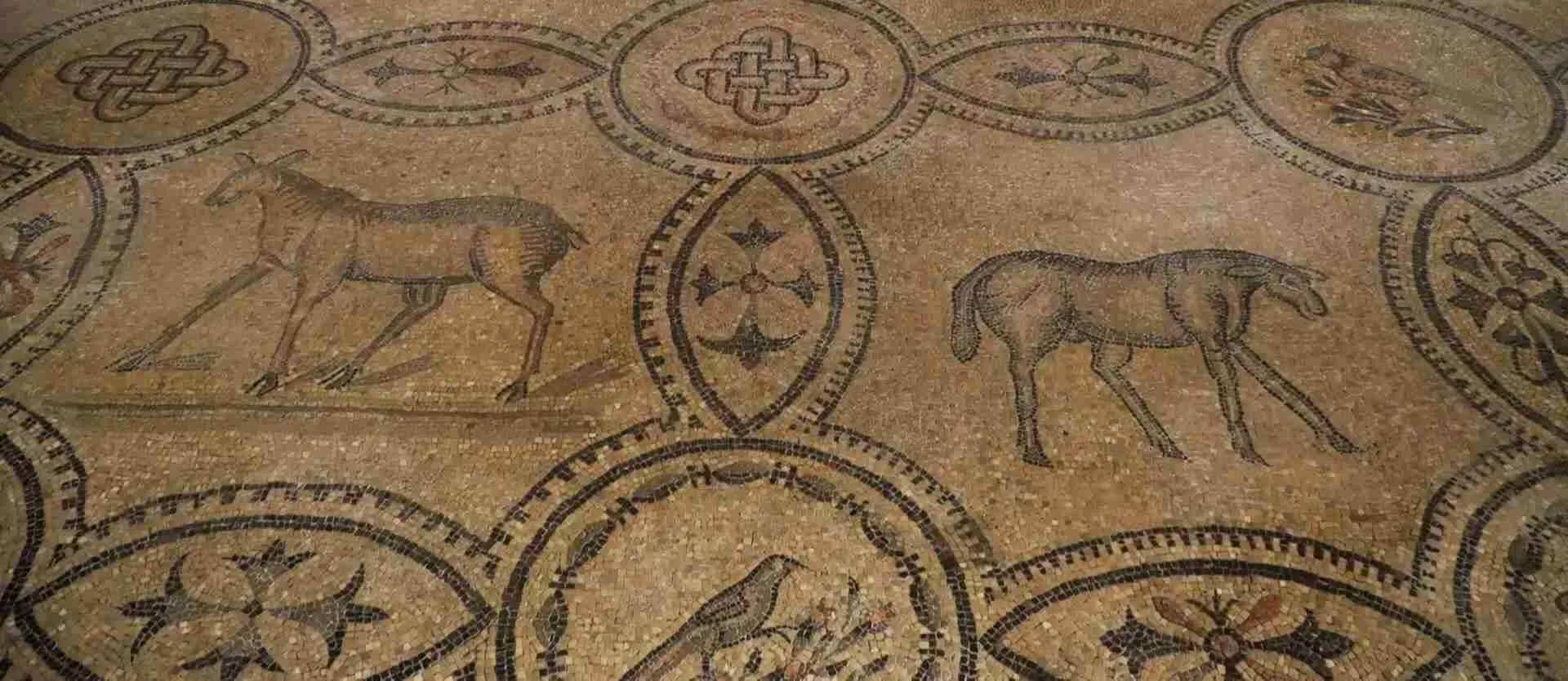
Theodore’s program included commissioning the extraordinary mosaic floors that survive today. The 760 square meters of fourth-century mosaics in the north hall represent the largest and best-preserved early Christian mosaic floor in the Western world. The iconographic program combines biblical narratives (Jonah and the whale, the Good Shepherd), early Christian symbols (fish, anchors, bread baskets representing the Eucharist), classical motifs (seasons, putti, geometric patterns), and enigmatic scenes whose interpretation scholars continue to debate. The artistic quality equals the finest contemporary work from Rome or Ravenna, with sophisticated use of color gradations, three-dimensional modeling, and narrative complexity.
The preservation of these mosaics resulted paradoxically from Aquileia’s catastrophic destruction. When Attila the Hun sacked the city in 452 CE, the systematic burning and demolition buried the floor mosaics under collapsed building materials. This debris layer, which eventually reached several meters depth as the site was progressively abandoned and new structures built atop the ruins, sealed the mosaics in a protective matrix that excluded moisture and prevented the deterioration that destroyed comparable works elsewhere.
Rediscovery and Current Presentation
Systematic excavation beginning in 1909 revealed the mosaic treasure. Archaeologists working under the existing basilica floor—the structure had been rebuilt in the eleventh through fourteenth centuries—discovered the perfectly preserved fourth-century surfaces. The discovery posed an extraordinary conservation challenge: how to display mosaics that lay beneath a medieval cathedral still in religious use. The solution involved creating elevated viewing platforms throughout the basilica nave, allowing visitors to walk above the ancient floor while viewing it through protective glass sections and periodic openings where the mosaic surface lies exposed.
The current Patriarchal Basilica, rebuilt primarily between 1021 and the fourteenth century, incorporates Romanesque and Gothic elements while preserving and displaying the ancient mosaics as its principal artistic treasure. The complex also includes the Crypt of the Excavations, an underground archaeological area surrounding the bell tower where visitors can examine ruins from four successive building periods, including mosaics from a fifth-century BCE Roman house. The ninth-century Crypt of the Frescoes preserves important medieval wall paintings, while the fourth-century Baptistery features a hexagonal baptismal font and additional mosaic work.
The bell tower, rising seventy-three meters, dates to the eleventh century with fourteenth-century heightening. Its summit provides panoramic views across the Friulian plain toward the Alps, offering visual context for understanding Aquileia’s strategic position.
The Broader Archaeological Area
Beyond the basilica complex, excavated portions of ancient Aquileia scatter across the modern town. The Roman Forum, partially reconstructed with standing columns, conveys the scale of the 115-meter-long administrative and commercial center. The river port area, where first-century quay walls survive along with warehouse foundations, demonstrates the sophisticated maritime infrastructure that enabled Aquileia’s commercial dominance.
Special open days organized by the Fondazione Aquileia and regional universities provide access to areas normally closed, including the Great Baths complex with extensive fourth-century mosaic floors, the Roman theater, residential districts featuring houses with elaborate mosaic decorations (the “House of the Wounded Beasts” displays hunting scenes with remarkable artistic quality), and portions of the Byzantine-era defensive walls. Most of ancient Aquileia, however, remains deliberately unexcavated beneath the surrounding agricultural fields, preserving a vast archaeological resource for future investigation using advancing technologies.
The National Archaeological Museum of Aquileia houses artifacts recovered from the excavations, including statuary, architectural elements, inscriptions, glasswork, jewelry, and everyday objects that illuminate daily life in the Roman city. The museum’s collection, while substantial, represents only material excavated from the small percentage of the ancient city that has been explored, suggesting the extraordinary wealth of artifacts that remain underground.
UNESCO Recognition and Significance
UNESCO inscribed the Archaeological Area and the Patriarchal Basilica of Aquileia as a World Heritage Site in 1998 under criteria recognizing both Aquileia’s importance as one of the largest and wealthiest Early Roman Empire cities and the exceptional completeness of the unexcavated ancient urban fabric. The inscription notes that most of ancient Aquileia survives intact beneath the modern landscape, making it the most complete example of an Early Roman city in the Mediterranean world. The Patriarchal Basilica’s mosaics receive particular recognition for documenting early Christianity’s artistic development and the role of the Aquileia church in evangelizing Central Europe.
Visiting Aquileia Strategically
Aquileia merits a full day for comprehensive exploration, though the principal sites can be visited in a half-day. The Patriarchal Basilica complex requires two to three hours for proper appreciation of the mosaics, crypts, and baptistery. The archaeological excavations scattered across town reward walking exploration, ideally with the archaeological museum visit providing context. Serious enthusiasts should investigate the schedule for special open days when normally inaccessible areas become available with guided tours.
The town’s small size and rural setting create a contemplative atmosphere markedly different from crowded tourist destinations. Aquileia receives relatively modest visitor numbers despite its UNESCO status, making it possible to study the mosaics without jostling crowds. The surrounding Friulian countryside, dotted with vineyards and characterized by the flat plains that stretch toward the lagoon, retains much of the landscape character that would have surrounded the ancient city.
Cividale del Friuli: Lombard Legacy at the Gateway
Twenty kilometers east of Udine, perched above the Natisone River gorge, Cividale del Friuli preserves the artistic and architectural legacy of the Lombards, the Germanic people who established their first Italian duchy here in 568 CE and ruled Friuli for two centuries. The town’s exceptional Lombard monuments earned it inclusion in the UNESCO serial site “Longobards in Italy: Places of the Power (568-774 d.C.)” inscribed in 2011, recognizing seven locations across Italy where Lombard architectural and artistic achievements survive in concentrated form.
Roman Foundation and Lombard Transformation
Julius Caesar founded Forum Iulii around 50 BCE as a military market town, giving both the settlement and eventually the entire region (Friuli) their names. The Roman town occupied a strategic position controlling the eastern Alpine passes and the route from Aquileia toward the Danube frontier. When the Lombard king Alboin invaded Italy in 568, he recognized Forum Iulii’s strategic importance and established it as the capital of the first Lombard duchy on Italian soil, renaming it Civitas Austriae (later corrupted to Cividale).
Under Lombard rule, Cividale developed into a political, cultural, and religious center of European significance. The duchy controlled territories extending from the Adriatic north into the Alps, making it one of the Lombard kingdom’s most powerful regional authorities. When the Patriarch of Aquileia relocated to Cividale in 738 to escape Byzantine harassment, the town gained additional religious prestige, becoming the patriarchal seat until 1238. This combination of secular and ecclesiastical authority during the eighth and ninth centuries produced the architectural and artistic treasures that survive today.
The Tempietto Longobardo: Masterwork of Lombard Art
The Tempietto Longobardo (Lombard Temple), located within the Santa Maria in Valle monastic complex, represents the pinnacle of Lombard artistic achievement and the most important surviving architectural monument from the Lombard period. Dating to the mid-eighth century, this small oratory features stucco decorations of exceptional quality that have astonished art historians since their rediscovery.
The interior west wall displays six larger-than-life female saints in high relief stucco, executed with sophisticated three-dimensional modeling and arranged in a rhythmic composition beneath a decorative arch with interwoven vine patterns. The figures’ drapery shows classical influence combined with Byzantine frontality and Germanic decorative sensibilities, creating a unique synthesis characteristic of Lombard art at its height. The craftsmanship demonstrates mastery of stucco techniques that allowed the creation of delicate details including jewelry, hair textures, and fabric folds.
The Tempietto’s significance extends beyond its artistic quality to its documentation of cultural synthesis at a crucial European historical moment. Lombard rulers, originally Arian Christians, had converted to Catholicism by the eighth century and were actively integrating Roman, Byzantine, and Germanic traditions into a distinctive artistic language. The Tempietto exemplifies this cultural fusion, preserving techniques and iconographic programs that influenced subsequent Carolingian and Ottonian art across northern Europe.
The Altar of Ratchis and Lombard Sculpture
The Christian Museum and Treasury of the Duomo houses the Altar of Ratchis, an exceptional eighth-century sculptural work commissioned by Duke Ratchis (later briefly King of the Lombards) around 740 CE. This marble altar features four carved panels depicting biblical scenes: the Visitation, the Adoration of the Magi, Christ in Majesty, and the Translation of the Body of Christ, all executed in a distinctive style that combines Byzantine iconographic models with Germanic decorative patterns and a powerful, almost abstract approach to figural representation.
The museum also displays the Baptistery of Callisto, an octagonal baptismal font from the eighth century decorated with intricate geometric and vegetal patterns demonstrating Lombard stone-carving techniques. Together with numerous other artifacts including jewelry, weapons, and ecclesiastical objects, these treasures document the sophistication of Lombard material culture and the duchy’s patronage of advanced artistic production.
The Episcopal Complex and Medieval Architecture
The Episcopal Complex, including the Duomo (Cathedral of Santa Maria Assunta) and the adjacent Palazzo dei Patriarchi, forms the second component of Cividale’s UNESCO inscription. While the current cathedral dates primarily to the fifteenth and sixteenth centuries, it preserves earlier elements including the remarkable Silver Altar of Pellegrino II, a masterpiece of medieval goldsmithing created between 1185 and 1195. The complex documents the continuous ecclesiastical importance of Cividale from the Lombard period through the Patriarchate’s residence here and into the Venetian era.
The National Archaeological Museum
The National Archaeological Museum occupies the Palazzo dei Provveditori Veneti in Piazza Duomo. Its collection spans from Celtic and Roman artifacts through extensive Lombard materials including grave goods, weapons, jewelry, and everyday objects that illuminate Lombard culture beyond the elite artistic commissions. The museum’s necropolis finds demonstrate burial customs, social stratification, and the gradual cultural transformation as Germanic Lombards integrated with the indigenous Italian population.
The Devil’s Bridge and Medieval Urban Fabric
The Ponte del Diavolo (Devil’s Bridge), spanning the Natisone River gorge, dates to the fifteenth century (rebuilt after World War I destruction) and carries the name from a legend claiming the devil built it overnight in exchange for a citizen’s soul. The bridge provides access to the Celtic Hypogeum, a mysterious complex of underground chambers carved into the bedrock, whose precise origins and purposes remain debated but which may have served ritual functions during the Celtic and Roman periods.
The historic center preserves substantial medieval character with narrow cobblestone streets, medieval houses, artisan workshops, and defensive elements from successive periods. The town’s compact size and hillside setting create an intimate scale where Lombard monuments integrate naturally into the urban fabric rather than standing as isolated museum pieces.
UNESCO Recognition and Cultural Significance
Cividale’s inclusion in the “Longobards in Italy” UNESCO serial site recognizes the town’s exceptional concentration of Lombard artistic and architectural achievements. The inscription criteria emphasize these monuments’ testimony to the cultural and spiritual values of European societies during the critical transition from Antiquity to the Middle Ages, and their demonstration of Lombard patronage and artistic synthesis at the moment when Germanic peoples were integrating classical and Christian traditions.
Visiting Cividale Strategically
Cividale merits a full day for thorough exploration. The Tempietto Longobardo, Christian Museum with the Altar of Ratchis, and National Archaeological Museum form the core visits requiring three to four hours total. The Duomo, Devil’s Bridge, Celtic Hypogeum, and wandering the medieval streets occupy additional time. A combined ticket covering multiple sites offers value for comprehensive visits.
The town’s hillside position and gorge setting provide dramatic views, particularly from the Devil’s Bridge lookout where the Natisone River’s emerald waters flow beneath medieval walls with the Julian Alps visible to the north. The atmosphere remains genuinely Italian rather than tourist-oriented, with local cafes, traditional shops, and residential neighborhoods maintaining authentic character.
Palmanova: The Perfect Star Fortress
Thirty kilometers south of Udine in the Friulian plain, Palmanova embodies Renaissance military engineering and urban planning ideals through its geometrically perfect nine-pointed star design. Founded by the Venetian Republic in 1593 as a defensive bulwark against Ottoman and Habsburg expansion, Palmanova represents the trace italienne fortification system at its theoretical and practical zenith. UNESCO recognized its exceptional value by inscribing it in 2017 as part of the transnational serial site “Venetian Defence Works between the 16th and 17th centuries: Stato da Terra – Western Stato da Mar,” which includes fortifications across Italy, Croatia, and Montenegro.
Strategic Imperatives and Foundation
The Venetian Republic’s decision to construct Palmanova responded to specific military and political pressures of the late sixteenth century. Ottoman expansion in the Balkans and Mediterranean threatened Venetian territories, while Habsburg power in Austria presented potential dangers from the north. Friuli, as Venice’s northeastern frontier territory, required enhanced defensive infrastructure beyond the medieval castle network inherited from the Patriarchate period. Venice sought a modern fortress city that could serve as a forward base for regional defense, a refuge for surrounding populations during invasions, and a symbol of Venetian power and technical sophistication.
The foundation ceremony occurred on October 7, 1593, deliberately chosen as the twenty-second anniversary of the Christian victory at Lepanto. The site selection emphasized strategic considerations: a location in the middle Friulian plain, equidistant from Ottoman-threatened territories to the east and Habsburg frontiers to the north, positioned to control roads connecting the coast with Alpine passes. General Giulio Savorgnan led the military planning team, while the renowned architect Vincenzo Scamozzi contributed to the theoretical design, though the fortress ultimately reflected collaborative engineering by multiple Venetian military specialists rather than a single architect’s vision.
The Geometry of Defense: Three Rings of Fortification
Palmanova’s design consists of three concentric defensive rings constructed over two centuries, each representing advancing military engineering in response to evolving siege warfare technologies.
The first ring, built between 1593 and 1623, established the basic nine-pointed star configuration. Each bastion projects from the main curtain walls at precisely calculated angles allowing artillery fire from each position to cover the walls adjacent to neighboring bastions, eliminating dead zones where attackers could approach undetected. The bastions feature thick earthen ramparts faced with hewn limestone, topped with seven-meter-wide artillery platforms, and honeycombed with powder magazines, barracks, and storage chambers. The total circumference of this first defensive ring measures approximately seven kilometers, a massive construction project that required three decades despite intensive labor by Croatian and Friulian workers.
The second ring, added between 1658 and 1690, consists of nine ravelins—triangular, stand-alone fortifications positioned beyond the moat along each straight curtain wall section. Three particularly substantial ravelins guard the three main city gates, perpetually vulnerable points in any fortress wall. These outworks forced attackers to assault isolated positions under crossfire from the main bastions while preventing direct artillery bombardment of the primary walls. The second ring incorporated covered ways for concealed troop movement, elevated cavalier positions for counter-battery fire, and an extensive network of underground passages (caponiers) allowing defenders to access outworks without exposure. A glacis—sloped earthwork—completed the second ring, deflecting artillery shot away from the wall faces.
The third ring, constructed between 1806 and 1813 under Napoleonic occupation, added lunettes (crescent-shaped advanced positions) beyond the ravelins and expanded the glacis system. This final ring responded to improvements in artillery range and power that made the earlier defenses potentially vulnerable to bombardment from greater distances.
The Ideal City: Internal Urban Design
Palmanova’s internal layout embodies Renaissance ideal city concepts as thoroughly as its fortifications demonstrate military engineering principles. The town plan centers on the hexagonal Piazza Grande (now Piazza Grande), from which six major streets radiate outward to the city gates and bastions, creating a perfectly symmetrical grid. This arrangement allowed rapid troop deployment to any threatened sector while maintaining clear sightlines from the central command position to all parts of the defensive perimeter.
The Piazza Grande features important civic and religious buildings demonstrating Venetian architectural influence. The Duomo Dogale (Cathedral), executed in Venetian Mannerist style with a facade of white Istrian stone, served as the principal religious institution. The Palazzo del Provveditore Generale, formerly the residence of Venice’s appointed governor, now houses the Military History Museum with extensive collections documenting the fortress’s construction, defensive technologies, and military history through World War I. Eleven statues around the square represent the Provveditori Generali who governed Palmanova, commemorating Venetian administrative continuity.
The residential zones between the radial streets feature tightly organized blocks with uniform building heights and widths, creating both aesthetic harmony and practical military advantages. The geometric precision extended to water management systems, with carefully engineered drainage preventing the moat from stagnating while maintaining sufficient water depth for defensive purposes.
Historical Reality versus Defensive Theory
Palmanova’s elaborate fortifications never underwent the major siege that would have tested their defensive capabilities in practice. The fortress changed hands through political negotiations rather than military assaults: Austria acquired it in 1815 following Napoleon’s defeat, and Italy annexed it in 1866 during the unification process. During World War I, Palmanova served as a rear-area base rather than a front-line fortress, though Italian troops set fire to military installations during their retreat after the Caporetto disaster in 1917.
This absence of combat paradoxically contributed to Palmanova’s exceptional preservation. Unlike fortresses destroyed during siege warfare or demolished to accommodate urban expansion, Palmanova survived intact, its fortifications maintained but never tested. The defensive works remain substantially complete, providing modern visitors the opportunity to study trace italienne fortification systems in their most developed form.
UNESCO Recognition and Preservation
The 2017 UNESCO inscription recognized Palmanova as part of a transnational system of Venetian defensive works extending over 1,000 kilometers from Lombardy to the eastern Mediterranean. The inscription criteria emphasize these fortifications’ representation of the modern state’s emergence and its systematic application of scientific principles to military and political control of territory, and their documentation of the evolution of fortification architecture responding to gunpowder artillery technology.
Palmanova was declared a National Monument in 1960, ensuring legal protection for its defensive works and historic center. Ongoing conservation maintains the fortifications while adapting the town for contemporary residential and commercial uses. The population of approximately 5,400 residents sustains an authentic community rather than a fortress-museum, though tourism increasingly contributes to the local economy.
Walking the Ramparts: Three Discovery Routes
Visitors can explore Palmanova through three marked walking routes. The Architect’s Walk (approximately 1.5 kilometers) follows streets from Piazza Grande to examine the geometric urban design, historic buildings, city gates, and the star’s perfect symmetry visible from elevated positions. The Soldier’s Walk traverses portions of the ramparts, accessing artillery platforms, powder magazines, and defensive positions while providing elevated views across the fortifications and surrounding plains. The Nature Walk circles the outer glacis and moat areas where defensive engineering integrates with landscape design.
The three monumental city gates—Porta Udine, Porta Aquileia, and Porta Cividale—feature imposing stone architecture with Venetian lions and classical motifs. Each gate incorporated sophisticated defensive mechanisms including drawbridges, portcullises, and murder holes where defenders could attack trapped enemies.
Military History Museum
The Military History Museum in Palazzo del Provveditore Generale documents Palmanova’s construction, defensive technologies, and role through changing political regimes. The collection includes architectural plans and models illustrating the fortress design process, period weapons and artillery pieces, uniforms and equipment from Venetian, Austrian, and Italian military periods, and extensive archival materials documenting administrative and military operations. The museum contextualizes Palmanova within broader developments in European fortification engineering and military theory.
Visiting Palmanova Strategically
Palmanova can be explored in a half-day visit covering the principal sites, though full appreciation of the fortifications rewards a full day including walking tours of the ramparts. The town’s compact size allows easy navigation on foot. Visitors should prioritize the Military History Museum for contextual understanding before exploring the fortifications. The star geometry becomes fully apparent from aerial perspectives or elevated positions on the ramparts; ground-level experience emphasizes the massive scale rather than the geometric pattern.
The town maintains authentic character with local businesses, cafes, and residential neighborhoods functioning normally rather than catering exclusively to tourism. Annual events including historical reenactments, classical music festivals, and markets activate Piazza Grande and demonstrate continued community use of the historic spaces.
Medieval Castles of the Friulian Plains and Mountains
Beyond the three UNESCO World Heritage Sites, Friuli-Venezia Giulia preserves dozens of medieval and Renaissance fortifications scattered across plains and mountains, collectively forming the densest concentration of castles in any Italian region. These fortresses document the perpetual strategic contestation of Friulian territory by successive powers—Patriarchs of Aquileia, German feudal lords, Venetian authorities, Habsburg administrators—each building and modifying defensive works to consolidate control over specific territories.
Castello di Udine: The Patriarchal Seat
The Castello di Udine crowns the hill at the center of Friuli’s regional capital, reached via an elegant cobblestone path ascending from Piazza della Libertà. The original fortress, destroyed in the catastrophic 1511 earthquake, gave way to construction beginning in 1517 of the current complex that served as the residence for both the Patriarch of Aquileia and later Venetian military governors. The castello now houses Udine’s Civic Museums complex comprising four institutions: the Museum of Archaeology, Gallery of Ancient Art, Gallery of Design and Printing, and Friulian Museum of Photography, along with rotating temporary exhibitions. The hillside position provides panoramic views across Udine and the surrounding plain toward the Alps.
Castello di Strassoldo: Twin Fortified Villages
The remarkable Strassoldo castle complex actually consists of two distinct fortified villages—Strassoldo di Sopra and Strassoldo di Sotto—separated by about 500 meters but sharing a continuous history since the twelfth century. Both settlements remain privately owned and continuously inhabited by descendants of the noble families who constructed them, creating living medieval villages rather than museum-piece restorations. The fortifications feature moat systems fed by natural springs creating elaborate water networks that wind through the villages, medieval bridges, defensive walls, towers, and remarkably preserved buildings maintaining their original functions as residences, stables, and agricultural structures. Limited public access occurs during special events including the renowned spring water festival when gardens open to visitors, revealing the integration of defensive architecture with sophisticated landscape design.
Castello di Buttrio: Wine Country Fortress
Rising above the vineyard-covered hills of the Colli Orientali del Friuli wine region, Castello di Buttrio demonstrates the evolution of military structures into elegant Renaissance residences. The castle’s elevated position provides spectacular views across the vineyards and Friulian plain while maintaining symbolic lordship over the surrounding wine-producing estates. The castle now operates as a venue for cultural events and wine-related activities, integrating historical architecture with contemporary agricultural tourism. The view from the castle grounds encompasses the geographic relationship between mountain fortifications controlling passes and lowland strongholds commanding agricultural territories, illustrating the complementary defensive network that characterized medieval Friuli.
Castello di Partistagno: Mountain Stronghold Restored
Perched on a dramatic rocky outcrop near Attimis in the Julian Prealps, Castello di Partistagno represents the mountain fortress type controlling passage between Friuli and the Carinthian territories beyond the Alps. Abandoned in the sixteenth century as gunpowder artillery rendered such elevated positions militarily obsolete, the castle deteriorated for centuries until comprehensive restoration in recent decades returned it to accessible condition. The restored structure demonstrates medieval mountain fortress architecture, with walls following the irregular rocky terrain, towers positioned to observe valley approaches, and construction techniques adapted to challenging highland conditions. The castle’s commanding position above the surrounding valleys illustrates why control of such strongholds determined who could move armies and trade through the Alpine passes.
Castello di Duino: Coastal Guardian
Positioned on limestone cliffs plunging into the Gulf of Trieste twenty kilometers north of the city, Castello di Duino has guarded the Adriatic coastal approaches since the fourteenth century when it replaced an earlier Roman and medieval fortress whose ruins remain visible nearby. The castle gained cultural fame when Rainer Maria Rilke, guest of the resident Princess Marie von Thurn und Taxis from 1911 to 1912, composed his Duino Elegies here, finding inspiration in the dramatic coastal setting. The castle remains privately owned by descendants of the Thurn und Taxis family but opens regularly for guided tours showcasing elaborately furnished rooms, collections of family portraits and historical artifacts, and terraced gardens descending toward the sea. The Rilke Trail, a spectacular coastal path connecting Duino with Sistiana, follows the cliffside route the poet walked, combining natural beauty with literary pilgrimage.
Castello di Ceconi: Neogothic Fairytale
Deep in the Arzino Valley’s Ceconi Forest stands Castello di Ceconi, a magnificent neogothic manor house with Art Nouveau elements constructed in the early twentieth century. While chronologically outside the medieval fortress tradition, Ceconi demonstrates the persistence of castle architecture as an expression of social status and romantic medievalism even after defensive functions became obsolete. The castle and its surrounding eighteen-hectare park, accessible for walks though the castle interior remains private, create a fairytale atmosphere where nineteenth-century romantic conceptions of medieval nobility found architectural expression amid forested mountains.
Castello di Manzano and Castello di Capriva: Friulian Noble Residences
Scattered throughout the Friulian countryside, numerous lesser castles functioned primarily as noble residences controlling agricultural estates rather than major military installations, though most incorporated defensive features suitable for protection against raiders and local conflicts. Castello di Manzano and Castello di Capriva exemplify this category, both featuring elegant Renaissance and Baroque modifications overlaying medieval cores and both now serving cultural or hospitality functions. These smaller castles collectively outnumber major fortresses and document the feudal social organization of rural Friuli where noble families controlled village-centered territories from fortified manor houses.
The Consortium for Historical Castles of Friuli-Venezia Giulia
The Consorzio Castelli FVG (Consortium for the Protection of Historical Castles of Friuli-Venezia Giulia) coordinates preservation efforts, public access, and cultural programming across dozens of privately-owned and publicly-managed castles. The consortium organizes Castelli Aperti (Open Castles), an annual event typically held spring and fall when participating castles offer special guided tours, historical reenactments, and cultural activities providing access to sites normally closed to the public. This program allows exploration of privately-owned fortifications that maintain residential functions while sharing their heritage with the public during designated periods.
Trieste’s Fortifications: Where Empires Met
Friuli-Venezia Giulia’s capital city Trieste, positioned at the northeastern head of the Adriatic Sea where Italian, Slavic, and Germanic territories converge, developed extensive fortifications reflecting its position as the Habsburg Empire’s principal Mediterranean port from the fourteenth through twentieth centuries. While administratively part of the Trieste province rather than historical Friuli proper, the city’s fortress architecture complements and extends the regional defensive tradition.
Castello di San Giusto: Hilltop Fortress
The Castello di San Giusto dominates Trieste from its position atop the Capitoline Hill in the city’s historic center, occupying the site where a Roman fortress once controlled ancient Tergeste. After the sack of Trieste by Holy Roman Emperor Frederick III in 1469—an event remembered as the Destruction of Trieste involving massacres, looting, and plague—the humiliated city was compelled to construct a fortress at its own expense as punishment. The castle built between 1470 and the early sixteenth century incorporated two pre-existing towers into a formidable complex featuring a triangular bastion, thick curtain walls, and a courtyard. The castle’s Military History Museum displays weapons collections, armor, and artifacts spanning from the medieval period through World War I, when Trieste’s position on the Austro-Italian border made it strategically critical. The rampart walkways provide commanding views across Trieste, its harbor, the Karst plateau, and the Gulf.
Castello di Miramare: Habsburg Adriatic Dream
While chronologically later than medieval fortifications and primarily palatial rather than military, Castello di Miramare occupies a strategic coastal promontory north of Trieste that had military significance throughout history. Archduke Maximilian of Habsburg, younger brother of Emperor Franz Joseph and commander of the Austro-Hungarian navy, chose this dramatic headland as the site for his residence in the 1850s. The resulting white castle, completed in 1860, combines defensive elements in its tower and coastal position with romantic neogothic and neorenaissance architectural details and lavish interior decoration. The extensive park, covering twenty-two hectares and featuring both geometric Italian and naturalistic English garden sections, descends to the sea. Maximilian’s tragic fate—he accepted the throne of Mexico in 1864 and was executed by firing squad in 1867—lends the castle an aura of doomed imperial ambition. The castle, now a museum, preserves the Habsburgs’ attempt to establish a Mediterranean presence rivaling Venetian maritime tradition.
Habsburg Coastal Defenses
Beyond the prominent castles, Trieste’s surroundings feature numerous Habsburg-era defensive works constructed during the nineteenth and early twentieth centuries as Austria-Hungary fortified its sole major port against potential Italian or Yugoslav threats. These installations, many now abandoned or adapted to other uses, include coastal batteries, observation posts, and fortress systems scattered across the Karst plateau east of the city. While outside the medieval fortress tradition, they complete the defensive architecture continuum demonstrating how Trieste’s strategic position commanded military attention across centuries.
Cultural Crossroads: Influences and Heritage
Friuli-Venezia Giulia’s architectural and cultural heritage reflects more than military history; it documents the complex layering of civilizations whose convergence created one of Europe’s most culturally diverse regions within a compact geographic area. Understanding this cultural synthesis enriches appreciation of the fortresses and monuments that materially express successive powers’ presence.
Linguistic Diversity and Identity
The region preserves remarkable linguistic diversity reflecting historical political divisions and cultural boundaries. Friulian, a distinct Rhaeto-Romance language rather than an Italian dialect, functions as the primary regional tongue across central Friuli, with approximately 600,000 speakers maintaining a literary tradition and cultural identity distinct from Italian mainstream culture. Slovene-speaking communities in the eastern territories near the current Slovenian border preserve their language and cultural practices, with Slovene holding official status in designated municipalities. German linguistic and cultural elements persist in Trieste and some Alpine valleys, legacy of centuries of Habsburg rule. This multilingualism creates a living connection to the historical periods when Germanic, Slavic, and Romance populations shared this borderland under various political arrangements.
Architectural Synthesis in Urban Fabric
The region’s towns demonstrate architectural layering where Roman foundations support medieval walls incorporating Venetian Renaissance refinements beneath Habsburg neoclassical or Art Nouveau facades. Trieste particularly exemplifies this synthesis, with its Habsburg-era coffeehouse culture, Central European urban planning, Venetian-influenced religious architecture, and distinctly Mitteleuropean literary and intellectual traditions creating a cultural identity difficult to classify as purely Italian. Udine’s center displays Venetian architectural vocabulary overlaying medieval structures built upon Roman settlement patterns. Gorizia, divided between Italy and Slovenia since World War II, preserves Habsburg urbanism adjacent to Slavic cultural elements.
Religious Heritage and Artistic Traditions
Beyond the major monuments already discussed, Friuli preserves exceptional religious architecture documenting successive waves of Christian evangelization and artistic patronage. The region’s position as the base from which Christianity spread into Central Europe during the early medieval period produced a concentration of significant churches, monasteries, and religious artworks. Fresco cycles in rural churches demonstrate artistic traditions influenced by both Italian and transalpine models. The persistence of folk religious practices and festivals maintains continuity with pre-modern devotional culture.
Wine Culture and Landscape
The cultural landscape of eastern Friuli’s Collio and Colli Orientali wine regions demonstrates how agricultural prosperity supported fortress construction and noble residences. The region’s winemaking tradition extends to Roman times—Aquileia exported wine throughout the empire—and continues today with internationally recognized vintages from both indigenous and international grape varieties. Castles such as Buttrio integrate into this wine landscape, their historic cellars now often serving contemporary viticultural operations alongside heritage tourism. Understanding Friuli’s cultural heritage requires recognizing that fortresses protected agricultural territories whose wealth funded their own construction and maintenance.
Planning Your Cultural Itinerary Through Friuli
Friuli-Venezia Giulia’s compact geography allows comprehensive cultural exploration within a week, though the density of significant sites rewards longer stays for travelers seeking depth rather than checklist coverage. The following strategic approaches optimize heritage exploration.
Five-Day Comprehensive Heritage Itinerary
Day One: Trieste and Coastal Fortifications. Base in Trieste, explore Castello di San Giusto and the city’s Habsburg architecture, visit Castello di Miramare, walk portions of the Rilke Trail to Castello di Duino if time permits.
Day Two: Aquileia Deep Dive. Transfer to accommodation near Aquileia or Palmanova, dedicate the full day to thorough exploration of Aquileia’s Patriarchal Basilica mosaics, archaeological excavations, and museum. Evening in Palmanova.
Day Three: Palmanova and Friulian Plains Castles. Morning comprehensive exploration of Palmanova including rampart walks and Military History Museum. Afternoon visiting plains castles such as Strassoldo (if special access event available) or Buttrio, experiencing the wine country setting.
Day Four: Cividale del Friuli and Eastern Mountains. Transfer to Cividale, explore the Lombard monuments thoroughly (Tempietto Longobardo, Christian Museum, Archaeological Museum), Devil’s Bridge, Celtic Hypogeum. If time allows, visit mountain fortresses such as Partistagno.
Day Five: Udine and Regional Context. Castello di Udine museums, historic center exploration, synthesis of the regional heritage narrative before departure or extension into wine country or Alpine areas.
Three-Day Essential UNESCO Sites Focus
For travelers with limited time prioritizing UNESCO World Heritage recognition: Day One Trieste and Miramare (while not UNESCO, provides Habsburg context), Day Two Aquileia (full day), Day Three divide between Palmanova morning and Cividale del Friuli afternoon. This compressed itinerary sacrifices depth for coverage of the signature monuments.
Thematic Approaches: Fortification Architecture Deep Dive
Travelers particularly interested in military architecture and fortress evolution might structure an itinerary chronologically: Roman defensive infrastructure at Aquileia, Lombard fortifications and early medieval development at Cividale, Patriarchate and feudal castles across the countryside, Venetian military engineering at Palmanova, Habsburg coastal defenses at Trieste. This approach emphasizes how fortification technology and strategy evolved in response to changing warfare while adapting to Friuli’s specific geographic challenges.
Transportation and Logistics
Friuli-Venezia Giulia’s railway network connects major towns, with Trieste, Udine, and the corridor between them well-served by regional trains. However, comprehensive castle exploration requires automobile transportation to reach rural fortifications and mountain strongholds inaccessible by public transit. Rental car arrangements from Trieste Airport or Venice (ninety kilometers from eastern Friuli) provide flexibility for self-guided exploration following personalized routes and schedules.
Seasonal Considerations for Heritage Exploration
Heritage sites remain accessible year-round, though seasonal factors influence the experience. Spring (April-June) offers ideal weather for outdoor fortress exploration, blooming gardens at castles such as Miramare and Duino, and the Castelli Aperti events providing special access to normally closed sites. Summer (July-August) brings peak tourism to Trieste’s coastal areas though UNESCO sites away from the coast remain relatively uncrowded. Autumn (September-October) provides excellent conditions with harvest festivals in wine regions and comfortable temperatures for extended walking. Winter (November-March) sees reduced visitor numbers and some castle closures but offers intimate experiences at major sites; indoor museums and the Aquileia mosaics remain fully accessible regardless of weather.
Accommodation Strategies
Multiple approaches suit different preferences. Basing in Trieste provides urban amenities, Habsburg architectural ambiance, and excellent restaurants while keeping the UNESCO sites within day-trip range (Aquileia forty-five kilometers, Palmanova forty kilometers, Cividale seventy kilometers). Alternatively, establishing a base in the Udine area centralizes access to Palmanova (thirty kilometers), Cividale (twenty kilometers), and Aquileia (fifty kilometers) while experiencing a more authentically Friulian rather than cosmopolitan environment. Rural accommodation in converted farmhouses or small hotels in wine country offers immersive landscape experiences. Some castles, including properties in the Consorzio network, offer hospitality experiences combining heritage architecture with lodging.
Experiencing Friuli’s Living Heritage
Beyond static monument observation, Friuli offers opportunities to engage with heritage as a living cultural tradition rather than merely historical artifact. These experiential dimensions enhance understanding of the contexts that produced the architectural treasures.
Castelli Aperti and Special Access Events
The Consorzio Castelli FVG’s Open Castles program, typically scheduled for spring and autumn weekends, provides the single best opportunity for comprehensive castle exploration. During these events, privately-owned fortifications that maintain residential functions open for guided tours, often accompanied by historical reenactments, medieval markets, cultural performances, and exhibitions. Participation allows access to dozens of sites normally closed to the public, including interiors furnished with family collections spanning generations. Advanced planning around Castelli Aperti dates maximizes the heritage exploration value of a Friuli visit.
Wine Culture Integration
The Collio and Colli Orientali wine regions surrounding castles such as Buttrio and incorporating medieval villages such as Cormòns offer wine tourism experiences that contextualize the agricultural wealth supporting fortress construction. Vineyard estates often occupy historic properties with cellars in medieval or Renaissance structures. Wine tasting and vineyard tours combined with heritage site visits create comprehensive understanding of the cultural landscape rather than monuments in isolation.
Cultural Festivals and Traditional Events
Friuli maintains traditional festivals rooted in historical practices. Cividale’s Epiphany Messa dello Spadone (Mass of the Great Sword) continues medieval ritual traditions. Aquileia hosts summer concerts in the Basilica where early Christian mosaics create an extraordinary performance setting. Palmanova’s historical reenactments and classical music festivals activate the Renaissance piazza. Trieste’s literary festivals and Central European cultural events reflect its Habsburg intellectual legacy. Participating in these living traditions rather than merely touring empty monuments provides deeper cultural engagement.
Friulian Cuisine and Food Heritage
Regional cuisine reflects the same cultural synthesis evident in architecture, combining Italian, Austro-Hungarian, and Slavic influences into distinctive dishes. Frico (fried cheese and potato cake), brovada (pickled turnips), cjarsons (sweet filled pasta), gubana (spiral sweet bread), and jota (bean and sauerkraut soup) demonstrate ingredients and preparation techniques from multiple traditions. Traditional osterie and agriturismo establishments serving authentic Friulian cooking provide culinary context for the cultural crossroads heritage.
Conservation Challenges and Heritage Futures
Friuli’s exceptional architectural heritage faces ongoing conservation challenges despite UNESCO protection and national monument status for key sites. Understanding these issues provides perspective on the complex work of maintaining historical structures for contemporary and future access.
Earthquake Vulnerability
Friuli-Venezia Giulia lies in a seismically active zone, with devastating earthquakes in 1348, 1511, 1695, 1976, and lesser events continuing regularly. The catastrophic 1976 Friuli earthquake, measuring 6.4 magnitude, killed nearly 1,000 people and severely damaged historic structures across the region including churches, castles, and fortifications. Post-earthquake reconstruction efforts combined heritage restoration with seismic reinforcement, though the tension between historical authenticity and structural safety creates ongoing conservation dilemmas. Many medieval buildings incorporate modern seismic bracing invisible to casual observation but essential for survival during future earthquakes.
Maintenance Funding and Private Ownership
Many of Friuli’s castles remain in private ownership, creating both preservation advantages and challenges. Private families maintaining ancestral properties often invest substantial personal resources in conservation and may resist public access requirements that threaten privacy or residential use. Public funding for heritage conservation competes with other priorities, particularly in economically challenged areas. The Consorzio Castelli model, facilitating cooperation between private owners and public authorities while organizing limited-access events, represents one successful approach to balancing conservation, access, and viable contemporary use of historic structures.
Tourism Balance and Authenticity
Friuli’s relative obscurity compared to Venice, Florence, or Rome protects it from overtourism’s pressures but also limits the economic resources tourism might generate for conservation. Finding optimal balance between increased heritage tourism that funds conservation and excessive visitation that degrades the authentic character visitors seek presents ongoing challenges. The UNESCO inscriptions raise international awareness potentially driving increased visitation while establishing conservation obligations and monitoring mechanisms.
Frequently Asked Questions About Friuli’s Cultural Heritage
How does Friuli-Venezia Giulia compare to other Italian regions for castle tourism?
Friuli-Venezia Giulia possesses the highest density of medieval castles and fortifications per square kilometer of any Italian region, with several hundred documented structures ranging from major fortresses to modest tower houses scattered across plains and mountains. This exceptional concentration reflects Friuli’s strategic position as a perpetually contested frontier where successive powers—Patriarchs of Aquileia, German feudal lords, Venetian military engineers, Habsburg administrators—maintained overlapping defensive networks rather than relying on a few major strongholds. The region’s castle heritage differs from better-known areas such as Tuscany or Trentino-Alto Adige both in sheer quantity and in the diversity of architectural styles representing Roman, Lombard, medieval Italian, Venetian, and Habsburg fortification traditions within a compact geographic area. Additionally, Friuli’s relative obscurity compared to major tourist destinations means many castles remain in authentic settings rather than heavily commercialized environments, often maintaining residential or agricultural functions alongside heritage access. The combination of quantity, diversity, authenticity, and accessibility makes Friuli arguably Italy’s premier destination for comprehensive castle exploration, though its lower international profile means it receives far fewer castle-focused tourists than regions with more aggressive cultural tourism marketing.
What distinguishes Aquileia’s mosaics from those in Ravenna or Rome?
Aquileia’s Patriarchal Basilica mosaics occupy a unique position in early Christian art history, differing from the more famous mosaics of Ravenna and Rome in several significant ways. The Aquileia mosaics date to approximately 313-319 CE, immediately following Christianity’s legalization, making them among the very earliest large-scale Christian mosaic programs and predating Ravenna’s fifth and sixth-century masterworks by over a century. This early date means Aquileia’s iconography shows Christianity’s artistic vocabulary still developing, combining biblical narratives with classical motifs, early Christian symbols, and enigmatic scenes whose precise meanings scholars continue to debate—a transitional quality less evident in the more fully developed theological programs at Ravenna. The Aquileia mosaics function as floor decoration covering 760 square meters of horizontal surface rather than the wall and ceiling mosaics characteristic of Ravenna, creating different viewing experiences and compositional challenges for the ancient artists. The preservation circumstances also differ dramatically: Aquileia’s mosaics survived buried and sealed under building collapse from Attila’s 452 CE sack, remaining underground until twentieth-century excavation, while Ravenna’s churches survived continuously in use with mosaics always visible but subject to various restorations and alterations. The iconographic program at Aquileia emphasizes its function as a teaching space (catechumenal hall) rather than purely liturgical setting, featuring instructional narratives and symbols designed to educate converts, whereas Ravenna’s mosaics primarily served established Christian communities’ worship needs. Finally, the sheer expanse of intact original floor mosaic at Aquileia exceeds any comparable early Christian site in the Western world, making it uniquely important for studying fourth-century Christian artistic production despite Ravenna’s greater fame and arguably superior individual artworks from later periods.
How accessible are Friuli’s castles for visitors with mobility limitations?
Accessibility for visitors with mobility limitations varies dramatically across Friuli’s castle network, from modern accessibility standards at some major sites to complete inaccessibility at others due to historical architecture that cannot be modified without destroying heritage values. The three UNESCO sites demonstrate different accessibility levels: Aquileia’s Patriarchal Basilica floor mosaics present the most significant access challenges because viewing them requires navigating elevated walkways with stairs, though ground-level portions of the church remain accessible and limited mosaic viewing is possible from accessible positions; Palmanova’s fortifications include both accessible areas (Piazza Grande, portions of the historic center) and completely inaccessible sections (rampart walks, bastions, underground passages) that require stair climbing and traversing uneven historic surfaces; Cividale del Friuli’s Tempietto Longobardo and museums feature partial accessibility with some adapted entrances but limitations reaching certain exhibition spaces in historic buildings not designed for modern accessibility standards. Among other castles, Castello di Miramare near Trieste provides relatively good accessibility to ground floor rooms and portions of the park, with adapted visitor facilities, though upper floors remain inaccessible; Castello di San Giusto in Trieste faces significant access challenges due to its hilltop position and historic architecture; most rural and mountain castles such as Partistagno, Duino, and Buttrio present substantial accessibility barriers including steep approaches, stairs, and uneven terrain inherent to their defensive positioning and historical construction. The Consorzio Castelli website provides accessibility information for participating castles, though this varies by property. Visitors with mobility limitations planning castle-focused Friuli exploration should research specific sites in advance, prioritize UNESCO locations with best accessibility infrastructure, and contact properties directly to confirm current accessibility status and any accommodations available, as heritage conservation regulations and historical construction methods create genuine limitations that cannot always be overcome without compromising the authentic character that makes these sites culturally valuable.
What role did the Patriarchs of Aquileia play in regional development?
The Patriarchs of Aquileia exercised both ecclesiastical and temporal authority over vast territories extending from the Adriatic to Austria for over six centuries, fundamentally shaping Friuli’s political, cultural, and architectural development. Established as a Christian bishopric in the first century CE, Aquileia gained patriarchal rank (equivalent to Rome, Constantinople, Antioch, and Jerusalem in the early church hierarchy) in 557 CE, acknowledging its historical importance and its role evangelizing Alpine and Balkan regions. When the Lombard invasion of 568 CE made Aquileia unsafe, the patriarch fled to Grado on the coast, beginning a schism that lasted until the eighth century when political and theological disputes resolved. The patriarchs returned to Aquileia (though maintaining the schismatic Grado patriarchate separately) and began accumulating temporal political authority, formally recognized when they became prince-bishops of the Holy Roman Empire in 1077. This dual spiritual and secular power transformed the patriarchs into territorial lords governing a state extending from the Adriatic coast through the Friulian plain and into the Carnic and Julian Alps, controlling strategically vital passes into Austria and the Balkans. The Patriarchal State of Aquileia functioned as a buffer zone between Germanic and Italian territories, with its rulers navigating complex relationships with the Holy Roman Empire, Venice, and local feudal lords. The patriarchs commissioned extensive fortifications to defend their territories, built cathedrals and churches promoting Christian culture, patronized artistic production including the Lombard masterworks at Cividale when the patriarchal seat relocated there temporarily, supported monastic communities, and spread Christianity and Latin culture deep into Central Europe. Venice gradually encroached on patriarchal territories, acquiring secular control over most of Friuli in 1420 while the patriarchs retained spiritual jurisdiction; the temporal power finally ended when Venice forced the last patriarch to cede remaining secular authority in 1445, and the ecclesiastical patriarchate itself was suppressed in 1751 with territories divided among new archbishoprics. The patriarchs’ legacy persists in Friuli’s exceptional concentration of fortifications (built to defend patriarchal territories), the region’s Catholic cultural identity (strengthened by centuries of direct patriarchal authority), and numerous churches, monasteries, and artistic treasures commissioned during the patriarchate’s political and cultural zenith.
Why did Palmanova never face a major siege despite its elaborate fortifications?
Palmanova’s paradoxical history—elaborate defensive works that never underwent the major siege they were designed to resist—results from shifting geopolitical circumstances between the fortress’s foundation in 1593 and its acquisition by Italy in 1866, combined with the defensive works functioning more as deterrent than actual battlefield. Venice constructed Palmanova primarily against two perceived threats: Ottoman expansion from the east and potential Habsburg aggression from the north. However, the geopolitical situation evolved differently than Venice anticipated. Ottoman power in the Balkans began declining through the seventeenth century following defeats such as the second Siege of Vienna in 1683, shifting the threat eastward away from Friuli. Venice and the Habsburgs, while often rivals, never engaged in prolonged military conflict in Friuli after Palmanova’s construction, with both powers maintaining cautious diplomatic relations that avoided the open warfare Venetian planners feared when commissioning the fortress. When Napoleon conquered the Venetian Republic in 1797, Palmanova surrendered without resistance, changing hands through negotiation rather than siege. The fortress subsequently transferred to Austrian control in 1815 as part of post-Napoleonic territorial reorganizations, again without military action. Italy acquired Palmanova in 1866 during unification as part of territorial settlements that included Venice and western Friuli but excluded Trieste and eastern territories that remained Austrian until World War I. Throughout these political transitions, Palmanova’s strategic importance diminished relative to other military considerations: the fortress’s mid-plain position became less critical as frontiers shifted, naval power and colonial territories gained importance relative to land fortifications, and evolving military technology—particularly long-range artillery—reduced the effectiveness of star fortresses generally. During World War I, when Friuli finally became a major battlefield, the front lines established after Italian entry in 1915 placed Palmanova well behind the combat zone along the Isonzo River to the east, relegating it to a rear-area base and headquarters location rather than a besieged fortress. Ironically, Palmanova’s most dramatic military moment came during the Italian retreat following the Caporetto disaster in October 1917, when Italian forces set fire to military installations to prevent their capture by advancing Austro-German armies, though the fortifications themselves survived intact. The absence of siege warfare, while disappointing from a military history perspective, contributed to Palmanova’s exceptional preservation, as the defensive works never suffered bombardment damage or demolition during conquest, leaving them as perhaps the most complete example of Renaissance trace italienne fortification in existence.
How long should I spend exploring each of Friuli’s UNESCO sites?
The three UNESCO World Heritage Sites in Friuli-Venezia Giulia reward different time investments based on their complexity, scale, and visitor experience characteristics. Aquileia’s Archaeological Area and Patriarchal Basilica optimally requires a full day for comprehensive exploration, though essential sites can be covered in four to five hours for time-constrained visitors. The Patriarchal Basilica itself merits two to three hours to properly study the 760 square meters of mosaic floors, explore the Crypt of the Excavations beneath the church, examine the Crypt of the Frescoes with its ninth-century wall paintings, visit the fourth-century Baptistery, and climb the bell tower for panoramic views. The National Archaeological Museum housing artifacts from the Roman city requires one to two hours depending on interest level in Roman material culture, architectural fragments, and site interpretation materials. The scattered archaeological excavations across modern Aquileia—including the Roman Forum, river port area, and accessible portions of the ancient urban fabric—reward one to two hours of walking exploration, particularly for visitors interested in urbanism and topography rather than individual artifacts. Serious enthusiasts should investigate whether special open days are scheduled during their visit, as these provide access to normally closed excavation areas including residential districts with exceptional mosaics, the Great Baths complex, portions of the Roman theater, and other zones that substantially expand understanding of ancient Aquileia’s scale and sophistication. Factoring lunch and travel time within the archaeological area, a full day allows for thorough rather than rushed appreciation while maintaining energy and attention for detailed mosaic study. Cividale del Friuli requires a half-day to full day depending on depth of exploration. The Tempietto Longobardo, Cividale’s signature monument, merits one hour of careful viewing to appreciate the exceptional Lombard stucco decorations and understand its architectural context within the Santa Maria in Valle monastic complex. The Christian Museum and Treasury of the Duomo, housing the Altar of Ratchis and Baptistery of Callisto among other Lombard masterworks, requires one to two hours for comprehensive examination of the collections and their historical interpretation. The National Archaeological Museum occupies another one to two hours for visitors interested in Lombard material culture, grave goods, and the transition from Roman to medieval civilization. The Duomo itself, the Devil’s Bridge, the Celtic Hypogeum, and walking exploration of Cividale’s medieval streets add two to three hours. A combined ticket covering multiple sites offers economic value for thorough visits. Four to six hours covers essential monuments, while a full day allows for leisurely exploration including lunch in traditional restaurants and immersion in the town’s authentic atmosphere rather than checklist monument-bagging. Palmanova can be experienced in a half-day visit covering principal features, though enthusiasts of military architecture and fortification systems benefit from a full day. The compact historic center and geometric street plan allow efficient navigation on foot. The Military History Museum in Palazzo del Provveditore Generale requires one to two hours to examine the fortress construction documentation, defensive engineering models, weapons collections, and historical context spanning Venetian, Napoleonic, Austrian, and Italian periods. Walking Piazza Grande and examining the Duomo, civic buildings, and three monumental city gates occupies one hour. The rampart walks—the most distinctive experience Palmanova offers—require two to four hours depending on whether visitors traverse the complete circuit or sample representative sections, exploring bastions, artillery platforms, ravelins, and covered ways while appreciating the geometric precision and defensive coordination built into the design. Photography enthusiasts particularly benefit from extended time as the star geometry becomes apparent from various elevated positions along the fortifications, and changing light conditions throughout the day affect the visual impact dramatically. A half-day visit covers the essential sites adequately, while a full day allows for comprehensive fortification exploration and contemplative appreciation of Renaissance military engineering at its zenith without time pressure. All three sites benefit from pre-visit reading or on-site guide materials to contextualize what might otherwise appear as disconnected architectural features, and visitors particularly interested in Roman, Lombard, or Renaissance military history will naturally gravitate toward longer visits at sites matching their specific interests.
What linguistic skills are helpful for exploring Friuli-Venezia Giulia?
Italian language skills provide the primary advantage for independent exploration throughout Friuli-Venezia Giulia, as Italian functions as the region’s administrative and commercial language despite the presence of linguistic minorities. Major heritage sites including all three UNESCO locations provide interpretive materials in English, and larger museums often offer English audio guides or guided tours, making essential heritage appreciation possible for English-speaking visitors without Italian. However, Italian ability substantially enhances experiences beyond the major monuments. Many smaller castles, rural fortifications, and local museums may offer limited or no English materials, with signage, interpretive panels, and guided tours conducted exclusively in Italian. Restaurant menus outside tourist zones, local cultural events, and interactions with castle custodians or guides during Castelli Aperti events typically occur in Italian, making language skills valuable for full cultural immersion. In Trieste particularly, Italian is essential as the city’s cosmopolitan character means service workers and guides often speak multiple languages including English and German, but cultural understanding requires engaging with the city’s Italian identity alongside its Habsburg heritage. Some knowledge of Friulian language and culture enriches appreciation of the region’s distinct identity, though Friulian functions primarily in intimate social settings rather than tourism contexts, and all Friulian speakers are fully bilingual in Italian. In eastern border areas near Slovenia and in municipalities with Slovene-speaking populations, Slovene appears on bilingual signage and may be heard in daily life, adding another linguistic layer though Italian remains the practical lingua franca for visitors. German skills occasionally provide advantages in Trieste where Habsburg heritage creates some German cultural continuity, and historically-minded guides at castles and fortifications may reference German terminology for military architectural features or historical periods. However, German is far less useful than in Trentino-Alto Adige or Austria despite the historical connections. Practically, English-speaking visitors with no Italian can successfully visit the major UNESCO sites and larger castles while missing nuances and struggling at smaller attractions. Basic Italian significantly improves the experience, enabling menu navigation, basic cultural interactions, and comprehension of museum interpretive materials that may lack English translations. Fluent Italian opens the full cultural landscape including local festivals, detailed historical discussions with knowledgeable guides, and authentic participation in regional life rather than surface tourism. For optimal heritage exploration, investing in Italian language study before visiting or traveling with Italian-speaking companions enhances both practical logistics and cultural depth substantially.
Are there guided tours that connect all three UNESCO sites?
Comprehensive guided tours specifically connecting all three of Friuli-Venezia Giulia’s UNESCO World Heritage Sites—Aquileia, Cividale del Friuli, and Palmanova—exist but remain relatively limited compared to more heavily promoted Italian destinations, reflecting the region’s lower international tourism profile despite the exceptional heritage quality. Several regional tour operators based in Trieste, Udine, and specialized cultural tourism companies offer multi-day itineraries incorporating the UNESCO trio alongside other heritage sites, though these typically function as private customized tours rather than regularly scheduled group departures. The regional tourism authority PromoTurismoFVG occasionally coordinates heritage routes connecting the UNESCO sites, particularly during cultural events or special anniversaries, though these promotional initiatives vary seasonally and year-to-year rather than operating continuously. International cultural travel companies specializing in Italian heritage and off-the-beaten-path destinations occasionally include Friuli in northern Italy itineraries that might encompass Venice, Verona, and the Dolomites alongside the Friulian UNESCO sites, though comprehensive Friuli-focused tours remain the exception rather than the norm. The most reliable approach for visitors seeking guided experiences across all three sites involves either booking a private guide service that can create a customized multi-day itinerary with transportation included, or joining separate single-site guided tours at each UNESCO location and handling inter-site logistics independently. Aquileia offers guided tours of the Basilica and archaeological area through the Fondazione Aquileia and local guide cooperatives, with both group tours for individuals joining scheduled departures and private arrangements for dedicated groups. Cividale del Friuli’s tourist office coordinates guided visits to the Lombard monuments including the Tempietto and Christian Museum, with enhanced programs during special events. Palmanova provides guided tours of the fortifications and historic center through the municipal tourist office, with specialized tours focusing on military architecture available through arrangements with fortress experts. For independent travelers comfortable with self-guided exploration using quality guidebooks and on-site interpretive materials, the three UNESCO sites function well without guided tours as each provides sufficient context through museums, signage, and available literature. However, guided expertise substantially deepens understanding, particularly for Aquileia’s complex mosaic iconography, Cividale’s Lombard artistic achievement, and Palmanova’s sophisticated fortification engineering, as knowledgeable guides illuminate details and connections that non-specialists easily miss despite careful observation. The optimal approach for serious heritage travelers involves researching current tour offerings through PromoTurismoFVG’s website and contacting specialized cultural tourism operators serving northeastern Italy, while remaining flexible about whether guided services cover all three sites in a single packaged tour or require separate arrangements at each location coordinated into a self-designed itinerary.
How does Friuli’s castle heritage compare to nearby regions like Trentino or Slovenia?
Friuli-Venezia Giulia’s castle heritage shares characteristics with neighboring Trentino-Alto Adige to the west and Slovenia to the east while maintaining distinctive qualities that differentiate it within the broader Alpine-Adriatic castle landscape. Trentino-Alto Adige, particularly the Alto Adige/South Tyrol portion, preserves numerous impressive castles reflecting its position as a borderland between Italian and Germanic cultures under various political authorities including the Bishopric of Trent, Habsburg Austria, and Tyrolean nobility. Alto Adige’s castles often demonstrate Germanic architectural traditions more pronounced than in Friuli, with mountain strongholds such as Castel Tirolo near Merano, Castel Roncolo with its exceptional fresco cycles, and numerous fortified residences dotting the valleys between the Dolomites and Bolzano. Compared to Friuli, Alto Adige/Trentino showcases more Germanic castle types including Ansitze (fortified manor houses) and displays stronger visual continuity with Austrian and southern German fortress architecture, while Friuli’s castles reflect more diverse influences including Venetian, Lombard, and Patriarchal traditions alongside Germanic elements. Slovenia, sharing an extensive border with Friuli-Venezia Giulia, preserves substantial castle heritage from overlapping historical periods and political authorities, with major fortresses including Ljubljana Castle, Predjama Castle (dramatically built into a cliff face), Bled Castle, and dozens of smaller fortifications scattered across the country. Slovenian castles developed under similar geopolitical pressures as Friuli—positioned between Habsburg, Venetian, and Ottoman spheres of influence—creating architectural parallels though Slovenian fortifications often show stronger Austrian and Central European character reflecting longer Habsburg rule. The key distinction placing Friuli’s castle heritage in exceptional position involves density and diversity within compact geography. While Trentino and Slovenia both possess significant castle numbers and individual structures of great historical importance, Friuli concentrates a higher number of fortifications per square kilometer than any other Italian region, creating an almost unparalleled landscape where castles cluster so densely that comprehensive exploration requires selection rather than attempting complete coverage. Additionally, Friuli’s unique position hosting three UNESCO World Heritage Sites representing different historical periods and cultural traditions—Roman and early Christian Aquileia, Lombard Cividale, Renaissance Venetian Palmanova—provides thematic breadth unmatched in neighboring regions where castle heritage, however impressive, represents narrower historical and cultural ranges. Trentino’s UNESCO recognition focuses on the Dolomites natural heritage and prehistoric pile dwellings rather than castles specifically, while Slovenia’s UNESCO cultural sites emphasize different heritage categories including Škocjan Caves and mercury heritage rather than fortress architecture. From a practical visitor perspective, Friuli offers more concentrated heritage exploration with shorter distances between major sites compared to Trentino’s spread across lengthy Alpine valleys or Slovenia’s distribution across the entire country. Aesthetic and architectural quality comparisons prove subjective—Alto Adige’s Germanic castles, Friuli’s diverse fortifications, and Slovenia’s dramatic fortress positions each offer distinct beauties—but Friuli’s combination of density, diversity, UNESCO recognition breadth, and relatively undiscovered status creates exceptional value for castle enthusiasts seeking comprehensive heritage exploration in a compact, authentic setting without the heavy tourist development affecting more famous Alpine and Italian destinations.
What photography opportunities do Friuli’s heritage sites offer?
Friuli-Venezia Giulia presents exceptional photography opportunities across its heritage landscape, combining architectural subjects of rare historical significance with dramatic natural settings and favorable lighting conditions, though specific photographic considerations vary by site and subject type. Aquileia’s Patriarchal Basilica mosaics pose both extraordinary opportunities and technical challenges. The 760 square meters of fourth-century floor mosaics create stunning subjects with intricate details, vibrant colors preserved for sixteen centuries, and complex iconographic programs combining biblical narratives, early Christian symbols, and classical motifs. However, photographing the mosaics effectively requires understanding the lighting conditions and viewing platform restrictions. The basilica’s interior receives natural light from clerestory windows supplemented by artificial lighting designed to illuminate the mosaics while protecting them from excessive light exposure that could accelerate pigment degradation. The viewing platforms place photographers at an elevated position looking downward at the mosaic surface through glass panels in many sections and viewing openings in others, creating challenges for eliminating reflections, managing mixed lighting sources (daylight and artificial), and achieving sufficient depth of field to render details sharply. Wide-angle lenses capture the mosaics’ scale while telephoto capabilities allow detailed documentation of individual scenes and tesserae craftsmanship. Tripods may be restricted or prohibited depending on visitor traffic and conservation concerns, making high ISO capability and image stabilization valuable for acceptable exposures without motion blur. The Crypt of the Excavations beneath the basilica provides atmospheric archaeological photography opportunities with layered ruins from multiple periods visible in carefully controlled artificial lighting that creates dramatic shadows and textures. Palmanova offers completely different photographic opportunities centered on geometric architectural documentation and fortress landscape perspectives. The nine-pointed star configuration becomes visually apparent only from elevated positions or aerial views, making photography from the rampart walls, bastions, and bell tower essential for capturing the geometric perfection that distinguishes Palmanova. Wide-angle lenses document the bastion architecture, curtain walls, ravelins, and defensive systems while emphasizing the massive scale of the three-ring fortifications. The symmetrical radial streets converging on the hexagonal Piazza Grande create powerful geometric compositions best captured from elevated positions looking toward the center or from the center outward toward the bastions and gates. Early morning or late afternoon light rakes across the fortification’s limestone surfaces creating texture and relief, while midday overhead sun flattens the perspective though providing even illumination. Drone photography, if permitted under current Italian regulations and site-specific restrictions, provides the ultimate perspective for documenting the star geometry, though photographers should verify permissions before deploying unmanned aircraft near heritage sites. Cividale del Friuli combines architectural photography of the Lombard monuments with dramatic landscape opportunities where the medieval town perches above the Natisone River gorge. The Tempietto Longobardo’s interior stucco decorations require careful exposure management to preserve detail in the white plaster relief work while avoiding blown highlights, typically necessitating exposure compensation or HDR techniques. The eighth-century Lombard sculptures including the Altar of Ratchis reward macro photography documenting the intricate carving details and stylistic characteristics. The Devil’s Bridge spanning the river gorge provides both an architectural subject and a viewpoint for photographing the emerald-green Natisone waters, medieval walls, and surrounding valley landscapes. The bridge and gorge are particularly photogenic in late afternoon light when the sun illuminates the stone bridge against shadowed valley walls. Beyond the UNESCO sites, Friuli’s broader castle landscape offers diverse photographic subjects. Castello di Miramare’s white facades rising from coastal cliffs above the Gulf of Trieste create dramatic compositions combining architecture, landscape, and seascape, with the Habsburg-era park providing garden photography opportunities. The hillside fortifications such as Castello di San Giusto in Trieste and Castello di Partistagno in the mountains benefit from dramatic sky backgrounds and elevated perspective views across surrounding territories. Rural castles integrated into vineyard landscapes in the Colli Orientali, including Buttrio, offer agricultural landscape photography where fortress architecture punctuates rolling hills covered in geometrically planted vines. Seasonal considerations significantly affect photographic opportunities. Spring provides wildflowers in fortress ruins, fresh green landscapes surrounding castles, and generally favorable weather though variable cloud conditions. Summer offers long daylight hours for extended shooting but harsh midday sun and tourist crowds at major sites. Autumn brings vineyard harvest colors and dramatic cloud formations but shortening daylight and increased rainfall probability. Winter provides stark architectural clarity, minimal vegetation obscuring structures, and dramatic light but very short days and potential weather limitations. Interior photography in castles and museums typically faces restrictions on flash photography and sometimes tripod use due to conservation concerns and visitor flow management. Serious photographers should research specific site policies, arrive early for less crowded conditions, and prioritize morning or late afternoon visits for optimal natural light quality. Many heritage sites now permit photography for personal use while restricting commercial photography without special permissions, and drone operations near UNESCO sites face strict regulations requiring advance authorization.