The Conero and Esino Valley Road Trip Guide 2026: An Architectural Route Without the Crowds
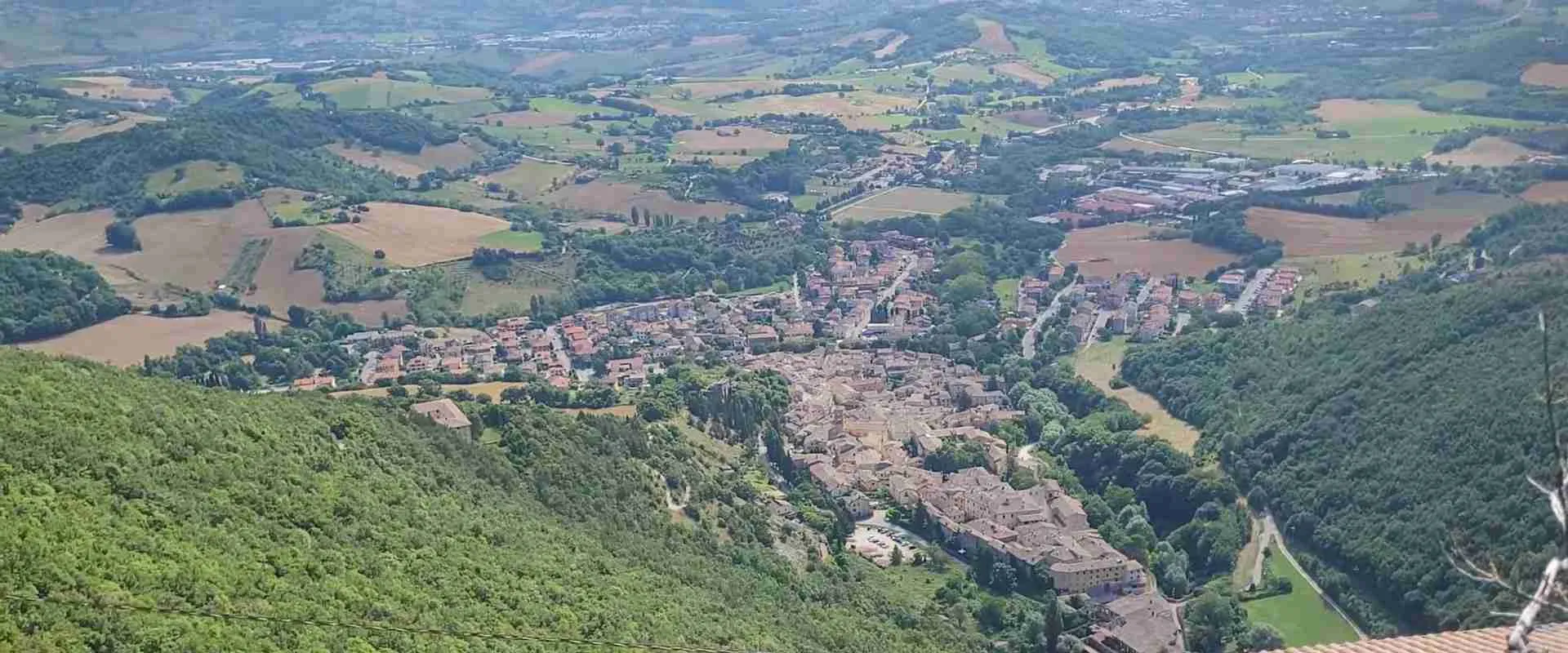
The corridor that runs inland from Ancona’s Adriatic cliffs through the Esino Valley to the Apennine passes at Genga packs a remarkable density of Romanesque abbeys, medieval fortresses, and hilltop wine towns into five manageable driving days — without the queues that make Tuscany exhausting in summer. This 2026 planning guide covers the complete route from Ancona Hub through Offagna, Jesi, Serra San Quirico, and the Genga gorge country, with verified logistics for restricted traffic zones, electric vehicle charging, and the drone regulations that apply at each protected site.
Key Takeaways
- The full Conero-to-Genga circuit covers roughly 120 kilometres across a mix of Adriatic coastal roads, the SS76 Esino Valley highway, and narrow provincial climbs, connecting five architecturally distinct stops across five days.
- Mid-range travelers sharing a room budget €130–195 per person daily (two sharing mid-range hotel or agriturismo), with a five-day trip total of approximately €650–975 per person; budget road-trippers using agriturismi with included breakfast can bring that down to €80–115 per person daily.
- Every walled historic centre on this route — Ancona’s port quarter, Offagna’s village core, Jesi, and Serra San Quirico — sits within or immediately adjacent to a ZTL (Zona a Traffico Limitato) zone where camera-detected, unauthorized entries generate automatic fines; parking strategies for each stop are detailed in the day-by-day sections below.
- The Frasassi Caves charge €18 per adult for the standard 75-minute tour and require advance booking online at tickets.frasassi.com in peak season; three English-language tours run daily at 11:40, 13:40, and 15:40.
- Recreational drone flights are restricted in both Conero Regional Park and the Red Gorge and Frasassi Regional Nature Reserve; all operators must register with ENAC’s D-Flight portal and check airspace status before flying, with unauthorized operations subject to significant fines under Italian aviation law.
- Fast EV charging is reliable in Ancona and Jesi but sparse between Serra San Quirico and Genga; plug-in hybrids or a planned overnight charge at accommodation are strongly recommended for the inland mountain leg.
People Also Ask About the Conero and Esino Valley Road Trip 2026
How many days do you need for the Conero and Esino Valley road trip in 2026?
Five days is the practical minimum for covering the full route from Ancona Hub to the Genga passes at a pace that allows proper time inside the abbeys, fortress, and caves rather than drive-by photography. A three-day compressed version works if travelers skip either the Mount Conero coastal circuit or the Offagna Fortress detour, keeping only the inland Jesi–Serra San Quirico–Frasassi axis. Conversely, seven days unlocks wine-country detours into Staffolo and the broader Verdicchio dei Castelli di Jesi wine zone, a half-day at the Valadier Temple above the Frasassi gorge, and the hilltop town of Arcevia on the return loop — all of which reward a slower pace without adding significant driving distance.
How much does the Conero and Esino Valley road trip cost per day in 2026?
Mid-range travelers sharing a room spend approximately €130–195 per person daily, covering accommodation at €50–75 per person (two sharing a mid-range hotel or agriturismo), restaurant meals at €55–75, fuel costs split between two people at €10–18, parking at €5–10, and daily attraction entry averaging €10–18 (including the Offagna Fortress Museum at €7 and the Frasassi Caves at €18 amortised across five days). Budget road-trippers staying at agriturismi with included breakfast and eating at simpler trattorias reduce this to €80–115 per person daily. The five-day mid-range trip total runs approximately €650–975 per person, with the budget version coming in at €400–575 per person.
What are the best Romanesque abbeys to visit on the Esino Valley route in 2026?
San Vittore alle Chiuse Abbey near Genga is the architectural centrepiece of the route — an 11th-century stone church set into a narrow gorge on the Sentino stream, with a semicircular apse and external blind arcading that represent some of the most complete Romanesque stonework in Le Marche. For travelers based in Ancona on Day 1, the small pre-Romanesque oratory of Santa Maria di Portonovo at the foot of Mount Conero’s cliff face provides an atmospheric counterpoint: a single-nave church documented from the 11th century, set directly above a pebble beach. Ancona Cathedral on Colle Guasco offers a third typology — a larger Romanesque-Gothic hybrid built on earlier Roman and early-Christian foundations. Smaller pievi (rural parish churches) dot the SS76 corridor and are generally accessible with a short detour; signage along the road identifies them, though hours are irregular outside summer.
Are there ZTL restrictions to be aware of on this road trip in 2026?
Every walled historic centre along the route operates some form of restricted access. Jesi’s centro storico is a full ZTL zone monitored by cameras, typically active from morning through the early evening on weekdays; visitors should park at the designated external parking areas near the walls and enter on foot. Offagna’s village core is pedestrian, with car access stopping at the base of the hill where a small free or blue-zone parking area is located. Serra San Quirico’s access road is narrow enough to prevent most traffic from reaching the medieval gates; park at the base and walk. In 2026, local municipalities across Le Marche continue expanding ZTL camera coverage, and rental cars with foreign plates are automatically flagged and fined if a camera records unauthorized entry. Parking fees in these smaller towns run €1–2 per hour in marked blue zones, with free white-zone spaces typically available five to ten minutes’ walk from the gate.
Extended multi-day tours – 5+ days
Featured Region Lazio Marche Abruzzo Hiking Trekking Multi-Day Tour Packages

3 days
Region Lazio Marche Abruzzo Hiking Trekking 3-Day Discovery Tour
- ✓ Comprehensive Region Lazio Marche Abruzzo Hiking Trekking experience
- ✓ Expert local guides included
- ✓ All accommodation included
- ✓ Transportation provided
5 days
Region Lazio Marche Abruzzo Hiking Trekking 5-Day Highlights Experience
- ✓ Comprehensive Region Lazio Marche Abruzzo Hiking Trekking experience
- ✓ Expert local guides included
- ✓ All accommodation included
- ✓ Transportation provided
7 days
Region Lazio Marche Abruzzo Hiking Trekking 7-Day Cultural Journey
- ✓ Comprehensive Region Lazio Marche Abruzzo Hiking Trekking experience
- ✓ Expert local guides included
- ✓ All accommodation included
- ✓ Transportation provided
10 days
Region Lazio Marche Abruzzo Hiking Trekking 10-Day Complete Adventure
- ✓ Comprehensive Region Lazio Marche Abruzzo Hiking Trekking experience
- ✓ Expert local guides included
- ✓ All accommodation included
- ✓ Transportation provided
Multi-day tour packages powered by TourRadar. Prices and availability subject to change.
Why This Road Trip Belongs on Your 2026 Italy Itinerary
Le Marche occupies a paradoxical position in Italian tourism: it is among the country’s most architecturally and gastronomically rich regions and simultaneously one of its least visited by international travelers. The region sits between the Adriatic and the Apennines, shares its wine culture with Umbria and its coastal character with Abruzzo, and yet rarely appears on itineraries that route through Florence, Siena, and the Cinque Terre. That absence is the opportunity.
The road trip described in this guide does not follow one of Italy’s established tourist circuits. It connects a series of minor landmarks — a 15th-century fortress, a handful of Romanesque parish churches, a walled hilltop town where the Holy Roman Emperor Frederick II was born in 1194 — with one major draw, the Frasassi Caves, and wraps them into a driving route of satisfying variety. The coastal approach via Mount Conero replaces the usual motorway introduction with limestone cliffs and a turquoise cove. The inland section through the Esino Valley follows a river cut that gradually deepens into Apennine gorge country, so the landscape shifts visibly with every twenty kilometres of driving. The Romanesque abbeys are not locked behind visitor centres or ticketed enclosures; most are open structures where the stonework can be examined close-up, without the filtering apparatus of a major museum site.
Practically, Le Marche is also straightforward to drive. Roads are well-maintained, signage is consistent, distances are short, and the region has invested in tourism infrastructure including ZTL guidance and — increasingly — EV charging at key stops. Ancona functions as a genuine hub: a ferry port connecting to Croatia, Greece, and Albania; a train station on the main Adriatic line with direct services to Rome and Milan; and an international airport within ten minutes of the city centre. The route is therefore equally accessible to road-trippers arriving by car on the A14 motorway and to travelers picking up a rental car at the airport or station.
The architectural focus of the route also means it performs well outside the peak summer season. Romanesque abbeys do not require good weather, and the gorge country around Genga is arguably more dramatic under an overcast autumn sky than in flat summer sunshine. Spring and early autumn strike the optimal balance between open site hours, lower accommodation prices, and reasonable driving conditions on the mountain roads approaching Genga.
Planning Your Conero and Esino Valley Road Trip 2026: Duration, Season, and Starting Points
The core circuit begins and ends in Ancona, making it easy to combine with ferry arrivals or onward train connections. From Ancona, the route moves south along the coast to Mount Conero on Day 1, turns inland on Day 2 toward Offagna and the Esino Valley, continues west through Jesi and Serra San Quirico on Day 3, reaches the Genga area and San Vittore alle Chiuse Abbey on Day 4, and completes the Frasassi Caves visit before looping back to Ancona on Day 5. Total driving across five days runs approximately 220–250 kilometres — an average of 44–50 kilometres per day, with the longest day being the Day 3 run from the coast into the Apennine foothills.
The route can also be driven west-to-east by travelers arriving from Umbria or central Italy: pick up at Fabriano or Genga, drive the Esino Valley eastward to Jesi and the coast, and exit at Ancona. The west-to-east direction has the advantage of delivering the most dramatic section — the Red Gorge gorge entry near Genga — at the beginning of the trip rather than the end, which some architectural travelers prefer. It also means the Frasassi Caves appear before the more relaxed coastal days, preserving the best sea views for the final stage.
For 2026 timing, April through early June and September through October represent the recommended windows. In spring, San Vittore alle Chiuse Abbey and the Offagna Fortress Museum operate regular hours, the mountain roads are clear of snow, and accommodation in the region costs materially less than in July and August. The Frasassi Caves are open year-round except for four closures (December 4, December 25, and the period from January 7–30), so winter visits are feasible for the cave component, but several of the outdoor sites along the route operate reduced or suspended hours outside the April–October window. Summer is perfectly viable for the trip but brings elevated accommodation prices in Sirolo and the Conero coast, and the Frasassi Caves require advance booking as demand is highest in July and August.
A rental car is the most practical vehicle for this route. Major rental companies operate from Ancona airport (Falconara Marittima) and the main train station. For EV rental, several operators at Ancona airport offer electric vehicles in the standard and compact categories, though availability should be confirmed at booking. The key EV planning consideration — limited charging between Serra San Quirico and Genga — is addressed in detail in the Electric Vehicle Charging section below. Plug-in hybrids remove the range anxiety on that inland leg and are widely available at Italian rental counters.
Navigating the Medieval Ridges: Driving Itineraries from Ancona to Offagna and Genga
Day 1 2026 – Ancona Hub to Mount Conero: Cliff Roads and the Promontory Circuit
Day 1 uses Ancona as a staging point, spending a morning in the city before driving south to Mount Conero in the early afternoon. Ancona’s historic centre repays two to three hours of walking: the Arch of Trajan, built in 115 CE to mark the harbour entrance, stands close to the port and is in excellent condition. Ancona Cathedral on the Colle Guasco hill above the port combines a Romanesque exterior with earlier structural phases on Roman and early-Christian foundations; the climb to the hill delivers views over the harbour and, on clear days, down the Adriatic coast toward the Conero promontory. The cathedral is generally open from mid-morning; entry is free.
After Ancona, take the SP16 or SP2 south toward Camerano, then follow signage for Conero Regional Park. The provincial road drops through olive groves before opening onto the cliff edge above Portonovo, the bay that forms the northern shelf of the Mount Conero limestone block. Park at the Portonovo lot (fee: approximately €2–3 per hour in summer, free or reduced off-season) and walk down to the bay, where Santa Maria di Portonovo sits directly above the pebble shore — a small, single-nave Romanesque oratory documented from the 11th century, its pale stone exterior weathered by sea spray but structurally intact. The church is not always open to interior visits, but the exterior and its setting between cliff and sea are reason enough for the descent.
From Portonovo, continue south on the park road to Sirolo, a clifftop village with a well-preserved medieval centre and views down to the Adriatic. Sirolo is a ZTL zone in its historic core; park at the municipal lot outside the gates (follow signs for Parcheggio, approximately €2 per hour, with a free outer lot a five-minute walk further back). The walk through the village to the belvedere terrace above the cliff takes under twenty minutes and delivers the best panoramic view of the Conero coastline from above. Those with time can descend to Sirolo’s beaches by shuttle bus in summer, or continue on the park road to Numana, a slightly larger town with a small archaeological museum housing finds from the Iron Age Picene culture that inhabited this coastal strip.
The summit of Mount Conero itself (572 metres) is accessible on foot from the Badia di San Pietro trail — a former Benedictine monastery perch, partially ruined, whose setting at the cliff edge is striking. The walking time from the nearest accessible parking is approximately one hour each way on a marked trail through Mediterranean scrub. Summit access is not practical by car.
Overnight: Sirolo or Numana for the coastal option (higher prices in summer; book early for July–August); Camerano for a quieter inland alternative with easy access back to the SS16 for Day 2.
Day 2 2026 – The Offagna Fortress and the Verdicchio Wine Roads
Day 2 moves inland from the coast. From Sirolo or Camerano, take the SP64 toward Offagna, a fifteen-kilometre drive through rolling hills that takes approximately twenty minutes. Offagna is a small hilltop village whose entire identity is organized around the fortress at its crown — visible from several kilometres out as a rectangular tower rising above terracotta rooftops.
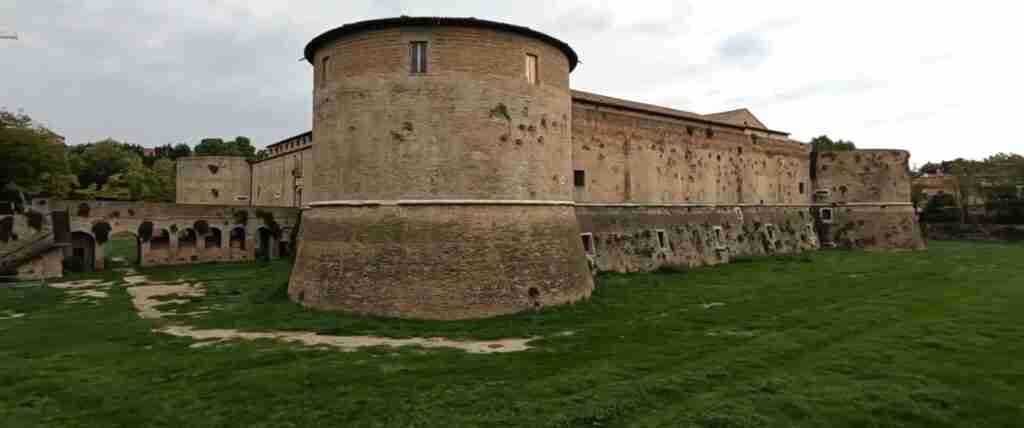
The Offagna Fortress was built between 1454 and 1456 on the commission of the city of Ancona, constructed specifically to defend Anconitan territorial interests against the rival city of Osimo to the south. The fortress’s design reflects standard 15th-century military architecture: a five-level main tower (mastio) built in brick and stone, enclosed by a curtain wall with a drawbridge system, and topped with a distinctive swallow-tail crenellation pattern. Inside the tower, a staircase connects the dungeon level at the base with the commander’s quarters on the third floor — identifiable by the presence of the only fireplace in the structure — and the watchman’s walkway at the summit, which provides a 360-degree panorama across the Marche hills toward the Sibillini Mountains to the southwest and the Adriatic to the east on clear days. The fortress’s alarm bell in the tower, still in place, bears a dating inscription to 1477 and the signature of the bell-caster.
The Fortress Museum inside the tower houses a substantial collection of antique weapons assembled in collaboration with the Academy of Oplology and Military Science in Ancona, ranging from Picene-era iron weapons through medieval edged arms to early modern firearms. The collection is well-labelled and covers five rooms; the full visit takes 45–60 minutes. Summer opening hours run from 10:00 to 13:00 and 15:00 to 20:00 daily (June through September); off-season hours are reduced and should be verified at visitoffagna.it before the visit. The adult ticket costs €7, reduced to €5 for visitors aged 6–17, over 65, and groups of ten or more (check current rates at visitoffagna.it before visiting, as hours and pricing are updated seasonally). A combined ticket covering the Fortress Museum plus the Luigi Paolucci Natural Science Museum a short walk away costs €10 per adult, €25 for a family of two adults with children under 18. Audio guides are available for an additional €1.
After Offagna, the afternoon is best spent driving the wine roads of the Verdicchio dei Castelli di Jesi wine zone — a designated DOC wine area covering the hills between Offagna and Jesi. Staffolo, a hilltop town approximately fifteen kilometres northwest of Offagna on the SP116, has a medieval tower, a small wine museum, and a terrace above the Esino Valley from which the full sweep of the Esino course to the sea is visible on clear days. Several estates along this road offer tasting rooms open in the afternoon without reservation; the dry Verdicchio whites produced here are among central Italy’s most food-friendly wines and are very affordable purchased direct.
Overnight: an agriturismo in the Verdicchio hills between Staffolo and Jesi maximizes the wine-country atmosphere and typically includes a home-cooked dinner in the room rate — a significant saving on the daily food budget. Jesi itself offers conventional hotel accommodation at the lower to mid-range tier.
Day 3 2026 – Jesi’s Medieval Walls and the Road to Serra San Quirico
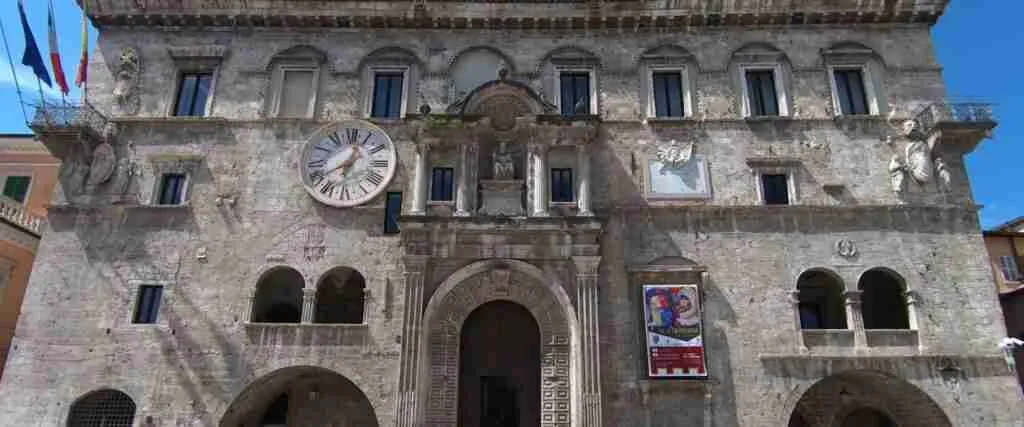
Jesi is the largest town on the interior route and requires at least a half-day. Its medieval walls are largely intact, enclosing an elongated historic centre that sits on a modest limestone bluff above the Esino River. The city’s single most resonant historical fact is that the Holy Roman Emperor Frederick II was born here on December 26, 1194 — a documented birth recorded in medieval chronicles, with his mother Constance of Hauteville giving birth in Jesi while traveling. A commemorative plaque marks the location in the main piazza. Frederick II’s connection to Jesi was maintained through his reign: he referred to Jesi affectionately in correspondence and the city used the imperial connection to assert prestige through the medieval period.
The approach to Jesi’s historic centre from most directions requires navigating the ZTL zone. The authorized external parking areas — including Piazzale della Pace near the northeastern walls and the Piazza della Repubblica parking area — are signed from the main access roads and connect to the historic centre via gate passages through the medieval walls. Do not follow GPS routing directly to the centro storico without confirming you are using one of the access gates designated as ZTL-exempt; cameras at the gates record every plate, and the authorization system distinguishes permit-holders from general visitors.
Once inside the walls, the Jesi circuit on foot covers the main piazza with its Frederick II association, the Palazzo della Signoria (now the civic library), the Cathedral of San Settimio with its 18th-century Baroque interior, and the Pinacoteca Civica (Civic Art Gallery) in the Palazzo Pianettiano. The Civic Art Gallery holds a significant collection of works by Lorenzo Lotto, the Venetian painter who lived and worked in Le Marche during the 1530s and 1540s; the collection is one of the best concentrations of Lotto’s work outside Venice and is well worth the museum entry fee. Jesi is also the birthplace of the composer Giovanni Battista Pergolesi (1710–1736), and a small museum in his honour occupies a building near the cathedral.
From Jesi, the SS76 dual carriageway runs west toward the Apennines through increasingly dramatic terrain. Serra San Quirico is approximately 25 kilometres from Jesi; the exit is signed from the SS76, and the access road climbs sharply to the village, which occupies a narrow ridge between two valleys. The village’s most unusual architectural feature is its arcaded gallery walkways (logge) — a covered passage running along the inner side of the medieval walls, functioning simultaneously as defensive rampart and public arcade, shaded in summer and rain-protected in winter. Few other Marche villages retain this feature in such complete form. Parking is available at the base of the access road or in a small lot just outside the eastern gate; the historic centre is effectively pedestrian, so the walk up from the car is unavoidable and takes about ten minutes on a steep lane.
Overnight: Serra San Quirico itself has a small hotel and a well-regarded agriturismo. The quieter option is to stay in Genga or the Genga valley area, which shortens Day 4’s driving, though accommodation options there are limited and pre-booking is essential.
Day 4 2026 – The Genga Passes and San Vittore alle Chiuse Abbey
The drive from Serra San Quirico back to the SS76 and then west toward Genga is the scenic climax of the entire route. From the Serra San Quirico exit on the SS76, the road enters the Red Gorge and Frasassi Regional Nature Reserve — a protected zone covering the limestone gorge carved by the Sentino stream over millions of years. The road runs through the gorge bottom, with vertical limestone walls rising on both sides; in certain sections the gorge narrows to a width where cliff and road margins nearly touch, making it one of the most dramatic short driving stretches in central Italy. Interpretive pull-offs along the road allow stops to view the cliff formations without obstructing traffic.
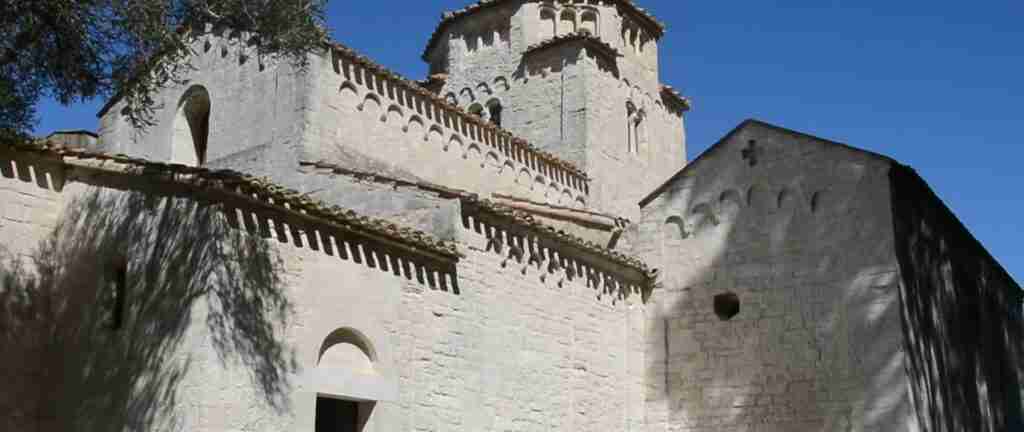
San Vittore alle Chiuse Abbey appears on the right side of the road approximately three kilometres before the Frasassi Caves entrance, identified by a small sign and a parking area beside the valley floor. The abbey is a Romanesque church documented from the 11th century — its precise foundation date is not established in surviving documents, and it appears in local historical records of the early medieval period as a monastic church connected to Benedictine communities active in this part of the Apennine region, though the specific foundation attribution has not been confirmed in surviving primary sources. What is not in doubt is the quality and completeness of the existing structure: a three-nave basilica in warm local limestone, with a semicircular external apse decorated with blind arcading, corbel-table friezes, and pilaster strips that follow the standard central Italian Romanesque vocabulary of the 11th–12th centuries.
The exterior apse sequence is particularly worth careful examination: the interplay between the blind arcading on the apse drum and the corbel table running below the roofline reflects the same formal priorities found in Romanesque buildings across the Apennine belt from Emilia to Umbria. The scale is intimate — this was a rural monastic church, not a cathedral — and the absence of later accretions (no Baroque additions, no 19th-century restoration campaigns visible on the exterior) makes the Romanesque fabric unusually legible. Entry to the church is generally free, with a donation box in the interior; hours are irregular outside the spring and summer season, and the structure may be locked in winter or on weekday mornings. An adjacent small museum (the Speleological and Archaeological Museum) connected to the Frasassi cave system houses finds from both the gorge’s prehistoric cave deposits and the surrounding archaeological landscape.
The Genga village itself, approximately two kilometres further west from the abbey, is a small comune on the hillside above the valley. It repays a brief stop for the view from the main square down into the gorge and for the 12th-century Genga parish church; the village has a couple of restaurants where lunch is straightforward and inexpensive by Italian standards.
Overnight: accommodation near Genga or in the San Vittore Terme valley (where several hotels serve the Frasassi Caves visitor market) allows an early start at the caves on Day 5 and avoids the peak midday crowd.
Day 5 2026 – Frasassi Caves and the Return Loop to Ancona
The Frasassi Caves are the one site on this route with the infrastructure and visitor volume of a major Italian attraction, and they merit the advance planning appropriate to that status. The ticket office and parking area are located at San Vittore delle Chiuse, approximately 1.5 kilometres from the cave entrance; a free shuttle bus connects the car park to the entrance. Book tickets online in advance at tickets.frasassi.com, especially for the English-language tours which run three times daily at 11:40, 13:40, and 15:40 — these slots fill well ahead in summer. Arriving early (at least 45 minutes before a booked tour time) allows time to park, take the shuttle, and orient without rushing.
The standard guided tour lasts approximately 75 minutes and follows a 1.5-kilometre path through the cave system’s main chambers. The scale of the underground spaces is genuinely astonishing: the main cavern (the Great Cave of the Wind) is large enough that its full height is difficult to grasp from the floor. Stalactite and stalagmite formations of exceptional variety line the route. The caves maintain a constant temperature of 14°C year-round regardless of external weather; a light layer is essential.
The standard adult ticket costs €18 (check the official site for 2026 pricing, as the caves are entitled to adjust rates annually). Children aged 6–14 pay €12; children under 6 enter free. The caves are closed December 4, December 25, and from January 7–30 inclusive. Photography is permitted from a specific point mid-tour; follow guide instructions on when cameras may be used.
After the caves, the return to Ancona via the SS76 eastbound takes approximately 50–55 minutes without stops. Travelers with an afternoon to spend can add a detour through Arcevia, a hilltop town north of the SS76 with a well-preserved historic centre and the 15th-century collegiate church of Sant’Angelo in Massa — an unusual late Gothic structure that provides a useful stylistic contrast with the Romanesque sites visited earlier in the trip. The Arcevia detour adds roughly 45 minutes of driving but is straightforward on well-surfaced SP roads.
Practical Logistics for Exploring Romanesque Abbeys: Parking, Access Vectors, and Drone Regulations 2026
Romanesque abbeys and rural parish churches in Le Marche sit on land that was often remote when they were built and has not necessarily become more accessible since. Several of the sites on this route — Santa Maria di Portonovo, San Vittore alle Chiuse Abbey, and smaller pievi visible from the SS76 — require leaving the car at an informal gravel lot or at a road widening and walking the final 100–400 metres on an unpaved path. Parking at these sites is generally free, unstructured, and limited to a handful of vehicles. Arriving early or at midday avoids conflicts at the most popular sites.
Parking by site: Portonovo (Santa Maria oratory) — paid lot at the Portonovo bay road junction, roughly 250 metres from the church. Offagna Fortress — free or blue-zone parking at the base of the hill below the village walls; no vehicles beyond the pedestrian zone boundary. San Vittore alle Chiuse Abbey — small gravel lot directly adjacent to the abbey on the valley floor; 20–30 spaces, no fee. Frasassi Caves — large paved lot at San Vittore delle Chiuse ticket office; parking is included in the shuttle arrangement with your ticket purchase. Jesi and Serra San Quirico — see the ZTL section below for authorized external lots.
Access vectors and mobility: The sole site on the route with any significant accessibility limitation is Offagna Fortress, which the official municipality information notes is not accessible by wheelchair due to its multi-level staircase structure. Santa Maria di Portonovo involves a steep descent on a paved path from the road-junction parking lot. The Frasassi Caves pathway is a paved, flat-to-gently-graded walkway with handrails, suitable for most visitors including those with limited mobility, though some sections have steps; the cave staff can provide specific guidance on accessibility needs at the ticket office.
Drone regulations 2026: Italy operates its drone regulatory framework under EU Regulation 2019/947, enforced by ENAC (the Italian Civil Aviation Authority). All drone operators — including tourists using consumer drones — must register with ENAC’s D-Flight platform before flying in Italy; registration is online and provides access to the real-time airspace map showing restricted zones, controlled airspace, and notification requirements.
Both primary protected areas on this route carry significant drone restrictions. Conero Regional Park, covering the Mount Conero promontory and coastal strip, is a natura protetta designation that classifies most of the park area as restricted or requiring pre-authorization for drone operations beyond the “Open A1” sub-category (drones under 250 grams not flown over gatherings). The Red Gorge and Frasassi Regional Nature Reserve, covering the gorge country between Serra San Quirico and Genga, similarly restricts recreational drone use across most of its protected surface; the narrow canyon topography also creates wind conditions that make drone operation genuinely hazardous regardless of regulatory status.
Historical monuments — including the Offagna Fortress, Ancona Cathedral, and San Vittore alle Chiuse Abbey — may carry additional restrictions under Italian Ministry of Culture (MiC) regulations governing flight near nationally listed heritage structures. In practice, this means that any planned aerial photography of heritage buildings or protected landscapes on this route requires checking D-Flight status before flying, and that operations in the Specific category (requiring ENAC authorization) need to be requested well in advance — typically a minimum of several weeks for non-urgent applications. Unauthorized drone flights in restricted areas under Italian aviation law carry fines that can reach into the thousands of euros; the D-Flight portal (vds.enac.gov.it) is the authoritative resource for current zone status and notification procedures.
Site-by-site summary: Mount Conero area — Conero Regional Park restriction, check D-Flight; Offagna Fortress — heritage monument, check D-Flight and MiC status; Jesi city centre — urban airspace, restricted; San Vittore alle Chiuse Abbey — gorge terrain plus heritage monument, effectively not flyable without authorization; Frasassi Caves area — Red Gorge and Frasassi Regional Nature Reserve restriction, plus complex canyon airspace. Travelers carrying drones should plan around these constraints from the start, treating aerial photography as a bonus if authorization is obtained rather than an assumed activity.
ZTL Zones 2026: A Driver’s Complete Guide to Restricted Areas Along the Route
A ZTL (Zona a Traffico Limitato) is a camera-monitored restricted traffic zone present in virtually every Italian historic centre. Cameras are mounted at access points to the designated zone and record every licence plate that enters. Authorized vehicles — residents, businesses with permits, deliveries in permitted windows — pass without consequence. All other vehicles receive a fine by post within days or weeks, typically in the €80–150 range per infraction. Rental car companies facilitate payment on their customers’ behalf and add an administrative handling fee, usually €25–40 on top of the underlying fine. Entering a ZTL zone once can therefore cost €110–190 or more. Entering twice on the same day at different cameras means two separate fines.
GPS navigation systems — including those in rental cars — frequently route directly into ZTL zones unless specifically set to avoid them. The recommended practice is to identify the designated external parking area for each stop before driving in, set the GPS to that parking lot rather than the attraction, and complete the visit on foot from there.
Ancona: The Ancona historic centre (Porto Antico, Colle Guasco, and the streets connecting them) is a ZTL zone active during daytime hours on weekdays and Saturday mornings. Visitors arriving to see Ancona Cathedral or the Arch of Trajan should use the Piazzale della Posta parking lot adjacent to the port district, or the Parcheggio Traiano near the arch, and walk the remaining distance. A short walk up the Colle Guasco is unavoidable for the cathedral, but no roads to the hilltop are accessible without ZTL clearance.
Offagna: The village core is a pedestrian zone that functions like an informal ZTL. The road approaching Offagna from the SP64 terminates at a small parking area at the base of the hill — typically a free or one-euro blue-zone lot. From there, the climb to the fortress gate takes approximately five minutes on foot. There are no cameras in the conventional sense, but driving into the pedestrian village would require mounting a kerb to pass the barrier; it is unambiguously the wrong option regardless of any camera presence.
Jesi: Jesi’s ZTL covers the full historic centre enclosed within the medieval walls and is one of the more actively enforced on the route. The designated external lots used by visitors are Piazzale della Pace (northeastern approach, near Porta Valle gate), with approximately 200 spaces, and Piazza della Repubblica (southern approach), with a smaller capacity. Both lots are free or charge a nominal blue-zone fee. From either lot, the main piazza at the heart of the historic centre is a seven-to-ten-minute walk through a gate passage in the medieval wall. ZTL hours in Jesi are typically active Monday through Saturday from early morning until evening; Sunday hours may differ and should be confirmed on the Jesi municipality website (comune.jesi.an.it) before the visit.
Serra San Quirico: The access road to Serra San Quirico rises steeply and terminates at a small parking area just below the eastern gate of the village. There is no conventional ZTL camera system in this small comune, but the access road is marked as limited-access and the village centre is effectively car-free by its topography. Parking at the base costs €1–2 in the blue zone during peak hours, with free white-zone spaces a short distance further back on the access road.
Genga and San Vittore alle Chiuse: Neither Genga village nor the San Vittore alle Chiuse valley has a formal ZTL zone. Parking at the abbey site and in Genga village is free and unstructured. The Frasassi Caves parking area is a managed paid lot that operates as part of the ticket and shuttle system.
For 2026, travelers with rental cars are advised to photograph the ZTL signage at each entry point if they inadvertently pass one, note the time and location, and contact the rental company immediately — some companies can facilitate administrative resolution of erroneous entries if reported promptly, though this is not guaranteed. The Italian ZTL portal (ztl.italia.it) and the official municipal websites are the authoritative sources for current boundary maps and active hours, both of which can change between tourist seasons.
Electric Vehicle Charging on the Conero and Esino Valley Route 2026
Italy’s EV charging network has expanded significantly since 2022, but the expansion has been concentrated along motorways, in major cities, and in coastal tourist zones rather than in the agricultural interior or mountain areas. The Conero and Esino Valley road trip spans all three terrains, which means charging availability varies considerably across the five stages.
Ancona: Well-served. Fast chargers (50kW DC and above) are available at the port area, near the train station, and at several commercial parking facilities in the city. The Enel X Way network operates multiple points in the Ancona urban area, and Be Charge stations are also present. Arriving in Ancona with a depleted battery is not a problem; a one-to-two-hour fast charge is achievable while exploring the cathedral hill.
Mount Conero / Conero Regional Park area: Limited. The park road and the villages of Sirolo and Numana have minimal public charging infrastructure as of late 2025; accommodation in the area increasingly offers destination charging (a standard domestic or Type 2 socket for overnight charging) but this should be confirmed at booking. EV drivers staying in Sirolo or Numana are advised to use their available range from Ancona without expecting a mid-day top-up.
Offagna area: Very limited public charging. The area between the coast and Jesi is agricultural with few commercial facilities that host chargers. An agriturismo with private charging is the most reliable option; inquire directly at booking.
Jesi: The most important charging stop on the inland portion of the route. The Jesi area has Type 2 AC chargers (22kW) available in the main external parking areas serving the historic centre and at several fuel stations along the SS76 approach. Fast DC chargers are present at the larger commercial developments on the Jesi industrial periphery. EV drivers on this route should plan to arrive in Jesi with enough time for a one-to-two-hour charge during the visit to the historic centre — this aligns naturally with the half-day needed to see Jesi properly.
Serra San Quirico to Genga — the critical gap: This is the section requiring the most careful planning for pure-EV drivers. The 35–40 kilometres between Jesi and Genga on the SS76 pass through the Red Gorge and Frasassi Regional Nature Reserve with minimal commercial infrastructure and no fast chargers identified along the route as of late 2025. The Frasassi Caves visitor area reportedly offers a small number of charging points, but availability is not guaranteed and the power level may be limited. The accommodation cluster in the San Vittore Terme valley near Genga increasingly offers guest charging, but capacity is typically one or two points per property.
The practical recommendation for 2026 EV drivers: charge to a full or near-full battery in Jesi before departing for Serra San Quirico and Genga. A vehicle with 250km+ of remaining range after charging in Jesi can complete the Day 3–4–5 inland section (Jesi to Genga and back to Ancona via the SS76, approximately 140 kilometres) without requiring a fast charge in the interior. If your vehicle’s range is below 200km per charge, a plug-in hybrid is the more practical choice for this specific route. Check real-time charger availability using the Enel X Way app, Be Charge app, or the multi-network aggregator Nextcharge before departing each morning.
Budget Breakdown for the Conero and Esino Valley Road Trip 2026
Budget Road Trippers 2026: Daily Costs and Agriturismo Strategies
Budget travel on this route is genuinely comfortable rather than austere. The Le Marche agriturismo system — farmstays that operate under a regional regulatory framework and are required to serve food produced on the property — delivers accommodation and breakfast (and often dinner) at prices well below coastal resort hotels, and the food quality is consistently high. Budget travelers spending two people sharing a room at an agriturismo or a small two-star hotel can expect to spend €80–115 per person daily, covering accommodation at €30–40 per person (two sharing a room at €60–80 per night), meals at €32–48 per person (breakfast included at agriturismo, lunch at a village bar or panino, dinner at a simple trattoria or the agriturismo’s own dining room), fuel split between two people at €8–12 each for the day’s driving, parking at €2–5, and attraction costs averaging €5–7 per day when Offagna Fortress (€7 one day) and Frasassi Caves (€18 one day) are amortised across five days. The five-day budget trip total runs approximately €400–575 per person.
Key savings strategies for budget travelers: book agriturismi that include dinner in the room rate — a home-cooked meal in an agriturismo dining room costs the property €15–20 to provide and is typically included in packages at rates that save the equivalent cost of a restaurant dinner. Eat lunch at village bars or bakeries (a panino and coffee runs €5–8) rather than sit-down restaurants. Purchase Verdicchio wine direct at estate shops along the Day 2 route, where a very good bottle costs €8–12 — less than a restaurant pour of the same wine. Use the SS76 dual carriageway for the main inland driving rather than the A14 motorway, which avoids toll costs entirely on the Ancona-to-Jesi section.
Mid-Range Road Trip Costs 2026
Mid-range travel on this route — a clean three-star hotel or a premium agriturismo with ensuite bathroom, meals at sit-down restaurants for lunch and dinner, and one or two paid guided experiences — costs €130–195 per person daily (two sharing), broken down as: accommodation €50–75 per person (from a room at €100–150 per night), restaurant meals €55–75 per person (a proper lunch and dinner with local wine), fuel €10–18 per person, parking €5–10, and attraction costs €10–18 per day across the five stages. The five-day mid-range trip total runs approximately €650–975 per person.
At the mid-range level, the additional expenditure that most improves the trip experience is a guided tour of either the Frasassi Caves (the standard ticket already includes a professional guide) or the Offagna Fortress (where an optional guided tour by the museum’s resident specialist covers historical details not accessible from the standard displays). A full-day wine tour with transport through the Verdicchio dei Castelli di Jesi wine zone — available through operators based in Jesi, typically at €80–120 per person including tasting fees — can substitute for the self-drive Day 2 wine road itinerary and removes the driving/tasting conflict.
Luxury Road Trip Costs 2026
Boutique hotels in converted historic buildings — a category that Le Marche has developed thoughtfully over the past decade, particularly in Jesi, the Conero coast, and the Esino Valley wine country — charge €200–350 per night for a double room, positioning the luxury tier at €250–430 per person daily (two sharing). At this level, accommodation runs €100–175 per person, fine dining including wine €80–125, premium fuel or private transfer costs €20–35, parking €10–20, and private tours or premium experiences €40–75 per person. The five-day luxury trip total runs approximately €1,250–2,150 per person.
Experiences that distinguish the luxury version of this route include: a private Frasassi speleological tour (the advanced “Blue Route” exploration available for visitors aged 12 and above, requiring advance reservation by calling the cave booking line); a Verdicchio wine masterclass at a historic estate in Castelbellino or Cupramontana; a private architectural guide for the Jesi historic centre and San Vittore alle Chiuse Abbey; and dinner at one of the region’s Michelin-recognised restaurants, of which Le Marche has a small but impressive cluster concentrated around Senigallia (off the main route but accessible for an evening excursion from a Jesi base).
Where to Stay Along the Route 2026: Agriturismi, Hotels, and Hilltop Villages
Accommodation on this route falls broadly into three categories: coastal hotels in Sirolo and Numana (expensive in summer, excellent for the Day 1 coastal experience); inland agriturismi in the wine hills between Offagna and Jesi (the best value-to-quality ratio on the entire route, excellent food, often spectacular views); and small hotels in Jesi and the Genga valley (practical bases for the architectural and cave stages).
For the Mount Conero coastal night (Day 1 overnight), book early for any July or August stay in Sirolo — the village has limited accommodation capacity and most properties fill two to three months ahead in peak summer. The alternative of staying in Camerano (five kilometres inland, a workaday market town rather than a tourist destination) saves 30–40% on accommodation and is a comfortable base for the next morning’s inland drive toward Offagna.
The Verdicchio hills agriturismo cluster — the ideal base for Day 2 and optionally Day 3 if driving into Jesi as a day trip — is most easily reached from the SP116 and SP10 roads between Staffolo, Castelbellino, and Maiolati Spontini. Several properties here operate full board (accommodation plus breakfast and dinner) in the €70–110 per person per night range; the food at the better agriturismi in this wine zone, which serve ingredients grown on the property and wine from the adjacent vines, is genuinely excellent and would cost twice as much in a comparable restaurant setting.
Jesi has a reasonable range of conventional hotel accommodation — two-star through four-star — concentrated in the lower town outside the historic walls. The most atmospheric hotel options are in converted historic buildings within the walls (one or two small boutique properties operate there), though these fill quickly for weekend stays when Jesi’s calendar of events — including a September wine festival associated with the Verdicchio harvest — draws regional visitors.
The Genga valley accommodation cluster serves the Frasassi Caves visitor market and ranges from simple two-star hotels to a small number of mid-range properties near San Vittore Terme with thermal spa facilities. Pre-booking is advisable in summer; in spring and autumn, same-day availability is often possible.
Romanesque Architecture in the Esino Valley: Understanding What You Are Seeing
The Romanesque buildings on this route are not isolated curiosities but products of a coherent building tradition that spread through central Italy between roughly the 10th and 13th centuries, adapting consistent forms — semicircular arches, rubble-and-dressed-stone walling, external blind arcading, bell towers rising detached or semi-detached from the nave — to local materials and patronage conditions. Understanding that tradition makes the individual sites more legible.
The core structural vocabulary of Romanesque architecture in Le Marche is based on what archaeologists and architectural historians call the pieve type — a rural parish church built to serve a scattered agricultural population that could not be accommodated in a single village church. The pieve characteristically has a single or triple nave, a semicircular apse at the eastern end, and an exterior that addresses the passerby through texture (the contrast between dressed stone coursing and rubble infill) and rhythm (pilaster strips dividing the apse surface into bays, each bay punctuated by a window or blind arch) rather than through figurative sculpture. Le Marche’s Romanesque pievi tend toward restraint compared with the more elaborate portal sculpture found in Emilia-Romagna or Apulia, which makes the spatial and structural logic more immediately readable.
San Vittore alle Chiuse Abbey represents the monastic version of this tradition rather than the pieve version. Monastic churches are generally larger, have more complex eastern ends (the apse at San Vittore is the defining external feature), and are associated with communities of monks who funded more ambitious stonework over longer construction campaigns. The blind arcading on San Vittore’s apse — where small columns carry semicircular arches that are purely decorative (no window or opening behind them) — is a standard Romanesque surface treatment that probably arrived in Le Marche through connections with Benedictine building campaigns further north in Emilia and Tuscany, though the precise transmission routes are not documented in surviving sources.
Santa Maria di Portonovo, the small oratory at the base of Mount Conero, belongs to a third sub-type: the votary or commemorative chapel, built by a patron (in this case possibly a maritime community or monastic cell) in a site of particular landscape significance. Its single nave and minimal exterior treatment reflect a limited patronage budget, but the setting — cliff, sea, and a beach of white pebbles on three sides — gives it an atmospheric charge that larger buildings on the route cannot match.
Ancona Cathedral is the most architecturally complex stop on the route, having been built over a much longer period and on a much larger and more complex site than any of the rural churches. The cathedral’s exterior combines Romanesque arching and pilaster articulation with Gothic pointed elements introduced in later construction campaigns, and the building’s position on Colle Guasco above the Roman-era remains of a temple to Venus adds archaeological depth to the architectural reading. Travelers with strong architectural interests will want to spend an hour working from the exterior around to the apse before entering — the outside tells a more complex historical story than the largely later-reworked interior.
Reaching Ancona Hub 2026: Ferry, Train, and Air Gateway Options
Ancona’s value as a road trip gateway derives from its unusual combination of transport connections. It is one of Italy’s primary Adriatic ferry ports, a main-line rail junction, and a regional airport — giving it a connectivity that most comparable-sized Italian cities do not have. For travelers combining this road trip with broader Adriatic or Balkan travel, Ancona’s positioning is particularly convenient.
By ferry: The Ancona port (Stazione Marittima) operates year-round ferry services to Split and Zadar in Croatia (crossing time approximately 10–11 hours overnight on the main JADROLINIJA and GNV services), to Patras in Greece (approximately 22–24 hours), to Igoumenitsa (approximately 16 hours), to Durrës in Albania (approximately 16 hours), and to Cesme in Turkey (a longer overnight route operated seasonally). For travelers arriving from Croatia or Greece, Ancona’s road trip circuit means no backtracking: arrive by ferry, complete the Conero and Esino Valley route over five days, and depart by train or fly home from the airport. Ferry schedules and 2026 pricing are available through the port authority’s official booking portal and through the individual ferry operators.
By train: Ancona station sits on the Adriatic main line (Bologna–Ancona–Brindisi), with frequent Intercity services north to Bologna and Milan and south to Pescara and Bari. Rome connections require a change at Falconara Marittima or direct InterCity services taking approximately three hours. The high-speed rail network does not directly serve Ancona (the nearest Frecciarossa stop is Bologna, approximately 1h45 from Ancona by Intercity), but journey times from Bologna are competitive with flying once airport transit is factored in. The Ancona–Genga train line (the branch toward Fabriano) is a slow regional service used primarily by commuters, taking approximately 57 minutes and costing €4–11; it connects to the Frasassi Caves area at Genga–San Vittore Terme station, from which the cave ticket office is a 15-minute walk — a viable car-free option for day-trippers from Ancona who want to visit the caves without a rental car.
By air: Raffaello Sanzio Airport in Falconara Marittima, approximately 12 kilometres northwest of Ancona, operates scheduled services to major Italian hubs (Rome Fiumicino, Milan Malpensa, Naples) and to a growing range of European destinations, with Ryanair and Wizz Air operating budget routes that connect Ancona to northern and central Europe. Transfer to the city centre or train station takes approximately 20–25 minutes by taxi or the Conerobus shuttle service. Car rental desks at the airport include most major international brands.
Best Season and Road Conditions for the 2026 Conero and Esino Valley Drive
The route operates well across most of the year, with the exception of a brief winter window when the Apennine roads approaching Genga can carry snow and several of the smaller sites operate minimal or suspended hours. The best practical windows for 2026 are April through early June and September through October.
Spring (April–May): The SS76 mountain section and the Red Gorge approach to Genga are typically clear of snow from late March onward; road conditions are excellent. Site hours for the Offagna Fortress Museum, San Vittore alle Chiuse Abbey, and the Conero coastal paths are in full spring operation. Wildflowers on the Mount Conero cliff paths and in the gorge country are at their best in May. Accommodation prices are 20–35% lower than July–August across the region.
Summer (June–August): All sites fully operational, longest daylight hours, warmest sea temperatures for a Sirolo beach day. The negatives: accommodation in Sirolo and Numana requires advance booking months ahead for July–August; the Frasassi Caves require online pre-booking or very early arrival at the ticket office; and the coastal sections of the drive can feel congested on summer weekends. The inland sections — Jesi, Serra San Quirico, Genga — are significantly quieter than the coast even at peak summer.
Autumn (September–October): Arguably the most rewarding season for the architectural and food components of the route. The Verdicchio harvest takes place in September and October; visiting the Esino Valley wine zone during the harvest brings the additional dimension of working winery visits and local festivals. Temperatures are comfortable for walking. Site hours begin to reduce in October, so confirm Offagna Fortress Museum and abbey hours before the visit.
Winter (November–March): Viable for the Frasassi Caves (open except for the three closures noted above), Ancona Cathedral, and Jesi historic centre, which operate year-round. The Conero Regional Park coastal paths are accessible on mild winter days and offer dramatic light for photography. The Offagna Fortress Museum has reduced winter hours and should be checked before visiting. The mountain roads toward Genga may carry snow or black ice in January and February; winter tires or chains are required by Italian law when snow chain signs are posted, and rental cars must be equipped accordingly.
Money-Saving Strategies 2026 for the Conero and Esino Valley Road Trip
Book Frasassi Caves tickets in advance: Online booking at tickets.frasassi.com guarantees your tour time, avoids the ticket-office queue, and allows you to book the English tour specifically. On busy summer weekends, arriving without a pre-booked ticket can mean waits of two hours or more before your tour departs — an unpleasant experience that is entirely avoidable.
Use the combined Offagna museum ticket: At €10 per adult, the combined ticket covering the Fortress Museum and the Luigi Paolucci Natural Science Museum saves €1 versus buying the two separate tickets (€7 + €4 = €11). If you have children, the family ticket at €25 covers two adults and unlimited children under 18, making it significantly cheaper than individual tickets for a family of three or more.
Drive the SS76, not the A14: Between Jesi and the SS76 junction near Ancona (Ancona Nord), the SS76 dual carriageway is toll-free and only marginally slower in normal traffic than the A14 motorway. The A14 toll between Ancona and the Genga/Fabriano exit is approximately €2.60 each way — a modest sum, but multiplied across multiple days of motorway driving it accumulates. The SS76 also delivers significantly better scenery through the Esino Valley.
Time your Conero stay outside peak summer: Accommodation in Sirolo in July–August can reach €180–250 per room per night at mid-range properties. The same rooms in May or September cost €90–130 — a saving of €90–120 per couple per night for a nearly identical experience (the sea is swimmable from late May through early October; the cliff paths are equally beautiful).
Eat at village bars for lunch: The food at village bars and village-square bakeries in the Marche interior is consistently good and priced very differently from sit-down restaurants. A panino with local salumi or cheese plus a glass of wine or coffee at a bar in Offagna, Serra San Quirico, or Genga typically costs €5–9 per person. The equivalent in a trattoria covering the same quality level would be €20–30. Using bars for lunch and restaurants only for dinner reduces the daily food budget by €15–25 per person.
Buy wine direct from the estate: Along the Day 2 Verdicchio wine road route between Staffolo and Maiolati Spontini, estate shops sell bottles of current-vintage Verdicchio dei Castelli di Jesi for €8–15 — wines that appear on restaurant wine lists at three to four times that price. Purchasing two or three bottles during the drive and enjoying them with picnic food from a village market or at the agriturismo dinner table is both less expensive and more atmospheric than ordering by the glass at a restaurant.
Frequently Asked Questions About the Conero and Esino Valley Road Trip 2026
Is this road trip suitable for first-time visitors to Italy?
Yes, with one caveat: the ZTL zone system requires advance familiarization. First-time Italy visitors sometimes inadvertently drive into historic centre restricted zones while following GPS navigation. Before the trip, spend fifteen minutes reading the ZTL section of this guide and identify the correct parking area for each stop. Beyond that, the route presents no unusual difficulties for first-time visitors: the roads are well-maintained and clearly signed, English is spoken at the Frasassi Caves and at most Jesi hotels and restaurants, and the distances between stops are short.
Can this road trip be done without a car using public transport?
Partially. Ancona, Jesi, and the Frasassi Caves area are connected by the Ancona–Fabriano regional train line, making the Ancona–Jesi–Genga–Frasassi axis feasible without a car. Offagna and Serra San Quirico are not served by regular train services and require a car or taxi for practical access. Sirolo and Numana on the Conero coast are served by bus from Ancona in summer but not by train. A combination of train for the SS76 corridor and taxi or rideshare for the detours to Offagna and Serra San Quirico makes a car-free version possible but significantly less flexible than a self-drive itinerary.
What is the road surface quality like on the provincial roads to Offagna and Serra San Quirico?
The main provincial roads (SP and SS designations) on this route are sealed and generally well-maintained. The final ascent to Serra San Quirico is narrow and steep but paved; a standard compact car is sufficient. The access track to the San Vittore alle Chiuse Abbey and the small parking area near the Frasassi ticket office are likewise paved or compacted gravel, accessible without four-wheel drive. No off-road driving is required or recommended anywhere on the route.
Are there good restaurants and food experiences along the route?
Le Marche is one of Italy’s most underappreciated food regions, and the Esino Valley route passes through several of its strongest culinary territories. The Verdicchio dei Castelli di Jesi wine zone produces dry whites of high quality that pair naturally with the region’s freshwater fish, legume, and cured meat dishes. Vincigrassi — a baked lasagne layered with a complex meat and offal ragù — is the region’s signature pasta preparation. Porchetta from the Marche interior is excellent. Seafood, if included, is at its best bought from Sirolo or Numana restaurants one day after the local fishing fleet returns (call ahead to ask what arrived). Trattorias in Jesi and the surrounding hill towns typically offer fixed-price lunch menus (pranzo fisso) at €12–20 per person including wine — the best-value sit-down lunch option on the route.
Is the Frasassi Caves visit appropriate for children?
Yes, very much so. The cave pathway is a paved, well-lit walkway with handrails, suitable for children from about age four or five upward (children under six enter free). The dramatic scale of the cave chambers — the Great Cave of the Wind can notionally fit a large cathedral inside it — tends to produce genuine awe in younger visitors rather than fear, provided they are not prone to claustrophobia. The constant 14°C temperature and the 75-minute duration are manageable for most children with a light jacket and comfortable shoes. The shuttle bus from the car park to the cave entrance is an additional novelty that most children enjoy.
Can the Offagna Fortress visit and the Frasassi Caves be combined in a single day?
Technically yes — the driving distance from Offagna to the Frasassi Caves is approximately 50 kilometres via Jesi and the SS76, taking 50–60 minutes. However, doing so would require skipping Jesi entirely or making it a very rushed stop, and would compress the Genga valley area into a brief afternoon. The five-day structure of this guide distributes these two major stops across different days deliberately. If a four-day schedule is required, the Day 2 (Offagna and wine roads) and Day 3 (Jesi and Serra San Quirico) stages can be merged at the cost of a rushed Day 2 afternoon; the Frasassi Caves should always be reserved for their own half-day.
What is the best way to handle the Mount Conero summit — drive, walk, or skip?
The summit is accessible only on foot from the nearest road access point (approximately one hour each way on a marked trail). Driving to the summit is not possible. For travelers with time and reasonable fitness, the walk is worthwhile: the summit ridge delivers the only 360-degree view of both the Adriatic and the Esino Valley simultaneously. Travelers who prefer not to hike can fully satisfy the Conero experience through the Portonovo bay oratory visit and the Sirolo belvedere terrace — both accessible from road-adjacent parking — without the summit climb.
How do I book English-language tours at the Frasassi Caves?
English tours depart at 11:40, 13:40, and 15:40 daily. Book online at tickets.frasassi.com, selecting the English-language departure time from the tour calendar. The online system shows real-time availability. If the English slots are fully booked and you read some Italian, the standard guided tour — which runs in Italian with additional informational plaques in English along the route — remains informative. Alternatively, an Italian-language tour taken with the assistance of the free official cave app (available on the Frasassi website), which provides descriptive commentary in multiple languages, compensates reasonably well for the language gap in the live guide’s narration.
Is there a risk of the Genga mountain roads being closed in 2026 due to weather or landslide events?
The SS76 through the Red Gorge and Frasassi Regional Nature Reserve has been subject to periodic temporary closures due to rockfall or maintenance work in past years; the road passes through a narrow limestone gorge where the cliff faces above the carriageway require active monitoring. For 2026, check the Marche road conditions portal (viabilità.marche.it) in the week before travel to confirm SS76 status. In the event of a closure, an alternative route via Fabriano and the SP360 approaches Genga from the west — a longer drive but usable. The Genga and Frasassi area has no rail alternative that is practical for day visitors.