
The Central European Soul: A Cultural Itinerary Through Habsburg Trieste and Gorizia
At the northeastern tip of Italy, where the Adriatic dissolves into karst limestone and the land remembers three empires, two cities carry a cultural identity unlike anywhere else in the country. Trieste — once the great seaport of the Austro-Hungarian Empire — and Gorizia — a market town severed by a cold-war border and only recently made whole again — share an inheritance of cafés, literature, divided loyalties, and layered memory that rewards travelers willing to read beneath the surface. This itinerary traces the Central European soul that still animates both places.
Key Takeaways
- Habsburg architecture defines the visual identity of both cities. Trieste’s monumental Piazza Unità d’Italia — one of Europe’s largest seafront squares — and Gorizia’s neoclassical center preserve the urban grammar of Austro-Hungarian planning at a quality rarely seen outside Vienna and Prague.
- Trieste holds one of Europe’s most concentrated literary legacies. James Joyce lived here for more than a decade and drafted the works that would define literary modernism. Italo Svevo, Umberto Saba, and Scipio Slataper make Trieste a city where literature and landscape are inseparable.
- The historic café is not a relic here — it is still a living institution. Caffè San Marco, opened in 1914, continues to function as meeting place, reading room, and community anchor. The Triestine coffee vocabulary, distinct from the rest of Italy, is itself a cultural inheritance.
- Gorizia’s postwar story is one of the twentieth century’s most striking urban tragedies and its most hopeful resolutions. The Iron Curtain bisected the city’s central square, leaving a white line through the pavement. That line has vanished; the square is now a symbol of European reconciliation.
- The cuisine of the borderlands exists nowhere else in Italy. Jota, goulash, strudel, prosciutto cotto di Praga, the wines of the Carso and Collio — the Triestine and Gorician table draws equally from Central European, Slavic, and Adriatic traditions.
- Both cities reward unhurried travel. The Central European inheritance here is subtle, layered, and atmospheric rather than monument-driven. The itinerary below is designed to be walked, sat in, and absorbed — not ticked off.
People Also Ask About Habsburg Trieste and Gorizia
What makes Trieste culturally different from other Italian cities?
Trieste spent four centuries as the main seaport of the Habsburg Empire, becoming Italian only in 1918. Its architecture, café culture, cuisine, and literary tradition were all shaped by Austro-Hungarian rather than purely Italian influences, producing a city that feels simultaneously Mediterranean and Central European. The population has always included large Italian, Slovenian, German, and Jewish communities, and this multi-ethnic heritage gives Trieste its distinctive intellectual and cosmopolitan atmosphere — one that attracted James Joyce, Rainer Maria Rilke, and Sigmund Freud at different points in their lives. The city also had a further period of uncertainty after World War II, when it became the center of a contested territory between Italy and Yugoslavia that was only fully resolved in 1975, deepening the Triestine sense of identity as something earned rather than assumed.
What happened to Gorizia after World War II?
The Paris Peace Treaty of 1947 divided Gorizia in two. The historic city center remained Italian, but the surrounding territory — along with the railway station, the main hospital, and several residential neighborhoods — was assigned to Yugoslavia. The Slovenian authorities immediately began building a new city on the Yugoslav side, naming it Nova Gorica. The border ran directly through Piazza Transalpina, the square that had served as the social heart of the undivided city, where a white line in the cobblestones marked where Yugoslavia began. Families were separated, streets were severed, and the city that had flourished as a multicultural Austro-Hungarian market town found itself split between two antagonistic Cold War blocs. The border was progressively softened after both countries joined the Schengen Area, and since 2004 the square has been fully open. In 2025, Gorizia and Nova Gorica were jointly designated European Capitals of Culture, formalizing the reunification of the two cities as a shared cultural and civic project.
Which writers are most associated with Trieste?
James Joyce is the most internationally famous, having lived in Trieste between 1904 and 1915, and again in 1919 to 1920, teaching English at the Berlitz school while completing Dubliners and drafting much of A Portrait of the Artist as a Young Man and early sections of Ulysses. Italo Svevo — born Ettore Aron Schmitz, a Jewish Triestine businessman who became one of the great modernist novelists — was a close friend of Joyce and drew on Joyce’s encouragement to publish Zeno’s Conscience, considered a masterpiece of early twentieth-century European fiction. Umberto Saba ran an antiquarian bookshop on Via San Nicolò for decades and wrote poetry rooted entirely in the streets, faces, and atmosphere of his native city. Scipio Slataper, writing in the early twentieth century, explored the complex triple identity — Italian, Slavic, Germanic — that characterized Trieste’s borderland existence. More recently, the novelist Claudio Magris has made Trieste and the broader Danubian world the subject of both fiction and a celebrated work of cultural geography.
How do you travel from Trieste to Gorizia?
Direct trains connect Trieste Centrale to Gorizia Centrale in approximately fifty minutes, with services running several times daily. Regional buses are slower but offer a more scenic route through the karst plateau and the villages of the Collio wine country. By car, the journey along the SS55 takes around forty minutes and passes through the dramatic limestone landscape of the Carso. Given that the two cities are close enough to combine in a single extended day, many travelers base themselves in Trieste and make Gorizia a day trip, though Gorizia merits at least one overnight stay for those wishing to explore the town at a slower pace and cross into Nova Gorica in the evening.
Extended multi-day tours – 5+ days
Featured Northern Italy Multi-Day Tour Packages
3 days
Northern Italy 3-Day Discovery Tour
- ✓ Comprehensive Northern Italy experience
- ✓ Expert local guides included
- ✓ All accommodation included
- ✓ Transportation provided

5 days
Northern Italy 5-Day Highlights Experience
- ✓ Comprehensive Northern Italy experience
- ✓ Expert local guides included
- ✓ All accommodation included
- ✓ Transportation provided

7 days
Northern Italy 7-Day Cultural Journey
- ✓ Comprehensive Northern Italy experience
- ✓ Expert local guides included
- ✓ All accommodation included
- ✓ Transportation provided
10 days
Northern Italy 10-Day Complete Adventure
- ✓ Comprehensive Northern Italy experience
- ✓ Expert local guides included
- ✓ All accommodation included
- ✓ Transportation provided
Multi-day tour packages powered by TourRadar. Prices and availability subject to change.
Introduction: Two Cities, One Imperial Memory
The Austro-Hungarian Empire collapsed in November 1918, but in Trieste and Gorizia it has not entirely disappeared. It persists in the rational grid of the Borgo Teresiano neighborhood, laid out under Empress Maria Theresa in the eighteenth century. It persists in the coffee houses where the newspapers are still held in wooden frames and the pastry counter offers strudel alongside baba. It persists in the languages overheard in the market — Italian running into Slovenian, the occasional German phrase, the surnames that could belong to Vienna as easily as to Venice. And it persists most powerfully in the quality of melancholy that writers and visitors have consistently identified in these cities: a sense of having been shaped by a civilization that no longer exists, of living at the edge of a world that receded.
Trieste was for much of its history more Habsburg than Italian. From 1382, when the city placed itself under the protection of the Austrian Duke Leopold III, until the end of World War I, it was the empire’s main access to the sea — a free port through which the trade of Central Europe flowed to the Mediterranean and beyond. The Habsburgs built it deliberately and grandly, funding the draining of canals, the construction of neoclassical palaces and insurance houses, the establishment of a stock exchange and a Lloyd shipping company, and the laying out of one of the most monumental urban squares in Europe along the seafront. The result was a city that looked outward to the Adriatic and inward toward Vienna — cosmopolitan, commercial, multilingual, and perpetually uncertain of its own identity.
Gorizia occupied a different position: a market and administrative center set in a landscape of vineyards and hills where the Italian lowlands meet the Slovenian highlands. It was the capital of the County of Gorizia and Gradisca, a small Habsburg territory that sat between the Duchy of Carniola and the Friulian plains. Like Trieste, it drew its population from multiple ethnic groups — Italian-speaking in the lower town, Slovenian in the surrounding villages, German in the administrative classes — and cultivated a genteel provincial cosmopolitanism. Its destruction in the First World War was severe: the city changed hands eleven times during the Isonzo campaign, and the battlefields of the Carso just to the south saw some of the bloodiest fighting of the entire war. Gorizia rebuilt, flourished briefly in the interwar period, and then lost half of itself to the new Yugoslav border in 1947.
To travel between these two cities is to enter a landscape where European history has pressed harder than almost anywhere else, leaving striations visible in the stone, the street plan, the food, the books, and the faces of the people.
The Habsburg Legacy That Defines Trieste and Gorizia
The Empire’s Gateway to the Sea
Charles VI of Austria granted Trieste the status of free port in 1719, triggering the transformation of what had been a modest coastal settlement into a major commercial city. Maria Theresa continued this project systematically: under her reign the Borgo Teresiano was planned and built on reclaimed land north of the old medieval core, its regular streets intersected by a canal — the Canal Grande — dug in 1756 to allow ships to unload directly into the city’s warehouses. The canal still runs through the center of the borough today, lined with baroque and neoclassical palaces, its banks occupied by coffee-drinkers and booksellers rather than stevedores.
The physical scale of Habsburg ambition in Trieste is most legible in Piazza Unità d’Italia. Three sides of the square are lined with monumental nineteenth-century buildings — the Palazzo del Municipio, the Palazzo del Governo, the Palazzo della Deputazione, the headquarters of the Lloyd Triestino shipping company — and the fourth side opens directly onto the sea. At a size of roughly 120 by 120 meters, it ranks among the largest seafront piazzas in Europe, and its proportions communicate something unmistakably imperial: this was a place built not for a market or a procession but for the representation of power before an audience of arriving ships. The buildings surrounding it are the work of multiple architects across several decades, yet they share a common grandeur that speaks to the sustained ambition of the Austrian administration. The square was originally named Piazza Grande; its current name was given after Italian unification, a reminder that Trieste wore its Habsburg identity uneasily once it became clear that Italian nationalists — the irredentists — wished to detach it from Austria and attach it to Italy.
Away from the monumental center, Habsburg Trieste survives in quieter forms. The Borgo Teresiano retains its eighteenth-century grid. The buildings along Corso Italia and Via Carducci display the restrained neoclassicism favored by Austrian official architecture. The Revoltella Palace — built in 1858 by the Baron Pasquale Revoltella, a financier of the Suez Canal — is an almost perfect specimen of the decorative eclecticism that characterized prosperous Habsburg bourgeois taste, and it now houses a museum of nineteenth and twentieth-century art. Even the railway station, a handsome structure near the seafront, was part of the infrastructure the empire built to connect its landlocked heartlands to the sea.
Gorizia Between Empires
Gorizia’s Habsburg past is more intimate and less monumental than Trieste’s. The city grew around a medieval castle — still standing and still dominant on its hill above the town — and the Habsburg imprint arrived gradually through administration, architecture, and the settlement of the aristocratic families who built their villas in the mild climate of the surrounding hills. By the late nineteenth century, Gorizia had acquired a reputation as a gentle spa and retirement town for the Austrian gentry, earning the affectionate nickname la Nizza austriaca — the Austrian Nice. The climate was mild, the landscape beautiful, the society cultured without being overheated.
This patrician character is still visible in the neoclassical architecture of the town center — the Piazza della Vittoria with its baroque fountain, the elegant Corso Verdi, the villas set back from the road behind garden walls. The Museo di Palazzo Coronini Cronberg, housed in a villa that once belonged to an aristocratic family with direct connections to the Habsburgs, preserves interiors and collections that convey the cultivated domesticity of this class with unusual completeness. The Castle of Gorizia itself contains a museum of local history and medieval life, but its most important function is visual: from its battlements, the divided landscape of the two cities — the Italian town descending to the west, the Slovenian city spreading to the east — is visible in a single panoramic sweep.
Literary Trieste: The City That Shaped European Modernism
James Joyce and the Years That Produced Ulysses
In October 1904, James Joyce and Nora Barnacle arrived in Trieste after an impulsive journey from Dublin, intending to take up teaching positions that had been vaguely promised and did not materialize as expected. They stayed, in increasingly precarious circumstances, for most of the next eleven years. Joyce taught English at the Berlitz school, borrowed money from his brother Stanislaus who eventually came to live with him, quarreled with landlords, frequented the cafés of the Borgo Teresiano, and wrote. Dubliners was completed in Trieste. A Portrait of the Artist as a Young Man was substantially written here. The first episodes of Ulysses were drafted in the apartment on Via della Barriera Vecchia.
What Trieste gave Joyce is not fully reducible to a list of completed manuscripts. The city provided him with a vantage point from which to see Ireland with the clarity that distance allows. It provided him with a social world that was multilingual, politically tangled, and acutely self-conscious about identity in a way that mirrored his own concerns. It provided him with Italo Svevo, who became a close friend after enrolling as an English student, and whose novels opened Joyce to the full potential of psychologically interior fiction. And it provided him with the particular quality of Triestine light — southern and hard, bouncing off stone and water — that appears in oblique ways in the luminous precision of his prose.
The Joyce trail in Trieste is specific and walkable. The Berlitz school operated on Piazza Ponterosso, at the foot of the Canal Grande — the building still stands, now occupied by other businesses. Joyce and Nora lived at multiple addresses across the city, which are marked with plaques; a concentrated cluster of them occupies the streets around Via della Barriera Vecchia and Via Bramante, about fifteen minutes’ walk north of Piazza Unità. The Biblioteca Civica holds Joyce materials and correspondence. A small statue of Joyce stands near the Canal Grande on Via del Teatro Romano, a more recent tribute to the city’s most famous resident exile.
Italo Svevo and the Triestine Novel
Ettore Aron Schmitz, who published under the name Italo Svevo, was a businessman of Jewish Triestine family who wrote three novels over a period of three decades, was largely ignored, and then became famous across Europe in the 1920s partly through Joyce’s active promotion of his work to publishers and critics in Paris. His masterpiece, La coscienza di Zeno — published in 1923 and translated as Zeno’s Conscience — is one of the great early stream-of-consciousness novels, a darkly comic study of self-deception, addiction, and the will to change narrated by an unreliable Triestine merchant who has submitted himself to psychoanalysis.
Svevo’s Trieste — the city of the late Habsburg period and the early Italian decades — pervades the novel without being named. The coffeehouses, the seafront, the social world of the commercial bourgeoisie, the awareness of living in a city between cultures: all of it is encoded in Zeno’s circuitous self-examination. The Museo Sveviano on Via Rossini preserves the writer’s manuscripts, photographs, and personal objects, and offers the most detailed portrait available of the literary and social world that produced both Svevo and his friendship with Joyce. Walking the streets that both men walked — the Corso Italia, the Canal Grande, the Riva Tre Novembre along the seafront — with either writer’s prose in hand is one of the most rewarding acts available to the literary traveler in Italy.
Umberto Saba and the Ancient Bookshop
While Joyce and Svevo explored the psychological interior, Umberto Saba — born Umberto Poli in 1883 to a Jewish Triestine mother — wrote poetry of almost classical directness rooted in the visible world of his native city. His Canzoniere, assembled over a lifetime, is considered one of the major works of twentieth-century Italian poetry: a record of daily life in Trieste’s streets, markets, football grounds, and cafés, written in language that is plain to the point of severity and moving in proportion to its restraint.
Saba’s bookshop, the Libreria Antica e Moderna, which he ran at various addresses in Trieste from 1919 until the 1940s when the Racial Laws forced its closure, is the most tangible surviving monument to his presence in the city. It now operates at Via San Nicolò 30 as the Libreria Antiquaria Umberto Saba, still selling books and still bearing the name of its founder. Walking through the door is one of those small acts of contact with literary history that Trieste makes possible in a way that few Italian cities can match. Saba wrote an extended prose meditation on his bookshop and the people who visited it — Storia e cronistoria del Canzoniere — that is at once a critical autobiography and an intimate portrait of Triestine literary life in the first half of the twentieth century.
The Caffè as Cultural Institution
The Viennese coffeehouse was one of the Habsburg Empire’s most durable cultural exports, and in Trieste it took root with particular tenacity. The city’s historic cafés were not merely places to drink coffee: they were reading rooms, debating chambers, offices, and living rooms for a class of writers, merchants, lawyers, and intellectuals who had no other warm public space in which to spend their days. The café tradition in Trieste predates Italian unification and, unlike much of the country’s café culture, derives its form and philosophy directly from Vienna rather than from Parisian or Italian models.
Caffè San Marco
Caffè San Marco on Via Cesare Battisti opened in 1914, was destroyed by nationalists the following year for its perceived Austrian sympathies, was rebuilt in 1920, and has operated continuously ever since, surviving two world wars, occupation, and the economic transformations that closed most of its contemporaries. Its interior — long wooden booths, dark paneling, mirrored walls, art nouveau detailing — is one of the best-preserved historic café interiors in Italy. It holds a complete reading collection of Italian and international newspapers and magazines, available to customers in the Viennese tradition. A small but thoughtfully curated bookshop occupies part of the back room. The café hosts literary events and readings, maintaining into the present the function it has always served as a space where the city’s intellectual life is conducted in public.
Caffè San Marco is the place to understand what the Central European café meant and still means. Ordering a coffee, finding a booth, and spending an unhurried hour with a book and a newspaper here is not a tourist performance — it is participating, however briefly, in an institution that has shaped the cultural life of the city for over a century.
Caffè degli Specchi and the Piazza
Caffè degli Specchi — the Café of Mirrors — occupies a corner of Piazza Unità d’Italia and has been in continuous operation since 1839, making it one of the oldest surviving cafés in Italy. Its position on the great imperial square gives it a different character from the literary Caffè San Marco: this is a café for watching the city rather than for reading it, a place whose tables spill onto the stone of the piazza in the warmer months and whose interior retains the mirrored and gilded appointments that nineteenth-century café-builders considered appropriate to such a setting. The bora — Trieste’s violent northeastern wind, which can reach speeds that make walking impossible — occasionally tears across the open square and empties the terrace entirely, a reminder that the city’s Mediterranean pretensions are always contested by its geography.
Other historic establishments worth seeking out include the Caffè Tommaseo on the Riva Tre Novembre, opened in 1830 and named after the lexicographer who was among its early regulars, and the Caffè Urbanis on Via della Ginnastica, quieter and less touristic than the piazza establishments but equally steeped in the daily life of the city.
The Triestine Coffee Vocabulary
Triestine coffee terminology diverges from the rest of Italy in ways that are immediately confusing to visitors and that serve as a small daily assertion of local distinctness. An espresso is ordered as a nero. A caffè macchiato is a capo in b — short for cappuccino in bicchiere, a small cappuccino in a glass. A capo in tazza is the same drink served in a ceramic cup. A goccia is a coffee with just a drop of milk. These distinctions are observed with pride and mild satisfaction at the confusion they cause outsiders. Learning the vocabulary before ordering is a gesture of respect that Triestines notice and appreciate.
Exploring Trieste’s Imperial Cityscape on Foot
Piazza Unità d’Italia and the Seafront
Any walk through Trieste begins at Piazza Unità d’Italia, both because the square is the natural orientation point of the city and because no amount of description prepares the first-time visitor for its actual scale. Entering from Via Carducci, the proportions open suddenly and completely: the vast paved rectangle, the monumental facades on three sides, the horizon of the Adriatic on the fourth. In the evening, with the piazza lit and the sea dark beyond it, the visual effect borders on the theatrical.
From the piazza, the Riva Tre Novembre runs northeast along the seafront past the neo-baroque Palazzo del Lloyd Triestino and the Grand Hotel Duchi d’Aosta toward the Molo Audace — the long pier extending into the harbor that is one of the most beloved promenades in the city, particularly at sunset when Triestines gather there in numbers that confirm its central place in the social life of the waterfront. The view back toward the city from the end of the pier — the white facades of the Habsburg buildings rising above the waterline, the silhouette of the castle hill beyond — is one of the defining images of Trieste.
The Borgo Teresiano and Canal Grande
North of the piazza, the Borgo Teresiano unfolds in its eighteenth-century grid. The Canal Grande runs through its center, terminating at the church of Sant’Antonio Nuovo — a neoclassical structure of considerable grandeur that faces down the length of the canal toward the sea. The canal’s banks are Trieste at its most photogenic and most leisurely: bookstalls, flower vendors, café tables, the occasional fisherman on the bridges, the facades of the insurance palaces and merchant houses reflected in the water.
Piazza Ponterosso, where the canal meets Via Carducci, was the site of the Berlitz school where Joyce taught and is now occupied by a daily market. The streets running north from here toward Via delle Torri and Via Imbriani form the grid that Maria Theresa designed — still legible, still largely intact, still giving the neighborhood a rational clarity distinct from the organic accumulation of the medieval core on the hill above.
The Synagogue of Trieste on Via Donizetti, built in 1912 in a Byzantine-Moorish style that draws on multiple orientalizing traditions, is one of the largest synagogues in Europe and a monument to the importance and prosperity of the Jewish community in Habsburg Trieste. The community produced Svevo, Saba, and numerous figures in commerce, law, and medicine, and the synagogue’s scale reflects their standing in the city. It is open for visits and for Shabbat services.
The Hill of San Giusto
The medieval core of Trieste occupies the hill rising directly behind the piazza. The Cathedral of San Giusto, assembled in the fourteenth century from two earlier basilicas, contains Byzantine mosaics of the twelfth century that are among the oldest and most significant in the region — the golden-ground apse mosaics depicting the Virgin enthroned and scenes from the lives of San Giusto and San Servolo are remarkable for their quality and state of preservation. The adjacent Castello di San Giusto, a fifteenth-century Venetian and later Habsburg fortress, houses a modest museum of arms and furnishings and offers terraced gardens with views across the city and the bay that on clear days extend to the Istrian coast.
The hill is reached most easily on foot via the Roman arch of Riccardo at the base of the Via del Teatro Romano — a first-century Roman gateway that marks the entrance to what was once Tergeste, the Roman city from which Trieste descends. The Via della Cattedrale winds up past a substantial stretch of Roman mosaic floor visible through a protective grating in the pavement, a reminder that the city’s layered history reaches well below the Habsburg surface.
Miramare Castle and the Imperial Tragedy
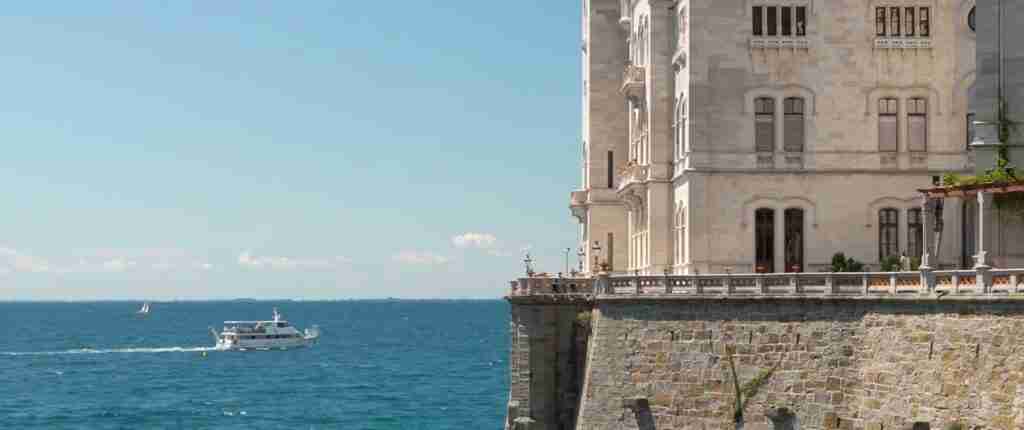
Seven kilometers north of the city center, on a promontory of white limestone jutting into the bay, stands Miramare Castle — built between 1856 and 1860 by Archduke Maximilian of Austria, younger brother of Emperor Franz Joseph, as a residence combining the romantic neo-Gothic of the period with the practical needs of a naval officer who genuinely loved the sea. Maximilian designed many elements of the castle himself, incorporating nautical details — rooms modeled after ship cabins, rigging-style staircases — into the standard princely apartments. The interiors survive largely intact, frozen in the style and taste of the 1860s, and the collection of furniture, portraits, maps, and personal objects conveys the Habsburg aristocratic world with an intimacy that the great palaces of Vienna cannot.
The castle carries an air of tragedy inseparable from its beauty. Maximilian left Miramare in 1864 to become Emperor of Mexico, installed by Napoleon III over a reluctant population. His empire collapsed, his French backing was withdrawn, and he was captured and shot by republican forces in 1867. He never returned to Miramare. The castle passed to his wife Charlotte, who had already gone mad with grief, and remained Habsburg property until the end of the empire. A local superstition holds that anyone who spends a night in the castle is condemned to die violently in a foreign land — a belief that Maximilian’s fate, and the subsequent deaths of other Miramare residents under similar circumstances, has done nothing to dispel. The surrounding park, designed in English landscape style with exotic plantings and sea walks, is among the most pleasant outdoor spaces in the Trieste area.
The Karst Above the City
Behind Trieste, rising sharply from the coastal strip, is the Carso — the Karst plateau, a limestone highland that gives its name to an entire geological formation and that extends across the border into Slovenia. The plateau is a landscape of extraordinary character: pale stone, sparse soil, scrub oak and resinous herbs, sudden sinkholes and caves, the wind always present. The rock here is the same Cretaceous limestone that underlies much of Central Europe, soluble, fractured, perforated by underground rivers and chambers. The Grotta Gigante — accessible by bus from Trieste — is among the largest accessible show caves in the world, its single chamber large enough to contain several city blocks and high enough that its own interior weather systems operate independently of the surface above.
The Carso above Trieste preserves the most concentrated concentration of World War One memorials and cemeteries in Italy. The Isonzo front ran directly across this landscape between 1915 and 1917, and eleven major battles were fought here — the Austrian lines on the heights, the Italian lines on the valley floor, the carnage between them. The Sacrario Militare di Redipuglia, a monumental cemetery containing the remains of over 100,000 Italian soldiers, is the largest military cemetery in Italy and one of the most sobering monuments of the war. The villages of the plateau — Monrupino, Rupingrande, Sgonico — retain the compact stone architecture of the Carso culture, distinct from both the coastal Italian settlements below and the Slovenian villages across the border.
The Carso also produces its own wine — the Terrano, a sharp, tannic red made from the Refosco grape grown in the iron-rich red soil that gives the plateau its color, and increasingly the Vitovska, a white of elegant minerality that has attracted considerable critical attention. The osmize — farmhouse wine bars that are traditionally opened for limited periods when families have surplus wine to sell, announced by a branch of ivy hung at the gate — are one of the most distinctive gastronomic institutions of the Trieste hinterland, offering wine, cured meats, cheese, and bread in surroundings that have changed little in a century.
The Cuisine of the Borderlands
Triestine Cooking: Where Austria Meets the Adriatic
Triestine cuisine is one of the most genuinely plural in Italy, a reflection of a city that sat at the intersection of the Adriatic Mediterranean, the Central European plains, and the Slavic highlands. The Habsburg element is unmistakable: goulash appears on trattoria menus alongside spaghetti alle vongole; strudel di mele is as common a dessert as tiramisù; prosciutto cotto di Praga — Prague-style cooked ham, served warm with horseradish — is a street food sold from dedicated stalls. Jota — a thick soup of sauerkraut, beans, potatoes, and smoked pork — is the signature winter dish, Central European in spirit and deeply satisfying in the bora-whipped cold of a Trieste January.
The Adriatic element is equally present. The fish market on the Riva Tre Novembre supplies the city’s restaurants with spider crabs, scampi, moeche (soft-shell crabs from the lagoon), branzino, and the small bony fish of the upper Adriatic that appear in soups and fritters. The boreto alla Gradese — a fish soup from the nearby town of Grado, seasoned with vinegar and black pepper in a manner that is emphatically not Italian in sensibility — is one of the great dishes of the northeastern coast. Sardoni in saor — sardines marinated in sweet-sour agrodolce with onions and raisins — arrives from Venice but has been absorbed into the Triestine repertoire completely.
The Slovenian and Istrian influence appears in the stuffed pastas — idrijski žlikrofi, small potato dumplings from the Slovenian highlands, appear on specialist menus — and in the extensive use of herbs, particularly wild garlic, marjoram, and rosemary, foraged from the Carso and incorporated into preparations that have no Italian equivalent. The prosciutto of Karst — San Daniele’s less famous but equally distinguished cousin — is cured in the bora wind on the plateau above the city and has a character entirely distinct from the more celebrated Friulian and Parman varieties.
The Wines of the Carso and Collio
Two wine districts of distinction lie within reach of Trieste. The Carso DOC produces the Terrano and Vitovska mentioned above, along with a growing range of whites made from Malvasia Istriana and other local varieties. The wines are mineral, sometimes austere, and very much the product of their violent landscape. The Collio DOC, straddling the border between Italy and Slovenia near Gorizia, is one of the finest white wine appellations in Italy, producing Friulano, Pinot Grigio, Sauvignon Blanc, and Ribolla Gialla — the last a variety of ancient local origin — at a quality level that specialists rate highly but that has not yet generated the international recognition it deserves. The Slovenian side of the same hills — the Brda — produces wines under identical conditions and of comparable quality, and cross-border wine tourism connecting the Italian and Slovenian appellations has developed significantly since the border opened.
Gorizia: The City the Iron Curtain Cut in Two
Before the Partition
Before 1947, Gorizia was a prosperous and confident small city. Its position at the junction of the Italian plain and the Slovenian hills had made it a natural trading center for centuries, and the Habsburg period had given it a cultivated administrative class, a network of aristocratic villas, and a lively commercial middle class. The city was bilingual — Italian in the center, Slovenian in the surrounding villages and among the working class — and multi-religious, with Catholic, Orthodox, and Protestant communities coexisting in close proximity. The nineteenth century had brought railways, civic institutions, and the gentle prosperity of a secondary Habsburg center that had found its niche as a place of retirement and leisure for the imperial gentry.
The First World War was catastrophic. The Isonzo front ran directly through the surrounding landscape, and Gorizia was occupied by Italian forces in 1916 before being retaken by Austria in the Caporetto offensive of 1917. The city emerged from the war damaged but intact, was assigned to Italy by the Peace of Paris in 1919, and proceeded to rebuild its commercial and civic life through the 1920s and 1930s, even as Fascist policies suppressed Slovenian cultural expression. The Second World War brought further destruction and, in its final months, the massacres and violence of a partisan conflict that had ethnic and political dimensions still contested by Italian and Slovenian historians today.
The Wound and the Wall
The Peace Treaty of 1947 drew a line that made no geographic or urban sense, separating the city from its own suburbs, railway station, and social hinterland. The Yugoslav authorities, who had hoped to receive Trieste itself, built Nova Gorica with notable speed — the new city was largely complete by the mid-1950s — and invested it with architectural ambitions that reflected the Yugoslav state’s desire to demonstrate socialist modernity. The Slovenian writer Boris Pahor, born in Trieste in 1913 and one of the most important witnesses to this borderland world, described the effect of the partition on ordinary people with a quiet ferocity that makes his memoirs essential reading for anyone wishing to understand what the Cold War meant at ground level in a city like Gorizia.
The border was demarcated with wire and checkpoints. The railway station on the Yugoslav side became Nova Gorica station; travelers crossing between the two cities required documentation. The division of the city was so complete and so strange — streets ending in wire, neighborhoods cut off from their own centers — that it became, paradoxically, a subject of international interest. The white line running through Piazza Transalpina, dividing the café tables of one country from the park benches of another, became one of the most photographed symbols of the Cold War’s absurdity.
Piazza Transalpina: Europe’s Most Symbolic Square
Piazza Transalpina — known as Trg Evrope in Slovenian — sits exactly on the border between Italy and Slovenia. Before 1947 it was the forecourt of Gorizia’s main railway station; after the partition the station found itself in Yugoslavia, and the square became the most literal expression of what it meant for a city to be divided by an international border. The white line in the pavement that marked the frontier was, during the Cold War years, patrolled and enforced; it is now decorative, a historical marker on otherwise seamless stone.
Since Slovenia joined the Schengen Area in 2007, the square has been fully open and has become a space for joint events, markets, and celebrations. The sight of people moving freely across what was once a patrolled border, stopping to photograph the white line, sitting on café chairs that straddle two countries, is in its quietness one of the most moving expressions of European integration available in any public space on the continent. The joint designation of Gorizia and Nova Gorica as European Capitals of Culture for 2025 — the first time a cross-border city has received the designation — formalized what was already visible on the ground: these are not two cities sharing a border but one city recovering its unity.
Nova Gorica and Gorizia: A City Reunited
Nova Gorica is not, as visitors expecting a grim socialist settlement might assume, an architecturally uninteresting place. The Yugoslav architects who designed it in the late 1940s and 1950s worked within the modernist idiom of the period, producing a city of wide boulevards, public gardens, and civic buildings that have a confident rationalism of their own. The casino — a famous institution, opened in 1947 partly as a way of attracting hard currency from Italian visitors who were not permitted to gamble at home — was for decades one of the most profitable gambling houses in Europe and funded considerable public investment in the surrounding region. It still operates, considerably expanded and modernized, and still draws visitors across what is now an invisible border.
The shared European Capital of Culture project — GO!2025 — invested both cities with a year-long program of exhibitions, performances, and public events organized around themes of border-crossing, memory, reconciliation, and shared identity. The physical legacy of this project includes restored cultural facilities, new public spaces, and a renewed consciousness in both communities of the history they share. For travelers arriving after the program year, the institutions and attitudes it fostered remain: the joint events calendar, the bicultural programming, the easy movement between the two city centers on foot through Piazza Transalpina that makes it possible to have lunch in Italy and coffee in Slovenia without touching a passport.
The walk between the two centers takes approximately twenty minutes through the Piazza Transalpina crossing, long enough to register the shift in urban character — from the neoclassical Italian compact of Gorizia’s historic center to the modernist Slovenian openness of Nova Gorica’s planned grid — without losing the sense of continuity that the absence of a border makes possible. The Slovenian town of Šempeter, a short distance from the Nova Gorica center, contains a remarkably well-preserved Roman necropolis with reconstructed mausoleums that gives an indication of the long human habitation of this agricultural valley.
A Three-Day Cultural Itinerary
Day One: Imperial Trieste
Begin at Piazza Unità d’Italia, arriving early enough — before nine, ideally — to have the square largely to yourself. Walk the perimeter of the square, reading the facades: the Palazzo del Municipio with its twin clock towers, the Palazzo del Governo with its Habsburg mosaic, the Lloyd building now housing a luxury hotel. Take coffee at Caffè degli Specchi as it opens, then walk the Molo Audace to the end of the pier for the view back to the city.
Return along the seafront to the base of the hill and ascend to San Giusto by the Via della Cattedrale, pausing at the Roman arch and the mosaic floor visible in the pavement. Allow at least an hour in the cathedral for the Byzantine mosaics. The castle terrace gives the best elevated view of the city’s layout. Descend through the old town via Via della Cattedrale and Via del Teatro Romano, then enter the Borgo Teresiano at Piazza Ponterosso and walk the length of the Canal Grande to Sant’Antonio Nuovo.
After lunch — the market stalls on Piazza Ponterosso or the trattatorie on Via Geppa and Via Rossini are the right register for the midday meal, not the piazza restaurants — spend the afternoon at the Revoltella Museum on Via Diaz, which combines the intact interiors of the baron’s mid-nineteenth century palace on the lower floors with an excellent modern art collection in the extension designed by Carlo Scarpa in the 1990s. The juxtaposition of Habsburg bourgeois decorative excess and Scarpa’s ascetic modernism is itself a small commentary on Trieste’s cultural trajectory. End the day at Caffè San Marco on Via Cesare Battisti: find a booth, order a capo in b, read, stay.
Day Two: Literary Trieste and the Karst
The morning belongs to the Joyce and Svevo trail. The Berlitz school site on Piazza Ponterosso, the Joyce statue on Via del Teatro Romano, and the cluster of apartments where Joyce lived in the streets north of Via della Barriera Vecchia (a short walk up the hill from the Canal Grande) make a coherent walking circuit of forty-five minutes that requires no museum ticket and rewards those who have read even a passage of the relevant works beforehand. The Museo Sveviano on Via Rossini is small, focused, and worth an hour.
From Via San Nicolò, stop at the Libreria Antiquaria Umberto Saba — browse, buy something if the collection moves you; these transactions are the lifeblood of such places. Continue up Via San Nicolò toward Piazza della Borsa and the Museo Teatrale Carlo Schmidl if theater and opera history interest you, then walk along the Riva Tre Novembre to the fish market for a sense of the Adriatic commercial life that sits beneath the literary and imperial layers.
In the afternoon, take the bus up to the Carso. The Grotta Gigante near Borgo Grotta Gigante is forty minutes from the city center by bus and represents one of the genuine geological wonders of the region; the tour of the main chamber is mandatory for first-time visitors. Return to the plateau village of Monrupino for the view across both the city below and the Slovenian highlands above, then seek out an osmiza — the tourist office on the Riva Tre Novembre maintains a current list of open establishments — for an early evening of Terrano wine and cured meats before the bus back to the city. Dinner should be jota and brodetto di pesce at one of the inner-city trattatorie on Via Cadorna or Via Geppa.
Day Three: Gorizia and Nova Gorica
Take an early train to Gorizia Centrale — the journey is fifty minutes through the karst landscape, with views of the limestone plateau giving way to the vineyard-covered hills of the Collio as the train descends toward the Isonzo valley. From the station, walk directly to the historic center and the Piazza della Vittoria, the baroque heart of the city, with its Neptune fountain and the long perspective of the Corso Verdi leading uphill toward the castle.
The Castle of Gorizia, reached on foot in twenty minutes from the piazza, gives the panoramic overview that orients the day: the division of the two cities is visible from the battlements in a way that no map or description fully conveys. The museum inside covers medieval and early modern local history adequately; the view is the primary reason to come. Descend via the gardens on the eastern flank of the hill toward the Palazzo Coronini Cronberg, which opens mid-morning: its collection of Habsburg aristocratic interiors, portraits, and decorative arts is the richest single expression of Gorizia’s genteel imperial character available anywhere in the city.
After lunch in the Gorizia historic center — the restaurants around Via Oberdan and Via Rastello offer good Collio wines and the local variant of the borderland cuisine — walk to Piazza Transalpina and cross into Nova Gorica on foot. The walk through the modernist Slovenian city to the casino district takes about twenty minutes and is instructive: two completely different urban cultures, shaped by the same landscape and separated only by a line on the pavement. Return to Piazza Transalpina in the late afternoon when the light is low and the square most atmospheric. The evening train back to Trieste arrives in time for a final dinner at the city’s most characteristically Triestine institution: a seafood restaurant on the Riva with the harbor visible through the window and a bottle of Vitovska on the table.
Museums and Cultural Institutions
Key Museums in Trieste
The Museo Revoltella on Via Diaz is the city’s primary art museum, combining the intact state apartments of the baron’s palazzo with a significant collection of Italian nineteenth and twentieth-century painting and sculpture, housed in the adjacent Scarpa extension. The combination of decorative arts and modern art across two adjoining buildings makes it one of the most rewarding museum experiences in northeastern Italy. Admission costs €7 for adults (check the official site for current rates and combined ticket options).
The Museo del Risorgimento in the Civico Museo di Storia Patria covers the complex history of Trieste’s transition from Habsburg to Italian administration, with particular attention to the irredentist movement and the political tensions of the late nineteenth and early twentieth centuries. For those seeking to understand the specific historical pressures that shaped the city’s literary generation, this museum provides essential context. Entry is included in the combined Civic Museums ticket.
The Risiera di San Sabba in the Ratto della Pileria district is a rice-hulling plant converted by the German occupation into the only extant Nazi concentration and extermination camp in Italy. Between 1943 and 1945, it served as a detention center, transit camp, and site of executions. The memorial museum within it is one of the most important sites of memory in northeastern Italy and a mandatory stop for visitors wishing to understand the full history of the region. Entry is free.
The Museo di Storia Naturale on Via dei Tominz holds collections reflecting the natural history of the Karst region and the surrounding Adriatic, including important geological and botanical collections assembled during the Habsburg scientific expeditions of the nineteenth century. The Civico Museo di Guerra per la Pace Diego de Henriquez holds an extraordinary private collection of First and Second World War material assembled over a lifetime by a single collector — one of the most eccentric and rich museums of its kind in Italy.
Gorizia’s Cultural Offerings
The Palazzo Coronini Cronberg on Via Coronini is the single most important cultural site in Gorizia, housing the contents of an aristocratic villa that was occupied by, among others, the last Austrian Emperor Charles I during his Gorizia exile in 1921-22. The interiors, gardens, and library preserve the world of Habsburg provincial aristocracy with remarkable completeness. Opening hours are limited; advance booking is advised. Admission costs €8 for adults including the garden visit.
The Castello di Gorizia on the hill above the town houses a Museum of the Middle Ages and Castle Life in partially restored medieval interiors, alongside displays on the local history of the Gorizia county from medieval to early modern times. The castle hosts theatrical events and historical reenactments in summer months that attract family visitors and add a festive dimension to what is otherwise a primarily historical destination.
The Musei Provinciali di Gorizia operate collections in multiple locations including the Palazzo Attems Petzenstein, a baroque palace housing the art collections of the province, and the Museo della Grande Guerra, which addresses the Isonzo campaign of World War One through objects, maps, photographs, and personal accounts from both the Italian and Austrian sides — a notably evenhanded approach by Italian regional museum standards that reflects the borderland complexity of the city’s position during the conflict.
Practical Information for Cultural Travelers
Trieste is served by Ronchi dei Legionari Airport, shared with Gorizia and the Friuli Venezia Giulia region, approximately forty-five minutes from the city by bus and rail. Direct flights operate to major Italian and European hubs. Venice Marco Polo and Ljubljana airports offer additional connectivity for travelers arriving from further afield, with bus and rail services to Trieste from both. High-speed rail connects Trieste to Venice in approximately two hours and to Milan in three and a half.
Within Trieste, the historic center is compact and best explored on foot. The castle hill is a moderate climb achievable in twenty minutes from the piazza; the Miramare excursion requires the number 6 bus from Piazza Oberdan, which runs regularly and takes about thirty minutes. The Carso plateau buses depart from the same square. For Gorizia, direct trains from Trieste Centrale depart several times daily; the journey is comfortable and the ride through the Karst landscape is itself worthwhile.
Accommodation in Trieste ranges from budget guesthouses in the Borgo Teresiano to five-star hotels occupying the palaces of the historic waterfront. Mid-range visitors are well served by a strong stock of three-star hotels in the streets around Piazza Oberdan and Via Rossini, positioned within ten minutes’ walk of all the principal cultural sites. Gorizia has a smaller selection of accommodation, adequate for overnight stays but without the variety of the larger city; travelers planning extended time in the Collio wine country find hotels and agriturismo in the surrounding hills offer a pleasant alternative base.
The best season for cultural travel in this part of Italy is spring and early autumn, when the light is clear, the crowds manageable, and the temperature suited to extended walking. Summer brings heat and humidity to the coast and the Isonzo valley, though the Carso plateau is consistently cooler. The bora wind blows principally in winter and spring, occasionally with sufficient force to make outdoor exploration difficult; it subsides within hours or days and, when it lifts, leaves the air of extraordinary clarity that gives Trieste its characteristic luminosity.
Frequently Asked Questions
How much time do Trieste and Gorizia together require for a thorough cultural visit?
Trieste merits a minimum of three full days for cultural travelers: one day for the imperial cityscape and cafés, one for the literary trail and Karst excursion, and a third for museums and the Miramare Castle excursion. Gorizia adds one to two days, with the Piazza Transalpina crossing into Nova Gorica and the Collio wine country potentially occupying a full additional day. A total of four to five days allows the two cities to be explored without rushing, which is the appropriate pace for a cultural landscape this layered.
Is Trieste worth visiting if I have already been to Venice?
Completely. The two cities share the Adriatic but almost nothing else. Venice is Italian through its foundations, shaped by the Republic and the Serenissima’s specific maritime identity. Trieste is Central European, Habsburg, literary, and melancholic in ways that Venice — for all its complexity — is not. Travelers who find Venice overwhelmingly touristic typically find Trieste startlingly and refreshingly itself: a city that has not organized itself around visitor expectations but that rewards the visitor who approaches it on its own terms. The contrast between the two within a single trip is one of the richest available in northeastern Italy.
Do I need to speak Italian to visit Trieste and Gorizia?
Italian is the primary language of daily life in both cities, and basic Italian significantly enhances the experience, particularly in the cafés and trattatorie where the specific vocabulary of ordering matters and where the willingness to engage in the local terms is appreciated. English is widely understood in hotels, major museums, and tourist-facing businesses. In Gorizia and Nova Gorica, Slovenian is the second language, and crossing into Nova Gorica without any Italian is entirely manageable. German, historically the third language of Habsburg Trieste, is still understood by older residents and occasionally surfaces in the café traditions and culinary vocabulary.
What is the best way to combine Trieste and Gorizia with the wider Friuli Venezia Giulia region?
Udine, the regional capital and a city of outstanding baroque architecture, lies about an hour from Trieste by train and makes an excellent addition to an itinerary focused on Habsburg and Venetian northeastern Italy. The Friulian lowlands between Udine and the coast include Aquileia, a Roman city of the first rank with extraordinary mosaics, and Palmanova, a UNESCO-inscribed Renaissance star fortress. The wine road through the Collio from Gorizia toward Cividale del Friuli — a Lombard capital with a remarkable National Museum and a dramatic gorge carved by the Natisone river — passes through some of the most visually rewarding agricultural landscape in northern Italy. A full regional circuit of one week, based on Trieste with excursions to Gorizia, Udine, Aquileia, Palmanova, and Cividale, covers the principal cultural and historical layers of the Friuli Venezia Giulia without repeating itself.
What is jota and where should I eat it in Trieste?
Jota is a thick, warming soup made from sauerkraut, beans, potatoes, and smoked pork — most commonly ribs or cotechino — cooked together until the ingredients surrender their separate identities into a unified, deeply flavored whole. It is the definitive winter dish of Trieste and the clearest single expression on the plate of the city’s Central European inheritance. The best versions are served in the traditional trattatorie of the inner city and the wine bars of the Carso, where the dish appears in autumn and winter and disappears from menus in warmer months. Look for it on the lunch menu at establishments on Via Geppa, Via Cadorna, and in the streets around the old fish market; avoid any version that comes with explanatory tourist-menu photography.
Can Miramare Castle be reached by boat from Trieste?
Seasonal boat services operate from the Molo Audace and the adjacent piers to Miramare during the spring and summer months, taking approximately thirty minutes and offering views of the castle from the sea — the perspective for which it was originally designed. The bus remains the more reliable and year-round option, departing regularly from Piazza Oberdan. Many visitors combine both: bus to Miramare for the morning visit, boat back to the city for lunch if the service is operating. The castle’s grounds are also accessible by bicycle along the coastal path from the city — a pleasant ride of about an hour through the seaside district of Barcola, where Triestines traditionally swim in summer.
Is the Risiera di San Sabba appropriate to visit with children?
The Risiera is one of the most historically significant sites in northeastern Italy and an important place of memory, but its subject matter — the German occupation’s treatment of Jewish, Slovenian, partisan, and civilian prisoners — requires preparation and sensitivity for younger visitors. The museum’s approach is documentary rather than graphic, focusing on testimony, objects, and architectural evidence rather than explicit imagery, and the memorial spaces are designed for contemplation. Many families and school groups visit; the decision depends entirely on the age and readiness of the children. The museum staff are experienced with educational visits and can provide context appropriate to different ages.
What literary works should I read before visiting Trieste?
Italo Svevo’s Zeno’s Conscience is the essential starting point — reading it before arrival and again afterward produces two different books, the second enriched by recognition of the streets, social world, and atmosphere that the novel inhabits. Umberto Saba’s Canzoniere, even in translation, gives the city’s daily life and geography a lyrical dimension that no guidebook can replicate. Claudio Magris’s Microcosms, a work of imaginative geography centered on Trieste’s cafés, border landscapes, and literary culture, is indispensable for the culturally curious traveler. For the broader Danubian context from which Trieste’s culture descends, his earlier Danube is one of the great works of European cultural travel writing. Jan Morris’s Trieste and the Meaning of Nowhere, a meditation on the city’s identity and atmosphere by a writer who was herself a figure of border-crossing, offers a more personal and literary approach that many travelers find useful as both preparation and companion text.
How has the relationship between Gorizia and Nova Gorica evolved since the border opened?
The relationship has moved steadily from coexistence to active collaboration since Slovenia’s accession to the Schengen Area in 2007. Shopping, employment, education, and cultural events have increasingly drawn residents of both cities across what is now a symbolic rather than functional border. The joint European Capital of Culture designation for 2025 accelerated institutional cooperation, producing shared programming, joint infrastructure investment, and a formal administrative collaboration between the two municipal governments. Public opinion surveys conducted in connection with the cultural capital project showed strong majorities on both sides favoring continued integration. The challenge now is less political than economic and demographic: both cities face depopulation pressures common to mid-sized European towns, and the shared cultural capital project was partly conceived as a strategy for attracting the investment and population flows needed to sustain two small cities that together have greater critical mass than either alone.
What is the significance of coffee culture in Trieste that distinguishes it from the rest of Italy?
Coffee in Trieste is not simply a beverage but a cultural institution with its own vocabulary, its own social rituals, and its own historical weight. The city imports and roasts more coffee per capita than any other city in Italy — Illy, the company that essentially defined Italian espresso culture for the international market, was founded in Trieste in 1933 by Francesco Illy, a Hungarian-born immigrant who had come to the city via Vienna. The coffeehouse tradition, imported directly from Vienna via the Habsburg administration, gave coffee a social and intellectual function — as a place for extended occupation, reading, and conversation — that the stand-up espresso culture of southern Italy never developed. The result is a city where the café is still genuinely public space in the Central European sense: you pay for the right to stay as long as you wish, the newspapers are provided, and nobody expects you to leave when your cup is empty. This is not a boutique revival or a nostalgic performance; it is a survival, and as such it is one of the most authentic inheritances the Habsburg world has left in Italian territory.