The Architecture of Devotion: A Cultural Itinerary Through Assisi’s Giotto Frescoes and Basilicas
The hillside town of Assisi in Umbria holds one of Western art’s most revolutionary achievements: a cycle of 28 frescoes that transformed how artists depicted human emotion, spatial depth, and spiritual narrative. Within the UNESCO-inscribed Basilica of San Francesco, Giotto di Bondone and his workshop created between 1296 and 1304 a visual biography of St. Francis that broke decisively with Byzantine conventions and established principles that would guide European painting for centuries. This cultural journey explores how architecture and devotion converge in frescoes where saints have dirty feet, clothes move in wind, and human feelings become legible on painted faces.
Key Takeaways: Essential Cultural Insights
- Revolutionary Artistic Achievement: The 28-scene Life of St. Francis cycle represents Western art’s decisive break from Byzantine flatness, introducing three-dimensional space, emotional depth, and naturalistic human figures that established Renaissance foundations
- Dual Architectural Vision: The Basilica of San Francesco comprises two distinct churches built 1228-1253—a meditative Lower Church with intimate vaulted spaces and a soaring Upper Church with Gothic verticality—each serving different spiritual and artistic purposes
- UNESCO World Heritage Significance: Inscribed in 2000, “Assisi, the Basilica of San Francesco and Other Franciscan Sites” earned recognition not only as St. Francis’s birthplace but as a fundamental reference point for Italian and European art and architecture development
- Attribution Complexity: While traditionally credited to Giotto, scholarly debate continues regarding authorship, with some experts identifying the “Master of the Legend of St. Francis” and multiple workshop hands, though the artistic innovation remains undisputed
- Multi-Layered Artistic Heritage: Beyond Giotto’s cycle, the basilica preserves masterworks by Cimabue, Simone Martini, Pietro Lorenzetti, and Puccio Capanna, creating an unprecedented concentration of 13th-14th century Italian painting
- Living Spiritual Center: Unlike museum contexts, these artworks function within active Franciscan devotional life, where architectural space, liturgical practice, and visual narrative remain integrated as originally intended
People Also Ask About Assisi’s Artistic and Architectural Heritage
What makes Giotto’s Assisi frescoes revolutionary in art history?
Giotto’s frescoes in the Upper Church of San Francesco fundamentally transformed Western painting by introducing naturalistic spatial depth, emotional expression, and narrative coherence that departed radically from Byzantine conventions. Where Byzantine art presented figures against flat gold backgrounds with stylized gestures, Giotto created three-dimensional architectural settings with convincing perspective, placed figures within believable landscapes that recede into depth, and depicted human emotions through facial expressions and body language rather than symbolic gestures. Each of the 28 scenes depicting St. Francis’s life functions as a window onto events that feel inhabited by real people moving through actual space. This shift toward observed reality rather than symbolic representation established principles that Masaccio, Leonardo, and Michelangelo would develop in subsequent centuries, making the Assisi cycle a foundational moment in the transition from medieval to Renaissance art.
How does the basilica’s two-level architecture serve different purposes?
The Basilica di San Francesco’s innovative two-church design creates distinct atmospheric and functional experiences that reflect different aspects of Franciscan spirituality. The Lower Church, built first and completed around 1230, features low ribbed vaults, intimate chapels, and dim lighting that creates a meditative, sepulchral atmosphere appropriate for pilgrims venerating St. Francis’s tomb in the crypt below. Its architectural compression and rich fresco decoration emphasize inward contemplation and mystical encounter. The Upper Church, completed in 1253, rises above with soaring Gothic proportions, tall windows flooding the nave with light, and open spaces designed for large congregational gatherings and preaching—reflecting the Franciscan commitment to public ministry. This vertical stacking of contrasting architectural experiences within a single structure was unprecedented in medieval church design and created ideal surfaces for the extensive fresco programs that would make Assisi a laboratory for Italian painting innovation.
Which other major artists contributed to Assisi’s artistic treasures beyond Giotto?
The Basilica of San Francesco preserves an extraordinary concentration of late medieval Italian painting beyond the Giotto-attributed cycle. Cimabue, Giotto’s presumed teacher, painted monumental frescoes in the transept and apse of the Upper Church during the 1280s-1290s, including dramatic Crucifixion scenes that demonstrate his mastery of Byzantine traditions even as his pupil was breaking from them. In the Lower Church, Simone Martini created the exquisite Chapel of St. Martin frescoes between 1312-1320, displaying the refined linear elegance and courtly sophistication of Sienese painting at its height. Pietro Lorenzetti contributed powerful scenes from Christ’s Passion in the Lower Church transept, while the Maestro delle Vele (Master of the Assisi Vaults) painted allegories above the Lower Church altar. Puccio Capanna added a Coronation of the Virgin, and the so-called Master of St. Francis created an early iconic portrait of the saint. This artistic wealth spanning 1280-1320 makes Assisi an unparalleled museum of the crucial transitional period when Italian painting moved from Byzantine tradition toward Renaissance naturalism.
What is the UNESCO World Heritage significance of Assisi?
UNESCO inscribed “Assisi, the Basilica of San Francesco and Other Franciscan Sites” on the World Heritage List in 2000, recognizing the town as an exceptional cultural landscape where medieval urban fabric, monumental architecture, and artistic masterpieces combine with living spiritual traditions. The inscription acknowledged Assisi as St. Francis’s birthplace and the center from which the Franciscan movement spread globally, carrying messages of peace, poverty, and environmental reverence that transcend religious boundaries. Beyond spiritual significance, UNESCO cited the town’s medieval art—particularly the Basilica’s paintings by Cimabue, Pietro Lorenzetti, Simone Martini, and Giotto—as having “made Assisi a fundamental reference point for the development of Italian and European art and architecture.” The designation encompasses not only the basilica complex but also Santa Chiara, the cathedral of San Ruffino, Santa Maria degli Angeli, the Eremo delle Carceri, and the medieval town’s architectural ensemble, preserving an integrated cultural environment that has influenced Western civilization for eight centuries.
Extended multi-day tours – 5+ days
Featured Umbria Multi-Day Tour Packages
5 days
5 Days Italian Cookery Getaway in Umbria
- ✓ Comprehensive Umbria tour
- ✓ Expert local guides included
- ✓ All accommodation arranged
- ✓ Transportation provided

7 days
Authentic Umbria
- ✓ Comprehensive Umbria tour
- ✓ Expert local guides included
- ✓ All accommodation arranged
- ✓ Transportation provided

5 days
Italy: Authentic Puglia by E-Bike 🚴 – White Villages & Southern Flavors – 5 DAYS
- ✓ Comprehensive Umbria tour
- ✓ Expert local guides included
- ✓ All accommodation arranged
- ✓ Transportation provided
8 days
Hilltowns of Umbria, Self-Drive
- ✓ Comprehensive Umbria tour
- ✓ Expert local guides included
- ✓ All accommodation arranged
- ✓ Transportation provided
Multi-day tour packages powered by TourRadar. Prices and availability subject to change.
Introduction: Where Sacred Architecture Becomes Visual Theology
On September 26, 1997, two earthquakes struck central Italy within hours, causing the vault of the Upper Church of San Francesco in Assisi to collapse, destroying centuries-old frescoes and killing four people inside. The tragedy focused global attention on what many had taken for granted: that this hillside town in Umbria preserves one of Western culture’s most precious artistic inheritances, where the very foundations of Renaissance painting emerged from medieval spiritual devotion. The restoration that followed demonstrated not only technical mastery but renewed recognition that Assisi’s frescoes constitute irreplaceable witnesses to a revolutionary moment when art learned to depict human experience with unprecedented emotional truth and spatial conviction.
The Basilica of San Francesco rises from the western edge of Assisi’s medieval hill in a composition that appears both inevitable and impossible—a double church whose lower level burrows into the hillside while its upper church soars above the Umbrian valley, visible for miles. Built with remarkable speed between 1228 and 1253 to house the body of St. Francis, who died in 1226, the structure became far more than a tomb. It became a laboratory where the most advanced architects and painters of the late 13th and early 14th centuries experimented with spatial design, narrative strategies, and visual representation of spiritual truths. The result was an artistic explosion that fundamentally altered how Western culture would depict human experience, divine presence, and the relationship between them.
Understanding Assisi’s artistic significance requires grasping a paradox: this monument to the saint who preached radical poverty became one of history’s most lavishly decorated churches, where competing artistic schools and successive generations of painters covered nearly every surface with frescoes of extraordinary sophistication. The apparent contradiction dissolves when we recognize that Franciscan poverty never meant aesthetic poverty. Francis himself wrote poetry praising creation’s beauty, and his followers understood that art honoring their founder’s life and teachings could itself become a form of devotion—a visual theology accessible to the largely illiterate pilgrims who flocked to his tomb. The basilica’s frescoes thus serve dual purposes: they narrate Francis’s life and miracles for devotional contemplation, and they demonstrate technical and emotional achievements that would reshape European visual culture.
The most celebrated of these fresco cycles—the 28 scenes depicting the Life of St. Francis in the Upper Church’s nave—has been attributed since Giorgio Vasari’s 16th-century biography to Giotto di Bondone, the Florentine painter whom Vasari credited with single-handedly revolutionizing Western art. Whether Giotto himself painted these scenes, or whether they represent the work of an anonymous “Master of the Legend of St. Francis” and his workshop, remains one of art history’s most debated questions. What remains undisputed is the revolutionary character of the work itself: figures move through convincing architectural settings and landscapes with spatial depth unknown in earlier medieval painting; faces register specific emotions rather than generic holiness; narrative unfolds with dramatic clarity that makes even complex theological concepts visually intelligible. These innovations established principles that Masaccio would develop in Florence a century later, that Leonardo and Michelangelo would perfect in the High Renaissance, and that Western painting would follow for five centuries.
Yet the Giotto cycle represents only one layer of Assisi’s artistic wealth. The same Upper Church preserves Cimabue’s powerful late-Byzantine frescoes in the transept, creating a visible dialogue between old and new artistic languages within the same building. The Lower Church contains Simone Martini’s elegant St. Martin Chapel frescoes, Pietro Lorenzetti’s dramatic Passion scenes, and mysterious allegorical paintings by the Maestro delle Vele—each representing distinct artistic personalities and regional styles. This concentration of major works spanning barely four decades (roughly 1280-1320) makes Assisi an unparalleled document of the crucial transitional period when Italian painting moved from Byzantine tradition toward Renaissance humanism.
The architectural container for this artistic wealth is itself an innovation. Brother Elias, the Franciscan vicar general who directed the basilica’s construction, created a building type without clear precedent: two complete churches stacked vertically, each with its own entrance, altar, and congregation space, serving different liturgical and devotional functions while sharing structural support. The Lower Church’s compressed vaults and dim lighting create intimacy appropriate for personal prayer at Francis’s tomb; the Upper Church’s soaring Gothic height and luminous windows provide space for large gatherings and public preaching. This architectural duality enabled corresponding artistic dualities—contemplative versus didactic, mystical versus narrative, intimate versus monumental—that gave painters unprecedented opportunities to explore how sacred space shapes visual meaning.
UNESCO’s 2000 inscription of Assisi recognized these interwoven significances. The designation encompasses not only the basilica but the entire medieval town and surrounding Franciscan sites—the Eremo delle Carceri where Francis retreated for contemplation, Santa Maria degli Angeli enclosing the tiny Porziuncola chapel where the Franciscan order began, San Damiano where Francis heard Christ command him to “rebuild my church,” and the urban fabric of narrow medieval streets ascending Monte Subasio’s slopes. This cultural landscape preserves not a static museum but a living spiritual center where Franciscan friars still maintain daily liturgical rhythms, where pilgrims still seek the founder’s intercession, and where art and devotion remain integrated as the original builders and painters intended.
This guide offers a cultural itinerary through Assisi’s artistic and architectural treasures, organized to help visitors understand both individual masterpieces and the broader cultural revolution they represent. We examine the basilica’s innovative dual architecture, analyze Giotto’s narrative strategies in the Upper Church frescoes, explore the Lower Church’s rich fresco decoration, consider other Franciscan sites’ artistic significance, and situate these achievements within their historical, theological, and art-historical contexts. The goal is not merely to list works worth seeing but to illuminate how sacred architecture became a laboratory for visual innovation, how devotional narrative drove artistic revolution, and how a single building complex concentrated creative energies that would shape Western culture for centuries.
The Basilica’s Revolutionary Dual Architecture: Form Following Spiritual Function
The Basilica di San Francesco’s most radical architectural innovation lies not in decorative details but in its fundamental conception as two complete churches occupying the same footprint, stacked vertically to serve complementary spiritual purposes. This unprecedented design emerged from practical necessity—the need to accommodate both Francis’s tomb and large pilgrimage crowds on a steep hillside site—but Brother Elias transformed constraint into architectural poetry, creating contrasting spatial experiences that would enable corresponding innovations in fresco painting.
The Lower Church, entered through a Gothic portal on the basilica’s north side, burrows into the hillside with an almost crypt-like character despite being at ground level. Low ribbed vaults painted deep blue and spangled with gold stars compress vertical space, creating atmospheric density rather than Gothic soaring. Massive pillars divide the nave into distinct bays, each feeling like a separate chamber rather than parts of a unified space. Side chapels penetrate the thick walls like caves, their entrances creating pools of shadow. Light enters sparingly through small windows, leaving much of the interior in deliberate dimness that candles punctuate rather than dispel. The overall effect resembles a sacred grotto—appropriate for a space built around the rocky tomb where Francis’s body rests in the crypt below.
This compression serves contemplative devotion. Pilgrims descending into the Lower Church leave the sunlit Umbrian hillside for an interior world where normal spatial orientation dissolves. The low vaults and restricted sightlines prevent comprehensive views—you cannot see the entire space from any single position, forcing movement and discovery. Attention focuses not outward but inward, not on architectural grandeur but on intimate encounters with specific frescoed narratives, with particular altars, with the descent to Francis’s tomb. The architecture creates conditions for mystical rather than intellectual engagement, for personal prayer rather than public proclamation.
The Upper Church, entered through its own west facade and accessed via external stairs, occupies the same length and width as the Lower Church but creates entirely opposite architectural experience. The single nave rises to soaring Gothic height, with pointed arches springing from slender colonettes and ribbed vaults cresting nearly 70 feet above the floor. Tall lancet windows fill the clerestory level, flooding the interior with light that Italian sun intensifies to near-blinding brilliance. The unobstructed nave offers clear sightlines from entrance to apse, allowing a congregation of hundreds to gather for liturgical celebrations and hear preaching from the pulpit. Where the Lower Church compresses and fragments, the Upper Church expands and unifies.
This architectural contrast enabled corresponding artistic distinctions. The Lower Church’s fragmented spaces, dim lighting, and intimate scale suited allegorical and mystical subjects that reward close contemplation—Simone Martini’s courtly St. Martin scenes invite viewers to linger over exquisite details, while the Maestro delle Vele’s complex allegories of Poverty, Chastity, and Obedience demand extended meditation. The Upper Church’s bright, unified space called for large-scale narrative frescoes legible from a distance—the Life of St. Francis cycle wraps the nave with 28 scenes designed to be read sequentially by crowds moving through the space, each panel large enough and compositionally clear enough to communicate its episode from across the nave.
The structural relationship between the two churches creates subtle architectural drama. The Upper Church’s walls bear not only their own weight and vault thrust but also the Lower Church’s mass below. Massive buttresses visible on the exterior transfer these loads to foundations cut into the hillside bedrock. This structural interdependence has symbolic resonance—the public, luminous Upper Church quite literally rests on the foundations of the private, shadowed Lower Church, much as Franciscan public ministry grew from contemplative roots.
The facade presents yet another architectural innovation. Rather than a single unified composition, the basilica offers distinct facades for each level. The Lower Church’s entrance sits recessed in shadow beneath the Upper Church’s projecting front, marked by a simple Gothic portal and flanking arcades. Above, the Upper Church facade rises with Gothic verticality, featuring a large rose window, pointed portal, and decorative arcading—all rendered in the pink and white stone characteristic of Assisi construction. This vertical division of facades makes architecturally explicit the dual-church concept, signaling to approaching pilgrims that they encounter not one sacred space but two complementary realms.
The campanile stands separately from the basilica proper, rising 75 feet as a freestanding bell tower whose Romanesque solidity contrasts with the Gothic delicacy of the churches it serves. This separation follows Franciscan poverty principles—the tower’s modest height and unadorned surfaces reject the soaring campaniles that signaled civic pride and ecclesiastical wealth in contemporary Italian cities. Yet even in restraint, the tower achieves architectural distinction through perfect proportions and harmonious integration with the pink stone cloister arcades surrounding it.
Inside, the transition between Lower and Upper Churches occurs via narrow staircases that disorient deliberately. Emerging from the Lower Church’s dimness into the Upper Church’s brilliance creates a sensory shock that medieval pilgrims would have understood as spiritual metaphor—the movement from contemplative shadow into illuminated understanding, from intimate encounter with Francis’s tomb to participation in the broader Franciscan community. This transition reverses for those descending from Upper to Lower Church, creating a rhythm of expansion and compression, light and shadow, public and private that structures the devotional experience.
The architectural achievement extends beyond the churches themselves to the monastery complex built against the hillside. The multi-level cloister wraps around gardens terraced into the slope, creating contemplative spaces that connect interior and exterior, sacred and natural. Friars’ cells, chapter houses, libraries, and refectories organize around these cloisters, forming a self-sufficient monastic community that has functioned continuously since the basilica’s completion. This integration of liturgical, residential, and communal spaces within a coherent architectural ensemble represents medieval planning at its most sophisticated.
The 1997 earthquake revealed the basilica’s structural vulnerabilities even as it demonstrated architectural resilience. The Upper Church vault collapsed where Cimabue’s frescoes had deteriorated the masonry, but the Lower Church remained largely intact. The restoration required not only art conservation but structural reinforcement—hidden steel bracing now supports vulnerable vaults, and seismic sensors monitor structural movement. These interventions, invisible to visitors, ensure that architectural integrity and artistic treasures can survive future geological violence while preserving the authentic medieval spatial experience.
Understanding this architectural container is essential for appreciating the frescoes it houses. The Upper Church’s spatial logic—sequential movement along the nave, clear sightlines across the space, luminous visibility—shaped how Giotto organized the 28-scene Life of Francis cycle as a coherent visual narrative. The Lower Church’s spatial fragmentation—discrete chapels, compressed vaults, dim lighting—enabled Simone Martini and other painters to create intimate devotional experiences suited to small groups or individual contemplation. Architecture and painting developed in dialogue, each medium responding to possibilities the other created. The revolutionary dual-church design thus becomes not merely context for artistic masterpieces but active collaborator in their meaning and effect.
Giotto’s Life of St. Francis: Visual Revolution Through Narrative Innovation
The 28 frescoes depicting St. Francis’s life that wrap the lower walls of the Upper Church nave constitute one of Western art’s pivotal achievements, regardless of whether Giotto himself painted them or whether they represent the work of the “Master of the Legend of St. Francis” and his workshop. The cycle’s revolutionary character lies not in technical virtuosity alone but in fundamentally new approaches to spatial representation, emotional expression, and narrative coherence that established principles guiding European painting for centuries.
The cycle begins on the right side of the entrance wall as you face the altar—following medieval convention that positioned narrative beginnings to the viewer’s right—and proceeds clockwise around the nave in 28 distinct episodes. Each scene occupies a rectangular panel roughly 9 feet high and 13 feet wide, framed by painted architectural borders that create the illusion of windows opening onto Francis’s life. This uniform format establishes rhythmic consistency while allowing each episode to function as an independent composition. The overall effect resembles a monumental illustrated manuscript transferred to architectural scale, making Francis’s biography visually accessible to the illiterate pilgrims who formed the primary medieval audience.
Scene One, “The Homage of a Simple Man,” introduces revolutionary spatial principles immediately. Francis walks through a precisely rendered townscape where buildings recede into depth according to consistent perspective logic. The “simple man” spreads his cloak before Francis’s feet while townspeople watch from windows and doorways, their overlapping figures creating spatial recession. Unlike Byzantine painting’s flat gold backgrounds where figures float in abstracted space, this scene constructs a believable stage where human action unfolds within architectural reality. The painted border frames this space like a window, inviting viewers to witness events rather than contemplate icons.
The cycle’s narrative source, St. Bonaventure’s official biography written between 1260-1263, provided a carefully structured account emphasizing Francis’s conformity to Christ’s life pattern—poverty, preaching, miraculous signs, mystical encounters, suffering, and glorification. The fresco cycle translates this textual structure into visual logic, selecting 28 episodes that span Francis’s life from his youthful conversion through his death and posthumous miracles. Each scene distills complex events into compositionally clear moments: Francis renouncing his father’s wealth by stripping naked in the bishop’s presence; Francis preaching to birds that gather attentively; Francis creating the first Christmas crèche at Greccio; Francis receiving the stigmata during mountain prayer.
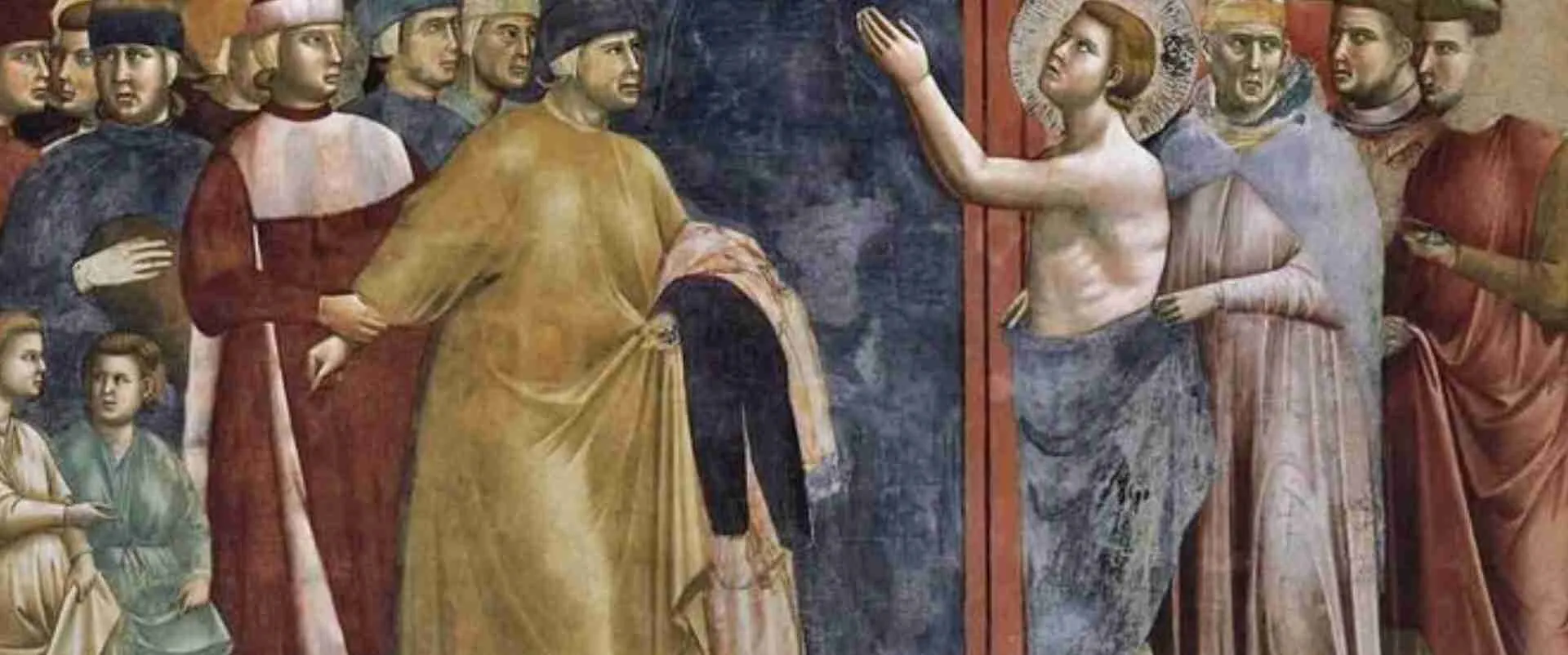
What makes these depictions revolutionary is their naturalism—not photographic realism but convincing representation of how bodies move, how faces express emotion, how spatial relationships organize visual experience. In “Francis Renouncing His Patrimony” (Scene Six), the naked saint’s body exhibits anatomical plausibility unknown in earlier medieval painting. His father lunges forward in rage, restrained by a companion whose grip we can almost feel. The bishop wraps his cloak around Francis’s nakedness with protective tenderness. Townspeople crowd windows and arcades, their varied reactions—shock, sympathy, curiosity, disapproval—making the spiritual drama humanly comprehensible. The architecture framing these figures recedes with consistent perspective, creating spatial depth that places viewers at the scene rather than before an icon.
“The Miracle of the Spring” (Scene Seven) demonstrates the cycle’s landscape innovation. Francis kneels on a rocky mountainside rendered with geological specificity—stratified layers, jutting outcrops, sparse vegetation clinging to crevices. A thirsty peasant drinks from the spring that Francis’s prayer has miraculously produced, his bent posture and eager face expressing physical relief. The landscape recedes into blue distance through atmospheric perspective—a technique that renders distant mountains lighter and hazier than foreground rocks, mimicking how atmosphere affects vision. This attention to natural appearance marks another break from Byzantine convention, where landscapes served as symbolic backdrops rather than observed reality.
“The Apparition at Arles” (Scene Eighteen) showcases the cycle’s compositional sophistication. Inside a vaulted chapter house, Franciscan friars listen to Anthony of Padua preach. Above the preacher, Francis appears in vision—arms extended in cruciform pose, hovering against the architectural background. The scene’s genius lies in its spatial organization: the architecture creates deep recession through converging floor tiles and ceiling ribs, while Anthony’s commanding gesture and the friars’ varied reactions—some seeing the vision, others absorbed in prayer—distribute narrative attention across the composition without confusing visual hierarchy. The viewer’s eye moves from Anthony to the vision to the responding friars in a choreographed sequence that makes complex theological content (the saint’s mystical presence despite physical absence) visually clear.
“The Death of the Knight of Celano” (Scene Sixteen) demonstrates the cycle’s dramatic range. A banquet scene shows Francis warning a knight of imminent death. The composition’s left side presents aristocratic festivity—elaborately dressed diners at a laden table in an architectural setting of courtly refinement. The right side shows the knight’s sudden collapse, servants rushing to help while Francis’s prophetic gesture connects both halves. This juxtaposition of worldly pleasure and mortal fragility, rendered with architectural precision and emotional specificity, achieves narrative impact through compositional contrast rather than textual explanation.
The cycle’s emotional achievement becomes most apparent in faces. Earlier medieval painting rendered holiness through standardized features—elongated faces, large eyes, symmetrical features expressing transcendent calm. The Assisi frescoes depict specific individuals experiencing particular emotions. In “The Mourning of St. Clare” (Scene Twenty-Six), Clare and her sisters grieve over Francis’s body with faces registering genuine sorrow—not generic lamentation but individualized grief. Some weep openly, some pray silently, some touch the corpse with tender reverence. This emotional specificity makes spiritual experience humanly accessible, inviting viewers to identify with depicted figures rather than merely admire their holiness.
The cycle’s chromatic achievement deserves attention alongside its spatial and emotional innovations. The frescoes employ a palette of extraordinary richness—deep blues derived from expensive lapis lazuli for skies and important garments, warm ochres and siennas for architecture and landscapes, vivid reds and greens for clothing and vegetation. The Lower Church’s dim lighting obscured colors into mysterious shadow, but the Upper Church’s brilliant illumination makes these pigments sing. Restoration work revealed that original colors possessed even greater intensity, though centuries of candle smoke, humidity, and the 1997 earthquake’s damage have muted some passages.
Technical examination reveals sophisticated fresco technique. The painters worked in giornate—sections completable in a day before plaster dried—carefully planned to align with compositional logic. In “The Confirmation of the Rule” (Scene Eleven), a single giornata encompasses Pope Innocent III’s head and shoulders, allowing the painter to complete the face in one continuous session to maintain unity of flesh tones and expression. This technical planning enabled the naturalism that makes figures feel present rather than symbolic.
The painted architectural borders framing each scene constitute minor masterpieces themselves. Twisted columns, elaborate capitals, decorative friezes, and simulated stone inlays create rich frames that enhance rather than compete with narrative scenes. These borders employ trompe-l’oeil illusion to suggest three-dimensional projection from the wall, making each fresco appear as a window with physical depth. The sophistication of these architectural simulations rivals the narrative scenes themselves, demonstrating command of perspective and decorative design that would influence countless later artists.
The attribution question—Giotto or the “Master of the Legend of St. Francis”—remains unresolved despite decades of scholarly debate. Stylistic analysis identifies multiple hands within the cycle, suggesting workshop collaboration typical of large fresco commissions. Some scenes exhibit more sophisticated spatial construction than others; some faces show greater emotional nuance; some drapery falls with more convincing weight and volume. These variations might indicate Giotto’s personal execution of key scenes with assistants completing others, or they might suggest a talented master with several advanced pupils, or perhaps an entirely different artistic personality whom Vasari’s 16th-century attribution mistakenly identified as Giotto.
What matters more than individual attribution is the cycle’s collective achievement. Whether painted by Giotto, the “St. Francis Master,” or collaborative workshop, these frescoes fundamentally transformed how Western art depicted human experience within spatial and temporal reality. The innovations visible here—consistent perspective creating believable architectural space, landscape recession through atmospheric effects, emotional expression through individualized faces and gestures, narrative clarity through compositional organization—became foundational principles that Masaccio would develop in Florence’s Brancacci Chapel a century later, that Leonardo would perfect in “The Last Supper,” that Michelangelo would monumentalize in the Sistine Chapel. The Upper Church frescoes thus stand not as isolated masterpieces but as generative works that established visual languages still current in Western culture.
The Lower Church Treasury: Simone Martini, Pietro Lorenzetti, and Mystical Allegory
While the Upper Church’s narrative clarity and spatial breadth capture most visitor attention, the Lower Church preserves artistic treasures of equal significance, created by some of the 14th century’s greatest painters working in more intimate, mystical registers. The Lower Church’s compressed vaults, dim lighting, and fragmented spatial character enabled artistic approaches impossible in the Upper Church’s luminous openness—allegorical complexity, courtly refinement, and devotional intimacy that invite prolonged contemplation rather than quick legibility.
Simone Martini’s Chapel of St. Martin frescoes (1312-1320) represent Sienese painting at its most refined. The chapel occupies a side space off the Lower Church’s left transept, its walls covered with ten scenes from the life of St. Martin of Tours, the 4th-century bishop who shared his cloak with a beggar and became patron saint of France. Martini, already famous for his Maestà in Siena’s Palazzo Pubblico, brought to Assisi a courtly elegance that contrasts markedly with the Giotto cycle’s robust naturalism.
“The Dream of St. Martin” demonstrates Martini’s distinctive aesthetic. The sleeping saint reclines on an elaborate bed beneath a textile canopy decorated with heraldic patterns. Christ appears in vision, wearing the cloak Martin had shared with the beggar, while angels attend in courtly fashion. Every surface displays decorative richness—patterned textiles, detailed armor, ornamental frames, gold-leaf halos tooled with intricate designs. The figures possess elongated Gothic grace rather than naturalistic proportion, and faces express refined spirituality rather than psychological specificity. This aesthetic reflects Sienese painting’s different priorities: where Florentine art (including the Giotto-attributed cycle) emphasized spatial rationality and human psychology, Sienese painters cultivated linear elegance, decorative splendor, and spiritual refinement.
“The Investiture of St. Martin” shows the saint receiving knighthood in a ceremony of elaborate courtly protocol. The composition organizes figures across the panel in rhythmic intervals, their overlapping forms creating decorative pattern rather than deep spatial recession. Rich costumes display heraldic emblems, decorative borders, and textile patterns rendered with jeweler’s precision. The scene celebrates aristocratic ceremony with aesthetic delight that seems distant from Franciscan poverty—yet Martin’s subsequent rejection of military career for religious vocation provides spiritual justification for depicting worldly splendor the saint transcended.
The chapel’s vaults feature geometric patterns and medallions with saints and prophets, all rendered with exquisite decorative detail. Gold leaf covers backgrounds, halos, and ornamental details, creating luminous effects that dim light intensifies into mysterious glow. The overall impression combines spiritual devotion with courtly sophistication in ways that reflect Sienese cultural values—this was art for aristocratic patrons who appreciated refined elegance as much as religious content.
Pietro Lorenzetti’s Passion cycle in the Lower Church’s left transept (1320s) demonstrates different artistic priorities. Lorenzetti, Simone Martini’s slightly younger Sienese contemporary, combined Sienese linear grace with more dramatic emotional intensity. His “Deposition from the Cross” achieves heartbreaking pathos through careful attention to grief’s physical manifestations. The Virgin faints as Christ’s body is lowered from the cross, supported by holy women whose faces register anguish. Nicodemus and Joseph of Arimathea strain under the corpse’s weight, their bodies bent in effort that makes Christ’s death physically real. Mourners weep with gestures of genuine grief—hands pressed to faces, bodies doubled over, expressions twisted by loss.
The composition achieves powerful unity despite depicting multiple simultaneous actions—the careful lowering of Christ’s body, the Virgin’s collapse, the mourners’ varied reactions, Magdalene’s grief at the cross’s base. Lorenzetti organizes these elements through rhythmic arrangement of figures and coordinated directional forces that guide the viewer’s eye through the scene’s emotional crescendo. The colors—deep blues, muted ochres, blood-red accents—enhance the somber mood without becoming merely dark. Gold-leaf backgrounds set figures in timeless sacred space rather than naturalistic landscape, maintaining connection to Byzantine tradition even as the figures’ emotional specificity moves toward Renaissance humanism.
“The Last Supper” fresco demonstrates Lorenzetti’s architectural sophistication. The apostles gather around a table within a hexagonal room whose vault ribs converge to a central point, creating geometric space of remarkable complexity. The architecture appears simultaneously as rational construction and symbolic container—the hexagonal form suggesting sacred geometry while the detailed rendering of vault ribs, columns, and capitals displays observational precision. Judas sits isolated in the foreground, his face turning away from Christ’s offering of bread, his psychological separation made spatially explicit through compositional placement.
The Maestro delle Vele (Master of the Assisi Vaults), an anonymous painter working around 1315-1320, created allegorical frescoes in the Lower Church’s crossing vaults that rank among medieval art’s most enigmatic works. The four vault sections depict personified abstractions—Poverty, Chastity, Obedience, and Glory—rendered with symbolic complexity that rewards extended contemplation.
The “Allegory of Poverty” shows Francis’s mystical marriage to Lady Poverty, depicted as an emaciated woman in rags whom Christ joins to Francis while angels attend. The theological sophistication here is remarkable: poverty personified as female figure whom Francis takes as bride, with Christ blessing the union, visualizes Franciscan theology’s radical claim that voluntary destitution represents not mere renunciation but mystical union. Surrounding this central scene, smaller vignettes show episodes illustrating poverty’s virtue—Francis rejecting his father’s wealth, friars living in humble dwellings, charitable acts toward the poor.
“Obedience” appears as a robed female figure placing a yoke on a friar’s shoulders while angels assist and Christ looks on approvingly. The yoke, potentially negative symbol of submission, becomes positive emblem of willing service through the allegory’s visual logic. Subsidiary scenes show obedience’s practical applications in Franciscan community life—friars accepting assignments, following rules, submitting to authority. The composition achieves visual complexity through overlapping figures, multiple simultaneous actions, and symbolic objects requiring iconographic knowledge to decode.
These allegorical frescoes demonstrate how the Lower Church’s intimate scale and contemplative atmosphere enabled artistic approaches different from the Upper Church’s narrative directness. The vault paintings require viewers to stand beneath them looking upward—a physically uncomfortable position that becomes spiritually meaningful, forcing bodily submission that mirrors the obedience depicted. The dim lighting makes details difficult to see clearly, requiring extended looking that becomes meditative practice. The symbolic complexity rewards repeated viewing, encouraging the kind of prolonged contemplation that Franciscan spirituality valued.
Cimabue’s transept frescoes, painted in the 1280s before the Upper Church cycle, demonstrate the Byzantine tradition from which Giotto’s revolution emerged. Cimabue’s figures possess the elongated proportions, symmetrical features, and golden backgrounds characteristic of Byzantine icon painting, but hints of naturalism appear in drapery that falls with weight, in faces that show individual features, in architectural settings that suggest spatial depth. His “Crucifixion” in the left transept creates monumental impact through compositional clarity and chromatic richness, though the 1997 earthquake and subsequent deterioration have sadly reduced its power. The contrast between Cimabue’s late-Byzantine style and the Giotto-attributed cycle’s naturalism visible within the same basilica makes art history’s evolution tangible—you can literally walk from one artistic language to another within the same building.
The Lower Church’s decorative program extends beyond individual masterpieces to create comprehensive visual theology. Nearly every surface receives fresco decoration—vaults painted as starry firmament, walls covered with narrative scenes, altars framed by architectural painting, even floors patterned with geometric inlay. The cumulative effect overwhelms rational analysis, creating instead immersive sensory experience where sacred narrative, allegorical meaning, decorative beauty, and architectural space merge into devotional totality. This aesthetic differs fundamentally from modern museum display that isolates artworks for individual contemplation—medieval viewers encountered these frescoes as integrated environment where liturgical action, architectural space, and visual splendor combined to create what medieval people called “heavenly Jerusalem on earth.”
Beyond the Basilica: Assisi’s Wider Franciscan Artistic Heritage
The Basilica di San Francesco represents only the most spectacular concentration of artistic treasures in a town where virtually every church preserves significant medieval and Renaissance works. Understanding Assisi’s cultural landscape requires venturing beyond the basilica complex to sites that illuminate different aspects of Franciscan spirituality and artistic patronage.
The Basilica di Santa Chiara, built 1257-1265 to honor St. Clare (founder of the Poor Clares, the female Franciscan order), dominates the eastern end of Assisi’s main square. Its austere Gothic facade in pink and white striped stone establishes visual dialogue with San Francesco while asserting distinct identity. The interior preserves the painted crucifix before which Francis prayed when he heard Christ’s voice commanding him to “rebuild my church”—a crucial relic that makes Santa Chiara a pilgrimage destination in its own right. Though less extensively frescoed than San Francesco, the church contains important works including a 13th-century fresco cycle depicting St. Clare’s life and the elaborate Gothic tomb where her incorrupt body rests in a crystal reliquary.
The Cathedral of San Ruffino, Assisi’s principal church before the Franciscan basilicas’ construction, rises near the town’s highest point. Its Romanesque facade (1140) displays sculptural sophistication predating the Franciscan monuments—carved portals with symbolic beasts, rose window with zodiac symbols, geometric patterns in rose and white stone. The interior was transformed by 16th-century renovations, but the baptismal font where both Francis and Clare were baptized remains—a tangible link to the town’s pre-Franciscan history. The cathedral’s crypt preserves Roman and early Christian remains, demonstrating Assisi’s layered history extending far deeper than its Franciscan identity.
The Eremo delle Carceri sits 2.5 miles east of Assisi on Monte Subasio’s forested slopes, accessible via steep paths that wind through ancient oak forest. This hermitage marks caves where Francis and his early companions retreated for solitary prayer, seeking contemplative balance to active ministry. The existing structures—tiny cells, a small chapel, cloister, and refectory added in the 15th century—preserve medieval ascetic character. The site’s architectural poverty contrasts sharply with the basilica’s splendor, offering insight into Franciscan values the lavish church decorations might obscure. Ancient oak trees surrounding the hermitage reportedly date to Francis’s lifetime, creating a rare direct connection to the natural environment the saint knew.
Santa Maria degli Angeli, located in the valley below Assisi’s hill, encloses the Porziuncola—the tiny chapel where Francis founded his order and where he died. The massive 16th-century basilica built over this humble structure creates striking contrast: a monumental church containing a modest stone chapel in its nave. The juxtaposition embodies Franciscan tension between spiritual poverty and institutional grandeur. The Porziuncola chapel preserves 14th-century frescoes, and the basilica complex includes the Chapel of the Transitus marking the room where Francis died. Though architecturally later than the Gothic monuments discussed above, Santa Maria degli Angeli holds crucial significance in Franciscan devotional geography as the movement’s literal birthplace.
San Damiano, a small church and monastery complex south of Assisi’s walls, marks another foundational Franciscan site. Here Francis heard Christ speak from the crucifix, commanding him to rebuild the church (the same crucifix now in Santa Chiara). Here Clare and her sisters established their community, living in radical poverty while maintaining enclosed contemplative life. The simple stone structures—church, cloister, dormitory, refectory—preserve medieval character with minimal later alteration. The intimate scale and architectural simplicity offer counterpoint to the basilica’s grandeur, suggesting how Francis’s original followers actually lived. The cloister garden, small chapel, and austere cells create atmosphere of profound peace that helps modern visitors imagine Franciscan spirituality’s contemplative dimensions.
The town’s medieval walls, towers, and fortress—the Rocca Maggiore crowning the hill and Rocca Minore commanding the southern approaches—establish defensive architecture that protected Assisi throughout its contested history. Though militarily functional rather than religiously significant, these structures create the medieval townscape context within which sacred architecture emerged. Walking Assisi’s stone-paved streets beneath medieval walls makes tangible the 13th-century urban environment that shaped Franciscan experience.
The Museo della Porziuncola, housed in the Santa Maria degli Angeli complex, preserves art and artifacts documenting Franciscan history—illuminated manuscripts, liturgical objects, paintings, sculptures. The Pinacoteca Comunale in Assisi’s Palazzo Vallemani contains detached frescoes, panel paintings, and archaeological material spanning from Roman times through the Renaissance. These collections provide context for understanding Assisi’s artistic production beyond its most famous monuments.
The UNESCO inscription encompasses this entire landscape—not merely individual monuments but the integrated cultural environment they create. Medieval pilgrims experienced Assisi not as collection of discrete tourist sites but as sacred geography where architecture, landscape, historical memory, and spiritual significance merged into devotional totality. Modern visitors can still approximate this experience by moving between sites on foot, following paths Francis himself walked, experiencing the hillside topography that shaped Franciscan settlement patterns, understanding how architecture articulated spiritual values across the entire urban and rural landscape.
Historical and Theological Context: How Franciscan Spirituality Shaped Revolutionary Art
Understanding Assisi’s artistic achievement requires grasping the theological and historical forces that made this small Umbrian town a cultural epicenter in the early 14th century. The revolution in visual representation that occurred here emerged not from purely aesthetic concerns but from spiritual values, institutional agendas, and devotional practices specific to Franciscan religious culture.
Francis of Assisi (1181/82-1226) founded his religious movement in the early 13th century as a radical reform responding to the wealth and political entanglement corrupting the established Church. His insistence on absolute poverty—owning neither individual nor collective property—challenged not only ecclesiastical corruption but entire social structures based on wealth accumulation. His embrace of lepers, preaching to common people in vernacular rather than Latin, identification with nature as divine creation rather than resource for exploitation, and joyful rather than penitential spirituality created a religious movement of revolutionary character.
Yet within two years of Francis’s death, Pope Gregory IX canonized him and construction began on a monumental basilica to house his remains—apparent betrayal of everything the saint represented. The Franciscan order split between “Spiritual Franciscans” who demanded literal observance of Francis’s poverty and “Conventual Franciscans” who accepted institutional structures, property ownership, and ecclesiastical integration necessary for large-scale religious organization. The basilica’s magnificence represented Conventual triumph over Spiritual resistance, institutionalizing a Franciscanism Francis himself might not recognize.
This institutional transformation created conditions for artistic innovation. The basilica required decoration befitting its monumental architecture and spiritual significance. Conventual Franciscans understood art as devotional tool serving legitimate spiritual purposes—frescoes could make Francis’s life accessible to illiterate masses, inspire devotional practice, and demonstrate the order’s cultural sophistication and ecclesiastical legitimacy. The apparent contradiction between Franciscan poverty and artistic lavishness dissolved through theological reasoning: the art belonged to God, not the friars, and served spiritual education rather than personal enjoyment.
The Franciscan emphasis on Christ’s humanity rather than divine transcendence shaped artistic representation in crucial ways. Earlier medieval theology stressed Christ’s divinity—the eternal Logos, cosmic judge, enthroned Pantocrator. Franciscan spirituality emphasized Christ’s human suffering, his identification with the poor and marginalized, his physical vulnerability in the Incarnation and Crucifixion. This theological shift demanded new visual languages capable of depicting emotional suffering, physical pain, and human compassion—precisely the innovations visible in the Assisi frescoes.
Francis’s stigmata—the miraculous wounds that appeared on his hands, feet, and side, conforming his body to Christ’s crucified body—became central to Franciscan theology and iconography. The stigmatization demonstrated Francis’s complete identification with Christ’s suffering and validated Franciscan spirituality’s legitimacy through miraculous divine endorsement. Multiple scenes in the fresco cycles depict the stigmatization, each emphasizing different aspects—the mystical vision, the physical transformation, the authentication of wounds. This iconographic focus on bodily transformation and physical suffering required naturalistic representation of the human body impossible within Byzantine conventions.
The Franciscan movement’s rapid geographic expansion and institutional development created urgent need for visual propaganda—imagery that could communicate Franciscan values, narrate Francis’s life, and inspire devotion across Europe. The Assisi frescoes functioned as mother church exemplar that other Franciscan foundations would imitate. Portable images—panel paintings, illuminated manuscripts, small devotional objects—carried Assisi’s iconographic innovations to Franciscan communities throughout Europe. The artistic revolution occurring in this small Umbrian town thus spread through an efficient distribution network that made Franciscan visual culture internationally influential.
St. Bonaventure’s official biography of Francis, written 1260-1263 and mandated as the sole authoritative account (earlier biographies were destroyed), provided the narrative framework for visual cycles. Bonaventure structured Francis’s life to parallel Christ’s—both experienced mystical revelations, performed miracles, suffered persecution, received divine marks (Christ’s resurrection wounds, Francis’s stigmata), and established new religious communities. This typological structure made Francis a “second Christ” and justified depicting his life with visual strategies previously reserved for Christ and the saints. The Assisi frescoes translate Bonaventure’s textual structure into visual narrative, each scene corresponding to specific episodes in the official biography.
The devotional practice of meditation on sacred narrative shaped how frescoes were designed and experienced. Franciscan spirituality emphasized imaginative meditation where devotees mentally placed themselves within gospel scenes, experiencing events through sensory imagination rather than abstract contemplation. The Assisi frescoes facilitate this practice by depicting scenes with such spatial and emotional specificity that viewers can mentally enter the depicted space, imaginatively participating in Francis’s life. The frescoes thus function not as icons for veneration but as devotional tools enabling meditative practice.
The institutional competition between Franciscans and Dominicans (the other major mendicant order) created cultural pressure for artistic magnificence. Both orders built monumental churches in Italian cities throughout the 13th-14th centuries, competing for patronage, recruitment, and cultural prestige. The basilica’s artistic splendor demonstrated Franciscan cultural sophistication and attracted aristocratic patronage—wealthy families funded chapels, commissioned frescoes, and established burial rights, providing revenue that funded further artistic commissions. This patronage system integrated sacred art into complex networks of family prestige, civic identity, and ecclesiastical politics.
The changing economic structures of late medieval Italy provided material conditions for artistic innovation. Growing urban economies created wealthy merchant classes with disposable income for artistic patronage. Professional painter workshops developed, training apprentices in skills that became increasingly specialized. Pigment merchants imported expensive materials—lapis lazuli from Afghanistan for ultramarine blue, cinnabar for vermilion red—making brilliant colors available to painters willing to pay premium prices. Fresco technique itself required specialized knowledge of plaster chemistry, pigment behavior, and timing that developed through workshop transmission of technical expertise.
The shift from Byzantine to naturalistic representation reflected broader cultural transformations—emerging humanism, growing attention to observable nature, philosophical debates about universals versus particulars, theological interest in Incarnational theology emphasizing Christ’s humanity. The Assisi frescoes didn’t cause these shifts but expressed them visually, translating intellectual and spiritual currents into concrete images that then reinforced and spread those very ideas. Art history and intellectual history thus intertwine inseparably.
Conservation Challenges and the 1997 Earthquake: Preserving Cultural Heritage
On September 26, 1997, at 2:33 AM, a magnitude 5.5 earthquake struck central Umbria, followed nine hours later by a 5.8 aftershock. The Upper Church of San Francesco suffered catastrophic damage when portions of the entrance vault collapsed, destroying Cimabue’s frescoes depicting the Four Evangelists and killing four people—two Franciscan friars and two technicians who had entered to assess earlier damage. The tragedy focused international attention on heritage conservation challenges in seismically active regions and initiated restoration efforts that continue decades later.
The earthquake’s damage revealed vulnerabilities inherent in fresco technique and medieval construction. Frescoes consist of pigments applied to wet lime plaster that carbonates as it dries, binding color to wall surface. This creates durable painting when plaster adheres strongly to masonry, but earthquakes can shear plaster from walls or cause masonry collapse that destroys frescoes entirely. The 1997 quake caused exactly these failures—vault sections separated from supporting walls and crashed to the floor, shattering into thousands of fragments.
The immediate conservation response mobilized international expertise. Teams worked around the clock to stabilize damaged structures with temporary supports, cover exposed areas to prevent water damage, and collect fresco fragments scattered across the rubble. Every piece was photographed, catalogued, and stored in controlled environments to prevent further deterioration. The painstaking process of identifying fragments, determining their original positions, and reconstructing destroyed frescoes began—work requiring art historians to identify iconographic details, conservators to develop adhesives and supports, and engineers to design structural reinforcement preventing future collapse.
The Cimabue vault frescoes—depicting Matthew, Mark, Luke, and John as seated figures writing their gospels—existed in severely damaged condition even before the earthquake. Centuries of humidity, candle smoke, and earlier restoration attempts had degraded the pigments and weakened plaster adhesion. The 1997 collapse essentially destroyed these works, though conservators managed to recover approximately 80% of the fragments. The reconstruction required identifying tens of thousands of small pieces, determining their original positions through photographic documentation and iconographic analysis, and reassembling them like an impossibly complex jigsaw puzzle. The restored vault, completed and reinstalled in 1999, represents extraordinary conservation achievement even as it remains a documented loss—large areas required reconstruction based on archival photographs rather than surviving original material.
The earthquake revealed that earlier restoration work had sometimes contributed to vulnerability. 19th and early 20th-century conservators had applied synthetic adhesives that aged poorly, becoming brittle and losing adhesion. They had introduced moisture barriers that trapped water rather than allowing walls to breathe, accelerating plaster decay. They had repainted damaged areas with materials chemically incompatible with original frescoes. Modern conservation required removing these harmful interventions before implementing new stabilization strategies based on scientific understanding of fresco deterioration mechanisms.
Structural reinforcement became essential to prevent future earthquake damage. Engineers installed hidden steel reinforcement in vulnerable vaults, added seismic isolators beneath foundations to absorb ground motion, and created monitoring systems with sensors detecting structural movement in real time. These interventions had to be invisible to preserve the authentic medieval experience while providing modern engineering security. The challenge resembled earthquake-proofing a Fabergé egg—protecting an extraordinarily delicate object from violent forces while maintaining its aesthetic integrity.
The restoration program extended beyond earthquake damage to address centuries of accumulated deterioration. Conservators cleaned surfaces darkened by candle smoke and pollution, revealing original color intensity that surprised even specialists. They stabilized areas where plaster had separated from masonry, injecting consolidants that rebond layers without altering appearance. They removed inappropriate earlier restorations and filled losses with reversible materials distinguishable from original work on close inspection but visually integrated from normal viewing distances. The principle of minimum intervention guided all work—doing only what’s necessary to stabilize and preserve, avoiding hypothetical reconstructions or aesthetic improvements that compromise historical authenticity.
The Giotto cycle required extensive but less dramatic conservation. Though the Lower Church remained largely intact, vibrations had caused hairline cracks, minor plaster separation, and paint layer detachment. Conservators stabilized these conditions through injection of consolidants and installation of monitoring equipment. They cleaned surfaces using laser technology that removes dirt without abrading paint layers. They addressed salt migration from damp masonry that crystallizes on fresco surfaces, causing paint loss. They installed environmental control systems regulating temperature and humidity to slow chemical deterioration processes.
The conservation ethics debate these interventions raised continues. Should lost areas be reconstructed based on historical documentation, or left as honest gaps acknowledging damage? Should cleaning restore original color brilliance, or preserve the patina of age that has acquired its own historical value? Should modern materials and techniques be used when they outperform traditional methods, or should conservation remain faithful to original materials and methods? Different conservators and institutions answer differently, reflecting varying conservation philosophies that balance historical authenticity, aesthetic integrity, material stability, and public accessibility.
The ongoing conservation program addresses not only dramatic damage but routine deterioration. Millions of visitors annually bring humidity through breath and body heat, introduce pollutants on clothing and shoes, and cause micro-vibrations through foot traffic. Managing this human impact requires sophisticated environmental monitoring, controlled visitor flows, periodic closure for conservation work, and public education about heritage vulnerability. The basilica must remain accessible for worship and pilgrimage while protecting irreplaceable artistic treasures—a balancing act requiring constant vigilance.
Climate change creates new conservation challenges. Temperature and humidity fluctuations stress frescoes through expansion and contraction cycles. Extreme weather events become more frequent and severe. Biological growth—molds, bacteria, insects—finds favorable conditions in changing microclimates. Conservation strategies must adapt to environmental conditions that medieval builders never anticipated and that accelerate deterioration beyond historical rates.
The 1997 earthquake ultimately demonstrated both heritage fragility and institutional resilience. The immediate disaster mobilized international conservation expertise and funding. The restoration work advanced scientific understanding of fresco conservation. The structural reinforcement improved earthquake resistance. The event raised public awareness of cultural heritage vulnerability and the resources required for preservation. Two decades later, the basilica stands fully restored and reinforced, continuing to serve both as active worship space and art historical monument—though the cost, measured in destroyed Cimabue frescoes and lost human lives, remains irreplaceable.
Experiencing Assisi: Practical Guidance for Cultural Engagement
Approaching Assisi’s artistic treasures requires different strategies than conventional museum visiting. These are not isolated artworks under controlled lighting with explanatory labels but integrated architectural environments where sacred function, historical context, and aesthetic experience remain inseparable. Thoughtful engagement with this complex cultural landscape requires preparation, patience, and willingness to experience art within its devotional context.
The Upper Church of the Basilica di San Francesco opens its west facade directly onto the Piazza Superiore di San Francesco, accessed via stairs from the town center or from the lower piazza where buses arrive. Entry is free but requires appropriate dress (covered shoulders and knees), and photography without flash is permitted though discouraged during services. The church functions as active worship space with regular masses, liturgical offices, and pilgrim devotions—visitors should respect liturgical activities and understand that access may be restricted during services.
Viewing the Giotto cycle effectively requires systematic approach. Enter through the west portal and proceed to the right side of the entrance wall where the narrative begins. Follow the cycle clockwise around the nave, allowing time to examine each of the 28 scenes individually before attempting to grasp the overall program. The frescoes’ height above floor level (beginning about 6 feet up and extending to roughly 15 feet) creates viewing angle that medieval designers intended—you look slightly upward, physically enacting humble attention to sacred narrative. Binoculars help discern facial expressions and detailed elements, though nothing substitutes for prolonged looking that allows eyes to adjust to lighting conditions and compositions to reveal their organizational logic.
The ideal time for viewing is mid-morning (10 AM to noon) when natural light through the clerestory windows achieves optimal intensity without harsh contrasts. Early morning light can be too dim for color appreciation; afternoon sun shifts angle unfavorably; evening light fades too much. Spring and fall provide better conditions than summer (when crowds impede viewing) or winter (when low light reduces visibility). Weekday mornings see fewer tour groups than weekends, allowing quieter contemplation.
The Lower Church, entered through the north portal, requires different viewing strategies suited to its compressed architecture and dim lighting. Allow time for eyes to adjust to low light levels—what initially appears dark shadow gradually reveals detail as pupils dilate. The fragmented spatial organization prevents comprehensive viewing from any single position, requiring movement between chapels and bays to encounter different fresco cycles. The Simone Martini chapel (left transept) permits only small groups simultaneously; waiting for uncrowded moments improves viewing experience. The crypt housing Francis’s tomb, accessed via stairs from the nave, creates powerful devotional atmosphere that transcends aesthetic concerns—pilgrims pray, leave offerings, and maintain silent vigil in ways that remind visitors of the site’s ongoing spiritual function.
Guided tours provide valuable art historical context but can interfere with sustained looking. Group tours typically allocate 60-90 minutes for the entire basilica complex, insufficient for serious engagement with the artistic wealth. Individual visitors should allow minimum three hours for thorough examination of both churches, longer if including the tomb, treasury museum, and associated spaces. Audio guides (available for rental) offer flexibility to control pacing while receiving expert commentary.
The treasury museum, housed in spaces above the Lower Church, preserves liturgical objects, reliquaries, illuminated manuscripts, and textile arts documenting Franciscan artistic patronage beyond monumental painting. The collection includes Francis’s tunic and other relics that provide tangible connection to the saint’s life. Museum entry requires separate admission and involves stairs; opening hours vary seasonally.
Visiting other Assisi sites requires planning suited to the town’s hillside geography. Walking from the basilica to Santa Chiara involves steep ascent through medieval streets, taking 20-30 minutes. The Eremo delle Carceri requires either steep uphill walk (approximately one hour from town center) or short drive/taxi ride; the site offers extraordinary views over the Umbrian valley and genuine solitude absent from the crowded basilica. San Damiano sits south of town walls, accessible via gentle downhill walk (20 minutes) through olive groves. Santa Maria degli Angeli in the valley requires bus or taxi unless you’re willing to descend steep paths and later climb back up.
The town rewards extended stay rather than rushed day-trip. Assisi preserves medieval character in its narrow stone-paved streets, small piazzas, ancient walls, and residential fabric. Walking the same streets Francis walked, viewing the landscape he knew, experiencing the town’s rhythms across morning mass, midday siesta, and evening passeggiata provides cultural immersion that brief visits cannot achieve. Small hotels and religious houses offer accommodation within the medieval walls, allowing sunrise and sunset experiences when day-trippers have departed.
Photography presents ethical considerations. While technically permitted (without flash), constant photographing interferes with actual seeing—people spend more time framing shots than looking at what they’re photographing. The desire to capture everything often prevents experiencing anything deeply. A better approach treats photography as aide-mémoire after sustained looking rather than substitute for visual attention. Institutional photography books and digital resources provide higher-quality images than tourist snapshots while allowing on-site time for direct visual engagement.
Understanding liturgical calendar enhances cultural experience. Major Franciscan feast days (Francis’s feast October 4, Clare’s feast August 11, Francis’s death anniversary October 3) create intense devotional atmosphere with special liturgies, processions, and pilgrim gatherings that illuminate the sites’ ongoing spiritual function. Holy Week and Easter demonstrate how sacred art integrates with liturgical practice as the church year’s drama unfolds. Ordinary Sundays show daily devotional life continuing rhythms established eight centuries ago.
Physical preparation matters for sites involving steep walks, stairs, and standing for extended periods. Comfortable shoes with good support are essential for the medieval pavement’s uneven surfaces. The Lower Church’s dim light and compressed space can trigger claustrophobia; those affected might prefer focusing on the Upper Church. The Eremo delle Carceri involves rough woodland paths unsuitable for limited mobility. Summer heat makes midday visits uncomfortable; carry water and seek shade during peak sun hours.
Respect for sacred space means more than modest dress and silence. These are active churches where believers pray, where the consecrated host remains on altars, where Francis’s relics rest, where spiritual encounter occurs. Visitors who treat the sites as museums miss essential dimensions of their meaning and cultural function. Observing how believers engage these spaces—the old women who clean votive candles, the pilgrims who pray at Francis’s tomb, the friars who maintain liturgical offices—provides insight into how sacred art continues to serve spiritual purposes rather than existing merely as historical artifact.
The cultural experience Assisi offers extends beyond individual artworks to encompass integrated religious culture where architecture, visual art, liturgical practice, landscape, and spiritual tradition merge. Approaching this with patience, preparation, and openness to experiencing art within its devotional context enables richer engagement than rushed tourist consumption. The reward is not merely seeing famous frescoes but understanding how sacred space becomes vehicle for spiritual encounter, how artistic achievement serves devotional purpose, and how medieval cultural synthesis between beauty and belief created monuments that continue to move viewers eight centuries after their creation.
Assisi’s Enduring Cultural Legacy: Medieval Innovation, Modern Relevance
The artistic revolution that occurred in Assisi between 1280 and 1320 fundamentally shaped Western visual culture in ways that extend far beyond art historical scholarship into how contemporary people perceive reality, construct meaning, and imagine spiritual truths. The innovations visible in the basilica’s frescoes—spatial depth, emotional expression, narrative clarity, naturalistic representation—became so thoroughly absorbed into Western visual consciousness that their revolutionary character requires conscious effort to recognize. We inherit Giotto’s visual language so completely that we must actively reconstruct pre-Giottesque ways of seeing to grasp how radically these frescoes transformed representation.
The cycle’s narrative achievement established templates that cinema would follow six centuries later. Each scene functions as carefully composed frame, organizing visual attention through compositional hierarchy, directing viewer movement through coordinated gestures and sight lines, creating emotional impact through facial expression and dramatic gesture. The sequential organization of 28 panels around the nave pioneered visual storytelling techniques that graphic novels, storyboards, and film editing would develop. Giotto’s ability to compress complex narrative into single telling moment—Francis receiving stigmata, the Christmas crèche at Greccio, the renunciation scene—demonstrates the same principle of pregnant instant that cinema terms the master shot.
The emotional naturalism Assisi frescoes pioneered transformed how Western culture represents human feeling. Earlier Byzantine art depicted sanctified figures whose transcendent calm signaled spiritual perfection—emotion belonged to the fallen world that saints transcended. Giotto’s saints weep with genuine grief, rejoice with visible happiness, argue with evident anger, pray with palpable devotion. This shift made spiritual experience accessible through identification rather than distant veneration, inviting viewers to recognize their own emotions in sacred figures rather than admiring incomprehensible perfection. Modern psychology’s emphasis on emotional authenticity, therapeutic culture’s validation of feelings, even advertising’s emotional manipulation all inherit this assumption that authentic emotion deserves visual representation—an assumption that Giotto helped establish.
The spatial revolution Assisi’s frescoes represent enabled subsequent developments in Western painting that culminated in photography, cinema, and digital imaging. The assumption that pictures should create illusion of three-dimensional space extending behind the picture plane—an assumption so naturalized it seems obvious—required invention at specific historical moment. Byzantine painting made no such assumption, presenting figures against flat gold backgrounds in timeless sacred space. Giotto’s innovation of constructing believable architectural settings with consistent perspective created expectations about pictorial space that Masaccio would systematize, Leonardo would perfect, and baroque illusionism would elaborate into ceiling frescoes that appear to open heaven above viewers’ heads. Photography inherited these spatial conventions, making two-dimensional surfaces represent three-dimensional reality through perspective logic Giotto pioneered. Digital imaging, virtual reality, computer graphics all build on spatial representation principles visible in embryonic form in the Upper Church nave.
The cycle’s influence spread through multiple channels beyond art historical transmission. Franciscan expansion carried Assisi’s iconographic innovations across Europe and eventually globally—from medieval England to colonial Mexico, from Counter-Reformation Philippines to 19th-century California missions. Portable images—panel paintings, manuscript illuminations, prints—disseminated Franciscan visual culture far beyond those who could pilgrimage to Assisi. The printing revolution multiplied this distribution, making Francis’s image one of Western Christianity’s most widely reproduced icons. This global circulation means that Assisi’s artistic innovations influenced visual cultures across continents and centuries, shaping how diverse peoples imagined sacred narrative and spiritual truth.
Modern art history emerged partly from scholarly engagement with the attribution debates surrounding Assisi’s frescoes. Questions about Giotto’s authorship, workshop collaboration, chronological sequence, and stylistic development drove development of connoisseurship methods, archival research, scientific analysis, and comparative study that became art history’s disciplinary foundations. Bernard Berenson, Roberto Longhi, Millard Meiss, and other scholars who shaped 20th-century art history honed their methodologies on Assisi problems. The basilica thus functioned not only as art historical subject but as training ground where the discipline learned to ask and answer complex questions about attribution, dating, and artistic development.
The 1997 earthquake and subsequent restoration demonstrated cultural heritage’s vulnerability and the international commitment to preservation. The immediate mobilization of conservation expertise, the sophisticated restoration techniques deployed, the structural reinforcement installed all represent unprecedented technical achievement in heritage protection. Yet they also revealed painful truths about what cannot be restored—Cimabue’s destroyed evangelist frescoes exist now only as reconstructed fragments and archival photographs, authentic medieval surfaces replaced by modern approximations however skillfully executed. This loss reminds that heritage preservation always arrives too late for what’s already destroyed, that prevention matters more than restoration, and that every generation holds cultural inheritance in temporary stewardship for posterity.
The basilica’s ongoing function as worship space rather than museum preserves dimensions of meaning that secularization obscures. Franciscan friars still maintain liturgical offices in spaces Franciscans have inhabited for eight centuries. Pilgrims still pray at Francis’s tomb seeking intercession for contemporary concerns. Liturgical drama still unfolds against fresco backgrounds depicting the same spiritual truths liturgy celebrates. This continuity of sacred function means the art serves purposes its creators intended rather than existing as decontextualized aesthetic objects. Modern visitors who recognize this ongoing spiritual life rather than treating the basilica as museum gain deeper understanding of how sacred art functions and what it means.
Environmental concerns give Francis’s nature spirituality contemporary urgency. His canticle praising Brother Sun and Sister Moon, his preaching to birds, his vision of creation as divine manifestation rather than human resource speak directly to ecological crisis. The basilica frescoes depicting Francis’s relationship with nature—birds gathering to hear his preaching, a wolf tamed through spiritual encounter—visualize theological principles that environmental movements now champion. Assisi thus becomes pilgrimage site not only for traditional believers but for those seeking spiritual resources for environmental action, making medieval art speak to contemporary crisis.
The tension between Franciscan poverty and artistic magnificence remains unresolved and productive. The apparent contradiction between Francis’s radical destitution and the lavish basilica built to honor him raises questions about institutional religion’s relationship to material culture, about whether beauty serves or betrays spiritual values, about art’s role in sacred contexts. These questions have no simple answers but remain vital for anyone reflecting on religion’s material expressions, on cultural heritage’s meaning and cost, on how societies balance spiritual ideals against institutional realities. The basilica embodies these tensions rather than resolving them, making the very contradiction generative of ongoing reflection.
Assisi’s cultural legacy extends into unexpected domains. The spatial representation principles Giotto pioneered inform not only painting but architecture, urban planning, theatrical design, even video game environments—any discipline concerned with representing or creating three-dimensional space. The emotional naturalism the frescoes achieved influences not only visual art but literature, drama, film, even therapeutic practices—any cultural form concerned with representing or evoking authentic emotion. The narrative strategies the cycle demonstrates inform not only religious art but secular storytelling across media—any narrative form concerned with visual communication. The revolutionary innovations visible in this small Umbrian basilica thus ripple across Western culture in ways their medieval creators could never have imagined.
The UNESCO designation recognizes these layered significances—Assisi matters not only for what happened here eight centuries ago but for ongoing influence on global culture, not only for artistic masterpieces but for spiritual traditions still vital, not only for medieval achievements but for questions they pose to modernity. Preservation of this cultural heritage serves not antiquarian nostalgia but living engagement with human creativity, spiritual insight, and artistic achievement that transcend their specific historical moment to address perennial questions about beauty, meaning, and transcendence.
The paradox at Assisi’s heart—that revolutionary artistic innovation emerged from conservative religious devotion, that radical naturalism served mystical spirituality, that unprecedented creativity followed prescribed narrative—suggests that cultural achievement often emerges from productive tensions rather than harmonious synthesis. The frescoes work precisely because they must serve devotional purposes while achieving artistic excellence, must narrate prescribed stories while inventing new visual languages, must respect tradition while revolutionizing representation. Contemporary culture might learn from this example that constraint can enable rather than prevent creativity, that tradition and innovation need not oppose each other, that sacred and secular values can generate each other rather than existing in zero-sum competition.
Ultimately, Assisi’s frescoes demonstrate that great art serves purposes beyond itself while achieving aesthetic autonomy, that spiritual content and artistic form can enhance rather than compromise each other, that medieval and modern concerns can meet in productive dialogue across eight centuries. These painted walls where a medieval saint’s life unfolds with revolutionary naturalism continue to teach, inspire, challenge, and move viewers who bring their own questions to encounter with lasting human achievement. The architecture of devotion that Brother Elias and his painters created remains living cultural force precisely because it synthesized spiritual truth and artistic innovation in ways that transcend their moment to speak across time.
Frequently Asked Questions About Assisi’s Artistic and Cultural Heritage
Can you visit the Basilica of San Francesco for free, and are there restrictions?
Both the Upper and Lower Churches of the Basilica di San Francesco are free to enter and open daily, though specific hours vary seasonally (generally 8:30 AM to 6:00 PM with shorter winter hours). Visitors must dress modestly with covered shoulders and knees, and large bags may require storage in provided facilities. Photography without flash is permitted, though discouraged during services. The basilica functions as active worship space, so access may be restricted during masses and liturgical celebrations. The separate treasury museum requires paid admission and has different hours. Audio guides are available for rental, and free guided tours sometimes occur but cannot be guaranteed.
How long should I allow to properly see the basilica’s frescoes?
Serious engagement with the basilica’s artistic treasures requires minimum three hours—approximately 90 minutes for the Upper Church’s Giotto cycle and vault frescoes, 90 minutes for the Lower Church’s multiple fresco programs, plus time for the crypt, cloisters, and brief rest. Many visitors allocate only 60-90 minutes total, which permits only rushed overview rather than sustained looking that the complex artworks deserve. Art history students and devoted visitors sometimes spend full days returning repeatedly to specific works. If visiting other Assisi sites the same day, reserve at least half a day for the basilica complex alone. The ideal approach involves multiple visits—initial overview, then focused returns to particular cycles or sections.
What makes the attribution of the Giotto frescoes controversial among scholars?
The attribution debate centers on stylistic differences between the Upper Church St. Francis cycle and Giotto’s later documented works in Padua’s Arena Chapel, combined with absence of contemporary written evidence definitively identifying the Assisi painter. Critics note that the Assisi frescoes employ spatial construction and architectural detail more sophisticated than what appears in Giotto’s early work elsewhere, suggesting either different authorship or dramatic artistic development. Some scholars identify multiple distinct hands within the 28-scene cycle, proposing workshop collaboration under a master they call the “Master of the Legend of St. Francis.” Giorgio Vasari’s 16th-century attribution to Giotto established traditional belief, but modern art historians question whether Vasari, writing 250 years later, possessed reliable information or simply assumed the greatest painter of the period must have created the greatest fresco cycle. The debate continues because evidence permits multiple interpretations—scholars of equal expertise and integrity reach opposite conclusions from the same visual and documentary material.
Which other artists besides Giotto contributed significantly to the basilica?
The basilica preserves major works by several of the 14th century’s greatest painters. Cimabue painted dramatic transept frescoes in the Upper Church during the 1280s, including Crucifixion scenes and apocalyptic visions that demonstrate late Byzantine monumental style. Simone Martini created the exquisite St. Martin Chapel frescoes in the Lower Church (1312-1320), displaying Sienese painting’s refined courtly elegance. Pietro Lorenzetti contributed powerful Passion cycle frescoes in the Lower Church’s left transept during the 1320s. The anonymous Maestro delle Vele (Master of the Assisi Vaults) painted complex allegorical frescoes in the Lower Church crossing vaults around 1315-1320. Puccio Capanna added a Coronation of the Virgin. The so-called Master of St. Francis created an early iconic portrait of the saint. This concentration of major artists working within a 40-year period (roughly 1280-1320) makes the basilica an unprecedented document of the crucial transitional period in Italian painting.
What happened to the frescoes during the 1997 earthquake?
The September 26, 1997 earthquakes caused portions of the Upper Church vault to collapse, destroying Cimabue’s Four Evangelists frescoes and killing four people inside. The vault sections shattered on impact, fragmenting frescoes into thousands of pieces. Conservation teams recovered approximately 80% of the Cimabue fragments through painstaking collection from rubble, then spent years identifying pieces, determining original positions through archival photographs and iconographic analysis, and reassembling them using advanced adhesives and structural supports. The reconstructed vault, reinstalled in 1999, represents extraordinary technical achievement but remains documented loss—significant areas required reconstruction from photographs rather than surviving original material. The Lower Church suffered less dramatic but still serious damage through vibration-caused cracks and plaster separation. The disaster triggered comprehensive structural reinforcement installing hidden steel supports, seismic isolators, and monitoring systems to protect against future earthquakes.
How does the basilica’s architecture enhance the fresco viewing experience?
The dual-church design creates contrasting spatial experiences that enable different artistic approaches and devotional modes. The Upper Church’s tall windows flood the nave with natural light that makes the Giotto cycle’s colors brilliant and legible from distance—essential for frescoes designed to be read sequentially by crowds moving through the space. The unified spatial volume allows comprehensive views enabling viewers to grasp the cycle’s overall organization before examining individual scenes. The Lower Church’s dim lighting, compressed vaults, and fragmented bays create intimate atmosphere suited to allegorical complexity and mystical subjects requiring prolonged contemplation. Viewers must move between discrete spaces to discover individual fresco programs rather than grasping everything from single viewpoint. This architectural contrast enabled artists to develop different visual strategies suited to each church’s spatial and atmospheric character—monumental clarity in the Upper Church, mysterious depth in the Lower Church.
Why did Franciscans commission such lavish art despite preaching poverty?
This apparent contradiction between Franciscan poverty ideals and the basilica’s artistic magnificence created intense debate within the order, splitting Conventual Franciscans who accepted institutional structures from Spiritual Franciscans who demanded literal poverty observance. The Conventual position, which prevailed, argued that art belonged to God rather than the friars personally, served legitimate devotional and educational purposes rather than personal pleasure, and honored Francis through beauty rather than contradicting his teachings. Frescoes made Francis’s life accessible to illiterate pilgrims, inspired devotion through visual beauty, and demonstrated the order’s cultural sophistication and ecclesiastical legitimacy. This theological reasoning allowed artistic patronage while maintaining poverty principles—friars owned no individual property and lived simply even while their churches displayed magnificent decoration. The tension between spiritual ideals and institutional reality remains productive rather than resolved, inviting ongoing reflection on how material culture serves or betrays spiritual values.
What is the best season and time of day to visit for optimal viewing conditions?
Spring (April-May) and fall (September-October) provide ideal visiting conditions—moderate temperatures, manageable crowds, and optimal natural lighting. Within any season, mid-morning (10 AM to noon) offers best light conditions in the Upper Church when sun through clerestory windows achieves intensity without harsh contrasts. Early morning can be too dim for color appreciation; afternoon sun shifts angle unfavorably. The Lower Church’s dim interior requires allowing time for eyes to adjust to low light levels—what initially appears shadowy gradually reveals detail as pupils dilate. Weekday mornings see fewer tour groups than weekends, allowing quieter contemplation essential for sustained looking. Major feast days (Francis’s feast October 4, his death anniversary October 3) create intense devotional atmosphere with special liturgies worth experiencing but also attract maximum crowds. Summer brings overwhelming tourist numbers that impede viewing; winter offers fewer crowds but shorter daylight hours and reduced natural lighting.
Are the frescoes’ colors as brilliant as they appear in photographs?
Professional photography and digital reproduction typically enhance color saturation and contrast beyond what direct viewing reveals. The frescoes’ actual appearance varies dramatically depending on lighting conditions—the Upper Church’s colors appear brilliant in strong natural light but muted on overcast days or in artificial evening illumination. The Lower Church’s dim lighting subdues even the most vivid pigments into mysterious shadow that candlelight punctuates rather than dispels. Conservation cleaning following the 1997 earthquake revealed that original colors possessed even greater intensity than what centuries of accumulated dirt and candle smoke had allowed viewers to see, though some areas remain deliberately uncleaned to preserve historical patina. The most accurate perception requires experiencing the frescoes under varying light conditions rather than trusting any single photographic representation—medieval viewers knew these works through natural light cycles and candle illumination that created very different visual experiences than modern flood lighting or camera flash.
How does visiting Assisi’s other Franciscan sites complement understanding the basilica?
The basilica represents institutional Franciscanism’s artistic and architectural achievement, but other sites illuminate the movement’s contemplative, ascetic, and foundational dimensions that the magnificent church obscures. The Eremo delle Carceri’s forest hermitage preserves the austere retreat environment where Francis and early companions practiced solitary prayer, offering counterpoint to the basilica’s grandeur. San Damiano’s simple stone structures show how the Poor Clares actually lived in radical poverty. Santa Maria degli Angeli’s Porziuncola chapel—tiny stone structure where the order began—creates striking contrast when enclosed by the massive 16th-century basilica built over it, embodying tensions between humble origins and institutional development. Santa Chiara preserves the crucifix before which Francis heard Christ’s voice, providing devotional focus distinct from artistic masterpieces. Visiting these sites creates more complete understanding of Franciscan spirituality’s diverse expressions—from contemplative withdrawal to active ministry, from radical poverty to artistic patronage, from individual charisma to institutional structure. The cultural landscape UNESCO designated encompasses these complementary sites because together they document Franciscanism’s complexity more fully than the basilica alone could represent.