Sveti Stefan Montenegro: Iconic Island Resort & Photography Guide
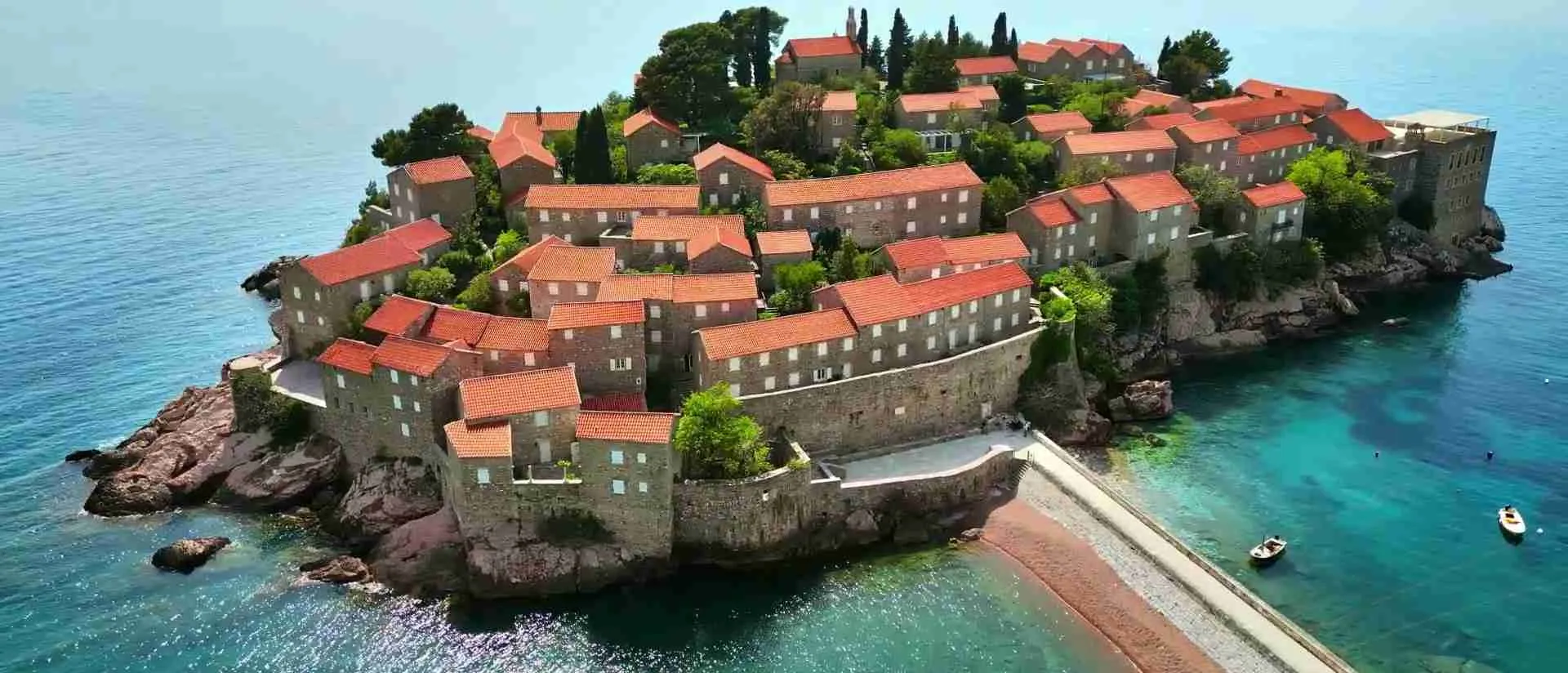
Sveti Stefan stands as Montenegro’s most photographed destination, a fortified island of terracotta-roofed stone houses connected to the Adriatic coast by a narrow isthmus. This 15th-century fishing village transformed into an exclusive resort captures the imagination of photographers and travelers drawn to its medieval architecture, pink-sand beaches, and dramatic coastal setting between Budva and Petrovac.
Key Takeaways: Sveti Stefan Photography & Resort Essentials
- Architectural Heritage: The fortified island preserves authentic 15th-century stone buildings originally constructed by the Paštrovići tribe as defense against Ottoman expansion, with narrow cobbled streets, three historic churches, and traditional Mediterranean architecture maintained through centuries
- Photography Excellence: The Jadranski Put coastal road viewpoint delivers the iconic elevated perspective capturing the island’s complete form, causeway connection, and surrounding beaches, while golden hour lighting transforms terracotta roofs and stone walls into warm cinematic compositions
- Multiple Vantage Points: Beyond the famous road viewpoint, photographers access diverse perspectives from beach level for intimate architectural details, Crvena Glavica headland for southern angles with red cliffs, Przno village for mountain backdrops, and Miločer Park for framed compositions through Mediterranean vegetation
- Resort Access Evolution: The Aman Sveti Stefan luxury resort occupies the entire island with 58 exclusive accommodations across the fortified village and mainland Villa Miločer, while the causeway and public beaches flanking the island remain accessible for photography and viewing regardless of guest status
- Seasonal Light Dynamics: Summer morning light illuminates the island’s eastern facades and sea-facing architecture from sunrise through mid-morning, while afternoon and sunset sessions capture warm tones on western walls, with spring and autumn offering softer light and fewer crowds at primary viewpoints
- Cultural Significance: Sveti Stefan represents Montenegro’s coastal heritage through preserved Venetian-influenced architecture, transformation from communal fishing settlement to socialist-era resort hosting global celebrities including Sophia Loren and Elizabeth Taylor, and contemporary role as Adriatic luxury hospitality landmark
People Also Ask About Sveti Stefan Photography & Resort
Can You Access Sveti Stefan Island Without Staying at the Resort?
Direct access to Sveti Stefan island remains exclusive to guests staying at Aman Sveti Stefan resort and diners with confirmed restaurant reservations at the island’s dining venues. The fortified island operates as a private luxury property where accommodation reservations provide entry through the gated causeway entrance. Non-guests photograph the island from multiple public viewpoints including the elevated coastal road perspective, beach-level angles from the public portions of Sveti Stefan Beach flanking the causeway, and walking paths through Miločer Park that offer framed views through Mediterranean pine forest. The causeway itself permits walking to the island’s entrance gate where stone walls and architectural details become visible, though the interior village streets, churches, and resort facilities require guest status for exploration.
What Makes Sveti Stefan One of the Adriatic’s Most Photographed Locations?
Sveti Stefan’s photographic appeal stems from the visual drama of a complete medieval fortified village occupying a small rocky island connected to the mainland by a narrow sandy isthmus creating symmetrical beaches on either side. The architectural composition presents 15th-century stone houses with terracotta roofs cascading down the island’s slope toward the Adriatic, their warm ochre and rust tones contrasting against turquoise water and green Mediterranean vegetation. The island’s compact 12,400 square meter area concentrates photogenic elements—church bell towers, defensive walls, cobbled lanes, stone courtyards—into a single frame viewable from elevated coastal road positions that reveal the complete island shape, causeway connection, and surrounding coastline. Light quality enhances the scene particularly during golden hour when low-angle sun illuminates stone facades with warm amber glow while casting long shadows that define architectural textures and create dimensional depth impossible to achieve during harsh midday conditions.
Which Viewpoint Provides the Classic Sveti Stefan Photograph?
The Jadranski Put coastal road viewpoint positioned northeast of the island along the E65 highway delivers the signature Sveti Stefan photograph appearing in Montenegro tourism materials, travel publications, and social media imagery. This elevated vantage point approximately 50 meters above sea level captures the island’s complete profile including the narrow causeway, symmetrical beaches curving away on both sides, the fortified village architecture rising from sea level to the church at the island’s summit, and open Adriatic horizon beyond. The perspective reveals spatial relationships between island and mainland that beach-level positions cannot convey, showing the tombolo land connection, Villa Miločer property on the southern mainland, and the scale contrast between medieval village and surrounding coastal landscape. Designated pull-off areas along this highway section allow safe roadside stops for photography, with morning light illuminating the island’s sea-facing facades and afternoon sun creating dramatic sidelight across stone walls and terracotta roofs.
What Historical Significance Does Sveti Stefan Hold Beyond Its Resort Status?
Sveti Stefan embodies five centuries of Adriatic coastal history beginning with its 15th-century establishment as a fortified settlement by the Paštrovići tribe seeking defense against Ottoman expansion and Adriatic piracy. The island functioned as an autonomous community under Venetian protectorate from 1423, maintaining defensive walls, cannon emplacements, and strategic position controlling this Budva Riviera coastline section. By the 19th century the fortified village evolved into a thriving fishing community of approximately 400 residents living within stone houses, maintaining three churches, and developing the narrow interior streets and courtyards visible today. Yugoslavia’s conversion of the abandoned village into a state luxury hotel during 1955-1957 represented pioneering adaptive reuse preserving authentic architectural fabric while introducing modern hospitality infrastructure, creating the resort format that attracted global celebrities including Marilyn Monroe, Elizabeth Taylor, and Bobby Fischer throughout the 1960s-1980s. Contemporary Aman Resorts stewardship since 2007 continues this preservation tradition, maintaining 15th-century stone construction, original building footprints, and historic character while meeting luxury hospitality standards.
Extended multi-day tours – 5+ days
Featured Montenegro Multi-Day Tour Packages
1 days
Semi-Private Day Tour of Montenegro: Budva & Kotor from Tirana
- ✓ Comprehensive Montenegro tour
- ✓ Expert local guides included
- ✓ All accommodation arranged
- ✓ Transportation provided
8 days
8 Days Montenegro Sailing Tour
- ✓ Comprehensive Montenegro tour
- ✓ Expert local guides included
- ✓ All accommodation arranged
- ✓ Transportation provided
8 days
Highlights of Montenegro; Semi – Private tour with dedicated Tour Leader & Car
- ✓ Booking needs min. 2 travelers
7 days
Comfortable Heartland of Montenegro Trip
- ✓ Comprehensive Montenegro tour
- ✓ Expert local guides included
- ✓ All accommodation arranged
- ✓ Transportation provided
Multi-day tour packages powered by TourRadar. Prices and availability subject to change.
Introduction: Montenegro’s Iconic Fortified Island
Sveti Stefan commands recognition as the Adriatic’s most distinctive coastal landmark, a fortified island village whose terracotta roofs and stone walls have defined Montenegro’s tourism identity since the 1960s. Connected to the Budva Riviera coastline by a narrow isthmus creating symmetrical pink-sand beaches, this 12,400 square meter island preserves authentic 15th-century Mediterranean architecture within a setting that has evolved from defensive settlement to fishing village to exclusive resort while maintaining architectural integrity across five centuries.
The island’s visual impact derives from remarkable architectural density—approximately 50 stone buildings occupy the rocky outcrop, their multi-story construction rising from sea level to the Church of Saint Stephen at the summit creating layered compositions of warm ochre walls, rust-colored roofing tiles, dark green cypress trees, and deep blue Adriatic water. This compact medieval village remains entirely intact, its defensive walls, narrow cobbled streets, stone courtyards, and church towers preserved through careful restoration that honors original construction while adapting interior spaces for contemporary use.
For photographers, Sveti Stefan presents subjects ranging from sweeping landscape compositions capturing the island’s complete form against mountain backdrops to intimate architectural studies of weathered stone textures, iron lanterns, wooden shutters, and decorative details surviving from Venetian-period construction. The island’s position jutting into the Adriatic creates constantly changing light conditions as sun angles shift throughout the day, while the elevated coastal road viewpoint and multiple beach-level perspectives offer compositional variety rarely available for historic Mediterranean architecture.
The resort dimension adds contemporary luxury context to historical significance. Aman Sveti Stefan operates the entire island as an exclusive 58-room property where 15th-century fishing cottages house elegant accommodations, cobbled lanes connect private courtyards, and stone buildings shelter restaurants, spa facilities, and cultural spaces. This transformation from communal fishing settlement to socialist-era celebrity retreat to international luxury destination traces Montenegro’s tourism evolution while the architectural preservation ensures the island’s medieval character remains dominant visual element.
Sveti Stefan’s cultural resonance extends beyond physical beauty to symbolic status representing Montenegro’s Adriatic heritage, architectural preservation priorities, and position attracting global travelers seeking authentic Mediterranean experiences within luxury frameworks. The island appeared in international publications featuring celebrities including Sophia Loren, who described returning to Sveti Stefan as entering “the most beautiful fairy tale of my childhood,” Elizabeth Taylor, Marilyn Monroe, and Kirk Douglas during the resort’s 1960s-1980s golden era. Contemporary visitors range from photographers documenting historic architecture to travelers appreciating coastal scenery to resort guests experiencing the island’s transformation from fortress to luxury hospitality venue.
This guide examines Sveti Stefan from dual perspectives addressing both photographic opportunities accessible to all visitors through public viewpoints and beaches, and the exclusive resort experience available to guests staying within the fortified village. Understanding the island’s 15th-century construction history, defensive purpose, fishing village evolution, socialist-era resort conversion, and contemporary Aman stewardship provides context for appreciating both visual compositions and cultural significance informing Montenegro’s most photographed destination.
Historical Evolution: From Fortress to Fishing Village to Luxury Resort
Sveti Stefan’s transformation across five centuries reflects broader Mediterranean coastal history where defensive settlements evolved into commercial fishing communities before adapting to tourism economies. The island’s history divides into distinct phases—15th-century fortification, fishing village prosperity, 20th-century abandonment, socialist resort conversion, celebrity era fame, post-Yugoslav decline, and contemporary luxury repositioning—each leaving architectural and cultural traces visible today.
The earliest documented references to Sveti Stefan date to 1442 when the Paštrovići tribe, an autonomous community occupying the Budva Riviera coastline, constructed the fortified settlement during Ottoman expansion threatening Adriatic territories. Paštrovići oral tradition recounts the island’s foundation following a successful defense of Kotor against Turkish siege in 1539, when tribal warriors looted Turkish vessels anchored near Jaz Beach and used captured treasure to fund construction of defensive fortress housing twelve founding families, one from each Paštrovići clan. The fortification included stone walls encircling the island perimeter, defensive towers at strategic positions, cannon emplacements protecting the narrow land approach, and dense interior construction maximizing protected living space within limited island area.
The Paštrovići accepted Venetian protectorate status in 1423 while maintaining considerable autonomy, paying no tribute to Venice in exchange for ceasing piracy against Venetian shipping. This relationship provided protection against Ottoman threats while preserving local governance structures. The island’s defensive architecture reflects Venetian military engineering principles visible throughout Adriatic coastal fortifications—thick stone walls, narrow defensive positions, limited entry points, and elevated positions commanding surrounding waters. The fortified village survived destruction during the Fourth Ottoman-Venetian War when Turkish forces razed the settlement, leading to reconstruction under Venetian oversight during the 16th century that established the architectural footprint visible today.
By the 19th century Sveti Stefan evolved from military stronghold to thriving fishing village as Ottoman threats receded and Adriatic maritime commerce expanded. The population grew to approximately 400 residents living in multi-story stone houses built against island topography, with ground floors serving as storage for fishing equipment and catches while upper floors provided family living spaces. Three churches served the community—the Church of Saint Stephen at the island’s summit for which the settlement was named, dedicated to Serbia’s Nemanjić dynasty patron saint; the Church of Saint Alexander Nevsky; and a smaller chapel. Narrow cobbled streets connected family courtyards where residents conducted daily activities sheltered from coastal winds, while the causeway connecting island to mainland facilitated movement of goods, fishing boats, and agricultural products from mainland gardens.
The fishing village’s economic decline began in the early 20th century as younger residents emigrated seeking opportunities in larger cities, joined the military, or departed for overseas destinations. By 1954 only 20 residents remained on the island, creating circumstances that enabled Yugoslavia’s pioneering adaptive reuse project. The government relocated the final residents to mainland housing and began converting the abandoned medieval village into a luxury hotel complex during 1955-1957. This transformation required substantial infrastructure—plumbing, electricity, road access, beach development—while preserving exterior architectural character including stone walls, terracotta roofs, wooden shutters, and cobbled streets. Interior spaces received complete renovation transforming fishing cottages into hotel suites while maintaining period architectural details including exposed stone walls, wooden ceiling beams, and traditional Mediterranean design elements.
The socialist-era Sveti Stefan Hotel opened to international acclaim, immediately attracting global celebrities, political leaders, and cultural figures drawn to the unique proposition of staying within an authentic medieval village offering modern luxury amenities. The 1960s through 1980s represented the resort’s golden age when Sophia Loren, Elizabeth Taylor, Marilyn Monroe, Orson Welles, Princess Margaret, Kirk Douglas, Bobby Fischer, and Boris Spassky visited, establishing Sveti Stefan’s reputation as the Adriatic’s most exclusive destination. The resort received the Golden Apple award in 1972 recognizing it as the world’s most exclusive summer resort, validating Yugoslavia’s tourism development strategy combining architectural preservation with luxury hospitality.
Yugoslavia’s dissolution during the 1990s brought dramatic decline as conflict, economic turmoil, and infrastructure deterioration reduced international tourism throughout the region. Sveti Stefan fell into disrepair as maintenance ceased, facilities deteriorated, and the resort’s international clientele disappeared. By the early 2000s the property required comprehensive restoration to restore both architectural fabric and competitive hospitality standards. Montenegro’s government, following independence in 2006, solicited international proposals for a public-private partnership revitalizing the property.
Aman Resorts, the Singapore-based luxury hospitality group, secured a 30-year lease in 2007 and invested substantial capital in comprehensive restoration completed in 2009. The renovation addressed structural issues, upgraded infrastructure, restored 15th-century architectural details, and introduced contemporary luxury amenities while respecting historic character. The reopening concert featured Italian tenor Andrea Bocelli and marked Sveti Stefan’s return as an international luxury destination under the Aman brand known for properties occupying culturally significant historic sites. The resort expanded beyond the island to include Villa Miločer, the former summer residence of Queen Marija Karađorđević built during 1934-1936, creating an integrated 80-acre coastal estate encompassing three beaches, Miločer Park’s Mediterranean forest, and both island and mainland accommodations.
A five-year closure from 2021-2025 resulted from disputes over beach access between Aman management and local residents demanding traditional public access to beaches adjacent to the resort property. The closure reflected broader tensions between luxury tourism development and community access to traditional coastal areas. Resolution came in 2025 when Montenegro’s government and Aman agreed to reopen the resort with Sveti Stefan Beach and King’s Beach available to the public while Queen’s Beach remained exclusive to resort guests. The island reopened July 1, 2026 for seasonal operation while Villa Miločer commenced year-round operation May 22, 2026, marking the latest chapter in Sveti Stefan’s continuing evolution.
Architectural Character: Understanding the Fortified Village Design
Sveti Stefan’s architecture represents authentic 15th-century Mediterranean coastal fortification adapted through centuries of fishing village habitation and multiple restoration phases preserving original construction principles while introducing modern infrastructure. The island’s architectural significance derives from complete village preservation—defensive walls, residential buildings, churches, public spaces, and circulation systems remain intact creating rare examples of medieval Adriatic settlement patterns visible in comprehensive form.
The defensive perimeter defines the island’s architectural organization with stone walls approximately 2-3 meters thick encircling the rocky outcrop and creating protected interior space for dense residential construction. These fortification walls feature narrow defensive positions, cannon emplacements facing seaward approaches, and limited entry points controlling access to the interior village. The primary entrance gate positioned at the causeway terminus incorporates defensive architecture including thick wooden doors reinforced with iron hardware, stone guard positions flanking the entrance passage, and overhead positions allowing defenders to repel attackers attempting entry. This gateway represents the transition point between public coastal area and private fortified village, a threshold that contemporary resort operation maintains through restricted access.
Interior circulation follows organic medieval patterns where narrow cobbled streets wind between buildings following island topography rather than geometric planning principles. These lanes range from 1.5-3 meters wide, sufficient for pedestrian movement and small cargo transport but too narrow for vehicles, maintaining the walking-scale intimacy characteristic of pre-automotive Mediterranean settlements. The cobblestone paving consists of local stone laid in traditional patterns creating durable surfaces draining rainwater toward the coast while providing textured surfaces visible in close-up architectural photography. Street intersections create small courtyard spaces where residents historically gathered for social activities, now serving as transition zones between resort accommodations.
Residential buildings represent vernacular Mediterranean construction adapted to island constraints where limited buildable area required multi-story construction maximizing living space within fortification walls. Buildings typically rise three to four stories with ground floors serving utilitarian functions—fishing equipment storage, food preservation, craft workshops—while upper floors provided family living quarters. External stone walls range from 40-60 centimeters thick providing thermal mass moderating interior temperatures, constructed from local limestone using traditional masonry techniques binding stones with lime mortar. These walls exhibit weathered textures from centuries of salt spray, wind erosion, and atmospheric exposure creating surface patinas photographically distinctive from modern construction.
Roofing across the island employs traditional terracotta tiles in warm rust and ochre tones that define Sveti Stefan’s visual identity in distant landscape photographs. These clay tiles form overlapping courses creating weatherproof surfaces channeling rainwater to gutters while their color contrast against gray stone walls and blue Adriatic water creates the chromatic palette characterizing the island’s appearance. Roof forms follow simple pitched geometries adapted to Mediterranean climate where minimal snow loads permit relatively shallow slopes while summer heat requires ventilated attic spaces beneath living quarters.
Window and door openings maintain proportions and materials characteristic of 15th-16th century Venetian-influenced construction. Windows feature simple rectangular forms with wooden shutters painted in traditional colors—deep greens, blues, and natural wood tones—providing security, privacy, and sun control. The shutters operate on iron hinges mounted to stone frames, with louver designs admitting breezes while excluding direct sunlight. Door frames utilize local stone carved with subtle decorative details at lintel positions, while wooden doors incorporate iron hardware including hinges, locks, and decorative elements forged using traditional blacksmithing techniques. These architectural details—weathered wood, hand-forged iron, carved stone—provide subjects for close-up photography documenting traditional Mediterranean craftsmanship.
The three churches occupying the island represent religious and community functions central to fishing village life. The Church of Saint Stephen positioned at the island’s highest point serves as architectural focal point visible from distant viewpoints, its bell tower and domed roof creating vertical emphasis contrasting with horizontal residential construction. The church dedication honors Saint Stephen the First-Martyr, patron saint of Serbia’s Nemanjić dynasty, reflecting the Paštrovići community’s cultural connections. Church architecture follows Byzantine-influenced Orthodox Christian traditions incorporating stone masonry, domed roofs, modest exterior ornamentation, and interior spaces designed for liturgical functions. During socialist resort conversion, one church was controversially repurposed as a casino, though subsequent restorations returned religious buildings to appropriate cultural use.
Contemporary resort infrastructure integrates modern systems—electrical, plumbing, HVAC, communications—within historic architectural fabric through careful interventions minimizing visual impact while meeting luxury hospitality standards. This integration required extensive engineering preserving stone walls and historic construction while introducing necessary building systems. Interior spaces combine exposed original architecture—stone walls, wooden beams, vaulted ceilings—with refined contemporary finishes, furnishings, and amenities creating accommodations respecting historic character while providing expected luxury resort experiences.
Villa Miločer on the mainland represents contrasting architectural approach as purpose-built royal residence rather than adaptive reuse of vernacular structures. Built 1934-1936 as Queen Marija Karađorđević’s summer residence, the villa demonstrates interwar Mediterranean revival architecture incorporating classical design elements—columns, symmetrical facades, formal gardens—within coastal setting. The villa’s architecture reflects aristocratic patronage and professional architectural design contrasting with Sveti Stefan’s communal vernacular construction, yet both properties now operate as integrated resort components under unified Aman management.
Primary Photography Viewpoint: Jadranski Put Coastal Road
The Jadranski Put viewpoint along Montenegro’s E65 coastal highway delivers the definitive Sveti Stefan photograph that appears in virtually all tourism materials, travel publications, and social media imagery representing Montenegro. This elevated roadside position approximately 50 meters above sea level captures the complete island composition including the fortified village rising from the Adriatic, the narrow causeway connecting to mainland, symmetrical beaches curving on both sides, Villa Miločer property visible to the south, and open water extending to the horizon—a comprehensive landscape impossible to achieve from beach-level perspectives.
The viewpoint’s effectiveness derives from optimal elevation revealing spatial relationships between architectural and natural elements. From this height the island’s shape becomes legible as a rocky outcrop densely occupied by stone buildings, the causeway appears as defining linear element bisecting the composition, and the beaches’ pink-sand crescents create foreground interest balancing the island’s mass. The perspective compresses depth making the island appear more compact and visually dense than ground-level observation suggests, while the elevated angle prevents foreground vegetation, beach infrastructure, or other elements from obscuring the primary subject.
Multiple pull-off areas along this highway section accommodate vehicles for photography stops, though parking duration should remain brief as these are roadside shoulders rather than designated parking lots. The safest approach involves one passenger exiting to photograph while the driver maintains position, then switching if multiple photographers require shots. Morning traffic generally flows lighter than afternoon periods when day-trippers return from southern coastal destinations toward Budva and Kotor, suggesting early arrival benefits both lighting conditions and reduced vehicle congestion.
Optimal lens selection depends on intended composition. Wide-angle lenses in the 16-35mm range capture the complete scene including foreground road elements, the full island, surrounding coastline, and sky, creating environmental context showing Sveti Stefan’s position within the broader Budva Riviera landscape. Standard focal lengths from 35-70mm isolate the island more tightly while including sufficient surrounding water and beaches to establish context, producing balanced compositions suitable for various publication formats. Telephoto lenses beyond 70mm compress perspective further and extract the island from its environment, useful for graphic compositions emphasizing architectural density and abstract form rather than geographic relationships.
Morning light from sunrise through approximately 10:00 provides the most photogenic conditions at this viewpoint. Early light illuminates the island’s eastern and southern facades creating dimensional modeling through shadow and highlight transitions across stone walls and terracotta roofs. The low sun angle produces warm color temperatures enhancing ochre and rust tones in architecture while the Adriatic reflects cool blue tones creating pleasing chromatic contrast. Morning atmospheric conditions typically offer clearer visibility than afternoon periods when haze accumulates, and morning tide levels often expose more beach area creating larger pink-sand foregrounds in compositions.
Midday conditions present challenges common to Mediterranean coastal photography—harsh overhead sunlight flattens three-dimensional forms reducing architectural texture visibility, high contrast between bright highlights and deep shadows exceeds camera dynamic range creating exposure compromises, and elevated sun positions eliminate the directional sidelight that reveals stone wall textures and building volumes. Photographers shooting during midday hours benefit from increased polarizer filter effect reducing water surface glare and intensifying blue tones, though architectural lighting remains suboptimal.
Afternoon and sunset sessions offer warm golden hour light from approximately two hours before sunset through the sunset event itself. The westward-moving sun illuminates the island’s western faces creating sidelight across architecture different from morning conditions, while the declining angle produces increasingly warm color temperatures progressing from golden amber to deep orange and red tones at sunset. Sunset compositions benefit from potential sky drama as clouds intercept horizontal light creating colorful atmospheric displays, though clear weather limits this enhancement. The primary limitation involves backlight during actual sunset when the sun descends behind the island from this viewpoint position, creating silhouetted architectural forms rather than detailed illumination—a creative choice suitable for graphic sunset images but limiting for architectural documentation.
Seasonal variations affect both light quality and crowding. Summer months from June through August bring peak tourist numbers increasing roadside congestion, though longer days extend optimal morning shooting times. Spring months of April-May and autumn months of September-October offer softer light quality, fewer crowds, and pleasant temperatures while maintaining sufficient daylight hours for multiple photography sessions. Winter provides the least crowding and most dramatic storm light possibilities, though shorter days compress shooting schedules and inclement weather may limit access.
Weather conditions beyond basic sun-cloud variations significantly impact photographic results. Light overcast creates soft even illumination revealing architectural details without harsh shadows, though the resulting images lack the dramatic light-shadow interplay that makes strong landscape photography. Heavy overcast produces flat gray light suitable only for documentary purposes. Scattered clouds offer ideal conditions when gaps allow sunlight to illuminate the island while surrounding clouds create atmospheric depth and potential dramatic skies. Storm conditions approaching or departing create theatrical lighting as sun breaks through gaps in dark storm clouds, though these fleeting moments require quick response and multiple exposures bracketing changing conditions.
Post-processing considerations for images from this viewpoint involve managing the high dynamic range typical of coastal scenes. The bright sky, reflective water surface, and shadowed architectural elements often exceed camera sensor latitude requiring either graduated neutral density filters during capture, exposure bracketing for HDR processing, or careful raw file processing recovering highlight and shadow detail. Polarizing filters prove particularly valuable reducing water surface reflections and increasing sky saturation, though their effectiveness varies with sun angle requiring rotation adjustment to maximize effect while avoiding unnatural darkening in wide-angle compositions spanning 90 degrees or more.
Alternative Viewpoint: Beach-Level Perspectives
Beach-level viewpoints flanking the causeway offer intimate perspectives impossible from elevated positions, bringing photographers within 50-100 meters of the fortified village walls and allowing architectural detail documentation, human-scale environmental portraits, and alternative compositional approaches emphasizing vertical island form rather than horizontal landscape context. These positions sacrifice the comprehensive overview that makes the coastal road viewpoint iconic but gain proximity revealing textures, details, and spatial relationships evident only at close range.
The public portions of Sveti Stefan Beach extend on both sides of the causeway with northern and southern sections providing distinct photographic opportunities. The northern beach section offers direct frontal views of the island’s northern facades where multi-story buildings rise directly from rocky shoreline. This angle captures the verticality of construction climbing the island’s slope, the defensive walls protecting the village perimeter, and the Church of Saint Stephen’s bell tower at the summit. Morning light illuminates these northern facades optimally, while afternoon brings the architecture into shadow requiring careful exposure management or waiting for overcast conditions providing even illumination.
The southern beach section provides views of the causeway’s full length stretching from beach through narrow land bridge to the island entrance gate, with the fortified village rising as backdrop. This perspective emphasizes the island’s connectivity to mainland and the architectural drama of approaching the gated entrance along the elevated causeway with sea visible on both sides. Afternoon light works favorably for this angle as the westward-moving sun illuminates causeway and southern facades, though morning sessions capture the causeway in attractive sidelight revealing its form projecting into the Adriatic.
Telephoto lenses prove essential for beach-level architectural photography due to the distance from shoreline to island structures. Focal lengths from 70-200mm compress perspective emphasizing the village’s vertical density and isolating architectural details—window patterns, roof tile textures, stone wall weathering, vegetation growing between buildings—that read as abstract patterns from elevated viewpoints. Longer lenses beyond 200mm extract individual architectural elements for detail studies documenting traditional construction techniques, decorative features, and material patinas developed over centuries.
Foreground elements at beach level offer compositional possibilities unavailable from elevated positions. Beach stones, water’s edge, beached boats, beach furniture, and vegetation can serve as foreground interest leading viewers toward the island as primary subject. Wide-angle lenses in the 16-35mm range emphasize these foreground elements through perspective exaggeration creating depth in otherwise two-dimensional photographs, though this approach requires careful management avoiding excessive foreground dominance that competes with the island rather than complementing it.
Human-scale environmental portraiture benefits from beach-level positions where the island functions as recognizable backdrop establishing location while subjects occupy foreground positions. This approach suits travel photography showing visitors experiencing the destination rather than pure landscape documentation, though success requires balancing subject and background to maintain both elements as significant compositional components. Afternoon light generally proves more flattering for portraiture than harsh morning backlight, suggesting afternoon beach sessions for images combining people and architecture.
Water conditions significantly affect beach-level photography through wave action, tide levels, and surface reflections. Calm water creates mirror-like reflections doubling the island’s visual impact, particularly during morning when glassy conditions prevail before afternoon breezes roughen the surface. Higher tides reduce visible beach area potentially eliminating foreground options, while lower tides expose more pink-sand foreground creating warm-toned bases for compositions. Wave patterns catching morning or afternoon light add dynamic elements to otherwise static architectural subjects, though motion blur from wave movement requires shutter speed decisions balancing blur creativity against overall image sharpness.
The causeway itself offers a unique linear perspective walking toward the island entrance gate with water visible on both sides and the fortified village growing larger as you approach. This position provides narrative photography opportunities documenting the approach experience, though active resort operations may limit photographic freedom depending on guest activity levels and security protocols. The causeway walk permits architectural photography from progressively changing angles as you advance, revealing different building relationships and perspective compressions impossible from single fixed viewpoints.
Seasonal beach usage affects photographic opportunities through varying congestion levels. Summer peak season brings beach furniture coverage, umbrella forests, and crowd density that complicates clean architectural photography unless shooting very early morning before beach setup or late evening after removal. Spring and autumn offer cleaner beach conditions with minimal furniture and few beachgoers permitting unobstructed compositions. Winter provides the cleanest conditions though weather reliability decreases and rough water conditions may prevent certain foreground techniques dependent on calm reflection surfaces.
Hidden Viewpoint: Crvena Glavica Headland
Crvena Glavica—Red Head in English—occupies a rocky headland southeast of Sveti Stefan past Queen’s Beach, offering elevated southern perspectives photographically distinctive from the famous northern coastal road viewpoint while attracting far fewer visitors creating opportunities for undisturbed shooting sessions. The headland name derives from distinctive reddish cliff coloring resulting from iron-rich geological formations creating warm-toned foreground rocks contrasting dramatically with turquoise Adriatic water and the island’s gray-beige stone architecture.
The viewpoint elevation approximates the coastal road position providing similar comprehensive overview benefits while the southern angle reverses spatial relationships showing the island from an opposite perspective rarely appearing in published imagery. This reversal reveals southern facades receiving different light throughout the day, presents Villa Miločer and the mainland resort properties in different spatial relationships to the island, and shows the Paštrovići coastal mountains as backdrop rather than the open Adriatic horizon visible from northern positions.
Access to Crvena Glavica requires walking from Queen’s Beach through coastal paths traversing Mediterranean vegetation including pine forest, low scrub, and wildflowers depending on season. The walk covers approximately 15-20 minutes from the nearest vehicle access point at Villa Miločer, creating natural crowd filtering that reduces photographer numbers compared to roadside viewpoints requiring no walking commitment. This relative isolation proves valuable for photographers seeking contemplative shooting sessions without competing for positions or managing crowds in frame.
The headland’s reddish rock formations provide unique foreground elements unavailable at other Sveti Stefan viewpoints. These iron-stained cliffs and rocky outcrops create warm ochre and rust tones complementing the island’s terracotta roofs while the geological texture adds tactile visual interest to compositions. Wide-angle lenses can emphasize these foreground rocks using perspective exaggeration while maintaining the island as identifiable background element, creating layered compositions showing geological, maritime, and architectural elements within single frames.
Afternoon light proves optimal for Crvena Glavica photography as the westward-moving sun illuminates both the red cliffs in foreground and the island’s southern facades in midground creating cohesive warm-toned illumination across the complete composition. The afternoon angle produces sidelight revealing texture in both geological formations and architecture while the declining sun angle creates progressively warmer color temperatures enhancing the red cliff tones and terracotta roof colors. Morning sessions place the island in less favorable backlight from this position, though photographers seeking silhouette effects or dramatic contre-jour lighting may find creative opportunities in these conditions.
Marine activity visible from Crvena Glavica adds dynamic elements to compositions including private yacht traffic, local fishing boats, and resort water sports creating scale references and motion within otherwise static architectural subjects. The elevated position allows clear views across Queen’s Beach showing the exclusive private beach facilities and spa complex serving resort guests, though photographing private resort areas requires discretion respecting guest privacy expectations. The southern perspective shows the causeway and island entrance in profile rather than head-on view, emphasizing the land bridge’s architectural function connecting island to mainland.
Vegetation framing opportunities exist along the approach path where Mediterranean pines and coastal scrub create natural frames focusing attention toward the island as primary subject. These foreground vegetation elements prove particularly effective during afternoon golden hour when backlit foliage edges glow creating depth layers between shadowed foreground and illuminated middle-distance subjects. The technique requires careful aperture selection balancing sharp focus across multiple depth planes against creative use of selective focus isolating the island while rendering foreground vegetation as soft organic shapes.
The headland position offers storm photography opportunities when weather fronts approach from the south bringing dramatic cloud formations, dark atmospheric conditions, and potential lightning over the Adriatic. The southern angle allows photographing approaching weather with the island as foreground subject rather than shooting back toward receding storm conditions, creating more compositionally effective dramatic weather imagery. These conditions occur most frequently during spring and autumn transition seasons when Mediterranean weather patterns become unstable producing the atmospheric drama absent during stable summer high-pressure periods.
Przno Village Perspective
Przno village positioned approximately 1.5 kilometers northwest of Sveti Stefan provides distant perspectives framing the island against the Paštrovići mountain range rising dramatically inland from the coastal plain. This traditional fishing village maintains authentic character distinct from resort development, offering photographers both the distant Sveti Stefan views and immediate Przno architectural and cultural subjects documenting traditional Montenegrin coastal life continuing alongside tourism transformation.
The optimal viewpoint occupies Przno’s southern waterfront where the crescent beach curves back toward Sveti Stefan with open water views framing the island between foreground beach elements and background mountain profiles. This distance—approximately 1500 meters—requires telephoto lenses compressing perspective and bringing the island and mountains into apparent proximity impossible to achieve at closer ranges. Focal lengths from 100-300mm prove effective for isolating the island against mountain backdrop, creating graphic compositions emphasizing shape relationships and tonal contrasts between architectural forms and natural landscapes.
Late afternoon light provides the most photogenic conditions for Przno viewpoint photography as the westward-descending sun illuminates both the island and mountain faces in warm sidelight while the photographer shooting from northwest faces favorable angles capturing this illumination. The afternoon timing also typically brings calmer wind conditions producing mirror-like water surfaces that reflect both island and mountain creating symmetrical compositions doubling visual impact. Morning light places mountains in shadow from this northwest position reducing the mountain backdrop’s contribution to compositions, though early morning may offer attractive mist effects in mountain valleys creating atmospheric depth.
The walking path connecting Przno to Sveti Stefan via coastal trail through Miločer Park offers progressive viewpoints along the 20-30 minute walk where the island’s appearance changes with each position shift. This progression creates photographic storytelling opportunities documenting the journey toward Sveti Stefan rather than single iconic vista, an approach suiting travel photography portfolios and personal documentation more than tourism marketing requiring instantly recognizable landmark imagery. The path traverses Mediterranean pine forest periodically opening to coastal vistas where frames through vegetation direct attention toward architectural and maritime subjects.
Przno itself merits photographic attention as authentic fishing village representing traditional Montenegrin coastal life. Small fishing boats pulled onto the pebble beach, stone buildings housing family restaurants, elderly residents maintaining traditional activities, and the village’s modest scale contrasting with resort development create documentary subjects complementing iconic Sveti Stefan landscape photography. The juxtaposition of working village and luxury resort within proximity tells broader stories about Mediterranean tourism transformation, cultural continuity, and economic change affecting coastal communities throughout the region.
Sunset sessions from Przno waterfront looking south toward Sveti Stefan place the island in silhouette against sunset sky colors, creating graphic compositions emphasizing shape and form over architectural detail. This approach requires clear western horizon allowing sunset light to create colorful atmospheric displays, conditions most reliable during summer months when stable high-pressure systems produce fewer clouds. The silhouette approach works particularly effectively when the island’s distinctive profile—compact clustered buildings rising to church tower summit—reads clearly against bright background, creating instantly recognizable shapes despite absence of architectural detail.
Foreground boats, fishing nets, beach stones, and waterfront elements in Przno add human-scale context and cultural authenticity to compositions featuring distant Sveti Stefan. These foreground subjects ground images in place-based reality rather than abstract landscape beauty, suggesting stories about people who live, work, and maintain traditions along this coast beyond the resort guests occupying the fortified island temporarily. This documentary approach requires different photographic skills than pure landscape work—attention to human activity, patience observing daily patterns, respect for working people’s dignity—but rewards photographers seeking authentic cultural documentation.
Miločer Park Interior Perspectives
Miločer Park’s 80 acres of protected Mediterranean forest surrounding Villa Miločer property offers intimate framed views of Sveti Stefan island through forest vegetation creating compositions quite different from open coastal viewpoints emphasizing horizontal landscape relationships. The park preserves ancient olive groves, Aleppo pine forest, cypress alleys, and cultivated gardens maintained since the property’s royal residence period during the 1930s, creating layered foreground and middle-ground elements that contextualize the island within cultivated landscape rather than purely natural coastal setting.
The walking path network traversing Miločer Park connects Villa Miločer, King’s Beach, Queen’s Beach, and Sveti Stefan island through approximately 3 kilometers of maintained trails passing alternately through dense forest shade and open coastal clearings. These path sections create progressive viewpoints where photographers discover island perspectives between vegetation screens, through natural frames formed by pine branches or olive tree canopies, and from elevated positions where terrain rises 10-20 meters above sea level providing intermediate elevation between beach level and coastal road height.
The designated “Rock for photos” position marked by local photographers and tour guides occupies a specific outcrop within Miločer Park where pine branches frame the island view creating natural vignette effects focusing attention toward the fortified village while foreground vegetation provides scale, depth, and organic shapes contrasting with architectural geometry. This location requires some exploration to locate as it lacks official signage, though local guides familiar with the park can direct photographers to this specific position. The rock outcrop provides stable footing for tripod setup and sufficient elevation revealing the island’s full profile including causeway and beaches.
Morning light filtering through pine canopy creates dappled illumination patterns on forest floor and pathway surfaces while the island beyond receives full morning sun producing high contrast between shadowed foreground and brightly lit subject. This contrast presents technical challenges managing exposure range but creates dramatic compositions emphasizing depth through brightness transitions from dark foreground through middle-tone forest edges to bright architectural subject. Photographers can exploit this contrast creatively using foreground silhouettes framing the illuminated island, or manage it technically through graduated neutral density filters or exposure blending techniques.
The Villa Miločer property occupies southern mainland positions overlooking King’s Beach with architectural elements—the royal residence building, formal gardens, terrace overlooks—creating human-designed foreground structures contrasting with natural forest environments. These cultivated landscape elements suit compositions exploring relationships between architecture, landscape design, and natural coastal beauty, though access to certain villa areas may be restricted to resort guests limiting photographic positions. The villa’s 1930s Mediterranean revival architecture provides stylistic contrast to Sveti Stefan’s medieval vernacular construction, creating visual dialogue between different architectural periods and design intentions within single photographic frames.
Olive grove sections within Miločer Park feature ancient gnarled trees creating organic sculptural forms that function as compositional elements directing viewer attention or providing dramatic foreground subjects balanced against distant island architecture. These centuries-old olive trees with twisted trunks, silver-green foliage, and characterful forms represent Mediterranean agricultural heritage predating both royal villa and contemporary resort development, connecting current landscape to deeper historical layers. Photographing these olive trees with Sveti Stefan visible beyond tells layered stories about landscape continuity and change across centuries.
Seasonal changes affect Miločer Park’s appearance significantly compared to the relatively constant island architecture. Spring brings wildflower blooms throughout forest clearings creating colorful foreground elements and fresh green foliage contrasting with darker summer leaf tones. Autumn introduces warm yellows and browns in deciduous species mixed through the dominant evergreen pine forest while seasonal light shifts to lower angles producing longer shadows and warmer color temperatures. Winter reduces vegetation density slightly improving sight lines toward the island while the park’s protected position and mild Mediterranean climate maintains year-round green vegetation cover unlike more dramatic seasonal changes in continental European forests.
Technical Photography Considerations
Sveti Stefan photography presents technical challenges common to Mediterranean coastal environments where high dynamic range, intense light conditions, atmospheric haze, and reflective water surfaces require specific equipment and technique approaches maximizing image quality. Understanding these technical considerations allows photographers to anticipate challenges and implement solutions producing professional results regardless of skill level or equipment sophistication.
Dynamic range management represents the primary technical challenge when photographing Sveti Stefan from elevated viewpoints where compositions typically include bright sky, reflective water surfaces, and shadowed architectural details within single frames. The brightness range from darkest shadows to brightest highlights often exceeds camera sensor capabilities, particularly during midday conditions when contrast peaks. Three practical approaches address this limitation: graduated neutral density filters reduce sky brightness during capture allowing sensors to record both sky and ground detail in single exposures; exposure bracketing captures multiple frames at different exposures combined through HDR processing or manual blending; or careful raw file processing recovers detail from shadow and highlight regions within single properly exposed captures. Each approach involves trade-offs—filters require additional investment and technique mastery, bracketing requires static subjects preventing wind-blown vegetation or wave motion blur, and raw processing has technical limits when initial capture exceeds sensor latitude.
Polarizing filters prove particularly valuable for Sveti Stefan photography through multiple benefits including water surface glare reduction revealing subsurface detail and color, sky saturation increase creating richer blue tones contrasting with architecture, and haze reduction improving clarity in distant atmospheric conditions. Polarizer effectiveness varies with sun angle achieving maximum effect when shooting 90 degrees from sun position and minimal effect shooting toward or away from sun, requiring photographers to understand sun-subject-camera geometry when planning sessions. Circular polarizers permit use with autofocus and through-the-lens metering systems unlike older linear designs, making them suitable for modern digital cameras. The primary limitation involves 1-2 stop light transmission reduction requiring exposure compensation through wider aperture, slower shutter speed, or higher ISO settings.
Haze management challenges Mediterranean coastal photography throughout summer months when atmospheric moisture and particulates reduce contrast and saturation in distant subjects. Sveti Stefan photographs from coastal road viewpoints often show the island sufficiently distant that haze effects become visible particularly in afternoon when haze accumulation peaks. Ultraviolet filters provide minimal haze reduction contrary to marketing claims, while polarizers offer significant improvement when sun angle permits optimal polarization. Post-processing haze reduction tools in contemporary software provide effective correction increasing local contrast and color saturation in affected regions, though excessive application creates unnatural appearing results. The most reliable approach involves shooting during optimal atmospheric conditions—morning hours, after rain systems clear atmosphere, during high-pressure stable weather—when natural haze reduction eliminates the problem at capture rather than requiring correction afterward.
Lens selection affects both practical shooting constraints and creative visual results. Wide-angle lenses from 16-35mm suit comprehensive landscape compositions showing Sveti Stefan within broader coastal context including surrounding beaches, Villa Miločer property, and Budva Riviera coastline, though these focal lengths provide limited architectural detail due to subject distance. Standard focal lengths from 35-70mm balance landscape context with sufficient island detail for recognizable architectural documentation, producing versatile images suitable for various publication formats. Telephoto lenses beyond 70mm isolate the island from environment creating graphic compositions emphasizing architectural form and texture while eliminating contextual elements, an approach suitable for abstract visual studies and detailed architectural documentation but less effective for tourism photography requiring location recognition. Very long telephoto lenses beyond 200mm compress perspective dramatically bringing island and background mountains into apparent proximity while extracting fine architectural details—individual windows, roof tiles, wall textures—invisible at shorter focal lengths.
Tripod use improves image sharpness through camera stabilization and enables techniques impossible with handheld shooting including long exposures smoothing water motion, focus stacking extending depth of field, HDR bracketing maintaining perfect frame alignment, and precise composition refinement. Coastal wind conditions present stabilization challenges requiring tripods with sufficient weight or center column hooks permitting added ballast maintaining stability in breezes that would blur handheld images. Low-angle shooting positions capturing foreground elements with island beyond benefit from tripods permitting precise camera height control and perspective management, while the ability to leave camera in position while checking composition on screen or adjusting settings proves valuable during complex lighting or creative exploration sessions.
Time of day considerations extend beyond simple golden hour recommendations to understanding how specific light angles interact with Sveti Stefan’s three-dimensional form and coastal orientation. The island faces generally eastward meaning morning light illuminates primary facades visible from the famous coastal road viewpoint, while afternoon brings these same facades into shadow requiring different creative approaches. South-facing facades visible from Crvena Glavica receive optimal afternoon light while appearing shadowed during morning sessions. Understanding these relationships allows photographers to match viewpoint selection with time of day producing technically optimal lighting rather than fighting unfavorable conditions. Sunset photography requires recognizing that actual sunset from northern viewpoints creates island silhouettes rather than detailed architectural illumination, suggesting sunset timing serves better for atmospheric sky color than architectural documentation.
Weather tracking improves photographic success rates through anticipation of optimal conditions and avoidance of problematic situations. Mediterranean summer weather patterns generally favor photography with stable high-pressure systems producing clear skies, light winds, and predictable conditions allowing advanced planning, though the resulting clear weather sometimes lacks the dramatic cloud formations adding visual interest. Spring and autumn transition seasons bring more variable weather including passing storm systems creating dramatic atmospheric conditions, though the unpredictability complicates planning and may produce multiple unsuitable days between optimal sessions. Using weather applications tracking cloud cover, wind speed, precipitation, and atmospheric visibility allows photographers to identify approaching optimal windows and position themselves accordingly rather than hoping for favorable conditions upon arrival.
Optimal Lighting Conditions Throughout the Day
Understanding how natural light interacts with Sveti Stefan’s architecture and coastal environment throughout the day allows photographers to plan sessions capturing specific visual effects rather than accepting whatever conditions coincide with arrival. Mediterranean coastal light follows predictable daily patterns modified by seasonal variations and weather influences, creating opportunities for photographers who align viewpoint selection and timing with desired aesthetic results.
Pre-dawn blue hour occurring approximately 30-45 minutes before sunrise creates soft diffused illumination from scattered skylight before direct sun appears. The island during this period appears as dark mass against brightening eastern sky with minimal architectural detail visible, an atmospheric condition suitable for moody silhouette compositions or long exposures capturing motion in calm water surfaces. The blue hour’s cool color temperature contrasts with warmer artificial lighting if any remains active in resort facilities, creating color temperature juxtapositions between cool natural ambience and warm interior lights visible through windows. This period requires higher ISO settings or tripod-supported long exposures managing low light levels, and proves most productive during summer months when early sunrise timing aligns with reasonable wake-up hours rather than winter’s late dawn requiring very early starts.
Sunrise itself occurs when sun crests the eastern horizon creating the first direct illumination striking Sveti Stefan’s eastward-facing facades visible from the primary coastal road viewpoint. The initial moments produce extremely warm orange-red light as the low-angle sun filters through maximum atmospheric distance, creating dramatic color temperatures enhancing terracotta roof tiles and warming gray stone walls. This golden beginning light lasts only 15-20 minutes before sun elevation increases and color temperature shifts toward more neutral daytime values. Sunrise timing varies seasonally from approximately 5:30 AM during summer solstice to 7:30 AM during winter solstice, requiring photographers to check local sunrise tables and position themselves with sufficient margin ensuring readiness before the event.
Morning golden hour extends from sunrise through approximately 2 hours afterward when sun angle remains relatively low producing warm directional sidelight ideal for revealing three-dimensional architectural form through shadow-highlight modeling. This period provides the single best lighting window for Sveti Stefan photography combining warm color temperature enhancing architectural tones, low angle sidelight revealing texture and dimension, clear atmospheric conditions before haze accumulation, and calm wind typically prevailing during early morning hours. The coastal road viewpoint performs optimally during this window with direct frontal-to-side illumination on the island’s primary eastward facades. Beach-level viewpoints also benefit from morning light though photographers should evaluate shadow patterns determining if specific beach positions receive optimal illumination or fall into shadow from adjacent headlands or the island itself.
Midday light from approximately 10:00 AM through 2:00 PM represents the most challenging period for Sveti Stefan photography due to overhead sun angles creating flat frontal lighting that minimizes texture and dimension, harsh contrast between bright highlights and deep shadows exceeding camera dynamic range, and atmospheric haze accumulation reducing clarity and saturation. These conditions prove problematic for traditional architectural photography emphasizing form and detail, though creative photographers might exploit the harsh contrast for graphic black-and-white work or accept technical limitations if midday timing proves unavoidable for scheduling reasons. The one technical advantage involves maximum polarizer effectiveness during midday when sun position relative to north-facing subjects approaches the 90-degree angle producing optimal polarization, allowing significant glare reduction and sky saturation even during otherwise problematic lighting conditions.
Afternoon light beginning around 2:00 PM and extending toward sunset creates progressively warmer color temperatures and lower sun angles bringing directional sidelight back into play after midday’s unfavorable overhead illumination. The westward-moving sun illuminates Sveti Stefan’s western facades creating different shadow patterns and highlight placements compared to morning light, while the warm color temperatures increase steadily as sun approaches horizon. Afternoon proves optimal for Crvena Glavica viewpoint where the southern perspective and westward sun angle align producing excellent architectural illumination. The coastal road viewpoint shifts from optimal morning frontal illumination toward less favorable afternoon backlight as sun moves west of the island, though this backlight creates opportunities for silhouette work if dramatic sunset sky colors develop. Beach-level positions may benefit from afternoon light depending on specific orientation with southern beach sections potentially receiving favorable western illumination.
Golden hour preceding sunset by approximately 2 hours provides the second premium lighting period matching morning golden hour quality with warm directional sidelight, though with some differences—afternoon atmospheric haze may reduce clarity compared to morning’s clearer conditions, afternoon typically brings increased wind roughening water surfaces and reducing reflection opportunities, and the color temperature progression differs with sunset golden hour growing progressively warmer while sunrise golden hour grows progressively cooler as sun rises. Sunset golden hour proves ideal for certain viewpoints including Crvena Glavica and Przno where westward illumination complements specific angles, while becoming problematic for the coastal road viewpoint where backlight dominates.
Sunset itself creates dramatic atmospheric displays when conditions permit, though the specific effects depend heavily on cloud cover, humidity, and dust concentration in atmosphere. Clear cloudless sunsets produce relatively simple color transitions from yellow through orange to brief red just after sun descends below horizon. Scattered clouds intercept horizontal light creating much more dramatic displays with illuminated cloud undersides ranging from gold through orange, red, and purple. The coastal road viewpoint positions sunset behind the island creating silhouette opportunities if sky colors warrant, while other viewpoints may offer more favorable relationships between illuminated subject and sunset sky. Sunset occurs approximately 6:00 PM during winter solstice and 8:30 PM during summer solstice, with the exact timing and duration of color displays varying seasonally—summer sunsets develop more slowly through extended twilight while winter sunsets transition rapidly from daylight to darkness.
Post-sunset blue hour mirrors the pre-dawn period with diffused skylight illumination without direct sun creating soft even lighting and cool blue color temperature. This period lasts approximately 30-45 minutes after sunset until twilight fades to full darkness, providing opportunities for moody atmospheric photography, long exposure water motion studies, or capturing the transition from natural daylight to artificial lighting if resort properties activate exterior illumination. Blue hour requires similar technical approaches as pre-dawn shooting with elevated ISO or tripod-supported long exposures managing low light levels.
Seasonal Photography Considerations
Seasonal variations affect Sveti Stefan photography through multiple factors including light quality and sun angle, weather pattern reliability, tourist congestion levels, vegetation appearance, and seasonal atmospheric conditions. Understanding these seasonal characteristics allows photographers to select optimal visit timing matching their priorities regarding light quality, solitude, weather reliability, or specific seasonal effects.
Spring months from March through May bring transitional conditions as Mediterranean winter patterns yield to summer stability. Early spring maintains cool temperatures, occasional rainfall, and variable weather producing dramatic cloud formations and storm light opportunities while also risking extended periods of overcast or precipitation preventing photography. Late spring shifts toward more reliable conditions with increasing sunshine percentages while maintaining cooler temperatures and fewer tourists than summer peak season. Spring light quality proves excellent with moderate sun angles creating stronger directional lighting than summer’s near-overhead positions, while clear post-storm atmospheric conditions provide exceptional visibility and color saturation. Vegetation during spring appears fresh green with wildflower blooms in forest clearings and coastal areas creating colorful foreground elements, though these seasonal plants complete flowering by late May or early June.
Summer months from June through August represent peak tourism season bringing maximum visitor numbers, booked accommodations, crowded beaches, and congested viewpoints. These operational challenges may frustrate photographers seeking solitude or clean compositions without crowds, though early morning shooting before general tourist activity begins and sunset sessions after day-trippers depart mitigate congestion significantly. Summer weather patterns provide the most reliable sunshine with extended periods of stable high-pressure systems producing clear skies, calm winds, and predictable conditions allowing confident advance planning. The primary lighting disadvantage involves high sun angles approaching nearly overhead positions at summer solstice, reducing the dramatic sidelighting periods to brief windows near sunrise and sunset while midday light becomes particularly unfavorable. Summer provides longest days with sunrise around 5:30 AM and sunset near 8:30 PM permitting multiple shooting sessions, early morning minimalist beach photography, and evening sessions without requiring pre-dawn starts.
Autumn months from September through November mirror spring conditions with transitional weather patterns, variable atmospheric conditions, and increasing likelihood of dramatic storm light as Mediterranean stability breaks down. Early autumn maintains summer-like conditions with warm temperatures, reliable sunshine, and pleasant shooting conditions while tourist numbers decrease substantially after August peak season concludes. Late autumn brings increasing precipitation probability, cooler temperatures approaching winter conditions, and the most dramatic storm and cloud photography opportunities as autumn weather systems produce highly variable atmospheric displays. Autumn light quality matches or exceeds spring with moderate sun angles creating excellent directional lighting throughout the day, while autumn color in deciduous vegetation adds warm yellow and gold tones to forest environments within Miločer Park.
Winter months from December through February bring the quietest tourism period with minimal visitors, empty viewpoints, and maximum solitude though also presenting the most challenging weather conditions. Winter Mediterranean weather alternates between clear calm periods under high-pressure systems and stormy periods when Atlantic weather systems penetrate bringing wind, precipitation, and rough seas. These stormy conditions create dramatic photography opportunities for photographers comfortable working in adverse weather and accepting the reality that only a fraction of winter days provide shootable conditions. Winter sun angles reach their lowest producing extended golden hour periods and dramatic low-angle sidelighting even during midday hours, while the shorter days from approximately 7:00 AM sunrise to 5:00 PM sunset concentrate shooting into a compressed schedule. Winter proves ideal for photographers prioritizing solitude and willing to accept weather unpredictability in exchange for empty viewpoints and pristine beach conditions without furniture, umbrellas, or crowds.
Water temperature variations affect swimming and aquatic activities relevant for photographers seeking water-based perspectives or working with subjects engaged in beach activities. Summer water temperatures range 23-26°C providing comfortable swimming conditions during July-August peak, while spring temperatures of 16-18°C during April-May prove quite cool requiring wetsuits for extended immersion. Autumn maintains comfortable 20-23°C through September cooling to 18°C by November, while winter drops to 13-15°C—cold enough to preclude most swimming but potentially creating interesting vapor effects during cold mornings.
Atmospheric visibility varies seasonally affecting distant-view clarity from elevated coastal road positions. Summer typically brings the poorest visibility due to atmospheric moisture and haze accumulation, sometimes reducing clarity sufficiently to obscure background mountains and create flat atmospheric rendering. Spring and autumn generally provide better visibility particularly following weather systems that clear atmosphere. Winter offers the best visibility during clear high-pressure periods with crisp clear air providing maximum clarity and saturated colors, though these ideal winter days alternate with stormy periods preventing photography.
Aman Sveti Stefan Resort Experience
The Aman Sveti Stefan luxury resort occupies the entire fortified island plus mainland Villa Miločer property creating an integrated 80-acre coastal estate encompassing 58 exclusive accommodations within preserved 15th-century architecture, three private beaches spanning two kilometers of pink-sand coastline, Mediterranean forest preserving ancient olive groves, contemporary spa facilities, and multiple dining venues serving regional cuisine. Understanding the resort dimension provides context for photographers encountering restricted island access and informs travelers considering the ultimate Sveti Stefan experience of staying within the fortified village itself.
Accommodations divide between 50 island units within the fortified village and 8 mainland units at Villa Miločer. Island accommodations occupy authentic 15th-century fishing cottages transformed through comprehensive restoration maintaining exterior stone walls, terracotta roofs, and traditional architectural character while introducing contemporary luxury interiors. Room categories range from cottages housing single rooms to multi-level suites incorporating entire historic buildings. The signature Sveti Stefan Suite occupies a prominent island position featuring a private swimming pool, separate living areas, dining space, pantry, and steam room spread across multiple levels of a restored building commanding premium views across the Adriatic.
Interior design throughout island accommodations emphasizes authentic materials and traditional craftsmanship balanced with contemporary comfort. Exposed stone walls reveal original 15th-century construction, wooden ceiling beams preserve historic structural elements, and large windows incorporate traditional wooden shutters controlling natural light and ventilation. Contemporary interventions include refined bathroom facilities with modern fixtures, climate control systems managing Mediterranean heat, luxury bedding and furnishings meeting international resort standards, and subtle lighting designs illuminating stone textures and architectural details. The design philosophy maintains the rustic authentic character that attracted celebrities during the socialist resort era while elevating comfort and service levels matching contemporary luxury expectations.
Villa Miločer on the mainland provides contrasting accommodations within the former royal summer residence built during 1934-1936 for Queen Marija Karađorđević. The villa houses six suites within the main residence building plus two suites in a separate annex structure, all featuring refined interiors with period architectural details, generous room proportions characteristic of aristocratic construction, and private terraces or balconies overlooking either King’s Beach or the forested Miločer Park. Villa accommodations operate year-round unlike the island units which close during winter months reflecting the property’s residential heritage as permanent royal residence rather than seasonal fishing village.
The three beaches serving resort guests span distinct characters and access policies following the 2025 agreement resolving public access disputes. Sveti Stefan Beach flanking the causeway north side and King’s Beach south of Villa Miločer maintain public access allowing non-guests to enjoy these pink-sand stretches during daytime hours, though premium beach positions and services remain reserved for resort guests. Queen’s Beach occupies a secluded cove accessible only through resort property remaining exclusively available to hotel guests, featuring the finest pink sand, calm lagoon waters, and Aman Spa facilities positioned directly at beachfront. These beaches feature the distinctive rose-colored sand resulting from crushed coral and shell content creating warm-toned foregrounds for photography and gentle water entry over smooth pebble bases.
Dining venues reflect the resort’s integration of historic architecture with contemporary luxury hospitality. Arva restaurant occupies an elevated island position serving Italian-influenced cuisine for dinner service with a Rakija Bar on the upper terrace offering traditional Balkan spirits in a setting commanding sunset views over the Adriatic. Piazza functions as the island’s social center incorporating multiple components—a taverna serving rustic Mediterranean dishes, enoteca featuring regional wines, pasticceria offering Italian-style pastries and coffee, and antipasti bar providing casual dining throughout the day. The Cliff Pool Bar adjacent to the adults-only swimming pool serves refreshments and light meals in a more relaxed environment. Villa Miločer Restaurant operates year-round overlooking King’s Beach serving breakfast, lunch, and dinner with seasonal menus emphasizing Montenegrin coastal cuisine and Mediterranean preparations using regional ingredients.
The Aman Spa occupies a dedicated facility at Queen’s Beach incorporating four double treatment rooms providing couples massage and individual services, a 24-meter indoor swimming pool suitable for lap swimming regardless of weather conditions, three hydrotherapy areas equipped with steam rooms, saunas, and either cold-plunge pools or therapeutic bathtubs, plus yoga and Pilates studio space. Treatment menus combine traditional massage techniques with contemporary wellness approaches adapted to Mediterranean coastal environments, while the beachfront position allows spa experiences integrated with beach access and outdoor relaxation areas.
Two outdoor swimming pools serve island guests with one designated adults-only providing a quieter atmosphere and the other welcoming families with children. These pools supplement beach swimming particularly during periods when sea conditions become rough or when guests prefer fresh water and controlled environments. The pools occupy strategic island positions commanding views across the Adriatic while maintaining privacy within the fortified village environment.
Resort operations reflect Aman’s philosophy emphasizing privacy, personalized service, and cultural authenticity. Staff maintains high service ratios providing attentive hospitality while respecting guest privacy preferences, a balance particularly valued by high-profile visitors seeking refuge from public attention. Many staff members have worked at Sveti Stefan across multiple decades through the property’s various management periods, providing institutional knowledge about the island’s history, architecture, and operational traditions. This continuity maintains connection to the resort’s socialist-era heritage when staff like Sophia Loren’s favored chef achieved legendary status for their service to celebrity guests.
Pricing reflects the property’s positioning as one of Europe’s most exclusive island resorts with room rates beginning around €800 per night during low season for standard island cottages and extending beyond €3,000 per night for premium suites during peak summer months. Villa Miločer accommodations typically command premium pricing reflecting year-round operation and royal residence heritage. These rates include beach access, resort facilities usage, and standard services while dining, spa treatments, and special activities incur additional charges. Multi-night minimum stays may apply during peak periods, and advance reservations prove essential particularly for summer months when the property operates at full capacity.
The resort reopening schedule following the 2021-2025 closure establishes Villa Miločer as year-round operation commencing May 22 annually while the island resort operates seasonally opening July 1 and closing in autumn when Mediterranean climate becomes less predictable. This seasonal operation reflects the island’s exposure to weather conditions and the traditional pattern of Mediterranean coastal resorts focusing operations during reliable summer months while closing during variable winter weather periods.
Access Policies and Photography Permissions
Understanding current access policies affecting Sveti Stefan photography requires recognizing the property’s status as private luxury resort where the fortified island itself remains restricted to hotel guests and authorized visitors while surrounding public areas including viewpoints, beaches, and walking paths remain accessible to all photographers and travelers. These policies result from the 2025 agreement between Aman management and Montenegro government resolving disputes over traditional public access to beaches adjacent to the exclusive resort property.
The fortified island interior remains strictly accessible only to Aman Sveti Stefan hotel guests, restaurant diners with confirmed reservations at island dining venues, and individuals participating in authorized guided tours if these operate under current management policies. The gated entrance at the causeway terminus employs security personnel controlling access and verifying guest credentials before permitting entry. Photographers without guest status cannot access the island’s interior streets, courtyards, churches, or architectural details, limiting their documentation to distant perspectives from public viewpoints and beach-level positions outside the fortification walls. This restriction protects guest privacy and maintains the exclusive atmosphere that defines luxury resort operations while preserving the island as private rather than public historic site.
The causeway connecting mainland to island entrance permits walking by all visitors allowing close approach to the fortification walls and entrance gate where some architectural details become visible including defensive architecture, stone construction techniques, and the gateway’s traditional wooden doors and iron hardware. Photographers can document the causeway experience, capture the approach perspective with island architecture growing larger as you advance, and photograph the gateway exterior without entering the restricted interior area. This access allows intimate perspectives unavailable from distant viewpoints while respecting property boundaries preventing unauthorized interior access.
Sveti Stefan Beach sections flanking the causeway on both north and south sides maintain public access restored through the 2025 resolution following years of restricted use. These beach areas permit unrestricted entry, photography, swimming, and sunbathing allowing non-guests to experience the island’s immediate environment and capture beach-level architectural photography from positions within 50-100 meters of the fortified walls. The public beach policy represents traditional Montenegrin coastal access rights affirming that waterfront areas remain available to local communities and general visitors rather than becoming exclusively reserved for private resort operations. Beach furniture, umbrellas, and premium positions remain reserved for resort guests though ample public beach space exists for general use.
King’s Beach south of Villa Miločer also maintains public access under the 2025 agreement providing another pink-sand beach position with views toward the island from southern perspectives. This beach connects to Sveti Stefan Beach via coastal walking paths traversing Miločer Park creating continuous public access along the resort property boundaries. Queen’s Beach remains exclusively accessible to resort guests maintaining one entirely private beach environment where hotel guests enjoy seclusion without public presence.
The Jadranski Put coastal road viewpoint occupies public highway right-of-way providing unrestricted access for roadside photography from the definitive elevated position capturing the iconic Sveti Stefan composition. Vehicle pull-off areas along this highway section accommodate brief stops for photography though these are informal roadside shoulders rather than designated parking facilities, suggesting photographers should park efficiently, minimize roadway obstruction, and limit stop duration to actual shooting time rather than extended observation periods. No fees, restrictions, or permissions apply to roadside viewpoint photography as this occurs entirely within public highway infrastructure.
Miločer Park maintains public access for walking the path network connecting beaches and traversing the Mediterranean forest environment, though certain areas immediately adjacent to Villa Miločer guest facilities may be restricted protecting resort guest privacy. The park’s walking paths provide multiple photography positions capturing framed views of the island through vegetation, coastal perspectives from intermediate elevations, and environmental photography documenting the preserved olive groves and pine forest. Signage indicates restricted areas where they exist, and visitors should respect these boundaries maintaining public access privileges by avoiding attempts to enter private resort areas.
Crvena Glavica headland requires walking from the nearest vehicle access point but once reached provides unrestricted photography from public coastal positions. The elevated rocky outcrop occupies land outside resort property boundaries creating legitimate public viewpoints for photographers willing to make the 15-20 minute walk from parking areas. This effort requirement naturally limits visitor numbers maintaining relatively uncrowded conditions compared to roadside viewpoints requiring no walking commitment.
Drone photography regulations in Montenegro require permits for commercial aerial photography and restrict drone operations near private property, security-sensitive locations, and areas where privacy expectations exist. The status of Sveti Stefan as exclusive luxury resort with high-profile guests creates privacy concerns potentially restricting drone photography even from public positions if flight paths would capture resort property or guest activities. Photographers considering drone work should research current Montenegro drone regulations, obtain necessary permits if undertaking commercial work, and respect privacy considerations by avoiding flight paths that intrude on resort guest areas or capture identifiable individuals without consent. Recreational drone use may face fewer restrictions but should still follow responsible practices maintaining adequate altitude and distance from private property.
Photography of resort guests, staff, or identifiable individuals requires standard respect for privacy and portrait rights. Distant landscape photography from public viewpoints where individuals appear as small anonymous figures generally presents no issues, while close-up photography from beach-level positions potentially identifying individuals should involve awareness that some subjects may be high-profile personalities or guests who selected this exclusive resort specifically seeking privacy from public attention. Photographers working at beach level should exercise discretion avoiding intrusive documentation of individuals engaged in private resort experiences, particularly when photographing from public beaches adjacent to resort facilities.
Commercial photography including professional shoots for publications, advertising, fashion, or other commercial purposes may require permissions beyond standard public access rights particularly if work involves substantial equipment setups, extended occupation of specific positions, or potential disruption to other visitors’ experiences. Photographers undertaking commercial projects should contact local authorities regarding necessary permits and consider whether the intended work requires coordination with resort management if any aspect occurs on resort property or involves resort facilities as background elements.
Complementary Subjects Beyond the Island
While Sveti Stefan island dominates as primary photographic subject, the surrounding Budva Riviera coastal environment offers complementary subjects creating portfolio diversity beyond repetitive island compositions. Photographers spending multiple days in the area benefit from expanding coverage to include these related subjects documenting broader regional context and providing visual variety within Sveti Stefan-focused projects.
Przno fishing village maintains authentic character as working maritime community where traditional activities continue alongside tourism development. Morning visits capture fishing boats returning with catches, nets spread for mending, and local residents conducting daily routines relatively unchanged despite proximity to luxury resort development. The village’s stone architecture, waterfront restaurants, modest scale, and working-class character contrast dramatically with Sveti Stefan’s exclusive resort status, creating documentary storytelling opportunities about economic diversity, cultural continuity, and different community responses to tourism transformation along the same coastline. Photographing elderly residents maintaining traditional skills, family-operated restaurants serving authentic regional cuisine, and weathered boats pulled onto pebble beaches provides human-scale cultural documentation complementing architectural photography of historic monuments.
Miločer Park’s Mediterranean forest environment merits dedicated photography sessions documenting the preserved landscape surrounding the resort properties. Ancient olive groves contain centuries-old trees with massively gnarled trunks, twisted branches, and silver-green foliage creating sculptural organic forms. These trees represent agricultural heritage predating contemporary tourism and provide tangible connections to historical land use patterns when olive cultivation supported local economies. The Aleppo pine forest shading walking paths creates dappled light effects, organic textures, and green canopy environments contrasting with coastal exposure and architectural subjects. Photographing forest interior with shafts of light penetrating canopy, close-up bark textures, or looking upward through pine branches toward sky produces images establishing environmental context for the coastal resort development.
Villa Miločer’s 1930s Mediterranean revival architecture represents a distinct design period from Sveti Stefan’s 15th-century vernacular construction. The royal residence’s symmetrical facades, classical columns, formal gardens, and refined proportions demonstrate professional architectural design serving aristocratic patronage rather than communal fishing community needs. Photographing Villa Miločer from King’s Beach perspectives or along connecting paths creates architectural comparisons between different periods, social classes, and design intentions—the fishing village’s dense organic medieval construction versus the villa’s ordered classical composition both preserved within the contemporary integrated resort property.
Beach photography beyond simple Sveti Stefan backdrop compositions includes detailed studies of the distinctive pink sand resulting from crushed coral and shell content creating warm rose tones particularly evident in close-up views where individual particle colors become visible. The smooth pebbles forming beach composition in some sections, gentle water transparency over sandy bottom, and the subtle color gradations as depth increases from shore toward deeper water provide abstract natural subjects. Morning light reveals these details optimally with sidelight revealing texture in sand ripples and gentle wave patterns.
Coastal path photography documents the walking routes connecting beaches and traversing headlands between Sveti Stefan and surrounding communities. These paths pass through diverse environments—forest shade, open coastal exposure, rocky headlands, cultivated gardens—creating visual journey sequences. The paths themselves with stone paving, wooden railings, wayfinding signs, and benches at viewpoint positions represent infrastructure balancing nature preservation with visitor access. Photographing solitary figures walking these paths, distant views framed through vegetation, or path details with island visible beyond creates environmental portraiture showing how visitors experience and move through coastal landscape.
Budva’s Old Town located approximately 6 kilometers northwest provides medieval walled city architecture contrasting with Sveti Stefan’s fortified island format. Budva preserves Venetian-period construction including defensive walls, a citadel fortress, Orthodox churches with distinctive architecture, and narrow streets within compact historic core. The Old Town’s mainland position, larger scale compared to Sveti Stefan’s tiny island, and different architectural styles representing 2,000 years of occupation from Roman through Venetian periods offer comparative historic architecture photography. Budva also maintains working port functions, contemporary resort development, and active urban life contrasting with Sveti Stefan’s exclusive resort isolation.
Nearby beach destinations including Jaz Beach, Mogren Beach, and others along the Budva Riviera provide diverse coastal landscapes where different geological formations, beach compositions, and development patterns create varied maritime photography subjects. These beaches range from long sandy expanses accommodating summer crowds to intimate coves nestled between rocky headlands, offering comparative studies of how Mediterranean coastal environments vary within relatively compact regions. Some beaches preserve relatively natural character with minimal development while others show intensive tourism infrastructure reflecting different management priorities and economic pressures.
Cultural documentation subjects include traditional restaurants serving regional Montenegrin cuisine, markets selling local products, religious ceremonies at Orthodox churches, seasonal festivals celebrating maritime heritage, and daily life activities showing how contemporary Montenegrin coastal communities balance tradition and modernity. These subjects provide cultural context for architectural photography, showing that coastal Montenegro encompasses living communities maintaining cultural practices rather than existing solely as historic preservation exhibits or luxury resort destinations.
Post-Processing Approaches for Sveti Stefan Images
Post-processing decisions significantly affect how Sveti Stefan photographs communicate mood, emphasize specific qualities, and align with photographers’ creative intentions ranging from documentary realism to artistic interpretation. Understanding common processing approaches and technical considerations allows photographers to make informed decisions enhancing image quality and visual impact while maintaining authentic representation of this iconic location.
Color processing for Sveti Stefan images typically emphasizes the warm terracotta roof tones, golden stone walls, turquoise Adriatic water, and green Mediterranean vegetation that define the location’s chromatic palette. Selective color adjustments targeting specific hue ranges allow enhancement of these characteristic tones without affecting the entire image. Increasing saturation and luminance in orange hues enriches terracotta roofs making them more vibrant while potentially reducing saturation in competing color ranges prevents oversaturated garish results. Blue tone adjustments affect both sky and water requiring careful balance—oversaturated blues appear unnatural while conservative blue enhancement maintains realistic appearance while creating pleasing contrast with warm architectural tones. Green adjustments affect vegetation ranging from pine forest to coastal scrub with potential to emphasize fresh spring growth or rich summer foliage depending on seasonal capture timing.
Contrast management addresses the high dynamic range typical of coastal scenes where bright sky, reflective water, and shadowed architecture exist within single frames. Global contrast adjustments affect entire images but often prove too aggressive crushing shadow detail or blowing highlights while attempting to optimize middle tone punch. Local contrast adjustments through techniques including dodging and burning selectively lighten shadowed architectural details while darkening bright sky areas, creating the appearance of expanded dynamic range without the artifacts sometimes produced by aggressive HDR processing. Clarity and structure adjustments increase local contrast emphasizing texture in stone walls and architectural details though excessive application creates the harsh overprocessed appearance characteristic of heavy-handed HDR work.
Exposure optimization frequently requires recovery of detail from both shadow and highlight regions where initial capture compressed tonal range to fit within camera sensor limitations. Shadow recovery tools lift exposure in darkest regions revealing detail in building facades, archways, and other features falling into shadow during high-contrast lighting conditions. These tools prove remarkably effective with contemporary camera raw files though excessive recovery sometimes introduces noise or unnatural flat appearance in recovered shadow areas. Highlight recovery compresses bright areas bringing overexposed sky or water reflections back into printable range, though effectiveness depends on capture exposure—blown highlights with zero recorded information cannot be recovered regardless of processing skill.
Atmospheric haze reduction improves clarity in distant views from elevated coastal road positions where Mediterranean summer haze reduces contrast and saturation. Dehaze tools in contemporary software analyze images identifying areas affected by atmospheric scattering and selectively increase contrast and color saturation compensating for haze effects. The tool proves remarkably effective though excessive application creates unnatural appearance with oversharpened details and excessive saturation. Combining modest dehaze application with selective sharpening in affected areas produces natural appearing improvements without obvious processing artifacts.
Color temperature adjustments allow correction of mixed lighting situations or creative enhancement of natural color casts. Morning and sunset images often benefit from warming through positive temperature adjustment emphasizing golden light’s inherent warmth, while midday images may require cooling to counter excessive warmth from reflected light off sand and stone. Split toning techniques apply different color temperatures to highlights and shadows creating subtle color contrast—warm highlights with cool shadows or vice versa—adding sophistication to monochromatic sections of images. These adjustments should enhance rather than override natural light quality maintaining believable appearance rather than creating obvious artificial color casts.
Sharpening application requires careful calibration balancing enhanced detail perception against introduction of artifacts including halos around high-contrast edges, emphasized noise in smooth areas, and unnatural crunchy texture in organic subjects. Sharpening targeting specific spatial frequencies emphasizes fine architectural details—roof tile patterns, stone coursing, window details—without affecting larger-scale forms where sharpening provides no benefit. Output sharpening adapted to final use—screen display, inkjet printing, offset reproduction—ensures images appear appropriately sharp in their destination medium without over-sharpening during initial processing.
Perspective correction addresses converging vertical lines when tilting camera upward to include tall buildings or church towers in compositions, creating the appearance that architecture leans backward rather than standing vertical. Perspective correction tools straighten these converging lines maintaining architectural geometry though the correction crops image edges and may introduce distortion requiring further adjustment. Not all images require perspective correction—sometimes converging lines emphasize height and create dramatic effects—so photographers should evaluate whether correction serves specific image intent rather than applying it universally.
Black and white conversion transforms Sveti Stefan’s chromatic palette into tonal relationships emphasizing form, texture, light quality, and composition over color information. Successful black and white processing requires controlling how different color channels translate to grayscale values—typically lightening warm architectural tones while darkening blue sky creates the dramatic contrast characteristic of strong black and white landscape photography. Contrast adjustment proves particularly important in black and white where color contrast no longer separates elements requiring tonal contrast to distinguish overlapping forms. Adding grain replicates traditional film characteristics creating organic texture compared to digital capture’s clinical smoothness, though grain should enhance rather than dominate images.
HDR processing combining multiple exposures addresses dynamic range limitations though the technique requires careful implementation avoiding the unrealistic overprocessed appearance that gave HDR negative associations. Natural-appearing HDR maintains realistic tonal relationships, preserves appropriate contrast preventing flat appearance, and avoids excessive saturation or artificial sharpening. The goal involves expanding captured dynamic range matching human visual perception rather than creating obviously processed effects drawing attention to technique rather than subject. Tone mapping algorithms vary significantly between software applications requiring experimentation determining which approaches produce results aligning with personal aesthetic preferences.
Cropping decisions affect composition, aspect ratio, and final image impact. Photographers should evaluate whether cropping tighter emphasizes primary subject removing distracting elements, or whether original capture composition serves image intent maintaining environmental context. Aspect ratio choices between standard formats including 3:2, 4:3, 16:9, or square affect how composition balances, whether panoramic formats suit horizontal landscape orientation, or whether vertical formats emphasize island height. These decisions significantly affect how viewers perceive and respond to final images making cropping evaluation an important processing consideration rather than automatic acceptance of capture framing.
Historical Celebrity Associations
Sveti Stefan’s transformation from working fishing village to international luxury destination created cultural legacy connecting the island to global celebrity culture spanning seven decades from socialist-era glamour through contemporary luxury resort positioning. This celebrity heritage contributes significantly to the island’s mystique and cultural significance extending its identity beyond architectural preservation to symbol of Mediterranean luxury hospitality attracting cultural figures, political leaders, royalty, and entertainment industry celebrities.
The socialist-era Sveti Stefan Hotel operated by Yugoslavia’s government from 1957 through the 1990s established the property’s initial celebrity appeal attracting Hollywood stars, European royalty, and cultural luminaries drawn to the unique proposition of staying within an authentic fortified medieval village offering modern luxury amenities in exclusive Adriatic location. This period represented the island’s golden age when international celebrities discovered Montenegro’s coastal beauty before mass tourism development reached the region, creating sense of discovered secret shared among cultural elite.
Sophia Loren maintained particularly close association with Sveti Stefan visiting repeatedly during the 1960s-1970s and later describing the experience in evocative terms that her return felt like entering “the most beautiful fairy tale of my childhood.” Loren’s appreciation for the island’s romantic character and her documented interactions with resort staff—including her reportedly teaching the chef proper pasta preparation to achieve perfect al dente texture—created lasting stories connecting Hollywood glamour to Montenegrin hospitality traditions. Her enthusiasm for Sveti Stefan contributed significantly to the resort’s reputation among international celebrity circles and established patterns of repeat visitation by guests who developed genuine affection for the location beyond simple luxury accommodation needs.
Elizabeth Taylor visited Sveti Stefan during her relationship with Richard Burton, the couple representing peak Hollywood glamour during the 1960s-1970s period when major studios controlled film production and movie stars occupied extraordinary public attention. Taylor’s presence brought international media coverage to the island introducing Sveti Stefan imagery to global audiences who might otherwise remain unaware of Yugoslavia’s Adriatic coast. The combination of Taylor’s legendary beauty, her tumultuous relationship with Burton, and the island’s photogenic medieval architecture created powerful imagery linking classic Hollywood celebrity culture to European coastal luxury.
Marilyn Monroe’s visit represented perhaps the single most significant celebrity association given her status as quintessential American film icon and global cultural figure transcending traditional entertainment industry boundaries. Monroe’s presence at Sveti Stefan occurred during the early 1960s before her death in 1962, creating poignant historical resonance as one of her final international travels. Her visit established the island as destination worthy of America’s most celebrated actress validating Yugoslavia’s tourism development aspirations and demonstrating that Eastern European destinations could attract Western cultural figures despite Cold War political divisions.
Princess Margaret’s visits as member of British royal family brought aristocratic prestige to Sveti Stefan’s celebrity roster demonstrating that the resort attracted not only entertainment industry figures but also European nobility. Royal patronage carried particular weight in European social hierarchies validating the island as appropriate destination for highest social circles. Princess Margaret’s documented enjoyment of the property and her return visits indicated genuine appreciation beyond obligatory royal tour functions, suggesting the island succeeded in providing experiences satisfying even guests accustomed to palace luxury.
Orson Welles visited Sveti Stefan during his later career period when the legendary actor-director-writer spent increasing time in Europe working on various projects while maintaining presence in cultural circles spanning cinema, theater, and broader intellectual life. Welles’ presence connected the island to serious artistic achievement rather than only commercial entertainment success, suggesting Sveti Stefan attracted cultural figures valued for artistic contributions beyond mere celebrity status. His visits likely included the kind of extended conversations and cultural exchanges that characterized Welles’ engagement with European intellectual traditions.
Kirk Douglas visited Sveti Stefan multiple times appreciating the combination of natural beauty, architectural authenticity, and personal privacy the island provided. Douglas represented Hollywood’s golden age generation maintaining careers spanning decades and commanding respect beyond typical celebrity attention. His documented enthusiasm for the property and return visits established patterns where certain guests developed lasting relationships with Sveti Stefan rather than treating it as single-visit curiosity, creating loyal patronage base supporting the resort’s long-term success.
Bobby Fischer and Boris Spassky, legendary chess champions whose 1972 world championship match in Reykjavik became cultural phenomenon during Cold War tensions, both visited Sveti Stefan appreciating the quiet environment suitable for intellectual concentration. The island hosted chess events attracting world-class players drawn to the combination of beautiful setting and sufficient isolation permitting focused preparation or exhibition matches. Chess celebrity represented different cultural dimension from entertainment industry figures, connecting Sveti Stefan to intellectual achievement and strategic thinking rather than only glamorous entertainment world.
Novak Djokovic, contemporary tennis champion and Montenegro’s highest-profile contemporary celebrity connection, married his wife Jelena at Sveti Stefan in 2014 during the property’s Aman resort period. This wedding brought renewed international attention to the island introducing Sveti Stefan to global audiences following contemporary rather than classic celebrity culture. Djokovic’s Serbian heritage and his subsequent role as global ambassador for Aman Resorts created ongoing association between the tennis champion and the property, while his public advocacy for resolving the island’s closure during 2021-2025 disputes demonstrated his genuine personal investment in Sveti Stefan’s success beyond simple transactional celebrity endorsement.
The celebrity heritage contributes to Sveti Stefan’s contemporary appeal as symbol of timeless luxury transcending temporary fashion trends. The continuity connecting 1960s Hollywood glamour through contemporary athletic achievement suggests the island possesses enduring qualities attracting cultural figures across generations rather than representing momentary phenomenon tied to specific historical period. This legacy informs current marketing positioning emphasizing heritage, authenticity, and cultural significance alongside pure luxury amenities, distinguishing Sveti Stefan from purpose-built luxury resorts lacking comparable historical depth and celebrity associations.
Conservation and Architectural Preservation
Sveti Stefan’s transformation from abandoned fishing village to luxury resort created ongoing preservation challenges balancing heritage conservation maintaining authentic architectural character against hospitality industry requirements introducing modern infrastructure, meeting contemporary safety standards, and providing luxury amenities expected by international resort guests. The multiple restoration phases—initial socialist conversion during 1955-1957, Aman renovation during 2007-2009, and ongoing maintenance—demonstrate different approaches to preservation reflecting changing standards, available resources, and philosophical positions regarding appropriate intervention levels in historic architecture.
The initial socialist-era conversion established precedent preserving exterior architectural character while completely renovating interior spaces to accommodate hotel functions. This approach prioritized maintaining the fortified village’s visual appearance from external viewpoints recognizing that Sveti Stefan’s value derived significantly from its distinctive island silhouette and medieval townscape. Exterior stone walls, terracotta roofs, wooden shutters, cobbled streets, church towers, and defensive fortifications received careful restoration maintaining original materials, construction techniques, and architectural details. Interior spaces underwent comprehensive transformation introducing modern plumbing, electrical systems, interior finishes, and room layouts suitable for hotel accommodations while the exterior preservation ensured visitors approaching the island encountered apparently authentic medieval architecture.
This preservation philosophy represented pioneering adaptive reuse during the 1950s when wholesale demolition of historic structures remained common practice and heritage conservation movements had not yet established contemporary standards prioritizing minimal intervention and reversible modifications. The socialist project demonstrated that economically viable contemporary use could justify preservation investment while the visible architectural heritage maintained cultural value beyond purely touristic functions. The approach influenced subsequent adaptive reuse projects throughout Yugoslavia and Mediterranean regions showing that historic architecture could serve modern purposes through thoughtful intervention rather than requiring abandonment or demolition.
The Aman restoration during 2007-2009 addressed deferred maintenance accumulated during 1990s decline when economic turmoil and conflict throughout former Yugoslavia prevented adequate building care. Stone walls required repointing, roofing needed comprehensive replacement, wooden elements showed rot and weather damage, and infrastructure systems no longer met contemporary standards or safety codes. The Aman approach involved more sophisticated preservation methodology compared to socialist-era work, employing conservation specialists documenting original construction before intervention, using traditional materials and techniques where possible, and introducing contemporary systems through minimal-impact installation methods.
Aman’s preservation work included comprehensive stone wall restoration removing damaged sections, rebuilding using traditional lime mortar rather than cement-based products that trap moisture causing masonry deterioration, and matching stone types and surface finishes to original construction. This detailed approach maintained authentic material character and construction techniques rather than simply achieving visual similarity through different modern materials. The work preserved weathered surface patinas demonstrating building age and environmental exposure rather than creating pristine appearance suggesting new construction disguised as historic architecture.
Roofing restoration replaced deteriorated terracotta tiles with new tiles matching traditional profiles, colors, and installation patterns maintaining the warm rust and ochre tones defining Sveti Stefan’s visual character. Traditional terracotta tile production uses clay from specific regional sources fired in ways creating characteristic color variations and surface textures, requiring sourcing from suppliers maintaining traditional manufacturing methods rather than accepting modern industrial tiles with uniform appearance. The restored roofing maintains weathered appearance through careful selection of aged tiles or new tiles treated to accelerate weathering matching surrounding older sections.
Interior preservation balanced maintaining historic architectural elements including exposed stone walls, wooden ceiling beams, vaulted spaces, and original floor levels against requirements introducing luxury amenities including refined bathrooms, climate control systems, modern lighting, and communications infrastructure. The approach emphasized revealing rather than concealing historic construction where this aligned with contemporary luxury aesthetic—exposed stone walls and wooden beams became featured design elements rather than surfaces requiring covering. New interventions used contemporary materials honestly rather than creating false historicism, allowing clear differentiation between original fabric and restoration work while maintaining visual harmony.
Infrastructure integration presented significant challenges installing modern systems within buildings never designed to accommodate electrical wiring, plumbing, HVAC ductwork, or data communications. The solutions involved creative routing through wall cavities, beneath floor structures, and within ceiling spaces minimizing visible impact while meeting functional requirements and safety codes. Kitchen and bathroom installations required particularly careful integration incorporating substantial plumbing and ventilation infrastructure within compact spaces. The resulting installations maintain historic architectural character from guest perspectives while concealed infrastructure enables contemporary functionality.
Church restoration addressed the three religious buildings occupying the island including the Church of Saint Stephen at the summit. These structures required different preservation approaches reflecting their cultural significance as active religious sites rather than purely architectural monuments. The restoration maintained religious function where appropriate, preserved ecclesiastical architectural details and decorative elements including iconography and liturgical fittings, and addressed structural issues threatening building integrity. The controversial socialist-era conversion of one church to casino use was reversed during Aman restoration returning the building to culturally appropriate function.
Ongoing maintenance requirements ensure preserved architecture maintains integrity across decades rather than deteriorating between major restoration cycles. The Mediterranean coastal environment presents particular challenges through salt spray causing accelerated weathering, humidity promoting biological growth and material deterioration, summer heat stressing building materials and systems, and occasional storms generating wind and water damage. Regular maintenance addressing these factors includes repointing deteriorated mortar joints, replacing damaged roof tiles, maintaining wooden elements through protective treatments, cleaning biological growth from stone surfaces, and monitoring structural conditions identifying problems before they become severe.
Preservation standards continue evolving as conservation theory advances and best practices become established through international documentation and professional exchange. Contemporary preservation prioritizes minimal intervention preserving maximum original fabric, reversible modifications allowing future restoration using improved techniques, documentation recording interventions for future reference, and sustainable practices minimizing environmental impact. These principles inform ongoing Sveti Stefan maintenance ensuring the island’s 15th-century architecture survives for future generations while continuing to serve contemporary hospitality functions demonstrating that heritage conservation and economic vitality can coexist through thoughtful management.
Regional Context: Budva Riviera Position
Sveti Stefan occupies central position within Montenegro’s Budva Riviera, a 35-kilometer coastal section stretching from Jaz Beach northwest of Budva southeast to Petrovac na Moru representing Montenegro’s primary beach tourism destination. Understanding this regional context provides perspective on Sveti Stefan’s role within broader coastal development patterns, its relationship to nearby communities and attractions, and how the island functions as anchor destination attracting visitors who explore surrounding areas during multi-day stays.
The Budva Riviera name reflects the region’s Mediterranean character combining scenic coastal landscapes, historic architecture, beach tourism infrastructure, and cultural heritage creating comprehensive destination appealing to diverse visitor interests. The region maintains relatively compact scale where major attractions lie within 30-minute drive allowing visitors to experience varied coastal environments, architectural sites, and beach locations without extensive travel between destinations. This accessibility encourages exploration beyond single primary destination creating economic benefits distributed across multiple communities rather than concentrated exclusively in headline attractions.
Budva itself functions as the region’s commercial center and largest settlement, a medieval walled city occupying coastal promontory with Old Town preserving Venetian-period architecture including defensive walls, citadel fortress, Orthodox churches, and narrow stone streets within compact historic core. The Old Town’s larger scale compared to Sveti Stefan’s tiny island, its mainland position allowing continuous urban development beyond medieval walls, and its function as active commercial center rather than exclusive resort create different urban character and visitor experience. Budva provides dining, shopping, nightlife, and cultural activities complementing beach destinations including Sveti Stefan where resort isolation limits these options.
Beach destinations distributed along the Budva Riviera offer varied characteristics from long sandy expanses accommodating mass tourism to intimate coves nestled between rocky headlands providing quieter alternatives. Jaz Beach northwest of Budva stretches approximately 1.2 kilometers providing Montenegro’s largest beach by surface area, accommodating summer crowds and hosting music festivals and events impossible at smaller locations. Mogren Beach near Budva consists of two connected coves with pink sand accessed through pedestrian tunnel, providing scenic beauty without extreme isolation. These beach options allow visitors to select environments matching preferences regarding crowd levels, facilities, accessibility, and aesthetic character.
Sveti Stefan occupies premium position approximately 6 kilometers southeast of Budva combining immediate beach access, iconic architecture, luxury resort facilities, and relative quiet compared to Budva’s active urban environment. The island’s location midway between Budva and southern communities including Petrovac creates convenient base for exploring both directions, while the surrounding area including Miločer Park, Przno village, and nearby beaches provides immediate activities without requiring vehicle travel. This balance between resort isolation and regional accessibility makes Sveti Stefan particularly attractive to visitors seeking both exclusive retreat experiences and opportunities to explore broader Montenegrin coast.
Przno village positioned 1.5 kilometers northwest maintains authentic fishing village character despite proximity to luxury resort development. The village’s working waterfront, traditional stone architecture, modest scale, and family-operated restaurants serving authentic Montenegrin cuisine provide cultural contrast to Sveti Stefan’s exclusive resort positioning. Visitors staying at Sveti Stefan or nearby properties frequently walk to Przno for dining experiences emphasizing local ingredients, traditional preparations, and family hospitality rather than international luxury resort cuisine. The village also offers alternative beach options and opportunities to observe continuing fishing activities representing traditional coastal livelihoods.
Petrovac na Moru approximately 15 kilometers southeast represents the southern terminus of the Budva Riviera’s developed tourism zone before coastline transitions to more remote sections toward Albanian border. Petrovac maintains smaller-scale character than Budva with waterfront promenade, medieval fortress, and beach stretching 600 meters providing family-oriented tourism environment. The town functions as day-trip destination from Sveti Stefan or Budva offering alternative coastal scenery and quieter atmosphere compared to more heavily developed northern Budva Riviera sections.
Interior mountain regions rising immediately behind the coastal plain provide hiking, rural village tourism, and dramatic landscape photography opportunities. The Paštrovići mountain range visible from Sveti Stefan creates scenic backdrop for coastal photography while also offering access to traditional highland communities maintaining rural lifestyles and cultural practices different from coastal populations. Mountain villages including those historically connected to the Paštrovići tribe that founded Sveti Stefan preserve stone architecture, Orthodox churches, and agricultural landscapes representing Montenegro’s interior character complementing coastal attractions.
The Bay of Kotor approximately 30 kilometers northwest represents Montenegro’s most significant UNESCO World Heritage Site and premier cultural tourism destination. This dramatic fjord-like bay penetrates 28 kilometers inland from the Adriatic creating protected waters surrounded by mountains rising directly from sea level to elevations exceeding 1,700 meters. Historic settlements including Kotor, Perast, and other communities preserve Venetian-period architecture within spectacular natural setting creating destinations combining cultural heritage and landscape drama. Visitors basing themselves in Sveti Stefan frequently include day trips to Kotor experiencing both beach resort and mountain-fjord environments during single Montenegro visit.
National parks including Lovćen National Park inland from Kotor and Skadar Lake National Park northeast of coastal region provide protected natural areas showcasing Montenegro’s ecological diversity and dramatic topography. These parks offer hiking, wildlife observation, and photography opportunities emphasizing natural rather than cultural heritage, appealing to visitors seeking active outdoor experiences complementing beach-based relaxation. The relatively compact distances between coastal resorts and interior protected areas make multi-day itineraries combining beach, culture, and nature practical without excessive travel time.
Regional transportation infrastructure including the Jadranski Put coastal highway connecting all major Budva Riviera destinations facilitates independent travel for visitors with rental vehicles while bus services provide public transportation alternatives. The coastal highway offers continuous scenic driving with Mediterranean views, though summer traffic congestion during peak season can slow travel significantly. Tivat Airport approximately 25 kilometers northwest and Podgorica Airport 50 kilometers northeast provide international air access making Montenegro accessible to European and increasingly global tourism markets.
Practical Visitor Information
Planning Sveti Stefan photography or general visits requires understanding practical logistics including transportation access, parking availability, optimal visit timing, accommodation options for non-resort guests, dining alternatives, and seasonal considerations affecting both photographic conditions and general visitor experience. These operational details significantly impact visit quality and photographic success beyond pure creative and technical photography considerations.
Transportation to Sveti Stefan from Budva follows multiple options balancing convenience, cost, and flexibility. Public bus service operates regularly between Budva bus station and Sveti Stefan charging approximately €2 per person for the 15-20 minute journey along the coastal highway. Buses typically run every 30-60 minutes during daytime hours with reduced frequency during early morning and evening periods, requiring schedule verification if depending on bus transportation for time-sensitive photography sessions. The bus drops passengers at the main road above Sveti Stefan requiring short walk down access road to beach level and causeway area.
Taxi service provides more flexible transportation charging approximately €10-15 for the Budva-Sveti Stefan route depending on negotiation and season. Taxis offer advantages including door-to-door service, avoiding schedule constraints, and accommodation of photography equipment that might prove cumbersome on public buses. The higher cost makes taxis more practical for groups sharing fare or when timing requirements make bus schedules impractical.
Rental car provides maximum flexibility for photographers requiring early morning arrival for optimal light, equipment transportation, and ability to explore multiple viewpoints including Crvena Glavica requiring walking from nearest vehicle access point. The coastal highway route from Budva proves straightforward following clear signage, though summer traffic congestion can slow travel during midday and afternoon periods when day-trippers concentrate on roads. Parking near Sveti Stefan occurs in designated lot near the beach charging hourly rates approximately €3-4 per hour, with some establishments including Olive Restaurant offering free parking for dining patrons meeting minimum spending requirements. Roadside parking along the coastal highway viewpoint positions remains free though space proves limited particularly during peak summer months.
Walking access from Budva follows the coastal path approximately 8 kilometers requiring 2-2.5 hours at casual pace. This option suits fit travelers comfortable with extended walking, provides swimming opportunities at beaches along the route, and offers progressive coastal viewpoints unavailable from road transportation. The path condition varies from paved sections to natural trails requiring appropriate footwear, while summer heat makes early morning or late afternoon walking timing advisable avoiding midday exposure. Photographers walking this route should evaluate equipment weight considering extended carry distance over sometimes uneven terrain.
Accommodation options for visitors not staying at Aman Sveti Stefan cluster in surrounding areas including Budva, Przno, and properties between these locations. Budva offers the widest selection spanning budget hostels, mid-range hotels, vacation apartments, and upscale properties providing various price points and facility levels. Budva’s larger scale ensures dining, shopping, and evening entertainment options unavailable in smaller communities though the urban environment lacks the quiet exclusive character surrounding Sveti Stefan itself. Properties closer to Sveti Stefan including hotels in immediate vicinity and vacation rentals in Przno provide proximity to the island while maintaining significantly lower cost than Aman rates, allowing extended stays and repeated photography sessions throughout various light conditions and weather patterns.
Dining near Sveti Stefan beyond exclusive resort venues includes several notable options. Olive Restaurant adjacent to Sveti Stefan Beach provides upscale Mediterranean cuisine in covered terrace setting with direct island views, serving breakfast, lunch, and dinner at price points elevated compared to typical Montenegrin restaurants but substantially below Aman resort dining. The restaurant maintains high quality ingredients and professional service while remaining accessible to non-resort guests. Adrovic Restaurant at Hotel Adrovic overlooking Sveti Stefan serves local specialties including fresh seafood, grilled meats, and traditional Montenegrin preparations emphasizing regional ingredients and authentic flavors at moderate prices. Przno village contains family-operated restaurants lining the waterfront where fresh fish and seafood dominate menus, preparations follow traditional methods, and pricing remains reasonable reflecting working village character rather than luxury resort positioning.
Photography timing considerations extend beyond light quality to include crowd management and operational factors. Summer peak season from July-August brings maximum visitor numbers creating beach congestion, viewpoint crowding, and general activity that complicates clean architectural photography. These crowds necessitate very early morning shooting before general tourist arrival or late afternoon-evening sessions after day-trippers depart. Spring months April-May and autumn months September-October offer dramatically reduced crowds while maintaining generally favorable weather and light quality, making these shoulder seasons optimal for photographers prioritizing uncrowded conditions and extended shooting access to primary locations.
Weather monitoring proves valuable for planning optimal photography sessions given Mediterranean climate variability particularly during spring and autumn transition seasons. Weather applications tracking cloud cover, precipitation probability, wind speed, and atmospheric visibility allow photographers to identify approaching optimal windows and avoid periods of overcast, rain, or poor visibility preventing quality work. The most productive approach involves maintaining flexible scheduling positioning photography during favorable weather periods rather than committing to rigid schedules potentially coinciding with unsuitable conditions.
Security and safety considerations remain straightforward as Montenegro maintains low crime rates and the Budva Riviera functions as heavily visited tourism destination with appropriate infrastructure and services. Standard travel precautions including securing valuables, maintaining awareness in crowded areas, and avoiding isolated locations during darkness prove sufficient. Photography equipment attracts attention particularly expensive professional gear, suggesting photographers should maintain awareness and avoid leaving equipment unattended even briefly. The coastal environment requires attention to tide levels, wave conditions, and slippery rocks when working near water, while summer heat necessitates adequate hydration and sun protection during extended outdoor sessions.
Respect for resort guest privacy remains important consideration when photographing from public beaches or viewpoints potentially capturing resort property and guest activities. While public photography from public locations generally presents no legal restrictions, ethical considerations suggest avoiding intrusive documentation of identifiable individuals engaged in private resort experiences. This proves particularly relevant given Sveti Stefan’s appeal to high-profile guests seeking privacy and the reality that some visible individuals may be celebrities or public figures who selected this exclusive location specifically for refuge from public attention.
Frequently Asked Questions
Is Sveti Stefan Island Open to the Public?
The fortified island interior remains restricted to Aman Sveti Stefan hotel guests and diners with confirmed reservations at island restaurants, maintaining exclusive resort operations protecting guest privacy. Public access includes the causeway approach walking to the entrance gate, Sveti Stefan Beach sections flanking the causeway, King’s Beach south of Villa Miločer, and multiple elevated viewpoints including the famous coastal road position. These public areas provide comprehensive photography opportunities capturing the island from various perspectives without requiring resort guest status.
What Is the Best Time of Day for Photographing Sveti Stefan?
Morning golden hour from sunrise through approximately two hours afterward provides optimal light for the primary coastal road viewpoint with warm directional sidelight illuminating the island’s eastward-facing facades, clear atmospheric conditions before haze accumulation, and typically calm wind creating smooth water surfaces for reflections. Afternoon golden hour preceding sunset suits alternative viewpoints including Crvena Glavica headland where westward sun angle produces favorable illumination. Midday light creates harsh contrast and flat frontal lighting unsuitable for quality architectural photography.
Can You Walk on the Causeway Connecting the Island to Mainland?
The causeway remains accessible to all visitors allowing walking from beach level to the island’s entrance gate where fortification walls and gateway architecture become visible at close range. This access provides unique linear perspective approaching the island with water visible on both sides and progressive architectural viewpoints impossible from static positions. The interior village beyond the entrance gate requires resort guest status for access, though the causeway walk and gateway exterior photography remain available to general visitors.
How Far in Advance Should Sveti Stefan Resort Reservations Be Made?
Peak summer season reservations for Aman Sveti Stefan require booking several months in advance—typically 3-6 months for July-August dates—given the limited 58-room capacity and high demand for this exclusive property. Shoulder season periods including late spring and early autumn offer somewhat greater availability though advance booking remains advisable particularly for specific room categories or Villa Miločer accommodations. Last-minute availability occasionally occurs through cancellations though depending on this possibility proves risky for travelers with fixed schedules.
What Focal Length Lenses Work Best for Sveti Stefan Photography?
Wide-angle lenses from 16-35mm capture comprehensive landscape compositions showing the island within broader coastal context suitable for environmental photography, while standard focal lengths from 35-70mm balance island detail with surrounding context producing versatile images. Telephoto lenses beyond 70mm isolate the island creating graphic compositions emphasizing architectural form, with focal lengths from 100-300mm allowing detail documentation of roof patterns, wall textures, and building relationships from distant viewpoints. Photographers should carry varied focal lengths or zoom lenses spanning this range accommodating different compositional approaches.
Are There Accommodation Options Near Sveti Stefan for Non-Resort Guests?
Numerous hotels, vacation apartments, and guesthouses operate in immediate proximity to Sveti Stefan along the Budva Riviera coastline providing accommodation ranging from budget-oriented options to upscale properties at substantially lower rates than Aman resort pricing. Budva approximately 6 kilometers northwest offers the widest selection spanning all price ranges and facility levels, while properties in Przno village and along the coastal road between Budva and Sveti Stefan provide closer proximity. These alternatives allow extended stays supporting multiple photography sessions throughout various times and conditions.
What Weather Patterns Should Photographers Expect During Different Seasons?
Summer months June-August provide the most reliable sunshine with stable high-pressure systems, calm seas, and predictable conditions though sometimes lacking dramatic cloud formations. Spring months April-May and autumn months September-October bring more variable weather including passing storm systems creating atmospheric drama between periods of clear conditions. Winter months December-February alternate between clear calm periods under high-pressure systems and stormy periods with wind and precipitation, offering the most dramatic light opportunities for photographers comfortable working in challenging weather while accepting that only a fraction of winter days provide shootable conditions.
How Does Sveti Stefan’s Pink Sand Develop Its Distinctive Color?
The beaches surrounding Sveti Stefan including Sveti Stefan Beach, King’s Beach, and Queen’s Beach feature pink-toned sand resulting from crushed coral, shell fragments, and limestone particles creating warm rose and peach hues particularly evident in close-up views and during certain light conditions. Morning and late afternoon sidelight reveals these color nuances most effectively while midday overhead light tends to flatten color perception. The distinctive beach color contributes significantly to Sveti Stefan’s photographic appeal creating warm foreground tones contrasting with turquoise water and gray-beige island architecture.
What Relationship Exists Between Sveti Stefan and Nearby UNESCO Heritage Sites?
Sveti Stefan itself does not hold UNESCO World Heritage designation though it occupies coastal position approximately 30 kilometers from the Natural and Culturo-Historical Region of Kotor, a UNESCO-inscribed property encompassing the dramatic Bay of Kotor and historic settlements including Kotor Old Town. The proximity allows visitors to experience both Sveti Stefan’s fortified island architecture and the UNESCO-recognized Kotor bay environment during single Montenegro visits, creating comprehensive cultural heritage tourism opportunities combining beach resort experiences with mountain-fjord landscapes and Venetian-period historic architecture.
How Long Does Visiting Sveti Stefan for Photography Typically Require?
Minimum visit duration for capturing the primary coastal road viewpoint under favorable morning light requires approximately 1-2 hours allowing travel to location, photography session during optimal lighting window, and return transportation. Comprehensive photography visiting multiple viewpoints including beach-level positions, Crvena Glavica headland walk, and Miločer Park perspectives extends to half-day or full-day commitment particularly when working during multiple light conditions. Serious photographers often allocate 2-3 days supporting sessions during various times, weather conditions, and seasonal light quality allowing selective work when conditions align optimally rather than accepting whatever circumstances coincide with single-day visit.