St. John’s Co-Cathedral Valletta: Caravaggio Beheading & Knights’ Tombs Guide
St. John’s Co-Cathedral stands as Malta’s most spectacular Baroque treasure, housing Caravaggio’s largest and only signed painting alongside 400 marble tomb slabs commemorating the Knights of St. John. Behind the austere limestone facade lies an interior of such overwhelming golden opulence that visitors often pause at the threshold, eyes adjusting to what many consider Europe’s finest example of Baroque ecclesiastical art.
Key Takeaways About St. John’s Co-Cathedral
- Caravaggio’s Masterwork: The Beheading of Saint John the Baptist measures 12 feet by 17 feet, making it the largest painting Caravaggio ever created and the only work he signed, using the blood flowing from the saint’s severed neck to inscribe his name
- Walking on History: The entire cathedral floor comprises 400 inlaid marble tombstones of Knights of St. John, creating an unparalleled heraldic monument where visitors literally walk across centuries of European nobility
- Eight National Chapels: Each of the Order’s eight langues (national divisions) commissioned a dedicated chapel, resulting in fierce artistic competition that produced some of Baroque Europe’s most elaborate decorative programs
- Mattia Preti’s Ceiling: The Calabrian master spent five years painting 18 scenes from the life of St. John the Baptist directly onto the barrel-vaulted stone ceiling, creating a continuous narrative masterpiece viewable from the floor
- Co-Cathedral Status: The church shares equal cathedral rank with Mdina’s St. Paul’s Cathedral, a unique designation granted in 1816 that reflects both religious authority and the Knights’ historical importance
- Oratory Museum Treasures: Beyond Caravaggio’s Beheading, the adjacent oratory houses his St. Jerome Writing and a museum collection featuring Flemish tapestries, liturgical silver, and illuminated choir books from the Order’s centuries in Malta
People Also Ask About St. John’s Co-Cathedral
What makes Caravaggio’s Beheading painting significant?
Caravaggio’s Beheading of Saint John the Baptist represents the pinnacle of his revolutionary artistic approach and holds unique status as the only painting the artist ever signed. The monumental canvas measures 12 feet by 17 feet, making it both the largest work Caravaggio created and his final masterpiece before his death in 1610. The signature itself carries profound symbolism: Caravaggio inscribed “f. Michelangelo” (Brother Michelangelo) in the blood flowing from John’s severed neck, simultaneously referencing his given name Michelangelo Merisi and his honorary status as a Knight of Malta at the time of painting. The work’s dramatic chiaroscuro, psychological intensity, and stark realism epitomize the Baroque movement’s emotional power while documenting a specific moment—the instant after the executioner’s blade has struck but before death is complete, as Salome extends her golden platter to receive the Baptist’s head.
Why are there tombs covering the entire floor?
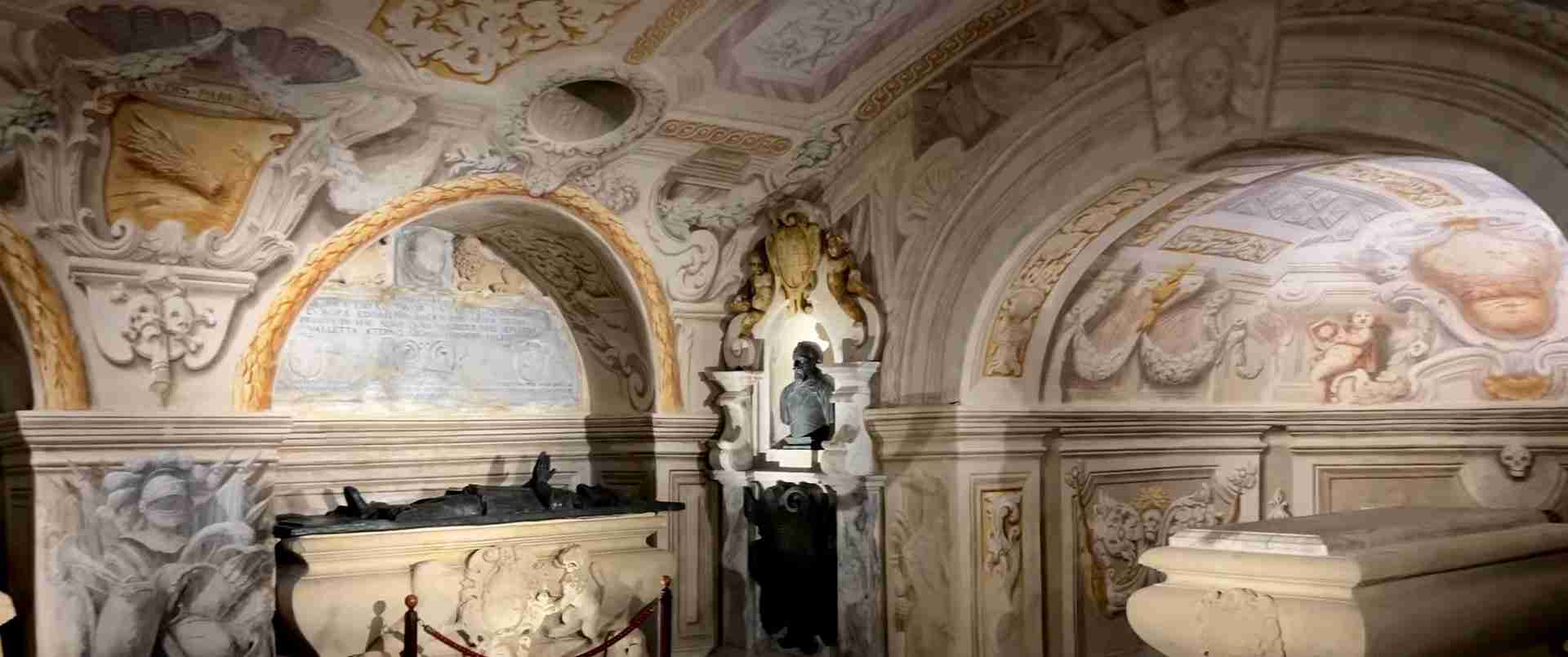
The floor of St. John’s Co-Cathedral serves as the primary burial ground for Knights of the Order of St. John from 1577 to 1798, creating an extraordinary necropolis of European nobility beneath visitors’ feet. Each of the 400 marble tomb slabs represents not merely a burial marker but an elaborate heraldic monument, carved with the deceased knight’s coat of arms, family insignia, military achievements, and symbolic imagery reflecting his langue (national division) and rank within the Order. The Knights considered burial within the cathedral a supreme honor reserved for members who had completed distinguished service, and families competed to commission the most elaborate inlaid marble designs, incorporating semi-precious stones, colored marbles from across the Mediterranean, and intricate allegorical figures. This unprecedented concentration of funerary art transforms the entire floor into a readable genealogy of European aristocracy spanning two centuries, with each slab documenting noble lineages from France, Italy, Spain, Portugal, Germany, England, and other Catholic nations.
How did the Knights decorate each chapel differently?
The eight langues of the Order of St. John each commissioned elaborate side chapels within the cathedral between 1600 and 1680, creating an artistic competition that pushed Baroque decoration to extraordinary heights. Each langue approached its chapel as a statement of national pride and religious devotion, employing master sculptors, painters, and goldsmiths from their respective homelands to create distinctive aesthetic identities. The Chapel of Aragon features Spanish polychrome sculpture and dramatic altar compositions, while the Italian Chapel displays Roman Baroque exuberance with gilt stucco work and marble intarsia. The French Chapel emphasizes classical restraint within Baroque abundance, incorporating French sculptural traditions, while the German Chapel showcases Central European craftsmanship in its altar metalwork and stone carving. This deliberate differentiation extended to iconographic programs, with each chapel selecting patron saints, biblical scenes, and allegorical figures that resonated with national devotional traditions, resulting in a cathedral interior that functions as both unified architectural space and anthology of European Baroque regional styles.
What other artworks besides Caravaggio are important?
St. John’s Co-Cathedral houses an exceptional collection of Baroque art beyond Caravaggio’s celebrated paintings, with Mattia Preti’s ceiling frescoes representing the cathedral’s most extensive single artistic program. The Calabrian master spent 1661 to 1666 painting 18 interconnected scenes from the life of St. John the Baptist directly onto the barrel-vaulted stone ceiling, creating a continuous narrative that guides visitors’ eyes from the main entrance toward the high altar. The cathedral’s altarpieces include works by Giuseppe Calì, Stefano Erardi, and Francesco Zahra, Malta’s most accomplished religious painters, while the side chapels feature marble sculpture by Giuseppe Mazzuoli and Melchiorre Gafà, whose Baptism of Christ in the Chapel of Aragon ranks among Baroque Malta’s finest sculptural achievements. The museum collection preserves 29 Flemish tapestries woven after designs by Rubens and Poussin, commissioned by Grand Master Ramon Perellos in the early 18th century, alongside the Order’s treasury of liturgical silver, embroidered vestments, and illuminated choir books that document the Knights’ patronage across three centuries.
Extended multi-day tours – 5+ days
Featured Malta Multi-Day Tour Packages
3 days
Malta 3-Day Discovery Tour
- ✓ Comprehensive Malta experience
- ✓ Expert local guides included
- ✓ All accommodation included
- ✓ Transportation provided
5 days
Malta 5-Day Highlights Experience
- ✓ Comprehensive Malta experience
- ✓ Expert local guides included
- ✓ All accommodation included
- ✓ Transportation provided
7 days
Malta 7-Day Cultural Journey
- ✓ Comprehensive Malta experience
- ✓ Expert local guides included
- ✓ All accommodation included
- ✓ Transportation provided
10 days
Malta 10-Day Complete Adventure
- ✓ Comprehensive Malta experience
- ✓ Expert local guides included
- ✓ All accommodation included
- ✓ Transportation provided
Multi-day tour packages powered by TourRadar. Prices and availability subject to change.
Introduction: Malta’s Baroque Masterpiece
St. John’s Co-Cathedral embodies the paradox at the heart of the Knights of St. John: warrior-monks whose martial prowess defending Christendom against Ottoman expansion coexisted with sophisticated artistic patronage that made Valletta a Mediterranean cultural capital. Commissioned by Grand Master Jean de la Cassière in 1572 and consecrated in 1578, the cathedral served as the conventual church of the Order of St. John—the spiritual center where knights gathered for religious observances, chapter meetings, and the elaborate ceremonies that structured their hierarchical society. The building’s austere Renaissance exterior, designed by the Maltese architect Girolamo Cassar, deliberately contrasts with the explosion of gilded Baroque decoration within, a transformation that occurred gradually between 1600 and 1680 as successive Grand Masters and individual langues competed to embellish the interior.
The cathedral’s designation as “co-cathedral” reflects Malta’s ecclesiastical history: when the Order arrived in Malta in 1530, Mdina’s medieval St. Paul’s Cathedral already served as the island’s episcopal seat. Rather than displace the existing cathedral, the Knights built their own conventual church in the new capital of Valletta, which was eventually granted equal cathedral status in 1816 by Pope Pius VII. This dual cathedral arrangement persists today, with St. John’s functioning as the co-cathedral of the Roman Catholic Archdiocese of Malta alongside St. Paul’s in Mdina.
The cathedral’s interior transformation began in 1600 when Grand Master Alof de Wignacourt commissioned extensive marble cladding and the creation of the eight langue chapels. Each of the Order’s national divisions—Provence, Auvergne, France, Italy, Aragon, England, Germany, and Castile—received a side chapel to decorate according to their aesthetic preferences and devotional traditions. This arrangement sparked an artistic rivalry that drew master craftsmen from across Catholic Europe, each langue striving to outdo the others in magnificence. The resulting interior represents not a unified vision but a collaborative masterpiece where diverse European Baroque traditions coexist within a single architectural framework.
Caravaggio’s arrival in Malta in 1607 added international artistic prestige to the cathedral’s already substantial collection. The troubled genius sought refuge and redemption among the Knights after fleeing Rome following a fatal sword fight. Grand Master Alof de Wignacourt commissioned The Beheading of Saint John the Baptist for the oratory, and the painting’s success led to Caravaggio’s admission as a Knight of Magistral Obedience—an honor soon revoked after the artist’s imprisonment and escape from Malta following another violent altercation. Despite this disgrace, Caravaggio’s paintings remained in the cathedral, becoming its most famous artworks and ensuring that visitors from across the world would come to witness his revolutionary approach to sacred art.
The cathedral’s floor, perhaps its most distinctive feature, evolved into a comprehensive monument to the Order’s membership between 1580 and 1798. Knights who died in Malta received burial beneath marble tomb slabs commissioned by their families or langues, each carved with heraldic devices that documented genealogies of European aristocracy. By the time the French revolutionary forces expelled the Knights from Malta in 1798, 400 tomb slabs covered the nave and langue chapels, creating what scholars describe as Europe’s most extensive heraldic floor monument.
Understanding St. John’s Co-Cathedral requires recognizing it as both sacred space and political monument. The Knights of St. John, formally known as the Order of St. John of Jerusalem, Rhodes, and Malta, functioned as an autonomous military-religious state within Malta, with the Grand Master exercising princely authority. The cathedral served not merely as a place of worship but as the Order’s ceremonial center, where the election of Grand Masters, investiture of new knights, and diplomatic receptions occurred. The building’s opulence announced the Order’s power and legitimacy to visiting dignitaries and reinforced internal hierarchy through the careful allocation of chapel patronage and burial privileges.
Modern visitors encounter St. John’s Co-Cathedral as a museum as well as an active parish church. The cathedral underwent extensive restoration between 1952 and 2001, stabilizing the structure and conserving the artworks. Today it welcomes approximately 350,000 visitors annually, who come to witness Caravaggio’s masterworks, walk across the tomb-covered floor, and experience one of Europe’s most concentrated examples of Baroque ecclesiastical art. The cathedral administration has implemented protective measures including mandatory shoe covers to prevent damage to the historic floor and controlled climate systems to preserve the paintings and tapestries. Audio guides provide detailed interpretation, while the adjacent museum displays artifacts too fragile for continued use in the active church.
Historical Background and the Knights of St. John
The Knights of St. John traced their origins to a hospital established in Jerusalem around 1050 to care for Christian pilgrims visiting the Holy Land. Following the First Crusade’s capture of Jerusalem in 1099, this charitable institution transformed into a military-religious order, adding armed defense of pilgrims and crusader territories to its original hospitaller mission. When Saladin recaptured Jerusalem in 1187, the Order relocated to Acre, then after Acre’s fall in 1291 to Cyprus, and finally in 1310 to Rhodes, where the Knights established an independent state that controlled the eastern Mediterranean sea lanes for over two centuries.
Ottoman Sultan Suleiman the Magnificent expelled the Knights from Rhodes in 1522 after a six-month siege that nearly annihilated the Order. For seven years the dispossessed Knights wandered the Mediterranean seeking a new base until Emperor Charles V granted them sovereignty over Malta and Gozo in 1530, with the condition that they defend these strategically located islands against Ottoman expansion. The Knights initially regarded Malta as a poor substitute for Rhodes—the islands were barren, hot, and lacking natural harbors—but Grand Master Jean Parisot de Valette recognized the potential of Mount Sciberras, a rocky peninsula that controlled access to Malta’s two great harbors.
The Great Siege of 1565 validated the Knights’ defensive value and transformed their reputation. When Ottoman forces landed 40,000 troops on Malta with the intention of establishing a base for attacks on Sicily and southern Europe, the Knights’ stubborn defense of Fort St. Elmo and the fortified positions around the Grand Harbor delayed the Ottoman advance until Spanish reinforcements arrived. The siege lasted four months and cost both sides devastating casualties, but the Knights’ victory established them as Christianity’s heroic defenders and earned substantial financial support from grateful Catholic monarchs.
Grand Master de Valette immediately began constructing a new fortified capital on Mount Sciberras, employing the military engineer Francesco Laparelli to design what became one of Europe’s most advanced Renaissance fortress cities. Valletta rose rapidly between 1566 and 1571, its grid-plan streets, massive bastions, and strategic placement of defensive batteries creating an impregnable stronghold that also functioned as a sophisticated urban center. The Knights required a conventual church worthy of their newly elevated status, and Grand Master Jean de la Cassière commissioned Girolamo Cassar to design St. John’s Co-Cathedral as the spiritual heart of the new city.
The Order’s internal organization shaped the cathedral’s architecture and decoration. Eight langues—Provence, Auvergne, France, Italy, Aragon, Castile, Germany, and England—divided the Knights along linguistic and national lines, with each langue occupying specific auberges (residences) in Valletta and maintaining its own military and administrative structures. When the cathedral’s interior decoration began in 1600, Grand Master Alof de Wignacourt assigned each langue a side chapel, creating both devotional spaces and venues for national pride. The English langue chapel remained incomplete after England’s break with Rome under Henry VIII reduced English membership to a handful of recusant Catholic families.
The Knights’ wealth derived from multiple sources that funded their extensive artistic patronage. Each knight surrendered a portion of his inheritance to the Order upon admission, while European estates (commanderies) provided annual revenue. The Order’s navy engaged in corso—licensed privateering against Ottoman and Barbary shipping—generating substantial prize money that Grand Masters distributed among participants and the common treasury. The Knights also operated hospitals, pharmaceutical laboratories, and agricultural enterprises on Malta, while diplomatic gifts from Catholic monarchs acknowledging the Order’s role in defending Christendom added to available funds. This wealth concentration allowed Grand Masters and individual knights to commission works from Europe’s leading artists.
The cathedral witnessed the Order’s gradual decline following the Knights’ failure to prevent Ottoman expansion into Crete in the 1660s and their limited involvement in the Holy League’s victory at Vienna in 1683. By the 18th century, the Knights increasingly functioned as a ceremonial organization of European nobility rather than an active military force, though they maintained their hospitals and continued sponsoring artistic projects. Napoleon’s occupation of Malta in 1798 during his Egyptian campaign ended the Knights’ territorial sovereignty. The French revolutionary forces looted the cathedral’s treasury, melting down the silver altar furnishings to pay for military operations, though Caravaggio’s paintings were preserved.
British administration of Malta from 1800 to 1964 transformed St. John’s from a conventual church into a regular parish church serving Valletta’s residents. The building survived World War II relatively intact despite heavy bombing of the surrounding city, though blast damage necessitated some structural repairs. Malta’s independence in 1964 and subsequent development of heritage tourism brought renewed attention to the cathedral as a major visitor attraction, leading to the comprehensive restoration programs that have preserved the building and its artworks for contemporary audiences.
Architecture and Exterior Design
St. John’s Co-Cathedral presents an austere facade that deliberately underplays the extraordinary interior splendor beyond. Girolamo Cassar’s design reflects the architectural priorities of military engineers during the Counter-Reformation: massive walls, small windows, and minimal ornamentation that would neither distract from spiritual purpose nor provide vulnerable points during potential sieges. The limestone facade, constructed from Malta’s honey-colored globigerina limestone, features a simple pediment above a rectilinear entrance portal, with two bell towers flanking the main body of the church. This restrained Renaissance exterior follows the pattern Cassar established for Valletta’s other major churches, creating stylistic unity across the city while concentrating decorative resources on interiors.
The cathedral’s plan follows a Latin cross configuration with a single nave measuring 58 meters in length and 18 meters in width, flanked by side aisles that create space for the eight langue chapels. The barrel-vaulted ceiling rises approximately 13 meters above the floor, providing sufficient height for Mattia Preti’s later fresco program while maintaining the horizontal emphasis characteristic of Counter-Reformation church design. Unlike Gothic cathedrals that drew the eye upward toward divine mystery, St. John’s focuses attention along the central axis toward the sanctuary, emphasizing the Eucharistic sacrifice celebrated at the high altar as the core of Catholic worship.
The exterior walls average two meters in thickness, a defensive measure typical of Valletta’s public buildings during the late 16th century when Ottoman naval raids remained a constant threat. Small windows punctuate the thick walls at high elevations, limiting natural light penetration in a way that enhances the dramatic illumination effects within the gilded interior. This combination of massive masonry and restricted fenestration creates exceptional acoustic properties, making the cathedral particularly effective for the polyphonic choral music that accompanied the Knights’ elaborate liturgical ceremonies.
The bell towers, completed in 1577, originally housed the cathedral’s original bronze bells that regulated daily life in Valletta, calling knights to religious offices and alerting the city to approaching ships or potential threats. The towers’ pyramidal stone spires employ a design common in Maltese church architecture, adapted from Spanish models that influenced Cassar’s architectural vocabulary. The bells themselves have been replaced several times due to war damage and metal requisitioning during various conflicts.
Cassar’s exterior design deliberately contrasts with contemporary Italian church architecture, rejecting the elaborate facades being created by architects like Giacomo della Porta and Carlo Maderno in Rome. This restraint reflects both the Knights’ warrior identity—ostentation would ill-suit a military order sworn to poverty and obedience—and practical considerations of Malta’s harsh Mediterranean climate, where complex stone carving deteriorates rapidly under intense sun and salt spray. The plain facade also established the pattern for Baroque transformation: visitors’ shock at the golden interior increased dramatically when contrasted against the sober exterior, creating the theatrical effect central to Counter-Reformation religious experience.
The cathedral’s urban context amplifies its architectural impact. Positioned on Merchant Street in the heart of Valletta’s commercial district, St. John’s rises amid the grid of palace and auberge buildings that house government offices and museums. The narrow approach streets frame carefully composed views of the facade, while the small piazza fronting the entrance provides just enough space for ceremonial processions entering and exiting the building. This tight urban fabric reflected Valletta’s identity as a fortress-city where every square meter required defensive planning.
Later additions modified Cassar’s original design without fundamentally altering its character. The oratory wing, added to the southern side of the church in the 1590s, created additional space for the Knights’ daily chapter meetings and provided the setting for Caravaggio’s monumental paintings. The museum wing, added in the 20th century, houses the cathedral’s collection of vestments, silver, and illuminated manuscripts in climate-controlled galleries. These additions remain subordinate to the main church volume, preserving the visual primacy of Cassar’s austere Renaissance composition.
The Interior Transformation: Baroque Opulence
The interior of St. John’s Co-Cathedral represents one of European Baroque’s most complete and overwhelming decorative programs, where virtually every surface bears gilded carving, painted narrative, or inlaid marble ornament. This transformation occurred gradually between 1600 and 1680 as successive Grand Masters commissioned progressive layers of embellishment that built upon and integrated with earlier work. The result creates an environment of such intense visual richness that art historians describe the experience as approaching the limits of human decorative capacity—there is literally nowhere left for the eye to rest on unornamented stone.
Grand Master Alof de Wignacourt initiated the transformation in 1600 by commissioning Maltese craftsmen to clad the plain stone walls and piers with carved limestone decorated with gilding and polychrome paint. This initial phase established the architectural framework: pilasters with elaborate Corinthian capitals rise between the langue chapels, supporting an entablature that encircles the entire nave. The entablature itself bears carved garlands, putti, military trophies referencing the Knights’ crusading mission, and the heraldic devices of Grand Masters who funded various phases of work. This gilded framework creates the background against which all subsequent decoration reads.
The transformation of each architectural element followed similar principles: structural components received carving that enhanced rather than obscured their load-bearing function, while flat surfaces became fields for narrative painting or ornamental pattern. The pilasters feature spiraling acanthus leaves rising toward capitals so deeply undercut that they appear almost three-dimensional in the raking light from the clerestory windows. The arches framing each langue chapel display carved keystone faces representing saints or allegorical virtues, while the spandrels above contain relief carvings of angels bearing the instruments of Christ’s passion.
Mattia Preti’s contribution to the interior transformation between 1661 and 1666 unified the previously disparate decorative elements into a coherent whole. The Calabrian master proposed painting the barrel vault with scenes from the life of St. John the Baptist, creating a continuous narrative that would draw visitors’ eyes progressively toward the sanctuary. Preti painted directly onto the prepared stone surface using an oil-based medium rather than true fresco, allowing him to work methodically on individual scenes without the time pressure fresco imposed. This technique also permitted extensive modeling and atmospheric effects impossible in traditional buon fresco, giving the ceiling paintings an illusionistic depth that makes the architectural framework seem to dissolve.
The gilt decoration that covers the walls and ceiling required extraordinary quantities of gold leaf applied over red bole (clay) ground that gives the gold its warm, rich appearance. Craftsmen achieved varying surface textures by tooling the applied gold leaf—burnishing some areas to mirror-like brilliance while leaving others matte to create contrast. The total quantity of gold employed in the cathedral’s decoration has never been precisely calculated, but estimates suggest several hundred thousand individual gold leaf sheets covering approximately 2,000 square meters of carved stone surface. The gold’s reflective properties serve both aesthetic and practical purposes: they amplify the limited natural light entering through the small clerestory windows while creating the glowing, transcendent atmosphere considered essential to Baroque religious experience.
The cathedral’s color scheme complements the gold through careful use of pigments applied to carved details and painted surfaces. Deep reds and blues dominate the langue chapels, where altarpieces and side walls feature scenes from saints’ lives executed by Mattia Preti, Stefano Erardi, and other Malta-based painters. Green and purple accents appear in architectural moldings, while white marble contrasts against the warm limestone tones. This restrained palette prevents visual chaos despite the abundance of decorative elements—colors serve to define spatial zones and guide attention rather than competing for dominance.
The lighting design, though modified by modern electrical systems, originally relied entirely on natural daylight filtered through small clerestory windows and the countless candles that burned during services. The Knights’ religious offices occurred at fixed times throughout the day, and the changing quality of light transformed the interior atmosphere from the cool blue of early morning to the warm gold of afternoon to the flickering drama of candlelit vespers. The gilt surfaces respond dynamically to these lighting changes, sometimes appearing almost silver in morning light, then warming to deep copper tones as sunset approaches. Contemporary lighting respects these effects while ensuring adequate illumination for visitors navigating the floor’s uneven surface.
The integration of sculpture into the decorative program adds three-dimensional emphasis to key points. The high altar features a sculptural group of the Baptism of Christ by Giuseppe Mazzuoli, while side chapel altars display marble reliefs and free-standing figures by various hands. These sculptures create focal points that project forward from the wall plane, using the strong directional light to cast dramatic shadows that enhance their volumetric presence. The most significant sculpture, Melchiorre Gafà’s marble relief of the Baptism in the Chapel of Aragon, demonstrates the Maltese sculptor’s mastery of the Baroque vocabulary he absorbed during training in Rome under Bernini.
The overall effect of the interior transformation creates what Baroque theorists described as a “total work of art” (gesamtkunstwerk)—an environment where architecture, sculpture, painting, and decorative arts merge into unified sensory experience. Visitors entering from the bright Mediterranean sunlight require several moments for their eyes to adjust to the dimmer interior, during which the golden surfaces gradually emerge from darkness, creating the revelation central to Counter-Reformation religious practice. The Knights designed this sequence deliberately, understanding that the cathedral served not merely as a gathering space but as a theatrical setting for spiritual transformation.
Caravaggio’s Beheading of Saint John the Baptist
Caravaggio’s Beheading of Saint John the Baptist dominates the oratory of St. John’s Co-Cathedral with a physical presence and psychological intensity unmatched in Western religious art. The painting measures 361 by 520 centimeters—approximately 12 feet by 17 feet—making it both the largest canvas Caravaggio ever executed and his most ambitious compositional undertaking. Commissioned in 1608 by Grand Master Alof de Wignacourt shortly after the artist’s arrival in Malta, the painting served dual purposes: decorating the newly completed oratory where knights gathered for daily chapter meetings, and demonstrating Caravaggio’s worthiness for admission to the Order despite his criminal record in Rome.
The composition depicts the moment immediately following the executioner’s sword stroke, capturing the instant when John the Baptist lies dying on the prison courtyard ground while Salome extends a golden platter to receive his severed head. Caravaggio structured the scene with theatrical precision: the action occurs in the lower third of the canvas, leaving vast areas of dark prison wall and shadow that emphasize the brutality unfolding in the harsh sunlight. This unusual compositional choice—concentrating the narrative in a narrow horizontal band while surrounding it with empty space—creates psychological claustrophobia despite the painting’s monumental scale. The viewer confronts not epic religious drama but a sordid prison yard execution witnessed by a few indifferent officials.
The painting’s most significant detail appears in the blood pooling beneath John’s severed neck: Caravaggio signed the work by inscribing “f. Michelangelo” (Brother Michelangelo) in the red pigment, simultaneously referencing his baptismal name and the honorific title “Brother” accorded to Knights of Malta. This signature represents the only certain instance of Caravaggio signing a painting—his practice typically avoided signatures, letting the work speak for itself. The blood signature carries multiple layers of meaning: it documents Caravaggio’s brief membership in the Order; it literally signs the painting in the Baptist’s martyrdom blood, linking artist and subject in shared sacrifice; and it demonstrates technical virtuosity, rendering the signature as wet blood catching light rather than simply lettering.
The five figures populate the scene with psychological complexity that elevates the work beyond mere illustration. The executioner, having delivered the killing blow, turns away with professional detachment while reaching for the knife at his belt to complete the decapitation—the sword apparently failed to sever the head completely. His stance suggests routine rather than emotion; this is work, not religious persecution. Salome, gorgeously dressed in red and gold, extends the platter with almost clinical interest, her expression ambiguous—is she horrified, fascinated, or simply performing the task her mother demanded? An elderly woman beside Salome—some scholars identify her as Salome’s mother Herodias, others as a servant—gestures toward the dying Baptist with raised hands, her horror more evident than Salome’s restraint.
Two prison officials observe from the shadows behind Salome, their poses suggesting conversation more than concern. Their presence transforms the scene from religious martyrdom to legal execution: the Baptist dies not in dramatic confrontation but through bureaucratic process, murdered for criticizing Herod Antipas’s marriage to his brother’s wife. The officials’ indifference—they seem to be discussing unrelated matters—underscores the banality of institutional violence, a theme that resonates with Caravaggio’s own experience of arbitrary authority.
The Baptist himself, his nearly nude body sprawled on the prison courtyard stone, embodies Caravaggio’s revolutionary approach to religious painting. There is nothing idealized or beautified in this martyrdom: John appears as an actual man dying violently, his body twisted in final agony, blood pooling beneath him. Caravaggio rejected the Renaissance tradition of ennobling martyrdom through classical poses and serene expressions, instead presenting execution as the brutal, undignified thing it is. The realism extends to anatomical details—the visible sternum and rib cage suggesting John’s ascetic deprivations, the awkward position of the limbs reflecting actual death throes rather than artistic arrangement.
The architectural setting reinforces the painting’s stark realism. Caravaggio depicts a specific type of Mediterranean prison courtyard: high limestone walls, an arched gateway, and a barred window suggesting the dungeon within. The ground shows cracks and weathering, while the prison wall displays the kind of staining and deterioration visible on actual Maltese limestone buildings. This environmental specificity grounds the biblical narrative in contemporary Malta, suggesting that religious persecution occurred not in ancient abstract settings but in places resembling the Knights’ own prisons.
The painting’s chiaroscuro—Caravaggio’s trademark dramatic contrast between illuminated figures and deep shadow—achieves particular intensity here. A single powerful light source from the upper left rakes across the scene, creating sharp shadows and highlighting key elements: Salome’s outstretched platter, the Baptist’s dying body, the executioner’s muscular torso. The vast areas of shadow occupying the upper two-thirds of the canvas create negative space that pushes the illuminated action toward the viewer while suggesting unseen horrors in the darkness beyond. This lighting creates theatrical focus while conveying moral darkness—evil flourishing in shadow while the Baptist’s sacrifice occurs in revealing light.
Technical analysis reveals Caravaggio’s working method. X-radiography shows he painted directly onto the prepared canvas with minimal underdrawing, working out the composition through the painting process itself. He made significant changes during execution: the elderly woman’s position shifted, Salome’s costume underwent alterations, and the Baptist’s pose was adjusted multiple times. This empirical approach—discovering the image through paint application rather than following predetermined designs—gives the final work its sense of immediacy and observed reality rather than constructed illustration.
The painting’s condition remains remarkably good considering its age and the challenging Maltese climate. The canvas has never been lined (backed with additional canvas for support), retaining its original structure. Several restoration campaigns have addressed surface dirt accumulation and minor paint losses, but the fundamental paint layer remains intact with its original glazes and modeling visible. The most recent conservation in 2001 removed centuries of grime and discolored varnish, revealing the subtle tonal range and atmospheric effects Caravaggio achieved in the shadowed areas.
Scholars debate the painting’s relationship to Caravaggio’s personal circumstances. Some interpret it as the artist’s meditation on his own violent nature—the signed blood signature suggesting identification with the murdered Baptist, whose outspokenness paralleled Caravaggio’s own refusal to conform to artistic and social expectations. Others read it as an appeal for redemption, the artist documenting Christian martyrdom as proof of his worthiness for the Order’s protection despite his criminal record. The painting’s completion in 1608 preceded Caravaggio’s admission to the Knights but also his violent altercation with a senior knight that led to imprisonment and escape from Malta, adding biographical resonance to this prison execution scene.
The Beheading’s influence on subsequent painting was immediate and long-lasting. Caravaggio’s radical realism and dramatic lighting inspired generations of followers across Europe, while the composition’s horizontal emphasis and psychological complexity provided a model for history painters seeking alternatives to Renaissance idealization. The work established that religious art could convey spiritual truth through unflinching documentation of human violence rather than through beautification and idealization, a principle that shaped Counter-Reformation painting across Catholic Europe.
The Cathedral Floor: Walking Among Knights’ Tombs
St. John’s Co-Cathedral floor comprises 400 inlaid marble tombstones creating Europe’s most extensive heraldic monument, where visitors literally walk across two centuries of European aristocratic genealogy. Every knight who died in Malta between 1577 and 1798 aspired to burial within the cathedral, and families competed to commission the most elaborate memorial designs, employing master marble craftsmen from Italy and Malta to create polychrome inlays that documented lineage, military achievements, and devotional identity. The cumulative effect transforms the entire floor into a readable text of European nobility, each tomb slab functioning as both burial marker and heraldic proclamation.
The earliest tomb slabs, dating from the 1580s, display relatively simple designs: rectangular limestone slabs carved with the deceased knight’s coat of arms, name, rank, and death date. These early monuments follow late medieval memorial traditions, emphasizing textual information over decorative elaboration. By 1600, however, as the cathedral’s interior transformation gained momentum, tomb slab design evolved toward greater complexity. Families began commissioning multi-colored marble inlays imported from quarries across the Mediterranean: red jasper from Sicily, black Belgian marble, yellow sienna, green serpentine, white Carrara, gray bardiglio from Tuscany, and pink Portuguese marble. Master craftsmen cut these colored marbles into intricate patterns, assembling them like jigsaw puzzles into the prepared limestone slabs.
The iconography of individual tomb slabs follows established heraldic vocabulary while allowing for personal variation. Most slabs display the deceased knight’s family coat of arms at the center, surrounded by the emblems of his langue and sometimes his commandery (the European estate that provided his income). Military achievements receive representation through carved or inlaid weapons, armor, and battle standards. Knights who held high office within the Order—admiral, grand commander, prior—display the insignia of these positions. The Order’s eight-pointed cross appears on virtually every tomb, its points representing the eight beatitudes or, alternatively, the eight langues themselves.
Baroque elaboration transformed tomb slab design between 1650 and 1750. The most ambitious monuments employ trompe-l’oeil effects, creating the illusion that textiles or documents lie draped across the floor. Some slabs depict death’s head skulls with remarkable realism, the marble inlay creating shading and volumetric effects that make the macabre imagery appear almost three-dimensional. Hourglass motifs remind viewers that time runs out for all mortals, while scrolls bearing Latin inscriptions proclaim the deceased’s virtues and achievements. Several slabs incorporate architectural elements—miniature temples or arches—framing the heraldic content, while others feature allegorical figures representing virtues, continents, or military victory.
The most celebrated tomb slab commemorates Gregorio Carafa, who died in 1690 after serving as Grand Master for only ten months. Carafa’s monument occupies a prominent position in the nave near the sanctuary steps and displays exceptional artistic virtuosity: colored marbles create the illusion of a richly embroidered carpet lying across the floor, complete with tasseled edges and folded corners revealing the “underside” of the textile. The central medallion bears Carafa’s arms surrounded by elaborate scrollwork, military trophies, and allegorical figures, while the outer border mimics brocade fabric. The entire composition demonstrates marble inlay’s capacity to rival painting in illusionistic representation.
Langue affiliation determined burial locations within the cathedral, with each of the eight national divisions controlling specific zones. The Chapel of Italy contains primarily Italian knights’ tombs, while the Chapel of Aragon preserves Spanish monuments. This geographic organization creates distinct aesthetic zones: Italian slabs often display Roman Baroque exuberance and complex allegorical programs, while Spanish monuments favor darker marbles and more restrained compositions reflecting Iberian taste. The French zones show classical restraint even within Baroque abundance, and German areas demonstrate Central European craftsmanship in the precision of inlay work.
Prominent knights received burial in the nave—the cathedral’s main floor space—while lesser members occupied positions in the side aisles and langue chapels. The most prestigious locations lay near the sanctuary, where tombs would receive greatest visibility during services. Grand Masters merited elevated tomb monuments along the walls rather than floor slabs, their sarcophagi displaying sculptural programs celebrating their achievements. This hierarchical burial arrangement made the cathedral floor a readable map of the Order’s internal social structure, with each tomb’s location conveying information about the deceased’s rank and importance.
The practical challenges of maintaining and preserving these 400 tomb slabs are considerable. Centuries of foot traffic have worn some inlays smooth, obliterating fine details and inscriptions. The colored marbles weather at different rates—softer stones like limestone erode faster than hard jaspers and serpentines, creating uneven surfaces that pose tripping hazards. Some tomb slabs have developed cracks from structural settling or wartime blast damage. Conservation efforts since the 1960s have addressed the most damaged monuments, but the cathedral’s function as both museum and active church means foot traffic continues, necessitating protective measures like mandatory shoe covers for visitors.
Modern interpretation of the tomb slabs has benefited from heraldic research identifying many previously anonymous knights. Art historians working with genealogical records have traced family lineages and documented individual knights’ careers, transforming anonymous arms into personal biographies. This research reveals the tomb slabs’ value as historical documents: they record not only individual lives but also the Order’s changing composition over time, the rise and fall of various noble families, and the shifting political alliances that brought knights from particular regions to Malta during different periods.
The tomb slabs’ greatest historical value lies in their documentation of European aristocratic genealogy. Heraldic records maintained by the Order when admitting new knights required proof of noble ancestry—typically sixteen noble quarterings demonstrating that all great-great-grandparents belonged to the nobility. The tomb slabs display these quarterings, documenting family alliances through marriage over generations. For genealogists and historians studying European nobility, St. John’s floor provides unparalleled evidence about noble families across Catholic Europe from the 16th through 18th centuries.
Walking across the tomb floor creates a peculiar psychological experience. Visitors navigate carefully, conscious of treading on graves while simultaneously trying to examine the intricate artistry beneath their feet. The floor’s slight undulation—tomb slabs settling at different rates over centuries—requires attention to avoid tripping, while the visual complexity of 400 individual heraldic compositions creates information overload. The audio guide helps interpret key monuments, but comprehensive examination would require hours of study. This tension between the tombs as functional floor and as artistic/historical monument characterizes the contemporary visitor experience.
Mattia Preti’s Ceiling: Life of Saint John the Baptist
Mattia Preti’s ceiling frescoes represent St. John’s Co-Cathedral’s most extensive single artistic undertaking, transforming the barrel-vaulted stone ceiling into a continuous narrative sequence depicting eighteen episodes from the life of St. John the Baptist. The Calabrian master worked on the project from 1661 to 1666, painting directly onto prepared stone surfaces using an oil-based technique that allowed the atmospheric effects and complex modeling impossible with traditional fresco. The completed cycle creates a unified iconographic program that guides visitors’ eyes from the entrance toward the sanctuary, using the Baptist’s life story to reinforce Counter-Reformation themes of prophetic witness, baptismal regeneration, and martyrdom for truth.
Preti arrived in Malta in 1659 with an established reputation earned through work in Rome and Naples, where he absorbed Caravaggio’s dramatic lighting and developed his own synthesis of Roman classicism and Venetian colorism. Grand Master Raphael Cotoner recognized Preti’s potential and commissioned the ceiling paintings as part of an ongoing program to unify the cathedral’s increasingly complex interior decoration. Previous piecemeal additions by various artists had created visual fragmentation; Preti’s overarching ceiling narrative would provide the architectural framework within which disparate elements could cohere.
The narrative sequence begins at the cathedral entrance with the Annunciation to Zacharias—the angel Gabriel appearing to John’s father in the Temple of Jerusalem to announce his wife Elizabeth would bear the prophetic child despite her advanced age. Preti depicts Zacharias’s gesture of disbelief that will leave him mute until John’s birth, establishing the theme of prophetic announcement that structures the entire cycle. The composition employs Preti’s characteristic dramatic diagonal movements, with the angel descending from upper left while Zacharias recoils in surprise at lower right, creating dynamic energy that draws the eye into the cathedral’s interior.
Subsequent scenes trace John’s life chronologically as visitors progress toward the sanctuary. The Visitation shows the pregnant Mary visiting her cousin Elizabeth, with both women rendered in flowing draperies that demonstrate Preti’s Venetian colorism. The Birth of John depicts the celebration following the Baptist’s arrival, with Zacharias regaining speech to proclaim his son’s name. John in the Wilderness presents the young prophet living ascetically in the Judean desert, preparing for his mission of proclaiming the coming Messiah—a scene allowing Preti to display his skill in landscape painting and dramatic lighting effects.
The central sequence focuses on John’s baptismal ministry. The Preaching of Saint John shows crowds gathered at the Jordan River to hear the prophet call them to repentance, with Preti organizing multiple figures in groups that create spatial recession and documentary realism. The Baptism of Christ occupies a prominent position near the cathedral’s center, depicting the moment when John baptizes Jesus in the Jordan while the Holy Spirit descends in the form of a dove and the voice of God declares Christ’s divine sonship. Preti renders this pivotal scene with particular attention to the spiritual significance—Christ’s humble submission to John’s baptism despite his divine nature, and the trinitarian revelation of Father, Son, and Holy Spirit present simultaneously.
The cycle’s emotional intensity increases as John’s confrontation with political authority develops. John Reproaching Herod shows the Baptist denouncing Herod Antipas for his unlawful marriage to his brother Philip’s wife Herodias, the moral stance that will cost John his life. Preti depicts John gesturing dramatically while Herod and Herodias recoil from the prophet’s accusation, establishing the personal animosity that motivates John’s eventual execution. The Imprisonment of John presents the Baptist confined in Herod’s fortress at Machaerus, where he will await martyrdom.
The cycle concludes with the martyrdom sequence. Salome Dancing before Herod depicts the infamous scene where Herodias’s daughter performs for the king, who rashly promises her any reward. Preti renders Salome mid-dance with flowing garments creating rhythmic movement across the vault, while Herod watches from his throne. The Beheading of Saint John—distinct from Caravaggio’s oratory painting—shows the actual moment of execution within the prison, with the executioner’s sword descending. The Presentation of John’s Head portrays Salome delivering the severed head to her mother Herodias on the golden platter. The final scene, The Burial of Saint John, depicts John’s disciples recovering his body from the prison for proper interment, establishing the cult of relics that would make John’s remains pilgrimage destinations.
Preti’s technique demonstrates mastery of oil painting’s capacity for atmospheric effects and subtle tonal gradation. Unlike true fresco, which requires painting quickly into wet plaster before it dries, oil painting on prepared stone surfaces allowed Preti to work methodically, building up layers of transparent glazes to create depth and luminosity. This technique enabled the soft transitions from light to shadow that give the ceiling paintings their convincing three-dimensionality. From the cathedral floor sixty feet below, individual scenes appear to occur in actual spaces beyond the vault, with architecture and landscape receding convincingly despite the curved ceiling surface.
The illusionistic architecture Preti painted within several scenes extends the actual architectural framework upward into fictional space. Columns and pilasters appear to support painted entablatures, while archways frame views into distant landscapes. This quadratura technique—using perspective to create illusory architectural space—was standard practice in Baroque ceiling decoration, but Preti employed it with particular skill, making the boundaries between actual architectural elements and painted illusion difficult to perceive from the floor. The effect creates spatial ambiguity that enhances the ceiling’s capacity to transport viewers imaginatively into the biblical narrative.
Preti’s color palette emphasizes deep blues, rich reds, golden yellows, and earth tones that harmonize with the gilded wall decoration below. He avoided the pastel colors fashionable in contemporary Rococo ceiling painting, preferring dramatic contrasts that read clearly from the cathedral floor. The paintings’ excellent state of preservation allows these original colors to appear as Preti intended—restoration work in the 1960s and 2000s removed centuries of candle smoke and dirt without heavy-handed repainting, preserving the original paint layer’s subtle modeling and transparent glazes.
The ceiling’s narrative structure serves didactic purposes central to Counter-Reformation religious practice. By tracing John’s life from miraculous birth through prophetic mission to martyrdom, Preti created a visual catechism teaching core Christian doctrines: God’s providence in sacred history, the importance of baptismal sacrament, the cost of moral witness against worldly authority, and the promise of heavenly reward for earthly sacrifice. Knights viewing these scenes during daily religious offices received constant reinforcement of the values structuring their own vowed lives—obedience, sacrifice, and defense of Christian truth against hostile forces.
The ceiling paintings’ relationship to the floor tombs creates vertical dialogue between artistic programs. While the floor documents the earthly achievements and noble lineages of deceased knights, the ceiling directs attention toward spiritual realities and eternal salvation. Visitors looking down see mortality and family pride; looking up, they encounter prophetic witness and martyrdom. This deliberate contrast embodies the tension at the heart of the Knights’ identity—aristocratic warriors who were simultaneously religious brothers sworn to evangelical poverty.
The Eight Langue Chapels: National Artistic Identity
The eight langue chapels flanking St. John’s Co-Cathedral nave represent one of Baroque Europe’s most fascinating artistic experiments—a deliberate competition where national divisions of the Order of St. John each created autonomous devotional spaces reflecting their distinct aesthetic traditions and religious sensibilities. Grand Master Alof de Wignacourt assigned chapel spaces to the langues in 1600, intentionally sparking rivalry that would generate exceptional artistic quality. Each langue approached its chapel commission as an opportunity to demonstrate cultural sophistication and devotional seriousness, importing master craftsmen from their respective homelands and competing to outdo neighboring chapels in magnificence. The resulting ensemble preserves snapshot of European Baroque regional diversity within a unified architectural framework.
Chapel of Italy: Roman Baroque Exuberance
The Chapel of Italy, positioned on the left side of the nave entering from the main entrance, displays the full range of Roman Baroque decorative vocabulary. Italian knights dominated the Order numerically and wielded disproportionate influence within the hierarchy, circumstances reflected in their chapel’s exceptional size and elaborate decoration. The chapel’s altar, designed by Lorenzo Gafà and executed by his brother Melchiorre, features multi-colored marble columns framing a painting of the Madonna of Carafa by Mattia Preti. The altarpiece depicts the Virgin presenting the Christ child to saints and donors, including Grand Master Gregorio Carafa, who funded major renovations to the chapel in the 1680s.
The chapel’s walls display Preti’s characteristic style in multiple canvases depicting Italian saints—St. Catherine of Alexandria, St. Lucy, St. Agatha—each painting demonstrating the artist’s mastery of dramatic lighting and volumetric figure modeling. The vault features elaborate gilt stucco work creating the impression of coffered architecture, with each coffer containing painted medallions of additional saints and allegorical figures. This profusion of decorative elements reflects Roman practice where every surface received ornament, creating visual abundance that symbolized spiritual richness.
The floor contains numerous tomb slabs of prominent Italian knights, many displaying the sophisticated marble inlay work characteristic of Roman workshops. These monuments frequently employ allegorical imagery—figures representing Fame, Victory, Time, and Death surround central heraldic devices, creating miniature narrative programs within each slab’s confined space. The overall effect establishes the Chapel of Italy as the cathedral’s most densely decorated zone, setting a standard other langues struggled to match.
Chapel of France: Classical Restraint Within Baroque Framework
The Chapel of France, though employing Baroque decorative elements, maintains a classical restraint reflecting French academic traditions. The chapel’s altar features a painting of the Conversion of Saint Paul by Antoine Favray, a French knight-artist who worked extensively in Malta during the mid-18th century. Favray’s composition demonstrates French neoclassical principles: clearly organized spatial structure, rational arrangement of figures, and restrained emotion contrasting with Italian Baroque theatricality. The Damascus road scene shows Saul thrown from his horse by divine light, but the violence remains contained within classical compositional discipline.
The chapel’s architectural framework employs paired pilasters supporting a classical entablature, with proportions adhering more closely to Vitruvian principles than the exaggerated scale employed in neighboring chapels. The color scheme favors cool blues and whites rather than warm reds and golds, creating psychological distance that suggests philosophical contemplation rather than mystical ecstasy. This aesthetic choice reflects French Catholic traditions emphasizing intellectual engagement with faith over emotional experience—a theological position associated with French Jansenism and the Cartesian philosophical tradition.
The floor monuments in the French chapel display heraldic precision and genealogical detail reflecting the French nobility’s obsession with documented lineage. Many slabs feature multiple quarterings documenting marriage alliances across generations, creating visual complexity that rewards sustained examination. The inlay work tends toward geometric precision rather than naturalistic representation, emphasizing the abstract patterns inherent in heraldic composition.
Chapel of Aragon: Spanish Polychrome Drama
The Chapel of Aragon represents Spanish Baroque aesthetic traditions through dramatic polychrome sculpture and intense religious emotionalism. The chapel’s masterwork, Melchiorre Gafà’s marble relief of the Baptism of Christ, demonstrates Spanish influence absorbed during the Maltese sculptor’s training period. The relief depicts John pouring water over Christ’s head while angels attend and the Holy Spirit descends, all rendered in white Carrara marble with exceptional technical virtuosity. The sculpture’s dramatic undercutting creates deep shadows that enhance volumetric presence and emotional intensity.
The chapel’s altar features a painting of St. George and the Dragon, the warrior saint whose cult enjoyed particular devotion in Aragon. The composition shows George in gleaming armor slaying the dragon that terrorized a pagan city, with the rescued princess witnessing the heroic act. This subject choice reflects the Knights’ self-identification as Christian warriors combating the Islamic “dragon” threatening Europe—a particularly resonant metaphor for Aragonese knights whose homeland had only completed the Reconquista in 1492.
Spanish polychrome sculptural traditions appear in several secondary altar statues featuring painted and gilded surfaces rather than pure white marble. These works reflect Spanish devotional practices emphasizing physical presence and realistic depiction to encourage empathetic identification with sacred figures. The emotional intensity of Spanish religious art—suffering depicted graphically to inspire penitential response—contrasts with the more intellectualized approaches in French and Italian chapels.
Chapel of Castile: Iberian Mysticism and Martial Pride
The Chapel of Castile, representing the other major Spanish langue, displays similar aesthetic preferences to the Aragonese chapel while emphasizing specifically Castilian devotional traditions. The chapel’s altar painting depicts St. James the Greater (Santiago), patron saint of Spain and symbolic leader of the Reconquista. Santiago appears in his traditional guise as mounted warrior trampling Moorish enemies—an iconography that modern sensibilities find problematic but that expressed medieval Spanish Christian identity formed through centuries of religious warfare.
The chapel’s decorative program incorporates Castilian heraldic devices including the castle emblem that gave the region its name. These appear in gilded stucco reliefs surrounding the altar and in the vault decoration, creating visual affirmation of regional identity. The color scheme emphasizes deep reds and golds associated with Spanish royal iconography, linking the langue’s identity to the broader Spanish monarchy even while the Knights maintained autonomous sovereignty in Malta.
Several significant Castilian knights received burial in this chapel, their tomb slabs displaying the characteristically complex Spanish heraldry documenting noble ancestry. The most elaborate monuments date from the late 17th century when Castilian families competed to memorialize their sons’ service with increasingly expensive commissions. These tomb slabs frequently incorporate skull imagery and other memento mori elements reflecting Spanish Counter-Reformation spirituality’s emphasis on death contemplation as preparation for judgment.
Chapel of Germany: Central European Craft Traditions
The Chapel of Germany, though smaller than the major langues’ chapels due to German knights’ fewer numbers, displays exceptional craftsmanship in its altar metalwork and stone carving. The silver altar furnishings, executed by German craftsmen trained in Augsburg and Nuremberg traditions, demonstrate the precision metalworking for which German workshops earned international reputation. Altar candlesticks, crucifix, and tabernacle door feature elaborate engraved decoration combining religious imagery with German heraldic devices.
The chapel’s stone carving employs techniques characteristic of Central European Gothic survivals in Baroque contexts. German sculptors maintained Gothic traditions of deep relief and narrative complexity longer than Italian workshops, and these preferences appear in the chapel’s altar frame and architectural ornament. The result creates distinctive aesthetic identity—still recognizably Baroque in overall composition but retaining medieval German characteristics in execution details.
The chapel’s painting program includes works by German artists rarely represented in Mediterranean contexts, providing art historical evidence of cross-cultural artistic exchange facilitated by the Order. Several paintings display Northern European attention to realistic detail and material surfaces—textures of fabric, metal reflections, precise botanical rendering—contrasting with Italian emphasis on idealized form and dramatic gesture. These works document German religious painting traditions during a period when most German artistic production addressed Protestant markets, making this Catholic commission particularly valuable for understanding German Counter-Reformation visual culture.
Chapel of Provence: Southern French Refinement
The Chapel of Provence represents the langue headquartered in southeastern France, a region with distinct cultural identity balancing Italian and French influences. The chapel’s decorative program reflects this hybrid character—Italian Baroque exuberance tempered by French classical restraint. The altar features a painting of the Madonna and Child with Provençal saints, executed by a French artist working in Malta during the early 18th century. The composition displays Italianate figure types and coloring within French rational spatial organization.
The chapel’s architectural framework employs colored marbles imported from Provence and Italy, with green serpentine and pink breccia creating chromatic richness. The stone choices demonstrate the langue’s wealth—transporting heavy marble blocks across the Mediterranean represented significant expense that announced Provençal knights’ financial capacity. The resulting color palette differs markedly from neighboring chapels, creating distinctive visual identity through material selection rather than purely decorative choices.
Several tomb slabs in the Provençal chapel display early examples of sophisticated marble inlay work, suggesting Provençal knights pioneered the elaborate floor monuments that other langues subsequently imitated. These early-17th-century slabs show technical innovation in colored stone inlay that became standard practice by mid-century. The heraldic devices emphasize Provençal regional identity—coats of arms featuring local castles, family territories, and regional symbols—documenting the langue’s geographic roots in southern France.
Chapel of Auvergne: French Regional Identity
The Chapel of Auvergne, representing the langue from central France, occupies a smaller space reflecting Auvergnat knights’ fewer numbers compared to other French langues. Despite its modest scale, the chapel displays refined decoration emphasizing quality over quantity. The altar painting depicts regional saints venerated in Auvergne, providing documentary evidence of local devotional traditions that might otherwise remain obscure. These regional saints—bishops, hermits, local martyrs—enjoyed limited recognition beyond their geographic origins, making their appearance in Malta testimony to the langue’s determination to maintain cultural connections with their French homeland.
The chapel’s decorative carving demonstrates French sculptural refinement in both figure modeling and ornamental detail. French sculptors working in Malta brought training in classical proportions and restrained gesture that contrasted with Italian dramatic exaggeration. The resulting altar frames and architectural ornament display elegance and precision that art historians characterize as distinctly French—beautiful without ostentation, refined without affectation.
The floor monuments include several exceptional examples of early-18th-century French heraldic design, with tomb slabs employing rococo decorative elements that anticipate the style’s full flowering in France. These monuments show how artistic fashions migrated from French workshops to Mediterranean contexts through the Knights’ patronage networks, creating cultural exchange that enriched both regions.
Chapel of England: Incomplete Testament to Recusant Faith
The Chapel of England remains the cathedral’s least developed, its sparse decoration testifying to the English langue’s virtual disappearance following Henry VIII’s break with Rome. After the English Reformation, only a handful of English Catholic families—recusants who maintained illegal Catholic practice despite official persecution—could send sons to join the Order in Malta. These few English knights lacked the financial resources and numerical strength to compete with langues representing entirely Catholic nations, leaving their assigned chapel essentially incomplete.
The chapel’s altar features a simple painting of English martyrs—saints like Thomas Becket and Thomas More who died defending Catholicism against royal authority. This iconographic choice transforms the chapel into political statement: English knights declaring allegiance to papal authority in defiance of their homeland’s Protestant establishment. The chapel thus served less as active devotional space than as memorial to English Catholicism’s embattled status, a permanent reminder of the religious division that severed England from the continental Catholic community.
Several tomb slabs of English knights occupy the chapel floor, their inscriptions documenting recusant families who maintained Catholic faith despite legal penalties. These monuments provide genealogical evidence about English Catholic survival networks during the 17th and 18th centuries, naming families who sent sons to Malta rather than conform to Anglican establishment. For historians studying English recusancy, these tomb slabs offer valuable documentation of families whose Catholic practice left limited archival traces in England itself.
Caravaggio’s St. Jerome Writing and the Oratory Museum
The oratory wing adjoining St. John’s Co-Cathedral houses Caravaggio’s second major painting in Malta, St. Jerome Writing, alongside a museum collection documenting the Knights’ liturgical, artistic, and documentary heritage. The oratory itself functioned as the Knights’ daily gathering space for chapter meetings, administrative business, and the canonical hours that structured religious life. Caravaggio’s paintings decorated this functional space, transforming bureaucratic meetings into occasions for contemplating sacred art. Today the oratory serves primarily as a museum gallery, with both Caravaggio paintings displayed under controlled lighting and environmental conditions that preserve the fragile oil paint.
St. Jerome Writing presents an intimate study of the 4th-century scholar-saint translating biblical texts in his cave dwelling. Caravaggio depicts an elderly, partially nude figure hunched over manuscripts, his concentration absolute as he transfers Hebrew and Greek texts into Latin—the work that produced the Vulgate Bible used throughout medieval Europe. A skull rests on the table beside Jerome’s books, the traditional memento mori reminding that scholarship, like all human endeavor, operates under death’s shadow. The painting measures significantly smaller than The Beheading—105 by 165 centimeters—creating an entirely different viewing experience: whereas The Beheading overwhelms through monumental scale, St. Jerome invites close examination of subtle psychological and technical details.
The painting demonstrates Caravaggio’s mature style at its most refined. The lighting comes from a single source at upper left, creating the dramatic chiaroscuro that became synonymous with Caravaggio’s name but employed here with exceptional subtlety. The light rakes across Jerome’s aged body, revealing anatomical details—prominent ribs, sagging skin, muscular tension in the writing hand—that document the physical reality of extreme old age. Yet this unflinching realism serves spiritual purpose: Jerome’s body may be failing, but his intellectual and spiritual powers remain focused on God’s word. The cardinal’s red cloak draped behind the saint creates the painting’s only strong color accent, its rich fabric contrasting with Jerome’s ascetic nudity.
The books and manuscripts surrounding Jerome display Caravaggio’s attention to material reality. The pages show text rendered illegibly but convincingly—they look like actual books rather than symbolic props. The skull’s bone structure appears anatomically accurate, suggesting Caravaggio worked from an actual skull rather than relying on conventional representations. This insistence on observational truth extends to minor details: the table’s wood grain, the stone cave walls, the precise way Jerome’s fingers grip the pen. Every element grounds the sacred subject in physical reality, making Jerome’s scholarship appear as actual work rather than abstract holy activity.
Scholars debate the painting’s date and original location. Some argue Caravaggio completed it before The Beheading in 1607–1608, while others date it to his brief return to Malta after escaping imprisonment in 1609. The painting’s provenance before the 19th century remains uncertain—it may have originally hung in the oratory alongside The Beheading, or it might have decorated Grand Master Wignacourt’s private apartments before transfer to the oratory. Technical analysis comparing paint samples and canvas weave patterns to authenticated Caravaggio works supports the attribution, though a few skeptical scholars continue questioning whether the master himself executed the entire painting or whether workshop assistants completed portions.
The oratory museum’s collection extends far beyond Caravaggio’s paintings to encompass objects documenting the Knights’ religious and ceremonial life. The Flemish tapestries, commissioned by Grand Master Ramon Perellos in 1697–1700, rank among the museum’s most valuable holdings. These 29 tapestries, woven by Judocus de Vos in Brussels after designs by Rubens, Poussin, and other masters, depict biblical scenes and allegorical subjects. The tapestries originally decorated the cathedral’s walls during major feast days, their rich colors and elaborate narratives transforming the interior for the most important celebrations. Today they hang in the museum’s climate-controlled galleries, preservation requirements preventing their liturgical use.
The treasury collection displays liturgical silver and metalwork documenting European goldsmith traditions from the 16th through 18th centuries. Monstrances, chalices, patens, thuribles, and altar cruets represent commissions by Grand Masters and wealthy knights seeking to glorify divine worship through precious materials and exceptional craftsmanship. Many pieces feature elaborate sculptural programs combining religious imagery with heraldic devices identifying donors. The collection’s most spectacular object, a processional cross measuring over two meters tall, contains emeralds, rubies, and diamonds set in gilded silver, its weight requiring two men to carry during processions.
The illuminated choir books, many dating to the 16th century, preserve both musical and visual artistic traditions. These massive volumes—some measuring 60 by 40 centimeters—contain polyphonic settings of mass texts and divine office hymns sung by the cathedral’s choir during services. The illuminated initials display miniature painting of exceptional quality: biblical scenes, heraldic devices, decorative borders incorporating naturalistic flowers and fantastic creatures. These manuscripts document the high level of book production maintained in Malta despite the island’s limited artistic infrastructure, suggesting skilled illuminators either resided in Malta or traveled from Italian workshops to execute commissions.
The vestment collection includes chasubles, dalmatics, copes, and other liturgical garments demonstrating European textile arts from the Renaissance through the Rococo. Many vestments feature elaborate embroidery employing gold and silver metallic threads, seed pearls, and semi-precious stones. The designs often incorporate heraldic motifs identifying the Grand Master or knight who commissioned the vestment, transforming functional religious clothing into statements of personal piety and institutional magnificence. Several Renaissance-era vestments display North Italian embroidery techniques, while 18th-century examples show French Rococo influences in their lighter colors and naturalistic floral patterns.
Documentary materials in the museum collection include manuscript archival records, painted portraits of Grand Masters, and prints depicting the Great Siege of 1565 and other significant events in the Order’s history. These materials provide research resources for scholars studying the Knights’ administration, diplomatic relationships, and military operations. The archive’s most historically significant items include Grand Master La Valette’s correspondence during the Great Siege and architectural drawings for Valletta’s fortifications by Francesco Laparelli and his Maltese assistant Girolamo Cassar.
The museum’s modern presentation employs multimedia interpretation techniques unavailable in traditional museum displays. Touchscreen exhibits provide detailed information about individual objects, while video presentations document conservation work and explain historical contexts. The lighting design protects light-sensitive materials while ensuring adequate visibility—a constant challenge in museum design for textiles and paintings. The climate control system maintains stable temperature and humidity levels preventing the dramatic seasonal fluctuations that previously threatened Malta’s historic collections.
Visiting St. John’s Co-Cathedral: Practical Information
St. John’s Co-Cathedral operates as both active parish church and major museum attraction, a dual function requiring visitors to observe both tourist site protocols and religious space etiquette. The cathedral welcomes approximately 350,000 visitors annually, making advance planning advisable during peak tourism periods. Entry occurs through the museum entrance on Republic Street rather than the main church portal, a routing that facilitates ticket sales, security screening, and distribution of protective shoe covers required to preserve the historic floor. The cathedral administration enforces strict dress codes and behavioral expectations appropriate to the building’s continued religious function.
Opening hours follow a seasonal schedule accommodating both visitor demand and liturgical requirements. The cathedral typically opens Monday through Friday from 9:30 AM to 4:30 PM, with last admission at 4:00 PM allowing adequate time for the self-guided visit that most tourists require. Saturday hours extend from 9:30 AM to 12:30 PM, closing at midday for weekend religious services. The cathedral closes entirely on Sundays and major Catholic feast days including Christmas, New Year’s Day, Good Friday, Easter Sunday, and several Malta-specific holidays honoring patron saints. These closures preserve the space for its primary liturgical function while limiting visitor access during the most important religious observances.
Admission fees support the cathedral’s extensive conservation requirements and ongoing maintenance of the building, artworks, and collections. Adult tickets cost €15, providing access to the cathedral interior, langue chapels, and the oratory housing Caravaggio’s paintings. Student and senior discounts reduce admission to €12 with valid identification. Youth aged 12-17 receive discounted €9 tickets, while children under 12 enter free when accompanied by adults. These prices position St. John’s among Malta’s higher-priced cultural attractions, reflecting both the exceptional quality of the artistic holdings and the significant conservation expenses the cathedral administration manages. Tickets include access to the multimedia audio guide available in twelve languages, providing detailed interpretation essential for understanding the complex artistic and historical content.
Online ticket purchasing through the cathedral’s official website allows visitors to bypass queues and secure preferred entry times. The reservation system operates with timed entry slots limiting the number of visitors inside simultaneously, preventing overcrowding that would damage both visitor experience and the historic floor. During summer peak season (June through September), online booking becomes essential as same-day tickets often sell out by late morning. Booking also provides flexibility—tickets remain valid for the selected date regardless of exact arrival time within the designated morning or afternoon window.
The mandatory shoe covers, distributed at the entrance before accessing the cathedral interior, protect the marble tomb slabs from abrasive wear that would obliterate the detailed inlay work over time. Visitors slip disposable fabric covers over their shoes, a requirement enforced without exception. These covers occasionally cause minor traction issues on the slightly uneven floor surface, requiring careful attention while walking. The cathedral discourages high heels for this reason—the pointed pressure risks damaging inlaid stones even through the protective covers. The shoe cover requirement reflects serious conservation concerns: with 350,000 annual visitors, uncovered shoes would wear away the softer marble components within decades, destroying irreplaceable Renaissance and Baroque artwork.
The dress code enforces standards appropriate for active religious sites. Shoulders must be covered—sleeveless tops, tank tops, and bare shoulders warrant denial of entry. Shorts and skirts must extend below the knee; the cathedral strictly enforces this requirement regardless of fashion trends or weather conditions. Hats must be removed by male visitors upon entry, though female head coverings receive tolerance as they conform to traditional Catholic practice. Visitors arriving inappropriately dressed can rent cover-up shawls at the entrance for €2 deposit, a solution that generates minor revenue while ensuring code compliance. The strict dress code occasionally surprises visitors accustomed to more permissive secular museums, but staff explain the regulations reflect the cathedral’s continued use as consecrated worship space where religious sensibilities supersede tourist convenience.
Photography policies permit personal non-flash photography throughout the cathedral interior for private use. Flash photography receives absolute prohibition—repeated burst from cameras would fade the historic paintings and textiles. Video recording requires special permission typically granted only to professional film crews paying location fees. Commercial photography for publication requires advance written permission and often involves access fees supporting conservation work. These restrictions balance visitors’ desire to document their experience against preservation requirements protecting light-sensitive materials. The cathedral’s official photography provides professional images for publications, ensuring high-quality reproduction while limiting damaging light exposure.
The audio guide, included with admission, provides essential interpretation that transforms a visually overwhelming experience into comprehensible narrative. The guide’s twelve-language options include English, Italian, French, German, Spanish, Russian, Japanese, Mandarin, Polish, Portuguese, Arabic, and Maltese, accommodating the cathedral’s diverse international visitor base. The audio tour follows a logical routing through the nave, langue chapels, and oratory, with numbered stops corresponding to interpretive content about specific artworks, architectural features, and historical contexts. The guide duration extends approximately 45-60 minutes for attentive listeners, though visitors can pause or skip sections according to personal interest. The audio guide device requires headphones provided at distribution or personal earbuds for hygiene-conscious visitors.
Accessibility accommodations address the historic building’s challenging physical environment. A wheelchair-accessible ramp provides entry from Republic Street, bypassing the few entrance steps. The main nave floor, though slightly uneven due to centuries of settling tomb slabs, generally accommodates wheelchairs with careful navigation. However, some langue chapels feature raised thresholds or steps limiting full accessibility—staff provide warning and alternative viewing positions. The oratory housing Caravaggio’s paintings includes a slight ramp accommodating wheelchairs. Visitors with mobility limitations should inquire at the entrance about optimal routing and available assistance. Audio guide devices include visual displays supplementing audio content, supporting hearing-impaired visitors. Guide dogs receive welcome with proper documentation.
The visit duration varies considerably according to visitor interest levels. Cursory examination covering major highlights—Caravaggio’s paintings, the overall interior impression, brief chapel viewing—requires minimum 45 minutes. A thorough visit engaging with the audio guide content, reading tomb inscriptions, and examining individual artworks extends to 90-120 minutes. Scholarly visitors or enthusiasts with specialized interests in Baroque art, heraldry, or Knights of Malta history may spend three or more hours studying specific elements. The cathedral provides minimal seating—several benches near the entrance and a few strategically placed seats—as the floor’s tomb coverage precludes extensive seating installation. Visitors with stamina concerns should plan accordingly, perhaps visiting during cooler morning hours or breaking the visit across multiple days if extended Malta stays permit.
The museum shop, located in the exit corridor before returning to Republic Street, offers publications, reproductions, and souvenirs related to the cathedral and the Knights of Malta. The book selection includes scholarly studies of the cathedral’s art and architecture, popular guidebooks, and lavishly illustrated coffee-table volumes reproducing the major artworks. Reproduction prints of Caravaggio’s paintings, decorative items featuring heraldic motifs, and religious articles provide gift options. Prices reflect the captive-audience museum shop premium but quality generally exceeds the tourist kitsch dominating Republic Street vendor stalls. Proceeds support the cathedral’s conservation programs and operational costs.
Visiting strategy considerations include timing, seasonal factors, and coordination with other Valletta attractions. Early morning visits (9:30-11:00 AM) generally encounter fewer crowds than midday arrival, particularly during summer months when cruise ships discharge passengers around 10:00 AM. Winter visits (November-March) benefit from cooler temperatures and reduced tourist density, though shorter daylight hours compress available touring time. The cathedral’s location in central Valletta facilitates combination visits with other major sites—the Grand Master’s Palace, Upper Barracca Gardens, National Museum of Archaeology—within comfortable walking distance. Most visitors allocate half a day to Valletta’s major attractions, with St. John’s consuming the largest single time block.
Photography Guide: Capturing the Cathedral’s Splendor
Photographing St. John’s Co-Cathedral presents exceptional technical challenges arising from extreme contrast between the golden interior’s reflective surfaces and the deep shadows that create the dramatic Baroque atmosphere. The cathedral’s lighting conditions—primarily indirect natural light from small clerestory windows supplemented by carefully positioned LED fixtures—create approximately 200-300 lux illumination levels in most areas, with brighter zones near windows and darker corners receiving 50 lux or less. This low-light environment, combined with the absolute prohibition on flash photography, requires specific camera settings and techniques to achieve acceptable results without damaging the historic artworks through inappropriate lighting.
Camera equipment recommendations begin with the fundamental requirement for manual control over exposure settings. Smartphone cameras, despite impressive computational photography advances, struggle with the cathedral’s extreme dynamic range where bright golden surfaces and black shadows coexist within single frames. Dedicated cameras—mirrorless or DSLR systems—with larger sensors and manual exposure control produce superior results. A fast prime lens (f/1.4, f/1.8, or f/2.0) or zoom lens with maximum aperture of f/2.8 captures adequate light without requiring excessively high ISO settings that introduce noise degrading image quality. Image stabilization becomes essential at the slow shutter speeds required—in-body stabilization proves particularly valuable as it functions with any lens, including vintage manual-focus glass offering exceptional optical quality at affordable prices.
Optimal exposure settings balance three competing variables: ISO sensitivity, aperture opening, and shutter speed. ISO settings between 1600 and 6400 prove necessary for handheld photography, with modern cameras producing acceptable noise levels at these sensitivities when shooting RAW files permitting post-processing noise reduction. Aperture selection depends on creative intent: wide apertures (f/1.4-f/2.8) gather maximum light enabling faster shutter speeds but create shallow depth of field requiring precise focus; smaller apertures (f/5.6-f/8) extend depth of field showing more architectural detail in focus but demand slower shutter speeds approaching the camera shake threshold. Shutter speed selection follows the reciprocal rule as minimum handheld speed—1/focal length second—meaning a 50mm lens requires 1/50 second or faster to avoid motion blur from camera shake. Image stabilization systems can extend this by 3-5 stops, allowing 1/6 second or even 1/4 second handheld exposures at 50mm.
Composition strategies must accommodate the overwhelming visual complexity that makes selective framing essential. Wide-angle lenses (16-35mm equivalent) capture the architectural space and provide context showing relationships between decorative elements, but the cathedral’s low light challenges wide-angle photography since wider apertures become less effective at stopping down for depth of field. Standard focal lengths (35-50mm) replicate human visual perspective and prove most versatile for general documentation and detail shots. Telephoto lenses (85-200mm) isolate specific artworks, compress perspective in ways that emphasize decorative density, and allow photographing ceiling paintings without severe keystone distortion—the convergence of vertical lines when pointing the camera upward.
The golden surfaces throughout the cathedral create exposure challenges as camera meters read the bright gilding and underexpose the image, rendering shadows completely black. Exposure compensation of +1 to +2 stops above metered values usually proves necessary, with review of the camera’s histogram guiding refinement—the histogram should show some data extending toward the right (bright) end without clipping highlights, while maintaining shadow detail visible in the dark areas. Bracketed exposures—shooting multiple frames at different exposure values—provides insurance and allows later HDR (high dynamic range) processing combining multiple exposures’ information to preserve both highlight and shadow detail exceeding any single exposure’s capability.
The ceiling paintings present particular photographic difficulty as they require pointing the camera nearly vertical, creating keystoning where the barrel vault’s parallel lines appear to converge. This geometric distortion proves unavoidable with standard lenses positioned directly beneath subjects. Solutions include using tilt-shift lenses that correct perspective through optical movements—though these specialized lenses command high prices and require technical expertise—or embracing the distortion as inherent to the architectural photography challenge. Post-processing perspective correction tools in software like Lightroom or Photoshop can reduce but not eliminate keystoning, with the correction sometimes introducing edge stretching that degrades image corners. Accepting moderate keystoning as authentic representation of the viewing experience often produces more natural results than aggressive correction.
The tomb floor offers rich photographic opportunities but requires specific approaches. Overhead shots from standing position create foreshortening that distorts the tomb slabs’ geometric designs—circular elements become elliptical, rectangular borders appear trapezoidal. Kneeling or crouching to position the camera closer to perpendicular with the floor surface reduces distortion at cost of slower, more awkward shooting. The uneven floor surface from centuries of settling means perfect perpendicular alignment proves impossible—accepting slight distortion as authentic documentation of the floor’s actual condition produces more honest images than digitally corrected “perfect” geometry. Side lighting from clerestory windows emphasizes the carved details and inlaid marble color differences, while direct overhead lighting from afternoon sun creates minimal shadow modeling that flattens the relief carving.
Caravaggio’s paintings in the oratory demand careful photographic treatment respecting both their artistic significance and physical vulnerability. The paintings hang under controlled LED spotlights providing even illumination that minimizes glare while protecting the light-sensitive oil paint from damaging ultraviolet radiation. Photographing from approximately 45 degrees off-axis to the picture plane—not straight-on—reduces glare from the protective glass installed several inches in front of the paint surface. This glazing prevents accidental contact but creates reflections that appear in photographs as distracting bright spots. The oratory’s relatively bright illumination compared to the main cathedral allows slightly lower ISO settings (1600-3200) improving image quality. Shooting RAW files provides maximum post-processing flexibility for adjusting color balance, exposure, and contrast to match the paintings’ actual appearance—JPEG files lose information through in-camera processing that limits subsequent refinement.
Ethical considerations in cathedral photography extend beyond technical concerns to questions about appropriate behavior in active religious space. While the cathedral administration permits photography, respectful visitors consider whether constant camera operation interferes with spiritual contemplation—both their own and other visitors’. Some photographers become so focused on capturing images that they experience the space through viewfinders rather than direct perception, reducing the visit to an image-gathering exercise rather than aesthetic and spiritual encounter. Balanced approach involves initial exploration without camera, absorbing the overall environment and identifying specific subjects worth photographic documentation, then returning to those locations for focused shooting. This method respects the cathedral’s religious nature while acknowledging visitors’ legitimate desire to document their experience.
Post-processing digital files transforms RAW captures into finished images matching the cathedral’s visual impact. The golden surfaces often require warming color balance to reproduce their actual appearance, as daylight white balance settings render the gold too neutral. Shadow lifting reveals detail in dark areas while maintaining the atmospheric mystery essential to Baroque lighting drama—excessive shadow brightening creates flat, unrealistic results. Selective local adjustments using graduated filters, radial filters, or brush tools allow brightening specific areas while leaving surrounding zones darker, replicating how human vision naturally focuses attention. Noise reduction addresses the grain introduced by high ISO capture, though moderate noise can contribute texture appropriate to the historic environment. Perspective corrections reduce keystoning in architectural shots while accepting that some distortion authentically represents the viewing experience.
Cultural and Religious Significance
St. John’s Co-Cathedral embodies multiple overlapping cultural meanings that extend far beyond its function as religious architecture or art museum. The building serves simultaneously as Catholic devotional space, military monument, aristocratic necropolis, Baroque artistic treasury, and symbol of Maltese national heritage. Understanding the cathedral requires engaging with these layered significances and recognizing how different constituencies—the Roman Catholic Church, the Sovereign Military Order of Malta (the Knights’ modern continuation), Maltese citizens, and international visitors—invest the space with distinct meanings that sometimes conflict and sometimes harmonize.
As Catholic sacred space, St. John’s maintains its original consecrated status despite the dramatic transformation in how most visitors engage with it. The cathedral continues serving as Valletta’s parish church for the approximately 6,000 residents who live within the fortified city’s walls. Regular masses occur in side chapels and occasionally in the main nave when visitor patterns permit, maintaining the liturgical rhythms that structured the building’s original purpose. The Blessed Sacrament remains reserved in the tabernacle on the high altar, technically making the entire church space one requiring reverent behavior regardless of tourist activities. Catholic theology holds that consecrated churches retain sacred character permanently—they cease being merely historic buildings and become actual dwelling places of divine presence through the reserved Eucharist. This theological understanding informs the strict dress codes and behavioral expectations the cathedral administration enforces, framing visitor access as privilege granted within religious space rather than secular tourist right.
For the Sovereign Military Order of Malta, St. John’s Cathedral represents both historical monument and continued spiritual center even though the Order lost territorial sovereignty over Malta in 1798. The modern Order, recognized by over 100 nations as a sovereign entity despite lacking territory, maintains diplomatic relations, issues passports, and continues its original hospitaller mission through worldwide healthcare and relief programs. The Order’s members—now approximately 13,500 knights, dames, and chaplains—regard St. John’s as their spiritual motherhouse despite headquartering in Rome since Malta expulsion. The cathedral hosts occasional Order ceremonies when the Grand Master visits Malta, and the langue chapel system preserves memory of the national divisions that once structured the organization. Understanding the cathedral’s significance for Order members requires recognizing it as simultaneously historical relic and living institutional symbol connecting modern members to eight centuries of continuous history.
Maltese national identity claims St. John’s Cathedral as patrimony transcending its origins as foreign military order’s conventual church. Contemporary Maltese citizens—descendants of the native Maltese who lived under the Knights’ rule rather than descendants of the Knights themselves—have thoroughly integrated the Order’s architectural and artistic heritage into Maltese cultural identity. The Knights’ palaces, fortifications, and churches now represent Maltese rather than foreign achievement in popular understanding, a process of historical appropriation that began during British colonial period (1800-1964) when both the native Maltese and their British administrators found common cause in celebrating the Knights’ history as preferable alternative to focusing on colonialism’s asymmetries. Independent Malta since 1964 has reinforced this identification, marketing the Knights’ heritage to tourists while claiming it as foundational to Maltese cultural distinctiveness. The cathedral thus functions as national monument in ways its original builders never intended, serving symbolic purposes remote from crusading military orders.
The artistic community regards St. John’s as exceptional example of complete Baroque environment where architecture, sculpture, painting, and decorative arts merge into unified gesamtkunstwerk. Art historians study the cathedral as document of patronage patterns, artistic networks connecting Malta to European mainland centers, and the specific aesthetic choices that distinguish Baroque regional traditions. The langue chapels provide comparative evidence about French, Italian, Spanish, and German Baroque developments occurring simultaneously in different cultural contexts. Caravaggio’s paintings anchor scholarly debates about his influence, working methods, and psychological state during his troubled final years. The tomb floor documents Renaissance and Baroque heraldic art traditions that otherwise receive insufficient attention from art history privileging painting and sculpture over decorative crafts.
Conservation professionals view St. John’s as case study in managing heritage sites balancing preservation requirements against public access demands. The 350,000 annual visitors generate both revenue supporting conservation and physical threats to fragile materials—floor wear, humidity fluctuations from breathing crowds, light exposure from photography, accidental contact with artifacts. The cathedral administration’s solution—timed entry, mandatory shoe covers, flash prohibition, climate control, protective glazing—represents best practices that other heritage sites study and sometimes adopt. The successful conversion of functioning church to also-museum without destroying religious atmosphere demonstrates possibilities for adaptive heritage use that neither freezes buildings in museum state nor allows uncontrolled access causing deterioration.
The cathedral’s role in interfaith dialogue remains underdeveloped potential that some observers believe could address Mediterranean religious tensions. The Knights’ history as crusading order fighting Ottoman expansion creates problematic legacy in contemporary context seeking Christian-Muslim dialogue rather than confrontation. Yet St. John’s could reframe this history, acknowledging past religious warfare while celebrating artistic achievements that transcended conflict—Ottoman textiles in the treasury collection, architectural influences from Islamic building traditions, the fact that both Christian and Islamic civilizations created sublime sacred art glorifying monotheistic God worship. Such recontextualization would require institutional will to complicate triumphalist narratives that currently dominate interpretation, but could position the cathedral as space for reflection on religious art’s capacity to inspire rather than divide.
Educational programming at St. John’s shapes how diverse audiences understand and value the site. School groups from Malta and abroad receive guided tours emphasizing either historical content (the Knights’ role in Mediterranean history), artistic material (Baroque art movements and techniques), or religious themes (Catholic devotional traditions). The tours’ varying emphases reveal how the same physical space generates different knowledge depending on interpretive frameworks applied. A student experiencing St. John’s through historical lens learns about military orders, Mediterranean geopolitics, and European aristocratic culture. The same space interpreted through art historical framework teaches about Baroque aesthetics, patronage systems, and artistic influence networks. Religious interpretation emphasizes liturgical practice, sacred architecture symbolism, and Christian visual theology. These multiple valid interpretations coexist without necessarily conflicting, though they create distinct understandings that shape visitors’ relationship to the site.
The cathedral’s UNESCO World Heritage context—Valletta received inscription in 1980 as “one of the most concentrated historic areas in the world”—frames international preservation obligations and tourism development pressures. UNESCO status brings prestige attracting visitors while imposing requirements to maintain “outstanding universal value” justifying inscription. The Maltese government must balance heritage protection against development pressures in tourism-dependent economy, occasionally creating conflicts when proposed changes threaten historic fabric. UNESCO’s periodic monitoring reviews evaluate whether inscribed sites maintain integrity and authenticity, potentially threatening inscription if preservation standards decline. St. John’s benefits from UNESCO attention through international conservation expertise and funding while accepting external oversight limiting autonomous decision-making about the building’s use and preservation.
Frequently Asked Questions
How long should I spend visiting St. John’s Co-Cathedral?
A thorough visit to St. John’s Co-Cathedral requires approximately 90 to 120 minutes to adequately appreciate the architectural details, Caravaggio’s paintings, the decorated langue chapels, and the tomb floor. This duration allows time to engage with the audio guide content, which provides essential historical and artistic interpretation transforming the overwhelming visual experience into comprehensible narrative. Visitors focusing only on major highlights—Caravaggio’s Beheading, the overall golden interior impression, and brief chapel viewing—can complete a condensed visit in 45 to 60 minutes, though this abbreviated approach sacrifices deeper understanding of the artistic and historical layers that make the cathedral exceptional. Conversely, enthusiasts with specialized interests in Baroque art, heraldry, or Knights of Malta history may easily spend three or more hours studying specific elements. Plan your visit for mid-morning or early afternoon when crowds are typically lighter, and remember that the slightly uneven tomb floor requires careful walking, potentially slowing movement through the space for visitors with mobility concerns.
Can I take photos inside the cathedral?
Personal non-flash photography for private use is permitted throughout St. John’s Co-Cathedral interior, allowing visitors to document their experience while protecting light-sensitive historic materials from damaging flash bursts. The cathedral’s low lighting conditions require camera settings appropriate for dim environments—high ISO sensitivity (1600-6400), wide aperture lenses, and slow shutter speeds that benefit from image stabilization. Smartphone cameras struggle with the extreme contrast between bright golden surfaces and deep shadows, often producing disappointing results compared to dedicated cameras with manual exposure control. Photography is explicitly prohibited during religious services when they occur in the main cathedral space, out of respect for worshippers and liturgical solemnity. Video recording requires advance written permission typically granted only to professional film crews. Commercial photography for publication demands special authorization and often involves location fees supporting conservation work. These restrictions balance visitors’ desire to capture memories against preservation requirements protecting irreplaceable Baroque artworks and sacred atmosphere.
What is the best time of day to visit?
Early morning visits immediately after the cathedral opens at 9:30 AM generally provide the most favorable experience, with fewer crowds, cooler temperatures during summer months, and optimal natural lighting as morning sun illuminates the clerestory windows. The period between 9:30 AM and 11:00 AM typically sees lighter visitor density compared to late morning and early afternoon when tour groups and cruise ship passengers concentrate their visits. Winter months (November through March) offer additional advantages: reduced overall tourist numbers make the cathedral less crowded throughout the day, and cooler temperatures create more comfortable viewing conditions in the unheated historic building. However, winter’s shorter daylight hours compress available touring time. The cathedral closes at 12:30 PM on Saturdays and remains closed entirely on Sundays and major Catholic feast days, requiring advance planning to avoid disappointment. Visitors should note that the cathedral occasionally closes sections for religious services or special events, typically announced on the official website. Late afternoon visits in summer sometimes benefit from golden-hour lighting effects as setting sun angles through the western clerestory windows, though this risks encountering larger crowds if earlier arrivals extended their visits.
Why is the cathedral called a co-cathedral?
St. John’s designation as “co-cathedral” reflects Malta’s ecclesiastical history and the theological principle that bishops maintain only one official seat (cathedra) per diocese, even when multiple important churches exist. When the Knights of St. John arrived in Malta in 1530, the medieval cathedral of St. Paul in Mdina already served as the island’s episcopal church where the Catholic bishop maintained his throne and cathedral functions. The Knights built St. John’s in their new capital Valletta as their conventual church—the spiritual center of their military-religious order—but it initially lacked cathedral status since the existing St. Paul’s already fulfilled that role. In 1816, Pope Pius VII granted St. John’s equal co-cathedral rank alongside St. Paul’s, recognizing both buildings’ historical and religious importance while maintaining Mdina’s original cathedral rights. This unusual arrangement means Malta’s Roman Catholic Archdiocese officially possesses two cathedrals of equal status, both serving as seats of the Archbishop of Malta for different ceremonial purposes. In practice, St. Paul’s Cathedral in Mdina functions primarily as local parish church and historical monument, while St. John’s in Valletta combines active parish duties with its role as major museum attraction. The co-cathedral designation honors both locations’ significance while reflecting the Knights’ exceptional political and religious position as autonomous military order within the Catholic Church hierarchy.
What should I wear to visit the cathedral?
St. John’s Co-Cathedral enforces a strict dress code reflecting its continued function as consecrated religious space where visitor access constitutes privilege granted within sacred environment rather than secular tourist right. Shoulders must be fully covered for all visitors—no sleeveless tops, tank tops, or bare shoulders regardless of temperature or fashion preferences. Shorts and skirts must extend below the knee; the cathedral strictly enforces this requirement, denying entry to visitors wearing clothing that exposes knees or thighs. Hats must be removed by male visitors upon entry, though female head coverings receive tolerance as they conform to traditional Catholic practice. Visitors arriving inappropriately dressed can rent cover-up shawls at the entrance for a refundable €2 deposit, providing a solution that ensures code compliance while generating modest revenue. The dress code occasionally surprises visitors accustomed to more permissive secular museums, but staff explain these requirements reflect the cathedral’s primary identity as active worship space where religious sensibilities supersede tourist convenience. Comfortable walking shoes with closed toes and low heels prove advisable for navigating the slightly uneven marble tomb floor—the mandatory shoe covers distributed at entry provide minimal protection, and high heels risk damaging inlaid stones through concentrated pressure points even through the protective fabric. Plan clothing accordingly when visiting Malta’s historic churches, as similar dress codes apply at most active religious sites across the island.
Is the cathedral wheelchair accessible?
St. John’s Co-Cathedral provides partial wheelchair accessibility through entrance ramps and relatively level nave flooring, though the historic building’s 16th-century construction presents inherent challenges that modern modifications cannot fully overcome. A wheelchair-accessible ramp at the museum entrance from Republic Street bypasses the few entry steps, providing level access to the ticketing area and cathedral interior. The main nave floor, though slightly uneven from centuries of tomb slab settling, generally accommodates wheelchairs with careful navigation—the protective shoe covers required for walking visitors obviously do not apply to wheelchair users. However, several langue chapels feature raised thresholds or one to two steps limiting full access, and the narrow doorways into some chapel spaces pose width constraints for larger wheelchairs or electric mobility scooters. Cathedral staff provide advance warning about accessibility limitations and can suggest alternative viewing positions offering sight lines into chapels that wheelchairs cannot physically enter. The oratory wing housing Caravaggio’s paintings includes a gentle ramp suitable for wheelchairs, ensuring access to these major artworks. Accessible restrooms are available within the museum facilities. Visitors with mobility limitations should contact the cathedral administration in advance to discuss specific needs and optimal routing through the complex. The audio guide devices include visual displays supplementing audio content, supporting hearing-impaired visitors, and guide dogs receive welcome with proper documentation.
What is the most valuable artwork in the cathedral?
Caravaggio’s Beheading of Saint John the Baptist holds distinction as both the most historically significant and commercially valuable artwork in St. John’s Co-Cathedral, representing the only painting the revolutionary Baroque master ever signed and his largest canvas at 361 by 520 centimeters. The painting’s art market value—purely hypothetical since it will never be sold—would likely exceed €100 million and potentially reach €200 million based on prices achieved for lesser Caravaggio works at auction and the premium this signed masterpiece would command. Beyond monetary valuation, The Beheading possesses exceptional art historical importance as the culmination of Caravaggio’s revolutionary approach to religious painting, documenting his radical realism and psychological intensity during his final productive period before death. The painting’s blood signature—Caravaggio inscribing his name in the Baptist’s flowing blood—creates unique autobiographical connection between artist and martyred subject. However, several other cathedral artworks merit consideration for “most valuable” status depending on valuation criteria: Mattia Preti’s ceiling frescoes represent the most extensive single artistic program and required five years of intensive labor; the complete set of 400 inlaid marble tomb slabs constitutes Europe’s finest heraldic floor monument with aggregate value surpassing any individual painting; the Flemish tapestries from Grand Master Perellos’s commission rank among Baroque Europe’s finest textile arts; and the treasury collection’s liturgical silver and ceremonial objects contain intrinsic precious metal value plus artistic merit. Art valuation ultimately depends on whether one prioritizes individual artistic genius (favoring Caravaggio), comprehensive decorative programs (favoring Preti’s ceiling), historical documentation (favoring the tomb floor), or precious materials (favoring the silver treasury).
How did Caravaggio come to paint for the Knights in Malta?
Caravaggio fled to Malta in 1607 seeking refuge and possible redemption after killing a man named Ranuccio Tomassoni during a violent altercation in Rome the previous year. The exact circumstances of Tomassoni’s death remain disputed—accounts range from a duel over gambling debts to a street brawl involving multiple participants—but the fatal outcome forced Caravaggio to escape Rome where papal justice would likely have executed him for murder. The artist wandered southern Italy for a year before securing passage to Malta, where the Knights of St. John offered potential sanctuary beyond papal jurisdiction and the possibility of papal pardon through knighthood admission. Grand Master Alof de Wignacourt, an art connoisseur who appreciated Caravaggio’s revolutionary painting style, commissioned the portrait now in the Louvre and soon after awarded the monumental commission for The Beheading of Saint John the Baptist to decorate the newly completed oratory. The painting’s success impressed the Knights sufficiently that Caravaggio received admission to the Order as a Knight of Magistral Obedience in July 1608—an honor typically requiring noble birth that the Grand Master waived given Caravaggio’s artistic genius and the prestige his presence brought the Order. This apparent redemption proved short-lived: in August 1608, Caravaggio engaged in a violent altercation with a senior knight, circumstances again disputed in sources but resulting in imprisonment in Fort St. Angelo. The artist escaped Malta in October 1608, fleeing to Sicily and continuing his restless flight from authority until his death from fever in July 1610 while traveling toward Rome seeking papal pardon. The Knights formally expelled Caravaggio from the Order in December 1608, but his paintings remained in the cathedral, ultimately becoming more famous than the circumstances of their creation.
Can I attend mass at St. John’s Co-Cathedral?
Regular Catholic masses occur at St. John’s Co-Cathedral serving Valletta’s parish community, typically scheduled in side chapels or early morning hours before the building opens to tourist visitors. Sunday masses generally take place at 8:30 AM and 10:00 AM in one of the langue chapels or occasionally in the main nave when visitor patterns permit, maintaining the liturgical functions that represent the cathedral’s primary purpose. Weekday masses occur less regularly, typically early morning on certain days to accommodate local parishioners before tourist operations begin at 9:30 AM. The cathedral’s dual function as active parish church and major museum attraction creates scheduling complexity—the tourist revenue funds essential conservation work and operational costs, but religious services receive priority when conflicts arise. Visitors wishing to attend mass should contact the cathedral office in advance to confirm current mass schedules, which vary seasonally and occasionally change due to special liturgical celebrations or diocesan events. Mass attendance does not require tickets and dress codes appropriate to religious services apply—the same coverage requirements enforced for tourist visitors but with enhanced expectation of respectful demeanor appropriate to sacred liturgy. During mass, photography is prohibited and visitors should maintain silence, refraining from the movement and conversation tolerated during tourist viewing hours. Major feast days including the cathedral’s patronal feast (June 24, Nativity of St. John the Baptist) and other significant Catholic celebrations feature particularly elaborate liturgies that showcase the cathedral’s continued religious vitality beyond its museum function. These special masses may include processions, polyphonic choral music from the cathedral’s traditional repertoire, and ceremonial elements reflecting the Knights’ liturgical heritage adapted for contemporary worship.
What happened to the Knights after they left Malta?
Napoleon Bonaparte’s forces expelled the Knights of St. John from Malta in 1798 during his Egyptian campaign, ending 268 years of the Order’s territorial sovereignty over the Maltese islands. The French occupation proved brief—British forces captured Malta in 1800—but the Knights never regained territorial control despite diplomatic efforts to reclaim their sovereign rights. The dispossessed Order relocated to Russia temporarily under Tsar Paul I’s protection, where the eccentric monarch accepted election as Grand Master despite being Orthodox rather than Catholic, creating canonical irregularity that Rome never recognized. Following Paul I’s assassination in 1801, the Order fragmented with disputed leadership until the Congress of Vienna (1814-1815) declined to restore Malta to the Knights, instead confirming British sovereignty over the strategically valuable islands. The Order eventually established headquarters in Rome in 1834, occupying the Magistral Palace on Via dei Condotti and the Magistral Villa on the Aventine Hill, both granted extraterritorial status by the Italian government. The modern Sovereign Military Order of Malta continues as a unique entity in international law: a sovereign subject without territory, recognized by over 100 nations, maintaining diplomatic relations, issuing passports and postage stamps, and operating healthcare and humanitarian programs worldwide. The Order abandoned its military functions in the 19th century, refocusing entirely on its original hospitaller mission through hospitals, ambulance services, medical clinics, and disaster relief programs across six continents. Current membership of approximately 13,500 knights, dames, and chaplains includes both Catholic aristocrats maintaining the traditional noble membership requirement and increasing numbers of non-noble members admitted based on service rather than lineage. The Order’s Grand Master holds rank equivalent to a cardinal in Catholic Church protocol, and the organization maintains permanent observer status at the United Nations. Despite losing Malta in 1798, the Order celebrates its Maltese heritage as the eight centuries of continuous history that legitimizes its contemporary existence and mission.