Skopje Travel Guide 2026: Best Things to Do in Macedonia’s Capital
Few European capitals offer the same head-spinning contrast as Skopje: an ancient Ottoman bazaar on one bank of the Vardar River, a boulevard of neoclassical marble monuments straight out of a fever dream on the other, and a medieval fortress watching over the whole improbable scene from a hilltop. North Macedonia’s capital is one of the continent’s most affordable and most underrated destinations, where a full day of sightseeing, excellent food, and strong Macedonian coffee rarely exceeds $50 per person. This guide covers every major attraction, practical logistics, and verified 2026 costs to help you plan a trip that delivers far more than your budget suggests.
- Exceptional Value in 2026: Skopje is one of Europe’s most affordable capitals — budget travelers spend $40-60 per person daily, while mid-range visitors with a comfortable hotel and restaurant meals average $80-130 per person daily (two sharing).
- Majority of Attractions Are Free: Kale Fortress, Macedonia Square, the Stone Bridge, the Mother Teresa Memorial House, and the entire Old Bazaar (Stara Čaršija) all cost nothing to visit, making Skopje ideal for tight budgets.
- Matka Canyon Is a Must: Just 15 kilometres from the city centre, this dramatic gorge with emerald waters, medieval monasteries, and boat tours to Vrelo Cave is the single best half-day excursion from Skopje and has no entrance fee.
- Best Season Is Spring and Autumn: April–May and September–October bring pleasant temperatures (18–24°C), smaller crowds, and ideal conditions for exploring both the city and surrounding nature. Summers reach 38–40°C and become busy.
- Currency Is the Macedonian Denar (MKD): At approximately MKD 53 per US dollar in 2026, cash is essential for markets, taxis, and smaller cafes. ATMs from NLB and Stopanska Banka give the best exchange rates; avoid Euronet machines.
- Two to Three Days Is the Sweet Spot: The city centre, Old Bazaar, and Kale Fortress fill two full days comfortably. Add a third day for Matka Canyon or the cable car up Mount Vodno, or a fourth for the overnight-worthy town of Ohrid.
People Also Ask About Skopje 2026
How much does a trip to Skopje cost per day in 2026?
Skopje is one of Europe’s most budget-friendly capitals in 2026. Budget travelers staying in hostels and eating at local grill restaurants spend $40-60 per person daily, including accommodation. Mid-range travelers sharing a hotel and mixing restaurants with cafes average $80-130 per person daily (two sharing a room at $85-120 per night). Luxury visitors in five-star hotels with fine dining and private day trips spend $175-270 per person daily. A week in Skopje costs $280-420 (budget), $560-910 (mid-range), or $1,225-1,890 (luxury) per person excluding international flights. The city is roughly 50–60% cheaper than Western European capitals at equivalent comfort levels.
What are the top things to do in Skopje in 2026?
The top free attractions in Skopje are Macedonia Square with its controversial “Warrior on a Horse” monument and triumphal arch, the Ottoman-era Kale Fortress with panoramic city views, the atmospheric Old Bazaar (Stara Čaršija) with its mosques, hans, and artisan workshops, the Mother Teresa Memorial House on the site of her birthplace, and the 15th-century Stone Bridge spanning the Vardar River. Paid highlights include the Archaeological Museum of North Macedonia (MKD 300-400 / $6-8 for foreign visitors), the Museum of the Macedonian Struggle (MKD 300 / $6), and the cable car to the Millennium Cross on Mount Vodno (MKD 120 / $2 return). The day trip to Matka Canyon for a boat tour to Vrelo Cave rounds out the essential Skopje experience.
How many days do you need for Skopje in 2026?
Two full days cover the main sights comfortably: Day 1 for Macedonia Square, Kale Fortress, and the Old Bazaar; Day 2 for the museums, Mother Teresa, and an evening in the Debar Maalo café district. Add a third day for a Matka Canyon half-day trip combined with the Mount Vodno cable car in the afternoon. Travelers with four or more days should extend to Ohrid, a UNESCO-listed lakeside town three hours away that warrants an overnight stay. A long weekend (3–4 nights) gives a thorough experience of both the city and its surroundings without feeling rushed.
Is Skopje safe for tourists in 2026?
Skopje is safe for tourists by Balkan and international standards. Petty theft and pickpocketing exist around busy areas like Macedonia Square and the Old Bazaar, as in any European capital, so standard precautions apply. The city centre and Old Bazaar are well-lit and lively until late, and solo travelers including solo women report feeling comfortable in the main tourist areas. Protests and demonstrations occasionally occur near government buildings, but they remain peaceful. Traffic is the most frequent hazard — pedestrian crossings are not always observed, so cross with care. The emergency number is 192 (police) and 194 (ambulance).
Extended multi-day tours – 5+ days
Featured Macedonia Multi-Day Tour Packages

3 days
Macedonia 3-Day Discovery Tour
- ✓ Comprehensive Macedonia experience
- ✓ Expert local guides included
- ✓ All accommodation included
- ✓ Transportation provided
5 days
Macedonia 5-Day Highlights Experience
- ✓ Comprehensive Macedonia experience
- ✓ Expert local guides included
- ✓ All accommodation included
- ✓ Transportation provided
7 days
Macedonia 7-Day Cultural Journey
- ✓ Comprehensive Macedonia experience
- ✓ Expert local guides included
- ✓ All accommodation included
- ✓ Transportation provided
10 days
Macedonia 10-Day Complete Adventure
- ✓ Comprehensive Macedonia experience
- ✓ Expert local guides included
- ✓ All accommodation included
- ✓ Transportation provided
Multi-day tour packages powered by TourRadar. Prices and availability subject to change.
Introduction to Skopje 2026: Why This Balkan Capital Deserves More Attention
Skopje sits at a geographic and cultural crossroads that has made it a strategic prize for every major civilisation in the region. The area around the Vardar River valley has been continuously settled since at least the Bronze Age; the Romans knew it as Skupi, and made it the capital of the province of Dardania. Medieval Bulgarian and Byzantine rulers fought over its walls, and the Ottomans held it for more than five centuries from 1392, transforming it into one of the most important trading cities in the Balkans. The old stone bridge, the bazaar that still hums with business today, and the mosques that punctuate the skyline are direct inheritances of that long Ottoman chapter.
The modern city carries a deeper wound: on 26 July 1963, an earthquake measuring 6.1 on the Richter scale struck at 5:17 in the morning. Over 1,000 people died, roughly 3,000 were injured, and an estimated 80% of the city’s buildings were damaged or destroyed. The international response was remarkable — more than 78 countries sent aid and expertise, and architects and urban planners from across the world arrived to help rebuild. The rebuilt city centre has a distinctly 1960s and 1970s brutalist character in its civic buildings, a permanent reminder of that moment of global solidarity that locals acknowledge with quiet pride.
The most recent transformation came half a century later. Beginning around 2010 and largely completed by 2014, the government of North Macedonia launched a massive urban project known as Skopje 2014. Hundreds of millions of euros poured into Macedonia Square and its surroundings, producing neoclassical facades on existing buildings, new museums designed to resemble ancient Greek temples, triumphal arches, ornamental bridges, and a forest of bronze statues depicting warriors, poets, and national heroes. The centrepiece is an enormous equestrian figure officially titled “Warrior on a Horse” — the government strategically avoided naming it Alexander the Great to sidestep the long-running dispute with Greece over the use of Macedonian historical legacy, though few visitors are in doubt about who is depicted. The project is genuinely divisive: architecture critics consider it kitsch and politically loaded, while many visitors find it spectacular in its sheer excess. Either way, it makes Skopje completely unlike anywhere else in Europe.
Below all this theatrical layering lies a city of considerable everyday charm. The Debar Maalo neighbourhood west of the centre functions as a Bohemian village of café terraces, independent restaurants, and neighbourhood life. The Old Bazaar across the Stone Bridge operates in much the same way it has for centuries, with coppersmiths, tailors, and food stalls occupying centuries-old stone buildings. North Macedonia joined NATO in 2020 and is a candidate for EU membership, giving the country a more stable and connected geopolitical position than at any point in its modern history. For 2026, Skopje represents one of the best-value cultural capitals in Europe: genuinely fascinating, warm in its welcome, and dramatically cheaper than any comparable city in Western or Central Europe.
Top Things to Do in Skopje 2026: Must-See Attractions and Experiences
Macedonia Square and the Skopje 2014 Project
Macedonia Square is the overwhelming centrepiece of the Skopje 2014 project and the first stop for every visitor. The square itself is large by European standards, flanked by neoclassical facades that were built onto existing communist-era buildings, giving them the appearance of 19th-century government palaces. Fountains shoot jets of water across the paving stones, illuminated at night in rotating colours that make the square a genuine spectacle after dark. The dominant figure in the centre is the “Warrior on a Horse” — a bronze equestrian statue standing over 22 metres tall including its elaborate pedestal, from which cascading water flows into a lower pool. Around the square’s perimeter stand additional statues of historical figures, and at the far western end rises Porta Makedonia, a full-sized triumphal arch inscribed with scenes from Macedonian history. Entry to the square is free at all hours, and the fountain and arch are impressive at both midday and midnight. Budget around 60-90 minutes for a proper walk around the square and its immediate surroundings.
Kale Fortress 2026: Panoramic Views Over the Old City
Perched on the hill directly above the junction of the Vardar River and the Old Bazaar, Kale Fortress offers the best free panoramic view in Skopje. The site has been fortified since antiquity — Neolithic, Byzantine, and Ottoman layers all exist here — but what stands today is primarily the Ottoman fortification built and expanded between the 6th and 14th centuries. The limestone walls run for approximately 121 metres east-west and 70 metres north-south, enclosing a plateau from which the entire city unfolds: Macedonia Square and the Vardar bridges to the south, the minarets and rooftops of the Old Bazaar immediately below, the mountains beyond. Entry is free and the gates open during daylight hours. Directly adjacent to the fortress walls stands the Mustafa Pasha Mosque, built in 1492 by a grand vizier of the Ottoman Empire and one of the finest examples of classical Ottoman architecture in the Balkans. The mosque is still active, and respectful visitors are welcome outside prayer times. The walk up to Kale from Macedonia Square takes 10–15 minutes through winding lanes past old stone houses; the views reward every step.
The Old Bazaar (Stara Čaršija) 2026: Ottoman Heart of the City
The Stara Čaršija is one of the oldest and largest bazaars in the Balkans, dating in its current form to the 12th century and expanded substantially under Ottoman rule from the late 14th century onwards. Where visitors to Istanbul or Sarajevo encounter heavily touristified markets, Skopje’s Old Bazaar retains a working, neighbourhood character that makes it exceptional. Coppersmiths still hammer out vessels in the workshops that line the main lanes; tailors work at foot-pedal sewing machines in open-fronted shops; jewellers display filigree silver work in the tradition brought to the city centuries ago. The hans — large caravanserai inns that served medieval merchants — survive in various states of restoration: the Kapan Han and the Suli Han both date to the 15th century, and the latter now hosts the Museum of the Old Bazaar. The Bit Pazar, a large outdoor market immediately north, overflows with produce, clothing, and household goods in the morning hours. Entry to walk and browse the bazaar is free; meals, coffee, and shopping are the only costs. Prices in the bazaar restaurants and cafes run significantly lower than in the Macedonia Square tourist strip — lunch at a local grill in the bazaar lanes costs MKD 400-600 ($8-11) for a full meal with a drink.
Mother Teresa Memorial House 2026
Anjezë Gonxhe Bojaxhiu — known to the world as Mother Teresa — was born in Skopje on 26 August 1910. The original house on Nënë Tereza Street was destroyed in the 1963 earthquake, and the current memorial opened on the site in 2009. The building is designed to evoke both the dome of a religious structure and an open hand, and houses a permanent exhibition covering her life from her childhood in Skopje through her departure for Ireland at 18, her work in Calcutta, her 1979 Nobel Peace Prize, and her canonisation in 2016. The exhibition includes personal objects, documents, and photographs. Admission is free, and the grounds include a small chapel and a contemplative garden. Visits take 30–45 minutes; the location in the central pedestrian zone makes it a natural stop between the Stone Bridge and the city’s main street.
The Stone Bridge and the Vardar River 2026
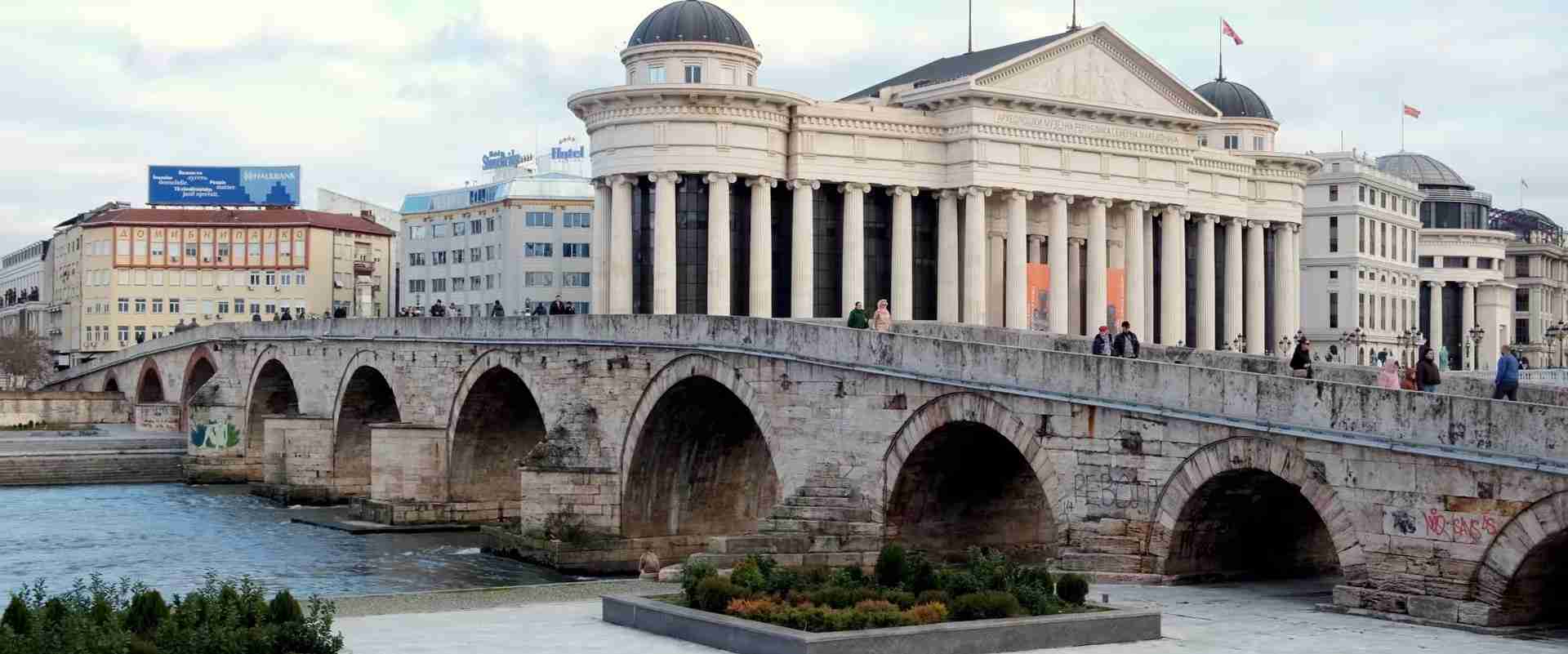
The Kameni Most — Stone Bridge — is the hinge on which the old and new city turn. Built in the 15th century under Sultan Murat II and reconstructed in 1992, the bridge spans the Vardar on 13 arched piers and connects Macedonia Square on the south bank to the entrance of the Old Bazaar on the north. It has served as the city’s symbolic centre for nearly six centuries: Ottoman emperors passed over it, Yugoslav partisans gathered on it, and today’s tourists photograph the equestrian monument reflected in the river at dusk. The Vardar embankment on both sides has been redeveloped with pedestrian promenades as part of the Skopje 2014 project, and the walkway between the Stone Bridge and the newer pedestrian bridges to the east makes for an excellent evening stroll. The bridge itself is always open and free; the best photographs come in the golden hour before sunset or when the Macedonia Square fountains are illuminated after dark.
Skopje Museums and Cultural Sites 2026: What to Visit and What to Pay
Skopje has more museums than most visitors expect from a city of its size, and admission prices at most of them are among the lowest in Europe. Come with cash — many museums do not accept cards, and the ones that do often experience machine failures.
Archaeological Museum of North Macedonia 2026
The Archaeological Museum building is itself part of the story: a massive neoclassical construction with Ionic columns across its river-facing facade, built entirely new as part of the Skopje 2014 project and designed to evoke an ancient Greek temple on the banks of the Vardar. Inside, the collection covers the region’s human history from the Palaeolithic era through to the Byzantine period, with approximately 7,000 artefacts spread across departments covering prehistoric archaeology, antiquity, and the lapidarium — a hall of stone monuments with inscriptions in Greek and Latin that record the region’s Roman and early medieval past. The Antiquity department is the highlight for most visitors, featuring gold jewellery, ceramic vessels, and sculptural fragments from sites across North Macedonia. Foreign visitors pay MKD 300-400 ($6-8) for admission, with the exact rate having fluctuated recently; the first Saturday of every month offers free admission to all visitors regardless of nationality. Opening hours are Tuesday to Sunday, 10:00–18:00 (last entry 17:00); the museum is closed on Mondays.
Museum of the Macedonian Struggle 2026
The Museum of the Macedonian Struggle covers the period from the 19th-century liberation movements through North Macedonia’s independence in 1991, using a format that visitors consistently describe as the most engaging in the city: full-scale wax figures in historically accurate settings, depicting the fighters, revolutionaries, and political figures who shaped the country’s path to statehood. The figures are placed in period-accurate rooms with authentic objects, creating diorama-style scenes that bring the history alive even for visitors with little prior knowledge of the region. Goce Delčev, the most celebrated hero of the Macedonian revolutionary movement, appears prominently. Admission is MKD 300 ($6) for adults, with reduced rates for children and students. The museum is located in a striking yellow neoclassical building directly on Macedonia Square, open Tuesday to Sunday. Allow 60-90 minutes for a thorough visit.
National Museum of Macedonia and the National Gallery 2026
The National Museum of Macedonia, housed in a mid-20th-century building that is itself worth seeing for its striking brutalist architecture, holds a collection of some 66,000 items spanning anthropology, archaeology, ethnology, and history. The ethnological section is particularly strong, with meticulously reconstructed traditional Macedonian domestic environments, regional costumes from all parts of the country, and explanatory panels in English. Adult admission is MKD 100 ($2). Nearby in the Old Bazaar, the Daut Pasha Hamam is one of the largest and best-preserved Ottoman bathhouses in the Balkans, built in 1490 by Daut Pasha (the grand vizier). Its interior — a sequence of domed marble chambers with star-shaped skylights — now serves as the main exhibition space for the National Gallery of Macedonia, displaying Macedonian fine art and icons. The adjacent Chifte Amam (Twin Bath) houses additional contemporary art exhibitions. Both hamam galleries have similarly low admission prices in the MKD 100-150 ($2-3) range.
Church of Saint Spas and the Old Bazaar’s Sacred Architecture 2026
The Church of Saint Spas (the Church of the Ascension) is one of the most technically interesting buildings in Skopje for a counterintuitive reason: it is largely underground. Built in the late 17th century under Ottoman rule, the church was constructed with its floor excavated below ground level so that the roof would not exceed the height of the surrounding mosques — a condition imposed by Ottoman law. The result is a disorienting and memorable space, entered by descending a short flight of steps from street level. The interior is dominated by an extraordinary carved walnut iconostasis created by master craftsman Petre Filipovski-Garkata in the early 19th century, considered one of the finest examples of Macedonian woodcarving and depicting biblical scenes with exceptional detail and expression. The grave of Goce Delčev rests in the church courtyard. A small admission fee applies; check with the church directly for current hours as they vary seasonally. The Mustafa Pasha Mosque next to Kale Fortress (built 1492) and the Yahya Pasha Mosque in the bazaar quarter (early 16th century) are also open to respectful visitors outside prayer times and provide powerful context for understanding the city’s Ottoman centuries.
Day Trips from Skopje 2026: Best Excursions Within Easy Reach
Matka Canyon Day Trip 2026: The Essential Escape
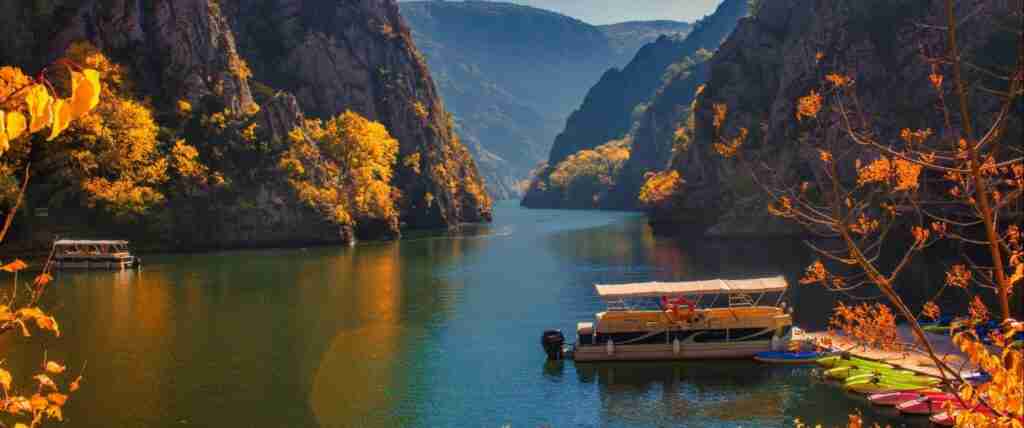
Matka Canyon is 15 kilometres west of Skopje, and the journey from the city centre to one of the Balkans’ most dramatic natural landscapes takes under an hour. The canyon was formed when a dam was built on the River Treska in 1938, creating North Macedonia’s oldest artificial lake and flooding a series of gorges whose cliffs now rise 50–100 metres above the emerald-green water. Entry to the canyon itself is completely free. The main draw beyond the scenery is the boat tour to Vrelo Cave — described by some geologists as one of the deepest underwater caves in the world — a motorised trip that winds through the narrowing canyon to the cave entrance, where a guide leads a 20-minute walk through stalactite chambers. The tour costs MKD 500 ($9) per person and takes approximately 60 minutes in total; boats depart from the second dock (past the dam) when they have enough passengers, running from mid-morning to late afternoon in the warmer months. The Church of Saint Andrew (Sveti Andrej Monastery), built in the 14th century on a ledge above the water, requires a short boat crossing (MKD 25-50 / $1) to reach and is included on many boat tour routes. The Church of Saint Panteleimon has an entry fee of MKD 120 ($2). Kayaks are available for hire at the canyon entrance for independent exploration of the lake. Several hiking trails start from the canyon: the Yellow Trail to the Church of Saint Nikola involves a steep 30-minute climb but delivers unobstructed views across the entire canyon from above. Bring cash for all activities and food at the canyon; card payment is unreliable.
To reach Matka Canyon independently, take bus number 60 from Skopje Bus Station. Buses run daily and the journey takes 45-50 minutes; each one-way fare costs MKD 40 ($1) with a Skopska card, or buy a return pass for MKD 120 ($2). Taxis from the city centre cost approximately MKD 600-800 ($11-15) one way. Organised day tours from Skopje combining Matka Canyon with other sights start from around $40-45 per person and include transport and a guide.
Mount Vodno and the Millennium Cross 2026
The Millennium Cross on Krstovar Peak is visible from almost everywhere in Skopje: a steel structure standing 66 metres tall (twice the height of Rio’s Christ the Redeemer) atop Mount Vodno at 1,066 metres above sea level, erected in 2002 to mark 2,000 years of Christianity in North Macedonia. The cable car from Middle Vodno station to the summit carries visitors up for a return fare of MKD 120 ($2) and takes approximately 7 minutes each way, delivering views that on clear days extend across the entire Vardar Valley and, in winter, to the distant Šar Mountains. The cable car closes on the last Tuesday of each month for maintenance; check before visiting. From the summit, the “Love Path” hiking trail descends through pine forest back to Middle Vodno station, passing hidden viewpoints and benches that many walkers find superior to the summit itself for photographs. The trail takes 40-60 minutes at a relaxed pace. Bus number 25 connects Skopje city centre to Middle Vodno station.
Ohrid Day Trip 2026: North Macedonia’s Crown Jewel
Ohrid, 170 kilometres southwest of Skopje on the shores of Lake Ohrid, is North Macedonia’s most visited destination and one of the Balkans’ most beautiful towns. The town is a UNESCO World Heritage Site encompassing both the natural values of Lake Ohrid — one of Europe’s oldest and deepest lakes, over three million years old — and the extraordinary concentration of medieval church architecture in and around the old town. Over 365 churches are said to have existed here (one for every day of the year), and while that number is apocryphal, dozens of genuinely remarkable frescoed interiors survive. The Church of Saint John at Kaneo, perched on a cliff above the lake’s crystalline water, is among the most photographed views in the Balkans. Direct buses from Skopje’s main bus station depart multiple times daily; the journey takes approximately 3-3.5 hours by bus or 2.5 hours by private car. An early departure on the first bus (around 07:30) allows a full day in Ohrid with enough time to return the same evening, though an overnight stay in Ohrid strongly enhances the experience.
Mavrovo National Park 2026
Mavrovo National Park, about 90 kilometres west of Skopje in the Mavrovo valley, offers the most dramatic highland scenery easily accessible from the capital. The park’s centrepiece is Mavrovo Lake, an artificial reservoir backed by forested ridges rising towards the Šar Mountains range, with the half-submerged bell tower of the old St. Nicholas Church emerging from the water when lake levels fall — a haunting sight that many photographers time visits to capture. In winter (December through March), Mavrovo hosts skiing and snowboarding on slopes up to 2,255 metres altitude, with ski pass prices significantly below Western European resorts. In summer, the park offers hiking, mountain biking, and wildlife watching in untouched alpine meadows. Shared minibuses run from Skopje; the journey takes around 2 hours. Organised day tours from Skopje combining Mavrovo with the historic Bigorski Monastery (an 11th-century complex with carved iconostasis rivalling Saint Spas) run for approximately $45-60 per person.
Getting Around Skopje 2026: Transportation Costs and Options
Public Buses in Skopje 2026: The Cheapest Way to Move
Skopje’s public bus network covers the city and extends to outlying attractions including Matka Canyon (bus 60), Mount Vodno (bus 25), and the main airport road. The standard fare for a single journey is MKD 40 ($1) paid with the Skopska contactless card, which also functions on all regular city lines. Buying the Skopska card itself costs MKD 148 ($3) as a one-time fee, then add credit as needed at kiosks and the bus station office. Paper single-use tickets are available at tobacco kiosks and newsstands for the same base fare. The city centre is compact enough that many visitors rarely need the bus for sightseeing in the Macedonia Square–Old Bazaar–Kale triangle, but the bus becomes essential for day trips to Matka Canyon and the Vodno cable car station. Bus frequency on main routes runs every 10-20 minutes during the day; evening frequency drops to 30-minute intervals. Schedules and route maps are posted at major stops and on the JSP Skopje website.
Taxis and Rideshare in Skopje 2026
Taxis in Skopje are significantly cheaper than in Western Europe and a reasonable option for airport transfers and late-night journeys. The meter starting fee is MKD 50-60 ($1) and the per-kilometre rate runs approximately MKD 34-35 ($1) — a 3-kilometre journey across the city centre costs around MKD 150-160 ($3). Always ensure the meter is running before departure; a small number of drivers attempt fixed-price tourist rates at tourist areas, but asking firmly for the meter is effective. Reliable taxi companies reachable by phone include Naše Taxi and Lotus Taxi. Bolt, the ride-hailing app used widely across Eastern Europe, operates in Skopje and offers a convenient alternative with upfront pricing; download the app and add a payment method before arrival. For the airport, Bolt quotes MKD 650-900 ($12-17) versus the MKD 800-1,200 ($15-23) that negotiated airport taxis ask; the official Skopje Airport shuttle bus (W-Transporter) covers the 21-kilometre route to the city centre for MKD 199 ($4) and is the most economical option for solo travellers.
Walking in Skopje 2026: The Best Way to See the Centre
The central Skopje sightseeing circuit — Macedonia Square, Stone Bridge, Old Bazaar, Mother Teresa, and Kale Fortress — is fully walkable in a loop of about 5-7 kilometres with manageable elevation. The climb to Kale Fortress is the only sustained ascent, taking 10-15 minutes at a steady pace. The Vardar embankment promenade connects the main bridge cluster in a flat, pleasant walk ideal for evenings. Debar Maalo, the café and restaurant neighbourhood, lies about 15 minutes’ walk west of Macedonia Square along the river. The main challenge for walkers is Skopje’s chaotic traffic, particularly at unmarked crossings — wait for a gap rather than assuming vehicles will stop. Pavement quality varies: the tourist zone is well-maintained while side streets can have uneven surfaces, particularly in the Old Bazaar.
Airport Transfers to Skopje 2026
Skopje International Airport (SKP), officially Alexander the Great Airport, lies 21 kilometres east of the city centre. The W-Transporter airport shuttle departs from outside the arrivals hall and reaches the city centre bus station in 25-35 minutes; tickets cost MKD 199 ($4) payable on board. The shuttle runs approximately hourly, coordinated with major flight arrivals. Bolt and taxi both operate from the airport rank; negotiate a price or open the Bolt app before approaching drivers. Car hire is available from all major agencies at the arrivals hall and represents good value for itineraries that include multiple day trips — daily rates start at approximately $30-45 for a compact car including insurance, and driving in North Macedonia is straightforward outside the capital.
Where to Stay in Skopje 2026: Accommodation Guide by Budget
Budget Accommodation in Skopje 2026: Hostels and Guesthouses
Skopje has a solid range of budget accommodation concentrated in and around the city centre. Hostel dormitory beds in well-reviewed central properties run MKD 950-1,170 ($18-22) per night per person in 2026, placing Skopje among the cheapest European capitals for budget accommodation. Shanti Hostel and Hostel 42 are consistently well-reviewed options with social common areas, regular free walking tours, and knowledgeable staff who function as informal concierges for the city. Budget private rooms — either in hostels or small guesthouses — cost MKD 2,100-3,500 ($40-66) per room per night for two people, making a private room competitive with hostel dorm pricing for couples. Neighbourhoods slightly away from the immediate tourist centre — Debar Maalo, Gazi Baba — offer lower prices at the cost of a short bus ride to the main sights. The area around Bit Pazar and the Old Bazaar has a number of small family-run guesthouses in restored Ottoman buildings that add character for roughly the same price as budget hotels.
Mid-Range Hotels in Skopje 2026: Value and Comfort
Mid-range hotels in Skopje offer a level of comfort and location that would cost significantly more in most European capitals. Properties within walking distance of Macedonia Square and the Stone Bridge — the optimal location for sightseeing — run MKD 4,500-6,350 ($85-120) per room per night for two people, with many including breakfast. Boutique properties near the waterfront and in the Prolet neighbourhood consistently receive high ratings for cleanliness and service. The Holiday Inn Skopje (part of the IHG group) occupies a central position and offers a reliable mid-range experience with pool, breakfast buffet, and a consistent international standard; rates here run at the upper end of the mid-range bracket. For two people sharing a room, mid-range accommodation adds approximately $43-60 per person to the daily cost, making it excellent value by European standards. Book three to four weeks in advance for peak spring and autumn dates; prices in July–August rise 30-40% above the annual average.
Luxury Hotels in Skopje 2026: Top Options
Skopje’s luxury hotel market has expanded significantly since 2015, with international brands establishing a presence around Macedonia Square. Five-star rooms run MKD 7,950-11,660 ($150-220) per room per night in 2026, adding $75-110 per person to the daily cost for couples. The Skopje Marriott Hotel on Macedonia Square offers the most prominent address in the city, with spa facilities, multiple dining options, and floor-to-ceiling views over the illuminated fountains below. The Bushi Resort and Spa, located a short walk from the main square, combines a garden, indoor pool, and library with strong service. For visitors seeking a more characterful luxury experience, several restored Ottoman-influenced boutique properties in the Old Bazaar area offer atmospheric rooms at five-star prices without the corporate feel. Luxury hotel bookings benefit from being made 4-8 weeks in advance for the best room categories; last-minute luxury rates can drop substantially in November-February.
Best Neighbourhoods to Stay in Skopje 2026
The City Centre (near Macedonia Square) is the default choice for first-time visitors: walkable to all major sights, surrounded by restaurants and cafes, and connected to buses for day trips. Hotels here sit at every price point. Debar Maalo, west of the centre along the Vardar River, is Skopje’s most atmospheric residential neighbourhood — a Bohemian grid of tree-lined streets, independent cafes, wine bars, and restaurants where locals eat and drink. It’s 15 minutes’ walk from Macedonia Square but feels distinctly less touristy; guesthouses and apartments here represent some of the best mid-range value in the city. The Old Bazaar area north of the Stone Bridge places visitors in the Ottoman heart of the city, within walking distance of the bazaar, Kale Fortress, and the Mustafa Pasha Mosque; quieter than the city centre and particularly atmospheric in the evenings. Prolet, just east of the city centre, is convenient for the Archaeological Museum and the main bus connections, with a mix of hotel options and easy access to both tourist sites and working-class local restaurants.
Food and Dining in Skopje 2026: What to Eat and Where to Eat It
Traditional Macedonian Cuisine: What to Order
Macedonian cooking is one of the great underrated culinary traditions of the Balkans, drawing on Ottoman, Greek, and Southern Slav influences to produce food that is hearty, heavily vegetable-led in the warmer months, and built around woodsmoke and slow-cooked flavours. Tavče gravče is the undisputed national dish: white beans slow-cooked in a traditional clay pot with onions, peppers, and herbs, and served bubbling from the oven with dense bread for dipping. Kebapi are small finger-shaped grilled minced-meat rolls, served in clusters of five or ten with flatbread and raw onion, eaten standing at a grill stall or in a casual restaurant; Destan in the Old Bazaar is widely cited as serving the city’s best version, at MKD 350-400 ($7-8) for a portion. Burek — flaky pastry filled with cheese, meat, or spinach — is the classic breakfast, bought from a bakery for MKD 50-80 ($1-2) and eaten with local yoghurt. Turli tava is a mixed vegetable and meat casserole baked in a clay pot, and in summer ajvar — a roasted red pepper and aubergine relish — appears on every table. Macedonia has a strong domestic wine tradition centred on the Tikveš region in the south; a glass of local red (the Vranec grape produces Skopje’s most characteristic wine) costs MKD 150-250 ($3-5) in a restaurant, and full bottles of excellent quality start at MKD 600-900 ($11-17). Skopsko is the local beer, a light lager that costs MKD 100-150 ($2-3) per 0.5-litre glass.
Budget Eating in Skopje 2026: Where to Eat Well for Less
Eating on a budget in Skopje is genuinely pleasurable, not a compromise. The Old Bazaar grill restaurants are the best-value option for a full sit-down meal: kebapi, grilled meats, shopska salad (tomato, cucumber, and grated white cheese), and a drink come to MKD 400-600 ($8-11) per person. Gostilnicas — traditional Macedonian taverns serving home-cooked food — are found throughout the city and rarely charge more than MKD 600-700 ($11-13) for a three-course meal. The area around Bit Pazar has several working-class gostilnicas used exclusively by locals, with dishes like tavče gravče and grilled lamb at prices even lower than the tourist zone. Street food near the bazaar runs MKD 50-200 ($1-4): burek from a pekarna (bakery), börek-filled pastries, Turkish simit sesame bread rings, and roasted chestnuts in autumn. Supermarkets — Tinex, Kam Market, and Vero are the main chains — stock excellent local produce for self-catering; a full picnic lunch with local bread, cheese, vegetables, and fruit costs under MKD 400 ($8) for two people. The single best money-saving rule for dining in Skopje: avoid restaurants on Macedonia Square itself, where the location premium adds 30-50% to the cost of an equivalent meal three streets away.
Mid-Range and Upscale Dining in Skopje 2026
Skopje’s mid-range and upscale dining scene has improved significantly over the past decade, with the Debar Maalo neighbourhood leading the city’s restaurant evolution. A mid-range dinner for two with wine runs MKD 2,200-4,000 ($42-75) at a well-regarded restaurant. Makedonska Kuka (Macedonian House) in the Old Bazaar is the most famous traditional restaurant in the city, serving regional specialities in a wood-panelled setting with folk music in the evenings — expect MKD 800-1,400 ($15-26) per person with wine. Restaurant Timče near Debar Maalo is known for its contemporary take on traditional Macedonian cooking using seasonal produce and local wines. For the city’s most ambitious fine dining, a handful of restaurants near the city centre offer tasting menus and modern European cooking with North Macedonian ingredients: expect MKD 2,500-3,500 ($47-66) per person including wine pairing. The Debar Maalo café district is the place for casual evening dining; the neighbourhood’s street-level restaurants and wine bars are busy until midnight on weekends, with al fresco tables filling the pavement from April through October. A meal with wine in Debar Maalo runs MKD 700-1,200 ($13-23) per person.
Skopje Budget Breakdown 2026: How Much Does a Trip Cost Per Person?
All figures below are per person, per day, assuming two people travelling together and sharing hotel accommodation. Hotel room rates are divided by two before being added to individual expenses. Single-figure daily costs are not used because individual components vary — the ranges reflect the genuine spread within each tier. All amounts in USD with 1 USD = 53 MKD.
Budget Travelers in Skopje 2026
Budget travel in Skopje is built around hostel dorms, grill restaurants, and the city’s exceptional array of free attractions. A hostel dorm bed runs $18-22 per night. Meals at gostilnicas, burek breakfasts, and market food total $19-26 per day. Public bus transport (primarily for day trips) adds $1-3. Entry fees to the few paid attractions remain optional given the free alternatives. Accommodation $18-22, meals $19-26, transport $1-3, attractions $0-9. Total: approximately $40-60 per person daily, making a five-night stay in Skopje achievable for under $250-300 per person in accommodation and daily expenses. A full week costs $280-420 per person on a budget. Even the higher end of this range places Skopje among the five most affordable European capitals for budget travellers in 2026.
Mid-Range Travelers in Skopje 2026
Mid-range travel means a comfortable hotel room in a good location, sit-down restaurant meals at local and neighbourhood establishments, and spending comfortably on paid attractions and guided experiences. A mid-range hotel room runs $85-120 per night for two people, adding $43-60 per person per night. Two sit-down meals plus breakfast total $28-40 per person. Bus and occasional Bolt or taxi use adds $3-8. Museum entries and a half-day tour add $8-20. Accommodation $43-60, meals $28-40, transport $3-8, attractions $8-20. Total: approximately $80-130 per person daily for mid-range comfort (two sharing hotel). A week at mid-range costs $560-910 per person. This budget allows genuine comfort: a hotel with breakfast, proper restaurant meals, every museum visited, and day trips to Matka Canyon with the boat tour.
Luxury Travelers in Skopje 2026
Luxury travel in Skopje means a five-star hotel on or near Macedonia Square, fine dining with Macedonian wine, private guided tours, and comfortable transport. A five-star hotel room runs $150-220 per night, adding $75-110 per person. Upscale dining totals $70-100 per person per day. Bolt, private transfers, and rideshare add $15-25. Premium experiences — private tours, wine tasting at a vineyard, a half-day private driver to Matka Canyon and Vodno — add $15-35. Accommodation $75-110, dining $70-100, transport $15-25, experiences $15-35. Total: approximately $175-270 per person daily for luxury comfort (two sharing). A week at luxury level costs $1,225-1,890 per person — substantially less than the equivalent experience in Prague, Vienna, or Athens despite comparable (or superior) hotel quality. Skopje represents remarkable value at the luxury tier specifically, where room quality is high and fine dining remains affordable relative to Western European capitals.
Best Time to Visit Skopje 2026: Seasonal Planning Guide
Spring in Skopje 2026 (April–May): The Best Overall Season
April and May deliver the most reliably pleasant conditions in Skopje. Temperatures settle between 15°C and 24°C, outdoor café terraces fill from mid-April, the mountains surrounding the city retain snow on higher peaks for dramatic backdrops, and the Vardar valley greens rapidly with spring growth. Hotel prices run 15-25% below summer peak rates in early April before rising through May. The Old Bazaar is at its most comfortable for extended walking in the warm but not oppressive temperatures. Matka Canyon hiking is at its best in May when the canyon walls are fully verdant and water levels are high. The city hosts the Skopje Jazz Festival in April, one of the Balkans’ most respected jazz events, which brings international performers to stages across the city centre. Spring is also the optimal time for a day trip to Ohrid, when the lake road is clear and the town is not yet overwhelmed with summer visitors.
Summer in Skopje 2026 (June–August): Hot and Buzzing but Demanding
Summer in Skopje is energetic and social but genuinely hot — July and August temperatures regularly reach 36-40°C, and the enclosed basins around Macedonia Square and the Old Bazaar trap heat effectively. Morning sightseeing (before 11:00) and evening exploration (from 18:00 onwards) are the sensible approach; the hottest midday hours reward a long lunch, a café with air conditioning, or a visit to an air-conditioned museum. Hotel prices peak in summer, rising 30-40% above the annual average. The Skopje Summer Festival runs through July and August, staging open-air concerts, theatre performances, and cultural events across the city. Matka Canyon is busiest in summer and can feel crowded on weekends; weekday visits avoid the worst of it, and arriving before 09:00 gives an hour of relative quiet. The cable car to Mount Vodno is popular for sunset visits in summer, when the valley heat haze clears in the late afternoon and the views extend furthest.
Autumn in Skopje 2026 (September–October): Second Best Season
September and October in Skopje rival spring for overall appeal, with temperatures dropping from summer highs to a comfortable 20-26°C in September and 12-20°C in October. The summer crowds thin quickly after mid-September, hotel prices fall to moderate levels, and the mountains around the city begin to display autumn foliage that makes hiking and cable-car trips particularly scenic. Matka Canyon in autumn is arguably at its most beautiful: the deciduous trees on the canyon walls turn orange and yellow, reflected in the still water. The grape harvest period in the Tikveš region to the south (late September through October) makes autumn an excellent time for a day trip to the winelands. October evenings require a light jacket; the first rains of autumn begin in late October and can make the Old Bazaar’s stone lanes slippery.
Winter in Skopje 2026 (November–February): Cold but Atmospheric
Skopje winters are cold and occasionally snowy, with temperatures running 0-8°C in December and January. The city transforms pleasantly: the Skopje Christmas Market sets up around Macedonia Square from late November, the fountains are illuminated with seasonal lighting, and the lack of summer tourists makes the Old Bazaar and the museums genuinely peaceful. Hotel prices drop 25-35% below the annual average in January and February, making winter the best season for value-focused visitors who prioritise museums and food over outdoor sightseeing. Snow on the surrounding mountains makes the cable car to Mount Vodno an unusual winter experience, with cloud inversions occasionally making the cross appear to float above the city below. Mavrovo National Park is at its best in deep winter for skiing. The main practical challenge is air quality: Skopje’s valley location and heating practices create pollution episodes in cold, still weather that can reduce visibility and affect outdoor comfort for several days at a time.
Money-Saving Tips for Skopje 2026
Skopje is already one of Europe’s best-value capitals, but the following strategies stretch that value further.
- Base yourself in Debar Maalo or near the Old Bazaar rather than directly on Macedonia Square. Hotel and guesthouse prices are 20-30% lower while remaining walkable to all major sights. The neighbourhood atmosphere in both areas is also superior to the tourist strip.
- Visit the Archaeological Museum on the first Saturday of the month for free admission, saving MKD 300-400 ($6-8) per person. Other museums with free days also operate first-Saturday policies; confirm at the tourist information office on Macedonia Square.
- Eat in the Old Bazaar lanes and Debar Maalo rather than restaurants on Macedonia Square. The same quality of Macedonian food and wine costs 30-50% less a few minutes’ walk from the tourist concentration.
- Take bus number 60 to Matka Canyon rather than a taxi or tour: MKD 80 ($2 total return) versus MKD 600-800 ($11-15) by taxi one way. The bus journey adds time but the saving is substantial for budget travellers.
- Buy the Skopska card (MKD 148 / $3 one-time fee) as soon as you arrive if you plan to use public buses more than twice. The card fare of MKD 40 ($1) per journey compares favourably to taxis and eliminates the need to have exact change.
- Visit Macedonia Square and the Stone Bridge in the evening when the fountains are illuminated — the spectacle is significantly better at night and costs nothing. Many visitors spend time there twice: once by day for context and once by night for the atmosphere.
- Use ATMs at NLB Banka or Stopanska Banka for cash withdrawals. Euronet ATMs (found near tourist areas) charge high conversion fees and commission of approximately MKD 309 ($6) per withdrawal. NLB and Stopanska machines apply standard bank rates with no additional commission beyond your own bank’s foreign transaction fee.
- Book organised tours through local operators rather than international booking platforms. Walking tours and half-day trips to Matka Canyon or Mavrovo cost 15-25% less booked through the hostel, a local agency, or on arrival than through GetYourGuide or Viator — the commission difference is passed directly to your wallet.
- Drink local at every opportunity. Macedonian Vranec wine, Skopsko beer, and rakija brandy all cost a fraction of imported drinks. A glass of local wine in Debar Maalo costs MKD 150-250 ($3-5); the same table with Spanish wines doubles the beverage bill for no discernible gain.
- Bring a reusable water bottle. Tap water in Skopje is safe to drink and the city has public fountains in the bazaar and parks. Buying bottled water adds up quickly — an unnecessary MKD 50-80 ($1-2) per day at tourist prices.
Practical Tips for Visiting Skopje 2026: Everything You Need to Know
Visa and Entry Requirements for Skopje 2026
North Macedonia is not a member of the European Union or the Schengen Area, though it is an EU candidate country with a long-standing membership application. Passport holders from the United States, Canada, Australia, the United Kingdom, and all EU member states enter North Macedonia without a visa for stays up to 90 days within a 180-day period. Border crossing from EU-member neighbours Greece and Bulgaria involves a brief passport check; the process is fast and courteous. Citizens of some other countries require a visa; check the official North Macedonia Ministry of Foreign Affairs website for the current list. Non-EU travellers entering North Macedonia via Bulgaria or Greece are not counting these days against their Schengen 90-day entitlement, as North Macedonia is outside Schengen — useful to know for travellers on longer European itineraries.
Currency and Money in Skopje 2026
The currency is the Macedonian Denar (MKD or ден), which operates at a fixed exchange rate pegged to the Euro. In 2026 the rate is approximately MKD 53 per US dollar and MKD 61-62 per Euro. Euros are widely accepted in tourist establishments, hotels, and some restaurants and shops, but you will receive change in MKD at an unfavourable rate; paying in MKD from a cash withdrawal is always the better option. Many smaller restaurants, local cafes, taxis, markets, and attractions only accept cash — carry MKD in small denominations at all times. Card payment (Visa and Mastercard) is accepted at hotels, mid-range and upscale restaurants, larger supermarkets, and some museums; American Express has limited acceptance. The best ATMs for withdrawals are NLB Banka and Stopanska Banka, found across the city centre; Euronet ATMs charge significantly higher fees and should be avoided. The tourist tax charged by accommodation providers runs approximately MKD 40-80 ($1-2) per person per night and is collected at check-in.
Safety in Skopje 2026
Skopje is a safe city for tourists by Balkan and broader European standards. Violent crime targeting visitors is rare. The primary concerns are standard to any European capital: watch for pickpockets in crowded areas (Macedonia Square, Bit Pazar, the Old Bazaar during busy periods), do not leave valuables visible in cars, and be alert near busy intersections where traffic does not reliably stop for pedestrians. The streets of the city centre and Old Bazaar remain busy and well-lit until midnight, and solo travellers of all genders report feeling comfortable. Night transport by Bolt or a known taxi company is recommended over walking unfamiliar streets after midnight. The Roma neighbourhood adjacent to the Old Bazaar receives an inflated reputation for danger that does not match the reality for respectful, aware visitors. Keep a photocopy of your passport separate from the original; registration with accommodation providers is required by law and automatically handled by the hotel. Police emergency: 192. Ambulance: 194.
Internet, Language, and Communication in Skopje 2026
Internet connectivity in North Macedonia is excellent by regional standards — Skopje has reliable 4G coverage throughout the city and fast Wi-Fi in virtually every hotel, hostel, café, and restaurant. A local SIM card from A1 Macedonia or Telekom provides 20 GB of data plus calls for approximately MKD 600 ($11); SIM cards are sold at A1 and Telekom kiosks in the airport arrivals hall, the main shopping centres, and the city centre. The official languages are Macedonian and Albanian; Macedonian is the majority language in Skopje and uses the Cyrillic alphabet. English is widely spoken by younger residents, tourism staff, hotel and restaurant workers, and throughout the hospitality industry. Street signs in the city centre appear in both Macedonian Cyrillic and Latin script. Learning a few Macedonian words — blagodaram (thank you), molam (please), dobro jutro (good morning) — is appreciated by locals and received with warmth. The country dialling code is +389; Skopje’s city code is 02.
Frequently Asked Questions About Skopje 2026
Is Skopje worth visiting in 2026?
Skopje is absolutely worth visiting in 2026. It offers a genuinely unique urban landscape — the combination of Ottoman bazaar, Byzantine fortress, and over-the-top neoclassical monuments is found nowhere else in Europe — at prices that are 50-60% lower than comparable Western European capitals. The food is excellent, the people are hospitable, the day trip to Matka Canyon is one of the most scenic short excursions in the Balkans, and the city’s relatively low profile on the international tourist circuit means you experience it without the overcrowding that affects Dubrovnik, Prague, or Santorini. It works well as a standalone destination for 3-4 days or as part of a broader Balkans itinerary combined with Ohrid, Sofia, and Sarajevo.
How do I get from the airport to central Skopje in 2026?
The W-Transporter airport shuttle bus operates between the airport and the city centre for MKD 199 ($4) per person, departing every 30-60 minutes and taking 25-35 minutes. This is the cheapest and most reliable option for independent travellers. Bolt costs approximately MKD 650-900 ($12-17) for the same journey booked through the app. Negotiated airport taxis ask MKD 800-1,200 ($15-23); always agree on the price before getting in or insist on the meter. Car hire from the airport starts at around $30-45 per day and is worth considering for itineraries involving multiple day trips.
What is the best neighbourhood to stay in for first-time visitors to Skopje 2026?
The city centre immediately around Macedonia Square and the Stone Bridge is the most convenient location for first-time visitors: all major sights are within 15 minutes’ walk, restaurants and cafes are abundant, and bus connections for day trips are easy. For a more authentic, quieter experience at slightly lower prices, Debar Maalo to the west offers excellent restaurant and café options in a neighbourhood that locals actually use. Both areas are safe and well-connected. Avoid committing to accommodation in remote suburban areas without researching bus connections, as Skopje’s public transport becomes less frequent outside the centre.
Can you drink the tap water in Skopje in 2026?
Yes, tap water in Skopje is safe to drink according to municipal authorities and is treated to EU standards. Most locals drink it directly from the tap, and travellers experience no issues. The taste is noticeably mineral but not unpleasant. Public fountains in the Old Bazaar area and parks provide free drinking water. Buying bottled water adds unnecessary cost to your daily budget; a reusable bottle filled from the hotel tap is the sensible approach.
Do I need to tip in Skopje restaurants in 2026?
Tipping in Skopje is appreciated but not obligatory, and the expected amounts are modest compared to North American customs. The standard practice is to round up the bill or leave 10% of the total for good service in sit-down restaurants — in practice, this means MKD 80-200 ($2-4) on a typical meal. Service charges are not automatically included in restaurant bills. Tipping taxi drivers by rounding to the nearest MKD 50 is customary. In cafes and bars, leaving small coins or rounding up is a gesture rather than an expectation. Tipping with a MKD 50-100 ($1-2) note per service encounter for helpful hotel staff, tour guides, and drivers who go beyond their duties is appropriate.
What is the Skopje 2014 project and why is it controversial?
Skopje 2014 was a large-scale government-funded urban development project running primarily between 2010 and 2014 that transformed Macedonia Square and the surrounding waterfront with over 100 new or redesigned buildings, dozens of bronze statues, neoclassical architectural facades applied to existing structures, new bridges with statues, and a triumphal arch (Porta Makedonia). The total cost exceeded €500 million. The controversy centres on several points: critics argue the project imposed a fictional, ideologically motivated vision of antiquity on a city with its own genuine historical layers; the style is widely described as kitsch or disproportionate; the project borrowed heavily against state debt and was built while public services struggled; and the naming of statues and monuments deliberately evoked claims to Macedonian descent from ancient Macedonians and Alexander the Great that Greece considers provocative. Supporters argue the project created a visually dramatic public space and boosted tourism. Most visitors find it simultaneously excessive and irresistibly photogenic — whatever its politics, it has made Skopje impossible to confuse with anywhere else.
Is English widely spoken in Skopje in 2026?
English is widely spoken among younger residents and throughout the tourism, hospitality, and service industries in central Skopje. Hotel staff, restaurant waiters, hostel workers, taxi drivers who regularly serve tourists, and most shop staff in the main tourist areas communicate comfortably in English. The Old Bazaar has patchier English-language coverage, particularly in the craftsmen’s workshops and the working-class gostilnicas, where pointing and a calculator app for prices resolve most situations. Older residents are more likely to speak Serbian, Russian, or German as a second language. Street signs in the city centre appear in both Macedonian Cyrillic and Latin script, making navigation straightforward even without Cyrillic reading skills.
What Macedonian food should I try in Skopje in 2026?
The essential Macedonian foods to seek out in Skopje are: tavče gravče (white beans baked in a clay pot — the national dish, available at any gostilnica and at its best when cooked for at least 45 minutes); kebapi (small grilled minced-meat rolls with flatbread and raw onion, best at Destan in the Old Bazaar); burek (flaky pastry with cheese or meat, the essential breakfast from any pekarna); shopska salata (tomato, cucumber, and grated white sirene cheese — simple and excellent in summer); and ajvar, the smoky roasted red pepper relish that accompanies nearly every meal. For drinks, order Macedonian Vranec red wine by the glass at any restaurant, try a glass of rakija (grape brandy, served as a digestif or aperitif), and finish coffee in a café in Debar Maalo. The entire culinary experience in Skopje is achievable on a tight budget — a complete lunch with wine costs MKD 400-600 ($8-11) in the Old Bazaar.
What are the best day trips from Skopje in 2026?
The best day trips from Skopje in 2026, rated by ease and reward: Matka Canyon (15km, 45 minutes by bus — highest priority, all-day excursion combining boat tour, monastery visits, hiking, and canyon scenery; no entrance fee); Mount Vodno and the Millennium Cross (20 minutes by bus + 7 minutes cable car — ideal afternoon addition to Matka Canyon or a standalone half-day excursion for MKD 120 / $2 return cable car ticket); Ohrid (170km, 3 hours by bus — requires a full day minimum, better as an overnight; UNESCO World Heritage Site, extraordinary lake scenery and medieval church architecture); Mavrovo National Park (90km, 2 hours by minibus — best for nature and hiking in summer, skiing in winter; combine with Bigorski Monastery); and Tetovo (45km, 45 minutes by bus — the painted Alaca Mosque, Albanian culture, and the mountains above). All of these are accessible without a car using public buses or organised day tours.
What currency should I bring to Skopje in 2026?
Bring Macedonian Denars (MKD) for daily spending in Skopje. Euros are accepted in hotels and tourist-facing establishments, but you will receive change in MKD at the seller’s exchange rate rather than the market rate, which consistently disadvantages the traveller. The most cost-effective approach is to withdraw MKD from an ATM at NLB Banka or Stopanska Banka immediately on arrival (the airport NLB ATM is a reliable first option), which converts your home currency to MKD at the bank’s exchange rate. Carry MKD 500-1,000 ($9-19) in small denomination notes at all times for taxis, market purchases, museum tickets, and the Old Bazaar. Cards are accepted at hotels, mid-range restaurants, and larger shops; cash is essential for the Old Bazaar, taxis, local cafes, and attraction entry fees.