
North Macedonia 7-Day Itinerary 2026: First-Time Visitor Guide
North Macedonia rewards first-time visitors with a combination rarely found elsewhere in the Balkans: a capital city of extraordinary architectural ambition, one of Europe’s oldest and deepest lakes bearing dual UNESCO recognition, and medieval monasteries clinging to cliffsides above crystal water. This 7-day plan covers Skopje’s highlights, a canyon day trip, a scenic mountain crossing to Ohrid, and a lake excursion that most visitors call the trip’s centrepiece. All prices are verified for 2026, with costs expressed in Macedonian Denar (MKD) alongside USD equivalents.
- Daily Costs: Budget travelers spend MKD 1,925-3,575 ($35-65) per person daily; mid-range travelers spend MKD 4,125-7,425 ($75-135) per person daily (two sharing hotel); luxury travelers spend MKD 10,175-17,600 ($185-320) per person daily (two sharing boutique hotel).
- 7-Day Trip Totals: Budget trip approximately $245-455 per person; mid-range approximately $525-945 per person; luxury approximately $1,295-2,240 per person (all excluding international flights).
- UNESCO Heritage: The Natural and Cultural Heritage of the Ohrid Region, inscribed by UNESCO in 1979 and extended in 1980, covers medieval churches, Byzantine frescoes, and the extraordinary natural biodiversity of Lake Ohrid — one of Europe’s oldest and deepest lakes.
- Getting Around: Direct buses connect Skopje to Ohrid every 2-3 hours for MKD 520-900 ($9-16), taking approximately 3 hours; no rental car is required for this itinerary.
- Best Time in 2026: May to June and September to October offer comfortable temperatures, smaller crowds, and accommodation prices 25-35% below peak summer rates.
- Practical: Most Western passport holders enter visa-free for up to 90 days; MKD is the local currency and cash is preferred widely; English is spoken confidently in tourist areas throughout Skopje and Ohrid.
People Also Ask About North Macedonia 7-Day Itinerary 2026
How much does a 7-day trip to North Macedonia cost in 2026?
A 7-day trip to North Macedonia costs approximately $245-455 per person for budget travelers using hostel accommodation, local transport, and traditional restaurants. Mid-range travelers sharing a hotel double room spend $525-945 per person across 7 days. Luxury visitors in boutique hotels with upscale dining and private transfers budget $1,295-2,240 per person for the week. On a daily basis, mid-range travelers (two sharing) spend $75-135 per person including accommodation, three meals, local transport, and attraction admissions. North Macedonia remains among Europe’s most affordable destinations in 2026, with meal prices 50-60% below Western European equivalents and hotel rates significantly below regional Balkan competitors such as Croatia or Greece.
Is North Macedonia safe for first-time visitors in 2026?
North Macedonia is a safe destination for first-time visitors in 2026. Both Skopje and Ohrid have low violent crime rates, well-lit tourist zones, and reliable tourist infrastructure. Standard urban precautions apply: keep valuables secure, stay alert near crowded markets, and avoid isolated areas after midnight. Petty theft occurs occasionally around Macedonia Square and the Skopje Old Bazaar during peak tourist season. The country has been an EU candidate since 2005 and is a full NATO member since 2020, maintaining strong political and institutional stability. Emergency services reach the caller at 112 (general), 192 (police), and 194 (ambulance).
Do you need a rental car for a 7-day North Macedonia itinerary in 2026?
A rental car is not required for a 7-day North Macedonia itinerary centred on Skopje and Ohrid. Regular bus services connect the two cities multiple times daily for under $16; city bus #60 reaches Matka Canyon from central Skopje for under $3. A rental car becomes genuinely useful for exploring Mavrovo National Park independently, stopping at the Bigorski Monastery on the Radika River, and reaching villages beyond scheduled bus routes. Compact car rental starts from approximately MKD 2,200-3,300 ($40-60) per day from airport agencies in Skopje. The Skopje-Mavrovo-Ohrid route on Day 4 is the single occasion in this itinerary where a hired car or private driver provides a clearly better experience than public transport.
What are the must-see UNESCO World Heritage sites on a North Macedonia itinerary in 2026?
The centrepiece UNESCO World Heritage site on a North Macedonia itinerary is the Natural and Cultural Heritage of the Ohrid Region, inscribed in 1979 and extended in 1980. The inscription covers the medieval Old Town of Ohrid — including Samuel’s Fortress, the 11th-century Church of St. Sophia, the Church of St. John at Kaneo perched on its lakeside cliff, and the Plaoshnik archaeological complex where Saint Clement established the first Slavic-language university in the 9th century — alongside the extraordinary natural ecosystem of Lake Ohrid itself, over 3 million years old and hosting more than 200 endemic species. This 7-day itinerary allocates three full days to the Ohrid region, including a lake excursion to St. Naum Monastery at the lake’s southern end near the Albanian border.
Extended multi-day tours – 5+ days
Featured Macedonia Multi-Day Tour Packages
5 days
Explore the capital of North Macedonia
- ✓ Comprehensive Macedonia tour
- ✓ Expert local guides included
- ✓ All accommodation arranged
- ✓ Transportation provided
8 days
Scenic Macedonia in 8 days
- ✓ Comprehensive Macedonia tour
- ✓ Expert local guides included
- ✓ All accommodation arranged
- ✓ Transportation provided
8 days
Best of North Macedonia; Semi – Private Tour with Dedicated Tour Leader & Car
- ✓ Comprehensive Macedonia tour
- ✓ Expert local guides included
- ✓ All accommodation arranged
- ✓ Transportation provided
1 days
Day Tour of Ohrid from Tirana
- ✓ Comprehensive Macedonia tour
- ✓ Expert local guides included
- ✓ All accommodation arranged
- ✓ Transportation provided
Multi-day tour packages powered by TourRadar. Prices and availability subject to change.
North Macedonia in 2026: Why First-Time Visitors Choose This Destination Now
North Macedonia occupies a peculiar position in European travel: richly historic, architecturally extraordinary, and genuinely affordable, yet bypassed by most international travellers who fill Croatia’s coast and Greece’s islands every summer. This gap between quality and awareness is precisely what makes 2026 an ideal moment to visit — before the tourist infrastructure pricing that inevitably follows sustained attention catches up with the experience.
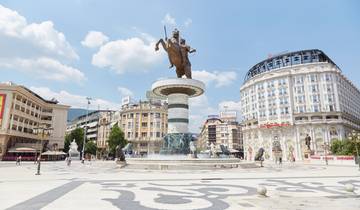
The capital, Skopje, confronts every visitor with an immediate and unavoidable question. Its Skopje 2014 redevelopment project — largely constructed between 2010 and 2018 — filled Macedonia Square and surrounding streets with neoclassical monuments, triumphal arches, fountains, and more than a hundred bronze statues, creating a cityscape unlike anything else on the European continent. The centrepiece Warrior on a Horse statue rises 22 metres above the square, widely understood to represent Alexander the Great despite the naming ambiguity. Travellers find the result either fascinatingly surreal or unexpectedly impressive; almost nobody finds it forgettable. Directly across the Stone Bridge, Skopje’s Ottoman-era Old Bazaar — one of the largest bazaars in the Balkans — preserves 15th-century trading architecture in cobblestone lanes where artisan workshops, mosques, and traditional restaurants coexist in largely unchanged form. The two halves of Skopje, baroque and Ottoman, produce a contrast that defines the city’s appeal.
Ohrid, 174 kilometres to the southwest, offers the country’s other defining experience and the one that most first-time visitors cite as the trip’s emotional peak. The UNESCO-listed Old Town climbs a rocky promontory above a lake of scientific importance matched by few bodies of water in the world. Lake Ohrid is approximately 3 million years old, 294 metres at maximum depth, and so biologically isolated by its geological history that it harbours species found nowhere else on Earth — including the Ohrid trout (Salmo letnica) and dozens of endemic invertebrates. Medieval churches crowd the hilltop in extraordinary concentration: Saint Clement of Ohrid established the first Slavic-language university here in the 9th century, and the subsequent centuries of religious building left a density of Byzantine frescoes, carved iconostases, and fortified walls that the UNESCO inscription of 1979-1980 recognised as internationally significant.
This itinerary constructs a logical route through these highlights over 7 days — three days based in Skopje with the Matka Canyon excursion on Day 3, a scenic mountain transfer via Mavrovo National Park on Day 4, and three days exploring the Ohrid lake region on Days 5-7. The route is fully executable by public bus throughout, with the single optional improvement being a hired driver for the mountain crossing on Day 4. Accommodation costs verify what the prices suggest: North Macedonia in 2026 is significantly cheaper than anywhere else on this cultural level in Europe.
Day 1 in Skopje 2026: Arrival and City Orientation
Flights into North Macedonia arrive primarily at Alexander the Great Airport (SKP), 21 kilometres east of Skopje’s city centre. The Vardar Express public bus connects the airport to central Skopje for MKD 199 ($4), running frequently with a journey time of 30-40 minutes and a final stop near Hotel Bristol in the centre. Official taxis operate at a fixed rate of approximately MKD 1,100-1,650 ($20-30) to central accommodation; confirm the meter is running or agree on the price before departure. Ride-hailing apps (InDrive and Bolt both operate in Skopje) offer transparent fares as an alternative. Check official schedules at the airport for current bus times, as these update seasonally.
Afternoon: Macedonia Square and the Stone Bridge
After checking in, Macedonia Square serves as an immediate and suitably overwhelming introduction to the city. The square is the centrepiece of the Skopje 2014 project: the Warrior on a Horse monument rises 22 metres at its centre, surrounded by smaller statues of historical figures on tall plinths, the arc of the Macedonia Gate, and the Alexander the Great fountain basin that activates with music and lights each evening. The ensemble is simultaneously the most controversial and most photographed collection of public statuary in the Balkans. Entry is free throughout; the evening fountain show begins around 8-9 PM in summer.
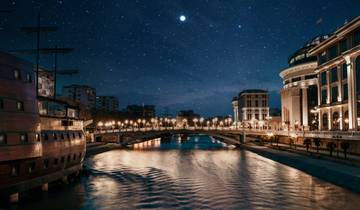
The Stone Bridge (Kameni Most), a few paces from the square, crosses the Vardar River into the Old Bazaar quarter. Dating to the 15th century under Ottoman rule and rebuilt on much earlier Byzantine foundations, it is the oldest surviving structure in the city centre and marks the transition between Skopje’s two distinct personalities. Walk across it in the late afternoon to get a preliminary feel for the bazaar district before exploring it in full on Day 2.
Evening: First Dinner in the Old Bazaar
The Old Bazaar concentrates Skopje’s best traditional cooking in restaurants along its cobblestone lanes. Destan, Kapan Han, and Čorbadzilnicata are among the most consistently praised choices for Macedonian cuisine — expect tavče gravče (slow-baked white beans with paprika and vegetables, the national dish), grilled meats, ajvar (roasted red pepper spread), and locally produced wine at prices that confirm the country’s affordability. A full dinner with a main course, side salad, bread, and a local beer costs MKD 600-1,000 ($11-18) per person at traditional bazaar restaurants. Book ahead for peak summer evenings when outdoor terrace seating fills by 7 PM.
Day 2 in Skopje 2026: Fortress, Old Bazaar, and Heritage Sites
Day 2 explores Skopje’s most historically significant areas on foot. The natural route runs from Kale Fortress above the city, down through the bazaar quarter, east to the Mother Teresa Memorial House, and back along the pedestrian Macedonia Street to the city centre. Total walking distance is approximately 6-8 kilometres for a full day at an unhurried pace.
Morning: Kale Fortress and the City from Above
Kale Fortress (Skopsko Kale) crowns the hill directly above the Old Bazaar, providing the best panoramic views of Skopje from any accessible point in the city. Entry is free. The fortress complex in its current form dates primarily to the 6th century under Byzantine Emperor Justinian, though archaeological excavations within the walls have confirmed continuous occupation from the Neolithic period through the Ottoman era. The enclosed plateau preserves visible wall sections, towers, and the foundations of multiple building phases revealed by ongoing excavations. The view south over Macedonia Square and the Vardar River, and north toward Vodno Mountain with its 66-metre Millennium Cross on the ridge, explains the strategic logic of the site across three thousand years of fortification. Arrive before 10 AM in summer to avoid heat; the fortress requires no ticket and no advance booking.
Midday: The Old Bazaar Quarter
Walking downhill from Kale, the Old Bazaar begins directly below the fortress walls and extends across roughly 3 square kilometres of cobblestone streets, Ottoman mosques, caravanserais, artisan workshops, and traditional restaurants. The Mustafa Pasha Mosque (1492) is among the finest surviving Ottoman religious buildings in the Balkans — its marble entry portal and portico columns are in exceptional condition, and non-Muslim visitors are welcome outside the five daily prayer times (free entry, shoes removed at the entrance). The Daut-Pasha Hammam, a 15th-century Ottoman bathhouse converted to the National Gallery of Macedonia, runs changing exhibitions in the restored domed chambers; admission is MKD 100-150 ($2-3). The Bezisten, a four-domed Ottoman covered market, continues as a commercial arcade and is freely accessible during business hours.
The bazaar rewards unhurried walking rather than a site-by-site checklist. Artisan copper workshops, leather goods producers, and traditional textile sellers occupy the lanes closest to the fortress on the steeper northern section. Lunch is straightforward anywhere in this district: burek (flaky pastry with cheese, meat, or spinach filling) from a street bakery costs MKD 80-150 ($1-3), while a sit-down traditional lunch runs MKD 500-800 ($9-15) per person with a drink at any of the courtyard restaurants.
Afternoon: Mother Teresa Memorial House and City Centre
Mother Teresa was born in Skopje on 26 August 1910 as Anjezë Gonxhe Bojaxhiu — a fact that surprises many visitors more familiar with her association with Kolkata. The Mother Teresa Memorial House on the pedestrian Macedonia Street occupies the site of the original family home and combines a small chapel, exhibition rooms tracing her life and work in sequence, and a tranquil interior courtyard. Admission is MKD 100-150 ($2-3) and the visit typically takes 45-60 minutes. The surrounding Macedonia Street pedestrian precinct connects directly back to Macedonia Square, passing cafés, the National Theatre, and several of the Skopje 2014 statues at street level — a pleasant way to close the day’s walking with coffee before a return to the bazaar for dinner.
Day 3 from Skopje 2026: Matka Canyon Full Day
Matka Canyon sits 15 kilometres southwest of Skopje’s city centre — close enough for a half-day trip, but rich enough in activities to justify a full one. The Treska River cut this canyon through limestone over millions of years, producing sheer cliff walls up to 100 metres high above emerald-green water. Ten caves, three medieval monasteries, hiking trails along the rim, and motorised boat tours to an underground cave system make it the most diverse natural day trip available from any Balkan capital. Entrance to the canyon itself is free.
Getting to Matka Canyon in 2026
City bus #60 departs from the main bus station in central Skopje and stops at the Matka Canyon entrance, a journey of 40-55 minutes costing MKD 45-65 ($1) each way. Buses run roughly every 30-40 minutes during daylight hours, though the schedule varies seasonally — confirm current times at the bus station on the morning of departure. Taxis from the city centre charge MKD 600-900 ($11-16) each way, making a shared taxi worthwhile for groups of three or four. For those arriving by car, parking at the canyon is free.
Vrelo Cave Boat Tour
The primary activity at Matka is the motorised boat tour to Vrelo Cave, departing from two separate docks at the canyon entrance. The longer tour — including the scenic transit up the gorge, guided entry to the cave system with its stalactites and two underground lakes, and the return journey — costs MKD 500-600 ($9-11) per person and takes approximately 60-90 minutes. Boats depart when sufficient passengers have gathered rather than on a fixed schedule; summer mornings see frequent departures, while off-season visits require waiting 20-40 minutes for enough passengers. Vrelo Cave is documented as one of Europe’s deepest known underwater cave systems — the floor has been measured at over 200 metres depth and not yet fully explored. Bring a light jacket regardless of outside temperature: the cave interior holds a consistent 10-12°C throughout the year. Carry cash in MKD, as the boat operators are cash-only.
Hiking Trails and the Canyon Monasteries
A 6-kilometre round-trip cliff-edge walking path starts near the main dock restaurant and follows the canyon rim, with views down to the lake and across to the opposite cliff face. Sturdy metal railings protect the most exposed sections; the walk takes approximately 2 hours at a moderate pace and is suitable for anyone with reasonable fitness and appropriate footwear. The 13th-century Monastery of St. Andrew sits within the canyon walls, accessible via a short steep path from the main trail. Entry is free; the partially preserved Byzantine frescoes inside the small church are worth the 15-minute detour. A second monastery, St. Nicholas, perches higher on the opposite cliff face and requires a more strenuous ascent.
The full Matka experience — boat tour with cave visit, cliff walk, and monastery visits — takes 6-8 hours comfortably. Pack water (limited options on trail), sun protection, and trail-appropriate footwear. The restaurant at the canyon entrance serves standard Macedonian grilled food (MKD 600-900 / $11-16 for a full meal), though bringing lunch from Skopje reduces cost. Return by bus #60 or pre-arranged taxi in the late afternoon.
Day 4 in 2026: Skopje to Ohrid via Mavrovo National Park
Day 4 is the trip’s most scenic transit day, moving from Skopje to Ohrid via Mavrovo National Park through western North Macedonia’s mountain landscapes. The full Skopje-Mavrovo-Ohrid journey takes 5-6 hours with a 2-3 hour park stop, requiring an early departure from Skopje — a 7-8 AM start is ideal. This is the single day of the itinerary where a hired driver or rental car provides a significantly better experience than public bus, though the bus route is feasible for committed budget travellers.
Getting to Mavrovo: Transport Options for 2026
The most practical option for most first-time visitors is hiring a private driver or taxi for the full Skopje-Mavrovo-Ohrid day, costing MKD 5,500-8,250 ($100-150) total for a vehicle accommodating up to four passengers. This allows flexible stops at lake viewpoints, the Bigorski Monastery, and village cafés along the Radika River gorge road — the scenic highlight of the route. Negotiate the full-day price in advance and confirm it includes all petrol; established taxi companies at the Skopje Transport Centre offer this service routinely.
Budget travellers using public transport take a bus from Skopje to Gostivar (MKD 220-330 / $4-6, 1 hour), then a connecting minibus or local bus toward Mavrovo village (MKD 165-275 / $3-5). From Mavrovo, a further bus or shared taxi reaches Ohrid via Kičevo and Struga. This public transport route is slower, less scenic, and involves waiting at connections — but costs under $20 total including the Bigorski Monastery detour, where a local taxi from the main road charges MKD 165-220 ($3-4) each way.
Mavrovo National Park: Lake and Monastery
Mavrovo National Park — the largest of North Macedonia’s three national parks at 730 square kilometres — surrounds Lake Mavrovo in the Bistra and Korab mountain ranges along the Albanian border. The artificial reservoir was created in 1953 when a dam flooded the Mavrovo valley; the 19th-century Church of St. Nikola now stands partially submerged in the lake, its tower and upper walls emerging above the water surface during dry periods to produce one of the country’s most striking photographic subjects. The lakeside village of Mavrovo provides the main access point, with a free lakeside viewpoint accessible on foot from the village in under 10 minutes. Park entry fees of MKD 165-275 ($3-5) per person apply at formal entry points, though collection varies by season and access route.
The 14th-century Bigorski Monastery (Monastery of St. John the Baptist) stands in the Radika River gorge approximately 25 kilometres south of Lake Mavrovo and is worth a dedicated 45-minute stop. The monastery’s iconostasis — a carved wooden screen between the nave and sanctuary completed over 12 years by master craftsmen in the 19th century — is considered among the finest examples of traditional Macedonian wood-carving and is detailed to a standard that requires close viewing to fully appreciate. Entry to the monastery is free; visitors dress modestly (covered shoulders and knees). The drive along the Radika gorge from Mavrovo to Bigorski monastery, following the river through sheer limestone walls, is one of the most beautiful road sections in the western Balkans.
Afternoon Arrival in Ohrid
The drive from Bigorski Monastery continues south through Debar and Struga to Ohrid, arriving in late afternoon after approximately 90 minutes. Check in to accommodation and take an evening walk along the lakefront promenade to orient yourself before dinner. The boardwalk from the modern harbour to the Old Town is flat, lit, and directly on the lake — a pleasant introduction after a day in the mountains. Lakefront restaurants around the harbour specialise in grilled Ohrid lake trout (pastrmka), the regional delicacy; expect to pay MKD 500-700 ($9-13) per fish portion at a quality restaurant, accompanied by local Vranec wine at MKD 220-330 ($4-6) per glass.
Day 5 in Ohrid 2026: UNESCO Old Town Exploration
Ohrid Old Town rises steeply from the lake on a rocky promontory, its narrow cobblestone streets connecting a medieval fortress, multiple Byzantine-era churches, a Hellenistic-Roman theatre, and a 9th-century archaeological complex within a zone walkable end-to-end in under 20 minutes. Day 5 covers the four essential heritage sites in a single full day, moving from the highest point (Samuel’s Fortress) downward through the promontory to the famous clifftop church. The boardwalk and lakeside path provide a pleasant return route.
Samuel’s Fortress and the Upper City
Tsar Samuel’s Fortress (Carevi Kuli) crowns the highest point of the Old Town promontory, offering panoramic views encompassing both the historic city below and the entire expanse of Lake Ohrid reaching to the Albanian mountains on the far shore. Entrance costs MKD 120 ($2), making it one of the most affordable viewpoints relative to quality in the Balkans — check the official site for current opening hours as these vary seasonally. The fortress dates in its current form to the 10th-century reign of Tsar Samuel, who made Ohrid the capital of the First Bulgarian Empire during his wars with Byzantium, though its walls incorporate foundations from much earlier periods. The upper ramparts require a climb but are fully accessible; the view from the top is the definitive orientation point for understanding Ohrid’s geography.
Plaoshnik and the Church of St. Sophia
Plaoshnik, the archaeological complex immediately below the fortress along the promontory’s western edge, represents one of the most culturally significant sites in Slavic history. Saint Clement of Ohrid — a direct disciple of Saints Cyril and Methodius, who created the Glagolitic and Cyrillic alphabets for the purpose of translating religious texts into Slavic languages — established the first Slavic-language university at this site in 893 AD. The reconstructed Church of Saints Clement and Panteleimon stands over the original 9th-century foundations, and the surrounding archaeological zone exposes extensive Roman-era floor mosaics alongside early Christian basilica remains. Admission to the Plaoshnik complex is MKD 100 ($2) and includes access to the church interior and the mosaics. Allow 45-60 minutes.
The 11th-century Church of St. Sophia (Sveta Sofija) stands a short walk below Plaoshnik in the lower Old Town. This was the archbishop’s cathedral of the Ohrid Archbishopric — a religious institution of pan-Balkan significance — and its interior walls preserve the largest concentration of Byzantine frescoes in North Macedonia. The paintings cover multiple layers from the 11th to the 14th centuries, with a quality of preservation attributable to the region’s dry microclimate. Admission is approximately MKD 150-200 ($3-4). The church closes midday on some days; morning visits before noon are the most reliable option.
Church of St. John at Kaneo
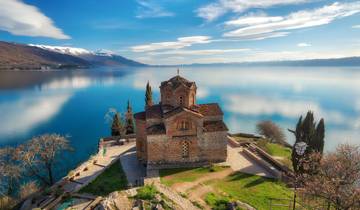
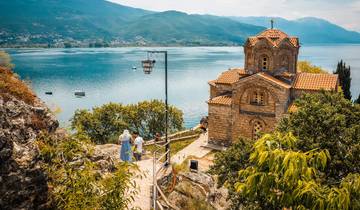
The 13th-century Church of St. John at Kaneo is North Macedonia’s most photographed structure: a small Byzantine church perched on a rocky cliff jutting directly into Lake Ohrid, its red-tiled dome and pale stone walls framed by blue water and distant mountains from every angle. The approach follows a wooden boardwalk from the Old Town harbour, rising steeply along the cliff to a terrace above the lake. The exterior and cliff viewpoint are free and constitute the primary draw; interior admission is MKD 150 ($3). The church is small enough that 10-12 visitors fill it, and the interior frescoes are more modest than St. Sophia’s — but the setting makes this one of the most memorable locations in the entire Balkan region regardless of interior content. The light for photography falls optimally in the 90 minutes before sunset, when the western sun catches the façade against the darkening lake.
The Ancient Theatre of Ohrid
The Ancient Theatre of Ohrid sits within the Old Town walls below the fortress, partially carved into the natural hillside in the Hellenistic style. Constructed in the 2nd century BC and substantially preserved despite centuries of burial under later construction, the theatre was rediscovered in 1980 during building works and partially restored. It holds approximately 5,000 spectators and remains in active use for performances during the Ohrid Summer Festival (late June to August). Admission to the empty theatre on non-event days is MKD 100 ($2). The stone seating overlooks the lake and offers another strong photographic angle on the town’s geography. If visiting during the festival, check the programme at ohridskoleto.com.mk — the experience of attending an outdoor performance in a functioning ancient theatre is worth planning around.
Day 6 in Ohrid 2026: Lake Ohrid and St. Naum Monastery
Day 6 uses the lake itself as the primary transit route, travelling by ferry to St. Naum Monastery at the lake’s southern extremity and returning by late afternoon. The journey passes the Bay of Bones prehistoric site, lakeside villages, and the Galičica National Park mountainside rising above the Albanian shore. This is the most relaxed day of the itinerary — deliberately paced, with long stretches on open water and time to simply absorb a lake environment of unusual scientific importance.
The Lake Ferry to St. Naum 2026
Ferry companies operating from Ohrid harbour offer daily excursions to St. Naum Monastery, typically departing between 9:30 and 10:30 AM and returning by 4-5 PM. The round-trip crossing takes approximately 90 minutes each way and costs MKD 600-900 ($11-16) per person for an independent ferry ticket. Operators including Boat Ohrid, Christina Nova, and Alexandria all ply the route; buy tickets at the harbour on the morning of departure — advance booking is unnecessary except during peak August festival weeks. Full-day guided tours with commentary about the lake ecosystem, a stop at Bay of Bones, and inclusion of the St. Naum springs rowing boat cost $55-65 per person through GetYourGuide and Viator, and are worthwhile for visitors who want ecological context for what they see. Check official operator websites or the harbour board for the 2026 schedule, as departure times can shift between seasons.
En route south, most ferries make a 30-40 minute stop at the Bay of Bones Museum (Zaliv na Koščite), a reconstructed Bronze Age lake-dwelling settlement on stilts approximately 8 kilometres from Ohrid. The site dates to 1400-700 BC and is one of the best-documented prehistoric pile-dwelling complexes in Europe; museum buildings extend over the water and contain the original excavated artefacts with explanation panels in English. Entrance is MKD 120 ($2), payable at the floating dock.
St. Naum Monastery and the Springs of the Black Drim
St. Naum Monastery was founded in 905 AD by Saint Naum of Ohrid — a direct disciple of Saints Cyril and Methodius who spent the later decades of his life continuing Saint Clement’s educational mission on the lake’s southern shore. The monastery stands on a rocky promontory at the Albanian border, its current church structure dating primarily to the 16th and 17th centuries, with an interior of richly layered frescoes and the venerated tomb of Saint Naum. Entry to the monastery grounds is free; a donation at the church door is customary. Peacocks roam the gardens surrounding the church — a detail visitors consistently note as unexpectedly charming.
The Springs of the Black Drim (Crn Drim) immediately adjacent to the monastery grounds provide the day’s most distinctive natural experience. Cold freshwater springs bubble from the lake floor through a series of channels between reed beds and willow overhangs, producing water of exceptional clarity — visibility to the sandy bottom reaches 3-4 metres or more. Small wooden rowing boats navigate the narrow channels; guided tours include the rowing boat trip, while independent visitors can arrange a boat directly at the springs for MKD 250-400 ($5-7) per person. The temperature in the spring channels is markedly cooler than the open lake, and the silence after the ferry crossing amplifies the sense of having arrived somewhere genuinely remote despite the ferry dock immediately behind.
An alternative to the ferry is the local bus from Ohrid bus station to St. Naum, which runs 6-7 times daily and costs MKD 120-150 ($2-3) one way. This makes sense for travellers prioritising maximum time at the monastery over the lake journey experience; the bus follows the scenic southern lakeside road through Pestani and Gradište, passing lake beaches along the way. The last return bus typically departs St. Naum in early afternoon — check current times at the Ohrid bus station before departure.
Day 7 in 2026: Final Ohrid Morning and Return, with Bitola Option
Day 7 offers a choice based on departure logistics and remaining energy. Travellers with evening flights from Skopje or no morning commitments can take a morning day trip to Bitola — North Macedonia’s second city and one of the most historically layered Ottoman towns in the western Balkans. Travellers with early morning flights from Ohrid’s St. Paul the Apostle Airport or afternoon departures from Skopje use the morning for a final lakefront walk and relaxed breakfast before transfer.
Bitola Day Trip from Ohrid 2026: Heraclea Lyncestis
Bitola sits 68 kilometres east of Ohrid, accessible by direct bus in approximately 1.5 hours for MKD 300-400 ($5-7) from Ohrid bus station. The city’s defining attraction is Heraclea Lyncestis, an ancient Macedonian city founded by Philip II of Macedon in the 4th century BC — the father of Alexander the Great established the settlement as a military and commercial outpost on the road connecting the Aegean coast to the Danube region. The site sits 1 kilometre south of Bitola’s centre and contains some of the most exceptional Roman-era floor mosaics in the Balkans: the Large Basilica mosaic covers hundreds of square metres with hunting scenes, birds, and botanical motifs in colours and detail that have survived largely intact. Entrance to Heraclea Lyncestis costs MKD 300 ($5). The site also exposes a Hellenistic-Roman theatre, colonnaded street, episcopal residence, and early Christian baptistery; allow 1.5-2 hours for a thorough visit with time to read the information panels.
After Heraclea, Bitola’s pedestrianised Shirok Sokak (literally “Wide Street”) provides a pleasant hour of Ottoman-era architecture and café culture before the return journey. The boulevard is lined with 19th-century consular buildings from the period when Bitola was a significant Ottoman administrative and diplomatic centre — a young military officer named Mustafa Kemal, later known as Atatürk, was posted here in 1905-1906 and a small museum marks his connection to the city. The clock tower (Saat Kula) at the boulevard’s north end is the city’s symbol. Lunch on Shirok Sokak at a traditional restaurant costs MKD 500-800 ($9-15) per person — noticeably cheaper than equivalent restaurants in Ohrid.
Return to Skopje 2026
Direct buses from Ohrid to Skopje run up to 11 times daily, with the earliest departure at 05:30 and the last at 22:30. Journey time is 3-3.5 hours; tickets cost MKD 520-900 ($9-16) depending on operator. Galeb, Classic Company, and Makedonija Soobrakaj are the primary operators; tickets are purchased at the Ohrid bus station window or online at traveling.com. The station entry fee of MKD 50 ($1) is payable separately at the gate. For travellers departing via Skopje airport, the bus deposits passengers at the Skopje Transport Centre (Transporten Centar); the airport shuttle departs from nearby for MKD 199 ($4), taking 30-40 minutes to the terminal.
Travellers departing from Ohrid Airport (OHD) — St. Paul the Apostle Airport, 4 kilometres from Ohrid town — take a fixed-rate taxi of approximately MKD 300 ($5) to the terminal. The airport operates primarily seasonal charter flights to the UK, Germany, and the Netherlands between June and October; check your departure details carefully, as the airport handles only a fraction of the international capacity of Skopje.
Transportation in North Macedonia 2026: Getting Around on Any Budget
Arriving in North Macedonia 2026
Alexander the Great Airport (SKP) in Skopje handles the majority of international arrivals year-round, with direct connections to most major European hubs including London, Amsterdam, Frankfurt, Istanbul, Vienna, and Zürich. Ohrid’s St. Paul the Apostle Airport (OHD) operates seasonal charter and low-cost flights primarily from the UK, Germany, the Netherlands, and Scandinavia between June and October. Travellers with flexibility can fly into one airport and out of the other — Skopje in, Ohrid out, or vice versa — without doubling back along the same route.
From Skopje airport, the Vardar Express public bus costs MKD 199 ($4) to the city centre, runs frequently from early morning to late evening, and takes 30-40 minutes. Official metered taxis at the airport charge approximately MKD 1,100-1,650 ($20-30) to central Skopje accommodation. From Ohrid airport, fixed-rate taxis to the town centre charge approximately MKD 300 ($5).
Intercity Bus Services in North Macedonia 2026
Buses form the practical backbone of intercity travel in North Macedonia. The routes relevant to this 7-day itinerary, with 2026 price ranges:
- Skopje to Ohrid: MKD 520-900 ($9-16), approximately 3-3.5 hours. Up to 11 daily departures from Skopje Transport Centre, with operators including Galeb, Classic Company, and Makedonija Soobrakaj. Buses run from 05:00 to approximately 22:30.
- Ohrid to Bitola: MKD 300-400 ($5-7), approximately 1.5 hours. Several daily departures from Ohrid bus station.
- Skopje to Bitola (direct): MKD 440-600 ($8-11), approximately 2.5-3 hours via the A1 motorway — a free motorway with no tolls.
- Skopje to Gostivar (Mavrovo connection): MKD 220-330 ($4-6), approximately 1 hour. Gostivar is the transfer point for buses toward Mavrovo village.
- Ohrid to St. Naum (local bus): MKD 120-150 ($2-3) one way, approximately 1 hour, 6-7 departures daily.
A MKD 50 ($1) platform entry fee applies at the Skopje Transport Centre, payable at the entrance gate and separate from the bus ticket. Tickets are purchased at station windows or directly from the driver on some regional services. Cash in MKD is required at most bus stations, though the main Skopje terminal accepts card payment at the ticket office for international and premium services.
Local Transport in Skopje and Ohrid 2026
Within Skopje, all major tourist sites are within walking distance of centrally located accommodation, with the most useful exception being Matka Canyon (reached via bus #60 at MKD 45-65 / $1 each way). City buses within Skopje cost MKD 35-65 ($1) per ride. Metered taxis for in-city journeys run MKD 100-250 ($2-5) for most destinations. InDrive and Bolt both operate in Skopje and provide transparent fares via app, making them increasingly preferred over street taxis.
Ohrid’s Old Town is compact enough that all primary UNESCO sites — Samuel’s Fortress, St. Sofia, Plaoshnik, St. John at Kaneo, and the Ancient Theatre — are reachable on foot from any Old Town accommodation. The lakefront boardwalk connecting the modern harbour to the Old Town promontory is pedestrian-only and a pleasure to walk in either direction. For Bay of Bones and St. Naum, the ferry (departing from the harbour) and the local bus (from Ohrid bus station, MKD 120-150 / $2-3 one way) are the standard options.
Car Rental in North Macedonia 2026
Renting a car unlocks the most rewarding aspects of Day 4 (the Mavrovo crossing) and opens day trips to the Tikveš wine region, Pelister National Park south of Bitola, and villages unreachable by scheduled bus. Compact car rental from major agencies at Skopje airport (Europcar, Avis, Sixt, and local operators all have desks) starts from approximately MKD 2,200-3,300 ($40-60) per day. Main roads between cities are in good condition; mountain roads in Mavrovo and Galičica can be narrow and steep with limited guardrails on exposed sections. An International Driving Permit is recommended alongside a valid home-country licence, though EU and US licence holders are not always strictly required to carry one. Insurance is typically included in the daily rate at major agencies; confirm the excess and confirm coverage for gravel roads before signing.
Where to Stay in North Macedonia 2026: Accommodation by Tier
Where to Stay in Skopje 2026
Skopje accommodation clusters in two areas: the modern city centre around Macedonia Square, convenient for monuments, restaurants, and transport, and the Old Bazaar district, more atmospheric and within walking distance of the fortress and traditional dining. The city centre suits most first-time visitors for ease of orientation; the bazaar area suits those who want to open their window to Ottoman streetscapes.
- Budget (hostel dorm): MKD 770-1,375 ($14-25) per bed per night. Hi Skopje Hostel and Skopje City Hostel receive consistently strong reviews for cleanliness, central location, and English-speaking staff. Budget hotels (private room) start from MKD 1,375-2,200 ($25-40) per room per night.
- Mid-range (hotel double): MKD 3,300-5,500 ($60-100) per room per night. Boutique hotels in the Old Bazaar area and 3-star properties near Macedonia Square represent best value in this range. Hotel Super 8 (from approximately MKD 3,282 per room) and the Holiday Inn Skopje are among the consistently rated options near central sights. The average mid-range hotel near Macedonia Square sits around $61 per night, with well-reviewed alternatives available from $48.
- Luxury (hotel double): MKD 8,250-13,750 ($150-250+) per room per night. The Skopje Marriott (rated 9.4/10) and DoubleTree by Hilton represent the city’s 5-star category. The Aleksandar Palace Hotel is a long-established luxury option in the city centre.
Book accommodation at least 2-3 weeks ahead for July-August visits to Skopje; the city’s festival calendar and regional summer travel create periodic demand spikes. Shoulder and off-season rates (October-April) run 30-40% below the peak summer figures quoted above. Check Booking.com or Expedia for current rates as prices update daily.
Where to Stay in Ohrid 2026
Ohrid accommodation divides between three distinct zones, each with a different character. The Old Town promontory — steep cobblestone streets, stone houses converted to guesthouses, quiet evenings away from the harbour bar strip — is the most atmospheric choice for first-time visitors. The modern lakefront along the main boulevard provides direct water access and the greatest concentration of restaurants but feels more generic. The Kaneo village area, near the famous church, is the quietest option and well-positioned for early morning photography at the clifftop, with the trade-off of a 15-minute walk back to the Old Town.
- Budget (hostel/guesthouse): MKD 820-1,650 ($15-30) per person per night. Blue Lake Hostel is the most established budget option. Small family-run guesthouses in the Old Town frequently offer private rooms at the low end of the mid-range price with hostel-level informality.
- Mid-range (hotel double): MKD 3,300-6,600 ($60-120) per room per night. Stone-house guesthouses within the Old Town walls provide the strongest atmosphere in this range, with lake views from upper floors in some properties. The average hotel room across all Ohrid properties runs approximately $113 per night, with budget-oriented options from $26.
- Luxury (hotel double): MKD 8,250-14,000 ($150-255) per room per night. Inex Olgica Hotel & Spa and Ambasador Hotel represent Ohrid’s 4-5 star tier, with lakeside locations and pool access.
Ohrid in peak summer (late July-August, particularly during the Ohrid Summer Festival) sees accommodation fully booked up to 6 weeks in advance. Book both accommodation and any guided tours simultaneously if your 2026 dates align with the festival calendar. May-June and September rates run 25-35% below the peak summer figures above.
North Macedonia Budget Breakdown 2026: Complete Cost Guide
North Macedonia is among the most affordable countries in Europe for the quality of experience it delivers in 2026. All daily cost figures below are per person, per day, assuming two people sharing accommodation. Hotel room rates are divided by two before inclusion in per-person totals — the accommodation cost in every figure below represents one person’s share of a shared double room.
Budget Tier Daily Costs in North Macedonia 2026
Budget travelers using hostel dormitories, eating at local eateries and bakeries, and relying entirely on public transport spend MKD 1,925-3,575 ($35-65) per person per day in North Macedonia. This includes a hostel dorm bed at MKD 770-1,375 ($14-25) per night, three meals combining bakery breakfasts, local eatery lunches, and sit-down dinners at MKD 880-1,450 ($16-26), city transport and occasional taxis at MKD 100-250 ($2-5), and daily attraction admissions averaging MKD 100-300 ($2-5). Intercity bus costs — the Skopje-Ohrid journey at MKD 520-900 ($9-16) and the return — add approximately $2-5 per day when amortised across the full week. A 7-day budget trip including all of the above (hostel accommodation, local meals, public transport, and attraction admissions) costs approximately $245-455 per person in total.
Mid-Range Tier Daily Costs in North Macedonia 2026
Mid-range travelers sharing a hotel double room and dining at proper sit-down restaurants spend MKD 4,125-7,425 ($75-135) per person per day. The mid-range hotel double divided by two contributes MKD 1,650-2,750 ($30-50) per person; three meals at mid-range restaurants add MKD 1,650-2,750 ($30-50); mixed transport (transit plus occasional taxi) runs MKD 275-600 ($5-11); and daily attractions and experiences account for MKD 385-825 ($7-15). A guided day tour — Ohrid Old Town walking tour at $20-30, or a Matka Canyon tour including cable car at $35-45 — sits comfortably within the attractions allowance. A 7-day mid-range trip (6 nights hotel sharing, restaurant dining throughout, intercity buses, and day tour activities) costs approximately $525-945 per person in total. North Macedonia’s mid-range dining is exceptional value: a three-course dinner with house wine at a respected Ohrid lakefront restaurant rarely exceeds MKD 1,500 ($27) per person.
Luxury Tier Daily Costs in North Macedonia 2026
Luxury travelers in boutique 4-5 star hotels, upscale restaurants, and private transfers spend MKD 10,175-17,600 ($185-320) per person per day (two sharing). The luxury hotel double divided by two contributes MKD 4,125-6,875 ($75-125) per person per night; upscale dining across three meals adds MKD 3,850-6,600 ($70-120); private transfers and taxis account for MKD 825-1,375 ($15-25); and premium experiences including private guided tours run MKD 1,375-2,750 ($25-50). A 7-day luxury trip costs approximately $1,295-2,240 per person — still significantly below equivalent hotels and restaurants in Western European capitals. A lake-view suite in Ohrid at $125 per person per night compares favourably with coastal Croatia or Greek island boutique hotels at three to four times the per-person cost.
Complete 7-Day Trip Summary for North Macedonia 2026
The totals below cover 6 nights accommodation, all daily meals, local transport throughout, intercity buses (Skopje-Ohrid and Ohrid-Skopje), and attraction admissions. International flights are excluded as these vary substantially by origin city and booking lead time.
- Budget (hostel dorms, local restaurants, public transport): approximately $245-455 per person for the 7-day trip
- Mid-range (hotel double shared, restaurant dining, mix of public and taxi transport): approximately $525-945 per person for the 7-day trip
- Luxury (boutique hotel shared, upscale dining, private transfers): approximately $1,295-2,240 per person for the 7-day trip
Hidden Costs and Fees in North Macedonia 2026
Several costs catch first-time visitors unprepared. The Skopje bus station entry fee of MKD 50 ($1) applies every time you enter the terminal building — including to purchase tickets — and applies at both the outbound and return Ohrid journeys. Tourist taxes in Ohrid add MKD 55-165 ($1-3) per person per night to hotel bills; the rate varies by accommodation category and is stated at check-in rather than always shown in online booking totals. ATM charges from local Macedonian banks for foreign cards typically run MKD 165-330 ($3-6) per withdrawal; withdrawing larger amounts less frequently reduces these. Credit cards are accepted in mid-range and upscale hotels and restaurants but are not universally usable at markets, smaller guesthouses, transport windows, or canyon boat operators. Carry MKD 3,300-5,500 ($60-100) in cash at all times for day-to-day expenses. No road tolls apply on the main highway routes in North Macedonia.
Food and Dining Costs in North Macedonia 2026
Macedonian cooking draws on Ottoman, Greek, and South Slavic traditions, producing a cuisine built around slow-cooked legumes, grilled meats, roasted peppers, and fresh dairy products. The country is an emerging wine destination, with the Tikveš region producing Vranec (dark, tannic red) and Smederevka (crisp white) at price points that make restaurant wine lists genuinely affordable. Dining out in North Macedonia in 2026 consistently surprises Western visitors accustomed to the cost of equivalent quality in their home countries.
- Bakery breakfast: A burek (cheese, meat, or spinach-filled flaky pastry) with a portion of yoghurt at a local pekara (bakery) costs MKD 80-150 ($1-3) per person. This is the standard breakfast eaten by most Macedonians before work and the cheapest solid meal available anywhere in the country.
- Café breakfast: Coffee with eggs, toast, and juice at a sit-down café runs MKD 300-500 ($5-9) per person in the city centre.
- Lunch at a local taverna: A full taverna lunch (tavče gravče or a grilled meat plate with salad, bread, and a beer) costs MKD 400-700 ($7-13) per person in the Old Bazaar or equivalent neighbourhood restaurants.
- Dinner at a mid-range restaurant: A three-course dinner with house wine at a quality Ohrid or Skopje restaurant runs MKD 800-1,500 ($15-27) per person. Grilled Ohrid lake trout (pastrmka) costs MKD 500-700 ($9-13) per whole fish portion.
- Fine dining: A gourmet meal at the best lakefront restaurants in Ohrid costs MKD 1,500-2,750 ($27-50) per person with wine.
- Coffee: Espresso or Macedonian-style coffee costs MKD 80-150 ($1-3) at local cafés; MKD 100-200 ($2-4) at tourist-oriented venues.
- Local beer (Skopsko, Zlaten Dab): MKD 100-200 ($2-4) at a local bar; MKD 200-350 ($4-6) at tourist restaurants.
- Macedonian wine by the glass: MKD 150-300 ($3-5) at mid-range restaurants — among the lowest wine-by-glass prices in Europe for regional varietals of this quality.
The essential food experiences to seek out on this 7-day itinerary are tavče gravče at any traditional Old Bazaar restaurant in Skopje on Day 1 or 2, grilled pastrmka lake trout on the Ohrid lakefront on Day 5 or 6, and a glass of Vranec with any dinner in Ohrid. These three dishes between them cover the national cuisine’s defining character and cost under $30 combined at mid-range establishments.
Best Timing for Your 2026 North Macedonia Trip
North Macedonia has four distinct seasons, each with specific implications for the 7-day itinerary described here.
- May-June 2026: The strongest recommendation for first-time visitors. Temperatures in Skopje reach 22-28°C and Ohrid’s lake warms toward swimming temperature by late June. Accommodation runs 25-35% below peak August rates, the Ohrid Summer Festival has not yet begun so crowds are manageable, and Mavrovo’s mountainsides are green and wildflower-covered after winter snowmelt. The Bigorski Monastery gorge road is at its most atmospheric in late May.
- July-August 2026: Peak season in every sense. The Ohrid Summer Festival (late June to August) fills the Ancient Theatre and other venues with classical music, opera, and folk performances — a compelling reason to accept higher prices and larger crowds. Ohrid accommodation requires booking 4-6 weeks in advance during festival weeks. Temperatures reach 32-38°C in Skopje; Matka Canyon and Mavrovo offer welcome relief. Beach days on Lake Ohrid are at their best, with water temperatures reaching 22-25°C.
- September-October 2026: Excellent shoulder season with arguably the best combination of conditions. Temperatures drop to 18-25°C, lake swimming remains possible through September, harvest festivals take place across the wine regions, and accommodation returns to mid-season pricing. Mavrovo’s forests turn amber and rust by late October — the mountain crossing on Day 4 looks its best at this time of year.
- November-April 2026: Off-season. Skopje functions year-round with all monuments accessible; Ohrid quiets significantly with many lakefront establishments closing November through March. Mavrovo operates limited ski facilities December-March. Accommodation prices across the country drop 40-50% below peak rates, making this an option for budget-focused travellers comfortable with cooler temperatures and reduced services in Ohrid.
Money-Saving Strategies for North Macedonia 2026
North Macedonia is already affordable by European standards, but specific approaches reduce costs further without compromising the trip’s essential experiences.
- Visit Ohrid outside late July and August: The Ohrid Summer Festival drives accommodation prices up 30-40% in peak weeks. A guesthouse charging MKD 5,500 ($100) per room per night in late July charges MKD 3,850 ($70) for the same room in early June or September. The UNESCO monuments, lake, and restaurants are identical in both periods.
- Use bus #60 to Matka Canyon: The city bus costs MKD 45-65 ($1) versus MKD 600-900 ($11-16) for a taxi. The 40-55 minute ride deposits you directly at the canyon entrance with the same result for the day.
- Take the local bus to St. Naum rather than the ferry: The Ohrid-St. Naum bus costs MKD 120-150 ($2-3) one way compared to MKD 600-900 ($11-16) for the round-trip ferry. Choose the bus if maximising time at the monastery is the priority and the lake journey is secondary; choose the ferry if the crossing itself is part of the experience.
- Hire a driver for Day 4 as a group: The Skopje-Mavrovo-Ohrid private driver cost of MKD 5,500-8,250 ($100-150) covers a full vehicle — split among four passengers this equals $25-37 each, making it one of the best-value travel experiences in the country for any group.
- Self-cater breakfast from local markets: Tinex and Ramstor supermarkets (both present in Skopje and Ohrid) carry fresh bread, local white cheese (sirenje), seasonal fruit, and yoghurt for MKD 200-350 ($4-6) per person per day — saving MKD 100-150 ($2-3) compared to café breakfast and providing a direct experience of local dairy culture.
- Order lunch, not dinner, at upscale restaurants: Most quality restaurants in Ohrid and Skopje offer lunch service at prices 20-25% below the same dishes at dinner. Grilled trout at a respected Ohrid lakefront restaurant costs MKD 550 ($10) at lunch versus MKD 700 ($13) at dinner in the same establishment.
- Exchange currency at bank branches or ATMs: Bank ATMs connected to Stopanska Banka, Komercijalna Banka, or NLB Tutunska Banka offer rates 5-8% better than hotel exchange desks and airport currency counters. Withdraw larger amounts less frequently to reduce per-transaction ATM fees of MKD 165-330 ($3-6).
Practical Travel Information for North Macedonia 2026
- Visas: Citizens of EU member states, the USA, Canada, Australia, New Zealand, the UK, and most other Western nations enter North Macedonia visa-free for up to 90 days. Verify current entry requirements at the official Ministry of Foreign Affairs of North Macedonia website before travel, as conditions can change between the time of publication and your departure date.
- Currency: Macedonian Denar (MKD). The MKD is pegged to the Euro at approximately 61.5 MKD per EUR, providing exchange rate stability. The USD rate at the time of writing is approximately 55 MKD per USD. Cash is preferred for markets, small guesthouses, buses, taxis, and many smaller restaurants. ATMs are widely available in Skopje and Ohrid city centres; less common in smaller towns and villages. Most mid-range and upscale hotels and restaurants accept Visa and Mastercard.
- Language: Macedonian is the official language, written in Cyrillic script. Albanian is co-official in municipalities with significant Albanian populations. English is spoken confidently in tourist areas of Skopje and Ohrid, including by virtually all hotel, hostel, and restaurant staff. Basic Macedonian phrases — фала / fala (thank you), добар ден / dobar den (good day), колку чини / kolku čini (how much does it cost) — are appreciated but are not required for navigating tourist zones.
- SIM cards: A local SIM from A1, Telekom (T-Mobile), or VIP Mobile costs MKD 275-550 ($5-10) at mobile phone shops in Skopje and Ohrid city centres, providing local calls and data coverage throughout the country. International roaming charges from many European networks are prohibitive by comparison; a local SIM is the most cost-effective option for a week-long stay.
- Health: No vaccinations are required for entry into North Macedonia. Tap water is safe to drink in both Skopje and Ohrid. EU citizens with a European Health Insurance Card (EHIC) receive partial coverage at public healthcare facilities; this does not substitute for comprehensive travel insurance, which is strongly recommended for all visitors. Hospital standards vary; the main Clinical Centre in Skopje handles serious cases.
- Electricity: 230V/50Hz, European Type C and Type F (Schuko) sockets throughout. Travellers from the UK require a Type G adapter; North American travellers require a Type C adapter and a voltage converter for non-dual-voltage devices.
- Tipping: Not mandatory but expected at restaurants with table service. Ten percent is standard for a satisfactory restaurant meal; rounding taxi fares up to the nearest convenient MKD figure is customary. Service is not typically included in restaurant bills in North Macedonia; check before leaving. Budget MKD 55-165 ($1-3) per meal as a practical tipping guide.
- Photography: Interior photography is restricted or prohibited in most churches and monasteries; exterior photography is unrestricted almost everywhere. Ask before photographing inside religious buildings; a small MKD donation is sometimes associated with photography permission in active religious sites.
Frequently Asked Questions About North Macedonia 2026
How many days do you really need in North Macedonia?
Seven days covers the country’s essential highlights with appropriate depth — three days in Skopje including Matka Canyon, the mountain crossing via Mavrovo, and three days in Ohrid with the lake excursion. Travellers with 4-5 days can concentrate on Skopje (2 days) and Ohrid (2-3 days) without the Mavrovo detour. Ten days or more opens up Bitola as a multi-night base, the Tikveš wine region south of Veles, Pelister National Park, and the Prespa Lake region shared with Greece and Albania.
Is Ohrid worth the trip from Skopje?
Ohrid ranks among the most rewarding destinations in the entire Balkan region and is the primary reason most travellers come to North Macedonia. The combination of a UNESCO-listed medieval Old Town, Byzantine frescoes in exceptional preservation, a lake of extraordinary scientific rarity, and affordable lakefront restaurants serving grilled fish and regional wine produces an experience that most visitors describe as the trip’s defining memory. The 3-hour bus journey from Skopje for under $16 makes it one of the most accessible major heritage sites per kilometre in Eastern Europe.
What is the best way to travel from Skopje to Ohrid in 2026?
The direct bus from Skopje Transport Centre costs MKD 520-900 ($9-16), takes 3-3.5 hours, and operates up to 11 times daily — it is the practical standard for most independent travellers. For this specific itinerary’s Day 4, a hired driver covering the Skopje-Mavrovo-Ohrid route costs MKD 5,500-8,250 ($100-150) for the vehicle and provides the superior experience through the mountain detour. Car rental from Skopje airport at $40-60 per day is the most flexible option for travellers who want independent movement throughout the trip. No regular domestic air service operates between the two cities.
What is the food like in North Macedonia?
Macedonian cuisine is built around slow-cooked legumes, grilled meats, roasted vegetables, and fresh dairy products in a tradition shaped equally by Ottoman, Greek, and South Slavic influences. The national dish, tavče gravče, is white beans baked slowly in a clay pot with onions, paprika, and peppers — simple, deeply flavoured, and available at virtually every traditional restaurant. Ohrid lake trout (pastrmka) grilled whole with herbs is the defining regional speciality of the lake zone. Macedonian wine from the Tikveš region — Vranec red and Smederevka white — costs MKD 150-300 ($3-5) per glass, representing some of the most affordable quality European viticulture available anywhere in the continent.
Do you need travel insurance for North Macedonia?
Travel insurance with medical and emergency evacuation coverage is strongly recommended for North Macedonia. The country has functional hospitals in Skopje and specialist services at the Clinical Centre, but standards vary significantly compared to Western Europe and medical costs for uninsured foreign visitors can be substantial. Emergency evacuation coverage is particularly relevant for travellers planning mountain hiking in Mavrovo or Galičica. EU citizens carry partial EHIC coverage at public facilities, which does not replace comprehensive travel insurance. Most policies covering the Balkans for a 7-day trip cost $40-80 when purchased through reputable providers.
How affordable is North Macedonia compared to other Balkan countries?
North Macedonia is among the three most affordable countries in the Balkans for travel in 2026, alongside Albania and Kosovo. Daily costs for mid-range travelers run $75-135 per person compared to $120-200 in Croatia, $100-180 in Montenegro, and $130-220 in Slovenia for equivalent accommodation and dining quality. A full restaurant dinner with wine costs $15-27 per person in Ohrid versus $30-50 at equivalent quality along the Dalmatian coast. The country’s price index sits approximately 50% below the EU average, making it the best value proposition among UNESCO-inscribed heritage destinations in the European region in 2026.
What language barriers should I expect in North Macedonia?
English is widely spoken in tourist areas of both Skopje and Ohrid, including by hotel staff, tour guides, bus station staff on main routes, and most restaurant servers in areas frequented by international visitors. The Cyrillic script used for Macedonian and for street signs can be momentarily disorienting for first-time visitors, though major tourist sites, menus, and transport terminals carry Latin-script translations. Google Translate’s camera function works effectively for on-the-spot Cyrillic translation. Outside tourist zones — in markets, smaller villages, and rural transport — English speakers are less common, and a few basic Macedonian phrases make a significant difference in interaction quality.
Can you swim in Lake Ohrid in 2026?
Swimming in Lake Ohrid is excellent from mid-June through September. The lake’s water quality ranks among the highest of any large European lake, with horizontal visibility reaching 20 metres in the clearest conditions. Free public beaches extend along the Ohrid lakefront and continue south toward Gradište and Pestani; the beach at the base of the Kaneo cliff below St. John at Kaneo is one of the most photographed swimming spots in the country. Water temperature reaches 22-25°C in July-August. Swimming is restricted near the ecologically sensitive spring zone at St. Naum and near lake trout aquaculture areas on the southern shore. The lake’s extraordinary biodiversity — including endemic species found nowhere else on Earth — means it is treated as a protected natural ecosystem; keep this context in mind while enjoying it.
What is the Ohrid Summer Festival and is it worth timing a visit around?
The Ohrid Summer Festival (Охридско Лето / Ohridsko Leto) has run annually since 1961, filling the Ancient Theatre, lakefront stages, and other venues with classical music concerts, opera, folk performances, and theatre productions from late June through August. Individual event tickets range from MKD 550-2,200 ($10-40) depending on the performance and seating category; the full 2026 programme is typically announced at ohridskoleto.com.mk in April-May. The experience of attending a classical concert in a functioning 2nd-century BC theatre above Lake Ohrid is one of the most memorable evenings available anywhere in the Balkans. The trade-off is that peak festival weeks in late July and early August see accommodation in Ohrid fully booked — plan and book at least 6 weeks ahead if your 2026 dates overlap with the programme.
What is the currency situation and do you need cash in North Macedonia?
The Macedonian Denar (MKD) is the sole official currency. Cash is essential for daily travel in North Macedonia in 2026: bus fares, market purchases, canyon boat tours, small guesthouses, taxis, and many local restaurants are cash-only or strongly prefer it. ATMs are reliably available in central Skopje and Ohrid; carry MKD 3,300-5,500 ($60-100) in small denominations at all times for incidental expenses. EUR is accepted informally at some establishments (particularly hotels and larger restaurants) but at less favourable exchange rates than MKD. Credit cards work at most mid-range and upscale hotels and at larger supermarkets. The MKD is pegged to the EUR at approximately 61.5 MKD, providing predictable exchange rate stability for European travellers.