Seville Travel Guide 2027: Ultimate Andalusia Planning Resource
Seville combines magnificent Moorish and Gothic heritage with Spain’s most exuberant festival culture — a city that rewards travelers at every budget and in every season. As Andalusia’s capital, it offers world-class monuments, exceptional tapas, authentic flamenco, and convenient access to southern Spain’s finest day-trip destinations. This complete guide covers everything needed for a successful 2027 trip, from booking the Real Alcázar and Seville Cathedral to navigating seasonal price swings and choosing the right neighborhood as a base.
Key Takeaways
- The best time to visit Seville is spring (April–May) or autumn (October–November); summer temperatures regularly exceed 40°C, making July and August genuinely difficult for sightseeing.
- Budget travelers spend approximately €90–120 per person daily (two sharing a budget hotel); mid-range visitors spend €170–230; luxury travelers invest €485–725 per person per day.
- Advance online booking is essential for both the Real Alcázar (€15.50 general admission) and Seville Cathedral (€13 online); both attractions sell out weeks or months ahead during peak spring and summer periods.
- Seville’s compact, walkable historic center means transport costs are minimal for most visitors — a single metro or bus ride costs €1.40, and all major monuments cluster within a 20-minute walk of each other.
- Semana Santa (Holy Week) and the April Fair (Feria de Abril) are world-class cultural experiences, but they push hotel rates to two to four times normal levels; book accommodation at least six to twelve months in advance for either festival.
- High-speed AVE train connections make Córdoba, Granada, Cádiz, and Ronda feasible as day trips; car rental is unnecessary for most Seville itineraries.
People Also Ask About Seville 2027
How much does a trip to Seville cost per day in 2027?
Daily costs in Seville vary significantly by accommodation level and travel style, but the city remains one of Spain’s more affordable major destinations. Budget travelers sharing a private room at a budget hotel or hostel spend approximately €90–120 per person per day, covering accommodation (roughly €35–45 per person after splitting a double room), meals, transport, and basic sightseeing. Mid-range travelers sharing a three- to four-star hotel can expect to spend €170–230 per person daily, including comfortable accommodation, sit-down restaurant meals with wine, and admission to the main paid attractions. Luxury visitors sharing a five-star property invest €485–725 per person per day, covering premium hotels, fine dining, private guided tours, and high-end flamenco experiences. All figures assume two people sharing and reflect typical prices during standard (non-festival) periods; costs rise sharply during Semana Santa and the April Fair.
When is the best time to visit Seville in 2027?
Spring (mid-March through May) and autumn (October and November) are the two ideal windows for visiting Seville. Spring brings pleasant temperatures of 18–27°C alongside the extraordinary spectacle of Semana Santa and the April Fair — though these festivals push prices high and demand very early accommodation booking. Autumn offers temperatures of 17–25°C, thinner crowds than spring, and noticeably lower hotel rates. Summer is the city’s harshest period: temperatures in July and August regularly climb above 40°C, outdoor sightseeing becomes exhausting by late morning, and many Sevillians leave the city entirely. Winter (December–February) offers mild weather of 10–15°C, very low hotel prices, and uncrowded monuments at the cost of shorter daylight hours.
How many days do you need to see Seville in 2027?
Three days covers Seville’s core sights comfortably — one day for the cathedral complex and Real Alcázar, a second for the Santa Cruz quarter, Metropol Parasol, and riverfront, and a third for Triana and María Luisa Park. Five to seven days allows a more relaxed pace and accommodates one or two day trips to Córdoba or Cádiz. Visitors attending Semana Santa or the April Fair should add at least two additional days, since festival activities fill both mornings and evenings alongside normal sightseeing. Weekend visitors covering Seville as part of a broader Andalusia itinerary can see the essential highlights in two full days if pre-booked tickets for the cathedral and Real Alcázar are secured well in advance.
What should first-time visitors know before traveling to Seville in 2027?
Several practical realities separate a smooth Seville trip from a frustrating one. First, ticket pre-booking is non-negotiable: the Real Alcázar and Seville Cathedral operate strict capacity limits, and online time slots sell out weeks ahead during spring and summer — arriving without a ticket typically means waiting for hours or being turned away. Second, Seville runs on a late-night dining schedule — most restaurants don’t open for dinner before 9 PM, and tapas bars reach their prime from 10 PM onward. Third, the restricted traffic zone (ZTL) covers most of the historic center, making driving into the old city both difficult and expensive in fines; arriving by train and walking or using public transit is the practical solution. Fourth, if traveling during Semana Santa or the April Fair, book all accommodation at least six months in advance and expect extraordinary crowds at every turn.
Extended multi-day tours – 5+ days
Featured Seville Multi-Day Tour Packages
3 days
Seville 3-Day Discovery Tour
- ✓ Comprehensive Seville experience
- ✓ Expert local guides included
- ✓ All accommodation included
- ✓ Transportation provided

5 days
Seville 5-Day Highlights Experience
- ✓ Comprehensive Seville experience
- ✓ Expert local guides included
- ✓ All accommodation included
- ✓ Transportation provided
7 days
Seville 7-Day Cultural Journey
- ✓ Comprehensive Seville experience
- ✓ Expert local guides included
- ✓ All accommodation included
- ✓ Transportation provided

10 days
Seville 10-Day Complete Adventure
- ✓ Comprehensive Seville experience
- ✓ Expert local guides included
- ✓ All accommodation included
- ✓ Transportation provided
Multi-day tour packages powered by TourRadar. Prices and availability subject to change.
Introduction to Seville: Andalusia’s Capital
Seville occupies a cultural position in Spain that far outweighs its size. With a metropolitan population of around 1.5 million, it is Spain’s fourth-largest city, yet its concentration of great architecture, festival tradition, musical heritage, and culinary depth makes it one of the most visited destinations in Europe. The city sits on the Guadalquivir River — the only navigable major river in Spain — which historically gave it access to Atlantic trade and made it the primary port of departure and arrival for Spain’s commerce with the Americas from the 16th through the 18th centuries. That exceptional wealth funded the monuments visitors come to see today: a cathedral of extraordinary scale, a royal palace complex layering a thousand years of architectural styles, and civic buildings that reflect centuries of imperial ambition.
Seville’s UNESCO World Heritage designation, awarded in 1987, covers three interconnected monuments: Seville Cathedral and the Giralda, the Real Alcázar palace complex, and the Archive of the Indies. Together these three sites document the city’s transformation from Moorish capital to Christian seat of power to global maritime hub. Surrounding them are neighborhoods — the Santa Cruz quarter, Triana, El Arenal, Macarena — that preserve street patterns, architectural character, and a way of life that are distinctly Sevillian.
Planning a 2027 trip requires understanding that Seville operates on distinct tiers of experience. The well-trodden circuit of the cathedral, Real Alcázar, and Plaza de España is legitimately superb. But the secondary layer — artisan ceramic workshops in Triana, free flamenco clubs open to curious visitors on certain evenings, rooftop bars with Giralda views, impromptu tapas routes through the Alameda de Hércules district — separates a good Seville trip from an exceptional one. This guide covers both tiers so that visitors at every budget and time frame can build an itinerary that matches their priorities.
One logistical note shapes every good Seville itinerary: pre-book tickets for the Real Alcázar and Seville Cathedral before any other planning step. These two attractions together form the centerpiece of most Seville visits. Arriving without advance tickets — particularly from April through September — is the single most common mistake visitors make. The second most common mistake is underestimating the summer heat. With those two caveats in place, Seville is a city that almost always exceeds expectations.
Getting to Seville in 2027
Flights to Seville Airport in 2027
Seville’s San Pablo Airport (airport code SVQ) lies approximately 10 kilometers northeast of the city center, making it one of Spain’s more convenient airports in terms of transfer time. Direct scheduled flights connect Seville year-round with London Heathrow, London Gatwick, London Stansted, Manchester, Amsterdam, Frankfurt, Paris Charles de Gaulle, Brussels, and a number of other European hubs. Low-cost carriers including Vueling, Ryanair, and easyJet operate the majority of routes, keeping prices competitive particularly outside peak festival windows. Seasonal charter connections expand the network considerably during spring and summer.
The Airport Bus (EA Line) runs directly between the airport and Seville’s city center, stopping at Calle Laraña (near the Museum of Fine Arts), Plaza de Armas bus station, and Santa Justa railway station. Journey time is approximately 35 minutes and the one-way fare is €4. Taxis from the airport to the historic center cost approximately €25–30 including luggage; the journey takes 20–25 minutes without traffic. Ride-hailing platforms are also active at the airport. There is no metro connection between the airport and the city center.
Travelers arriving from North America, South America, or Asia typically connect through Madrid Barajas, which offers multiple onward options to Seville via the AVE high-speed train (strongly preferred over the short domestic flight for both environmental and practical reasons). From Madrid, train connections take as little as 2 hours 30 minutes versus the combined check-in, flight, and transfer time of a domestic air leg.
High-Speed AVE Train Services to Seville 2027
The AVE high-speed train link between Madrid and Seville is one of the most practical rail connections in Spain, covering roughly 390 kilometers in as little as 2 hours 30 minutes at speeds approaching 300 km/h. Multiple daily departures operate from Madrid’s central station to Seville Santa Justa, which sits just over a kilometer from the historic center. Ticket prices vary substantially depending on advance booking: promotional fares on Renfe’s platform and budget high-speed operator Ouigo (and the private competitor Iryo) can be as low as €25–35 each way, while full-price Confort (first) class walkup fares reach €100–120. Booking two to six weeks in advance for popular departure times typically secures fares in the €40–70 range for standard class.
From Barcelona, a direct high-speed service now operates without a Madrid connection, covering Barcelona Sants to Seville Santa Justa in approximately 5 hours 45 minutes, with tickets starting from around €100 each way. Regional connections link Seville to Córdoba in around 45 minutes (an excellent day-trip base), Málaga in approximately 2 hours, and Cádiz in around 1 hour 45 minutes by regional rail.
Seville Santa Justa station is modern and well organized. The city center is reachable on foot in about 20 minutes (to the cathedral area), by taxi in 10 minutes (€8–12), or by city bus (Lines C4 and 32 connect the station to the historic center in approximately 15 minutes). There is no metro stop at Santa Justa itself.
Bus and Driving Options 2027
Long-distance coach services operated by Alsa and Flixbus connect Seville with Madrid (around 6 hours), Málaga (around 2.5 hours), Córdoba (2 hours), Cádiz (1.5 hours), and other Andalusian cities. Prices are typically lower than the AVE but journey times are considerably longer. Seville’s Plaza de Armas bus station is centrally located near the Guadalquivir riverfront.
Driving to Seville is straightforward on Spain’s motorway network, but the ZTL restricted-traffic zone covers most of the historic center, prohibiting private vehicle access except for residents. Cameras enforce entry automatically, and rental companies typically pass fines through to customers several weeks after return. Parking a car outside the historic core and using city transport costs €20–30 per day in a parking garage. For the vast majority of visitors, arriving by AVE and walking or using local transport is both simpler and cheaper than any car-based approach.
Getting Around Seville in 2027
Seville Metro and City Bus Network 2027
Seville’s metro system has a single line (Line 1) connecting suburban stations with the city center via Puerta Jerez — within comfortable walking distance of the historic monuments. For most visitors focused on the cathedral area, Real Alcázar, and Triana, the metro sees limited daily use, as the relevant sights are more walkable from each other than they are metro-accessible. However, the metro is useful for connecting Santa Justa station with the city center and for reaching the Nervión commercial district east of the historic core.
City bus services (TUSSAM) cover Seville comprehensively. A single ride costs €1.40; a rechargeable Bonobús card (10 trips) brings the per-ride cost to €0.75. A monthly unlimited pass costs €26 — worth considering only for longer stays or frequent bus users. The Circular Lines C3 and C4 loop through the historic center and connect the main tourist neighborhoods in a convenient route starting from the Prado de San Sebastián bus station. Buses run from approximately 6 AM to around midnight, with reduced night services after that.
Cycling and Scooter Options in Seville 2027
Seville has invested significantly in cycling infrastructure since the mid-2000s and now maintains over 180 kilometers of dedicated cycle lanes, making it one of the most cycle-friendly cities in Spain. The SEVici city bike-sharing scheme operates at hundreds of docking stations across the city; tourist day passes are available through the SEVici app and at the city’s visitor center. Rental rates run approximately €10–15 per day for a standard city bike. Electric scooter rental through platforms such as TIER is widely available, with per-minute rates of approximately €0.25 plus a starting fee. Cycling along the Guadalquivir riverfront and through María Luisa Park is a genuinely enjoyable way to cover ground in comfortable weather.
Taxis and Ride-Sharing in Seville 2027
Seville has ample licensed taxis at competitive prices by major European city standards. The starting rate is approximately €1.50 flag-fall, and a standard city-center journey costs €5–12 depending on distance and time of day. Taxi ranks are found outside the cathedral, at Puerta Jerez, at Santa Justa station, and at major hotels. Cabify and Uber both operate in Seville, with fares broadly comparable to licensed taxis. Tipping taxi drivers is not expected; rounding up to the nearest euro is the common practice.
Walking Seville’s Historic Center
The single most important transport fact about Seville is that its historic center is extremely compact. Walking from Seville Cathedral to the Real Alcázar takes under five minutes. Walking from the cathedral to Plaza de España through María Luisa Park takes 25 minutes at a leisurely pace. Walking from the cathedral across the Triana Bridge to Triana’s ceramic district takes around 20 minutes. In the favorable weather that characterizes most of the year outside summer, walking is the best way to experience Seville’s narrow streets, flower-draped balconies, orange tree-lined plazas, and the visual texture that makes the old city so distinctive. Many visitors find they spend almost nothing on city transport during a typical sightseeing day.
Where to Stay in Seville 2027
Best Neighborhoods for Accommodation in Seville 2027
Where you stay in Seville shapes the character of the whole trip. The five main accommodation zones each offer a distinct experience:
Santa Cruz quarter places you in the old Jewish quarter immediately adjacent to the cathedral and Real Alcázar, in a network of narrow pedestrian lanes lined with orange trees and bougainvillea. This is the most atmospheric and most expensive zone — ideal for short stays or special occasions — but noise from nearby bars can be an issue in rooms facing busy streets.
El Arenal sits between the cathedral area and the Guadalquivir River, encompassing the Torre del Oro and the bullring district. It is slightly more residential than the Santa Cruz quarter and typically 15–20% cheaper on accommodation, while remaining within easy walking distance of all central sights.
Triana, on the west bank of the Guadalquivir, offers the most authentic neighborhood atmosphere — ceramic workshops, tapas bars frequented predominantly by locals, and a ten-minute bridge walk to the cathedral area. Mid-range and boutique hotels here deliver excellent value for the location.
Macarena Norte, north of the historic center, has expanded its hotel inventory significantly in recent years and typically offers lower nightly rates than central neighborhoods, at the cost of a 25–35 minute walk or short bus ride to the cathedral.
Historical Center (Centro) covers the commercial core around the Alameda de Hércules and Encarnación squares, with good transport links, a lively food and nightlife scene, and a range of accommodation from budget hostels to design boutique hotels.
Budget Accommodation in Seville 2027
Seville’s hostel scene is well developed, with dorm beds in well-rated establishments starting around €20–30 per night in low season, rising to €35–50 during spring festival periods. Private rooms in budget hostels or two-star hotels run approximately €70–90 per room per night outside peak periods, making the per-person cost around €35–45 for two sharing. The streets around the Alameda de Hércules and the Macarena Norte neighborhood are the best budget accommodation zones — walkable to the center but a meaningful distance from tourist-price restaurants. Establishments that include breakfast add approximately €5–8 of value per person. Check current availability on booking platforms several months in advance for spring visits; last-minute budget rooms in convenient locations are scarce from April through June. Verify current prices when booking, as Seville’s accommodation market is highly seasonal.
Mid-Range Hotels in Seville 2027
Seville’s three- and four-star hotel sector is well developed and competitive by Western European standards. Mid-range hotels in the historical center typically run approximately €130–170 per night for a double room outside festival periods, with breakfast often available for €12–18 per person. Many of the city’s best independent boutique hotels occupy former palaces (palacios) and merchant houses with traditional Andalusian interior courtyards (patios); these often deliver the most atmospheric stays at surprisingly reasonable prices. Popular four-star options in El Arenal and the Santa Cruz quarter surroundings fill up quickly for spring; booking eight to twelve weeks in advance is advisable for April and May, and six to twelve months ahead for Semana Santa or April Fair dates.
Luxury Hotels in Seville 2027
Seville offers genuine luxury at prices that compare favorably with Madrid and Barcelona. The Alfonso XIII, a Luxury Collection Hotel, is the city’s landmark five-star property, occupying an Andalusian neo-Mudejar palace purpose-built for the 1929 Ibero-American Exposition and recognized as one of the great historic hotels of Spain. Nightly rates typically range from €350–600 during standard periods, rising sharply around festivals. The Las Casas de la Judería complex in the Santa Cruz quarter delivers a distinctive luxury experience across interconnected historic houses arranged around a series of beautiful internal courtyards. Both properties are within five minutes’ walk of the cathedral. For luxury combined with contemporary design, the Mercer Plaza Sevilla in the historic center represents a newer addition to Seville’s premium offering. Spring non-festival luxury rates typically start around €350–450 per room per night; secure reservations three to six months ahead.
Seville’s Top Attractions in 2027
Seville Cathedral and the Giralda
Seville Cathedral is by most measures the largest Gothic cathedral in the world by total floor area — a status recognized in UNESCO’s inscription and broadly accepted by architectural historians — and the third-largest church building in Europe by interior volume. Its scale is genuinely difficult to comprehend from street level; the full impact arrives only when standing inside the nave and looking east toward the main altarpiece, where the Great Altarpiece (Retablo Mayor) rises approximately 27 meters in an astonishing mass of gilded Gothic carving, containing over 40 figures depicting scenes from the life of Christ and the Virgin.
Construction of the cathedral began in 1401 on the site of Seville’s Great Mosque, following the widespread medieval Iberian pattern of building a Christian church on the foundations of an earlier Islamic place of worship. The mosque’s original courtyard survives as the Patio de los Naranjos (Orange Tree Courtyard), accessible separately and retaining its ablution fountain and original orange tree grid in largely preserved form. Christopher Columbus is buried within the cathedral in an elaborate 19th-century tomb, his coffin supported by four heraldic figures representing the medieval kingdoms of Spain — a monument that draws millions of visitors annually.
The Giralda, the cathedral’s famous bell tower, rises approximately 98 meters above street level. It was originally constructed in the late 12th century as the minaret of the Great Mosque during the Almohad dynasty, whose builders created the tower’s characteristic geometric brickwork in a style shared with sister towers in Marrakech and Rabat. The lower two-thirds of the tower is original Almohad construction; the upper section was added in a blend of Gothic and Renaissance styles following the Christian Reconquista of the city in 1248. The ascent is via a series of ramps rather than stairs — a feature that, according to widespread tradition, allowed the muezzin to ride a horse to the top — and takes approximately 20 minutes of moderate uphill walking, rewarding visitors with the best unrestricted rooftop views of Seville available without an additional admission fee.
Real Alcázar of Seville
The Real Alcázar is widely considered Seville’s single most impressive monument and the one that most rewards extended time. It is a complex of royal palaces, gardens, and defensive walls built in successive layers from the 10th century onward — the accumulated result of Moorish, Mudejar, Gothic, Renaissance, and Baroque construction by generations of Andalusian rulers and Spanish monarchs. It remains an active royal residence: the Spanish royal family uses certain apartments during official visits to Seville, making it the oldest royal palace still in regular use in Europe, a status widely cited in heritage literature.
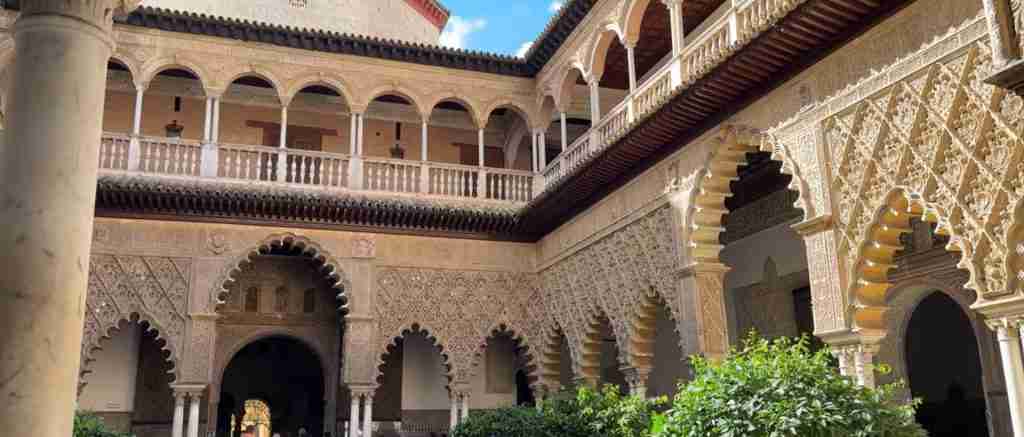
The visual and spatial centerpiece of the complex is the Mudejar Palace, commissioned by King Peter I of Castile in the 14th century. Peter I, who maintained close political and cultural connections with the Nasrid kingdom of Granada, employed craftsmen working in the Nasrid tradition from Granada to create the palace’s extraordinary interior: ceramic tile dados (azulejos), intricately carved stucco walls, wooden artisanal ceilings (artesonado), and horseshoe arches that express a deeply Islamic aesthetic in a palace built for a Christian king. This cultural synthesis defines the Mudejar style, and the Real Alcázar holds some of its finest surviving examples.
The palace’s formal gardens extend over several hectares of terraced, fountained spaces. In spring they reach extraordinary bloom; in summer they provide welcome shade in one of Europe’s hottest cities. The Alcázar also gained a wave of popular-culture attention when sections of it served as filming locations for a major international television series, bringing additional visitors but intensifying the capacity pressure that makes advance booking essential. Arrive at your booked time slot; the palace does not accommodate walk-in visitors during busy periods.
Plaza de España and María Luisa Park
Plaza de España is the grand semi-circular ensemble built for the 1929 Ibero-American Exposition — arguably the most photogenic public space in Spain and one of the most recognizable architectural compositions in the country. The 500-meter crescent of neo-Renaissance and neo-Moorish architecture is punctuated by towers at each end and fronted by a canal crossed by four tile-decorated bridges. Along the building’s base, 48 alcoves — one per Spanish province — display hand-painted ceramic scenes from each province’s history and geography in one of the world’s most unusual public history installations. Entry to Plaza de España is free. Small rowing boats are available for hire on the canal at approximately €6 per boat per 30 minutes — popular with families.
Adjacent to Plaza de España, María Luisa Park covers approximately 34 hectares of formal gardens, fountains, pavilions, and shaded walks originally designed for the 1929 exposition on land donated to the city by the Duchess of Montpensier in 1893. Several of the exposition’s national pavilions survive as museums, including the Museum of Popular Arts and Customs of Seville. Entry to the park is free, and it is one of Seville’s finest public assets — particularly beautiful in spring when seasonal plantings and orange blossom are at their peak. The park also houses the Archaeological Museum of Seville in the former Fine Arts Pavilion, covering artifacts from the Tartessos, Roman, and Visigoth periods of the region’s history.
Santa Cruz Quarter: Seville’s Historic Jewish Heritage
The Santa Cruz quarter — the former Jewish quarter of medieval Seville — is a labyrinth of whitewashed alleys, flower-draped balconies, and small plazas that collectively form one of the most atmospheric historic neighborhoods in Spain. The medieval street layout remains largely intact, producing lanes too narrow for vehicles and improbable junctions that open suddenly onto intimate squares like the Plaza de Santa Cruz (site of the former main synagogue) and Plaza de Doña Elvira. The neighborhood was home to one of medieval Iberia’s largest and most intellectually significant Jewish communities until the forced conversions of 1391 and the expulsion of 1492; the layered history of Jewish, Moorish, and Christian presence is embedded in the architecture even where it is not formally labeled.
Exploring the Santa Cruz quarter without a fixed itinerary — following alleys as they curve, pausing at orange tree courtyards visible through heavy wooden doors, listening for the sound of running fountain water — is one of Seville’s defining pleasures. A note on the Hospital of Charity (Hospital de la Caridad), just outside the quarter near the riverfront: this 17th-century Baroque complex was commissioned by Sevillian patrician Miguel de Mañara and houses an important collection of Baroque painting, including major works by Bartolomé Esteban Murillo and Juan de Valdés Leal. Mañara is one of the historical figures sometimes associated with the Don Juan literary archetype, though the precise connection between the historical Mañara and the fictional archetype is disputed among scholars and should be understood as tradition rather than established biography.
Torre del Oro and the Guadalquivir Riverfront
The Torre del Oro (Golden Tower) stands on the eastern bank of the Guadalquivir at the edge of the El Arenal neighborhood — a 13th-century Almohad military watchtower that served to control river access to the city with a chain extending to a corresponding tower on the opposite bank. Its name most likely derives from the golden color of the glazed tiles that originally covered its exterior, though some accounts connect the name to the gold from the Americas that the tower’s position helped guard during the colonial period. Today the tower contains a small Naval Museum (Museo Naval) with maritime artifacts and exhibits related to Seville’s seafaring history; general admission is €3, with free entry on Tuesdays for EU residents.
The Guadalquivir riverfront promenade — running along both banks between the Triana Bridge and María Luisa Park — provides a pleasant walking or cycling route that rewards an evening stroll. River cruise tours depart from near the Torre del Oro, offering a 60-minute circuit of the city from the water and a different perspective on the Triana neighborhood and the historic skyline; typical prices run approximately €20 per adult. In the evenings the promenade is lively with locals and visitors, and the view of the Torre del Oro in late-afternoon light is one of Seville’s classic photographic compositions.
Metropol Parasol and the Old Town
The Metropol Parasol — popularly known as “Las Setas” (The Mushrooms) for its organic, parasol-like wooden lattice structure — is Seville’s most striking piece of contemporary architecture, completed in 2011 to a design by German architect Jürgen Mayer. The structure rises over the Encarnación market square in the historic center and spans approximately 150 meters by 70 meters, making it one of the largest laminated timber structures in the world. The project generated controversy during development due in part to Roman and Moorish remains discovered during construction; those archaeological finds are now displayed in the Antiquarium museum beneath the structure, accessible for approximately €2.
A panoramic walkway at the top of the parasols (the Setas Walkway, with a separate admission of approximately €5–8) provides among the best elevated views of Seville’s rooftops, the Giralda, and the old city from a height of 28 meters. This vantage point is often less crowded than the Giralda itself during peak morning and afternoon hours and is worth prioritizing for photography. The Mercado de la Encarnación at street level sells fresh produce, local cheeses, and prepared tapas at prices that are competitive for a central location — a useful lunch stop.
Casa de Pilatos
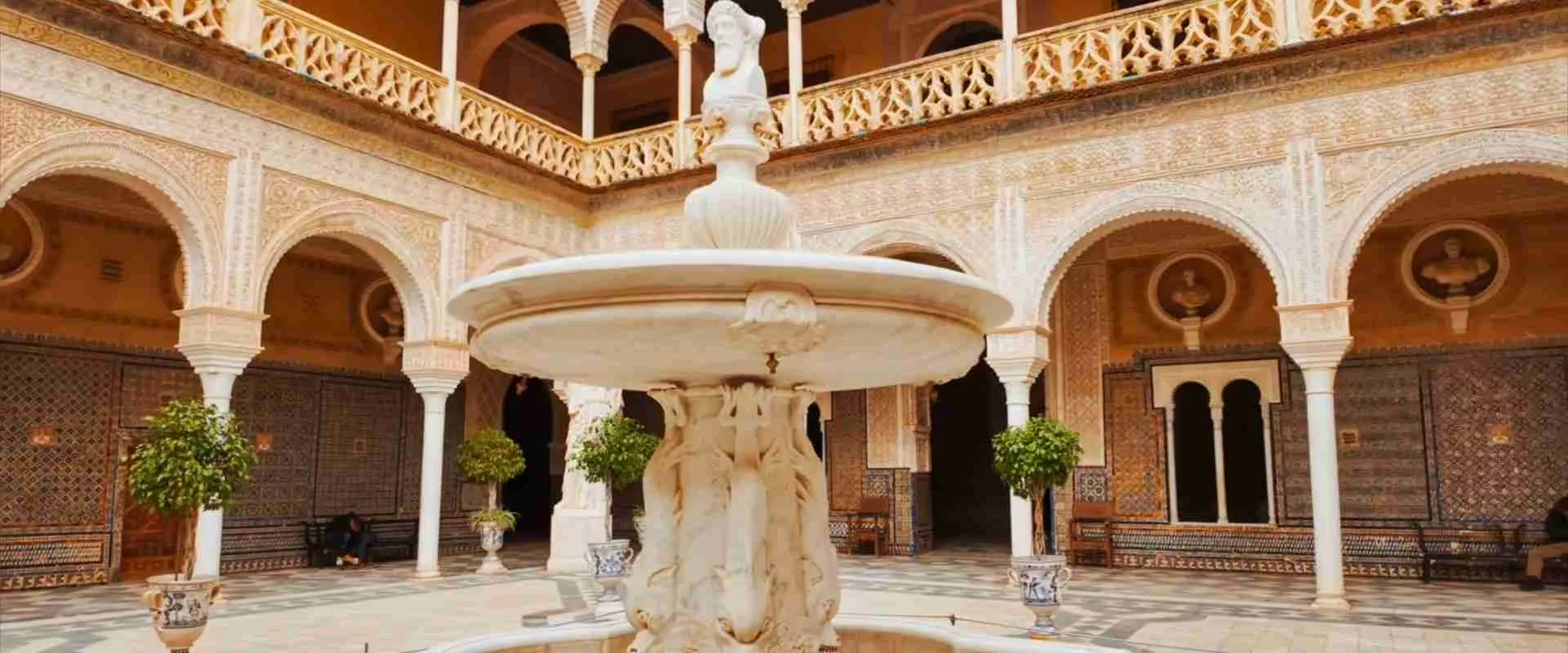
Casa de Pilatos is the finest surviving private palace in Seville and one of the most remarkable examples of early Spanish Renaissance architecture outside the royal collections. The house was developed from the early 16th century onward by the Enríquez de Ribera family — later Dukes of Medinaceli — into a synthesis of Italian Renaissance spatial organization and Mudejar decorative arts. The main courtyard, the tiled staircase hall, and the garden loggia display craftsmanship of a quality and intactness that makes this building, in many visitors’ view, more intimate and more emotionally affecting than the more famous Real Alcázar. General admission covers the ground floor and gardens (approximately €12 online; verify current pricing); access to the upper floor, which contains paintings from the ducal collection, requires a separate guided-only ticket at approximately €19.
Archive of the Indies
The Archive of the Indies (Archivo General de Indias), housed in a 16th-century Renaissance building originally designed as the Merchants’ Exchange, is the third member of Seville’s UNESCO World Heritage trio and one of the world’s great documentary archives. The building holds over 80 million pages of documents from Spain’s colonial administration of the Americas, the Philippines, and other territories — including original correspondence by Christopher Columbus, Hernán Cortés, and Amerigo Vespucci, along with maps, administrative records, and ecclesiastical documents spanning the 16th through 19th centuries. Entry is free Tuesday through Saturday (9:30–17:00) and Sunday (10:00–14:00); the building is closed on Mondays. The architecture — attributed to Juan de Herrera, who also designed the Escorial palace near Madrid, based on documentation of the period — is itself significant: two stories of gallery-fronted arcades around a central courtyard, in the severe Herreran style that defined official Spanish architecture in the late 16th century.
Triana: Seville’s Flamenco and Ceramic Neighborhood
Triana, on the west bank of the Guadalquivir accessible via the Puente de Isabel II (Triana Bridge), is the city’s most fiercely independent neighborhood — many Trianeros have historically maintained a distinct neighborhood identity separate from broader Sevillian identity, a pride still visible in the language locals use about their barrio. The area has been associated with flamenco for centuries, with several of the genre’s most significant historical performers born and trained here; the neighborhood’s contribution to flamenco’s development in Seville is documented at the Centro Andaluz de Flamenco (Andalusian Flamenco Center), which operates a free exhibition space in Triana covering flamenco’s historical geography, musical forms, and influential artists.
Triana’s ceramic tradition runs equally deep. The neighborhood has produced tiles and earthenware since the Moorish period and continues to do so; the tiles covering Plaza de España were made in Triana workshops. Several family workshops are active today, selling both production pieces and hand-crafted artisan tiles; prices range from €5 for small decorative tiles to €200–500 for large painted panels. The Mercado de Triana, housed in a former 16th-century castle site, serves as both a fresh food market and a tapas destination — a particularly enjoyable place for a market lunch at approximately €12–18 per person.
Booking Seville’s Key Attractions in 2027
Seville Cathedral Tickets and Opening Hours 2027
General admission to Seville Cathedral (including the Giralda tower and the Church of El Salvador) costs €13 when purchased online through the official cathedral website (catedraldesevilla.es) — always the recommended method — and €14 at the ticket office. A reduced rate of €6 online (€7 at the window) applies to seniors over 65, students under 25, and people with disabilities between 33% and 65%. Children under 13 accompanied by an adult enter free. Buy tickets online to secure a preferred time slot; popular time slots during spring fill weeks in advance. These prices are effective from January 2025 and should be verified against the official website when planning.
Standard visiting hours run Monday to Saturday 11:00–18:00 (last entry 17:00) and Sunday 14:30–19:00 (last entry 18:00). Hours may be modified around religious celebrations; always check the official calendar before travel. One free-entry window exists per week: Sundays (excluding public holidays) from 16:30–18:00, limited to 100 advance online reservations that typically fill within hours of becoming available. An audioguide costs an additional €2.50; the cathedral’s own downloadable app provides an alternative. Dress code applies throughout: knees and shoulders must be covered, hats removed, and open-toed sandals may be refused at staff discretion — a lightweight scarf or shawl resolves this for summer visitors.
Real Alcázar Tickets and Advance Booking 2027
General admission to the Real Alcázar covers the ground-floor palace complex and gardens and costs €15.50 per adult. Reduced admission (€7) applies to students aged 17–25 and seniors over 65; children under 16 and Seville residents with ID enter free. The optional Royal Apartments (Cuarto Real Alto) ticket, giving access to the upper-floor furnished royal chambers, costs an additional €5.50 and is available only through a reservation made at an in-complex desk on the day of your visit — not bookable in advance online.
The Real Alcázar receives approximately 1.8 million visitors annually. Conservation-based capacity limits allow only 750 people inside the complex at any time. This means online time-slot tickets sell out weeks or months ahead during spring and summer — in March through June, popular afternoon slots commonly disappear weeks in advance. Purchase through the official Real Alcázar website (alcazarsevilla.org) or through reputable third-party platforms. Physical same-day tickets are available only for any remaining capacity and cannot be counted on from April through September. A free-entry window applies during the last hour before closing on Monday afternoons, but this also requires advance online reservation. Guided tours from licensed operators often provide access with a reserved slot even when standalone tickets are exhausted — a practical option for late-stage planners.
Seville Food and Tapas Guide 2027
Essential Seville Food Experiences
Seville maintains one of the strongest tapas traditions in Spain — and within Andalusia, it preserves a custom that has largely disappeared in Madrid and Barcelona: in many neighborhood bars, a small free tapa is still served with every drink ordered. This tradition survives primarily in the Triana, Alameda de Hércules, and Macarena districts; tourist-oriented bars near the cathedral are considerably less likely to follow it.
Several dishes define the Seville food experience specifically rather than Andalusian cuisine generally. Salmorejo is the city’s daily staple in warm months — a thick cold tomato purée, denser and richer than gazpacho, traditionally garnished with hard-boiled egg and cured ham. Espinacas con garbanzos (spinach with chickpeas) in a spiced tomato sauce reflects the Arab culinary tradition running through much of Andalusian cooking and is found on virtually every traditional menu. Fried fish (pescaito frito) — a mixed platter of anchovies, small cuttlefish, red mullet, and whatever is fresh — is eaten at all hours and price levels; the best versions use daily catches from the Atlantic coast at Huelva and Cádiz. Manzanilla, the pale dry sherry produced in nearby Sanlúcar de Barrameda, is Seville’s house wine of choice: served ice-cold in a small glass at approximately €1.50–2.50 per serving in a local bar, €3–5 in a tourist area bar.
Where to Eat Tapas on a Budget in Seville 2027
Budget eating in Seville means navigating away from the cathedral and Real Alcázar perimeter, where tourist-menu restaurants cluster. The practical rule: the further from the main monuments, the lower the prices and the more local the clientele. The Alameda de Hércules district — a long, tree-lined promenade about 15 minutes’ walk north of the cathedral — concentrates locally priced bars and cafés with a predominantly local crowd. A tostada con tomate (toasted bread with olive oil and tomato) and coffee at a neighborhood café costs €3–4 for breakfast. The daily set-price lunch menu (menú del día), typically comprising two courses, bread, and a drink, runs €10–14 at neighborhood establishments and represents the best value meal of the day in Seville — and is an authentic way to eat alongside working locals.
For evening tapas, the streets around the Mercado de Feria in the Macarena district, Santa Catalina, and Calle Feria offer prices 30–50% lower than the tourist core near the cathedral. A typical evening of tapas — three or four small plates and two glasses of wine or beer per person — costs €18–28 in these neighborhoods, compared with €30–45 for the same consumption pattern near the Santa Cruz quarter.
Mid-Range and Fine Dining in Seville 2027
Seville’s mid-range restaurant scene has grown considerably in ambition and variety over the past decade. The city now has a cluster of restaurants applying modern Andalusian technique to traditional regional ingredients — updated interpretations of local recipes that remain anchored in the flavors of the south. Main courses at mid-range establishments run €18–28; a full dinner for two with wine typically costs €70–110. The Triana neighborhood and streets around the Alameda de Hércules offer the best concentration of well-priced mid-range restaurants with genuine atmospheres.
Fine dining in Seville remains accessible by the standards of Madrid or Barcelona. The city has several restaurants at Michelin-recognized level exploring creative Andalusian cuisine at tasting-menu prices of approximately €70–120 per person for food; wine pairings add substantially to this. Reservations are essential at this level, often several weeks in advance during spring. The experience typically centers on reinterpreted Andalusian produce — seafood from the Atlantic coast, game from the Sierra Morena, vegetables from the Guadalquivir valley — in formats that feel contemporary without abandoning regional roots.
Seville’s Markets 2027
Seville’s market halls provide some of the best-value eating in the city alongside their primary role as fresh food markets. The Mercado de Triana, on the west bank in the former castle-site building, combines traditional stalls with a row of tapas bars in an architecturally notable setting; budget approximately €12–18 per person for a market lunch. The Mercado de Feria in the Macarena district is more local in character, with competitive prices on fresh produce, seafood, and cooked tapas and relatively few tourists. The Mercado de la Encarnación beneath the Metropol Parasol is more contemporary in presentation and slightly more expensive, but conveniently central and open into the afternoon when most traditional markets close.
Flamenco in Seville 2027
Best Tablao Shows for 2027
Seville is one of flamenco’s two or three most historically significant cities, alongside Jerez de la Frontera and Cádiz, and its tablao (performance venue) scene is correspondingly well developed. Show-only admission at the main tablaos typically costs €28–45 per person; combined dinner-and-show packages run €70–100 per person including a set meal. Among the most consistently recommended venues for visitors wanting a polished, professional performance are Tablao Flamenco El Arenal in the El Arenal neighborhood and La Casa del Flamenco in the Santa Cruz quarter. Book at least several days ahead for spring visits and several weeks ahead around Semana Santa and the April Fair. Most tablao shows run 60–90 minutes and feature a rotating company of four to six performers covering a sequence of flamenco styles (palos) — soleá, bulerías, alegrías, seguiriyas — in a format accessible to audiences without prior knowledge of flamenco.
Authentic Flamenco Experiences in Seville 2027
For visitors interested in flamenco in a less staged context, several alternatives exist beyond the tablaos. The Centro Andaluz de Flamenco in Triana provides a free exhibition space covering flamenco’s historical geography, major artists, and musical forms — an excellent orientation for first-time visitors. Some private flamenco clubs (peñas flamencas) open their evening sessions to visitors on specific nights of the week, typically with a small bar minimum rather than a ticket price; the municipal tourist information office (at the Puerta Jerez area) can advise on current schedules. These informal settings, when they align with a visitor’s timing, offer flamenco as a living social form — practiced and watched by enthusiasts rather than presented as a cultural product — and the contrast with the tablao experience is illuminating.
Seville Festivals and Events in 2027
Semana Santa 2027
Seville’s Semana Santa (Holy Week) is the most elaborate Holy Week procession in Spain — a week of nightly and some daytime processions in which more than 60 religious brotherhoods (hermandades) carry life-size carved wooden figures (pasos) depicting scenes from the Passion of Christ through the city streets, accompanied by brass bands, incense bearers, and thousands of penitents in distinctive pointed capirote hoods. The processions move at walking pace from neighborhood churches to the cathedral and back, some lasting ten hours or more, creating an atmosphere that combines medieval religious theater, extraordinary processional craft, and genuine communal devotion that is specific to Seville.
In 2027, Semana Santa falls in late March to early April (exact dates should be verified when planning, as the liturgical calendar determines the precise dates each year). The entire city transforms for the week: streets are roped off along procession routes, temporary grandstands are erected at prime viewing points along the cathedral approach, and crowds fill the city. Hotel prices at central properties commonly double or triple normal rates, and availability for rooms not booked six to twelve months in advance becomes genuinely scarce. If attending Semana Santa is a travel priority, booking accommodation in late 2026 for March 2027 dates is standard practice among experienced visitors.
April Fair (Feria de Abril) 2027
The April Fair (Feria de Abril) takes place approximately two weeks after Easter Sunday and runs for six days on a dedicated fairground (Real de la Feria) southwest of the historic center. The fair is organized primarily around thousands of private entertainment tents (casetas), most of which are owned by families, social clubs, or political associations and require an invitation for entry — a distinction that surprises first-time visitors expecting a uniformly public festival. A number of public casetas are open to all visitors, and the broader fair includes public rides, food stalls, and a daily horse parade through the fairground grounds accessible without invitation.
The experience of the April Fair is extraordinary even for visitors without caseta invitations. The fairground lights up nightly in a spectacular lantern display, women in elaborately embroidered flamenco dresses (trajes de flamenca) are visible throughout the grounds, horse-drawn carriages move in procession, and the sounds of sevillanas — the local dance form — fill the air from scores of venues simultaneously. The most visually spectacular period is typically late afternoon to midnight. Feria de Abril 2027 dates should be confirmed when planning — they typically fall in late April, approximately two weeks after Easter.
Other Seville Events and Festivals 2027
Seville’s calendar extends beyond its two headline festivals. The Corpus Christi procession (typically late May or early June) fills the streets around the cathedral with elaborate floral decorations and a major ceremonial procession of brotherhoods. The Bienal de Flamenco — a significant international flamenco biennial — is held in even-numbered years and is therefore not scheduled for 2027, but smaller flamenco festivals and concert series operate throughout the year. July and August bring outdoor concerts to the city’s plazas during cooler evening hours. Christmas (late November through January 6) sees decorative lighting, seasonal markets in the pedestrian center, and nativity-scene installations throughout the historic neighborhoods.
Day Trips from Seville in 2027
Córdoba Day Trip 2027
Córdoba is the closest and most logistically perfect day trip from Seville, located approximately 140 kilometers northeast and reachable by AVE train in 44–50 minutes — one of the most remarkable monument-to-monument rail connections anywhere in Europe. Advance AVE tickets cost around €25–35 each way in standard class; regional Avant services are slightly slower (around 70 minutes) but cheaper at approximately €13–18. The first trains from Seville typically depart around 6–7 AM; last evening returns from Córdoba allow eight to nine hours of daytime exploration.
Córdoba’s central sight is the Mosque-Cathedral (Mezquita-Catedral) — a building of extraordinary historical complexity. The Great Mosque of Córdoba, built and expanded between the 8th and 10th centuries by the Umayyad Caliphate, created a prayer hall of 856 striped marble and jasper columns under distinctive double-height horseshoe arches, covering one of the largest footprints of any mosque in the Islamic world. After the Christian Reconquista, a Renaissance cathedral was inserted into the mosque’s center in the 16th century — a juxtaposition that the supervising bishop reportedly opposed, and which Charles I of Spain (Charles V) is said to have criticized on seeing the finished result, though the precise authenticity of the royal remark is disputed by historians. General admission is approximately €13. The surrounding Jewish quarter of Córdoba and the Alcázar of the Christian Monarchs (where Ferdinand and Isabella received Christopher Columbus before his 1492 voyage) add further historical depth to a full day visit.
Granada Day Trip 2027
Granada is reachable from Seville in approximately 3 hours by the fastest rail connections (combining AVE to Antequera-Santa Ana and then onward service) or by direct bus in around 3 hours 20 minutes. Bus services from Seville’s Plaza de Armas to Granada’s bus station are often more practically convenient than the train connection for this particular route; ticket prices run approximately €18–28 each way by bus. Book tickets in advance online for better fares.
Granada’s defining attraction is the Alhambra palace complex — the Nasrid Palaces, the Generalife gardens, and the Alcazaba fortress — representing the pinnacle of Moorish palatial architecture in Spain and one of the most visited monuments in Europe. The Nasrid Palaces require a timed-entry ticket that is typically sold out months in advance during spring and summer; attempting a Granada day trip without a pre-booked Alhambra ticket is not advisable. Tickets for the Nasrid Palaces cost approximately €20 online. The historic Albaicín neighborhood (the old Moorish quarter, now a UNESCO World Heritage site), the Cathedral of Granada, and the adjacent Royal Chapel (where Ferdinand and Isabella are buried) are additional major sights. A Granada day trip is possible but tight on timing; a two-day visit with an overnight stay is genuinely preferable if the schedule allows.
Cádiz Day Trip 2027
Cádiz — one of the oldest continuously inhabited cities in Western Europe, built on a narrow Atlantic peninsula — is among southern Spain’s most characterful and undervisited destinations and one of the most rewarding day trips from Seville. Direct regional trains make the journey in approximately 1 hour 45 minutes (approximately €10–18 each way); multiple services operate daily. Cádiz’s old quarter, almost entirely surrounded by the Atlantic on three sides, is a compact labyrinth of 18th-century merchant houses, baroque churches, fish markets, fortifications, and beaches, combined with extraordinary sea light and exceptional seafood.
Key Cádiz sights include the cathedral (with its distinctive golden-domed silhouette visible across the bay), the Central Market (Mercado Central de Abastos) with its outstanding fresh seafood stalls, the dramatic ocean promenade along the Atlantic walls, and the Camera Obscura of the Torre Tavira, which projects a live panoramic image of the city on a curved viewing table in a darkened chamber. Cádiz is also the starting point for the Sherry Triangle — the zone around Jerez de la Frontera, El Puerto de Santa María, and Sanlúcar de Barrameda where manzanilla and fino sherry are produced. Sherry bodegas in these towns can be incorporated into an extended Cádiz day trip for visitors interested in Andalusian wine culture; bodega tours typically cost €10–25 per person including a tasting.
Ronda Day Trip 2027
Ronda, a spectacular white hill town built on the edge of a dramatic gorge in the Serranía de Ronda mountains, is approximately 2 hours from Seville by direct bus (several services daily, approximately €15–20 each way) or by a rail connection requiring a change at Bobadilla. The town’s defining visual feature is the Puente Nuevo (New Bridge) — an 18th-century stone arch that spans the roughly 120-meter gorge dividing the old and new quarters of the town, with vertigo-inducing views that are among the most photographed in Spain. The old Moorish quarter (La Ciudad) on the southern side of the gorge contains the Arab Baths, the Mondragón Palace (now the local history museum), and the Collegiate Church of Santa María la Mayor, which incorporates elements of the earlier mosque on whose site it was built. The main square area contains Spain’s oldest still-operating bullring (constructed 1785) with an adjoining museum open to visitors. Ronda is best visited outside July and August, when tour bus crowds concentrate heavily at the limited gorge viewpoints.
Complete Budget Guide for Seville in 2027
Budget Traveler Daily Costs in Seville 2027
Budget travelers — two sharing a private room at a budget hotel or hostel, eating at local cafés and market stalls, and focusing on free and low-cost sightseeing — should plan on approximately €90–120 per person per day. This breaks down as follows. Accommodation: a budget hotel or private hostel room runs approximately €70–90 per night for the room; dividing by two gives €35–45 per person. Meals: a neighborhood café breakfast costs €4–6; a tapas bar lunch or market stall meal runs €12–16; a budget dinner at a local bar runs €18–25; drinks add approximately €4–5 — totaling approximately €38–52 per person per day for food. Transport: with Seville’s walkable center, most days involve minimal public transit; occasional bus or metro journeys add €5–8. Attractions: mixing free sites (Plaza de España, María Luisa Park, Santa Cruz quarter, the Guadalquivir promenade) with one paid entry per day adds approximately €10–15. Full calculation: low end €35 + €38 + €5 + €10 = €88, rounded to €90; high end €45 + €52 + €8 + €15 = €120. A full week at the budget tier costs approximately €630–840 per person.
Mid-Range Daily Costs in Seville 2027
Mid-range travelers — two sharing a three- or four-star hotel, eating at sit-down restaurants with wine, visiting the main paid attractions — should budget approximately €170–230 per person per day. Accommodation at this level runs approximately €130–170 per room per night, giving approximately €65–85 per person after splitting. Meals at mid-range restaurants — breakfast at hotel or café €8–12, tapas lunch with a glass of wine €20–25, dinner at a good restaurant with wine €38–50, additional drinks €5–7 — total approximately €71–94 per person. City transport (occasional bus, short taxi ride) adds €8–12. Attractions on a standard day — Seville Cathedral (€13), Real Alcázar (€15.50), Metropol Parasol walkway (€5–8) — add approximately €28–38. Full calculation: low end €65 + €71 + €8 + €28 = €172, rounded to €170; high end €85 + €94 + €12 + €38 = €229, rounded to €230. Adding one tablao flamenco show (€30–45) to any evening adds to the total for that day. A full week at mid-range costs approximately €1,190–1,610 per person.
Luxury Daily Costs in Seville 2027
Luxury travelers — two sharing a five-star hotel, dining at high-quality restaurants, using taxis, and booking private tours — should plan on approximately €485–725 per person per day. Accommodation at a five-star property runs approximately €380–600 per room per night, giving approximately €190–300 per person. Fine dining — hotel breakfast €25–35, quality restaurant lunch €60–80, fine-dining dinner or tasting menu €110–150, aperitifs and wines €25–40 — totals approximately €220–305 per person. Private transfers and taxis add approximately €20–35. Premium experiences — private guided tours of the cathedral and Real Alcázar, a premium dinner-and-flamenco-show package, special museum access — add approximately €55–85. Full calculation: low end €190 + €220 + €20 + €55 = €485; high end €300 + €305 + €35 + €85 = €725. A full week at the luxury tier costs approximately €3,400–5,075 per person. Seville offers excellent value at this level compared with equivalent quality in Madrid or Barcelona, which typically costs 30–50% more for comparable hotels and dining.
Sample 7-Day Seville Trip Costs 2027
A seven-day mid-range Seville trip for two people — covering the city’s main attractions, a flamenco evening, and two day trips (Córdoba and Cádiz) — involves the following per-person costs. Accommodation for six nights: approximately €65–85 per night per person, totaling €390–510. Meals and drinks across seven days: approximately €71–94 per day, totaling €497–658. Transport (city buses, return AVE to Córdoba, return bus to Cádiz, occasional city taxis): approximately €80–120. Attraction tickets (Seville Cathedral, Real Alcázar, Casa de Pilatos, Metropol Parasol walkway, Torre del Oro Naval Museum, one flamenco tablao evening): approximately €100–140. Miscellaneous expenses (souvenirs, café stops, tips, one market lunch): approximately €60–80. Listing all components: accommodation €390–510, food €497–658, transport €80–120, attractions €100–140, miscellaneous €60–80. Total per person approximately €1,127–1,508, rounding to approximately €1,130–1,510 per person for the week. This aligns closely with the daily mid-range calculation of €170–230 multiplied by seven days.
Best Time to Visit Seville in 2027
Spring in Seville: March to May 2027
Spring is simultaneously Seville’s most beautiful and most logistically demanding season. Temperatures between 18°C and 27°C make outdoor sightseeing genuinely comfortable. Orange trees in the historic streets bloom in late February and March, filling the old city with scent. The wildly popular Semana Santa (late March/early April in 2027 — confirm exact dates when planning) and April Fair (typically late April) bring world-class cultural experiences but also the city’s highest prices, most intense crowds, and tightest accommodation availability. Hotel rates during Semana Santa peak at two to four times normal; rooms at well-located properties not booked many months in advance become genuinely scarce. Mid-May represents perhaps the most favorable single week of the year: warm weather, post-festival price normalization, well-tended spring gardens, and no major crowds at the monuments.
Summer in Seville: June to August 2027
Summer in Seville is formidable. Average July and August temperatures exceed 36°C and frequently reach 42–44°C during heat events that are intensifying in frequency and severity under current climate patterns. Outdoor sightseeing becomes genuinely uncomfortable by 11 AM and nearly impossible from 1 PM to 6 PM. Sevillians adapt with a nocturnal summer rhythm — late lunches, extended afternoon rest, activities concentrated in the early morning and late evening — but visitors unfamiliar with this adaptation often find the heat exhausting rather than manageable. Practical advantages of summer include significantly lower hotel prices (20–30% below spring peak), almost no queues at major monuments, and vibrant late-night street activity. June, before peak heat arrives, is the most livable summer month. Visitors who must visit in July or August should plan to be inside air-conditioned spaces during the hottest hours and concentrate outdoor activities strictly before 10 AM and after 7 PM.
Autumn in Seville: September to November 2027
Autumn is arguably the most underrated season for visiting Seville. September remains hot — temperatures often above 30°C in the first two weeks — but October and November bring ideal sightseeing weather in the 17–25°C range with dramatically fewer visitors than spring. Hotel prices in October and November are typically 25–40% below spring peak, and queues at major monuments are minimal. The city returns to its normal local rhythm rather than operating in festival mode, providing a more representative experience of everyday Sevillian life. The risk of autumn rain — concentrated in October and November — is real but typically takes the form of afternoon showers rather than sustained all-day rainfall; mornings are usually clear and good for sightseeing.
Winter in Seville: December to February 2027
Seville’s winter is mild by northern European standards — daytime temperatures of 10–16°C, significant sunshine by northern comparison, and predominantly dry weather except in January, which sees the most rainfall of the year. Monuments are at their least crowded and their most affordable; hotel rates in January and February reach annual lows, sometimes 40–50% below spring peak levels. Christmas decorations transform the pedestrian center from late November through January 6 (Epiphany — the primary gift-giving occasion in Spain), with illuminations and seasonal markets adding to the atmosphere. The main limitation of winter is shorter daylight (sunset around 6 PM in December) compressing the sightseeing window and reducing the impact of outdoor sites like María Luisa Park at their best. For budget-conscious visitors for whom festival attendance is not the priority, December outside the Christmas holiday period and January represent the best value-for-money windows to visit Seville.
Money-Saving Tips for Seville 2027
Planning paid attractions strategically saves real money in Seville. The Sunday free entry window at Seville Cathedral (16:30–18:00; maximum 100 reservations per week; advance online booking required at the official website) saves €13 per person when your schedule allows. The Monday free-entry hour at the Real Alcázar (during the last hour before closing) similarly saves €15.50 per person but also requires advance online reservation. Neither free slot can be counted on during spring and summer, when they fill immediately — but outside peak periods they are a genuine option for flexible travelers.
Plaza de España, María Luisa Park, the Santa Cruz quarter, the entire Guadalquivir riverfront promenade, and the ground level of the Metropol Parasol are all free to visit and together account for much of what makes Seville visually and experientially distinctive. The Archive of the Indies — one of the three UNESCO-designated Seville monuments — is entirely free Tuesday through Sunday. A thoughtfully planned budget day can be extraordinarily rich without significant expenditure.
The daily set-price lunch menu (menú del día), available Monday through Friday at most neighborhood bars and restaurants, provides two courses, bread, and a drink for €10–14 — the best-value meal in Seville and an authentic way to eat. By contrast, tourist-menu restaurants near the cathedral charge €18–25 for the same type of meal.
Choosing accommodation in Triana, Macarena Norte, or around the Alameda de Hércules rather than the Santa Cruz quarter or El Arenal typically saves 15–25% on nightly rates while maintaining walking or cycling access to all central attractions. The SEVici bike-sharing tourist day pass (approximately €10–15) covers the distance between these neighborhoods and the historic center efficiently.
For day trips, AVE tickets to Córdoba booked two to four weeks ahead can be as low as €15–20 each way versus €35–45 for same-day purchase. Bus tickets to Cádiz and Ronda are generally competitive and can often be purchased with little advance notice without significant price premium.
Practical Travel Tips for Seville 2027
Visa and Entry Requirements 2027
Spain is a member of the Schengen Area. EU citizens, plus Swiss, Norwegian, Icelandic, and Liechtenstein nationals, need only a national ID card for entry. US, Canadian, Australian, and New Zealand passport holders can visit Spain without a visa for stays up to 90 days within any 180-day period. UK visitors should verify the status of the EU’s ETIAS (European Travel Information and Authorization System) before planning 2027 travel: this online pre-registration system (costing approximately €7, valid for three years) was under phased implementation for non-EU travelers and should be confirmed current when booking. It is not a visa but is required before travel to Schengen-area countries for nationalities that are otherwise visa-exempt. Nationals who require a Schengen visa must apply through the Spanish embassy or consulate in their country of residence; processing times vary and should be initiated well in advance of any planned travel date.
Health, Safety, and Emergencies in Seville 2027
Seville is a generally safe city for visitors by European standards, with standard urban caution applicable. Pickpocketing is the primary risk — concentrated in the densely crowded areas around the cathedral entrance, the Real Alcázar queue area, and Plaza de España during peak visiting hours. A cross-body bag worn in front, phone kept out of sight in crowds, and use of the hotel safe for unnecessary cash and documents are the most effective precautions. The Semana Santa procession crowds represent a particularly active environment for opportunistic theft due to density and general distraction.
Tap water throughout Seville is safe to drink and meets EU standards. Spain’s healthcare system provides emergency care to EU citizens on presentation of a European Health Insurance Card (EHIC); UK travelers should ensure their UK Global Health Insurance Card (GHIC) is current. Non-EU visitors should carry comprehensive travel insurance with medical coverage. The universal Spanish emergency number is 112 (police, ambulance, fire). The major hospitals closest to Seville’s historic center are the Hospital Virgen del Rocío and the Hospital Virgen de la Macarena, both within the city and accessible by taxi.
Money, Banking, and Tipping in Seville 2027
Spain uses the Euro (€). ATMs are widely available throughout Seville’s center and accept all major international debit and credit cards; cards are accepted at virtually all restaurants, hotels, and shops of any size. Carrying €30–50 in small-denomination notes covers most incidental cash needs — some small tapas bars, market stalls, and street vendors prefer cash for small transactions. Currency exchange offices in tourist areas offer less favorable rates than bank ATMs; using an ATM affiliated with a major Spanish bank (CaixaBank, Santander, BBVA) minimizes currency conversion fees for most international cards.
Tipping in Spain is less institutionalized than in the United States and UK. At tapas bars, leaving coins or rounding up the bill is common but not expected. At mid-range and fine-dining restaurants, 5–10% for genuinely good service is appreciated but not obligatory; a service charge is not typically added to the bill. Taxi drivers are not tipped by Sevillians; rounding up to the next whole euro is common for visitors. Hotel housekeeping tips of €1–2 per night left in the room are appreciated at international-standard properties.
Language and Communication in Seville 2027
The official language of Seville is Spanish (Castilian). English is widely spoken at major hotels, airport and railway staff, and most tourist-facing restaurants and shops in the historic center. Outside the main tourist areas — in neighborhood tapas bars, local markets, and residential districts — English proficiency drops substantially, and a few basic Spanish phrases make a significant practical difference. The Andalusian accent and pronunciation differ considerably from Madrid-standard Spanish: “s” sounds are frequently dropped at word endings, “c” and “z” are not lisped as in northern Spain, and speech tends to be rapid; non-native Spanish speakers often find Sevillians harder to understand initially. Translation apps and camera-based menu translation tools are useful practical supplements.
What to Pack for Seville 2027
Packing for Seville requires seasonal calibration. In spring and autumn, layering is advisable: mornings and evenings can be cool at 10–15°C while afternoons reach 22–28°C. In summer, ultra-lightweight breathable fabrics, a hat, high-SPF sun protection, and a refillable water bottle are essential practical gear; plan to carry very little and keep movement to shaded routes during midday. In winter, a mid-weight jacket suffices for daytime, with warmer layers needed for evenings; a compact rain jacket is worth packing for October, November, and January.
Comfortable, supportive walking shoes are non-negotiable. Seville’s historic center is paved in cobblestones, the Real Alcázar’s interior floors are marble and ceramic tile, and daily walking distances of 12–18 kilometers are normal. Thin-soled shoes become painful within a day. Carry a lightweight scarf or shawl regardless of season: it resolves the cathedral dress code (covering shoulders), doubles as sun protection, and serves as a layer in air-conditioned spaces.
Frequently Asked Questions About Seville 2027
Is Seville worth visiting in 2027?
Seville consistently ranks among Europe’s most rewarding city destinations and fully justifies that reputation. The combination of three world-class monuments within walking distance of each other, an exceptional and genuinely living tapas culture, authentic flamenco tradition, and two of the most spectacular annual cultural festivals in Europe makes it a destination that delivers on virtually every dimension. It is compact enough to cover well in three to five days, accessible at almost every budget level, and sufficiently distinct from Madrid and Barcelona to merit a dedicated visit rather than a brief stopover. Visitors with even moderate interest in history, architecture, food, or music will find Seville rewards them at length.
How far in advance should I book the Real Alcázar for 2027?
For visits between April and September, booking the Real Alcázar at least four to eight weeks in advance is strongly advisable; popular time slots in April, May, and June frequently sell out eight to twelve weeks ahead. For Semana Santa week and the week of the April Fair, six months or more of advance booking is standard. Outside peak periods — October through March, excluding Spanish public holidays — two to four weeks typically provides adequate lead time, though online booking in advance is always recommended. Book directly through the official website (alcazarsevilla.org) to guarantee a legitimate time slot; some third-party resellers mark up prices or add unnecessary booking fees.
What are the free museums in Seville?
Several of Seville’s best cultural institutions are free. The Archive of the Indies is entirely free Tuesday through Saturday 9:30–17:00 and Sunday 10:00–14:00, with extraordinary original historical documents on display. The Archaeological Museum of Seville in María Luisa Park is free for EU citizens (check current rates for others). The Centro Andaluz de Flamenco in Triana is free. The Antiquarium Roman Museum beneath the Metropol Parasol charges approximately €2. The Museum of Popular Arts and Customs of Seville in María Luisa Park charges a modest admission of approximately €1.80. Seville Cathedral is free on Sundays 16:30–18:00 (advance booking required). The Real Alcázar has a free entry window the last hour before closing on Mondays (advance booking required). Plaza de España, María Luisa Park, and all public streets, plazas, and river promenades cost nothing.
Is it possible to visit Seville on a weekend trip?
A weekend trip to Seville is very feasible and rewards careful pre-planning. The key to success is securing Seville Cathedral and Real Alcázar tickets online before arrival — ideally for Friday afternoon or Saturday morning — since both attractions require advance time slots that can sell out. With both booked, a two-day itinerary can comfortably cover: Day 1 — Seville Cathedral and Giralda in the morning, Real Alcázar in the afternoon, evening tapas in the Santa Cruz quarter; Day 2 — Plaza de España and María Luisa Park in the morning, Triana in the afternoon, evening in the Alameda de Hércules district. This covers the essential Seville experience within 48 hours. Arriving by AVE from Madrid (2 hours 30 minutes) or by direct flight from European cities makes the logistics straightforward.
What are the best neighborhoods to stay in for first-time visitors?
First-time visitors are best served by staying in the El Arenal neighborhood or just outside the Santa Cruz quarter — close enough to walk to the cathedral and Real Alcázar in under ten minutes, yet slightly removed from the most tourist-dense streets. El Arenal provides the best balance of atmosphere, convenience, and price for a first visit. Triana is an excellent second choice for visitors who want authentic neighborhood character and are happy with a 15–20 minute walk or short taxi ride to the main monuments. The Santa Cruz quarter itself is the most atmospheric but tends to be the most expensive and occasionally noisy. Macarena Norte offers the best budget value at the cost of a longer walk or bus ride to the main sights.
How do I get from Seville to the April Fair fairground?
The April Fair fairground (Real de la Feria) is located in the Los Remedios neighborhood, southwest of the historic center and across the Guadalquivir from the Triana district. From central Seville, the fairground is reachable by city bus (Lines C1 and 31 during the fair week operate directly to the fairground), by taxi (approximately €10–15 from the historic center), by bicycle along the river path, or on foot in approximately 30–40 minutes from the cathedral area. Parking near the fairground during feria week is essentially impossible; public transport or walking is the practical approach. The fairground is at its liveliest from early afternoon until well after midnight; the full lantern illumination is most spectacular from sunset onward.
Are there any hidden or lesser-known attractions worth visiting?
Several Seville sites substantially reward visitors who go beyond the main monument circuit. The Palacio de las Dueñas, a private palace belonging to the House of Alba opened to visitors in recent years, offers one of Seville’s most beautiful Renaissance courtyards and a small museum of the ducal family’s collections (admission approximately €12; verify current opening status). The Alameda de Hércules — a long, tree-lined promenade flanked by Roman columns — is the heart of Seville’s most authentically local street life, particularly in evenings and weekends, and is entirely free. The Basilica of La Macarena in the north of the historic city houses the most famous processional figure of the Virgin in Seville, carried in the most attended of all Semana Santa processions; the basilica museum is open with modest admission and is extraordinary context for understanding Semana Santa’s emotional significance. The 1929 Exposition’s “Pueblo Español” pavilion area in María Luisa Park contains some of the most interesting surviving architecture from the exposition that is largely missed by visitors focused on Plaza de España.
Can I do laundry in Seville?
Self-service laundries (lavanderías) are available throughout Seville and are reasonably priced at approximately €4–7 per wash cycle and €2–3 per dry cycle. Full-service drop-off laundry (where staff wash and fold) typically costs €8–15 per kilogram and is available at most lavanderías; turnaround time is usually 24–48 hours. Hotels offer in-house laundry service at considerably higher prices — typically €4–8 per individual garment for washing and pressing. For longer stays, locating a self-service lavandería in the Triana or Macarena districts (where prices are lower than in the Santa Cruz quarter) is straightforward via map search.
What is Seville like in terms of accessibility for visitors with mobility limitations?
Seville’s historic center presents real challenges for visitors with mobility limitations. Cobblestone streets throughout the Santa Cruz quarter and much of the old city are difficult to navigate in a wheelchair or with limited mobility; some streets have no curb cuts and surfaces are uneven. The Real Alcázar provides adapted access but the gardens involve some uneven terrain. Seville Cathedral has accessible toilets and a wheelchair loan service, and the main nave is accessible, though the Giralda ascent presents no steps but involves a sustained uphill ramp that can be challenging. María Luisa Park and Plaza de España are largely flat and navigable. The metro system has lift access at most stations. City buses accommodate wheelchairs. For specific accessibility requirements, contacting the official Seville tourism office in advance and checking individual site accessibility pages provides detailed current information.
What is the local equivalent of a meal deal or budget breakfast in Seville?
The classic Sevillian budget breakfast is a tostada con aceite y tomate — toasted crusty bread generously spread with olive oil and topped with fresh tomato pulp or grated tomato — accompanied by a café con leche (espresso with warm milk) or fresh-squeezed orange juice (zumo de naranja natural). This combination costs €3–5 at any neighborhood bar and keeps most people comfortably fueled until a late lunch. Many bars also offer a churro service in the morning — deep-fried dough sticks for dipping in thick drinking chocolate — at similarly budget prices. Eating a full sit-down breakfast at hotel restaurants typically costs €12–18 per person and is generally not necessary in a city where the neighborhood café culture is so well developed.