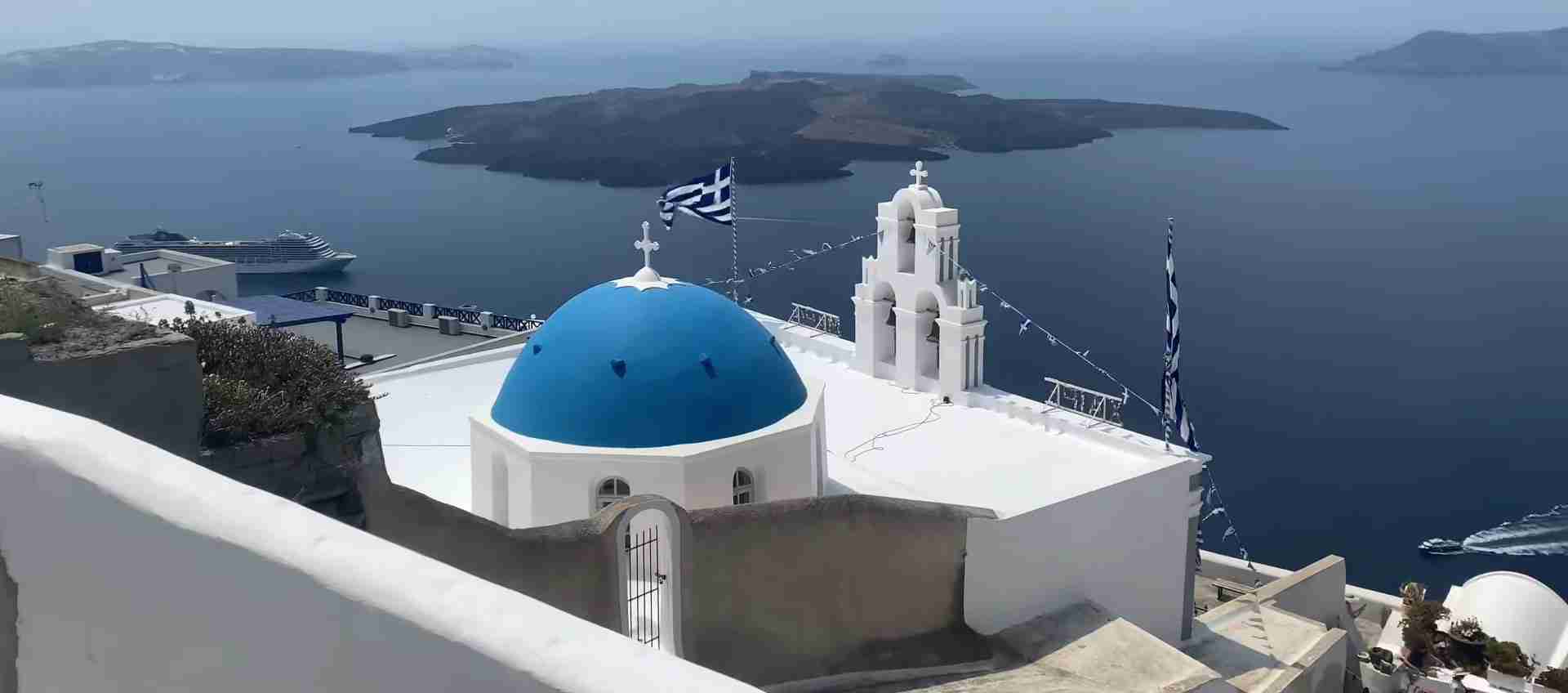
Santorini Photography Guide: Blue Domes & Caldera Views
Santorini’s photographic landscape combines iconic blue-domed churches perched on volcanic cliffs with sweeping caldera panoramas that rank among the Mediterranean’s most photographed scenes. The island’s distinctive Cycladic architecture — whitewashed buildings cascading down rust-red and black volcanic cliffs above deep blue Aegean waters — creates natural compositional layers that transform simple snapshots into compelling images. Mastering Santorini photography requires understanding optimal viewpoint locations, lighting condition timing, compositional strategies for layering architectural and natural elements, and technical camera settings that capture the extreme dynamic range between brilliant white buildings and deep shadow details in cliff-face cave structures.
Key Takeaways for Santorini Photography
- The three blue domes viewpoint in Oia requires precise positioning: Located on Nomikos Villas terrace along Odos Ypapantis street, this iconic composition demands early morning arrival (sunrise to 8:00 AM) before crowds obstruct sightlines and optimal side-lighting reveals architectural texture without harsh overhead shadows.
- Extreme dynamic range necessitates exposure bracketing: Santorini’s brilliant white buildings against deep shadow cave interiors create 8-12 stop contrast ratios impossible to capture in single exposures, requiring HDR techniques or graduated neutral density filters to retain both highlight detail in whitewashed walls and shadow information in architectural recesses.
- Golden hour delivers superior caldera photography: The hour following sunrise and preceding sunset provides directional side-lighting that sculpts volcanic cliff textures, warms whitewashed architecture, and intensifies blue dome saturation through enhanced color temperature contrast between warm ambient light and cool Mediterranean hues.
- Blue hour transforms architectural photography: The 30-40 minutes following sunset enable artificial building illumination to balance with residual skylight, creating ethereal compositions where golden-lit interiors glow against deep blue twilight skies impossible to achieve during full daylight or complete darkness.
- Composition depth requires foreground-middleground-background layering: Effective Santorini images incorporate architectural foreground elements (blue domes, white staircases, bell towers), caldera cliff middleground structure, and Aegean horizon backgrounds creating visual depth through scale progression and atmospheric perspective.
- Hidden viewpoints offer crowd-free alternatives: Imerovigli’s Skaros Rock trail, Firostefani’s caldera rim path, and Pyrgos village hilltop positions provide equally dramatic perspectives without Oia’s intense photographer congestion, enabling patient composition refinement impossible at overcrowded iconic locations.
People Also Ask About Santorini Photography
Where are the famous blue domes in Santorini?
The most photographed blue domes cluster in three primary locations across Santorini’s caldera cliff villages. Oia’s iconic three-domes viewpoint sits on Nomikos Villas terrace along Odos Ypapantis street, featuring the Agios Spyridonas Church’s triple blue domes with caldera and windmill backgrounds creating the quintessential Santorini composition reproduced across travel imagery worldwide. This specific viewpoint requires walking uphill from Oia’s main square, navigating narrow marble pathways to the elevated terrace that provides the classic angle — photographing from street level produces distorted perspectives missing the compositional balance that defines this iconic scene.
Firostefani’s blue dome church (Agios Gerasimos) perches prominently along the caldera rim walking path between Fira and Oia, offering an isolated single dome against dramatic cliff drop-offs with superior foreground-background separation compared to Oia’s clustered architecture. Fira’s central caldera path features multiple blue-domed churches including the prominent Catholic Cathedral (Panagia Episcope) and smaller Orthodox chapels scattered throughout the cliff-face architecture, each providing unique compositional opportunities combining architectural detail with sweeping caldera panoramas. The geographic distribution across multiple villages enables photographers to capture blue dome variety rather than repetitive single-location imagery, with each site offering distinct lighting conditions, background elements, and compositional possibilities throughout different times of day.
What camera settings work best for Santorini photography?
Santorini photography demands aperture priority or manual mode with f/8-f/16 apertures maximizing depth of field across foreground architectural elements through distant horizon backgrounds, ISO 100-400 minimizing noise while maintaining image quality, and shutter speeds 1/125-1/500 second preventing motion blur from wind-affected elements like flags or hanging plants while enabling handheld shooting stability. Exposure compensation requires +1 to +2 EV adjustments to prevent camera metering systems from underexposing brilliant white architecture — left uncorrected, automatic metering interprets whitewashed buildings as overly bright scenes requiring exposure reduction, resulting in muddy gray renderings rather than crisp white surfaces.
Bracketing exposures captures the extreme 8-12 stop dynamic range between sunlit whitewashed walls and shadowed cave interiors impossible to contain in single exposures even with modern sensor technology. Typical bracketing sequences include base exposure for mid-tones, -2 EV for highlight detail retention in white buildings against bright skies, and +2 EV for shadow information in architectural recesses and doorway interiors. RAW format shooting proves essential for post-processing flexibility — JPEG compression discards shadow and highlight detail critical for recovering the full tonal range Santorini’s high-contrast scenes demand. Photographers using graduated neutral density filters can reduce dynamic range at capture by darkening bright skies while maintaining exposure in darker architectural elements, though careful positioning prevents visible transition lines across complex architectural skylines.
What is the best time to photograph Santorini?
Golden hour — the first hour after sunrise and final hour before sunset — delivers optimal Santorini photography lighting through directional side-illumination that reveals architectural texture, warms white buildings with golden ambient light, and creates long shadows adding compositional depth to cliff-face scenes. Sunrise photography (approximately 6:00-8:00 AM depending on season) offers the additional advantage of minimal tourist presence at popular viewpoints like Oia’s three blue domes, enabling unobstructed compositions and patient refinement impossible during crowded sunset hours when hundreds of photographers compete for limited vantage positions.
Blue hour — the 30-40 minutes following sunset when residual skylight remains visible — transforms architectural photography by enabling artificial building illumination (interior lights, street lamps, church spotlights) to balance with deep blue twilight skies creating ethereal atmospheres impossible during full daylight. This transitional period requires rapid shooting as optimal lighting balance lasts only 10-15 minutes before darkness overwhelms ambient light, demanding preparation with pre-composed frames and known exposure settings enabling quick adaptation to changing conditions. Midday harsh overhead lighting proves least favorable for Santorini photography — flat illumination eliminates texture-revealing shadows, extreme contrast creates blocked highlights in white buildings alongside impenetrable shadows in cave interiors, and tourist crowds reach maximum density at popular viewpoints between 11:00 AM and 4:00 PM.
Do I need special equipment for Santorini photography?
Wide-angle lenses (16-35mm full-frame equivalent) prove essential for capturing Santorini’s expansive caldera panoramas and tight architectural compositions where physical space limitations prevent backing away from subjects — Oia’s narrow pathways and cliff-edge positioning often require ultra-wide focal lengths to incorporate complete scene elements within frame boundaries. Standard zoom lenses (24-70mm equivalent) provide versatile framing options for both establishing shots and architectural detail isolation, while telephoto focal lengths (70-200mm) enable compressed perspective compositions stacking distant islands, cruise ships, and architectural layers creating visual depth through selective compression.
Tripods facilitate low-ISO image quality during golden hour and blue hour shooting when optimal lighting occurs at shutter speeds below handheld stability thresholds, enable precise composition refinement through stable framing, and prove mandatory for HDR bracketing sequences requiring perfect frame alignment across multiple exposures. Graduated neutral density filters reduce dynamic range by darkening bright skies while maintaining exposure in darker cliff-face architecture, though Santorini’s complex architectural skylines make smooth gradient transitions challenging without visible lines bisecting buildings. Polarizing filters intensify blue sky saturation, reduce reflections on whitewashed surfaces revealing texture detail, and enhance color separation between blue domes and white architecture — rotate for maximum effect at 90-degree angles to the sun position rather than shooting directly into or away from light sources.
Extended multi-day tours – 5+ days
Featured Santorini Multi-Day Tour Packages
3 days
Escape to Santorini, 3 Days
- ✓ Comprehensive Santorini tour
- ✓ Expert local guides included
- ✓ All accommodation arranged
- ✓ Transportation provided

2 days
2-Day Escape to Santorini from Heraklion
- ✓ Comprehensive Santorini tour
- ✓ Expert local guides included
- ✓ All accommodation arranged
- ✓ Transportation provided
3 days
Paros & Santorini: 3-Day Tour to Iconic Cycladic Islands
- ✓ Comprehensive Santorini tour
- ✓ Expert local guides included
- ✓ All accommodation arranged
- ✓ Transportation provided
7 days
Romantic Santorini
- ✓ Booking needs min. 2 travelers
Multi-day tour packages powered by TourRadar. Prices and availability subject to change.
Introduction to Santorini Photography
Santorini’s photographic appeal stems from the convergence of distinctive Cycladic architecture, dramatic volcanic geology, and Mediterranean light quality that creates visual conditions photographers spend careers seeking elsewhere. The island’s signature aesthetic — whitewashed cubic buildings with blue-domed churches cascading down multicolored volcanic cliffs above turquoise Aegean waters — provides inherent compositional structure requiring only thoughtful viewpoint selection and lighting optimization to transform into compelling imagery. Unlike many photographic destinations demanding extensive location scouting to discover compelling scenes, Santorini’s caldera cliff villages present photograph-worthy compositions at nearly every turn, with the primary challenge shifting from finding interesting subjects to managing crowds at popular viewpoints and optimizing technical execution to capture the extreme tonal range Santorini’s high-contrast scenes present.
The island’s volcanic origin creates the foundation for its photographic distinctiveness — the catastrophic eruption approximately 3,600 years ago that formed the present caldera left multicolored cliff faces (rust-red, black, ochre, white) providing dramatic backdrops for human settlements that cling to rim edges in defiance of geological instability. Traditional Cycladic architecture evolved practical responses to Mediterranean climate — thick whitewashed walls reflect intense summer heat while providing bright neutral canvases that enhance natural light reflection into cave-carved interiors, cubic forms maximize interior volume while minimizing exterior surface area exposed to sun and wind, and blue paint traditionally utilized available materials (copper sulfate, indigo) creating the iconic color contrast that defines Santorini’s visual identity today.
Photographing Santorini effectively requires understanding the interplay between architectural form, volcanic landscape, and Mediterranean light across different times of day and seasons. Morning golden hour provides east-facing caldera illumination ideal for Oia and Imerovigli compositions, while evening light favors west-facing Fira scenes though sunset-seeking crowds concentrate heavily at Oia’s castle ruins making alternative viewpoints strategically valuable. Blue hour transforms architectural photography through the balance between artificial interior lighting and residual twilight creating luminous building atmospheres impossible during full daylight or complete darkness. Seasonal variation affects both light quality and compositional opportunities — spring wildflowers add foreground color impossible in summer’s parched landscape, autumn’s lower tourist density enables patient composition refinement at popular viewpoints, and winter’s dramatic storm light creates moody alternatives to summer’s consistently blue skies though reduced daylight hours compress optimal shooting windows.
Iconic Blue Dome Locations and Access
Santorini’s blue-domed churches distribute across caldera cliff villages with varying accessibility, compositional potential, and crowd density that photographers must navigate strategically to capture desired imagery. The most photographed viewpoint worldwide — Oia’s three blue domes composition — represents only one of dozens of blue-domed structures across the island, though its specific architectural arrangement, caldera positioning, and background elements create the archetypal Santorini image reproduced across travel media. Understanding precise locations, optimal approach paths, access restrictions, and alternative viewpoints enables comprehensive blue dome photography beyond repetitive single-location imagery.
Oia Three Blue Domes Viewpoint
The iconic three blue domes viewpoint in Oia sits on Nomikos Villas terrace approximately 150 meters uphill from the main square along Odos Ypapantis street, featuring Agios Spyridonas Church’s triple domes with background windmill and caldera creating the quintessential Santorini composition. Access requires navigating Oia’s marble-paved pedestrian pathways — from the central bus station square, walk toward the caldera edge, turn right along the main shopping street, then ascend the steep uphill path marked by small directional signs toward “Blue Domes” or “Nomikos Villas” emerging onto the elevated terrace that provides the classic elevated perspective.
Optimal photography timing demands sunrise to 8:00 AM arrival when early morning side-lighting reveals architectural texture, minimal tourist presence enables unobstructed compositions, and soft directional illumination creates natural shadow modeling impossible under harsh midday overhead light. The viewpoint terrace accommodates approximately 15-20 photographers comfortably, though sunset crowds swell to 100+ individuals creating impossible shooting conditions with constant frame obstruction and zero space for tripod positioning. The composition itself requires precise camera placement — too far left loses the windmill background element, too far right creates awkward dome spacing, and insufficient elevation (shooting from street level below the terrace) produces distorted perspective missing the balanced architectural arrangement that defines this scene’s iconic status.
Compositional variations at this location include tight framing isolating the three domes against caldera backgrounds, wider establishing shots incorporating foreground white staircases and bougainvillea, vertical orientations emphasizing the cascading cliff-face architecture, and detail crops focusing on individual dome architectural elements. Early morning timing also enables secondary compositional opportunities — the adjacent alleyways, lesser-known blue domes 50 meters north along the path, and architectural details (doorways, staircases, courtyard gardens) remain accessible before crowds arrive, creating portfolio diversity beyond the single iconic composition. Photographers seeking crowd-free alternatives should explore this area during blue hour when most tourists depart after sunset, though available light diminishes requiring higher ISO settings and accepting noise as compromise for solitude.
Firostefani Caldera Path Blue Dome
Firostefani’s Agios Gerasimos Church presents a single prominent blue dome perched along the caldera rim walking path between Fira and Oia, offering isolated architectural subject with dramatic cliff drop-off foregrounds and superior background separation compared to Oia’s dense architectural clustering. Located approximately 10-minute walk north from Fira’s central square along the paved caldera path, this viewpoint provides accessible photography without Oia’s crowd challenges while maintaining equally compelling compositional potential through its prominent positioning and unobstructed caldera panoramas.
The church’s isolated caldera-edge position enables multiple compositional approaches — wide shots incorporating surrounding white architecture cascading down cliffs, telephoto compressions stacking the blue dome against distant caldera islands, and detail frames isolating the dome’s architectural form against sky backgrounds. The caldera path positioning allows photographers to scout various angles along the walkway, with the classic composition found approximately 30 meters south of the church where slight elevation enables the dome to sit prominently against caldera backgrounds without foreground architectural obstruction. Morning golden hour provides east-facing illumination ideal for this position, while late afternoon side-lighting creates interesting shadow play across the church’s white walls though direct sunset light proves too harsh for optimal image quality.
Firostefani’s relative obscurity compared to Oia translates to dramatically reduced photographer density — even during peak summer season, this location rarely hosts more than 5-10 photographers simultaneously versus Oia’s hundreds, enabling patient composition refinement, extended blue hour sessions, and tripod positioning impossible at congested viewpoints. The caldera path continues north toward Imerovigli offering additional blue dome discoveries along the 2-kilometer walking route, with multiple smaller churches presenting foreground opportunities for caldera panorama compositions. Sunset timing at Firostefani creates challenging backlighting situations where the blue dome sits in shadow against bright western skies, though this can create silhouette opportunities or dramatic rim-lighting effects for photographers willing to embrace high-contrast creative approaches rather than traditional evenly-lit architectural documentation.
Fira Central Caldera Blue Domes
Fira’s central caldera path features multiple blue-domed churches distributed along the cliff-face walkway, including the prominent Panagia Episcope Catholic Cathedral with its distinctive twin bell towers and central blue dome, plus numerous smaller Orthodox chapels scattered throughout residential architecture. The cathedral’s prominent position along the main caldera walkway north of the cable car station makes it Fira’s most accessible blue dome subject, visible from multiple viewpoints along the pedestrian path and offering varied compositional possibilities through approach angle selection.
The cathedral’s architectural complexity — white bell towers flanking the central blue dome, ornate facade details, and elevated position above surrounding buildings — creates compositional opportunities beyond simple dome-against-sky imagery. Photographers can incorporate foreground elements (caldera path railings, bougainvillea, white staircases) leading viewers toward the cathedral, use telephoto compression to stack multiple architectural layers, or employ wide perspectives encompassing the cathedral within broader Fira townscape establishing shots. Optimal lighting occurs during morning golden hour when east-facing illumination reveals architectural texture and shadow modeling, while late afternoon light creates harsh contrast though blue hour following sunset transforms the scene through balanced interior lighting and twilight sky tones.
Fira’s additional blue domes scattered throughout residential neighborhoods provide discovery opportunities for photographers willing to explore beyond primary caldera walkways. Small Orthodox chapels appear unexpectedly in narrow alleyways, residential courtyards, and elevated positions throughout the town’s labyrinthine architecture, each offering unique compositional potential through their integration with surrounding whitewashed buildings, volcanic stone pathways, and indigenous plants. These lesser-known locations enable original imagery distinct from the over-photographed primary sites, though finding them requires exploratory wandering without specific navigation guidance — Fira’s compact geography makes getting lost impossible while random exploration yields photographic discoveries unachievable through directed location targeting alone.
Caldera Viewpoint Photography Locations
Caldera viewpoint photography extends beyond blue dome isolation to encompass sweeping volcanic panoramas incorporating cliff-face architecture, Aegean seascapes, distant islands, and atmospheric conditions creating the epic landscape imagery that defines Santorini’s photographic reputation. Strategic viewpoint selection considers lighting direction across different times of day, foreground architectural elements providing compositional depth, background island formations creating horizon interest, and access logistics balancing photographic quality against practical constraints like crowd density and approach difficulty.
Oia Castle Ruins Sunset Viewpoint
Oia’s castle ruins represent Santorini’s most famous sunset viewpoint, positioned at the village’s northwestern tip where the caldera rim path terminates providing 270-degree panoramas encompassing western horizon sunsets, northern caldera cliff faces, and Thirassia island formations. This location attracts hundreds of photographers and tourists nightly during summer season, arriving 60-90 minutes before sunset to claim limited vantage positions along the narrow castle ruins platform and surrounding cliff edges. The extreme crowding transforms photography from creative composition exercise to logistical challenge managing human obstruction, protecting equipment in dense crowds, and accepting compromised framing dictated by available space rather than optimal artistic choice.
Compositional opportunities at the castle ruins include wide sunset panoramas incorporating silhouetted windmills and white architecture against orange-pink skies, telephoto compressions isolating the setting sun framed by architectural elements, and foreground-focused compositions using ruins, crowds, or vegetation against sunset backgrounds. The location’s western orientation provides optimal sunset illumination though morning photography proves less compelling due to backlit conditions — the castle ruins receive east-facing sunrise light but lack the dramatic foreground elements that justify sunrise shooting compared to superior morning locations elsewhere in Oia. Blue hour following sunset delivers the location’s most photogenic moments when crowds dissipate, residual twilight creates deep blue skies, and Oia’s illuminated architecture glows golden against darkening horizons — this 20-30 minute window enables previously impossible compositions with space for tripod positioning and patient exposure refinement.
Alternative sunset viewpoints around Oia include the caldera path 200 meters south of the castle (elevated position above main village architecture), the Three Bells viewpoint area (fewer crowds though partially obstructed western horizon), and various hotel terraces along the caldera rim where public access enables photography though proprietor tolerance varies. Photographers prioritizing image quality over location prestige should consider these alternatives where 90% crowd reduction enables superior technical execution compensating for marginal compositional advantages the overcrowded castle ruins nominally provide. The sunset phenomenon itself lasts only 15-20 minutes from first color appearance to final horizon contact, though optimal photography extends 60 minutes before (golden hour side-lighting) to 40 minutes after (blue hour twilight) requiring strategic planning to maximize the complete lighting transition rather than focusing exclusively on the brief sunset moment itself.
Imerovigli Skaros Rock Formation
Imerovigli’s Skaros Rock presents dramatic caldera viewpoints accessible via hiking trail descending from the village to the volcanic rock formation jutting into the caldera approximately 100 meters below rim level. The trail approach requires 20-30 minutes hiking from Imerovigli’s main caldera path, descending steep stone stairs and narrow cliff-edge pathways to reach Skaros Rock’s elevated platform providing unique perspectives unattainable from standard village rim positions. This intermediate elevation between sea level and caldera rim creates compositional opportunities incorporating both upward-looking architectural elements (Imerovigli’s cliff-face buildings) and downward caldera seascapes impossible to achieve from single-perspective rim viewpoints.
Skaros Rock’s positioning enables 360-degree photography encompassing northern views toward Oia’s white villages, eastern perspectives across Imerovigli’s cascading architecture, southern vistas toward Fira’s sprawling development, and western sunset horizons across open Aegean waters. The rock formation itself provides foreground compositional elements — volcanic stone textures, remnant chapel ruins, indigenous vegetation — creating layered compositions with architectural middlegrounds and water backgrounds establishing visual depth. Optimal photography timing includes sunrise when eastern light illuminates Imerovigli’s cliff architecture with warm directional side-lighting, sunset when western positioning enables golden hour caldera panoramas, and blue hour when Imerovigli’s illuminated buildings glow against twilight skies creating ethereal long-exposure opportunities.
Access considerations include moderately challenging hiking requiring stable footwear and reasonable fitness levels, wind exposure on the exposed rock platform demanding equipment stabilization, and variable crowd density ranging from solitude during off-season weekdays to moderate presence during summer sunsets though never approaching Oia’s extreme congestion. Photographers should allow adequate time for the round-trip hike when planning golden hour or blue hour sessions — rushing the ascent in fading light creates safety concerns on steep, uneven pathways while premature departure sacrifices optimal blue hour shooting windows. The location’s hiking access naturally filters casual tourists favoring serious photographers, creating a self-selecting environment where most present individuals pursue photography rather than selfie documentation enabling collaborative space-sharing and mutual frame awareness impossible at overcrowded primary viewpoints.
Fira to Firostefani Caldera Path Panoramas
The paved caldera rim path connecting Fira to Firostefani spans approximately 1.5 kilometers offering continuous viewpoint access with varied compositional opportunities every 50-100 meters as path elevation, architecture density, and foreground elements shift throughout the walking route. This pedestrian thoroughfare enables location scouting on foot, returning to preferred compositions at optimal lighting times, and discovering personal viewpoints beyond the documented popular locations that appear across photography guides and image searches. The path’s gentle gradient and smooth paving accommodate tripod transport and extended walking sessions unlike steeper, rougher trails requiring hands-free navigation.
Compositional diversity along this path includes intimate architectural details (doorways, staircases, courtyard gardens), mid-range townscape establishing shots incorporating multiple architectural layers, and sweeping caldera panoramas with minimal architectural obstruction emphasizing volcanic landscape over human settlement. Specific high-value locations include the area near Theotokopoulos Hotel (elevated terrace perspective), the pathway section adjacent to small blue-domed churches (foreground architectural elements), and the northern Firostefani approach where path elevation increases providing superior over-village vantage points. Each position offers distinct lighting characteristics — south-facing areas receive extended daylight hours ideal for afternoon shooting, east-facing segments optimize sunrise golden hour illumination, and west-facing sections capture sunset light though often in challenging backlit scenarios.
The path’s accessibility throughout the day enables flexible shooting schedules accommodating variable lighting conditions, crowd patterns, and creative energy levels — photographers can scout locations during midday harsh light, return during optimal golden hour timing for primary capture, and revisit during blue hour for twilight imagery all within manageable walking distances. This continuous viewpoint access contrasts with isolated locations requiring dedicated visits and specific timing coordination, providing adaptive flexibility valuable for photographers working within constrained schedules or variable weather conditions requiring opportunistic shooting rather than rigid planning. The pathway’s public nature ensures unrestricted access unlike private hotel terraces or gated residential areas, eliminating permission requirements or access uncertainty that complicates photography at semi-public locations.
Optimal Lighting Conditions for Santorini Photography
Lighting quality determines photographic success in Santorini more than equipment sophistication or compositional skill — the same viewpoint transforms from mediocre snapshot potential during midday harsh light to extraordinary image opportunity during golden hour directional illumination or blue hour atmospheric conditions. Understanding light direction, color temperature, contrast characteristics, and temporal evolution throughout the day enables strategic shooting schedule optimization that maximizes photographic return on limited time investment while avoiding futile midday sessions that produce technically compromised results regardless of compositional effort.
Golden Hour Photography Techniques
Golden hour — the first hour after sunrise and final hour before sunset — provides directional side-lighting that reveals architectural texture through shadow modeling, warms white buildings with golden ambient light enhancing color temperature contrast against blue domes and Aegean waters, and creates manageable dynamic range enabling single-exposure capture without extensive HDR processing. The low sun angle produces long shadows that add compositional depth to cliff-face architecture, rim-lights building edges creating separation from backgrounds, and generates warm color casts (2500-3500K color temperature) that enhance Mediterranean aesthetic compared to neutral midday light’s cooler tones.
Morning golden hour (sunrise through two hours after) offers distinct advantages including minimal tourist presence at popular viewpoints enabling unobstructed compositions, east-facing caldera illumination ideal for Oia and Imerovigli villages, calm wind conditions superior for long-exposure water photography, and atmospheric clarity before afternoon heat haze reduces distant detail visibility. Sunrise timing varies seasonally — summer (5:45-6:30 AM), spring/autumn (6:30-7:15 AM), winter (7:30-8:00 AM) — requiring advance location scouting to identify optimal positions before darkness prevents compositional refinement. Morning sessions enable extended shooting windows as golden hour transitions into bright morning light still acceptable for photography versus evening’s rapid descent into darkness limiting post-sunset shooting duration.
Evening golden hour (one hour before through 30 minutes after sunset) concentrates photographer presence at popular viewpoints creating crowding challenges offset by spectacular light quality and dramatic color evolution. Pre-sunset light provides warm directional illumination across caldera architecture, sunset moment itself offers brief intense color displays (orange, pink, purple), and post-sunset blue hour creates balanced illumination between artificial building lights and residual skylight. Successful evening sessions require arriving 90-120 minutes before sunset to secure desired positions, shooting continuously through the complete lighting transition rather than only the sunset moment, and extending sessions 30-40 minutes post-sunset to capture blue hour atmospheric conditions when most crowds depart. Camera settings during golden hour utilize ISO 100-400 for optimal quality, apertures f/8-f/11 balancing depth of field with diffraction prevention, and shutter speeds 1/60-1/250 second depending on light levels and desired motion effects in flags, clouds, or water elements.
Blue Hour Atmospheric Photography
Blue hour — the 30-40 minute period following sunset when residual skylight remains visible creating deep blue tones — transforms architectural photography through balanced illumination between artificial building lighting (interior lamps, street lights, architectural spotlights) and natural twilight creating luminous atmospheres impossible during full daylight or complete darkness. This transitional period produces color temperature contrasts where warm artificial lighting (2700-3000K) glows golden-orange against cool blue twilight skies (8000-12000K) creating visually striking scenes that capitalize on human perception’s sensitivity to complementary color relationships. The window’s brief duration demands preparation with pre-composed frames and known exposure settings enabling rapid adaptation to changing light conditions.
Optimal blue hour timing begins approximately 10 minutes after sunset conclusion when sufficient darkness enables artificial lights to become visible yet adequate skylight remains to illuminate architectural forms and prevent complete shadow blocking. The peak moment — when artificial and natural illumination achieve perfect balance — lasts only 10-15 minutes requiring efficient shooting to capture multiple compositions before darkness overwhelms ambient light forcing pure night photography with black skies rather than deep blue atmospheric tones. Advanced preparation includes scouting locations during daylight to identify compositions, pre-focusing in adequate light to avoid autofocus hunting in dimness, and calculating required exposures based on metering rather than real-time trial-and-error consuming precious minutes during optimal lighting windows.
Blue hour camera settings utilize tripods supporting longer exposures (1/2 second to 30 seconds depending on scene brightness and desired effects), low ISO 100-400 maintaining image quality despite reduced light levels, and apertures f/8-f/16 maximizing depth of field across foreground architectural elements through background horizon details. White balance requires careful consideration — auto white balance often produces inconsistent results across sequential frames, daylight (5500K) setting preserves natural blue twilight tones but may render artificial lights excessively warm, and custom white balance 6500-7500K balances the scene’s mixed lighting creating neutral renderings though sacrificing the dramatic warm-cool color contrast that defines blue hour’s atmospheric appeal. Manual exposure mode proves essential as scenes darken rapidly — aperture priority or shutter priority modes chase changing light conditions producing inconsistent exposures across image sequences, while manual settings maintain consistent baseline exposure with minor adjustments for brightness evolution.
Midday Light Challenges and Solutions
Midday light — approximately three hours before through three hours after solar noon — presents Santorini photography’s most challenging conditions through harsh overhead illumination eliminating texture-revealing shadows, extreme contrast creating blocked highlights in white buildings alongside impenetrable shadow details, and flat dimensional quality reducing architectural form to two-dimensional graphic patterns. The overhead sun angle produces minimal shadow modeling, neutral color temperature (5500K) lacks golden hour’s warm enhancement, and atmospheric haze from afternoon heat reduces distant detail clarity creating softened backgrounds in caldera panoramas. These technical limitations combine with maximum tourist density at popular viewpoints creating compound challenges where both lighting quality and crowd obstruction reach peak unfavorability.
Midday photography strategies focus on subjects that benefit from overhead illumination or operate independently of lighting direction. Detail photography captures architectural elements (doorways, windows, decorative tilework) where harsh light reveals texture detail impossible in softer golden hour illumination, close-up compositions of blue dome architectural features utilize diffuse sky reflections providing even lighting without directional shadow complications, and abstract pattern photography exploits the two-dimensional graphic quality that diminishes three-dimensional landscape photography. Swimming pool compositions benefit from overhead sun penetration creating underwater light patterns and surface reflections, while white architectural minimalism embraces harsh light’s ability to bleach detail into high-key abstractions emphasizing form over texture.
Alternative midday activities include location scouting for golden hour return visits, researching additional viewpoints through exploratory walking when harsh light prevents quality photography, indoor photography at museums or architectural interiors where natural window light provides diffuse illumination independent of exterior conditions, and post-processing previous captures to productively utilize time periods when outdoor shooting produces inferior results. Photographers operating under compressed schedules without flexibility to avoid midday shooting should employ graduated neutral density filters reducing sky brightness, fill flash or reflectors lifting shadow detail in architectural recesses, and HDR bracketing sequences capturing extended dynamic range impossible in single exposures. Accepting midday’s limitations and adapting shooting strategies to complement available light proves more productive than fighting inherent conditions through excessive post-processing attempting to salvage fundamentally compromised captures.
Camera Settings for Santorini Photography
Santorini’s high-contrast scenes combining brilliant white architecture against deep shadow cave interiors, intense blue skies, and variable lighting conditions demand specific camera settings optimized for dynamic range capture, depth of field control, and exposure accuracy that automatic modes struggle to deliver consistently. Understanding fundamental technical parameters — aperture, shutter speed, ISO sensitivity, white balance, metering patterns — and their application to specific Santorini photographic scenarios enables consistent technical quality supporting compositional and creative vision rather than compromising artistic intent through technical limitations.
Aperture and Depth of Field Management
Aperture selection determines depth of field controlling sharpness distribution across foreground architectural elements through background horizon details — narrow apertures (f/11-f/16) maximize depth of field rendering entire scenes sharp from near foreground through distant infinity, while wider apertures (f/2.8-f/5.6) create selective focus isolating specific subjects against defocused backgrounds. Santorini photography predominantly employs narrow apertures f/8-f/11 optimizing the balance between depth of field maximization and diffraction avoidance that degrades overall sharpness beyond f/16 on most digital sensors. Landscape compositions incorporating foreground blue domes, middleground cliff architecture, and background caldera islands require f/11-f/16 ensuring complete scene sharpness, while detail photography of architectural elements tolerates f/5.6-f/8 providing adequate depth for isolated subjects without extreme depth requirements.
Hyperfocal distance focusing techniques maximize depth of field at given apertures — focusing approximately one-third into the scene depth rather than at infinity extends sharpness forward from near foreground elements while maintaining background sharpness through focus depth distribution. Modern cameras’ focus-stacking capabilities enable ultimate depth of field through multiple exposures focused at different distances combined in post-processing, valuable for extreme depth scenarios like foreground doorways 2 meters distant combined with background islands 5 kilometers away requiring depth of field impossible to achieve in single captures even at minimum apertures. Wide-angle lenses (16-35mm) provide greater depth of field at equivalent apertures compared to telephoto focal lengths through their inherent optical characteristics, enabling f/8 wide-angle depth matching f/16 telephoto depth when photographing similar subject distances.
Aperture selection interacts with shutter speed through exposure reciprocity — narrower apertures require longer shutter speeds or higher ISO to maintain equivalent exposure, creating interdependencies photographers must balance based on creative priorities. Golden hour shooting with adequate light enables f/11 at ISO 100 with 1/125 second shutter speeds providing optimal quality and stability, while blue hour’s reduced illumination forces choices between wider f/5.6 apertures sacrificing depth, slower 1-second shutters requiring tripods, or elevated ISO 800-1600 introducing noise. Understanding these relationships enables informed technical decisions prioritizing critical parameters (depth of field, motion control, image quality) while accepting compromises in less critical aspects based on specific creative requirements.
Exposure and Dynamic Range Techniques
Exposure metering in Santorini demands compensation for brilliant white architecture that confuses camera metering systems calibrated for middle-tone subjects — automatic metering interprets whitewashed buildings as overly bright scenes requiring exposure reduction, producing underexposed muddy gray renderings rather than crisp white surfaces. Exposure compensation of +1 to +2 EV overcomes this systematic underexposure, though precise compensation varies based on scene composition — minimal white architecture requires modest +1 EV adjustment, while dominant whitewashed buildings demand +1.5 to +2 EV compensation preventing gray rendering. Evaluative or matrix metering patterns analyze complete scene brightness distribution providing intelligent exposure recommendations, though extreme high-contrast Santorini scenes often exceed metering system capabilities requiring manual exposure adjustment or bracketing sequences.
Histogram monitoring provides objective exposure assessment independent of variable LCD screen brightness or lighting conditions affecting visual evaluation — proper white building exposure shows histogram extending toward right edge without clipping (lost highlight detail), while shadow detail retention requires histogram information in left third without blocking (lost shadow information). Santorini’s extreme dynamic range often produces histograms spanning the complete tonal range with both highlight and shadow concerns requiring compromise or bracketing techniques. The “expose to the right” technique maximizes signal-to-noise ratio by placing exposure as bright as possible without highlight clipping, then reducing brightness in post-processing to achieve desired tonality — this approach captures maximum shadow detail while preserving highlights enabling superior tonal quality in final images.
HDR bracketing sequences capture dynamic range impossible in single exposures — typical three-frame brackets include base exposure for mid-tones, -2 EV underexposure protecting highlight detail, and +2 EV overexposure lifting shadow information. Five-frame brackets extend this range with -3 and +3 EV extremes valuable for Santorini’s most challenging high-contrast scenes combining sunlit white buildings against shadow cave interiors within identical frames. Successful bracketing requires tripod stability maintaining perfect frame alignment across exposures, mirror lock-up or electronic shutter eliminating vibration, and static scenes without moving elements (people, flags, clouds) that create ghosting artifacts in merged HDR outputs. Single-exposure shooters using graduated neutral density filters reduce dynamic range at capture by darkening bright skies while maintaining shadow exposure, though Santorini’s complex architectural skylines make smooth gradient positioning challenging without visible transition lines bisecting buildings.
White Balance and Color Temperature Control
White balance determines color temperature rendering affecting overall image warmth or coolness — daylight setting (5500K) produces neutral rendering approximating midday sunlight, cloudy setting (6500K) adds warmth compensating for overcast light’s cool cast, and shade setting (7500K) further warms scenes shot in building shadows or heavily shaded environments. Santorini photography benefits from thoughtful white balance selection enhancing natural color relationships — golden hour shooting using daylight 5500K setting preserves warm ambient light tonality, blue hour photography at daylight 5500K maintains dramatic blue twilight tones, and automatic white balance often neutralizes atmospheric color creating technically correct but aesthetically uninteresting renderings that sacrifice mood for accuracy.
Custom white balance targeting specific scene elements creates consistent color rendering across image sequences — setting white balance from white architectural elements ensures accurate whitewashed surface rendering though may cool overall scenes, while balancing from blue domes risks overcorrection warming entire images excessively. Mixed lighting scenarios during blue hour combine warm artificial illumination (2700-3000K) with cool twilight skies (8000-12000K) creating impossible-to-balance color temperatures — choosing daylight 5500K setting splits the difference accepting warm interior rendering against blue exterior tones that human vision perceives as natural despite extreme technical color temperature variance. Photographers prioritizing post-processing flexibility should shoot RAW format enabling non-destructive white balance adjustment after capture versus JPEG’s embedded color temperature requiring more intensive corrections introducing quality degradation.
Color temperature creative applications include cooling images to enhance blue dome saturation and sky intensity (6500-7500K white balance), warming golden hour scenes to emphasize sunset atmospheric quality (4500-5000K), and extreme cooling creating ethereal blue-tone atmospheres from twilight scenes (8000-10000K). These creative approaches deviate from “accurate” color reproduction pursuing aesthetic enhancement over documentary rendering, valid artistic choices when applied intentionally to support creative vision. Split toning techniques in post-processing extend white balance concepts enabling independent warm-cool adjustments in highlights versus shadows — warming highlights while cooling shadows creates dimensional quality enhancing depth perception, while reverse combinations produce surreal effects appropriate for creative interpretations beyond traditional landscape documentation.
Composition Strategies for Layered Scenes
Effective Santorini composition transcends simple subject documentation to create visual narratives through layered scene construction, leading line integration, rule of thirds application, and negative space utilization that transforms snapshots into considered photographic statements. The island’s inherent visual richness — architectural detail, volcanic texture, Aegean expanse — provides compositional raw materials requiring thoughtful arrangement rather than indiscriminate capture. Understanding compositional principles and their specific application to Santorini’s characteristic scenes enables consistent imagery that resonates beyond documentary recording.
Foreground-Middleground-Background Layering
Three-dimensional depth representation on two-dimensional image planes requires distinct visual elements distributed across foreground, middleground, and background zones creating scale progression and atmospheric perspective that communicates spatial relationships. Foreground elements (blue domes, white staircases, bougainvillea, architectural details) positioned prominently establish immediate viewer engagement and provide scale reference for more distant elements, middleground architecture (caldera cliff buildings, churches, pathways) creates structural composition framework, and background horizons (Aegean water, distant islands, sky) complete spatial depth while providing atmospheric context. This layered approach transforms flat graphic arrangements into dimensional spaces viewers can mentally inhabit through visual journey progression from near to far.
Wide-angle focal lengths (16-24mm) emphasize foreground-background separation through exaggerated perspective rendering nearby elements dramatically larger than distant equivalents creating pronounced depth effects, while telephoto compression (70-200mm) stacks layers minimizing apparent distance creating graphic patterns from architectural repetition across depth. Foreground emphasis requires low camera positions placing viewpoint below primary subjects looking upward, clean foreground element selection avoiding cluttered distractions, and adequate depth of field (f/11-f/16) maintaining sharpness throughout layered depth. Common Santorini foreground elements include blue dome cupolas filling lower frame thirds, white staircases creating leading lines toward middleground architecture, blooming bougainvillea adding color contrast, and volcanic stone textures providing material variety against smooth whitewashed surfaces.
Middleground architectural arrangement benefits from stepped composition where successive building layers create rhythm through repetition and variation — cascading white buildings descending cliffs establish visual flow from foreground through background, church bell towers provide vertical elements contrasting horizontal architectural masses, and pathway curves create organic movement through rectilinear building forms. Background simplification prevents competition with foreground-middleground complexity — clean Aegean water provides neutral backdrop emphasizing architectural forms, distant island silhouettes add horizon interest without detail distraction, and sky gradients from intense blue overhead to lighter tones near horizons create natural vignetting drawing attention toward central compositional elements. The interaction across layers creates visual dialogue where foreground blue dome specificity contrasts with middleground architectural repetition and background atmospheric simplicity producing balanced complexity maintaining viewer interest without overwhelming compositional unity.
Leading Lines and Pathways
Leading lines guide viewer attention through compositions toward intended focal points using linear elements — pathways, staircases, railings, architectural edges — that create directional movement from frame entry points toward primary subjects. Santorini’s marble pathways provide natural leading lines curving through architectural clusters toward caldera viewpoints, white staircases ascending or descending cliff faces create strong diagonal movements contrasting static horizontal-vertical architectural grids, and caldera rim railings form continuous linear elements connecting foreground through background establishing structural frameworks for complex compositions. Effective leading line application positions these elements originating from frame corners or edges directing attention inward toward compositional centers where primary subjects (blue domes, architectural details, viewpoint vistas) await viewer arrival.
Staircase compositions utilize diagonal line dynamism creating energy impossible in static horizontal-vertical arrangements — ascending stairs suggest journey and discovery appropriate for aspirational Santorini imagery, descending stairs create visual flow toward caldera views matching viewer psychological movement from architectural human scale toward vast natural landscape scale, and switchback staircases provide rhythmic repetition through zigzag patterns adding visual complexity. Pathway curves create organic leading lines softer than geometric staircase diagonals — gentle S-curves through Oia’s alleyways lead viewers through architectural clusters revealing blue domes or caldera vistas at curve endpoints, while pathway perspective convergence toward vanishing points creates depth through diminishing scale regardless of other compositional depth cues.
Architectural edge leading lines include building rooflines cascading down cliffs creating stepped diagonal movements, doorway and window frames creating natural rectangular borders directing attention toward views beyond openings, and shadow edges forming linear darkness against white walls that guide eyes along light-dark boundaries. Multiple leading line integration creates visual complexity — combining staircase diagonal, pathway curve, and architectural edge into unified composition directing viewer journey through planned sequential route experiencing intended narrative progression. Leading line termination at compositional focal points proves critical — lines leading nowhere create visual frustration, while lines delivering viewers to meaningful destinations (blue domes, sunset horizons, architectural details) provide satisfying resolution rewarding attention investment throughout compositional journey.
Negative Space and Minimalist Composition
Negative space — areas of uniform tone or minimal detail surrounding primary subjects — provides visual breathing room reducing compositional clutter while emphasizing subject importance through isolation. Santorini’s whitewashed architecture and blue Aegean skies create abundant negative space opportunities — white wall expanses surrounding blue dome doorways isolate architectural details through tonal contrast, clear blue skies provide uniform backgrounds emphasizing building silhouettes, and Aegean water surfaces create neutral foundations for architectural forms reflected or positioned above waterlines. Minimalist compositions embracing negative space prioritize subject clarity over comprehensive scene documentation, creating graphic simplicity that communicates essential elements without extraneous detail competing for attention.
White architectural negative space enables blue dome isolation where the dome’s color and form contrast dramatically against surrounding whitewashed emptiness — positioning blue domes within expansive white wall contexts creates graphic punch impossible in cluttered architectural assemblages where multiple competing elements dilute individual impact. This approach requires careful framing eliminating background distractions (tourists, signage, overhead wires) that interrupt negative space purity, precise exposure maintaining crisp white rendering without gray muddiness, and subject positioning following rule of thirds or golden ratio rather than centered placement that creates static symmetry. Sky negative space functions similarly with blue dome silhouettes positioned against clear azure backgrounds, though sky positioning creates different emotional qualities — overhead sky creates openness and aspiration, while horizon sky grounds subjects in landscape context connecting architecture to physical environment.
Negative space proportions dramatically affect compositional impact — minimal negative space (subject occupying 70-80% frame) creates bold graphic statements emphasizing form and detail, moderate negative space (subject 40-60% frame) balances subject prominence with environmental context, and extensive negative space (subject 10-30% frame) emphasizes isolation, scale, and atmospheric mood over subject detail. Santorini’s architectural miniaturism — small blue domes and churches dwarfed by vast volcanic landscapes and Aegean expanses — naturally supports extensive negative space compositions where human-scale architecture contrasts with geological and oceanic immensity creating sublime qualities distinguishing memorable imagery from conventional architectural documentation. The conscious choice between inclusion and exclusion, complexity and simplicity, detail and space defines compositional voice separating thoughtful photography from indiscriminate capture.
Hidden Photography Locations Beyond Oia
Santorini’s photographic potential extends far beyond Oia’s overcrowded iconic viewpoints to encompass lesser-known villages, volcanic beach landscapes, and elevated inland positions offering equally compelling imagery without crowd challenges and access restrictions that complicate popular location photography. Discovering alternative locations requires exploratory initiative and location scouting investment but rewards photographers with original perspectives distinct from the repetitive imagery saturating Santorini photography portfolios and social media feeds. These hidden locations often provide superior shooting conditions through solitude enabling patient composition refinement, flexible timing without queue management, and unique subjects unavailable at documented popular sites.
Pyrgos Village Hilltop Panoramas
Pyrgos village occupies Santorini’s highest elevation position providing 360-degree island panoramas encompassing caldera views westward, Aegean horizons eastward, and agricultural landscape inward unavailable from caldera rim villages focused exclusively on volcanic crater perspectives. The village’s medieval architecture — narrow alleyways, Venetian castle ruins, traditional cubic buildings predating tourist development — presents authentic Cycladic character without the commercial overlay dominating Oia and Fira. Prophitis Ilias monastery crowning Pyrgos summit offers elevated viewpoints above village architecture revealing landscape patterns and settlement distribution impossible to perceive from within architectural clusters at lower elevations.
Photographic opportunities include sunrise from eastern-facing monastery terraces where first light illuminates agricultural terraces and village architecture creating golden-hour warmth without caldera crowds, sunset from western village edges where caldera views incorporate Pyrgos foreground architecture providing context missing from pure caldera cliff viewpoints, and architectural detail photography within village alleyways capturing traditional building forms, doorways, and courtyards representing pre-tourism Santorini aesthetic. The village’s relative obscurity attracts minimal photographer presence — even summer peak season rarely sees more than 5-10 photographers versus Oia’s hundreds, enabling spontaneous composition development and extended shooting sessions without external pressure or frame obstruction.
Access logistics favor Pyrgos photography through free public parking enabling rental car convenience, bus connections from Fira central station providing budget transportation, and compact village geography enabling complete exploration within 1-2 hours on foot. The village’s inland position creates different atmospheric conditions from coastal locations — reduced maritime humidity improves distant clarity, elevated position increases wind exposure requiring tripod stability, and agricultural surroundings provide seasonal variation through springtime wildflower color and autumn harvest activities adding temporal variety impossible in static architectural seascapes. Photographers seeking distinctive Santorini imagery beyond repetitive blue dome documentation find Pyrgos invaluable for portfolio diversity demonstrating comprehensive island coverage beyond tourist concentration zones.
Volcanic Beach Landscapes
Santorini’s colored volcanic beaches — black (Perissa, Perivolos, Kamari), red (Red Beach near Akrotiri), white (White Beach near Akrotiri) — provide dramatic landscape photography opportunities combining geological uniqueness with Aegean seascapes creating visual drama impossible at conventional sand beaches elsewhere. Red Beach’s rust-colored volcanic cliffs tower above matching red-black sand creating monochromatic compositions where color unity dominates despite material variety (solid rock versus granular sand), while black sand beaches provide stark tonal contrast against white architecture, blue water, and colorful beach umbrellas creating graphic punch through pure color separation rather than subtle tonal gradation.
Optimal beach photography timing emphasizes golden hour when directional side-lighting reveals volcanic cliff texture and warm ambient light enhances red beach iron oxide coloration, blue hour when residual twilight balances with beach taverna lighting creating atmospheric long exposures of water movement against illuminated architecture, and overcast conditions when diffuse light eliminates harsh shadows enabling even exposure across challenging dynamic range between bright sand and dark volcanic rock formations. Long exposure techniques transform wave action into misty ethereal forms contrasting with static rock formations — 1-4 second exposures create soft water texture retaining wave pattern suggestion, 15-60 second exposures render water as smooth glass-like surfaces, and multi-minute exposures in neutral density filters create completely blank water planes emphasizing geological forms through elimination of all movement.
Compositional approaches include wide establishing shots incorporating complete beach-cliff-sky relationships demonstrating geological context, telephoto compressions isolating cliff detail and stratification patterns revealing volcanic deposition layers, and detail abstracts focusing on sand-rock-water interfaces where material transitions create textural variety. Foreground incorporation proves challenging on beaches lacking vertical architectural elements — driftwood, volcanic rocks, shoreline foam patterns, and tidal pools provide potential foreground interest though require careful selection avoiding cluttered distraction. The beaches’ accessibility via paved roads and bus routes enables convenient transportation though summer peak season crowds compromise solitude — early morning and late evening sessions provide light quality advantages while avoiding midday beach density when hundreds of sunbathers occupy foreground zones preventing clean landscape captures.
Megalochori and Emporio Traditional Villages
Megalochori and Emporio represent traditional inland villages maintaining authentic architectural character and local community atmosphere distinct from tourism-dominated coastal caldera settlements. These villages feature narrow marble-paved alleyways, traditional cubic houses with minimal ornamental development, local churches serving residential populations rather than tourist photography, and daily life rhythms continuing largely independent of visitor presence. Photography opportunities emphasize authentic cultural documentation, architectural detail exploration, and environmental portraiture capturing local residents in community contexts impossible within tourist zones where commercial activity overwhelms traditional life patterns.
Megalochori’s blue-domed churches and bell towers provide familiar Santorini architectural elements within quieter contexts enabling patient photography without crowd navigation, while the village’s wine-making tradition creates seasonal activity photography during autumn grape harvest and production periods adding temporal narrative dimension. Emporio’s medieval castle ruins and defensive architecture present historical depth beyond Cycladic aesthetic focus, with the preserved kasteli (fortified settlement) area containing traditional buildings, narrow defensive passageways, and elevated viewpoints across surrounding agricultural landscape. Both villages offer shaded alleyway photography during midday harsh light periods when coastal locations prove unphotogenic — narrow passages create controlled lighting through architectural shadow while maintaining indirect sky illumination preventing complete darkness.
Photographic approaches include environmental portraits integrating local residents within architectural contexts (doorways, courtyards, tavernas) capturing community life rather than isolated landscapes, architectural detail photography focusing on traditional building elements (wooden doors, window shutters, courtyard gardens, street furniture), and atmospheric mood pieces using narrow alleyway light quality creating high-contrast scenes with dramatic shadow play. The villages’ minimal tourist presence enables street photography and candid captures impossible in Oia where constant camera presence makes authentic moments rare — local residents going about daily activities, taverna social gatherings, and traditional practices occur naturally without self-conscious performance for tourist audiences. Photographers pursuing comprehensive Santorini documentation beyond postcard clichés find these villages essential for balanced portfolios demonstrating island complexity beyond simplified blue-dome-white-architecture reductionism.
Essential Photography Equipment for Santorini
Equipment selection for Santorini photography balances comprehensive capability against practical portability constraints considering the island’s walking-intensive exploration, variable shooting conditions, and specific technical demands from high-contrast scenes and architectural subjects. While professional results remain possible with modest equipment through skilled technique, certain tools specifically address Santorini’s photographic challenges enabling superior technical quality and expanded creative possibilities. Understanding equipment priorities and their specific applications to Santorini scenarios enables informed packing decisions maximizing photographic capability within luggage and budget constraints.
Camera Bodies and Sensor Considerations
Full-frame sensor cameras provide advantages for Santorini photography through superior low-light performance enabling higher-quality blue hour and golden hour captures, enhanced dynamic range capturing more highlight and shadow detail in high-contrast scenes, and improved depth of field control through sensor size optical properties. Modern mirrorless cameras offer electronic viewfinders previewing exposure and white balance before capture valuable for high-contrast Santorini scenes where optical viewfinders provide no exposure indication, silent electronic shutters eliminating vibration and shutter sound in quiet locations, and in-body stabilization supporting handheld shooting at slower shutter speeds during marginal light conditions. Crop-sensor cameras remain viable alternatives providing 80-90% full-frame image quality with reduced cost and size, though compromising slightly in low-light noise performance and ultimate dynamic range capability.
Dual card slots provide data redundancy protecting against card failure during once-in-lifetime travel photography — simultaneous RAW to both cards ensures backup copy while shooting, while RAW+JPEG to separate cards enables immediate sharing from JPEG card while protecting RAW originals. Weather sealing proves valuable for Santorini’s coastal environment with salt air exposure, occasional rain, and dusty conditions during strong winds though not essential for careful photographers avoiding direct moisture exposure. Battery life considerations favor cameras achieving 400+ frames per charge enabling full-day shooting without spare battery management, though all serious photographers should carry minimum two batteries ensuring power availability regardless of conservative shooting or unexpected intensive use depleting primary battery reserves.
Lens Selection and Focal Length Strategy
Wide-angle lenses (16-35mm full-frame equivalent) prove essential for Santorini photography capturing expansive caldera panoramas, architectural interiors in tight spaces, and foreground emphasis in layered compositions where proximity to foreground elements demands wider coverage than normal focal lengths provide. Ultra-wide options (14mm) enable extreme perspective exaggeration though introduce distortion requiring correction, while moderate wide-angles (24-28mm) balance coverage with natural perspective rendering. Standard zoom lenses (24-70mm or 24-105mm) provide maximum versatility covering wide establishing shots through moderate telephoto compressions in single compact packages, valuable for travel photography where lens changing frequency creates inconvenience and dust contamination risk.
Telephoto lenses (70-200mm) enable caldera island compression stacking distant formations into layered compositions, architectural detail isolation removing surrounding context to emphasize specific elements, and candid street photography from discrete distances avoiding subject self-consciousness. Longer telephotos (300mm+) provide extreme compression effects though prove awkward to carry during walking exploration and offer limited application to Santorini’s predominantly wide-scene photography emphasis. Prime lenses sacrifice zoom flexibility for superior optical quality, wider maximum apertures enabling better low-light performance and subject isolation through shallow depth of field, and compact size reducing carrying burden — a lightweight kit combining 24mm and 50mm primes covers most Santorini photography needs though requires frequent lens changes adapting to varying shooting distances.
Lens quality considerations prioritize optical sharpness across frame especially at corners where wide-angle architectural photography demands edge-to-edge clarity, minimal chromatic aberration preventing color fringing along high-contrast edges abundant in white-architecture-against-blue-sky scenes, and controlled flare resistance important when shooting toward bright skies or including sun positions in frames. Professional-grade lenses justify their premium costs through superior optical correction though modern mid-tier options achieve 90% professional performance at 50% cost representing optimal value for amateur photographers. Lens filters (UV protection, polarizer, neutral density) attach to lens fronts requiring appropriate diameter filters matching each lens — purchasing step-up rings enables larger diameter filter use across multiple lenses sharing common filter sizes reducing duplicate filter purchases.
Support Equipment and Accessories
Tripods prove essential for blue hour photography, HDR bracketing sequences, long-exposure water smoothing, and extended composition refinement enabling precise framing impossible through handheld shooting. Travel tripods balance portability against stability — carbon fiber construction reduces weight while maintaining rigidity, compact folded lengths (40-50cm) fit carry-on luggage, and modest extended heights (140-160cm) suffice for most photography where elevated perspectives prove unnecessary. Ball heads enable quick composition adjustment across all axes while pan-tilt heads provide independent control valuable for precise architectural alignment. Tripod alternatives include tabletop miniature tripods for low-angle compositions, Gorillapod flexible-leg models wrapping around railings or architectural elements, and beanbag supports for wall-top stabilization though none match full tripod versatility.
Graduated neutral density filters reduce sky brightness relative to darker foreground architecture by 2-3 stops enabling balanced exposure capturing both detail zones in single frames without HDR processing. Hard-edge GND filters create abrupt transitions suitable for clean horizon lines, while soft-edge versions provide gradual transitions better suited to complex architectural skylines though increasing transition visibility risk. Reverse GND filters position maximum density at horizon fading both upward and downward ideal for sunset scenes where maximum brightness occurs at horizon rather than overhead. Polarizing filters intensify blue sky saturation reaching maximum effect at 90-degree angles to sun position, reduce reflections on whitewashed surfaces revealing texture detail, and enhance color separation between blue domes and white architecture though requiring 1-2 stop exposure compensation reducing available light.
Cleaning supplies maintain equipment condition in Santorini’s dusty, salt-air environment — microfiber cloths remove external dust and fingerprints, air blowers clean sensors without contact risk, and lens cleaning solution with tissues remove stubborn marks without scratching optical surfaces. Memory cards require adequate capacity for high-resolution RAW files — 64GB cards store approximately 1,500-2,000 RAW images while 128GB doubles capacity, though multiple smaller cards distribute risk preventing complete loss if single card fails. Card readers enable efficient laptop transfer without camera battery drain. Spare batteries ensure power availability for extended shooting days, while portable chargers enable in-field recharging though requiring AC power access. Camera bags protect equipment during transport while enabling quick access — backpack styles distribute weight comfortably for walking exploration, while messenger bags provide faster access at cost of reduced comfort during extended carrying. Weather protection covers shield equipment during unexpected rain or excessive wind-blown dust exposure.
Post-Processing Techniques for Santorini Images
Post-processing transforms captured RAW files into finished images through exposure optimization, color enhancement, detail refinement, and creative interpretation that realizes photographic vision impossible to achieve through capture alone. Santorini photography particularly benefits from post-processing addressing the high dynamic range challenges, white balance refinement, saturation optimization, and architectural perspective correction that elevate snapshots into polished results. Understanding fundamental editing workflows, specific adjustments addressing Santorini’s characteristic challenges, and restraint preventing over-processing maintains authentic representation while maximizing image impact.
Exposure and Dynamic Range Optimization
Base exposure adjustment corrects initial capture brightness establishing proper tonal foundation for subsequent refinements — adjusting overall exposure slider +/- 1 stop compensates for intentional over/underexposure protecting highlights or shadows respectively, while histogram monitoring ensures no clipping occurs in critical tonal zones. Highlight recovery sliders pull detail from bright areas approaching clipping — Santorini’s brilliant white architecture often requires highlight reduction of -20 to -50 preventing blown highlights while maintaining crisp white rendering rather than dull gray appearance. Shadow recovery lifts detail from dark areas particularly in architectural recesses and cave interiors — positive shadow adjustments +30 to +60 reveal detail while monitoring for noise amplification and unnatural flat tonality indicating excessive recovery.
Whites and blacks sliders fine-tune tonal extremes independent of broader exposure adjustments — increasing whites +10 to +30 enhances brightness in near-white tones without affecting overall exposure, while reducing blacks -10 to -30 deepens shadow density adding contrast and visual punch. Contrast adjustments affect midtone separation creating visual snap — modest contrast increases +10 to +25 enhance image presence though excessive contrast sacrifices subtle tonal gradation creating harsh transitions. Clarity adjustments enhance midtone contrast particularly visible in texture definition — positive clarity +10 to +30 reveals architectural detail, surface texture, and atmospheric clarity though excessive amounts create haloing artifacts around high-contrast edges appearing as unnatural glowing boundaries.
HDR processing merges bracketed exposures combining shadow detail from overexposed frames, highlight detail from underexposed frames, and midtone information from base exposures into composite images capturing complete tonal range. Natural HDR processing maintains realistic tonality avoiding the excessive saturation, unnatural glows, and surreal qualities characterizing heavy-handed HDR aesthetics — manual blending through luminosity masks or exposure fusion provides superior results compared to automated HDR software though requiring advanced Photoshop skills. Single-RAW pseudo-HDR techniques create HDR-like results from individual captures through virtual exposure bracketing in raw processing — creating three virtual exposures (+/- 2EV from base) then merging simulates bracketing though with inferior noise and quality compared to true multi-exposure brackets.
Color and White Balance Refinement
White balance adjustment corrects color temperature establishing neutral rendering or creative enhancement depending on artistic intent — daylight (5500K) provides neutral baseline, while temperature slider adjustment warmer (lower Kelvin) adds golden tones enhancing sunset atmosphere, or cooler (higher Kelvin) creates crisp blue qualities emphasizing sky and sea tones. Tint slider corrects green-magenta color casts often appearing in mixed lighting scenarios — slight magenta adjustment +5 to +10 warms overall tonality pleasantly, while green adjustment corrects excessive warmth from sunset lighting or artificial illumination. Custom white balance establishes neutral point from specific scene element — selecting white architectural surface sets accurate white rendering though may cool overall warmth reducing atmospheric golden hour quality.
Saturation and vibrance adjustments enhance color intensity — vibrance increases muted colors while protecting already saturated tones from clipping making it safer for overall enhancement, while saturation affects all colors equally risking oversaturation in already intense hues. Typical adjustments include vibrance +10 to +30 enhancing blue domes and bougainvillea without destroying sky subtlety, modest saturation +5 to +15 adding overall color presence. HSL (Hue-Saturation-Luminance) selective color adjustments target specific color ranges — increasing blue saturation +20 to +40 intensifies blue domes and sky independently, while slightly reducing blue luminance -10 to -20 deepens sky richness. Orange and yellow adjustments affect architectural shadow warmth — reducing orange saturation -10 to -20 cleans shadow tones preventing excessive warmth, while luminance adjustments control building shadow brightness independently of exposure controls.
Split toning applies different color casts to highlights and shadows creating stylistic color harmonies — warming highlights with subtle orange-yellow (hue 40-50, saturation 10-20) while cooling shadows with blue (hue 210-230, saturation 10-15) creates dimensional quality enhancing depth perception and atmospheric quality. Excessive split toning produces obvious coloration appearing artificial, while subtle applications add sophistication viewers perceive as improved aesthetic without identifying specific technical intervention. Color grading presets establish consistent look across image series — creating custom presets or using commercial preset packages maintains unified portfolio aesthetic though requires individual image refinement preventing cookie-cutter identical treatment destroying each image’s unique requirements.
Sharpening and Detail Enhancement
Sharpening enhances edge contrast creating perceived detail increase — applying sharpening amount 40-80 with appropriate radius (0.8-1.2 for general photography) and detail control creates crisp results without oversharpening artifacts. Masking slider (hold Alt/Option while adjusting) restricts sharpening to edges preventing noise amplification in smooth areas like sky or whitewashed walls — setting mask to show only prominent edges (30-50 value) targets sharpening where beneficial while protecting smooth tonalities. Output sharpening depends on final use — screen display requires modest sharpening while print output demands more aggressive sharpening compensating for visual softening in physical reproduction, with separate sharpening passes for different output destinations from single base-processed file.
Noise reduction removes sensor noise particularly visible in shadow areas and blue hour high-ISO captures — luminance noise reduction 20-40 reduces graininess while preserving detail, while color noise reduction 30-50 eliminates color speckles especially visible in blue skies and smooth architectural surfaces. Excessive noise reduction destroys fine detail creating plastic smoothness lacking texture reality — balancing noise reduction with retained detail requires zooming to 100% view assessing actual pixel-level appearance rather than making adjustments based on scaled-down preview views. Detail and contrast sliders within noise reduction controls restore texture detail potentially softened by luminance reduction — increasing detail 30-50 brings back fine texture without reintroducing excessive noise.
Perspective correction straightens architectural lines converging toward vanishing points appearing distorted — vertical correction eliminates converging vertical lines making buildings appear to lean backward, while horizontal correction addresses converging horizontals in wide-angle captures. Manual perspective adjustment using transform tools provides precise control, while automated lens profile corrections apply predetermined adjustments for specific lens models correcting characteristic distortions, vignetting, and chromatic aberration. Cropping final composition refines framing eliminating extraneous elements, correcting slightly tilted horizons, and optimizing aspect ratios for specific output requirements — maintaining original capture proportions versus cropping to square formats or panoramic ratios affects compositional balance and platform-specific presentation requirements (Instagram squares, print panoramas, screen wallpapers).
Frequently Asked Questions About Santorini Photography
What focal length is best for Santorini photography?
Wide-angle focal lengths 16-35mm (full-frame equivalent) prove most versatile for Santorini photography capturing expansive caldera panoramas, tight architectural scenes where physical space prevents backing away from subjects, and foreground-emphasized layered compositions requiring close proximity to foreground elements while maintaining background inclusion. The 24mm focal length specifically balances wide coverage with natural perspective rendering avoiding ultra-wide distortion while providing adequate width for most scenarios — this single focal length could handle 70% of Santorini photography situations making it optimal choice for photographers carrying only one lens. Standard zoom ranges 24-70mm or 24-105mm provide complete coverage from wide establishing shots through moderate telephoto compressions in single packages valuable for travel photography where lens changes create inconvenience. Telephoto focal lengths 70-200mm enable caldera island compression, architectural detail isolation, and candid street photography though prove less essential than wide-angle coverage — photographers prioritizing minimal equipment should select wide-angle capability over telephoto options when forced to choose limited focal length ranges.
How do I avoid crowds at popular Santorini photography locations?
Arriving at popular locations during sunrise (6:00-8:00 AM depending on season) precedes tourist crowds that typically appear mid-morning through evening sunset hours, enabling unobstructed compositions and patient refinement impossible during peak density periods. Blue hour photography immediately following sunset captures optimal lighting after most tourists depart — the 30-40 minute twilight window provides dramatic atmospheric conditions with minimal human presence as crowds disperse after sunset’s conclusion. Alternative location selection prioritizes equally photogenic but less-documented viewpoints — Firostefani blue dome instead of Oia’s three domes, Imerovigli Skaros Rock versus Oia castle ruins, Pyrgos village rather than Oia alleyways — enabling superior shooting conditions through solitude compensating for any marginal compositional advantages overcrowded famous locations nominally provide. Off-season visiting during April-May or September-October reduces tourist density 50-70% compared to peak July-August concentrations while maintaining excellent weather and complete tourism infrastructure operation. Weekday shooting versus weekend visits further reduces crowds as day-trippers from cruise ships and Athens concentrate on Saturday-Sunday schedules.
Should I shoot RAW or JPEG for Santorini photography?
RAW format shooting proves essential for Santorini photography providing maximum post-processing flexibility through uncompressed sensor data retention that enables extensive exposure adjustment, white balance correction, and dynamic range recovery impossible with compressed JPEG files. Santorini’s high-contrast scenes combining brilliant white architecture against deep shadows exceed JPEG’s limited dynamic range, with RAW files containing 2-4 additional stops of recoverable highlight and shadow detail enabling proper exposure optimization in post-processing. White balance correction demonstrates RAW’s advantage — changing color temperature in RAW processing proves completely non-destructive accessing original sensor data, while JPEG white balance adjustment degrades image quality introducing posterization and color shifts through manipulation of already-processed embedded data. The storage cost of RAW versus JPEG (2-3x file size) proves negligible considering modern memory card capacities and declining storage costs, while workflow efficiency improves through RAW’s latitude enabling salvage of technically imperfect captures that JPEG rendering would consign to deletion. Photographers shooting RAW+JPEG simultaneously gain immediate sharing capability from JPEG files while retaining RAW originals for serious post-processing when time and capability permit though doubling storage requirements and increasing buffer clearing times during continuous shooting sequences.
What is the best weather for Santorini photography?
Partly cloudy conditions provide optimal Santorini photography weather through dramatic sky interest, directional sunlight breaking through cloud gaps creating spotlight effects on architecture, and dynamic light evolution enabling varied imagery throughout single sessions as cloud patterns shift and lighting conditions evolve. Completely clear blue skies produce predictable consistent lighting though sometimes appearing monotonous in finished images lacking atmospheric variation, while total overcast creates flat even illumination eliminating harsh shadows and challenging dynamic range though sacrificing dimensional quality and color saturation that directional sunlight provides. Storm approach conditions generate the most dramatic atmospheric photography — dark threatening skies contrasting with sunlit white architecture, atmospheric turbulence creating dynamic cloud formations, and unusual lighting quality from low sun angles penetrating beneath storm systems producing golden light against dark backgrounds impossible during normal weather patterns. Post-storm clearing delivers exceptional atmospheric clarity with dust and haze washed away enabling sharp distant detail visibility, while storm aftermath often produces dramatic cloud formations and unusual light quality persisting hours after precipitation cessation. Wind considerations affect tripod stability and long-exposure cloud movement — calm conditions enable extended exposures creating smooth cloud motion blur, while high winds require faster shutters preventing camera shake though creating dynamic sky texture through wind-driven cloud patterns.
Can I use a smartphone for Santorini photography?
Modern smartphones produce capable Santorini photography for social media sharing, travel documentation, and casual portfolio use through their wide-angle native focal lengths ideal for architectural scenes, computational photography features automatically handling HDR processing and exposure optimization, and immediate editing/sharing capability enabling real-time posting. Smartphone limitations include small sensors producing inferior low-light quality compared to larger camera sensors particularly during blue hour shooting, fixed focal length preventing compositional variation through zoom, and limited manual control restricting creative exposure choices though pro camera apps address some control limitations. Effective smartphone photography strategies include using native camera HDR modes for high-contrast scenes, downloading manual camera apps providing exposure control, and maximizing golden hour shooting when adequate light enables optimal image quality. Smartphone photographers should embrace their equipment’s strengths — portability enabling capture of spontaneous moments, immediate processing and sharing, and unintimidating presence facilitating street photography and candid captures where large cameras create self-consciousness. Hybrid strategies carry both smartphone and dedicated camera using phones for behind-the-scenes documentation, Instagram stories, and backup capture while reserving serious cameras for portfolio-quality imagery requiring superior technical quality and creative control impossible through smartphone limitations.
How do I photograph the Santorini sunset?
Sunset photography requires arriving at chosen locations 90-120 minutes before sunset to secure desired positions especially at popular Oia viewpoints where hundreds compete for limited vantage points, scouting compositions during adequate light enabling precise framing before darkness prevents refinement, and preparing camera settings in advance facilitating rapid adjustment as lighting evolves through golden hour, sunset, and blue hour transitions. Camera settings include aperture priority mode f/8-f/11 balancing depth of field with diffraction prevention, exposure compensation +1 to +2 EV preventing sunset backlight from causing underexposure, and continuous shooting mode capturing moment-to-moment lighting evolution rather than missing optimal instances between single exposures. Compositional strategies incorporate foreground architectural elements (silhouetted buildings, blue domes, white staircases) preventing empty sunset-only frames lacking visual interest beyond color displays, using surrounding architecture to frame the sun creating layered compositions, and varying focal lengths from wide establishing shots through telephoto sun isolations creating portfolio variety. The complete sunset sequence extends beyond the brief horizon contact moment — shoot continuously starting 60 minutes pre-sunset capturing golden hour architectural lighting, through sunset color displays, concluding 30-40 minutes post-sunset during blue hour when artificial building illumination balances twilight skies creating ethereal atmospheres superior to the sunset moment itself. Continuing beyond sunset when crowds depart enables superior blue hour compositions impossible during peak congestion.
What editing software is best for Santorini photos?
Adobe Lightroom provides comprehensive RAW processing capabilities specifically suited to Santorini photography through powerful exposure and dynamic range tools handling high-contrast scenes, selective color adjustments targeting blue dome saturation and sky enhancement, and batch processing enabling consistent editing across image series through preset applications and synchronized adjustments. Lightroom’s non-destructive editing workflow preserves original RAW files while maintaining complete edit history enabling unlimited revision, while catalog organization facilitates managing hundreds of Santorini captures through keyword tagging, rating systems, and collection organization. Adobe Photoshop complements Lightroom for advanced editing requiring layer-based compositing, content-aware fill removing tourists from compositions, luminosity masking for precise tonal control, and perspective correction tools straightening architectural elements. Free alternatives include Capture One Express providing basic RAW processing, Darktable offering advanced features matching commercial software functionality, and GIMP providing Photoshop-alternative capabilities though with steeper learning curves and less intuitive interfaces. Mobile editing apps like Snapseed, VSCO, and Lightroom Mobile enable on-location processing and immediate social media sharing though limited compared to desktop software capabilities — effective mobile workflow captures RAW+JPEG pairs, shares edited JPEGs immediately for social media presence, while preserving RAW files for comprehensive desktop post-processing creating portfolio-quality finished images after returning from travel.
How do I protect my camera equipment in Santorini’s climate?
Santorini’s coastal Mediterranean climate presents salt air exposure, occasional rain, strong winds carrying volcanic dust, and intense summer heat requiring equipment protection strategies beyond standard precautions. Salt air protection includes storing equipment in sealed bags with silica gel desiccant when not shooting, wiping external surfaces with slightly damp microfiber cloths removing salt residue before it corrodes metal components, and avoiding lens changes in exposed coastal positions where salt spray settles on sensor and internal mechanisms during brief opening periods. Rain protection requires weather-sealed camera bodies and lenses for serious shooting during precipitation, or rain covers/plastic bags for non-sealed equipment enabling continued photography during light rain or protecting gear during unexpected showers. Dust protection emphasizes minimizing lens changes in windy conditions when volcanic dust concentrations increase, using rear lens caps immediately when dismounting lenses preventing dust accumulation on rear elements, and carrying sensor cleaning supplies (air blower, swabs) enabling field cleaning when dust spots appear on images requiring immediate correction. Heat protection prevents leaving equipment in direct sunlight during summer’s 30-35°C temperatures risking LCD damage and battery degradation — storing gear in shade, air-conditioned accommodations, or insulated bags during midday breaks protects electronics while enabling afternoon/evening shooting when conditions improve. Backup strategies include carrying equipment across multiple bags preventing complete loss if single bag disappears, cloud backup uploading images to remote storage protecting against card failure or theft, and equipment insurance covering replacement costs for lost, stolen, or damaged gear during travel.
Are there photography restrictions or permits needed in Santorini?
Santorini photography requires no special permits for personal non-commercial use at public viewpoints, caldera paths, beaches, and exterior architectural photography from public spaces enabling unrestricted capture for portfolio development, social media sharing, and personal archives. Commercial photography for advertising, fashion shoots, or promotional content may require location permits particularly when using public spaces extensively, blocking pathways during shoots, or creating commercial content for brands though enforcement remains inconsistent and casual commercial use often proceeds without formal permission. Private property restrictions apply where hotel terraces, restaurant patios, or residential courtyards prohibit photography without proprietor permission — the famous Oia three domes viewpoint sits on Nomikos Villas private terrace though open access remains tolerated with hotel accepting photographer presence during reasonable hours. Church interior photography restrictions vary by specific location with some Orthodox churches prohibiting interior photography entirely, others permitting non-flash photography, and tourist-oriented locations accepting photography upon small donation — attempting photography produces no serious consequences beyond requests to stop or exit. Drone photography faces strict regulations requiring permits from civil aviation authorities, prohibited zones around airports and populated areas eliminating most Santorini locations, and enforcement through fines though prosecution remains rare for casual users. Tripod restrictions appear sporadically at extremely crowded locations during peak season where tripods obstruct limited pathway space though rarely enforced consistently — carrying tripod attracts no prohibition though crowded conditions may make setup impossible regardless of official policy. Respectful photography observing private property boundaries, avoiding obstruction of other photographers or tourists, and refraining from commercial exploitation without permission maintains community acceptance enabling continued access to semi-public photography locations.
What time of year offers the best Santorini photography conditions?
Spring months April-May provide optimal Santorini photography through wildflower blooming adding foreground color to landscapes, pleasant temperatures 18-24°C enabling comfortable all-day shooting, reduced tourist crowds allowing unobstructed popular viewpoint access, and dynamic weather patterns creating atmospheric cloud formations beyond summer’s monotonous blue skies. Late September through October delivers similarly excellent conditions with autumn light quality, lingering warm temperatures, post-summer crowd reduction, and occasional dramatic storm systems producing unusual lighting impossible during stable summer patterns. Summer peak June-August presents challenging tradeoffs — guaranteed sunshine and blue skies ensure consistent shooting conditions without weather cancellations, extended daylight hours maximize shooting time with 5:30 AM sunrises and 8:30 PM sunsets, but extreme crowds obstruct popular viewpoints, harsh midday heat limits comfortable shooting windows, and parched landscape lacks the green vegetation and wildflowers enriching spring imagery. Winter November-March offers solitude and dramatic storm light creating moody alternatives to summer’s postcard perfection though many hotels and restaurants close, reduced ferry schedules limit island access, cooler temperatures and rain periods restrict shooting windows, and shorter days compress golden hour opportunities. Photographers prioritizing image quality and shooting conditions should target April-May or September-October shoulder seasons balancing favorable weather, manageable crowds, and complete tourism infrastructure, while those accepting crowd challenges for guaranteed weather and maximum shooting hours justify peak summer visits despite composition and access limitations overcrowding creates.