Samos Pythagorion UNESCO Guide: Ancient Engineering Marvel
The ancient city of Pythagorion on Samos island stands as one of history’s most remarkable engineering achievements, where 6th-century BC Greek engineers carved a 1,036-meter tunnel through solid limestone using only bronze tools and geometric calculations, creating an underground aqueduct that supplied water for over a millennium. Together with the magnificent Heraion sanctuary 6 kilometers away—home to one of antiquity’s largest temples dedicated to the goddess Hera—this UNESCO World Heritage site preserves the extraordinary cultural and technological legacy of ancient Samos during its golden age as a maritime power commanding eastern Mediterranean trade routes.
Key Takeaways About Pythagorion UNESCO Site
- UNESCO Recognition: Inscribed as a World Heritage site in 1992, Pythagorion and Heraion of Samos earned UNESCO designation under criteria (ii) and (iii) for their importance in ancient Mediterranean cultural exchange and their unique testimony to Greek civilization during its most influential period of political and cultural development from the 6th century BC
- Engineering Marvel Status: The Eupalinian Tunnel represents one of ancient engineering’s greatest achievements as the first known tunnel excavated from both ends using geometric calculations, a feat requiring mathematical precision so remarkable that the two teams digging from opposite sides met in the middle with minimal error after boring through 1,036 meters of limestone mountain
- Historical Golden Age: Under tyrant Polycrates (circa 540-522 BC), Samos became the leading maritime and mercantile power in the 6th-century BC Greek world, establishing trading colonies from Ionia to the western Mediterranean while pioneering monumental architecture, sculpture, and infrastructure that influenced Greek civilization for centuries
- Heraion Temple Complex: The sanctuary of Hera evolved from the 8th century BC into one of antiquity’s most important religious centers, featuring the first Greek temple to reach one hundred feet in length and later housing one of the largest temples ever constructed in the Greek world, with a single surviving column standing 20 meters high as testament to its former magnificence
- Birthplace of Pythagoras: The ancient city that modern Pythagorion commemorates served as birthplace to mathematician and philosopher Pythagoras (circa 570 BC), whose revolutionary contributions to mathematics, music theory, and philosophy continue influencing Western thought more than 2,500 years after his birth on this Aegean island
- Archaeological Preservation: The site preserves remarkably complete remains of an ancient Greek fortified port city with defensive walls, harbor mole, theater, Roman baths, and residential quarters largely untouched by subsequent development, offering scholars and visitors extraordinary insights into ancient urban planning and daily life during classical antiquity
People Also Ask About Pythagorion Ancient Engineering
How Did Ancient Greeks Build the Eupalinian Tunnel Without Modern Technology?
The ancient Greeks constructed the Eupalinian Tunnel using advanced geometric principles, careful surveying techniques, and systematic organization of labor forces working simultaneously from both ends of Mount Kastro to create a meeting point deep inside the mountain. Engineer Eupalinos of Megara first established a “mountain line” over the summit connecting to precisely aligned “north line” and “south line” that guided separate teams boring into opposite sides of the limestone mountain. Workers checked their course alignment by making sightings back toward tunnel entrances, correcting direction when needed as evidenced by visible course corrections still preserved in the tunnel walls where teams veered slightly off course then adjusted their trajectory. The two teams employed bronze tools for chiseling through limestone, removing debris through basket brigades, and maintaining ventilation through vertical shafts that also served surveying purposes. When the teams reached earshot distance (estimated at 12 meters in this rock type), they directed tunnels toward each other for final connection. The precision required to meet successfully after boring over 500 meters from each entrance demonstrates mathematical and surveying knowledge that would not be codified into formal geometric principles until Euclid’s treatises several centuries later, marking this as perhaps ancient engineering’s most sophisticated achievement before the Roman period.
What Makes Pythagorion a UNESCO World Heritage Site?
Pythagorion earned UNESCO World Heritage designation in 1992 based on its outstanding universal value under criteria (ii) and (iii), recognizing the site as exhibiting important interchange of human values throughout ancient Mediterranean civilization and bearing unique testimony to the cultural traditions of Archaic and Classical Greek civilization. Criterion (ii) acknowledges Pythagorion’s role in facilitating cultural and technological exchange during Samos’s 6th-century BC golden age when the island operated as a leading maritime and mercantile power with trade connections spanning from Asia Minor to the western Mediterranean, spreading Greek art, architecture, and engineering knowledge throughout the ancient world. Criterion (iii) establishes Pythagorion as bearing exceptional testimony to a vanished civilization, specifically the Archaic Greek city-state at its height of prosperity and cultural achievement under Polycrates’ reign. The extent and richness of archaeological remains—including the Eupalinian Tunnel, fortification walls, ancient harbor, theater, temples, and residential quarters—provide scholars remarkably complete evidence of ancient Greek urban planning, defensive architecture, water engineering, and daily life during this formative period. The joint inscription with the Heraion sanctuary 6 kilometers distant recognizes the indissoluble connection between these sites as components of the same ancient city-state system, with the Heraion serving as the primary religious center for the polis centered at Pythagorion.
Can Visitors Walk Through the Entire Eupalinian Tunnel?
Visitors can walk through the Eupalinian Tunnel via three different itinerary options offering varying lengths of tunnel exploration, though the complete 1,036-meter full tunnel traverse requires advance booking and physical capability to handle challenging conditions including low ceilings, uneven rocky floors, and confined spaces. Itinerary 1 allows 185 meters of tunnel exploration in approximately 20 minutes round-trip, accommodating groups up to 20 people and operating on regular scheduled departures throughout the day without advance reservation required. Itinerary 2 extends to 424 meters deep into the tunnel for approximately 40 minutes round-trip with groups limited to 15 people maximum, requiring advance telephone booking to reserve specific time slots. Itinerary 3 offers the complete 1,036-meter one-way traverse taking approximately 60 minutes and exiting at the opposite mountain side, mandating advance booking and transportation arrangements at the north entrance since this itinerary does not return visitors to the south entrance parking area. All visitors receive protective helmets as ceiling heights drop to 1.5 meters in sections, requiring taller visitors to stoop throughout portions of the walk. The tunnel maintains constant temperature of 16.5-16.7°C with 85-97% humidity, wet and slippery conditions in places, and water dripping from ceiling sections. The site operators strongly advise against tunnel entry for visitors with claustrophobia, respiratory conditions, cardiac problems, mobility difficulties, or those significantly overweight due to the confined spaces and physical demands of navigating uneven surfaces in low-ceiling passages.
How Does Pythagorion Connect to the Mathematician Pythagoras?
The modern town of Pythagorion takes its name from the ancient mathematician and philosopher Pythagoras who was born in the original city of Samos (the ancient settlement underlying modern Pythagorion) circa 570 BC, though the town bore the name Tigani (meaning “frying pan” for its harbor shape) until officially renamed in 1955 to honor its most famous native son. Pythagoras lived during Samos’s golden age under Polycrates’ rule, experiencing firsthand the engineering marvels, artistic achievements, and intellectual ferment that characterized 6th-century BC Samos at its height of prosperity and influence. The mathematician spent his formative years in this environment of technical innovation and cultural sophistication before leaving Samos around age 40—reportedly fleeing Polycrates’ tyranny—to establish his philosophical school in Croton, southern Italy. His revolutionary contributions to mathematics including the famous Pythagorean theorem, his investigations into musical harmony and mathematical ratios, and his establishment of Pythagoreanism as both philosophical system and quasi-religious movement emerged from intellectual foundations developed during his Samos upbringing. The decision to rename Tigani as Pythagorion in 1955 reflected modern Greece’s desire to honor this towering figure of ancient Greek intellectual achievement while promoting tourism through association with one of history’s most recognized names in mathematics and philosophy. A modern statue of Pythagoras now stands in the harbor area where the ancient port once brought ships from across the Mediterranean to this thriving commercial center.
Extended multi-day tours – 5+ days
Featured Greece Multi-Day Tour Packages
3 days
Greece 3-Day Discovery Tour
- ✓ Comprehensive Greece experience
- ✓ Expert local guides included
- ✓ All accommodation included
- ✓ Transportation provided

5 days
Greece 5-Day Highlights Experience
- ✓ Comprehensive Greece experience
- ✓ Expert local guides included
- ✓ All accommodation included
- ✓ Transportation provided

7 days
Greece 7-Day Cultural Journey
- ✓ Comprehensive Greece experience
- ✓ Expert local guides included
- ✓ All accommodation included
- ✓ Transportation provided

10 days
Greece 10-Day Complete Adventure
- ✓ Comprehensive Greece experience
- ✓ Expert local guides included
- ✓ All accommodation included
- ✓ Transportation provided
Multi-day tour packages powered by TourRadar. Prices and availability subject to change.
Introduction: Understanding Pythagorion UNESCO Heritage
The UNESCO World Heritage designation encompassing Pythagorion and the Heraion of Samos protects one of the Mediterranean’s most significant archaeological complexes, preserving the remarkably complete remains of an ancient Greek city-state that reached its zenith during the 6th century BC when Samos commanded eastern Aegean trade routes and developed cultural, artistic, and engineering achievements that influenced Greek civilization throughout antiquity. The site occupies an area on the northeast coast of Samos island clearly defined by surrounding mountains, consisting of the fortified ancient city built around a natural harbor on the south coast and the sprawling temple sanctuary dedicated to Hera located 6 kilometers west along the ancient Sacred Way. The geographical position of Samos in the eastern Aegean, lying just 1.8 kilometers from the Asia Minor coast and securing easy communications with both mainland Greece and eastern Mediterranean civilizations, enabled the island to function as a crucial crossroads for political and cultural exchange from prehistoric times through the medieval period.
The archaeological remains at Pythagorion span over four millennia of continuous habitation beginning with Neolithic settlements dating to the 5th-4th millennium BC, developing through Bronze Age communities contemporary with Minoan and Mycenaean civilizations, reaching extraordinary florescence during the Archaic Greek period (8th-6th centuries BC), continuing through Classical, Hellenistic, and Roman periods, and extending into early Christian and Byzantine eras. The main settlement that evolved into the ancient polis of Samos began in the 10th century BC when Ionian Greeks from the mainland colonized the island, establishing the community that would grow into one of the Greek world’s most prosperous and culturally sophisticated cities. The 6th century BC marked Samos’s golden age when the island operated as a major nautical power with trading colonies extending from Ionian coastal cities to Thrace in the north and even the western Mediterranean, while establishing itself as a center for sculpture, bronze work, architecture, and engineering that rivaled Athens, Corinth, and other leading Greek cities.
The concentration of monumental architecture and engineering projects during this period—particularly under tyrant Polycrates who ruled circa 540-522 BC—created the archaeological landscape that makes Pythagorion exceptional among ancient Greek sites. The three great construction achievements that the historian Herodotus identified as the “greatest building and engineering feats in the Greek world” all survive in recognizable form: the Eupalinian Tunnel bored through Mount Kastro to supply the city with secure water; the massive harbor mole extending 440 meters into the sea to protect shipping; and the colossal Temple of Hera at the Heraion sanctuary. These projects required engineering knowledge, organizational capacity, and economic resources that demonstrate Samos operating at the forefront of Greek technological and architectural development during a period when Greek civilization established foundational achievements in democracy, philosophy, art, and science that continue shaping Western culture.
The remarkable preservation of Pythagorion’s archaeological remains reflects the site’s fortunate history of minimal post-ancient development disrupting the ancient city plan. Unlike continuously inhabited cities like Athens or Corinth where modern construction has obliterated or buried ancient remains, the abandonment of major settlement at Pythagorion after the ancient and medieval periods left the city’s street grid, fortification walls, public buildings, and residential quarters accessible to archaeological investigation. This preservation allows scholars to study an essentially complete example of an Archaic-Classical Greek polis including its defensive systems, harbor facilities, water supply infrastructure, religious architecture, and domestic quarters—a combination of elements rarely surviving intact at other ancient sites. For visitors, this completeness creates the rare opportunity to walk ancient streets, examine engineering marvels in situ, and understand the spatial organization of an ancient Greek city rather than viewing isolated monuments extracted from their original urban context.
Pythagorion and Heraion UNESCO World Heritage Inscription
The United Nations Educational, Scientific and Cultural Organization inscribed Pythagorion and Heraion of Samos on the World Heritage List in 1992, recognizing their outstanding universal value under criteria (ii) and (iii) as sites exhibiting important interchange of human values and bearing unique testimony to cultural traditions of exceptional significance. The inscription process acknowledged that many civilizations had inhabited this small Aegean island near Asia Minor since the 3rd millennium BC, creating a palimpsest of cultural layers that contribute to the site’s historical significance. The formal boundaries of the protected property encompass both the intra-muros ancient city of Samos (Pythagorion) with a 500-meter buffer zone and the area occupied by the ancient Heraion sanctuary with a 2-kilometer buffer zone, totaling 285.9 hectares of protected property plus 402.25 hectares of buffer zone.
Criterion (ii) establishes Pythagorion and Heraion as sites exhibiting important interchange of human values over a span of time within a cultural area of the world, specifically recognizing Samos’s role in facilitating exchange between Greek, Asian Minor, and broader Mediterranean civilizations during the Archaic period. The inscription acknowledged that Samos functioned as one of the most important centers of political and cultural development from the prehistoric era through almost the Middle Ages, with its strategic location enabling communications and trade that spread Greek artistic, architectural, and engineering achievements throughout the ancient world. The 6th-century BC construction projects including the Eupalinian Tunnel, harbor works, and temple architecture represented technological innovations that influenced subsequent Greek and Roman engineering while demonstrating the sophisticated mathematical and organizational knowledge that Greek civilization had achieved by this period.
Criterion (iii) recognizes Pythagorion and Heraion as bearing unique testimony to a cultural tradition that has disappeared or continues to exist, specifically the Archaic Greek city-state at its height of commercial prosperity and cultural achievement. The Outstanding Universal Value statement emphasizes that Samos served as the leading maritime and mercantile power in the Greek world during the 6th century BC, an importance reflected in the extent and richness of archaeological remains which are largely untouched by subsequent development. The evaluation noted that the remains of Samos rank among the most impressive and complete in the Greco-Roman world, providing exceptional evidence for understanding ancient Greek urban planning, defensive architecture, water engineering, religious architecture, and artistic production during civilization’s formative period.
The authenticity of the property receives protection through implementation of conservation and restoration methods respecting original structures, while integrity remains preserved through the property containing all key attributes that convey Outstanding Universal Value. Protection operates under Greek Archaeological Law 3028/2002 “On the Protection of Antiquities and Cultural Heritage in General,” supplemented by ministerial decrees establishing specific protection zones and regulations. The Hellenic Ministry of Culture Education and Religious Affairs exercises jurisdiction through the Ephorate of Antiquities of Samos-Ikaria, which manages conservation, restoration, and visitor access while conducting ongoing archaeological research expanding knowledge of the ancient city and sanctuary.
The joint inscription of Pythagorion and Heraion recognizes these locations as components of a unified cultural landscape rather than isolated monuments, reflecting the indissoluble historical and functional connections between the urban center and its primary religious sanctuary. The Sacred Way connecting Pythagorion to the Heraion served as the ritual processional route during religious festivals, particularly celebrations honoring Hera when the entire polis population would travel from the city to the sanctuary for sacrifices, athletic competitions, and communal feasting. This spatial relationship between urban center and rural sanctuary exemplifies the organization of ancient Greek city-states where religious life integrated deeply with civic identity, making the combined inscription essential for representing the complete cultural system of ancient Samos rather than fragmentary monuments divorced from their original cultural context.
Eupalinian Tunnel Engineering Achievement
The Tunnel of Eupalinos (also called the Eupalinian Aqueduct or Amphistomon Orygma meaning “tunnel having two openings”) stands as perhaps ancient engineering’s most sophisticated achievement before the Roman period, representing the first known tunnel excavated from both ends using geometry-based methods to ensure the two teams would meet successfully deep inside Mount Kastro. The 1,036-meter tunnel runs through the mountain to connect a spring source at Agiades on the north side with the ancient city of Samos on the south side, solving the critical problem of providing reliable water supply to a growing urban population while maintaining defensive security by placing the aqueduct underground where enemies could not easily discover and cut the water source. The inscription running along the tunnel threshold at the south entrance attributes the work to “Eupalinos, son of Naustrophus, from Megara,” identifying the engineer who conceived and executed this extraordinary project during the 6th century BC, likely between 550-530 BC during the reign of Polycrates or the regime immediately preceding his tyranny.
The construction methodology employed by Eupalinos demonstrates mathematical and surveying sophistication far exceeding typical ancient engineering practice, requiring precise horizontal and vertical alignment calculations to ensure the two teams boring from opposite mountain sides would meet successfully rather than missing each other and creating two separate dead-end tunnels. Eupalinos first established a “mountain line” running over the summit at the most accessible crossing point, connecting this to a “south line” heading straight into the mountain from the city side and a “north line” providing approach from the Agiades spring side. This created a surveyed triangle with known angles and distances that allowed calculating the bearing and length each tunnel team needed to maintain for successful convergence inside the mountain. Workers checked their course alignment throughout excavation by making sightings back toward tunnel entrances, using light penetration and line-of-sight techniques to verify they maintained correct direction.
The tunnel dimensions measure approximately 1.8 meters high by 1.8 meters wide on average, though variations occur with heights dropping to 1.5 meters and widths narrowing to 0.42 meters in constricted sections where geological conditions challenged excavation. The two tunnels meet inside the mountain at a characteristic dog-leg junction where teams adjusted their final approach angles to ensure connection after coming within earshot distance of approximately 12 meters when sound transmission through the rock allowed directing final convergence. The horizontal alignment accuracy achieved remarkable precision considering the primitive surveying instruments available, with the two tunnels meeting with deviation of only several meters after boring over 500 meters from each entrance—an error margin of less than 1% that demonstrates either extraordinary surveying skill or fortunate correction of accumulated errors during the final approach when teams heard each other through the rock.
The water conveyance system within the tunnel employed terra cotta ceramic pipes assembled from approximately 5,000 individual sections joined with lime mortar, each pipe measuring standard dimensions for systematic production and installation. The pipes sat within a channel cut into the tunnel floor on the east side, with the top quarter of each pipe cut open to allow regular maintenance access for removing sediment and debris that accumulated over time. This design anticipated the inevitable silting problem that plagues ancient aqueducts, providing practical maintenance access that extended the system’s functional lifespan. The aqueduct operated continuously for approximately 1,100 years from its 6th-century BC construction until silting finally overwhelmed maintenance capacity during the 7th century AD, when the tunnel was repurposed as a defensive refuge with cisterns constructed to collect water dripping from rock veins rather than flowing through the ceramic pipe system.
The gradient control throughout the 2,385-meter total pipeline length (including above-ground sections before and after the tunnel) demonstrates sophisticated understanding of hydraulic engineering principles. The pipeline descends from the Agiades spring through an initial 600-meter section at 0.6% grade, transitioning to 0.75% grade for 260 meters before entering the tunnel where gradient continues at carefully calculated slope providing sufficient flow velocity to transport water while preventing excessive speeds that would erode the ceramic pipes or create maintenance difficulties. The gradient calculations required accurate surveying to establish elevation changes across the mountain, accomplished using water levels or similar leveling instruments available to 6th-century BC Greek engineers.
The labor organization for excavating the tunnel likely involved slave workers organized into teams assigned to each tunnel direction, working in shifts to maintain continuous progress through the hard limestone rock. Estimates for construction duration range from 5 to 15 years depending on assumptions about work force size, shift organization, and rate of progress through the varying rock hardness encountered. The workers employed bronze tools for chiseling rock, as iron tools remained relatively rare and expensive during the 6th century BC. Bronze chisels required frequent sharpening as the soft metal dulled quickly against limestone, creating demand for metallurgical support operations producing replacement tools and resharpening worn implements. The removed rock debris required systematic extraction through basket brigades carrying material to the tunnel entrances, with vertical shafts at intervals providing additional access points for debris removal and ventilation to prevent asphyxiation of workers deep in the mountain.
The tunnel’s international recognition as an engineering landmark extended beyond its UNESCO World Heritage designation when the International Tunnelling & Underground Space Association proclaimed it an International Tunnelling Landmark in 2015 at the World Tunnel Congress in Dubrovnik, Croatia. This recognition by the professional tunneling engineering community acknowledges the Eupalinian Tunnel as establishing fundamental principles and techniques that influenced underground construction throughout history. The geometric approach to aligning tunnels excavated from multiple faces, the use of vertical shafts for access and ventilation, the maintenance provisions within the water conveyance system, and the defensive-utilitarian dual purpose all represent innovations that later engineers refined and expanded in Roman aqueducts, medieval mining operations, and modern tunnel construction projects extending the legacy of Eupalinos’s 6th-century BC achievement into contemporary engineering practice.
Ancient City Fortifications and Harbor Works
The fortification system protecting ancient Samos represents one of the best-preserved examples of Archaic Greek defensive architecture, with substantial wall sections, towers, and gates surviving in remarkably intact condition around the perimeter of the ancient city. The walls followed the natural topography enclosing approximately 115 hectares within their circuit, extending roughly 6,430 meters around the urban area from the harbor on the south coast northward along the hillsides to encompass residential quarters, public buildings, and the acropolis occupying higher ground inland from the port. Construction dates primarily to the 6th century BC during Samos’s golden age, with subsequent repairs and modifications during Hellenistic and Roman periods adding layers that demonstrate the continuing defensive importance of this strategic location commanding approaches from Asia Minor.
The wall construction employed polygonal masonry technique using large irregular limestone blocks fitted together without mortar, creating massively strong walls approximately 3-4 meters thick that could withstand siege warfare tactics available during the Archaic and Classical periods. Towers positioned at strategic intervals along the walls provided elevated platforms for defenders to rain projectiles on attackers, while gates controlled access through fortified passages that forced potential invaders into constricted killing zones under direct observation and fire from multiple defensive positions. The north gate preserves particularly impressive remains showing the sophisticated entrance design with offset passages, multiple door positions, and tower flanking that made forced entry extremely difficult even if attackers breached the outer gate.
The harbor installations constituted the second of Herodotus’s three great Samian engineering achievements, featuring a massive mole (breakwater) extending approximately 440 meters into the sea to create protected anchorage for the merchant ships and war galleys that made Samos a leading maritime power during the 6th century BC. The mole construction required moving enormous quantities of stone and earth into the sea to create a permanent structure capable of withstanding storm surge and wave action throughout Mediterranean winter storm seasons. The engineering challenge of constructing stable foundations in underwater conditions demonstrates technical sophistication complementing the terrestrial engineering achievements of the fortification walls and Eupalinian Tunnel, showing Samos developing comprehensive infrastructure systems addressing both defensive security and commercial prosperity requirements.
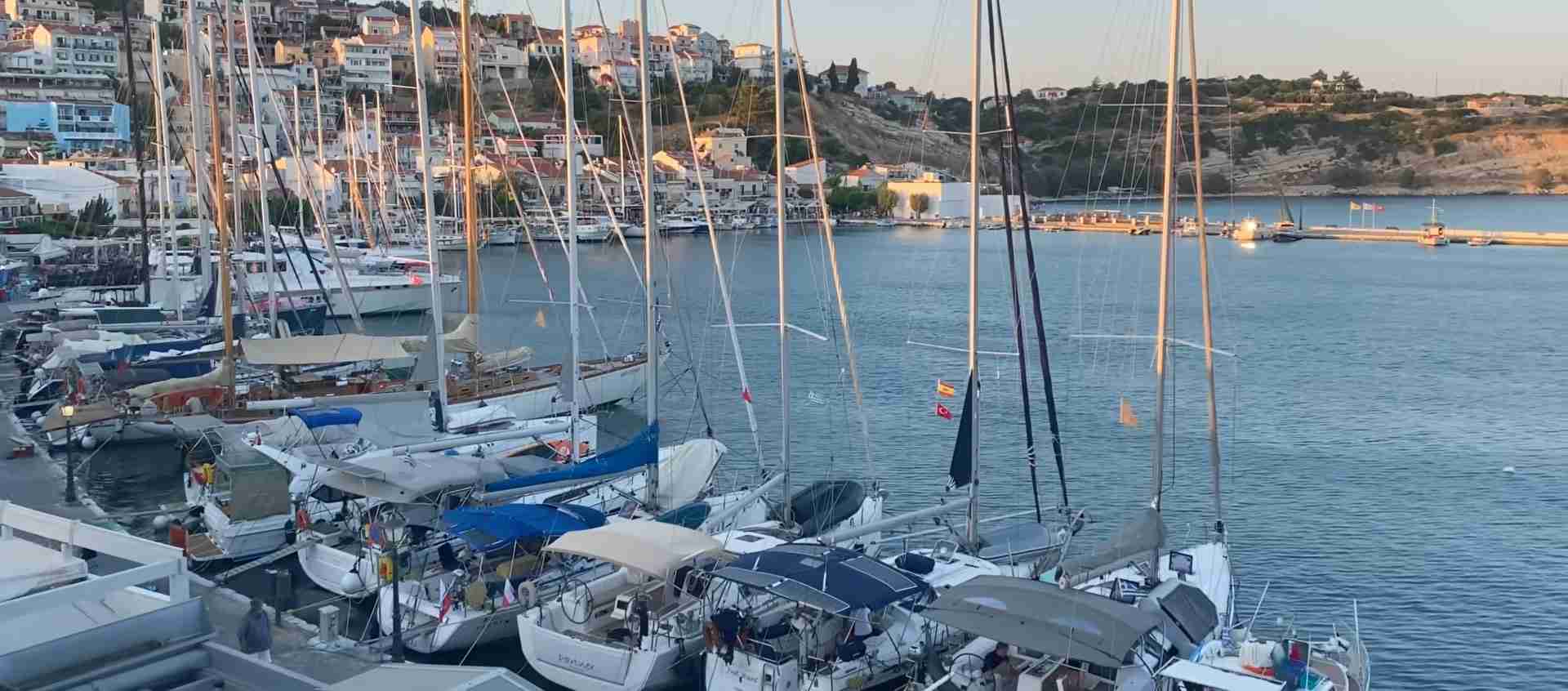
The harbor design created what historians consider the oldest artificial harbor in the Mediterranean, providing sheltered anchorage that could accommodate large numbers of vessels simultaneously while protecting them from the northerly Etesian winds that dominate Aegean weather patterns during summer months and southern storms arriving during winter. The commercial advantages of reliable safe harbor facilities enabled Samos to capture lucrative trade routes connecting mainland Greece with Asia Minor and the broader eastern Mediterranean, generating the wealth that funded monumental construction projects and supported the artistic, literary, and philosophical culture that flourished during the island’s golden age. The harbor capacity supported both the merchant fleet conducting trade throughout the Mediterranean and the naval forces that made Samos a significant military power capable of projecting force across the eastern Aegean and maintaining the island’s independence against larger states.
The urban layout within the fortifications preserves evidence of systematic city planning including a grid street system, organized residential quarters, public spaces, and zoned areas for different functions. Excavations have identified the agora (marketplace and civic center), theater seating approximately 3,000 spectators, gymnasium complex for athletic training and education, and numerous temples and sanctuaries serving religious functions. The residential architecture ranges from modest single-room dwellings to substantial multi-room houses with courtyards, reflecting the social stratification between wealthy merchant families, middle-class artisans and traders, and lower-class laborers and slaves who together comprised the urban population estimated at 10,000-20,000 inhabitants during the city’s peak prosperity.
The acropolis occupying elevated ground inland from the harbor served defensive purposes as the ultimate refuge during siege situations while housing important temples and public buildings that benefited from the prominent location visible from throughout the lower city and from approaching ships. The acropolis fortifications included their own defensive circuit with towers and gates, creating a citadel within the larger urban fortification system following standard Greek practice of providing layered defensive positions. The combination of harbor defenses, urban fortification walls, and acropolis citadel created a comprehensive defensive system that made ancient Samos extremely difficult to capture by assault, contributing to the city’s ability to maintain independence and project power despite being surrounded by larger territorial states in Asia Minor and competing Greek city-states throughout the Aegean.
Heraion Sanctuary and Temple of Hera
The Heraion sanctuary located 6 kilometers west of Pythagorion along the ancient Sacred Way represents one of antiquity’s most important religious centers, evolving from simple 8th-century BC origins into a sprawling temple complex that eventually housed one of the largest temples constructed in the Greek world. The sanctuary occupied a low-lying area near the Imbrasos River mouth where tradition placed the birthplace of the goddess Hera, creating sacred geography that attracted worshippers from throughout the Greek world and beyond. Archaeological evidence demonstrates cult activities at this location extending back to circa 1700 BC during the late Bronze Age, with continuity of worship through Mycenaean, Dark Age, and Archaic periods establishing the Heraion as one of Greek religion’s most ancient and continuously venerated sanctuaries.
The first monumental temple constructed at the Heraion during the 8th century BC earned the designation “Hekatompedos” (hundred-footer) as the first Greek temple to achieve 100 feet in length, marking a revolutionary departure from earlier small shrine buildings toward the monumental stone temple architecture that would characterize Greek religious architecture throughout antiquity. This temple established the canonical form of Greek temple design with rectangular plan, surrounding colonnade (peristyle), and pitched roof, creating the template that architects refined over subsequent centuries into the perfected Classical temple architecture exemplified by the Parthenon and other 5th-century BC masterpieces. The Hekatompedos demonstrated Samos operating at the forefront of architectural innovation during the 8th century BC, pioneering monumental stone construction techniques that other Greek cities would adopt and develop.
The great Temple of Hera constructed during the mid-6th century BC under Polycrates represented an even more ambitious project, creating a massive dipteral (double-peristyle) temple measuring approximately 55 meters wide by 112 meters long with 155 columns arranged in double rows around the cella (inner chamber). This colossal structure ranked among the largest temples of the ancient world, comparable in scale to contemporary projects including the Temple of Artemis at Ephesus (one of the Seven Wonders of the Ancient World) and later surpassed only by a few extraordinary structures like the Temple of Olympian Zeus in Athens. The construction employed the Ionic order with elaborately carved column capitals and bases, demonstrating the sophisticated sculptural and architectural capabilities that Samian workshops had developed by this period. The temple remained unfinished at Polycrates’ death in 522 BC with construction continuing intermittently for centuries without achieving complete roofing of the enormous interior space.
The single surviving column from the great temple stands approximately 20 meters high, providing dramatic testament to the structure’s original magnificence while illustrating the catastrophic destruction that reduced this magnificent building to scattered architectural fragments. Earthquakes, stone robbing for later construction projects, and simple structural failure due to the ambitious span of the roof combined to destroy most of the temple over centuries, leaving primarily foundations, scattered column drums, and architectural fragments that require archaeological expertise to interpret. The column capital displays the sophisticated Ionic volute carving and precise geometric proportions that characterized high-quality Greek architectural sculpture, while the column’s enormous dimensions—far exceeding human scale—demonstrate the temple’s intention to overwhelm viewers with divine grandeur appropriate to honoring the queen of the Olympian gods.
The sanctuary complex surrounding the temple included numerous subsidiary buildings, altars, treasuries, stoas (covered walkways), and processional ways creating a sacred precinct that functioned as both religious center and commercial/social gathering place for Samians and visiting worshippers. The Sacred Way connecting the city to the Heraion featured monumental statuary and votive dedications lining the processional route, transforming the approach into a gallery displaying artistic achievements and pious offerings that demonstrated individual wealth and civic pride. Excavations have recovered extraordinary votive offerings including bronze figurines, ivory carvings from Egypt and the Near East, exotic objects like Egyptian crocodile skull fragments, and the famous kouros statues (nude male figures) that rank among early Greek sculpture’s finest achievements.
The Kouros of Samos discovered under Roman-period pavement near the sanctuary entrance represents one of the largest and most impressive kouroi known from ancient Greece, standing approximately three times life size and dominating the sanctuary when originally erected around 580 BC. An inscription on the thigh identifies the dedicator as Isches son of Rhesus, presumably an important aristocrat who commissioned this extraordinary sculpture to honor Hera while demonstrating his wealth and piety to the broader community. The statue exemplifies the East Ionian sculptural style that Samian workshops pioneered during the Archaic period, featuring the characteristic rigid frontal pose, stylized anatomy, and “Archaic smile” that would evolve toward increasing naturalism in later Classical sculpture. The kouros now resides in the Samos Archaeological Museum in Vathy, protected from weathering while displayed for scholarly study and public appreciation.
The international character of dedications at the Heraion demonstrates the sanctuary’s far-reaching reputation and Samos’s extensive trade connections during the Archaic period. Votives from Egypt, Phoenicia, Cyprus, Syria, Iran, and Urartu illustrate the exotic goods flowing through Samian ports and the cosmopolitan character of worshippers drawn to this major sanctuary. A bronze horse frontlet from northern Syria bears an Aramaic inscription from the late 9th century BC, representing the earliest example of alphabetic writing discovered anywhere in Greece and demonstrating the early date when eastern Mediterranean contacts brought writing systems into Greek culture. These exotic dedications served both religious purposes (honoring Hera with precious offerings from distant lands) and social functions (displaying the dedicator’s participation in long-distance trade networks and ability to acquire luxury goods), creating a material record of Samos’s integration into Mediterranean-wide exchange systems.
Polycrates Tyranny and Samos Golden Age
Polycrates established his tyranny over Samos circa 540 BC, seizing power with his two brothers before eliminating them to rule alone, inaugurating a period of extraordinary prosperity and cultural achievement that made Samos the leading power in the eastern Aegean and one of the Greek world’s most influential cities. The historical sources, particularly Herodotus’s detailed account, portray Polycrates as an ambitious ruler who combined ruthless political skill with genuine patronage of arts, architecture, and engineering, creating conditions that allowed Samian culture to flourish even under autocratic government. His reign lasted approximately two decades until his death circa 522 BC when he fell victim to a plot by the Persian satrap Oroetes, who lured Polycrates to the mainland with promises of alliance before executing him in circumstances that ancient sources describe as both treacherous and ignominious.
The three great engineering projects that Herodotus identifies as Samos’s greatest achievements all date to Polycrates’ reign or the period immediately preceding his accession, reflecting the extraordinary concentration of resources and organizational capacity that enabled such ambitious construction programs. The Eupalinian Tunnel required massive investment in skilled surveying, engineering design, labor mobilization, and sustained funding over the 5-15 year construction period, demonstrating state capacity to commit resources to long-term infrastructure projects. The harbor mole similarly demanded enormous expenditure on materials, labor, and engineering oversight to create permanent marine installations capable of withstanding Mediterranean storm conditions. The great Temple of Hera represented religious devotion and civic pride but also served political purposes by enhancing Samos’s prestige and attracting visitors to this major sanctuary, generating economic benefits through religious tourism while strengthening Samos’s cultural influence throughout the Greek world.
Polycrates built a powerful navy that dominated eastern Aegean waters, deploying reportedly 100 pentekonters (fifty-oared galleys) and establishing maritime supremacy that enabled Samos to control trade routes and project military force throughout the region. The naval power supported an aggressive foreign policy including alliances with Egypt’s Pharaoh Amasis and later with the Persian Empire, demonstrating Polycrates’ sophisticated diplomacy navigating between the major powers dominating the eastern Mediterranean during the mid-6th century BC. The wealth generated through maritime trade, possibly including piracy operations that ancient sources attribute to Polycrates, funded both military expenses and the massive construction projects while supporting the artistic and intellectual culture that made Samos a leading cultural center rivaling Athens and other major Greek cities.
The court of Polycrates attracted poets, artists, and intellectuals from throughout the Greek world, creating a cultural center that influenced Greek literature and arts for generations. The lyric poet Anacreon served in Polycrates’ court, composing drinking songs and love poetry that exemplified the sophisticated literary culture patronized by the tyrant. Sculptors and architects working on temple projects and civic monuments developed styles and techniques that influenced Greek art throughout the Archaic and Classical periods, with the Samian school of sculpture achieving particular renown for kouros figures and relief carving. The combination of engineering achievements, naval power, economic prosperity, architectural magnificence, and cultural sophistication made Polycrates’ Samos one of the Greek world’s most impressive cities, demonstrating that autocratic government could produce cultural flowering comparable to the achievements of democratic Athens in later generations.
The relationship between Samos and Pythagoras during this period remains historically unclear, with ancient sources offering conflicting accounts of whether the philosopher left Samos fleeing Polycrates’ tyranny or departed earlier for other reasons. The traditional narrative portrays Pythagoras rejecting autocratic rule and seeking freedom to establish his philosophical community in Croton, southern Italy, where democratic or at least non-tyrannical government allowed the development of his quasi-religious movement combining mathematical philosophy with ascetic practices and communal living. Alternative interpretations suggest Pythagoras may have left Samos before Polycrates’ tyranny or for reasons unrelated to politics, making his departure part of broader patterns of Greek colonization and intellectual migration rather than specifically political exile. Regardless of precise chronology, the coincidence of Samos producing both extraordinary engineering achievements and one of history’s most influential mathematicians during the same 6th-century BC period demonstrates the intellectual and technical sophistication that characterized the island’s golden age.
The collapse of Polycrates’ tyranny following his death initiated a period of political instability including brief Persian control, democratic reforms, involvement in the Ionian Revolt against Persia, and eventual incorporation into the Athenian-dominated Delian League during the 5th century BC. Samos never regained the extraordinary prosperity and independence it enjoyed under Polycrates, though the island remained an important naval and commercial center through Classical, Hellenistic, and Roman periods. The monumental construction projects initiated during the 6th century BC continued exerting influence long after Polycrates’ death, with the Eupalinian Tunnel supplying water for 1,100 years, the harbor continuing to serve shipping for centuries, and the Temple of Hera remaining one of the Greek world’s most important sanctuaries through the Roman period. The archaeological remains of this brief but brilliant golden age constitute the primary elements that earned Pythagorion and the Heraion UNESCO World Heritage designation, preserving evidence of the extraordinary achievements that made 6th-century BC Samos one of ancient civilization’s most remarkable city-states.
Archaeological Museums and Artifact Collections
The Pythagorion Archaeological Museum inaugurated in 2010 displays the most important archaeological finds from excavations in the ancient city and surrounding territory, creating a carefully curated collection that illuminates Samos’s history from Neolithic origins through Byzantine periods. The museum building itself represents contemporary Greek museum architecture emphasizing natural lighting, clear sight lines, and accessible interpretation that makes ancient artifacts intelligible to non-specialist visitors while maintaining scholarly rigor appropriate for researchers. The ground floor presents the history of ancient Samos through thematically organized displays combining pottery, sculpture, architectural elements, inscriptions, and small finds that together reconstruct ancient life in this prosperous maritime city-state.
The entrance features a remarkable marble inscription documenting the ancient municipality’s program providing free wheat to all citizens, with funding derived from donations by wealthy Samians who contributed to a special public fund for this purpose. This inscription demonstrates the sophisticated social welfare concepts and public administration that characterized developed Greek city-states, where civic pride and competition among elite families created public benefits through privately funded programs administered by democratic institutions. The inscription represents both an important historical document revealing ancient social policies and an example of the epigraphic evidence that provides scholars detailed information about ancient governance, economy, and social relations that supplement literary sources and archaeological remains.
The ground floor displays include extensive pottery collections representing the distinctive Samian ceramic production traditions including “Wild Goat” style pottery featuring elaborate animal and floral decoration that circulated throughout the eastern Mediterranean during the Archaic period. Samian workshops developed ceramic technologies and decorative styles that influenced pottery production across the Greek world, with Samian amphorae (transport vessels) and fine ware reaching markets from the Black Sea to Spain, serving both utilitarian functions and artistic purposes. The pottery sequences displayed in the museum allow tracking stylistic development across centuries, demonstrating continuity and change in ceramic production while providing absolute chronological indicators through pieces whose style dates to specific periods reconstructed by comparative analysis with pottery from other sites.
The children’s graves excavated near the Heraion sanctuary reveal burial practices and beliefs about death and afterlife through grave goods including toys, jewelry, and personal items interred with young individuals. The four-level structure constructed in the museum to display graves from different periods (Geometric, Archaic, Hellenistic, Roman) demonstrates chronological development in burial customs, allowing visitors to trace changing practices across nearly a millennium. Burial urns, sarcophagi, and funerary markers provide evidence for family structures, wealth distribution, religious beliefs, and artistic production, creating a comprehensive picture of ancient society through the material culture surrounding death rituals.
The upper floor features the museum’s most impressive collections of monumental sculpture including marble statues, architectural reliefs, and bronze figurines that rank among ancient Greek art’s finest achievements. The seated statue of Aiakes, father of tyrant Polycrates, bears an inscription identifying it as a dedication to Hera dating to circa 540 BC, representing the scale and quality of sculptural dedications that wealthy Samians commissioned for the Heraion sanctuary. The statue demonstrates early Greek sculpture’s characteristic frontal rigidity while showing increasing attention to anatomical detail and garment rendering that would evolve toward Classical naturalism in later generations. Other sculptures include kouros figures, clothed female statues (korai), and relief sculptures displaying the technical virtuosity and artistic sensitivity that made Samian workshops renowned throughout the ancient world.
A particularly striking black-and-white female statue constructed from two different stone types (black and white marble) represents the experimental approach Samian sculptors brought to their craft, creating visual effects through color contrasts that enhanced the figure’s presence and symbolic meaning. This polychrome approach to sculpture challenged the traditional conception of Greek sculpture as purely white marble, demonstrating that ancient artists employed color, mixed materials, and visual effects that later centuries lost when paint and precious metal attachments deteriorated leaving the stone substrate that subsequent generations perceived as the complete work. The museum’s sculpture collection allows studying the early Greek sculptural tradition at a major production center, providing comparisons with contemporary work from other regions and tracking stylistic development toward Classical period achievements.
The display representing open-air sanctuaries found on hillsides around ancient Samos illustrates religious practices outside the major temple complexes, showing how ordinary Samians worshipped local deities and hero cults through dedications at natural sacred sites like caves and rock outcrops. The votive statuettes dedicated to the Mother-Goddess Cybele placed in natural rock cavities demonstrate religious syncretism blending Greek with Anatolian divine figures, reflecting Samos’s position bridging Greek and Asia Minor cultural spheres. These modest dedications contrast with the monumental offerings at the Heraion, revealing the full spectrum of religious practice from wealthy aristocrats commissioning life-size marble statues to modest worshippers leaving small terra cotta figurines at local shrines.
The major sculpture collections from the Heraion sanctuary reside in the Samos Archaeological Museum in Vathy (the island’s capital) rather than the Pythagorion museum, with the most important pieces including the Kouros of Samos, the Hera of Samos (actually likely a priestess rather than the goddess), and the Geneleos group of family dedications. This distribution of collections between museums reflects curatorial decisions balancing local relevance (displaying finds near their discovery locations) against conservation needs and visitor access to major pieces. Visitors seriously interested in Samian archaeology should plan to visit both museums to experience the full range of significant artifacts from this UNESCO World Heritage site.
Visiting Pythagorion UNESCO Site Practically
Visiting the Pythagorion and Heraion UNESCO World Heritage site requires understanding the spatial distribution of monuments across the modern landscape, as significant remains spread across multiple locations rather than concentrating in a single archaeological park. The modern town of Pythagorion occupies the same footprint as the ancient city, with archaeological remains interspersed among contemporary buildings, waterfront development, and infrastructure creating a palimpsest where ancient and modern coexist. Visitors should allocate minimum one full day to experience the major monuments including the Eupalinian Tunnel, Pythagorion Archaeological Museum, ancient theater, fortification walls, harbor area, and Castle of Lykourgos Logothetis, with additional time required for visiting the Heraion sanctuary 6 kilometers distant requiring separate transportation.
The Eupalinian Tunnel located approximately 2 kilometers north of Pythagorion town center represents most visitors’ primary destination, operating on scheduled tour departures with three itinerary options requiring advance planning based on physical capability and time availability. The south entrance provides vehicular access with parking area and visitor facilities including toilets and interpretive displays explaining the tunnel’s history and engineering. Visitors arriving by foot from Pythagorion can walk the 2-kilometer distance in 30-40 minutes along roads with limited dedicated pedestrian infrastructure, making vehicle transport (rental car, taxi, or organized tour) preferable for most visitors. The north entrance at Agiades requires walking approximately 20 minutes on dirt road from the nearest vehicle access, making it impractical for most visitors except those completing the full 1,036-meter Itinerary 3 traverse.
Tunnel visiting requires appropriate preparation including closed sturdy shoes with good traction for navigating wet, uneven rocky surfaces, light jacket or sweater for the constant 16.5°C temperature (significantly cooler than summer Mediterranean temperatures), and realistic assessment of physical capabilities regarding confined spaces, low ceilings, and extended walking on difficult surfaces. Visitors should arrive at scheduled departure times 10 minutes early to receive protective helmets (mandatory for all visitors) and receive brief orientation from guides. Photography with hand-held non-professional cameras receives permission without fees though flash photography is forbidden to protect delicate rock surfaces and historical inscriptions, while professional photography or video requires special permits from the Hellenic Ministry of Culture Education and Sports. Children under 14 years old cannot enter the tunnel due to safety concerns, while youth aged 14-18 must be accompanied by responsible adults.
The Pythagorion Archaeological Museum operates regular hours in the town center within easy walking distance of waterfront hotels and restaurants, requiring 1-2 hours for thorough examination of displays and interpretive materials. The museum provides air-conditioned refuge from summer heat while offering essential context for understanding the archaeological remains scattered around the modern town and throughout the ancient city’s former extent. Combining museum and tunnel visits creates a comprehensive half-day or full-day itinerary depending on tunnel route selected and time spent in museum galleries. The museum shop sells scholarly publications, popular guidebooks, and reproductions providing educational resources and souvenirs appropriate to a UNESCO World Heritage site.
The ancient theater occupying hillside location above the town preserves substantial seating sections and orchestra area though lacking the complete restoration seen at some famous Greek theaters. Visitors can walk through the seating areas examining construction techniques and experiencing the acoustic properties that Greek theater architecture achieved without modern amplification technology. The theater’s elevated position provides views across the town to the harbor, allowing appreciation of the ancient city’s topographical setting and defensive advantages while imagining performances that drew audiences from throughout the urban population and surrounding countryside. The theater hosts occasional summer performances of ancient drama and concerts, creating opportunities to experience the space as living cultural venue rather than purely archaeological monument.
The Heraion sanctuary requires separate planning as a half-day excursion from Pythagorion or Vathy (Samos capital), accessible by rental car, taxi, public bus, or organized tour. The site operates standard archaeological hours with the single standing column, temple foundations, scattered architectural fragments, and interpretive signage explaining the sanctuary’s history and significance. The low-lying location near the modern coastline (the ancient shoreline has prograded seaward due to Imbrasos River sedimentation) provides different landscape character than the hillside urban setting of Pythagorion, with the scale of temple foundations and massive architectural elements conveying the original monument’s extraordinary size. Visitors should allocate 1-2 hours for exploring the sanctuary, examining the standing column and foundations, and walking the Sacred Way approach that ancient worshippers followed during religious processions from the city to the temple.
Practical considerations for visiting Pythagorion include accommodation availability in the modern town ranging from budget pensions to upscale hotels, waterfront restaurants serving fresh seafood and traditional Greek cuisine, and tourist infrastructure including rental vehicle agencies, boat excursions, and water sports facilities. The summer season (June-September) sees peak visitor numbers with advance booking essential for accommodations and recommended for tunnel visits, while shoulder seasons (April-May, October) offer pleasant weather with fewer crowds and easier logistics. The site’s integration into a living town rather than isolated archaeological park means visitors experience the UNESCO heritage within contemporary Greek island culture, dining in tavernas steps from ancient fortification walls and swimming at beaches overlooking the harbor mole that served ancient shipping for over a millennium.
Frequently Asked Questions About Pythagorion Ancient Engineering
How Long Did It Take to Build the Eupalinian Tunnel?
Construction of the Eupalinian Tunnel required between 5 and 15 years according to scholarly estimates, with the wide range reflecting uncertainty about labor force size, work organization, shift patterns, and progress rates through varying rock hardness encountered during excavation. The 1,036-meter tunnel through solid limestone mountain demanded removing approximately 8,000-10,000 cubic meters of rock using only bronze tools available during the 6th century BC, with workers chiseling through harder limestone sections at much slower rates than softer rock zones. Assuming continuous work with multiple shifts totaling 50-100 workers distributed between the two teams boring from opposite mountain sides, progress might average 1-3 meters per week depending on rock conditions, requiring 350-1000 weeks (7-20 years) for complete excavation. The 5-year minimum estimate assumes optimal conditions with hard-working large labor forces maintaining rapid progress, while the 15-year maximum accounts for difficulties including tool breakage, geological obstacles, work stoppages, and the challenging confined conditions that limited how many workers could operate simultaneously at the tunnel face. The actual construction period likely fell in the middle range of 8-12 years, representing a massive commitment of resources and sustained organizational capacity that demonstrates the Samian state’s wealth and administrative sophistication during Polycrates’ reign or the preceding regime.
What Happened to the Ancient City of Samos After the Roman Period?
Ancient Samos continued functioning as an important city through Roman and Byzantine periods before gradual decline during late antiquity and the medieval era eventually reduced it to a small settlement that medieval sources called Tigani, with the modern town of Pythagorion developing from this modest community rather than maintaining the ancient city’s population and prosperity. During the Roman period (146 BC onward), Samos operated as a significant provincial city with construction of Roman baths, administrative buildings, and modifications to earlier structures demonstrating continuing urban vitality and integration into Mediterranean-wide trade networks. The early Christian period saw the conversion of some ancient buildings to Christian use and construction of basilica churches, with Samos functioning as bishopric maintaining religious and administrative importance through Byzantine times. Raids by Arab forces during the 7th-9th centuries AD, earthquakes damaging infrastructure, silting of the harbor reducing maritime capacity, and general contraction of Mediterranean trade during the medieval period all contributed to gradual urban decline. The Eupalinian Tunnel ceased operating as water supply during the 7th century AD when silting overwhelmed maintenance capacity, with the tunnel converted to defensive refuge equipped with cisterns collecting seepage water rather than functioning as aqueduct. By the late medieval period, the town had contracted to a small fishing village occupying only a fraction of the ancient city’s extent, with most of the ancient urban area abandoned and reverting to agricultural use or remaining vacant, creating the archaeological preservation conditions that allow modern investigation of the ancient city plan largely undisturbed by continuous occupation.
Why Is the Site Called Both Pythagorion and Samos in Different Sources?
The naming confusion arises because the ancient city bore the same name as the island (Samos), the modern town took a different name (Tigani) during medieval times, and the 1955 renaming to Pythagorion honored the mathematician while creating multiple designations used differently in historical texts, archaeological publications, and tourism materials. Ancient sources including Herodotus and other classical authors refer to the city as “Samos” when discussing the 6th-century BC golden age, using the same name for both the island and its principal urban center following Greek practice where major cities often shared names with their territories. Medieval sources call the reduced settlement “Tigani” (frying pan) referring to the harbor’s rounded shape, with this name persisting until 1955 when Greek authorities officially renamed the town Pythagorion to commemorate Pythagoras’s birthplace and promote tourism through association with the famous mathematician. Modern archaeological publications often use “ancient Samos” when referring to the city versus “Samos island” when discussing the broader territory, while UNESCO documents employ “Pythagorion” for the urban area to match contemporary naming while distinguishing it from Vathy (modern Samos town serving as island capital). Tourism materials sometimes interchange “Pythagorion” and “ancient Samos” depending on whether emphasizing modern visitor infrastructure (Pythagorion the living town with hotels and restaurants) or ancient heritage (Samos the 6th-century BC maritime power). Visitors should understand these terms all reference the same ancient city underlying modern Pythagorion, with naming variations reflecting different historical periods and contemporary usage contexts rather than indicating distinct locations.
Can You Visit the Heraion Temple and Pythagorion in One Day?
Visiting both the Heraion sanctuary and Pythagorion monuments in a single day proves entirely feasible with private vehicle or organized tour providing transportation between sites separated by 6 kilometers of paved road requiring 10-15 minutes driving time. A well-planned day might begin with early morning Eupalinian Tunnel visit on the 8:30 or 9:20 departure avoiding midday heat in the confined underground space, followed by the Pythagorion Archaeological Museum during mid-morning hours when fresh energy allows absorbing detailed exhibits, continuing with the Heraion sanctuary for late morning or early afternoon exploration of temple remains and site museum, returning to Pythagorion for afternoon rest or beach time, and concluding with evening examination of the ancient theater, fortification walls, and waterfront harbor area as temperatures moderate and lighting improves for photography. This itinerary requires approximately 8-10 hours total including driving time, site visits, museum examination, and meals, representing a full but manageable day for visitors with reasonable walking capability and genuine interest in ancient history and archaeology. Alternative approaches might dedicate separate days to each site allowing more leisurely exploration, extended time in museums, and reduced schedule pressure, particularly appealing for visitors staying multiple nights in Pythagorion accommodations or combining site visits with beach relaxation and other island activities. Organized day tours from other Samos locations or even neighboring islands typically include both Heraion and Pythagorion in single itineraries with guided commentary providing historical context, though limited time at each location versus independent visits allowing flexible pacing according to individual interests.
What Is the Best Time of Year to Visit Pythagorion?
The optimal visiting periods for Pythagorion span late April through June and September through October when pleasant temperatures, reduced tourist crowds, and operational archaeological sites combine with lower accommodation costs and available ferry connections from mainland Greece and other islands. Spring months (April-June) offer warming temperatures ideal for walking archaeological sites and exploring the Eupalinian Tunnel’s cool underground passages without summer heat exhaustion risks, wildflowers coloring hillsides and countryside, and pre-peak-season hotel availability at moderate prices. Early summer (June) provides excellent weather before July-August crowds arrive, while September through early October maintains summer warmth with departing tourists creating more relaxed site visits and better accommodation value. July and August peak season brings guaranteed sunshine, warmest sea temperatures for swimming, and maximum service availability but accepts trade-offs including highest accommodation costs, crowded archaeological sites (particularly the Eupalinian Tunnel with scheduled tour bookings filling rapidly), intense heat making midday outdoor activity uncomfortable, and ferry/flight capacity constraints requiring advance booking. Winter months (November-March) see many tourist facilities closing, reduced ferry schedules limiting island access, and cooler wetter weather inappropriate for beach activities though still permitting archaeological site visits during favorable weather windows and offering rock-bottom accommodation rates for hardy travelers accepting limited services and unpredictable conditions.
Is the Pythagorion Site Suitable for Children and Families?
Pythagorion accommodates family visits with children appreciating the Eupalinian Tunnel adventure, ancient harbor exploring, and beach activities, though the archaeological focus, limited interactive elements, and age restrictions on tunnel access require realistic parental expectations about children’s engagement with ancient history and site logistics. The Eupalinian Tunnel prohibits children under 14 years old from entering due to safety concerns about confined spaces, low ceilings, wet slippery conditions, and emergency evacuation difficulties, eliminating the most distinctive site feature for families with younger children who must find alternative activities while other family members tour the tunnel. Children aged 14-18 can enter with adult supervision, providing families with teenagers the opportunity for this unique underground experience that often captures adolescent imagination more effectively than conventional museum exhibits or architectural ruins. The Pythagorion Archaeological Museum offers modern displays that some children find engaging, particularly sculpture galleries and video presentations showing excavation processes, though the educational focus and scholarly interpretation may not sustain interest for children younger than 10-12 years without parental mediation making the content accessible and relevant. The ancient theater, fortification walls, and harbor area provide open spaces where children can run, explore, and imagine ancient life without the constraints of indoor museum behavior, creating family-friendly environments where archaeological appreciation combines with active physical engagement. The modern town’s waterfront restaurants, ice cream shops, and swimming beaches provide essential breaks from cultural tourism, allowing families to alternate archaeological activities with leisure time maintaining children’s positive attitudes and energy levels through potentially long days of sightseeing.
How Does Pythagorion Compare to Other Greek UNESCO Sites?
Pythagorion distinguishes itself among Greek UNESCO World Heritage sites through its exceptional engineering achievements, completeness of urban archaeological remains, and distinctive focus on Archaic period history predating the Classical Athens monuments that dominate popular conceptions of ancient Greece. While sites like the Acropolis of Athens, Delphi, Olympia, and Epidaurus attract vastly larger visitor numbers through combinations of monumental architecture, mythological associations, and accessible mainland locations, Pythagorion offers scholars and serious archaeology enthusiasts opportunities to study a complete ancient city plan largely undisturbed by subsequent development—a preservation condition rare among continuously inhabited regions. The Eupalinian Tunnel represents engineering sophistication unmatched at other Greek sites except perhaps the defensive walls at Mycenae or harbor works at Piraeus, demonstrating mathematical and organizational capabilities that challenge assumptions about ancient technological limitations. The joint inscription with the Heraion creates a cultural landscape approach recognizing urban-rural sanctuary relationships rather than isolated monument protection, anticipating contemporary heritage management philosophies emphasizing interconnected cultural systems over individual buildings. Pythagorion’s Archaic period focus (6th century BC) provides crucial evidence for understanding Greek civilization during its formative phase before the Persian Wars and Classical golden age dominated by Athens, filling chronological gaps in the UNESCO Greek portfolio concentrated on 5th-4th century BC monuments. The site’s island location on Samos requires greater travel effort than mainland destinations, contributing to lower visitor numbers that create more contemplative site experiences without the crowds overwhelming popular attractions, appealing to travelers seeking authentic archaeological engagement over tourist spectacle. Compared to Delos (the other major Cycladic UNESCO site), Pythagorion offers superior accessibility through regular ferry connections and modern town accommodations, while Delos provides more extensive architectural remains across a larger uninhabited island requiring full-day excursion commitment.
What Role Did Samos Play in Ancient Greek History Beyond the 6th Century BC?
Samos maintained significant historical and cultural importance throughout Classical, Hellenistic, and Roman periods despite never regaining the extraordinary prosperity and maritime dominance it enjoyed during Polycrates’ 6th-century BC golden age, participating in major Greek conflicts, producing notable philosophers and artists, and functioning as strategic naval base for successive Mediterranean powers. During the 5th century BC, Samos joined the Delian League led by Athens, initially as autonomous ally but later as subject state following a failed revolt in 440 BC that resulted in Athenian-imposed democratic government and tribute obligations. The island supported Athens during the Peloponnesian War against Sparta, hosting Athenian naval forces and receiving special privileges including retention of democratic institutions and limited self-government even as Athens ruled other allies more harshly. The mathematician and astronomer Aristarchus of Samos (circa 310-230 BC) proposed the heliocentric model of the solar system nearly 2,000 years before Copernicus, demonstrating continuing scientific innovation in Hellenistic Samos though his revolutionary ideas found limited acceptance in antiquity. The Epicurean philosopher Epicurus (341-270 BC) taught briefly in Samos before establishing his famous Garden school in Athens, while the astronomer Conon of Samos (circa 280-220 BC) conducted mathematical research and corresponded with Archimedes, maintaining Samos’s reputation for producing significant thinkers and scientists. During Roman times, Samos initially received favored treatment from Julius Caesar and Mark Antony for supporting them during civil wars, though later incorporation into regular provincial administration reduced the island’s autonomy and special privileges. The Byzantine period saw Samos functioning as provincial administrative center and bishopric, suffering Arab raids during the 7th-9th centuries AD but maintaining urban life and Christian culture through successive medieval centuries before Ottoman conquest in 1475 initiated four centuries of Turkish rule ending only with Greek independence in the 19th century.
Are There Other Important Archaeological Sites on Samos Beyond Pythagorion?
Samos preserves numerous significant archaeological sites beyond the UNESCO-designated Pythagorion and Heraion areas, including the island capital Vathy with its Archaeological Museum housing major sculpture collections, the ancient sanctuary of Artemis at modern Pythagorio near the airport, prehistoric settlements at various coastal locations, medieval fortifications at multiple points, and Byzantine churches scattered throughout the island’s villages. The Samos Archaeological Museum in Vathy displays the most important artifacts from excavations across the island including the monumental sculpture from the Heraion sanctuary, the famous Kouros of Samos, the Hera of Samos (Cheramyes kore), and the Geneleos family group representing some of ancient Greek sculpture’s finest Archaic period achievements. The museum building occupies a neoclassical structure in Vathy’s town center, requiring 2-3 hours for thorough examination of galleries displaying pottery, sculpture, small finds, and interpretive materials contextualizing Samos’s archaeological heritage. The ancient sanctuary of Artemis Tauropolis located near Pythagorion between the town and airport preserves temple foundations and altar remains from a significant cult site, though lacking the monumental scale of the Heraion and receiving fewer visitors due to less impressive visible remains. Prehistoric sites including Bronze Age settlements contemporary with Minoan and Mycenaean civilizations demonstrate Samos’s ancient habitation and participation in Aegean-wide cultural networks, though these early sites typically preserve only foundations and artifact scatters requiring archaeological expertise to interpret. Medieval fortifications including the Castle of Lykourgos Logothetis in Pythagorion dating to the Greek War of Independence (1821-1829) and the Venetian castle at Pythagorio built during brief Venetian control periods illustrate later historical eras when Samos remained strategically important commanding eastern Aegean approaches. Byzantine churches throughout the island, particularly the Monastery of Panagia Spiliani built into a cave above Pythagorion, preserve medieval Christian heritage and continue functioning as active religious sites maintaining Orthodox traditions across centuries from Byzantine origins through Ottoman period and into modern Greece.
How Accessible Is Pythagorion for Visitors with Mobility Limitations?
Pythagorion presents significant accessibility challenges for visitors with mobility limitations due to the Eupalinian Tunnel’s confined underground conditions, ancient site terrain featuring uneven surfaces and steep hillside locations, and limited wheelchair accessibility at archaeological remains and museums, though the modern town offers relatively accessible waterfront areas and some museum spaces accommodate mobility devices. The Eupalinian Tunnel completely excludes wheelchair users and visitors requiring mobility assistance due to narrow passages (width narrowing to 0.42 meters in sections), low ceilings (height dropping to 1.5 meters), uneven rocky floors, steps at entrance areas, and emergency evacuation impossibilities, making this signature attraction unfortunately inaccessible to significant portions of the disabled community. The Pythagorion Archaeological Museum provides ground-floor galleries with relatively level access suitable for wheelchairs or walkers, though the building may lack comprehensive accessibility features including automatic doors, accessible restrooms, and complete barrier-free navigation depending on recent renovations and improvements. The ancient theater occupies hillside location with stepped seating sections and uneven stone surfaces making wheelchair access impossible to most areas, while allowing visitors who can manage limited uneven walking to experience portions of the monument and views from accessible sections near the entrance. The fortification walls, harbor mole, and other archaeological remains distributed around the modern town present variable accessibility depending on specific locations, with some waterfront areas offering level sidewalks suitable for wheelchairs while others involve rough terrain, steps, or steep slopes preventing access for mobility-limited visitors. The Heraion sanctuary features relatively level terrain across the temple precinct allowing wheelchair access to view the standing column and foundations on compacted earth paths, though the site museum and some outlying structures may present accessibility obstacles depending on specific conditions and recent improvements. Visitors with mobility limitations planning Pythagorion visits should research current accessibility conditions at specific monuments, consider organized tours offering accessible van transportation and pre-arranged accessibility accommodations, accept that some signature attractions including the Eupalinian Tunnel remain unfortunately inaccessible regardless of planning, and focus attention on accessible elements including museum galleries, waterfront archaeological areas, and Heraion sanctuary spaces that allow experiencing important aspects of Samos’s heritage despite inability to access all monuments.