
Ronda and Serranía de Ronda Itinerary 2027: Exploring Setenil, Acinipo & the Tajo Gorge Without a Car
Ronda rises above a 100-meter gorge in the heart of the Serranía de Ronda, and a scenic train from Málaga still runs directly to its station — one of Andalusia’s most rewarding rail arrivals for travelers who prefer railways to rental cars. This 2027 itinerary builds outward from Ronda’s Moorish old town and the Tajo Gorge viewpoints to two lesser-visited sites in the surrounding highlands: the cliff-carved village of Setenil de las Bodegas, reachable by local bus, and the Roman theater ruins of Acinipo, best reached by taxi or bicycle from Ronda in a single morning excursion.
Key Takeaways
- The RENFE train from Málaga María Zambrano to Ronda takes approximately 1 hour 45 minutes and costs around €12–17 per person each way in 2027; confirm current fares and timetables at renfe.com before booking, as schedules are subject to seasonal change.
- A regional bus connects Ronda to Setenil de las Bodegas in 30–45 minutes for approximately €3–5 each way; services are typically limited to 2–3 departures per day in each direction, so confirm the current timetable at Ronda’s bus station before planning the excursion.
- Acinipo has no scheduled public bus service; a return taxi from Ronda costs approximately €40–60 and can be shared among up to four passengers, or the 18-km country road can be cycled on a suitable bike by fit riders.
- Budget travelers sharing a room should plan approximately €60–95 per person daily for accommodation, meals, local transport, and entry fees; mid-range travelers budget €110–165 per person daily (two sharing).
- Ronda’s main historical circuit — Puente Nuevo, the Arab Baths, Almocábar Gate, and the Tajo Gorge rim walk — covers roughly 1.5 km and fits into a single day on foot; most viewpoints are free, with paid admissions concentrated at the Arab Baths and the small bridge-chamber museum.
- Acinipo entry is free, managed by the Junta de Andalucía; bring water, sunscreen, and a hat, as the exposed mesa at around 1,000 meters elevation has no shade and no on-site refreshments.
People Also Ask About Ronda and Serranía de Ronda Itinerary 2027
How do I travel from Málaga to Ronda without a car in 2027?
The fastest and most scenic car-free option is the RENFE Media Distancia train from Málaga María Zambrano station. The journey takes approximately 1 hour 45 minutes and in 2027 fares typically fall in the €12–17 range per person depending on booking class and how far in advance you purchase; check renfe.com for confirmed 2027 fares and timetables, as prices are set closer to the date. RENFE currently operates 2–4 departures per day in each direction, with the earliest morning train from Málaga leaving around 7:00–8:00 AM; confirm the current schedule directly with RENFE, as times are subject to seasonal adjustment. The train deposits you at Ronda’s compact lower station, which is a flat 15-minute walk from the old town center or a short inexpensive taxi ride. An alternative is the intercity bus from Málaga bus station (run by Alsa and partner operators), which reaches Ronda via a longer road route in approximately 2 hours 30 minutes to 3 hours depending on the service, with some additional departure times when trains are limited.
Can I visit Setenil de las Bodegas from Ronda by public transport in 2027?
Yes, though careful timetable planning is essential. A regional bus connects Ronda and Setenil de las Bodegas in 30–45 minutes on winding mountain roads, with a one-way fare of approximately €3–5. Services are limited — typically 2–3 departures in each direction per day — so this excursion works best on a day when you take an early morning bus to Setenil, allow 3–4 hours for the cave streets and castle ruins above the town, and return to Ronda on an afternoon bus. Confirm the current timetable in person at Ronda’s bus station (located a few minutes on foot from the train station at the edge of the new town) before the day of travel, since schedules may be reduced during public holidays and the low season. Within Setenil itself all movement is on foot — the village is small enough to walk end to end in under 20 minutes.
How much does a 3-day Ronda itinerary cost per person in 2027?
A car-free three-day itinerary covering Ronda, Setenil de las Bodegas, and Acinipo costs approximately €365–535 per person at the mid-range level, two sharing a hotel room. That figure covers three nights’ accommodation (€45–65 per person per night), three days of meals at sit-down restaurants (€47–70 per person per day), the RENFE train from Málaga (€12–17 one way), a return bus to Setenil (€6–10), a return taxi to Acinipo (€40–60), and attraction admissions over the three days (€30–45 total, since most viewpoints are free). Budget travelers sharing a guesthouse room can cover the same three-day itinerary for approximately €255–375 per person. Visitors staying at a four-star hotel or the Parador de Ronda should budget approximately €650–1,045 per person for the full three days.
Is it possible to visit Acinipo from Ronda without a car in 2027?
Yes, through a taxi or a bicycle — no scheduled public bus serves the site. The ruins, locally known as Ronda la Vieja (Old Ronda), sit approximately 18 km northwest of Ronda on the A-374 country road with no regular public transport coverage. A return taxi from Ronda costs approximately €40–60; shared among four passengers, this comes to roughly €10–15 per person, making it genuinely affordable for a small group. Cyclists can ride the route on a mountain or hybrid bike, though the return journey involves a significant climb back up to the Ronda plateau and should be attempted only by fit riders with appropriate equipment. Bike rental in Ronda is available from a small number of operators; check availability well in advance as inventory is limited. Acinipo is managed by the Junta de Andalucía and entry is free of charge; verify current opening days and hours on the official Junta de Andalucía cultural heritage website before the trip, as the site is closed on certain weekdays and may operate reduced hours in low season.
Extended multi-day tours – 5+ days
Featured Malaga Multi-Day Tour Packages

3 days
Malaga 3-Day Discovery Tour
- ✓ Comprehensive Malaga experience
- ✓ Expert local guides included
- ✓ All accommodation included
- ✓ Transportation provided
5 days
Malaga 5-Day Highlights Experience
- ✓ Comprehensive Malaga experience
- ✓ Expert local guides included
- ✓ All accommodation included
- ✓ Transportation provided

7 days
Malaga 7-Day Cultural Journey
- ✓ Comprehensive Malaga experience
- ✓ Expert local guides included
- ✓ All accommodation included
- ✓ Transportation provided
10 days
Malaga 10-Day Complete Adventure
- ✓ Comprehensive Malaga experience
- ✓ Expert local guides included
- ✓ All accommodation included
- ✓ Transportation provided
Multi-day tour packages powered by TourRadar. Prices and availability subject to change.
Introduction: Car-Free Travel in the Serranía de Ronda 2027
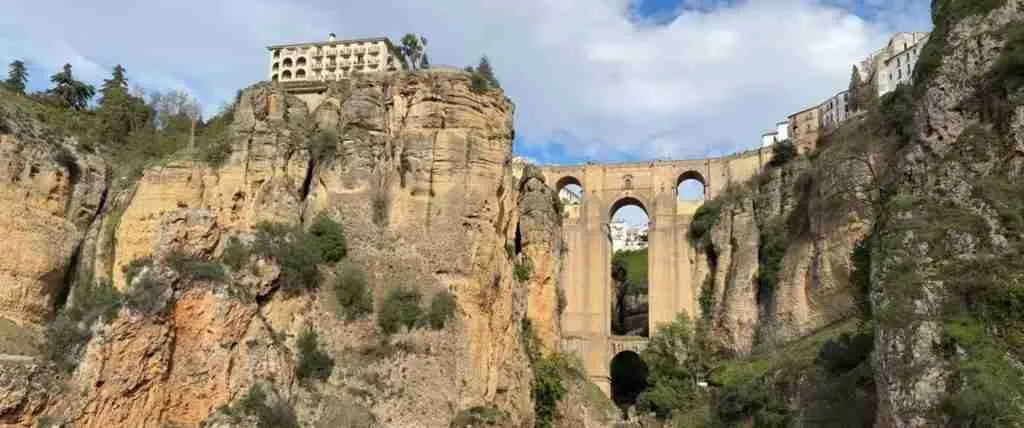
The Serranía de Ronda is a range of limestone mountains in western Andalusia, rising sharply from the Campo de Gibraltar and the agricultural plateaus of the Málaga and Cádiz interior. Its central town, Ronda, occupies a dramatic position on a mesa split by the Guadalevín river, whose cutting has produced the Tajo Gorge — a sheer-sided canyon approximately 100 meters deep that divides the medieval old town (La Ciudad) from the later new town (El Mercadillo). The 18th-century Puente Nuevo (New Bridge) spanning that gorge is one of Spain’s most-photographed structures.
What is less often recognized is how well Ronda functions without a car. A direct RENFE train runs from Málaga’s main station through the mountain interior to Ronda’s lower station, which is a level 15-minute walk from the Puente Nuevo. This removes the principal barrier that keeps many travelers from the Serranía’s secondary sites: the assumption that mountain Andalusia requires a hire car.
This 2027 itinerary structures three days around a single overnight base in Ronda. Day one uses the afternoon to walk Ronda’s compact Moorish old town circuit. Day two is a full-day excursion by regional bus to Setenil de las Bodegas, an extraordinary cliff-dwelling village in Cádiz province roughly 18 km north of Ronda — one of the most visually distinctive of Andalusia’s white villages, where houses are built under massive overhanging rock ledges rather than on the hillside above. Day three takes in Acinipo, the Iberian and Roman archaeological site on a 1,000-meter mesa northwest of Ronda, via a shared taxi for the outward and return journey.
The itinerary deliberately excludes drive-only sites — Grazalema, Zahara de la Sierra, Jimena de la Frontera — that feature in many regional car-hire guides. The three sites covered here form a coherent car-free narrative that rewards the kind of slow attention that trains and walking encourage. Visitors with more time should consider extending the Ronda base to four or five nights to allow the itinerary to breathe and to take advantage of the Serranía de Ronda’s underrated food and wine culture. Ronda is not a UNESCO World Heritage Site, though its layers of Phoenician, Roman, Moorish, and post-Reconquista heritage across a medieval street plan largely intact would qualify it for serious consideration under cultural criteria. For the practical 2027 traveler, what matters more is that the streets are cobbled, the viewpoints are free, and a rental car is a cost and a complication, not a requirement.
Rail & Transit Logistics: Using the Mr. Henderson’s Railway Line
The train that connects Málaga to Ronda runs on a line with a long and specific engineering history. The section of the Algeciras-Bobadilla railway through the Serranía de Ronda was completed in the 1890s, a period when British capital and engineering expertise were deeply embedded in Spain’s mountain railway construction. The route linking Bobadilla (the Málaga province junction) to Ronda and onward to Algeciras was a technically demanding project through hard limestone terrain, requiring substantial viaducts and cuttings to negotiate the Sierra Bermeja foothills and the Serranía ridgelines. Among heritage rail enthusiasts who write about Spain’s scenic mountain railways, this line is sometimes credited to British engineering leadership from the era of its construction — a common attribution in the travel literature of the line, though the precise corporate and individual records of who directed specific sections are not always consistently cited in English-language sources. What is certain is that the line’s completion in the 1890s opened Ronda to regular passenger traffic for the first time, and RENFE’s contemporary Media Distancia service still uses this infrastructure today.
For the 2027 traveler, the practical points are as follows. Trains depart from Málaga María Zambrano, the city’s main intercity rail hub, which connects directly to the airport (AVE/MD platforms) and the city center. The Ronda service is a Media Distancia train — not a high-speed service — and the journey of approximately 1 hour 45 minutes passes through the mountain interior of Málaga province, climbing from the coastal lowlands through the hills and descending into the river valleys that approach Ronda from the east. The scenery is the reason to take the train rather than the bus; the route crosses several notable viaducts and traverses landscape that cannot be seen from the main road. Book through renfe.com in advance — the line is popular among day-trippers from Málaga and can sell out on weekends and public holidays, particularly in spring. First-class (Preferente) seats on this service cost marginally more and provide wider spacing; for a journey of under two hours, the comfort difference is modest.
Train Schedules and Bus Links Between Malaga, Ronda, and Setenil
RENFE operates 2–4 trains per day in each direction between Málaga and Ronda on this line, with exact departure times varying seasonally and year to year. As of planning for 2027, check renfe.com for the live timetable; the first morning departure from Málaga typically leaves between 7:00 and 8:30 AM, making it possible to reach Ronda before 10:00 AM with a full day ahead. The last train back from Ronda to Málaga typically runs in the early evening, which gives day-trippers from Málaga a workable 7–8 hours in the town. Travelers based overnight in Ronda have more flexibility, but should still note the limited frequency to avoid being stranded if they miss a departure by taking a longer walk or a slow lunch.
Tickets for the Ronda line should be purchased in advance online. The one-way fare in 2027 falls approximately in the €12–17 range depending on class and booking timing; confirm the current price on renfe.com before purchasing, as RENFE adjusts fares dynamically. Student and senior discounts are available through the RENFE Abono Cercanías or through the TúMas loyalty program — register before travel if you plan to use the train more than once during the trip. The train station in Ronda is located at Avenida de Andalucía on the eastern edge of the town, a flat 15-minute walk through the new town to the Puente Nuevo, or approximately €5–8 by taxi.
For the Setenil de las Bodegas day trip, the connection is by regional bus, not by train — Setenil has no railway station. The bus departs from Ronda’s main bus station on Avenida Concepción García Redondo, a few minutes’ walk south of the train station. Regional bus services in the Serranía are managed by a rotation of operators under the Junta de Andalucía’s concession system; the current operator for the Ronda–Setenil route is best confirmed directly at the station, as contract changes are periodic. The journey takes 30–45 minutes and currently runs 2–3 times daily in each direction, with services thinning on Sundays and holidays. The one-way fare is approximately €3–5; a return ticket may be available and is worth purchasing at the outset if the operator offers one, to avoid the uncertainty of buying on the return bus. Setenil has no bus office — the bus stops in the village center and returns from the same stop.
Travelers combining Setenil and Acinipo in a single day (without a car) face a logistical challenge: bus service between Setenil and Acinipo does not exist, and a taxi from Setenil to Acinipo would require returning to Ronda first or calling a Ronda-based taxi firm to drive out to Setenil — a feasible but more expensive arrangement. The cleaner itinerary, followed in this guide, keeps each day-trip separate: Setenil on day two by bus, Acinipo on day three by taxi from Ronda.
Where to Stay in Ronda 2027
Ronda’s accommodation market divides cleanly between the old town (La Ciudad), which has the gorge views, cobbled atmosphere, and premium pricing, and the new town (El Mercadillo), which offers lower rates, easier access to the bus and train stations, and proximity to the main commercial streets. For car-free travelers, the new town’s proximity to the stations is a practical advantage, but the old town’s position above the gorge provides morning views that justify the marginally higher cost.
Accommodation Options by Tier in Ronda 2027
Budget accommodation (€60–80 per room per night): Several small guesthouses and pensiones operate in and around the new town’s central streets. These are typically family-run rooms in apartment buildings, with shared or en-suite bathrooms and simple breakfast available on request or nearby at a bar. Standards vary; read recent guest reviews before booking. Ronda has no conventional hostel dormitory in the town center, though a small number of hostels have opened in recent years — check booking platforms for current options. Budget travelers should expect €30–40 per person per night when two share a budget room.
Mid-range accommodation (€90–130 per room per night): The most rewarding category in Ronda is the boutique hotel or rural house (casa rural) concentrated in the old town streets near the Mondragón Palace and the Santa María la Mayor church. Several converted historic townhouses in La Ciudad offer rooms looking out over the gorge or into quiet interior courtyards, at prices that represent reasonable value by Andalusian town standards. These properties typically include a small sitting room, local breakfast, and staff who can arrange taxis for the Acinipo excursion. Mid-range travelers share a room at €45–65 per person per night.
Luxury accommodation (€180–300+ per room per night): The Parador de Ronda occupies one of the finest positions of any parador in Spain, built on the former town hall site on the edge of the Tajo Gorge — the dining terrace extends directly over the 100-meter drop. The Parador’s public areas and gorge-view rooms are exceptional; standard rooms on the town side are also good but significantly less dramatic. For the Parador or comparable four-star alternatives in the old town, book several months ahead for spring and summer travel. Luxury travelers pay approximately €90–150 per person per night (two sharing).
Regardless of tier, book accommodation before booking trains — Ronda’s limited inventory sells out quickly on spring weekends (Semana Santa through May is peak season) and during the September Feria de Pedro Romero. Winter stays (December–February) offer the lowest prices and fewest crowds, with mild temperatures and the occasional dramatic low cloud filling the Tajo Gorge in the mornings.
Stop 1: Ronda Old Town — Navigating the Moorish Quarter and Bridge Defenses
La Ciudad, the old walled town on the south side of the Tajo Gorge, is one of the best-preserved examples of a Nasrid-period Andalusian hill town. Its street plan derives from the medieval Islamic city built by the Marinid and later the Nasrid rulers of Granada, who held Ronda until 1485 — a full seven years before the fall of Granada itself. The Reconquista capture of Ronda by Ferdinand and Isabella in that year was a strategically significant milestone, as Ronda’s natural defensive position (a mesa with sheer drops on three sides, connected to the surrounding plateau only by narrow ridges) had made it effectively impregnable for centuries. The city’s defenses, mosques, baths, and domestic architecture were substantially intact at the point of capture, and enough has survived — the Arab Baths, the Almocábar Gate, sections of the medieval wall, the minaret of the San Sebastián oratory — to read the Moorish city through the later Christian overlays.
The walk through La Ciudad requires no guide, no advance booking, and roughly four to five hours at a pace that allows stops for coffee and for reading the historical panels at the main monuments. The total distance is modest — the old town’s perimeter is under 2 km and the main circuit is shorter — but the cobbled inclines and the heat of a Serranía afternoon make comfortable shoes essential and midday visits inadvisable in summer. The optimal time to walk the old town circuit is between 9:00 and 12:00 in the morning, when the light strikes the gorge walls at an angle that reveals the limestone textures, the temperature is manageable, and the tour groups from Seville and Málaga have not yet arrived.
Route Layout: Puente Nuevo, Arab Baths, and Almocábar Gate
Puente Nuevo and the gorge viewpoints: Begin at the Puente Nuevo (New Bridge), completed in 1793 and traditionally attributed to the Spanish architect José Martín de Aldehuela. The bridge’s three-arch design rises approximately 98 meters above the gorge floor — close enough to 100 meters that travel accounts conventionally use that round figure. Walking across is free; the bridge chamber, reached by a staircase on the town side, contains a small permanent exhibition about the bridge’s construction history and serves as a viewpoint from within the arch. Entry to the chamber costs approximately €2–4 (confirm current price on arrival). The gorge viewpoints best accessed on foot from the bridge are the Jardines de Cuenca gardens (Cuenca Gardens) on the new town side, reached by crossing the bridge and descending a landscaped path, and the mirador at the edge of La Ciudad’s western wall, a five-minute walk south from the bridge along Calle Tenorio. Both are free.
Arab Baths (Baños Árabes): From the Puente Nuevo, head north along Calle San Miguel and descend toward the old town’s lower defensive wall to reach the Arab Baths, one of the finest and most complete surviving examples of a medieval Islamic hammam on the Iberian Peninsula. Built in the 13th century during the Nasrid period, the baths followed the standard tripartite division of cold, warm, and hot rooms, with star-shaped and horseshoe-perforated skylights in the vaulted ceilings designed to control temperature and light. The brick vaults, the original stone channels, and the hypocaust heating passages beneath the warm room floor are all substantially intact and visible on the self-guided visit. Admission is approximately €3–5; check current prices and opening hours on the Ronda tourism website before visiting, as the site occasionally closes for maintenance. The baths occupy a quiet garden setting at the bottom of a cobbled lane, removed from the main tourist circulation of the Puente Nuevo area, and are often uncrowded even in high season.
Almocábar Gate and the city wall circuit: Return uphill and make your way south through the old town’s streets to Almocábar Gate (Puerta de Almocábar), the main southern entrance to La Ciudad, built in the 13th century as part of Ronda’s Nasrid-period defenses. The gate is a horseshoe-arched passage in the city wall, flanked by two rectangular towers and still functioning as the pedestrian entry point to the old town from the south side. Standing immediately beside it is the Puerta de Carlos V, a Renaissance gateway added in the 16th century after the Christian conquest — the two gates side by side illustrate the abrupt cultural transition of 1485 with unusual clarity. The gate itself is free to pass through; the stretch of wall that continues north and west from the gate is walkable in parts and provides close views of the external face of La Ciudad’s defenses.
Other sites on or near the old town circuit worth including depending on available time: the Mondragón Palace (Palacio de Mondragón), a 14th-century Nasrid palace later modified under the Christian rulers, which now houses the Ronda Municipal Museum (entry approximately €3–5); the Santa María la Mayor church, built on the site of the principal mosque after 1485, which retains the original minaret as its bell tower and has a Mudéjar dome above the prayer hall; and the Casa del Rey Moro (House of the Moorish King), a 20th-century Romantic-era building set into a 14th-century Nasrid foundation, with a garden terrace above the gorge and an original underground water staircase descending to the Guadalevín river (entry to the gardens and staircase approximately €6–8, check current prices). None of these requires advance booking.
The Ronda Bullring (Real Maestranza de Caballería de Ronda): The bullring at the edge of the new town is historically significant — it is among the oldest surviving bullrings in Spain and has a documented association with the origins of modern bullfighting as a mounted and later dismounted spectacle. The building is attributed to Martín de Aldehuela and dates to 1785, predating the Puente Nuevo by eight years. A small museum inside the ring covers its history; entry is approximately €8–10 and includes the museum and access to the ring and royal box. The visit is worthwhile regardless of one’s feelings about bullfighting as a practice: the architectural space of the ring, with its two tiers of colonnade and the arena sand, is genuinely impressive. Check current opening hours before visiting.
Stop 2: Setenil de las Bodegas — Troglodyte Architecture Built into Basalt Cliffs
The overhanging rock formations that define Setenil de las Bodegas have attracted varied geological descriptions across travel and popular accounts, including “basalt” — a dark volcanic rock found in some areas of Andalusia. The stratigraphy of the Guadalporcún valley around Setenil, however, is dominated by sedimentary sequences: limestone, marl, and conglomerate layers deposited and subsequently cut by the river over geological time. Whatever the precise classification applied to the cap rock at any given source, the visual reality is unmistakable: a massive shelf of solid rock projecting far out over the streets below, creating a natural ceiling under which an entire village has been built and sheltered for centuries. The distinction between rock types matters far less to the visitor than the effect — houses, bars, and restaurants tucked under a stone overhang that cuts the sky to a narrow strip above the street, providing shade in summer and shelter from rain at other seasons.
Setenil de las Bodegas is a village of approximately 3,000 people in the province of Cádiz — not Málaga, as is sometimes assumed given its proximity to Ronda. It sits in the valley of the Guadalporcún river approximately 18 km north of Ronda and can be reached by bus in 30–45 minutes. The village name’s suffix “de las Bodegas” (of the wine cellars) reflects the historical use of the natural rock shelters for storing wine and provisions: the constant cool temperature under the rock overhang suited fermentation and preservation before refrigeration. Today the same spaces house bars, restaurants, and shops rather than wine cellars, but the economic logic of the overhang is essentially unchanged.
Navigating Calle Cuevas del Sol and Upper Fortress Ruins
The bus from Ronda drops passengers in or near the village center, from which Setenil’s two famous cave streets are a two-minute walk in either direction along the Guadalporcún valley floor. Calle Cuevas del Sol (Street of the Sun Caves) runs along the south-facing bank of the stream and receives more direct sunlight; it is lined with bars and restaurants that operate under the rock overhang and have outdoor tables extending to the river edge. Calle Cuevas de la Sombra (Street of the Shadow Caves) runs along the north-facing bank, receives less direct light, and is somewhat quieter and more residential in character. Both streets are between 100 and 150 meters long and are the concentrated heart of Setenil’s visitor experience. Walk both in both directions — the experience of looking up at the overhang changes significantly at different distances from the rock face, and the play of light on the white-washed cave walls is at its most striking in the morning hours.
Above the cave streets, the village rises steeply toward the ridge on which the medieval fortress (Alcázar) stands. The Alcázar — a Nasrid-period fortification that was besieged and taken by Ferdinand and Isabella in 1484, a year before Ronda — survives as substantial ruins: the tower keep, the circuit of outer wall, and the postern gates are largely intact and can be reached by a steep climbing path from the upper village. The fortress is freely accessible and provides panoramic views over the Guadalporcún valley, the cave streets directly below, and the surrounding Serranía countryside. The church of Our Lady of the Incarnation (Nuestra Señora de la Encarnación), built in the 16th century within the village, is the other principal structure above the cave level. Allow 20 minutes to climb from the village center to the Alcázar; the path is unpaved in sections and requires reasonable footwear.
The recommended Setenil schedule for a car-free day trip from Ronda: arrive by the first morning bus, take coffee at a cave bar on Calle Cuevas del Sol, walk both cave streets, climb to the Alcázar ruins, descend for lunch at a restaurant under the overhang (the local specialty is lamb chops and charcuterie from the Serranía pigs), and catch an afternoon bus back to Ronda. This itinerary takes approximately 3.5–4 hours and leaves the evening free in Ronda. The cave bars along Calle Cuevas del Sol serve free tapas with drinks, which is a surviving local custom in many smaller Andalusian towns — one drink with a free small tapa is the norm at lunchtime.
A practical note: Setenil is a genuinely inhabited village, not a heritage theme park. The cave streets are residential as much as commercial, and visitors walking through private sections of the rock overhangs outside the main bar-and-restaurant concentration should be appropriately quiet. The village is best explored on foot at an unhurried pace; attempting to see everything in under two hours produces a superficial impression that misses the particular quality of the place — the temperature drop under the rock, the distant sound of the stream, the way the cave houses have been adapted and re-adapted over centuries.
Stop 3: Acinipo Ruins — Roman Theater Logistics in the Highlands
Acinipo is a pre-Roman and Roman archaeological site on an isolated mesa approximately 18 km northwest of Ronda, rising to around 1,000 meters elevation on the eastern edge of the Serranía. It is one of the most dramatically sited ancient monuments in Andalusia and is almost entirely unknown to international tourism, though it has been known to archaeologists and local historians since the 19th century. The site’s best-known feature is a Roman theater from the 1st–2nd century AD, substantially intact in its seating cavea (carved into the hillside) and retaining significant portions of its stage wall; the views from the theater’s upper rows extend to Ronda’s mesa on the southern horizon and to the limestone peaks of the Serranía on the east and north. Around the theater, the surviving surface remains of the Roman city include sections of the city wall, cistern foundations, forum-area masonry, and domestic structures in various states of preservation.
The site’s pre-Roman history is attested by Iberian material from at least the 5th century BC, and the Roman name Acinipo is confirmed by coin evidence — bronze coins bearing the legend ACINIPO were produced at the site’s own mint, a mark of status in the Roman provincial system. The settlement’s later history is one of gradual decline rather than violent destruction; by the later Roman period the population had migrated to the lower and more accessible site of Arunda, the foundation that grew into modern Ronda. The name “Ronda la Vieja” — Old Ronda — which local people still use for the Acinipo site, preserves this memory of continuity between the two settlements.
Taxi and Cycling Access to the Heights of Ronda la Vieja
Getting to Acinipo without a car requires either a taxi or a bicycle. The site is located on the A-374 road that heads northwest from Ronda toward Algodonales, with a signposted turn-off onto a farm track leading to the archaeological zone. No scheduled public bus runs this route, and the distance from Ronda — approximately 18 km each way, with 400 meters of cumulative climbing — rules out walking for most visitors on a day-trip timeline.
By taxi: The standard approach for car-free visitors. A Ronda taxi firm can provide a return transfer to Acinipo with a waiting time at the site of 2–3 hours, which is more than enough to explore the theater, the forum remains, and the wall circuit. The return fare including waiting time is approximately €40–60 depending on the driver and the length of the waiting period; for a group of four passengers this divides to €10–15 per person, making it a reasonable and uncomplicated day-trip option. Ask your hotel or guesthouse to recommend a local taxi driver and ideally to make the booking on your behalf, particularly if your Spanish is limited. Confirm the agreed price before departing and carry the taxi driver’s mobile number in case of delays on site.
By bicycle: A viable option for fit, experienced cyclists with appropriate equipment. The A-374 is a secondary road with light traffic and reasonable surface quality; the outward journey from Ronda is predominantly downhill toward the Guadalquivir catchment, while the return involves a sustained climb back up to the Ronda plateau. A mountain bike or robust hybrid is recommended — road bikes are less suitable for the unpaved access track to the site. Allow 1.5–2 hours for the outward ride and 2–2.5 hours for the return, plus time on site, making this a full-day commitment. Bring at least 2 liters of water per person, as there are no facilities between Ronda and the site. Bike rental in Ronda is available from a small number of operators (check current availability in advance, as the town’s rental market is modest in scale).
On site at Acinipo: Entry is free, managed by the Junta de Andalucía. The site typically opens Wednesday to Sunday during daylight hours, but exact times change seasonally and year to year — verify the current schedule on the Junta de Andalucía’s official cultural heritage website (patrimoniocultural.junta-andalucia.es or its current successor URL) before making the journey, since arriving at a closed site is the most common disappointment visitors report. There are no visitor facilities at Acinipo: no café, no shop, no toilets, and no shade structures. Bring all water and food you will need, wear sun protection, and wear robust footwear, as the ground within the site is uneven and the paths between the excavated areas cross rough terrain. The theater is the most photogenic element of the site and the most visited; allow at least 45 minutes here before moving to the perimeter wall and the northern section of the plateau, where the views toward the Sierra de Grazalema are particularly clear on days with low humidity.
Day-by-Day Car-Free Itinerary 2027: Three Days in the Serranía de Ronda
Day 1 — Arrive by train; Ronda old town afternoon circuit
Take the morning RENFE train from Málaga María Zambrano, arriving in Ronda before noon. Check in, leave luggage, and take lunch in the new town (the streets immediately around the train station have straightforward, affordable bar-restaurants). After lunch, cross to the old town via the Puente Nuevo and walk the main circuit: Puente Nuevo and gorge viewpoints, the Arab Baths, Almocábar Gate, and the Santa María la Mayor church. This loop takes 3–4 hours at a comfortable pace. Spend the late afternoon at a mirador with a coffee or glass of Serranía de Ronda wine watching the light change on the gorge walls. Evening meal in the old town — the streets around the Mondragón Palace have several reliable restaurants.
Day 2 — Setenil de las Bodegas by bus (full day)
Check the bus timetable the previous evening and plan to catch the first morning departure from Ronda bus station to Setenil. Journey time approximately 30–45 minutes. On arrival, walk Calle Cuevas del Sol and Calle Cuevas de la Sombra, take coffee under the rock overhang, then climb to the Alcázar ruins for the high-level view of the valley. Return downhill for lunch at a cave restaurant — order the local cured meats (chacina de la Serranía) and lamb if available. Return by afternoon bus to Ronda, arriving in time for a late-afternoon rest before dinner. This is a leisurely day; if energy allows, the evening is suitable for revisiting a Ronda gorge viewpoint at dusk, when the light on the bridge is particularly good for photography.
Day 3 — Acinipo by taxi; Ronda afternoon before departure
Arrange the taxi to Acinipo through the hotel the previous evening for a morning departure — aim to arrive at the site when it opens (typically around 9:00–10:00 AM). Allow 2–3 hours at the Roman theater and the surrounding excavated areas. Return to Ronda by taxi by midday, leaving the early afternoon for a final lunch and any remaining old town streets — the lanes around Calle Santo Domingo in the northeast corner of La Ciudad are among the quietest and least-visited in the old town. Depart by afternoon train back to Málaga or continue onward by bus. If continuing to Sevilla, check the bus connection from Ronda bus station to Sevilla, which takes approximately 2 hours and offers a good alternative to backtracking through Málaga.
Budget Guide 2027: What Car-Free Travel in the Serranía Costs per Person
The following daily and trip costs assume two people sharing accommodation throughout and cover all components of the car-free itinerary. Figures are per person.
Budget Breakdown by Tier: Car-Free Costs in Ronda and the Serranía 2027
Budget tier — €60–95 per person daily (two sharing): Budget accommodation in Ronda runs €60–80 per room per night, or €30–40 per person when two share. Add breakfast at a local bar (€4–7), lunch at a budget restaurant or supermarket (€10–14), dinner at a tapas bar or inexpensive restaurant (€12–20), local transport for the day (€2–6 for a taxi from the station or similar), and attraction admissions (€4–8, with most major viewpoints free). Total daily range: €62–95 per person, rounded to €60–95 per person daily. Over a 3-day itinerary including the Málaga train (€12–17), Setenil bus return (€6–10), and Acinipo taxi (€40–60), budget travelers total approximately €255–375 per person for the complete trip. This assumes no guided tours, free viewpoints throughout, and a mix of self-catered and cheap restaurant meals.
Mid-range tier — €110–165 per person daily (two sharing): Mid-range accommodation in an old-town boutique hotel or casa rural runs €90–130 per room per night, or €45–65 per person. Add breakfast at the hotel or a good café (€7–10), a menú del día lunch at a restaurant (€15–20), dinner with wine at a mid-range restaurant (€25–40), local transport including occasional taxis (€8–15), and paid attractions and museums (€10–15 per day). Total daily range: €110–165 per person daily. Over 3 days including transport extras, the mid-range trip totals approximately €365–535 per person. This is the target range for travelers wanting comfortable accommodation, sit-down meals at all three daily services, and admissions to all the paid sites.
Luxury tier — €225–380 per person daily (two sharing): Luxury accommodation — the Parador de Ronda or equivalent four-star properties — runs €180–300 per room per night, or €90–150 per person. Add hotel or café breakfast (€15–20), a restaurant lunch (€28–45), dinner with wine at one of Ronda’s better restaurants (€55–90), taxis and private transfers (€15–35 per day), and guided tours or premium entries (€20–40 per day). Total daily range: €225–380 per person daily. The 3-day luxury trip, including the same transport components, totals approximately €650–1,045 per person. Staying at the Parador itself generally requires booking at least 2–3 months in advance for peak season dates.
Hidden costs to anticipate: The Acinipo taxi is the single largest transport expense in the itinerary and benefits from being shared among multiple passengers. If traveling solo, the taxi becomes €40–60 for one person rather than €10–15 per person for four; this shifts the budget calculation significantly. Consider posting in travel forums before departure to find other car-free visitors interested in sharing the Acinipo taxi. Parking costs are not applicable to this itinerary. Luggage storage at Ronda train station is available for approximately €3–5 per bag per day if checking in later than 2:00 PM on arrival day is inconvenient.
Best Time to Visit Ronda and the Serranía de Ronda in 2027
Spring (March–May): The optimal season for the Serranía de Ronda. Temperatures range from 15°C to 24°C at Ronda’s altitude, the limestone scrubland of the surrounding hills is green and often in flower (wild orchids, lavender, and rock roses are characteristic of the Serranía limestone), and the light quality on the Tajo Gorge is clear and long. Easter week (Semana Santa) brings significant domestic tourism to Ronda — the town’s Holy Week processions are among the more impressive in the Málaga region — and accommodation should be booked months in advance for that specific period. Outside Semana Santa, April and early May are the best-balanced months: good weather, manageable crowds, and the best chance of arriving at Acinipo to find the site open and the long views to the mountains unobscured by summer haze.
Summer (June–August): Hot and increasingly busy. Temperatures in Ronda can reach 35–38°C in July and August, making midday walking inadvisable. The gorge provides a small amount of shade on the La Ciudad side of the town, and the old town’s narrow streets are cooler than the open new town, but morning-only visits to outdoor sites (Acinipo, Setenil upper fortress) are strongly recommended in July and August. Advance booking for accommodation is essential — popular old-town properties sell out in summer, sometimes as early as March for August weekends. Train tickets should also be purchased well in advance for summer weekend services.
Fall (September–November): An excellent alternative to spring, particularly September and October. The harvest season for both olives and grapes in the Serranía de Ronda brings good produce to local markets; the Serranía de Ronda wine appellation (Denominación de Origen) produces its harvest in September and early October, and some wineries receive visitors during this period. Temperatures return to comfortable walking levels (18°C–26°C through October) and crowds thin markedly after the first week of September. The Ronda Feria de Pedro Romero in early September is a major local festival with a distinctive Goyesque bullfight; the town is busy for this event and accommodation requires advance planning.
Winter (December–February): The quietest and cheapest season. Ronda’s elevation gives it occasional cold mornings and the possibility of frost or light snow on the surrounding Serranía peaks in January, though the town center itself rarely freezes. Accommodation prices drop substantially, the old town is genuinely uncrowded, and the low winter light on the gorge walls has a clarity absent in summer. The main risk is rain, which can arrive in prolonged periods from Atlantic weather systems. Check Acinipo’s opening schedule carefully in winter, as reduced access is more common in the low season. Some smaller accommodation and restaurants reduce hours or close entirely between January and early March.
Dining in Ronda 2027: Local Restaurants, Tapas, and Serranía de Ronda Wine
Ronda’s food culture draws on the mountain produce of the Serranía de Ronda — cured meats (chacina) from Iberian pigs fed on acorns and mountain pasture, wild mushrooms in autumn, locally produced honey, and chivo (kid goat) that appears in the slower-cooked dishes of the old restaurants in La Ciudad. The town is also the commercial center for the Serranía de Ronda Denominación de Origen, a small but increasingly respected wine appellation producing full-bodied reds from local varieties (including Romé, a distinctive native grape of the Ronda highlands) alongside international varieties planted at altitude. A glass of Serranía red is the natural accompaniment to dinner in Ronda and is available by the glass at most restaurants in the old town.
Traditional dishes worth ordering: Migas (fried breadcrumbs with pork, garlic, and sometimes grapes — a classic mountain breakfast or late lunch), rabo de toro (slow-braised oxtail, common across Andalusia but particularly good where restaurants have local supply chains), sopa de almendras (cold almond soup, a regional variation on the ajoblanco family), berenjenas con miel de caña (fried aubergine slices with cane-sugar molasses, a signature Andalusian vegetable dish), and any charcuterie platter featuring the local Serranía mountain ham and sausages.
Where to eat in 2027: The strip of restaurants along the gorge edge in the new town (Calle Virgen de la Paz and surroundings) offers the views but tends toward tourist pricing. The streets inside La Ciudad — particularly around Calle Ruedo Alameda and Calle Jerez — have a mix of local family restaurants and newer small plates places at more honest prices, though the best-known old-town restaurants also fill quickly and benefit from advance booking on weekends. The tapas bar culture in the new town’s commercial center (around Plaza del Socorro) offers the most affordable eating: a caña (small draft beer) with a complimentary tapa at lunchtime is standard at the traditional bars on these streets.
Meal costs in 2027: Coffee and a tostada (toast with tomato and olive oil, the Andalusian morning standard) at a local bar runs €3–5. A full sit-down menú del día — three courses with wine or water and bread included — costs €13–18 at a mid-range restaurant. Evening meals at a full-service restaurant with wine are €25–45 per person. The Parador de Ronda’s restaurant commands higher prices (€50–80 per person for dinner) and offers the gorge terrace view as part of the experience; lunch at the Parador is slightly less expensive and provides the same terrace in better light.
Frequently Asked Questions
Is the RENFE train from Málaga to Ronda reliable in 2027?
RENFE’s Media Distancia train to Ronda is generally reliable for a rural mountain route, though it is not a high-frequency service. Delays of 10–20 minutes are not uncommon on routes through mountain terrain, and occasional cancellations occur due to infrastructure issues on the older section of track through the Serranía. For 2027 travel, check the RENFE app or website on the morning of departure for real-time service status. The train is the strongly recommended option over the bus for the outward journey from Málaga — the scenery through the mountain interior is part of the experience — but carrying a backup bus option in mind for the return is prudent. RENFE offers customer service in Spanish and English; call the national number or use the RENFE app for cancellation or rebooking assistance.
How do I book the Setenil bus from Ronda in 2027?
The regional bus from Ronda to Setenil de las Bodegas is operated under the Junta de Andalucía’s provincial bus concession and is typically purchased in cash at the bus station or on the bus itself. There is no online advance booking system for this service in the conventional sense; purchase your ticket at Ronda bus station on the morning of the trip, confirming the current timetable at the same time. Arrive at the bus station 15–20 minutes before the scheduled departure. The driver or station staff can advise on the return schedule from Setenil and whether a return ticket is available at the outset. If the service has changed operators since the time of writing, the bus station desk will have the current information; the bus station is the most reliable source for up-to-date schedules on these rural routes.
What is the best time of year to visit Ronda in 2027?
April, May, and October are the most comfortable months for walking Ronda’s old town and making day trips to Setenil and Acinipo. Temperatures range from 15°C to 26°C in these months, the crowds are present but manageable on weekdays, and the light quality on the Tajo Gorge is at its clearest. Avoid midday walking in July and August, when temperatures regularly exceed 35°C and Acinipo’s exposed mesa plateau becomes genuinely uncomfortable for extended site visits. Semana Santa (Easter) and the September Feria de Pedro Romero are the two periods requiring the longest advance booking lead times — both are worth experiencing for visitors interested in Andalusian festivals, but they require accommodation bookings several months in advance.
Can I combine Setenil de las Bodegas and Acinipo in one day without a car in 2027?
It is technically possible but logistically awkward and not recommended. Setenil is north of Ronda and Acinipo is northwest; there is no bus connection between them, and a taxi from Setenil to Acinipo would require calling a Ronda-based taxi firm to drive out to collect you — adding an hour’s driving time and significantly increasing the cost. The cleaner approach is to keep the two day trips separate, as described in this itinerary: Setenil by bus on day two, Acinipo by taxi on day three. If you are traveling in a group of four and sharing the Acinipo taxi, a combined day could be arranged with a taxi that picks you up at Setenil after the morning visit and drives directly to Acinipo, but this requires careful coordination with the driver and an early start from Ronda.
What are the Arab Baths in Ronda and what do they cost in 2027?
The Arab Baths (Baños Árabes) are a 13th-century Nasrid-period hammam located in Ronda’s lower old town, below the line of the main wall and close to the Guadalevín river. They are among the best-preserved examples of medieval Islamic bathing architecture in Iberia, retaining the original vaulted rooms, star-shaped skylight openings, stone water channels, and the partially surviving hypocaust (underfloor heating) system of the warm room. A self-guided visit takes 30–45 minutes. Entry costs approximately €3–5 in 2027 — confirm the current admission price on the Ronda municipal tourism website before visiting, as prices are subject to periodic revision. The baths open most mornings, typically from around 10:00 AM; check current opening days and hours before planning your visit, as periodic closure for conservation work occurs without advance notice.
How deep is the Tajo Gorge in Ronda, and what does it cost to see it in 2027?
The Tajo Gorge — the sheer-sided canyon cut by the Guadalevín river that divides Ronda’s old and new town — is approximately 100 meters deep at its deepest section below the Puente Nuevo; the exact figure varies slightly between sources (commonly cited as 90–120 meters depending on the measurement point), and 100 meters is the conventional figure used in tourism descriptions. Walking across the Puente Nuevo to view the gorge is completely free. The small bridge-chamber museum within the Puente Nuevo costs approximately €2–4 (confirm current admission). The best free viewpoints are the Cuenca Gardens on the new town side of the bridge (accessed by descending a landscaped path from the bridge road) and the western edge of La Ciudad’s city wall, a five-minute walk south from the bridge. Photography of the bridge and gorge from the old town side is free and excellent from the terrace in front of the Parador at the rim of the gorge, which is accessible to non-guests during the day.
Is Acinipo worth visiting in 2027?
For visitors with an interest in Roman archaeology or in dramatic landscape, Acinipo is one of the most rewarding sites in Andalusia. The Roman theater is substantially intact, the mesa plateau gives 360-degree views to the Serranía peaks, and the complete absence of crowds — the site receives a small fraction of Ronda’s visitor numbers — gives it a quietness that the main Ronda circuit cannot offer. For visitors primarily interested in the cave streets of Setenil or the Moorish town of Ronda, Acinipo may feel like an additional half-day that stretches the itinerary. The deciding factor is usually the taxi cost: for a group of four, the shared return fare of approximately €40–60 (€10–15 per person) makes Acinipo a straightforward decision; for a solo traveler paying the full taxi fare alone, the cost-benefit calculation changes. Entry is free. The site richly rewards the effort of getting there.
What are the best restaurants near Puente Nuevo in Ronda in 2027?
The restaurants directly adjacent to the Puente Nuevo viewing terrace on the new town side of the bridge are predominantly tourist-facing, with views priced into the menu. Better-value options are found a few streets into the old town: the lanes around Calle Ruedo Alameda have several family-run Andalusian restaurants where the menú del día at lunch costs €13–18 and the local charcuterie and rabo de toro are reliably good. The Parador de Ronda’s restaurant, while expensive at €50–80 per person for dinner, offers the best gorge-terrace setting of any restaurant in the town and is worth considering for one celebratory evening meal. For budget eating, the tapas bars around Plaza del Socorro in the new town (five minutes from the bridge) provide a free tapa with each drink at lunchtime — a custom still maintained at traditional bars on this square. Restaurant recommendations change seasonally; check recent reviews on Google or TripAdvisor for the current best-regarded options, as the Ronda dining scene has seen new openings in recent years.
Where should I stay in Ronda in 2027 as a first-time visitor?
For a first visit, the old town (La Ciudad) provides the most atmospheric base: waking up to the sound of the bells of Santa María la Mayor and walking to the Puente Nuevo in under five minutes without encountering a road is a qualitatively different experience from staying in the new town. The old town’s accommodation is clustered around the streets near the Mondragón Palace and near the Almocábar Gate; both areas are quiet at night and have good access to the main old-town circuit without long daily walks. First-time visitors with budget constraints can stay in the new town (lower rates, closer to the train and bus stations) and accept the 15-minute walk to La Ciudad as part of the daily routine — it passes through the commercial center and is an entirely pleasant walk with a coffee-stop built in. Book whichever area you choose several months in advance for spring travel.
Are there English-speaking guided walking tours of Ronda’s Moorish old town in 2027?
Yes, English-language walking tours of Ronda’s old town are available in 2027 from multiple operators, most of them small-scale local guides working independently or through the Ronda tourism office. Tours typically depart from the Puente Nuevo area and last 2–3 hours, covering the bridge, the gorge viewpoints, the Arab Baths exterior, the Almocábar Gate, and the main monuments of La Ciudad, with running historical commentary. Prices in 2027 are approximately €15–25 per person for a small group tour; private tours for two or more people cost approximately €60–100 for the group. Book through the Ronda municipal tourism website or through Viator and GetYourGuide for verified operators. The Ronda tourism office (Oficina de Turismo) on the Puente Nuevo’s north side can also provide current recommendations. For the Setenil and Acinipo excursions, guided tours from Ronda are available with shared minibuses but are less common than independent taxi or bus travel; operators offering these combined excursions can be found through Viator or the tourism office.