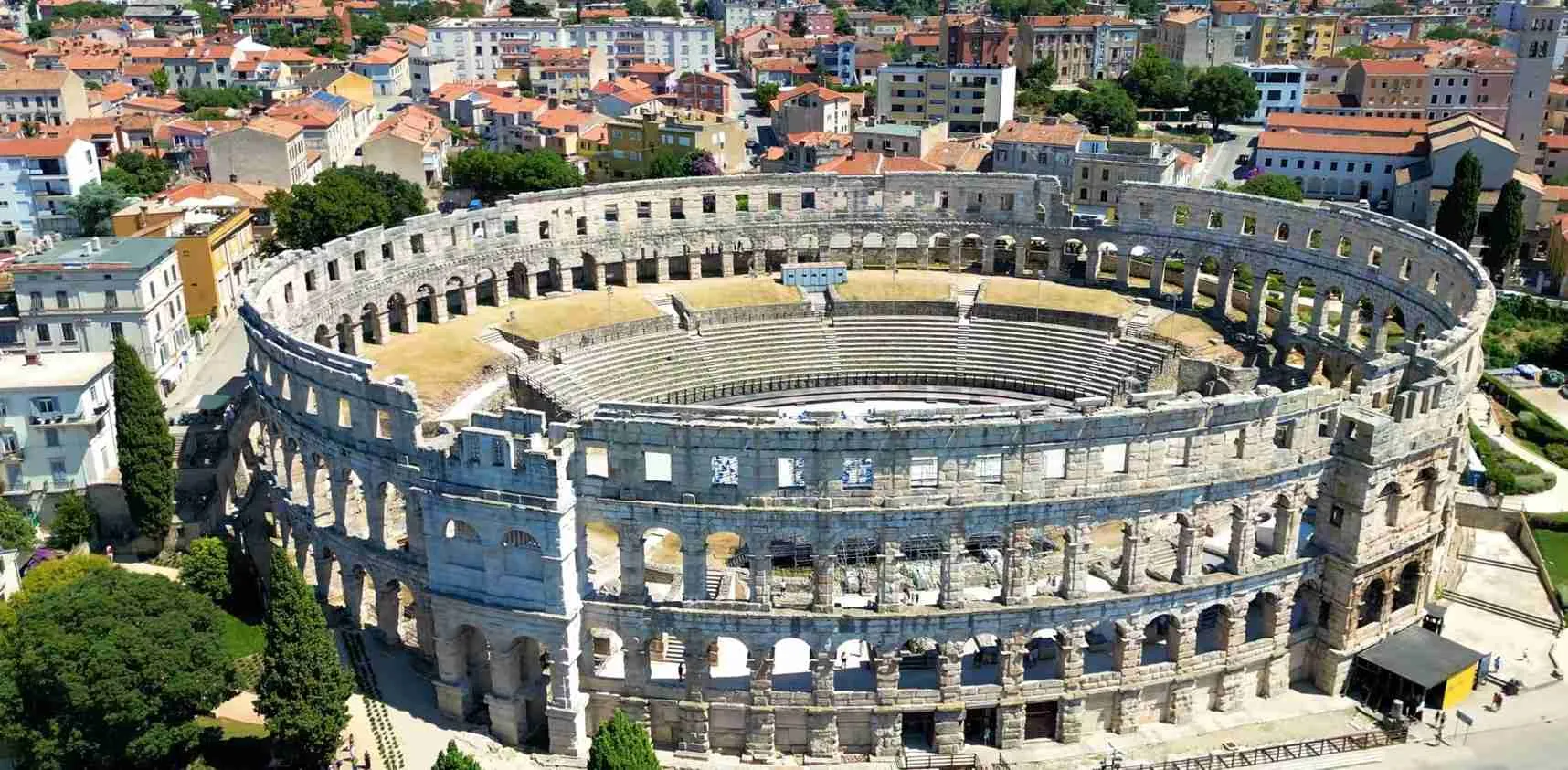
Pula Travel Guide 2026: Roman Arena & Istrian Gateway
Pula anchors Croatia’s Istrian Peninsula with one of the world’s best-preserved Roman amphitheaters and serves as the region’s cultural and transportation gateway. This ancient port city combines 2,000 years of architectural heritage with modern Mediterranean living, turquoise Adriatic waters, and proximity to Istria’s hilltop villages, truffle forests, and wine regions. Planning your 2026 visit requires understanding current costs, seasonal patterns, and strategic approaches to experiencing both the city’s Roman monuments and the broader Istrian landscape.
Key Takeaways for Visiting Pula in 2026
- Arena dominance: The Pula Arena ranks as the sixth-largest surviving Roman amphitheater globally and remains fully operational for concerts and events, with €10 general admission providing access to underground exhibits on Istrian viticulture and olive production.
- Affordable base: Pula offers significantly lower accommodation costs than neighboring Rovinj or Poreč, with 3-star hotels averaging €62 nightly and apartments ranging €50-120 depending on season, making it an economical Istrian headquarters.
- Transportation hub: Pula Airport connects directly to major European cities, while the city’s bus network extends throughout Istria with €1.60 city fares and regional buses reaching Rovinj (40 minutes), Poreč (90 minutes), and Opatija.
- Seasonal strategy: May-June and September offer optimal conditions with 22-26°C temperatures, moderate crowds, and shoulder-season pricing 30-40% below July-August peaks, while maintaining full operational hours at all attractions.
- Culinary value: Traditional konoba taverns serve authentic Istrian cuisine at €10-15 per main course, with specialties including truffle pasta, fresh Adriatic seafood, and Malvasia wine, substantially undercutting prices in Venice or coastal Italy across the Adriatic.
- Roman circuit: Beyond the Arena, Pula preserves the Temple of Augustus, Arch of the Sergii, and extensive Roman defensive walls, creating a concentrated ancient heritage circuit walkable in 2-3 hours without requiring specialized transport.
People Also Ask About Visiting Pula 2026
How much does it cost to visit Pula Arena in 2026?
Pula Arena admission costs €10 for adults in 2026, with children over 6 and students paying €5 (half price). Children under 6 enter free when accompanied by parents. The ticket provides full access to all four levels of the amphitheater, the underground gladiator chambers, and the permanent exhibition “Istrian Olive and Viticulture in Antiquity” featuring ancient oil presses, wine production equipment, and amphorae. The Arena operates year-round except January 1st, with extended summer hours from 8 AM to 10 PM (June-August) and reduced winter schedule from 9 AM to 5 PM (January-March). Pre-purchasing tickets online through GetYourGuide or the official website eliminates queuing during peak summer periods when crowds exceed 2,000 daily visitors. Last entry occurs one hour before closing regardless of season.
What is the average daily budget for Pula in 2026?
Budget travelers spend €45-70 daily in Pula in 2026, mid-range visitors €90-140, and luxury travelers €180-300+, excluding accommodation which ranges €21-240 nightly depending on category. Budget allocation covers meals (€20-35 for three meals at casual restaurants or self-catering with market ingredients), local transportation (€3-6 for multiple bus rides or walking most distances), and one or two paid attractions (€10-20 total). Mid-range budgets incorporate sit-down restaurant dining for lunch and dinner (€35-55), occasional taxi rides (€10-15), museum admissions (€15-25), and evening drinks at harbor cafes (€8-12). Luxury spending includes fine dining at establishments like Batelina or Wine Vault (€60-90 per person with wine), private transfers (€30-50), and premium experiences like sunset boat tours to Brijuni Islands (€45-75). Pula’s costs run 30-40% below major Croatian coastal destinations like Dubrovnik or Hvar, while matching or slightly exceeding inland cities like Zagreb.
When is the best time to visit Pula in 2026 to avoid crowds?
Late April through mid-June and the entire month of September represent optimal windows for visiting Pula in 2026 with minimal crowds and favorable conditions. May shoulder season delivers 20-24°C temperatures, 8-9 hours of daily sunshine, calm Adriatic waters averaging 18-20°C, and tourist volumes 50-60% below July-August peaks, while all attractions maintain full operating hours and boat services to Brijuni Islands run daily schedules. September particularly excels for visitors seeking warm sea temperatures (21-23°C from summer heating), harvest season activities in surrounding vineyards and olive groves, and the Pula Film Festival (typically early-to-mid July, check specific 2026 dates). Easter week and Croatian holidays in late April-early May see moderate domestic tourist increases but nothing approaching summer saturation. Winter (November-March) offers the quietest experience and lowest prices but encounters reduced attraction hours, limited boat services, and temperatures of 8-14°C that preclude beach activities—worthwhile only for visitors prioritizing Roman architecture over coastal leisure or combining Pula with skiing in nearby Slovenia.
How many days should I spend in Pula in 2026?
Two to three days in Pula provides sufficient time to experience the city’s Roman heritage, beaches, and use it as a base for Istrian day trips in 2026. A focused one-day visit covers the Arena (2 hours including underground exhibits), Roman circuit walking tour hitting the Temple of Augustus, Arch of the Sergii, and Forum Square (2-3 hours), plus lunch at the city market and afternoon beach time at Ambrela or Hawaii Beach. Three days allows for deeper immersion: day one devoted to Roman monuments and old town exploration, day two combining morning beach relaxation with afternoon kayaking along the Verudela Peninsula or visiting the Pula Aquarium in Fort Verudela, and day three executing a day trip to Rovinj (40 minutes by bus), Brijuni National Park (boat tours from Fažana, 15 minutes north), or inland hilltop towns like Motovun (90 minutes, famous for truffle hunting). Visitors planning extensive Istrian exploration should consider basing themselves in Pula for 4-5 nights, utilizing the city’s superior accommodation value and transportation connections while making daily excursions throughout the peninsula. Beach enthusiasts may prefer relocating to Rovinj or Poreč after 2 days to access superior swimming infrastructure.
Extended multi-day tours – 5+ days
Featured Pula Multi-Day Tour Packages

3 days
Pula 3-Day Discovery Tour
- ✓ Comprehensive Pula experience
- ✓ Expert local guides included
- ✓ All accommodation included
- ✓ Transportation provided

5 days
Pula 5-Day Highlights Experience
- ✓ Comprehensive Pula experience
- ✓ Expert local guides included
- ✓ All accommodation included
- ✓ Transportation provided

7 days
Pula 7-Day Cultural Journey
- ✓ Comprehensive Pula experience
- ✓ Expert local guides included
- ✓ All accommodation included
- ✓ Transportation provided

10 days
Pula 10-Day Complete Adventure
- ✓ Comprehensive Pula experience
- ✓ Expert local guides included
- ✓ All accommodation included
- ✓ Transportation provided
Multi-day tour packages powered by TourRadar. Prices and availability subject to change.
Introduction: Pula as Croatia’s Ancient Adriatic Gateway in 2026
Pula occupies the southern tip of Croatia’s Istrian Peninsula, functioning as the region’s largest city, primary transportation hub, and most concentrated repository of Roman architectural heritage. The city’s defining monument, the remarkably intact 1st-century amphitheater capable of seating 23,000 spectators, competes in preservation quality with the Colosseum in Rome while maintaining active use for contemporary concerts, opera performances, and the annual Pula Film Festival. Beyond this iconic arena, the city preserves an exceptional density of Roman infrastructure including the Temple of Augustus on Forum Square, the triumphal Arch of the Sergii, substantial defensive walls with original towers, and floor mosaics documenting ancient mythology.
Modern Pula’s strategic value for 2026 travelers extends beyond its ancient monuments to its role as Istria’s most affordable coastal base and best-connected transport node. Pula Airport receives direct flights from 30+ European cities through budget carriers like Ryanair and easyJet, while bus services radiate throughout the Istrian Peninsula reaching every significant coastal town and inland village. The city’s accommodation sector offers Croatia’s best value proposition: 3-star hotels averaging €62 nightly compared to €90-120 in Rovinj or Poreč, while apartment rentals during shoulder season (May-June, September) cost €50-75 for properties that would command €120-150 in other Istrian destinations.
Culturally, Pula represents a microcosm of Istria’s complex historical layering. Roman colonization established the city’s urban grid and monumental core. Venetian rule (1331-1797) contributed palazzo architecture and Mediterranean urban planning visible in the old town’s narrow streets and harbor-front piazzas. Austrian imperial administration (1797-1918) developed Pula as the Austro-Hungarian Navy’s principal Adriatic base, creating the military installations now repurposed as museums, galleries, and the extraordinary underground Zerostrasse tunnel network beneath the historic center. Italian sovereignty (1918-1947) left linguistic traces still evident in bilingual signage and culinary traditions blending Croatian and Italian influences. This cultural synthesis produces contemporary Pula’s distinctive character: fundamentally Croatian yet inflected with Italian-Mediterranean sensibilities, maritime rather than purely coastal, working-class and authentic rather than resort-curated.
The city’s physical geography combines urban concentration with immediate access to natural recreation. Pula’s compact historic core (1 km diameter) contains all major Roman sites within easy walking distance, while the surrounding coastline offers 15 km of varied beaches ranging from the popular pebble strands of Verudela Peninsula (4 km south) to the secluded coves of Cape Kamenjak (10 km south). The Brijuni archipelago, Croatia’s most exclusive national park and former summer residence of Yugoslav leader Tito, lies just offshore (30-minute boat ride from Fažana). Inland, the Istrian interior begins 20 km north: rolling hills covered in vineyards, olive groves, and oak forests famous for white truffles, dotted with medieval hilltop towns like Motovun, Grožnjan, and Hum (claimed as the world’s smallest town with just 30 residents).
For 2026 visitors, Pula functions optimally as a strategic base rather than a standalone beach resort destination. The city excels for travelers who prioritize cultural heritage, culinary authenticity, and budget efficiency while using Pula as headquarters for exploring broader Istria. It particularly suits multi-generational families (combining beach time, historical education, and day-trip variety), independent travelers seeking authentic Croatian life beyond sanitized resort experiences, and culturally-focused visitors willing to trade picture-perfect coastal aesthetics for substantial Roman architecture and lower costs. Visitors seeking exclusively beach-focused holidays or Instagram-optimized Mediterranean charm should consider Rovinj or the Dalmatian islands, but those who value historical depth, regional exploration, and authentic urban life will find Pula an exceptionally rewarding and affordable Adriatic gateway.
Pula Arena: The Iconic Roman Amphitheater in 2026
The Pula Arena stands as Croatia’s most significant Roman monument and ranks sixth globally among surviving amphitheaters by size, trailing only Rome’s Colosseum, Capua, El Djem (Tunisia), Verona, and Nîmes (France). Constructed during the 1st century AD under Emperor Vespasian (completed around 80 AD, the same period as the Colosseum), the Arena originally served as a venue for gladiatorial combats, animal hunts, and public spectacles accommodating over 23,000 spectators across its oval seating bowl measuring 132 meters long by 105 meters wide. The structure’s exceptional preservation stems from continuous use throughout its 2,000-year lifespan rather than abandonment and stone-robbing that destroyed many Roman monuments—medieval authorities repurposed it for markets and tournaments, modern administrators for concerts and cultural events.
Architecturally, the Arena demonstrates sophisticated Roman engineering adapted to local topography and available materials. The exterior wall reaches 29.40 meters on its seaward side (facing the harbor) where the ground slopes downward, incorporating two tiers of 72 arched bays creating the characteristic rhythmic arcade pattern, topped by a third level with rectangular windows. The landward side, built on higher ground, required only the lower two tiers. White Istrian limestone, quarried from nearby Vinkuran, provides the primary building material—a dense, durable stone that weathers to a warm honey color and contains visible fossilized sea creatures from the ancient Tethys Ocean. Four surviving corner towers, unique among Roman amphitheaters, originally supported the velarium (retractable canvas awning) that shaded spectators during performances. Channels in the floor collected rainwater draining through hidden conduits to underground cisterns, while a network of passages beneath the arena floor provided access for gladiators, animals, and scenery.
The 2026 visitor experience combines access to the Arena’s monumental spaces with educational exhibits documenting both Roman entertainment culture and Istrian agricultural traditions. Entry (€10 adults, €5 students/children 6+, free under 6) provides unrestricted exploration of the seating tiers, offering progressively impressive views as you climb toward the upper levels where the structure’s engineering becomes comprehensible and panoramic views extend across Pula’s harbor and the Istrian coastline. The underground chambers, accessed via the arena floor, house a permanent exhibition titled “Istrian Olive and Viticulture in Antiquity” featuring reconstructed ancient equipment for olive oil pressing and wine production—stone mills, beam presses, settling tanks, and clay amphorae used for storage and maritime transport. This exhibit connects the Arena to its regional context: Roman Istria produced agricultural surplus that sustained the imperial economy, with olive oil and wine representing key export commodities shipped throughout the Mediterranean.
Operational hours vary significantly by season in 2026, with extended summer access from 8 AM to 10 PM during June, July, and August when evening concerts and events create spectacular nighttime atmospheres under floodlighting. May and September maintain 8 AM to 9 PM hours, April operates 9 AM to 8 PM, while the winter season (November-March) reduces to 9 AM to 5 PM. The Arena closes only on January 1st, making it accessible year-round for architectural appreciation even when weather prohibits beach activities. Last entry occurs one hour before official closing time, with guards actively clearing the monument 30 minutes before closure—plan for minimum 90-minute visits to adequately explore both the Arena’s spaces and the underground exhibition.
Contemporary use as a performance venue adds dynamic value beyond static monument viewing. The Pula Film Festival, Croatia’s oldest and most prestigious cinema event (founded 1954), typically occurs in mid-July (check 2026 specific dates), screening international and Croatian films against the Arena’s Roman backdrop—tickets for festival screenings require separate purchase from regular admission. Summer concert series brings international rock, pop, classical, and opera performers to the Arena’s acoustically excellent space: past headliners include Sting, Elton John, Duran Duran, Placido Domingo, and Jose Carreras. Concert tickets (€40-150+ depending on performer) sell through official websites months in advance and include Arena access from afternoon for exploring before evening performances. Off-season events include occasional gladiator reenactments during spring and autumn weekends (typically April-May and September-October), offering choreographed combat demonstrations in period costume—these require separate tickets (€15-20) available through local tour operators.
Strategic visiting approaches maximize the Arena experience while minimizing crowds and environmental discomfort. Summer mornings (8-10 AM) offer coolest temperatures and smallest crowds before tour groups arrive around 10:30 AM; late afternoons (after 5 PM) bring golden lighting ideal for photography but increasing crowds as daytime beach visitors relocate to cultural activities. Shoulder seasons (May-June, September) provide optimal balance: moderate temperatures, reduced visitor volumes, and full operational hours. Winter visits suit architecture enthusiasts willing to forego outdoor comfort for exceptional emptiness—December-February averages fewer than 200 daily visitors versus 2,000+ in July-August. Bring sun protection for summer visits as the limestone reflects intense heat and minimal shade exists within the Arena bowl. Electronic audio guides (available in 10 languages, included in admission) provide 45-minute commentary accessible via smartphone QR codes throughout the monument—using personal earbuds improves audio quality over ambient acoustic conditions.
Roman Heritage Circuit: Beyond the Arena in 2026
Pula preserves exceptional concentration and variety of Roman architectural heritage beyond its famous amphitheater, creating a compact archaeological circuit explorable in 2-3 hours of walking through the city center. This Roman infrastructure documents nearly 500 years of continuous urban development from Augustus’s initial colonization (1st century BC) through the late imperial period (3rd-4th centuries AD), encompassing religious architecture, triumphal monuments, defensive works, and urban infrastructure that together illustrate a complete Roman city rather than isolated spectacular ruins.
The Forum, Pula’s historic central square, anchors the Roman circuit at the presumed location of the ancient city’s civic and religious heart. The Temple of Augustus dominates the Forum’s northern end—a remarkably intact prostyle temple (temple with free-standing columns only on the front facade) dedicated to Emperor Augustus and the goddess Roma, constructed between 2 BC and 14 AD during Augustus’s lifetime as part of the imperial cult promoting emperor worship throughout the provinces. The temple’s Corinthian columns, ornate capitals, triangular pediment, and elevated podium represent textbook examples of Augustan-era religious architecture. Interior spaces now function as a lapidarium museum (included in Arena ticket or €2 standalone) displaying Roman stone inscriptions, sculpture fragments, and architectural elements recovered from excavations throughout Pula—particularly valuable for understanding Latin epigraphy and Roman provincial administration. Adjacent to the temple stand remnants of a second temple (likely dedicated to Diana) integrated into the Renaissance-era town hall, visible as incorporated columns in the later building’s facade.
The Arch of the Sergii (also called the Golden Gate), 300 meters northeast of the Forum, represents Roman triumphal architecture adapted to family commemoration rather than military victory. Constructed around 30-25 BC by the prominent Sergii family to honor three family members who held civic offices in the early colony, the arch demonstrates late Republican artistic sophistication with elaborate Corinthian capitals, winged victories in the spandrels, and decorative friezes depicting military weapons and spoils. Unlike true city gates, this arch served primarily symbolic and aesthetic purposes, marking one entrance to the Roman forum area. Its survival resulted from medieval incorporation into defensive walls (later demolished), preventing the stone-robbing that destroyed most decorative Roman structures. The arch’s exceptional preservation allows detailed study of Republican-era decorative sculpture rare in provincial Roman cities.
Pula’s Roman defensive walls, constructed in multiple phases from the 1st century BC through medieval enlargements, survive in substantial fragments throughout the old town. The most impressive section extends along the city’s northeastern edge near Giardini Square, incorporating 15-meter-high walls with original Roman masonry visible in the lower courses and medieval additions atop. Two of the original ten gates survive: the double-arched Hercules Gate (1st century BC), Pula’s oldest standing Roman structure, features a carved Hercules head on the keystone that gave the gate its name. Twin Arch Gate (also called Porta Gemina), a few hundred meters north, preserves its double-arched passage and flanking towers, demonstrating Roman entrance fortification techniques. Walking the wall circuit provides perspective on Roman Pula’s original perimeter (smaller than the modern city center) and defensive priorities protecting the harbor-side colony.
The Small Roman Theater, tucked into a hillside on the old town’s eastern edge, represents Pula’s second major entertainment venue—a modest theater seating approximately 4,500 spectators for dramatic performances, poetry recitations, and musical events that contrasted with the Arena’s gladiatorial spectacles. Though less complete than the amphitheater, the theater’s semicircular seating cavea (taking advantage of natural slope) and stage building foundations remain clearly visible, with ongoing archaeological work gradually exposing additional structures. The site currently functions as an open archaeological area (free access, no formal visiting hours) rather than a ticketed attraction, allowing casual exploration of Roman theater architecture without Arena-level crowds or restrictions.
Floor mosaics scattered throughout the city center document wealthy Roman villas and public buildings that occupied present-day Pula. The most significant, “The Punishment of Dirce,” lies protected under glass in a courtyard between residential buildings on Sergijevaca Street (free viewing from street level). This 3rd-4th century mosaic depicts the Greek mythological scene of Dirce’s punishment—being tied to a wild bull by Amphion and Zethus—rendered in intricate tesserae with remarkable color preservation. Additional mosaics appear in the Archaeological Museum of Istria (€4 admission, open Tuesday-Sunday 10 AM-6 PM May-September, 9 AM-2 PM October-April) located in the Austrian-era fortress on the hill above the city center. The museum houses extensive Roman collections including sculpture, pottery, glass, jewelry, and inscriptions from Pula and surrounding Istrian sites, providing essential context for understanding the city’s Roman-era prosperity and cultural connections.
Strategic approaches to experiencing Pula’s Roman circuit involve early-morning or late-afternoon timing to avoid midday heat reflecting off limestone pavements and monuments. Begin at the Arena (requiring paid admission and most time investment), proceed to the Arch of the Sergii and wall sections (quick photo stops requiring 15-20 minutes combined), continue to the Forum and Temple of Augustus (30-45 minutes for temple interior and square appreciation), then conclude at either the Small Roman Theater or Archaeological Museum depending on interest depth and remaining time. The entire circuit covers approximately 2 km of walking through pedestrianized old town streets with minimal elevation change except the climb to the Archaeological Museum (optional extension, 10-minute uphill walk from city center). Combine Roman circuit exploration with lunch at the city market (adjacent to the Forum) for authentic Istrian products and affordable tavern meals, or reserve evening hours for harbor-front dining after completing cultural sightseeing during cooler morning hours.
Accommodation Costs and Options in Pula 2026
Pula accommodation ranges from €21 hostel dormitories to €240+ luxury hotels per night in 2026, with the city offering Croatia’s best coastal value proposition—prices running 30-40% below comparable properties in Rovinj, Poreč, or Dalmatian destinations. Three-star hotels average €62 nightly while four-star properties cost €118, both figures representing shoulder season (May-June, September) pricing with summer peaks (July-August) increasing rates 40-60% and winter lows (November-March) dropping prices 30-50% from shoulder baselines. Apartments provide particularly strong value, ranging €50 off-season to €75 shoulder season to €120 high season for one-bedroom units that in other Istrian towns would command €80-140 depending on location and amenities.
The accommodation market divides into three geographic zones with distinct characteristics and pricing. City center properties occupy the compact old town within 500 meters of the Forum and Arena, offering immediate access to Roman monuments, restaurant concentration, and authentic urban atmosphere in historic buildings—typically small boutique hotels (10-25 rooms), converted townhouses operating as B&Bs, and privately-owned apartments in Habsburg-era buildings. Representative options include Hotel Scaletta (€75-95 in shoulder season, 3-star, 12 rooms in renovated 19th-century building 200 meters from Arena), Boutique Hotel Valsabbion (€160-220, 4-star luxury property with Michelin-recommended restaurant, 500 meters from city center), and numerous Booking.com apartments ranging €50-100 depending on size and renovation quality. City center locations excel for car-free visitors, short stays focused on cultural sightseeing, and travelers prioritizing walkable access to dining and nightlife over beach proximity.
Verudela Peninsula, 4-5 km south of the city center, concentrates Pula’s large resort hotels within pine forest setting offering immediate beach access, extensive facilities (pools, spa, sports), and package-tour convenience. The Arena Hospitality Group operates most properties here under Park Plaza and Radisson franchises: Park Plaza Verudela (€100-160, 4-star, 329 rooms, outdoor and indoor pools, children’s waterpark, 50 meters from pebble beaches), Park Plaza Histria (€120-180, 4-star, 227 rooms, beachfront location, full-service spa, business center), and Park Plaza Arena (€90-140, 3-star, 201 rooms, budget-conscious option with pool and beach access). These large properties (200-370 rooms) offer comprehensive amenities and professional service standards but can feel impersonal and crowded during peak summer when occupancy exceeds 90%. Verudela suits families requiring children’s programming and pool facilities, beach-focused visitors willing to commute to city center (€3-4 taxi, 20-minute bus ride, or 15-minute rental bike), and travelers prioritizing resort predictability over authentic Croatian atmosphere.
Stoja Peninsula and outlying residential neighborhoods (Veli Vrh, Veruda, Šijana) 2-4 km from center offer the accommodation market’s best value: locally-owned guesthouses, small family-run hotels, and apartments in modern buildings renting €40-90 depending on season and proximity to beaches. Properties here trade walkable city access for quiet residential settings, often with parking included (€10-15 daily value), gardens or terraces, and host interactions providing local knowledge. Stoja’s coastline features several small beaches and the popular Valsaline beach complex with natural pools formed in limestone rocks. Transportation to city center requires buses (€1.60, every 30-60 minutes) or taxis (€8-12), making car rental logical for visitors basing here. These neighborhoods particularly suit longer stays (4+ nights) where daily city commuting becomes routine, budget-conscious independent travelers, and visitors exploring broader Istria who need affordable sleeping accommodation rather than resort facilities.
Hostel infrastructure serves budget travelers and younger visitors with four primary properties: Hostel Antique in city center (€21-28 dormitory beds, €50-65 private doubles, atmospheric Habsburg-era building near Arena), Crazy House Hostel near bus station (€18-25 dormitories, social atmosphere, shared kitchen, organized activities), and Monte Zaro Hostel in Verudela (€20-30, beach proximity, summer-only operation April-October). These facilities provide standard hostel amenities—shared dormitories, communal kitchens, common areas for socializing, luggage storage, and informal atmosphere—with Pula hostels particularly valued for cleanliness and mature management compared to party-focused properties in Split or Dubrovnik.
Booking strategies for 2026 emphasize timing and platform selection. Summer accommodation (June-August) requires 3-6 months advance booking to secure preferred properties at standard published rates—waiting until May for July bookings typically finds 70% occupancy with remaining inventory priced 20-30% above early reservation rates. Shoulder season (May, September) allows 4-6 week advance booking windows with wider selection, while winter accepts walk-in or same-week bookings at negotiated rates. Booking.com dominates the Croatian accommodation market with best inventory and competitive pricing, while Airbnb offers extensive apartment selection but occasional quality variability requiring careful review reading. Direct hotel websites sometimes offer “book direct” discounts of 10-15% or value-added perks (free breakfast, late checkout, room upgrades) for avoiding commission-based platforms.
Value-optimization tactics include targeting shoulder season visits (40% savings versus summer), choosing properties 2-3 km from city center with bus connections (30% cheaper than central locations), and considering 4+ night stays that qualify for weekly discounts of 10-20% at many properties. Free breakfast, when included, represents €8-12 daily value per person and proves particularly economical for families. Properties with kitchen facilities enable lunch self-catering using market ingredients, reducing daily food costs by €15-25 per person compared to full restaurant dining. Parking, when included, saves €10-15 daily in city center zones where street parking requires paid permits and hotel lots charge €12-18 nightly fees.
Transportation Costs and Getting Around Pula 2026
Pula’s public transportation system centers on Pulapromet city buses serving the urban area and extending to nearby towns including Fažana, Medulin, Premantura, and Vodnjan. Single-ride tickets cost €1.60 when purchased in advance from kiosks, tobacco shops (trafikas), or online through the Pulapromet website, or €2.50-3.40 when bought directly from drivers (Zone 1 city service €2.50, Zone 2 to Fažana/Medulin €2.50, Zone 3 to Premantura €3.40). Contactless smart cards, available for €5 refundable deposit at the main bus station and sales kiosks, reduce per-ride costs to €0.90 for Zone 1 travel and prove economical for visitors making 5+ trips during a stay—cards reload in increments of €3-15 and function across all Pulapromet routes.
Bus frequency and route coverage serve practical transportation needs rather than comprehensive urban transit. Main routes operate 6 AM to 11 PM with 15-30 minute intervals during peak periods (7-9 AM, 4-7 PM weekdays) and 30-60 minute service mid-day and evenings. Popular visitor routes include Line 1 (city center to Verudela beaches and Park Plaza hotels), Line 2A/2B (city center to Stoja Peninsula), and Line 30 (Pula to Fažana for Brijuni National Park ferries, 25 minutes, €2.50 advance or €3.40 driver-purchase). Sunday service operates reduced schedules with some routes suspended, requiring schedule verification at bus stops or online. The main bus station (Autobusni kolodvor) in city center serves both local Pulapromet buses and regional services throughout Istria and beyond—digital departure boards and ticket windows provide information and advance bookings for intercity routes.
Taxi services offer convenient point-to-point transportation with starting fares of €3.30 plus €2.00 per kilometer and additional charges for luggage (€1.30 per piece), night service (10 PM-6 AM, 20% surcharge), and Sunday/holiday travel (20% surcharge). Common routes include city center to Verudela hotels (4 km, €12-15), central Pula to airport (9 km, €18-25 depending on time and traffic), and train station to old town (1.5 km, €8-10). Official taxis display meters and use fixed government-regulated rates—always confirm meter activation or agree on fares before departure to avoid disputes. Taxi stands operate at the bus station, train station, Arena, and major hotels, while telephone dispatch (+385 52 222 144 for Radio Taxi Pula) provides reliable pickup service usually arriving within 10-15 minutes.
Ride-sharing through Bolt (Croatian equivalent to Uber, which operates limitedly in Croatia) provides app-based alternative to traditional taxis with transparent advance pricing, cashless payment, and driver tracking. Bolt fares typically run 10-20% below taxi rates for identical routes—city center to airport approximately €15-20, city center to Verudela €10-13—while offering payment convenience for international visitors avoiding currency exchange for taxi cash payments. Download the Bolt app before arriving, verify phone number for authentication, and load payment method (credit card or PayPal) to enable seamless booking. Bolt availability peaks during summer tourist season but may encounter limited driver supply during off-season or late-night hours when traditional taxi dispatch proves more reliable.
Airport transportation connects Pula Airport (9 km northeast of city center) to downtown via multiple options. Airport shuttle buses (€6.11 one-way) operate on flight-synchronized schedules, departing 30-40 minutes after arrivals and connecting directly to the main bus station in 25 minutes with stops at Verudela hotels. Purchase tickets from drivers or pre-book through the FILS or Brioni bus company websites (saves €1 per ticket). Taxis from airport to city center cost €18-25 depending on negotiation and meter versus fixed-rate agreement—official airport taxi desk inside terminal provides fixed-price vouchers eliminating negotiation. Pre-booked private transfers (arranged through hotels or services like Welcome Pickups) cost €25-35 for sedan capacity (1-3 passengers with luggage) but include meet-and-greet service, luggage assistance, and guaranteed English-speaking drivers—worthwhile for late arrivals, early departures, or groups where per-person cost becomes comparable to shuttle bus while adding convenience.
Car rental suits visitors planning extensive Istrian exploration beyond Pula city limits. Major international agencies (Enterprise, Hertz, Europcar, Sixt) and Croatian companies (Carpe Diem, Firefly) operate desks at Pula Airport and city center locations with daily rates ranging €25-60 depending on vehicle class, season, and advance booking duration. Economy vehicles (Volkswagen Polo, Peugeot 208) cost €25-35 daily in shoulder season, €40-50 in summer, while larger family vehicles (VW Golf, Škoda Octavia wagon) run €35-45 shoulder season, €55-70 summer. Booking 2-4 weeks in advance via comparison sites like Rentalcars.com typically yields 20-30% savings versus airport walk-up rates. Mandatory insurance (Collision Damage Waiver, Theft Protection) adds €10-18 daily; verify if personal credit cards provide rental coverage before purchasing redundant insurance. Parking in central Pula requires paid permits €1.20-1.80 per hour in blue/yellow zones (enforced 7 AM-9 PM), while hotels charge €10-18 nightly for parking or offer free spaces in outlying properties.
Bicycle rental provides eco-friendly, economical city exploration and coastal route access. Several operators including Pula Outdoor and bike shops near the Arena rent city bikes (€8-12 per day, €40-50 weekly), electric bikes (€20-30 daily), and mountain bikes for Cape Kamenjak terrain (€15-20 daily). Pula’s relatively flat topography suits cycling between city center and Verudela Peninsula via coastal paths (6 km round trip), around Stoja Peninsula circuit (8 km loop), or to Cape Kamenjak Nature Park (20 km one-way from city center, mostly flat with final 2 km gentle grades). Bike theft risks remain low in Pula compared to larger Croatian cities, but always use provided locks when leaving bikes unattended. Electric bikes rationalize longer routes to Fažana (15 km each way) or inland villages while minimizing exertion in summer heat.
Walking serves as the primary method for exploring Pula’s compact historic core—the Arena to the Forum measures 800 meters, Forum to train station 1 km, city center to beginning of Verudela Peninsula 2.5 km. The old town’s pedestrianized streets, moderate climate during shoulder seasons, and concentrated attraction density make walking both practical and pleasant. Summer midday heat (30-35°C July-August) recommends restricting walking to early morning (before 10 AM) and evening (after 6 PM) hours, using buses or taxis for midday repositioning between city center and beach areas. Comfortable footwear proves essential as Pula’s streets mix smooth modern pavements with irregular stone cobbles in historic zones, and Roman monument exploration involves stairs and uneven surfaces.
Food and Dining Costs in Pula 2026
Pula dining costs range from €7 fast food meals to €60+ per person for upscale seafood restaurants with wine in 2026, positioning the city as more affordable than Italian Adriatic counterparts (Trieste, Venice) while matching or slightly exceeding Croatian inland cities like Zagreb. Casual restaurant meals cost €10.70-15 at traditional konoba taverns and pizzerias, mid-range sit-down dining runs €20-30 per person for multi-course meals without wine, and fine dining establishments charge €45-70 per person with wine pairings. These prices reflect summer high-season rates (June-August); shoulder and winter seasons see 10-20% reductions at locally-owned restaurants though tourist-focused establishments maintain year-round pricing.
Budget dining strategies emphasize self-catering from the Pula City Market and strategic restaurant selection. The covered market (Narodni trg, open Monday-Saturday 7 AM-2 PM, Sundays 7 AM-noon in summer) offers extraordinary value: Istrian produce (tomatoes, zucchini, peppers €1-2/kg), fresh Adriatic fish caught overnight (sea bass, bream, sardines €8-15/kg), local cheeses including sheep’s milk varieties (€12-18/kg), prosciutto and regional cured meats (€18-25/kg), and seasonal fruits. Self-catering breakfast with market purchases costs €3-5 per person versus €8-12 at hotels or cafes. Picnic lunches assembled from market ingredients run €5-8 per person compared to €12-18 restaurant meals. The market’s surrounding cafes serve traditional Istrian lunches (maneštra bean soup, peka slow-cooked meats and vegetables, pastas) at €6-10 per portion—authentic local cooking without tourist markup.
Pizzerias represent exceptional value throughout Pula, serving 30-35cm Neapolitan-style pizzas at €6-12 depending on toppings, easily satisfying one person or shareable between two with salad. Pizza Jupiter, Pizza Nina in nearby Banjole, and Ferrovia Pizza (converted train station, affordable and atmospheric) earn consistent recommendations from locals for quality-to-price ratios. A pizza, side salad, and glass of house wine total €12-16 per person. Burger joints offering Croatian takes on American fast food cost €7-9 for burger-and-fries combinations—try local spots like Burgermeister rather than international chains for better quality and comparable pricing.
Mid-range restaurants serving traditional Istrian cuisine provide optimal balance between cost and authentic experience. Konoba Kantina (Flanatička 16) specializes in Istrian pasta, particularly fuži (hand-rolled pasta tubes) with truffles (€14-18), local wines, and grilled meats in casual atmosphere. Vodnjanka, recommended by locals, serves fresh fish and seafood at €15-25 per main course. Ribarska Koliba, a harbor-front institution operating over 100 years, offers traditional preparations of daily catch (grilled whole fish €18-28/kg, shellfish €16-24 per portion, squid and octopus €14-20). Three-course meals at these establishments (starter, main, dessert or coffee) without wine cost €25-35 per person, with local Malvasia or Teran wine adding €12-18 per bottle for table sharing.
Upscale dining emphasizes seafood sourced from local fishing families and inland specialties like truffles and game. Konoba Batelina (Čimulje, 6 km southeast of center) achieved international fame through Anthony Bourdain’s Parts Unknown coverage and maintains exceptional quality despite tourist attention—family fishermen serve daily catch in preparations using entire fish including bones and organs, with meals averaging €45-60 per person. Wine Vault at Rovinj’s Monte Mulini Hotel (40 minutes from Pula) offers fine dining combining Istrian ingredients with European techniques, €60-90 per person with wine pairings. Valsabbion in Pula (attached to the hotel of the same name) provides Michelin-recognized cuisine emphasizing seasonal Istrian products, €50-75 per person. These restaurants require advance reservations, particularly summer months when bookings open 2-3 weeks ahead.
Beverages contribute significantly to dining costs. House wine (vino domaće) at konobas costs €8-15 per liter carafe for drinkable quality Malvasia (white) or Teran (red). Bottled Istrian wines from quality producers (Kozlović, Matošević, Benvenuti) range €18-35 per bottle in restaurants. Croatian craft beer (Pulska Pivovara, San Servolo) costs €3-4.50 for 0.5L, while imported beers run €4-6. Cocktails at harbor cafes and bars cost €6-10. Espresso runs €1.40-2.00, cappuccino €2.00-3.00. Bottled water costs €2-3 in restaurants but €0.50-1.00 in supermarkets—bringing purchased bottles to beach picnics saves meaningfully over time.
Street food and quick meals suit lunch efficiency during sightseeing. Burek (flaky pastry filled with cheese, meat, or spinach) from bakeries costs €2-3.50 and provides substantial calories. Grilled squid or fish from harbor vendors runs €8-12 per portion. Gelato from the numerous ice cream shops costs €2-4 for two scoops. Sandwiches made fresh at market cafes or delicatessens cost €4-6. These options enable €10-15 daily lunch budgets while reserving dinner for sit-down restaurant experiences.
Supermarkets (Konzum, Plodine, Tommy) offer standard grocery prices: bread €0.80-1.50, fresh milk €0.90-1.20/L, eggs €2-3/dozen, pasta €1-2/500g, chicken breast €6-8/kg, vegetables €1-3/kg. Shopping supermarkets for breakfast supplies and dinner preparation in apartment accommodation reduces costs to €8-12 daily per person for three meals versus €35-50 for equivalent restaurant dining. Markets provide superior quality for produce, cheese, and cured meats but supermarkets win for packaged goods, dairy, and convenience.
Best Beaches and Coastal Access Around Pula 2026
Pula’s 20-kilometer coastline combines easily-accessed city beaches with more remote natural areas requiring short drives or bike rides, offering variety from organized pebble strands with facilities to secluded rocky coves for snorkeling. The Adriatic here features clear, calm waters protected by the Istrian Peninsula’s southern position, with summer temperatures reaching 23-25°C (July-August) and maintaining 20-22°C during shoulder months (May-June, September). None of Pula’s beaches qualify as sandy—Istria’s geology produces pebble beaches, concrete platforms, and rocky shorelines rather than the sand beaches found in Dalmatia—but water clarity and quality exceed more touristed Croatian coastal regions.
Verudela Peninsula beaches, 4-5 km south of city center, concentrate organized beach infrastructure and serve as default destinations for hotel guests and families. Hawaii Beach (Havajsko) on the peninsula’s western side features pebble surface, gradual water entry suitable for children, beach bar, sun lounger rental (€8-12 per day), and easy bus access (Line 1 from city center, 15 minutes, €1.60). The beach extends 200 meters along protected cove with pine forest providing natural shade during afternoon hours. Valkane Beach on the peninsula’s eastern side offers paved sunbathing platforms, diving boards, beach volleyball courts, and proximity to Park Plaza hotels—popular with younger crowds and sports-oriented visitors. Both beaches provide changing rooms, showers, and nearby restaurants, though expect summer crowds exceeding 500-1000 people on peak July-August weekends.
Stoja Peninsula coastline, 3 km southwest of center, offers more local atmosphere with smaller beach areas scattered along rocky shoreline. Valsaline, the main organized beach, features natural pools formed in limestone rock where seawater collects and warms, creating swimming areas that children enjoy safely. Adjacent pebble sections provide traditional beach experiences. The entire Stoja coast rewards exploration for cove-finding—rocky access points lead to semi-private swimming spots frequented by Pula residents rather than tourists. Bring water shoes for comfortable walking on rock surfaces and snorkeling gear to explore underwater visibility that often exceeds 10-15 meters.
Gortanova Uvala (Gortanova Bay), within city limits 1.5 km from center, provides Pula’s most accessible swimming without requiring buses or taxis. The pebble beach curves along protected bay with gradual depth increase, facilities including changing cabins and showers, and nearby cafes. The bay’s urban proximity means moderate summer crowding but convenience for visitors basing in city center hotels without cars. Morning visits (7-10 AM) and weekday patterns avoid peak usage. Free entry and parking make Gortanova budget-friendly for families not requiring lounger rentals or organized facilities.
Cape Kamenjak Nature Park, 10 km south of Pula at Istria’s southernmost point, represents the region’s premier natural coastal area—6,656 hectares of protected wilderness featuring dozens of coves, rocky beaches, and crystal-clear waters along a dramatically sculpted coastline. Vehicle entrance costs €6 per car in shoulder season, €9 in summer, with park hours 7 AM-9 PM May-September. The park’s 30 km of dirt roads (passable by standard cars driven carefully) access numerous swimming spots: Safari Bar beach with beach bar and lounger rental attracts crowds, while coves along the western coast offer isolation for visitors willing to walk 10-15 minutes from parking areas. Bring food, water, and sun protection as limited facilities exist beyond the main bar. The park suits full-day excursions combining swimming, snorkeling, coastal walks, and picnicking. Mountain bikes handle the rough roads better than road bikes, while rental cars require caution to avoid damage from sharp rocks.
Pješčana Uvala (Sandy Bay), 5 km northwest of Pula toward Fažana, provides one of Istria’s rare sandy beaches—actually fine pebbles rather than true sand, but softer underfoot than typical Adriatic rocks. The crescent bay features shallow water ideal for children, pine forest shade, beach volleyball, paddleboard rentals, and nearby campground infrastructure (restaurants, shops, parking). Popular with Croatian families from inland cities, creating livelier local atmosphere than tourist-heavy Verudela beaches. Bus Line 30 toward Fažana stops nearby (€1.60, 20 minutes from center).
Beach equipment rental costs include loungers €8-12 per day depending on location and season, umbrellas €5-8, paddleboards €10-15 per hour, kayaks €8-12 per hour, and snorkeling gear €8-10 per day. Bringing personal beach equipment (purchased from Pula sporting goods stores for €20-40 total) eliminates these daily costs for stays exceeding 3-4 days. Croatian beaches charge no admission fees except Cape Kamenjak’s park entrance, with all coastline legally accessible to public regardless of adjacent hotel properties. Changing facilities, showers, and toilets at organized beaches cost €0.50-1.00 per use or are included in lounger rental.
Swimming safety remains excellent along Pula’s coastline with lifeguards present at major beaches (Verudela, Valkane) during summer season 9 AM-6 PM. Waters remain calm with minimal current or wave action except during bura (northeastern wind) events that generate 1-2 meter waves several times per season. Jellyfish occasionally appear in August but rarely in problem densities. Sea urchins populate rocky areas—water shoes prevent foot injuries when entering from rocks. Croatian law prohibits removing shells, rocks, or marine life from beaches and waters, with fines up to €500 for violations.
Day Trips and Regional Exploration from Pula 2026
Pula’s strategic position enables day trips throughout Istria and to nearby Kvarner Bay islands, with bus connections, proximity (most destinations under 90 minutes), and the city’s role as accommodation base making it ideal headquarters for regional exploration. Istria combines coastal resort towns, inland medieval hilltop villages, truffle forests, wine regions, and national parks within compact geography—the peninsula measures just 90 km north-south and 50 km east-west, enabling diverse experiences without long-distance driving or complicated logistics.
Rovinj, Istria’s most photographed coastal town, sits 40 km northwest of Pula (40-minute drive, hourly buses €6-8 each way, 50-minute journey). The Venetian-era old town occupies a peninsula jutting into the Adriatic, creating the characteristic postcard image of colorful buildings rising from waterfront to hilltop St. Euphemia’s Basilica. Day trips focus on old town wandering through marble-paved streets (2-3 hours), harbor-front lunches featuring Istrian seafood (€25-40 per person), and afternoon swimming at Lone Bay or Cuvi Beach (pebble beaches with clear water 2 km south of center). Peak summer (July-August) brings massive crowds that overwhelm Rovinj’s narrow streets and limited parking—shoulder season visits (May-June, September) provide equivalent weather without density. Combining Rovinj with nearby Lim Fjord (15 km north) creates fuller day itinerary: the dramatic 10-km channel carved inland hosts oyster and mussel farms, boat tours, and waterfront restaurants specializing in shellfish. Independent travelers using buses should plan 6-8 hour Rovinj excursions including 2 hours total transport and 4-6 hours in destination. Car rentals enable combining Rovinj with Lim Fjord or Vrsar coastal town (5 km north of Rovinj) in single day.
Brijuni National Park archipelago lies just offshore northwest of Pula, consisting of 14 islands that served as Yugoslav President Tito’s private summer residence 1947-1980, developed with safari park, botanical gardens, Roman villa ruins, and Mediterranean vegetation. Access requires boat transport from Fažana (7 km north of Pula, €1.60 bus, 15 minutes) where national park ferries operate on set schedules with mandatory guided tours (independent island access prohibited). Day tour packages cost €35-45 adults, €18-22 children, including ferry transport, guided island tour by tourist train covering safari park (introduced by diplomatic gift animals from various countries), Roman and Byzantine archaeological sites, Tito’s museum residences, and protected coastal areas. Tours last 4-5 hours total including 2-3 hours on main Veli Brijun island. Departures occur 9 AM-3 PM with specific times varying by season (check schedule at www.np-brijuni.hr before planning visit). The park represents unique combination of natural protection, political history, and archaeological heritage absent elsewhere in Croatia. Book tickets 1-2 days ahead during summer or purchase same-day tickets for shoulder season visits. Swimmers cannot access island beaches (prohibited by park regulations), so this excursion serves cultural and historical interests rather than coastal recreation.
Motovun hilltop town, 60 km northeast of Pula in central Istria’s truffle-hunting territory, epitomizes the inland medieval villages that contrast dramatically with coastal architecture and atmospheres. The fortified settlement crowns a 277-meter hill rising above the Mirna River valley, surrounded by concentric defensive walls (13th-17th centuries) and accessed via steep cobbled lanes. Day trips involve 90-minute drives (no bus service) through Istrian countryside, 1-2 hours exploring the compact old town (300-meter diameter), lunch featuring truffle-based dishes (fuži pasta with truffles €18-25, truffle hunting demonstrations and tastings €35-50 per person), and afternoon visits to nearby hilltop towns (Grožnjan artists’ village 12 km west, Hum “world’s smallest town” 25 km east). The region’s famous white truffles (October-December season) command €2000-4000 per kilogram, making truffle-based dishes expensive but offering tastes of this prized ingredient at fraction of market price. Motovun Film Festival (late July, check 2026 specific dates) transforms the sleepy village into cinema hub screening international and regional films in open-air venues—festival periods require advance accommodation booking in limited town capacity. Car rental proves essential for Motovun and broader inland exploration; organized day tours from Pula (€65-85 per person including transport, guide, lunch) provide hassle-free alternatives for non-drivers.
Poreč, 50 km north of Pula, houses UNESCO World Heritage Euphrasian Basilica (6th century, extraordinary Byzantine mosaics) and operates as major package-tour resort with hotel infrastructure exceeding Pula and Rovinj combined. Day trips suit cultural visitors interested in the basilica (€5 admission to mosaics and church complex) and Venetian-Gothic old town architecture rather than beach-seekers (better options exist closer to Pula). Hourly buses connect Pula-Poreč (€8-10 each way, 90 minutes), enabling 5-7 hour excursions with 3-4 hours in destination. The town’s excessive tourist development and commercialization relative to Rovinj or authentic inland villages makes it lower priority unless Byzantine art particularly interests visitors or combining with Lim Fjord (20 km south of Poreč) in car-based itinerary.
Učka Nature Park’s mountain ridge (1,396-meter Vojak peak) separates Istria from Kvarner Bay, offering hiking, panoramic views across the peninsula and to Alps, and cool refuge from coastal summer heat. The 50 km drive from Pula to park entrance at Poklon Pass takes 75 minutes through increasingly forested terrain. Summit trails range from 45-minute steep hike from Poklon parking area (suitable for fit visitors with basic hiking shoes) to longer 4-6 hour ridge traverses for experienced hikers. Views from Vojak tower encompass Istrian coastline, Kvarner islands including Cres and Krk, Italian Alps on clear days, and inland valleys—extraordinary orientation over geography covered by other day trips. The mountain ecosystem provides 8-10°C temperature reductions versus coastal elevations, making Učka appealing on hottest summer days when Pula temperatures exceed 32°C. Combine summit hiking with lunch in Mošćenička Draga or Lovran coastal towns on Učka’s eastern slopes (traditional Kvarner Bay fishing villages with excellent seafood restaurants) before returning to Pula. Organized hiking tours (€55-75 per person from Pula) include transport and guide; independent visitors need cars and should check weather forecasts (summit fog reduces visibility to near-zero during unstable conditions).
Labin old town and Rabac beach resort, 40 km east of Pula, combine medieval hilltop architecture with modern coastal development. Labin occupies strategic position above former coal mines (now converted to museums and arts spaces), with atmospheric stone streets, galleries, and panoramic positions overlooking the Kvarner Bay. Rabac, 5 km downhill at sea level, developed as purpose-built resort in communist era, offering pebble beaches ranked among Istria’s finest for water clarity and scenic settings beneath forested cliffs. Day trips by car (50 minutes) allow combining both destinations: morning Labin exploration (2-3 hours including mine museum visit €5), lunch overlooking the bay, afternoon beach time at Rabac’s Girandella Beach or Maslinica cove. Bus service exists (€7-9 each way, 90 minutes with changes) but complicates accessing both Labin and Rabac efficiently—better suited to dedicated beach visits focusing solely on Rabac.
Sample Daily Budget Breakdown for Pula 2026
Budget travelers visiting Pula in 2026 spend €45-70 daily per person excluding accommodation, covering meals, local transportation, and one paid attraction or activity. Breakfast at market cafes or self-catered from supermarket purchases costs €3-5, lunch combining market-sourced ingredients or pizza slices runs €6-10, and dinner at traditional konoba tavern totals €15-20 for pasta or simple meat dish with house wine. Local bus transportation to beaches or attractions adds €3-6 for multiple rides, while one significant site visit (Pula Arena €10, Brijuni tour €35-40, or Cape Kamenjak park entry €6-9) completes the activity budget. This level requires conscious cost management including market shopping, walking instead of taxis, limiting alcohol consumption to house wine with dinner, and choosing free activities like beach time, wall circuit walks, or city exploration over multiple paid attractions daily. Budget total €48-75 excluding accommodation (€21-75 for hostel or budget apartment), creating all-in daily costs of €69-150 depending on lodging choice.
Mid-range budgets allocate €90-140 daily per person excluding accommodation, enabling restaurant meals, occasional taxi use, museum admissions, and balanced experience quality. Breakfast at hotel buffet or cafe costs €8-12, lunch at casual restaurant with beer or wine runs €18-25, and dinner at recommended konoba or seafood spot totals €28-40 including drinks. Transportation combines buses for longer distances (€3-6), taxis when convenient (€10-15 for 1-2 rides), and rental bikes for coastal exploration (€10-15 daily if choosing this option). Activities might include Arena admission (€10), Archaeological Museum (€4), rented beach loungers (€10), and evening concert or event (€15-30). Mid-range comfort prioritizes meal quality and setting over maximum economy, uses time-efficient transport modes, and builds in activity variety rather than optimizing around lowest-cost options. Budget total €98-152 excluding accommodation (€50-120 for 3-star hotel or quality apartment), creating all-in daily costs of €148-272.
Luxury budgets exceed €180 daily per person excluding accommodation, covering fine dining, private transport, premium experiences, and maximum convenience. Breakfast at upscale hotel or harbor cafe costs €15-25, lunch at notable restaurant with wine runs €35-50, and dinner at Michelin-recognized establishment totals €60-90 with quality wine selections. Transportation utilizes private transfers (€30-50 daily for flexible availability), rental car with premium GPS and insurance (€60-80 daily), or boat charters for coastal exploration (€200-400 for half-day, shareable among group). Activities emphasize exclusive experiences: private Arena tours after closing hours (€150-200 for small groups, arranged through specialized operators), premium wine tasting tours in Motovun region with truffle hunting (€120-180 per person), sunset sailing excursions (€80-120), or spa treatments at luxury hotels (€60-120). Luxury approach values convenience, exclusivity, and highest-quality dining/wine over cost concerns. Budget total €195-370 excluding accommodation (€160-240+ for 4-star or boutique luxury properties), creating all-in daily costs of €355-610.
Couples sharing accommodation reduce per-person costs by 30-40% for housing while other expenses remain individual. A couple on mid-range budget might spend €90-140 per person for food, transport, and activities, plus €60-120 per night accommodation cost (€30-60 per person) for combined daily expenditure of €120-200 per person or €240-400 per couple. Families with children benefit from half-price attraction admissions for youth, larger apartments enabling self-catering savings, and activity costs that don’t multiply by full family size (single Cape Kamenjak vehicle entry fee €9 covers entire carload). A family of four might operate on €350-500 total daily budget combining prudent dining choices, strategic self-catering, apartment accommodation (€80-120 nightly for 2-bedroom), and shared activity costs.
Seasonal variation significantly impacts budgets beyond accommodation price swings. Summer (July-August) increases restaurant demand leading to higher prices and fuller service that slows meal progression, beach equipment rental maximums (€12 loungers versus €8 shoulder season), and activity costs for seasonal offerings like boat tours and water sports. Shoulder seasons (May-June, September) deliver 15-25% cost reductions across categories while maintaining nearly identical weather quality and full operational hours. Winter (November-March) minimizes accommodation costs dramatically (€21-40 for properties charging €80-120 in summer) but restricts coastal activities and limits restaurant selections as seasonal establishments close.
Value optimization strategies include: concentrating in shoulder season for 25-35% overall savings versus summer, basing in Pula rather than Rovinj/Poreč for 30% accommodation savings, market shopping for breakfast and lunch supplies reducing food costs by 40%, using buses for most transport rather than taxis/rentals when car not necessary for day trip plans, combining free activities (old town walks, wall circuit, beach time, market visits) with 1-2 paid attractions rather than attempting to see everything, and booking accommodation through comparison platforms 6+ weeks ahead for advance-purchase discounts. Visitors spending 5+ days should consider weekly apartment rentals (10-20% discount) with kitchen facilities enabling dinner self-catering several nights per week, significantly reducing overall food expenditure while maintaining restaurant experiences for highlights.
Practical Planning Tips for Visiting Pula 2026
Currency and payment infrastructure in Croatia uses the Euro (€) as Croatia adopted the Euro on January 1, 2023, replacing the Croatian Kuna. ATMs throughout Pula dispense Euros without difficulty, with machines concentrated around Forum Square, bus station, and major hotel areas. Credit cards (Visa, Mastercard) achieve wide acceptance at hotels, established restaurants, museums, and larger shops, though smaller konobas, market vendors, and some beach equipment rentals remain cash-only. Carry €50-100 cash daily for markets, buses, taxis, and casual establishments. Currency exchange offices operate near the bus station and Arena but offer inferior rates versus ATM withdrawals—use bank ATMs affiliated with international networks for best exchange rates.
Language presents minimal barriers as tourism infrastructure operates in English, German, and Italian alongside Croatian. Younger Croatians (under 40) generally speak functional English learned through education and media exposure, particularly in hotels, restaurants, and attractions. Older generations more commonly speak Italian (legacy of Istria’s proximity to Italy and historical connections) or German (from Austrian imperial period and tourism patterns). Basic Croatian phrases enhance interactions: “dobar dan” (good day), “hvala” (thank you), “molim” (please/you’re welcome), “koliko košta?” (how much does it cost?). Restaurant menus typically provide English translations, while major sites including Arena offer multi-language information displays and audio guides.
Mobile connectivity and internet access meet modern expectations throughout urban Pula with 4G/5G coverage from major Croatian carriers (T-Mobile, A1, Telemach). European Union residents traveling under EU roaming regulations use home country data plans without additional charges—verify specific carrier policies before departure. Non-EU visitors should purchase local SIM cards from carrier stores in shopping centers or the city market area (€10-20 for tourist packages providing 10-20GB data plus local calls for 7-30 day validity). Public WiFi operates in Forum Square, major cafes, Arena, and most accommodation properties, though reliability varies and secure browsing for financial transactions requires VPN protection. Download offline maps (Google Maps, Maps.me) before arrival to enable navigation without data connectivity.
Shopping for provisions, beach equipment, and general needs utilizes several supermarket chains. Konzum stores appear throughout the city center and residential areas with extended hours (7 AM-9 PM daily), moderate pricing, and full grocery selection. Plodine and Kaufland operate larger hypermarket formats in commercial zones outside city center (requiring bus or car access) but deliver 10-20% savings on bulk purchases worthwhile for longer stays or family provisions. The central city market (Narodni trg) provides superior fresh produce, seafood, cheese, and cured meats versus supermarket alternatives while supporting local producers. Pharmacies (ljekarna) marked with green cross operate throughout the city providing over-the-counter medications, sunscreen (€8-15 for quality brands), after-sun care, and basic first aid supplies.
Weather preparation requires season-specific approaches. Summer (June-August) demands serious sun protection including SPF 30+ sunscreen reapplied every 2 hours (Croatian sun intensity peaks 11 AM-4 PM), wide-brimmed hats, UV-protective sunglasses, and light long-sleeve cover-ups for extended beach exposure. Temperatures regularly exceed 30°C with high humidity, making morning (before 11 AM) and evening (after 6 PM) the most comfortable periods for active sightseeing. Shoulder seasons (April-May, September-October) provide ideal conditions with 18-24°C temperatures requiring only light layers and occasional light jacket for evening coastal breezes. Spring brings occasional rain requiring packable umbrella or rain jacket. Winter (November-March) sees 8-14°C temperatures, significant precipitation, and bura wind events that can drop perceived temperatures further—heavy jacket, waterproof layers, and closed shoes become necessary.
Health and safety considerations remain minimal in Pula, which maintains extremely low crime rates typical of smaller Croatian cities. Petty theft targeting tourists occasionally occurs near Arena and in crowded summer locations—maintain awareness of bags and valuables in crowds, avoid displaying expensive electronics conspicuously, and use hotel safes for passports and excess cash. Medical facilities include Pula General Hospital (Opća bolnica Pula) providing emergency and routine care, numerous private clinics for non-emergency treatment, and 24-hour pharmacies for medication needs. EU citizens should carry European Health Insurance Cards (EHIC) providing reciprocal emergency healthcare coverage. Non-EU visitors should verify travel insurance includes medical coverage as costs for foreign nationals without insurance become substantial. Emergency numbers include 112 (general emergency), 194 (ambulance), 192 (police), and 193 (fire).
Tipping customs in Croatia remain more modest than American expectations but appreciate good service. Restaurants expect 10% gratuity for satisfactory service, rounded up to convenient amounts (€47 bill becomes €50 payment). Exceptional service warrants 15%, while poor service justifies minimal or no tipping. Taxi drivers receive small rounding (€11.50 fare becomes €12), hotel porters €1-2 per bag, and housekeeping €2-3 daily for multi-day stays. Service charges rarely appear on restaurant bills, making tips expected but voluntary based on experience quality.
Booking strategies optimize both cost and experience quality. Accommodation requires 3-6 months advance booking for summer travel (June-August), 6-8 weeks for shoulder season (May, September), and permits flexible same-week booking for off-season (October-April). Flights to Pula from European hubs see best pricing 2-3 months advance for summer, though budget carriers occasionally offer last-minute deals 2-4 weeks out. Restaurant reservations prove essential for upscale establishments like Batelina (2-3 weeks ahead in summer), advisable for mid-range konobas on summer weekends (3-5 days ahead), and unnecessary for casual pizza or quick meals. Car rentals book 3-4 weeks ahead for 20-30% savings versus airport walk-up rates. Arena tickets purchase online 1-2 days ahead during peak summer to avoid queues; other attractions allow same-day walk-up with minimal wait.
Frequently Asked Questions About Visiting Pula 2026
Can I visit Pula as a day trip from other Croatian cities?
Pula functions poorly as day-trip destination from distant Croatian cities due to geographic isolation at Istria’s southern tip, but works effectively for excursions from other Istrian towns or northern Kvarner Bay. Rovinj sits just 40 km northwest (40-minute drive, hourly buses), making Pula feasible for 6-8 hour day trips focused on the Arena and Roman circuit. Opatija lies 65 km east (75-minute drive), similarly enabling single-day visits. However, Zagreb (280 km, 3.5-4 hours each way), Split (550 km, 6+ hours), and Dubrovnik (800 km, 9+ hours) position too far for practical day-tripping—these routes require minimum 2-night stays to justify travel investment. Travelers basing elsewhere in Istria should consider visiting Pula for its Roman heritage while using other coastal towns (Rovinj, Poreč) for beach-focused days and picturesque old town atmospheres.
Does Pula have a beach directly in the city center?
Pula’s historic center contains no beaches—the old town occupies a harbor area with commercial port facilities rather than swimming infrastructure. The nearest beaches lie 1.5 km away at Gortanova Uvala (accessible by 20-minute walk from Arena or short bus ride on Line 1), while the primary beach areas concentrate 3-5 km south on Verudela Peninsula and Stoja Peninsula. This geographic reality makes Pula better suited to visitors willing to commute 15-30 minutes from central accommodation to beach areas, or those basing in Verudela hotels with immediate beach access but distant from city center attractions. Visitors prioritizing walk-to-beach convenience should consider Rovinj, where old town connects directly to swimming areas, or purpose-built resorts in Poreč and Rabac.
How crowded does Pula get compared to Dubrovnik or Split?
Pula experiences substantially lower tourist density than Dubrovnik or Split, maintaining functional urban character rather than transforming into overwhelmed heritage sites during peak summer. While July-August brings significant crowds to the Arena (2,000+ daily visitors) and harbor-front restaurants, the city’s larger geographic area (3,000+ permanent residents versus Dubrovnik’s car-free old town concentrating all visitors in tiny space) disperses crowds effectively. Pula accommodates regular Croatian urban life—working port, resident population engaged in non-tourism employment, authentic market serving locals—that creates dilution effect absent in cities where tourism dominates entirely. Visitors seeking to avoid Dubrovnik’s cruise-ship masses and Split’s July-August saturation will find Pula substantially more manageable while still encountering meaningful summer crowds at headline attractions. May-June and September deliver Pula at its most balanced: warm weather, operational hours, and manageable visitor numbers approximating shoulder-season Dubrovnik but without requiring the extreme advance planning that Dubrovnik demands year-round.
Is renting a car necessary for visiting Pula?
Car rental proves unnecessary for visitors focusing exclusively on Pula city attractions, central beaches, and potential bus-accessible destinations like Rovinj or Brijuni Islands. The city’s compact old town supports walking, buses connect major beach areas (Verudela, Stoja) and regional towns adequately, and organized day tours cover destinations like Motovun and wine regions for non-drivers. However, cars dramatically expand possibilities for exploring Istria’s inland hilltop villages (Motovun, Grožnjan, Hum), Cape Kamenjak Nature Park’s remote coves, eastern coastal towns (Rabac, Mošćenicka Draga), and scenic countryside routes that public transport cannot access efficiently. Visitors planning 4+ day stays with interest in broader Istrian exploration should rent cars for 2-3 days (rather than full stay) to execute inland and distant coastal excursions while relying on walking and buses for Pula-based days—this hybrid approach maximizes exploration while minimizing parking headaches and rental costs. Solo travelers or couples without plans beyond Pula, Rovinj, and Brijuni can skip car rental entirely; families or groups visiting 5+ days with varied interests benefit substantially from vehicle flexibility.
What’s the best area to stay in Pula with children?
Families with children should prioritize Verudela Peninsula accommodation for immediate beach access, hotel children’s facilities (pools, playgrounds, kids’ clubs at Park Plaza properties), and self-contained resort environment minimizing daily logistics. Park Plaza Verudela’s waterpark, multiple pools, and organized children’s programming particularly suit families with youth under 12, while proximity to Hawaii Beach and Valkane Beach provides variety for swimming and beach play. The peninsula’s pine forests offer shaded walking paths and playground areas separate from beaches. Trade-offs include 4 km distance from city center requiring bus rides or taxis (€3-6) for Arena visits and old town dining—acceptable for families prioritizing beach time over intensive cultural sightseeing. Alternatively, apartments in Stoja residential area (3 km from center) provide quieter neighborhood settings with small beaches, local playgrounds, and full kitchens enabling meal preparation for picky eaters while maintaining bus access (Line 2A/2B, €1.60) to city attractions. City center hotels suit families with older children interested in history and culture who can walk Arena-Forum-market circuit without complaint, though lack of immediate beach access requires daily commutes for swimming.
Can I swim in Pula’s waters year-round?
Adriatic sea temperatures around Pula support comfortable swimming only May through October, with peak season July-September offering 23-25°C water. June and early October maintain 20-22°C—refreshing but pleasant in warm air temperatures. May and late October drop to 18-20°C, suitable for hardy swimmers but cool for extended immersion without wetsuits. November through April sees water temperatures of 10-16°C that only extreme cold-water enthusiasts tolerate without specialized equipment. Croatian swimming culture concentrates May-September with beaches fully operational, lifeguards present, and rental equipment available; off-season (October-April) finds beaches deserted, no services, and only occasional local swimmers pursuing winter sea bathing for health benefits. Visitors planning swimming activities should target May-September visits, with July-August providing warmest conditions, September maintaining summer warmth with reduced crowds, and June offering pleasant temperatures 2-3 degrees cooler than peak summer.
Are there vegetarian and vegan restaurant options in Pula?
Pula’s restaurant scene leans heavily toward meat and seafood reflecting traditional Istrian cuisine, but vegetarian options exist through pasta dishes (truffle pasta without meat, vegetable risottos), salads, and pizza. Most konobas offer 2-4 vegetarian-friendly choices including seasonal vegetable preparations, pasta with olive oil and garlic, and bean-based Istrian soups like maneštra. Vegan dining proves more challenging as Croatian cuisine relies heavily on dairy (cheese in pasta, cream in sauces) and many vegetable dishes incorporate animal products. Purpose-built vegetarian/vegan restaurants remain rare—check Happy Cow app for current listings and dedicated establishments. Visitors with strict dietary requirements should consider apartment accommodation enabling self-catering from the city market’s excellent vegetable, fruit, and grain selections. Restaurant staff generally accommodate vegetarian requests with advance notice or menu modifications, though language barriers can complicate explaining vegan restrictions comprehensively. Indian and Asian restaurants (several locations in Pula) provide alternative plant-based options beyond Italian-Croatian offerings.
How far is Pula from the Slovenian border and Trieste, Italy?
Pula sits 90 km south of the Slovenian border (via quickest route through Koper border crossing) and 110 km from Trieste, Italy—both destinations reachable in 90-120 minutes by car depending on border crossing wait times and traffic. This proximity enables day trips to both countries: Trieste offers Italian urban culture, Habsburg-era architecture, exceptional coffee culture, and Miramare Castle waterfront setting; Ljubljana lies 150 km north (2-hour drive), delivering Slovenia’s charming capital with castle, riverside old town, and distinctive architecture. Coastal Slovenia’s Koper and Piran provide Venetian-era towns similar to Istrian counterparts but with Slovenian character and pricing (generally 10-20% lower than Croatian equivalents). Border crossings between Croatia and Slovenia function with minimal delays as both countries participate in Schengen Area (eliminating passport controls for EU/Schengen visitors, though non-EU travelers face document checks). These cross-border possibilities add value for visitors basing in Pula 5+ days or those seeking Italian/Slovenian cultural contrasts. Direct buses connect Pula-Trieste (€12-15, 2.5 hours including border time) for carless travelers, though limited frequencies (2-3 daily) require schedule coordination.
What should I know about Pula’s Zerostrasse underground tunnels?
Zerostrasse represents Pula’s extensive network of underground tunnels and shelters constructed during World War I by the Austro-Hungarian military to protect the naval base population during aerial bombardment. The tunnel system extends beneath the historic center for several kilometers, excavated through solid rock and connecting strategic positions including the hilltop fortress (now Archaeological Museum) to the harbor area. Approximately 400 meters of tunnels open for tourist visits (€4 admission, open April-October 10 AM-8 PM, November-March weekends only 10 AM-4 PM), accessed via entrance near the Forum. Visitors experience the authentic wartime infrastructure—rough-hewn rock walls, ventilation shafts, storage chambers, and cramped corridors that once sheltered thousands during air raids. Temperature inside maintains 12-15°C year-round regardless of surface conditions, making tunnels appealingly cool during summer heat but requiring light jacket for comfortable extended exploration. Exhibits document WWI Adriatic naval operations, civilian life during wartime Pula, and tunnel construction techniques. The experience suits history enthusiasts and visitors seeking alternative to surface attractions during midday summer heat, though claustrophobic individuals may find narrow passages and low ceilings challenging.
When do cruise ships visit Pula and how does this affect the city?
Pula receives limited cruise ship traffic compared to Dubrovnik, Split, or Kotor—typically 15-25 ships annually (versus 800+ in Dubrovnik) concentrated April-October. Small-to-medium ships (500-1500 passengers) dock at Pula’s commercial port southwest of city center, with passengers shuttled to Arena area for 4-6 hour port calls focused on Arena visits and old town shopping. Unlike ports where cruise arrivals overwhelm infrastructure, Pula absorbs these groups with modest impact—Arena crowds increase noticeably for 2-3 hour windows but city center restaurants, markets, and secondary sites maintain normal operations. Cruise schedules appear on Pula Port Authority website and tourist office resources, enabling visitors to potentially avoid specific dates if concerned about crowds, though impact remains minor enough that most travelers won’t notice meaningful difference. The city’s substantial permanent population and working port character dilute cruise effects far more effectively than heritage-focused destinations where tourism dominates economy entirely.
What are the best local food products to buy as souvenirs from Pula?
Istrian specialty products make exceptional souvenirs combining culinary quality with regional authenticity. Extra virgin olive oil from local producers (Chiavalon, Brist, Ipša) costs €15-30 for 500ml bottles at market stalls or specialized shops—look for Protected Designation of Origin (PDO) certification indicating quality standards. Truffles (white in autumn, black year-round) appear as whole preserved specimens (€40-80 for 30-50g jars), truffle paste (€8-15 for 80g), or truffle-infused olive oils (€12-20 for 100ml). Istrian wines including Malvasia white and Teran red from producers like Kozlović, Matošević, or Coronica cost €12-25 per bottle at wineries or specialized shops (duty-free limits apply when leaving EU). Biska herbal liqueur (mistletoe-flavored brandy, €15-20 per bottle) represents traditional Istrian digestif. Honey from lavender, acacia, or chestnut blossoms costs €8-15 for 250g jars. Istrian prosciutto (pršut) vacuum-sealed for transport runs €25-35 per kilogram. Purchase food products from Pula city market for best prices and quality, or visit specialized gourmet shops like Uljara Ipša (olive oil specialist) and Nautica wine shop for curated selections with shipping assistance for liquid products exceeding airline carry-on limits.