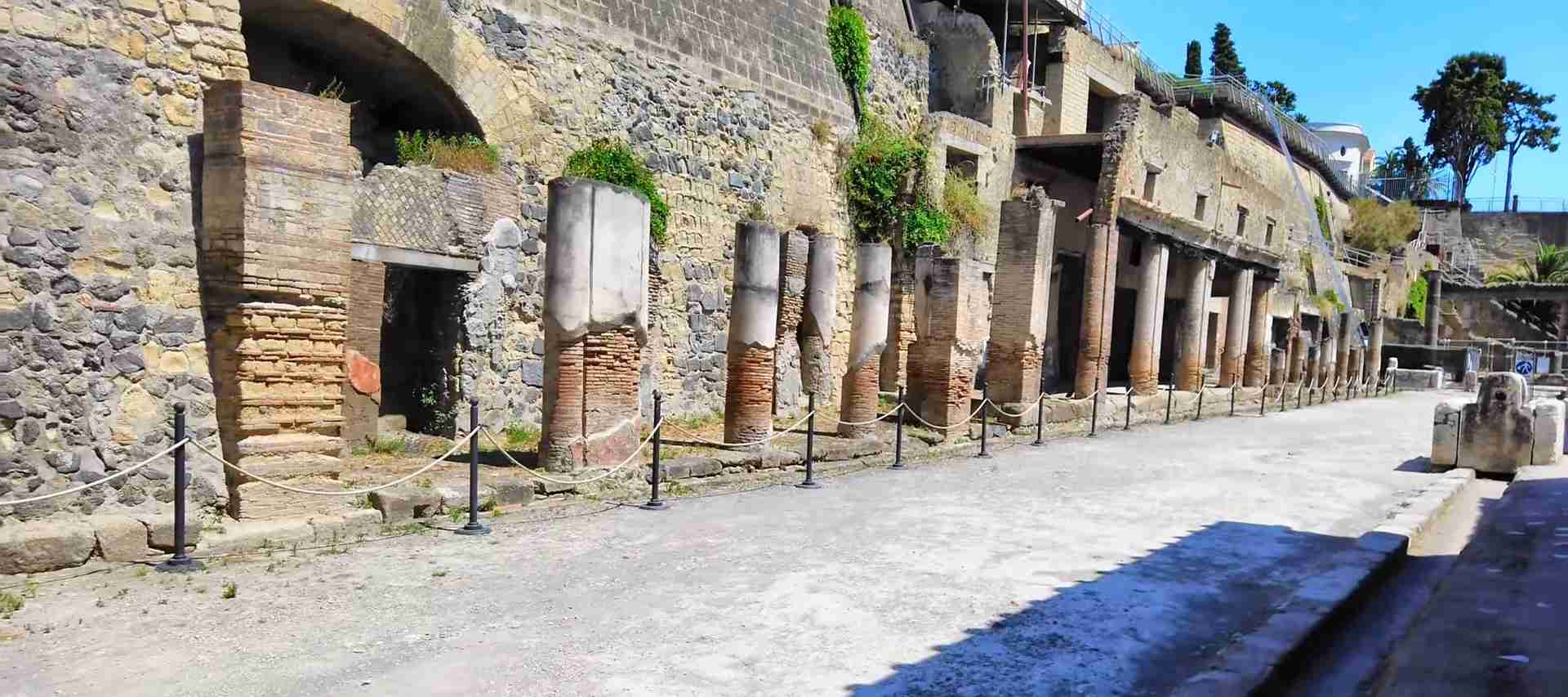
Pompeii vs Herculaneum: Which to Visit (and Why Both)
Two ancient Roman cities frozen in time by Mount Vesuvius’s catastrophic eruption in 79 AD offer dramatically different experiences despite sharing the same fate. Pompeii reveals the grand scale of urban Roman life across 44 hectares of excavated streets, while Herculaneum preserves intimate household details in just four hectares of remarkably intact structures. Understanding what distinguishes these UNESCO World Heritage Sites helps travelers choose between them or, better yet, appreciate why experiencing both provides the most complete picture of Roman civilization at its peak.
Key Takeaways: Pompeii vs Herculaneum at a Glance
- Pompeii offers monumental scale and civic grandeur: The excavated ruins span 44 hectares with forums, amphitheaters, theaters, temples, and thousands of buildings showcasing the complexity of a major Roman commercial city with 11,000-20,000 inhabitants.
- Herculaneum excels in preservation quality and intimate detail: Covering just four hectares, this wealthy seaside resort town preserves wooden structures, second-story floors, household furniture, and vivid frescoes that vanished at Pompeii due to different volcanic destruction patterns.
- Visit time requirements differ substantially: Pompeii demands 3-5 hours minimum for core highlights and can occupy a full day for thorough exploration, while Herculaneum’s compact layout allows comprehensive tours in 1.5-2 hours without feeling rushed.
- The volcanic destruction mechanisms created opposite preservation outcomes: Pompeii suffered catastrophic damage from falling pumice stones and scorching surges that destroyed upper floors and organic materials, while Herculaneum’s deep burial under pyroclastic material sealed buildings intact, creating superior preservation conditions.
- Visiting both sites reveals complementary dimensions of Roman life: Pompeii demonstrates public architecture, urban planning, and commercial activity at city scale, while Herculaneum illuminates private domestic life, luxury residential design, and the material culture of Rome’s wealthy classes.
- Practical accessibility and crowd levels create distinct visitor experiences: Pompeii attracts over 2.5 million annual visitors with corresponding crowds and infrastructure, while Herculaneum maintains a quieter, more intimate atmosphere with fewer tourists and more manageable exploration conditions.
People Also Ask About Pompeii and Herculaneum
Is Pompeii or Herculaneum Better Preserved?
Herculaneum exhibits superior preservation quality due to the volcanic burial mechanism that sealed the town. The pyroclastic surge that destroyed Herculaneum created a deep, dense layer of superheated mud and volcanic material reaching temperatures of 400°C, which instantly carbonized organic materials and filled buildings without collapsing them. This process preserved wooden beams, doors, furniture, roof structures, second-story floors, and even food items that completely vanished at Pompeii. The ancient shoreline boat chambers contain over 300 skeletal remains found in the 1980s, preserved exactly where victims sought refuge during the eruption’s final hours.
Pompeii’s destruction followed a different pattern that caused more structural damage. The city endured hours of pumice stone rainfall that accumulated on roofs, causing upper floors and roof structures to collapse under the weight. Subsequent pyroclastic surges knocked down walls and incinerated wooden elements. While Pompeii’s ground floors survived remarkably well and provide excellent examples of wall paintings and mosaics, the loss of organic materials, furniture, and upper-story architecture creates significant gaps in understanding daily life. Herculaneum’s three-dimensional preservation—with intact staircases leading to furnished second floors—offers an unmatched glimpse into the vertical architecture of Roman domestic spaces.
Can You Visit Both Pompeii and Herculaneum in One Day?
Visiting both sites in one day is physically possible but creates a rushed, exhausting experience that diminishes appreciation for each location’s unique qualities. Pompeii requires 3-5 hours minimum to see major highlights without feeling hurried, while Herculaneum needs 1.5-2 hours for thorough exploration. Adding 30-40 minutes for transportation between sites, plus time for rest, refreshments, and ticket procedures, creates an 6-8 hour commitment under optimal conditions.
The physical demands intensify the challenge. Both sites involve extensive walking on uneven ancient paving stones under Mediterranean sun with limited shade, particularly at Pompeii where covered areas are scarce. Summer temperatures frequently exceed 35°C, making afternoon visits particularly draining. Most visitors who attempt both sites in one day report significant fatigue by the second location, reducing their ability to fully engage with the archaeology and absorb historical context. Allocating separate days for each site allows morning visits when temperatures are cooler, crowds thinner, and energy levels higher, resulting in substantially richer experiences at both locations.
Which Site Should First-Time Visitors Choose If They Can Only See One?
First-time visitors limited to one site should choose Pompeii for its comprehensive representation of Roman urban civilization and iconic status as the world’s most famous archaeological site. Pompeii offers unmatched diversity in architectural types—public forums, temples, theaters, amphitheaters, bathhouses, commercial establishments, and residential districts ranging from modest homes to grand villas. This variety provides broad understanding of Roman society’s complexity, social stratification, religious practices, entertainment culture, and daily commercial activity.
Pompeii’s scale creates visceral understanding of ancient city life that smaller sites cannot match. Walking the main thoroughfares like Via dell’Abbondanza, standing in the vast Forum with Vesuvius looming behind ancient columns, and viewing the 20,000-capacity amphitheater convey the ambition and organizational sophistication of Roman civilization. The plaster casts of eruption victims—created by injecting plaster into voids left by decomposed bodies—provide haunting, deeply humanizing connections to the tragedy that no other site offers. However, visitors fascinated by preservation quality, intimate architectural details, or seeking quieter, less crowded experiences should choose Herculaneum despite Pompeii’s greater fame.
How Far Apart Are Pompeii and Herculaneum?
Pompeii and Herculaneum sit approximately 20 kilometers apart on opposite sides of Mount Vesuvius, connected by road and rail routes that curve around the volcano’s southern and western slopes. Direct road distance is roughly 18 kilometers, while the rail journey via Circumvesuviana regional train historically took 30-35 minutes. Recent changes to Circumvesuviana train schedules in 2025 complicated direct connections, as Ercolano Scavi station (serving Herculaneum) no longer functions as a regular stop on all trains running between Naples and Pompei Scavi-Villa dei Misteri station.
Current transportation requires either catching limited Campania Express trains that stop at both stations (4-6 departures daily), using the regular Circumvesuviana with a transfer at Naples, or traveling by road via taxi, ride-share services, or organized tours. Road journey time ranges from 25-40 minutes depending on traffic conditions along the SS 18 coastal highway and local roads through Torre del Greco and Torre Annunziata. The geographical separation, combined with each site’s time requirements and physical demands, explains why attempting both locations in single day creates rushed, exhausting experiences that most travelers and guidebook authors explicitly advise against.
Extended multi-day tours – 5+ days
Featured Pompeii Multi-Day Tour Packages
3 days
Discover Sorrento, Amalfi Coast & Pompeii in 3 Days
- ✓ Comprehensive Pompeii tour
- ✓ Expert local guides included
- ✓ All accommodation arranged
- ✓ Transportation provided

6 days
6 Days from Naples: Pompeii, Mount Vesuvius, Amalfi Coast, Sorrento, Positano & Capri Island
- ✓ Comprehensive Pompeii tour
- ✓ Expert local guides included
- ✓ All accommodation arranged
- ✓ Transportation provided
7 days
Sorrento Escape, Private Tour
- ✓ Comprehensive Pompeii tour
- ✓ Expert local guides included
- ✓ All accommodation arranged
- ✓ Transportation provided
4 days
Discovering Amalfi Coast
- ✓ Comprehensive Pompeii tour
- ✓ Expert local guides included
- ✓ All accommodation arranged
- ✓ Transportation provided
Multi-day tour packages powered by TourRadar. Prices and availability subject to change.
Introduction: Two Cities, One Catastrophe, Infinite Insights
On August 24th, 79 AD, Mount Vesuvius erupted with catastrophic violence, releasing thermal energy equivalent to multiple atomic bombs and ejecting volcanic material to altitudes exceeding 30 kilometers. The eruption’s fury obliterated multiple Roman settlements on Vesuvius’s slopes, but two locations—Pompeii and Herculaneum—achieved historical immortality through the paradox of destruction preserving what would otherwise have vanished. These cities remained buried and largely forgotten for over 1,600 years until accidental rediscoveries in the 16th and 18th centuries transformed archaeological science and fundamentally altered modern understanding of ancient Roman civilization.
Today, both sites hold UNESCO World Heritage status and attract millions of visitors annually, yet they offer remarkably different experiences that complement rather than duplicate each other. Pompeii reveals Roman urban planning, public architecture, and civic life at monumental scale across one of the ancient world’s most extensively excavated cities. Herculaneum illuminates the domestic sphere, luxury residential architecture, and material culture of Rome’s affluent classes with preservation quality unmatched anywhere in the Roman world. The volcanic processes that destroyed these communities created opposite preservation outcomes: Pompeii’s structural damage contrasts sharply with Herculaneum’s three-dimensional integrity, offering scholars and visitors complementary windows into the same civilization at the same historical moment.
The question “Pompeii or Herculaneum?” ultimately depends on individual priorities—monumental scale versus intimate detail, comprehensive variety versus exceptional preservation, iconic familiarity versus quieter discovery. Yet the most rewarding approach recognizes that these sites answer different questions about Roman life, and experiencing both provides exponentially richer understanding than visiting either alone. This guide examines what distinguishes these archaeological treasures, helping travelers make informed decisions while explaining why the answer for most visitors should be “both.”
The Volcanic Catastrophe: Different Destruction, Different Preservation
Mount Vesuvius’s 79 AD eruption produced a complex sequence of volcanic phenomena over approximately 24 hours, with different stages affecting Pompeii and Herculaneum at different times and through different mechanisms. Understanding these destruction processes explains why two cities experiencing the same eruption exhibit such dramatically different preservation characteristics today. Modern volcanology recognizes the 79 AD eruption as a Plinian eruption—the most explosive volcanic event type, named for Pliny the Younger, who witnessed and documented the disaster from across the Bay of Naples.
The eruption began with a massive vertical column of pumice, ash, and rock fragments that rose 30-33 kilometers into the atmosphere. Prevailing winds carried this column southeastward, directly over Pompeii, where pumice stones began falling in early afternoon. Over the following 6-8 hours, pumice accumulation reached depths of 2.5-3 meters, crushing roofs, burying ground floors, and forcing most residents to flee or seek shelter inside reinforced structures. This pumice fall phase primarily affected Pompeii while largely sparing Herculaneum, located northwest of the volcano and outside the fallout zone. When the eruption column collapsed around midnight, it generated the first pyroclastic surges—avalanches of superheated gas, ash, and rock traveling at speeds exceeding 100 kilometers per hour.
These surges devastated both cities but through different mechanisms. Pompeii, already buried under pumice, experienced surges flowing over the debris layer, generating extreme temperatures (200-400°C) that killed remaining inhabitants instantly but did not significantly penetrate the buried structures. The surges knocked down exposed walls and incinerated organic materials on surfaces, but the pumice layer actually protected buried portions. Herculaneum faced pure pyroclastic material without protective burial, experiencing surges of even higher temperatures (400-500°C) that instantly carbonized organic materials—wood transformed into carbon rather than burning to ash—while the dense mudflow of superheated volcanic material filled every space in buildings without destroying structural integrity.
The preservation paradox stems from these different burial mechanisms. Pompeii’s pumice fall created porous, oxygen-permeable burial that allowed organic materials to decompose over centuries, leaving voids where wood, food, fabric, and bodies once existed. Archaeologists famously exploit these voids by injecting plaster to create casts of victims, furniture, and even root systems. Herculaneum’s deep pyroclastic burial created anaerobic conditions—no oxygen penetration—that preserved carbonized organic materials intact. Wooden doors remain in doorframes, furniture sits in rooms, roof beams span ceilings, and even foodstuffs retain recognizable form. This fundamental difference in burial environment created opposite preservation outcomes: Pompeii preserves stone structures excellently but lost organic materials; Herculaneum retains both stone and organic elements in three-dimensional completeness.
Size and Scale: Monumental City versus Compact Town
Pompeii’s excavated area encompasses approximately 44 hectares of a city that covered 66 hectares at its destruction, making it one of the most extensively explored ancient urban centers in existence. Archaeologists have uncovered roughly two-thirds of the original city, with significant portions remaining buried under modern Pompeii town and private agricultural land. The excavated zones reveal comprehensive urban infrastructure including a massive Forum measuring 38 by 142 meters, a 20,000-capacity amphitheater (the oldest surviving permanent Roman amphitheater), two theaters accommodating 1,500 and 5,000 spectators, multiple public bath complexes, temples to Jupiter, Apollo, Venus, and Isis, exercise grounds called palestrae, and commercial districts with workshops, bakeries, fulleries, thermopolia (fast-food establishments), and the famous brothel with explicit frescoes.
The residential architecture spans the complete Roman social spectrum. Grand aristocratic houses like the House of the Faun occupy entire city blocks with multiple peristyle courtyards, elaborate mosaic programs including the famous Alexander Mosaic, and dozens of rooms. Middle-class homes demonstrate comfortable but more modest designs with single courtyards and reception rooms. Working-class housing clusters in multi-story apartment buildings and simple dwellings above ground-floor shops. This social diversity across a 44-hectare expanse creates complex navigational challenges—visitors can easily spend hours wandering streets while missing significant structures, making maps and guidebooks essential for efficient exploration.
Herculaneum presents a dramatically different scale proposition, with excavations covering just four hectares of what scholars estimate was a 20-hectare town. The smaller excavated area doesn’t reflect lesser archaeological importance but rather practical limitations: modern Ercolano town sits directly above most of the ancient settlement, making excavation prohibitively expensive and disruptive. The uncovered portion represents the ancient town’s waterfront district, including luxury villas, commercial properties, public baths, the palaestra (exercise complex), and apartment buildings. The compact layout allows visitors to see the entire accessible area in 1.5-2 hours, experiencing everything from the imposing House of the Deer to modest apartments without exhausting navigation challenges.
The population estimates further illustrate the scale difference. Pompeii housed approximately 11,000-20,000 inhabitants at its destruction, functioning as a significant commercial center controlling agricultural trade from the fertile Sarno River valley and serving as a regional market town. Herculaneum’s population numbered roughly 4,000-5,000 residents, operating as an exclusive coastal resort for wealthy Romans escaping summer heat in Rome and Naples. The town’s character reflects this elite demographic—Herculaneum lacks Pompeii’s commercial infrastructure, industrial workshops, and social diversity, instead featuring concentrated luxury residential architecture and leisure facilities. This fundamental difference in civic function and scale shapes visitor experiences profoundly: Pompeii overwhelms with variety and scope, while Herculaneum charms with intimacy and refinement.
State of Preservation: Structural Integrity and Organic Materials
Herculaneum’s preservation quality represents the finest example of Roman architecture and material culture surviving from antiquity, surpassing not only Pompeii but virtually every other Roman site worldwide. The pyroclastic surge that destroyed the town created preservation conditions that captured organic materials archaeologists rarely encounter at other ancient sites. Wooden architectural elements survive throughout Herculaneum: doors remain mounted in their original frames with hinges intact, shutters cover windows, roof beams span upper-story ceilings, and wooden stairs connect ground floors to furnished second-story rooms. Furniture appears in situ—beds with carbonized mattresses, tables, chairs, storage chests, and even a baby’s cradle discovered in one home.
The preservation extends beyond wooden structures to everyday objects that document daily life in extraordinary detail. Archaeologists uncovered carbonized foodstuffs including bread loaves still sitting in commercial ovens, eggs, nuts, dates, and even fishing nets with preserved rope. Fabric remnants reveal clothing styles and textile production techniques. Writing materials survived, including wooden tablets with stylus marks documenting commercial transactions and legal agreements. The famous Villa of the Papyri (currently inaccessible to visitors as it lies beneath modern Ercolano) contained a library of approximately 1,800 carbonized papyrus scrolls—the only intact library from the classical world—which scholars continue deciphering using advanced imaging technologies.
The vertical preservation distinguishes Herculaneum most dramatically from Pompeii and other Roman sites. Complete buildings stand two and three stories high with staircases connecting floors, allowing modern visitors to climb to second-story rooms and experience Roman domestic architecture in three dimensions. Upper-floor apartments retain mosaics, wall paintings, and architectural details identical to those on ground floors, demonstrating that decoration quality didn’t diminish with height. The House of the Wooden Partition preserves an ingenious folding screen that separated the atrium from the tablinum (reception room), demonstrating flexible space usage that purely ground-level archaeology cannot reveal. Balconies projecting over streets show how residents utilized vertical space in dense urban environments.
Pompeii’s preservation, while less complete in certain aspects, offers advantages in different areas. The pumice burial protected ground-floor wall paintings and mosaics exceptionally well, with color saturation and artistic detail often superior to Herculaneum’s examples in buildings affected by subsequent moisture infiltration. The extensive excavated area provides vastly larger sample sizes for understanding urban planning, commercial distribution, social stratification, and civic architecture. Pompeii preserves complete street systems showing drainage infrastructure, stepping stones for crossing streets during rain, and wheel ruts worn into paving stones by centuries of cart traffic. The famous plaster casts—impossible to create at Herculaneum where bodies carbonized rather than decomposing—provide haunting visual evidence of the human tragedy that no other site matches.
The preservation differences reflect not just volcanic processes but also subsequent histories. Pompeii suffered significant damage from amateur excavations in the 18th and 19th centuries, when archaeologists prioritized artifact extraction over structural conservation, removing wall paintings and mosaics to museums while neglecting building protection. Modern excavation techniques and conservation science have improved conditions dramatically, but early damage remains visible. Herculaneum benefited from later, more scientific excavation beginning in 1738 under royal Bourbon patronage, though early tunneling (before systematic excavation commenced in 1927) damaged some areas. Contemporary conservation faces different challenges at each site: Pompeii struggles with rainwater damage to exposed structures, while Herculaneum combats moisture from the modern water table that didn’t exist in antiquity, causing deterioration to wall paintings and structural elements in some buildings.
Visitor Experience and Atmosphere: Crowds, Infrastructure, and Accessibility
Pompeii ranks among Italy’s most visited archaeological sites, attracting over 2.5 million visitors annually and generating massive crowds that fundamentally shape the visitor experience. Peak tourist season (April-October) brings daily visitor counts approaching the new 20,000-per-day limit instituted in 2025, with summer weekends and the first free Sunday of each month creating particularly intense crowding. Popular structures like the Forum, House of the Faun, and amphitheater experience continuous streams of tour groups, limiting quiet contemplation and making photography without other people challenging during midday hours. The sheer number of visitors necessitates extensive site management infrastructure including ticket offices, baggage storage facilities, restrooms, cafeterias, bookshops, and security checkpoints.
The infrastructure supports efficient crowd management but creates decidedly modern intrusions into the ancient atmosphere. Metal railings prevent access to many structures and channel visitors along prescribed routes, reducing spontaneous exploration. Multilingual signage, tour group flags, and portable audio guide rentals add visual clutter. The site’s popularity attracts aggressive unofficial guides, souvenir vendors, and photographers near entrance gates despite prohibition. However, strategic timing substantially mitigates crowding: arriving at opening time (9:00 AM March-October, 8:30 AM November-February) provides 1-2 hours of relative tranquility before tour buses arrive. Late afternoon visits during the final two hours before closing also offer reduced crowds as tour groups depart, though summer heat intensifies during these hours.
The vast site area disperses crowds effectively once visitors move beyond central attractions. Remote sections like the necropolis outside the Herculaneum Gate, residential districts in Regions I and II, and peripheral streets see relatively few tourists even during peak periods. Visitors willing to explore beyond highlighted attractions discover largely empty areas where the ancient city reveals itself without modern interruptions. The excavation’s scale creates both navigation challenges and exploration opportunities—getting lost in Pompeii’s street grid feels remarkably authentic, though carrying a detailed map prevents actual disorientation.
Herculaneum offers a strikingly different visitor experience characterized by intimacy, quieter exploration, and more manageable crowds despite growing popularity. Annual visitor numbers remain significantly lower than Pompeii’s millions, creating notably less congested conditions even during summer peak season. The compact four-hectare site concentrates visitors but rarely feels overwhelming, as the layout naturally disperses people across multiple residential blocks, public buildings, and the impressive boat chamber area. Tour groups pass through more quickly than at Pompeii due to shorter standard visit durations, leaving extended periods when individual visitors can explore structures with minimal disturbance.
The preservation quality creates more immersive atmospheric conditions. Standing in second-story rooms with original wooden beams overhead, viewing intact furniture arrangements, and examining household objects in situ generates powerful connections to ancient inhabitants that Pompeii’s more fragmentary ground-level preservation cannot match. The compact scale makes spontaneous exploration practical without elaborate navigation planning—visitors can see every accessible structure without predetermined routes or aggressive time management. The site’s smaller infrastructure footprint creates less visual intrusion, though facilities like restrooms, ticket offices, and a small café still accommodate visitor needs.
Accessibility considerations differ at both sites. Pompeii’s ancient paving stones create challenging surfaces: large basalt blocks with uneven worn surfaces and gaps between stones pose tripping hazards and difficult navigation for wheeled mobility devices. The site offers a designated “Pompeii for All” accessible route from Piazza Anfiteatro entrance with reduced gradients and smoother paths, though this covers only limited site areas and cannot fully replicate the standard visitor experience. Many individual houses and structures have steps and thresholds incompatible with wheelchair access. Summer heat compounds accessibility challenges, with limited shade and long walking distances requiring significant physical stamina. Pompeii provides free baggage storage, water fountains, shaded rest areas, and basic accessibility infrastructure, but the ancient city’s inherent design resists modern accessibility adaptations.
Herculaneum’s accessibility presents similar inherent challenges from ancient construction—uneven surfaces, steps, narrow doorways—but the compact scale reduces physical demands significantly. Visitors with limited mobility can experience substantial portions of the site without the exhausting distances required at Pompeii. The site includes some ramped access points and smoother pathways, though complete accessibility remains impossible without compromising archaeological integrity. Herculaneum’s advantage lies primarily in concentration: major highlights cluster within smaller areas, allowing visitors to see exceptional examples of Roman architecture without kilometers of walking. Both sites permit service animals and offer disabled visitor assistance at ticket offices, though advance coordination proves helpful for specialized needs.
Architectural Highlights: What Each Site Showcases Best
Pompeii’s architectural significance centers on civic and public buildings that demonstrate Roman urban planning, engineering sophistication, and the social infrastructure supporting city life. The Forum represents the city’s heart, a vast rectangular plaza surrounded by temples, basilica, macellum (covered market), and administrative buildings where commercial, religious, and political activities converged. Standing in the Forum with Mount Vesuvius framed by ancient columns creates one of archaeology’s most iconic vistas. The Temple of Jupiter at the Forum’s north end showcases Roman religious architecture with its massive podium, Corinthian columns, and cella (inner chamber) that once housed cult statues. The adjacent Temple of Apollo, predating Roman control and showing Greek influences, demonstrates Pompeii’s multicultural architectural heritage.
The entertainment infrastructure reveals Roman society’s sophisticated leisure culture. The amphitheater, built around 70 BC, accommodated 20,000 spectators—roughly the entire city population—for gladiatorial combats and wild animal hunts (venationes). The structure’s excellent preservation shows the complete seating arrangement, arena surface, entrance tunnels, and even ancient graffiti documenting favorite gladiators. The nearby palaestra (exercise ground) provided training facilities and public space for athletic contests. The two theaters showcase architectural adaptation to different performance types: the larger Theater (1st century BC) hosted dramatic performances and musical events in a traditional Greek semicircular design, while the smaller covered Odeon presented intimate musical and poetry recitations for elite audiences.
The public baths exemplify Roman engineering excellence and social bathing culture. The Stabian Baths, Pompeii’s oldest bathing complex dating to the 4th century BC, preserve the complete sequence of heated rooms (caldarium), warm rooms (tepidarium), and cold rooms (frigidarium) with original architectural details including barrel vaults, heating systems (hypocausts), and decorative stucco work. The Forum Baths demonstrate the standard Roman bathing establishment’s layout with separate men’s and women’s sections, exercise areas, and changing rooms. These structures reveal sophisticated understanding of climate control, water management, and architectural design for public comfort.
The commercial and residential architecture provides unmatched insights into daily economic life and social stratification. The Via dell’Abbondanza, Pompeii’s main commercial street, preserves dozens of shops, workshops, taverns, and thermopolia with original counters, storage vessels, and even faded advertisements painted on external walls. The House of the Vettii showcases wealthy merchant-class domestic architecture with elaborate Fourth Style wall paintings depicting mythological scenes, intricate garden designs, and the famous priapic fresco in the entrance corridor. The Villa of the Mysteries, located outside the city walls, contains the ancient world’s most celebrated fresco cycle—a mysterious ritual sequence possibly depicting Dionysian mystery cult initiation spanning an entire room in vivid reds and other preserved colors.
Herculaneum’s architectural strengths lie in residential sophistication, luxury villa design, and the vertical domestic architecture that Pompeii’s collapsed upper floors cannot demonstrate. The House of the Deer exemplifies elite Roman domestic architecture with expansive peristyle gardens decorated with marble sculptures including the famous deer-attack statue groups. The house’s multi-level design includes terraces overlooking the ancient coastline, reception rooms with Fourth Style wall paintings, private baths, and an elaborate water feature system. The preservation of wooden screens, doors, and upper-floor structures reveals how wealthy Romans organized domestic space with remarkable flexibility and aesthetic refinement.
The House of Neptune and Amphitrite preserves one of antiquity’s finest mosaic programs in the nymphaeum (garden shrine), where glass mosaic panels depict the marine deities in brilliant blues, greens, and gold tesserae that retain their original luster. The adjacent shop with intact wooden shelving demonstrates commercial architecture’s integration into residential structures. The House of the Wooden Partition showcases middle-class domestic comfort with its ingenious folding screen separating the atrium from tablinum—the only surviving example of flexible Roman interior partition technology.
The apartment buildings reveal urban housing solutions for non-elite residents with sophistication absent from typical Mediterranean apartment architecture. The Insula Orientalis complex demonstrates four-story residential construction with individual apartments accessed by exterior staircases, balconies projecting over the ancient street, and ground-floor commercial spaces. The preservation of upper stories shows that decoration quality—wall paintings, mosaics, architectural detailing—did not diminish with height, contradicting assumptions about elite decoration concentrating on ground floors. These structures influenced modern understanding of Roman urban housing density and vertical construction techniques.
The Suburban Baths represent the pinnacle of Roman bathing architecture with exceptional marble decoration, sculpted stucco ceilings, elaborate mosaic floors, and perfectly preserved heating systems. The changing room features a mosaic floor showing the storage shelf numbering system, while the bath chambers retain original marble wall veneers and decorative architectural elements. The College of the Augustales, headquarters for freedmen (former slaves) who served as priests of the imperial cult, contains extraordinary marble floors and Fourth Style wall paintings demonstrating that non-aristocratic organizations commanded impressive architectural resources.
Wall Paintings and Mosaics: Artistic Preservation Quality
Pompeii preserves the ancient world’s most comprehensive collection of Roman wall paintings, with thousands of frescoed walls documenting the evolution of Roman decorative styles across multiple centuries. The site displays examples of all four Pompeian painting styles identified by art historians: the First Style’s imitation of marble veneering (2nd century BC), the Second Style’s architectural illusions creating false perspective windows and colonnades (1st century BC), the Third Style’s refined elegance with mythological panels on plain colored backgrounds (late 1st century BC to mid-1st century AD), and the Fourth Style’s eclectic baroque combinations of architectural frameworks, mythological scenes, and decorative elements dominant at Pompeii’s destruction.
The preservation quality varies significantly across different buildings and locations, with some frescoes retaining extraordinary color saturation and artistic detail while others suffer from fading, water damage, or deterioration from prolonged exposure after excavation. The House of the Vettii showcases Pompeii’s finest Fourth Style paintings in remarkable condition, with vivid reds (Pompeian red derived from cinnabar and red ochre), blues (Egyptian blue), yellows, and greens creating complex mythological narratives across multiple rooms. The villa’s frieze depicting cupids and psyches engaged in various crafts and commercial activities demonstrates Roman painting’s narrative sophistication and attention to everyday detail.
The Villa of the Mysteries contains the ancient world’s most famous fresco cycle, a continuous narrative covering the walls of a large room with nearly life-size figures engaged in mysterious ritual actions. The dominant Pompeian red background intensifies the dramatic figures’ impact, while the artistic quality—from the sophisticated poses to the expressive faces and flowing drapery—demonstrates that provincial Roman painting achieved exceptional levels comparable to metropolitan art from Rome itself. Modern scholars continue debating the fresco’s precise meaning, with interpretations ranging from Dionysian mystery cult initiation to marriage preparation allegories, but its artistic and preservation significance remains uncontested.
Herculaneum’s wall paintings, while less numerous due to the smaller excavated area, often exhibit superior preservation in specific examples where volcanic burial conditions protected surfaces from moisture damage and oxidation. The House of the Deer contains exceptional Fourth Style paintings with colors so vibrant they appear recently completed. The villa’s mythological panels—including scenes of Hercules and Telephus—retain subtle color gradations, delicate brushwork details, and sophisticated compositional arrangements that demonstrate the full potential of Roman painting techniques when perfectly preserved.
The distinction between sites lies partly in preservation environment and partly in excavation history. Pompeii’s 18th and 19th-century excavators removed many of the finest wall paintings to museums, particularly the Naples National Archaeological Museum (MANN), where controlled environments protect them from weather exposure. Herculaneum’s later excavation under more scientific protocols preserved more paintings in situ, though moisture from the elevated modern water table threatens some frescoes with deterioration. Recent conservation efforts at both sites employ advanced technologies including laser cleaning, consolidation treatments, and protective shelters, improving long-term preservation prospects.
The mosaic programs demonstrate similar patterns: Pompeii’s quantity versus Herculaneum’s quality. Pompeii contains hundreds of mosaic floors ranging from simple geometric black-and-white designs to elaborate polychrome pictorial compositions. The House of the Faun’s Alexander Mosaic, depicting Alexander the Great’s battle against Persian King Darius III, ranks among antiquity’s greatest artworks—a massive floor mosaic measuring approximately 5.8 by 3.1 meters composed of over 1.5 million tiny tesserae creating remarkably sophisticated perspective, shading, and narrative drama. The mosaic now resides in MANN, with a copy marking its original location.
Herculaneum’s Neptune and Amphitrite mosaic represents a different achievement: glass mosaic wall decoration rather than floor work, employing precious materials including gold-backed glass tesserae to create luminous effects impossible with stone. The nymphaeum mosaic’s brilliant blues and greens evoke the marine deities’ aquatic realm with color saturation stone mosaics cannot achieve. This technique, rarer and more expensive than floor mosaics, appears occasionally at Pompeii but survives in exceptional condition at Herculaneum due to the protective burial environment.
Time Requirements and Visit Planning Strategies
Pompeii demands substantial time investment for meaningful exploration, with minimum recommended durations ranging from 3-5 hours for first-time visitors focusing on major highlights to full-day commitments for thorough site coverage. The 44-hectare expanse contains over 1,000 excavated structures across multiple distinct districts, making comprehensive exploration impossible in single visits. Strategic planning based on personal interests maximizes limited time: visitors fascinated by public architecture should prioritize the Forum, amphitheater, theaters, and bath complexes; those interested in domestic life should focus on villas like the House of the Vettii and House of the Faun; art enthusiasts should seek out the finest fresco locations including the Villa of the Mysteries.
Efficient routing prevents wasted time retracing steps across the vast site. Pompeii has three main entrances—Porta Marina (most popular, accessing the Forum area directly), Piazza Anfiteatro (accessing the amphitheater and eastern sections), and Piazza Esedra (accessing the Antiquarium museum and northern areas). Entering at Porta Marina and following a clockwise circuit through the Forum, commercial districts along Via dell’Abbondanza, residential areas, amphitheater, and returning via the western sections creates logical progression minimizing backtracking. Purchasing detailed maps at entrance bookshops or downloading digital maps before arrival proves essential—Pompeii’s street grid confuses even seasoned visitors, and GPS signals function unreliably amid ancient walls.
Physical stamina considerations influence timing decisions. Summer heat makes midday visits during June-August physically punishing, with temperatures exceeding 35°C, intense sun exposure, limited shade, and heat radiating from ancient paving stones. Morning visits (arriving at 9:00 AM opening) capture cooler temperatures and softer light for photography while avoiding peak crowds. Spring (April-May) and autumn (September-October) offer ideal weather conditions—comfortable temperatures, lower humidity, and reduced tourist numbers compared to summer peak. Winter visits (November-March) provide smallest crowds and shortest ticket lines but face reduced daylight hours (5:00 PM closing), occasional rain, and cool temperatures requiring appropriate clothing.
Herculaneum’s compact scale creates fundamentally different planning requirements, with 1.5-2 hours sufficient for thorough exploration of all accessible areas without rushing. The four-hectare site allows systematic progression through residential blocks, public buildings, and waterfront areas in linear fashion requiring minimal navigation strategy. Visitors can see every major structure including the House of the Deer, House of Neptune and Amphitrite, Suburban Baths, College of the Augustales, apartment buildings, and boat chambers in chronological sequence without elaborate routing or concern about missing significant areas.
The concentrated time requirement makes Herculaneum excellent for travelers with limited schedules or combining multiple activities in single days. Morning visits from Naples (30-minute train journey) followed by afternoon exploration of Naples museums or other Campania destinations work efficiently. The more generous shade from preserved upper-story structures makes Herculaneum more comfortable during hot months compared to Pompeii’s exposed streets, though summer temperatures still demand adequate hydration and sun protection. The smaller visitor numbers create less pressure to arrive at opening time—crowds remain manageable throughout operating hours except during rare free-entry first Sundays when locals flood the site.
Combining both sites in single days remains technically possible but creates suboptimal experiences. The minimum combined time commitment totals 5-6 hours of actual site exploration plus 30-40 minutes transportation between locations, plus time for entrance procedures, rest breaks, and meals, producing 7-8 hour commitments under ideal conditions. Most visitors report significant fatigue by the second site, reducing appreciation quality and physical comfort. The recommendation from both archaeological authorities and travel experts consistently advises separate-day visits, allowing fresh energy, optimal timing, and sufficient processing time for each site’s distinct character. Travelers with genuinely limited time should prioritize one site based on personal preferences rather than attempting rushed coverage of both.
Getting There and Between Sites: Transportation Logistics
Reaching Pompeii from Naples involves taking the Circumvesuviana regional train from either Garibaldi station (adjacent to Napoli Centrale main station) or Porta Nolana station to Pompei Scavi-Villa dei Misteri station. Trains depart approximately every 30 minutes during peak hours with journey times of 35-40 minutes. The archaeological site entrance at Porta Marina sits 5-10 minutes walking from the train station via clearly marked pedestrian route. The Circumvesuviana operates as a separate system from Italy’s main rail network, requiring separate tickets that cannot be purchased through Trenitalia. Tickets cost approximately €2.90 one-way and should be validated in yellow machines before boarding to avoid substantial fines.
Recent changes to Circumvesuviana service patterns in 2025 complicated previously straightforward connections, particularly affecting travelers attempting to combine Pompeii and Herculaneum visits. Ercolano Scavi station (serving Herculaneum) no longer functions as a regular stop on all Circumvesuviana trains running the Naples-Pompeii-Sorrento line. Only the premium Campania Express trains—limited to 4-6 daily departures—stop at both Pompei Scavi and Ercolano Scavi stations. Regular Circumvesuviana trains bypass Ercolano Scavi, requiring travelers to use alternative routes.
Reaching Herculaneum from Naples now requires either catching limited Campania Express trains or using Circumvesuviana Line 4 trains to Portici-Ercolano station (different from Ercolano Scavi), requiring a 30-minute walk to the archaeological site. Alternatively, travelers can take Trenitalia regional trains from Naples to Portici-Ercolano station on the main coastal rail line, though this also involves walking. The Ercolano Scavi station, when accessible via Campania Express, places visitors 10-15 minutes downhill walk from Herculaneum’s entrance. The complications introduced by 2025 schedule changes explain why most guidebooks now recommend road transportation rather than rail for direct site connections.
Road transportation offers more flexible and often faster connections, particularly when combining both sites. Taxis and ride-sharing services (Uber availability varies) provide direct point-to-point service with journey times of 25-40 minutes depending on traffic. Costs range €35-60 for one-way trips, making this option economical for small groups splitting costs. Private drivers offering day-rate services (€150-250 for 8-hour availability) prove cost-effective for groups of 3-4 travelers, providing flexibility to spend desired time at each site without train schedule constraints. Organized tours from Naples, Sorrento, and Amalfi Coast destinations include transportation, entrance fees, and guided touring, simplifying logistics at premium prices (€80-150 per person) while reducing spontaneous exploration opportunities.
Self-driving provides maximum flexibility but introduces parking challenges and navigation complexity. Pompeii offers several parking lots near site entrances, with the largest at Via Villa dei Misteri charging €5-10 daily. Summer and weekend parking fills rapidly, requiring early arrival. Herculaneum’s limited parking near the site entrance also fills quickly, with overflow parking requiring 15-20 minute walks. The A3 autostrada connects both sites efficiently, with Pompeii exits at Pompei Ovest and Herculaneum exits at Ercolano, though local roads through modern towns involve confusing navigation, aggressive driving conditions, and congested traffic during peak periods. Rental car costs, fuel, parking fees, and potential traffic fines should factor into cost comparisons with public transportation and tour options.
Inter-site travel between Pompeii and Herculaneum has become significantly more complicated with 2025 rail schedule changes. The formerly straightforward 30-minute Circumvesuviana connection now requires either catching limited Campania Express trains (requiring schedule coordination), returning to Naples and changing trains (adding 60-90 minutes total travel time), or using road transportation. Taxis waiting at both sites offer direct inter-site service for €40-60, providing fastest connections with 25-30 minute journey times. Local buses operated by EAV theoretically connect the sites but run infrequently with unreliable schedules, making them impractical for time-conscious travelers. The transportation complications reinforce recommendations to visit sites on separate days rather than attempting same-day combinations.
Pompeii Entrance Fees and Tickets
Pompeii entrance fees were revised effective January 12, 2026, establishing new pricing tiers for different access levels. The basic Pompeii Express ticket costs €20 and grants single-entry access to the main archaeological park including the Forum, residential areas, commercial districts, theaters, amphitheater, and public buildings. This ticket excludes the suburban villas (Villa of the Mysteries and Villa of Diomedes) and Villa Regina at Boscoreale. The Pompeii+ ticket at €25 includes everything in the basic admission plus access to suburban villas, Villa Regina, and the Antiquarium museum at Boscoreale, with shuttle bus transportation between sites included. The 3-day ticket costs €30, allowing multiple entries over three consecutive days to explore the vast site at a relaxed pace.
Reduced-price tickets at €2 apply to European Union citizens aged 18-25 (not yet turned 26) and certain non-EU residents holding Italian residence permits for specified categories. Free admission extends to all visitors under 18 regardless of nationality, EU citizens with disabilities and one accompanying caregiver, teachers with valid certification, tour guides with professional licenses, and journalism professionals with current press credentials. Free admission for everyone occurs on the first Sunday of every month as part of Italy’s national “Sunday at the Museum” initiative, though these dates attract massive crowds requiring early arrival and patience with long entry lines.
Starting in 2025, Pompeii implemented significant access restrictions including a 20,000 daily visitor limit and mandatory nominative ticketing requiring names on tickets to match government-issued photo identification presented at entry. During peak season (March 16-October 14), time-slot reservations became mandatory with admissions divided into morning slots (9:00 AM-1:00 PM allowing maximum 15,000 visitors subdivided into 12,000 Pompeii Express and 3,000 Pompeii+ tickets) and afternoon slots (1:00 PM-5:30 PM allowing maximum 5,000 visitors subdivided into 3,000 Pompeii Express and 2,000 Pompeii+). These restrictions make advance online ticket purchase essential during tourist season to guarantee entry at preferred times.
Official tickets are purchased through www.vivaticket.com (exclusive official vendor as of March 2026) or from physical ticket offices at site entrances, though arrival without advance tickets risks being turned away when daily quotas fill. Third-party vendors including GetYourGuide, Tiqets, and Viator offer tickets at premium prices (typically €2-5 above official rates) with added conveniences like easier booking interfaces, better customer service, flexible cancellation policies, and bundled audio guides. These premium-priced tickets remain valid, and the small surcharge often proves worthwhile for improved booking experience and flexibility.
Herculaneum Entrance Fees and Tickets
Herculaneum entrance tickets are managed through CoopCulture, the official ticketing partner for the Parco Archeologico di Ercolano. Standard admission grants access to the entire excavated archaeological park including all accessible houses, public buildings, baths, apartment complexes, and the boat chambers. Ticket pricing information varies across sources due to temporary exhibitions and special events that create bundled pricing options. The site offers time-slot reservations in 15-minute increments throughout operating hours, providing better crowd management compared to unrestricted entry systems.
Reduced-price tickets at €2 apply to European Union citizens aged 18-25 (not yet turned 26) and certain non-EU residents holding qualifying Italian residence permits. Free admission extends to visitors under 18 regardless of nationality, EU citizens with disabilities and one accompanying person, teachers with valid professional certification, licensed tour guides, and journalism professionals with current credentials. Herculaneum participates in free admission initiatives on the first Sunday of each month plus specific Italian national holidays including April 25 (Liberation Day), June 2 (Republic Day), and November 4, though free-entry days attract significant crowds requiring early arrival and potential queuing despite the site’s smaller size.
Advanced online booking through CoopCulture releases tickets 3-4 months ahead of visit dates, allowing substantial planning flexibility. The booking process requires creating a CoopCulture account and selecting specific entry time slots, with small pre-sale fees (€1.50 per ticket) adding to base admission prices. Third-party vendors including GetYourGuide, Tiqets, Headout, and specialized local tour operators offer alternative purchasing options with added services like audio guides, skip-the-line priority (actually referring to bypassing ticket purchase lines rather than security), and combined tickets with other Vesuvian sites.
Unlike Pompeii’s strict daily visitor limits and time-slot capacity restrictions, Herculaneum maintains more flexible admission policies, though the site reserves the right to implement crowd control measures during exceptional circumstances. The generally lower visitor numbers compared to Pompeii means advance booking, while advisable during high season (July-August) and weekends, remains less critical than at Pompeii where daily quotas frequently fill. Free-entry Sundays represent the primary exception, when local residents and tourists create crowding requiring morning arrival for reasonable entry wait times.
Combined Tickets and Multi-Site Passes
No official combined ticket covers both Pompeii and Herculaneum as single-purchase admission, as the sites operate under separate administrative authorities—Pompeii under the Parco Archeologico di Pompei and Herculaneum under the Parco Archeologico di Ercolano. Visitors must purchase separate tickets for each location through respective official channels. However, third-party tour operators and ticketing platforms frequently bundle Pompeii and Herculaneum entries as “combo tickets” or “two-site packages” that provide administrative convenience and occasionally modest price advantages compared to separate purchases.
These commercial combo offerings typically include skip-the-line access (bypassing ticket purchase queues), audio guides for both sites, and sometimes transportation between locations. Prices range €45-80 depending on included services, representing €5-15 premiums over separate official ticket purchases but providing simplified booking, consolidated customer service, and bundled amenities. Travelers prioritizing convenience over absolute minimum cost often find these packages worthwhile despite the surcharge. Careful comparison of included services against individual needs prevents paying for unnecessary additions like audio guides when preferring independent exploration or transportation when already having rental cars.
The Campania Artecard represents the region’s official multi-site cultural pass, offering various configurations providing free or discounted admission to multiple archaeological sites and museums across Campania region. The three-day card (€32) includes free admission to two sites plus 50% discounts on additional sites, making it cost-effective for visitors planning multiple cultural attractions beyond just Pompeii and Herculaneum. The seven-day version (€34) provides similar benefits with extended validity. The Artecard includes public transportation in Naples, adding value for visitors using metro, buses, and funicular services. However, cards purchased in 2025 function exclusively as mobile app-based tickets rather than physical cards, requiring compatible smartphones.
Pompeii’s MyPompeii annual pass (€45, €10 for under-25 EU citizens) grants unlimited visits to all Pompeii archaeological park sites for 365 days from first use, providing exceptional value for visitors spending extended time in Campania or making multiple trips to the region. The pass covers Pompeii, Villa Poppaea at Oplontis, Antiquarium and Villa Regina at Boscoreale, Stabian Villas, and the Archaeological Museum of Stabiae. For travelers visiting Pompeii multiple times or extensively exploring greater Pompeii sites, the annual pass costs barely more than two Pompeii+ tickets while including several additional locations.
Opening Hours and Seasonal Considerations
Pompeii operates daily year-round with seasonal schedule variations maximizing daylight utilization while managing visitor flow patterns. From April through October, the site opens 9:00 AM with last entry at 5:30 PM and final exit at 7:00 PM, providing up to 8 hours of potential exploration time. The extended summer hours accommodate demand during peak tourist season and allow visitors to avoid intense midday heat by arriving early or staying into evening when temperatures moderate. From November through March, opening time remains 9:00 AM but last entry moves to 3:30 PM with final exit at 5:00 PM, reflecting shorter winter daylight and reduced tourist traffic. The site closes only on January 1, May 1, and December 25.
The time-slot reservation system implemented in 2025 applies during peak season (March 16-October 14), dividing daily admission into morning (9:00 AM-1:00 PM) and afternoon (1:00 PM-5:30 PM) windows with capacity limits in each period. This system spreads visitor arrival throughout operating hours rather than concentrating crowds at opening time, theoretically improving site conditions and visitor experience. The morning slot receives larger capacity allocation (15,000 of 20,000 daily maximum) because most organized tours and independent visitors prefer earlier visits, while the afternoon slot’s reduced capacity (5,000 maximum) reflects lower demand during hotter afternoon hours.
Herculaneum’s operating schedule follows similar seasonal patterns with different specific hours. From March 16 through October 14, the site opens 8:30 AM with last entry at 6:00 PM and mandatory site evacuation by 7:00 PM. The earlier opening time compared to Pompeii (8:30 AM versus 9:00 AM) helps distribute visitors across longer operating window. From October 15 through March 15, opening time remains 8:30 AM but last entry moves to 3:30 PM with site evacuation required by 4:40 PM. Herculaneum closes on the same national holidays as Pompeii (January 1, May 1, December 25) plus occasional special closures for maintenance or conservation work announced on the official website.
Seasonal weather patterns dramatically influence visitor comfort and site conditions beyond simple schedule variations. Summer months (June-August) bring intense heat with temperatures frequently exceeding 35°C, strong sun exposure, minimal shade (especially at Pompeii), and potential heat exhaustion risks requiring aggressive hydration, sun protection, and heat management strategies. July and August represent absolute peak tourist season with maximum crowds, highest prices for accommodations and services, and most stressed site conditions. Early morning or late afternoon summer visits prove essential for tolerable temperatures, though afternoon visits face intense heat radiating from ancient paving stones accumulated throughout the day.
Spring (April-May) and autumn (September-October) offer optimal weather conditions combining comfortable temperatures (18-25°C typically), lower humidity, reduced precipitation risk compared to winter, and substantially smaller crowds than summer peak. These shoulder seasons provide the best overall visitor experience balancing weather comfort, crowd levels, longer daylight hours, and moderate tourist service prices. Accommodations and tours book at lower premium rates compared to summer, yet weather remains reliably pleasant for outdoor archaeological exploration.
Winter (November-March) presents trade-offs: smallest crowds, lowest prices, zero heat concerns, but reduced daylight hours limiting visit duration possibilities, increased rain probability requiring contingency planning and appropriate gear, occasional cold temperatures demanding warm layers, and some tour operators running reduced schedules or closing entirely. Winter Campania weather varies dramatically year-to-year, with some years experiencing mild, sunny conditions ideal for comfortable exploration while others bring frequent rain, wind, and temperatures requiring winter coats. December and early January see particularly quiet conditions as most tourists avoid Italy’s cold season, creating near-private experiences at both sites for weather-tolerant visitors.
Guided Tours versus Independent Exploration
Guided tours provide structured introduction to archaeological sites’ historical context, architectural significance, and interpretive frameworks that independent visitors often miss without extensive preparation. Professional guides explain building functions, artistic programs, social contexts, and eruption narratives while directing attention to details easily overlooked during self-guided exploration. At Pompeii’s overwhelming scale, guides offer navigation efficiency, ensuring visitors see major highlights within limited time while avoiding wasted effort on closed structures or less significant areas. Qualified guides hold official licenses requiring archaeological training and regional knowledge examinations, ensuring factual accuracy and interpretive depth.
Tour options range from large group tours (20-30 participants) at lowest price points (€40-60 including entrance) to small group tours (8-15 participants) at moderate prices (€70-100) to private tours (1-6 participants) at premium rates (€150-300 depending on group size and duration). Large groups sacrifice personal attention and question opportunities but cost less, while small groups balance affordability with improved guide access and flexibility. Private tours maximize personalization, allowing customized focus on specific interests, flexible pacing, and unrestricted question opportunities but cost substantially more unless split among larger families or friend groups.
The disadvantages of guided tours include reduced spontaneous exploration, rigid pacing following group consensus rather than individual preferences, and limited time in areas personally fascinating but not included in standard tour routes. Tours typically last 2-2.5 hours at Pompeii and 1-1.5 hours at Herculaneum, providing overview coverage of highlights but insufficient time for thorough exploration, detailed photography, or extended contemplation in particularly compelling locations. The fixed narrative approach may frustrate visitors with specific interests diverging from standard tour coverage or those preferring self-directed discovery over prescribed interpretation.
Independent exploration offers maximum freedom, unlimited time in personally interesting areas, spontaneous routing following curiosity, and absence of group dynamics or guide dependency. Visitors can spend 30 minutes photographing a particular fresco, explore remote site sections avoided by tours, return to compelling structures for repeated viewing, and create completely customized experiences matching individual interests rather than group averages. The silence of solitary exploration in quiet site corners generates atmospheric connections impossible in guide-narrated group settings.
The challenges of independent visits include navigation complexity (especially at Pompeii’s vast scale), interpretive limitations without archaeological expertise, missing significant details or structures without guidance, and time waste exploring less important areas while overlooking highlights. Quality audio guides partially address these limitations, providing professional narration, historical context, and routing suggestions while maintaining independent pacing. Pompeii and Herculaneum both offer audio guide rentals (approximately €8) in multiple languages with detailed commentary on major structures, though audio quality and content depth vary. Third-party audio guide apps including Rick Steves Audio Europe offer free alternatives with generally good content quality.
The optimal approach for many visitors combines both methods: starting with a guided tour providing foundational orientation and historical context, then returning for independent exploration to revisit compelling areas, see structures missed during the tour, and develop personal connections without time constraints or group dynamics. This two-visit strategy works particularly well at Pompeii where a single visit, guided or independent, cannot possibly address the site’s scope comprehensively. For Herculaneum’s more manageable scale, many visitors successfully navigate independently using detailed guidebooks or audio guides without professional guide assistance.
Why Visiting Both Sites Provides Exponentially Richer Understanding
The complementary nature of Pompeii and Herculaneum’s preservation characteristics, scale, and archaeological strengths means experiencing both sites provides understanding exponentially richer than visiting either alone. Pompeii demonstrates Roman urban civilization’s public face—civic infrastructure, commercial vitality, social stratification, entertainment culture, and religious life at city scale. Walking Pompeii’s streets reveals urban planning principles, economic geography, social organization, and the monumental architecture expressing Roman political and religious ideology. The vast scale and architectural variety show how Romans created and operated complex urban societies supporting tens of thousands of inhabitants with sophisticated infrastructure centuries before modern cities.
Herculaneum illuminates the private sphere, domestic architecture, and material culture with detail impossible at Pompeii’s ground-level preservation. The intact furniture, wooden elements, second-story rooms, and household objects reveal daily life’s intimate details—how families organized domestic space, what possessions they valued, how they decorated homes, and what activities filled private hours. The organic material preservation shows aspects of Roman material culture absent from stone-only archaeology: textile patterns, food varieties, writing materials, and the wooden construction elements that comprised half of Roman buildings’ material composition but rarely survive archaeologically.
The sites’ different social contexts complement each other. Pompeii’s diversity from aristocratic villas to working-class apartments demonstrates Roman society’s full social spectrum, commercial vitality, and urban density. Herculaneum’s concentration on wealthy residential architecture reveals how Rome’s elite lived when freed from commercial constraints, the luxury goods they accumulated, and the architectural sophistication they commissioned. Together, the sites show both common Roman urban patterns and socio-economic variations creating different urban character between commercial centers and resort towns.
The volcanic destruction’s different impacts on each location provide unique preservation windows. Pompeii’s pumice fall and pyroclastic surges created the plaster-castable voids documenting the human tragedy’s final moments with haunting immediacy—families huddled together, individuals caught fleeing, dogs chained in courtyards, people collapsed while protecting valuables. Herculaneum’s boat chambers contain over 300 skeletons of people seeking coastal escape, preserved in postures documenting their final desperate hours. The different preservation mechanisms mean aspects lost at one site survive at the other: Pompeii preserves street-level civic architecture Herculaneum’s limited excavation cannot show, while Herculaneum preserves vertical architecture and organic materials Pompeii’s destruction eliminated.
From art historical perspectives, both sites contribute essential evidence for understanding Roman painting and decorative arts. Pompeii’s quantity—thousands of frescoed walls across hundreds of buildings—documents stylistic evolution, regional workshop practices, iconographic programs, and social variations in decoration quality. Herculaneum’s superior preservation shows these same artistic traditions in brilliant original condition, revealing color vibrancy, brushwork subtlety, and compositional sophistication that Pompeii’s partially deteriorated examples cannot fully demonstrate. Mosaic programs follow similar patterns: Pompeii’s Alexander Mosaic shows Roman mosaic’s pinnacle achievement in scale and ambition; Herculaneum’s glass mosaics demonstrate precious material techniques absent from Pompeii’s stone mosaic tradition.
The architectural evidence creates similar complementarity. Pompeii shows how Romans organized public spaces—forums for civic gathering, temples for religious activity, theaters for entertainment, baths for social cleansing—while Herculaneum demonstrates how these same architectural types appeared in wealthy resort town contexts with different scale and design priorities. Pompeii’s commercial architecture reveals economic life; Herculaneum’s luxury villas show how accumulated commercial wealth translated into residential splendor. Together they document Roman architectural versatility across functional types, social contexts, and economic levels.
For educational purposes, the dual-site experience transforms abstract historical knowledge into tangible, visceral understanding. Reading about Roman life in textbooks or museums provides information; standing in Roman streets, entering Roman homes, viewing Roman art in original contexts, and experiencing the scale, organization, and material reality of Roman urban civilization creates comprehension no secondary source can match. The sites’ different preservation states and scales ensure this learning operates at multiple registers—Pompeii teaches through monumental impression and urban complexity, Herculaneum through intimate detail and exceptional preservation quality.
Practical Recommendations for Different Visitor Profiles
First-time visitors to the Naples region with 3-5 days total should allocate separate full mornings to each site rather than attempting same-day combinations. Visit Pompeii first for comprehensive introduction to Roman urban archaeology, spending 4-5 hours exploring major highlights with either guided tour followed by independent time or thorough self-guided exploration using quality guidebook or audio guide. Schedule Herculaneum for a separate morning 2-3 days later after processing Pompeii’s overwhelming information, allowing fresh perspective and energy for appreciating Herculaneum’s distinct preservation character and more intimate scale. Afternoon hours can address other Campania attractions including Naples museums (particularly the National Archaeological Museum housing artifacts from both sites), Vesuvius ascent, or Amalfi Coast exploration.
Travelers on extremely tight schedules (1-2 days in Naples area) face difficult choices between attempting both sites in exhausting single-day marathons or selecting one location for quality experience. The recommendation heavily favors quality over quantity: choose Pompeii for its comprehensive representation of Roman urban life and iconic status, planning 4-5 hours minimum and accepting that thorough coverage remains impossible. Herculaneum serves better for travelers with only 2-3 hours available or seeking quieter, less overwhelming experiences, but missing Pompeii means sacrificing Roman archaeology’s most famous and varied site. Same-day attempts with either predawn starts or tour packages combining both sites work physically but create rushed, fatiguing experiences diminishing appreciation for both locations.
Families with children require special considerations. Pompeii’s vast scale creates navigation complexity and potential child exhaustion from extensive walking on uneven surfaces in heat. Families should target 2-3 hour visits focusing on specific engaging areas: the amphitheater where children can imagine gladiatorial spectacles, the plaster casts providing dramatic evidence of the eruption’s human impact, the ancient bakery with intact millstones and ovens, and the Forum where children can run relatively safely in open spaces. Herculaneum’s compact layout suits family visits better, allowing complete site coverage in 90 minutes without overwhelming young attention spans. The boat chambers’ skeletal remains and intact wooden furniture generate stronger impressions than Pompeii’s fragmentary ground-level preservation.
Photography enthusiasts should prioritize early morning or late afternoon visits when slanting light creates dramatic shadows and warm color temperatures enhancing ancient stone and fresco colors. Summer sunrise visits (arriving at 9:00 AM opening) provide 1-2 hours of optimal light before harsh midday sun flattens contrast and creates severe shadows. Afternoon visits during the final 2-3 hours before closing offer golden hour light quality ideal for architectural and landscape photography, though summer afternoon heat intensifies. Overcast days provide even, diffused light excellent for wall painting and mosaic photography, eliminating harsh shadows and allowing longer exposures without blown highlights. Tripods require special permits at both sites, but modern camera stabilization systems and high ISO performance make handheld photography viable for most situations.
History and archaeology enthusiasts should allocate multiple days for comprehensive exploration, combining site visits with the National Archaeological Museum in Naples housing major artifacts, wall paintings, mosaics, and the Secret Cabinet’s ancient erotic art collection. Serious students should invest in detailed academic guidebooks including “The Houses and Monuments of Pompeii” by Fausto and Felice Niccolini or “Pompeii: A Sourcebook” by Alison Cooley providing structure-by-structure documentation. Joining specialized archaeological tours led by university-trained guides or practicing archaeologists adds depth beyond standard tourism narratives. Consider timing visits to coincide with ongoing excavations when possible, as Pompeii continues revealing new structures and Herculaneum’s waterfront areas remain partially explored.
Accessibility-challenged visitors should recognize both sites’ inherent limitations from ancient construction—uneven surfaces, steps, narrow passages, lack of ramps—that modern adaptations cannot fully overcome without compromising archaeological integrity. Pompeii offers the “Pompeii for All” accessible route from Piazza Anfiteatro entrance with reduced gradients and smoother paths covering limited but significant areas including parts of Via dell’Abbondanza, the amphitheater area, and selected houses. Herculaneum’s compact scale and greater shade reduce some challenges compared to Pompeii’s vast, exposed expanse, though steep grades and steps remain obstacles. Both sites permit wheelchairs and mobility devices, provide disabled parking, and offer assistance from entrance staff, but potential visitors should contact sites in advance to discuss specific needs and establish realistic expectations about achievable coverage.
What Not to Expect: Common Misconceptions and Disappointments
Many first-time visitors arrive expecting completely intact ancient cities resembling architectural theme parks or movie sets, confronting instead the reality of ruined structures, collapsed walls, missing roofs, and fragmentary preservation requiring archaeological imagination to reconstruct original appearances. While Herculaneum preserves remarkable structural integrity including upper floors and wooden elements, even its best-preserved buildings remain ruins missing furnishings, complete decoration, and living populations that created their original character. Pompeii presents even more fragmentary conditions with most structures reduced to ground-level foundations, partial walls, and doorways framing empty spaces where rooms once existed.
The sites’ presentation emphasizes archaeological preservation rather than theatrical reconstruction. Unlike some historical sites that reconstruct ancient appearances through extensive restoration, both Pompeii and Herculaneum maintain conservative archaeological approaches preserving authentic remains rather than creating speculative reconstructions. This authentic approach means visitors see ancient structures as discovered—weathered, damaged, fragmentary—rather than restored to imagined original conditions. The intellectual effort required to mentally reconstruct complete buildings from ruined remains challenges visitors expecting immediately comprehensible architecture, making guides, reconstructive illustrations, or digital applications valuable for bridging the gap between ruined reality and original appearance.
Famous structures and artworks often disappoint through absence or restricted access. Many celebrated wall paintings and mosaics mentioned in guidebooks now reside in the Naples National Archaeological Museum rather than original locations, removed decades ago for protection from weather and vandalism. The Alexander Mosaic, House of the Faun’s masterpiece, exists only as modern copy in situ while the original occupies museum display. Numerous houses close periodically for conservation work, staff shortages, or protection from excessive visitor traffic, meaning structures highlighted in guidebooks may prove inaccessible during particular visits. Pompeii’s sheer size means many notable structures remain buried, excavated but closed to visitors, or located in remote site sections requiring extensive walking to access.
The modern site management infrastructure creates inevitable contemporary intrusions into ancient atmosphere. Metal railings prevent access to many structures and channel visitors along prescribed routes, reducing spontaneous exploration. Warning signs, directional markers, ticket checkpoints, security staff, tour groups with portable amplification systems, and souvenir vendors near entrances inject 21st-century elements into ostensibly ancient environments. Pompeii’s popularity generates crowding that fundamentally alters the visitor experience from quiet archaeological contemplation to navigating tourist masses during peak seasons. The juxtaposition of ancient ruins with modern tourism infrastructure, while necessary for site protection and visitor management, diminishes atmospheric immersion particularly for visitors expecting isolated communion with antiquity.
Visitors expecting comprehensive labeling and interpretive signage face disappointment from minimal on-site information at both locations. Structure identification signs provide basic building names in Italian and English, but detailed explanations of historical context, artistic significance, or architectural features remain largely absent. This minimal signage approach reflects both conservation philosophy—avoiding visual clutter with excessive modern elements—and practical challenges of maintaining interpretive materials in outdoor archaeological environments. The signage limitation makes audio guides, mobile applications, or printed guidebooks essential for understanding site significance beyond simple architectural observation.
The preservation quality varies dramatically across different site areas and structures, creating uneven experiences contradicting expectations of uniform excellence. Pompeii’s most famous locations—Villa of the Mysteries frescoes, House of the Vettii paintings, Forum temples—receive intensive conservation maintaining excellent conditions, while peripheral areas show significant deterioration from inadequate protection, water damage, and deferred maintenance. Recent structures opening to the public after decades of closure often dazzle with exceptional preservation, while long-exposed buildings show weathering effects from years of outdoor exposure before modern protective measures. Herculaneum faces moisture infiltration problems from the elevated modern water table, causing deterioration to wall paintings and structural elements in some houses despite the generally superior preservation conditions.
Beyond the Sites: The National Archaeological Museum Connection
The National Archaeological Museum of Naples (MANN) houses the world’s most important collection of Roman artifacts, wall paintings, mosaics, sculptures, and everyday objects excavated from Pompeii, Herculaneum, and other Vesuvian sites. Visiting MANN provides essential complement to site visits, displaying treasures removed from original locations for protection alongside explanatory context impossible to provide in outdoor archaeological environments. The museum’s collections transform abstract archaeological ruins into material reality populated by specific objects—bronze statues from the Villa of the Papyri, silver tableware from the House of the Menander, medical instruments, jewelry, glass vessels, and carbonized foodstuffs preserving 2,000-year-old meals.
The wall painting collection contains masterpieces removed from Pompeii and Herculaneum when 18th and 19th-century excavators prioritized artifact extraction over in situ preservation. Entire room frescos appear reconstructed in museum galleries, showing complete decorative programs impossible to appreciate from fragmentary remains at the sites. The Alexander Mosaic, ancient world’s most ambitious floor decoration, occupies a dedicated gallery where visitors can examine the approximately 1.5 million tiny tesserae composing the epic battle scene without the visual obstructions of protective barriers required at archaeological sites. The Secret Cabinet displays ancient erotic art—explicit sexual imagery from brothels, private homes, and religious contexts—providing uncensored evidence of Roman sexual culture typically restricted or removed from general site access.
The organization of museum displays by findspot and building allows tracing specific structures’ complete artifact assemblages. The House of the Faun gallery reunites objects discovered throughout that massive villa—bronzes, mosaics, sculptures, household items—demonstrating the archaeological richness of individual elite residences. The Villa of the Papyri collection displays bronze sculptures of philosophers, athletes, and mythological figures that decorated the villa’s gardens and rooms, creating mental reconstructions of luxury villa decoration impossible from empty ruins. The everyday object collections—cooking equipment, construction tools, medical instruments, cosmetic containers, writing materials—humanize ancient life beyond monumental architecture and elite art.
Strategic timing of museum and site visits maximizes understanding through complementary perspectives. Visiting MANN before site exploration provides mental preparation, establishing historical context, showing complete artifacts and decorative programs that survive only fragmentarily at sites, and offering reconstructive models demonstrating original building appearances. Visitors then arrive at sites equipped with visual references transforming ruined walls into mentally reconstructed structures. Alternatively, visiting sites first generates questions and interests that museum displays specifically address, creating active learning where museum information answers site-generated curiosities rather than presenting abstract information without experiential context. Many serious visitors allocate at least 3-4 hours for MANN, insufficient for comprehensive coverage but adequate for major collections and highlights.
Conservation Challenges and the Race Against Time
Both Pompeii and Herculaneum face ongoing conservation crises threatening long-term survival of structures that survived initial volcanic destruction and 2,000 years of burial but deteriorate rapidly under exposure to weather, tourism pressure, and inadequate maintenance. Pompeii’s vast 44-hectare expanse creates conservation challenges exceeding available resources—with thousands of structures requiring continuous maintenance, protective sheltering, structural stabilization, and active conservation, the archaeological authority struggles to address deterioration faster than it occurs. Periodic building collapses, including the 2010 House of the Gladiators collapse that triggered international outcry, demonstrate the stakes of inadequate conservation funding and delayed maintenance.
Water represents the primary destruction mechanism at both sites. Pompeii’s structures, designed for Mediterranean climate with roofs shedding rain, now stand roofless or with inadequate modern protective coverings, allowing rainwater to penetrate walls, dissolve mortar, freeze in winter causing spalling, and carry soluble salts that crystallize within wall fabrics causing structural damage. Wall paintings suffer particularly severe water damage as moisture dissolves pigment binders and causes plaster delamination from wall surfaces. Recent conservation initiatives include installing protective shelters over vulnerable structures, improving drainage systems, and developing water-repellent treatments, but the scale of intervention required vastly exceeds available budgets.
Herculaneum faces different but equally serious water challenges from the elevated modern water table that didn’t exist in antiquity. Modern urban development surrounding the ancient town raised ground water levels, causing rising damp that saturates ancient walls from below, carrying dissolved mineral salts that crystallize as water evaporates from surfaces. This salt crystallization exerts tremendous pressure within wall fabrics and plaster layers, causing structural deterioration and artistic damage to frescoes. The Herculaneum Conservation Project, an international collaboration between archaeological authorities and conservation organizations, implemented innovative dewatering systems and drainage improvements, but ongoing moisture management remains critical to long-term survival.
Tourism pressure creates mechanical wear, vandalism risks, and microclimate alterations accelerating deterioration. Millions of annual visitors at Pompeii generate erosion of ancient paving stones, doorway thresholds, and stairs from foot traffic; graffiti and vandalism despite surveillance; and changes to interior microclimates when crowds enter enclosed spaces, raising humidity and temperature while introducing pollutants. Access restrictions closing vulnerable structures to visitors protect individual buildings but concentrate traffic on fewer structures, intensifying wear to those remaining accessible. The 2025 implementation of daily visitor limits and time-slot reservations attempts to reduce peak crowding while maintaining tourism revenue supporting conservation work.
Climate change introduces new conservation challenges as Mediterranean weather patterns shift toward increased precipitation intensity and frequency, higher temperatures accelerating chemical deterioration, and extreme weather events causing dramatic damage. The biological growth accelerates in warmer, wetter conditions as mosses, lichens, and vegetation colonize ancient walls, with plant roots mechanically disrupting masonry while retaining moisture. Conservation science develops new materials and techniques—breathable protective coatings, improved mortar formulations, advanced consolidants for friable surfaces—but implementation across thousands of structures proceeds slowly given budget and technical workforce limitations.
The fundamental paradox remains that excavation creates destruction: buried structures survived millennia in stable anaerobic conditions, but exposure to atmospheric oxygen, water, temperature fluctuations, biological activity, and human interaction initiates irreversible deterioration requiring perpetual intervention. Each excavated building becomes a permanent conservation obligation demanding continuous monitoring, maintenance, and eventual intervention. Archaeological authorities increasingly question excavating additional structures when existing excavations already exceed conservation capacity, leading to controversial decisions leaving proven archaeological deposits unexcavated rather than exposing them to destruction through inadequate post-excavation care. The unexcavated portions of both cities—approximately one-third of Pompeii and three-quarters of Herculaneum—may remain permanently buried as deliberate preservation strategy, protecting them for future generations with superior conservation resources and technologies.
Frequently Asked Questions
Is it worth visiting both Pompeii and Herculaneum or should I choose one?
Visiting both sites provides dramatically richer understanding of Roman urban life than experiencing either alone, as they preserve complementary rather than duplicate archaeological evidence. Pompeii demonstrates Roman civic architecture, urban planning, commercial activity, and social diversity at monumental city scale across 44 hectares, while Herculaneum illuminates elite residential architecture, domestic material culture, and organic preservation quality in four compact hectares. The sites’ different scales, preservation states, and archaeological strengths mean they answer different questions about Roman civilization. However, if severe time or budget constraints force choosing one location, first-time visitors should prioritize Pompeii for comprehensive representation of Roman urban archaeology and iconic status, while those seeking superior preservation quality, intimate architectural detail, or quieter experiences should choose Herculaneum.
How much time should I allocate for visiting each site?
Pompeii requires minimum 3-5 hours for covering major highlights without feeling rushed, with thorough exploration easily occupying full days. The 44-hectare site contains over 1,000 excavated structures across multiple districts, making comprehensive single-visit coverage impossible. First-time visitors should allocate 4-5 hours, allowing time for navigation, rest breaks, and absorption of overwhelming historical information. Herculaneum’s compact four-hectare layout allows complete coverage in 1.5-2 hours, providing sufficient time to explore all accessible houses, public buildings, boat chambers, and archaeological highlights without exhausting pace. Visitors seeking unhurried contemplative experiences or extensive photography should add additional hours to these minimum recommendations.
Are the sites suitable for visitors with limited mobility or wheelchair users?
Both sites present significant accessibility challenges from ancient construction featuring uneven paving stones, steps, narrow passages, and thresholds incompatible with modern accessibility standards. Pompeii offers the “Pompeii for All” designated accessible route from Piazza Anfiteatro entrance with reduced gradients and smoother surfaces covering limited but important site areas including portions of Via dell’Abbondanza and selected structures. Herculaneum’s compact scale reduces walking distances compared to Pompeii’s vast expanse, and greater shade from preserved upper-story structures improves comfort, but steep grades and steps remain obstacles. Both sites permit wheelchairs and mobility devices, offer disabled parking, and provide entrance staff assistance, but visitors should contact sites in advance to discuss specific needs and establish realistic expectations about achievable coverage given inherent ancient architecture limitations.
What should I bring for a comfortable site visit?
Essential items include comfortable walking shoes with good support and grip for uneven ancient paving, sun protection (hat, sunglasses, sunscreen with minimum SPF 30), at least one liter of water per person (both sites have refill fountains), and weather-appropriate clothing accounting for minimal shade at Pompeii. Summer visits demand light, breathable fabrics covering skin for sun protection while allowing heat dissipation; winter visits require layered clothing addressing cool temperatures and potential wind. Detailed maps or guidebooks prove invaluable for navigation and interpretation, particularly at Pompeii where getting lost in the vast street grid happens frequently. Cameras and portable chargers for mobile devices running audio guide apps or maps should include backup batteries. Both sites prohibit large bags and backpacks exceeding 30x30x15 centimeters, though free baggage storage operates near ticket offices.
Can I take photographs inside the sites?
Photography for personal, non-commercial use is permitted throughout both sites without restriction, though flash photography receives varying treatment across different areas and times. Tripods and other stabilization equipment require special permits and fees, though modern camera and smartphone stabilization systems make handheld photography viable for most situations. Professional photography, video production, and commercial image use require advance authorization and fees from archaeological authorities. Respectful photography avoiding invasive behavior toward other visitors and prohibited climbing on structures or crossing barriers allows capturing site memories while maintaining proper archaeological conservation and visitor courtesy. The plaster casts at Pompeii and skeletal remains at Herculaneum’s boat chambers document human tragedy deserving photographic respect rather than casual selfie backgrounds.
Are audio guides or guided tours recommended for first-time visitors?
First-time visitors benefit substantially from either professional guided tours or quality audio guides providing historical context, architectural interpretation, and navigation assistance impossible for untrained visitors to derive from ruins alone. Guided tours offer live expert interpretation, question opportunities, and efficient routing to major highlights within limited time, though they sacrifice spontaneous exploration and independent pacing. Audio guides provide similar interpretive content with complete flexibility for timing and routing, though they lack the interactive question-answer dynamic and personalized attention professional guides offer. The optimal approach for many visitors combines both methods: starting with a 2-hour guided tour establishing foundational understanding, then returning for independent exploration to revisit compelling areas and develop personal connections without time constraints or group dynamics.
What is the best time of year to visit to avoid crowds and heat?
Spring (April-May) and autumn (September-October) provide optimal visiting conditions combining comfortable temperatures between 18-25°C, reduced tourist crowds compared to summer peak, longer daylight hours than winter, and moderate precipitation risk. These shoulder seasons balance weather comfort, crowd levels, and practical logistics for the most pleasant overall experiences. Summer months (June-August) bring intense heat frequently exceeding 35°C that creates exhausting conditions particularly at Pompeii with minimal shade, plus maximum tourist crowds and highest accommodation prices. Winter (November-March) offers smallest crowds and lowest prices but faces reduced daylight limiting visit duration, increased rain probability, and cool temperatures requiring warm layers. Within any season, arriving at opening time provides 1-2 hours of relative quiet before tour buses arrive, substantially improving the visitor experience.
Do I need to book tickets in advance or can I purchase them at the sites?
Advance online ticket purchase became essential for Pompeii following implementation of 20,000 daily visitor limits and mandatory time-slot reservations during peak season (March 16-October 14) in 2025. The site frequently reaches capacity during high season, turning away visitors without advance reservations despite nominal on-site ticket office operations. Herculaneum maintains more flexible admission without strict daily limits, making advance booking advisable but less critical except during free-entry Sundays and peak summer weekends when crowds surge. Both sites sell official tickets through designated online platforms (Pompeii via www.vivaticket.com, Herculaneum via CoopCulture), while third-party vendors including GetYourGuide and Tiqets offer premium-priced tickets with improved booking interfaces and customer service justifying small surcharges for many travelers prioritizing convenience.
Are there restaurants or cafeterias inside the archaeological sites?
Both sites operate basic cafeterias near entrances serving sandwiches, snacks, beverages, and simple hot foods at inflated tourist prices with mediocre quality. Pompeii’s larger infrastructure includes multiple refreshment points at different entrances, while Herculaneum operates a single café near the ticket office. The on-site food service functions adequately for quick energy restoration during long visits but disappoints visitors seeking quality dining experiences. No restaurants or significant food options exist inside the excavated archaeological areas, and re-entry after exiting for external meals is prohibited. Visitors planning extended site visits should pack substantial snacks and beverages or plan to accept basic cafeteria options. The nearby modern towns of Pompeii and Ercolano offer superior restaurant options within 10-15 minute walks of site exits for post-visit dining.
What happened to the people of Pompeii and Herculaneum during the eruption?
The 79 AD eruption killed approximately 2,000-3,000 people at Pompeii and 300-400 at Herculaneum through different mechanisms reflecting the disaster’s temporal progression and geographical patterns. At Pompeii, most residents fled during the initial pumice fall phase beginning early afternoon August 24, creating massive refugee flows toward Naples and the countryside. Those remaining either sought shelter in reinforced structures or attempted escape after volcanic conditions worsened, dying from pyroclastic surge exposure causing instant death from extreme temperatures (300-400°C) or asphyxiation from toxic gases and ash inhalation. The famous plaster casts document their final moments—families huddled together, individuals collapsed while fleeing, people protecting valuables or children—preserving the human tragedy’s devastating intimacy.
Herculaneum’s population initially avoided the pumice fallout affecting Pompeii, as prevailing winds carried volcanic material southeastward away from the town. Residents likely remained in homes or gathered in public spaces watching the eruption column from relative safety for hours. When pyroclastic surges began around midnight following eruption column collapse, some residents attempted coastal evacuation, congregating in boat storage chambers along the ancient beach hoping for marine rescue. The surge struck before boats arrived, killing at least 300 people whose skeletons archaeologists discovered in the 1980s, preserved in the postures documenting their final desperate hours seeking safety that never came. The instantaneous death from extreme temperatures meant victims experienced minimal suffering, though the terror preceding the final moments remains recorded in their postures and locations.