Visiting Herculaneum: Complete Guide
Herculaneum stands as one of the ancient world’s most remarkably preserved Roman cities, offering visitors an intimate glimpse into daily life before Mount Vesuvius’s catastrophic eruption in 79 AD. Unlike its more famous neighbor Pompeii, this wealthy seaside resort was buried under pyroclastic flows that carbonized and preserved wooden structures, organic materials, and complete building facades in ways found nowhere else in the Roman Empire.
Key Takeaways
- Herculaneum preserves wooden furniture, doors, and roofs that survived nearly 2,000 years, offering unprecedented insights into Roman domestic architecture
- The site is significantly smaller and less crowded than Pompeii, making it accessible to explore thoroughly in 2-3 hours
- As a UNESCO World Heritage Site since 1997, Herculaneum forms part of the Archaeological Areas of Pompeii, Herculaneum and Torre Annunziata
- The pyroclastic surge that destroyed the city paradoxically created perfect preservation conditions, carbonizing organic materials and sealing buildings intact under 20 meters of volcanic material
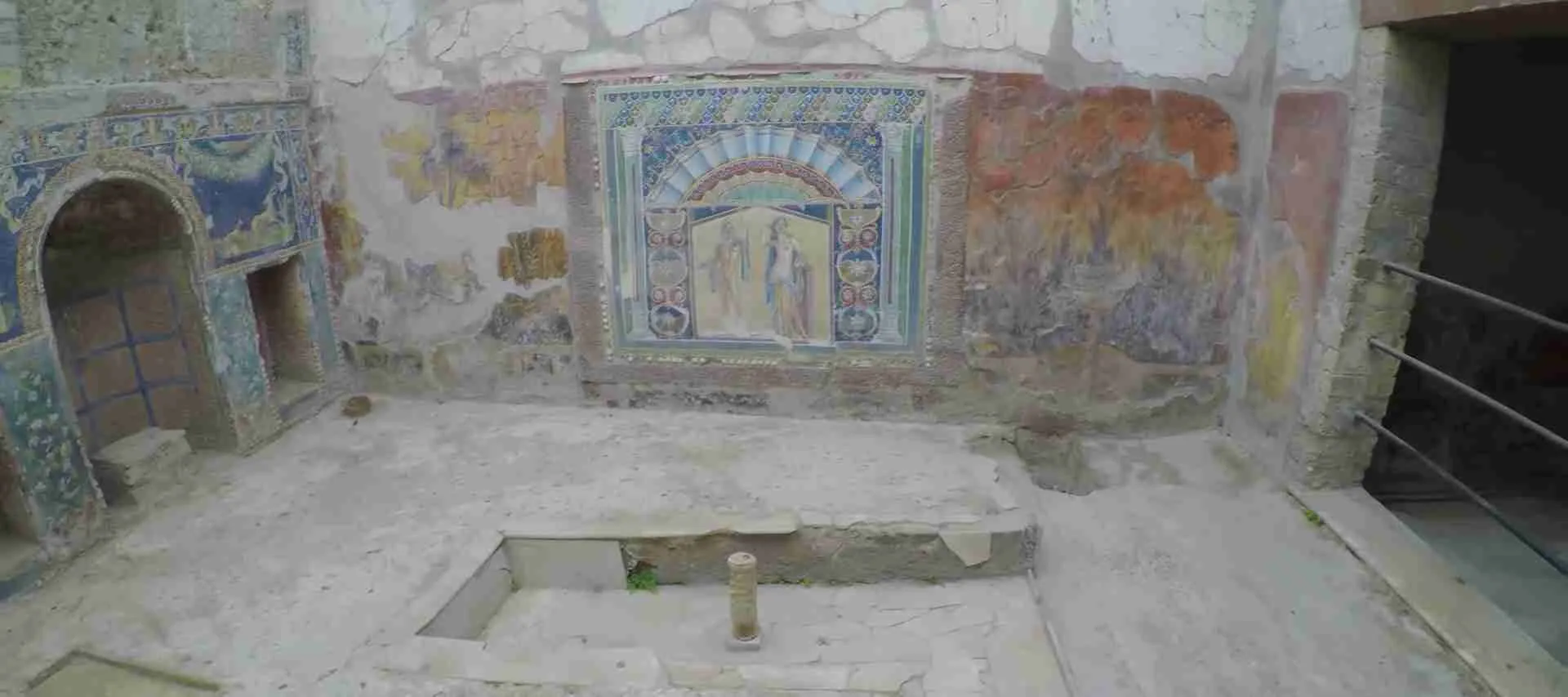
- Major highlights include the House of Neptune and Amphitrite with its brilliant blue glass mosaic, the Villa of the Papyri containing 1,800 ancient scrolls, and the boathouses where 300 victims sought refuge
- Herculaneum was wealthier than Pompeii, evident in the luxurious multi-story villas, sophisticated architectural details, and opulent decorative programs
People Also Ask About Visiting Herculaneum
How is Herculaneum different from Pompeii?
Herculaneum differs from Pompeii in size, preservation quality, and character. The site covers approximately 4 hectares compared to Pompeii’s 44 hectares, making it far more manageable for visitors. The pyroclastic flows that buried Herculaneum under 20 meters of material filled buildings from the ground up rather than crushing them, preserving upper floors, wooden beams, furniture, and organic materials that perished at Pompeii. Herculaneum was a wealthy seaside resort of 4,000-5,000 inhabitants, while Pompeii served as a commercial center of approximately 20,000 people. The exceptional preservation at Herculaneum includes intact multi-story buildings, complete wooden door frames, carbonized food, textiles, and even the hull of a boat. Visitors find Herculaneum more intimate and less overwhelming, with superior architectural preservation that reveals Roman domestic life in extraordinary detail.
What are the must-see highlights at Herculaneum?
The House of Neptune and Amphitrite ranks as the most photographed structure, featuring a stunning glass mosaic in brilliant blues depicting the sea god Neptune and his wife. The Villa of the Papyri housed an extensive library of 1,800 papyrus scrolls that modern scientists continue deciphering using advanced imaging techniques. The thermal baths showcase remarkably intact heated floors, marble basins, and sea creature mosaics. The boathouses along the ancient shoreline preserve the skeletal remains of 300 people who sought escape from the eruption, providing haunting evidence of the disaster’s human toll. The House of the Deer demonstrates the luxury of Herculaneum’s elite with panoramic coastal views and impressive sculpture collections. Carbonized wooden structures throughout the site, including a sliding door still mounted on its hinges, offer unique glimpses of Roman craftsmanship rarely preserved elsewhere.
Is Herculaneum worth visiting if I’ve already seen Pompeii?
Herculaneum absolutely merits a visit even after experiencing Pompeii, as the two sites complement rather than duplicate each other. Herculaneum’s superior preservation reveals architectural details impossible to see at Pompeii, including complete upper floors with balconies, intact wooden frameworks, and carbonized organic materials. The smaller scale creates a more intimate connection with individual households and their inhabitants. Where Pompeii impresses with vast urban planning and public buildings, Herculaneum excels in preserving the minutiae of domestic life: furniture still positioned in rooms, food carbonized inside ovens, wine racks in shops, and fabric fragments in closets. The contrast between the two sites enhances understanding of Roman society, as Pompeii represents commercial urban life while Herculaneum showcases elite leisure culture. Visitors consistently report that Herculaneum provides the more emotionally resonant experience despite its smaller footprint.
How much time should I spend at Herculaneum?
Visitors typically require 2-3 hours to explore Herculaneum thoroughly, though archaeology enthusiasts often spend 4 hours examining details. The compact site layout allows comprehensive coverage in this timeframe, unlike Pompeii where even a full day leaves major areas unexplored. A basic visit covering all major structures takes approximately 2 hours at a comfortable pace. Adding time for detailed mosaic observation, photography, and reading interpretive panels extends this to 3 hours. Guided tours typically run 2-2.5 hours, balancing comprehensive coverage with manageable pacing. Families with children can complete a highlights-focused visit in 90 minutes by concentrating on the most visually impressive structures. Early morning visits offer the best experience, with cooler temperatures, better lighting for photography, and fewer crowds sharing the narrow streets.
Extended multi-day tours – 5+ days
Featured Pompeii Multi-Day Tour Packages
3 days
Pompeii 3-Day Discovery Tour
- ✓ Comprehensive Pompeii experience
- ✓ Expert local guides included
- ✓ All accommodation included
- ✓ Transportation provided
5 days
Pompeii 5-Day Highlights Experience
- ✓ Comprehensive Pompeii experience
- ✓ Expert local guides included
- ✓ All accommodation included
- ✓ Transportation provided
7 days
Pompeii 7-Day Cultural Journey
- ✓ Comprehensive Pompeii experience
- ✓ Expert local guides included
- ✓ All accommodation included
- ✓ Transportation provided

10 days
Pompeii 10-Day Complete Adventure
- ✓ Comprehensive Pompeii experience
- ✓ Expert local guides included
- ✓ All accommodation included
- ✓ Transportation provided
Multi-day tour packages powered by TourRadar. Prices and availability subject to change.
Introduction
Herculaneum occupies a unique position in archaeological history as the first Vesuvian city discovered and the best-preserved Roman settlement in existence. When Mount Vesuvius erupted on August 24-25, 79 AD, this prosperous seaside resort of 4,000-5,000 inhabitants vanished beneath superheated pyroclastic flows traveling at 100 kilometers per hour and reaching temperatures of 500 degrees Celsius. The intense heat killed inhabitants instantly while paradoxically creating perfect preservation conditions that carbonized organic materials and sealed buildings intact.
The accidental rediscovery in 1709, when a farmer drilling a well struck marble remnants from the ancient theater, precipitated modern archaeology’s birth. Unlike Pompeii, which suffered centuries of looting after its rediscovery, Herculaneum remained protected under 15-20 meters of solidified volcanic material that deterred treasure hunters. Systematic excavations beginning in 1738 under the Bourbon monarchs and continuing through Amedeo Maiuri’s careful 20th-century work have revealed approximately one-quarter of the ancient city, with the modern town of Ercolano built atop the remainder.
The site achieved UNESCO World Heritage status in 1997 as part of the Archaeological Areas of Pompeii, Herculaneum and Torre Annunziata, recognized for providing “complete and living evidence of a society and everyday life at a precise moment in time with no parallel elsewhere in the world.” Where Pompeii offers grand-scale urban planning, Herculaneum delivers unmatched preservation of private life’s intimate details. Multi-story houses stand with upper floors intact, wooden furniture remains positioned in rooms, and carbonized food sits inside ovens as if awaiting diners who never returned.
The discovery of 300 skeletal remains in the boathouses during 1982 excavations revolutionized understanding of the eruption. Previously scholars believed most residents escaped, but these victims huddled along the shore awaiting rescue that never arrived. Their remains, along with preserved organic materials, provide scientists with unprecedented data about Roman diet, health, and social structure. The ongoing Herculaneum Conservation Project, a collaboration between Italian authorities and the Packard Humanities Institute since 2001, ensures this irreplaceable archaeological treasure receives proper preservation for future generations.
UNESCO World Heritage Significance
The UNESCO World Heritage Committee inscribed Herculaneum on the World Heritage List in 1997 under cultural criteria (iii), (iv), and (v), recognizing the site as part of the serial property “Archaeological Areas of Pompeii, Herculaneum and Torre Annunziata” with inscription number 829. The designation acknowledges these sites as representing “complete and living evidence of a society and everyday life at a precise moment in time and have no parallel elsewhere in the world.”
Herculaneum satisfies Criterion (iii) by bearing exceptional testimony to a disappeared civilization, preserving a Roman seaside resort community frozen at the instant of destruction. The pyroclastic flows created a time capsule unmatched in archaeological completeness. Criterion (iv) recognizes Herculaneum as an outstanding example of Roman urban planning and architecture, with multi-story residential buildings, public bath complexes, and commercial structures demonstrating advanced engineering and sophisticated design principles. The carbonization of wooden elements provides the only surviving examples of Roman structural timber, furniture, and fixtures from the 1st century AD.
The site fulfills Criterion (v) through its demonstration of human interaction with a volcanic landscape. The settlement pattern along the Bay of Naples slopes of Mount Vesuvius, combined with the eruption’s preservation effects, creates an irreplaceable record of human vulnerability to natural disasters and the paradoxical benefits catastrophes can provide to historical understanding. The designation covers not only Herculaneum itself but also the Villa of the Papyri, whose 1,800 carbonized scrolls represent the only surviving library from the Greco-Roman world.
The Outstanding Universal Value statement emphasizes that these archaeological areas provide vivid impressions of Roman society in the 1st century AD through their exceptional integrity and authenticity. The sites preserve not just monumental architecture but complete urban contexts including housing, commercial facilities, religious structures, entertainment venues, and infrastructure. The level of preservation allows scholars to reconstruct daily routines, social hierarchies, economic activities, and cultural practices with unprecedented accuracy. No other archaeological site worldwide offers comparable insight into Roman provincial life at a specific historical moment.
Historical Background: The Destruction and Rediscovery
Herculaneum’s origins trace to Greek colonization around the 6th century BC, though legend attributes the city’s foundation to the hero Hercules. The Oscans established the first settlement, later controlled successively by Etruscans, Greeks, Samnites, and finally Romans. Following the Social War of 91-88 BC, the city became a Roman municipium, granting citizenship rights to male inhabitants. By 79 AD, Herculaneum had evolved into a prosperous seaside resort attracting wealthy Romans who built luxurious villas along the coast.
The city’s population of 4,000-5,000 residents enjoyed a higher standard of living than Pompeii’s 20,000 inhabitants. Archaeological evidence reveals that Herculaneum functioned primarily as a leisure destination rather than a commercial center. The abundance of multi-story townhouses, sophisticated architectural details, extensive decorative programs, and lack of major industrial facilities all indicate an affluent residential community. Prominent residents included Marcus Nonius Balbus, a Roman senator and Governor of Crete who served as the city’s benefactor, and possibly Lucius Calpurnius Piso Caesoninus, Julius Caesar’s father-in-law, who owned the magnificent Villa of the Papyri.
On August 24, 79 AD, Mount Vesuvius began erupting around 1:00 PM, ejecting volcanic material thousands of meters into the atmosphere. Herculaneum, located just 7 kilometers from the volcano’s western base, initially escaped the ash fall that buried Pompeii. Many residents apparently believed themselves safe and remained in the city. Shortly after midnight on August 25, the eruption column collapsed, generating six successive pyroclastic surges. The first surge struck Herculaneum at approximately 100 kilometers per hour with temperatures reaching 500 degrees Celsius, killing all remaining inhabitants instantly through thermal shock.
Unlike Pompeii, buried under 3-4 meters of ash and pumice, Herculaneum vanished beneath pyroclastic flows that solidified into a rock-hard mass 15-20 meters deep. This volcanic material filled buildings from ground level upward, supporting walls and roofs as it encased them. The extreme heat and rapid burial created unique preservation conditions. Organic materials carbonized rather than decomposing, preserving wooden beams, furniture, doors, food, textiles, and papyrus. The solidified material deterred looting and protected the site for nearly 1,700 years until accidental rediscovery.
In 1709, a farmer named Ambrogio Nocerino struck marble while digging a well. Prince d’Elbeuf, an Austrian military commander, purchased the property and excavated tunnels radiating from the well shaft, discovering he had breached the ancient theater. The prince removed statues and architectural elements to decorate his villa, initiating the first organized looting. King Charles III of Naples commissioned formal excavations beginning in 1738 under military engineer Roque Joaquín de Alcubierre, though techniques remained treasure-hunting rather than scientific archaeology.
Karl Weber introduced more systematic methods in the mid-1750s, creating the first accurate plans and preserving contextual information. Excavations continued sporadically until 1765, then ceased until 1828. The modern phase began in 1927 under Amedeo Maiuri, who directed excavations until 1958 using careful stratigraphic methods. Maiuri’s work revealed the street grid, major public buildings, and numerous private houses. The discovery of 300 skeletons in the boathouses during 1982 excavations, directed by Sara Bisel, revolutionized understanding by proving many residents died attempting escape rather than fleeing successfully. Today approximately 25% of ancient Herculaneum has been excavated, with the remainder lying beneath the modern town of Ercolano.
Exceptional State of Preservation
Herculaneum’s preservation surpasses all other Roman sites due to the pyroclastic flows’ unique burial mechanism. The superheated volcanic material filled buildings methodically from ground level upward at speeds allowing it to support structures as it solidified, preventing the crushing collapse that damaged Pompeii’s upper stories. This process preserved multi-story buildings complete with upper floors, balconies, and roof structures that provide the only surviving examples of Roman multi-level residential architecture.
The extreme temperatures reaching 500 degrees Celsius combined with rapid oxygen deprivation created carbonization rather than combustion. Wooden elements transformed into carbon while retaining original shapes and details. This unprecedented preservation includes structural timbers, door frames mounted on working hinges, window shutters, furniture including beds and tables, wine racks with amphorae, food inside ovens and storage vessels, and wax tablets inscribed with legal documents. The House of the Wooden Partition preserves a sliding door mechanism still functional after two millennia.
Organic materials beyond wood also carbonized. Archaeologists have recovered textiles including clothing fragments and rope, leather goods, food items ranging from carbonized bread loaves to fish bones, and most remarkably, the 1,800 papyrus scrolls from the Villa of the Papyri representing the only surviving library from the ancient Greco-Roman world. Modern imaging techniques including X-ray computed tomography and infrared hyperspectral imaging allow scholars to read these fragile scrolls without physically unrolling them, revealing Greek philosophical texts and potentially Latin works.
The hardened volcanic material created a protective seal preventing looting, weathering, and structural degradation that affected Pompeii. When excavations began, buildings emerged from volcanic rock essentially as they existed in 79 AD. The preservation extends to decorative elements with exceptional completeness. Wall paintings retain vivid colors, mosaics display intricate details in glass paste and stone, marble floors show original patterns, and stucco reliefs preserve fine modeling. The thermal baths contain intact heating systems with visible hypocaust chambers, lead piping, and marble fixtures demonstrating Roman engineering sophistication.
Archaeological research benefits from preservation quality that allows reconstruction of daily activities with unprecedented precision. Cesspits preserved in drains yielded samples analyzing diet through identification of 110 food types including shellfish, fruits, vegetables, and meats. The 300 skeletons discovered in boathouses provide data on ancient health, nutrition, disease patterns, and population demographics. DNA analysis, bone isotope studies, and dental examinations reveal migration patterns, familial relationships, and socioeconomic status. No other Roman site offers comparable opportunities for multidisciplinary research combining archaeology, osteology, environmental science, and textual analysis.
Getting to Herculaneum from Naples and Beyond
Reaching Herculaneum from Naples requires taking the Circumvesuviana commuter train to Ercolano Scavi station, located 600-800 meters from the archaeological site entrance. The Circumvesuviana station operates on the lower level of Napoli Centrale (also called Napoli Garibaldi or Piazza Garibaldi), accessible by descending from the main railway station to underground platforms. Two Circumvesuviana lines serve Ercolano Scavi: the Naples-Sorrento line and the Naples-Poggiomarino line, with 2-4 departures per hour between approximately 5:40 AM and 11:00 PM.
Train tickets from Naples to Ercolano Scavi cost €2.60-2.70 per person one-way, purchased from ticket windows, vending machines, or newspaper stands inside the station, or using contactless payment cards at enabled turnstiles via the Tap&Go system. The journey takes 10-20 minutes depending on whether you board a direct service or a train making all intermediate stops. The Napoli-Poggiomarino line provides more frequent service to Ercolano Scavi throughout the day, while the faster Napoli-Sorrento line includes fewer trains stopping at this station.
Before boarding, verify on the platform display that your train stops at Ercolano Scavi, as some direct services skip intermediate stations. Trains typically depart from platform 3. The Circumvesuviana operates as a basic commuter service without reserved seating, air conditioning, or extensive luggage space. During peak tourist seasons and morning/evening commute hours, trains become crowded. Travelers with large bags should consider alternative times or services. The Campania Express offers a more comfortable option with guaranteed seating, air conditioning, and luggage storage, though tickets cost significantly more and departures are less frequent.
From Ercolano Scavi station, exit and follow brown directional signs reading “Scavi di Ercolano” downhill along Via IV Novembre for 7-10 minutes to reach the archaeological park entrance at Corso Resina 187. The walk descends through the modern town’s commercial district, passing restaurants and shops. Remember that the return journey climbs uphill to the station, requiring slightly more time and effort. No luggage storage exists at Ercolano Scavi station.
Visitors traveling from Sorrento take the Circumvesuviana Sorrento-Naples line, with the journey requiring approximately 40-50 minutes. From Pompeii, the route requires transferring at Torre Annunziata-Oplonti station, as not all Pompeii-Naples trains stop at Ercolano Scavi. The total journey from Pompeii takes 30-40 minutes including the transfer. The Pompeii Santuario station on the Naples-Poggiomarino line offers direct service to Ercolano Scavi without transfers.
Driving from Naples takes approximately 20 minutes via the A3 Autostrada, though parking near the archaeological site is limited and the area experiences heavy traffic. The site lacks dedicated parking, with the nearest facilities located along Via dei Papiri Ercolanesi requiring payment. Organized tours from Naples, Sorrento, and the Amalfi Coast provide hotel pickup, transportation, and guided visits, eliminating navigation concerns while offering expert interpretation. These tours typically combine Herculaneum with Mount Vesuvius or Pompeii for comprehensive day trips.
Visiting Information and Practical Details
Herculaneum opens daily from 8:30 AM year-round with seasonal closing times. During the summer period from March 16 through October 14, the site closes at 7:30 PM with last entry at 6:00 PM. Winter hours from October 15 through March 15 feature 5:00 PM closing with last entry at 3:30 PM. The archaeological park closes on three annual holidays: January 1, May 1, and December 25. Free admission is offered on the first Sunday of each month plus three additional national holidays: April 25, June 2, and November 4.
Standard adult admission costs €16. Reduced tickets at €2 are available to European Union citizens aged 18-25 upon presentation of valid identification proving age and citizenship. EU citizens under 18 receive free admission. Non-EU visitors under 18 generally receive free entry, while those aged 18-25 pay full price unless their country maintains reciprocal agreements with Italy. Current pricing and special exhibition fees should be verified on the official Parco Archeologico di Ercolano website, as rates occasionally change and special temporary exhibitions may incur additional charges.
Advanced ticket reservations are recommended during peak season (April-October) and on weekends year-round, though Herculaneum experiences significantly lower crowds than Pompeii. Tickets can be purchased online through the CoopCulture website (the official ticketing partner) or other authorized resellers offering skip-the-line access. Audio guides in multiple languages are available for rent at the entrance, providing detailed information about major structures and historical context. Guided tours led by licensed archaeologists and historians offer deeper interpretation and access to areas occasionally closed to independent visitors.
The Campania Artecard provides an economical option for visitors planning to see multiple archaeological sites and museums in the region. Several Artecard versions exist with varying benefits, generally offering free or discounted admission to Herculaneum, Pompeii, the Naples Archaeological Museum, Mount Vesuvius, and numerous other attractions plus public transportation coverage. The Artecard Lite 365 version provides exceptional value for multi-day regional exploration.
Visitors should arrive wearing comfortable walking shoes with good traction, as ancient Roman paving stones are uneven and can be slippery when wet. Much of the site lacks shade, necessitating sun protection including hats, sunscreen, and sunglasses during warmer months. Bringing refillable water bottles is advisable, as temperatures inside the excavated city can exceed ambient air temperature. A free cloakroom at the entrance provides storage for bags and items not needed during the visit, though bags with maximum dimensions of 35x30x15 cm may be carried inside.
Accessibility remains challenging due to the site’s ancient street grid, with uneven surfaces, steps, narrow passages, and lack of elevator facilities. Wheelchair users and visitors with limited mobility should inquire in advance about accessible routes and assistance. Strollers prove impractical on the ancient streets and should be left at the cloakroom. Photography is permitted throughout the site without flash, though commercial filming requires special authorization. Drones are strictly prohibited. Touching frescoes, mosaics, or structures is forbidden to prevent degradation.
The House of Neptune and Amphitrite
The House of Neptune and Amphitrite ranks among Herculaneum’s most celebrated residences, named for the stunning glass mosaic adorning its summer dining room. This relatively modest dwelling measuring approximately 200 square meters demonstrates how wealthy merchants transformed compact urban properties into elegant showpieces through sophisticated decoration. The house occupies a prime location on Insula V facing the entrance to the women’s section of the Suburban Baths along what was ancient Herculaneum’s busiest street.
The structure follows typical Roman domus layout with rooms arranged around a central atrium open to the sky. A bronze statue of Jupiter and bronze herm of Hercules originally stood in the atrium, establishing the owner’s cultural refinement and religious devotion. The ground floor contained living spaces while the second story provided additional rooms accessible via internal stairs. Attached to the residence, a wine and food shop opened directly onto the street, allowing the owner to profit from commercial activity while maintaining residential respectability.
The shop preserves extraordinary details of Roman retail operations. Original wooden wine racks and storage shelving remain in place after 2,000 years, complete with amphorae and storage vessels positioned as they were on the day of the eruption. The counter displays carbonized chickpeas and beans ready for sale. A charcoal stove sits prepared for lighting. Delivery lists and business records carbonized on wax tablets reveal the shop’s commercial reach, suggesting the owner shipped products to other cities via Herculaneum’s port facilities. The wooden grill protecting the shop front survives intact, demonstrating Roman carpentry techniques rarely preserved elsewhere.
The house’s defining feature occupies the open-air summer triclinium or dining room at the rear. The spectacular glass paste mosaic depicting Neptune and his wife Amphitrite covers the central wall in brilliant blues imported from Alexandria. Neptune poses with his trident while Amphitrite stands beside him holding a staff, her flowing multi-colored dress created from thousands of tiny glass pieces. A decorative frame of shells maintaining the oceanic theme surrounds the divine couple. This mosaic represents one of the finest examples of Roman glass paste work surviving from antiquity.
The triclinium’s remaining walls feature frescoes creating an illusionistic garden complete with plants, birds, and fountains, giving diners the impression of outdoor dining even in an enclosed space. The room’s centerpiece was a marble basin with a fountain fed from a water tank concealed by a decorated structure with three niches. The central niche housed a small statue while glass mosaic panels above depicted hunting scenes and garden motifs. Stone benches that accommodated reclining diners still line the triclinium perimeter.
The decoration program reveals the owner’s sophisticated artistic taste and substantial wealth. Commissioning glass paste mosaics using imported materials and employing skilled craftsmen to execute complex garden frescoes required significant financial investment. The triclinium transformed this modest-sized house into a venue for impressing guests and conducting business social functions. The combination of mythological imagery, luxurious materials, and illusionistic decoration created an elite environment comparable to much larger villas.
The Villa of the Papyri
The Villa of the Papyri represents the most extensive and luxurious seaside residence excavated at Herculaneum, spreading across four terraces descending toward the ancient shoreline. This magnificent complex served as a philosophical retreat and likely belonged to Lucius Calpurnius Piso Caesoninus, Julius Caesar’s father-in-law, Roman senator, and patron of Epicurean philosophy. The villa’s architecture, art collection, and library establish it as one of the most important archaeological discoveries for understanding elite Roman culture.
Excavations conducted through tunnel systems during the 18th century revealed the villa extended over 250 meters from the hillside to the sea, encompassing gardens, living quarters, reception halls, service areas, and extensive art galleries. The architectural plan follows Greek peristyle design principles with columned walkways surrounding internal gardens on multiple levels. The lower terraces featured long promenades over 100 meters in length offering panoramic views across the Bay of Naples. Water features including ornamental pools, fountains, and elaborate garden sculptures created a luxurious leisure environment.
The villa housed an unparalleled collection of Greek and Roman sculpture including over 80 bronze and marble pieces. Five larger-than-life bronze Danaïdes (mythical daughters condemned to carry water in the underworld) demonstrate Hellenistic sculptural mastery. Bronze portrait busts of Greek philosophers, statesmen, and poets lined the library and garden areas. The controversial sculpture of Pan copulating with a goat, along with hermae depicting poets and thinkers, reveal the owner’s appreciation for both classical learning and provocative art. Most of these treasures now reside in the Naples National Archaeological Museum, though their original positions within the villa have been documented.
The villa’s greatest significance lies in its library containing approximately 1,800 papyrus scrolls, the only surviving library from the Greco-Roman world. The collection primarily consists of Greek philosophical texts, particularly works by the Epicurean philosopher Philodemus of Gadara who may have resided at the villa as Piso’s intellectual companion. The scrolls carbonized during the eruption, transforming into fragile charcoal cylinders that challenged early excavators. Many were destroyed attempting to unroll them using primitive techniques.
Modern scientific methods have revolutionized papyrus research. X-ray computed tomography allows scholars to visualize text layers without physical manipulation. Infrared hyperspectral imaging distinguishes carbon ink from carbonized papyrus substrate, making previously illegible passages readable. These techniques have revealed works by Philodemus on rhetoric, music, poetry, and ethics, plus texts by other Greek philosophers. Scholars believe a second library containing Latin works may remain undiscovered in unexcavated villa sections, potentially including lost works of Roman literature.
Most of the Villa of the Papyri remains buried beneath modern Ercolano and volcanic material up to 25 meters deep. Recent excavations and ground-penetrating radar surveys suggest the villa extends much further than previously documented, possibly incorporating additional garden terraces, service buildings, and private quarters. The portions accessible to visitors include the entrance area, portions of the peristyle, and interpretive displays explaining the villa’s history. The Getty Villa in Malibu, California, was designed as an architectural recreation based on the Villa of the Papyri’s 18th-century excavation plans, offering visitors a sense of the original building’s scale and design.
The Thermal Baths
Herculaneum preserves two exceptionally complete bath complexes demonstrating Roman public bathing culture and engineering sophistication. The Suburban Baths and Central Baths showcase the social, hygienic, and recreational functions these facilities served in Roman daily life. The state of preservation allows detailed examination of heating systems, plumbing, decorative programs, and spatial organization rarely visible at other Roman sites.
The Suburban Baths occupy a prominent position along the ancient shoreline with direct sea access. This complex features separate sections for men and women, each containing a complete sequence of heated rooms. Bathers progressed through the apodyterium (changing room), frigidarium (cold bath), tepidarium (warm room), and caldarium (hot bath), with temperatures increasing through the sequence. The men’s section includes a large frigidarium with a vaulted ceiling and central pool. Mosaic floors depicting sea creatures including dolphins, octopi, and fish provide appropriate maritime decoration.
The caldarium or hot room preserves its original marble basin and elaborate fountain featuring a mosaic of Triton, the demigod son of Neptune and Amphitrite. The semicircular apse containing the hot bath demonstrates sophisticated architectural design with coffered ceiling decoration still visible. Wall niches provided spaces for storing bathing implements and clothing. The preservation quality allows visitors to understand the bathing experience’s physical and sensory aspects, from the steam-filled atmosphere to the progression through temperature zones.
Beneath the visible bathing rooms, the hypocaust heating system remains remarkably intact. This engineering innovation circulated hot air from furnaces through spaces under raised floors and inside wall cavities, creating even heat distribution without smoke or visible flames in bathing areas. Brick pillars support the suspended floor while allowing air circulation. Lead piping visible in walls supplied hot and cold water to various basins and pools. The furnace areas show where slaves maintained fires fueling the system, burning wood and charcoal to generate heat for water and air.
The Central Baths occupy a more prominent location in the city center and represent a later, more elaborate bathing establishment under construction when Vesuvius erupted. This complex includes a large palestra or exercise courtyard where bathers engaged in athletic activities before bathing. The bath sequence follows similar progression through temperature zones but on a grander scale with more elaborate decoration. The frigidarium contains an impressive cross-vaulted ceiling with stucco decoration creating geometric patterns.
The preservation of marble fixtures, floor heating systems, plumbing networks, and decorative programs allows detailed reconstruction of Roman bathing practices. The baths served as social centers where Romans spent hours daily bathing, exercising, socializing, and conducting business. Separate hours or sections accommodated women, though facilities were often smaller than men’s sections. The baths charged nominal entrance fees accessible to most citizens, functioning as democratic institutions where social classes mingled.
The thermal baths’ engineering demonstrates Roman mastery of concrete construction, hydraulic engineering, and architectural space design. The vaulted ceilings required sophisticated understanding of structural loads and compression forces. The heating systems balanced fuel efficiency with effective heat distribution. The water supply and drainage systems managed complex flows serving multiple rooms simultaneously. Modern visitors can observe these technical achievements alongside artistic elements including mosaics, frescoes, and sculptural decoration, understanding how Romans integrated beauty and utility in public architecture.
The Boathouses and Human Remains
The boathouses along Herculaneum’s ancient shoreline preserve the most poignant evidence of the eruption’s human tragedy. These vaulted chambers originally served as storage facilities for boats and fishing equipment, protecting vessels from weather and theft. During the catastrophic night of August 24-25, 79 AD, approximately 300 residents sought refuge in these waterfront structures, hoping to escape by sea or find protection from the volcanic disaster unfolding above them.
The 1982 discovery of skeletal remains in the boathouses revolutionized understanding of the eruption’s death toll and Herculaneum’s fate. Previously scholars believed most inhabitants had fled before the city’s destruction, as relatively few remains had been found within buildings. The concentration of skeletons in these chambers revealed that significant numbers remained in the city and died attempting evacuation. The victims included men, women, children, and elderly individuals representing all social classes, suggesting widespread panic and failed escape attempts.
The skeletal assemblage provides unprecedented scientific data about Roman population health, diet, and social structure. Physical anthropologist Sara Bisel led pioneering research examining bones, teeth, and tissue residues. Analysis revealed dietary patterns with significant fish and seafood consumption, evidence of lead exposure likely from water pipes and cooking vessels, and health conditions including arthritis, dental disease, and healed fractures. Some individuals displayed signs of wealth through superior nutrition and dental care, while others showed evidence of heavy manual labor and poorer health.
One particularly significant find includes the skeleton of a Roman soldier identified by his gladius sword, dagger, and military equipment. His presence among civilian refugees suggests military personnel either remained to assist evacuation or died attempting escape alongside citizens. The discovery challenges assumptions about military response to the disaster and indicates even trained, equipped individuals could not survive the eruption’s overwhelming force. The soldier’s superior physique and equipment contrast with elderly individuals and children found nearby, emphasizing the disaster’s indiscriminate nature.
The preservation conditions allow forensic reconstruction of the final moments. Victims huddled against boathouse walls seeking protection from the approaching pyroclastic surge. The extreme heat killed everyone instantly through thermal shock, with temperatures reaching 500 degrees Celsius. Death occurred so rapidly that bodies maintained their protective postures, with parents shielding children and individuals covering their faces. The pyroclastic material then buried and carbonized the remains, creating exceptional preservation that allows modern analysis.
Modern DNA studies of the skeletal population reveal family relationships, migration patterns, and population diversity. Some individuals originated from different Mediterranean regions, indicating Herculaneum’s cosmopolitan character. Family groups died together, including a cluster of seven individuals appearing to be related. Isotope analysis of bone and teeth chemistry indicates dietary variation and childhood origins, tracing migration and social mobility within Roman society.
The boathouses stand open today, allowing visitors to view the beach level where residents gathered in their final hours. Display cases present skeletal remains in situ, preserving original positions as discovered. Interpretive panels explain the scientific research and human stories revealed through archaeological analysis. The emotional impact of confronting these victims creates powerful connections across two millennia, transforming abstract historical events into immediate human tragedy. Many visitors report the boathouses as Herculaneum’s most affecting experience, bringing the eruption’s human cost into sharp focus.
Architectural Preservation and Wooden Structures
Herculaneum’s most distinctive preservation achievement lies in its wooden architectural elements, offering the only substantial collection of Roman structural timber, fixtures, and furnishings surviving from antiquity. The pyroclastic flows’ unique chemistry and extreme temperatures carbonized wood rather than incinerating it, transforming organic material into stable carbon while retaining original forms, grain patterns, and construction details. This unprecedented preservation allows detailed study of Roman carpentry techniques, building methods, and domestic furnishings impossible at sites where wood decomposed.
Multi-story buildings preserve complete wooden frameworks including beams, joists, rafters, and balcony supports demonstrating Roman structural engineering. The upper floors of houses along Cardo IV and Cardo V retain original timber framework, showing how Romans achieved three and even four-story heights using wood and brick construction. Balconies project over streets supported by wooden beams extending from interior structural systems. The carbonized wood reveals joinery techniques, timber species selection, and load distribution methods that influenced European architecture for centuries.
Door and window frames throughout the site preserve working mechanisms after two millennia. The House of the Wooden Partition contains the most famous example: a sliding accordion-style partition door still mounted on its original bronze hinges and track system. The door’s panels fold together allowing the room to be opened or closed, demonstrating sophisticated Roman joinery and hardware design. Window shutters, both solid panels and slatted designs allowing light and air circulation, survive in multiple buildings showing variety in Roman carpentry solutions.
Furniture preservation offers unprecedented insights into Roman domestic life. Carbonized beds complete with wooden frames and supports occupy bedrooms as positioned when the eruption struck. Tables, chairs, and storage chests demonstrate furniture design and construction techniques. The wine shop in the House of Neptune and Amphitrite preserves elaborate wooden storage racks and shelving systems with amphorae still positioned as displayed for customers. Loom components, work benches, and tool racks document craft production within domestic settings.
Architectural decoration in wood supplements the more commonly preserved stone and stucco elements. Decorative moldings, ceiling coffers, and wall paneling carbonized in place show how Romans integrated wooden elements into elaborate interior design schemes. Some buildings preserve sections of wooden stairs with treads, risers, and handrails intact, revealing construction methods for vertical circulation in multi-story structures. Upper floor rooms retain wood plank flooring showing installation patterns and board dimensions.
The preservation extends to organic building materials beyond structural elements. Rope and cordage used for various construction and domestic purposes carbonized along with wooden structures. Woven basket fragments and matting demonstrate Roman textile techniques applied to utilitarian objects. Seeds, plant materials, and food residues embedded in floors, storage areas, and refuse contexts provide botanical evidence for Roman diet, agriculture, and trade networks.
Scientific analysis of carbonized wood reveals details about Roman forestry and timber trade. Species identification shows Romans selected specific woods for particular applications: oak for structural beams requiring strength, pine for common carpentry, and exotic woods for decorative elements. Growth ring analysis indicates timber sources and harvesting ages. Some beams show evidence of reuse from earlier structures, documenting building renovation practices.
Conservation challenges for carbonized wood differ from standard archaeological preservation. The material remains stable when protected from moisture and temperature fluctuations but deteriorates rapidly if exposed to humidity or mechanical stress. Modern conservation efforts employ environmental controls, protective coatings, and structural supports to prevent degradation. Some wooden elements have been removed for laboratory study and display in controlled museum environments, while others remain in situ under protective coverings designed to allow visitor viewing while preventing environmental damage.
Art and Decoration: Frescoes and Mosaics
Herculaneum preserves one of the finest collections of Roman wall paintings and floor mosaics surviving from the 1st century AD, demonstrating the sophistication of Roman decorative arts and the wealth of the city’s inhabitants. The pyroclastic flows that destroyed the city paradoxically protected delicate painted surfaces and intricate mosaic work from weathering, looting, and gradual deterioration, resulting in exceptional preservation of colors, details, and artistic techniques.
Wall paintings at Herculaneum demonstrate all four Pompeian styles of Roman fresco technique, though Fourth Style examples predominate as this represented the fashionable approach in 79 AD. The Fourth Style combines architectural illusion, mythological panels, decorative borders, and fantastical elements into complex compositions covering entire room surfaces. The House of the Deer features spectacular Fourth Style frescoes with architectural perspectives creating illusions of columned pavilions opening onto imaginary vistas. Mythological panels depicting scenes from Greek legends occupy central positions, surrounded by ornamental borders and fantastical architectural elements.
Color preservation in Herculaneum frescoes surpasses most other Roman sites. The volcanic burial protected pigments from sunlight exposure and moisture penetration that fade and damage exposed paintings. Brilliant reds created from cinnabar (mercury sulfide), deep blues from Egyptian blue (calcium copper silicate), vibrant yellows from ochre, and luminous whites from lime maintain intensity approaching original appearance. Some frescoes preserve subtle shading, delicate brushwork, and fine details invisible in weathered examples from other sites.
The House of the Stags contains exceptional examples of still-life painting, a genre Romans called xenia after the Greek tradition of hospitality gifts. These panels depict fruits, game birds, fish, and other foods with remarkable naturalism, using light and shadow to create three-dimensional effects. The paintings advertised household wealth and hospitality while demonstrating artists’ technical mastery. Similar still-life compositions appear in dining rooms throughout the site, reinforcing connections between decorative art and social display.
Floor mosaics demonstrate the full range of Roman mosaic techniques from simple geometric patterns in opus tessellatum (regular tesserae in standard patterns) to complex figural scenes in opus vermiculatum (tiny tesserae following curved contours). The thermal baths contain extensive mosaic programs featuring marine themes appropriate to bathing contexts. Dolphins, octopi, fish, and sea monsters populate floor and wall surfaces. The Triton mosaic in the Suburban Baths demonstrates sophisticated figure modeling using tesserae as small as 2-3 millimeters to create smooth contours and subtle color gradations.
The House of Neptune and Amphitrite showcases the highest achievement in Roman mosaic art through its glass paste wall mosaics. Unlike standard stone tesserae, these mosaics employ colored glass pieces creating brilliant blues, greens, and reds impossible with natural stone. The Neptune and Amphitrite mosaic uses Egyptian blue glass imported from Alexandria, a luxury material requiring specialized procurement and skilled craftsmen. The surrounding shell frames and garden hunting scenes demonstrate how Romans integrated different mosaic techniques and materials into unified decorative programs.
Black and white geometric mosaics appear in utilitarian spaces and less wealthy households, creating elegant effects through pattern alone without expensive colored materials. The atrium of the Samnite House contains a fine example of geometric mosaic using only white and black tesserae arranged in complex patterns creating optical effects and spatial dynamics. These simpler mosaics demonstrate that even modest households invested in permanent floor decoration as a mark of respectability and cultural refinement.
Stucco decoration supplements painted and mosaic programs throughout Herculaneum. The vaulted ceilings in bath complexes preserve elaborate stucco work creating geometric patterns, floral motifs, and figurative reliefs. The technique involves applying wet plaster and modeling it into three-dimensional decoration while still plastic, then painting the dried surface. Some examples combine stucco relief with painted details creating integrated decorative schemes.
The preservation allows detailed study of ancient painting and mosaic techniques. Tool marks in wet plaster reveal how painters transferred designs from preliminary sketches. Layer analysis shows Romans applied multiple plaster coats creating smooth surfaces for painting. Pigment studies identify mineral and organic colorants and binding media. Mosaic studies document tesserae production, adhesive composition, and setting patterns demonstrating workshop practices and individual craftsmen’s techniques.
Daily Life and Social Structure
Herculaneum’s exceptional preservation illuminates Roman daily life with unmatched detail, revealing social hierarchies, domestic routines, commercial activities, and leisure practices frozen at the moment of the eruption. The combination of architecture, artifacts, organic remains, and human skeletal evidence allows reconstruction of a complete Roman community’s activities, relationships, and challenges.
Housing patterns reflect distinct social stratification. Wealthy elite families occupied multi-story townhouses and seaside villas featuring sophisticated architecture, elaborate decoration, and specialized room functions. The House of the Stags and House of the Telephus Relief exemplify elite residences with extensive peristyle gardens, multiple dining rooms for different seasons and purposes, and private bath suites. These properties often integrated commercial spaces like shops or workshops managed by enslaved workers or freedmen tenants, generating rental income while maintaining the owner’s residential privacy.
Middle-class households occupied smaller but well-appointed properties demonstrating financial success and cultural aspirations. The House of Neptune and Amphitrite illustrates this tier: a modest-sized residence elevated through sophisticated decoration and integration of a profitable wine shop. These middling properties adapted urban space efficiently, using vertical construction to create adequate living areas on small footprints, and investing in quality decoration signaling cultural sophistication and social ambition.
Poorer residents lived in multi-family housing including upper-story apartments and simple single-room dwellings. Some buildings contained shops on ground floors with workshops or living quarters above accessed by external stairs. The preservation of these humbler structures alongside elite residences provides rare evidence for the full social spectrum within a single Roman community. Archaeological analysis of different property types reveals variation in construction quality, decoration expense, and access to amenities like private water supply and sanitation.
Commercial activity permeated residential areas with shops, workshops, taverns, and bakeries integrated into neighborhood fabric. The wine shop attached to the House of Neptune and Amphitrite preserves complete business fixtures including storage facilities, display counters, and sales records. Bakeries contain intact ovens with carbonized bread loaves and millstones for grinding grain. Thermopolia (food shops) preserve marble counters with embedded terracotta vessels for keeping food warm, demonstrating Romans’ eating-out culture. These commercial spaces reveal economic activities, trade networks, and consumer practices sustaining urban life.
Evidence of craft production appears in workshops containing tools, raw materials, and finished products. Textile production equipment including loom weights and spindle whorls documents domestic cloth manufacture. Metalworking shops contain tools and scrap metal. Evidence for garum (fermented fish sauce) production suggests small-scale food processing. The integration of production, commerce, and residence in mixed-use properties demonstrates Roman economic organization and the household economy’s central role.
Food evidence from carbonized remains, storage vessels, and skeletal analysis reveals diet patterns varying by wealth and access. Elite households consumed diverse diets including seafood, meat, exotic fruits, and imported delicacies. Skeletal analysis shows superior nutrition among wealthy individuals through bone density and dental health. More modest households relied heavily on grain products, legumes, and locally available foods. The preservation of carbonized chickpeas, lentils, bread, fish bones, and fruit seeds allows identification of specific foodstuffs and meal preparation methods.
Sanitation infrastructure demonstrates Roman public health sophistication. Underground sewer systems connected to most buildings, carrying waste to the sea. Individual properties contained latrines with stone or wooden seats positioned over drainage channels. Some elite houses featured private bath suites with heated rooms and plumbing systems. The preservation of cesspit contents allowed analysis of 110 food types consumed by ancient residents, revealing diet composition with unprecedented precision.
Water supply systems included lead piping connecting properties to public aqueduct feeds, private cisterns collecting rainwater, and wells accessing groundwater. The distribution of water access reflects social hierarchies, with elite properties enjoying reliable piped supply while more modest households relied on public fountains or purchased water from carriers. Lead pipe inscriptions identify property owners and water rights, documenting bureaucratic systems regulating resource distribution.
Social activities centered on the thermal baths functioning as community centers for hygiene, exercise, socializing, and business networking. The bath complexes’ preservation shows separate facilities for men and women, changing rooms, exercise areas, and progressively heated bathing rooms. The democratic character of Roman bathing culture brought together different social classes in shared public spaces, though subtle distinctions in access times, services, and facilities maintained social boundaries.
Herculaneum Conservation and Modern Challenges
The Herculaneum Conservation Project represents one of archaeology’s most significant preservation initiatives, addressing deterioration threats to this irreplaceable site while advancing conservation science and public education. Launched in 2001 through partnership between Italian authorities and the Packard Humanities Institute, the project transformed Herculaneum’s prospects through sustained funding, expert technical support, and comprehensive long-term planning previously absent from the site’s management.
Herculaneum faces unique conservation challenges stemming from its burial environment and excavation history. The modern town of Ercolano built atop the ancient city creates structural instability through building loads, utility infrastructure, and groundwater disruption. Water infiltration from above represents the primary threat, as moisture penetrates ancient structures through modern drainage, broken utilities, and altered groundwater flows. Water damage undermines foundations, erodes mortar, promotes biological growth, and causes decorative elements including frescoes and mosaics to detach from wall and floor substrates.
Earlier excavation practices exacerbated preservation problems through inadequate structural support and environmental protection. When excavators removed volcanic fill from ancient buildings, they created exposure to weather without implementing proper drainage, roofing, or climate control. Some 18th and 19th-century interventions including crude repairs, inappropriate materials, and destructive exploration techniques damaged original fabric. The 1980s and 1990s saw declining maintenance budgets and increasing deterioration, with several building collapses and wholesale destruction of decorative elements.
The Conservation Project implemented systematic condition assessment documenting deterioration throughout the site. Teams recorded structural stability, water damage, biological growth, material degradation, and decoration condition for every excavated building. This baseline data enabled prioritization of interventions and ongoing monitoring of treatment effectiveness. Regular inspections track changes over time, identifying emerging problems before they cause irreversible damage.
Conservation treatments address both immediate crises and long-term stability. Structural stabilization includes foundation strengthening, wall consolidation, and installation of support systems preventing collapse. Roofing protection shields fragile structures from rain while allowing air circulation and visitor access. These protective systems use modern materials like steel, glass, and polycarbonate designed to be visually unobtrusive while providing effective environmental control. Drainage improvements channel water away from ancient structures, preventing infiltration and erosion.
Fresco and mosaic conservation requires delicate intervention preserving original materials while ensuring long-term stability. The project pioneered techniques for reattaching painted plaster separating from walls, a widespread problem caused by water infiltration dissolving adhesive mortar. Conservators inject lime-based grouts filling voids behind decorative surfaces, then apply gentle pressure reattaching loose sections. The House of the Beautiful Courtyard’s tablinum, conserved in 1938, required re-treatment when water infiltration caused 1930s interventions to fail, demonstrating conservation’s ongoing nature.
The project emphasizes training and capacity building, ensuring sustainable conservation beyond external project funding. Partnerships with universities and professional organizations provide training programs for Italian conservators, archaeologists, and site managers. The British School at Rome collaborates on student field schools offering hands-on conservation experience. These educational initiatives create skilled professionals equipped to maintain Herculaneum and other Italian archaeological sites.
Public engagement forms a central project component, recognizing that conservation succeeds only with community support and understanding. Educational programs for schools bring students to the site for guided tours and workshops explaining archaeology and conservation. Public lectures and exhibitions communicate research findings and conservation progress to broader audiences. The project website and publications disseminate information internationally, building global appreciation for Herculaneum’s significance and conservation needs.
Research initiatives advance understanding of the site’s history, destruction, and preservation potential. Archaeological excavations target specific research questions rather than expanding the exposed area, as leaving structures buried often provides better long-term preservation than exposure. Scientific studies investigate ancient technologies, construction techniques, and materials using modern analytical methods. The Villa of the Papyri papyrus scrolls benefit from advanced imaging allowing text reading without physical handling, potentially revealing lost classical literature.
Despite significant progress, Herculaneum faces ongoing challenges requiring sustained commitment and resources. Climate change brings increased rainfall intensity and frequency, exacerbating water infiltration problems. Tourist pressure, though far less than Pompeii, still creates wear on ancient surfaces and logistical challenges for site management. The unexcavated portions beneath Ercolano remain vulnerable to development pressure, urbanization impacts, and unauthorized interventions. Maintaining adequate funding, technical expertise, and political support requires continuous advocacy and demonstration of conservation’s value.
Comparing Herculaneum to Pompeii
Herculaneum and Pompeii together provide comprehensive understanding of Roman life in 79 AD, but the sites differ fundamentally in scale, character, preservation quality, and visitor experience. Understanding these differences helps visitors decide whether to see one or both sites and how to allocate limited time for each location.
Scale represents the most obvious distinction. Pompeii covers approximately 44 hectares with extensive excavations revealing a complete Roman city including forum, temples, theaters, amphitheater, commercial districts, and residential neighborhoods. Visitors require 4-6 hours minimum to see major areas, with full exploration taking multiple days. Herculaneum occupies just 4 hectares representing one-quarter of the ancient town. Visitors can thoroughly explore Herculaneum in 2-3 hours, seeing essentially all accessible structures and decorative elements.
Preservation quality favors Herculaneum decisively. The pyroclastic flows that buried Herculaneum filled buildings systematically from ground level, supporting walls and roofs as material solidified. This created preservation of complete multi-story structures, wooden architectural elements, furniture, organic materials, and decorative details impossible at Pompeii. Pompeii suffered burial under falling pumice and ash that crushed upper floors and incinerated organic materials. Herculaneum preserves wooden beams, door frames, furniture, and even foodstuffs, while Pompeii offers primarily stone and masonry remains.
The cities’ different characters reflect their economic and social functions. Pompeii served as a commercial center and port city with diverse population including merchants, craftsmen, enslaved workers, and elite landowners. The city layout includes large public buildings, extensive commercial districts, workshops, and housing ranging from luxury villas to modest dwellings. Herculaneum functioned primarily as a wealthy resort town attracting Roman elite building luxurious seaside villas. The smaller population enjoyed higher average wealth, evident in sophisticated architecture and lavish decoration even in relatively modest properties.
Tourist experience differs dramatically between sites. Pompeii receives approximately 2.5 million visitors annually, creating significant crowding especially in peak season. Popular areas like the Forum, Lupanar (brothel), and House of the Faun experience congestion diminishing visitor experience. Herculaneum attracts far fewer visitors, offering quieter, more contemplative experience. The compact layout prevents feeling lost or overwhelmed. The superior preservation creates more immediate connection with ancient residents, as viewing intact rooms with furniture and decoration generates visceral understanding of Roman domestic life.
Architectural highlights favor different aspects of Roman urbanism. Pompeii excels in demonstrating city planning, public architecture, commercial organization, and social infrastructure. The Forum complex, basilica, temples, theaters, and amphitheater show how Romans organized civic and religious life. Extensive commercial areas including bakeries, fulleries, taverns, and workshops reveal economic activities. Herculaneum surpasses Pompeii in domestic architecture detail, decorative arts quality, and preservation of daily life minutiae. The multi-story houses, elaborate frescoes, sophisticated mosaics, and preserved furnishings create intimate portraits of individual households.
Visitor facilities and accessibility differ between sites. Pompeii offers multiple entrances, extensive signage, numerous refreshment facilities, and various tour options including audio guides and organized groups. The large area includes shaded rest areas and modern restroom facilities. Herculaneum has simpler infrastructure with a single entrance, more modest facilities, but generally easier navigation due to smaller scale. The compact layout means visitors never venture far from the entrance, while Pompeii’s extent requires planning to avoid exhaustion and ensure seeing desired areas.
For visitors with limited time choosing between sites, Herculaneum offers superior quality if interested in seeing well-preserved architecture and decoration in intimate detail. The smaller scale and exceptional preservation create memorable experience without physical exhaustion. Pompeii suits visitors wanting comprehensive understanding of Roman urbanism, public architecture, and city organization. The site’s scale and variety offer something for every interest but require stamina and time commitment. Ideally, visiting both sites provides complete perspective, with Pompeii establishing broad context and Herculaneum revealing domestic details.
Many visitors find Herculaneum the more emotionally affecting experience despite Pompeii’s fame. The superior preservation and human-scale architecture create powerful connections across time. The boathouses containing skeletal remains of victims provide confronting reminders of disaster’s human cost. The carbonized furniture, food, and personal items make ancient Romans feel like real people with lives, hopes, and fears suddenly terminated. Pompeii’s grander scale can feel impersonal by comparison, though the plaster casts of victims and extensive graffiti create their own connections.
Mount Vesuvius and Regional Context
Mount Vesuvius dominates Herculaneum’s landscape and history, standing just 7 kilometers east of the ancient city. The volcano’s presence shaped settlement patterns, agricultural prosperity, and ultimately catastrophic destruction. Understanding Vesuvius within its regional context enhances appreciation for Herculaneum’s significance and the forces that both sustained and destroyed this Roman community.
Vesuvius rises 1,281 meters above sea level, consisting of a younger cone inside the older Monte Somma caldera created by earlier eruptions. The fertile volcanic soils covering the lower slopes supported vineyards, olive groves, and agriculture that made the region economically prosperous. The volcanic crater provided sulfur mining and other mineral resources. Romans recognized volcanic activity evident in hot springs, fumaroles, and occasional earth tremors but did not understand eruption risks, having no historical memory of major explosive activity.
The 79 AD eruption began around 1:00 PM on August 24 when the magma chamber’s pressure overcame the volcanic plug sealing the vent. The initial Plinian phase ejected volcanic material 33 kilometers into the atmosphere, creating the umbrella pine-shaped eruption column famously described by Pliny the Younger. Prevailing winds carried pumice and ash southeast, burying Pompeii under 3-4 meters of material over 18 hours. Herculaneum initially escaped this ash fall, leading many residents to believe they had avoided danger.
After midnight on August 25, the eruption column collapsed, generating six successive pyroclastic surges. These superheated flows of gas, ash, and debris traveled at speeds exceeding 100 kilometers per hour with temperatures reaching 500 degrees Celsius. The first surge struck Herculaneum around 1:00 AM, killing all remaining inhabitants instantly through thermal shock. Five additional surges completely buried the city under 15-20 meters of volcanic material that solidified into rock-hard mass. The eruption finally ceased the following day, having destroyed Pompeii, Herculaneum, Stabiae, and Torre Annunziata along with numerous farms and villas.
Vesuvius remained intermittently active after 79 AD, with major eruptions recorded in 203, 472, 512, 685, 787, 968, 991, and multiple later events. The 1631 eruption killed approximately 3,000 people and destroyed several towns, generating renewed awareness of volcanic hazards. The most recent eruption occurred in 1944 during World War II, destroying the villages of San Sebastiano and Massa and creating the current crater morphology. Since 1944, Vesuvius has remained quiet though continuous monitoring detects ongoing magmatic activity.
Modern scientific understanding classifies Vesuvius among the world’s most dangerous volcanoes due to its explosive eruption potential and surrounding population density. Approximately 3 million people live within the designated red zone facing highest eruption risk. Italian authorities maintain elaborate evacuation plans and continuous monitoring through the Osservatorio Vesuviano, tracking seismic activity, ground deformation, gas emissions, and other precursor signals. The observatory represents one of the world’s oldest and most sophisticated volcano monitoring systems.
Visitors can ascend Vesuvius from Ercolano via bus services departing near the train station. The Vesuvio Express shuttle operates regular departures transporting visitors to a parking area at approximately 1,000 meters elevation. From there, a 30-minute hike along maintained trails reaches the crater rim at 1,281 meters, offering panoramic views across the Bay of Naples and into the active crater. The round-trip bus ticket costs €12, while crater access requires separate national park entrance fee. The combination of Herculaneum and Vesuvius creates powerful understanding of the forces that preserved and destroyed this ancient city.
The broader Campania region contains multiple volcanic systems beyond Vesuvius. The Campi Flegrei (Phlegraean Fields) caldera west of Naples produced the enormous Campanian Ignimbrite eruption 40,000 years ago and remains seismically active with ongoing ground deformation. The island of Ischia experienced its last eruption in 1302. This volcanic landscape provided Romans with mineral resources, geothermal energy, fertile agricultural land, and therapeutic hot springs while exposing them to catastrophic hazards they incompletely understood.
Regional context explains Herculaneum’s prosperity and character as part of the Vesuvian coastal zone attracting Roman elite. The combination of dramatic landscape, mild climate, productive agriculture, fishing resources, and proximity to Naples created ideal conditions for luxury retreats. Multiple wealthy villas lined the coast from Herculaneum to Stabiae, forming a continuous zone of elite leisure residences. The same volcanic forces that created this prosperity ultimately destroyed it, preserving for posterity the achievements and lifestyles of this unique Roman community.
Planning Your Visit: Practical Tips
Successful Herculaneum visits require thoughtful planning regarding timing, preparation, and realistic expectations. These practical considerations ensure comfortable, rewarding experience while maximizing the site’s extraordinary qualities.
Optimal visiting times vary by season and crowd preferences. Early morning arrivals immediately after opening at 8:30 AM offer coolest temperatures, best natural lighting for photography, and smallest crowds. Morning hours between 8:30-11:00 AM provide ideal conditions before midday heat and tour group arrivals. Late afternoon visits from 4:00-6:00 PM in summer or 2:00-3:30 PM in winter capture golden light excellent for photography while avoiding peak visitor numbers. Weekday visits experience lighter crowds than weekends year-round.
Seasonal considerations affect comfort and experience quality. Spring (April-May) and fall (September-October) offer moderate temperatures, manageable crowds, and pleasant weather for outdoor exploration. Summer (June-August) brings intense heat, strong sun, and peak tourist season creating the least comfortable conditions despite extended opening hours. Winter (November-March) features cool temperatures, occasional rain, reduced crowds, and shorter visiting hours but excellent conditions for those unbothered by cooler weather. The free admission first Sunday monthly attracts significant crowds worth avoiding if possible.
Essential items for any visit include comfortable walking shoes with good traction for navigating uneven ancient paving stones, sun protection including hat and sunscreen during warmer months, refillable water bottle as onsite facilities are limited, and camera or smartphone for photography as the site permits non-commercial photography without flash. Bags larger than 35x30x15 cm must be left in the free cloakroom at the entrance. Bringing snacks proves useful as no food facilities exist inside the site and nearby Ercolano offers limited quality dining options.
Guided tours versus independent exploration presents trade-offs worth considering. Licensed guides provide historical context, architectural interpretation, and access to details easily missed independently. Tours typically last 2-2.5 hours covering major structures with expert commentary. Audio guides available for rent at entrance offer flexible self-paced touring with detailed information at numerous waypoints. Independent exploration allows unlimited time focusing on personal interests but risks missing significant details without interpretive assistance. Combining audio guide with advance research often provides optimal balance.
Combining Herculaneum with other area attractions creates comprehensive regional experience. Mount Vesuvius lies 30 minutes away by bus from Ercolano station, allowing morning Herculaneum visit followed by afternoon crater hike, or vice versa. Pompeii sits 25 minutes away by Circumvesuviana train, though visiting both excavations in one day creates exhausting experience not recommended. The Naples Archaeological Museum houses artifacts from Herculaneum including Villa of the Papyri sculptures, offering essential context for site interpretation. The combination of museum, Herculaneum, and Vesuvius across 2-3 days provides thorough understanding of the 79 AD eruption and its consequences.
Visitor limitations require awareness for realistic planning. Much of ancient Herculaneum remains unexcavated beneath modern Ercolano, limiting the accessible area to approximately one-quarter of the original city. Some structures within the excavated area close periodically for conservation, restoration, or research, creating variable access to specific buildings. The Villa of the Papyri remains largely inaccessible with limited public areas open, as most of the structure lies beneath volcanic material and modern construction. Weather conditions affect experience significantly, with rain making ancient surfaces slippery and extreme heat creating uncomfortable conditions in shadeless areas.
Accessibility challenges require consideration for visitors with mobility limitations. The ancient street grid features uneven paving, steps, narrow passages, and lack of elevator access between different site levels. Wheelchair users face significant obstacles navigating the terrain, though some areas remain accessible with assistance. Strollers prove impractical and should be left at the cloakroom. Visitors should contact the site in advance regarding accessibility needs and available accommodations. The compact size makes Herculaneum somewhat more manageable than Pompeii for mobility-limited visitors, as shorter distances reduce physical demands.
Photography opportunities throughout Herculaneum reward patience and planning. The House of Neptune and Amphitrite’s blue mosaic photographs beautifully in natural light, though interior darkness may require longer exposures or higher ISO settings. The thermal baths’ architectural details and mosaics benefit from morning or afternoon light angles. The boathouses create dramatic compositions emphasizing human-scale tragedy. Upper-story views looking down streets or across the site provide context and scale. Respectful photography of skeletal remains is permitted but should be approached thoughtfully given the subject’s sensitivity.
Beyond Herculaneum: Regional Archaeological Sites
The Vesuvian archaeological complex extends beyond Herculaneum and Pompeii to include several lesser-known sites offering unique perspectives on Roman life before the 79 AD eruption. These locations complement major sites through specialized focus on particular aspects of Roman culture, architecture, or social organization. Visitors with archaeological interest and adequate time benefit significantly from exploring this broader regional context.
The Villa of Oplontis at Torre Annunziata represents the prototype of Roman suburban luxury villas, possibly owned by Poppaea Sabina, Emperor Nero’s second wife. This enormous complex demonstrates the grandest domestic architecture built by Roman elite, featuring elaborate frescoes, extensive gardens with peristyles, private bath suites, and sophisticated water management systems. The preservation quality rivals Herculaneum with intact Second Style wall paintings among the finest surviving from antiquity. The site receives far fewer visitors than Pompeii or Herculaneum despite exceptional architectural and artistic significance. A second structure at Oplontis, the Villa of Lucius Crassus Tertius, functioned as an agricultural estate producing wine and oil, revealing Roman agricultural business organization.
Stabiae on the hills south of Pompeii preserves multiple luxury villas including Villa San Marco and Villa Arianna, both featuring extraordinary frescoes, mosaics, and architectural sophistication. These properties occupied premium hilltop locations offering panoramic Bay of Naples views, positioning them at the apex of Roman elite residential preferences. The villas demonstrate Late Republican and Early Imperial architectural evolution with complex spatial organization, extensive decorative programs, and integration of landscape elements. Stabiae remains relatively undeveloped for tourism, creating quiet, contemplative visiting experience despite remarkable artistic and architectural quality.
Boscoreale lies in agricultural territory north of Pompeii preserving rural villas demonstrating Roman agricultural operations. The Villa Regina represents a working farm with wine production facilities including grape-crushing areas, fermentation rooms, and storage facilities. The attached residential quarters show how landowners combined agricultural profit with comfortable living conditions. The Antiquarium museum displays agricultural implements, amphorae, and artifacts explaining Roman farming techniques and rural economy. This agricultural perspective complements the urban focus of Pompeii and the elite leisure character of Herculaneum and coastal villas.
The Archaeological Museum in Naples houses the world’s finest collection of Roman artifacts from Vesuvian sites, making it essential for comprehensive understanding. The museum displays the Villa of the Papyri sculpture collection including the famous Pan and Goat, Five Danaïdes, and Portrait Busts of Greek Philosophers. Extensive fresco collections demonstrate all Pompeian wall painting styles. The Secret Cabinet contains erotic art revealing Roman sexual culture. Mosaics, silver treasures, gladiatorial equipment, and countless daily life artifacts create complete picture of Roman material culture. Visiting the museum before or after site visits contextualizes field observations and explains artifact relationships.
The Herculaneum Excavations Office operates the Antiquarium displaying artifacts found during excavations including carbonized wooden objects, everyday household items, and organic materials demonstrating preservation quality. Though smaller than the Naples museum, this facility provides immediate context specific to Herculaneum’s character and discoveries. The display cases include examples of carbonized food, wooden furniture fragments, textile remnants, and papyrus materials illustrating the site’s unique preservation.
Paestum, located approximately 90 kilometers south of Naples, preserves a Greek colonial city founded in the 6th century BC with three standing Doric temples among the best-preserved Greek architecture worldwide. Though predating and separate from the Vesuvian eruption complex, Paestum complements understanding of Campanian cultural development and Greek influences on Roman civilization. The site’s exceptional temple preservation and associated museum create worthwhile full-day excursion for visitors interested in broader regional archaeology.
Cumae, one of the earliest Greek colonies in Italy, features the Antro della Sibilla (Cave of the Sibyl), an impressive trapezoidal tunnel carved through rock allegedly used by the famous prophetess described in Virgil’s Aeneid. The archaeological park includes temple ruins, Roman-era fortifications, and coastal defensive positions. The site’s historical significance as early Greek colonization point and literary associations create cultural richness beyond purely archaeological interest.
The Solfatara crater in the Campi Flegrei represents active volcanic phenomena accessible to visitors. This shallow volcanic crater emits sulfurous gases, steam vents, and bubbling mud pools demonstrating ongoing geothermal activity. Romans utilized the area’s thermal resources for industrial processes and therapeutic bathing. The combination of accessible volcanism and ancient exploitation illustrates relationships between geological forces and human settlement patterns evident throughout the region.
Multi-site tickets and passes facilitate economical regional exploration. The five-site ticket provides one admission each to Pompeii, Herculaneum, Oplontis, Stabiae, and Boscoreale at reduced combined price compared to individual purchases. The Campania Artecard includes major archaeological sites plus Naples museum admission and public transportation coverage, offering best value for extended regional touring. Planning 4-5 days allows comprehensive coverage of major sites without exhausting pace, creating thorough understanding of Roman culture in the Vesuvian region.
Frequently Asked Questions
What makes Herculaneum better preserved than Pompeii?
Herculaneum’s superior preservation results from the pyroclastic flows’ burial mechanism rather than falling ash and pumice that buried Pompeii. The superheated volcanic material filled Herculaneum’s buildings methodically from ground level upward, supporting walls and roofs as it solidified into rock-hard mass 15-20 meters deep. This process preserved complete multi-story structures with upper floors, balconies, and roof systems intact. The extreme heat reaching 500 degrees Celsius combined with rapid oxygen deprivation carbonized organic materials including wood, food, and textiles rather than incinerating them, creating preservation of furniture, architectural elements, and household objects impossible at Pompeii where such materials decomposed. The solidified volcanic material also deterred looting and protected buildings from weathering that damaged exposed Pompeii structures over subsequent centuries.
How long does it take to see Herculaneum?
A comprehensive Herculaneum visit typically requires 2-3 hours for most visitors, though archaeology enthusiasts often spend 4 hours examining details. The site’s compact 4-hectare area allows thorough coverage in this timeframe without the exhaustion associated with Pompeii’s 44 hectares. Visitors focusing on major highlights including the House of Neptune and Amphitrite, thermal baths, boathouses, and best-preserved residential structures can complete a satisfying tour in 2 hours at comfortable pace. Adding time for detailed mosaic and fresco observation, photography, reading interpretive panels, and contemplating the boathouses’ emotional impact extends visits to 3 hours. Guided tours generally run 2-2.5 hours, balancing comprehensive site coverage with manageable pacing. Families with children can see major structures in 90 minutes by concentrating on visually impressive features rather than detailed architectural analysis.
Can I visit Herculaneum and Pompeii in one day?
Visiting both Herculaneum and Pompeii in one day is technically possible but creates exhausting experience generally not recommended. The two sites sit approximately 25 minutes apart by Circumvesuviana train. A morning Herculaneum visit (2-3 hours) followed by midday train transfer and afternoon Pompeii visit (minimum 3-4 hours) fills an entire day with continuous walking on uneven ancient surfaces in often-hot conditions. This schedule allows only cursory Pompeii coverage given that site’s vast scale. Most visitors find the combination physically demanding and mentally overwhelming, diminishing appreciation for either location. Spreading the visits across separate days permits proper rest, allows each site adequate attention, and creates more enjoyable experience. If time constraints absolutely require same-day visiting, prioritizing morning Herculaneum when temperatures are cooler and crowds smaller, followed by afternoon Pompeii focusing on forum area, major houses, and key features provides most practical approach.
What should I wear and bring to Herculaneum?
Visitors should wear comfortable walking shoes with good traction for navigating uneven Roman paving stones that can be slippery especially when wet. Closed-toe shoes with ankle support prove most practical, while sandals or smooth-soled shoes create hazards on irregular surfaces and steep areas. During warmer months (April-October), bring sun protection including wide-brimmed hat, sunscreen, and sunglasses, as much of the site offers little shade. Light, breathable clothing in natural fibers handles heat better than synthetic materials. Cooler months (November-March) require layers adaptable to changing conditions, as mornings can be chilly while midday warms considerably. A refillable water bottle is essential given limited onsite facilities, though water fountains exist for refilling. Small bags containing camera, water, sunscreen, and personal items are permitted if under 35x30x15 cm maximum dimensions; larger bags must be checked at the free cloakroom.
Are there guided tours available at Herculaneum?
Multiple guided tour options serve Herculaneum visitors seeking expert interpretation. Licensed archaeological guides and historians offer private and small-group tours typically lasting 2-2.5 hours, providing detailed historical context, architectural analysis, and answers to specific questions. These professional guides possess deep knowledge of Roman culture, archaeology, and site-specific discoveries that greatly enhance understanding beyond what independent visitors can achieve. Tours can be booked in advance through official channels, tour operators, or sometimes arranged on-site though advance booking is recommended especially during peak season. Audio guides available for rent at the entrance provide self-paced alternative with detailed commentary at numbered waypoints throughout the site, available in multiple languages including English, Italian, French, German, and Spanish. Combination tours from Naples, Sorrento, or Amalfi Coast typically include transportation, skip-the-line entry, and guided interpretation, offering convenient all-inclusive packages.
How much does admission to Herculaneum cost?
Standard adult admission to Herculaneum costs €16. Reduced tickets at €2 are available to European Union citizens aged 18-25 upon presentation of valid identification proving both age and citizenship. Children under 18 receive free admission regardless of nationality, though booking fees may apply when purchasing tickets online. Free entry is offered on the first Sunday of each month plus three Italian national holidays: April 25 (Liberation Day), June 2 (Republic Day), and November 4. These free-entry days attract significantly larger crowds making paid-entry days preferable for quality experience. Combined tickets incorporating Herculaneum, Pompeii, and other Vesuvian sites offer cost savings for visitors planning multiple-site exploration. The Campania Artecard provides another economical option including Herculaneum plus numerous other archaeological sites and museums with public transportation coverage.
What are the opening hours for Herculaneum?
Herculaneum maintains year-round operation with seasonal hour variations. Summer hours from March 16 through October 14 feature 8:30 AM opening with 7:30 PM closing and last entry at 6:00 PM. Winter hours from October 15 through March 15 maintain 8:30 AM opening but close at 5:00 PM with last entry at 3:30 PM. The site closes completely on three annual holidays: January 1 (New Year’s Day), May 1 (Labor Day), and December 25 (Christmas Day). Visitors should arrive at least 90 minutes before closing to allow adequate exploration time, as guards begin directing visitors toward the exit at closing time. Current hours should be verified on the official Parco Archeologico di Ercolano website before visiting, as schedules occasionally change for special events, conservation work, or administrative reasons. The 90-minute minimum between last entry and closing provides sufficient time for basic site coverage but not detailed exploration.
Is Herculaneum suitable for children?
Herculaneum works well for children when visits are properly planned and expectations adjusted for young attention spans and physical capabilities. The site’s compact size prevents the overwhelming fatigue children experience at vast Pompeii. Highlights particularly engaging for children include the boathouses with skeletal remains (though parental judgment should guide whether this is age-appropriate), the thermal baths demonstrating ancient technology, shops with preserved goods and equipment, and multi-story houses showing how ancient families lived. The carbonized food, wooden furniture, and everyday objects make Roman life tangible in ways children find accessible. Most children aged 8 and older manage the physical demands of uneven paving and stairs, though younger children require close supervision given fall hazards from irregular surfaces. Strollers prove impractical and must be left at the cloakroom, necessitating baby carriers for infants and toddlers. Planning 90-minute to 2-hour visits focusing on visually impressive features rather than comprehensive coverage works best for maintaining children’s engagement.
Can I take photographs at Herculaneum?
Photography is permitted throughout Herculaneum for personal, non-commercial purposes without requiring special authorization. Visitors may photograph architecture, mosaics, frescoes, artifacts, and the site’s general character using cameras or smartphones. Flash photography is strictly prohibited as repeated light bursts can damage delicate ancient pigments in wall paintings and mosaics. Tripods generally are not allowed as they create obstacles in narrow passages and present tripping hazards for other visitors, though hand-held photography works well given modern cameras’ low-light capabilities. Touching artworks, structures, or artifacts is forbidden regardless of photographic intent, as oils and acids from human hands accelerate deterioration. Commercial filming, professional photo shoots, and drone operations require advance authorization and typically involve fees. Respectful photography of the boathouses’ skeletal remains is permitted but should be approached thoughtfully given the subject’s sensitivity and the victims’ tragic circumstances.
What is the Villa of the Papyri and can I visit it?
The Villa of the Papyri represents the most luxurious seaside residence discovered at Herculaneum, possibly owned by Lucius Calpurnius Piso Caesoninus, Julius Caesar’s father-in-law. The villa housed an extraordinary library of approximately 1,800 papyrus scrolls, the only surviving library from the Greco-Roman world, containing primarily Greek philosophical texts by Epicurean philosopher Philodemus of Gadara. The villa also contained an unparalleled sculpture collection including over 80 bronze and marble pieces now displayed in Naples Archaeological Museum. Most of the villa remains buried beneath 20-25 meters of volcanic material and modern Ercolano, making comprehensive excavation and access impossible without demolishing substantial portions of the overlying town. Limited areas near the entrance are accessible to visitors with interpretive displays explaining the villa’s significance, history, and ongoing research including modern scientific techniques allowing scholars to read carbonized scrolls without physically unrolling them. The majority of the villa’s extent, architecture, and potential additional discoveries remain underground awaiting future technological advances or changed circumstances permitting expanded excavation.