
Perugia Day Trips 2026: Best Excursions & Planning
Perugia’s position at the geographic heart of Umbria makes it one of the finest bases in central Italy for day excursions, placing UNESCO World Heritage Assisi twenty minutes away by train, medieval Gubbio an hour by bus, the clifftop drama of Orvieto ninety minutes south, and a chain of perfectly preserved hill towns in every direction. This guide covers eleven major day trip destinations from Perugia in 2026, with verified transport prices, admission costs, and practical logistics for every travel style, whether you rely entirely on public transport or plan to rent a car for the harder-to-reach corners of the region.
Key Takeaways
- Assisi by train costs under €10 return — the single cheapest and most rewarding day trip from Perugia, with the UNESCO Basilica of San Francesco free to enter for individual visitors.
- Budget day trips run €20-50 per person, covering return transport, one or two paid attractions, and a simple lunch, with Assisi, Spello, and Lake Trasimeno at the lower end of that range.
- Mid-range excursions to Orvieto, Spoleto, or Gubbio cost €50-70 per person, adding restaurant lunches and the main paid attractions at each destination.
- A rental car unlocks the region’s most photogenic inland villages — Todi, Bevagna, the Castelluccio plains above Norcia, and the ceramics workshops of Deruta all require wheels or very limited bus services.
- The first Sunday of every month brings free entry to all Italian state-owned museums and monuments, including Spoleto’s Rocca Albornoziana, making it the ideal date to schedule the more expensive destinations.
- Perugia’s MiniMetrò and bus network connect the historic centre to the Fontivegge rail station in minutes, making early-morning departures to more distant destinations like Orvieto straightforward without a car.
People Also Ask About Perugia Day Trips 2026
What are the best day trips from Perugia in 2026?
The best day trips from Perugia in 2026 are Assisi, Gubbio, Orvieto, Spoleto, and Lake Trasimeno. Assisi is the easiest and most iconic — a twenty-minute train ride delivers you to the UNESCO Basilica of San Francesco, free to enter for individual visitors, and a perfectly intact medieval hill town. Gubbio offers arguably the most dramatic medieval streetscape in all of Umbria, reached by bus in around an hour. Orvieto provides the region’s most visually striking cathedral, set atop its volcanic tufa cliff, with underground tunnels and Etruscan archaeology to fill a full day. Spoleto combines a Renaissance fortress, a Roman theatre, and a Romanesque cathedral, while Lake Trasimeno gives nature-focused visitors a ferry trip to a car-free medieval island. For travellers with a rental car, Todi, Spello, Montefalco, and the Castelluccio plateau above Norcia add further outstanding options.
How much does a day trip from Perugia to Assisi cost in 2026?
A day trip from Perugia to Assisi costs approximately €20-30 per person on a budget or €35-50 per person at mid-range comfort. The Trenitalia regional train runs from Perugia Ponte San Giovanni to Assisi in around twenty minutes, with single tickets starting from €4-5 (check trenitalia.com for current fares). The Basilica of San Francesco is free for individual visitors, so admission adds nothing to the day’s cost. Budget travellers who bring a packed lunch or buy sandwiches from a town bakery keep total spending to €20-30. Those who prefer a sit-down trattoria lunch in Assisi spend around €20-28 for a full meal, bringing the day to €35-50. Local bus connections from Santa Maria degli Angeli station up to the medieval hilltop cost approximately €1.30 each way, an expense worth factoring in if arriving by regional train rather than Intercity.
Can you visit Gubbio, Spoleto, and Orvieto from Perugia without a car in 2026?
Yes — all three are accessible from Perugia by public transport in 2026. Spoleto has regular Trenitalia regional trains from Perugia, with journeys taking as little as 52 minutes and tickets starting from around €8-9 one-way. Orvieto is connected by train in approximately 1.5 hours, with tickets from €10-12 one-way, though the slower regional services take up to two hours; check trenitalia.com for the fastest connections. Gubbio has no train connection but Busitalia Umbria runs a direct regional bus (Line E001) from Perugia Bus Terminal, with a journey of approximately one to one and a half hours. Arrival times and frequencies are lower on weekends for the Gubbio bus, so verify timetables at fsbusitalia.it before travelling. None of the three require a private vehicle; Orvieto in particular is actually easier without a car since its hilltop historic centre is pedestrianised and served by the historic funicular from the railway station.
What is the easiest day trip from Perugia for first-time visitors in 2026?
Assisi is the easiest and most rewarding day trip for first-time visitors in 2026. The Trenitalia regional train runs from Perugia Ponte San Giovanni approximately every 20-30 minutes throughout the day, the journey takes around twenty minutes, tickets cost €4-5 one-way, and the main attraction — the UNESCO Basilica of San Francesco — is free to enter. The town is compact, entirely walkable in half a day, and its signage and tourist infrastructure are excellent. Arriving in Assisi by 9:30 AM secures the quietest morning light inside the basilica and avoids the midday coach-tour crush; a 17:00 or 18:00 return train has you back in Perugia in time for aperitivo. Lake Trasimeno comes a close second for ease, requiring only a regional bus or train to Passignano sul Trasimeno followed by a short ferry ride.
Extended multi-day tours – 5+ days
Featured Umbria Multi-Day Tour Packages
3 days
Umbria 3-Day Discovery Tour
- ✓ Comprehensive Umbria experience
- ✓ Expert local guides included
- ✓ All accommodation included
- ✓ Transportation provided

5 days
Umbria 5-Day Highlights Experience
- ✓ Comprehensive Umbria experience
- ✓ Expert local guides included
- ✓ All accommodation included
- ✓ Transportation provided
7 days
Umbria 7-Day Cultural Journey
- ✓ Comprehensive Umbria experience
- ✓ Expert local guides included
- ✓ All accommodation included
- ✓ Transportation provided

10 days
Umbria 10-Day Complete Adventure
- ✓ Comprehensive Umbria experience
- ✓ Expert local guides included
- ✓ All accommodation included
- ✓ Transportation provided
Multi-day tour packages powered by TourRadar. Prices and availability subject to change.
Why Perugia Is the Perfect Base for Umbria Day Trips in 2026
Perugia has served as Umbria’s administrative and cultural capital for over two thousand years, and its geography reflects that centrality. The city sits on a ridge above the Tiber Valley at roughly 450 metres elevation, with the regional rail network radiating southward toward Rome and Assisi, the FCU line running north toward Città di Castello and south toward Terni, and the Busitalia bus network fanning out in all directions to reach the towns and villages not served by rail.
The practical advantages for day-trippers are significant. Perugia’s historic centre sits above the Fontivegge railway station, connected by the MiniMetrò automated metro line and a network of escalators and elevators that eliminate steep uphill walks even with luggage. The bus terminal at Piazza Partigiani lies directly below the old city walls, accessible in minutes. Hotels and apartments in the centro storico place visitors within a ten-minute walk of all onward transport, meaning it is perfectly feasible to depart for Assisi at 8:30 AM, spend a full day, and return in time for dinner without ever needing a taxi or rental car.
The eleven destinations covered in this guide divide roughly into two categories. The first group — Assisi, Spello, Spoleto, and Lake Trasimeno — all connect to Perugia via regular Trenitalia or FCU rail services and require no advance planning for transport. The second group — Gubbio, Todi, Orvieto, Cortona, Cascate delle Marmore, Deruta, and Norcia — involve buses, train changes, or a rental car, and repay slightly more advance timetable research. Both categories are covered in full below, with 2026 transport prices and admission costs verified from official sources.
Assisi Day Trip 2026: The Unmissable Franciscan Heritage Town
Assisi is the single most visited day trip destination from Perugia and, for most travellers, the one that justifies the entire journey to Umbria. Perched on the flanks of Monte Subasio above the Valle Umbra, the town is frozen at the height of its medieval significance, its pale rose stone facades, Romanesque churches, and winding alleys largely unchanged since the thirteenth century when Francesco di Pietro di Bernardone — Saint Francis of Assisi — transformed both the town and the wider Christian world.
Getting to Assisi from Perugia in 2026: Train and Bus Options
The Trenitalia regional train connects Perugia Ponte San Giovanni to Assisi in approximately eighteen to twenty-five minutes, with services running roughly every twenty to thirty minutes throughout the day. Single tickets start from €4-5 one-way; check trenitalia.com for current fares, as regional tickets do not require advance booking and are available at station machines or via the Trenitalia app on the day of travel. The Assisi train station sits at Santa Maria degli Angeli in the plain below the hilltop medieval centre, approximately four kilometres from Piazza San Francesco. Local Busitalia buses (Line C) run the connection from the station forecourt to the historic town centre roughly every thirty minutes for around €1.30 one-way, or the taxi rank outside the station offers fixed-rate rides of approximately €8-10. The fastest Trenitalia regional trains (Regionale Veloce) complete the Perugia to Assisi journey in eighteen minutes; slower all-stops services take up to thirty minutes. First trains from Perugia Ponte San Giovanni to Assisi depart around 5:54 AM on weekdays; last services return from Assisi to Perugia around 22:00-23:00, giving full flexibility for a long day out.
What to See in Assisi: The Essential 2026 Visitor Guide
The Basilica di San Francesco occupies the western end of the medieval town and ranks among the most significant Gothic monuments in Italy. Built in two superimposed churches — the Lower Basilica from 1228 and the Upper Basilica completed by 1253 — it contains the Tomb of Saint Francis in the lower crypt and an extraordinary cycle of frescoes attributed to Giotto di Bondone in the Upper Basilica, depicting twenty-eight scenes from the life of Francis. Entry is free for individual visitors; no ticket is required. Opening hours run 8:30 to 19:00 from April through October, and 9:00 to 18:00 from November through March, with last admission thirty minutes before closing. Groups of ten or more require advance booking at a cost of €2.50 per person for earphone hire. Visit the official site at sanfrancescoassisi.org for current group booking information. Modest dress covering shoulders and knees is mandatory, and scarves are available at the entrance for visitors who arrive unprepared.
Beyond the basilica, the Piazza del Comune at the town’s centre preserves the perfectly intact Roman Temple of Minerva (now the Church of Santa Maria sopra Minerva), dated to the first century BC, with six Corinthian columns that rank among the best-preserved Roman architecture in Umbria. Entry to the church interior is free. The Basilica di Santa Chiara, burial church of Saint Clare and co-founder of the Franciscan order, lies five minutes on foot toward the eastern end of town; its striped pink-and-white facade and crucifix said to have spoken to Francis are free to visit with the same dress code. The Rocca Maggiore fortress above the town charges €3 for adults and €2 for children; it provides the best panoramic view of the Valle Umbra and a direct sight line to Perugia on clear days. Assisi’s narrow vicoli — side lanes connecting the major streets — deserve unhurried exploration between the major sites, particularly the area around Via San Francesco lined with small shops selling local ceramics and Perugina chocolate products.
A budget day trip to Assisi costs €20-30 per person: train return €9, basilica and churches free, packed lunch or bakery sandwich €8-12, coffee and gelato €3-9. Mid-range visitors who sit down for a trattoria lunch on Via Fontebella or in the side streets off Piazza del Comune spend €35-50 per person in total (same transport plus €20-28 for a full meal with wine). Assisi has almost no paid attractions beyond the Rocca Maggiore, making it the most cost-effective major day trip from Perugia.
Gubbio 2026: Medieval Magnificence on the Edge of the Apennines
Gubbio sits forty kilometres northeast of Perugia at the foot of Monte Ingino, its medieval centre rising steeply against the wooded Apennine flank in a composition that looks more like a stage set than a real town. Built almost entirely in local grey-white limestone, the city of 30,000 inhabitants preserves one of the most cohesive medieval streetscapes in central Italy, anchored by the soaring Palazzo dei Consoli and the extraordinary Piazza Grande suspended on a terrace above the lower town. Gubbio also holds the annual Corsa dei Ceri on 15 May — one of Italy’s oldest and most spectacular street festivals — and provides access to Monte Ingino by a unique open-cage cable car that has become a pilgrimage in itself.
Getting to Gubbio from Perugia 2026
Gubbio has no rail connection and is reached from Perugia exclusively by bus. Busitalia Umbria Line E001 runs the Perugia to Gubbio route, departing from Perugia Bus Terminal at Piazza Partigiani. Journey time is approximately one hour to one hour thirty minutes depending on route variant, with services running several times per day on weekdays and reduced frequency at weekends. Under Umbria’s 2026 zone-based fare system, the Perugia-Gubbio route spans several zones, placing the single fare at approximately €5-7; check fsbusitalia.it or use the SALGO app for exact current pricing and timetables before travelling. Busitalia also provides a free shuttle service (navetta gratuita) within Gubbio’s historic centre, saving the uphill walk from the bus terminus at Piazza Quaranta Martiri to the medieval centre. A rental car covers the same journey in approximately forty-five minutes on the SS298 via Scheggia, and parking is available at Piazza Quaranta Martiri at the foot of the historic centre.
Highlights of a Gubbio Day Trip 2026
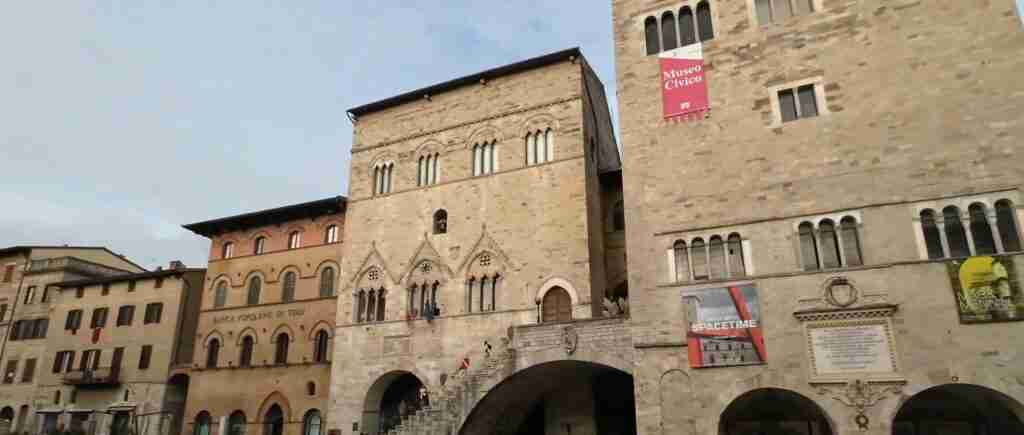
Piazza Grande is the centrepiece of any Gubbio visit: a vast stone terrace suspended on medieval vaulting above the lower city, flanked by the Palazzo dei Consoli to the north and the Palazzo Pretorio to the south, with a panoramic view of the Apennine foothills that rewards even the most jaded visitor. The Palazzo dei Consoli, built between 1332 and 1349 to a design attributed to Angelo da Orvieto, houses the Museo Civico and ranks among the finest Gothic civic buildings in Italy. Inside, the museum’s most important exhibit is the set of seven Tavole Eugubine — bronze tablets inscribed in both the Umbrian and Latin alphabets between the third and first centuries BC — providing the most complete surviving record of the ancient Umbrian language and Etruscan ritual practice. Admission to the Palazzo dei Consoli museum costs €5 for adults; opening hours run 10:00 to 18:30 daily in summer, with the ticket office closing one hour before museum closing time.
The Funivia Colle Eletto cable car ascends Monte Ingino from Via San Gerolamo on open-cage two-person gondolas, reaching the Basilica di Sant’Ubaldo at 827 metres above sea level in approximately five to six minutes. The ride itself has become one of the more photographed experiences in Umbria — the birdcage gondolas offering a vertiginous view over the rooftops of the medieval centre and the Gubbio plain stretching to the Apennines. Round-trip tickets cost approximately €6-7; check the station for current pricing before purchasing. The Basilica at the summit preserves the body of Sant’Ubaldo in a crystal urn above the main altar, and the three wooden ceri (large candles) raced through the streets on 15 May are displayed here year-round. The cable car does not operate during the lunch break of approximately 13:00 to 14:00, a detail worth remembering if timing the ascent before lunch. Visitors in good physical condition can descend on foot via the marked trails in approximately forty-five minutes.
A budget Gubbio day trip costs €34-45 per person (bus return approximately €12, Palazzo dei Consoli €5, funivia return €7, sandwich lunch €6-12, coffee €4-9 = total €34-45). Mid-range visitors who take a trattoria lunch near Piazza Grande spend €50-65 per person in total.
Orvieto 2026: The Most Dramatic Day Excursion from Perugia
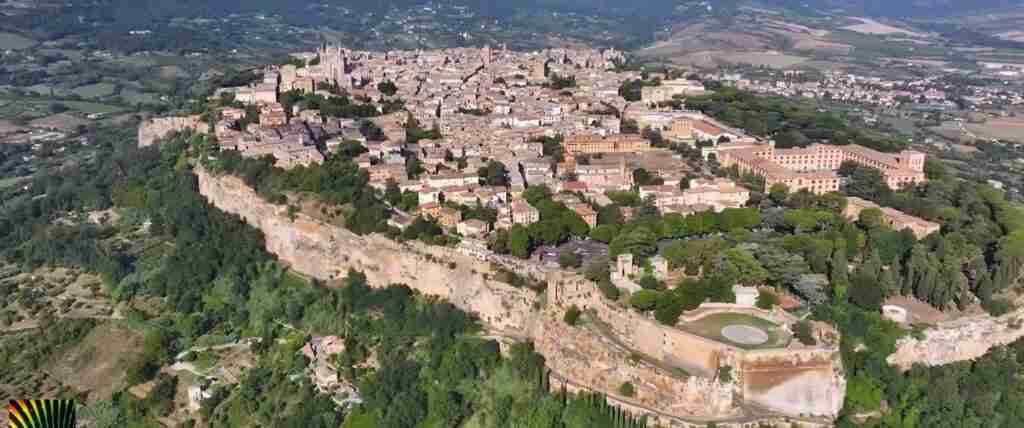
Orvieto rises from its platform of volcanic tufa rock with an abruptness that startles even experienced Italian travellers. The golden-mosaic facade of its Gothic cathedral, visible from the approaching plain, is followed by a labyrinth of Etruscan-era underground tunnels cut through the volcanic rock on which the entire city rests, a medieval well so deep it required a double-helix staircase, and a network of museums and churches that easily fills a full day. At 85 kilometres south of Perugia, Orvieto is the longest and most logistically complex day trip in this guide by public transport, but the visual payoff justifies every minute of the journey.
Getting to Orvieto from Perugia 2026: Train and Funicular
Trenitalia regional trains connect Perugia to Orvieto with journeys taking one hour thirty minutes to two hours on direct services, or longer on routes requiring a change at Terontola or Chiusi. Single tickets start from approximately €10-12 one-way; check trenitalia.com for current fares and select services carefully — the fastest connections are marked Regionale Veloce and run in around 1h30, while all-stops services can take over two hours. Orvieto’s railway station sits at the foot of the volcanic cliff, three kilometres below the historic centre. From the station, the historic funicular (funicolare) climbs to the upper town in approximately three minutes; the fare is included in the Carta Unica pass or costs a nominal amount separately. At the upper funicular station, the Orvieto Carta Unica pass provides the most economical access to all major sites for visitors planning to see more than just the Duomo. The Carta Unica starts from €25 and includes entry to the Duomo and Cappella di San Brizio, the Museo Etrusco Faina, Orvieto Underground guided visit, Pozzo di San Patrizio, Torre del Moro, and the Museo Archeologico Nazionale, among other sites; verify current pricing and included sites at cartaunica.it before purchasing. The Carta Unica is valid for one year from purchase, making it worth buying even if visiting only four or five of the included sites in a single day.
Orvieto Attractions and Ticket Prices 2026
The Duomo di Orvieto is one of the supreme achievements of Italian Gothic architecture. Construction began in 1290 on the site of an earlier Romanesque church and continued for over three centuries, producing a west facade of exceptional richness: a polychrome marble programme of gold mosaic, carved reliefs, and bronze doors designed by Lorenzo Maitani that functions as an outdoor art gallery independent of the cathedral interior. The interior houses the Cappella di San Brizio, containing Luca Signorelli’s Last Judgment fresco cycle (1499-1504) that directly influenced Michelangelo’s Sistine Chapel. Admission to the Duomo complex, including the Cappella di San Brizio and the Museo Emilio Greco, costs €8 per adult from January 2025 (check duomodiorvieto.it for current rates); it is included in the Carta Unica pass. Opening hours in the summer season (April to September) run 9:30 to 19:00 daily; winter hours are shorter. Photography without flash is permitted throughout.
Orvieto Underground offers guided tours of the Etruscan and medieval tunnel network carved beneath the city, including olive press chambers, pigeon houses cut into the tufa, wells, and excavated Etruscan-era structures. Tours depart from Piazza Duomo 23 and last approximately one hour; booking in advance is recommended, especially in high season (email [email protected]). The underground visit is included with the Carta Unica or bookable separately. Pozzo di San Patrizio, the double-helix well commissioned by Pope Clement VII in 1527 as a water reserve during siege, descends 53 metres through the volcanic rock on two interlocking spiral staircases — one for descent and one for ascent — allowing donkeys to carry water without ever meeting a descending animal. Entry is included in the Carta Unica or available separately; verify current prices at the Piazza Cahen ticket office.
A budget Orvieto day trip costs €35-48 per person (train return €22, Duomo only €8, sandwich lunch €8-12, coffee €3-6 = total €41-48, or €35-40 if skipping paid attractions beyond a Duomo exterior visit). Mid-range visitors who purchase the Carta Unica and take a restaurant lunch on Via del Duomo or in the streets behind the cathedral spend €55-70 per person in total.
Spoleto 2026: Dukes, Romans, and the Festival of Two Worlds
Spoleto occupies a position in the Umbrian imagination that exceeds its modest size. As the capital of the Lombard Duchy of Spoleto from the sixth century onward, it shaped the political and cultural history of central Italy for five hundred years; its Roman theatre, Romanesque cathedral, and the towering Rocca Albornoziana fortress give the modern visitor evidence of every layer of that history. In July, the Festival dei Due Mondi — Festival of Two Worlds — transforms the entire historic centre into a performance venue, drawing international artists to stages in the Roman theatre, the cathedral piazza, and temporary structures throughout the town. Outside festival time, Spoleto is unhurried, authentically inhabited, and genuinely rewarding.
Getting to Spoleto from Perugia 2026
Trenitalia regional trains connect Perugia to Spoleto in fifty-two minutes on the fastest services, or approximately one hour fifteen minutes on all-stops regionale trains, with around nineteen to twenty services per day in each direction. Single tickets start from approximately €8-9 one-way; check trenitalia.com for current fares. The Spoleto railway station sits below the historic centre; a network of covered escalators and elevators built in recent years connects the lower station area to the upper historic town, eliminating the hill climb and making the centre fully accessible. The escalator system is free and impressive — a Spoleto engineering achievement as remarkable in its way as the Roman aqueduct bridge above. Arrival by car is possible on the SS3 Flaminia highway but parking in the limited historic centre is challenging; the escalator system specifically encourages leaving cars at lower parking areas (Parcheggio SpoletoSfera near the station forecourt, €1-2 per hour) and ascending on foot or by the mechanical system.
Spoleto’s Top Attractions for Day Visitors 2026
The Rocca Albornoziana fortress crowns the hilltop above the historic centre and serves simultaneously as Spoleto’s most dramatic viewpoint and as the Museo Nazionale del Ducato di Spoleto. Cardinal Egidio Albornoz commissioned the construction in 1360 as a symbol of papal authority; the fortress later housed papal governors, popes, and, in its least glorious period, served as a prison until 1982. The museum across fifteen rooms traces the history of the Spoleto duchy from the fourth to the fifteenth century through funerary finds, Lombard-era metalwork, bas-reliefs, mosaics, and paintings. Admission costs €7.50 for adults, €2.00 for visitors aged 18-25, and is free for under-17s. Opening hours from May through September run Monday to Sunday 9:30 to 19:30; hours are shorter in winter. Entry is free on the first Sunday of each month and on 25 April, 2 June, and 4 November as part of the national MiC (Ministero della Cultura) free entry programme. For current hours and booking information, visit the Direzione Regionale Musei Umbria page at musei.umbria.beniculturali.it.
The Duomo di Spoleto (Cattedrale di Santa Maria Assunta) at the foot of the upper town provides the most photographed composition in Spoleto: a Romanesque facade with a rose window of extraordinary delicacy overlooking a paved piazza framed by medieval buildings. Inside, Filippo Lippi’s frescoes in the apse depicting the Life of the Virgin (1467-1469) are the cathedral’s artistic crown. Lippi himself is buried here — his tomb designed by his son Filippino. Entry to the cathedral is free. The Teatro Romano, a first-century BC Roman theatre excavated in the lower town near Piazza della Libertà, remains partially intact and hosts performances during the Festival dei Due Mondi in July; entry to the theatre structure itself (when not in use for performances) is free.
A budget Spoleto day trip costs €34-45 per person (train return approximately €17, Rocca €7.50, cathedral free, sandwich €6-12, coffee €3-8 = total €34-45). Mid-range visitors adding a restaurant lunch in Piazza Duomo spend €50-65 per person in total. Those visiting on the first Sunday of the month bring Rocca admission to zero, reducing budget-tier costs to €23-32 total.
Lake Trasimeno 2026: Island Ferries and Lakeside Villages
Lake Trasimeno, covering 128 square kilometres as Italy’s fourth-largest lake, lies 30 kilometres west of Perugia and provides a day of unhurried natural and cultural exploration entirely different in character from Umbria’s hilltop towns. The lake shores are fringed with medieval villages — Passignano sul Trasimeno, Castiglione del Lago, Tuoro sul Trasimeno — and two inhabitable islands accessible by regular Busitalia ferry services. Isola Maggiore is the smaller but more visited of the two, a car-free island of twenty-three permanent residents with a single medieval lane, several Franciscan sites, and a museum dedicated to traditional Trasimeno lacework. Isola Polvese, the largest of the three lake islands, is an ecological reserve with medieval ruins, a botanic garden, and a beach on its far shore.
Getting to Lake Trasimeno from Perugia 2026
The most practical approach for day visitors is to reach Passignano sul Trasimeno, the town with the most frequent ferry connections to Isola Maggiore. Regional FCU (Ferrovia Centrale Umbra) trains run from Perugia Fontivegge to Passignano in approximately thirty to forty minutes, with several daily services; Trenitalia regional buses also serve the route. For exact timetables and current fares (fares run in the €4-6 range one-way), check fsbusitalia.it or the SALGO app. Castiglione del Lago, on the southwestern shore, is reachable by Trenitalia regional train in approximately thirty to forty-five minutes and makes an excellent alternative base for lake exploration, with its fourteenth-century castle and headland promontory providing a second strong day trip focus independent of the islands.
Ferry Guide and Island Visits: Lake Trasimeno 2026
Busitalia Umbria operates the ferry (navigazione) services on Lake Trasimeno year-round, with enhanced summer schedules from late March through October providing up to 57 daily connections to Isola Maggiore and Isola Polvese. The main Passignano to Isola Maggiore route runs a single fare of €4.80 plus a landing contribution of €3.00 (from 1 March to 31 October 2026, reduced to €2.00 in the winter season), making a single trip €7.80 and a return journey €7.30 plus the €3.00 landing contribution on arrival. A daily pass costs €14.30 and includes unlimited ferry use without additional landing fees for Isola Maggiore. For Isola Polvese, board at San Feliciano (the fastest and most frequent connection at approximately ten minutes) or from Passignano; the single fare from San Feliciano is €4.20 with no landing contribution. Verify all current timetables and fares at fsbusitalia.it or by downloading the Busitalia Umbria ferry timetable PDF before travelling, as schedules vary between low and high season. Dogs of medium or large size travel free but must wear muzzles and leads.
On Isola Maggiore, the single cobbled lane runs the length of the island from the ferry landing past the Casa del Capitano del Popolo (a fourteenth-century manor), the Gothic church of San Michele Arcangelo with twelfth-to-fourteenth-century frescoes, and the chapel where Saint Francis rested during a Lenten retreat in 1213. The Museo del Merletto documents the lacemaking tradition introduced to the island in the late nineteenth century by the Marchioness Florentine Baglioni and still practised by a handful of remaining craftswomen. Entry to the church interiors is free; the Museo del Merletto charges a small admission fee. The island’s single restaurant serves Trasimeno lake fish — carp, perch, pike, and the local speciality of tegamaccio, a lake fish stew — making lunch here a genuine regional experience.
A budget Lake Trasimeno day trip costs €28-40 per person (FCU train return approximately €8-10, ferry return including landing contribution approximately €10, packed lunch or simple café stop €8-15, coffee €2-5 = total €28-40). Mid-range visitors taking a full fish lunch at the island restaurant spend €45-60 per person in total.
Spello 2026: Flowers, Frescoes, and Roman Gates
Spello is the quietest and most intimate of the towns on the direct Perugia-Assisi rail line, close enough (25 kilometres from Perugia) to combine with Assisi in a single long day for energetic visitors. The town climbs the western slope of Monte Subasio in a series of pink-stone terraces and alley-linked levels, its Roman walls and gates surviving in the lower sections of the town as some of the best-preserved first-century BC masonry in Umbria. Spello is internationally known for the Infiorata di Corpus Domini, a flower petal festival in June during which the entire main street is carpeted with elaborate mosaic compositions created overnight from freshly cut flower petals — a tradition shared with Gubbio and several other Umbrian towns but nowhere more spectacularly realised than here.
Getting to Spello from Perugia 2026
Trenitalia regional trains run from Perugia Ponte San Giovanni to Spello in approximately twenty-nine to fifty minutes depending on service type, with a direct connection roughly every thirty to sixty minutes throughout the day. Single tickets start from approximately €5-6 one-way; check trenitalia.com for current fares. The train station at Spello sits immediately below the medieval centre, within a five-minute walk of the Porta Consolare, the perfectly preserved Roman gate marking the southern entrance to the old town. Spello can also be combined with Assisi on the same day — both towns sit on the same railway line, with Spello approximately ten minutes south of Assisi by train. A suggested combined itinerary: morning in Assisi (Basilica and Piazza del Comune), afternoon in Spello (Pinturicchio chapel and Roman gates), return to Perugia by evening train.
What to See in Spello 2026
The Collegiata di Santa Maria Maggiore contains the Cappella Baglioni (also called the Cappella Bella), frescoed by Pinturicchio between 1500 and 1501 with a cycle including the Annunciation, the Nativity, and Christ Among the Doctors that represents one of the purest expressions of Umbrian Renaissance painting outside Perugia’s own Galleria Nazionale. Admission to the church is free, with a small fee sometimes charged for the chapel itself; verify at the church entrance on arrival. The three Roman gates — Porta Consolare, Porta Urbica, and Porta Venere (with flanking cylindrical towers) — are all free to view as public monuments in the town walls. The Porta Venere and its towers provide the town’s most photographed composition, particularly in late afternoon when the low light brings out the warm tones of the pink stone. A walk along the Via Giulia from the upper town to the lower Roman gates takes approximately twenty minutes and passes the best concentration of flower-box decorated windows and medieval facades. Admission to all major sites in Spello (churches, Roman remains, views) is free, making it one of the most affordable day trips from Perugia.
A budget Spello day trip costs €18-28 per person (train return approximately €10-12, free churches and Roman walls, picnic lunch on the town walls €6-10, coffee €2-6 = total €18-28). Mid-range visitors taking a restaurant lunch in the centro storico spend €30-45 per person in total. Spello is the best-value major day trip in this guide and is recommended as a morning or afternoon addition to an Assisi day rather than a standalone excursion due to its smaller size.
Todi 2026: Italy’s Most Perfectly Proportioned Hilltop Town
Todi rises from an isolated hill above the Tiber Valley 45 kilometres south of Perugia with the self-assurance of a town that once controlled a significant medieval territory. Its Piazza del Popolo, flanked by three medieval palaces and the Gothic Duomo on the steep stairs above, is routinely cited among the most harmoniously proportioned civic spaces in Italy. An American study in the 1980s that named Todi the “most livable city in the world” brought international attention that has never entirely dissipated; the town’s weekend antiques market and its ring of Renaissance churches sustain a second string of visitors beyond the purely historical.
Getting to Todi from Perugia 2026
Todi is most efficiently reached by car — the journey on the E45 highway takes approximately forty to fifty minutes from Perugia and offers the freedom to visit the Renaissance church of Santa Maria della Consolazione at the valley foot before ascending to the hilltop centre. By public transport, Busitalia Umbria operates regional bus services to Todi from Perugia Bus Terminal; verify current routes and timetables at fsbusitalia.it as services change with seasonal schedules. Journey time by bus is approximately one hour to one hour fifteen minutes. The town centre’s historic streets are pedestrianised; parking is available at the lower lots with escalators connecting to the medieval centre. Todi makes an ideal pairing with Orvieto for drivers — the two towns sit on the same north-south axis separated by only 30 kilometres — allowing a full day visiting both on a single excursion from Perugia.
Todi’s Main Attractions and Planning Tips 2026
Piazza del Popolo, the main medieval square, is flanked by the Palazzo dei Priori (seat of the commune since the twelfth century), the Palazzo del Capitano, and the Palazzo del Popolo — three civic buildings of different periods that together create an unusually coherent Gothic-Romanesque civic composition. The Duomo di Todi at the top of the broad staircase above the piazza contains a series of exceptional carved choir stalls and a mosaic floor; entry is free. The Museo della Città in the Palazzo del Vignola covers the Etruscan, Roman, and medieval history of Todi’s territory; admission runs approximately €3-5. The real treasure of a Todi visit, however, is Santa Maria della Consolazione, a Renaissance-era domed church at the foot of the hill (visible from the highway and also accessible by walking from the lower parking areas) attributed to Cola da Caprarola and begun in 1508; it represents the idealized Renaissance church building type in near-perfect architectural form, entirely free to visit during opening hours. A budget Todi day trip costs €22-35 per person (bus return approximately €10-14, museum €3-5, church free, lunch in the piazza €9-16 = total €22-35). Drivers reduce the per-person transport cost to approximately €15-20 (car hire divided between occupants), giving a premium self-drive day trip cost of €40-58 per person including a full restaurant lunch.
Cortona 2026: A Day in Tuscany from Perugia
Cortona sits technically in Tuscany — fifteen kilometres across the regional boundary from Umbria — but its position on the Valdichiana ridge just 58 kilometres from Perugia makes it an obvious day trip and its character is entirely consistent with the Umbrian hill towns to its south. Etruscan remains are visible throughout the town and territory (the Museo dell’Accademia Etrusca is one of the finest Etruscan collections outside Rome), the medieval centre is intimate and largely car-free, and the fame brought by Frances Mayes’s memoir “Under the Tuscan Sun” (set largely in a farmhouse in the Cortona hills) brings a steady international visitor stream that has done nothing to diminish the town’s authentic functioning life.
Getting to Cortona from Perugia 2026
The most practical public transport option is a Busitalia regional bus from Perugia to Cortona, with a journey time of approximately one hour; verify current routes and times at fsbusitalia.it, as connections can vary. By train, the route involves a change at Terontola (on the Rome-Florence mainline) and then a short ride to Camucia-Cortona station at the hill foot, followed by a local bus or taxi of approximately €10-12 up to the medieval town. The Camucia-Cortona taxi cooperative number is posted at the station forecourt. Journey time total (train to Terontola plus connection to Camucia plus taxi) typically runs ninety minutes to two hours. By car, the journey takes approximately fifty minutes on the E45 to the Cortona exit, with parking available below the town at Piazzale del Mercato from which escalators serve the upper town. Cortona is one of the day trips in this guide where a rental car adds genuine practical value, cutting journey time and enabling exploration of the Etruscan tumuili scattered through the countryside below the town.
Cortona Highlights and Entry Costs 2026
The MAEC (Museo dell’Accademia Etrusca e della Città di Cortona) in Palazzo Casali on Piazza della Repubblica is the town’s essential visit, housing an Etruscan collection that includes the extraordinary Etruscan bronze chandelier (lampadario) of the fifth century BC alongside Egyptian, Greek, Roman, and medieval material accumulated by the Etruscan Academy since its foundation in 1727. Admission is approximately €10 for adults; check cortonaweb.net for current prices. The Duomo di Cortona on Piazza del Duomo at the lower end of the historic centre is free to visit; the adjacent Museo Diocesano contains Fra Angelico’s Annunciation panel painting (one of two surviving versions, the other in Florence) and works by Pietro Lorenzetti and Luca Signorelli, with admission approximately €5. The Via Nazionale is the main pedestrian promenade connecting the major piazze and filled with local food shops selling the area’s notable Valdichiana beef, Chianina cattle products, and Sangiovese wines; it warrants a slow walk even without entering any museum. A budget Cortona day trip costs €36-45 per person (transport return approximately €15-18, MAEC admission €10, packed lunch €8-12, coffee €3-5 = total €36-45). Mid-range visitors adding a restaurant lunch spend €55-70 per person in total.
Cascate delle Marmore 2026: Europe’s Tallest Man-Made Waterfall
The Cascata delle Marmore is a 165-metre waterfall engineered by the Romans in 271 BC when consul Manius Curius Dentatus diverted the River Velino into the River Nera to drain the Reatine marshes upstream, creating a cascade that remains — over two thousand years later — the tallest artificial waterfall in the world. The falls operate on a controlled schedule because the Velino water drives a hydroelectric plant for much of the day; when the waters are released on the visitor schedule, the spectacle is genuinely overwhelming, particularly at the Belvedere Inferiore where spray and noise fill the entire valley. Terni, the industrial city at the falls’ foot, is 75 kilometres south of Perugia and makes this the longest day trip from the Umbrian capital after Orvieto.
Getting to Cascate delle Marmore from Perugia 2026
Trenitalia regional trains connect Perugia to Terni in approximately forty-five to sixty minutes, with the regional FCU line also serving part of the route. Train tickets cost approximately €8-10 one-way; check trenitalia.com for current fares. Trenitalia operates a dedicated Marmore Link service — a combined train and bus connection specifically designed for the falls — from Terni station to the waterfall park; verify current timetables and the supplement cost (approximately €1.30-2.00 in addition to the base rail fare) at trenitalia.com under the Marmore Link service page. By car, the journey from Perugia via the E45/SS3 takes approximately one hour. Within the park, the Belvedere Inferiore and Belvedere Superiore are connected by hiking trails; the short route takes approximately twenty minutes, the longer scenic route around one hour with some steps and elevation change.
Entry Prices, Water Release Times, and Trails 2026
Admission to the Cascata delle Marmore park costs €10 for adults, €7 for reduced-rate visitors (under-18s, over-70s, students), and is free for residents of Terni, visitors with serious disabilities, and accompanying carers. Evening entry on days with late opening starts at €8. Check cascatadellemarmore.info for current prices and the water release schedule before visiting — the falls operate at full flow only at specified times published monthly on the official site, and arriving during a non-release period reduces the visual impact considerably. The summer season (June through August) typically provides the most generous release schedule, with water flowing for much of the day. The park also offers guided walking tours of the trails (approximately €12 per person with guide) for those who prefer a structured visit. Booking through cascatadellemarmore.info is recommended in peak season.
A budget Cascate delle Marmore day trip costs €40-50 per person (train to Terni return approximately €16-20 (€8-10 each way), Marmore Link supplement return €3-4 = total transport €19-24, park entry €10, picnic lunch €8-12, coffee €3-4 = total €40-50). Mid-range visitors taking a restaurant lunch near the falls or in Terni spend €55-70 per person in total. The Cascate delle Marmore excursion pairs well with a morning visit to Narni Sotterranea (the underground medieval city beneath the hill town of Narni, 15 minutes from Terni by regional train) for drivers or travellers with the energy for a two-destination day.
Hidden Gems 2026: Deruta, Norcia, Montefalco, and Bevagna
Four destinations deserve mention for travellers who have exhausted the major day trip circuit or who specifically seek the food, wine, and crafts traditions that define Umbria’s regional identity. All four are best reached by car; bus connections exist but involve planning and limited frequency.
Deruta sits 18 kilometres south of Perugia on the E45 highway and qualifies as a half-day excursion rather than a full day trip. The town is the centre of Umbrian majolica production, a tradition documented since the fifteenth century and still active across dozens of family workshops lining Via Tiberina on the valley floor and the via principale of the medieval upper town. The Museo Regionale della Ceramica di Deruta in the lower town documents five centuries of production with pieces ranging from Renaissance pharmacy jars to contemporary works; admission is approximately €3. Buying directly from workshop studios in Deruta costs twenty to thirty percent less than buying the same pieces in Perugia souvenir shops, making the town a practical destination for anyone interested in decorative ceramics. The Busitalia line E004 connects Perugia to Deruta in approximately twenty to thirty minutes.
Montefalco, 42 kilometres southeast of Perugia, earns the title “Ringhiera dell’Umbria” — balcony of Umbria — for the 360-degree panorama of the Umbrian valley visible from its circular piazza. The town is primarily known as the production centre of Sagrantino di Montefalco, Umbria’s most powerful and age-worthy red wine, made from a grape variety unique to this small zone. The Museo Civico di San Francesco in the converted medieval church of San Francesco houses Benozzo Gozzoli’s Life of Saint Francis fresco cycle (1450-1452) as its centrepiece, alongside works by Perugino and Niccolò Alunno; admission approximately €6. Montefalco is reachable by Busitalia bus from Perugia, though car access makes it far more practical to combine with nearby Bevagna and Trevi on a single day. Wine tasting at estates including Arnaldo Caprai (the region’s most prominent Sagrantino producer) requires advance booking at most wineries.
Bevagna, 38 kilometres southeast of Perugia, occupies a compact medieval town on the Valle Umbra floor around a piazza anchored by two Romanesque churches — San Michele and San Silvestro — that face each other across a rectangle of almost impossible medieval perfection. The Museo di Bevagna beneath the piazza excavates the Roman town of Mevania, with intact mosaic floors from a first-century bathhouse visible through glass floors. The Mercato delle Gaite medieval festival in June, during which the whole town reenacts thirteenth-century crafts and commerce over ten days, is one of the outstanding cultural events in Umbria. Admission to the Roman museum is approximately €3-5.
Norcia, 100 kilometres east of Perugia at the foot of the Sibillini mountains, is the black truffle capital of Umbria and the birthplace of Saint Benedict. Its norcinerie — specialist pork butchers — produce the prosciutto di Norcia IGP, salami, and sausages that supply restaurants across central Italy. The 2016 earthquake severely damaged the historic centre, and reconstruction continues, but the famous prodotti norcini shops on Piazza San Benedetto reopened well before the complete restoration of the basilica; a visit to buy provisions remains a compelling reason for the journey. In summer, the road from Norcia over the Forca Canapine to the Castelluccio plateau, 1452 metres above sea level, passes through a landscape of dramatic mountain scenery culminating in the Piano Grande, a highland plain that erupts in wildflower colour from late May through July. The Castelluccio plateau and the Piano Grande are only accessible by car from Norcia and represent one of the most spectacular natural landscapes in the Italian peninsula.
Transportation Guide 2026: Getting from Perugia to Every Destination
Perugia sits at the intersection of two distinct rail systems: the Trenitalia regional network serving the Rome-Florence corridor (connecting to Assisi, Spello, Foligno, Spoleto, Terni, Orvieto, Cortona, and Lake Trasimeno), and the private FCU (Ferrovia Centrale Umbra) running north-south through the Tiber Valley to Città di Castello and south toward Terni. Busitalia Umbria buses cover the destinations not served by rail, most importantly Gubbio and Todi. All public transport tickets and timetables are available at fsbusitalia.it (buses), trenitalia.com (regional trains), and the SALGO app (Busitalia buses and local transit within Perugia).
Train Routes from Perugia 2026
The principal train connections from Perugia for day trips operate as follows in 2026, with one-way fares verified from booking platforms (check trenitalia.com for current prices as fares are subject to change):
- Assisi: Trenitalia regional from Perugia Ponte San Giovanni, 18-25 minutes, departures approximately every 20-30 minutes, from €4-5 one-way
- Spello: Trenitalia regional from Perugia Ponte San Giovanni, 29-50 minutes, from €5-6 one-way
- Foligno: Trenitalia regional, approximately 35-55 minutes, from €5-7 one-way (useful as a transfer point for Bevagna and Montefalco buses)
- Spoleto: Trenitalia regional from Perugia Fontivegge or Ponte San Giovanni, 52 minutes to 1 hour 15 minutes, from €8-9 one-way
- Terni: Trenitalia regional, approximately 45-60 minutes, from €8-10 one-way (connection for Cascate delle Marmore via Marmore Link)
- Orvieto: Trenitalia regional, 1 hour 30 minutes to 2 hours, from €10-12 one-way
- Passignano sul Trasimeno: FCU regional train from Perugia Fontivegge, approximately 30-40 minutes, from €4-6 one-way
- Camucia-Cortona: Trenitalia via Terontola change, total approximately 1 hour 30 minutes, from €7-9 one-way to Terontola plus connection
Regional trains do not require advance booking; tickets are available at station machines, the Trenitalia app, and ticket windows, and are valid for two hours from validation. Validate the ticket at the yellow validation machines on the platform before boarding — an unvalidated ticket is treated the same as no ticket by Italian rail inspectors.
Bus Routes from Perugia 2026
Busitalia Umbria operates the regional bus network from Perugia Bus Terminal at Piazza Partigiani (directly below the city walls, served by the escalators and MiniMetrò from Perugia Minimetro station). Under Umbria’s zone-based fare system introduced in 2026, journey prices depend on the number of fare zones crossed; shorter routes cost €1.60-3.60 and longer routes €5.00-8.00. Check current pricing and exact timetables at fsbusitalia.it or via the SALGO app, which also supports mobile ticket purchase. Key bus routes for day-trippers include:
- Perugia to Gubbio: Line E001, approximately 1 hour to 1 hour 30 minutes, several departures daily on weekdays (reduced at weekends)
- Perugia to Todi: Busitalia regional service, approximately 1 hour to 1 hour 15 minutes, several departures daily
- Perugia to Deruta: Line E004, approximately 20-30 minutes, frequent service
- Perugia to Cortona: Busitalia regional service, approximately 1 hour, verify current routes at fsbusitalia.it
- Perugia to Norcia: Busitalia Line E (via Foligno or direct), approximately 1 hour 30 minutes to 2 hours
Car Rental for Perugia Day Trips 2026
A rental car transforms the Perugia day trip experience for destinations poorly served by public transport, particularly Todi, Norcia, the Castelluccio plateau, Bevagna, and Montefalco. Daily car hire from Perugia starts at approximately €40-60 per day for a compact category (Fiat Panda or similar), with fuel additional at current Italian pump prices (check mimit.gov.it for daily fuel price bulletins). Car hire offices operate at Perugia railway station (Hertz, Europcar) and in the lower city; booking several days in advance through rental aggregators consistently produces lower prices than walk-up rates. Parking in the historic centres of most hill towns is restricted; the standard pattern is to park at a lower lot at the edge of the pedestrianised zone (€1-2 per hour or €5-8 for a day) and ascend on foot, by escalator, or by local shuttle. Petrol stations are not uniformly available in remote areas; filling up before leaving Perugia for destinations like Castelluccio or the Valnerina avoids potential range anxiety on mountain roads. Driving licence requirement: full national licence valid in Italy, or international driving permit for non-EU licence holders; insurance is standard with all rental agreements.
Day Trip Costs 2026: Budget Breakdown by Destination
Day trip costs from Perugia cover transport (return), admission to paid attractions, and food and drink. Unlike accommodation-based budgets, the hotel or apartment cost in Perugia is fixed regardless of which excursion is taken each day, so the figures below represent purely the incremental cost of each day trip on top of Perugia base costs. All figures are per person.
Budget travellers who use public transport, prioritise free attractions, and bring a packed lunch or buy sandwiches from local bakeries can expect the following costs per day trip:
- Assisi: €20-30 (train return €9, basilica free, sandwich and coffee €11-21)
- Spello: €18-28 (train return €10-12, free churches and walls, picnic €8-16)
- Lake Trasimeno: €28-40 (FCU train return €8-10, ferry return including landing fee €10, packed lunch €8-15, coffee €2-5)
- Gubbio: €34-45 (bus return €12, museum €5, funivia return €7, sandwich and coffee €10-21)
- Spoleto: €34-45 (train return €17, Rocca €7.50, sandwich and coffee €9-20; reduced to €23-32 on first Sunday of month when Rocca is free)
- Todi: €22-35 (bus return €10-14, museum €3-5, free churches, sandwich €9-16)
- Orvieto: €35-48 (train return €22, Duomo €8, sandwich and coffee €11-18)
- Cortona: €36-45 (transport return €15-18, MAEC €10, sandwich and coffee €11-17)
- Cascate delle Marmore: €40-50 (train to Terni return €16-20, Marmore Link supplement return €3-4, park entry €10, picnic and coffee €11-16)
Mid-range travellers who use public transport but take a proper restaurant lunch and visit all key paid attractions spend approximately €40-70 per person across most destinations. Assisi and Spello remain the most affordable even at mid-range (€35-50), while Orvieto, Cortona, and Cascate delle Marmore approach €55-70 with restaurant lunches and full attraction packages.
Premium day trips using a rental car, full-day guided tours, wine tastings, or gourmet lunches at destination restaurants run €95-150 per person. Montefalco winery visits combined with a tasting lunch at a Sagrantino producer sit comfortably in this range. A day guided tour from Perugia incorporating both Assisi and Spoleto (available through local tour operators and Viator) runs €80-120 per person including transport and guide but excluding lunches.
Organized Tours from Perugia 2026
Several operators offer structured day tours from Perugia that make the logistics of multi-destination days straightforward, particularly for first-time visitors or those without the confidence to navigate Italian regional buses independently. The main platforms for finding and booking these include Viator, GetYourGuide, and local Umbrian operators advertising through the Perugia Tourist Office at Piazza Matteotti 18.
Standard group day tours from Perugia cover the following routes: Assisi half-day (3-4 hours, departing 9:00 AM or 14:00, €25-45 per person including guided walk and basilica visit); Assisi and Spello combined full day (7-8 hours, €55-75 per person); Orvieto full day with underground tour (7-8 hours, €65-90 per person including transport and Underground); Gubbio and Umbrian countryside (7-8 hours, €55-80 per person). Prices exclude restaurant lunch but include transport from Perugia meeting points. Private guided tours for groups of two to six cost significantly more — €200-400 for a full private day depending on destination and group size — but provide entirely flexible itineraries, insider knowledge of seasonal highlights like Castelluccio flowering or truffle market days in Norcia, and door-to-door convenience.
Wine and food focused day excursions have grown substantially as a Perugia tour category in recent years. Half-day olive oil and wine tours to producers in the Colli del Trasimeno DOC or the Montefalco Sagrantino zone run €45-75 per person including tastings and transport. Combined ceramics workshop visits to Deruta studios with a hands-on majolica painting session cost approximately €40-65 per person including materials and a finished piece to take home.
Seasonal Planning and Best Times for Day Trips 2026
Spring (April through mid-June) is the finest season for day trips from Perugia across almost every destination. Temperatures are comfortable for walking (15-22°C), landscapes are green, Spello’s Infiorata in early June and Gubbio’s Corsa dei Ceri on 15 May add festival dimensions, and tourist volumes at major sites like Assisi remain manageable before the July-August peak. Lake Trasimeno ferry services are at enhanced frequency from late March. Book Assisi accommodation and any Orvieto Underground tours in advance for the Easter weekend and the weeks either side of it, when Italian domestic tourism fills the region.
Summer (mid-June through August) brings the warmest temperatures (28-36°C in the valleys), the highest visitor numbers, the longest opening hours, and the most active event calendar. Spoleto’s Festival dei Due Mondi in July transforms the city into an international performance venue — planning day trips to Spoleto during the festival period either requires advance accommodation booking if extending to an overnight or accepting that the town will be exceptionally busy. The Cascate delle Marmore have their most generous water release schedule in summer. For hiking-based day trips (Castelluccio plateau, Monte Subasio above Assisi) start before 8:00 AM and return by early afternoon to avoid the heat of the day.
Autumn (September through November) rivals spring for day trip quality and surpasses it for food and wine experiences. The white truffle season in October and November brings festivals to Norcia and the surrounding territory; the vendemmia (grape harvest) in September fills Montefalco and the Colli del Trasimeno zone with working activity. Autumn foliage on Monte Ingino above Gubbio and the forests of Monte Subasio creates exceptional photography conditions. Tourist volumes drop significantly after mid-September, making September and October arguably the best overall months for day trips from Perugia.
Winter (December through March) offers the quietest conditions and the most authentic daily life at all destinations, with the disadvantage of shorter opening hours, reduced bus and ferry frequencies, and the Castelluccio plateau sometimes inaccessible in snow. Orvieto has a strong Christmas and Epiphany programme, and the Cascata delle Marmore winter schedule releases water on weekend afternoons for dramatic cold-season viewings. The first Sunday of the month free entry programme applies year-round, making winter weekend day trips to Spoleto’s Rocca an exceptional value. Most destinations remain open year-round with winter hours; verify specific closures at official sites or through the Umbria Tourism portal at umbriatourism.it before planning winter excursions.
Sample Itinerary 2026: A Perfect Week of Day Trips from Perugia
This suggested seven-day schedule from a Perugia base combines the major destinations in a sequence that avoids visitor fatigue and takes advantage of transport connections, free entry dates, and seasonal timing. Distances and journey times assume public transport throughout except Day 4, which benefits strongly from a car.
Day 1 — Assisi and Spello: Depart Perugia Ponte San Giovanni by 8:30 train, arriving Assisi by 9:00. Spend the morning at the Basilica di San Francesco (free, open 8:30), visit the Piazza del Comune and Temple of Minerva, lunch at a trattoria near Via San Francesco (€18-28). Take the 14:15 train south to Spello (10 minutes), walk the Via Giulia and Porta Venere Roman gates, coffee in the piazza. Return train to Perugia by 18:30. Total cost per person approximately €35-55 (transport return for both towns €10-12, free basilica, lunch and coffees).
Day 2 — Gubbio: Depart Perugia Bus Terminal by the 9:05 Busitalia Line E001 bus, arriving Gubbio by approximately 10:30. Climb to Piazza Grande, visit the Palazzo dei Consoli and Tavole Eugubine (€5), take the funivia to Sant’Ubaldo (€7 return), lunch at a trattoria near the main piazza (€18-28), explore the lower town Roman theatre in the afternoon. Return bus to Perugia by 18:30. Total per person approximately €48-65.
Day 3 — Lake Trasimeno and Passignano: FCU train from Perugia Fontivegge to Passignano sul Trasimeno (approximately 35 minutes). Morning ferry to Isola Maggiore (return ticket plus landing fee approximately €10 total), explore the island, lunch at the island fish restaurant (€20-30 for lake fish speciality). Afternoon walk around Passignano’s lakeside promenade, sunset aperitivo overlooking the lake. Return FCU train to Perugia. Total per person approximately €40-58.
Day 4 — Todi and Orvieto by Car (rental required): Collect rental car at Perugia station (from €40-60 for compact). Drive south 45 minutes to Todi — morning in Piazza del Popolo, Santa Maria della Consolazione church, Museo della Città. Lunch at a Todi trattoria (€18-28). Drive south 35 minutes to Orvieto. Afternoon at the Duomo (€8) and Pozzo di San Patrizio (Carta Unica €25 recommended if time for multiple sites). Drive back to Perugia in approximately one hour. Total per person (two sharing car) approximately €80-110 including car hire, fuel, admissions, and meals.
Day 5 — Spoleto: Morning Trenitalia train from Perugia (50-65 minutes). Escalator system up to the historic centre, Rocca Albornoziana fortress and museum (€7.50), walk the Ponte delle Torri (free), Duomo di Spoleto (free), Roman theatre exterior (free). Lunch near Piazza Duomo (€18-28). Return train to Perugia. Total per person approximately €42-58 (reduced to €28-38 if visited on first Sunday of month for free Rocca entry).
Day 6 — Orvieto (if skipped Day 4) or Cortona: Trenitalia morning train to Orvieto (1.5 hours); funicular to upper town; full day Duomo, Underground, Torre del Moro; lunch in the streets behind the cathedral. Return to Perugia by evening. Total per person approximately €55-70 (train return €22, Duomo €8, Carta Unica €25 for multiple sites, or Duomo-only €8, lunch and coffee €22-35).
Day 7 — Cascate delle Marmore: Trenitalia morning train to Terni (45-60 minutes), Marmore Link connection to the falls. Arrive at the waterfall park for the late morning water release (check official schedule at cascatadellemarmore.info on the day). Full day in the park on Belvedere Inferiore and Superiore trails, lunch at the park café or a picnic on the approach path. Return to Terni and Perugia by late afternoon train. Total per person approximately €45-60 (transport return €19-24, park entry €10, food €16-26).
Practical Tips for Day Tripping from Perugia 2026
Purchase regional Trenitalia tickets on the Trenitalia app or at station self-service machines to avoid queues, especially at Perugia Fontivegge where the morning rush can create delays at manned windows. Tickets for regional trains do not expire quickly and can be bought the day before for early-morning departures. The DropTicket app and the SALGO app both support Busitalia Umbria bus ticket purchases on mobile, avoiding the need to carry exact change for on-board purchases (though on-board purchase carries a small surcharge).
Lunch timing matters more in Umbria than in more tourist-oriented regions: most local restaurants take their own midday break between 15:00 and 19:30, meaning late lunches ordered after 14:00 are difficult to obtain in smaller towns. Arrive at restaurants between 12:30 and 13:15 for the best table selection and the full menu. Enoteca wine bars in most towns serve light plates (cheese, charcuterie, crostini) throughout the afternoon and provide an alternative to the midday restaurant window.
The MiC (Ministero della Cultura) first-Sunday-of-month free entry programme covers all state-owned museums and monuments across Italy including Spoleto’s Rocca Albornoziana and numerous archaeological sites. This applies on the first Sunday of every month throughout 2026. Coordinating Spoleto and Cortona visits to fall on these Sundays reduces day trip costs by €7.50-10 per person and is worth factoring into the planning calendar.
Dress code for religious buildings applies throughout Umbria consistently: shoulders and knees must be covered. Scarves and wraps are available at most major basilica entrances for a small donation or purchase, but carrying a scarf or light shawl eliminates the pause at the door. Most churches except the Basilica di San Francesco in Assisi have no formal enforcement outside major pilgrimage periods, but observing the code is both respectful and practically important in Assisi where the Franciscan friars take it seriously.
Water is safe and free at public fontanelle (street drinking fountains) throughout Umbria’s hill towns. The white stone fontanelle in Gubbio’s lower town, Spoleto’s medieval quarter, and Assisi’s medieval streets run continuously with municipal spring water. Carrying a refillable bottle saves the cost of repeated bottled water purchases and reduces plastic use.
The Umbria Card, a regional tourism pass available through umbriatourism.it, occasionally offers discounted packages combining transport and admissions across multiple sites for multi-day visitors. Verify whether current editions of the card represent value against the individual site and transport costs listed in this guide before purchasing, as value depends heavily on the specific sites included and the planned itinerary.
Frequently Asked Questions About Perugia Day Trips 2026
How long does the train journey from Perugia to Assisi take in 2026?
The Trenitalia regional train from Perugia Ponte San Giovanni to Assisi takes approximately 18 to 25 minutes depending on the service type. Regionale Veloce services complete the journey in 18 minutes; all-stops regional services take up to 25-30 minutes. Services run roughly every 20-30 minutes throughout the day, with first departures around 5:54 AM and last returns from Assisi to Perugia around 22:00-23:00. Single tickets start from €4-5; no advance booking is required for regional trains.
Is Gubbio accessible from Perugia without a car in 2026?
Yes, Gubbio is accessible from Perugia by Busitalia Umbria Line E001 bus from Perugia Bus Terminal at Piazza Partigiani. The journey takes approximately one hour to one hour thirty minutes. Services operate several times per day on weekdays but with reduced frequency on Sundays and public holidays; always check the current timetable at fsbusitalia.it before planning. Gubbio has no rail connection. The Busitalia free centre shuttle (navetta gratuita) connects the bus terminus at Piazza Quaranta Martiri to the historic centre, avoiding the uphill walk.
What is the Orvieto Carta Unica and is it worth buying in 2026?
The Orvieto Carta Unica is an all-inclusive pass covering entry to all of Orvieto’s major museums and monuments, including the Duomo and Cappella di San Brizio, Orvieto Underground guided tour, Pozzo di San Patrizio, Torre del Moro, Museo Etrusco Faina, Museo Archeologico Nazionale, Pozzo della Cava, and the Etruscan necropolis. The pass starts from €25 per adult and is valid for one year from purchase, making it worth buying for any visitor who plans to see more than just the Duomo on a day trip. Buying the Duomo ticket alone (€8) plus the Underground tour (€6-10 separately) already approaches the Carta Unica price; adding the Pozzo di San Patrizio and Torre del Moro makes the pass clearly the better value. Purchase at cartaunica.it or at the Piazza Duomo and Piazza Cahen ticket offices on arrival.
What is the best free day trip from Perugia in 2026?
Assisi is the best free day trip from Perugia in 2026. The Basilica di San Francesco, containing Giotto’s fresco cycle and the Tomb of Saint Francis, is free for individual visitors with no ticket required. The Piazza del Comune, the Roman Temple of Minerva, and the Basilica di Santa Chiara are also free to enter. The only paid option is the Rocca Maggiore (€3), and visiting without it still provides a full and deeply rewarding day. Total cost for a budget visitor: approximately €9 for the train return, plus food. Spello is the second-best free day, with all its Roman gates and the Pinturicchio chapel accessible at no or minimal charge.
Can I do a Perugia day trip to Florence or Rome in 2026?
Both Rome and Florence are technically reachable as very long day trips from Perugia but are not recommended as day excursions. Rome lies approximately 170 kilometres south, with the fastest connections (via Terontola or direct Intercity train) taking around two hours each way, leaving approximately five to six hours in the city. Florence is about 160 kilometres north, with train journeys of around ninety minutes to two hours via Arezzo or Chiusi. Both cities reward multiple days rather than a rushed single day, and their logistics are considerably more complex than Umbria’s compact hill towns. For visitors specifically based in Perugia with a desire to see both, an overnight stay in either city is far preferable to a day trip. The Frecciargento from Perugia to Rome takes approximately 2.5 hours and costs around €25-40 one-way.
What is the Cascate delle Marmore water release schedule in 2026?
The Cascata delle Marmore operates on a controlled water release schedule because the Velino River drives a hydroelectric plant. The falls run at full flow only during published release periods, which vary by season and day of week. In summer (June through August), the schedule is most generous with afternoon and evening flows. In spring and autumn, weekend schedules are more active than weekdays. The current schedule for each month is published at cascatadellemarmore.info; always check the official site on the day of your visit before setting out from Perugia, as the schedule can change without advance notice.
Are there day trips from Perugia suitable for children in 2026?
Several day trips from Perugia work particularly well for families with children. Lake Trasimeno is ideal — the ferry crossing to Isola Maggiore is exciting, the island is compact and safe, and the beach on Isola Polvese has playground equipment. Gubbio’s open-cage cable car to Sant’Ubaldo is an adventure for children who like heights. The Cascate delle Marmore provides genuinely dramatic natural spectacle, and the marked park trails involve accessible walking at varying difficulty levels. Assisi’s medieval streets and the Roman animal symbols in the Basilica frescoes engage children who connect history with storytelling. For very young children, the compact and flat areas of Lake Trasimeno lakeside villages (Passignano, Castiglione del Lago) and Assisi’s lower piazza level provide stroller-friendly options.
What are the opening hours for the Spoleto Rocca Albornoziana in 2026?
The Rocca Albornoziana and Museo Nazionale del Ducato di Spoleto opens daily from Monday to Sunday 9:30 to 19:30 from May through September (last entry 18:45), with shorter hours from October through April. The museum is closed on Tuesdays outside summer season in some periods; verify current hours at musei.umbria.beniculturali.it or at the Spoleto tourist office before visiting. Entry is free on the first Sunday of each month, 25 April, 2 June, and 4 November as part of the national MiC programme. Guided tours of the fortress towers operate on Saturdays at 11:00 and 15:00 and Sundays at 11:00.
Is a rental car worth hiring for day trips from Perugia in 2026?
A rental car is worth hiring for at least one day of a week-long Perugia stay if your itinerary includes Todi, Norcia, Montefalco, Bevagna, or the Castelluccio plateau above the Sibillini mountains. These destinations are either inaccessible by public transport or involve very limited bus frequency that constrains arrival and departure times significantly. A car is not necessary for the major train-accessible destinations (Assisi, Spello, Spoleto, Orvieto, Trasimeno) and adds no meaningful advantage for those routes. Daily car hire from approximately €40-60 for a compact shared between two people adds €20-30 per person per day to trip costs — a reasonable investment for a day combining Todi, Orvieto, and the valley between them, but unnecessary for Assisi or Gubbio.
Where is the best place to have lunch on a day trip from Perugia?
Each destination has a distinct culinary character worth seeking. In Assisi, the trattorias near Piazza San Francesco and along Via Fontebella serve simple Umbrian cooking (strangozzi al tartufo, piccione arrosto, torta al testo flatbread) at accessible prices (€18-28 for two courses plus a half-litre of local wine). In Gubbio, the restaurants around Piazza Grande serve Eugubino specialities including the local crescia flatbread and porcini mushroom dishes. Spoleto’s best-value lunches are in the streets immediately behind Piazza del Duomo rather than in the piazza itself. Orvieto’s excellent Via dei Magoni and the streets north of the Duomo have trattorie and wine bars serving the area’s signature white wines (Orvieto Classico DOC) alongside umbricelli pasta with local sauces. On Isola Maggiore in Lake Trasimeno, the single trattoria serves lake fish dishes (carp, perch, tegamaccio lake stew) that are entirely unique to this geography and worth the higher island prices of approximately €25-35 for a full fish meal.