Perugia Best Tours & Walking Routes 2026: Secret Spots & Lesser-Known Treasures
Perugia sits atop an Etruscan hill in the Umbrian highlands, preserving 2,500 years of uninterrupted history beneath its medieval skin — an underground city, third-century-BC stone wells, Renaissance frescoes, and 13th-century aqueducts that most visitors miss entirely while heading straight to Assisi or Siena. The Umbrian capital rewards deliberate exploration in 2026, whether on a guided food tour threading through back-alley markets, a licensed historical walk into the Rocca Paolina’s buried streets, or a self-directed circuit of forgotten churches holding Raphael’s earliest surviving masterpiece. This guide covers every walking route, tour operator, and lesser-known treasure worth seeking out across the city and its surrounding Umbrian countryside.
Key Takeaways
- Free attractions fill the day: Rocca Paolina’s underground medieval city, the Via dell’Acquedotto elevated walkway, the Arco Etrusco, the Oratorio di San Bernardino facade, and several outstanding churches all cost nothing to visit, making Perugia an unusually generous destination for independent walkers.
- Best value museum access: The “La Perugia del Perugino” combined card covers four museums for €15, valid for three days — it accesses the Collegio del Cambio, Collegio della Mercanzia, Museo Capitolare di San Lorenzo, and Museo di Palazzo Baldeschi al Corso. First Sunday of every month, the Galleria Nazionale dell’Umbria admits visitors free with a €2 booking fee.
- Best tour investment: Via Del Vino’s food and wine walking tour runs €90-110 per person for four hours of tastings at local markets, artisan shops, and family-run restaurants most tourists never locate. Standard licensed history walking tours cost €15-25 per person for 1.5-2 hour experiences covering the historic center and underground passages.
- Overlooked masterpieces: Cappella di San Severo (€4) holds Raphael’s earliest known surviving fresco, painted in 1504 before he left Umbria for Rome; Tempio di Sant’Angelo, Perugia’s free and rarely crowded late-antique round church, dates to the 5th or 6th century and stands as one of central Italy’s most remarkable pre-Romanesque buildings.
- Underground Perugia is free and extraordinary: The Rocca Paolina, accessible through public escalators from Piazza Partigiani, reveals an entire 16th-century buried neighborhood built over medieval streets and Baglioni family towers — no ticket, no reservation required.
- Getting around: The Minimetro connects the train station valley to the upper historic center; single tickets cost €1.50, the daily pass costs €5.40. The entire historic center is walkable end-to-end in under 25 minutes on flat ground, though the terrain rises and falls sharply through alleys and stairways.
People Also Ask About Perugia Tours and Walking Routes 2026
What are the best guided tours in Perugia in 2026?
The best guided tour of Perugia in 2026 depends on what you want from the experience. For culinary depth, Via Del Vino’s Taste Perugia Food Tour (€90-110 per person, four hours) delivers 10+ tastings at artisan shops and local restaurants across the historic center — it is the highest-rated tour in the city and justifiably so. For historical orientation, the licensed walking tours departing from Piazza d’Italia (€15-25 per person, 1.5-2 hours) cover the Rocca Paolina underground, Corso Vannucci, and the Fontana Maggiore with professional guides who know Perugia’s intricate layered history. For archaeology, the dedicated Perugia Underground guided tour (€10 per person, 50 minutes) descends 15 metres beneath the Cattedrale di San Lorenzo and into Etruscan-era remains, with rated expert commentary unavailable on self-guided visits. Private licensed walking tours run €40-80 per person for 2-hour experiences tailored entirely to your interests — bookable through Viator, GetYourGuide, and local operators such as Umbria con Me.
How much do Perugia walking tours and attractions cost in 2026?
Perugia’s most visited monuments are free: Rocca Paolina, Arco Etrusco, Fontana Maggiore, Via dell’Acquedotto, and all major churches including the Cattedrale di San Lorenzo, Tempio di Sant’Angelo, and Basilica di San Pietro carry no admission charge. The Galleria Nazionale dell’Umbria costs €10 for adults (€12 during temporary exhibitions), with first-Sunday-of-the-month free entry (€2 booking fee). Cappella di San Severo charges €4. Collegio del Cambio, which includes the adjacent Collegio della Mercanzia, costs €7. The “Perugino” combined card for four museums costs €15 and remains valid for three days from first use. Guided walking tours start from €15 per person for group formats and reach €80-110 per person for private or food-specialist experiences. The Minimetro costs €1.50 per single journey between Pian di Massiano station and Pincetto in the upper city.
What are the hidden gems of Perugia worth seeking in 2026?
Perugia’s most underrated sights reward those willing to step off Corso Vannucci. The Tempio di Sant’Angelo (free), a circular early Christian church from the 5th or 6th century built reusing ancient Roman columns, stands near Porta Sant’Angelo in one of the quietest corners of the historic center — almost no guided tours stop here. Cappella di San Severo (€4) contains the upper half of a Raphael fresco from 1504, completed at the base by his teacher Perugino in 1521, with barely a queue outside. The Via dell’Acquedotto, a walkable medieval aqueduct path suspended above back-street gardens and terraced rooftops, offers some of Perugia’s finest views entirely for free. The Basilica di San Pietro, five minutes from the center, conceals an extraordinary carved wooden choir regarded as one of the finest in Italy. Beyond the city walls, Bevagna and Montefalco — 30-45 minutes south — remain largely undiscovered by non-Italian visitors.
When is the best time for walking tours in Perugia in 2026?
Spring (April through June) and autumn (September through October) offer the best conditions for walking tours in Perugia in 2026: temperatures stay in the 16-24°C range, crowds remain manageable outside major festival weekends, and the Umbrian light across the hilltop panoramas is at its most photogenic. Summer peaks in July bring the world-famous Umbria Jazz Festival (held mid-July), which fills hotels and raises prices across the board — reserve any guided tours weeks in advance. The Eurochocolate Festival in October draws large weekend crowds but keeps weekday visits calm. Winter (November through February) produces cold, occasionally foggy conditions but dramatically lower hotel rates and almost no queues at any museum — the Galleria Nazionale and Collegio del Cambio are practically private. Avoid walking the Via dell’Acquedotto in heavy rain or ice, as the elevated path becomes slippery.
Extended multi-day tours – 5+ days
Featured Umbria Multi-Day Tour Packages
5 days
5 Days Italian Cookery Getaway in Umbria
- ✓ Comprehensive Umbria tour
- ✓ Expert local guides included
- ✓ All accommodation arranged
- ✓ Transportation provided

7 days
Authentic Umbria
- ✓ Comprehensive Umbria tour
- ✓ Expert local guides included
- ✓ All accommodation arranged
- ✓ Transportation provided

5 days
Italy: Authentic Puglia by E-Bike 🚴 – White Villages & Southern Flavors – 5 DAYS
- ✓ Comprehensive Umbria tour
- ✓ Expert local guides included
- ✓ All accommodation arranged
- ✓ Transportation provided
8 days
Hilltowns of Umbria, Self-Drive
- ✓ Comprehensive Umbria tour
- ✓ Expert local guides included
- ✓ All accommodation arranged
- ✓ Transportation provided
Multi-day tour packages powered by TourRadar. Prices and availability subject to change.
Why Perugia Rewards Exploration in 2026
Perugia is simultaneously one of Italy’s best-known and least-explored cities. Every Italian knows the name — the capital of Umbria, birthplace of Perugino, home of the University for Foreigners, producer of Baci chocolates — yet international visitors almost always pass through quickly on the way to Assisi or skip it entirely in favour of Florence and Siena. The result, in 2026, is that one of central Italy’s most concentrated deposits of art, archaeology, and medieval urbanism remains genuinely accessible, queue-free at most sites, and surprisingly affordable for a city of this calibre.
The city’s topography shapes the experience. Perugia occupies the summit and flanks of an elongated hill at around 450 metres elevation, and the historic center is compact enough to walk entirely in a morning — but complex enough to spend days exploring. The streets run up, down, along narrow ridges, through stone arches, and occasionally underground or along ancient aqueduct channels elevated above adjacent rooftops. Getting lost in Perugia is not a failure; it is the point. Alleys that appear to end reveal stepped passages down to another quarter; buildings that look medieval above ground turn Etruscan five metres below street level.
This vertical layering makes Perugia unusual among Umbrian cities and rewards guided exploration more than almost any comparable destination in central Italy. A licensed guide who knows the Rocca Paolina’s buried alleys, the underground passage beneath the cathedral, and the location of Raphael’s early fresco tucked in a side street near Piazza Danti adds a dimension to any visit that self-guided maps cannot replicate. At the same time, many of Perugia’s best experiences — the aqueduct walk, the Etruscan gates, the frescoed churches — cost nothing and work perfectly at any pace.
In 2026, Perugia also serves as the ideal base for Umbrian day-trip exploration. Assisi lies 25 kilometres east, Gubbio 40 kilometres north, Deruta (Italy’s ceramic capital) 15 kilometres south, and Lake Trasimeno 30 kilometres west. Bevagna and Montefalco, two of the most perfectly preserved medieval hill towns in the entire country, sit within an hour by car and receive a fraction of the attention their quality deserves. Perugia’s combination of urban attractions, manageable scale, and proximity to these outliers makes it the most efficient base in Umbria for travellers who want to see the region without constant hotel changes.
Top Guided Tours of Perugia in 2026
Perugia’s guided tour market in 2026 covers a wide range — from €10 underground archaeology walks to €110 food and wine immersions. The city’s professional licensed guides offer some of the most knowledgeable commentary in central Italy, reflecting both the depth of Perugia’s layered history and the strong academic tradition rooted in the university. Matching the right tour type to your interests and time available shapes the experience more than any other planning decision.
Walking Tours with Licensed Guides 2026
Licensed walking tours of Perugia’s historic center depart from Piazza d’Italia and take approximately 1.5 to 2 hours, covering the Rocca Paolina, Corso Vannucci, the Palazzo dei Priori, Piazza IV Novembre, the Fontana Maggiore, and the Arco Etrusco at the far end of the historic spine. Group tours run €15-25 per person and are bookable through Viator, GetYourGuide, and the Umbria Tourism Office. Private licensed tours cover the same core route tailored to your interests and run €40-80 per person for two people sharing a guide.
The most consistently reviewed operator for Perugia private walking tours is Begonia Sánchez, a licensed guide praised across multiple recent reviews for her detailed knowledge of both the Etruscan archaeological layers and the Renaissance political history underpinning the city’s physical form. She is bookable through Viator (product code 304321P3) and meets visitors under the equestrian statue of Vittorio Emanuele II in Piazza d’Italia, ending at the Fontana Maggiore in Piazza IV Novembre. Tours operate in English and run approximately 2 hours.
For visitors wanting a structured group experience at lower cost, the Umbria Tourism Office operates a 1.5-hour “Walking Tour of Perugia” at €20 per person, joining other visitors for a route through the main monuments with local guide commentary in English. This format is ideal for solo travellers or couples who want historical context without the premium for a fully private guide. Book online or at the tourist office in Piazza Matteotti.
All licensed walking tours include Rocca Paolina access (free, as it is a public underground monument) and cover the Fontana Maggiore and Palazzo dei Priori exterior. Museum entry — Galleria Nazionale, Collegio del Cambio — is not included in walking tour prices and requires separate purchase at each site.
Via Del Vino Food and Wine Tours 2026
Via Del Vino’s “Taste Perugia Food Tour” is the most highly rated tour experience in Perugia for 2026, combining four hours of guided walking with 10 or more tastings at market stalls, artisan producers, local cafes, and family-run restaurants the guide knows personally. The tour costs €90-110 per person (check viadelvino.com for current rates as pricing updates seasonally) and departs from Piazza IV Novembre at 10:00 AM.
The tastings cover Umbrian staples — local prosciutto and salumi, Umbrian olive oil from Lake Trasimeno producers, fresh truffle pasta, local cheeses, regional wines, craft beer from Umbrian microbreweries, handmade chocolate, and a stop at one of Italy’s top 100 artisan gelaterias. The food amounts to a substantial breakfast and lunch combined. The tour runs approximately 3.5 hours at a leisurely pace through streets between Corso Vannucci and the less-visited neighborhoods around Piazza Danti and Porta Sole.
Richard, the lead guide and founder of Via Del Vino, brings American-in-Umbria perspective that makes the cultural context accessible to non-Italian visitors. He speaks English as a first language and draws constantly on his experience as a resident of Perugia to direct visitors to producers and spots that do not appear in any guidebook. The tour runs Tuesday through Sunday with morning departures; book at least one week ahead during summer and October, when Eurochocolate draws additional demand. Children are welcome; alcohol is served only to those aged 18 or older.
Via Del Vino also runs multi-day culinary tours across Umbria — an 8-night immersive program covering Perugia, Assisi, Spello, Todi, and Orvieto. These multi-day programs include accommodation, cooking classes, truffle hunts, winery visits, and guided tastings at family estates. Contact the company directly at viadelvino.com for availability and pricing on the longer format, which operates on a minimum group basis.
Underground and Archaeological Tours of Perugia 2026
The Perugia Underground guided tour descends 15 metres beneath the Cattedrale di San Lorenzo into an archaeological area containing Etruscan foundations, Roman-era remains, and medieval structures spanning over 2,500 years of layered occupation. The tour runs approximately 50 minutes, costs €10 per person, and is rated 4.7 out of 5 across multiple booking platforms. Book through GetYourGuide or directly at the Cathedral’s tourist information point in Piazza IV Novembre.
This is a focused, specialist experience that complements (not replaces) the Rocca Paolina self-guided walk. Where the Rocca Paolina shows you intact 16th-century streets buried under a Renaissance fortress, the underground cathedral tour focuses on the Etruscan-Roman-medieval strata beneath the city’s main religious complex — an entirely different archaeological layer telling a different part of Perugia’s story. Both experiences together take under two hours and leave visitors with a genuinely uncommon understanding of how this hilltop city has been continuously inhabited and rebuilt across its entire history.
The Umbria con Me agency (umbriaconme.com) offers private historical walking tours explicitly incorporating both underground experiences — Rocca Paolina and the Cathedral excavations — into a single extended route with a licensed guide who contextualises the archaeology within the broader narrative of Perugia’s Etruscan founding, Papal seizure, and Renaissance transformation. These private tours run 2.5-3 hours and cost approximately €50-70 per person for a couple.
Self-Guided Digital Tours of Perugia
For independent travellers who want guided context without fixed departure times, Ciceru and similar platforms sell self-guided audio and written tours of Perugia available in seven languages, including English. These digital guides load onto any smartphone, cost approximately €5-8 per person to download, and cover the major monuments at your own pace. Reviews consistently praise the commentary as accurate and well-researched; the format suits visitors with irregular schedules or those travelling with young children who need flexible timing.
The nomads-travel-guide.com self-guided walking tour of Perugia is available free online and maps a logical route from the Cattedrale di San Lorenzo through the aqueduct walk and back through the Etruscan quarters — a detailed resource for independent walkers who want historical background without paying for a digital guide platform. Print or download before arrival; mobile data in the historic center can be patchy in deeper alleys.
Perugia’s Essential Walking Routes 2026
Four distinct walking routes cover the breadth of Perugia’s historic center, each taking 45 minutes to 2 hours depending on pace and stops. All four are free to walk; some pass paid attractions whose admission is worth budgeting for. The routes connect logically and can be combined into a full-day itinerary of 6-8 hours for dedicated walkers.
The Historic Core Route: Piazza IV Novembre and Corso Vannucci 2026
This is Perugia’s spine — the 400-metre pedestrian corridor that every visitor walks — but its depth rewards far more than a transit stroll. Begin at Piazza Italia at the southern end, where the terrace above the Rocca Paolina offers views across the rooftops toward the Apennines. Descend through the escalators into the Rocca Paolina underground (free, no ticket required), emerging into the tunnels and buried streets of the medieval Baglioni neighbourhood before surfacing on Corso Vannucci.
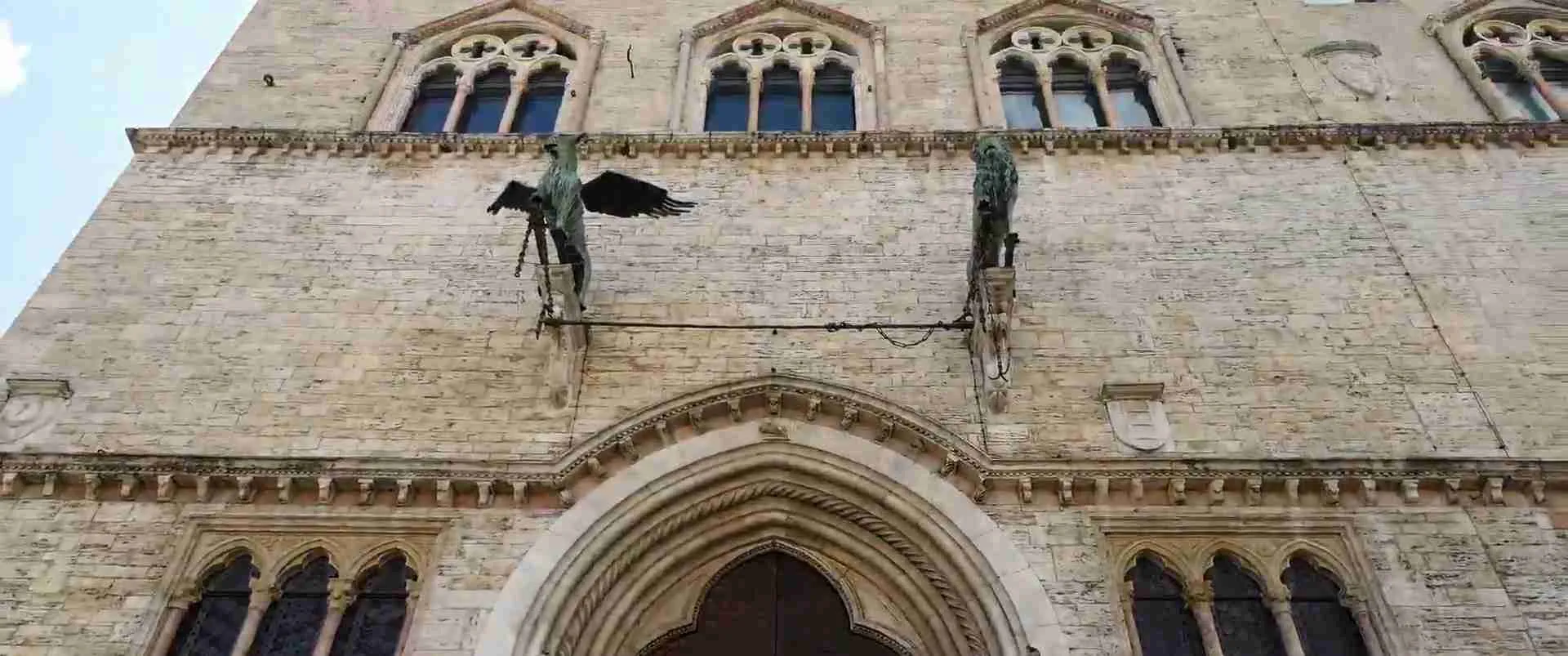
Walk north along Corso Vannucci past the Palazzo dei Priori — the greatest example of Gothic civic architecture in central Italy — noting the bronze griffin and lion above the main portal, the city’s heraldic symbols since the 13th century. The Collegio della Mercanzia (included in the €7 Collegio del Cambio ticket) occupies a side entrance in the same building and contains extraordinary carved wood panelling from 1390, a masterpiece of late Gothic decorative art.
Piazza IV Novembre opens at the north end of Corso Vannucci. The Fontana Maggiore at its centre, completed in 1278, is the work of Nicola and Giovanni Pisano — the same sculptors responsible for the pulpits at Pisa and Siena. Examine the 50 marble bas-reliefs on the lower basin at close range; they depict the months, labours of the year, biblical figures, and historical personages with a naturalism that preceded the formal Renaissance by nearly two centuries. The Cathedral of San Lorenzo flanks the piazza on the north; entry is free, and the interior contains a Renaissance interior of considerable grandeur, though the building’s exterior deliberately left unfinished in striped marble sets a melancholy tone that suits its place.
Total walking time: 45-60 minutes at an easy pace. Add 45 minutes to visit the Galleria Nazionale dell’Umbria (€10-12, top floors of Palazzo dei Priori, Tue-Sun 8:30-19:30) and another 30 minutes for the Collegio del Cambio (€7, Corso Vannucci 25, daily 9:00-19:00).
The Via dell’Acquedotto Walk: Perugia’s Most Atmospheric Hidden Path 2026
The Via dell’Acquedotto is Perugia’s best-kept non-secret — a medieval aqueduct channel converted into an elevated pedestrian walkway above the city’s sloping rooftops. The path runs approximately 300 metres at rooftop height between the Cathedral and the residential neighbourhood of Porta Sole, passing above gardens, terraced orchards, and the backs of medieval houses, with views across the valley and toward Monte Subasio in the direction of Assisi.
The aqueduct itself dates to 1254 in its first construction phase, with the full four-kilometre route from Monte Pacciano completed in 1278 — the same year the Fontana Maggiore received its water supply. Engineers solved the problem of supplying a hilltop city by using a pressurised conduit system that forced water uphill through an innovative hydraulic design. Walking the preserved section of the channel today means walking on top of a structure that solved one of medieval engineering’s hardest problems.
To access the walk: from Piazza IV Novembre, walk north along the side of the Cathedral, cross the road at the end of the building, and descend the steps to the left where the aqueduct path begins. The walking surface is uneven stone at original medieval level; flat-soled shoes are strongly recommended. The route connects naturally with the Via del Fagiano and Via Benedetta, two of the most atmospheric stepped alleys in the city, which continue downhill through residential neighborhoods to Porta Sole with its panoramic terrace over the Umbrian valley.
The full Via dell’Acquedotto walk including Via del Fagiano and Via Benedetta takes 30-45 minutes. It is entirely free. The views from the elevated path justify a significant detour even for visitors on tight schedules — this is one of the genuinely unmissable experiences in Perugia that most day-trippers never find.
The Etruscan Circuit: Ancient Gates and Walls
Perugia’s Etruscan city walls, constructed in the 3rd century BC, survive in scattered but substantial sections across the historic perimeter. The most dramatic single monument is the Arco Etrusco (also called Arco di Augusto) at the north end of the historic center — a free-standing gateway of enormous tufa blocks that has stood without mortar for over 2,300 years. The gateway retains its Etruscan lower sections beneath a Renaissance loggia added by the Della Corgna family in 1580, visible in the contrasting stone colours at different heights.
The Etruscan circuit walk begins at the Arco Etrusco, continues east along Via Ulisse Rocchi to the Arco dei Gigli (a smaller and less visited Etruscan gate in excellent preservation), then south to the Pozzo Etrusco on Piazza Danti — a third-century-BC cistern cut entirely through rock, 37 metres deep and 5.6 metres wide, with its original system of two superimposed barrel-vaulted tunnels still intact. Admission to the Pozzo Etrusco costs approximately €3. Looking down through the glass floor section at the top into the darkness 37 metres below is a surprisingly vertiginous experience.
The Porta Sant’Angelo, at the far northern edge of the historic center on Via del Tempio, is Perugia’s best-preserved Etruscan gate — a massive semicircular arch of squared stone blocks, free to walk through, best seen in late afternoon light. The gate stands directly adjacent to the Tempio di Sant’Angelo, making the two a logical combined stop on the Etruscan circuit.
Total circuit walking time: 60-90 minutes depending on stops inside the Pozzo Etrusco and at the Tempio. Add 20-30 minutes for the Museo Archeologico Nazionale (located in the former convent of San Domenico, with the city’s main Etruscan and Roman collections; check current admission prices at museiumbria.beniculturali.it).
The Churches and Convents Route
This free-of-charge route connects Perugia’s most exceptional religious buildings, most of which receive fewer visitors than the secular monuments on Corso Vannucci. Start at the Oratorio di San Bernardino (Piazza San Francesco, free), whose polychrome marble facade from 1461 by Agostino di Duccio is among the most beautiful small-scale Renaissance reliefs in Italy — a series of playful carved angels and saintly figures arranged across the facade with extraordinary lightness. The oratorio is rarely locked; interior access varies.
From San Bernardino, head northeast to the Cappella di San Severo (€4, Piazza Raffaello) — which the section on hidden gems covers in depth. Then continue to the Church of San Filippo Neri (Piazza Morlacchi, free) with its painted oval interior from the 17th century, a Baroque counterpoint to the Gothic and Renaissance buildings dominating the center.
The Basilica di San Pietro stands outside the main historic loop at the southeast edge of the city, approximately 800 metres from Piazza IV Novembre along Borgo XX Giugno (free entry). The monumental carved choir stalls inside — 88 seats carved between 1526 and 1535 by Fra Damiano da Bergamo — are widely considered among the finest wood-carving in Italy, rivalling the famous stalls of Monte Oliveto Maggiore in Tuscany. The church’s sacristy holds paintings by Perugino and Sassoferrato. Unusually for a major attraction of this quality, San Pietro sees very few foreign visitors outside weekends. The surrounding Borgo XX Giugno, with its arch gateway and long straight street lined with medieval buildings, also deserves the slow walk there and back.
Underground Perugia: Rocca Paolina and the Buried Medieval City
The Rocca Paolina is one of the most extraordinary urban experiences in Italy — an intact 16th-century city buried beneath a Renaissance fortress, accessible freely through public escalators running through its corridors. Pope Paul III ordered the fortress built in 1540 as a symbol of Papal authority over the rebellious Perugians following the Salt War. Construction involved burying an entire medieval neighbourhood, including the Baglioni family’s towers and palaces, the Via Baglioni, and surrounding houses, using them as the foundations for the new fortress above.
When Perugia’s citizens reclaimed their city in 1860 during Italian unification, they immediately demolished the hated fortress above — but the underground medieval streets it was built over had been preserved perfectly beneath it for over 300 years, sealed and dry. Today visitors enter through escalators from Piazza Partigiani at the lower end of the city or from the loggia entrance on Piazza Italia above, and walk through the original Via Baglioni — a complete medieval street with house facades, doorways, stairs, and stone flooring still intact, now running underground in perpetual dim light. The experience of walking a medieval street 15 metres below a contemporary city is unique in Italy and arguably in Europe.
The Rocca Paolina costs nothing and requires no reservation. It is open daily during public hours, and the escalators running through it operate as part of the city’s public transport network connecting the lower Piazza Partigiani with the upper Piazza Italia. This means locals use the underground street as a daily shortcut while tourists drift through the same space examining 500-year-old doorframes. The museum area within the Rocca — where signage explains the history of the Salt War and the Baglioni family — adds context that rewards 30-45 minutes of exploration beyond a simple transit walk through.
Via Baglioni, the main buried street, runs approximately 200 metres east to west. Side passages, vaulted rooms, and the remains of towers branch off it. Bring a light jacket even in summer — the underground temperature stays constant at around 14°C year-round, making it a welcome cool refuge during July and August heat.
The Perugia Underground guided tour (€10, booked through GetYourGuide) complements the Rocca Paolina self-visit by focusing on the Etruscan stratum beneath the Cathedral rather than the medieval-Renaissance layer of the Rocca. Together, the two underground experiences give a vertical cross-section through Perugia’s entire history from the 7th century BC to the 16th century AD — a sequence available nowhere else in Umbria.
Hidden Gems and Secret Spots of Perugia in 2026
Perugia’s best-hidden treasures sit within 15 minutes’ walk of Corso Vannucci but receive a fraction of the footfall of the main monuments. These are the sights that distinguish a Perugia visit from the standard Umbrian itinerary — experiences that residents recommend but that rarely appear in mainstream travel coverage.
Tempio di Sant’Angelo: Perugia’s Forgotten Masterpiece
The Tempio di Sant’Angelo, also known as the Church of San Michele Arcangelo, stands near Porta Sant’Angelo at the far northern edge of the historic center. It is a circular late-antique building dating to the 5th or 6th century AD, constructed reusing 16 ancient Roman columns from an earlier pagan temple on the same site — making it one of the oldest continuously used Christian buildings in Italy. The round plan and the ancient columns arranged in a double ring create an interior unlike anything else in Umbria, simultaneously Roman and early Christian.
Entry is free. The church sees almost no organised tour traffic despite being a site of genuine archaeological and architectural significance. The structure is small — 20 metres in diameter — but the atmosphere inside, with the original Roman column shafts carrying the circular colonnade and the medieval mosaic fragments surviving in patches on the floor, is deeply evocative. Combine the visit with the adjacent Porta Sant’Angelo for a 45-minute detour that covers 1,800 years of Perugian history without spending anything.
To reach the Tempio: from Piazza IV Novembre, walk north through Via dei Priori to Piazza San Francesco, continue up Corso Garibaldi past the medieval convent facades, and follow the street to its end at the church. The walk itself is among the quietest and most medieval-feeling in the city, passing through a residential quarter almost entirely free of tourist infrastructure.
Cappella di San Severo: Raphael’s Earliest Surviving Fresco
The Cappella di San Severo on Piazza Raffaello holds a remarkable document of two generations of Umbrian Renaissance painting: the upper half of the Trinity and Saints fresco was painted by Raphael Sanzio in 1504-1508, during his formative years in Perugia before his departure for Florence and Rome. The lower half was added by his teacher Perugino in 1521, sixteen years after Raphael’s work and three years after Raphael’s death at 37 — a poignant visual dialogue between master and student.
The fresco suffered serious damage over the centuries and only the upper section of Raphael’s contribution survives. What remains shows the young painter’s work before the sweeping compositional ambition of his Vatican frescoes, with a restraint and tenderness that reflects his training in the Perugino workshop. The lower Perugino sections are fully intact and display the characteristic gentle faces and serene landscape backgrounds that defined the Umbrian school.
Admission costs €4 for adults, €1 for children aged 7-14, free for those under 7. Opening hours: March-October daily 10:00-13:30 and 14:30-18:30; November-February daily 10:00-13:30 and 14:30-16:30, with Saturdays, Sundays, and holidays closing at 17:30. The chapel is small; visits last 15-20 minutes. The location in a quiet residential piazza near the Arco Etrusco means it combines naturally with the Etruscan circuit walk described above. Despite containing one of the very few surviving in-situ works by Raphael outside Rome, the chapel rarely has more than a handful of visitors at any one time.
Oratorio di San Bernardino: A Hidden Renaissance Jewel
The Oratorio di San Bernardino on Piazza San Francesco presents one of the finest examples of Florentine Renaissance polychrome marble carving outside Florence itself. Agostino di Duccio designed and executed the facade between 1457 and 1461, covering it with carved reliefs of angels, saints, and allegorical figures in pink, white, and grey marble with a lightness and playfulness that prefigures the joy of Baroque decoration by 150 years. The facade’s central lunette above the main doorway shows San Bernardino in glory surrounded by angels, while the pilasters carry floating angel musicians in a style resembling nothing else in 15th-century Umbrian art.
Entry is free, though the interior is not always accessible. The exterior alone justifies the five-minute walk from Corso Vannucci. The piazza around it — Piazza San Francesco — is one of the few open spaces in the historic center large enough to step back and view a facade without pressing up against the opposite wall. The Church of San Francesco al Prato behind the oratorio contains significant 13th-century frescoes and is accessible through the same entrance.
Basilica di San Pietro: The Most Spectacular Interior in Perugia
The Basilica di San Pietro stands at the southeastern edge of the historic city along Borgo XX Giugno, a five-minute walk from the Giardini Carducci gardens. The church dates to the 10th century in its original foundation but received its current interior in the 16th century, including the extraordinary carved wooden choir completed in 1535. Fra Damiano da Bergamo and his workshop produced 88 stalls over several years, each back panel inlaid with wood intarsia images of extraordinary precision and variety — biblical scenes, landscapes, architectural fantasies, and portraits rendered entirely in differently toned wood without a single drop of paint.
The church also holds a Pietà attributed to Perugino (though scholarly debate continues on this attribution), works definitively by Sassoferrato and Guido Reni, and an elaborately carved wooden ceiling from the 16th century. The sacristy retains its original painted wooden cupboards and a small painting collection. Entry is free; the church is open for visitors daily except during religious services. The Borromini-influenced campanile tower visible from across Perugia’s southern edge belongs to San Pietro and serves as a useful orientation marker when approaching from the lower city.
Borgo XX Giugno itself is worth the walk. The long straight street lined with medieval facades and entered through the gateway arch of Porta San Costanzo is one of Perugia’s most photogenic and quietest thoroughfares, largely bypassed by tour itineraries that concentrate on the northern historic center.
Giardini Carducci: Panoramic Views and a Hidden Garden
The Giardini Carducci, directly adjacent to Piazza Italia, offer some of the finest panoramic views in Umbria from a free, easily accessible public garden. The formal terraced garden looks south and west across the broad Umbrian valley toward Assisi on its hill, Spello, and, on clear days, the distant Apennine skyline. The garden is uncrowded in early mornings and late afternoons, when the horizontal light on the valley below rewards extended time. Binoculars bring the Basilica of Saint Francis in Assisi into clear view from the upper terrace — a 25-kilometre sight line that places Perugia’s topographic dominance over the region in immediate perspective.
Etruscan Perugia: Arco Etrusco, Pozzo Etrusco, and the Ipogeo dei Volumni
Perugia was an Etruscan city of the first rank — one of the 12 cities of the Etruscan League — and the archaeological evidence of that 2,400-year-old civilisation is more accessible here than in almost any other Italian city. The Arco Etrusco, the Pozzo Etrusco, the surviving sections of the 3rd-century-BC city walls, and the Ipogeo dei Volumni collectively form one of the finest Etruscan heritage itineraries in central Italy.
The Arco Etrusco at the north end of Via Ulisse Rocchi is the most visually dramatic single Etruscan monument in Perugia — a freestanding gateway 19 metres high built from enormous squared tufa blocks without mortar. The name “Arco di Augusto” reflects the Roman-era inscription on the upper arch, but the main structure is demonstrably Etruscan in construction technique. Walking through the arch in either direction gives a visceral sense of the Etruscan city’s physical scale. The gateway is free and open at all hours.
The Pozzo Etrusco (Etruscan Well) on Piazza Danti, entered through a doorway just off the north side of Piazza IV Novembre, is a 3rd-to-2nd-century-BC cistern cut through bedrock to a depth of 37 metres with a diameter of 5.6 metres. The original double-tunnel system for lowering and raising water buckets simultaneously without tangling remains structurally intact and visible through the glass floor panels at the entrance. Admission costs approximately €3. The well is small — visits last 15-20 minutes — but the technical ingenuity of the design and the sheer scale of the excavation are startling.
The Ipogeo dei Volumni, located approximately 6 kilometres southeast of the historic center in the Ponte San Giovanni district, is among the best-preserved Etruscan hypogeum tombs in Italy. The tomb complex, built for the aristocratic Volumni family in the 2nd century BC, contains nine chambers arranged around a central hall, with carved stone ash urns depicting family members in reclining poses on the lids — a characteristic Etruscan funerary tradition. The archaeological site was closed from June 2025 for extensive renovation and accessibility improvements, with its reopening scheduled for April 2026, meaning it should be fully accessible again for 2026 visitors. Admission costs €3 for adults. Reaching the site requires a bus from Piazza dei Partigiani or the Minimetro to Ponte San Giovanni; check timetables at APM Perugia (apmperugia.it). The hypogeum includes a small antiquarium with additional finds from the Palazzone necropolis.
The Museo Archeologico Nazionale dell’Umbria, located in the former Convent of San Domenico in Piazza Giordano Bruno (a short walk from the historic center), holds the primary collection of Etruscan and Roman finds from Perugia and the surrounding area, including the famous Cippo Perugino — a 3rd-century-BC Etruscan bronze tablet with one of the longest Etruscan inscriptions known, whose still-partially-undeciphered text has fascinated linguists since its discovery in 1822. Check current admission prices and hours at museiumbria.beniculturali.it.
Art and Culture Tours of Perugia 2026
Perugia’s art collections rank among the finest in central Italy outside Florence and Siena, concentrated in a small geographic area that makes combining multiple venues in a single day straightforward. The Galleria Nazionale dell’Umbria, the Collegio del Cambio, and the Cappella di San Severo together provide one of the most comprehensive surveys of medieval and Renaissance Umbrian painting available anywhere.
Galleria Nazionale dell’Umbria: Italy’s Greatest Collection of Umbrian Painting
The Galleria Nazionale dell’Umbria occupies the upper floors of the Palazzo dei Priori on Corso Vannucci and holds the national collection of Umbrian painting across 39 rooms covering the 13th through 19th centuries. The collection’s strength lies in the 14th through 16th centuries — Duccio di Buoninsegna, Arnolfo di Cambio, Benedetto Bonfigli, Fiorenzo di Lorenzo, Perugino, and Pinturicchio are all represented with major works, giving the gallery a depth of Umbrian School painting unmatched anywhere.
Full adult admission costs €10 for the permanent collection, rising to €12 when temporary exhibitions are installed on the third floor. Opening hours run Tuesday to Sunday 8:30-19:30 (last admission 18:30); the gallery closes Mondays. On the first Sunday of every month, admission is free with a mandatory €2 booking fee through TicketOne. The audio guide costs €5 additional (making total entry with guide €15 for the permanent collection or €17 during exhibition periods). Book tickets in advance at TicketOne to avoid waiting during busy summer weekends.
The Sala Podiani on the ground floor hosts temporary exhibitions and concerts; check gallerianazionaledellumbria.it for the current programme. The gallery also holds a specialised art history library with over 25,000 volumes open to researchers by appointment. For most visitors, 1.5 to 2 hours in the permanent collection is sufficient for a thorough visit at a comfortable pace without rushing through the rooms.
Collegio del Cambio: Perugino’s Greatest Frescoes
The Nobile Collegio del Cambio on Corso Vannucci 25 contains the most important surviving fresco cycle by Pietro Vannucci, called Perugino — the 16th-century hearing room of the Moneychangers’ Guild, decorated by Perugino between 1496 and 1500 with a programme integrating Christian and classical humanist themes across every surface of the ceiling and walls. The Sala dell’Udienza frescoes show virtues, prophets, sibyls, classical heroes, and saints in a compositional system designed to instil ethical character in the bankers and merchants who met here to settle disputes.
The adjacent Cappella di San Giovanni Battista, painted by Giannicola di Paolo between 1515 and 1518, completes the experience. Admission to the Collegio del Cambio — which includes access to the Collegio della Mercanzia in the same building — costs €7 per adult. Opening hours: daily 9:00-19:00. The visit takes 30-45 minutes for the rooms. Photography is not permitted inside. The carved wooden furnishings, including the Tribunale bench and the intarsia work by Antonio da Mercatello (1508), deserve as much attention as the frescoes themselves.
The “La Perugia del Perugino” Museum Pass 2026
The combined museum card “La Perugia del Perugino” costs €15 per person and provides access to four institutions holding works by Perugino and his contemporaries: the Nobile Collegio del Cambio, the Nobile Collegio della Mercanzia, the Museo Capitolare della Cattedrale di San Lorenzo, and the Museo di Palazzo Baldeschi al Corso. The card is valid for three days from first use and is nominally assigned — bring identification. Purchase at the ticket desk of any of the four institutions.
The Museo Capitolare, housed in the Cathedral complex, holds Perugia’s most important collection of medieval goldsmithery, illuminated manuscripts, and sacred art, including a 15th-century ring traditionally identified as the Virgin Mary’s wedding ring — one of the city’s most famous relics and the cause of a notorious theft attempt in 1473. The Museo di Palazzo Baldeschi al Corso presents Perugian art from the 14th through 20th centuries in a beautifully restored medieval palazzo on Corso Vannucci.
Visitors who plan to visit the Galleria Nazionale dell’Umbria on the first Sunday of the month and use the Perugino pass for the other four sites spend approximately €17 total (€2 GNU booking + €15 pass) to access five major cultural institutions over a three-day period — outstanding value by any Italian museum standard.
Food and Drink Walking Experiences in Perugia 2026
Perugia’s food culture reflects its position at the intersection of Umbrian, Lazio, and Tuscan influences — black truffles from Norcia and Spoleto, cured meats and lentils from Castelluccio di Norcia, olive oil from Lake Trasimeno’s hilly shores, and the internationally famous Perugina chocolate produced in the city since 1907. Walking the food geography of the historic center, even without a guide, reveals an unusual concentration of artisan producers, traditional market stalls, and local restaurants serving regional cuisine untouched by the tourist-menu conventions common in more heavily visited Italian cities.
Perugia’s Best Local Markets and Artisan Shops
The Mercato Coperto (Covered Market) in Piazza Matteotti operates daily and brings together Umbrian producers of cheese, cured meats, olive oil, legumes, fresh pasta, seasonal vegetables, and local bread. The market is free to browse and the stalls are primarily oriented to local shoppers rather than tourists, which keeps the quality and pricing closer to the production source. Look for fagiolina del Trasimeno — a tiny, ancient bean variety grown around Lake Trasimeno since at least the Roman period — pecorino stagionato from Umbrian hill farms, and fresh tartufo nero from the Norcia valley when in season (winter and spring).
Antica Spezieria e Drogheria Bavicchi, a spice shop and general store on Corso Vannucci that has operated continuously since the 19th century, sells an extraordinary collection of herbs, spices, dried legumes, and Umbrian specialties alongside the kind of compressed truffle products and bottled sauces that make practical edible souvenirs. Via Del Vino’s food tour includes this shop as a stop, providing access to the owner’s backstory and product context that transforms the browsing experience.
Chocolate Tours and the Perugina Heritage
Perugia is inseparable from chocolate. The Perugina company, founded in the city in 1907, invented the Baci (“Kisses”) chocolate in 1922 — a hazelnut and dark chocolate confection wrapped with love messages in multiple languages that became one of Italy’s most recognised confections internationally. The Casa del Cioccolato Perugina, located in the San Sisto district outside the historic center (accessible by bus), operates as both a factory museum and a chocolate-making school. Admission to the museum and factory tour costs approximately €14 for adults; chocolate-making workshops (where visitors produce their own Baci under expert guidance) require advance booking and cost more.
Within the historic center, the Eurochocolate Festival transforms the city each October — scheduled across ten days in the third or fourth week of the month — into one of Europe’s largest chocolate events, with outdoor installations, artisan producers from across Italy and abroad, demonstration kitchens, and an extended chocolate market occupying Corso Vannucci and surrounding piazzas. If your 2026 visit falls in October, the festival adds an extraordinary dimension to any food walk; if crowds are a concern, aim for a weekday rather than the weekend peaks.
Wine and Truffle Tasting Walks Near Perugia 2026
The Umbrian wine country begins effectively at Perugia’s doorstep. The Colli Perugini DOC zone covers the gentle hills immediately surrounding the city, producing Sangiovese-based reds and crisp Grechetto whites. Tenuta dei Mori, a boutique organic estate in the hills above Marsciano approximately 20 kilometres from the city, offers winery visits with panoramic terrace tastings. Book directly through the estate for private or small-group visits.
Truffle country centres on the Norcia and Spoleto valleys to the southeast, but several Umbrian estates and agritourismo near Perugia offer truffle walks and tastings as half-day experiences combinable with a Perugia city visit. Via Del Vino coordinates multi-day programs incorporating truffle hunts near Spoleto; for half-day wine and truffle tastings closer to the city, the Wine Tasting Lunch in Spello with Truffle Tasting (bookable through Trip.com and similar platforms from approximately €50-70 per person, 2 hours) combines a drive to Spello with a tasting lunch and truffle demonstration.
The Umbria Jazz Festival in mid-July — one of Europe’s most prestigious jazz events — occupies the whole city for ten days and attracts headliners performing in the Giardini Carducci, Piazza IV Novembre, and the Arena Santa Giuliana outside the walls. Tickets for individual concerts run €20-80 depending on the performer; many free performances take place in public piazzas throughout the festival period. Accommodation books out months in advance for festival dates; reserve early if visiting in July.
Day Trips from Perugia 2026: Discovering Umbria’s Secrets
Perugia’s position in central Umbria places it within an hour’s drive or bus journey of some of the finest medieval towns, sacred sites, and natural landscapes in Italy. The following destinations represent the most rewarding day-trip options from the city in 2026, ranging from the internationally famous to the deeply obscure.
Assisi: The Nearby UNESCO World Heritage City
Assisi lies 25 kilometres east of Perugia, accessed by regional train (30-40 minutes, approximately €4 one way from Perugia Fontivegge station) or by organised day-trip bus. The Basilica of Saint Francis, inscribed as a UNESCO World Heritage Site, houses the most significant cycle of narrative frescoes in Italian art history — the 28 scenes from the life of Saint Francis attributed primarily to Giotto in the Upper Basilica, dating from around 1296-1300. The Lower Basilica contains earlier frescoes by Cimabue and Simone Martini of equal importance.
Entry to the Basilica is free, though a donation is requested. The volume of visitors — Assisi is one of Italy’s most visited pilgrimage and heritage sites — means early arrival (before 9:00 AM) or late afternoon visits (after 15:00) provide a significantly better experience. Combined Perugia-Assisi guided tours run from approximately €40-60 per person for small-group formats departing from Perugia (check current availability on Viator). The medieval streets of Assisi beyond the Basilica — Via San Francesco, the Piazza del Comune with its Roman Temple of Minerva, and the Rocca Maggiore fortress above — reward additional time beyond a quick Basilica visit.
Bevagna and Montefalco: Umbria’s Best-Kept Medieval Secrets
Bevagna, 35 kilometres south of Perugia on the SP444, is among the most perfectly preserved medieval towns in Italy — a walled town of Roman and medieval layers that sees comparatively few international visitors despite its extraordinary quality. The Piazza Silvestri at its centre holds three medieval churches of different periods in direct visual dialogue: the 12th-century San Silvestro (with its intact Romanesque interior), the 13th-century San Michele (with a superb carved portal), and the 14th-century Palazzo dei Consoli. The piazza is free to experience; churches charge nominal fees for special areas. The Museo di Bevagna holds Roman-era mosaics found in the town’s subsoil, including a complete bathhouse mosaic of exceptional quality.
Montefalco, 10 kilometres east of Bevagna, rises above the Sagrantino wine country — a hilltop town of perfect medieval proportions whose church of San Francesco (now a museum, approximately €6 entry) contains Benozzo Gozzoli’s fresco cycle of the life of Saint Francis, rivalling Assisi’s cycle in quality if not in famous attribution. The panoramic view from the tower above the museum justifies the climb alone — on clear days, a complete semicircle of Umbrian landscape from Spoleto to Perugia is visible.
Getting to Bevagna and Montefalco without a car requires bus connections from Foligno (itself reachable by train from Perugia, approximately 30 minutes); the logistics work but require planning. A rental car or organised private driver opens up the combination as a comfortable half-day excursion.
Lake Trasimeno and Its Islands
Lake Trasimeno, the fourth-largest lake in Italy, lies 30 kilometres west of Perugia and is the site of one of Hannibal’s most decisive victories over Rome (217 BC) as well as some of Umbria’s most tranquil landscapes. The lake is accessible by direct train from Perugia (Castiglione del Lago station, approximately 25 minutes, around €4 one way).
Castiglione del Lago, on a promontory above the western shore, is the most visited of the lakeside towns, with a well-preserved Rocca and a 13th-century Palazzo Comunale. The town is pleasant for an afternoon but not exceptional. The lake’s islands are the real destination: Isola Maggiore, reached by ferry from Tuoro sul Trasimeno or Passignano (ferry timetables and prices at laketrasimeno.eu), is a largely car-free island of around 50 inhabitants, with a medieval village, a church containing a Perugino, and walking paths around the shore through ancient olive trees. The island receives visitors without needing advance booking; the ferry crossing takes approximately 15 minutes.
Isola Polvese, the largest island, has been managed as a natural park since the 1980s and is entirely uninhabited except for the park authority. Ferry access from San Feliciano on the eastern shore provides access to the island’s trails, medieval castle ruins, and fishponds. The combination of Isola Maggiore and Isola Polvese in a single day requires a car between the two ferry ports on opposite shores of the lake.
Gubbio: Northern Umbria’s Medieval Fortress City
Gubbio, 40 kilometres north of Perugia, is among Italy’s most dramatically positioned medieval cities — a compact stone town pressed against the base of Monte Ingino with a Gothic civic palace (the Palazzo dei Consoli) cantilevered dramatically over a cliff edge. The town receives far fewer foreign visitors than its quality justifies, partly due to the absence of a railway connection (buses from Perugia’s bus station take approximately 1 hour, €4-6 one way).
The Palazzo dei Consoli (€8 entry) contains the famous Tavole Eugubine — seven bronze tablets inscribed in both Umbrian and Latin, the most important document in the extinct Umbrian language and one of the longest pre-Roman inscriptions in any Italic language. The funivia cable car (approximately €8 round trip) rises from the lower town to the Basilica of Sant’Ubaldo at the summit of Monte Ingino, from which the entire Apennine massif is visible on clear days. The cable car cars are open-sided baskets — an unusual vintage mountain transport that is a destination experience in itself.
Practical Planning for Perugia Tours and Walks in 2026
Getting to Perugia and Getting Around in 2026
Perugia is accessible by train from Rome (approximately 2 hours via Foligno, roughly €15-25 depending on service) and Florence (approximately 2 hours via Terontola, similar pricing). Perugia’s main railway station (Fontivegge) sits in the valley below the historic center, connected to the upper city by the Minimetro and city buses. The Minimetro runs from Pian di Massiano (near the football stadium, terminus of the Minimetro at the southern end) to Pincetto (the upper historic center terminus), stopping at 7 stations including the main train station. Single tickets cost €1.50 (valid for 70 minutes), the daily pass costs €5.40, and a 10-ride carnet costs €12.90. The full journey takes approximately 13 minutes.
Perugia Airport (San Francesco d’Assisi Airport) in Sant’Egidio connects the city to approximately 15 Italian and European destinations. The airport ACAP shuttle bus runs to Piazza Italia in the city center. By car, the historic center is a ZTL (restricted traffic zone) and parking areas sit around the outer perimeter of the historic ridge; the main parking areas at Piazza dei Partigiani and Piazza del Cimitero are connected to the upper city by escalators through the Rocca Paolina.
Within the historic center, everything is accessible on foot. The main historic route (Piazza Italia to Arco Etrusco) covers approximately 600 metres of flat-to-gently-sloping ground. Side routes toward Tempio di Sant’Angelo, San Pietro, and Porta Sole involve steeper slopes and stairs. Comfortable walking shoes with grip are essential; the ancient stone surfaces become slippery when wet. The Minimetro card is worth buying for airport or train station connections; within the hilltop center itself, no transport is needed between any of the sites covered in this guide.
Best Season for Walking Tours in Perugia 2026
April through June delivers the best overall conditions for walking tours in 2026: temperatures in the 15-22°C range, the surrounding countryside in full green before summer drought, and tourist volumes significantly lower than July-August peaks. The Umbrian light in May is exceptional for photography from the Via dell’Acquedotto and Giardini Carducci viewpoints.
September and October are equally strong, with harvest season adding truffle and wine activities to the city’s cultural programme. The Eurochocolate Festival in October (third or fourth week) brings large weekend crowds but leaves weekdays comfortably manageable. November and December are cold — average temperatures drop to 5-10°C — but hotel rates fall significantly and the Galleria Nazionale and Collegio del Cambio are entirely uncrowded.
July brings the Umbria Jazz Festival, scheduled across the second and third weeks of the month, which fills the city with music and international visitors and creates a festive atmosphere unlike any other time of year. Book accommodation and any guided tours at least six weeks ahead for festival dates. Outside the festival window, July is hot (30°C+) and humid; the underground Rocca Paolina becomes a genuinely welcome cool refuge in the middle of the day.
Booking Tours and Tickets in Advance for 2026
Most Perugia attractions do not require advance booking outside July (Umbria Jazz) and October (Eurochocolate). The Galleria Nazionale dell’Umbria recommends booking on the first Sunday of the month (free entry day) since the €2 reservation is required and slots fill. The Collegio del Cambio and Cappella di San Severo operate walk-up ticketing without reservation requirements year-round.
For guided tours, Via Del Vino’s food tours book out 1-2 weeks ahead in summer and during October, and advance booking through viadelvino.com is strongly recommended. The Taste Perugia Food Tour does not accept walk-up bookings; tickets are only available through the website. Licensed walking tours through Viator and GetYourGuide are available on shorter notice but private tour guides — especially those with the strongest review records — book out during the busy spring and autumn travel seasons.
The Ipogeo dei Volumni, which reopened after renovation in approximately April 2026, benefits from calling ahead (Tel. +39 075 393329) for guided tour bookings, as the free guided tours that accompany the standard admission ticket operate at set times and with a maximum group size. The experience is significantly enriched with a guide explaining the Volumni family’s social and religious context.
Frequently Asked Questions About Perugia Tours and Walking Routes 2026
Is Perugia walkable for a first-time visitor?
Yes, Perugia’s historic center is entirely walkable in a day or two. The main attractions between Piazza Italia and the Arco Etrusco span approximately 600 metres of the central ridge, with side routes extending north to Porta Sant’Angelo and south to the Basilica di San Pietro. The terrain is uneven — ancient stone streets with frequent stairs and slopes — but no attraction requires transport within the historic center itself. Comfortable, flat-soled shoes with grip are essential; high heels and thin-soled sandals are impractical on medieval stone surfaces.
How many days do I need in Perugia in 2026?
Two full days allow a thorough Perugia experience: one day for the historic core (Galleria Nazionale, Rocca Paolina, Fontana Maggiore, Corso Vannucci, Collegio del Cambio), a half-day for the Etruscan circuit and hidden churches (Arco Etrusco, Pozzo Etrusco, Tempio di Sant’Angelo, Cappella di San Severo), and the remaining time for the Via dell’Acquedotto walk, Basilica di San Pietro, and a food tour. Three days allows an Assisi day trip or a Lake Trasimeno afternoon alongside thorough city coverage.
What is the Rocca Paolina and is it really free?
The Rocca Paolina is a 16th-century papal fortress built by Pope Paul III in 1540 over a buried medieval neighbourhood, now accessible as a free underground public walkway beneath the city. The medieval streets of the original Baglioni neighbourhood — Via Baglioni and surrounding buildings — were preserved intact when the fortress was constructed over them and remain visible underground today. Entry is free at all times; the public escalators from Piazza Partigiani and Piazza Italia run through the underground complex as part of the city’s transport network. There is no ticket desk and no reservation required.
Can I see Raphael’s work in Perugia?
Yes. The Cappella di San Severo on Piazza Raffaello contains the upper half of a Trinity and Saints fresco painted by Raphael Sanzio in 1504-1508, before his departure for Florence and Rome. This is one of the very few in-situ Raphael works outside the Vatican. Admission costs €4 for adults. The lower portion of the same fresco was completed by Perugino in 1521, providing a direct visual comparison between master and student. The Galleria Nazionale dell’Umbria also holds works connected to the Perugia period of Raphael’s career alongside the major Perugino collection.
What is the best way to see Perugia on a budget in 2026?
Budget visitors to Perugia have an unusually generous free itinerary available. The Rocca Paolina underground, Via dell’Acquedotto, Arco Etrusco, Fontana Maggiore, Oratorio di San Bernardino facade, Tempio di Sant’Angelo, Cattedrale di San Lorenzo, Basilica di San Pietro, and Giardini Carducci all cost nothing. Visiting the Galleria Nazionale dell’Umbria on the first Sunday of the month reduces its cost to €2 (booking fee). The Cappella di San Severo at €4 provides one of the most remarkable artistic experiences in the city at minimal cost. A full day of culture in Perugia costs under €10 in admissions if planned around the free attractions and the Sunday GNU offer.
Is the Ipogeo dei Volumni open in 2026?
The Ipogeo dei Volumni closed for renovation in June 2025 with a reopening scheduled for April 2026. For visits from late spring 2026 onwards, the site should be fully operational — call ahead on +39 075 393329 to confirm current opening times and guided tour schedules. Admission costs €3 for adults. The site is located approximately 6 kilometres from central Perugia in the Ponte San Giovanni district and requires a bus or car to reach; check APM Perugia bus timetables at apmperugia.it for the most current service information.
What should I know about the Via Del Vino food tour?
Via Del Vino’s Taste Perugia Food Tour costs €90-110 per person and lasts approximately 4 hours, departing from Piazza IV Novembre at 10:00 AM. It includes 10 or more tastings of Umbrian foods at market stalls, artisan shops, cafes, and restaurants across the historic center, providing enough food for breakfast and a substantial lunch combined. The tour covers local cheeses, cured meats, Umbrian olive oil, fresh truffle pasta, regional wines, craft beer, chocolate, and a stop at one of Italy’s top 100 artisan gelaterias. Children are welcome; alcohol is reserved for those 18 and older. Book online at viadelvino.com at least one week ahead in summer and October, when demand is highest.
How do I get from Perugia to Assisi in 2026?
The most convenient connection between Perugia and Assisi in 2026 is by regional train from Perugia Fontivegge station to Santa Maria degli Angeli station (approximately 30-40 minutes, around €4 one way); from the Santa Maria degli Angeli station, a local bus connects to Assisi’s upper town, or the walk takes approximately 25-30 minutes uphill. Organised small-group day tours from Perugia to Assisi and back run €40-60 per person, including a walking tour of Assisi and a visit to the Basilica of Saint Francis, and are bookable through Viator and GetYourGuide. Driving takes approximately 30 minutes on the E45 motorway.
Are Perugia’s museums open on Mondays in 2026?
Opening days vary by institution. The Galleria Nazionale dell’Umbria closes Mondays; it opens Tuesday to Sunday 8:30-19:30. The Collegio del Cambio opens daily 9:00-19:00 including Mondays. The Cappella di San Severo closes Mondays from November through February but opens daily from March through October. The Rocca Paolina is accessible daily as a public passageway. Monday is a viable visiting day in Perugia, but plan around the Galleria Nazionale closure and verify individual site hours at official websites before arriving.
What is the Umbria Jazz Festival and should I plan my 2026 visit around it?
The Umbria Jazz Festival, held across ten days in mid-July, is one of Europe’s most prestigious jazz events and one of Perugia’s most celebrated annual occasions. Major international artists perform in the Giardini Carducci, Piazza IV Novembre, and the Arena Santa Giuliana. Concert tickets run €20-80 per performance; many free outdoor performances take place in piazzas throughout the festival period. Planning a visit around the festival adds a unique dimension to any Perugia trip but requires booking accommodation and restaurant reservations weeks or months in advance. Check umbriajazz.com for 2026 programme announcements, published several months ahead of the festival dates.