
Orlando Day Trips 2026: Best Excursions & Planning Guide
Orlando’s central Florida location places you within easy reach of Atlantic and Gulf Coast beaches, America’s oldest city, world-class space exploration exhibits, and pristine natural springs teeming with manatees and wildlife. These destinations range from 30 minutes to two hours from International Drive, offering everything from historical immersion to coastal relaxation without requiring overnight stays.
Key Takeaways:
- Space Coast Access 2026: Kennedy Space Center Visitor Complex sits one hour east of Orlando with admission at $75, featuring Space Shuttle Atlantis, Apollo/Saturn V Center, and Artemis II mission exhibits opening throughout 2026
- Historic St. Augustine: America’s oldest continuously occupied European settlement lies 100 miles northeast, combining 450 years of history with Castillo de San Marcos fortress admission at $15 and free walking along St. George Street’s pedestrian district
- Beach Variety: Atlantic Coast surf beaches (Cocoa Beach, Daytona Beach, New Smyrna Beach) sit one hour east, while Gulf Coast’s calm waters (Clearwater Beach, Sarasota) require 90 minutes to two hours southwest
- Natural Spring Encounters 2026: Blue Springs State Park offers guaranteed manatee sightings November through March, Silver Springs provides glass-bottom kayaking through crystal-clear water, and both lie within 90 minutes of Orlando
- Planning Efficiency: Most destinations operate year-round from 9 AM to 5 PM, with early morning departures (7-8 AM) allowing full-day exploration and return before Orlando evening traffic peaks
- Transportation Considerations: Personal vehicle remains most practical for day trips from Orlando in 2026, with I-4, I-95, SR 528, and Florida’s Turnpike providing direct routes to all major destinations
People Also Ask About Orlando Day Trips 2026
What is the best day trip from Orlando in 2026?
Kennedy Space Center Visitor Complex ranks as Orlando’s premier day trip in 2026, combining historical significance with active space exploration programs. Located one hour east in Merritt Island, the facility charges $75 admission and requires 6-8 hours for comprehensive exploration. The Space Shuttle Atlantis exhibit positions the actual orbiter at launch angle, the Apollo/Saturn V Center displays a 363-foot moon rocket, and new Artemis II exhibits throughout 2026 showcase NASA’s return to lunar exploration. The facility opens daily at 9 AM except Thanksgiving and Christmas, with parking costing $15 separate from admission.
How far is St. Augustine from Orlando for a day trip in 2026?
St. Augustine sits 100 miles northeast of Orlando, requiring approximately two hours driving via I-4 East to I-95 North. This distance makes St. Augustine manageable as a full day trip in 2026, with early morning departures (7-8 AM) allowing 6-7 hours of exploration before returning to Orlando. The historic district centers around St. George Street, a pedestrian-only thoroughfare free to walk, while Castillo de San Marcos fortress charges $15 admission for adults. Plan minimum five hours in St. Augustine proper for meaningful exploration of the colonial quarter, waterfront, and primary historic sites.
Which beaches are closest to Orlando for day trips in 2026?
Cocoa Beach sits closest to Orlando at one hour east via SR 528 (BeachLine Expressway), offering wide sandy beaches, consistent surf conditions, and free beach access along A1A. Daytona Beach lies one hour northeast via I-4 and I-95, famous for vehicle-on-beach access and the Daytona International Speedway complex. New Smyrna Beach sits 60 miles northeast, providing less crowded conditions and strong surf culture. On the Gulf Coast, Clearwater Beach requires 90 minutes to two hours southwest via I-4 West to SR 60 West, delivering powder-white sand and calm turquoise water. All beaches provide free or low-cost access in 2026, with parking ranging $5-15 per day.
Can you see manatees near Orlando in 2026?
Blue Springs State Park guarantees manatee sightings November through March when hundreds of West Indian manatees migrate to the 72-degree spring water. Located one hour north of Orlando in Orange City, the park charges $6 per vehicle entrance fee and allows viewing from designated boardwalks and platforms. Peak viewing occurs December through February when cold fronts drive maximum numbers into the spring run. Crystal River, two hours northwest, offers in-water snorkeling with manatees year-round, though winter months provide most reliable encounters. Silver Springs State Park, 90 minutes north, occasionally hosts manatees visible through glass-bottom boat tours.
Extended multi-day tours – 5+ days
Featured Florida Multi-Day Tour Packages
3 days
Florida 3-Day Discovery Tour
- ✓ Comprehensive Florida experience
- ✓ Expert local guides included
- ✓ All accommodation included
- ✓ Transportation provided
5 days
Florida 5-Day Highlights Experience
- ✓ Comprehensive Florida experience
- ✓ Expert local guides included
- ✓ All accommodation included
- ✓ Transportation provided
7 days
Florida 7-Day Cultural Journey
- ✓ Comprehensive Florida experience
- ✓ Expert local guides included
- ✓ All accommodation included
- ✓ Transportation provided
10 days
Florida 10-Day Complete Adventure
- ✓ Comprehensive Florida experience
- ✓ Expert local guides included
- ✓ All accommodation included
- ✓ Transportation provided
Multi-day tour packages powered by TourRadar. Prices and availability subject to change.
Introduction: Orlando Day Trip Planning for 2026
Orlando’s reputation as a theme park capital obscures its strategic position at the crossroads of Central Florida’s most diverse attractions. Within a two-hour radius, travelers access both Atlantic and Gulf coastlines, natural spring systems hosting year-round wildlife, America’s oldest European settlement, and active space exploration facilities launching missions to the Moon and Mars. This geographic advantage transforms Orlando from a single-destination vacation into a base camp for exploring Florida’s cultural, natural, and historical depth.
The infrastructure supporting these day trips has expanded considerably heading into 2026. I-4 corridor improvements completed in late 2025 reduced congestion between Orlando and the Space Coast, while SR 528 (BeachLine Expressway) maintains direct toll-road access to Cocoa Beach and Port Canaveral. The Brightline high-speed rail now connects Orlando International Airport to South Florida destinations, though personal vehicles remain most practical for the majority of day trip destinations covered in this guide. Most attractions maintain year-round operations with extended summer hours and compressed winter schedules.
Day trip planning from Orlando balances drive time against on-site exploration requirements. Kennedy Space Center demands a full six to eight hours for comprehensive touring, making it unsuitable for combining with other destinations. St. Augustine’s compact historic district concentrates attractions within walking distance, allowing efficient exploration despite the two-hour drive. Beach destinations offer flexibility — a few hours of sun and surf satisfies some travelers, while others spend entire days on the sand. Natural springs typically require three to four hours including kayaking or swimming time.
This guide organizes day trips by category — space exploration, historic cities, Atlantic beaches, Gulf beaches, natural springs, and specialty destinations — with each section providing specific 2026 pricing, drive times, parking information, and recommended time allocations. The goal is enabling informed decisions about which destinations match your interests, physical capabilities, and available time. Some travelers will visit Kennedy Space Center multiple times during a week-long Orlando stay, while others focus on sampling several beach destinations. The variety ensures no two Orlando-based vacations need duplicate each other’s day trip itineraries.
Kennedy Space Center Day Trips 2026
Kennedy Space Center Visitor Complex stands alone among Orlando day trips for combining operational spaceport access with museum-quality exhibits spanning six decades of American space exploration. Located on Merritt Island one hour east of Orlando via SR 528, the facility functions as both active NASA launch facility and public education complex. Admission costs $75 for adults in 2026 and remains valid for seven consecutive days, though most visitors complete their exploration in a single full day.
The journey from Orlando International Drive to Kennedy Space Center takes 50-60 minutes via SR 528 East (BeachLine Expressway), a toll road charging approximately $8 for the full route. Traffic flows smoothly except during active launch windows when temporary road closures near the facility can add 30-45 minutes to return trips. Launch viewing from the visitor complex requires separate tickets purchased directly from Kennedy Space Center, as standard admission excludes launch day access. The parking lot opens one hour before the facility at 8 AM, with the $15 parking fee paid via credit card at automated gates — cash is not accepted.
Space Shuttle Atlantis and Core Exhibits in 2026
Space Shuttle Atlantis anchors the visitor complex with the actual orbiter suspended at 43.21-degree angle, mimicking its position in orbit. The exhibit hall surrounding Atlantis contains over 60 interactive displays explaining shuttle systems, mission profiles, and the 135-flight shuttle program history from 1981 to 2011. Atlantis completed 33 missions, orbited Earth 4,848 times, and traveled 126 million miles during its operational career. Visitors walk beneath the orbiter’s heat shield tiles, examine the payload bay, and interact with touchscreens explaining specific missions and technological innovations.
The Shuttle Launch Experience simulator places visitors in a crew cabin experiencing the eight-and-a-half-minute ascent to orbit, complete with motion simulation, lighting effects, and authentic launch audio. The simulation runs continuously throughout the day with typical wait times of 15-30 minutes. Heroes & Legends featuring the U.S. Astronaut Hall of Fame presents personal artifacts and stories from Mercury, Gemini, and Apollo astronauts, including Alan Shepard’s golf club used on the Moon and the actual Mercury 9 capsule flown by Gordon Cooper in 1963.
The Rocket Garden displays eight authentic rockets from the Mercury, Gemini, and Apollo programs in vertical launch position. Free guided tours of the Rocket Garden depart hourly from 10 AM to 3 PM, providing detailed technical explanations and historical context. The newest addition to the Rocket Garden is a full-scale Space Launch System mockup representing the Artemis program’s heavy-lift rocket designed for lunar missions.
Apollo/Saturn V Center and Bus Tour Access 2026
The Kennedy Space Center Bus Tour remains the only public access to restricted areas of the working spaceport, included in general admission. Buses depart every 15-20 minutes from the visitor complex, requiring minimum two hours for the complete tour loop. The route passes the massive Vehicle Assembly Building where rockets are integrated before launch, historic Launch Complex 39A and 39B that supported Apollo Moon missions and continue launching commercial and NASA vehicles, and the Launch Control Center where countdowns are managed.
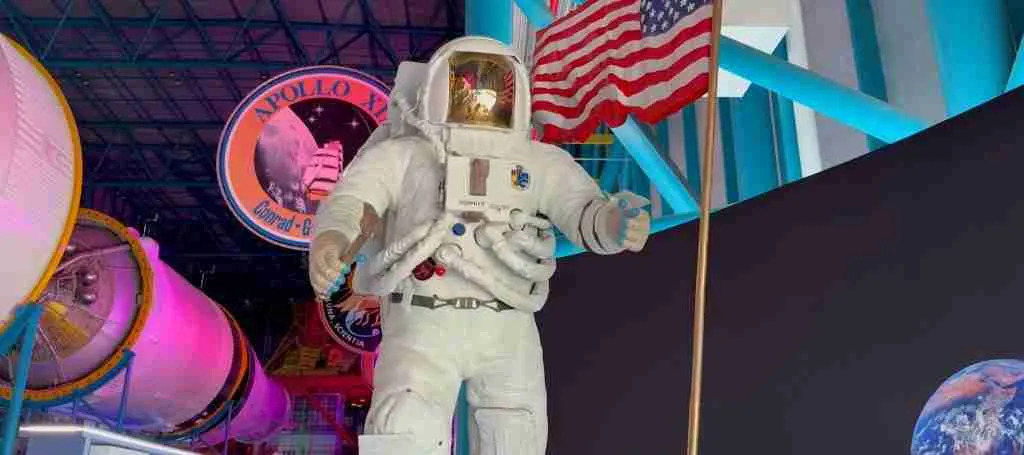
The Apollo/Saturn V Center serves as the bus tour’s terminus, requiring visitors to disembark and explore before returning via shuttle bus. The centerpiece is an actual Saturn V rocket — the only complete Saturn V displayed horizontally, allowing appreciation of its 363-foot length and 6.5-million-pound thrust capability. The Firing Room Theater recreates the Apollo 8 launch from original Launch Control consoles, while the Lunar Theater presents the Apollo 11 Moon landing through archival footage and mission audio. Actual Moon rocks collected during Apollo missions are displayed behind protective glass, available for viewing and photography.
Additional bus tour features include stops at the LC-39 observation gantry providing 360-degree views of launchpads and coastal wildlife refuges, and the Saturn V construction and storage facility where rocket stages were prepared. The complete bus tour loop, including Apollo/Saturn V Center exploration, requires approximately three hours. Return buses to the main visitor complex depart every 15 minutes.
2026 Artemis II Exhibits and Future Programs
Throughout 2026, Kennedy Space Center introduces new permanent exhibits focused on the Artemis program’s planned return to lunar exploration. The Gateway exhibit explains the lunar space station concept supporting sustained Moon missions, while interactive displays allow visitors to design their own lunar base modules. The Orion spacecraft cutaway model demonstrates crew accommodations for the four-astronaut Artemis II mission scheduled to orbit the Moon, with touchscreens explaining life support, navigation, and reentry systems.
The Artemis II crew — Reid Wiseman, Victor Glover, Christina Koch, and Jeremy Hansen — make regular appearances at the visitor complex throughout 2026, with scheduled “Chat with an Astronaut” sessions requiring separate ticket purchases ($20-30 above general admission). These sessions provide small-group Q&A opportunities and signed lithographs. The visitor complex calendar published at kennedyspacecenter.com lists specific appearance dates.
NASA’s Earth Information Center, opened in 2024 within the visitor complex, continues expanding in 2026 with real-time satellite data displays showing global climate patterns, ocean temperatures, and atmospheric composition. The center emphasizes Earth observation as a critical NASA mission alongside space exploration, using interactive globes and immersive displays to demonstrate satellite technology applications.
Planning Your Kennedy Space Center Visit in 2026
Allocate a full eight hours at Kennedy Space Center for comprehensive exploration without rushing. Arrive at the 8 AM parking lot opening to secure convenient parking and enter when gates open at 9 AM. Begin with the bus tour to avoid midday heat during outdoor portions, return to the visitor complex by noon, and spend afternoon hours in air-conditioned exhibits. The Shuttle Launch Experience and IMAX films (shown hourly in two theaters) provide comfortable breaks from Florida heat.
Dining options within the complex include the Orbit Café offering sandwiches, salads, and hot meals ($12-18 per entrée), the Moon Rock Café with quick-service options ($8-14), and the outdoor food court near the Rocket Garden. Outside food and beverages are prohibited except sealed water bottles. The visitor complex prohibits backpacks larger than standard size, with security screening at the entrance requiring 10-15 minutes during peak periods.
Kennedy Space Center hosts active launches throughout 2026, including SpaceX Falcon 9 missions, NASA resupply flights to the International Space Station, and potential Artemis program test flights. Launch viewing requires separate launch-specific tickets sold exclusively by Kennedy Space Center, not included in general admission. The launch schedule changes frequently; consult kennedyspacecenter.com for current launch manifest and ticket availability. On launch days, facility access closes 3-4 hours before liftoff for security protocols.
Photography is permitted throughout the visitor complex except in designated restricted areas. The best photo opportunities include the Atlantis gundeck overlooking the orbiter, the Rocket Garden vertical assemblies, and the observation platforms along the bus tour route. Bring fully charged camera batteries and empty memory cards — the facility provides no equipment charging stations.
St. Augustine Historic Day Trips 2026
St. Augustine, founded in 1565 by Spanish explorer Pedro Menéndez de Avilés, predates the Jamestown settlement by 42 years and Plymouth Rock by 55 years, claiming the title of oldest continuously occupied European settlement in the continental United States. Located 100 miles northeast of Orlando via I-4 East and I-95 North, the city preserves 450 years of Spanish, British, and American history through architecture, museums, and archaeological sites concentrated in a walkable historic district along Matanzas Bay. A full day trip from Orlando requires departing by 7-8 AM to maximize exploration time before returning in late afternoon or early evening.
The drive from Orlando to St. Augustine takes two to two-and-a-half hours depending on departure point and traffic conditions. Take I-4 East toward Daytona Beach, connect to I-95 North, and exit at State Road 16 (exit 318) for direct access to the historic district. The Historic Downtown Parking Facility at 1 Cordova Street provides all-day parking for $10, located within 10-minute walk of major attractions. Street parking along bay-front areas charges $2.50 per hour via credit card meters, with two-hour time limits enforced. Arrive before 10 AM for best parking availability, particularly on weekends.
Castillo de San Marcos National Monument 2026
Castillo de San Marcos dominates St. Augustine’s waterfront as the oldest masonry fortification in the continental United States. Spanish colonial forces constructed the star-shaped fortress from 1672 to 1695 using coquina, a sedimentary rock composed of compressed seashells harvested from nearby Anastasia Island. This indigenous building material proved remarkably resistant to cannon fire — incoming projectiles compressed into the soft coquina rather than shattering the walls, allowing the fortress to withstand multiple British sieges in the 18th century without falling.
Admission to Castillo de San Marcos costs $15 for adults aged 16 and older in 2026, with children 15 and younger entering free when accompanied by adults. Tickets remain valid for seven consecutive days across Castillo de San Marcos and Fort Matanzas National Monument 14 miles south. Purchase tickets at the entrance booth or online at recreation.gov to skip ticket purchase lines, though online purchases require the same entrance screening process. The fortress opens daily 9 AM to 5 PM except Thanksgiving and Christmas Day.
The fortress interior surrounds a central plaza accessible through the original entrance tunnel. Historic storerooms line the plaza walls, containing exhibits on Spanish colonial military life, the Seminole Wars when the fortress served as a prison, and the Civil War period when Union forces occupied St. Augustine. Climb the fortress’s gun deck via 47 steps for panoramic views of Matanzas Bay, the Bridge of Lions, and St. Augustine’s historic district. The gun deck features replica Spanish colonial cannons and interpretive panels explaining the fortress’s defensive strategy.
Ranger-led programs run twice daily at 11 AM and 2 PM, covering fortress history, construction techniques, and military tactics. Cannon firing demonstrations occur on weekends when staffing permits, with schedules posted at the entrance. The fortress hosts special events throughout 2026 including living history weekends where period-dressed interpreters demonstrate 17th-century military drills and daily life. Allocate 90 minutes to two hours for comprehensive exploration including exhibits, gun deck access, and ranger programs.
St. George Street and Colonial Quarter 2026
St. George Street functions as St. Augustine’s pedestrian main street, stretching seven blocks through the historic district from the Old City Gates to Cathedral Basilica. The street closes to vehicle traffic, allowing strolling past colonial-era buildings housing shops, restaurants, galleries, and historical attractions. Walking St. George Street is free, though individual businesses charge admission or sales prices.
The Colonial Quarter at 33 St. George Street recreates St. Augustine through four time periods — 1565 Spanish settlement, 1740 Spanish colonial town, 1740s British occupation, and 1821 American territorial period. Admission costs $15 for adults, with costumed interpreters demonstrating period crafts, weapons, and daily activities. The site includes a watchtower climb, blacksmith demonstrations, and musket firing displays. Operating hours run 10 AM to 5 PM daily.
Flagler College occupies the former Ponce de León Hotel, a Spanish Renaissance Revival masterpiece built by railroad magnate Henry Flagler in 1888. The college offers public tours showcasing the building’s Tiffany stained-glass windows, ornate dining hall, and Flagler’s original furnishings. Tours cost $20 for adults and depart daily at 10 AM, noon, and 2 PM, lasting 90 minutes. Reservations are recommended through flagler.edu/tours due to limited capacity.
The Lightner Museum occupies Flagler’s Hotel Alcazar, displaying Gilded Age decorative arts including Tiffany glass, Victorian mechanical musical instruments, and cigar label art. Admission costs $20 for adults, with the museum open daily 9 AM to 5 PM. The museum’s café operates in the former hotel’s indoor swimming pool, transformed into an elegant dining space with original pool architecture preserved.
Additional St. Augustine Attractions 2026
The Fountain of Youth Archaeological Park at 11 Magnolia Avenue claims to mark the landing site of Ponce de León’s 1513 expedition. The park charges $18 admission for adults and operates 9 AM to 6 PM daily. Attractions include the spring water source visitors can sample, a recreated Timucuan Indian village, planetarium shows about celestial navigation, and archaeological excavations from the earliest Spanish settlement. Allocate 90 minutes for complete exploration.
St. Augustine Lighthouse & Maritime Museum stands 165 feet tall on Anastasia Island, accessible via the Bridge of Lions from downtown. Admission costs $20 for adults, including museum access and lighthouse tower climb. The 219-step spiral staircase ascent requires moderate fitness and is not recommended for those with mobility limitations or heart conditions. The panoramic view from the observation deck spans St. Augustine, the Atlantic Ocean, and Matanzas Bay. The museum operates 9 AM to 6 PM daily, with last tower admission at 5:15 PM.
The Pirate & Treasure Museum at 12 S Castillo Drive displays the world’s largest collection of authentic pirate artifacts, including one of three existing Jolly Roger flags and Thomas Tew’s treasure chest. Admission costs $17 for adults, with the museum open 10 AM to 7 PM daily. Interactive exhibits allow visitors to fire replica cannons, navigate by stars, and examine genuine 17th-century weapons.
St. Augustine Dining and Practical Considerations 2026
St. George Street and the waterfront district contain over 100 restaurants ranging from casual cafés to upscale seafood establishments. The Columbia Restaurant at 98 St. George Street, Florida’s oldest restaurant continuously operating since 1905, serves Cuban and Spanish cuisine ($18-35 per entrée). Pizzalley’s at 138 St. George Street offers wood-fired pizza and craft beer in a casual courtyard setting ($12-18 per pizza). The Floridian at 72 Spanish Street specializes in Florida-sourced ingredients with creative Southern preparations ($14-26 per entrée).
Parking enforcement in St. Augustine’s historic district operates seven days per week until 6 PM, with strict two-hour limits in metered spaces. The Historic Downtown Parking Facility provides all-day parking without time restrictions, making it preferable for full-day visits. The facility fills to capacity by 11 AM on weekends, particularly during spring and fall peak seasons.
St. Augustine’s compact historic district enables exploring major attractions on foot, with distances rarely exceeding half a mile between sites. Wear comfortable walking shoes for cobblestone streets and uneven brick pathways. The Old Town Trolley and Ripley’s Red Train offer hop-on, hop-off narrated tours connecting major attractions, operating 9 AM to 5 PM with departures every 20-30 minutes. Single-day passes cost $35 for adults, though walking remains more efficient for the concentrated historic core.
Summer temperatures in St. Augustine routinely exceed 90°F with high humidity, making afternoon shade and hydration essential. Winter months (December through February) offer comfortable temperatures in the 60s-70s with minimal rainfall. Spring (March through May) and fall (September through November) provide optimal weather conditions, though these periods coincide with peak tourism and highest accommodation rates.
Atlantic Coast Beach Day Trips 2026
Orlando’s position in Central Florida provides equal access to Atlantic and Gulf coasts within 60-120 minutes’ drive. Atlantic Coast beaches east of Orlando deliver consistent surf conditions, wider temperature variations between seasons, and generally more active coastal atmospheres. Three primary destinations — Cocoa Beach, Daytona Beach, and New Smyrna Beach — each offer distinct characters while sharing the warm Gulf Stream-influenced Atlantic waters.
Cocoa Beach Day Trips 2026
Cocoa Beach sits one hour east of Orlando via SR 528 (BeachLine Expressway), making it the closest Atlantic beach to the city. The BeachLine toll road charges approximately $8 for the complete Orlando-to-beach route, with the highway terminating at A1A Coastal Highway. Turn north on A1A for the main Cocoa Beach area, or south for quieter stretches near Patrick Space Force Base.
Beach access is free along the entire Cocoa Beach coastline, with over 20 public access points marked by blue signs along A1A. The Cocoa Beach Pier at 401 Meade Avenue provides the most developed access point, featuring restaurants, shops, and paid parking lots ($10-15 per day depending on season and proximity). Free parking exists along residential A1A sections, though availability decreases significantly on weekends and summer months. Arrive before 10 AM for best parking prospects.
Cocoa Beach maintains a reputation as a surfing destination, with consistent wave action year-round attracting beginners and experienced surfers. Multiple surf schools along A1A offer lessons and board rentals, with two-hour group lessons typically costing $60-80 per person including equipment. Ron Jon Surf Shop, the iconic 52,000-square-foot retail complex open 24 hours daily, sells and rents surfboards, bodyboards, and beach equipment at 4151 N Atlantic Avenue.
The Cocoa Beach Pier extends 800 feet into the Atlantic, with fishing access requiring a $10 pier fishing permit separate from general beach access. The pier contains four restaurants and bars, including the Pier Bar overlooking the water and offering live music most evenings. Pier admission for non-fishing visitors is free, making it an ideal sunset viewing location.
Cocoa Beach offers limited shade on the beach itself — bring umbrellas or canopies for extended stays during summer months. Water temperatures range from 72°F in winter to 84°F in summer, comfortable for swimming year-round. Lifeguards staff designated areas marked by red and yellow flags during daylight hours. Alcohol is prohibited on Cocoa Beach except during designated events.
Combine Cocoa Beach with Kennedy Space Center for a space-and-beach day, as the destinations sit just 30 minutes apart. Many visitors allocate morning hours to Kennedy Space Center (8 AM-1 PM), then drive to Cocoa Beach for afternoon beach time (2 PM-6 PM) before returning to Orlando. This combination requires an early start but maximizes the eastward drive.
Daytona Beach Day Trips 2026
Daytona Beach lies one hour northeast of Orlando via I-4 East and I-95 North, famous for vehicle-on-beach access and the Daytona International Speedway complex. The drive takes 60-75 minutes depending on traffic, with beach access available via multiple exits from I-95 and US-1. Beach driving access points concentrate along A1A from Ormond Beach south to Ponce Inlet.
Daytona Beach permits vehicle driving on 23 miles of hard-packed sand beach from February 1 through November 30 annually. Beach driving access costs $25 per vehicle per day, paid at toll booths located at each vehicle entrance. Speed limits are strictly enforced at 10 mph, with fines starting at $100 for violations. Vehicles must stay on designated packed-sand driving areas, not on soft sand or dune areas. Four-wheel-drive is not required — standard passenger vehicles access most areas during normal tide conditions.
For visitors preferring traditional beach access without vehicles, walk-on access points exist throughout Daytona Beach with free entry. The Daytona Beach Pier and Boardwalk at 1200 Main Street provides the most developed pedestrian access, with paid parking lots ($10-20 per day) adjacent to the boardwalk. The boardwalk contains amusement rides, arcade games, restaurants, and souvenir shops operating year-round with extended hours in summer.
Daytona International Speedway, home of the Daytona 500, offers facility tours year-round at 1801 W International Speedway Boulevard. Tours cost $25 for adults and include pit road access, the NASCAR garage area, and the opportunity to walk on the 31-degree banking of the 2.5-mile tri-oval track. Tours depart at 11 AM, 1 PM, and 3 PM daily except during race event weekends. The Motorsports Hall of Fame of America, located at the speedway, charges $15 admission and displays racing history across all motorsports disciplines.
The Ponce de León Inlet Lighthouse, Florida’s tallest lighthouse at 175 feet, stands at the southern end of Daytona Beach in Ponce Inlet. Admission costs $8 for adults, with the lighthouse museum open 10 AM to 6 PM daily. Climbing the 203 steps to the observation deck provides views spanning 20 miles on clear days. The lighthouse grounds include the original lighthouse keeper’s dwelling, now serving as museum space for maritime history exhibits.
New Smyrna Beach Day Trips 2026
New Smyrna Beach occupies a quieter position 60 miles northeast of Orlando via I-4 East and I-95 North, attracting surfers, artists, and travelers seeking less commercial beach experiences. The drive takes approximately 75 minutes, with beach access via SR 44 East from I-95. New Smyrna Beach divides into the mainland arts district along Canal Street and the beachside area on the barrier island.
Flagler Avenue serves as New Smyrna Beach’s main beachside street, with free beach access at Flagler Avenue Park and metered parking along the street ($2 per hour, enforced 9 AM-6 PM). The Flagler Avenue business district contains locally-owned shops, surf rental outlets, and casual restaurants concentrated in four walkable blocks. Norwood’s Seafood Restaurant at 400 E 2nd Avenue, a New Smyrna Beach institution since 1946, serves fresh catches and waterfront dining ($14-28 per entrée).
New Smyrna Beach earned recognition as one of America’s top surf destinations, with consistent wave action and less crowded conditions than Cocoa Beach or Daytona Beach. The break at the north end of Flagler Avenue provides the most reliable surf, while the south end offers calmer conditions for families and swimmers. Multiple surf schools operate along Flagler Avenue, with typical lesson rates of $60-75 for two-hour sessions including equipment.
The mainland Canal Street arts district warrants exploration for galleries, boutiques, and the Atlantic Center for the Arts hosting artist residencies. The district sits across the North Causeway Bridge from the beach area, requiring a 10-minute drive. Canal Street contains over 30 galleries and art studios, many offering work by local artists at more accessible prices than commercial tourist areas.
Canaveral National Seashore’s southern entrance sits just north of New Smyrna Beach, offering 13 miles of undeveloped Atlantic coastline and coastal dune ecosystems. Entrance fees are $25 per vehicle valid for seven days, with the southern entrance providing access to Apollo Beach. This portion of the national seashore receives far fewer visitors than the northern Kennedy Space Center-adjacent sections, offering more solitary beach experiences. No facilities exist at Apollo Beach beyond portable toilets — bring all necessary supplies including water, food, and beach equipment.
Gulf Coast Beach Day Trips 2026
Gulf of Mexico beaches west and southwest of Orlando deliver distinctly different experiences from Atlantic Coast destinations. Gulf waters typically run 3-5 degrees warmer than the Atlantic, wave action is gentler due to the continental shelf’s gradual slope, and sand composition trends toward finer particles creating the “powder white sand” reputation. The tradeoff is longer drive times — Clearwater Beach requires 90 minutes minimum, while Sarasota stretches to two hours. These distances push the practical limits for same-day returns but remain manageable with early departures.
Clearwater Beach Day Trips 2026
Clearwater Beach consistently ranks among America’s top beaches for its sugar-white sand, calm turquoise water, and family-friendly atmosphere. Located approximately 100 miles southwest of Orlando, the drive takes 90 minutes to two hours via I-4 West to SR 60 West (Clearwater-Tampa Road). Traffic increases significantly as you approach the Tampa Bay area, particularly during weekday afternoon rush periods (3-6 PM). Plan return departures before 3 PM or after 7 PM to avoid the worst Tampa-area congestion.
Parking at Clearwater Beach represents the primary logistical challenge. The city operates several large parking garages near Pier 60, charging $3-4 per hour with daily maximums around $25-30. The largest facility, Clearwater Beach Parking Garage at 106 Coronado Drive, provides 700+ spaces but fills to capacity by 11 AM on weekends and summer weekdays. Arrive before 9 AM for guaranteed parking, or consider parking at less expensive lots on the mainland side of the Clearwater Memorial Causeway and using the free beach trolley for the final leg.
Pier 60 serves as Clearwater Beach’s central gathering point, extending 1,080 feet into the Gulf of Mexico. The pier hosts nightly sunset celebrations from two hours before until two hours after sunset, featuring street performers, craft vendors, and musicians. Beach access surrounding Pier 60 is free, with designated swimming areas supervised by lifeguards during daylight hours. The water’s calm nature and gradual depth increase make Clearwater Beach particularly suitable for families with young children.
Beach equipment rentals cluster near Pier 60, with umbrella and chair sets costing $35-45 per day. Paddleboard and kayak rentals run $25-35 per hour, with guided dolphin-watching kayak tours operating from Clearwater Beach Marina at $55-75 per person for two-hour excursions. The calm Gulf conditions make Clearwater ideal for first-time kayakers and paddleboarders.
The Clearwater Marine Aquarium, five miles from the beach at 249 Windward Passage, houses Winter the dolphin and other rescued marine animals. The aquarium featured in the “Dolphin Tale” films charges $30 admission for adults in 2026 and operates 10 AM to 6 PM daily. Allocate 90 minutes to two hours for comprehensive touring. The aquarium focuses on marine rescue and rehabilitation rather than entertainment shows, with all animals residents due to injuries preventing ocean release.
Clearwater Beach provides numerous dining options along Mandalay Avenue, the main beach road. Frenchy’s Rockaway Grill at 7 Rockaway Street specializes in grouper sandwiches and beachfront dining with outdoor tables directly on the sand. Columbia Restaurant’s Clearwater Beach location at 1241 Gulf Boulevard serves the same Spanish and Cuban cuisine as the original Tampa restaurant in upscale beachfront surroundings ($22-38 per entrée).
Sarasota and Siesta Key Beach Day Trips 2026
Sarasota sits 130 miles southwest of Orlando via I-4 West and I-75 South, requiring two hours minimum drive time under optimal traffic conditions. This distance represents the practical limit for Orlando day trips, making Sarasota most suitable for travelers with full-day flexibility and tolerance for extended driving. The reward is Siesta Key Beach, consistently ranked among the world’s finest beaches for its 99% pure quartz sand that stays cool even under intense Florida sun.
Siesta Key Beach occupies the northern portion of Siesta Key, a barrier island accessible via bridges from mainland Sarasota. Beach access is free, with the Siesta Key Public Beach park at 948 Beach Road providing 800 parking spaces charging $5 per day. The lot fills completely by 10 AM on weekends year-round and summer weekdays. Additional paid parking exists at nearby commercial lots for $10-15 per day. The beach park includes restrooms, outdoor showers, picnic pavilions, tennis courts, and volleyball courts.
Siesta Key’s quartz sand creates a uniquely soft surface and maintains comfortable temperatures even during midday summer heat. The sand’s composition results from Appalachian Mountain quartz carried south by rivers and refined by Gulf currents over millennia. The beach’s gentle slope and calm waves make it suitable for families and swimmers of all abilities. Lifeguards staff the main beach area during daylight hours.
Crescent Beach and Turtle Beach, located on Siesta Key’s southern end, offer quieter alternatives to the main public beach with smaller parking areas and fewer visitors. These sections appeal to travelers seeking less crowded conditions and don’t mind sacrificing immediate amenities. All Siesta Key beaches prohibit alcohol, glass containers, and overnight camping.
Mainland Sarasota contains the Ringling Museum complex at 5401 Bay Shore Road, combining art museum, circus museum, and historic Ca’ d’Zan mansion. Admission costs $30 for adults and includes access to all three venues plus the Bayfront Gardens. The art museum houses one of America’s premier Baroque collections, while the Circus Museum documents John Ringling’s circus empire through posters, costumes, and circus wagons. Ca’ d’Zan, the Ringlings’ 56-room mansion overlooking Sarasota Bay, exemplifies 1920s Gilded Age architecture. Allocate three to four hours for comprehensive museum exploration.
The Mote Marine Laboratory & Aquarium at 1600 Ken Thompson Parkway focuses on marine research and education, with exhibits on shark biology, sea turtle conservation, and manatee care. Admission costs $28 for adults, with the facility open 10 AM to 5 PM daily. Touch tanks allow interaction with stingrays and horseshoe crabs, while the outdoor rehabilitation pools house manatees recovering from boat strikes and other injuries.
Combining Sarasota beach time with museum visits requires strategic planning given the two-hour Orlando drive. Depart Orlando by 7 AM, arrive at Siesta Key Beach by 9 AM for morning beach hours, leave the beach by 1 PM for the Ringling Museum or Mote Aquarium, complete museum touring by 4 PM, and depart Sarasota by 5 PM to reach Orlando by 7 PM. This aggressive schedule maximizes the day but allows little flexibility for traffic delays or extended beach stays.
Natural Spring and Wildlife Day Trips 2026
Central Florida’s geological structure creates hundreds of freshwater springs bubbling from the Floridan Aquifer, with water maintaining constant 72°F temperature year-round. These springs attract manatees during winter months when ocean and river temperatures drop below the marine mammals’ tolerance. Multiple spring systems within 90 minutes of Orlando offer swimming, kayaking, glass-bottom boat tours, and guaranteed wildlife viewing during peak seasons.
Blue Springs State Park and Manatee Viewing 2026
Blue Springs State Park in Orange City guarantees manatee sightings November through March when hundreds of West Indian manatees migrate from the St. Johns River to the spring’s constant 72°F water. Located one hour north of Orlando via I-4 North and US 17/92 North, the park charges $6 per vehicle entrance fee paid at the park gate. The spring run’s viewing boardwalk provides close-up observations of manatees from elevated platforms without disturbing the animals.
Peak manatee season runs mid-December through mid-February when cold fronts drive maximum numbers into the spring. Counts exceeding 500 individual manatees occur during the coldest winter periods, with rangers providing daily population updates posted at the park entrance and on the park’s website. Arrive before 9 AM for best parking availability and least crowded viewing conditions. The park reaches capacity during peak winter weekends, closing to new arrivals once parking lots fill — typically by 10 AM on cold winter days.
Swimming in Blue Springs is prohibited November 15 through March 15 to protect manatees during critical refuge periods. Outside these dates, the spring offers some of Central Florida’s finest freshwater swimming in crystal-clear water with excellent visibility. The spring basin depth reaches 25 feet, with the spring run extending 2,600 feet to the St. Johns River. Strong currents near the boil require caution from inexperienced swimmers.
The park offers kayak and canoe rentals from an on-site concessionaire, with single kayaks costing $35 for two hours and canoes $45 for two hours. Paddling the spring run and St. Johns River provides opportunities to spot alligators, turtles, wading birds, and river otters in addition to manatees (during winter). The concessionaire operates daily 9 AM to 4 PM, though rentals pause during afternoon thunderstorms.
Thursby House, a 1872 pioneer homestead within the park, operates as a small museum showcasing 19th-century Florida frontier life. Admission is included in park entrance fees, with the house open for self-guided tours 10 AM to 4 PM Wednesday through Sunday. The park contains 4 miles of hiking trails through hardwood hammock and pine flatwood ecosystems, with the Manatee Trail providing additional spring run overlooks.
Silver Springs State Park Day Trips 2026
Silver Springs State Park, located 90 minutes north of Orlando near Ocala, features the largest artesian spring formation in Florida, producing 550 million gallons of crystal-clear water daily. The spring’s exceptional clarity — visibility exceeding 80 feet in optimal conditions — made it a popular filming location for Tarzan films, James Bond’s “Moonraker,” and numerous nature documentaries. The park charges $8 per vehicle entrance fee and operates 8 AM to sunset daily.
Glass-bottom boat tours remain Silver Springs’ signature attraction, operating continuously since 1878 and representing one of Florida’s oldest tourist activities. The boats feature viewing windows in the hull allowing passengers to observe the spring’s underwater formations, fish populations, and occasional manatees. Tours depart every 30 minutes from 9 AM to 4 PM, costing $13 for adults and lasting approximately 30 minutes. The boats navigate the spring basin and upper Silver River, with naturalist narration explaining spring ecology and history.
The park prohibits swimming in the spring basin to protect the spring’s pristine water quality and fragile ecosystem. However, swimming is permitted in designated areas along the Silver River downstream from the spring. The river’s gentle current and clear water make it suitable for families, with several shallow wading areas. No lifeguards are on duty — swimming occurs at visitor risk.
Kayak and canoe rentals from the park concessionaire provide access to the five-mile Silver River winding through the park to the Ocklawaha River. Single kayak rentals cost $32 for two hours, with canoes at $42 for two hours. The river passes through old-growth cypress forest and offers excellent wildlife viewing including alligators, turtles, various wading bird species, and wild monkeys — descendants of rhesus macaques released during filming in the 1930s. The monkey population numbers approximately 300 individuals and viewing is common but not guaranteed.
The Museum of Natural History within the park displays Florida wildlife, fossils, and Native American artifacts, included in park admission. The museum operates 9 AM to 5 PM daily. Adjacent to the museum, the Cracker Village recreates an 1890s Florida pioneer settlement with original log cabins relocated to the site, blacksmith shop, and one-room schoolhouse. Costumed interpreters provide demonstrations on weekends.
Silver Springs offers more developed infrastructure than most Florida spring parks, with multiple picnic areas, playground equipment, and a restaurant-café serving lunch and snacks. The park’s size and variety of activities warrant allocating four to five hours for comprehensive exploration including boat tour, river paddling, museum visits, and hiking trails.
Crystal River Manatee Encounters 2026
Crystal River, approximately two hours northwest of Orlando via Florida’s Turnpike and US-19, offers in-water snorkeling with wild manatees year-round, though winter months (November-March) provide most reliable encounters. Unlike observation-only locations, Crystal River permits swimming with manatees under strict federal guidelines protecting the endangered species. The town functions as a specialized manatee tourism destination with dozens of tour operators offering guided encounters.
Manatee snorkeling tours typically operate as three-hour morning excursions departing 6-8 AM, costing $65-85 per person including wetsuit rental, mask, snorkel, and boat transportation to spring areas where manatees congregate. Tours emphasize passive observation — participants float quietly while manatees approach if they choose. Touching manatees is illegal under federal Endangered Species Act protections, with exceptions only when animals initiate contact.
Peak manatee season runs November through March when 600+ manatees crowd into Crystal River’s spring systems seeking warm refuge water. Summer months see far fewer manatees as animals disperse throughout coastal areas once water temperatures rise. Tour operators continue operations year-round but emphasize that June-October encounters are less predictable.
The Three Sisters Springs boardwalk provides free observation access to one of Crystal River’s primary manatee refuges. The U.S. Fish & Wildlife Service maintains the facility at 123 NW Hwy 19, open during daylight hours with no admission fee. The elevated boardwalk prevents human-manatee contact while allowing close viewing. In-water access is prohibited at Three Sisters Springs during peak manatee season to prevent harassment of concentrated animals.
Crystal River requires dedicating a full day given the two-hour drive each direction. Depart Orlando by 5 AM for early morning tour departures, complete snorkeling by 10 AM, explore the Three Sisters Springs boardwalk and local restaurants for lunch, and depart Crystal River by 2 PM to reach Orlando by 4 PM. This schedule avoids driving during Tampa-area evening rush hour while maximizing water time during optimal manatee viewing hours.
Specialty and Alternative Day Trip Destinations 2026
Beyond the major categories of beach, springs, and historic sites, several distinctive day trip destinations within two hours of Orlando offer specialized experiences ranging from botanical gardens to theme parks to charming small towns. These alternatives suit travelers seeking variety from typical Florida coastal and historical attractions or looking to escape Orlando’s theme park atmosphere entirely.
Bok Tower Gardens Day Trips 2026
Bok Tower Gardens in Lake Wales, one hour south of Orlando via US-27 South, combines 250 acres of cultivated gardens with the 205-foot neo-Gothic Singing Tower housing a 60-bell carillon. Publisher Edward Bok commissioned landscape architect Frederick Law Olmsted Jr. to design the gardens atop Iron Mountain, one of Florida’s highest elevations at 298 feet above sea level. Admission costs $18 for adults in 2026, with the gardens open daily 8 AM to 6 PM.
The Singing Tower’s carillon performs live concerts daily at 1 PM and 3 PM, lasting 45 minutes each. The concerts feature both classical compositions and contemporary pieces arranged for carillon, with the bells audible throughout the gardens and surrounding area. Visitors cannot enter the tower itself — all viewing remains exterior — but the concerts constitute the gardens’ primary attraction. The tower architecture features pink and gray marble, coquina stone, and decorative tiles depicting Florida wildlife.
The garden grounds contain diverse ecosystems including pine forest, oak hammock, and fern gardens, connected by three miles of walking paths. The Window by the Pond overlooks a reflection pool offering the tower’s most photographed vantage point. The Hammock Hollow Children’s Garden provides interactive nature-play spaces for families. Seasonal displays emphasize azaleas (February-March), camellias (December-February), and wildflowers (April-June).
Pinewood Estate, a 20-room Mediterranean Revival mansion built in 1930, operates as a house museum within the gardens. Separate admission costs $10 additional to the gardens entry and includes guided tours departing hourly 12:30 PM to 3:30 PM Tuesday through Sunday. The mansion showcases 1930s furnishings, decorative arts, and provides historical context about the estate’s construction during the Florida land boom.
Bok Tower Gardens offers a distinctly different pace from Orlando’s theme parks — quiet contemplation rather than stimulation. The gardens attract nature photographers, bird watchers, and visitors seeking peaceful outdoor environments. Allocate three to four hours for gardens exploration, concert attendance, and potential mansion tour. The site contains two dining options — the Blue Palmetto Café serving sandwiches and salads ($10-15) and the Tower & Garden Café with grab-and-go items.
Mount Dora Day Trips 2026
Mount Dora, a small town 40 minutes northwest of Orlando via US-441 North, preserves turn-of-the-century architecture along tree-lined streets surrounding Lake Dora. The downtown area spans six walkable blocks filled with antique shops, galleries, boutiques, and cafés occupying restored 1920s buildings. Visiting Mount Dora costs nothing — walking the streets and viewing architecture is free, with individual businesses charging for purchases or admissions.
Donnelly Street and 4th Avenue form Mount Dora’s commercial core, containing approximately 100 independent shops and restaurants. The Modernism Museum at 140 E 4th Avenue displays mid-century modern furniture and design, charging $10 admission for adults and operating Thursday through Sunday 11 AM to 5 PM. The Royellou Museum at 450 Royellou Lane documents Mount Dora’s history through photographs and artifacts, with free admission and hours Tuesday through Saturday 1 PM to 4 PM.
Lake Dora supports kayaking and paddleboarding, with rentals available from Lakeside Inn at 100 N Alexander Street for $25-30 per hour. The lake connects to a chain of 15 lakes via navigable channels, though day-trippers typically stay on Lake Dora proper. The lakefront Grantham Point Park offers a public beach, playground, and picnic areas with free access.
Mount Dora hosts numerous festivals throughout 2026 including the Mount Dora Arts Festival (February), the Craft Fair (October-November), and the Christmas Walk (early December). Festival weekends attract significant crowds and parking challenges — weekdays provide easier access and less congestion. The town’s appeal centers on browsing antique stores, dining at locally-owned restaurants, and experiencing small-town Florida atmosphere absent from coastal tourist areas.
Allocate four to five hours for Mount Dora exploration including shopping, dining, and lakefront time. The Goblin Market Restaurant at 331 Dora Drawdy Way serves farm-to-table cuisine in a restored 1893 building ($14-26 per entrée). Windsor Rose English Tea Room at 142 W 4th Avenue offers traditional afternoon tea service ($25-35 per person) requiring advance reservations.
LEGOLAND Florida Day Trips 2026
LEGOLAND Florida in Winter Haven sits 45 minutes southwest of Orlando via I-4 West and US-27 South, occupying the former Cypress Gardens site. The theme park targets families with children ages 2-12, featuring over 50 rides, shows, and attractions built around LEGO construction themes. Single-day admission costs $95 for adults and children in 2026 when purchased at the gate, with online advance purchase discounts reducing prices to $75-85. The park operates daily with seasonal hours, typically 10 AM to 6 PM in off-peak months and 9 AM to 8 PM during summer.
LEGOLAND Florida emphasizes gentler rides compared to Universal Orlando or Walt Disney World, with maximum height requirements rather than minimums dominating ride restrictions. The Dragon Coaster reaches 43 feet height and 22 mph, representing the park’s most intense ride. Miniland USA displays scale LEGO recreations of American landmarks including the Kennedy Space Center, Las Vegas Strip, and Washington D.C., built from over 30 million LEGO bricks.
The park includes a separate-admission water park ($30 additional to general admission), operating May through September. Parking costs $30 per vehicle, with the lot located a 10-minute walk from the entrance. Food and beverage prices match other Central Florida theme parks ($12-18 for counter-service meals, $5-8 for drinks), with limited outside food permitted if stored in single-compartment bags.
LEGOLAND’s appeal diminishes for families without young children or LEGO enthusiasts. Adults without children pay full admission but may find limited interest in the park’s offerings beyond Miniland and LEGO building demonstrations. The park provides a quieter, less intense alternative to Orlando’s major theme parks, though the distance from Orlando and full-day time requirement make it comparable to a Walt Disney World or Universal day in terms of commitment.
Seasonal Considerations for Orlando Day Trips 2026
Central Florida’s subtropical climate influences day trip planning throughout the year, with temperature, rainfall, and wildlife viewing windows varying significantly between seasons. Understanding these patterns helps optimize destination selection and timing for maximum enjoyment and successful wildlife encounters.
Winter Season Day Trips: December 2025-February 2026
Winter represents optimal conditions for manatee viewing at Blue Springs, Crystal River, and Silver Springs, with guaranteed encounters during cold front periods when hundreds of animals seek warm spring water. Winter also delivers the most comfortable weather for outdoor activities, with typical daytime temperatures in the 70s°F and minimal rainfall. St. Augustine and historic site touring becomes more pleasant without summer humidity and heat.
Beach conditions vary between coasts in winter. Atlantic waters cool to 65-68°F, chilly for extended swimming but comfortable for wading and beach activities. Gulf Coast waters maintain slightly warmer temperatures at 68-72°F. Both coasts experience stronger winds in winter months, particularly January through February, with occasional cold fronts bringing overcast conditions and rain. Winter represents low season for beach visits, meaning less crowded conditions and easier parking, though some beach amenities and concessions operate on reduced schedules.
Sea turtle nesting season has not yet begun in winter, eliminating potential nest area closures on beaches. Winter bird migration brings increased diversity to natural areas and parks, with peak numbers of waterfowl, shorebirds, and raptors present January through February. Wildlife viewing opportunities peak across all natural areas during winter months.
Spring Season Day Trips: March-May 2026
Spring offers transition conditions bridging comfortable winter weather with approaching summer heat. March and early April maintain excellent outdoor activity weather with temperatures in the 75-82°F range and low humidity. Late April and May bring increasing heat and humidity foreshadowing summer conditions. Spring break periods (mid-March through early April) coincide with peak crowds at all destinations, particularly beaches, St. Augustine, and Kennedy Space Center.
Manatee season concludes mid-March as warming water temperatures allow animals to disperse from spring refuges. Blue Springs reopens for swimming March 15, providing excellent spring conditions before summer crowds arrive. Sea turtle nesting begins in late April, with potential beach access restrictions in designated nesting areas though major public beaches maintain full access.
Spring represents peak wildflower blooming at Bok Tower Gardens and other natural areas. Afternoon thunderstorms increase in frequency by late May, typically developing 3-5 PM and lasting 30-60 minutes. These storms rarely persist into evening but can disrupt afternoon beach time or outdoor activities.
Summer Season Day Trips: June-August 2026
Summer delivers peak heat and humidity with daily high temperatures routinely exceeding 90°F and heat indexes reaching 100-105°F. Ocean water temperatures peak at 82-85°F, providing warmest swimming conditions but also increasing jellyfish presence along beaches. Afternoon thunderstorms occur almost daily, typically 2-5 PM, sometimes producing lightning that closes beaches and outdoor attractions temporarily.
Summer represents peak tourism season at beaches and water-based attractions, with maximum crowds, full parking lots, and highest accommodation rates. Early morning arrivals (before 9 AM) become essential for securing beach parking. Manatees largely disappear from spring viewing areas as warm water temperatures allow unrestricted coastal movement. Summer wildlife viewing focuses on sea turtle nest monitoring and hatching events, occurring primarily at night on designated beaches.
Indoor attractions including Kennedy Space Center and museums provide air-conditioned relief from summer heat. St. Augustine touring becomes challenging during midday hours when heat and humidity combine with full sun exposure on exposed historic sites. Plan St. Augustine visits for early morning (7-11 AM) and late afternoon (4-7 PM) periods, avoiding midday heat.
Fall Season Day Trips: September-November 2026
Fall brings gradual cooling and hurricane season considerations September through November, though direct hurricane impacts on Central Florida remain statistically rare. September maintains summer heat and humidity with decreasing rainfall frequency. October and November deliver some of the year’s most pleasant weather conditions with comfortable temperatures, low humidity, and minimal rainfall. Fall represents shoulder season at most destinations, providing moderate crowds and reasonable prices.
Manatee season begins mid-November with early animals arriving at spring refuges, though peak numbers don’t accumulate until December cold fronts. Sea turtle nesting season concludes by October, reopening restricted beach areas. Fall bird migration brings different species than winter, with southbound warblers, tanagers, and other songbirds passing through September-October.
Water temperatures remain warm through October (78-82°F) before cooling in November (72-76°F). Beach conditions improve as summer crowds depart, with September and October offering warm water and available parking. Fall festivals populate the calendar at many destinations including St. Augustine’s food and wine festival (May), though specific 2026 dates should be verified.
Practical Planning for Orlando Day Trips 2026
Successful day trip execution from Orlando requires advance planning covering transportation, timing, dining, and contingencies. These practical considerations apply regardless of specific destination selected, forming the foundation for efficient and enjoyable excursions.
Transportation and Vehicle Considerations 2026
Personal vehicle remains the most practical transportation method for Orlando day trips in 2026, providing schedule flexibility and door-to-door service. Rental cars from Orlando International Airport or International Drive agencies typically cost $45-75 per day for economy to full-size vehicles, with insurance and taxes adding approximately 30% to base rates. Major rental companies include Enterprise, Hertz, Avis, Budget, and National, with airport locations offering most competitive rates.
Florida’s toll road system extensively covers Orlando-area highways including SR 528 (BeachLine), Florida’s Turnpike, and SR 417 (Central Florida GreeneWay). SunPass transponders or rental car toll programs provide automatic toll payment, avoiding cash toll booths and reducing toll plaza delays. Rental cars typically include toll payment programs charging daily fees ($3-5) plus actual tolls — verify specific terms before accepting rental agreements. A full day round-trip from Orlando to beaches or St. Augustine accumulates $15-25 in tolls depending on specific routes.
Fuel costs for day trips vary by destination and vehicle efficiency. Orlando to Cocoa Beach consumes approximately one gallon each direction in fuel-efficient vehicles, while Orlando to Clearwater Beach requires 2-3 gallons each direction. Current Florida gas prices (March 2026) average $3.25-3.50 per gallon for regular unleaded. Budget $15-25 for fuel costs on beach day trips, $25-35 for destinations like Crystal River or Sarasota.
Parking costs represent significant expenses at some destinations. Kennedy Space Center charges $15 mandatory parking, Clearwater Beach parking reaches $30 for all-day garage access, and St. Augustine downtown parking runs $10-20 depending on location. Many natural springs and state parks charge $6-8 vehicle entrance fees serving as parking fees. Include parking costs in daily budget calculations.
Timing and Schedule Optimization 2026
Departure timing significantly impacts day trip success, particularly for beach and high-traffic destinations. Early departures (6-7 AM) allow arrival before parking lots fill and provide maximum on-site time before afternoon heat peaks or thunderstorms develop. Many destinations require minimum four hours on-site for meaningful exploration, with travel time adding two to four hours depending on distance.
Kennedy Space Center visits benefit from 8 AM arrival, immediately following parking lot opening. This timing provides first access to the bus tour before lines develop and allows completing outdoor portions during morning hours before heat peaks. St. Augustine exploration works well with 9 AM arrival, providing full morning through mid-afternoon touring before departing ahead of evening traffic.
Beach day trips allow more flexibility, though parking availability constrains arrival times. Arrive at popular beaches (Clearwater, Cocoa Beach) before 9 AM for guaranteed parking, or accept backup parking options farther from beach access. Afternoon beach arrivals often find available parking as morning visitors depart, though the beach day’s prime hours have passed.
Return timing to Orlando should account for traffic patterns. Tampa area (I-4 corridor) experiences heavy westbound traffic 4-6 PM weekdays — departures from Clearwater, St. Petersburg, or Sarasota should occur before 3 PM or after 7 PM. I-95 northbound traffic from Miami encounters congestion near Port St. Lucie and Palm Beach, though this rarely affects Orlando day-trippers. Sunday afternoon and evening traffic on all routes increases as weekend travelers return to Orlando.
Dining and Food Considerations 2026
Restaurant availability and pricing varies significantly between destinations. St. Augustine and beach towns contain numerous dining options across all price ranges, while natural springs and state parks offer limited on-site food service. Kennedy Space Center prohibits outside food except sealed water bottles, necessitating purchasing meals from on-site vendors ($12-18 per person for lunch).
Beach destinations like Clearwater, Cocoa Beach, and Daytona Beach support full-service restaurants, beach bars, and quick-service options within walking distance of beach access points. Expect $15-25 per person for casual restaurant meals, $8-12 for sandwiches and quick service. St. Augustine’s historic district contains over 100 restaurants including upscale options ($25-40 per person) and casual cafés ($10-18 per person).
Natural springs and state parks typically permit outside food and beverages, making packed coolers practical for budget-conscious travelers. Blue Springs, Silver Springs, and most other park destinations contain picnic areas with tables and grills. This option reduces meal costs to grocery prices while providing flexibility for dietary restrictions or children’s preferences.
Florida’s heat and humidity increase hydration requirements significantly, particularly during summer months and outdoor activities. Bring reusable water bottles and plan for refilling at fountains or purchasing bottled water ($2-4 per bottle at attractions). Budget an additional $5-10 per person daily for beverages beyond meals. Alcohol is prohibited at most public beaches and all state parks — verify specific regulations before bringing coolers containing beer or wine.
Safety and Weather Contingencies 2026
Florida weather changes rapidly, particularly during summer months when morning sunshine transforms into afternoon thunderstorms. Monitor weather forecasts before departing Orlando and check radar apps (Weather Channel, Weather Underground) throughout the day for developing storms. Lightning safety requires evacuating beaches and outdoor areas immediately when thunder is audible or lightning visible — designated shelters exist at major beaches and parks.
Ocean swimming hazards include rip currents, particularly along Atlantic beaches. Lifeguarded beaches display flag systems indicating water conditions: green (calm), yellow (moderate), red (dangerous), purple (marine life hazards). Never swim alone or when red flags are displayed. Rip currents appear as darker water channels perpendicular to shore — escape by swimming parallel to shore rather than fighting the current directly back to beach.
Sun protection becomes critical during extended outdoor exposure. Apply SPF 30+ sunscreen before outdoor activities and reapply every two hours or after swimming. Florida’s latitude produces strong UV radiation year-round, with sunburn occurring within 20-30 minutes of unprotected exposure even on cloudy days. Wide-brimmed hats and UV-protective clothing provide additional protection for extended beach or spring visits.
Wildlife encounters require respectful distance and behavior. Alligators inhabit virtually all Florida freshwater including springs, lakes, and rivers — maintain minimum 30 feet distance and never feed alligators. Manatees are protected under federal law prohibiting touching, feeding, or disturbing the animals. Sea turtle nesting areas on beaches may have restricted access zones marked by stakes and tape — stay clear of marked areas and never disturb nests or hatchlings.
Combining Multiple Day Trip Destinations
Orlando’s central location enables combining certain destinations into single day trips, maximizing geographical proximity to experience multiple attractions with minimal additional driving. These combinations work best with early departures and full-day availability, accepting that each destination receives less time than single-focus visits.
Kennedy Space Center and Cocoa Beach Combination
The most practical combination pairs Kennedy Space Center with Cocoa Beach, separated by just 30 minutes driving via SR 528 and SR 405. Depart Orlando by 7:30 AM, arrive at Kennedy Space Center at 8:30 AM when parking opens, tour the facility until 1:30 PM (five hours allowing comprehensive exploration), drive to Cocoa Beach arriving 2 PM, enjoy beach time until 6 PM, and depart for Orlando by 6:30 PM arriving back 7:30 PM.
This combination provides substantial time at both locations while requiring only one eastward drive and avoiding duplicate toll costs. The schedule works year-round, though summer months add afternoon thunderstorm risks affecting beach time 2-5 PM. Pack swimwear and beach supplies in the vehicle during Kennedy Space Center touring, allowing immediate beach access after departing the space center.
St. Augustine and Beach Combination
St. Augustine combines effectively with nearby Atlantic beaches including St. Augustine Beach, Anastasia State Park, or Vilano Beach. These beaches sit just 10-15 minutes from St. Augustine’s historic district, allowing morning historic touring (8 AM-1 PM) followed by afternoon beach time (2-6 PM). This combination spreads activities across different times of day, avoiding midday heat during historic site walking and enjoying beaches during warmest hours.
Parking logistics work well for this combination — park in St. Augustine’s downtown parking facility for morning touring, then relocate to beach parking for afternoon ocean time. The relocation adds 15-20 minutes but provides appropriate access for each activity type. Bring beach supplies in the vehicle during morning touring, changing at beach after historic district exploration.
Silver Springs and Ocala National Forest Combination
Silver Springs State Park sits adjacent to Ocala National Forest’s northern boundary, enabling combination natural area exploration. After Silver Springs glass-bottom boat tours and river kayaking (3-4 hours), drive 20 minutes to Alexander Springs or Juniper Springs within Ocala National Forest for additional swimming and spring exploration. This combination suits nature enthusiasts seeking maximum spring exposure in a single day.
The combination requires departing Orlando by 7 AM for two-hour drive to Silver Springs, completing Silver Springs activities by noon, relocating to Ocala National Forest springs by 12:30 PM, and spending afternoon at the second location before departing 4 PM for return to Orlando by 6 PM. Both locations charge separate entrance fees ($8 for Silver Springs, $6-10 for Ocala National Forest depending on facility).
Mount Dora and Wekiwa Springs Combination
Mount Dora and Wekiwa Springs State Park sit 40 minutes apart via SR 46 and I-4, allowing combined small-town exploration and spring swimming. Morning Mount Dora browsing and breakfast (8-11 AM) transitions to afternoon Wekiwa Springs swimming and kayaking (noon-4 PM), with both locations under one hour from Orlando in opposite directions. This combination works particularly well for travelers seeking relief from theme parks while maintaining variety in activities.
Wekiwa Springs charges $6 per vehicle entrance fee and provides excellent swimming, kayaking, and hiking just 20 minutes north of Orlando. The spring maintains 72°F water year-round with moderate depth ideal for families. Canoe and kayak rentals cost $20-30 for two hours, paddling the Wekiwa River through old-growth cypress forest. The combination of Mount Dora’s civilized shopping and dining with Wekiwa’s natural setting provides complementary experiences within manageable driving distances.
Day Trip Costs and Budget Planning 2026
Orlando day trip costs vary dramatically based on destination selection, dining choices, and activity participation. Understanding typical expense categories allows realistic budget planning and prevents surprise costs depleting vacation funds.
Transportation and Fuel Costs
Rental car daily rates plus tolls and fuel constitute the foundation expense for any day trip. A typical beach destination (Cocoa Beach, Clearwater) requires $45-75 rental car, $15-25 tolls round-trip, and $15-25 fuel, totaling $75-125 transportation costs for the vehicle regardless of passenger count. Four passengers reduce per-person transportation costs to $19-31 each, while solo travelers bear full $75-125 costs alone.
Parking adds destination-specific fees ranging from $0 (free street parking in Mount Dora) to $30 (Clearwater Beach all-day garage). Budget $10-20 for parking at most beach, historic, and attraction destinations. State park entrance fees ($6-8) function as parking fees since they’re vehicle-based rather than per-person.
Admission and Activity Costs 2026
Destination admission costs range from free (beach access, walking St. Augustine’s streets) to $95 (LEGOLAND). Kennedy Space Center at $75 represents the highest single-attraction admission among traditional day trip destinations. Museums and historic sites typically charge $15-30 per adult, while natural springs and state parks charge $6-10 per vehicle benefiting groups over individuals.
Activity participation adds supplemental costs beyond base admission. Glass-bottom boat tours, kayak rentals, and snorkeling excursions cost $20-45 per person for two-hour experiences. Beach equipment rentals (umbrellas, chairs) run $35-45 daily. These optional activities can double overall day trip costs but provide enhanced experiences and memories beyond passive sightseeing.
Dining Costs and Budget Strategies
Restaurant meals at day trip destinations cost $12-25 per person for casual lunch, $20-40 for sit-down dinner, plus $5-10 for drinks and snacks throughout the day. A couple dining at restaurants for lunch and snacks spends $60-90 on food, while a family of four reaches $120-180. These costs add substantially to overall day trip expenses.
Budget strategies include packing coolers with sandwiches, snacks, and beverages for beach and spring destinations permitting outside food. This reduces meal costs to grocery prices ($3-5 per person) while providing flexibility for dietary needs. Kennedy Space Center prohibits outside food, requiring on-site purchases that cannot be avoided through packing.
Sample Day Trip Cost Breakdowns 2026
Kennedy Space Center day trip for family of four: rental car $60, tolls $16, fuel $20, parking $15, admission $300 (four adults), lunch on-site $70, drinks and snacks $30 = total $511 or $128 per person.
Cocoa Beach day trip for couple: rental car $50, tolls $16, fuel $18, parking $0 (free street parking), beach equipment rental $40, lunch at restaurant $40, drinks $15 = total $179 or $90 per person.
St. Augustine day trip for family of four: rental car $60, tolls $0 (I-4 and I-95 are free highways), fuel $30, parking $10, Castillo admission $30 (two adults, two children free), museum admission $40 (two adults at Lightner), lunch at restaurant $80, snacks $20 = total $270 or $68 per person.
Blue Springs day trip for couple: rental car $50, tolls $0, fuel $20, park entrance $6, kayak rentals $70, picnic lunch from packed cooler $10, drinks $10 = total $166 or $83 per person.
These examples demonstrate how costs scale with admission prices, dining choices, and activity participation. Beach and natural area destinations with free or low-cost access significantly undercut museum and attraction-based trips when comparing total expenses.
Frequently Asked Questions About Orlando Day Trips 2026
What is the closest beach to Orlando and how long does it take to drive there in 2026?
Cocoa Beach on Florida’s Atlantic Coast sits closest to Orlando at approximately 60 miles east via SR 528 (BeachLine Expressway). The drive takes 50-60 minutes under normal traffic conditions, with the entire route following a direct toll expressway from Orlando to the coast. BeachLine tolls cost approximately $8 for the complete round trip when using SunPass or rental car toll programs. Cocoa Beach provides free beach access along A1A Highway with multiple public entry points, though parking costs $10-15 per day at developed beach areas or can be found free along residential street sections. The beach offers consistent surf conditions suitable for swimming and surfing, wide sandy beaches, and the iconic Cocoa Beach Pier extending 800 feet into the Atlantic Ocean.
How much does a Kennedy Space Center day trip from Orlando cost in 2026?
A Kennedy Space Center day trip from Orlando costs $75-95 per adult for admission alone in 2026, with children ages 3-11 charged the same $75-95 rate. Add $15 mandatory parking per vehicle, $8 round-trip tolls via SR 528, $15-20 fuel costs, and $12-18 per person for on-site lunch since outside food is prohibited except sealed water bottles. A solo traveler spends approximately $125-150 total, while a family of four with one vehicle pays approximately $430-480 including admission, parking, tolls, fuel, and on-site dining. Two-day admission tickets cost only $10 more than single-day tickets and remain valid for six months, providing significant value for visitors planning multiple trips or unable to complete all exhibits in one day. Online advance purchase typically reduces admission costs $5-10 per ticket compared to gate prices.
Can you do a day trip to both Kennedy Space Center and a beach from Orlando in 2026?
Yes, combining Kennedy Space Center with Cocoa Beach works well as a single day trip since the destinations sit just 30 minutes apart via SR 405. Depart Orlando by 7:30 AM to arrive at Kennedy Space Center when parking opens at 8 AM, tour the facility for five hours until 1:30 PM covering major exhibits including Space Shuttle Atlantis, the bus tour to Apollo/Saturn V Center, and Heroes & Legends, then drive to Cocoa Beach arriving around 2 PM for four hours of beach time before departing at 6 PM to return to Orlando by 7:30 PM. This combination requires packing swimwear and beach supplies for the Kennedy Space Center portion, changing at Cocoa Beach upon arrival. The schedule provides substantial time at both locations though neither receives the extended exploration possible with single-destination focus. This combination works year-round though summer afternoon thunderstorms may affect beach time 2-5 PM.
When is the best time to see manatees near Orlando in 2026?
Mid-December through mid-February provides the most reliable manatee viewing at Blue Springs State Park and Crystal River when cold fronts drive hundreds of West Indian manatees into warm spring water maintained at constant 72°F. Blue Springs State Park counts frequently exceed 500 individual manatees during the coldest winter periods, with viewing guaranteed from elevated boardwalks overlooking the spring run. Crystal River offers in-water snorkeling with manatees under federal guidelines throughout winter, with 600+ animals concentrated in the spring systems November through March. Manatee season officially runs November 15 through March 15 at Blue Springs, during which the spring remains closed to swimming to protect animals seeking thermal refuge. Peak viewing occurs during and immediately following cold fronts when Gulf and coastal river temperatures drop below 68°F, triggering maximum manatee migration to spring sources. Check park websites for daily manatee count updates before making the drive from Orlando.
Is St. Augustine worth visiting as a day trip from Orlando in 2026?
St. Augustine merits day trip consideration from Orlando for history enthusiasts and travelers seeking experiences beyond beaches and theme parks, though the two-hour drive each direction requires early departure and full day commitment. The compact historic district concentrates 450 years of architectural and cultural history in a walkable area spanning less than one square mile, allowing efficient exploration of Castillo de San Marcos fortress ($15 admission), pedestrian St. George Street (free to walk), Flagler College tours ($20), and waterfront areas within five to six hours. The nation’s oldest continuously occupied European settlement provides authentic colonial Spanish architecture, museums, restaurants, and shops absent from modern Florida resort areas. Visitors interested primarily in beaches or theme park experiences may find St. Augustine’s historical focus less compelling, while those seeking cultural depth and authentic historic preservation rank it among Florida’s premier destinations. Plan departing Orlando by 7-8 AM to maximize on-site exploration time before returning in late afternoon or early evening.
What are the best beaches for families with young children near Orlando in 2026?
Clearwater Beach on Florida’s Gulf Coast provides the best family-friendly conditions for young children among Orlando-area beaches, with calm Gulf waters, gradual depth increases, and powder-white sand creating an ideal environment for toddlers and early elementary ages. The beach’s protected Gulf location minimizes wave action compared to Atlantic beaches, while lifeguard coverage during daylight hours adds safety supervision. Clearwater Beach maintains extensive amenities including restrooms, outdoor showers, playground equipment, and numerous family-oriented restaurants within walking distance of beach access. The 90-minute to two-hour drive from Orlando represents the primary tradeoff for these superior family conditions. On the Atlantic Coast, Cocoa Beach’s southern sections near Lori Wilson Park offer calmer conditions than the main pier area, with playground equipment, picnic facilities, and lighter crowds than northern Cocoa Beach sections. New Smyrna Beach provides family-friendly southern beach areas at Flagler Avenue Park, though Atlantic waters here maintain more active wave conditions suitable for older children comfortable with surf.
How much does parking cost at Orlando day trip destinations in 2026?
Parking costs vary significantly across Orlando day trip destinations, from free street parking to $30 all-day garage fees. Kennedy Space Center charges $15 mandatory parking separate from admission, paid at automated entrance gates accepting credit cards only. Clearwater Beach parking garages cost $3-4 per hour with $25-30 daily maximums, while Cocoa Beach offers free residential street parking along A1A Highway sections away from the main pier area or paid lots at $10-15 per day near beach amenities. St. Augustine’s Historic Downtown Parking Facility charges $10 for all-day access with unlimited in-and-out privileges, while street meters cost $2.50 per hour with two-hour time limits. State parks including Blue Springs, Silver Springs, and Wekiwa Springs charge vehicle entrance fees of $6-8 that function as parking costs. Natural springs within Ocala National Forest charge $6-10 per vehicle depending on the specific spring location. Mount Dora, Bok Tower Gardens, and most small-town destinations provide free parking in municipal lots or street spaces. Budget $10-20 for parking costs at most developed beach and attraction destinations when planning day trip expenses.
What should I pack for an Orlando day trip to beaches or springs in 2026?
Beach and spring day trips require swimwear, towels, sunscreen SPF 30 or higher, wide-brimmed hats, sunglasses, reef-safe insect repellent, reusable water bottles, waterproof phone cases, and change of clothes for the drive home. Pack coolers with ice, sandwiches, snacks, and beverages for destinations permitting outside food (all beaches except private resort areas, all state parks and springs). Bring cash for parking meters and small vendors since many beach areas lack credit card payment options at all locations. Include basic first aid supplies with bandages, antibiotic ointment, and pain relievers for minor cuts from shells or coral. Waterproof bags protect electronics and valuables from sand and water exposure. Beach umbrellas or pop-up canopies provide essential shade during extended stays, particularly for young children and during summer months when temperatures exceed 90°F. Water shoes protect feet from hot sand, sharp shells, and rocky spring bottoms at natural swimming areas. Snorkeling gear enhances spring experiences at Silver Springs and manatee encounters at Crystal River, though rental options exist at most locations. Camera equipment and binoculars improve wildlife viewing at spring parks and coastal areas, with fully charged batteries and empty memory cards essential for capturing Kennedy Space Center and historic St. Augustine.
Are there any free day trip destinations near Orlando in 2026?
Several Orlando day trip destinations provide free access though all require fuel costs and most involve tolls or parking fees. Beach access along the entire Florida coastline is legally free, with public access points every few blocks along A1A Highway though parking typically costs $5-15. Walking St. Augustine’s historic district including St. George Street pedestrian area, waterfront bay front, and colonial architecture viewing costs nothing beyond parking fees. Mount Dora’s downtown browsing, architecture appreciation, and lakefront park access are free with available street parking at no charge. The exterior grounds of Castillo de San Marcos allow free viewing and photography though interior access requires $15 admission. Many municipal parks, nature preserves, and wildlife viewing areas near Orlando provide free access including Orlando Wetlands Park (30 minutes east) offering bird watching and nature photography without fees. Shingle Creek Preserve, the headwaters of the Everglades just 20 minutes from International Drive, permits free kayaking, hiking, and wildlife viewing though kayak rentals cost $35-45 if you don’t own equipment. These free options significantly reduce day trip costs for budget-conscious travelers, though most premium attractions including Kennedy Space Center, museums, and guided tours require paid admission.
What is the best day trip from Orlando for avoiding crowds in 2026?
Blue Springs State Park weekdays outside school vacation periods and manatee season (April through October) provide the least crowded Orlando day trip experience, offering excellent swimming in crystal-clear 72°F spring water without the winter manatee-viewing crowds that fill parking lots by 9 AM. The park’s one-hour drive north of Orlando discourages casual visitors compared to closer beaches, while weekday timing avoids weekend family crowds. Silver Springs State Park similarly experiences lighter visitation weekdays during late spring and early fall (April-May, September-October) when school groups have diminished and summer vacation crowds have not yet arrived. New Smyrna Beach on the Atlantic Coast maintains significantly lower density than Cocoa Beach or Daytona Beach throughout the year, with its arts-focused character and lack of major resort development limiting mass tourism. Mount Dora weekdays provide peaceful small-town browsing without weekend festival and antique-shopping crowds. For true solitude, Canaveral National Seashore’s southern Apollo Beach entrance offers 13 miles of undeveloped barrier island coastline receiving a fraction of the northern entrance’s Kennedy Space Center-adjacent visitor numbers. All these destinations provide meaningful experiences without the overwhelming crowds characterizing Orlando’s theme parks or major beach resort areas.