Old Delhi Walking Tour: Chandni Chowk & Jama Masjid Heritage Guide
Old Delhi offers one of the most immersive walking experiences in India, where centuries-old bazaars, Mughal architecture, and vibrant street life create an overwhelming sensory journey. This walking tour through Chandni Chowk and Jama Masjid reveals the historic heart of Delhi, where Shah Jahan’s 17th-century vision still pulses through narrow lanes filled with merchants, food vendors, and architectural treasures that have witnessed four hundred years of history.
Key Takeaways
- Mughal Heritage: Walk through Shahjahanabad, the walled city built by Mughal Emperor Shah Jahan in 1639, experiencing architecture and urban planning from India’s most celebrated Islamic dynasty
- Chandni Chowk Bazaar: Navigate Asia’s largest wholesale market, a labyrinth of specialized lanes selling everything from spices and jewelry to electronics and wedding supplies across interconnected markets dating to the 17th century
- Jama Masjid: Visit India’s largest mosque, completed in 1656, where intricate marble work, massive courtyards, and towering minarets showcase peak Mughal architectural achievement
- Culinary Discovery: Sample legendary Old Delhi street food at historic establishments, from Karim’s 100-year-old Mughlai cuisine to Paranthe Wali Gali’s stuffed flatbreads that have fed generations of Delhi residents
- Living History: Experience a neighborhood where traditional craftspeople, centuries-old family businesses, and religious communities maintain practices unchanged since Mughal times, offering authentic glimpses of pre-colonial Indian urban life
- Architectural Contrasts: Discover hidden havelis (mansions), ancient temples, Jain temples with intricate carvings, and colonial-era buildings that reveal Delhi’s layered history spanning Mughal, British, and modern periods
People Also Ask About Old Delhi Walking Tours
What is the best time of day to walk through Chandni Chowk?
Early morning (7-9 AM) offers the most pleasant walking experience in Chandni Chowk, with cooler temperatures, fewer crowds, and morning light that’s ideal for photography. Markets begin opening around 10 AM, reaching full activity by 11 AM. Late afternoon (4-6 PM) provides beautiful golden-hour light and active street life, though temperatures remain warm and crowds intensify. Avoid midday (11 AM-3 PM) when heat becomes oppressive and lanes are most congested. Friday mornings see reduced activity as many Muslim shop owners attend Jummah prayers at Jama Masjid around noon. Monsoon season (July-September) brings afternoon thunderstorms that flood narrow lanes, making morning walks essential. Winter months (November-February) offer comfortable walking temperatures throughout the day, though fog occasionally obscures morning visibility.
How long does a complete Chandni Chowk and Jama Masjid walking tour take?
A comprehensive walking tour covering major sites requires 4-5 hours, allowing time for exploration, photography, and food sampling. This includes 90 minutes in Chandni Chowk’s main bazaars, 60 minutes at Jama Masjid (including minaret climb if desired), 45 minutes exploring Kinari Bazaar and specialized lanes, 30 minutes at historical sites like Sis Ganj Gurudwara, and 60 minutes for food stops and breaks. Dedicated food tours focusing on Old Delhi’s culinary heritage can extend to 3 hours alone, sampling 8-10 different establishments. Brief orientation walks covering only highlights require minimum 2-3 hours. Serious photographers or those interested in detailed architectural study should allocate 6-8 hours, ideally split between morning and late afternoon sessions to capture different lighting conditions. Extended exploration including hidden havelis, lesser-known temples, and craft workshops can fill an entire day.
What should I wear and bring on an Old Delhi walking tour?
Comfortable, closed-toe walking shoes are essential for navigating uneven cobblestones, crowded lanes, and occasional puddles; avoid sandals or flip-flops. Modest clothing respecting religious sites includes long pants or skirts covering knees and shoulders covered (scarves work well for women). Lightweight, breathable fabrics suit Delhi’s climate, with layers for air-conditioned shops. Bring a small backpack or crossbody bag you can keep in front in crowds; avoid large bags that become cumbersome in narrow lanes. Essentials include water bottle (stay hydrated in heat), sunscreen and sunglasses, small bills and coins for purchases, hand sanitizer and tissues, smartphone with maps and camera, and a headscarf for Jama Masjid (women). Consider lightweight scarf for dust protection, portable fan or cooling cloth in summer, and small umbrella for sun or monsoon rain. Leave valuables at hotel; bring only necessary cash and one credit card.
Is Old Delhi safe for solo travelers and tourists?
Old Delhi is generally safe for tourists during daylight hours, with violent crime against visitors extremely rare, though petty theft and scams require awareness. The area sees thousands of daily visitors, including many solo travelers, with heavy foot traffic providing natural security. Main thoroughfares like Chandni Chowk remain busy until evening, though narrow side lanes become quieter after 7 PM. Women traveling solo should exercise standard precautions: dress modestly, avoid isolated areas, ignore catcalls, and consider hiring a local guide for first visits. Common scams include overpriced rickshaw rides (agree on prices beforehand), shop touts claiming your destination is closed, and aggressive salespeople; politely but firmly decline unwanted assistance. Pickpockets target crowded areas, so secure valuables and remain aware in dense crowds. Traffic poses the primary danger, as vehicles, motorcycles, and cycle rickshaws share narrow lanes with pedestrians; stay alert and give vehicles right of way. Evening walks are safe in well-lit commercial areas but avoid deserted lanes after dark.
Extended multi-day tours – 5+ days
Featured Delhi Multi-Day Tour Packages

3 days
Delhi 3-Day Discovery Tour
- ✓ Comprehensive Delhi experience
- ✓ Expert local guides included
- ✓ All accommodation included
- ✓ Transportation provided

5 days
Delhi 5-Day Highlights Experience
- ✓ Comprehensive Delhi experience
- ✓ Expert local guides included
- ✓ All accommodation included
- ✓ Transportation provided

7 days
Delhi 7-Day Cultural Journey
- ✓ Comprehensive Delhi experience
- ✓ Expert local guides included
- ✓ All accommodation included
- ✓ Transportation provided
10 days
Delhi 10-Day Complete Adventure
- ✓ Comprehensive Delhi experience
- ✓ Expert local guides included
- ✓ All accommodation included
- ✓ Transportation provided
Multi-day tour packages powered by TourRadar. Prices and availability subject to change.
Introduction: Walking Through Shahjahanabad
Old Delhi, officially known as Shahjahanabad, represents one of the world’s most intact examples of Mughal urban planning, a walled city conceived and constructed by Emperor Shah Jahan between 1639 and 1648 as the new capital of the Mughal Empire. Unlike the British colonial architecture of New Delhi or the modern development sprawling across the National Capital Region, Old Delhi preserves the chaotic vitality of a medieval Islamic city, where narrow lanes follow the same paths walked by Mughal courtiers, merchants, and craftspeople four centuries ago.
Walking through Old Delhi requires surrendering to sensory overload. The cacophony of vendors hawking goods, bicycle bells ringing warnings, the rumble of overloaded hand carts, and devotional music from temples and mosques creates a constant soundtrack. Aromatic layers of incense, spices, sewage, frying food, and jasmine garlands assault the nose at every turn. Visual chaos overwhelms: tangles of electrical wires overhead, medieval architecture supporting modern signage, vibrant textiles spilling from shops, street food stalls surrounded by crowds, and unexpected architectural gems hidden behind crumbling facades.
The walking tour through Chandni Chowk and Jama Masjid traces the ceremonial and commercial heart of Shah Jahan’s capital. Chandni Chowk, the “Moonlight Square,” served as the principal north-south avenue of Shahjahanabad, lined with elaborate mansions, gardens, and canals that caught moonlight and created the boulevard’s name. The avenue connected Red Fort (the imperial palace) to Fatehpuri Mosque, forming the city’s grand processional route where royal parades and public celebrations unfolded before thousands of spectators.
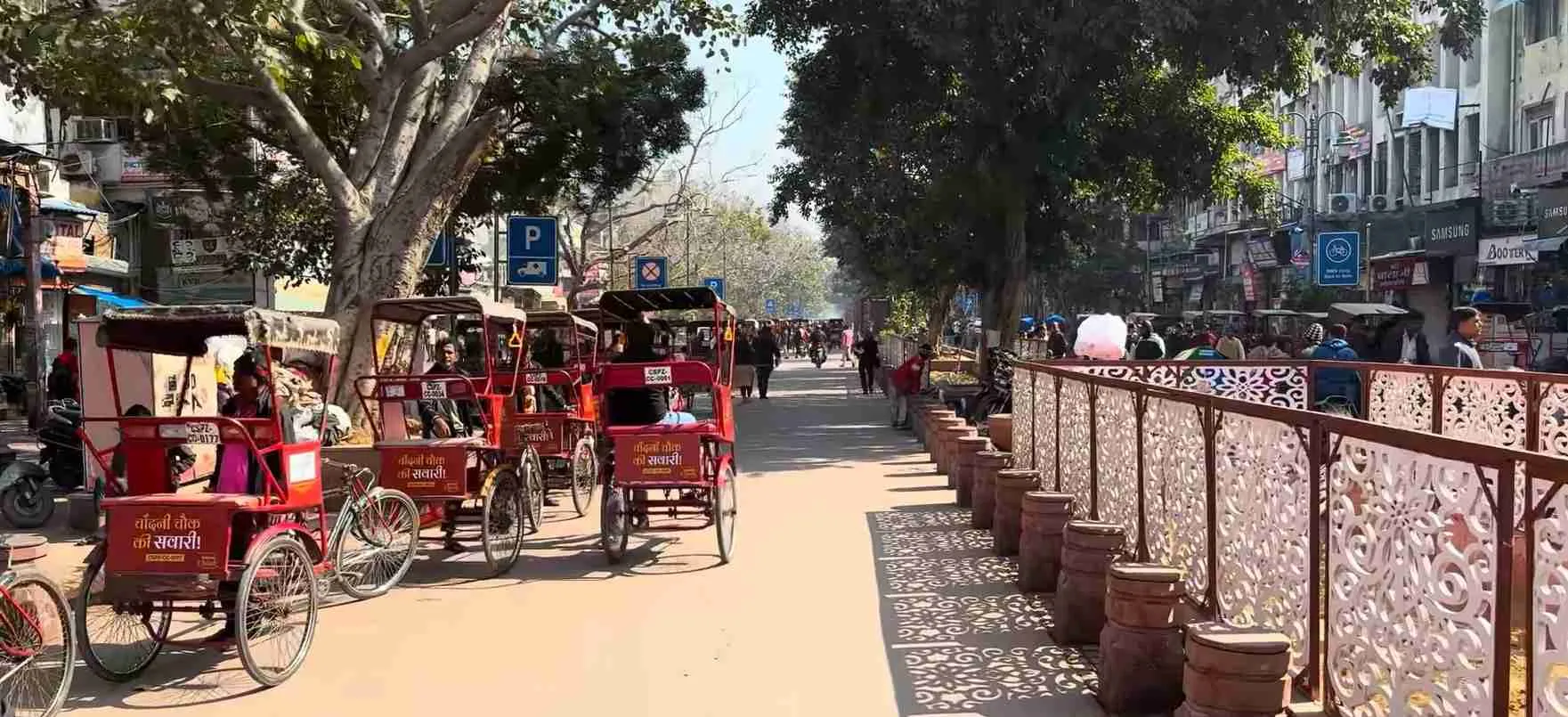
Today’s Chandni Chowk bears little resemblance to its Mughal elegance, transformed into a dense commercial corridor where wholesale markets, retail shops, street vendors, and pedestrians compete for space in lanes that seem impossibly narrow yet somehow accommodate rickshaws, motorcycles, and even occasional cars. The beauty lies not in preserved monuments but in the continuation of urban functions across centuries: merchants still sell spices from the same locations their ancestors occupied in the 1600s, craftspeople practice trades passed down through generations, and religious communities maintain temples, mosques, and gurudwaras that anchor neighborhood identity.
Jama Masjid, India’s largest mosque, dominates Old Delhi’s skyline as it has since 1656, its three massive domes and twin 40-meter minarets visible across the city. Shah Jahan commissioned the mosque as Shahjahanabad’s congregational prayer space, capable of holding 25,000 worshippers in its expansive courtyard. The mosque represents the culmination of Mughal architectural achievement, combining red sandstone and white marble in perfect proportions, with details that reward close examination: intricate calligraphy, geometric patterns carved in stone, and engineering that maintains stable temperatures despite Delhi’s extreme climate.
This walking tour requires different expectations than typical tourist experiences. There’s no clear path or marked route; navigation means following recommendations through a maze-like environment where you’ll frequently feel lost. Comfort disappears in favor of authentic experience: you’ll sweat in the heat, navigate crowds that feel overwhelming, encounter aggressive touts, and question whether the chaos justifies the effort. Yet this immersive confusion reveals Old Delhi’s essence more authentically than any sanitized heritage walk could achieve.
The reward comes in unexpected moments: stumbling upon a 300-year-old haveli with original frescoes still visible, watching craftspeople apply gold leaf to wedding items using centuries-old techniques, tasting food preparations that haven’t changed in generations, or catching sight of Jama Masjid’s domes framed perfectly at the end of a narrow lane as evening light transforms red sandstone to amber. These moments create memories more vivid than any carefully curated tourist attraction.
Historical Background: Shah Jahan’s Vision
Building Shahjahanabad (1639-1648)
Shah Jahan’s decision to build a new capital at Delhi reflected both practical politics and imperial ambition. His father Jahangir had ruled from Agra, but Shah Jahan found the existing capital inadequate for expressing his vision of Mughal power. Delhi’s strategic location in northern India provided better access to Mughal territories extending from Afghanistan to Bengal, while the city’s historical significance—as capital of previous Delhi Sultanate dynasties—added legitimacy to Mughal rule.
Construction began in 1639, employing thousands of workers, architects, engineers, and craftspeople recruited across the empire. The city plan followed Islamic urban design principles: a walled perimeter with controlled gates, a central axis (Chandni Chowk) connecting major monuments, separate quarters for different communities and trades, extensive water systems including canals and fountains, and the imperial palace (Red Fort) positioned strategically at the city’s edge.
Shahjahanabad’s construction demonstrated Mughal administrative efficiency and artistic achievement at their peak. The city walls stretched 6 kilometers, punctuated by 14 gates including the surviving Delhi Gate, Ajmeri Gate, Turkman Gate, and Kashmiri Gate. Within these walls, planned neighborhoods organized residents by profession and religion, creating specialized bazaars that continue today: Dariba Kalan for silver jewelry, Kinari Bazaar for wedding supplies, Ballimaran for paper products, Khari Baoli for spices.
Water management showcased Mughal engineering sophistication. The Nahr-i-Bihisht (Stream of Paradise) canal ran along Chandni Chowk’s center, fed by the Yamuna River through an elaborate system that maintained water flow during dry seasons. Pools, fountains, and smaller canals cooled the city, while underground channels supplied individual mansions. Most waterways disappeared during British rule, filled for road expansion or falling into disrepair, though remnants occasionally surface during construction projects.
The Mughal Period (1648-1857)
Shahjahanabad flourished as the Mughal capital for over two centuries, reaching populations estimated at 400,000-500,000 during peak periods. The city attracted merchants, scholars, artists, and craftspeople from across the Islamic world, creating a cosmopolitan center where Persian, Arabic, Turkish, and Indian cultures merged into distinctive Indo-Islamic civilization. Urdu language evolved in Old Delhi’s streets, blending Persian grammar with local dialects to create the lingua franca of Mughal India.
Trade networks connected Shahjahanabad to Central Asia, Persia, the Ottoman Empire, and European trading posts. Chandni Chowk’s merchants dealt in precious stones, fine textiles, spices, metals, and luxury goods that supplied Mughal aristocracy and affluent residents. Workshops produced miniature paintings, calligraphy, jewelry, weapons, textiles, and other crafts that defined Mughal aesthetic standards, establishing technical traditions that continue in Old Delhi workshops today.
The city’s cultural life centered on poetry, music, and intellectual discourse. Urdu poetry reached sophisticated heights in Shahjahanabad’s literary circles, where poets competed in mushairas (poetry gatherings) that established reputations and created works still celebrated today. Classical music traditions evolved in nobles’ courts, while Sufi shrines attracted devotees seeking spiritual teachings. This cultural flowering produced legacies that shaped South Asian arts for centuries.
Mughal decline began in the 18th century as central authority weakened. Persian invasions, including Nadir Shah’s devastating 1739 sack of Delhi that looted unimaginable wealth, and Afghan raids disrupted the city’s prosperity. The 1857 Sepoy Mutiny (First War of Independence) resulted in British forces besieging and recapturing Delhi, ending Mughal rule when they exiled the last emperor Bahadur Shah Zafar. British retaliation included destroying large portions of the city, executing residents, and systematically dismantling Mughal administrative structures.
British Colonial Period (1857-1947)
British authorities transformed Delhi’s character while leaving Old Delhi’s basic layout largely intact. They demolished extensive sections of Red Fort, filled many canals, widened Chandni Chowk for vehicle traffic, and imposed colonial administrative systems. The construction of New Delhi (1911-1931) as the British Raj capital created stark contrasts: while New Delhi featured wide avenues, parks, and orderly planning, Old Delhi remained dense, chaotic, and increasingly neglected.
British rule brought technological changes that altered urban life without destroying underlying patterns. Telegraph lines, railways, electricity, and motorized vehicles modernized commerce while preserving Old Delhi’s function as a commercial hub. Traditional merchants adapted to new economic conditions, adding British manufactured goods to inventories while maintaining family businesses and craft traditions. Photography studios, printing presses, and modern retailers appeared alongside age-old spice merchants and jewelry makers.
Architectural neglect during British rule meant many Mughal structures deteriorated while Victorian-era buildings appeared in major commercial areas. The British built Civil Lines (administrative residential area), established courts and offices, and created infrastructure serving colonial needs. Yet they largely left Old Delhi’s residential areas alone, allowing communities to maintain traditional practices and social structures that British authorities viewed as backward but harmless.
Post-Independence Evolution (1947-Present)
Partition’s violence in 1947 transformed Old Delhi’s demographics overnight. Muslim populations, previously majority or substantial minorities in many neighborhoods, migrated to Pakistan, while Hindu and Sikh refugees from Pakistan settled in vacated properties. This population exchange disrupted centuries of neighborhood continuity, though many merchant families remained, and new arrivals often took up similar trades, maintaining Old Delhi’s commercial character.
Post-independence development brought both preservation challenges and economic opportunities. Old Delhi remained a crucial wholesale market supplying northern India with goods ranging from electronics to textiles, while increasing population density strained infrastructure designed for medieval populations. Narrow lanes accommodated motor scooters, rickshaws, and cars despite dimensions meant for pedestrians and carts. Electrical wiring, plumbing, and communication cables snaked across facades in chaotic tangles.
Recent decades have seen increased preservation awareness. Jama Masjid underwent extensive restoration, some havelis received protected status, and heritage walks introduced tourism revenue that incentivizes building maintenance. Simultaneously, gentrification pressures threaten affordability, modern shops replace traditional businesses, and younger generations abandon family trades for different careers. Old Delhi exists in constant tension between preservation and development, tradition and modernity, heritage value and commercial pressure.
The Walking Route: Chandni Chowk and Beyond
Starting Point: Chandni Chowk Metro Station
Begin at Chandni Chowk Metro Station (Yellow Line), which provides the most convenient access and immediately orients you within the neighborhood. Exit onto Chandni Chowk main road, where the thoroughfare’s width surprises first-time visitors expecting narrow medieval lanes. This breadth results from British-era widening that destroyed the central canal and pools but created space for modern traffic that would otherwise paralyze the area.
Immediately outside the metro, the scene establishes Old Delhi’s sensory intensity: vendors selling fresh juice from carts laden with oranges and pomegranates, street food stalls frying samosas and jalebis, rickshaw drivers offering tours at inflated prices, and crowds moving in all directions without apparent pattern. This chaos intimidates initially but reveals underlying order as you recognize different types of traffic (pedestrians on the sides, vehicles in center) and business patterns (street vendors mobile, shops permanent).
The Red Fort looms behind you (east), its red sandstone walls visible above the congestion. While the fort itself merits separate exploration, its presence orients you within Shahjahanabad’s original plan: the fort served as the eastern anchor of Chandni Chowk, from which the emperor could survey his capital’s main avenue during processions and ceremonies that brought the entire city into the royal presence.
Sis Ganj Gurudwara
Walk west along Chandni Chowk’s north side approximately 200 meters to Sis Ganj Gurudwara, a Sikh temple marking a site of profound religious significance. The gurudwara commemorates Guru Tegh Bahadur’s martyrdom in 1675, when Mughal emperor Aurangzeb executed the Sikh leader for refusing to convert to Islam. The execution occurred in the main square (Chandni Chowk) as public demonstration of imperial authority, though it provoked Sikh resistance rather than submission.
The gurudwara’s white marble facade with golden dome stands in striking contrast to surrounding commercial buildings. Enter through the main gate (remove shoes and cover head—scarves provided), proceeding through the entrance courtyard to the main prayer hall. The architecture combines Mughal influences (domes, arches) with Sikh elements (open access, central focus on Guru Granth Sahib scripture). Devotional music (kirtan) plays continuously, creating a peaceful atmosphere despite the chaos immediately outside.
The martyrdom site itself lies beneath a marble platform in the main hall, marked with inscriptions describing Guru Tegh Bahadur’s sacrifice. For Sikhs, this location represents supreme dedication to religious freedom and resistance to forced conversion. The gurudwara receives continuous visitors offering prayers, making donations, and receiving langar (free community meal) available to all regardless of religion—an essential Sikh practice demonstrating equality and service.
The gurudwara’s langar hall (typically in basement or separate building) serves simple vegetarian meals throughout the day. Visitors are welcome to participate: wash hands, sit on floor mats (no chairs—everyone sits equally), and receive dal, vegetables, roti, and rice served by volunteers. This experience provides genuine insight into Sikh values of community service and equality while offering respite from Old Delhi’s intensity.
Kinari Bazaar: Wedding Shopping Lane
Exit the gurudwara and turn north into Kinari Bazaar, a narrow lane specializing in wedding supplies and decorative items. This market embodies Old Delhi’s specialized commercial organization: entire streets dedicated to single product categories, with competition driving quality and innovation within that specialty. Kinari Bazaar’s focus on weddings means elaborate decorations, costume jewelry, artificial flowers, fabric trimmings, sequined materials, and items needed for South Asian wedding ceremonies that can last multiple days and serve hundreds of guests.
The lane width—barely 3 meters in many sections—creates an enclosed tunnel effect, with shops on both sides displaying goods that overflow onto the pedestrian path. Merchants sit among their wares, ready to negotiate prices or provide advice about wedding planning. The density feels overwhelming: you’ll brush against merchandise, navigate around vendors setting up displays, and constantly step aside for motorcycles that somehow navigate these impossible spaces.
Look upward to appreciate the architecture the ground-level commerce obscures. Many buildings retain Mughal-era proportions and decorative elements: carved wooden balconies (jharokhas), ornate doorways, painted facades now faded and covered with modern signage. Some structures date to Shahjahanabad’s earliest periods, though continuous occupation and renovation have layered centuries of modifications. Residential quarters occupy upper floors above shops, maintaining Old Delhi’s characteristic mixed-use density.
Kinari Bazaar reveals Old Delhi’s economic resilience. While e-commerce disrupts many retail sectors, weddings remain occasions where families prefer in-person shopping, expert advice, and the ability to physically assess quality. The specialized knowledge accumulated by merchant families over generations—understanding fabric qualities, seasonal availability, regional preferences, price negotiation norms—cannot be easily replicated online. This expertise keeps Kinari Bazaar thriving when other traditional markets struggle.
Paranthe Wali Gali: Stuffed Flatbread Lane
From Kinari Bazaar, navigate through connecting lanes toward Paranthe Wali Gali (Flatbread Lane), one of Old Delhi’s most famous culinary destinations. The narrow lane hosts several shops selling paranthas (stuffed, fried flatbreads) prepared using recipes and techniques unchanged for generations. These establishments represent Old Delhi’s tradition of street food that evolved into legendary institutions, where specific families became known for particular preparations.
The lane itself is barely 2 meters wide, with parantha shops occupying both sides. Each shop displays similar setups: a cooking area with large flat griddle (tawa) where cooks prepare paranthas to order, seating areas with basic benches or chairs, and walls displaying faded photographs of celebrity visitors and newspaper clippings celebrating the establishment’s history and quality. Despite similar offerings, each shop maintains loyal customers who swear their paranthas are superior.
Paranthas come in numerous fillings: potato (aloo), cauliflower (gobhi), radish (mooli), paneer (cottage cheese), mixed vegetables, and more exotic options like rabri (sweetened condensed milk), banana, or mixed dry fruits. Each parantha is prepared fresh: dough rolled thin, filling placed in center, dough folded to enclose filling, then shallow-fried on the griddle with generous amounts of ghee (clarified butter) until golden and crispy. The result combines flaky exterior with well-seasoned filling.
Order at any shop—Pandit Gaya Prasad Shiv Charan, Kanhaiya Lal Durga Prasad Dixit, and Babu Ram Devi Dayal are among the most established. A typical order includes 2-3 different paranthas (they’re rich and filling), served with yogurt, pickle, and sometimes potato curry. Expect to pay minimal amounts for substantial food. The seating is basic, often shared tables, creating communal dining where strangers eat elbow-to-elbow while street activity continues immediately outside.
The experience transcends the food itself. Watching cooks prepare dozens of paranthas simultaneously, managing multiple orders while maintaining quality, demonstrates skills developed over decades. Conversations with owners often reveal family histories spanning multiple generations, stories of celebrities who visited, and pride in maintaining traditions in an era of fast food and chain restaurants. This living heritage—not just preserved but actively practiced—makes Paranthe Wali Gali significant beyond its delicious offerings.
Dariba Kalan: Silver Jewelry Market
Continue west through connecting lanes to Dariba Kalan, Old Delhi’s silver jewelry center. This market street has specialized in precious metals since Mughal times, when court jewelers established workshops supplying aristocratic demand for elaborate ornaments. Modern Dariba Kalan continues this legacy, with dozens of shops selling silver jewelry, gold ornaments, precious stones, and custom designs ranging from traditional Indian styles to contemporary pieces.
The market organization reflects India’s jewelry industry structure: manufacturers, wholesalers, and retailers often operate from the same small shop, with craftspeople working in back rooms or upper floors while display cases show finished products. This vertical integration means you can often watch jewelers at work, using traditional techniques like hand-setting stones, intricate filigree work, and detailed engraving that require years of training to master.
Dariba Kalan attracts both wholesale buyers purchasing inventory for retailers across India and individual customers seeking engagement jewelry, wedding ornaments, or investment pieces. Prices require negotiation—initial quotes start artificially high, expecting bargaining that can reduce costs by 20-40%. Understanding current precious metal rates (gold, silver) helps assess whether quoted prices are reasonable, as jewelry pricing typically includes metal weight plus craftsmanship charges.
The street reveals India’s complex relationship with precious metals as both adornment and investment. Families purchase gold and silver jewelry for weddings, festivals, and as wealth storage, with designs reflecting regional traditions and religious significance. Dariba Kalan’s continued prosperity demonstrates this enduring cultural practice, even as modern Indians increasingly invest in stocks and real estate alongside traditional gold accumulation.
Jama Masjid Approach
From Dariba Kalan, continue west and south toward Jama Masjid, navigating through residential neighborhoods that show Old Delhi’s non-commercial character. These lanes are narrower still, often barely wide enough for two people to pass, lined with multi-story residential buildings where families have lived for generations. Balconies overhang the street, connected by electrical wires and clotheslines, creating a canyon effect where sunlight barely penetrates.
The residential atmosphere differs markedly from commercial Chandni Chowk: quieter, with occasional chai (tea) stalls serving neighborhood residents, small grocery shops, and children playing in lanes that become their outdoor space in the absence of parks or playgrounds. This is where Old Delhi’s population density becomes most apparent—thousands of people living in buildings designed for much smaller medieval households, adapting to modern life in spaces that cannot easily accommodate contemporary needs.
Architecture in these residential lanes often reveals unexpected treasures: carved wooden doors with brass fittings, stone lintels inscribed with Persian calligraphy, remnants of painted frescoes, and havelis (traditional courtyard mansions) that once housed wealthy families but now accommodate multiple households in subdivided spaces. Many buildings deteriorate from decades of deferred maintenance, their historical value unrecognized by residents struggling with basic infrastructure challenges.
As you approach Jama Masjid, the character shifts again: the lanes widen slightly, shops selling prayer caps, perfumes, Islamic books, and other religious items appear, and the density of people increases with devotees heading to the mosque. The neighborhood around Jama Masjid remains predominantly Muslim, maintaining cultural continuity despite Delhi’s post-Partition transformations.
Jama Masjid: India’s Grand Mosque
Architectural Significance
Jama Masjid represents the culmination of Mughal mosque architecture, combining monumentality with refinement in proportions that Shah Jahan perfected during his reign. The mosque’s full name, Masjid-i-Jahān-Numā (Mosque Commanding View of the World), reflects the emperor’s imperial ambitions: the structure dominates Old Delhi’s skyline, visible for kilometers and establishing religious authority through architectural supremacy.
Construction lasted six years (1650-1656), employing 5,000 workers at peak periods. The mosque rises on an elevated platform that places the prayer hall and courtyard above street level, creating visual prominence and practical elevation above potential flooding. Red sandstone forms the primary building material, with white marble accents highlighting domes, minarets, and decorative elements—a color combination Shah Jahan favored for its visual impact and symbolic associations with power (red) and purity (white).
The architectural plan follows classic Islamic mosque design: a central courtyard (sahn) surrounded by arched corridors (riwaq), with the main prayer hall (liwan) on the western side facing Mecca. Three massive onion domes crown the prayer hall, their bulbous forms characteristic of Mughal mosque architecture. Two 40-meter-tall minarets (towers) flank the courtyard’s east side, their vertical emphasis balancing the prayer hall’s horizontal mass and providing platforms for the call to prayer (adhan) that once summoned worshippers before loudspeakers amplified the call across the city.
Proportional sophistication distinguishes Jama Masjid from earlier Mughal mosques. Shah Jahan’s architects achieved perfect balance between elements: dome heights relative to base widths, minaret placement creating visual symmetry, courtyard dimensions allowing 25,000 worshippers during major festivals, and decoration that enhances rather than overwhelms the structural forms. This refinement reflects lessons learned from previous projects including the Taj Mahal, completed just four years before Jama Masjid’s foundation.
Entering the Complex
Three gates provide access to Jama Masjid, each with distinct character and significance. The eastern gate (opposite Red Fort) served as the royal entrance, where emperors arrived for Friday prayers and major festivals. The northern gate faces the commercial heart of Old Delhi, serving the general population. The southern gate remains the most accessible for tourists, with wide stairs and proximity to metro stations.
Entry requirements mandate removing shoes (leave at designated counters for small fees) and modest dress (knees and shoulders covered; women may need to wear provided robes if dressed inappropriately). Security screening includes bag checks, particularly heightened during prayer times and festivals. Non-Muslims can enter outside of prayer times, though Friday afternoon (Jummah prayer) remains restricted to worshippers.
Climbing the entrance stairs—approximately 30-40 steps depending on which gate you use—builds anticipation as the mosque’s scale gradually reveals itself. The elevated platform creates separation from street chaos, establishing a threshold between worldly concerns and spiritual devotion. Upon reaching the courtyard level, the sudden openness after navigating Old Delhi’s compressed lanes creates powerful spatial contrast.
The Courtyard Experience
The courtyard (sahn) measures 100 meters square, paved with red sandstone in geometric patterns that guide worshippers into organized rows during prayers. Four sides feature arched corridors providing shade and architectural framing that focuses attention on the prayer hall and central ablution pool. The scale is overwhelming: 25,000 worshippers can pray simultaneously during Eid festivals, when the courtyard fills completely with rows of devotees performing synchronized prostrations.
The central pool (hauz) serves ritual washing (wudu) before prayers, though modern faucets lining the pool’s edges now supplement the traditional basin. Watching worshippers perform ablution—washing hands, face, arms, and feet in prescribed sequence—reveals the ritual’s meditative quality, the careful attention transforming mundane hygiene into spiritual preparation. This public intimacy, thousands of strangers sharing sacred space, embodies Islam’s egalitarian principles where rich and poor, educated and illiterate, pray as equals before God.
The prayer hall’s facade dominates the western courtyard edge, its three massive arched entrances (iwan) creating deep shadows and architectural drama. White marble strips outline the arches, enhancing their forms against red sandstone backgrounds. Calligraphic inscriptions in black marble inlay quote Quranic verses, choosing texts emphasizing God’s mercy and the importance of prayer. These inscriptions represent master calligraphers’ work, where letter proportions, spacing, and flourishes achieve aesthetic perfection while maintaining legibility for worshippers seeking spiritual messages.
Interior Prayer Hall
The prayer hall interior (accessible to non-Muslims outside prayer times with special permission or guided tours) reveals Mughal decorative sophistication. Rows of arches divide the space into eleven aisles, creating repetitive rhythms that emphasize the hall’s length and direct attention toward the mihrab (prayer niche) indicating Mecca’s direction. The domes rest on intersecting arches that distribute weight while creating geometric patterns appreciated from below.
Marble work demonstrates peak Mughal craftsmanship: intricate geometric patterns (pietra dura), delicate floral motifs, and precisely fitted stone creating seamless surfaces. The mihrab receives the most elaborate decoration, as this focal point concentrates worshippers’ attention during prayers. Marble screens (jali) filter light, creating soft illumination that changes throughout the day as sun angles shift, animating the interior with moving patterns.
Acoustic design ensures that voices project throughout the hall, allowing a single imam’s voice to reach thousands of worshippers before amplification systems. The architects achieved this through careful attention to ceiling heights, arch placement, and materials selection—hard stone surfaces reflect sound while dome shapes focus acoustic energy toward the congregation. Modern sound systems now amplify prayers, but the building’s inherent acoustics remain impressive.
Minaret Ascent
The southern minaret permits tourist access (small additional fee, limited hours), offering panoramic Old Delhi views from 40-meter height. The narrow spiral staircase—130 steps in confined space—challenges claustrophobic visitors, but the view rewards the climb. From the minaret’s top gallery, Old Delhi spreads in all directions: tangled lanes extending to city walls, Red Fort’s massive bulk, modern high-rises beyond the old city boundaries, and the visible contrast between Shahjahanabad’s density and New Delhi’s spacious planning.
The perspective reveals urban patterns invisible from street level: how neighborhoods organize around mosques, temples, and gurudwaras; how main commercial streets follow medieval thoroughfares; how Jama Masjid’s position creates a visual focal point for the entire old city. Early morning and late afternoon light particularly enhance the view, casting long shadows that emphasize architectural forms and providing relief from midday haze that often obscures distant landmarks.
Photography from the minaret captures quintessential Old Delhi imagery: the mosque’s domes in foreground, chaotic roofscapes extending to horizon, distant monuments punctuating the urban fabric. Time your visit to catch the light you want: sunrise creates soft pink tones, sunset dramatic oranges, blue hour mystical purple hues. Weather considerations include monsoon clouds adding drama, winter fog creating atmospheric mystery, and summer heat haze reducing clarity but creating dreamlike effects.
Culinary Journey Through Old Delhi
Karim’s: Mughlai Legacy
From Jama Masjid’s southern gate, walk approximately 100 meters through narrow lanes to Karim’s, Old Delhi’s most famous restaurant claiming direct descent from royal Mughal cooks. Established in 1913, Karim’s preserves recipes allegedly passed down from emperor Shah Jahan’s court, maintaining cooking techniques and flavor profiles that disappeared elsewhere as Mughal culture declined after 1857. Whether this lineage is absolutely authentic or partly mythologized, Karim’s certainly represents Old Delhi’s longest-running culinary institution.
The restaurant occupies a modest space with basic decor: wooden tables, simple chairs, walls decorated with old photographs and newspaper clippings celebrating the establishment’s fame. The kitchen remains visible, with cooks working over large tandoor ovens and heavy cooking pots, preparing dishes using methods that predate modern kitchen equipment. This simplicity reinforces authenticity—the food speaks for itself without relying on atmospheric pretense.
Signature dishes include mutton burra (marinated lamb chops cooked in tandoor), mutton korma (lamb in rich cashew-cream gravy), chicken jahangiri (attributed to Emperor Jahangir’s court), seekh kebabs (minced meat on skewers), and brain curry (maghaz) for adventurous eaters. The flavors emphasize slow cooking, complex spice blends, and rich gravies characteristic of Mughlai cuisine developed for aristocratic palates accustomed to elaborate meals.
Accompaniments include various breads fresh from the tandoor: naan (leavened flatbread), roti (unleavened flatbread), and roomali roti (thin as handkerchief, served folded). The breads arrive continuously, allowing you to scoop rich gravies while bread remains warm. Dal (lentils) provides protein for vegetarians, though Karim’s strength lies in meat preparations that showcase Muslim culinary traditions.
Crowds are constant, with peak lunch (1-3 PM) and dinner (7-9 PM) times requiring patience for tables. Service is efficient but not polished—waiters move quickly, take orders rapidly, and deliver food as soon as it’s ready without elaborate presentation. This no-nonsense approach suits the food-focused environment where presentation matters less than taste. Expect shared tables during busy periods, with strangers seated together to maximize seating capacity.
Street Food Circuit
Beyond sit-down restaurants, Old Delhi’s street food defines the neighborhood’s culinary character. Walking tours should include sampling from various vendors, experiencing the diversity of preparations and regional influences that converged in Delhi’s markets over centuries. Street food safety requires judgment: choose vendors with visible crowds (indicating turnover and freshness), observe preparation methods, and trust establishments that have survived decades through reputation rather than recent trendy openings.
Natraj Dahi Bhalla (near Chandni Chowk Metro) specializes in dahi bhalla, soft lentil dumplings in spiced yogurt topped with chutneys. The dish balances flavors (sweet, spicy, tangy) and textures (soft dumplings, creamy yogurt, crispy sev) while remaining light enough to eat between heavier foods. The shop has operated since the 1940s, maintaining quality that attracted repeat customers for three generations.
Ghantewala Sweets (established 1790s, though the original shop closed, newer locations continue traditions) represents Delhi’s oldest sweet shop heritage. Traditional Indian sweets (mithai) use milk solids, sugar, and ghee to create dense, rich confections: barfi (milk fudge), rasgulla (cheese balls in syrup), gulab jamun (fried dough balls in syrup), jalebi (pretzel-shaped fried batter soaked in syrup). These treats provide quick energy and satisfy sweet cravings that balance Old Delhi’s many savory options.
Fruit juice vendors along Chandni Chowk prepare fresh juice from seasonal fruits: pomegranate, orange, sugarcane, watermelon, or mixed fruit. The preparation is simple—fruit crushed or pressed, sometimes with lemon and salt—providing hydration and vitamins during long walking tours. Watching vendors handle pomegranates (cutting and manually extracting juice) or feed entire sugarcane stalks through crushing machines demonstrates physical labor behind even simple refreshments.
Chaat vendors offer India’s beloved street snacks: pani puri (crispy shells filled with spiced water), samosas (fried pastry triangles with potato or meat), aloo tikki (potato patties), and papri chaat (crispy wafers with chickpeas, yogurt, and chutneys). These foods combine contrasting elements—crispy and soft, hot and cold, sweet and spicy—creating complex flavors that define Indian street food culture. Each vendor develops their own recipes, creating subtle differences that regular customers recognize and prefer.
Khari Baoli: Asia’s Largest Spice Market
While not always included in standard Chandni Chowk walking tours, Khari Baoli merits extension for food enthusiasts or those interested in commercial heritage. Located west of Fatehpuri Mosque (approximately 1 kilometer from Jama Masjid), this wholesale spice market has operated since the 17th century, surviving as Asia’s largest spice trading center despite global supply chain modernization.
The approach via narrow lanes lined with spice warehouses announces the destination through overwhelming aromatics: cumin, cardamom, chili powder, turmeric, coriander, fenugreek, and dozens of other spices creating a complex olfactory experience that intensifies as you penetrate deeper into the market. The sensory overload can overwhelm—strong spice scents combined with crowds, noise, and visual chaos—but represents authentic encounter with Old Delhi’s commercial reality.
Market organization follows traditional wholesale patterns: specialized zones for different products (whole spices, ground spices, dried fruits, nuts, herbs), with merchants sitting among enormous sacks containing inventory measured in quintals (100 kilograms). Business occurs through established relationships, with wholesalers supplying retailers across India based on trust, quality reputation, and competitive pricing developed over years or generations of transactions.
Visiting Khari Baoli requires accepting your role as observer rather than active participant. The wholesale environment means most vendors don’t cater to small retail purchases from tourists. However, some shops accommodate individual buyers seeking authentic spices in larger quantities than supermarkets offer. Purchases here access source-level quality and pricing, though you’ll need to negotiate and understand that minimum quantities may exceed home cooking needs unless you cook extensively or buy spices as gifts.
The market’s continued vitality demonstrates India’s preference for fresh, whole spices over pre-packaged alternatives. Indian cooking relies on spice combinations that release flavors through grinding, toasting, and tempering, with quality significantly affecting final dish results. Khari Baoli’s merchants understand these nuances, offering expertise that online spice vendors cannot match despite e-commerce convenience.
Hidden Heritage: Temples and Havelis
Gauri Shankar Temple
Near Chandni Chowk Metro, Gauri Shankar Temple represents Delhi’s ancient Hindu presence predating Mughal Shahjahanabad. The temple likely dates to the 18th century, though local tradition claims older origins. Dedicated to Lord Shiva (Gauri Shankar), the temple maintains continuous worship despite surrounding commercial development, its practices unchanged as Old Delhi transformed around it.
The temple compound provides unexpected tranquility amid Chandni Chowk chaos. High walls separate the sacred space from street activity, though sounds of traffic and commerce penetrate. The main shrine houses a large Shiva lingam (abstract phallic symbol representing Shiva), continuously bathed with milk, water, and offerings by devotees performing worship (puja). The lingam supposedly grows annually, a miraculous property believers claim demonstrates divine presence.
Architecture combines traditional Hindu temple elements (pyramidal shikhara tower, small sanctum, mandapa hall) with Mughal-era influences visible in arches and decorative patterns. This synthesis reflects Shahjahanabad’s syncretic culture, where Hindu craftspeople worked on Mughal monuments while Muslims patronized Hindu religious sites, creating artistic cross-pollination that enriched both traditions.
Jain Temples: Lal Mandir and Digambar Jain Temple
Opposite Red Fort, Lal Mandir (Red Temple) represents Delhi’s Jain community’s principal worship site. Built in 1656, the temple received patronage from Jain merchants who prospered in Mughal Delhi, their business acumen and religious networks creating wealth that funded elaborate temple construction and charitable institutions. The temple’s red sandstone exterior matches Mughal architectural preferences, while interior decorations follow Jain iconographic traditions.
Jain temples emphasize non-violence (ahimsa) and asceticism reflected in artistic programs featuring tirthankaras (spiritual teachers) in meditation poses, devotees practicing self-denial, and detailed cosmological diagrams illustrating Jain universal concepts. The temples maintain strict vegetarian policies, with attached hospitals treating injured birds (a Jain charitable practice demonstrating concern for all living beings). Visitors can observe the bird hospital’s operations, where volunteers care for pigeons, parrots, and other birds rescued from Delhi’s streets.
The Digambar Jain Temple nearby dates to 1807, featuring impressive painted interiors with gold leaf decoration, intricate mirror work, and colored glass creating luminous effects when sunlight filters through. The temple serves Delhi’s Digambar Jain sect, one of Jainism’s two main divisions, distinguished by monks who renounce clothing as ultimate expression of non-attachment to material possessions.
Exploring Havelis
Old Delhi contains numerous havelis—traditional courtyard mansions once occupied by wealthy merchants, administrators, and aristocrats. Most remain private residences subdivided among multiple families, making access challenging. However, some havelis visible from streets reveal architectural details worth seeking: carved wooden facades, jharokhas (overhanging enclosed balconies), painted frescoes, and ornate doorways representing investment in artistic craftsmanship that demonstrated owners’ wealth and cultural refinement.
Chunnamal Haveli, one of Delhi’s best-preserved examples, occasionally opens for tours (verify current status locally). Built in 1848 by Shah Jahan’s treasurer’s descendants, the haveli features 128 rooms arranged around multiple courtyards, with painted ceilings, Belgian mirrors, and European chandeliers reflecting the family’s cosmopolitan tastes. Visiting reveals how Mughal aristocracy lived, the domestic arrangements balancing privacy and social obligation, and the decline from opulent past to struggling present as maintenance costs exceed current resources.
Other notable havelis include Mirza Ghalib Haveli (former residence of Urdu poetry’s greatest master, now a museum), Begum Samru’s Palace (converted to offices but externally visible), and numerous unnamed structures recognized only by architectural details suggesting historical importance. Spotting these buildings requires attentive observation—many hide behind modern shop fronts or deteriorate in plain sight while life continues around them.
Practical Walking Tips
Navigation Strategies
Getting lost in Old Delhi is inevitable and partly the point—the neighborhood’s maze-like structure rewards exploration over rigid route-following. However, some navigation principles help maintain general orientation. First, recognize major landmarks visible from distance: Jama Masjid’s domes, Red Fort’s walls, and specific gates provide fixed reference points. Second, main arteries (Chandni Chowk, Nai Sarak, Chawri Bazaar) run roughly east-west; remembering their names helps when asking directions. Third, smartphone GPS works reasonably well despite dense buildings; offline maps (download before visiting) prevent data usage concerns.
Asking directions is common and generally helpful. Shopkeepers and residents regularly assist lost tourists, though language barriers exist. Showing destination names written in Hindi script helps, as many Old Delhi residents read Hindi but not English. Expect directions to be approximate—”go straight, turn left, it’s there” might mean 5 minutes or 20 minutes, with “straight” sometimes meaning “generally forward through several turns.” Patience and repeated inquiries gradually narrow your position.
Rickshaw drivers offer guided tours, but agree on routes and prices beforehand. Standard scams include drivers claiming your destination is closed for repair/holiday and suggesting alternative stops (usually shops paying commission). If a driver insists somewhere is closed, walk to verify yourself before accepting alternatives. Legitimate rickshaw tours covering main sites typically cost 300-500 rupees for 2-3 hours, though aggressive initial demands may start at 1000+ rupees.
Timing Your Visit
Seasonal considerations significantly impact Old Delhi experiences. Winter (November-February) provides ideal walking weather with temperatures 15-25°C, though December-January fog occasionally disrupts morning visibility. Summer (April-June) brings oppressive heat exceeding 40°C, making midday walking dangerous; restrict summer visits to early morning or evening. Monsoon (July-September) means afternoon thunderstorms that flood lanes, creating navigational challenges and requiring rain protection. Post-monsoon (October-November) and spring (February-March) offer pleasant temperatures and clear skies ideal for photography.
Daily timing affects crowd levels and atmosphere. Early morning (7-9 AM) sees markets setting up, temples conducting morning rituals, and relatively empty lanes. Mid-morning to afternoon (10 AM-4 PM) brings peak activity, maximum crowds, and intense heat in summer. Late afternoon (4-6 PM) provides golden-hour photography light and cooling temperatures. Evening (7-9 PM) sees illuminated monuments and active dining spots, though some areas become less safe after dark. Fridays feature Jummah prayers at Jama Masjid, creating intense crowds around noon but offering cultural spectacle.
Festival periods transform Old Delhi’s character. Ramadan brings special foods and evening markets as Muslims break fast together. Diwali features elaborate decorations, special sweets, and festive shopping. Eid celebrations fill Jama Masjid with worshippers and create market disruptions as businesses close for prayers. Major Hindu festivals (Dussehra, Holi) affect predominantly Hindu commercial areas. Checking festival calendars helps plan visits to either experience celebrations or avoid crowds, depending on preferences.
Safety Considerations
Old Delhi is generally safe for tourists during daylight hours, with violent crime extremely rare. However, several issues require awareness. Pickpocketing occurs in crowded areas—keep valuables in front pockets or secure bags, avoid displaying expensive cameras or jewelry, and remain alert in dense crowds. Women may experience harassment ranging from staring to verbal comments; dressing modestly reduces but doesn’t eliminate attention; traveling with companions provides buffer against unwanted interactions.
Traffic poses the most immediate danger. Lanes accommodate motorcycles, rickshaws, hand carts, and pedestrians simultaneously without clear right-of-way rules. Stay alert, make eye contact with drivers to ensure they see you, and don’t assume vehicles will stop for pedestrians. Motorcycle accidents occasionally injure careless tourists stepping into lanes without checking traffic flow.
Food safety requires judgment. Established restaurants like Karim’s maintain standards, but street vendors vary. Choose vendors with visible crowds indicating turnover and freshness. Avoid pre-cut fruits that may have been washed in contaminated water; opt for juices made while you watch. Start with mild spice levels until your digestive system acclimates to Indian flavors and bacteria. Carry anti-diarrheal medication as precaution—Delhi’s intense spices and bacteria new to foreign stomachs frequently cause digestive upset regardless of food safety precautions.
Photography Guidelines
Old Delhi provides extraordinary photographic opportunities, but cultural sensitivity and technical challenges require consideration. Always ask permission before photographing people, especially women or religious activities. Many residents refuse, viewing photography as invasion of privacy or concern about image exploitation. Offer to show/email photos to willing subjects—this builds rapport and provides them images they often cannot take themselves.
Jama Masjid permits photography (small additional fee sometimes charged), but respect worshippers during prayers. Don’t photograph people praying unless you have explicit permission; focus on architecture and empty spaces during prayer times. The minaret climb provides spectacular views but narrow stairs make tripods impractical; bring lightweight stabilization or shoot at high ISOs to maintain shutter speed.
Light conditions in Old Delhi vary dramatically: harsh overhead sun in summer creates strong shadows and blown highlights, while monsoon clouds provide soft, even lighting. Golden hour (first/last hour of sunlight) enhances architecture with warm tones. Blue hour (twilight) captures illuminated monuments against deepening sky. Winter fog creates atmospheric mystery but reduces contrast. Experiment with different times to achieve desired moods.
Technical considerations include dust protection (Delhi’s air quality is poor; protect lenses), backup batteries (shops may not sell your camera brand’s batteries), and data backup (wifi is available at accommodations for cloud uploads). Consider lightweight gear—carrying heavy equipment through crowds in heat becomes burdensome. A versatile zoom lens (24-70mm or similar) handles most situations better than multiple prime lenses requiring changes in dusty conditions.
Beyond the Main Route: Extended Explorations
Ballimaran and Mirza Ghalib’s Legacy
Ballimaran, a neighborhood northeast of Chandni Chowk, represents Old Delhi’s literary heritage through association with Mirza Ghalib (1797-1869), Urdu poetry’s greatest master. Ghalib spent his later years in Ballimaran, writing poetry that captured Mughal Delhi’s decline, the trauma of 1857, and universal themes of love, loss, and existential questioning that ensure his continued relevance. His haveli, now a museum, preserves his living quarters and displays manuscripts, personal belongings, and information about his life and work.
Walking through Ballimaran’s lanes provides glimpses of residential Old Delhi away from tourist circuits. The neighborhood maintains traditional character: narrow lanes, densely packed housing, small corner shops serving daily needs, and social life spilling into streets through conversations, children playing, and vendors selling vegetables or snacks. This authentic residential environment shows how most Old Delhi residents actually live, contrasting with commercial Chandni Chowk’s frenetic energy.
The area also features small mosques, shrines, and community gathering spaces that anchor neighborhood identity. These institutions provide social cohesion, organizing festivals, maintaining charitable activities, and preserving cultural practices that might otherwise disappear under modernization pressures. Observing these community spaces illuminates how Old Delhi’s residents maintain traditions while adapting to contemporary urban challenges.
Turkman Gate and City Walls
Turkman Gate, one of Shahjahanabad’s original city gates, stands several kilometers south of Chandni Chowk along Asaf Ali Road. The gate provides tangible connection to Delhi’s walled city past, when gates closed at night for security and controlled movement between city interior and surrounding countryside. Though much of the wall has disappeared under modern development, sections near gates show construction methods: massive stone blocks forming bases, brick upper sections, and engineering that withstood centuries before traffic expansion demanded their removal.
The neighborhood around Turkman Gate suffered severe damage during Emergency-era (1975-77) slum clearances, when government demolished homes forcibly, displacing thousands of residents and destroying established communities. This traumatic history reminds visitors that Old Delhi’s preservation isn’t guaranteed—development pressures, infrastructure needs, and political priorities constantly threaten historic fabric despite its cultural value. Walking these areas reveals ongoing tensions between preservation and progress.
Nizamuddin Shrine (Beyond Old Delhi Proper)
While technically outside Shahjahanabad’s boundaries, Nizamuddin Dargah (shrine) merits inclusion for those interested in Delhi’s Sufi heritage. Located southeast of Old Delhi, the shrine complex honors Hazrat Nizamuddin Auliya (1238-1325), a Sufi saint whose teachings emphasized love, tolerance, and service. The shrine attracts devotees from all religions seeking blessings, spiritual solace, or participation in qawwali (Sufi devotional music) performances that occur Thursday evenings.
Approaching the shrine means navigating a market selling flowers, incense, prayer caps, and other devotional items. The atmosphere shifts from commercial to sacred as you enter the complex, where marble floors cool bare feet and architectural enclosure creates intimacy despite crowds. The saint’s tomb occupies a marble chamber decorated with mother-of-pearl inlay, constantly surrounded by devotees offering flowers and prayers, creating continuous movement around the sacred center.
Thursday evening qawwali sessions demonstrate Sufi Islam’s devotional practices, where music serves as vehicle for spiritual ecstasy and divine connection. Musicians perform traditional compositions in Urdu and Persian, with repetitive refrains building intensity as listeners clap, sway, and occasionally enter trance states. This participatory worship contrasts with more formal Islamic practices, revealing Sufism’s emphasis on direct experiential connection with divine reality beyond orthodox ritual.
Frequently Asked Questions
Do I need a guide to explore Old Delhi, or can I walk independently?
Independent exploration is entirely feasible and often more rewarding than guided tours, allowing flexible pacing, spontaneous discoveries, and authentic encounters without the mediation of a guide controlling your experience. Old Delhi’s main sites—Jama Masjid, Chandni Chowk, major temples, food establishments—are well-known, with basic navigation using smartphone maps or asking directions successfully reaching destinations. Solo walking lets you pause at interesting shops, photograph compelling scenes, and engage with residents naturally rather than rushing through a predetermined itinerary. However, guides provide valuable context about history, architecture, and cultural practices that independent visitors might miss. Quality guides explain the significance of seemingly ordinary buildings, share stories that bring locations alive, navigate efficiently through confusing lanes, and provide language interpretation when needed. Consider hiring guides for first visits to gain orientation and historical understanding, then return independently for deeper personal exploration using knowledge acquired from guided tours. Local walk-in tours offered by organizations like Delhi by Cycle or Salaam Baalak Trust provide excellent introductions with knowledgeable guides at reasonable prices, supporting community organizations while enriching your experience.
What are the biggest mistakes tourists make when visiting Old Delhi?
The most common mistake is expecting Western urban organization and becoming frustrated when Old Delhi operates by different logic—lanes that seem random, unclear navigation, absence of obvious signage, and commercial chaos that overwhelms systematic exploration attempts. Accepting that confusion is inherent to the experience reduces stress and allows appreciation of spontaneity. Second, tourists often rush through Old Delhi in 2-3 hours, attempting to “see the highlights” without allowing time for genuine absorption; Old Delhi rewards slow exploration where discoveries emerge from wandering rather than checking off predetermined sites. Third, many visitors stay in clearly marked tourist zones (main Chandni Chowk, Jama Masjid) without venturing into residential lanes where authentic neighborhood character reveals itself; the most memorable experiences often occur in unmarked areas tourists overlook. Fourth, excessive fear about food safety causes some visitors to skip Old Delhi’s legendary street food, missing essential experiences; while caution is reasonable, choosing established vendors with visible crowds provides reasonable safety with extraordinary culinary rewards. Fifth, failing to dress appropriately—particularly women wearing revealing clothing—attracts unwanted attention and prevents entry to religious sites; modest dress (covered knees and shoulders) shows cultural respect and eliminates barriers. Sixth, tourists often respond aggressively to touts and shopkeepers, creating confrontational situations; polite but firm “no thank you” responses work better than angry rejections. Finally, visiting only during peak tourist hours (mid-morning to afternoon) means experiencing Old Delhi at its hottest, most crowded, and least photogenic; early morning or late afternoon visits provide better light, cooler temperatures, and more relaxed atmosphere.
How do I avoid getting scammed or overcharged in Old Delhi’s markets?
Understanding common scams and pricing norms helps navigate commercial interactions successfully. First, agree on prices beforehand for services: rickshaw rides, guide fees, and shopping assistance should have clear rates established before accepting services. Many scams begin with “free” help that becomes expensive later—declining unsolicited assistance prevents these situations. Second, recognize that inflated initial prices are standard negotiation practice, not personal offense; first quotes may be 2-3 times fair prices, expecting bargaining that reduces costs significantly. Research approximate prices beforehand through hotel staff or online resources to establish reasonable ranges, then negotiate confidently using this knowledge. Third, avoid shops recommended by rickshaw drivers or self-appointed “friends” who appear on streets—these establishments pay referral commissions that inflate your prices; if genuinely needing recommendations, ask hotel staff or consult established guidebooks. Fourth, verify weights and quantities when purchasing items sold by weight; occasionally unscrupulous merchants manipulate scales or quote higher weights than actually provided. Fifth, examine merchandise carefully before purchasing, especially jewelry or antiques where authenticity matters—reputable shops accept returns if items prove fake, but street vendors won’t. Sixth, use small bills to prevent change-making scams where vendors claim they lack change for large notes; ATMs often dispense 500 and 200 rupee notes easily broken at restaurants before shopping. Seventh, credit card skimming occurs occasionally; use credit cards only at established restaurants or hotels, not small shops or street vendors. Finally, trust your instincts—if an offer seems too good to be true or situations feel uncomfortable, politely disengage rather than pursuing bargains that may involve risk. Remember that modest price differences (50-100 rupees) often consume significant negotiation energy for amounts that equal $1-2; knowing when price differences matter and when paying slightly more for convenience or goodwill makes sense improves overall experience.
Can I visit Old Delhi during Ramadan? What should I expect?
Ramadan offers exceptional Old Delhi experiences, though requiring awareness of fasting observances and modified commercial patterns. During daylight hours, practicing Muslims abstain from food, drink, smoking, and other physical pleasures, which affects restaurant operations and social atmosphere. Many small eateries close during day, reopening near sunset for iftar (fast-breaking meal). However, major restaurants and tourist-oriented establishments remain open, serving non-Muslim customers during fasting hours. The neighborhood’s energy shifts toward evening, when communal iftar meals, special prayers (tarawih), and late-night shopping create vibrant atmosphere extending past normal business hours. Markets around Jama Masjid particularly come alive after sunset with food stalls selling traditional iftar items: dates, fruit chaat, kebabs, biryanis, and special Ramadan desserts. Witnessing iftar provides moving cultural experience as entire communities break fast simultaneously, often sharing food with strangers in acts of charity central to Ramadan observance. Respect for fasting means avoiding eating, drinking, or smoking publicly in Muslim-majority areas during daylight hours; while not legally prohibited for non-Muslims, discretion shows cultural sensitivity. Some shops reduce hours or close entirely during Ramadan, affecting shopping opportunities; however, most commercial activity continues, adapted to community needs during the holy month. Photography during iftar and tarawih prayers requires extra sensitivity—these represent deeply personal spiritual practices where intrusive photography disrespects participants. Ramadan timing shifts annually by 10-11 days (following lunar calendar), meaning the holy month falls in different seasons each year; checking dates before planning visits ensures you arrive during Ramadan if seeking this experience or avoid it if preferring normal commercial patterns. The final days of Ramadan and Eid al-Fitr festival concluding the month bring enormous crowds to Jama Masjid and surrounding areas as hundreds of thousands gather for prayers and celebrations; this period offers spectacular cultural spectacle but challenging navigation and accommodation availability.
What’s the difference between Old Delhi and New Delhi, and can I walk between them?
Old Delhi (Shahjahanabad) and New Delhi represent distinct historical periods, urban planning philosophies, and cultural characters. Old Delhi dates to 1639, featuring dense medieval Islamic city planning with narrow lanes, high-density mixed-use buildings, and organic growth patterns. New Delhi emerged from British colonial planning (1911-1931) with wide tree-lined avenues, spacious parks, grand monuments, and orderly residential areas exemplifying imperial power through urban design. Walking between the two is physically possible—the distance from Chandni Chowk to India Gate is approximately 6-7 kilometers—but the route crosses through transitional zones without particular interest and involves heavy traffic on wide roads unpleasant for pedestrians. Metro provides efficient connection: Chandni Chowk station (Yellow Line) to Rajiv Chowk, then switch to Blue Line to Central Secretariat or Yellow Line to Patel Chowk, both within walking distance of New Delhi’s central sites (India Gate, Rashtrapati Bhavan, Parliament). Rickshaw or taxi rides take 30-45 minutes depending on traffic, providing views of the architectural and urban character transitions from Mughal-era density through British colonial grandeur to modern development. The contrast between the two cities illuminates Delhi’s layered history: Old Delhi’s chaotic vitality versus New Delhi’s planned order, medieval commercial density versus colonial administrative spaciousness, and organic community development versus imposed imperial vision. Most visitors find exploring each area separately more rewarding than attempting to connect them in single walking tours, as each requires different pacing and mindset—Old Delhi demands surrender to overwhelming sensory experience while New Delhi invites leisurely appreciation of monumental architecture and green spaces.
Are there public restrooms in Old Delhi, and what are alternatives?
Public restroom facilities in Old Delhi are limited, requiring planning for multi-hour walking tours. Jama Masjid maintains restrooms accessible for small fees, though cleanliness varies and facilities are basic Indian-style squat toilets. Delhi Metro stations including Chandni Chowk station have restrooms, though sometimes out of order or poorly maintained. Shopping in larger shops or having meals at restaurants provides opportunities to use their facilities—purchasing even small items or drinks creates reasonable expectation of restroom access. McDonald’s, Starbucks, and other international chains appearing in some areas offer Western-style toilets meeting international standards, though these are less common in Old Delhi proper than New Delhi or modern shopping districts. Some hotels allow non-guests to use facilities for small fees. Cultural note: Indian restrooms often include hand-spray bidets rather than toilet paper; carry your own tissues if preferring paper. Maintaining minimal food/drink consumption during tours reduces restroom urgency, though adequate hydration in Delhi’s heat is crucial—balance these concerns by making strategic restroom stops when encountering acceptable facilities rather than waiting for urgent need. Women face particular challenges as many Old Delhi facilities are designed for men; restaurants and hotels provide most reliable options for women’s restrooms. Planning your route to include stops at Jama Masjid, metro stations, or restaurants every 2-3 hours provides reasonable restroom access without excessive concern about finding facilities urgently.
How has Old Delhi changed in recent years, and is gentrification affecting the area?
Old Delhi faces complex transformation pressures balancing preservation with development, creating changes visible to repeat visitors over even 5-10 year periods. Positive changes include increased heritage awareness, with some havelis restored, walking tours bringing tourism revenue that incentivizes building maintenance, and government-funded restoration projects addressing infrastructure decay. The Delhi Metro’s 2006 extension to Chandni Chowk improved access, reducing travel times and making Old Delhi more accessible to visitors from across the metropolitan region. Some lanes underwent paving improvements, electrical wiring consolidation reduced visual chaos, and traffic restrictions on Chandni Chowk main road created more pedestrian-friendly conditions. However, gentrification pressures threaten affordability and traditional character. Rising property values encourage landlords to increase rents, forcing out longstanding residents and businesses that maintained neighborhood continuity across generations. Modern chain stores replace traditional family shops, homogenizing commercial offerings that once reflected specialized craft knowledge passed through apprenticeship systems. Some heritage buildings receive facade restorations while interiors convert to commercial spaces serving tourists rather than maintaining residential functions. The most significant concern involves displacing working-class Muslim communities who form Old Delhi’s cultural foundation—as property values rise and redevelopment pressures intensify, these populations face displacement to peripheral areas, potentially destroying the living heritage that makes Old Delhi significant beyond architectural preservation. Environmental challenges intensify: Delhi’s notorious air pollution affects Old Delhi particularly severely given building density and traffic congestion. Monsoon flooding increases as climate change brings more intense rainfall events while inadequate drainage infrastructure cannot handle volume. Building deterioration accelerates as maintenance costs exceed resources for many property owners. The tension between preservation and progress creates uncertain futures—optimistically, increased tourism revenue and heritage awareness will fund preservation while maintaining living community character; pessimistically, gentrification will transform Old Delhi into sanitized heritage zone where authentic neighborhood culture disappears behind restored facades catering to tourists and upscale residents rather than communities who maintained traditions across centuries.
What should I know about photography ethics and cultural sensitivity in Old Delhi?
Photography in Old Delhi requires balancing desires to capture compelling images with respect for residents’ privacy and cultural norms. Always request permission before photographing individuals, using gestures if language barriers exist; many residents consent enthusiastically, enjoying interactions with visitors, while others refuse, which you must respect immediately without argument. Never photograph women without explicit permission—many Muslim women observe purdah (modest dress and limited interaction with unrelated men), making unsolicited photography deeply offensive. Similarly, avoid photographing children without parental consent—parent reactions to child photography range from welcoming to hostile depending on individual attitudes and concerns about image exploitation. Religious spaces require particular sensitivity: mosques, temples, and gurudwaras are places of worship rather than tourist attractions, meaning photography should never disrupt devotional practices or make worshippers uncomfortable. Jama Masjid permits photography for fees, but photographing people praying requires individual permission; focus on architecture during prayer times when photographing worshippers would be intrusive. Some religious spaces prohibit photography entirely—respect these policies regardless of whether enforcement seems strict. Consider cultural context when evaluating whether photography is appropriate: intimate moments (bathing at public taps, families in doorways, people sleeping) deserve privacy despite occurring in public spaces. Poverty tourism—photographing destitution, beggars, or marginalized communities for artistic “exotic other” imagery—perpetuates exploitation; if documenting social conditions interests you, spend time understanding contexts and representing subjects with dignity rather than treating poverty as aesthetic subject matter. Offering to share photographs creates reciprocal relationship rather than extractive taking—ask for email addresses or social media handles, then actually send images. Consider printing photos and mailing them to subjects when possible—many Old Delhi residents lack smartphones or internet access that would allow viewing digital images. Street photography requires reading situations quickly: some scenarios welcome documentation while others would be invasive. When uncertain, err toward discretion. Technical considerations include being discrete with expensive camera gear that marks you as wealthy tourist; consider using smaller cameras or smartphones that draw less attention. Avoid photographing police or military personnel, government buildings, or sensitive infrastructure—while rarely enforced, photography restrictions exist that could create problems. Finally, understand that photography changes the dynamic of travel—constant camera use distances you from direct experience and can reduce encounters to image collection rather than genuine cultural engagement. Balance photographic documentation with periods of simply experiencing Old Delhi without the camera barrier.