
Ohrid Day Trips 2026: St. Naum Monastery, Bitola & Albania Cross-Border
Ohrid punches well above its size as a day trip base: within an hour’s bus or boat ride sit a ninth-century monastery guarding the springs of Lake Ohrid, a Macedonian-Roman city founded by Philip II of Macedon, and an open border crossing into Albania’s tranquil lakeside towns. This guide covers transport logistics, verified 2026 costs, and itinerary options for all three excursions — from fully independent budget travel to organised group tours.
- St. Naum Monastery Day Trip 2026: Budget travellers pay 600–700 MKD ($11–13) round trip on the public ferry plus 270 MKD ($5) in entry fees; a guided group boat tour covering St. Naum, Bay of Bones, and the spring rowing channel costs $70–80 per person all-inclusive.
- Bitola is the Most Affordable Day Trip 2026: The bus from Ohrid to Bitola runs five times daily for 300–400 MKD ($6–7) each way; combined with a 150 MKD ($3) entry to Heraclea Lyncestis and a budget lunch, the full self-guided day costs $25–30 per person.
- Albania Cross-Border Day Trip 2026: Independent travellers crossing at the Tushemisht–Sveti Naum checkpoint spend $25–35 per person (bus + border taxis + free Drilon Park + Pogradec lunch); organised group tours from Ohrid covering Bay of Bones, St. Naum, Pogradec, and Lin cost $130–150 per person all-inclusive.
- UNESCO World Heritage Setting: The Lake Ohrid region holds UNESCO inscription since 1979 (extended in 2019 to include the Albanian shore), making every day trip a journey through one of Europe’s oldest and most layered cross-border heritage landscapes.
- Border Crossing Requirements 2026: The Tushemisht–Sveti Naum crossing accepts valid passports and EU national ID cards for most European nationalities; North Macedonia and Albania are outside the Schengen Zone, so document checks apply to all travellers regardless of nationality. Budget 30–60 minutes for processing.
- Best Season 2026: May–June and September–October deliver comfortable temperatures, full boat schedules, and 20–35% lower prices than the July–August peak. Bitola and the Albania border crossing operate year-round; the public ferry to St. Naum runs April through October.
People Also Ask About Ohrid Day Trips 2026
How much does a day trip from Ohrid to St. Naum Monastery cost in 2026?
Budget travellers pay $35–40 per person on a self-guided day: the public return ferry costs 600–700 MKD ($11–13), the Bay of Bones entry is 150 MKD ($3), the monastery admission is 120 MKD ($2), a shared rowing boat on the springs runs 300 MKD ($6) per person, and a simple lakeside lunch adds another 500–700 MKD ($9–13). A full-service guided group boat tour — covering the same stops with a bilingual guide and all entrance fees already included — costs $70–80 per person and departs from Ohrid harbour around 9–10 AM. Prices vary by operator; check directly before booking to confirm what is included.
Can you cross from North Macedonia into Albania at St. Naum in 2026?
Yes — the Tushemisht–Sveti Naum road crossing is open to pedestrians and vehicles and is the standard border point for tourists making the lake circuit. Present a valid passport at both the Macedonian and Albanian checkpoints; EU citizens from most member states can use national ID cards instead. There is no dedicated pedestrian lane, so foot travellers walk through the car booths. Expect a 30–60 minute wait; the two checkpoints sit roughly 2–3 km apart, connected by a scenic lakeside road walkable in about 20 minutes. No visa is required for EU, UK, US, Canadian, and Australian citizens in either country for stays under 90 days.
How do you get from Ohrid to Bitola for a day trip in 2026?
Five daily buses connect Ohrid bus station to Bitola in 55 minutes; tickets cost 300–400 MKD ($6–7) each way. Departures run from early morning through mid-afternoon, with the last return leaving Bitola in the evening. The journey through Galičica National Park is scenic. A return bus journey gives you six to seven hours in Bitola — enough to walk Heraclea Lyncestis thoroughly, stroll the Ottoman boulevard of Širok Sokak, and eat lunch at a local restaurant. Private taxis for the round trip cost 3,000–4,300 MKD ($56–80) for the car and suit groups of three or four splitting the cost.
What is the best day trip from Ohrid in 2026?
St. Naum Monastery on a guided lake ferry consistently earns the highest visitor ratings among the three main excursions: the 90-minute boat journey across Lake Ohrid, the Byzantine monastery perched above the healing springs, and the rowing channel through floating water lilies combine natural and cultural experiences unavailable anywhere else in the region. Bitola and Heraclea Lyncestis win on value — the most archaeology per dollar of any Ohrid day trip — while the Albania cross-border excursion delivers genuine Balkan discovery, particularly for travellers who combine Pogradec, the Lin peninsula mosaics, and Drilon National Park in a single loop. All three complement each other perfectly across a three-day itinerary from Ohrid.
Extended multi-day tours – 5+ days
Featured Macedonia Multi-Day Tour Packages

3 days
Macedonia 3-Day Discovery Tour
- ✓ Comprehensive Macedonia experience
- ✓ Expert local guides included
- ✓ All accommodation included
- ✓ Transportation provided

5 days
Macedonia 5-Day Highlights Experience
- ✓ Comprehensive Macedonia experience
- ✓ Expert local guides included
- ✓ All accommodation included
- ✓ Transportation provided
7 days
Macedonia 7-Day Cultural Journey
- ✓ Comprehensive Macedonia experience
- ✓ Expert local guides included
- ✓ All accommodation included
- ✓ Transportation provided
10 days
Macedonia 10-Day Complete Adventure
- ✓ Comprehensive Macedonia experience
- ✓ Expert local guides included
- ✓ All accommodation included
- ✓ Transportation provided
Multi-day tour packages powered by TourRadar. Prices and availability subject to change.
Introduction: Ohrid as a Day Trip Base in 2026
Ohrid’s geography is the key to its day trip appeal. The city sits on the eastern shore of Lake Ohrid at the point where the Macedonian mountains slope down to the water, placing three genuinely distinct destinations within a short corridor to the south and east. Lake Ohrid itself, jointly inscribed on the UNESCO World Heritage List since 1979 as a mixed cultural and natural site (extended in 2019 to include the Albanian portion), provides both the transport artery — the lake ferries — and the backdrop against which every excursion unfolds.
In 2026 the region sits at an interesting heritage crossroads. The UNESCO World Heritage Committee at its 47th session in Paris in July 2025 chose not to place Ohrid on the Danger List but issued a firm deadline: North Macedonia’s government must submit a progress report on conservation and urbanisation issues by February 2026. That political backdrop matters for travellers, because it reflects the tension between the region’s extraordinary natural and cultural value and the rapid tourist infrastructure growth that threatens it. Visiting thoughtfully — staying in established accommodation, using licensed tour operators, and travelling outside the July–August crush — directly supports the heritage case Ohrid is trying to make to UNESCO.
Three day trips define the standard Ohrid itinerary. South along the lake lies St. Naum Monastery, a working Orthodox monastic community founded in 905 AD by Saint Naum, disciple of Saints Cyril and Methodius. The monastery complex sits two kilometres from the Albanian border at the point where underground springs bubble up through the lake floor, feeding the Black Drim River. Further east across the mountains, the city of Bitola — “the city of consuls”, second-largest city in North Macedonia — holds Heraclea Lyncestis, an ancient Macedonian and Roman city founded by Philip II around 358 BC and excavated to reveal some of the most detailed floor mosaics in the Balkans. Across the Albanian border, the lakeside town of Pogradec and the peninsula village of Lin occupy the Albanian portion of the World Heritage zone, largely undiscovered by international tourists and extraordinarily affordable by regional standards.
Ohrid itself functions as an excellent base. The Old Town holds a concentrated portfolio of Byzantine churches, Samuel’s Fortress, the ancient theatre, and a well-developed waterfront with ferry services, restaurants, and accommodation in every tier. Buses connect the town to both Bitola and St. Naum. The harbour serves the lake ferries. And the Albanian border lies just 30 kilometres down the lakeside road. A three-night stay activates all three day trips without doubling back.
Day Trip to St. Naum Monastery & Bay of Bones 2026
The St. Naum day trip is the signature Ohrid excursion and the one most travellers prioritise first. The combination of the lake ferry journey, the clifftop monastery, the spring rowing channel, and the optional Bay of Bones museum stop creates a day that moves through prehistoric, Byzantine, and natural history in a single arc. The 29-kilometre route south follows the Macedonian shore of Lake Ohrid to the point where the lake narrows toward the Albanian frontier.
Getting to St. Naum in 2026: Ferry, Bus, or Car
The lake ferry is the definitive way to reach St. Naum, and for most travellers the boat journey itself ranks as a highlight equal to the monastery. Regular scheduled return boats depart from Ohrid’s main harbour from approximately 9 AM through the morning and early afternoon during summer operation (April through October). The return fare costs 600–700 MKD ($11–13) per person; check with the ticketing offices at the harbour on the day for exact pricing and departure times, as schedules vary by season and operator. The crossing takes 80–100 minutes each way, passing the Gradišče peninsula (where Bay of Bones sits), traditional fishing villages, and the southern mountain ridges of Galičica National Park.
Guided group boat tours offer a structured alternative at a higher price point. These depart from the harbour at around 9 AM, stop at the Bay of Bones archaeological site for 30–45 minutes, continue to St. Naum for two to three hours, and include the rowing boat experience on the springs — all for $55–65 per person (check operators’ current rates before booking). The price covers all entrance fees, the guide’s commentary in English, and the rowing experience. The guided option particularly suits first-time visitors and those wanting context without needing to navigate independently.
The bus runs year-round from Ohrid bus station to the St. Naum stop approximately every two hours, with a reduced winter timetable. The fare costs 120 MKD ($2) each way. Journey time is roughly one hour. The bus is the only independent option in November through March when the lake ferries are out of service. Check return times carefully at the bus stop at St. Naum — the last bus back to Ohrid runs in the mid-to-late afternoon and missing it leaves you dependent on taxis.
A private taxi from central Ohrid to St. Naum with four hours of waiting time and the return journey costs approximately 1,600–2,700 MKD ($30–50), negotiated before departure. Taxis suit groups of three or four splitting the cost, or travellers combining St. Naum with the Albanian border crossing in a single day. If you rent a car independently, the drive south on the Ohrid lakeside road takes 40–45 minutes and the parking at St. Naum is free; note that taking a rental car across into Albania requires advance notice to the rental company and an international insurance green card.
St. Naum Monastery: What to See and Do in 2026
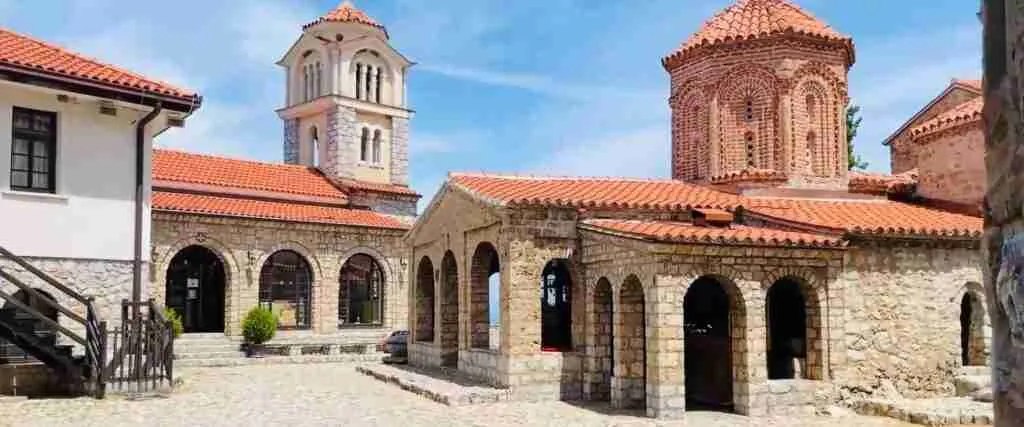
Saint Naum of Ohrid founded this monastery in 905 AD as an educational and spiritual centre — a continuation of the literary mission he shared with Saints Cyril and Methodius, who created the Glagolitic (and later Cyrillic) alphabet to enable Christian literacy among Slavic peoples. The monastery church, rebuilt in the nineteenth century, contains the saint’s tomb: local tradition holds that pressing one’s ear to the tomb surface allows the faithful to hear his heartbeat. The iconostasis dates to 1711 and the frescoes to the eighteenth and nineteenth centuries.
Entry to the monastery grounds costs 120 MKD ($2) per adult; verify the current admission fee at the ticket booth on arrival, as prices are subject to periodic revision. Within the complex, resident peacocks roam the terraces — a photogenic and unexpected detail that has become one of the monastery’s signatures. Sandy beaches flank the monastery on two sides, offering some of the clearest swimming on the Macedonian shore; the water stays cold even in summer due to the spring upwellings below.
The Black Drim springs form the monastery’s most distinctive natural feature. Underground water from the Albanian mountains filters through the limestone karst and emerges here in quantities sufficient to form the source of the Black Drim River (which drains Lake Ohrid toward the Adriatic). Small wooden rowing boats take visitors through the spring channels — shallow, gin-clear waterways lined with watercress and aquatic plants, with the monastery walls rising above. The rowing experience costs 300 MKD ($6) per person for a shared boat of three to four passengers and takes 20–30 minutes. Guided tours include this; independent visitors organise it at the boat dock near the spring outlet.
A secondary walking trail behind the monastery leads through pine forest to a scattering of smaller medieval churches. The Church of the Holy Archangels and the Church of the Dormition of the Theotokos both reward the extra twenty minutes of walking for visitors interested in fresco cycles outside the main monastery church. The area immediately around St. Naum — beaches, springs, walking trails — warrants two to three hours of exploration, which is why most boat trips allow that amount of free time before the return crossing.
Bay of Bones Museum: Planning Your 2026 Visit
The Bay of Bones (Zalivot na Koските) Archaeological Museum sits on the Gradišče peninsula, roughly 10 kilometres south of Ohrid town, en route to St. Naum. Most guided lake tours stop here for 30–40 minutes on the outward journey. The museum occupies a reconstructed Bronze and Iron Age pile-dwelling settlement built on stilts above the lake surface: 24 replica houses reproducing the structures discovered by underwater archaeologists who mapped a Bronze Age village dating from 1200–700 BC, including over 6,000 wooden piles on the lake floor.
Admission costs 150 MKD ($3) per adult and 60 MKD ($1) for children; only cash in Macedonian denars is accepted at the site. The museum closes on Mondays from October through April. Opening hours run 9 AM to 7 PM in July and August, and 9 AM to 4 PM during the rest of the season. Independent visitors reach the Bay of Bones by city bus (1 EUR equivalent from central Ohrid, about 20 minutes), by car (free parking), or as part of a lake boat tour. The site takes 45–60 minutes to explore properly, including the indoor museum section with artefacts recovered from the lakebed. An adjacent Roman-era military fortification on the hillside adds a second historical layer.
St. Naum & Bay of Bones Day Trip Costs 2026
A fully self-guided St. Naum day trip on the public ferry with Bay of Bones included costs $35–40 per person: the return ferry fare of 600–700 MKD ($11–13), the Bay of Bones entry of 150 MKD ($3), the monastery admission of 120 MKD ($2), a shared rowing boat at 300 MKD ($6) per person, a simple lunch at the monastery-area restaurants for 500–700 MKD ($9–13), and water and snacks for approximately 150 MKD ($3). This is the most cost-effective version of the excursion.
A guided group boat tour covering the same itinerary with English commentary, all entrance fees, and the rowing experience included costs $70–80 per person. The gap between the tour price and the independent price reflects the guide’s expertise, the organised routing, and the comfort of not managing logistics independently — a worthwhile premium for first visits. Lunch at the monastery restaurant is not included in these tours; budget an additional 800–1,000 MKD ($15–19) for a sit-down meal at the lakeside restaurants within the monastery complex.
Private guiding and charter options exist for travellers who want the undivided attention of a specialist. A private round-trip taxi from Ohrid with four hours of waiting at St. Naum costs 1,600–2,700 MKD ($30–50); adding a private English-speaking guide arranged through a local agency brings the total to $70–105 per person for groups of two. A fully private boat charter for small groups represents the luxury tier at $95–140 per person including guide and all fees. Upscale lunch at the monastery’s premium restaurant adds $25–35 per person.
- Budget (public ferry, self-guided): $35–40 per person
- Mid-range (guided group boat tour): $70–80 per person
- Luxury (private charter and guide): $95–140 per person
Day Trip to Bitola & Heraclea Lyncestis 2026
Bitola, 44 kilometres east of Ohrid across the Galičica mountains, is North Macedonia’s second city and the most historically layered urban centre in the country outside Skopje. The city earned the title “city of consuls” in the eighteenth and nineteenth centuries when the Ottoman-era trading importance of the region drew diplomatic representations from eleven European nations. That cosmopolitan past survives in the neoclassical facades of Širok Sokak — Bitola’s pedestrian main boulevard — and in the town’s most famous historical connection: Mustafa Kemal Atatürk, founder of the Turkish Republic, attended military school in Bitola and spent formative years here. Two kilometres south of the city centre, Heraclea Lyncestis presents one of the most rewarding ancient sites in the western Balkans.
Getting to Bitola from Ohrid in 2026
Five daily buses connect Ohrid bus station to Bitola, operated primarily by AD Galeb Ohrid with one additional daily service from Transkop. The journey takes 55 minutes through the southern Pelagonia plain and costs 300–400 MKD ($6–7) each way. Return buses run throughout the day with the last departure from Bitola in the early evening. Bus travel is the recommended independent option — the frequency, the low cost, and the reasonable journey time make the bus clearly preferable to taxis for solo travellers and pairs.
A private taxi for the round trip from Ohrid costs 3,000–4,300 MKD ($56–80) for the car. For a group of four splitting this cost, it reduces to $14–20 per person — cheaper than four individual bus tickets — and adds complete flexibility over departure times and stops along the route. Pelister National Park sits between Ohrid and Bitola and can be incorporated into a private car day if the schedule allows.
Organised private guided tours from Ohrid to Bitola start from $130 per person for a one-to-two person booking (private vehicle and English-speaking guide for the full day). For groups of four sharing a vehicle, per-person costs fall to approximately $50–65. Local tour operators in Ohrid and on booking platforms offer both private and small-group options; check operator websites for current pricing and availability before booking. The private tour option makes most sense for travellers who want contextual explanation of Heraclea’s mosaics and the Ottoman city history that significantly enriches the visit.
Heraclea Lyncestis: Philip II’s Ancient City in 2026
Heraclea Lyncestis sits two kilometres south of Bitola’s city centre, an easy walk through a park and past the main bus station. Philip II of Macedon — father of Alexander the Great — founded the city around 358 BC on the strategic route later formalised as the Via Egnatia, Rome’s highway connecting the Adriatic to Constantinople. The city passed through Macedonian, Roman, Byzantine, and finally medieval phases of occupation before being abandoned, leaving an unusually complete stratigraphy of a Balkan urban centre across six centuries.
Admission costs 150 MKD ($3) per adult (check at the ticket office on arrival for any updates). The entry fee includes access to the outdoor archaeological site and the on-site museum. The site operates with an audio guide system: QR codes at each of eleven stations link to narrated descriptions accessible via smartphone, covering the thermal baths, the portico, the Great Basilica, the Small Basilica, and the theatre. The system works reliably across the site with a standard data connection; download content in advance for use without data.
The mosaics of the Great Basilica are the archaeological headline. Dating from the fifth century AD, these floor mosaics display geometric patterning, hunting scenes, and bird imagery at a level of preservation exceptional for an open-air site. Some panels remain covered for conservation purposes during off-peak seasons; the full display is most consistently accessible from April through October. The mosaic room’s recent restoration work, reported by visitors as of spring 2025, has improved presentation significantly.
The Roman theatre, constructed in the second century AD under Emperor Hadrian, seats spectators on the original stone steps with a view across the ancient performance space to the mountains beyond. Unlike the mosaics, it was unknown until excavations in 1968 and remains in a remarkable state given its underground preservation. Three animal-holding cages beneath the stage confirmed gladiatorial uses alongside theatrical performances. The acoustics remain functional: standing in the centre and speaking at normal volume demonstrates the engineering precision of the original design.
Plan 90 minutes to two hours for a thorough visit to Heraclea. The site is not large but rewards slow exploration and reading at the QR stations. The outdoor setting under trees along the site’s edges suits a picnic; the modest site café provides coffee and cold drinks.
Širok Sokak and Ottoman Bitola in 2026
Bitola’s pedestrian boulevard, Širok Sokak (which translates approximately as “wide lane”), runs through the centre of the new town from the Clock Tower to the main square. The street’s nineteenth-century neoclassical buildings — many retaining the ground-floor arcades and upper-storey balconies of their Ottoman-era construction — house cafés, restaurants, and small shops. This is the most visually coherent Ottoman-European commercial streetscape in North Macedonia and makes a highly recommended complement to the Heraclea visit.
The Old Bazaar quarter east of Širok Sokak preserves a more compressed Ottoman urban fabric: mosques, the Clock Tower (a fourteenth-century structure rebuilt multiple times), and traditional market spaces. The Yeni Mosque and the Isak Mosque both date to the fifteenth century and remain active. Neither charges entry fees, though respectful dress is expected.
The Atatürk Museum in the military school building where the Turkish Republic’s founder studied costs 120 MKD ($2) to enter and takes about 30 minutes. The museum’s significance for Turkish visitors is considerable — tour groups regularly arrive specifically for this connection — and the building’s position in Bitola’s cultural identity is reflected in the well-maintained exhibits. For travellers interested in late Ottoman history, it provides essential regional context.
The National Museum of Bitola in the former Ottoman barracks building on the main square covers the region’s history from antiquity through the twentieth century. Entry costs approximately 100–150 MKD ($2–3); check at the door for current hours, as opening times vary seasonally. The costume collection — assembled by a local enthusiast and now one of the largest traditional textile collections in the Balkans — occupies a dedicated room within the museum.
Lunch in Bitola fits comfortably into the day trip schedule. The restaurant strip along Širok Sokak and the side streets around the square offers everything from traditional Macedonian taverns (skara grills, tavče gravče bean stew, cold cuts) to Italian-influenced cafés. Budget meals in local taverns run 400–600 MKD ($7–11) per person for a full plate and drink. Mid-range restaurants on the pedestrian strip charge 600–1,000 MKD ($11–18) per person for a meal with wine or beer.
Bitola Day Trip Costs 2026
The self-guided Bitola day trip is the most affordable full-day excursion from Ohrid. Transport on the return bus costs 700–800 MKD ($13–15) per person, Heraclea Lyncestis entry adds 150 MKD ($3), a local tavern lunch runs 400–600 MKD ($7–11), and coffee at a Širok Sokak café adds 100–150 MKD ($2–3). The total self-guided day costs $25–30 per person — the lowest cost of the three major excursions and a genuine budget day out without sacrifice on the cultural content.
Organised small-group tours from Ohrid covering transport, a guide’s commentary at Heraclea and in the city, and sometimes a lunch stop cost $50–65 per person. For travellers wanting contextual depth, this represents strong value: the difference in what you understand at Heraclea with a specialist guide versus a QR code alone is significant, and the group-tour price is still very low by European standards.
A private car with driver and guide for the day from Ohrid costs $100–145 per person for two travellers splitting the car — higher per-person but offering complete schedule control, the option to add Pelister National Park stops, and personalised guidance throughout.
- Budget (bus, self-guided): $25–30 per person
- Mid-range (organised group tour or shared hire): $50–65 per person
- Luxury (private vehicle and guide): $100–145 per person
Albania Cross-Border Day Trip from Ohrid 2026
The Albania cross-border excursion is the most distinctive and least conventional of the three Ohrid day trips — and for many travellers the most memorable. Crossing the border at Tushemisht–Sveti Naum puts you on the Albanian shore of Lake Ohrid within minutes of leaving North Macedonia, entering a lakeside landscape that feels noticeably quieter, less touristically developed, and more authentically local than the busy Macedonian side. Pogradec, the largest town on the Albanian side, offers a relaxed lakefront promenade, one of Albania’s most famous endemic fish dishes (koran, a trout unique to the lake), and easy access to Drilon National Park and the Lin peninsula. The entire Albanian portion of Lake Ohrid was incorporated into the UNESCO World Heritage listing in 2019, meaning visitors on both sides of the crossing are within the same inscribed property.
The Tushemisht–Sveti Naum Border Crossing in 2026
The crossing connects the North Macedonian side near St. Naum Monastery with the Albanian village of Tushemisht, four kilometres from the monastery grounds along a lakeside road. This is a secondary crossing serving almost exclusively tourists and local residents — there is no freight traffic — and the setting is correspondingly relaxed. The road between the two checkpoints runs along the lake shore through reed beds and willow forest, with views across the water to the mountains on both shores. The walk between checkpoints takes approximately 15–20 minutes at a comfortable pace.
At the North Macedonian checkpoint, present your passport (or national ID card for eligible EU citizens) and await clearance. At the Albanian checkpoint, repeat the process. Both sets of border officials are accustomed to tourist foot traffic from the St. Naum area. The standard queue for pedestrians uses the vehicle lanes; simply approach the booth and present your document. Processing at each side takes 5–15 minutes per person in normal conditions; total border transit time ranges from 30 minutes in quiet periods to 60 minutes in peak summer when multiple vehicles and tour buses queue simultaneously.
North Macedonia and Albania sit outside the Schengen Zone, so the EU’s Entry/Exit System (EES), which became fully operational in April 2026, does not apply at this crossing. Document checks apply to all travellers regardless of nationality. There is no border crossing fee for pedestrians or private vehicles. Vehicle drivers require valid registration documents and a Green Card (international insurance certificate); drivers in rental cars must confirm with their rental company before the trip that the vehicle is permitted for Albania, as not all companies allow cross-border use without advance notification and additional documentation.
Border Requirements and Practical Crossing Tips 2026
Citizens of European Union member states, the United Kingdom, the United States, Canada, and Australia do not require a visa for either North Macedonia or Albania for tourist stays of up to 90 days. Nationals of most other countries should verify entry requirements with the relevant embassies before travel; the requirement profile for both countries is broadly similar to each other.
Cash management is the single most important practical preparation for the Albania portion. Albania operates predominantly as a cash economy, particularly outside Tirana and the major coastal cities. ATMs exist in Pogradec town centre but are not available in Tushemisht village or along the road between the border and Pogradec. Withdraw Albanian lek (ALL) at an ATM in Pogradec on arrival. The exchange rate for 2026 runs approximately 100 ALL per USD; travellers from North Macedonia carrying Macedonian denars (MKD) can exchange at banks or exchange offices in Pogradec, though rates vary. USD and EUR cash are sometimes accepted at restaurants in Pogradec.
Getting from St. Naum to the border: The monastery sits four kilometres from the checkpoint. A taxi from St. Naum to the Macedonian border post costs 200–400 MKD ($4–7); negotiate the price before getting in, as drivers at tourist sites routinely quote elevated rates for the short distance. Walking is possible in 45–60 minutes along the main road. On the Albanian side, taxis from the checkpoint to Pogradec cost approximately 500 ALL ($5). From Pogradec, taxis to Drilon National Park (5 km) cost 500 ALL ($5) or the local bus covers the same route for 100 ALL ($1).
Returning to Ohrid independently requires reversing the sequence: taxi from Pogradec to the Albanian checkpoint, walk or taxi to the Macedonian side, and then either the bus (120 MKD, $2) or a taxi from St. Naum to Ohrid. The combined return transport adds $10–15 per person. Travellers on organised tours are driven back to Ohrid directly, which is one of the significant practical advantages of the group-tour option for the Albania excursion specifically.
Pogradec, Lin & Drilon: What to See on the Albanian Shore
Tushemisht village immediately after the Albanian checkpoint is itself a minor attraction: natural springs bubble up from the ground and flow through canal-channels between the houses and restaurants to the lake, feeding the lake with freshwater from the Albanian mountains. This network of small canals, lined with traditional buildings and populated with ducks and wildfowl, was recently upgraded with AADF (Albania American Development Foundation) infrastructure investment in a project launched in 2024 — paths, bridges, and waterscape facilities designed to improve sustainable tourism without disrupting the natural spring system. Cafés and small restaurants in Tushemisht serve koran trout and Albanian lakeside cuisine.
Drilon National Park occupies a short stretch of springs and wetland five kilometres from Pogradec toward Tushemisht. The park — centred on a network of reed-lined canals and small lakes fed by underground springs — was the summer retreat of Albanian communist-era dictator Enver Hoxha, whose former residence now functions as a restaurant. Entry is free; the park is walkable in 60–90 minutes on flat paths. Rowing boats are available for hire on the canals. The setting combines bird-rich wetland ecology with the lingering surrealism of a communist-era villa in a UNESCO World Heritage lakeside park.
Lin, a peninsula village 18 kilometres north of Pogradec along the Albanian shore, holds the early Christian basilica mosaics that gave the Albanian portion of the lake its UNESCO World Heritage listing — fifth-century geometric and figurative floor mosaics comparable in quality and rarity to those at Heraclea Lyncestis on the Macedonian side. The village itself is reached via a dramatic mountain road that descends to a peninsula of red-roofed stone houses reflected in the lake. A guided walk to the basilica site is available from local guides in the village; visiting without a guide is possible but the site is small and the context enriches the visit considerably. Most organised tours from Ohrid include a Lin stop.
Pogradec town offers a pleasant lakefront promenade, a central market, the hilltop ruins of Pogradec Castle (2,400 years old, walkable in 20 minutes from the town centre), and a selection of restaurants concentrated along the boulevard. The town sees its main tourist season in July and August, when Albanian families from across the country arrive for the lake holiday — but the spring Koran Festival (first held in September 2024) and the cross-border lake celebrations of Lake Day (June 21) add cultural events to the shoulder seasons.
Albania Cross-Border Day Trip Costs 2026
Independent cross-border travel is the most affordable option at $25–35 per person. The full cost breakdown: bus from Ohrid to St. Naum 120 MKD ($2), taxi from St. Naum to border 200–300 MKD ($4–6), walk between checkpoints (free), taxi from Albanian side to Pogradec 500 ALL ($5), entry to Drilon National Park (free), lunch in Pogradec 700–1,200 ALL ($7–12), return taxi to border 500 ALL ($5), and bus from St. Naum back to Ohrid 120 MKD ($2). Total per person: $25–35. This version suits flexible independent travellers comfortable with some logistical improvisation, particularly around border taxi negotiation and finding return transport.
Organised group tours from Ohrid offer a fully managed version of the Albania excursion — the most practical option for most travellers. These tours cover Bay of Bones, St. Naum Monastery, the border crossing, Pogradec (with free time for lunch), Lin village, and the return to Ohrid, all in a comfortable vehicle with a bilingual guide. Prices start from $130–150 per person (check operators such as Explore Macedonia Daily Tours and Vik Experience for current availability and pricing). This all-in price removes all the border taxi negotiation, Albanian transport uncertainty, and navigation challenges, and adds significant cultural context through the guide. Lunch in Pogradec is at the traveller’s expense — budget 700–1,200 ALL ($7–12) for a traditional Albanian meal.
Private full-day tours from Ohrid crossing into Albania with a private driver and guide cost $150–200 per person for groups of two, dropping proportionally for groups of three or four. These tours allow customisation: longer time in Lin, additional stops at Selça e Poshtme royal tombs, or a Korca side trip for adventurous groups.
- Budget (fully independent bus + border taxis): $25–35 per person
- Mid-range (organised group tour from Ohrid): $130–150 per person
- Luxury (private guided tour): $150–200 per person
Comparing All Three Day Trips: Costs & Value 2026
The three excursions target different priorities and present very different price profiles. Bitola by bus is the outstanding budget day trip: at $25–30 per person self-guided, it delivers Heraclea Lyncestis (one of the most underrated ancient sites in Europe), a beautiful Ottoman boulevard, and a real Macedonian city day — all for less than the ferry alone to St. Naum. For travellers prioritising cultural depth at minimum cost, Bitola is the clear winner.
St. Naum is the scenic and spiritual highlight. The lake journey, the monastery, and the spring rowing create an experience unavailable elsewhere in the region. At $35–40 independent or $70–80 on a guided tour, it sits in the middle of the cost range and delivers the highest ratio of visual impact to expenditure. Most travellers rate this as their most memorable Ohrid day out.
The Albania cross-border trip has the widest cost range: $25–35 for a pioneering independent trip or $130–150 for an organised tour. The large gap reflects the genuine logistical complexity of the independent option — border taxis, Albanian transport, and cash management — versus the ease of having a driver and guide handle everything. For travellers who have never been to Albania and want a genuine introduction to the country with context, the organised tour provides strong value at the higher price. Independent travellers who enjoy figuring it out as they go will find the DIY version both cheaper and more adventurous.
Note that combining St. Naum and Albania in a single day is feasible: take an early bus to St. Naum, spend two hours at the monastery and springs, take a taxi to the border, cross on foot, spend three to four hours on the Albanian side, and return via the evening bus. This condensed version works best in summer with long daylight hours but sacrifices depth at each stop. The organised “full-lake circuit” tours that include Bay of Bones, St. Naum, Pogradec, and Lin in one day deliver the complete version at the $130–150 price point.
Sample Day Trip Itineraries from Ohrid 2026
3-Day Itinerary: St. Naum, Bitola, and Albania
Day 1 — St. Naum Monastery and Bay of Bones (guided group tour): Join the guided group boat tour departing Ohrid harbour at 9–10 AM. Stop at Bay of Bones for 30–40 minutes (entry included in tour). Continue to St. Naum for two hours of exploration: monastery church, saint’s tomb, peacock gardens, and free time on the lake beach. Take the rowing boat on the Black Drim springs (included). Return to Ohrid harbour by late afternoon. Dinner in Ohrid Old Town. Day 1 per-person cost: guided tour $60, lunch at St. Naum 800–1,000 MKD ($15–19), dinner in Ohrid 700–1,000 MKD ($13–18). Day 1 activities total approximately $90–95.
Day 2 — Bitola and Heraclea Lyncestis (self-guided bus): Take the morning bus from Ohrid station to Bitola (55 minutes, 300–400 MKD, $6–7 each way). Walk from Bitola bus station to Heraclea Lyncestis (2 km, 25 minutes) for a 90-minute site visit — theatre, mosaics, basilica, and audio guide stations. Walk back through the park to Širok Sokak for lunch at a local tavern. Afternoon: Atatürk Museum (120 MKD, $2), Clock Tower, Old Bazaar. Coffee and a šop salad on the boulevard. Return bus to Ohrid in the late afternoon. Day 2 per-person cost: return bus 700–800 MKD ($13–15), Heraclea entry 150 MKD ($3), Atatürk Museum 120 MKD ($2), lunch 400–600 MKD ($7–11), coffee 100–150 MKD ($2–3). Day 2 total approximately $27–34.
Day 3 — Albania Cross-Border (organised group tour): Book the organised group tour from Ohrid covering Bay of Bones (second stop option), St. Naum, border crossing, Pogradec, and Lin. Tour departs hotel around 8–9 AM. Border processing at Tushemisht–Sveti Naum 30–45 minutes. Free time in Pogradec for lunch: koran trout at a lakefront restaurant 700–1,200 ALL ($7–12). Lin peninsula mosaic visit. Drilon National Park walk. Return to Ohrid by early evening. Day 3 per-person cost: group tour $133–145 (check current operator pricing), lunch 700–1,200 ALL ($7–12). Day 3 total approximately $140–157.
Three-day activities total (mid-range): approximately $260–285 per person. Add three nights in a mid-range Ohrid hotel for two sharing at 2,700–4,300 MKD ($25–40 per person per night) = $75–120 accommodation per person. Add three days of breakfasts and dinners not covered by the day trips: $55–80. Add miscellaneous Ohrid exploration (fortress entry, church visits, evening drinks): $20–30. Three-day mid-range grand total: approximately $410–515 per person.
Budget Itinerary: All Three Trips Under $100 in Activities
All three day trips are achievable under $100 in combined activities cost using independent transport and self-guided visits. Day 1 St. Naum by public ferry: $35–40. Day 2 Bitola by bus self-guided: $25–30. Day 3 Albania crossing independently: $25–35. Combined activities total: $85–105 per person. The Albania DIY trip requires confidence with basic navigation and border taxi negotiation, but all three excursions are independently manageable with English sufficient throughout North Macedonia and basic English functional in Pogradec’s tourist areas.
Add three nights in a budget guesthouse in Ohrid Old Town for two sharing (1,400–1,900 MKD, $26–35 per night) = $78–105 accommodation per person. Three days of simple meals (breakfast at the guesthouse, packed lunch or bakery, budget restaurant dinner) add $35–50 per person. Budget three-day total: $200–260 per person — a comprehensive Ohrid experience at exceptional value.
Seasonal Planning for Ohrid Day Trips in 2026
Best Months for Day Trips from Ohrid
May and June represent the best overall balance for all three day trips. Lake Ohrid is warm enough for lake swimming by mid-June, the ferry to St. Naum operates on full schedule from May, the archaeological sites are uncrowded, and accommodation prices run 20–30% below peak summer rates. Heraclea Lyncestis is best visited when the mosaics are fully uncovered and the site staffed for the summer season — which holds from mid-April onward.
September and October offer equally good conditions for the cultural day trips (Bitola, St. Naum on foot or bus, Albania) with comfortable walking temperatures and autumn colours on the Galičica mountain passes. The ferry to St. Naum runs through October on a reduced schedule. Lake swimming becomes cold by late September, which removes one of the St. Naum beach incentives.
July and August deliver the full summer programme — all ferries operating, all tour operators at peak capacity, maximum daylight hours for the Albania loop — but with significantly higher accommodation prices in Ohrid, crowding at St. Naum (described by some visitors as “a massive tourist trap” in peak season), and the full queuing experience at the Tushemisht–Sveti Naum border. If summer is the only possibility, book ferry tours and accommodation well in advance — popular guided boat tours sell out 3–4 weeks ahead in July.
November through March remains viable for the Bitola day trip year-round on the regular bus. The bus to St. Naum also runs in winter on a reduced schedule, allowing monastery visits outside the ferry season. The Albania crossing is open year-round but the Albanian lakeside sees minimal tourist activity outside summer; Drilon National Park and Lin are both accessible but the café infrastructure is reduced to seasonal operation.
Peak Season vs. Off-Season Pricing 2026
Accommodation in Ohrid shifts substantially between seasons. Budget guesthouses in the Old Town charge 1,400–1,900 MKD ($26–35) per night in June and September, rising to 2,200–2,700 MKD ($41–50) per night in July–August. Mid-range hotels see similar patterns: $50–70 per room per night in shoulder season versus $80–110 in peak summer. The lakefront properties with views command a premium in all seasons but spike most aggressively in late July.
Day trip costs at the attraction level are relatively stable year-round — ferry fares, entry fees, and bus tickets do not change seasonally. The premium in summer comes from accommodation and from the variable pricing of guided tours and private drivers, which climb in peak months as operator capacity fills. The same guided boat tour to St. Naum that costs $55–60 per person in May runs at $60–65 or sometimes higher in August.
The Albania organised tours are priced similarly year-round, though availability is better from May through October when operators run daily departures versus the weekly or by-request schedules of off-season.
Money-Saving Strategies for Ohrid Day Trips 2026
Book boat tours directly from Ohrid harbour rather than through international booking platforms, which add commissions that inflate the final price. Walk to the pier and speak directly with the operators running the 9–10 AM departures; the on-the-day price is consistently equal to or cheaper than pre-booked online prices for the standard scheduled tours.
Take the bus to Bitola rather than organising a private taxi or tour. The $13–15 round-trip bus fare versus the $100+ private guide option delivers the same cultural destination at a fraction of the cost. Heraclea Lyncestis’s QR audio guides cover the material a paid guide would discuss; equip yourself with the downloaded content before entering and you have effective self-guided commentary.
Plan the Albania crossing independently for significant savings on the organised tour price. The $25–35 DIY version versus $130–150 group tour saves $100 per person — enough for another full day of meals and activities in Ohrid. The savings are real if you are comfortable with the logistical elements: bus to St. Naum, taxi negotiation to the border (tell drivers 200 MKD, not 400 MKD — they accept), and the straightforward pedestrian border process.
Travel in shoulder season rather than July–August. May–June and September–October pricing saves $15–30 per night on Ohrid accommodation across a multi-night stay while delivering the same day trips at full operation. A four-night stay in June versus August saves $60–120 in accommodation cost alone.
Pack lunch for the Bitola day trip. Ohrid’s bakeries (pekари) open early and sell burek, pastries, and sandwiches for 80–150 MKD ($1.50–3) — enough for a substantial midday meal that replaces the 400–600 MKD tavern lunch in Bitola. The savings are modest but compound across multiple days.
Share taxis between travellers. At the St. Naum harbour, other independent travellers often need the same border taxi; a shared 400 MKD taxi ride split between two or three people halves or thirds the per-person cost. The same principle applies to the private car option for Bitola: four people splitting a 3,000 MKD taxi round trip pay 750 MKD ($14) each — comparable to the bus ticket.
Where to Stay in Ohrid for Day Trip Access 2026
Ohrid’s Old Town, on the hillside above the lake between Samuel’s Fortress and the St. John at Kaneo church, concentrates the best-located accommodation for day trip planning. The bus station — used for both Bitola and St. Naum buses — lies at the foot of the Old Town, a 10–15 minute walk downhill. The harbour, used by all lake ferries, is at the lake end of the waterfront promenade, also within easy walking distance.
Budget guesthouses and small private rooms (privatni smeštaj) in the Old Town charge 1,400–1,900 MKD ($26–35) per night for a double room in shoulder season, rising to 2,200–2,700 MKD ($41–50) in July–August. Properties on the cobblestone streets above the lake include Lake Ohrid view terraces and family-run hospitality typical of the region. Hostels in the lower Old Town and near the bus station offer dormitory beds at 800–1,080 MKD ($15–20) per bed per night in peak season.
Mid-range hotels in the Centar neighbourhood and along the waterfront charge 2,700–4,300 MKD ($50–80) per room per night in shoulder season. These properties include private bathrooms, air conditioning, breakfast options, and basic concierge services — including tour bookings and taxi arrangements, which are genuinely useful for the Albania and St. Naum excursions. Boutique hotels in the Old Town at the same price range offer more atmospheric settings but fewer services.
Luxury accommodation on the lakefront — four-star and villa-style properties — runs 5,400–8,100 MKD ($100–150) per room per night in shoulder season. These properties sit adjacent to the harbour and command lake views; for travellers doing all three day trips, the proximity to both the ferry pier and bus station maximises convenience. The Ambassador Hotel and similar lakefront properties in this tier provide concierge trip-planning support that simplifies tour booking significantly.
For Bitola specifically, the day-trip option is preferable to an overnight: Bitola has adequate accommodation but Ohrid’s lake setting and concentration of attractions makes it the clearly superior base for the full regional itinerary. Travellers extending to Albania could consider one night in Pogradec — the lakeside town is quiet, charming, and extremely affordable at 4,000–6,000 ALL ($40–60) per night for a mid-range guesthouse — but a day trip from Ohrid covers the Albanian highlights comfortably without requiring an overnight stay.
Practical Tips: Currency, Transport & Logistics 2026
North Macedonia uses the Macedonian denar (MKD). The 2026 exchange rate runs approximately 54 MKD per USD and 62 MKD per euro. ATMs in Ohrid’s Old Town and along the waterfront dispense denars; Visa and Mastercard work at most midrange and upmarket restaurants and hotels but budget guesthouses, bus ticket offices, and attraction entry booths frequently require cash. Carry MKD for all transport, entry fees, and small purchases. The Bay of Bones and some attraction ticket offices accept only MKD in cash; the monastery at St. Naum has been reported as cash-preferred.
Albania uses the Albanian lek (ALL), running approximately 100 ALL per USD in 2026. Do not expect to use MKD, USD, or EUR universally in Albanian restaurants and smaller businesses. Withdraw ALL at a Pogradec ATM on arrival — ATMs are present on the main boulevard and near the lakefront. Some Pogradec restaurants accept EUR cash at an informal rate, but lek ensures you get accurate pricing.
The Ohrid bus station serves both the St. Naum route (several times daily from early morning) and the Bitola route (five daily departures). Tickets are purchased at the bus station window or directly on the bus. No advance booking is required or available for either route — simply arrive at the station with enough time before departure, buy your ticket, and board. The St. Naum bus stop is on the main road near the monastery; the bus does not enter the monastery grounds, so factor in the five-minute walk.
Mobile data and navigation: Google Maps works well throughout Ohrid, along the road to St. Naum, in Bitola, and across the Albanian shore. The border crossing and the road between checkpoints is mapped. Albanian phone networks are separate from Macedonian networks; an international SIM or pre-purchased Albanian data roaming covers the Pogradec area adequately. Download offline maps for the Albanian side before crossing.
Language: English is widely understood at tourist-facing businesses in Ohrid, on the guided tours, and at upmarket Bitola restaurants. In Bitola’s local taverns and at the Heraclea ticket booth, Macedonian or basic pointing-and-numbers communication works fine. In Albania, English is functional at Pogradec restaurants and tour operator level but not universally so in smaller establishments; a translation app handles the gap easily.
Hidden Costs and Extras 2026
Border taxi overcharging is the most consistent hidden cost of the Albania day trip. Taxi drivers at St. Naum quote 400–800 MKD ($7–15) for the four-kilometre ride to the border. The fair negotiated price is 200–300 MKD ($4–6) for the same journey; decline the first offer and name your price clearly. Most drivers accept. The same dynamic applies on the Albanian side: the taxi from the checkpoint to Pogradec should be 500 ALL ($5); opening quotes run higher.
ATM fees in both countries: international ATM withdrawals attract a 200–300 MKD fee per transaction in North Macedonia. Use the minimum number of withdrawals by taking adequate cash for the day from a single ATM visit in Ohrid before heading to St. Naum or across to Albania. ATMs are not available between the border and Pogradec town centre.
The rowing boat at St. Naum springs costs 300 MKD ($6) per person for a shared boat of three to four people, or 1,000–1,200 MKD ($18–22) for an exclusive two-person boat. Guided tours that include the “rowing experience” in their pricing cover the shared-boat rate; exclusive bookings are extra. This cost is sometimes not explicitly mentioned in tour descriptions and catches travellers who assume exclusivity.
Restaurant menus in Ohrid’s Old Town and particularly along the lakefront display summer tourist pricing that exceeds the rates in residential streets. A meal in a restaurant facing the water runs 30–50% more than the same dish in a table set back from the view. The quality difference is minimal; the view premium is not. Two streets back from the waterfront delivers meaningfully better value at every meal.
St. Naum monastery restaurant pricing is higher than Ohrid town restaurants due to the captive-audience position: a full lunch with drinks costs 1,000–1,500 MKD ($18–28) per person. Travellers on a tight budget bring packed food or eat on return to Ohrid.
Parking at the Bay of Bones and at St. Naum is currently free; this is worth confirming on arrival as the region’s tourism infrastructure is actively developing. Car rentals add a cross-border surcharge and a required Green Card insurance document for the Albania portion; confirm all fees with the rental company before collecting the vehicle.
Frequently Asked Questions About Ohrid Day Trips 2026
Is St. Naum Monastery worth visiting in 2026?
St. Naum Monastery is consistently the most-recommended day trip from Ohrid and one of the most atmospheric religious sites in the western Balkans. The combination of ninth-century Orthodox heritage, lake scenery, and the natural wonder of the spring-fed rowing channel delivers experiences unavailable elsewhere in North Macedonia. Peak summer crowds (July–August) can detract from the peaceful atmosphere, particularly at the monastery entrance; visiting in May, June, September, or October maximises the tranquil quality that makes the site exceptional. The guided boat tour at $70–80 per person all-inclusive is the recommended first-visit option.
Do I need a visa to cross from Ohrid into Albania at Tushemisht in 2026?
No — citizens of European Union member states, the United Kingdom, the United States, Canada, and Australia enter Albania visa-free for stays up to 90 days. The same applies to North Macedonia. The Tushemisht–Sveti Naum crossing is a standard road border requiring a valid passport (or EU national ID card for eligible EU nationalities). North Macedonia and Albania are not Schengen members, so passport checks apply regardless of nationality. Prepare your document at both the Macedonian and Albanian checkpoints; processing takes 30–60 minutes total in summer conditions.
How long does the bus journey from Ohrid to Bitola take in 2026?
The Ohrid to Bitola bus takes 55 minutes and costs 300–400 MKD ($6–7) each way. Five daily services operate, with departures spread across the morning and afternoon from Ohrid bus station. The return journey to Ohrid runs on the same timetable from Bitola station. A day trip to Bitola leaves a comfortable six to seven hours in the city for Heraclea Lyncestis, Širok Sokak, and lunch — more than sufficient time for a satisfying visit. The bus is far preferable to taxis on this route for solo travellers and pairs on budget.
Can you do the Albania day trip independently, without an organised tour, in 2026?
Yes, fully independent Albania day trips are feasible and cost significantly less than organised tours: $25–35 per person compared to $130–150 on a group tour. The route involves a bus from Ohrid to St. Naum (120 MKD, $2 each way), a taxi negotiated to the border (200–300 MKD, $4–6), a pedestrian border crossing (30–60 minutes total), and Albanian taxis to Pogradec and Drilon. The main challenges are border-taxi overcharging (negotiate firmly), the absence of ATMs between the border and Pogradec, and the logistics of arranging return transport. Travellers comfortable with independent travel in the Balkans handle this easily; those who prefer a managed experience will find the organised tour price justifiable.
What is the best time of year to visit Heraclea Lyncestis in 2026?
April through October delivers the full site experience at Heraclea Lyncestis, with the mosaics fully uncovered, the audio guide QR stations active, and the site café staffed. The outdoor setting under mature trees is pleasant in warm weather; the site’s low visitor numbers even in summer mean no crowd pressure. May and September offer ideal conditions: comfortable walking temperatures, full access, and no peak-season pricing pressure on the Bitola accommodation side (relevant if extending to overnight). The site is technically accessible year-round but the audio guide infrastructure and mosaic coverage arrangements are reduced outside the main season.
What currency do I need for the day trips around Ohrid in 2026?
Macedonian denars (MKD) cover all North Macedonia costs: bus tickets, monastery and museum entries, restaurant meals, and taxis. The 2026 exchange rate runs approximately 54 MKD per USD. Albanian lek (ALL) covers the Albania portion at approximately 100 ALL per USD. Withdraw MKD from Ohrid ATMs before departing and ALL from a Pogradec ATM on arrival in Albania — there are no ATMs between the border crossing and Pogradec town centre. Some Ohrid tour operators and hotels transact in EUR, but all day-trip costs at the point of service are payable in the local currency. USD and EUR are not universally accepted at smaller Albanian restaurants and businesses.
Are the day trips from Ohrid suitable for families with children in 2026?
All three day trips work well for families. St. Naum’s rowing boats, peacocks, and clear lake water for swimming are consistently popular with children; the guided boat tour is the easiest version for families with young children. Heraclea Lyncestis has open space, walking paths, and enough visual drama (the theatre, the mosaic room) to engage children who enjoy history. The Albania crossing interests older children and teenagers; the border process itself is an educational experience in Balkan geopolitics. Entry fee discounts apply at most sites: Heraclea charges reduced rates for children, Bay of Bones is 60 MKD ($1) for children versus 150 MKD ($3) for adults, and guided boat tours offer 50% child discounts under age 10.
How do I book the guided boat tour to St. Naum in 2026?
Guided boat tours to St. Naum are bookable through the pier operators at Ohrid harbour, through local travel agencies in Ohrid’s Old Town, through platforms such as Viator and GetYourGuide, and through accommodation concierge services. Walking to the harbour the evening before and booking with the operator directly for the next morning’s departure is the most reliable approach; it avoids platform surcharges and allows you to confirm exactly what the tour includes (Bay of Bones stop, rowing boat, guide, entrance fees). Popular tours in July and August sell out regularly and benefit from booking 24–48 hours in advance. Off-season tours (May, June, September) are available with same-day booking.
Is Drilon National Park in Albania worth the detour in 2026?
Drilon National Park adds a genuinely beautiful natural dimension to the Albania day trip — the spring-fed canal network, resident swans and wildfowl, and flat easy walking paths provide a calming contrast to the monastery and border crossing portions of the day. Entry is free; the 60–90 minute walk covers the park comfortably. The park functions more like a spacious lakeside garden than a wilderness national park, with cafés and restaurants along the waterways. It is best treated as a relaxed complement to the Pogradec and Lin highlights rather than the primary Albania destination, but if itinerary time allows, it adds genuine value to the cross-border day.
What is the UNESCO status of the Ohrid region in 2026?
The Natural and Cultural Heritage of the Ohrid Region holds UNESCO World Heritage inscription since 1979 (initially for natural values, extended in 1980 to include the cultural heritage of the Macedonian portion, and extended again in 2019 to encompass the Albanian side of the lake). It is a mixed site inscribed under criteria i, iii, iv, and vii. As of July 2025, the UNESCO World Heritage Committee chose not to place Ohrid on the Danger List, but issued a firm deadline for the North Macedonian government to report on urban development and conservation progress by February 2026. The Albanian portion of the lake, including Pogradec, Lin, and Tushemisht, is therefore part of the same World Heritage inscription as Ohrid town and St. Naum — making the Albania cross-border day trip a journey between two sections of a single UNESCO property.