Norwich to North Norfolk Coast Road Trip 2026 East of England: Exploring Norwich Cathedral, Blickling Estate & Castle Acre Without the Crowds
Norfolk’s heritage triangle — Norwich’s Anglo-Norman cathedral, the ruined grandeur of Castle Acre Priory, and the Jacobean symmetry of Blickling Estate — compresses nine centuries of English architectural evolution into a three-day self-drive circuit short enough to execute from a single base yet varied enough to hold serious attention at every stop. This 2026 planning guide combines verified ticketing intelligence, road and rail logistics across the A140/A148 corridor and the Bittern Line, and site-specific crowd-avoidance strategies so that each visit lands at optimal conditions for both architecture and photography.
Key Takeaways
- The circuit covers roughly 70 driving miles in total — Norwich to Castle Acre (west, ~22 miles), back to Norwich, then north via the A140 to Blickling (~14 miles) and onward to the North Norfolk coast — making it a comfortable 3-day self-drive without long motorway sections.
- Norwich Cathedral admission to the nave and cloisters is free; volunteer-led guided tours run Monday to Saturday at scheduled intervals at no charge. The Upper Level Tour costs £10 plus a booking fee and runs on Wednesdays and Saturdays at 10:30am for visitors aged 16 and over.
- Castle Acre Priory (English Heritage) charges £9–11 per adult depending on season and day; booking online in advance guarantees the lowest price and entry. English Heritage members enter free at over 400 sites.
- Blickling Estate (National Trust) charges £18 per adult for house and garden access in 2026, with a 20% discount if you arrive by train, bus, bike, or on foot. National Trust members enter free; non-member car parking is £5 per vehicle.
- Budget travelers sharing a car and accommodation should plan for approximately £100–135 per person per day (two sharing); mid-range travelers spending more on hotels and meals typically spend £145–200 per person daily. A 3-day trip costs roughly £300–405 per person at budget level and £435–600 per person at mid-range.
- The Bittern Line (Greater Anglia) links Norwich to Cromer and Sheringham in under an hour, running approximately hourly at peak times; at Hoveton & Wroxham a connecting narrow-gauge steam railway, the Bure Valley Railway, continues inland to Aylsham — the walking and cycling gateway to Blickling Estate.
People Also Ask About the North Norfolk Heritage Road Trip 2026
What is the most efficient driving route for the Norwich to North Norfolk Coast heritage circuit in 2026?
The most time-efficient circuit follows a lobe pattern from Norwich rather than attempting a linear route. On Day 1, head west on the A47 and then south on the A1065 to Castle Acre — a journey of approximately 22 miles taking around 40 minutes under normal traffic conditions. Return to Norwich via the same or an alternative rural route. On Day 2, drive north on the A140 to Aylsham, turning off on the former B1354 (now the C593) directly into the Blickling Estate car park, a drive of roughly 14 miles and 25 minutes. The A148 connects the coastal corridor westward from Cromer through Holt toward Fakenham — useful if you choose to loop Castle Acre → coast in a single day rather than returning to Norwich. On Day 3, the A140 carries you directly to Cromer, or the A148 westward connects to Sheringham, Wells-next-the-Sea, and Hunstanton. Parking near Norwich Cathedral is best handled at the NCP car parks off St Giles Street or the Castle Meadow area; both are a short walk from the Cathedral Close, and the Close itself is pedestrian-only. Castle Acre village has free on-street parking close to the priory entrance, though spaces fill on summer weekends by mid-morning. Blickling Estate’s main car park charges £5 for non-National Trust members and accepts contactless payment or the JustPark app.
How much does it cost to visit all three sites on the North Norfolk heritage circuit in 2026?
Total admissions for one adult visiting all three sites without membership cards come to approximately £28–29: Norwich Cathedral is free to enter, with the optional Upper Level Tour costing £10 plus a booking fee; Castle Acre Priory costs £9–11 depending on whether you visit on a weekday (lower Super Saver rate) or a peak summer weekend (Standard rate); and Blickling Estate costs £18 per adult without Gift Aid for full house and garden access. English Heritage membership eliminates the Castle Acre charge, while National Trust membership covers Blickling admission and the car parking fee there. Travelers holding both memberships effectively reduce the admissions total to the optional Cathedral tour only. Car hire for three days from Norwich city centre typically costs £165–285 for a compact vehicle for two people sharing the cost, with fuel for the circuit adding approximately £30–50 total. See the Budget Planning section below for complete per-person daily and 3-day trip calculations.
Can I complete the Norfolk heritage circuit in 2026 without hiring a car?
A car-free version of the circuit is feasible but requires careful sequencing of public transport connections. Norwich Cathedral and the medieval city centre are entirely walkable from Norwich station. Castle Acre Priory is the most challenging stop without a car: the nearest rail station is King’s Lynn, approximately 14 miles away by road, requiring a bus connection on routes X1, 12A, or 32 from King’s Lynn station; journey time from King’s Lynn is 48–68 minutes plus a short walk. Alternatively, National Express coaches serve Norwich from major UK cities with onward local buses toward Swaffham (7 miles from Castle Acre). Blickling Estate is far more accessible by sustainable transport: take Greater Anglia’s Bittern Line from Norwich to Hoveton & Wroxham, then the Bure Valley Railway (a heritage narrow-gauge line) to Aylsham, from which Blickling is a 2-mile walk or a short taxi ride. Visitors arriving at Blickling by train, bus, bike, or on foot receive a 20% discount on admission in 2026. The North Norfolk Coast — Cromer and Sheringham — is directly served by the Bittern Line from Norwich. Check current Greater Anglia timetables and Bure Valley Railway operating schedules before booking, as services vary seasonally.
What are the least crowded times to visit Norwich Cathedral, Castle Acre Priory, and Blickling Estate in 2026?
Norwich Cathedral is quietest on weekday mornings before 10am and after 3pm on non-event days; large school groups tend to arrive mid-morning Tuesday through Thursday in term time. The Cathedral runs free volunteer tours throughout the day, but these can increase crowding in the nave by gathering visitors in clusters — arriving 20 minutes before a tour start time and following independently often gives quieter access to the cloisters and ambulatory. Castle Acre Priory sees its highest visitor volumes on Saturday and Sunday afternoons in July and August, when the Standard pricing tier applies (peak: £10.79 adult). Tuesday through Thursday mornings in May, June, and September offer the Super Saver rate (£8.50 adult) and significantly fewer visitors — the site’s open-air ruins mean fewer crowd-bottleneck issues than enclosed museums, but tour coach groups do arrive by mid-morning at popular times. Blickling Estate’s house opens at 11am and the house itself fills most quickly on Bank Holiday weekends and during school summer holidays; the formal garden and parkland remain spacious throughout. Arriving for garden opening at 10am allows an hour in the parterre before the house queues form. Midweek visits in April, May, early June, and September represent the best combination of crowd avoidance and architectural quality of light.
Extended multi-day tours – 5+ days
Featured South East England Multi-Day Tour Packages

3 days
South East England 3-Day Discovery Tour
- ✓ Comprehensive South East England experience
- ✓ Expert local guides included
- ✓ All accommodation included
- ✓ Transportation provided

5 days
South East England 5-Day Highlights Experience
- ✓ Comprehensive South East England experience
- ✓ Expert local guides included
- ✓ All accommodation included
- ✓ Transportation provided

7 days
South East England 7-Day Cultural Journey
- ✓ Comprehensive South East England experience
- ✓ Expert local guides included
- ✓ All accommodation included
- ✓ Transportation provided

10 days
South East England 10-Day Complete Adventure
- ✓ Comprehensive South East England experience
- ✓ Expert local guides included
- ✓ All accommodation included
- ✓ Transportation provided
Multi-day tour packages powered by TourRadar. Prices and availability subject to change.
The Norfolk Heritage Triangle: Context for the 2026 Driving Circuit
The route described in this guide is not a conventional tourist trail. It does not cluster around a single town or follow a signposted heritage trail. Instead it traces an architectural and chronological arc across three distinct landscape contexts: the urban medieval grain of Norwich, the agricultural hinterland of the Acre Valley to the west, and the country estate parkland of north Norfolk converging with the National Trust’s most southerly managed coastline. What holds these three components together is precisely their diversity — each stop represents a different institutional and material response to the same underlying problem of how to build for permanence in a region that lacked local stone.
Norfolk’s geology has no significant building-stone outcrop. The region’s medieval builders improvised across three main traditions: imported Caen limestone from Normandy (the prestige material for cathedral and major monastic construction), local flint in its knapped and uncoursed forms (ubiquitous for rubble walling at Castle Acre), and later brick fired from local clay deposits (the dominant material from the Tudor period onward, reaching its most confident expression in Blickling’s Jacobean facades). Reading these three sites in sequence is therefore also reading three chapters in the material history of English building craft, from high-status Norman import to locally manufactured brick confidence.
The chronological spread is equally instructive. Norwich Cathedral was founded in 1096 by Herbert de Losinga, the first Bishop of Norwich, on a site with deep pre-Norman urban and ecclesiastical roots — the city had been a significant Anglo-Saxon administrative and trading center before the Conquest. Castle Acre Priory was established by the Warenne family as part of their wider patronage of Cluniac monasticism in England following the Norman Conquest, with building activity concentrated in the late 11th and early 12th centuries. Blickling Estate’s great hall was built between 1616 and 1624 for Sir Henry Hobart, Lord Chief Justice of England, in an architectural language strongly influenced by the Dutch and Flemish fashions of the Jacobean court. Five and a half centuries separate the cathedral’s foundation from the stately home’s completion: this is not a single-era heritage circuit but a long view across the full arc of English medieval and early modern culture.
For 2026 visitors, the circuit also functions as a study in contrasting conservation regimes. Norwich Cathedral operates as an active Anglican cathedral — a living liturgical community that maintains its fabric and opens it to visitors without admission charges. Castle Acre Priory is managed by English Heritage as a conserved ruin, with audio interpretation and an excavated site plan guiding visitors through the recovered outlines of the Cluniac community’s daily life. Blickling Estate is a National Trust property managing both a furnished house with a significant library collection and a working 4,600-acre estate that remains in active agricultural and ecological management. Each institution approaches the heritage encounter differently, and understanding those differences shapes a more productive visit.
Route Overview & Rail-to-Road Logistics: Navigating Norwich, Aylsham, and the Acre Valley
The A140/A148 corridor forms the backbone of the northern and western arms of the circuit. The A140 is the primary trunk road running north from Norwich through Aylsham toward Cromer on the Norfolk coast; it carries relatively light traffic outside of peak summer weekends and school holidays, and its junction at Aylsham is clearly signed for Blickling Estate. The A148 cuts west from Cromer through Holt, then continues past Fakenham, providing the lateral link that makes a clockwise outer loop possible: Castle Acre lies roughly 7 miles south of Fakenham via the B1145, meaning a determined two-site day-trip could combine Castle Acre in the morning with Blickling in the afternoon, transiting via the A148 without returning to Norwich. Most visitors find this too compressed for architecture of this density, however; the 3-day format distributes time more usefully.
Car Hire vs. Bittern Line Rail: Timetables, transfers, and parking strategies for heritage sites
The decision between car hire and rail depends primarily on Castle Acre. The Bittern Line and its connecting services serve Blickling (via Bure Valley Railway to Aylsham) and the North Norfolk coast (Cromer and Sheringham) well, but Castle Acre has no practical rail access from Norwich: the nearest station, King’s Lynn, is 14 miles by road, and the bus connections are infrequent. A self-drive circuit remains the most practical choice for all three sites in a single trip.
For the rail option on the Blickling leg, Greater Anglia’s Bittern Line runs from Norwich station north through Salhouse, Hoveton & Wroxham, North Walsham, Gunton, Roughton Road, and Cromer to Sheringham, operating approximately one train per hour during peak periods and every two hours during off-peak times. The journey from Norwich to Hoveton & Wroxham takes approximately 22 minutes. At Hoveton & Wroxham station, the Bure Valley Railway’s narrow-gauge steam and diesel service departs for Aylsham (approximately 45 minutes, 9 miles), and Blickling Estate is a pleasant 2-mile flat walk from Aylsham along the Weavers’ Way footpath. This multi-modal chain — National Rail to heritage railway to footpath — is slower than driving but distinctly rewarding in terms of landscape experience, and arrival by sustainable transport earns the 20% admission discount at Blickling Estate.
Parking at Norwich Cathedral is complicated by the Cathedral Close’s pedestrian restrictions. The recommended approach is to park in a city-centre NCP car park (St Giles Street NCP or Castle Meadow are both within a 10-minute walk of the Close) and walk in on foot. For Castle Acre, free on-street parking is available in the village, with a small parking area directly adjacent to the priory entrance; arrive before 10:30am on summer weekends to secure a space. Blickling Estate’s main car park has four areas across the 4,600-acre estate; the main car park near the hall is the most convenient, with payment via contactless or the JustPark app. National Trust members park free; non-members pay £5 per vehicle per day.
Fuel planning for the circuit: the total driving distance across three days (Norwich → Castle Acre → Norwich → Blickling → Coast → Norwich) is approximately 95–115 miles depending on coastal extension chosen. At typical fuel consumption for a modern compact hire car, this represents a fuel cost in the range of £20–35 total for the circuit, before factoring in any detours.
3-Day Itinerary Breakdown: Allocating time between medieval urban cores and coastal monastic ruins
The following time allocation works well for visitors with serious architectural interest rather than quick walk-through visitors. Each site benefits from at least three hours; Castle Acre in particular rewards a slow inspection because the ruins repay close reading once the site plan is understood.
Day 1 — Norwich Cathedral & Close: Arrive at the Cathedral Close by 9am to explore the precinct before the first guided tour groups of the day gather near the nave Font. The cloister walk (the largest surviving monastic cloisters in England) is generally emptier in the early morning, and the light through the cloister garth is at its best before 11am on a clear day. Allow 2–3 hours for a thorough visit to the nave, ambulatory, and cloisters. The Upper Level Tour (Wednesdays and Saturdays, 10:30am; £10 plus booking fee, aged 16+) adds another hour and access to the first-floor spaces and elevated views. The afternoon is well used for exploring Norwich’s medieval street pattern — Elm Hill, Tombland, and the Guildhall district are within walking distance — before collecting the hire car for the following day’s westward drive.
Day 2 — Castle Acre Priory: Leave Norwich westbound via the A47 by 8:30am to arrive at Castle Acre before 9:30am. The English Heritage site opens at 10am, giving time to walk the village earthworks and the remains of the castle motte before the priory gates open. Inside the site, prioritize the west front before other visitors arrive: the richly carved blind arcading of the 12th-century church facade is the architectural highlight and photographs best with raking early light. Allow 2.5–3 hours at the priory. Return to Norwich for the night, or extend the day by driving northeast on the A148 to position yourself closer to Blickling for Day 3.
Day 3 — Blickling Estate & North Norfolk Coast: The Blickling Estate garden opens at 10am. Arriving at opening time gives an uninterrupted hour in the formal parterre and the walled kitchen garden before the house opens at 11am. The Long Gallery, containing the National Trust’s largest private library, requires at minimum 45 minutes to read properly. Allow 3–3.5 hours for the house and formal garden. By mid-afternoon, the A140 carries you north to Cromer in under 30 minutes, or continue on the B1436/A149 along the coast to Sheringham and the North Norfolk Railway heritage steam line. The CoastHopper bus service connects the coastal villages from Sheringham westward to Wells-next-the-Sea if you prefer to park at one point and ride the coast road without driving.
Getting to Norwich for the 2026 Heritage Circuit
Norwich is well connected by National Rail to London Liverpool Street, with Greater Anglia operating the intercity service from Liverpool Street. Journey times from London range from 1 hour 47 minutes on the faster expresses to just over 2 hours on slower services, with roughly 2–4 trains per hour during peak daytime periods in 2026. Advance purchase tickets offer the best value; walk-up fares particularly on Friday and Sunday afternoons can be significantly higher.
Norwich Airport connects to a range of UK regional airports and a limited number of European destinations, though most international visitors will find it more practical to arrive via London and transfer by rail. From London Stansted Airport, a coach service (National Express) runs to Norwich in approximately 1 hour 45 minutes; this is often cheaper than the train for flexible travelers.
Drivers from London will typically follow the A11 from the M11 exit near Cambridge northeastward to Norwich — a journey of approximately 115 miles from central London, taking around 2 hours under light traffic conditions. This route is generally clear of significant congestion outside the London orbital zone and the approaches to Norwich itself. For 2026 visitors planning to hire a car, the major rental companies have desks at Norwich Airport and offices in the city centre; booking at least two weeks in advance typically secures the best rates, and economy or compact vehicles are well suited to Norfolk’s road network.
Cyclists should note that Norwich is a developing cycling city, with the Marriott’s Way long-distance cycling route linking the city northward toward Aylsham and Blickling Estate along the corridor of a former railway line. This 26-mile traffic-free path is one of the most practically useful heritage-circuit options for fit cyclists who want to reach Blickling without a car; the surface is crushed stone and suitable for hybrid or gravel bikes. The route connects in Aylsham with the Weavers’ Way footpath and further cycling lanes toward the North Norfolk Coast. Bike hire is available in Norwich city centre and at Blickling Estate itself (April to October, electric bikes and standard bikes, booking recommended at peak times).
Key Heritage Stops: Architectural Transitions from Saxon Foundations to Jacobean Stately Homes
The three primary stops on this circuit span five centuries of English building history, from the Norman Romanesque of the cathedral’s ambulatory to the mature Jacobean brickwork of Blickling’s south front. Each is architecturally distinct; each raises different visiting and photography logistics; and each is managed by a different institutional framework with its own ticketing, access, and conservation philosophy.
Stop 1: Norwich Cathedral & Close — Anglo-Norman masonry and cloisters access
Norwich Cathedral is one of the most complete Norman churches in England. Founded in 1096 by Herbert de Losinga, the first Bishop of Norwich following the Conquest-era reorganization of the East Anglian see, the building raised what became one of the tallest Romanesque spires in England — at 96 meters, the second tallest cathedral spire in England after Salisbury. Construction proceeded through the 11th and 12th centuries, with the presbytery, transepts, and nave all following the standard scheme of the larger Norman churches in the Romanesque tradition: massive round pillars, semicircular arches, thick walls, and small clerestory windows creating an interior of contained, directional weight rather than soaring Gothic height. The distinctive flying buttresses and the upper stages of the spire are later Gothic additions, primarily from the 14th and 15th centuries, giving the exterior its current mixed character.
For architectural visitors in 2026, the cloisters are arguably the primary draw. Norwich Cathedral’s cloisters are the largest surviving monastic cloisters in England, built between approximately 1297 and 1430, and they are decorated with over 400 carved roof bosses — a figure unmatched at any other surviving medieval cloister. The bosses illustrate Old and New Testament narratives, apocalyptic visions, and scenes from the lives of saints in a stone picture-book format accessible at close range because the ceiling vaults are relatively low. The cloister walk is open without time restriction during normal visiting hours and entirely free. Binoculars are useful for reading the more distant bosses; the cathedral also sells a detailed guidebook that maps and describes the iconography boss by boss.
The Cathedral Close itself is one of the better-preserved medieval precincts in England, bounded by flint walls largely surviving from the 12th century and entered through several medieval gateways. The Erpingham Gate (c.1420) on Tombland, the principal public entry from the north, is one of the finest Perpendicular Gothic decorative gateways in East Anglia. Visitors arriving on foot from Norwich city centre typically enter here; drivers approaching from the city should park externally first and walk through, as the Close is predominantly pedestrian. The precinct contains the Bishop’s Palace, Hostry visitor centre (which houses the cathedral’s shop and introductory exhibition), and several former monastic ranges now in institutional use. Time spent in the Close before entering the cathedral proper gives a useful sense of the original monastic compound’s scale.
Access logistics for 2026: the nave and cloisters are free. Volunteer-led guided tours run Monday through Saturday at 10am, 11am, noon, 1pm, 2pm, and 3pm from the Font in the nave; no advance booking is required for individual visitors, and groups of fewer than eight may join without prior arrangement. The Upper Level Tour (Wednesdays and Saturdays, 10:30am; £10 plus booking fee) provides access to the upper first-floor spaces; book through the cathedral website as tours fill quickly, particularly in school holiday periods. Photography: the nave is freely photographed. The cloister south walk receives excellent diffuse light through the garth on overcast days — a strong argument for visiting Norwich Cathedral when the weather is not brilliant sunshine, which creates harsh contrast at the low vault level.
Visitors with limited time should concentrate on three elements: the ambulatory and apse at the cathedral’s east end (which preserves the 11th-century scheme most clearly, with the bishop’s throne in its original position), the east and south cloister walks (the most elaborate roof-boss sequences), and the Erpingham Gate exterior. All three are accessible without a tour and without admission charges.
Stop 2: Castle Acre Priory — Cluniac monastic infrastructure and site management
Castle Acre Priory is among the finest and most extensively preserved monastic ruins in England. Founded by William de Warenne, 2nd Earl of Surrey, as part of the Warenne family’s significant patronage of Cluniac monasticism following the Norman Conquest, the priory was established in the late 11th century — building activity is generally dated to around 1090 onward, with major construction through the first half of the 12th century. The Warenne family also founded Lewes Priory in Sussex (1077), the first Cluniac house in England; Castle Acre became the family’s second great Cluniac foundation, occupying a position within the Cluniac mother-house network centered on the great abbey of Cluny in Burgundy.
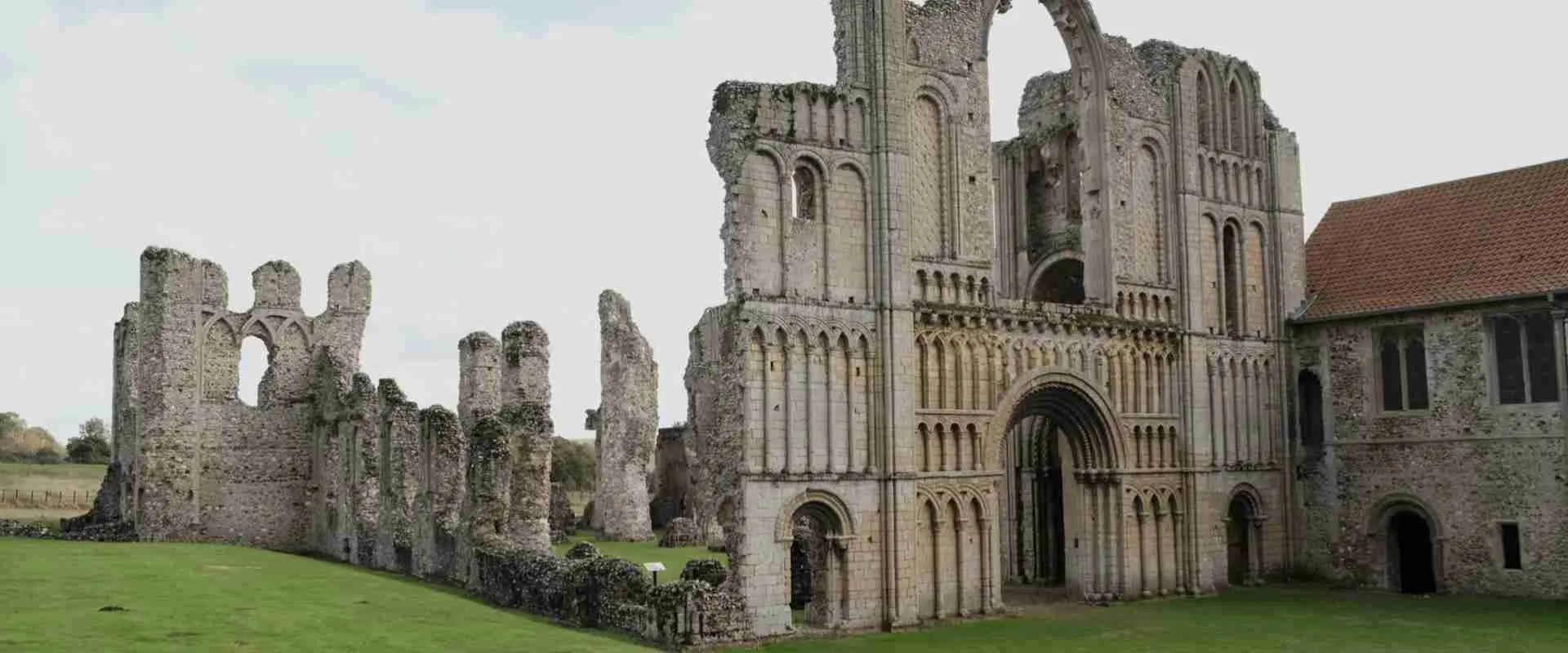
The Cluniac tradition is visible in Castle Acre’s material culture in several specific ways. The order’s theology and liturgy assigned unusual prominence to communal choral prayer, which in architectural terms mandated a large, well-decorated church capable of accommodating elaborate ceremonial. The west front of Castle Acre’s priory church, dating from around 1140, is one of the most elaborately decorated Romanesque west fronts surviving in England — its surface covered in registers of interlaced blind arcading, carved chevron ornament, and decorative nook-shafts worked in local limestone imported via the Wash. The effect is one of deliberate density, with the ornamental program extending over the full height of the wall surface rather than being concentrated in the doorway zones as in simpler Norman parish churches. English Heritage’s audio tour, which is included in the admission price, explains the iconographic and typological logic of this decorative scheme, though some aspects of the carving’s specific program remain subjects of scholarly discussion rather than settled interpretation.
The site’s remains extend well beyond the church itself. The west range of the priory — which contained the prior’s lodging — is virtually complete to its full height and retains a ceiling decorated with Tudor roses (added after the priory’s 1537 dissolution, during the conversion of the prior’s apartments for secular use). The prior’s lodging can be entered, and an interactive display inside addresses the building of Norman churches and their structural logic. The refectory, chapter house, and infirmary ranges survive in varying degrees of completeness, and English Heritage’s site plan — provided in the guidebook and displayed on interpretive panels throughout — allows visitors to reconstruct the full monastic precinct mentally from the extant fragments. The 24-seat two-storey reredorter (the medieval communal toilet block), one of the largest surviving examples in England, is one of the unexpected highlights for visitors who read the site plan carefully before walking.
Practical access for 2026: Castle Acre Priory is managed by English Heritage and open daily from late March through October, 10am–5pm; winter opening is limited to weekends. Admission prices for 2026/27 are tiered by season and day: the Super Saver rate (Monday to Friday, late March through late May and early September through early November) is £8.50 for adults; the Saver rate (peak weekday summer and shoulder-season weekends) is £9.26; the Standard rate (peak summer weekends, late May through August) is £10.79. All prices are before the 15% advance-purchase discount available when booking online via the English Heritage website. English Heritage members enter free. Audio tours in English are included in admission; the site’s shop, exhibition, and recreated herb garden are all included without additional charge. The car park adjacent to the priory entrance is free for all visitors.
Photography at Castle Acre rewards an early-morning arrival specifically for the west front: the carved arcading reads best in raking morning light from the east (roughly 9am–11am in summer, later in spring and autumn), when the depth of each blind arch creates shadow patterns that articulate the three-dimensional relief of the carving. In flat overcast light, the west front can appear compressed and less legible photographically; direct afternoon sunlight from the west is generally too frontal. The prior’s lodging interior benefits from overcast conditions and a wide-angle lens. The priory’s open site means visitors can position themselves freely without the constraints imposed by roped-off areas, making Castle Acre unusually accessible to photographers who want to work the geometry of the ruins at ground level.
Stop 3: Blickling Estate — Early 17th-century brickwork, gardens, and crowd-bypass hours
Blickling Estate’s great hall is one of the most confident Jacobean brick houses in England, built between 1616 and 1624 for Sir Henry Hobart, Lord Chief Justice of England. The architect was Robert Lyminge, who had recently completed Hatfield House in Hertfordshire for the Cecil family, and who brought to Blickling the same vocabulary of ogee-capped corner towers, shaped Dutch gables, and large mullioned windows that characterized the best Jacobean country house practice of the period. The construction material — red brick with stone dressings — reflects the mature local brick-making tradition that had developed in Norfolk and Suffolk through the Tudor period, drawing on abundant local clay deposits in a region that, like much of East Anglia, had no natural building stone. By 1616, East Anglian brick had reached a standard of consistency and color control that made it aesthetically competitive with imported stone for high-status commissions.
The house’s exterior is most effectively read from the main approach along the avenue from the estate gates — a view that terminates on the symmetrical south front with its flanking corner towers and the formal parterre garden in the foreground. This axial approach is a deliberate feature of the Jacobean design: the hall is positioned to be seen as a landscape composition as well as a domestic structure. The north-facing side of the building, which faces the church and the service courtyards, is less formally treated. The east wing, added later and now containing the National Trust’s visitor facilities, shop, and cafe, is clearly distinguishable from the Jacobean core by its different brick courses and window proportions.
Blickling is described by National Trust tradition as the birthplace of Anne Boleyn, second wife of Henry VIII. This attribution is a persistent local tradition, though it remains difficult to verify from surviving documentary evidence; the National Trust’s own materials consistently use phrases like “thought to be” when discussing the Boleyn connection. The hall of Blickling in the Boleyn period — if the family connection is accepted — would have been an earlier structure on the site, since the current building dates entirely from the Hobart commission of 1616–1624. The attribution adds visitor interest but should be understood as tradition rather than confirmed historical record.
The house interior contains several significant elements. The Long Gallery on the first floor — among the longest surviving Jacobean long galleries in England — is fitted with its original plaster ceiling (c.1620), featuring elaborate geometric ribs and pendant bosses. The gallery also houses the National Trust’s largest private library collection, with holdings of particular significance for early printed books and manuscripts. Access to the gallery is included in normal admission. The Peter the Great Room contains a remarkable tapestry gift — sent to the 1st Earl of Buckinghamshire by Catherine the Great of Russia in the 1770s — which at nearly 15 feet high is one of the largest tapestries in National Trust care and requires careful conservation attention. Blickling deployed a parasitic wasp species, Trichogramma evanescens, as part of an integrated pest management strategy to protect the tapestry and other textile collections from common clothes moth damage, a contemporary conservation technique reported in 2021.
The formal garden covers 55 acres and includes a parterre planted to a Victorian design on an earlier Jacobean layout, a walled kitchen garden currently managed as a productive growing space, a lake with a lakeside walk, and the 18th-century pyramid mausoleum designed by Joseph Bonomi (c.1796–97) in the parkland to the northeast. The garden opens at 10am daily, an hour before the house, creating a useful crowd-bypass window: visitors who arrive at 10am and walk the formal garden and the lakeside loop have typically completed these before the house opens at 11am and the crowd concentration shifts indoors. Midweek visits in April, May, and September are consistently the quietest: school groups and weekend visitors thin significantly, and the garden’s planting is at particularly good stages in these months.
National Trust admission for 2026: £18 per adult (without Gift Aid); £9 per child (5–17); under-5s free; family tickets (2 adults, up to 3 children) £45. A 20% discount applies to all visitors arriving by public transport, foot, or bicycle. Members of the National Trust enter free. The estate car park is £5 per vehicle for non-members; members park free. The Stables Café and Muddy Boots Café both operate within the estate grounds and serve locally sourced food, open from 10am daily.
Practical Visitor Intelligence: Seasonal Access, Ticketing, and Photography Windows
Managing a three-stop architectural road trip across three independently administered heritage organizations requires attention to each site’s distinct booking logic, seasonal hour variations, and photography restrictions. The following section consolidates that operational intelligence so it can be applied in a single pre-trip planning session rather than across three separate institutional websites.
Entry booking systems for 2026 and conservation closures
Norwich Cathedral does not require advance booking for free admission to the nave and cloisters; individual visitors of any size may walk in during opening hours (typically 7:30am–6pm daily, with variations for services and special events). The Upper Level Tour, however, requires advance booking through the cathedral’s own website and sells out well ahead on Wednesdays and Saturdays in school holiday periods; if this tour is a priority, book at least three weeks in advance for July and August dates. Choral Evensong takes place most evenings (check the cathedral’s events calendar) and is free to attend, though it effectively closes parts of the nave to general visitors for the service period; timing your main architectural visit to end before 5pm avoids service conflicts on most days.
Castle Acre Priory does not require timed entry but strongly recommends advance online booking through the English Heritage ticketing portal, which guarantees entry and applies the online advance discount (typically 15% off the walk-up rate). Walk-up tickets are available subject to availability but at the higher door price. English Heritage members can register their visit online or simply present their membership cards at the site entrance. The site can accommodate coach groups of up to 4 vehicles simultaneously (pre-booked), so large group arrivals are possible in peak season; arriving before 10:30am generally ensures the main ruins are clear of group tour formations for the first hour. Conservation closures are not typically pre-announced for Castle Acre because the site is largely open-air and access to specific structures can be managed without full closure; check the English Heritage website for any conservation access restrictions in the weeks before your planned visit.
Blickling Estate in 2026 operates on a timed-entry system for the house during peak periods (July, August, and Bank Holiday weekends). Garden and parkland access is untimed. Tickets can be purchased at the estate entrance or online through the National Trust’s booking system; buying online in advance is recommended for July and August weekend visits to guarantee a house entry slot. Members can pre-register visits through the National Trust app. The RAF Oulton Museum within the estate is open Tuesday to Sunday, 11am–3pm (closed over winter months), and requires no additional ticket. Cycle hire is available April to October; advance booking is recommended at peak times for electric bikes specifically.
The temporal arc across all three sites: Norwich Cathedral is open year-round; Castle Acre Priory is fully open March through October with limited weekend winter opening; Blickling Estate’s house opens March through October (daily), with reduced access periods through winter. A spring circuit (late April through early June) offers the best balance of full seasonal opening, manageable visitor numbers, and good photographic light conditions at all three sites simultaneously.
Optimal lighting conditions for limestone facades and ruined priory arcades
Architectural photography at heritage sites depends on understanding light direction relative to carved or textured surfaces. At Norwich Cathedral, the Norman nave and the carved cloister bosses present quite different lighting challenges. The nave’s interior is north-south oriented, with the main windows on the north side of the nave aisles and the clerestory above. For interior shooting without supplementary light, diffuse overcast conditions are generally superior to bright sun, which creates extreme contrast between windows and stone. The cloister garth — the central courtyard around which the walkways run — receives direct south light in the early afternoon; the south walk of the cloister (typically the most elaborate) reads well in this period, while the north walk benefits from softer reflected light at any time of day.
At Castle Acre, the critical surface is the west front of the priory church. This faces due west by convention (most medieval churches are oriented east-west with the main entrance on the west). The carved arcading, chevron ornament, and blind arches on the west front therefore receive raking morning light from the east — specifically, direct sunrise through midmorning light illuminates the carved relief at a shallow angle, creating strong shadow definition in the ornament. During British summer time, this window runs from approximately 7am to 11am (earlier in midsummer, later in spring and autumn). The prior’s lodging and west range to the south of the church facade are best photographed in the early afternoon when the sun has moved around. Overcast light is workable for the ruins as a whole but loses the textural definition in the carved stonework that makes the west front distinctive.
At Blickling Estate, the main south front faces south, meaning it receives best light on a clear day from mid-morning through mid-afternoon. The parterre garden in the foreground is in full shadow from the house itself in the early morning. The formal avenue approach from the car park (arriving from the north) delivers a north-looking view of the south front that works best in the full middle of the day when both the building and the garden terrace are evenly lit. The east wing’s brick colors — a warmer, more varied red than the central block — read particularly well in late afternoon golden-hour light. The pyramid mausoleum in the parkland benefits from clear blue-sky conditions and is most accessible from the main lakeside walk.
Accommodation Along the Norfolk Heritage Route 2026
Norwich city centre offers the widest concentration of accommodation and the most logical base for the full circuit, eliminating repositioning costs between sites. Mid-range hotels in the city centre cluster around the railway station and the riverside quarter, with room rates typically ranging from £90 to £140 per room per night in the spring and autumn shoulder seasons and £110–160 in July and August. Budget hotels and guesthouses, including several well-rated independent B&Bs in the Unthank Road and Golden Triangle neighborhoods near the city centre, typically charge £70–90 per room per night. Norwich also has a range of serviced apartments and self-catering options that can reduce per-night costs significantly for three-night stays.
For visitors who prefer to stay closer to the North Norfolk Coast for their third night, the towns of Sheringham, Cromer, and Holt offer good independent hotel and B&B options. Sheringham has several seafront hotels in the £90–130 range; Cromer, a larger and busier coastal town, has a broader selection from budget guesthouses at around £70 per room to Victorian seafront hotels at £120–150. Holt — a Georgian market town inland from the coast, approximately 10 miles from both Blickling and Sheringham — is particularly well placed for the Blickling/coast combination and has a concentration of independent accommodation and good restaurants in a smaller, quieter setting than the coastal towns.
For travelers with National Trust holiday membership or interest in estate accommodation, the Blickling Estate itself has seven characterful holiday cottages sleeping 4–8 people, ranging from traditional thatched properties to Blickling Tower (a former racecourse viewing stand with a third-floor roof terrace). These require advance booking well ahead for summer and school-holiday periods. The estate cottages are priced as weekly lets with some short-break options; pricing varies by property and season — check the National Trust Holidays booking platform. Staying on the estate eliminates all transport logistics for the Blickling day and includes free access to the estate grounds.
Extending the 2026 Norfolk Heritage Circuit Beyond the Main Stops
The three main sites in this guide represent a concentrated architectural argument; the surrounding area offers several significant extensions for travelers with additional days. The North Norfolk Coast Area of Outstanding Natural Beauty stretches from Hunstanton in the west to Sea Palling in the east and contains internationally significant saltmarsh, inter-tidal mudflat, and dune systems protected under multiple designations. At Blakeney National Nature Reserve, approximately 15 miles west of Sheringham along the A149 coast road, the grey seal colony (among the largest in England) is viewable from boat trips organized from the quay at Blakeney; the National Trust manages the reserve. Wells-next-the-Sea, reachable from Sheringham by the CoastHopper bus, is a working tidal harbor town with good independent restaurants and a famous pine-backed beach accessible via a causeway.
For visitors with an additional architectural interest, Oxburgh Hall (National Trust, near Stoke Ferry south of Castle Acre) is a late 15th-century moated manor house with a remarkable heraldic embroidered textile collection and one of the finest surviving medieval gatehouse towers in East Anglia; it can be combined with Castle Acre into a western extension day. The North Norfolk Railway, the heritage steam and diesel line connecting Sheringham with Holt (via Weybourne), operates from the station adjacent to the Bittern Line platform at Sheringham and provides a scenic return route to Holt — a Georgian town with a noted concentration of independent antique shops and food businesses — from which a taxi or local bus can reach Blickling and return to the Norwich rail connection.
Felbrigg Hall (National Trust), approximately 3 miles southwest of Cromer, is another significant Norfolk country house — a 17th-century Jacobean/William-and-Mary hybrid with a celebrated walled garden and an estate managed for wildlife — and offers natural pairing with a Cromer or Sheringham coastal visit on the same day. The estate’s working walled garden is particularly strong in late summer (August–September) when the vegetable growing sections are at full production. Check National Trust opening dates, which vary seasonally, before including Felbrigg in a day plan.
Budget Planning for the Norfolk Heritage Road Trip 2026
The following cost ranges are per person, per day, assuming two people sharing a hire car and hotel room. Accommodation is pre-divided by two before adding to individual costs. All figures are rounded to the nearest £5.
Budget travelers (budget hotel, self-catering where possible, weekday visits to get cheaper site admission): hotel per person £35–45, car hire per person £28–35, fuel per person £5–8, meals per person £25–35, admissions averaged across three days £9–12. Total approximately £100–135 per person per day for two sharing a budget hotel and compact hire car.
Mid-range travelers (comfortable hotel, restaurant dinners, peak weekend site visits): hotel per person £50–70, car hire per person £38–48, fuel per person £6–10, meals per person £40–55, admissions averaged across three days (including Cathedral Upper Level Tour) £11–15. Total approximately £145–200 per person per day for two sharing a mid-range hotel.
Three-day trip totals at budget level run approximately £300–405 per person; mid-range travelers should plan for approximately £435–600 per person for the full circuit. These figures include all transport within Norfolk, accommodation for three nights, meals, and site admissions, but exclude travel to Norwich from the visitor’s home city.
Membership card analysis: English Heritage membership (adult from around £65/year) covers unlimited free entry at Castle Acre Priory and over 400 other English Heritage sites. National Trust membership (from approximately £85/year for one adult) covers Blickling Estate admission and parking (saving £23 per person per visit) and over 500 Trust properties. For a single trip to this Norfolk circuit, the admissions savings alone (£27–29 per person for both Castle Acre and Blickling) do not fully offset the annual membership costs; the value case strengthens significantly for travelers who plan multiple heritage visits within the same year, which both organizations’ memberships facilitate. Check both organizations’ current membership rates directly on their websites before your 2026 trip as prices are reviewed annually.
Driving the A140/A148 Corridor: Practical Road Intelligence for 2026
The A140 from Norwich to Aylsham is a largely single-carriageway road with variable quality of overtaking opportunities. Traffic volumes are typically light during mid-week mornings outside school holidays; the busiest periods are Friday afternoons and Sunday afternoons in summer, when outgoing and returning coastal visitors share the corridor with local agricultural traffic. The road passes through several villages between Norwich and Aylsham — Swardeston, Newton Flotman, and Long Stratton in the southern section, then Tasburgh, Bunwell, and Wymondham Market cross roads — which impose 30mph speed restrictions and occasional hold-ups from farm access traffic. Allow 30–35 minutes for the Norwich to Aylsham section rather than the theoretical 20-minute driving time in conditions with any traffic.
The A47 westbound from Norwich toward the A1065 Castle Acre junction is dual carriageway for the section immediately west of Norwich and provides fast access to the A1065 turnoff near Swaffham. From the A1065 it is a further 7–8 miles south to Castle Acre village on a good B-road through open agricultural countryside. The B1145 westward from East Dereham provides an alternative route toward Castle Acre without using the A47; it is slower but more scenic through the market town of East Dereham (which has a notable medieval church worth a brief stop).
Electric vehicle charging along the route: Norwich city centre has Level 2 and DC fast charger provision at several city centre car parks, including the Chapelfield shopping centre and St Giles NCP. The A140 corridor northward has limited dedicated charging provision until Cromer, where EV chargers are available at the main car parks. Castle Acre village has no public charging infrastructure; EV drivers should plan to arrive with sufficient range from Norwich and return to charge. The North Norfolk Coast towns (Cromer, Sheringham, Holt) have improving Level 2 provision at major car parks; check ZapMap for real-time availability before each day’s drive.
Frequently Asked Questions About the North Norfolk Heritage Road Trip 2026
How long does it take to drive from Norwich to Castle Acre Priory in 2026?
The drive from Norwich city centre to Castle Acre Priory takes approximately 40–50 minutes under normal traffic conditions, covering roughly 22 miles west via the A47 dual carriageway to the A1065 junction, then south on the A1065 to Swaffham, turning onto the B1145 and village roads into Castle Acre. Friday afternoon and weekend morning traffic adds 10–20 minutes. The easiest routing from central Norwich uses the inner ring road to pick up the A47 westbound at Earlham Road. Sat-nav systems tend to route accurately for this journey, though some older mapping data shows the former B1354 classification for the Blickling approach road — verify current road numbering if following signage.
Is the Upper Level Tour at Norwich Cathedral worth booking in 2026?
For visitors with a serious interest in the cathedral’s architecture and history, yes. The Upper Level Tour (£10 plus booking fee, Wednesdays and Saturdays at 10:30am, aged 16+) accesses the first-floor spaces and provides elevated views over the nave and cloisters that are not available from ground level, as well as an extended interpretation of the building’s construction history. The tour takes approximately one hour and is led by trained volunteer guides. For visitors making a single trip to Norwich, it adds meaningful architectural depth to what is already an excellent free visit. It is not necessary for a satisfying cathedral visit, however, and the free nave and cloisters access is substantial in its own right. Demand in 2026 is high: book at least three weeks ahead for peak-period dates.
Can English Heritage members visit Castle Acre Priory for free in 2026?
Yes. English Heritage membership provides free entry at Castle Acre Priory and at all other English Heritage managed sites across England. Members simply present their membership card at the entrance. The audio tour, included in standard admission, is also available to members. English Heritage membership in 2026 starts at approximately £65 for a single adult annual membership; check the English Heritage website for current pricing as rates may be reviewed. For travelers visiting multiple English Heritage sites during the year, membership represents significant overall savings — English Heritage manages over 400 sites nationally, including many of the most significant historic castles, abbeys, and prehistoric sites in England.
What is the best month to do the North Norfolk heritage road trip in 2026?
May is consistently recommended by heritage professionals and experienced visitors as the optimal month for this circuit. All three sites are in full seasonal opening (Castle Acre opens daily from late March; Blickling’s full house and garden program is running from late March; Norwich Cathedral is open year-round). Visitor numbers in May are significantly lower than in July and August — particularly at Blickling and Castle Acre — while daylight hours are long (sunrise around 5am, sunset after 9pm), providing wide windows for morning and evening photography. May garden plantings at Blickling are typically at their best, with the formal parterre at peak condition and the walled kitchen garden productive. The weather in May can be variable, but overcast conditions are generally better for architectural interior photography at the cathedral. September is a strong second choice: the summer crowds have dissipated, autumn light can be excellent, and site opening hours remain at full summer extent through October.
Are there guided tours available at Castle Acre Priory in 2026?
Castle Acre Priory does not typically run daily public guided tours from an English Heritage guide, but the site provides a comprehensive audio tour in English (included free with admission) that covers the key elements of the priory’s history, Cluniac monastic life, and the architectural sequence of the ruins. This audio tour is generally considered excellent for its level of architectural and historical detail and is the most practical way to read the site for a first-time visitor. School Discovery Visit workshops for educational groups are available April through October, Monday to Friday, with sessions of approximately one hour; these require pre-booking. The site also has an exhibition near the shop entrance that displays archaeological finds from excavations, a site model, and contextual information about Cluniac monasticism in England.
How do I get from Blickling Estate to the North Norfolk Coast in 2026?
From Blickling Estate, the North Norfolk Coast at Cromer is approximately 14 miles northeast via the A140 — a 20-minute drive under normal conditions. From the estate car park, follow the minor road back to Aylsham, then join the A140 northward. Sheringham is slightly further west at approximately 18 miles from Blickling via Aylsham and Roughton. By public transport, take a taxi or bus from Aylsham (2 miles from Blickling, on foot via the Weavers’ Way) to Aylsham station, then the Bure Valley Railway back to Hoveton & Wroxham, and then the Greater Anglia Bittern Line northward to Cromer or Sheringham. The coastal walk between Cromer and Sheringham (4 miles via the cliff path, part of the Norfolk Coast Path) is a popular extension once on the coast. The CoastHopper bus service links all the major coast road settlements from Sheringham westward.
What are the best places to eat near Castle Acre Priory in 2026?
Castle Acre village is a small settlement with limited food provision compared with a larger town, though the Albert Victor public house in the village serves food and is a comfortable option for a lunch stop after the priory visit. Swaffham market town, approximately 5 miles south on the A1065, has a broader range of cafes, pubs, and a weekly market (Saturdays) with local food producers. For a more substantial restaurant lunch, the road from Castle Acre toward Fakenham via the B1145 passes through East Dereham, which has a full complement of chain and independent food options. Within the priory itself, a vending machine provides hot drinks and snacks; there is no cafe on site. Visitors are welcome to picnic in the grounds. Planning lunch either before arriving or on the return to Norwich gives the most practical outcome — the site visit itself is best completed without interruption.
How many days is the optimal time for the Norwich to North Norfolk Coast circuit in 2026?
Three full days is the minimum that allows adequate time at each major stop without rushing. Two of those days should be dedicated primarily to single sites — Castle Acre on one day (allow 3 hours at the priory plus driving time from Norwich), Blickling on another (3.5 hours for house and formal garden combined, then continue to the coast for the afternoon) — and one day for Norwich Cathedral combined with exploring the city’s medieval core. A fourth day can usefully be added for North Norfolk Coast extension activities: the coastal walk from Cromer to Sheringham, a morning at Felbrigg Hall, or a steam railway journey on the North Norfolk Railway from Sheringham to Holt. The circuit can technically be compressed into two days, but this sacrifices depth at each site; architecture at this quality rewards slow engagement rather than checklist visiting.
Is Norwich Cathedral accessible for visitors with reduced mobility in 2026?
Norwich Cathedral has made significant accessibility improvements in recent years. The nave and main interior spaces are accessible by wheelchair via level or ramped entry points; the cloisters are accessible from ground level without steps in most sections. The Upper Level Tour involves stairs and is not wheelchair-accessible; visitors with mobility limitations who cannot manage stairs may request alternative access arrangements through the cathedral’s volunteer team. The Cathedral Close itself is pedestrian surface (a mix of paving and grass) with some uneven areas. Blickling Estate has extensive accessibility provisions: mobility scooters and wheelchairs are available for hire from the estate barn visitor reception, Blue Badge parking is available close to the hall, and accessible toilets including a Changing Places facility are on site. Castle Acre Priory access from the entrance to the main ruins involves approximately 100 meters of smooth grass and tarmac path with some slope; the spiral staircase to the prior’s lodging upper floor is not wheelchair-accessible.
What is the Bittern Line Day Ranger ticket and how does it work in 2026?
The Bittern Line Day Ranger is a day pass offering unlimited travel on the Greater Anglia Bittern Line between Norwich and Sheringham for a single day. Check current pricing and validity directly with Greater Anglia and on the Bittern Line Community Rail Partnership website before travel, as fares are periodically updated. The pass has historically been valid on the CoastHopper bus service from Sheringham to Hunstanton, extending the coastal reach of a single ticket significantly. The Bittern Line itself runs approximately hourly at peak times (Monday–Saturday daytimes), with an off-peak frequency of approximately one train every two hours; Sunday services are less frequent and should be checked separately. The Bure Valley Railway to Aylsham operates its own separate ticketing and is not included in the Bittern Line Day Ranger. It connects at Hoveton & Wroxham (the Bittern Line stop on the southern Broads) and runs a heritage steam and diesel service through the Bure Valley to Aylsham in approximately 45 minutes.