Luton Hoo and Dunstable Priory Road Trip 2026 East of England: Exploring Totternhoe Quarry & Chiltern Heritage Without the Crowds
South Bedfordshire’s chalk heartland conceals a remarkable concentration of heritage that most visitors to the Thameslink corridor completely overlook. This 18-kilometer loop connects four layered stops — the Capability Brown-designed Walled Garden at Luton Hoo Estate, a nine-century-old Augustinian priory in Dunstable town center, medieval chalk-quarry grasslands at Totternhoe Knolls, and the atmospheric 15th-century gatehouse of Someries Castle — all within easy reach of London by train or car, and largely free to enter in 2026.
Key Takeaways
- This 18-kilometer circuit links four heritage stops across south Bedfordshire; three of the four sites are entirely free to visit and all four have free or low-cost parking within 100 meters of the entrance.
- The Luton Hoo Walled Garden opens on Wednesdays only, 6 May through 30 September 2026 (10:30am–4pm), at £7.50 per adult; RHS and Historic Houses members enter free, and entry is free for all on Heritage Open Day, 18 September 2026 (11am–3pm).
- Dunstable Priory Church welcomes visitors free of charge on Wednesdays and Thursdays (10am–2pm); a Wednesday visit is the one day that allows you to combine all four stops with every site at its full public access.
- Three of the four sites are free of charge at any time: Dunstable Priory (on open days), Totternhoe Knolls (open always, free parking), and Someries Castle (Scheduled Ancient Monument, freely accessible).
- Drivers spending a full day on this circuit can expect costs of approximately £18–26 per person (fuel for the loop, one Luton Hoo ticket, refreshments); London day-trippers using Thameslink and local bus routes 31 and 61 should budget approximately £44–55 per person.
- Red Eagle route 61 stops directly in Totternhoe village, linking it to Dunstable without a car; Arriva route 31 connects Luton to Dunstable at up to every 15 minutes during daytime hours.
People Also Ask About This Chiltern Road Trip 2026
How long does the Luton Hoo to Someries Castle loop take to drive in 2026?
The 18-kilometer driving loop takes approximately 35–45 minutes of pure driving time, but a full day visiting all four stops — including the guided tour at Luton Hoo Walled Garden, interior exploration at Dunstable Priory, a walk across Totternhoe Knolls chalk grassland, and a self-guided visit to Someries Castle gatehouse — runs between 6 and 8 hours comfortably. The Luton Hoo guided tour is included in the £7.50 admission and lasts approximately 45–60 minutes; build that into your morning timing to avoid arriving at Dunstable Priory after its 2pm weekday closing time for visitors. Traffic on the A5 and A505 corridors is generally light outside of Luton school-run hours (8–9am and 3–4pm) on weekdays.
Which sites on this 2026 Chiltern heritage circuit are free to visit?
Three of the four stops are free in 2026. Dunstable Priory Church charges no admission on its open visitor days (Wednesdays and Thursdays, 10am–2pm). Totternhoe Knolls nature reserve has no entry fee and free parking at the National Trust car park on Castle Hill Road. Someries Castle, a Scheduled Ancient Monument, is freely accessible at any reasonable hour with informal roadside parking near the farm track. Luton Hoo Walled Garden charges £7.50 per adult on standard Open Wednesdays; Historic Houses Association members and RHS members enter free across the full May–September 2026 season. Heritage Open Day (18 September 2026) opens the Walled Garden completely free between 11am and 3pm — the one day in 2026 when the entire four-stop circuit can be visited at zero admission cost.
Can I complete this road trip from London by public transport in 2026?
Yes, with careful planning around Someries Castle, which has no direct bus access. Take a Thameslink service from London St Pancras to Luton (off-peak singles typically £9–10); Arriva route 31 then links Luton to Dunstable at up to every 15 minutes during the day. From Dunstable, Red Eagle route 61 continues west through Totternhoe village to the Totternhoe Knolls area, a 10–15 minute walk from the bus stop to the car park. For Someries Castle, the most practical transit approach is a Thameslink journey one stop further to Luton Airport Parkway, then a 30–40 minute walk southward on the Lea Valley Walk footpath to the ruins. The transit day, including all four stops and the Someries walking leg, takes approximately 9–10 hours and is best planned for settled weather.
What is the best time to plan this 2026 road trip to avoid crowds?
Mid-week visits in May, June, and September offer the best combination of open sites, peak wildlife interest, and light visitor numbers. A Wednesday between late May and mid-September is ideal: both Luton Hoo Walled Garden and Dunstable Priory have their public access on that day, Totternhoe is at its botanical best, and Someries can be visited at leisure without weekend walkers. Heritage Open Day on 18 September 2026 — a Friday — is the outstanding single date on this circuit: all four sites are simultaneously accessible, Luton Hoo is free, and the national festival atmosphere adds context to every stop without the Saturday crowds of a bank holiday weekend.
Extended multi-day tours – 5+ days
Featured South East England Multi-Day Tour Packages

3 days
South East England 3-Day Discovery Tour
- ✓ Comprehensive South East England experience
- ✓ Expert local guides included
- ✓ All accommodation included
- ✓ Transportation provided
5 days
South East England 5-Day Highlights Experience
- ✓ Comprehensive South East England experience
- ✓ Expert local guides included
- ✓ All accommodation included
- ✓ Transportation provided
7 days
South East England 7-Day Cultural Journey
- ✓ Comprehensive South East England experience
- ✓ Expert local guides included
- ✓ All accommodation included
- ✓ Transportation provided

10 days
South East England 10-Day Complete Adventure
- ✓ Comprehensive South East England experience
- ✓ Expert local guides included
- ✓ All accommodation included
- ✓ Transportation provided
Multi-day tour packages powered by TourRadar. Prices and availability subject to change.
dover norwich cambridge Peterborough
A Chiltern Heritage Circuit Built Around Chalk
The geological spine of the southern Chilterns — a ridge of Upper Cretaceous chalk running northeast from Dunstable Downs toward Luton — gave this corner of Bedfordshire both its building material and its landscape character. Totternhoe limestone, a dense and workable form of chalk extracted from the escarpment at Totternhoe since at least the medieval period, was used across the region for major building projects. The Wildlife Trust for Bedfordshire, Cambridgeshire and Northamptonshire records that the material was used in buildings including Westminster Abbey — a measure of how highly it was valued as a construction stone at a time when bulk transport of heavy materials depended entirely on pack animals and river barges. The same chalk geology that yielded Totternhoe stone also defined the open downland at Totternhoe Knolls, where centuries of quarrying activity inadvertently sculpted spoil heaps into flower-rich grassland that is now a nationally significant Site of Special Scientific Interest.
That relationship between chalk, construction, and heritage runs through all four stops on this circuit in different ways. Someries Castle’s gatehouse, built from brick beginning around 1430, stands as one of the earliest documented examples of brick construction in England — its significance lying precisely in the departure from chalk and local stone toward fired clay at a moment when English builders were still working out how to use brick as a primary structural material. Dunstable Priory’s Norman nave, founded in 1131 by Henry I, sits at the junction of two of England’s most ancient long-distance routes — Watling Street (the Roman road now numbered A5) and the Icknield Way — and drew on the Chiltern chalk belt for the dressed stone used in its earliest construction phases. Even the Capability Brown parkland at Luton Hoo — redesigned in the mid-18th century with the sweeping water features and naturalistic planting that are Brown’s hallmark — works with the chalk landscape rather than against it, directing views across the downland valley and incorporating the River Lea’s course as a visual anchor.
Understanding this geological thread transforms the circuit from a list of heritage stops into a coherent landscape journey. You begin at an 18th-century designed estate garden on the chalk fringe south of Luton, move northwest into the market town of Dunstable which grew up along Watling Street, then push further west to the chalk escarpment at Totternhoe before looping back east to the airport perimeter where Someries’ brick gatehouse stands in splendid isolation. The circle you are describing on the map also traces the inner ring of the Chilterns Area of Outstanding Natural Beauty boundary, which sweeps around the west and south of Luton and includes Totternhoe Knolls as one of its designated chalk grassland sites.
The A5 corridor through which Stage 1 of this route runs is itself worth a moment’s consideration before departure. Watling Street connected London to Chester in Roman times and was one of the administrative arteries of Roman Britain; its line through Dunstable — directly through what is now the town center — determined the layout of Dunstable as a medieval market town and explains why Dunstable Priory was founded at this precise location, commanding the crossroads of two major routes and the traffic of pilgrims and traders alike. The A5 High Street in Dunstable town center still follows the Roman alignment almost exactly. Driving it northeastward from the priory toward Luton, you are tracking one of the oldest engineered roads in Britain, its surface now tarmac but its line unchanged for two thousand years.
For the visitor approaching this circuit with a serious interest in architectural history, the four stops also offer a compacted lesson in the materials and methods of English building across five centuries. The Romanesque stonework of Dunstable Priory (12th century), the early brick of Someries Castle (mid-15th century), the Capability Brown landscape design at Luton Hoo (18th century), and the Victorian horticultural infrastructure of the Walled Garden’s service buildings together represent a remarkably continuous thread of construction and adaptation in a small geographic area.
The Heritage Sites at a Glance: 2026 Access, Hours, and Cost
Before planning your day, the access parameters for each stop are summarized below. All times should be confirmed with the respective organizations as seasonal adjustments are possible.
Luton Hoo Walled Garden: Open Wednesdays, 6 May–30 September 2026, 10:30am–4pm. Admission £7.50 adult, £2.50 child (5 and over), under-5s and carers free. RHS and Historic Houses members free. Heritage Open Day (18 September 2026) free, 11am–3pm. Free parking. lutonhooestate.co.uk.
Dunstable Priory Church: Open to visitors Wednesdays and Thursdays, 10am–2pm. Free admission. Church Close, Church Street, Dunstable LU5 4RU. 01582 477401.
Totternhoe Knolls: Open at all times. Free admission, free parking at National Trust car park, Castle Hill Road, LU6 1QG. Dogs on leads. Height restriction on vehicle approach to car park.
Someries Castle: Freely accessible at any reasonable hour. Scheduled Ancient Monument. Nearest postcode LU2 9PL; access via farm track off Airport Way. No facilities.
Four Heritage Stops in 2026: Histories and Visitor Essentials
Each of the four stops on this circuit rewards an understanding of its historical context before arrival. The practical visiting information in this section is drawn from verified 2026 sources; opening hours and admission prices should be confirmed on the respective websites before travel.
Luton Hoo Walled Garden: Estate History and Garden Character
Two distinct entities share the Luton Hoo name and history but are today entirely separate organizations. Luton Hoo Hotel, Golf and Spa — which occupies the mansion building and much of the surrounding parkland — is currently closed for refurbishment and forms no part of this circuit. The stops on this itinerary concern Luton Hoo Estate, a separate organization based at the historic service buildings adjacent to the Walled Garden. The Estate’s own communications make this separation explicit, noting that it remains fully operational and welcoming visitors while the Hotel undergoes its separate renovation program.
The Walled Garden at Luton Hoo Estate was laid out as part of the broader landscape commission that Capability Brown undertook at Luton Hoo in the mid-18th century. Brown’s work at Luton Hoo is among his documented landscape redesigns, replacing an earlier formal garden with the sweeping parkland, serpentine lake, and naturalistic planting that characterize his mature style. The Walled Garden provided the productive horticultural infrastructure to support the estate’s household — kitchen gardens, glasshouses, cutting gardens — and its service buildings, several of which survive and form part of the visitor experience today. The garden passed through multiple ownership phases including the Wernher family, who acquired the Luton Hoo property in 1903 and undertook ambitious improvements to both the mansion and the grounds in the Edwardian period before the upheavals of two World Wars permanently altered the estate’s character. The Estate’s winter talk series explores this history in detail; the Spring 2026 program included a talk on the period 1900–1950 and the national changes that shaped the estate’s trajectory.
The Luton Hoo Estate currently operates the Walled Garden as a visitor attraction, volunteer project, and events venue in partnership with the Royal Horticultural Society and Historic Houses. The garden runs a full seasonal programme including horticultural workshops for children, specialist talks, open-air theatre performances, and guided bug hunts. For the 2026 season, highlights include a classical music event on 1 July, the Handlebards Shakespeare company on 8 July, and a Bug Hunt on 24 July. The season closes with an Autumn Open Day on 28 October. RHS members and Historic Houses members receive free admission throughout the May–September open season — a significant saving for heritage enthusiasts who hold either membership.
On arrival, standard Open Wednesday admission of £7.50 per adult includes a guided tour of the garden; this tour covers the main walled enclosure, the service buildings, and the seasonal horticultural displays. Cash is preferred for gate payment, though card payments are accepted subject to mobile signal availability within the garden walls. A season ticket at £20 allows unlimited Wednesday visits for the duration of the season. The Woodyard Café and Brasserie is a short walk through the garden gate; call 01582 879863 to confirm opening hours on your intended visit day, as café hours may differ from garden hours.
Dunstable Priory Church: Nine Centuries of History on Watling Street
Dunstable Priory Church — formally the Church of St Peter — is the surviving nave of an Augustinian priory founded in 1131 by Henry I at the junction of Watling Street and the Icknield Way. The Augustinian canons who served the priory from its foundation occupied a major religious house by medieval standards, managing properties and pilgrimage routes across Bedfordshire and beyond. The priory’s position at one of England’s most important road junctions meant it was both well-resourced and strategically visible; it functioned as a place of hospitality for travelers on Watling Street as well as a center of Augustinian religious life.
The priory’s most historically significant moment came in May 1533, when Thomas Cranmer — recently appointed Archbishop of Canterbury — convened an ecclesiastical court at Dunstable and formally pronounced the annulment of Henry VIII’s marriage to Catherine of Aragon. This judgment, reached here rather than at a more prominent location, was apparently chosen in part because Catherine herself had retired to Ampthill and the proceedings could be kept at a manageable distance from the political complexity of the London court. The Dunstable annulment cleared the path for Henry’s marriage to Anne Boleyn and constituted one of the critical steps in the sequence that produced the English Reformation. The priory’s prior at the time, Robert Catton, reportedly participated in the proceedings reluctantly; the priory itself was dissolved under the Act of Suppression seven years later in 1540.
What survived the dissolution was the parish nave, which the parishioners of Dunstable petitioned to retain and which has served as the town’s main Anglican church continuously since. The building retains considerable Romanesque fabric in the south arcade — 12th-century chevron-decorated stonework that gives the interior its character — alongside later medieval additions including early English pointed arches in the north arcade. The west front, though much altered, preserves Norman elements in its lower stages. The overall impression is of a substantial medieval building that has absorbed five centuries of adaptation without losing its architectural coherence.
For 2026 visits: the church is open to visitors on Wednesdays and Thursdays from 10am to 2pm, staffed by friendly volunteer welcomers. There is no admission charge. The building is an active place of worship with regular services; check the current service schedule on achurchnearyou.com or call 01582 477401 before planning a visit timed specifically to the volunteer open hours. The church also participates in special heritage events including Doors Open in June. Photography is generally welcomed; respect any request from the volunteer team regarding services in progress.
Totternhoe Knolls and the Medieval Chalk Quarries: Ecology and Access
The 31-hectare Totternhoe nature reserve is a direct consequence of medieval industry. Totternhoe stone — a dense, workable form of chalk extracted from the escarpment here from at least the 12th century onward — was a sought-after regional building material, appearing in ecclesiastical and civic structures across Bedfordshire and beyond. The Wildlife Trust for Bedfordshire, Cambridgeshire and Northamptonshire, which manages the reserve jointly with the National Trust and Central Bedfordshire Council, records that the material was used in buildings including Westminster Abbey. The quarrying activity left steeply sloping spoil heaps across the hillside; over centuries these disturbed chalk surfaces developed into the calcareous grassland that the site is now designated and protected for.
The reserve forms part of a larger complex that also encompasses Totternhoe Chalk Quarry and Totternhoe Stone Pit. Together, these sites comprise part of three Sites of Special Scientific Interest. Totternhoe Knolls itself — 13.1 hectares of the wider reserve — is owned by Central Bedfordshire Council and leased to the National Trust, which manages it jointly with the Wildlife Trust. The site is also classified as a Local Nature Reserve and forms part of the Chilterns Area of Outstanding Natural Beauty. At the top of the knolls sits the motte of Totternhoe Castle, an earthwork probably dating from the late 11th century; no masonry survives above ground, but the elevated motte provides panoramic views across the Vale of Aylesbury to the west and toward the Dunstable/Luton conurbation to the east.
The chalk grassland supports a nationally important assemblage of calcareous grassland species. The reserve is described by the Bedfordshire Natural History Society as one of the best sites in Bedfordshire for the small blue butterfly; the Duke of Burgundy butterfly is also found here in season, feeding as a caterpillar on cowslips. Several orchid species flower from late April into June, and the rare Chiltern gentian — a protected species requiring the specific thin, open chalk soil conditions the quarrying spoil heaps provide — is in bloom from late July into August. The Wildlife Trust runs guided orchid monitoring sessions and youth ranger events at the site during the season; check wildlifebcn.org for the current event calendar.
The National Trust car park is off Castle Hill Road, Totternhoe, LU6 1QG (OS reference SP986217). Parking is free for all visitors. There is a height restriction for vehicles approaching the car park; the surfaced access road includes speed bumps and uneven surfaces. Blue Badge bays are provided near the site access point. From the car park, a surfaced path passes through a kissing gate to the lower meadow area; this route is accessible to pushchairs and most mobility aids. Paths ascending to the motte and beyond into the quarry sections are steep and narrow and should be treated as walking terrain requiring sturdy footwear. Dogs must be kept on leads throughout the reserve because of grazing livestock. No on-site refreshments or toilets are available; the nearest facilities are in Dunstable town center (approximately 3.5 kilometers east) or at the Cross Keys pub in Totternhoe village, a short walk from the car park.
Someries Castle Ruins: Early Brick Architecture and Practical Access
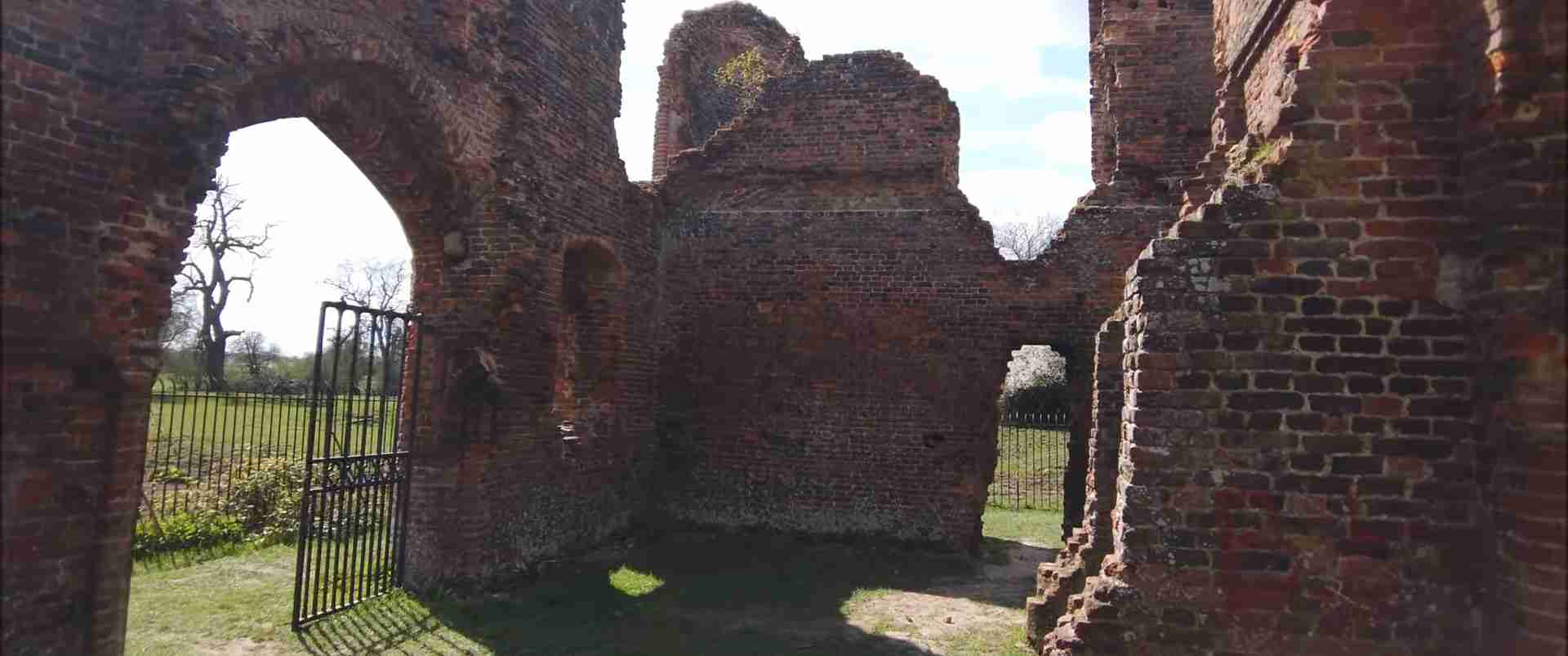
Someries Castle sits at the end of a farm track running alongside Luton Airport’s southeastern boundary, surrounded by fields and subject to the constant low-altitude sound of arriving aircraft — an incongruous setting that somehow amplifies the ruin’s atmosphere rather than diminishing it. What remains is the gatehouse and associated chapel of a fortified manor house begun by Sir John Wenlock from 1430 following his acquisition of the site. Wenlock never completed the building; his death at the Battle of Tewkesbury in 1471 halted construction, and the incomplete structure passed through subsequent ownership before being partially demolished in the 18th century. The site is protected as a Scheduled Ancient Monument under Historic England’s designation system (Scheduled Monument 1008452).
Multiple architectural and historical sources, including the Pevsner Buildings of England series, describe the surviving fabric as among the earliest examples of brick construction in England — a status that gives the gatehouse significance well beyond its picturesque condition as a ruin. The use of fired brick as a primary structural material was still unusual in English architecture at the time Wenlock commissioned the building; the Someries gatehouse therefore occupies an important position in the development of English brick-building tradition, alongside a small number of other 15th-century brick structures in East Anglia and the Home Counties. The Luton Heritage Forum notes that the surviving structure incorporates a twin-turreted gatehouse, entrance hall, a substantial chapel open to the sky, ancillary side rooms including what the 18th-century antiquarian Henry Gough described as the porter’s lodge with its fireplace and courtyard-overlooking window, and a spiral staircase.
The brickwork visible in the surviving walls is legible enough at close range to reward careful inspection. The 15th-century bond pattern, weathered to warm ochre tones across six centuries of exposure, gives the structure considerable photographic and architectural interest independently of its historical associations. The combination of aircraft noise from the adjacent runway and medieval brickwork makes for undeniably dramatic photography in late afternoon or early morning raking light.
Access is free and unrestricted at any reasonable hour. There is no formal visitor car park; most visitors park informally near Someries Farm at the end of the approach track, which branches off Airport Way to the east of Luton Airport Parkway station. Navigation to Someries is the trickiest element of this circuit: postcode LU2 9PL is the most reliable navigation reference, but standard sat-nav frequently struggles to resolve the final track junction. Watch for the farm access track to the right as you approach from Airport Way; pass the farm buildings and continue to the kissing gate at the field boundary, which leads directly to the ruins. Allow 30–45 minutes for a thorough visit to the exterior and surviving interior spaces. There are no interpretation boards, toilets, or refreshments at the site; carry any supplies you need.
The Watling Street Corridor: Historical Planning Context for Your 2026 Journey
The A5, which you will encounter at Dunstable during Stage 1 of this circuit, is not simply a busy trunk road but one of the most historically layered surfaces in Britain. Laid by Roman engineers sometime in the first or second century AD, Watling Street connected the port of Richborough in Kent to Wroxeter on the Welsh Marches via London, St Albans, and Dunstable, forming a primary administrative artery for the Roman province of Britannia. Its straight course — a characteristic of Roman military road-building — is visible on maps as a long diagonal line across the English Midlands, and in Dunstable the line is essentially unchanged from its Roman alignment: Church Street and High Street North in the town center follow Watling Street almost exactly.
The significance of that alignment for the founding of Dunstable Priory is direct. Henry I established the priory at the crossroads of Watling Street and the Icknield Way — an even older route, possibly prehistoric in origin, running along the chalk ridge of the Chilterns — not randomly but because the junction generated traffic, commerce, and the pilgrimage movement that religious houses depended on for both income and influence. Dunstable as a town effectively grew up around this crossroads and the priory it served, in a pattern common to dozens of English market towns founded in the Norman and early Plantagenet periods. Driving down High Street North today from the A505 junction toward Church Close, you are tracing the same axis that Augustine canons, medieval merchants, and Tudor travelers followed for four centuries before the Reformation dissolved the priory in 1540.
A5 road conditions for your 2026 visit: the Dunstable High Street section of the A5 is managed as a town center road with pedestrian crossings, on-street loading restrictions, and a one-way system around Church Close. Through traffic to Luton is generally directed onto the A505 or the Luton Busway corridor to the north of Dunstable center; drivers approaching Dunstable Priory from Luton Hoo should be prepared for the one-way streets in the immediate Church Close area. Parking enforcement in the town center is active; do not leave a vehicle on double yellow lines or in a loading bay while visiting the priory.
The Icknield Way — the second ancient route crossing at Dunstable — runs along the Chilterns escarpment and connects Totternhoe directly to the broader chalk ridge walking network. Visitors combining this driving circuit with a longer walking ambition can access Totternhoe Knolls as a point on the Icknield Way long-distance path, which ultimately connects Ivinghoe Beacon in the Chilterns to the Norfolk coast via the Ridgeway and Peddars Way. For day-trippers without walking ambitions, the point is simply that Totternhoe’s position on an ancient cross-country corridor explains both its importance as a quarry site — materials could be distributed along the ridge route — and the richness of its ecological heritage, which has been shaped by millennia of human land use along the chalk scarp.
Driving Route & Strategic Stopover Breakdown
The loop described here starts and ends at Luton Hoo Estate Walled Garden on the southern edge of greater Luton, traveling northwest to Dunstable, west to Totternhoe, then east-northeast to Someries before returning south. Total driving distance is approximately 18 kilometers. No section of this circuit is toll-gated or subject to urban clean air charging zones in 2026. The roads are a mix of A-road dual carriageway (the A5 and A505 between Luton and Dunstable), B-roads through residential and rural areas, and short stretches of lane or farm track at Totternhoe and Someries. Standard saloon cars, hatchbacks, and family estate vehicles handle the entire circuit without difficulty; only the final farm track to Someries Castle (unpaved, narrow) requires low-speed caution.
Stage 1: Luton Hoo Estate to Dunstable Priory (A5 Corridor & Parking Tips)
Luton Hoo Estate Walled Garden sits in the East Hyde valley area south of Luton, accessed from the B653 (Newmill End Road) or A1081 (Harpenden Road) depending on your approach direction. From the estate, head north toward Luton town via the A1081/B653 corridor, then take the A505 (Dunstable Road) westbound. This dual-carriageway section — locally signed as Dunstable Road through the Luton western suburbs — is the quickest route between Luton and Dunstable and carries you approximately 7 kilometers from Luton center to Dunstable town limits. As you enter Dunstable from the east, the A505 meets the A5 (High Street / Church Street). Dunstable Priory Church is on Church Street within a short distance of the A5; follow the one-way system into Church Close (postcode LU5 4RU) and park nearby.
Parking strategy at Dunstable Priory: there is no dedicated visitor car park at the church itself. The Priory View pay-and-display car park at 121 Church Street (LU5 4HN) is approximately 100 meters from the church entrance and is the closest paid option; it also has a BP Pulse EV charging point with rapid and fast devices (see Transit and Parking Logistics below for full charging details). On-street parking on Church Walk and adjacent streets is subject to time limits posted on signs; observe them carefully, as Dunstable town center enforcement is active. Dunstable’s wider town center offers additional pay-and-display options within a 5–10 minute walk of the church. Allow parking costs of approximately £1–3 per hour depending on the car park and duration.
The timing of this stage is the most critical scheduling decision for the whole day. The Luton Hoo Walled Garden opens at 10:30am and a guided tour (included in admission) runs 45–60 minutes. Add approximately 20–30 minutes for the garden at leisure after the tour, bringing your departure from Luton Hoo to around midday to 12:30pm. The driving time to Dunstable Priory via the A505 is approximately 20–25 minutes. Dunstable Priory’s visitor opening closes at 2pm on both Wednesdays and Thursdays. Arriving by 1:30pm at the absolute latest is advisable to allow a comfortable 30-minute interior visit with the volunteer welcomers. A Wednesday is the only day of the week on which both sites operate their public visitor hours simultaneously; plan the circuit around this constraint.
A practical note on the A5 through Dunstable: the road through the town center can be busy with local traffic at lunchtime on weekdays. Drivers arriving from Luton on the A505 and entering Church Street from the east will find signposting for Church Close sufficient for navigation; standard sat-nav is reliable for this stage of the circuit. From Dunstable Priory, driving time to Totternhoe Knolls is approximately 10–12 minutes.
Stage 2: Totternhoe Knolls & Medieval Chalk Quarries (Access & Footpaths)
From Dunstable Priory, drive west along High Street North and then take the B5120 (Castle Hill Road) westbound through the outskirts of Dunstable and into Totternhoe village. The National Trust car park for Totternhoe Knolls is on the left off Castle Hill Road as you approach the escarpment from the village; the address is Castle Hill Road, LU6 1QG. OS reference SP986217 is reliable for walkers using a mapping app; drivers with standard sat-nav should use the postcode. The drive from Dunstable Priory covers approximately 3.5 kilometers.
Vehicle height on this approach: the car park access lane includes a height restriction barrier. Standard passenger cars pass without issue, but larger SUVs, minibuses, and campervans should verify clearance before committing to the lane. The surface is tarmac with speed bumps and some uneven sections on the approach track. Two Blue Badge bays are located near the main access kissing gate. Parking is free for all visitors at all times.
The footpath network at the reserve splits at the kissing gate just inside the car park entrance area. The surfaced, accessible path leads southwest toward the lower Castle Hill meadow — this is the most appropriate route for pushchair users, wheelchair users, and those with limited mobility, and it provides good views of the chalk grassland and the broader Chilterns landscape without requiring any significant gradient. The grass path ascending from the lower meadow to the motte of Totternhoe Castle is steeper and requires appropriate footwear; from the motte, the views across the Vale of Aylesbury to the west are extensive and well worth the climb on a clear day. Paths from the motte down into the quarry sections and across the wider reserve are steep, narrow, and should be treated as countryside walking terrain. The Bedfordshire Natural History Society and Wildlife Trust both note that the reserve is crossed by green lanes and bridleways allowing extensive exploration of the wider chalk quarry landscape, including Totternhoe Chalk Quarry to the south and east of the Knolls car park.
Allow 60–90 minutes for a full walk across the knolls including the earthwork summit; a shorter visit focusing on the lower meadow and the view from below the motte takes 30–45 minutes. The site is open at all times and never closes, so there is no time pressure here — linger as long as the botanical interest and daylight allow. In season, do not rush past the lower meadow where the orchid populations concentrate; in late April and May, looking carefully at the sward at knee height will reveal the early purple orchid and cowslip together on the chalk-rich soil of the quarry spoil.
From Totternhoe Knolls, Stage 3 requires returning east along the B5120 toward Dunstable and then taking the A5 and A505 eastbound toward Luton before navigating to the Someries approach road. This leg of the circuit takes approximately 20–25 minutes of driving.
Stage 3: Someries Castle Ruins (Off-the-Beaten-Track Brickwork Navigation)
The navigation to Someries Castle is the most complex element of this circuit and deserves specific attention. From Totternhoe Knolls, return east along the B5120 (Castle Hill Road) back toward Dunstable town center. From Dunstable, take the A5 eastbound and then join the A505 (Luton Road) heading eastward toward Luton. As you approach the western outskirts of Luton, look for Airport Way, which runs north past the western edge of Luton Airport’s perimeter. Take Airport Way northbound, keeping the airport fence to your right; Someries Castle is accessible via a farm track that branches south off Airport Way east of Luton Airport Parkway railway station. Postcode LU2 9PL is the most reliable navigation reference; the turn onto the farm track is unsigned and can be missed on a first visit.
The farm track is unpaved and narrow, wide enough for a standard car at low speed. Drive slowly past the farm buildings at the end of the track and park informally in the open area near the farm. A signed kissing gate leads east from the parking area through a field boundary to the ruins; the gatehouse is visible from the gate. Walk the short field path (2–3 minutes) to arrive at the main gatehouse elevation facing south. The interior of the surviving structure — including the entrance hall, the chapel open to the sky, the porter’s lodge side room, and the spiral staircase in the southwest turret — can be explored freely.
The standard of surviving brickwork is worth examining closely. The 15th-century construction uses an early form of English bond, and the wall thickness, the quality of the dressed brick quoins at corners, and the surviving arch profiles over the gatehouse entrance give a clear sense of the ambition of the original commission. Whether you regard Someries as a melancholy ruin or as a remarkable survival of early English brick construction likely depends on your appetite for imagining the building as it was intended to be, rather than as it stands today. Either way, the 45 minutes spent here tend to reward the navigational challenge of getting there.
From Someries Castle, return to Luton Hoo Estate along Airport Way westbound and then south via the A1081 (Harpenden Road) toward East Hyde and the estate approach roads. The return drive from Someries to Luton Hoo takes approximately 10–15 minutes, completing the 18-kilometer loop. Total driving time for the circuit — excluding time at each site — is approximately 65–75 minutes.
Transit & Parking Logistics for 2026
This circuit is designed primarily for drivers, given the dispersed nature of the stops and the track-end access at Someries Castle. A transit strategy exists for three of the four stops — Luton Hoo Walled Garden, Dunstable Priory, and Totternhoe Knolls — using Thameslink from London combined with two local bus routes. Transit visitors should plan carefully around Someries, which requires either a 30–40 minute walk from Luton Airport Parkway station or a taxi from Luton town center. Verify all current timetables directly with the relevant operators before travel; bus schedules in this corridor are subject to periodic revision.
EV Charging & Parking Hubs at Luton, Dunstable, and Totternhoe
EV charging infrastructure across both Luton and Dunstable has expanded significantly in recent years, and the following verified charge points are available on or near the circuit. Always check Zap-Map (zapmap.com) for live availability and current pricing before departure; charge point status, pricing, and network access methods change, and an out-of-service rapid charger in a rural area can affect your day significantly.
Luton town center and Luton Airport area: The most practically located charger for drivers using Luton as a staging point for the circuit is the BP Pulse rapid device at Vicarage Street Car Park, Park Terrace, LU1 3HZ — centrally placed for Luton town center errands. The Ramsey Walk hub at 750 Parkland Square (LU1 3LU, BP Pulse, 6 rapid devices / 16 connectors) is a larger installation in Luton’s commercial district. For ultra-rapid charging near Someries Castle, the Shell Recharge hub at Eaton Green Road, Luton, LU2 9HD (near Luton Airport, 6 ultra-rapid devices / 14 connectors) is within 5 kilometers of the Someries approach and is the most reliable ultra-rapid option on the east side of the circuit. The MFG EV Power ultra-rapid installation at 102 Leagrave High Street, LU4 9LQ, provides an alternative on the northwest edge of Luton if your approach is from the motorway corridor.
Dunstable: The closest charger to Dunstable Priory Church is the BP Pulse installation at Priory View, 121 Church Street (LU5 4HN, 1 rapid device / 2 connectors, 1 fast device / 2 connectors) — approximately 100 meters from the church entrance. This is the logical opportunity to top up during your 30-minute priory visit. Larger options in and around Dunstable include the Osprey rapid network at White Lion, Chalk Hill (LU6 1RS, 4 rapid devices / 8 connectors), well placed for charging during the transition between Dunstable and Totternhoe; BP Pulse at Park Road North, Houghton Regis (LU5 5FU, 2 rapid devices / 4 connectors); and the Tesla Supercharger hub at Harlington on the M1 corridor near Toddington (24 ultra-rapid devices) for drivers arriving or departing via the motorway from London or the north.
Totternhoe and the escarpment: There are no EV chargers at Totternhoe Knolls itself or within practical walking distance of the car park. The nearest practical rapid charging is in Dunstable (3.5 kilometers east on the B5120) or at the Osprey hub at White Lion, Chalk Hill (LU6 1RS), which is approximately 1.5 kilometers from the Totternhoe Knolls car park via the B5120. EV drivers on a tighter range should use the Dunstable stop as their charging window — top up during the Dunstable Priory visit and drive to Totternhoe with confidence before returning east toward Luton.
Luton Hoo Estate: The Zap-Map database records a slow BP Pulse device at the Warren Weir Lakeside Venue at Luton Hoo (LU1 3TW, 1 device / 2 connectors); this is associated with the hotel operation rather than the Estate’s Walled Garden, and given the hotel’s current refurbishment its operational availability in 2026 cannot be confirmed. Do not rely on this as your primary charging option. Use Shell Recharge at Luton Airport (LU2 9HD) or the Luton town center BP Pulse hubs as your charging points before and after the Luton Hoo visit.
Public Transit Alternative: Thameslink to Luton + Local Bus Routes 31 & 61
Thameslink operates frequent services from London St Pancras International to Luton throughout the day, with trains calling at Luton Airport Parkway one stop further north. East Midlands Railway also calls at St Pancras and runs a faster non-stop service to Luton Airport Parkway in approximately 23 minutes. Thameslink services stop at Harpenden and St Albans City en route and typically take between 30 and 45 minutes to Luton town station. Both operators also serve Luton Airport Parkway, which is the better option if you plan to include the Someries Castle walking leg.
Off-peak single fares to Luton town are typically in the range of £9–10; return tickets are correspondingly in the range of £18–20 off-peak. Check the National Rail or Thameslink website for fares applicable to your specific travel date. Railcard holders — 16-25, Senior, Family and Friends, and Network Railcards are all valid on applicable fares from St Pancras — can reduce the off-peak ticket price by up to a third. Services at 30-minute intervals off-peak means departure flexibility is good; aim for a St Pancras departure no later than 9:00am on a Wednesday to arrive in Luton by 9:45–10:00am and reach Luton Hoo Walled Garden for its 10:30am opening.
From Luton station, Arriva route 31 connects Luton to Dunstable via Bury Park, Challney, and the Luton and Dunstable Hospital corridor. In April 2025 this service was revised and extended across Luton town center to Farley Hill. The service runs at up to every 15 minutes during daytime hours, making it the most reliable and frequent bus link between the two towns. Bus fares on Arriva routes in this corridor are typically in the range of £2–3 per single journey; confirm the current fare on the Arriva website or at Luton bus station. The journey time from Luton to Dunstable on route 31 is approximately 25–35 minutes depending on traffic.
From Dunstable, Red Eagle’s route 61 (and route 61A) runs westward through the village of Totternhoe and continues to Eaton Bray, Edlesborough, and Aylesbury. Route 61 stops in Totternhoe village, from which the Totternhoe Knolls National Trust car park and the main access path to the reserve are reachable on foot in approximately 10–15 minutes along Castle Hill Road. The X61 variant extends from Aylesbury through Totternhoe to Dunstable and continues to Luton, providing a useful direct link for the return leg of a transit circuit. Route 61 is a rurally routed service and runs less frequently than route 31; confirm the most current timetable at the Central Bedfordshire Council bus information pages (centralbedfordshire.gov.uk) or on Traveline. Note that timetable changes apply from time to time: the route had a revised timetable from 19 May 2025 and should be verified for 2026 departures before travel.
Someries Castle is the one stop on this circuit that no bus serves conveniently. The most practical transit approach is a Thameslink journey one stop north from Luton to Luton Airport Parkway station, then a 30–40 minute southward walk on the Lea Valley Walk footpath to the castle ruins. The path passes under the Airport Way flyover and follows the valley southward before bearing up to the ruins at the escarpment edge. The walk is achievable in settled weather with appropriate footwear; the return adds the same time. If you prefer, a taxi from Luton town center to Someries and back costs approximately £10–15 each way depending on current rates — confirm with local operators, as prices vary. Include Someries on a transit day only if weather and energy allow; the three bus-accessible stops — Luton Hoo, Dunstable Priory, and Totternhoe Knolls — make a complete and satisfying circuit in their own right.
A suggested Wednesday transit itinerary departing London: depart St Pancras 9:00am; arrive Luton by 9:45am; route 31 or short taxi to Luton Hoo Estate, arriving for the 10:30am opening; garden tour and visit until approximately 12:15pm; route 31 toward Dunstable (depart Luton around 12:20pm, arrive Dunstable by 12:55pm); Dunstable Priory visit until 1:45pm; route 61 from Dunstable toward Totternhoe (depart approximately 2:00pm, check timetable); Totternhoe Knolls visit until 3:30pm; route 61 or X61 return toward Luton; Luton Airport Parkway station by 4:30pm; Someries Castle walking leg if time and energy allow (add 60–80 minutes); Thameslink return from Luton or Luton Airport Parkway in the 5:00–6:00pm hour.
Seasonal Strategy for Your 2026 Visit
The May–September window is the most productive period for this circuit because it is the only time all four stops are simultaneously available at their maximum public access. Within that window, specific months and dates offer distinct advantages that are worth building your 2026 planning around.
May and June combine the full Luton Hoo open season (beginning 6 May), the peak orchid season at Totternhoe Knolls (late April to June), and the longest daylight hours of the year. The Duke of Burgundy butterfly is active at Totternhoe from late April into early June, making this the prime period for visitors with a wildlife focus. The chalk grassland at Totternhoe in good May weather — cowslips in the lower meadow, early purple orchids emerging above, and the Vale of Aylesbury stretching out from the motte on a clear day — is among the most rewarding open-access wildlife experiences in the Chilterns. Bank Holiday Mondays in May bring heavier road traffic on the A5 and A505 corridors; a mid-week Wednesday visit avoids both crowds and traffic.
July and August bring school holiday footfall to both Dunstable and Luton. Road pressure on the A505 and through Dunstable increases on weekday mornings from late July. The Luton Hoo summer programme in July is particularly active — the classical music event (1 July) and Handlebards performances (8 July) make specific Wednesdays very well attended at the Walled Garden; if you prefer a quieter garden visit, choose a Wednesday in May, June, or early September. The Totternhoe Knolls car park rarely fills even in August given its relatively low visitor profile, but parking can be tight on warm weekends; arriving before 10:30am on a weekend gives the best chance of a smooth start. August brings the Chiltern gentian into bloom at Totternhoe, adding a botanical highlight distinct from the spring orchid season.
September is widely the best single month for this circuit overall. Visitor numbers drop sharply after the school term returns in the first week of September. The Luton Hoo garden remains open until 30 September and the autumn planting display has its own character. Heritage Open Day on 18 September 2026 — a Friday — is the outstanding single date on the calendar for this circuit: it is the one occasion when the Walled Garden at Luton Hoo opens free of charge (11am–3pm), every stop on the loop is accessible at the same time, and the national festival atmosphere adds a layer of programming and interpretation to sites that are usually unguided. If your schedule allows only one specific date in 2026 for this trip, 18 September is the date to choose.
October through April: Dunstable Priory and Someries Castle remain accessible on their usual terms. The church maintains its Wed/Thu volunteer open hours. Totternhoe Knolls is open year-round and offers fine winter views from the motte even when the botanical interest is absent; autumn colors in the scrub around the quarry sections can be striking in October. Luton Hoo Walled Garden closes for the winter after 30 September but reopens for special events including an Autumn Open Day on 28 October 2026 (10:30am–1pm) and a winter programme of Monday talks on estate history running through the dormant season.
Budget Planning for the Chiltern Circuit in 2026
This is one of the most cost-effective heritage day circuits reachable from London in under an hour by train. Three of the four stops are free to enter, all parking on the circuit is free, and the total paid admission for two adults visiting all four sites on a standard Open Wednesday is just £15 (two Luton Hoo tickets at £7.50 each). The principal variable cost is transport.
Driving day budget (per person, two sharing car): Fuel for the 18-kilometer circuit loop itself is minimal — approximately £1–2 per person based on average UK fuel consumption and mid-2026 pump prices. Luton Hoo admission is £7.50 per adult (or free with qualifying membership). Refreshments at the Woodyard Café or a packed lunch: approximately £8–15 per person. Parking costs are zero at every stop. Total per person for a driving day from Luton or nearby: approximately £18–26. For London-based visitors driving, add approximately £6–10 per person in fuel for the London–Luton–London legs (approximately 35 miles each way), bringing the day cost to approximately £24–36 per person.
Transit day budget from London (per person): Off-peak Thameslink return from London St Pancras to Luton: approximately £18–20. Bus fares for routes 31 and 61 across the circuit (3–4 single journeys): approximately £8–12. Luton Hoo admission: £7.50. Refreshments: £10–15. Total transit day per person: approximately £44–55. Railcard holders (16–25, Senior, Family and Friends, Network Railcard) can reduce the rail component by up to a third on applicable fares, bringing the transit day toward approximately £38–48 per person.
Heritage Open Day (18 September 2026) budget: Luton Hoo admission is free, reducing the driving day to approximately £10–20 per person and the transit day to approximately £36–48 per person. RHS members and Historic Houses Association members save the Luton Hoo admission on every standard Open Wednesday, making the local driving day as low as £10–18 per person.
Hidden costs to factor in: parking charges at Dunstable (if using Priory View or a town center car park) typically add £1–4 depending on stay duration. A taxi from Luton town to Someries Castle and back, if preferred over the walking leg, adds approximately £20–30 for two people sharing. Refreshments at Dunstable Priory, Totternhoe (Cross Keys pub), or Someries (no facilities, bring your own) affect the total; budget £10–20 per person for lunch and drinks during the day.
Accessibility and Photography Notes for 2026
Accessibility varies considerably across the four sites. Luton Hoo Walled Garden has accessible parking immediately adjacent to the entrance, seating throughout the garden, and some accessible path sections; contact the Estate (01582 721443) for specific details before a visit designed around mobility requirements. Dunstable Priory Church has some uneven medieval floor surfaces and step thresholds at entrances typical of an ancient building; the parish administrator (01582 477401) can advise on the best access approach. Totternhoe Knolls has Blue Badge bays in the car park and a surfaced accessible path to the lower meadow; the upper site, motte, and quarry sections require walking fitness and sturdy footwear. Someries Castle has no accessible infrastructure of any kind — the farm track approach and uneven ground around the ruins make it impractical for wheelchair users or those with significant mobility limitations.
Photography: all four sites reward careful attention to light direction. Luton Hoo Walled Garden photographs well in morning or mid-morning light when the east-facing service buildings catch the sun. Dunstable Priory’s Norman south arcade is best seen in mid-morning light entering from south-facing windows. Totternhoe offers wide-open downland photography with the Chilterns scarp in the background; macro photography of the chalk-grassland flowers is rewarding from April through August. Someries Castle is a photographic subject that benefits strongly from raking light — late afternoon in summer or early morning from March onward will reveal the texture of the 15th-century brickwork at its best. The juxtaposition of the medieval fabric with incoming aircraft on the final approach to Luton Airport’s runway is an unusual compositional element that rewards experimentation.
Frequently Asked Questions
Is Luton Hoo Estate Walled Garden open to the public in 2026?
Yes, but on Wednesdays only during the spring-to-autumn season. The Walled Garden at Luton Hoo Estate opens every Wednesday from 6 May to 30 September 2026, 10:30am to 4pm. Standard admission is £7.50 per adult (£2.50 for children aged 5 and over, under-5s and carers free); RHS members and Historic Houses Association members enter free throughout the season. The Walled Garden also opens on Heritage Open Day, 18 September 2026, free of charge from 11am–3pm. Note that Luton Hoo Hotel, Golf and Spa — a separate entity from Luton Hoo Estate — is currently closed for refurbishment and is not part of this circuit. Contact the Estate directly on 01582 721443 or at lutonhooestate.co.uk for the current event calendar, as additional open days are announced during the year.
Where should I park for Dunstable Priory Church in 2026?
There is no dedicated free car park at the church. The Priory View pay-and-display car park at 121 Church Street (LU5 4HN), approximately 100 meters from the church entrance, is the closest paid option; it also has a BP Pulse rapid EV charger. On-street parking on Church Walk and adjacent streets is available subject to posted time limits — observe signs carefully. Dunstable’s town center car parks provide additional paid parking within a 5–10 minute walk of the priory. Allow approximately £1–3 per hour in parking costs depending on the car park chosen. If visiting by bus on route 31 from Luton, alight on High Street North in Dunstable and walk approximately 5 minutes to Church Close.
Is Totternhoe Knolls free to visit in 2026?
Completely free. No admission charge applies, and parking at the National Trust car park off Castle Hill Road (LU6 1QG) is free for all visitors. The site is managed jointly by the National Trust, the Wildlife Trust for Bedfordshire, Cambridgeshire and Northamptonshire, and Central Bedfordshire Council, and is open at all times with no seasonal closing. Dogs are welcome on leads. The car park has a height restriction on the vehicle access lane; standard passenger cars have no difficulty. The nearest public toilets are in Dunstable town center (approximately 3.5 kilometers east) or at the Chilterns Gateway Centre, Dunstable Downs.
How do I find Someries Castle in 2026?
Use postcode LU2 9PL as your primary navigation reference, then follow the unsigned farm track that branches south off Airport Way to the east of Luton Airport Parkway railway station. Standard sat-nav may not resolve the final track junction precisely; watch for the farm access track on the right as you approach from Airport Way and drive slowly past the farm buildings to the kissing gate at the field boundary. Park informally near the farm and follow the short field path to the ruins. If walking from Luton Airport Parkway station, take the Lea Valley Walk footpath south and southeast from the station; the castle is approximately 30–40 minutes on foot. The site is a Scheduled Ancient Monument (Historic England Monument 1008452) and is freely accessible at any reasonable hour.
Can I visit all four stops on this circuit in a single day in 2026?
Yes, but only by car and only on a Wednesday during the May–September 2026 season. Luton Hoo Walled Garden opens Wednesdays only (10:30am–4pm), and Dunstable Priory’s visitor open hours are Wednesdays and Thursdays (10am–2pm). Depart Luton Hoo by 12:00–12:30pm to reach Dunstable Priory before its 2pm closing. Totternhoe and Someries have no restrictive opening hours. By transit, including Someries Castle requires a 30–40 minute walking leg from Luton Airport Parkway; a transit day covering all four stops takes approximately 9–10 hours and should be planned for good weather.
What bus services connect Luton and Dunstable for this road trip in 2026?
Arriva route 31 connects Luton town center and Dunstable at up to every 15 minutes during daytime hours via Bury Park, Challney, and the Luton and Dunstable Hospital. The service was extended across Luton town center to Farley Hill in April 2025; check the current timetable at the Central Bedfordshire Council bus information pages (centralbedfordshire.gov.uk) or Traveline for 2026 departure times. For Totternhoe, Red Eagle route 61 runs from Dunstable westward through Totternhoe village to Aylesbury; the X61 variant connects Dunstable to Luton directly. Confirm route 61 timetables on the Central Bedfordshire bus pages before travel. Bus fares on these routes typically fall in the £2–3 per single journey range; verify current prices with the respective operators.
Which EV charging points should I use on this heritage circuit in 2026?
For Luton: BP Pulse at Vicarage Street Car Park (LU1 3HZ, rapid), BP Pulse at Ramsey Walk (LU1 3LU, 6 rapid devices / 16 connectors), and Shell Recharge at Eaton Green Road near Luton Airport (LU2 9HD, ultra-rapid) near Someries. For Dunstable and Totternhoe: BP Pulse at Priory View, 121 Church Street (LU5 4HN, 100m from the priory, rapid and fast devices), Osprey at White Lion, Chalk Hill (LU6 1RS, 4 rapid devices), and Tesla Superchargers at Harlington near the M1 (24 ultra-rapid devices). There are no chargers at Totternhoe Knolls or Someries Castle; plan charging during your Dunstable visit. Always verify live availability and pricing using Zap-Map (zapmap.com) before departure.
Is this road trip circuit accessible for visitors with mobility requirements in 2026?
Partially, with good options at two stops. Luton Hoo Walled Garden has accessible parking adjacent to the entrance and accessible seating throughout; contact the Estate (01582 721443) for detailed accessibility information. Totternhoe Knolls has Blue Badge bays in the car park and a surfaced accessible path to the lower meadow, suitable for wheelchairs and pushchairs; the upper site and quarry sections are walking terrain only. Dunstable Priory Church is a medieval building with some uneven floor surfaces; call the parish administrator (01582 477401) to confirm current provisions. Someries Castle has no accessible infrastructure — the unpaved track approach and uneven ruins make it impractical for wheelchair users. A circuit visiting Luton Hoo, Dunstable Priory, and the lower Totternhoe meadow provides a fully worthwhile heritage day without Someries.
What is the best month to see wildlife at Totternhoe Knolls in 2026?
Late April to June is the prime botanical and butterfly period: cowslips from mid-April, early purple orchids and bee orchids into May and June, the Duke of Burgundy butterfly (best in warm sunny May mornings), and the small blue butterfly on sunny days. August brings the Chiltern gentian — one of the site’s botanical highlights and a species tied to the thin open chalk soils of the quarry spoil — into bloom alongside late-season knapweed and wild marjoram. Autumn (September–October) offers quieter conditions with the grassland still colorful and the motte views enhanced by low-angle light. Winter visits are possible and the escarpment panoramas from the earthwork summit are unobscured by vegetation, but the botanical interest is concentrated in the warmer season. The Wildlife Trust runs guided orchid monitoring sessions at the reserve; check wildlifebcn.org for scheduled events.
What is the total budget for a day on this Chilterns road trip in 2026?
Three of the four stops are free to enter; Luton Hoo Walled Garden charges £7.50 per adult, with free entry for RHS and Historic Houses members. Parking is free at all four sites. For drivers based in or near Luton, a full circuit day including Luton Hoo admission, café refreshments, and fuel for the loop costs approximately £18–26 per person. London-based visitors driving should add approximately £6–10 per person in fuel for the London–Luton–London legs: total approximately £24–36 per person. London-based visitors using Thameslink (off-peak return approximately £18–20) and local buses (routes 31 and 61, approximately £8–12) should budget approximately £44–55 per person including Luton Hoo admission and refreshments. On Heritage Open Day 18 September 2026, Luton Hoo is free, reducing all estimates by £7.50 per person.