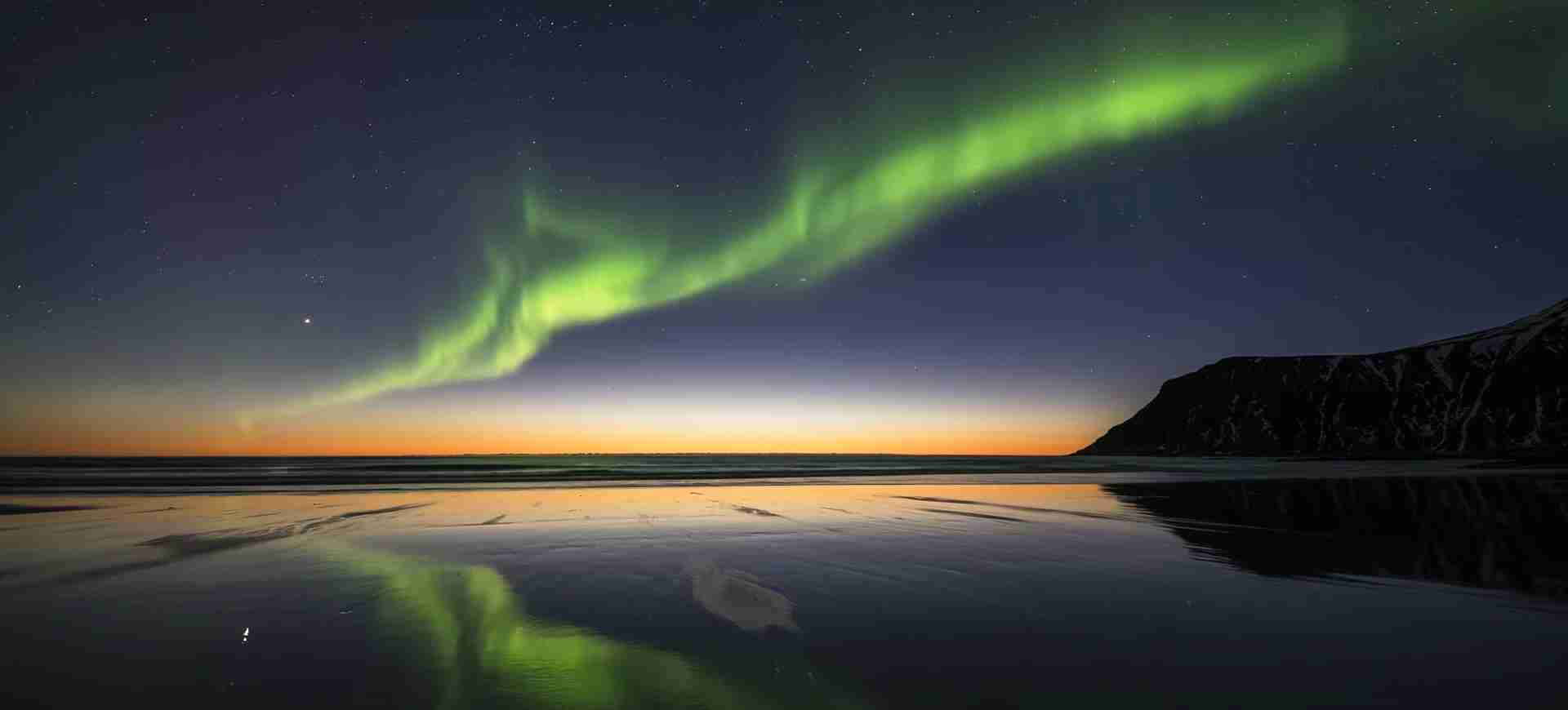
Northern Lights in Iceland: Complete Viewing Guide
Iceland’s position just south of the Arctic Circle creates exceptional conditions for viewing the Aurora Borealis, with the dancing curtains of green, pink, and violet light visible on clear nights from late August through mid-April. The country’s diverse landscapes—from black sand beaches to glacier lagoons—provide dramatic backdrops for one of nature’s most spectacular phenomena, while minimal light pollution in rural areas and accessible viewing locations make Iceland one of the world’s premier aurora destinations.
Key Takeaways
- Optimal Viewing Season: Northern Lights appear from late August/September through mid-April in Iceland, with peak darkness from November through January providing the longest viewing windows of 16-20 hours nightly.
- Solar Maximum Period: Solar Cycle 25 peaked in 2025 and continues elevated activity through 2026, producing stronger and more frequent auroras than the previous decade, with displays potentially visible at lower latitudes across southern Iceland.
- Location Requirements: Successful viewing requires three critical conditions—dark skies away from artificial light, clear weather with minimal cloud cover, and aurora activity of Kp 2 or higher on the geomagnetic index.
- Geographic Accessibility: Aurora viewing is possible throughout Iceland, from locations 40 minutes outside Reykjavík to remote wilderness areas in the Westfjords and North Iceland, with no need to travel to the Arctic Circle.
- Tour Options: Guided tours range from 8,500-12,000 ISK ($60-85) for standard bus tours to 18,000-30,000 ISK ($125-210) for specialized Super Jeep excursions, with the advantage of expert forecasting and flexible route adjustments based on real-time conditions.
- Self-Guided Advantages: Independent aurora hunting with a rental vehicle offers unlimited flexibility to chase clear skies, access to remote low-light locations, and budget advantages for groups, with 4×4 vehicles recommended for winter road conditions.
People Also Ask About Northern Lights in Iceland
What Causes the Northern Lights to Appear in Iceland?
The Northern Lights occur when electrically charged particles from solar wind collide with oxygen and nitrogen molecules in Earth’s upper atmosphere at altitudes of 60-250 kilometers. Solar flares eject clouds of charged particles that reach Earth within 2-3 days, drawn toward the magnetic poles by Earth’s magnetosphere. When these particles strike atmospheric gases, they transfer energy that releases as visible light—oxygen produces the characteristic green at lower altitudes (100-150 km) and rare red at higher altitudes (above 250 km), while nitrogen creates blue and purple hues. Iceland’s location at 64-66° North latitude places it directly beneath the auroral oval, the ring-shaped zone around the magnetic pole where aurora activity concentrates most intensely.
Can You See Northern Lights from Reykjavík?
Northern Lights are visible from Reykjavík during strong aurora activity of Kp 3 or higher, particularly in darker areas of the city like Grótta Lighthouse on the Seltjarnarnes peninsula and Perlan observation deck. Light pollution from Iceland’s capital significantly diminishes visibility compared to rural locations, and city viewing remains weather-dependent with the same clear-sky requirements as countryside locations. For optimal viewing, locations 40-60 minutes from Reykjavík such as Þingvellir National Park, Heiðmörk Nature Reserve, and Mount Esja provide substantially darker skies while remaining easily accessible. Most Reykjavík residents and experienced aurora hunters drive to these designated dark-sky areas rather than attempting city viewing, as even modest light pollution can obscure fainter auroral displays that would be spectacular in complete darkness.
What Is the Best Month to See Northern Lights in Iceland?
No single month guarantees optimal Northern Lights viewing, as success depends equally on dark hours, clear weather patterns, and solar activity rather than calendar date. November through January offers the longest darkness periods with only 4-5 hours of daylight, creating 19-20 hour viewing windows, but these midwinter months also bring Iceland’s stormiest weather with frequent cloud cover and precipitation. September-October and February-March provide an attractive balance—adequate darkness with 8-12 hour viewing windows combined with statistically more stable weather patterns and higher percentages of clear nights. The equinox months (September, March) historically show increased aurora frequency due to enhanced interaction between Earth’s magnetic field and solar wind during equinox alignment, making late September and early March particularly promising periods that combine reasonable darkness, improving weather, and geomagnetic activity spikes.
How Long Do Northern Lights Displays Last?
Northern Lights displays range from brief 15-30 minute appearances to sustained performances lasting 3-5 hours, with duration determined by the intensity and persistence of solar wind reaching Earth’s magnetosphere. Minor displays at Kp 2-3 often manifest as faint green arcs on the horizon that may brighten intermittently for 30-90 minutes before fading. Moderate activity at Kp 4-5 produces more dynamic displays with dancing curtains, coronas, and color variations lasting 2-4 hours with multiple peaks of intensity. Major geomagnetic storms at Kp 6+ can sustain brilliant, rapidly-moving auroras throughout the night with 5-8 hour displays, though these intense events occur only a few times per year even during solar maximum. The Aurora typically reaches peak visibility between 10:00 PM and 2:00 AM Iceland time, though activity can begin as early as 8:00 PM or continue past 4:00 AM during strong geomagnetic storms.
Extended multi-day tours – 5+ days
Featured Iceland Multi-Day Tour Packages
7 days
7 Day – Iceland Ring Road & Snæfellsnes Peninsula Small-Group Tour
- ✓ Comprehensive Iceland tour
- ✓ Expert local guides included
- ✓ All accommodation arranged
- ✓ Transportation provided
7 days
7-Day Small Group Journey Around Iceland with Premium Hotels
- ✓ Comprehensive Iceland tour
- ✓ Expert local guides included
- ✓ All accommodation arranged
- ✓ Transportation provided
5 days
5-Day Small Group Northern Lights Hunt & Glacier Lagoon Tour
- ✓ Comprehensive Iceland tour
- ✓ Expert local guides included
- ✓ All accommodation arranged
- ✓ Transportation provided
5 days
5 Days Land of Northern Lights
- ✓ Comprehensive Iceland tour
- ✓ Expert local guides included
- ✓ All accommodation arranged
- ✓ Transportation provided
Multi-day tour packages powered by TourRadar. Prices and availability subject to change.
Introduction
Standing beneath the Aurora Borealis as ribbons of green, purple, and pink light undulate across the Arctic sky represents one of Earth’s most humbling natural experiences. Iceland’s unique position at the southern edge of the auroral oval, combined with its accessible infrastructure and dramatic volcanic landscapes, has established the country as one of the world’s premier destinations for witnessing this celestial phenomenon. The Northern Lights occur year-round, but viewing requires the darkness of Iceland’s long winter nights, when the sun sets by 4:00 PM and doesn’t rise again until 11:00 AM, creating extended windows for aurora observation.
The science behind the aurora is as fascinating as the display itself. Solar flares eject massive clouds of charged particles—electrons and protons—that travel through space at speeds of 400-800 kilometers per second. When these particles encounter Earth’s magnetic field, they’re funneled toward the polar regions, where they collide with atmospheric gases and release energy as visible light. This cosmic dance between the sun and Earth’s magnetosphere creates displays that have inspired mythology, art, and scientific inquiry for millennia.
Iceland’s volcanic terrain provides dramatic foregrounds for aurora photography and viewing, from the iconic peak of Kirkjufell on the Snæfellsnes Peninsula to the ice-filled Jökulsárlón Glacier Lagoon in the southeast. Black sand beaches, frozen waterfalls, and geothermal pools add unique elements to the viewing experience, transforming aurora hunting into a comprehensive exploration of Iceland’s winter landscape. The country’s compact size and well-maintained Ring Road make multiple viewing locations accessible within a single trip, allowing aurora hunters to chase clear skies and optimal conditions across different regions.
Solar Cycle 25, which began in December 2019, reached its peak in mid-2025, creating exceptional conditions for aurora viewing that continue through 2026. During solar maximum, the sun produces more frequent and intense solar flares, resulting in stronger auroral displays that can extend to lower latitudes and produce more dramatic color variations. This current period represents the best aurora viewing opportunities since Solar Cycle 24’s peak in 2014, with scientists reporting increased sunspot activity and elevated probabilities of geomagnetic storms capable of generating vivid, widespread displays.
Successful aurora viewing in Iceland requires understanding the interplay of three critical factors: darkness, weather, and geomagnetic activity. Unlike destinations within the Arctic Circle that remain perpetually dark in winter, Iceland’s sub-Arctic latitude means aurora hunting must account for seasonal darkness variations and weather patterns that can change rapidly. This comprehensive guide examines the scientific foundations of aurora formation, optimal viewing strategies across Iceland’s diverse geography, practical considerations for both guided and independent aurora hunting, and the technical aspects of aurora forecasting and photography.
The Science Behind Aurora Borealis
Aurora Borealis begins 93 million miles away on the sun’s surface, where magnetic field disturbances create solar flares—massive eruptions that eject billions of tons of plasma into space at velocities reaching 800 kilometers per second. These coronal mass ejections (CMEs) carry electrically charged particles—primarily electrons and protons—along with embedded magnetic fields that interact with Earth’s protective magnetosphere. The journey from sun to Earth takes 2-3 days, during which space weather forecasters monitor the CME’s trajectory, speed, and magnetic orientation to predict potential auroral activity.
Earth’s magnetosphere acts as an invisible shield, deflecting most solar wind around the planet through magnetic field interactions. When a CME arrives with a southward-oriented magnetic field (opposite to Earth’s northward field), magnetic reconnection occurs—the two opposing fields merge and break apart, creating a gateway for solar particles to penetrate the magnetosphere. These particles accelerate down magnetic field lines toward the polar regions, concentrating their energy in ring-shaped zones called auroral ovals that circle the magnetic poles at latitudes of approximately 65-70 degrees.
The visible aurora manifests when accelerated particles collide with atmospheric gases at altitudes of 60-400 kilometers. Oxygen molecules struck by electrons at 100-150 kilometer altitudes emit the characteristic green light (wavelength 557.7 nanometers) that dominates most auroral displays. At higher altitudes above 250 kilometers, where oxygen is less dense, collisions produce rare red emissions (wavelength 630.0 nanometers) visible only during intense geomagnetic storms. Nitrogen contributes blue light (428 nanometers) and purple-red tones (particularly at lower altitudes below 100 kilometers), creating the multicolored displays that characterize strong auroral events.
The dynamic movement of auroras—curtains that wave, pulses that brighten and fade, coronas that radiate from overhead points—results from fluctuations in the solar wind’s density and magnetic field strength interacting with Earth’s magnetosphere. As solar wind pressure varies, the magnetosphere compresses and expands, altering the pathways available for particle precipitation. This creates the characteristic “dancing” quality of active auroras, where sheets of light ripple and fold like curtains in a breeze. The most dramatic displays occur during geomagnetic substorms, when magnetic field lines in Earth’s magnetotail suddenly reconfigure, releasing stored energy that accelerates particles toward the atmosphere in bursts that can illuminate the entire sky within minutes.
Iceland’s position at 64-66° North latitude places it at the southern edge of the typical auroral oval. During quiet geomagnetic periods (Kp 0-2), the oval contracts toward higher latitudes, making aurora viewing possible but not guaranteed from Iceland. When geomagnetic activity increases to Kp 3-4, the oval expands equatorward, positioning Iceland directly beneath the zone of maximum auroral intensity. During major geomagnetic storms at Kp 5 or higher, the auroral oval expands dramatically, sometimes extending as far south as Scotland and northern United States, while Iceland experiences overhead auroras with brilliant colors and rapid movements across the entire sky.
Understanding Iceland’s Northern Lights Season
Iceland’s Northern Lights season extends from late August through mid-April, determined by the astronomical requirement for dark skies rather than aurora occurrence—the phenomenon happens continuously year-round but remains invisible against daylight. The season’s boundaries reflect Iceland’s sub-Arctic latitude where summer brings midnight sun and winter delivers extended darkness, with the transition periods defining when viewing becomes possible.
Late August and early September mark the season’s beginning as darkness returns to Iceland’s night sky. Viewing windows remain limited initially—just 4-6 hours of adequate darkness—with sunset around 8:00 PM and sunrise at 5:00 AM. These early season weeks offer advantages beyond darkness duration: September weather patterns tend toward stability after summer, with clear night percentages higher than midwinter months, and the autumn equinox around September 22 correlates with increased aurora frequency as Earth’s magnetic field geometry enhances solar wind interaction. Temperatures remain moderate at 5-10°C (41-50°F), making outdoor viewing comfortable with standard cold-weather clothing.
October through February represents peak viewing season, with progressively longer darkness culminating in the winter solstice around December 21. November through January provides maximum darkness—the sun rises around 11:00 AM and sets by 4:00 PM, creating 19-20 hour viewing windows when any time between 5:00 PM and 10:00 AM offers potential aurora observation. This extended darkness increases the statistical probability of witnessing auroras during your visit, as you have more hours available to wait for the combination of clear skies and geomagnetic activity. However, these midwinter months also bring Iceland’s stormiest weather, with frequent low-pressure systems from the Atlantic delivering cloud cover, precipitation, and strong winds that can eliminate viewing opportunities for days at a time.
The practical reality of midwinter aurora hunting involves monitoring weather forecasts as carefully as aurora predictions. Cloud cover percentages become the critical variable—a Kp 5 geomagnetic storm produces spectacular auroras, but 100% cloud coverage renders them invisible. November typically delivers the best balance between darkness and weather, with daylight reduced to 5-6 hours but storm frequency not yet reaching January-February peaks. December brings maximum darkness and the festive appeal of aurora hunting during winter holidays, though cloud cover probability increases significantly.
February and March shift the balance back toward clearer weather as spring approaches. Darkness begins decreasing—sunset moves from 4:30 PM in early February to 7:00 PM by late March—but the remaining 10-14 hour viewing windows remain substantial. These late winter months offer statistical advantages in cloud-free nights, with high-pressure systems becoming more frequent and stable. The March equinox (around March 20) brings another period of enhanced aurora activity through geomagnetic field alignment, making mid-to-late March particularly attractive for combining adequate darkness with improving weather and equinox-related aurora frequency increases.
April marks the season’s gradual conclusion as lengthening days compress viewing windows to 6-8 hours. By mid-April, Iceland experiences only 4-5 hours of darkness deep enough for aurora observation, though viewing remains possible during geomagnetic storms until the midnight sun period begins in late May. Early April offers a unique combination—springtime weather with increasing clear sky probability, moderate temperatures above freezing, and sufficient darkness for committed aurora hunters willing to wait for late-night or early-morning hours.
Solar cycle timing profoundly influences aurora viewing success across all months. Solar Cycle 25’s peak in 2025, with sustained elevated activity through 2026, means aurora probability remains higher than during solar minimum years (2018-2020). During solar maximum, moderate Kp 3-4 conditions occur frequently rather than rarely, increasing the likelihood of witnessing auroras during any multi-day visit to Iceland. The enhanced solar activity partially compensates for Iceland’s position at the auroral oval’s southern edge, bringing displays that would require travel to higher latitudes during solar minimum years.
Prime Viewing Locations Across Iceland
Successful Northern Lights viewing in Iceland requires dark skies free from artificial light pollution, with the country’s sparse population and vast uninhabited areas providing numerous excellent locations within short distances of major settlements. Iceland’s compact size allows aurora hunters to access multiple regions during a single trip, chasing clear weather across different climatic zones when cloud cover affects one area.
Reykjavík Capital Region Access Points
Þingvellir National Park stands as the most accessible dark-sky location from Reykjavík, positioned 45 minutes northeast via Route 36. This UNESCO World Heritage Site offers the unique combination of aurora viewing and geological significance—the Mid-Atlantic Ridge rift valley creates open vistas with minimal obstructions, while the lack of nearby settlements eliminates light pollution. The Leirar Campground near the visitor center provides facilities and parking, with short walks to optimal viewing points overlooking Þingvallavatn lake. On clear nights, auroras reflect in the lake’s surface, doubling the visual impact. The site’s popularity means occasional crowding during peak season, but the expansive landscape provides ample space for positioning away from other viewers.
Grótta Lighthouse at Seltjarnarnes peninsula represents Reykjavík’s closest dark-sky option, located just 15 minutes from the city center. The rocky promontory extends into Faxaflói Bay, placing viewers at the edge of the Atlantic with unobstructed northern horizons. Light pollution from Reykjavík affects the southern sky, but aurora displays to the north and west remain clearly visible during moderate activity. The site requires tidal awareness—high tides can submerge the causeway connecting the lighthouse to shore, potentially trapping visitors for several hours. Check tide tables before visiting and allow retreat time before high tide peaks.
Heiðmörk Nature Reserve provides extensive dark areas within 30 minutes of Reykjavík, with 3,000 hectares of lava fields, forests, and open spaces. The reserve’s lava formations create interesting foreground elements for photography, while designated parking areas at Rauðhólar and Elliðavatn lake offer starting points for short walks to viewing locations. The reserve attracts local residents for aurora watching, creating an informal community atmosphere with shared enthusiasm when displays appear.
Mount Esja, the dramatic peak visible from Reykjavík, offers elevated viewing positions 30 minutes from the capital via Route 1 and Esjarvegur road. The mountain’s base parking areas provide dark skies with expansive views across Faxaflói Bay and the Reykjanes Peninsula. Winter access requires caution as parking areas may be snow-covered or icy, and the mountain’s elevation creates stronger winds than coastal locations.
South Coast Spectacular Backdrops
Reynisfjara black sand beach near Vík creates one of Iceland’s most photogenic aurora locations, where the Northern Lights appear above basalt sea stacks and hexagonal columnar formations. The beach sits 180 kilometers from Reykjavík via Route 1, requiring 2.5 hours of driving, making it suitable for dedicated aurora hunters or those combining viewing with multi-day South Coast exploration. The North Atlantic’s power manifests in sneaker waves that can sweep across the beach unexpectedly—maintain safe distances from the waterline and never turn your back to the ocean. The village of Vík (population 300) provides minimal light pollution while offering emergency services and facilities.
Jökulsárlón Glacier Lagoon presents Iceland’s most iconic aurora backdrop, with icebergs floating in the lagoon reflecting auroral light while Vatnajökull glacier provides a massive white canvas. Located 380 kilometers from Reykjavík (5-hour drive), this location suits multi-day tours or visitors based in Southeast Iceland. The adjacent Diamond Beach, where icebergs wash onto black sand, offers alternative compositions. Winter access requires awareness of changing ice conditions and potentially limited parking areas due to snow accumulation.
Skógafoss and Seljalandsfoss waterfalls, positioned 155 and 120 kilometers from Reykjavík respectively, combine aurora viewing with Iceland’s famous cascades. Both sites feature parking areas with restroom facilities and minimal light pollution from nearby farmsteads. Seljalandsfoss allows walking behind the waterfall curtain (weather and ice conditions permitting), creating unique composition opportunities with auroras framed by the water’s arc. Spray from both waterfalls can coat camera equipment with moisture—protect gear appropriately.
Snæfellsnes Peninsula Diverse Terrain
Kirkjufell mountain and Kirkjufellsfoss waterfall create Iceland’s most photographed aurora location, where the distinctive pointed peak serves as a foreground element in countless iconic images. The site lies 175 kilometers from Reykjavík via Route 1 and Route 54, requiring 2.5 hours of driving to reach Grundarfjörður town. Designated parking and viewing areas accommodate the location’s popularity, with clear sight lines to position tripods for the classic composition. The mountain’s north-facing orientation means auroras appear overhead and behind the peak during typical displays, though strong activity at Kp 4+ produces light across the entire sky.
Búðir black church on Snæfellsnes’ southern coast combines architectural elements with dark skies, positioned on a remote lava field facing Faxaflói Bay. The stark black church against lava rock creates dramatic foreground interest for aurora photography, while the isolation ensures complete darkness. The site requires navigating unpaved roads that may be challenging in winter conditions—4×4 vehicles recommended.
Djúpalónssandur beach on Snæfellsnes’ western tip provides volcanic shoreline aurora viewing with the Atlantic as backdrop. The beach’s isolation and western orientation offer unobstructed horizons, though accessing the beach requires careful navigation of winter trails across lava fields. Snæfellsjökull glacier, when visible, adds dramatic terrain to northern sky displays.
North Iceland Extended Darkness
Lake Mývatn region in North Iceland combines extensive dark skies with unique geothermal landscapes, positioned 480 kilometers from Reykjavík (5.5-hour drive via Route 1). The area’s volcanic craters, lava formations, and geothermal vents create varied foreground options for photography, while the lake’s 37-square-kilometer surface provides reflection opportunities during calm conditions. The village of Reykjahlíð (population 500) offers minimal light pollution while providing accommodation and services. North Iceland’s higher latitude places the region closer to the auroral oval’s typical position, marginally increasing aurora frequency compared to South Iceland during quiet geomagnetic periods.
Akureyri, Iceland’s northern capital (population 19,000), serves as a base for aurora viewing in North Iceland, though the town itself generates light pollution requiring travel to surrounding areas. Locations 15-20 minutes outside Akureyri along fjord roads provide dark skies with mountain backdrops. The city’s northern position delivers slightly longer winter darkness—up to 21 hours during the solstice period—and proximity to the auroral oval.
Westfjords Remote Wilderness
The Westfjords region offers Iceland’s most remote aurora viewing, with minimal population and virtually zero light pollution across vast uninhabited areas. Ísafjörður, the region’s largest town (population 2,600), provides access to surrounding fjords where aurora displays occur against dramatic cliff faces and mountain peaks. The region’s isolation means limited tourism infrastructure—visitors must be self-sufficient with fuel, food, and accommodation planned in advance. Winter road conditions in Westfjords can be severe, with mountain passes subject to closure and avalanche risk in certain areas. The rewards include complete solitude and pristine dark skies that reveal not only auroras but also exceptional star fields during aurora-free intervals.
The advantage of Westfjords’ remote location manifests during widespread poor weather—when South Iceland experiences cloud cover from Atlantic storms, Westfjords’ unique positioning can create localized clear-sky pockets. Experienced aurora hunters monitor weather patterns across regions, sometimes driving to Westfjords specifically to escape cloud systems affecting more populous areas.
Forecasting and Aurora Activity Monitoring
Successful aurora viewing requires monitoring three distinct forecast elements: aurora activity (geomagnetic conditions), cloud cover (weather), and moon phase (natural light pollution). The intersection of favorable conditions across all three elements determines actual viewing success, transforming aurora hunting from passive hoping to active pursuit based on predictive data.
The Kp index measures global geomagnetic activity on a 0-9 scale, quantifying the impact of solar wind on Earth’s magnetic field. The index derives from measurements at magnetic observatories worldwide, with values updated every three hours and forecasts extending 1-3 days ahead. For Iceland aurora viewing, Kp 2 represents the minimum threshold where auroras become visible under ideal dark-sky conditions—displays at this level typically manifest as faint green arcs on the northern horizon. Kp 3 produces clearly visible auroras with brighter green bands and occasional movement, making this the practical minimum for reliable viewing. Kp 4-5 generates active displays with dancing curtains, color variations including pink and purple, and auroras extending across more of the sky. Kp 6+ indicates major geomagnetic storms with brilliant overhead auroras, rapid movements, and displays potentially visible from lower latitudes far beyond Iceland.
The Icelandic Met Office (Veðurstofa Íslands) provides aurora forecasts specific to Iceland at en.vedur.is/weather/forecasts/aurora, displaying predicted activity levels on a 0-9 scale corresponding to Kp values and overlaying cloud cover forecasts on the same map. This integrated tool allows simultaneous evaluation of aurora activity and cloud coverage across Iceland’s regions, enabling strategic location selection. Green zones on the forecast indicate areas with predicted aurora visibility and clear skies—the intersection of favorable conditions—while cloud symbols show where weather will block viewing regardless of geomagnetic activity.
Cloud cover forecasts require equal attention to aurora predictions, as even Kp 7 geomagnetic storms remain invisible beneath complete cloud coverage. The Icelandic Met Office’s cloud forecast tool at en.vedur.is/weather/forecasts/areas displays predicted cloud coverage percentages in three-hour intervals extending two days ahead, with regional breakdowns showing which areas of Iceland expect clear conditions. Aurora hunters use this tool to identify clear-sky windows—periods when specific regions predict 0-30% cloud coverage—then cross-reference with aurora forecasts to find optimal viewing opportunities. Mobile aurora hunting involves checking forecasts hourly and driving toward regions predicting the combination of aurora activity and clear skies, sometimes traveling 100-200 kilometers to escape cloud systems.
The “My Aurora Forecast” smartphone application (available for iOS and Android) provides real-time aurora predictions with push notifications when conditions improve, Kp index displays, and cloud coverage integration. The app’s “ovation aurora forecast” shows the auroral oval’s predicted position and intensity, helping viewers understand whether Iceland falls within the primary viewing zone. During quiet periods at Kp 0-2, Iceland sits at the oval’s southern edge with reduced aurora probability; when activity increases to Kp 3+, Iceland moves beneath the oval’s center where displays are brightest and most active.
SolarHam (solarham.net) provides three-day geomagnetic forecasts based on solar wind data from spacecraft positioned between Earth and the Sun, offering advance warning of incoming coronal mass ejections. Serious aurora hunters monitor SolarHam for alerts of solar flares and CME trajectories, allowing planning 2-3 days before aurora storms arrive. The website’s real-time solar wind data shows current particle density, speed, and magnetic field orientation—the critical factors determining geomagnetic activity levels when solar wind reaches Earth.
Moon phase significantly affects aurora visibility through natural light pollution. Full moon periods illuminate the landscape and sky, reducing contrast between auroras and background sky glow—displays at Kp 2-3 may become imperceptible under bright moonlight that would be clearly visible during new moon darkness. New moon periods (when the moon is invisible) provide optimal viewing conditions, with auroras displaying maximum contrast against completely dark skies. The Aurora Forecast app includes moon phase information, allowing coordination of trips around new moon periods when possible. However, bright auroras at Kp 4+ remain clearly visible regardless of moon phase, and moonlight offers the advantage of illuminating landscape foregrounds for photography without requiring additional lighting.
Forecast accuracy decreases with time range—24-hour forecasts show reasonable reliability, while 3-day forecasts provide general trends rather than precise predictions. Aurora activity can change rapidly when unexpected solar events occur, and local weather patterns in Iceland shift quickly as Arctic and Atlantic air masses collide. Successful aurora hunting requires flexibility to respond to improving forecasts, willingness to wait through variable conditions, and patience when predictions don’t materialize as expected.
Guided Tours vs Self-Guided Viewing
Northern Lights viewing in Iceland presents two distinct approaches: joining guided tours or independently hunting auroras with rental vehicle and self-planned logistics. Each method offers specific advantages and limitations that suit different travel styles, budgets, and experience levels.
Guided Tour Advantages and Tour Types
Professional aurora guides bring expertise in forecast interpretation, local knowledge of viewing locations, and real-time decision-making that significantly increases success probability compared to inexperienced independent viewers. Guide services monitor aurora and weather forecasts continuously, adjusting routes dynamically to chase clear-sky pockets when cloud coverage affects planned destinations. This adaptive routing proves particularly valuable during marginal conditions when the difference between success and failure involves driving to alternative regions based on forecast updates received during the tour.
Standard shared minibus tours accommodate 15-19 passengers in heated vehicles, departing Reykjavík between 8:00 PM and 9:00 PM for 4-5 hour excursions to dark-sky locations within 60-100 kilometers of the capital. These tours cost 8,500-12,000 ISK ($60-85) per person, typically including hotel pickup/dropoff, hot chocolate, blankets, and basic photography assistance. The tours visit locations like Þingvellir, Heiðmörk, or Reykjanes Peninsula depending on forecast conditions, with guides selecting sites offering the best combination of accessibility and viewing probability. Most operators offer free rebooking if auroras don’t appear, allowing rescheduling for another night during your stay.
Small-group tours limit capacity to 8-12 participants, providing more personalized guidance and increased flexibility compared to larger groups. Pricing ranges from 12,000-18,000 ISK ($85-125) per person, with the premium justified by higher guide-to-participant ratios, ability to accommodate specific photography needs, and willingness to extend tours when auroras are active. Smaller groups can access certain locations where parking limits larger buses, and the intimate setting allows detailed explanations of aurora science and photography techniques.
Super Jeep tours utilize modified 4×4 vehicles with elevated ground clearance and off-road capability, accessing remote highland areas and mountain locations unavailable to standard vehicles. These specialized tours cost 18,000-30,000 ISK ($125-210) per person for shared departures, or 150,000+ ISK ($1,050+) for private vehicle bookings accommodating 4-6 passengers. The super jeep advantage manifests during winter when snow coverage limits access to certain prime viewing locations—the vehicles can reach elevated vantage points and isolated dark-sky areas that provide both superior viewing conditions and dramatic landscapes for photography. The smaller group sizes (maximum 6-8 passengers) create flexibility for adjusting schedules based on aurora intensity and participant preferences.
Private tours eliminate group dynamics entirely, offering completely customized itineraries with dedicated guide and vehicle. Pricing begins around 150,000 ISK ($1,050) for 4-5 hour tours accommodating up to 6 people, making private tours economically competitive for groups of 4+ when compared to individual tickets on standard tours. Private tours allow extended viewing when auroras are active—rather than adhering to scheduled return times, the tour continues as long as displays warrant and clients desire. Photographers particularly value private tours for the ability to request specific locations and shooting durations without coordinating with other passengers.
Combination tours merge Northern Lights hunting with daytime activities like Golden Circle sightseeing, South Coast waterfalls, or glacier experiences, creating full-day packages of 12-16 hours that conclude with evening aurora viewing. These intensive tours suit travelers with limited time in Iceland who want to maximize experience density, though the long duration can be exhausting and may compromise aurora viewing if weather deteriorates by evening.
Self-Guided Independent Viewing
Renting a vehicle and pursuing auroras independently offers unlimited flexibility, budget advantages for groups, and complete control over viewing duration and location selection. The approach requires more planning, weather monitoring capability, and willingness to navigate winter driving conditions, but rewards with the freedom to extend viewing indefinitely when auroras appear and to explore multiple locations across Iceland during a multi-day trip.
4×4 vehicles are strongly recommended for winter aurora hunting, providing necessary traction on icy roads, capability to access unpaved parking areas at remote locations, and safety margins when weather deteriorates. Winter rental rates for 4×4 vehicles range from 12,000-18,000 ISK ($85-125) per day with basic insurance, making the per-person cost economical for groups of 3-4 travelers compared to individual tour tickets. Two-wheel-drive vehicles can access many locations in favorable conditions, but ice accumulation and snow coverage on access roads can render certain prime viewing locations inaccessible or unsafe.
Independent viewing requires self-education in forecast interpretation, with the same Icelandic Met Office and Aurora Forecast tools available to tour guides accessible to all visitors. The learning curve is modest—understanding Kp index basics, cloud coverage map reading, and aurora oval positioning requires perhaps an hour of research before departure. Real-time decision-making during your visit involves checking forecasts at 5:00 PM daily, identifying regions predicting clear skies and Kp 2+ activity, then driving to the selected area for evening viewing.
Safety considerations for independent viewing include winter driving skills, roadside assistance coverage (included with most rental insurance packages), carrying emergency supplies (food, water, blankets, flashlight), and notifying accommodation staff of planned locations and expected return times. Iceland’s entire Ring Road and most major routes receive regular winter maintenance, but secondary roads to certain viewing locations may have ice accumulation or snow packing. The Icelandic Road and Coastal Administration (road.is) provides real-time road condition reports showing which routes are clear, icy, or closed.
The independent approach allows unlimited viewing duration—when auroras appear at 11:00 PM and remain active until 3:00 AM, independent viewers can stay for the entire display rather than adhering to tour schedules. This flexibility proves particularly valuable during Kp 4+ events when auroras build in intensity throughout the night, with peak activity often occurring between midnight and 2:00 AM. Tour buses typically return to Reykjavík by midnight or 1:00 AM regardless of aurora activity, while independent viewers can continue observing as long as displays warrant.
Budget comparison for a group of 4 people on a 3-night Iceland trip demonstrates independent viewing’s economic advantage: 4×4 rental for 3 days at 15,000 ISK ($105) daily = 45,000 ISK ($315) total, dividing to 11,250 ISK ($79) per person. Standard aurora tours at approximately 10,000 ISK ($70) per person per night across 3 nights total 30,000 ISK ($210) per person, or 120,000 ISK ($840) for all 4 people. The vehicle rental includes unlimited aurora hunting attempts across all three nights plus transportation for all daytime activities, while tour tickets cover single evening departures only. Fuel costs add approximately 3,000-5,000 ISK ($21-35) per person for a 3-night trip, bringing total independent costs to approximately 14,250-16,250 ISK ($100-115) per person versus 30,000 ISK ($210) per person for tours—a savings of approximately 45-50%.
Accommodation Strategies for Aurora Hunters
Accommodation selection for Northern Lights viewing in Iceland involves strategic decisions balancing budget, location, and amenities designed specifically for aurora hunting. The choice between Reykjavík-based lodging with daily tours versus countryside accommodation positioned in dark-sky areas fundamentally affects viewing probability and experience quality.
Reykjavík accommodation offers maximum diversity in lodging types, dining options, and urban conveniences, with prices ranging from 6,000 ISK ($42) for hostel dormitories to 30,000+ ISK ($210+) for upscale hotels. The capital location requires driving or joining tours to reach dark-sky viewing areas, adding 40-90 minutes of travel time each direction. This approach suits travelers prioritizing urban exploration and cultural activities during daytime, using Reykjavík as a base for evening aurora excursions. Accommodation proximity to tour pickup points and rental car agencies provides logistical convenience for daily departures.
Countryside hotels and guesthouses positioned in or near prime viewing locations eliminate travel time to dark skies, allowing aurora viewing directly from accommodation grounds or within minutes of lodging. Properties like Hotel Rangá near Hella (South Iceland), Hotel Húsafell in West Iceland, and hotels around Lake Mývatn specifically cater to aurora hunters with features including aurora wake-up services, rooftop observatories, outdoor viewing areas with heated shelters, and rooms with north-facing windows. Rates at these specialized properties range from 25,000-50,000 ISK ($175-350) per room nightly, reflecting both location advantages and premium amenities.
Aurora wake-up services offered by certain countryside hotels involve staff monitoring aurora forecasts and actually waking guests via phone call when Northern Lights appear, ensuring visitors don’t miss displays occurring while asleep. This service proves particularly valuable given aurora activity’s unpredictability—displays can begin at 8:00 PM or 2:00 AM with equal probability. Hotels maintaining 24-hour reception can provide wake-up calls throughout the night, while properties with automated aurora alert systems trigger room notifications when activity reaches predetermined thresholds.
Glass-roofed accommodations and aurora domes represent specialized lodging designed for viewing directly from bed, with transparent ceilings providing overhead views of the night sky. Panorama Glass Lodge near Hveragerði offers individual glass cabins with heated floors and hot tubs, positioning guests in dark-sky locations with complete comfort. Rates for glass accommodations typically range from 40,000-80,000 ISK ($280-560) per night, justified for travelers prioritizing the aurora experience above all other considerations. The benefit lies in continuous aurora monitoring without leaving bed—light sleepers can maintain awareness of sky conditions throughout the night, responding immediately when auroras appear.
Cabin and cottage rentals through platforms like Airbnb and Bókun provide self-catering accommodation in countryside locations, combining dark-sky access with budget advantages for groups and extended stays. A 2-bedroom cottage in South Iceland positioned 60-90 minutes from Reykjavík costs approximately 15,000-25,000 ISK ($105-175) nightly, sleeping 4-6 people for per-person costs competitive with hostel dormitories while providing privacy and location advantages. Self-catering capabilities reduce dining expenses significantly compared to restaurant meals, particularly relevant during multi-day stays focused on aurora hunting.
Strategic accommodation distribution across a multi-day trip allows experiencing different regions while optimizing aurora hunting potential. A sample 5-night itinerary might allocate 2 nights in Reykjavík for arrival/departure convenience and urban exploration, 2 nights in South Iceland countryside for Jökulsárlón and Vík area aurora hunting, and 1 night at Snæfellsnes Peninsula for Kirkjufell viewing. This distribution balances convenience, cost management, and geographic diversity while positioning viewers in different weather zones—if South Iceland experiences cloud cover, Snæfellsnes may offer clear skies due to different climatic influences.
Booking timing affects both availability and pricing, with Iceland’s winter season (September-April) seeing high demand for countryside accommodation near prime viewing areas. Properties offering aurora-specific amenities book 2-3 months in advance during peak periods (December-January, February-March), while shoulder season months (September-October, late March-April) often show availability with 2-4 weeks notice. Flexible booking policies allowing free cancellation provide insurance against weather forecast predictions indicating sustained poor conditions during your planned dates.
Photography Techniques and Equipment
Capturing Northern Lights photographically requires understanding the technical challenges of low-light photography, appropriate equipment selection, and field techniques for composing dynamic images that convey the aurora’s visual impact. While modern smartphones can photograph bright auroras, dedicated cameras with manual controls produce superior results across varying aurora intensities and lighting conditions.
Camera body selection prioritizes manual control capabilities and low-light sensor performance. Full-frame DSLR or mirrorless cameras offer larger sensors that capture more light, producing cleaner images at high ISO settings required for aurora photography. Cameras like Canon EOS R6, Nikon Z6 II, or Sony A7 III provide excellent results, though entry-level APS-C sensor cameras (Canon EOS Rebel series, Nikon D5600, Sony A6400) remain capable when used correctly. The critical requirement is manual mode capability allowing independent control of aperture, shutter speed, and ISO—cameras limited to automatic modes cannot reliably photograph auroras.
Lens selection emphasizes wide aperture (f/2.8 or wider) and wide angle (14-24mm full-frame equivalent) to maximize light gathering and capture expansive aurora displays. Prime lenses at 14mm, 20mm, or 24mm with f/1.4-2.0 apertures provide optimal performance, collecting maximum light for shorter exposures and lower ISO settings that reduce image noise. Zoom lenses like 14-24mm f/2.8 or 16-35mm f/2.8 offer compositional flexibility at modest cost in maximum aperture. Budget alternatives include manual focus lenses like Rokinon/Samyang 14mm f/2.8 or 24mm f/1.4, providing excellent optical quality at significantly lower prices than manufacturer lenses, with the tradeoff of manual focus operation that proves less important for aurora photography’s infinity focus requirements.
Sturdy tripods are non-negotiable for aurora photography’s exposure durations of 5-20 seconds, with vibration or movement during exposure creating blur that destroys image sharpness. Tripods must withstand wind conditions common during Iceland winter nights—lightweight travel tripods adequate for daytime photography may vibrate in 20-30 km/h winds, while heavier tripods with hook provisions for hanging weight (camera bag) from the center column provide necessary stability. Carbon fiber tripods offer strength-to-weight advantages over aluminum alternatives, though at significantly higher cost.
Camera settings for aurora photography begin with fully manual (M) mode operation. Aperture opens to the lens’s widest setting (f/1.4, f/2.0, or f/2.8) to maximize light collection. ISO settings of 1600-3200 balance sensitivity with noise control—higher ISOs capture fainter auroras but introduce grain, while lower ISOs produce cleaner images but may miss subtle displays. Shutter speed ranges from 5-15 seconds depending on aurora brightness and movement: bright, active auroras at Kp 4+ may blur with exposures exceeding 8 seconds as the aurora moves during exposure, while faint displays at Kp 2 require 15-20 second exposures to register adequately. The test-and-adjust approach involves taking initial exposures at 8 seconds/f/2.8/ISO 2000, reviewing the result, then adjusting ISO or shutter speed to achieve proper exposure without excessive noise or blur.
Focus demands precision at infinity, with aurora photographers using manual focus to avoid autofocus struggles in darkness. The technique involves focusing on a distant light (star, distant building, far horizon feature) in live view mode with 10x magnification, adjusting focus until the point appears smallest and sharpest, then locking focus and not adjusting again during the shoot. Some photographers use focus stacking techniques where an earlier daytime infinity focus mark on the lens provides a reference point for nighttime setup. Focus errors manifest as softness throughout the image, as the aurora and stars both reside at effective optical infinity.
Composition strategies balance aurora display with landscape foreground elements that provide context and visual interest. Iconic Icelandic features like Kirkjufell mountain, Jökulsárlón icebergs, or Reynisfjara sea stacks create recognizable subjects that anchor compositions. The rule of thirds applies—placing horizons at the lower third of the frame devotes two-thirds to sky, appropriate when auroras fill the overhead area, while horizons at the upper third emphasize foreground elements with aurora as backdrop. Reflections in calm water double the aurora’s visual presence, with locations like Þingvallavatn lake or quiet coastal areas providing mirror surfaces on wind-free nights.
Exposure adjustment for foreground illumination involves several approaches. Moonlight naturally illuminates landscapes during half-moon to full-moon phases, providing soft, even lighting that allows single exposures capturing both aurora and landscape detail. Headlamp or flashlight “light painting” during exposure involves briefly illuminating foreground elements during the 8-15 second exposure, adding detail to shadow areas. This technique requires practice to avoid overexposure or unnatural lighting effects. Exposure blending in post-processing combines a longer exposure optimized for landscape foreground with shorter exposure for aurora, merged digitally to maintain detail in both areas.
Smartphone photography has improved dramatically with computational photography advances in recent models. iPhone 13 Pro and later, Samsung Galaxy S21 and later, and Google Pixel 6 and later can photograph bright auroras at Kp 3+ using night mode features. Results lack the dynamic range and detail of dedicated cameras, and smartphones struggle with faint auroras at Kp 2, but the convenience of having a capable camera always available makes smartphones valuable for backup documentation. The technique involves using night mode, stabilizing the phone against a rock or tripod, and allowing the 3-10 second exposure to complete without movement.
Battery management becomes critical in Iceland’s winter cold, where lithium batteries rapidly lose capacity at temperatures below 0°C. Photographers carry 3-4 spare batteries kept warm in inner jacket pockets, rotating batteries as depletion occurs and returning depleted batteries to warm pockets where they may recover partial capacity. Some photographers use external battery warmers or USB-powered heating elements attached to camera battery grips, maintaining battery temperature above the threshold where capacity drops precipitously.
Cultural and Historical Significance
Iceland’s relationship with the Northern Lights extends beyond contemporary tourism into the realm of folklore, mythology, and cultural identity. The aurora borealis has influenced Icelandic storytelling, art, and spiritual beliefs since the island’s settlement in the 9th century, creating layers of cultural meaning that enrich the viewing experience for visitors interested in how human communities have interpreted this phenomenon across millennia.
Norse mythology associated the Northern Lights with Bifröst, the rainbow bridge connecting Midgard (Earth) to Asgard (realm of the gods), with the aurora’s shimmering colors representing the bridge’s construction from fire, water, and air. Some Icelandic folklore interpreted the lights as reflections from the shields and armor of Valkyries—the female figures who selected warriors fallen in battle for transport to Valhalla. These warrior maidens rode across the night sky on horseback, their polished armor catching moonlight and creating the dancing curtains of light visible from Earth below.
Another strand of Icelandic tradition viewed the Northern Lights as supernatural manifestations connected to childbirth and mortality. Pregnant women were advised to avoid looking directly at auroras, as folklore suggested this could cause children to be born cross-eyed or with other afflictions. The lights were sometimes interpreted as souls of the departed ascending to the afterlife, creating an association between aurora activity and recent deaths in communities. These beliefs reflected pre-scientific attempts to explain an unpredictable phenomenon through frameworks of existing spiritual and cosmological understanding.
Icelandic artists and writers have drawn inspiration from aurora displays throughout the nation’s cultural history. The aurora appears in medieval sagas and poetry, often as portents of significant events or symbols of divine intervention. Contemporary Icelandic literature continues this tradition, with authors incorporating aurora imagery as metaphors for transformation, transcendence, or the intersection of natural and supernatural realms. Visual artists working in Iceland frequently feature aurora motifs, attempting to capture the phenomenon’s ephemeral beauty and the emotion it evokes in viewers.
The scientific understanding of auroras gradually replaced supernatural explanations in Iceland as elsewhere, with early systematic observations beginning in the 18th century. Icelandic scholars contributed to aurora science through detailed records of display frequency, intensity, and appearance, creating historical data sets that modern researchers use to understand long-term solar activity patterns. The Aurora Research Center at the University of Iceland continues this tradition, conducting research on aurora physics, magnetosphere dynamics, and space weather prediction that benefits both scientific understanding and practical applications like power grid protection from geomagnetic storm effects.
Modern Icelandic culture maintains a nuanced relationship with auroras, balancing scientific literacy with appreciation for the aesthetic and emotional impact of displays. The aurora appears in contemporary Icelandic design, tourism marketing, and national identity expressions, serving as a symbol of the country’s Arctic character and natural heritage. Local residents often speak of never tiring of aurora displays despite seeing them regularly throughout life, describing renewed wonder each time the lights appear—a testament to the phenomenon’s power to evoke response beyond mere scientific understanding.
Safety and Practical Considerations
Northern Lights hunting in Iceland’s winter landscape requires attention to safety factors beyond typical sightseeing activities, as viewing occurs during nighttime hours in potentially remote locations under challenging weather conditions. Preparation and awareness transform potentially hazardous situations into manageable elements of the aurora hunting experience.
Winter driving in Iceland demands skills and caution, with road conditions varying from perfectly maintained asphalt on Route 1 to ice-covered secondary routes where traction disappears entirely. Black ice—transparent ice layers on asphalt that appear as wet pavement—poses particular danger, as drivers don’t recognize the hazard until traction loss occurs. Speed reduction to 40-60 km/h on routes showing ice coverage or recent precipitation provides safety margins for avoiding loss of control. 4×4 vehicles require the same caution as 2WD vehicles on ice—four-wheel-drive improves acceleration but provides no advantage in braking or cornering where physics governs traction limits.
The Icelandic Road and Coastal Administration’s real-time road condition map at road.is displays current status of all major routes with color coding: green indicates clear conditions, yellow shows ice or snow accumulation, orange warns of difficult driving requiring winter experience, and red indicates closure or impassable conditions. Checking this resource before departing for evening aurora viewing prevents situations where viewers drive toward locations on routes that have deteriorated into dangerous conditions. Winter storms can close mountain passes within hours, potentially trapping vehicles in locations where rescue may not arrive until conditions improve.
Weather in Iceland changes rapidly and dramatically, with clear skies transitioning to blizzard conditions in 20-30 minutes as Arctic fronts sweep across the landscape. Aurora hunters must monitor short-term weather forecasts throughout viewing sessions, prepared to retreat if conditions deteriorate beyond safe levels. Wind speed becomes the critical factor—winds exceeding 15-20 meters per second (35-45 mph) create dangerous exposure risk in sub-zero temperatures, where windchill can drop effective temperatures to levels causing frostbite in exposed skin within minutes.
Clothing for aurora viewing requires layered insulation capable of maintaining comfort during stationary outdoor periods lasting 1-3 hours. Base layers of merino wool or synthetic moisture-wicking fabrics provide foundation warmth, mid-layers of fleece or down insulation trap body heat, and outer layers of waterproof, windproof shells protect against precipitation and wind penetration. Icelandic winters average -2°C to 4°C (28°F to 39°F) in coastal areas, but windchill and radiative cooling under clear skies can create effective temperatures well below freezing. Head, hands, and feet require particular attention—wool or fleece hats covering ears, insulated gloves (photographers often use fingerless gloves with removable mittens for camera operation), and waterproof winter boots rated for sub-zero temperatures prevent heat loss from extremities where frostbite risk concentrates.
Emergency equipment for independent aurora hunting includes fully charged mobile phone with local emergency number (112 in Iceland) saved, portable battery pack for device charging, flashlight or headlamp with spare batteries, emergency blanket or sleeping bag in vehicle, food and water for unexpected delays, and first aid kit with basic supplies. The combination of darkness, potentially remote locations, and winter conditions creates scenarios where vehicle problems or wrong turns can evolve into emergency situations. Informing accommodation staff of planned viewing locations and expected return times provides safety redundancy if you fail to return as scheduled.
Mobile phone coverage in Iceland extends across populated areas and along major routes including most of the Ring Road, but remote locations may have intermittent or absent signal. Testing signal strength at viewing locations upon arrival confirms communication capability if assistance becomes necessary. Some aurora hunting locations deliberately chosen for isolation and darkness may lack coverage entirely—in these situations, viewers must be completely self-sufficient with contingency plans for vehicle issues or medical situations.
Altitude considerations affect certain viewing locations, particularly in highland areas or mountain positions accessible by super jeep. Elevations above 500-800 meters can have temperatures 5-10°C colder than coastal areas, with increased wind exposure due to topographic effects. The benefits of elevated viewing positions—clearer atmospheres and expansive horizons—must be weighed against harsher conditions requiring additional cold-weather protection.
Solo aurora hunting carries inherent risks that couples or groups don’t face, with no backup if vehicle problems, injury, or disorientation occurs. Solo viewers should bias strongly toward well-traveled locations with some level of regular traffic, carry comprehensive emergency equipment, maintain rigorous communication schedules with accommodation contacts, and consider joining guided tours rather than attempting remote locations alone. The aurora’s appeal justifies significant effort and some discomfort, but should never override basic safety judgment about personal limits and conditions beyond safe management.
Maximizing Success During Your Visit
Northern Lights viewing success in Iceland involves strategic planning that extends beyond simply being present during winter months, requiring optimization of trip duration, schedule flexibility, and expectation management around the phenomenon’s inherent unpredictability.
Trip duration significantly influences success probability through simple statistics—each additional night in Iceland provides another opportunity to encounter the combination of clear skies and aurora activity. A 3-night visit offers three chances to experience favorable conditions, while a 7-night visit doubles opportunities and increases likelihood of encountering at least one exceptional display. Historical data suggests approximately 30-40% of winter nights in Iceland offer at least Kp 2+ aurora activity with sufficient clear sky patches for viewing, meaning 3 nights provides roughly 60-70% probability of at least one successful viewing, while 5-7 nights approaches 85-90% probability. These probabilities assume willingness to chase clear skies across regions rather than remaining stationary if weather conditions deteriorate in one area.
Schedule flexibility within each day allows responding to forecast improvements that emerge as viewing time approaches. Aurora forecasts update throughout afternoon and evening, with 6:00 PM predictions often more accurate than noon forecasts as real-time solar wind data reaches Earth from sun-monitoring spacecraft. Maintaining open evening schedules without rigid dinner reservations or fixed-time commitments enables departure for viewing as soon as forecasts indicate improving conditions. The most memorable aurora displays often occur with minimal advance notice—a forecast upgrading from Kp 2 to Kp 4 between 5:00 PM and 7:00 PM based on incoming solar wind measurements may trigger spectacular displays by 9:00 PM, rewarding viewers who monitor forecasts actively and respond quickly.
Multiple attempts prove essential given weather’s central role in viewing success. Cloud coverage can obscure auroras completely even during major geomagnetic storms, requiring patience to wait for clear-sky windows. Aurora hunters treating viewing as the primary trip objective often attempt viewing 5-6 nights consecutively rather than assuming success will occur on any particular night. This persistence-based approach acknowledges that achieving spectacular viewing requires catching the intersection of multiple favorable variables, which may not align on first or second attempts.
Geographic mobility across Iceland’s regions provides weather-based advantages, as cloud systems affecting South Iceland may leave North Iceland or Westfjords clear, and vice versa. Travelers with rental vehicles can monitor regional weather forecasts and relocate between areas during multi-day trips, chasing clear-sky pockets. A sample scenario: 2 nights based in Reykjavík area reveal persistent cloud coverage in South Iceland, prompting drive to North Iceland for nights 3-4 where forecasts predict clear conditions. This mobile strategy requires accommodation flexibility (booking refundable rates or accepting last-minute availability) and willingness to drive 300-400 kilometers for optimal viewing chances.
Expectation management around display intensity prevents disappointment when witnessing Kp 2-3 auroras that appear as subtle green glows rather than the vivid, colorful displays featured in promotional photographs. Human eyes perceive aurora colors differently than cameras—our night vision relies primarily on rod cells that provide grayscale sensitivity, meaning faint auroras often appear as pale green or white to direct observation while cameras recording 8-15 second exposures accumulate more light and reveal pink, purple, and violet hues invisible to real-time viewing. This discrepancy between photographs and visual experience surprises many first-time viewers who expect the aurora to appear exactly as in long-exposure photographs. Bright auroras at Kp 4+ do display visible colors to human eyes, including vivid greens and occasional pink and red tones, but these intense displays occur less frequently than the subtle green-glow events at lower Kp levels.
Patience during viewing sessions proves essential, as auroras fluctuate in intensity rather than maintaining constant brightness throughout appearances. A display may begin as faint green arc barely visible on the horizon, persist in this subdued state for 30-60 minutes, then suddenly intensify into dancing curtains that fill half the sky before fading back to subtle glow. Viewers who abandon locations after 20 minutes of faint activity may miss spectacular brightening events that occur minutes after departure. Experienced aurora hunters typically commit to minimum 90-minute viewing sessions once auroras become visible, allowing time for natural intensity variations to develop.
Multi-night approaches also provide learning benefits—first-night experiences teach forecast interpretation, location selection, and photography techniques that improve subsequent attempts. Understanding how Kp index predictions translate to actual viewing, recognizing how cloud forecasts correspond to visible sky conditions, and developing camera settings for specific aurora brightness levels all improve through iterative experience. By night 3-4 of a committed aurora hunting trip, most visitors have developed practical forecasting skills and location knowledge that significantly increase effectiveness compared to first-night attempts.
Frequently Asked Questions
Can you predict exactly when Northern Lights will appear?
Northern Lights predictions provide probability estimates and general timeframes rather than precise appearance times, as the phenomenon depends on solar wind conditions that remain variable until they actually reach Earth. Three-day forecasts indicate periods of elevated geomagnetic activity likelihood based on observed solar flares and coronal mass ejections, while same-day forecasts incorporate real-time solar wind data from spacecraft positioned between Earth and Sun, offering accuracy windows of 30-60 minutes. Within any predicted aurora-favorable night, the actual appearance time, intensity peaks, and duration fluctuate based on subtle variations in solar wind density, speed, and magnetic field orientation interacting with Earth’s magnetosphere. Practical prediction capability allows identifying which nights offer good viewing probability and which hours show highest likelihood (typically 10:00 PM – 2:00 AM), but cannot specify that auroras will definitely appear at precisely 11:37 PM with peak intensity at 12:14 AM. This inherent unpredictability contributes to the aurora hunting experience—the element of surprise when displays suddenly intensify, combined with the patience required to wait through variable conditions.
Why do photographs show more colors than I can see with my eyes?
Human vision and camera sensors perceive auroras differently due to how eyes function in low-light conditions compared to camera sensors accumulating photons over multi-second exposures. Human eyes contain two types of photoreceptor cells: cones that detect color in bright light and rods that provide black-and-white vision in darkness. Under low-light aurora viewing conditions, vision relies primarily on rod cells that lack color discrimination capability, causing faint to moderate auroras to appear as pale green, white, or gray rather than the vivid greens, pinks, and purples visible to cameras. Camera sensors accumulate light during 5-15 second exposures, gathering total photon counts hundreds of times higher than instantaneous human vision, revealing subtle color variations and fainter auroral features that eyes cannot detect. Bright auroras at Kp 4+ do display visible colors to human eyes—vivid greens are clearly perceptible, and during intense displays, pink and occasionally red tones become visible. The discrepancy between photographs and visual experience exists primarily for moderate displays at Kp 2-3 where cameras reveal spectacular colors that appear subdued to direct observation. This difference doesn’t diminish the visual experience—witnessing even faint auroras dance across the sky creates profound impact regardless of whether all colors visible to cameras also appear to eyes.
Is seeing Northern Lights from Iceland better than other destinations?
Iceland offers several distinct advantages over alternative aurora viewing destinations while also having specific limitations compared to locations at higher latitudes. The primary advantage lies in accessibility—Iceland maintains year-round international flight connections, developed tourism infrastructure, paved roads to most viewing locations, and no requirement for expensive expedition travel to reach aurora zones. Destinations like Svalbard, Greenland, or Arctic Canada provide more consistent aurora viewing due to higher latitudes placing them closer to the auroral oval’s typical position, but require significantly more complex logistics, higher costs, and acceptance of more extreme cold and limited infrastructure. Iceland’s diversity of viewing backdrops—glacier lagoons, volcanic beaches, waterfalls, mountains—creates photographic opportunities unavailable in tundra or ice-sheet environments that dominate other Arctic regions. The country’s position at 64-66° North latitude means aurora viewing requires geomagnetic activity of Kp 2+ rather than being visible during Kp 0-1 quiet periods that still produce auroras at higher latitudes, but during solar maximum periods like 2025-2026, Iceland’s location becomes less limiting as frequent Kp 3-5 conditions bring the auroral oval over Iceland regularly. Iceland also combines aurora viewing with extensive daytime activities—glacier hiking, geothermal pools, sightseeing—creating well-rounded trips where auroras represent one element rather than the sole focus, attractive for travelers seeking diverse experiences beyond aurora-only expeditions.
How cold does it get during aurora viewing season?
Iceland’s coastal winter temperatures remain moderate compared to continental Arctic locations due to Gulf Stream influence warming maritime air masses, with average temperatures ranging from -2°C to 4°C (28°F to 39°F) during aurora season from September through April. September and October typically see overnight temperatures of 0-8°C (32-46°F), requiring moderate cold-weather clothing but not extreme insulation. November through February represent the coldest months with overnight temperatures frequently dropping to -5°C to 0°C (23-32°F) in coastal areas, and -10°C to -5°C (14-23°F) in inland and highland locations. March and April show warming trends with temperatures rising back toward 0-5°C (32-41°F) range. These temperature ranges appear relatively mild, but effective temperature during aurora viewing drops significantly due to wind and stationary outdoor exposure. Windchill can reduce effective temperature by 10-15°C, and standing motionless for 1-2 hours of aurora observation causes body cooling that seated or active daytime sightseeing doesn’t produce. Iceland rarely experiences extreme cold below -15°C (5°F) in coastal areas where most aurora viewing occurs, making winter cold manageable with proper layered clothing, insulated boots, and wind-resistant outer shells. The biggest cold-weather challenge often involves maintaining camera equipment operation in sub-zero temperatures rather than personal exposure limits—batteries drain rapidly in cold, and condensation forming when bringing cold cameras into warm environments can damage electronics if not managed correctly through gradual warming in sealed plastic bags.
Do guided tours guarantee seeing Northern Lights?
No tour operator can guarantee Northern Lights sightings as the phenomenon remains a natural event subject to weather and geomagnetic activity variables beyond human control, but most reputable tour companies offer free rebooking if auroras don’t appear during your booked tour. The standard policy allows rescheduling to another available night during your Iceland stay at no additional charge if clouds obscure viewing or aurora activity remains below visible thresholds (typically Kp 1 or lower). Tour operators define “seeing” auroras through various criteria—some require only faint green glow visibility, while others rebook unless auroras show clear movement and brightness exceeding minimal glow. Reading specific cancellation and rebooking policies before booking prevents misunderstandings about what constitutes sufficient viewing for the tour to be considered successful. The rebooking policy provides partial insurance against unfavorable conditions but requires schedule flexibility—if your Iceland trip includes only 2 nights and the first night’s tour experiences clouds with no auroras, you can rebook for night 2, but if that also fails, you’ve exhausted your opportunities despite the free rebooking availability. Multi-night stays in Iceland increase practical value of rebooking policies by providing additional nights available for rescheduling. Private tours occasionally offer extended viewing duration as implicit compensation when auroras appear later than typical—rather than returning at scheduled time despite no sighting, some private guides continue viewing attempts for additional hours, though this accommodation varies by operator and isn’t guaranteed unless explicitly stated in booking terms.
Can Northern Lights be seen year-round in Iceland?
Northern Lights occur continuously year-round as solar wind constantly interacts with Earth’s magnetosphere, but viewing requires dark skies that exist in Iceland only from late August through mid-April due to seasonal variations in daylight duration. From mid-May through mid-August, Iceland experiences midnight sun and extended twilight at its sub-Arctic latitude, with the sun setting as late as midnight and rising at 3:00 AM during peak summer, never allowing sufficient darkness for aurora visibility even during strong geomagnetic storms. The transition periods in late April through early May and mid-to-late August through early September offer marginal viewing windows—just 2-4 hours of deep darkness—making aurora sightings possible but requiring optimal timing and strong activity levels. The practical viewing season runs September through April when darkness extends to 8-20 hours nightly depending on specific month, providing reliable time windows for aurora observation. Aurora activity levels themselves show no seasonal variation—the solar wind and geomagnetic storms that create auroras occur equally in June and December—but June’s continuous daylight renders them invisible while December’s 20-hour darkness maximizes visibility. Visitors planning Iceland trips specifically for aurora viewing should avoid May through early August entirely, focus on October through March for best combination of darkness and weather, and consider September or April only if willing to accept limited viewing windows and requirement for later-night or early-morning observation during the brief darkness periods.
What is the difference between Kp index levels?
The Kp index measures planetary geomagnetic activity on a 0-9 scale, with each level representing distinct aurora viewing implications for Iceland’s latitude. Kp 0-1 indicates extremely quiet geomagnetic conditions where auroras occur only at very high latitudes well north of Iceland, making viewing from Iceland unlikely even under perfectly clear skies. Kp 2 represents the minimum threshold for possible aurora visibility in Iceland—displays appear as faint green arcs on the northern horizon, visible primarily in darkest locations away from any light pollution, often appearing static or slowly moving rather than dancing. Kp 3 produces clearly visible auroras with brighter green bands extending higher in the sky, occasional movement and brightness variations, and visibility even from locations with modest light pollution; this level represents practical minimum for reliable viewing experiences. Kp 4 creates active displays with dancing curtains that move rapidly across the sky, auroras extending overhead rather than remaining on the horizon, and beginning of color variations with pink becoming visible in photographs and occasionally to eyes. Kp 5 generates major displays with brilliant colors including vivid greens, pinks, and purples, rapid movements across entire sky, corona formations radiating from overhead points, and visibility extending to lower latitudes well beyond Iceland. Kp 6-9 indicates severe to extreme geomagnetic storms that produce spectacular auroral displays visible across much of northern hemisphere, though these intense events occur only a few times yearly even during solar maximum. For Iceland aurora hunting purposes, Kp 2 means possible viewing requiring optimal conditions, Kp 3 means good viewing probability worth dedicated effort, Kp 4+ means excellent conditions justifying immediate departure to viewing locations regardless of other plans.
How do I protect camera equipment in cold weather?
Camera equipment protection in Iceland’s winter conditions requires addressing battery performance degradation, condensation risks when transitioning between temperature extremes, and physical protection from precipitation and wind. Lithium batteries lose 40-50% of capacity at temperatures below -5°C (23°F), requiring photographers to carry 4-5 spare batteries kept warm in inner jacket pockets close to body heat—as installed battery depletes rapidly in camera exposed to cold air, swap it with warm spare from pocket, placing depleted battery back in pocket where it may recover partial capacity as it warms. Some photographers use adhesive hand-warmer packets attached to camera battery grips or external USB battery warmers maintaining operating temperature. Condensation forms when cold equipment enters warm environments (car, building) as moisture in warm air instantly condenses on sub-zero camera surfaces, potentially penetrating lens elements, camera electronics, and LCD screens where it can cause permanent damage. Prevent condensation by placing camera in sealed plastic bag while still outside in cold, then bringing sealed bag into warm environment—condensation forms on bag exterior rather than camera, allowing gradual warming over 30-60 minutes before opening bag to remove camera. Alternative approach involves storing camera in cold location (car trunk) throughout the trip, bringing only memory cards inside for reviewing images, keeping the camera permanently cold until final return home. Physical protection from precipitation requires weather-sealed camera bodies and lenses for shooting during light snow or rain, while heavy precipitation demands rain covers or plastic bags with openings cut for lens and viewfinder. Wind-driven snow can penetrate camera controls and battery compartments on non-sealed equipment, making weather-sealing highly valuable for serious aurora photographers. Lens fogging occurs when moving from cold exterior to warm breath vapor while composing images—allow lens to remain cold and avoid breathing directly on it, using live view on rear LCD rather than optical viewfinder when necessary to prevent fog buildup on eyepiece.
Are Northern Lights harmful to look at directly?
Northern Lights pose absolutely no harm to human vision or physical health from direct observation—the phenomenon occurs at altitudes of 100-300 kilometers where auroral light cannot damage eyes any more than viewing distant stars, clouds, or moonlight causes harm. This question likely derives from confusion with solar eclipses where direct sun observation can permanently damage retinas, but auroras involve diffuse atmospheric glow created by gas molecules emitting photons, not concentrated light from a solar surface requiring protective viewing. Auroras can be observed with naked eyes indefinitely without any eye protection, and in fact eye protection would prevent seeing the aurora at all by blocking the faint to moderate light levels. The only health consideration for aurora viewing involves exposure-related risks from standing outside in cold weather for extended periods—hypothermia and frostbite from inadequate cold-weather clothing represent genuine concerns requiring appropriate preparation, but the aurora light itself poses zero risk regardless of viewing duration or intensity. Historical folklore in some cultures associated auroras with supernatural danger or bad omens, creating superstitions about avoiding direct viewing, but these beliefs stemmed from pre-scientific aurora interpretation rather than any actual hazard. Modern understanding confirms auroras represent safe, beautiful natural displays that can and should be viewed directly for maximum appreciation of color, movement, and the experience of witnessing this remarkable interaction between the sun and Earth’s magnetosphere.
What should I do if I see Northern Lights while driving?
If Northern Lights appear while driving in Iceland, safety protocols require pulling completely off the road to safe parking areas before stopping to view, as abrupt stops on active roadways create serious collision risks especially during nighttime hours when other drivers may not expect stopped vehicles. Iceland’s roads include numerous designated parking areas and viewpoints specifically created for aurora viewing and photography—these marked locations provide safe pull-offs with sufficient space for multiple vehicles and adequate distance from active traffic lanes. If no designated parking exists at your current location when auroras appear, continue driving until reaching the next parking area, viewpoint, or road junction with safe stopping space rather than stopping on narrow shoulders or active lanes. After parking safely, turn on hazard flashers if your vehicle remains close to road edge where passing traffic exists, ensuring approaching vehicles recognize your stationary position. The aurora will typically persist long enough to reach safe parking—most displays last 30+ minutes minimum, and spectacular displays can continue 2-3 hours, meaning driving an additional 5-10 minutes to proper parking sacrifices little viewing time while preventing potential collisions. If aurora activity appears exceptionally intense and you’re on deserted rural roads with no traffic, pulling to widest available shoulder area with hazard lights activated becomes acceptable, but default assumption should favor continuing to designated stopping points. Many aurora hunters intentionally park at known viewing locations and wait for auroras to appear rather than driving during prime viewing hours (10:00 PM – 2:00 AM), eliminating the situation entirely by stationary positioning in optimal dark-sky areas before auroras begin. This stationary approach also allows continuous sky monitoring rather than intermittent attention between driving tasks, increasing probability of witnessing displays from their earliest appearance through peak intensity.