Northern Île-de-France Heritage Driving Itinerary 2026 from Paris: Exploring Royal Abbeys Beyond the Crowds
Four abbeys shaped by French royalty — and almost entirely overlooked by tourists rushing to Versailles — lie within sixty kilometres of central Paris, connected by quiet departmental roads that cross the Vexin plateau without a single motorway toll. This guide maps the most logical driving sequence through the monasteries of Saint-Denis, Maubuisson, Royaumont, and Chaalis in 2026, covering verified admission prices, EV charging stops, timing pitfalls, and two complete itinerary formats so you can calibrate the route to a single long day or a comfortable overnight.
Key Takeaways
- The core circuit visits four royal-foundation abbeys spanning the 12th to the 13th centuries: Saint-Denis Basilica, Maubuisson Abbey, Royaumont Abbey, and Chaalis Abbey Estate, with Chaalis lying just across the border into the adjacent Oise department.
- A budget day trip covering Saint-Denis and Royaumont costs approximately €50–60 per person (two sharing a car, packed lunch). A mid-range day trip adding Chaalis and a restaurant lunch runs €85–115 per person.
- The full two-day itinerary with an overnight stay costs €110–140 per person (budget gîte) or €175–250 per person (mid-range hotel and restaurant meals).
- Saint-Denis gained a major new attraction in September 2025: the Spire Workshop, an immersive exhibition documenting the in-progress reconstruction of the basilica’s north spire — the standard ticket (€17) includes both the royal necropolis and the workshop.
- The route is EV-friendly: Royaumont Abbey provides free electric vehicle charging in its parking area, and Val-d’Oise now has more than 880 publicly registered charge points.
- Book Saint-Denis tickets in advance on the Centre des Monuments Nationaux website; avoid Mondays at Saint-Denis if you want the full experience, as the Spire Workshop closes that day and the necropolis-only ticket drops to €11.
People Also Ask About Northern Île-de-France Driving Itinerary 2026
What is the best driving route for a heritage day trip from Paris in 2026?
The most efficient sequence in 2026 departs central Paris northward via the A1 or the D14 to Saint-Denis Basilica, then cuts west and north toward Maubuisson Abbey in Saint-Ouen-l’Aumône (in the Cergy-Pontoise agglomeration), before joining the D922 secondary corridor northward through the Vexin plateau to Royaumont Abbey near Luzarches. Drivers extending to Chaalis Abbey Estate continue east via the D909 and A1 for roughly another thirty kilometres. The four-abbey circuit covers approximately 160–200 kilometres in total depending on start point. Using secondary roads exclusively — including the D922 — eliminates all tolls, adds about fifteen minutes per leg compared to autoroute segments, and delivers far more scenic countryside.
How much does the northern Île-de-France abbey itinerary cost in 2026?
Costs vary by the number of sites and travel style. A budget day trip visiting Saint-Denis Basilica (€17) and Royaumont Abbey (€10), with a packed lunch and shared fuel, comes to approximately €50–60 per person for two sharing a car. A mid-range day trip adding Chaalis Abbey Estate (€8) and a brasserie lunch runs €85–115 per person. The full two-day itinerary with an overnight near Luzarches or L’Isle-Adam costs €110–140 per person in a budget gîte or chambres d’hôtes, or €175–250 per person in a mid-range hotel with restaurant meals. Maubuisson Abbey is free to enter. Check the official websites before departure, as prices occasionally adjust between seasons.
Which royal abbeys are open to visitors along the route in 2026?
All four abbeys on the itinerary are open in 2026 with specific caveats. Saint-Denis Basilica (Centre des Monuments Nationaux) is open Tuesday through Sunday from 10:00 and Sunday from 12:00; Mondays offer limited access at a reduced rate. Royaumont Abbey is open daily from April through October (10:00–18:00) and Tuesday through Sunday from November through March (10:00–17:30). Maubuisson Abbey operates Thursday through Monday from 13:00, with an additional Wednesday morning slot; it is closed Tuesdays year-round. Chaalis Abbey Estate is open daily April through September (10:00–18:00) and on weekends and school holidays only from October through March (10:00–17:00). The château-museum within Chaalis remains under renovation until spring 2028 but is included in the standard entry ticket via a guided “château under construction” tour.
Is the northern Île-de-France heritage itinerary suitable for electric vehicles in 2026?
Yes — the route suits EV drivers well in 2026. Royaumont Abbey provides dedicated EV charging points in its free parking area, making it a natural mid-route recharge stop. Val-d’Oise as a whole has more than 880 publicly accessible charge points registered on national databases, concentrated in larger towns including Cergy-Pontoise, L’Isle-Adam, and Beaumont-sur-Oise, all of which fall along or close to the D922 corridor. The Oise department around Chaalis has more than 1,000 registered points. For real-time availability, the Chargemap or Plugshare apps offer the most reliable live data. Drivers based in Paris with a range of 250 kilometres or more can complete the full four-abbey circuit on a single charge if they top up at Royaumont; those with shorter ranges will find a twenty-minute rapid charge at any Leclerc or Intermarché supermarket along the corridor sufficient.
Extended multi-day tours – 5+ days
Featured Paris Multi-Day Tour Packages
3 days
Paris 3-Day Discovery Tour
- ✓ Comprehensive Paris experience
- ✓ Expert local guides included
- ✓ All accommodation included
- ✓ Transportation provided
5 days
Paris 5-Day Highlights Experience
- ✓ Comprehensive Paris experience
- ✓ Expert local guides included
- ✓ All accommodation included
- ✓ Transportation provided
7 days
Paris 7-Day Cultural Journey
- ✓ Comprehensive Paris experience
- ✓ Expert local guides included
- ✓ All accommodation included
- ✓ Transportation provided
10 days
Paris 10-Day Complete Adventure
- ✓ Comprehensive Paris experience
- ✓ Expert local guides included
- ✓ All accommodation included
- ✓ Transportation provided
Multi-day tour packages powered by TourRadar. Prices and availability subject to change.
Why Northern Île-de-France Rewards the Heritage Driver in 2026
The Paris basin concentrates more Capetian and early Valois royal patronage per square kilometre than anywhere else in medieval Europe, yet the majority of day-trip visitors orbit Versailles or Fontainebleau, leaving the earlier and in some ways more significant fabric of royal piety almost entirely to themselves. The abbeys north and northwest of Paris were not peripheral choices made by distant kings; they were sites of deliberate dynastic investment. Kings and queens founded, rebuilt, endowed, and in several cases chose burial within these walls precisely because proximity to the capital made oversight and ceremonial access practical. The result is an arc of institutions — stretching from the suburbs of Saint-Denis through the Vexin plateau and into the Oise valley at Chaalis — that carries the accumulated weight of Capetian ambition in stone and mortar, largely without the crowds that weight would seem to justify.
The itinerary has gained additional relevance in 2026. Saint-Denis launched the Spire Workshop in September 2025 as the five-year reconstruction of its demolished north spire began, transforming what had been an architectural absence into a live performance of Gothic masonry skills. Royaumont, under the management of the Fondation Royaumont, continues to programme concerts and residencies that give the 13th-century cloister an active cultural calendar alongside the heritage visit. And Chaalis, though its château-museum is mid-renovation, has turned the construction itself into a guided experience included in the standard ticket. Three of the four sites have been refreshed or expanded since 2024, making 2026 a particularly good year to make the drive.
The Vexin plateau through which much of the route passes is a landscape of chalk arable fields, riverside forests, and hilltop village churches — the terrain that Camille Pissarro painted repeatedly from his home at Éragny-sur-Epte in the 1880s and 1890s, and that Van Gogh recorded during his final months at Auvers-sur-Oise. Driving the D922 secondary road rather than the A1 autoroute places that landscape at the window rather than the central reservation, and the time cost over the autoroute is typically under twenty minutes per leg.
The Royal Abbeys of Northern Île-de-France: Heritage Stops in Full
Saint-Denis Basilica: The Royal Necropolis and the Gothic Origin Story
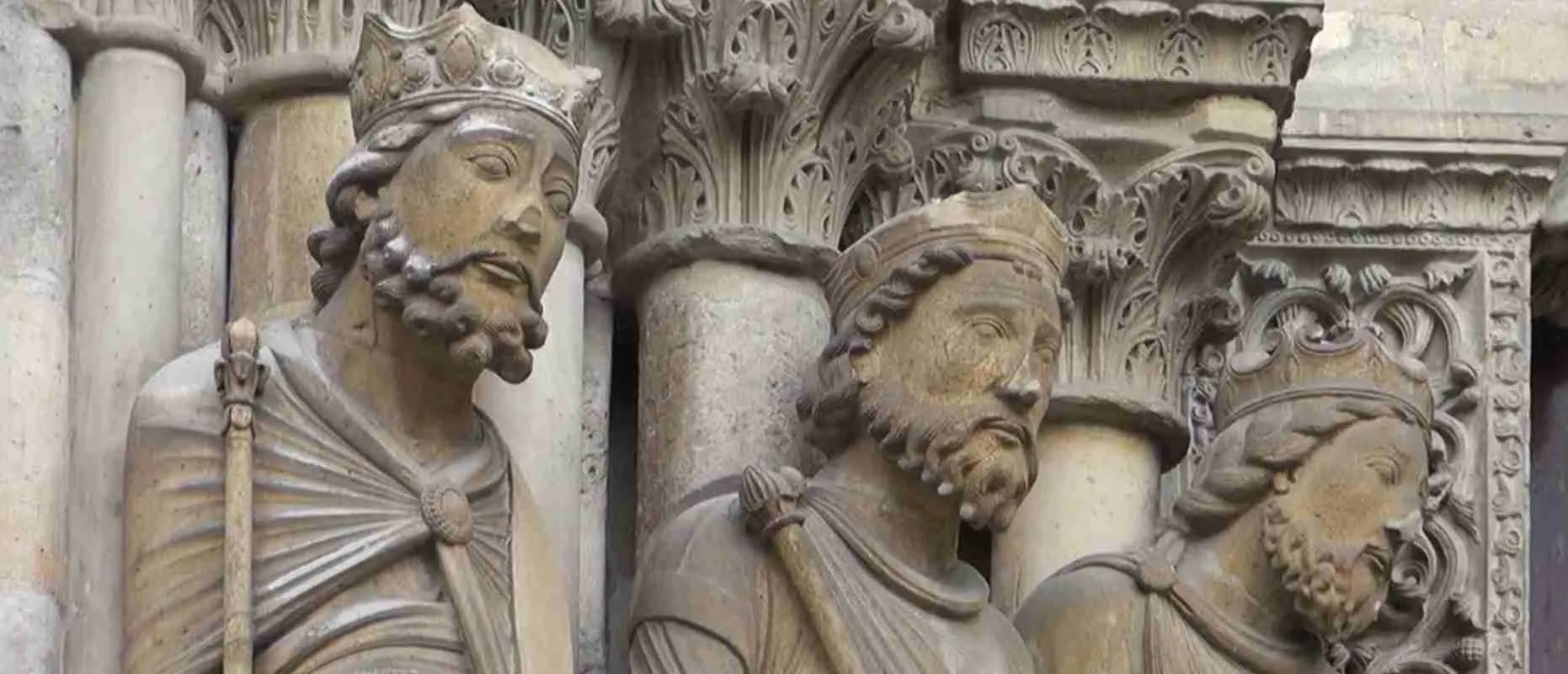
The Basilica of Saint-Denis, roughly twelve kilometres north of central Paris and directly accessible by Metro line 13 or tram T1, is among the most consequential buildings in Western architectural history. The site’s importance predates the current structure: the basilica was built above the tomb of Denis, the first bishop of Paris, who according to tradition was martyred on Montmartre in the 3rd century and carried his own severed head to the site of his eventual burial. From the death of King Dagobert I in 639 the church became the preferred burial place of French monarchs, a status it retained in practice for nearly twelve centuries. More than seventy medieval recumbent effigies and Renaissance funerary monuments are gathered within, representing a concentration of dynastic sculpture without parallel in France.
The architectural structure most visitors see today was substantially reconceived in the 12th century under Abbot Suger, who oversaw what is widely recognised by architectural historians as one of the first coherent Gothic programmes: the use of ribbed vaulting, pointed arches, and large stained-glass windows to create a luminous interior that Suger described as a form of theological illumination. The cathedrals of Paris, Chartres, and Reims follow in this tradition. The attribution of the Gothic programme to Suger’s direction is well documented in his own writings, which survive.
The interior rewards slow attention. The sequence of royal tombs spans the 12th to the 18th century and encompasses every major funerary style of that period: flat-carved Romanesque slabs, high Gothic recumbent effigies on raised sarcophagi, Renaissance tomb compositions with kneeling donors and classical canopies, and Baroque portrait sculpture. The monuments to Louis XII and Anne of Brittany and to Francis I and Claude of France, both in the transept, are among the most detailed pieces of early 16th-century French sculpture remaining in situ anywhere in the country. The medieval stained glass, particularly in the chevet chapels, is another reason to slow down: these windows date substantially from the 12th-century reconstruction and represent an early and influential deployment of the narrative glazing programme associated with Suger’s theological conception of the building. Later 19th-century restoration by Viollet-le-Duc affected portions of the glass and the stonework, and the basilica’s conservation history — including this ongoing spire project — is itself a subject the Spire Workshop addresses directly.
In 2026, a new layer of experience is available. The reconstruction of the north spire — demolished in the 19th century after storm damage weakened its structure — began in 2025 and is projected to run for approximately five years. The Spire Workshop, installed at the foot of the building in September 2025, gives visitors access to the working stonecutters, blacksmiths, and carpenters engaged on the project, alongside a 360-degree immersive space and a permanent exhibition on the spire’s history. Entry to the workshop is included in the standard ticket of €17 (Tuesday through Sunday); on Mondays, only the royal necropolis is accessible at the reduced rate of €11. Visitors under 18 and EU residents aged 18–25 enter free. Audio guides are available for €3 extra. The official ticketing website is saint-denis-basilique.fr.
Maubuisson Abbey: Cistercian Architecture as Contemporary Art Stage
Maubuisson Abbey in Saint-Ouen-l’Aumône, within the Cergy-Pontoise urban area approximately thirty kilometres northwest of Paris by road, was founded in the 1230s by Blanche of Castile under the name Notre-Dame-la-Royale. (Official departmental sources give the year 1234, while the national arts centre CNAP database cites 1236; the discrepancy in primary documentation has not been definitively resolved.) Blanche was regent of France twice during the minority and later the crusade absences of her son Louis IX, and Maubuisson was her personal foundation: a Cistercian house for women in the royal forest, endowed with the resources to sustain a substantial community.
The abbey’s conventual buildings — the chapter house, the nuns’ hall, the parlour, and the latrines — survive from the 13th century, classified as Monuments Historiques in 1947. The abbey church was demolished during the Revolutionary period. Since 2001 the Val-d’Oise Departmental Council has operated the remaining spaces as a contemporary art centre, commissioning in-situ works that enter into dialogue with the medieval architecture. The model is productive: artists invited to respond to the chapter house or the nuns’ hall have consistently generated work that neither decorates the space superficially nor ignores its history. Admission is free, which makes Maubuisson the natural counterpoint on the itinerary — a heritage building that funds its conservation through contemporary programming rather than through entry charges. The site is embedded in a ten-hectare wooded park with free access daily.
Opening hours: Thursday through Monday 13:00–18:15, with an additional Wednesday morning slot from 9:30 to 11:45, from April through October; winter hours are slightly reduced. The abbey is closed Tuesdays year-round. Given these constraints — particularly the afternoon-only access on most days — Maubuisson works best as a first or second stop after Saint-Denis, fitting naturally into a midday pause before the northward drive to Royaumont.
Royaumont Abbey: The Largest Cistercian Abbey in Île-de-France
Royaumont Abbey near Asnières-sur-Oise, some thirty-five kilometres north of Paris, was founded in 1228 by Louis IX (later canonised as Saint Louis) and his mother Blanche of Castile. It became the largest Cistercian monastery in Île-de-France. Louis IX reportedly spent extended periods here himself, and the abbey attracted substantial royal endowment throughout the 13th and early 14th centuries before the community gradually diminished. The abbey church was demolished after the Revolution by the then-owner, who used its stone for the workers’ housing of a cotton mill he installed within the monastic buildings.
What survives is exceptionally well preserved: the cloister, one of the largest Cistercian cloistres in France at roughly 47 by 48 metres (sources including the Fondation Royaumont itself give these figures, though they should be understood as approximate measurements rather than a precisely surveyed datum), the Gothic refectory regarded as one of the finest examples of that building type in France, the monks’ building, the latrine building, and the network of water channels that ran through the complex. The abbey church ruins stand as a romantic open space within the grounds. Three gardens hold the label “Jardins Remarquables”: the cloister garden (redesigned in 1912 by landscape designer Achille Duchêne), the kitchen garden, and a medieval-inspired herb garden.
The refectory deserves particular attention. Built in the mid-13th century as the monks’ dining hall, it is a large vaulted Gothic space lit by tall lancet windows; its proportions and the quality of its carved colonettes place it among the best examples of Cistercian interior architecture surviving in France. The water system that ran through the abbey is also unusually legible at Royaumont: a network of channels diverted from the local stream served the kitchen, the latrines, and the mills within the precinct, and these channels remain visible in the grounds. The latrine building, which the channels passed beneath, retains its Cistercian stonework. These hydraulic arrangements were standard to Cistercian planning — the order’s regulations required running water through every monastery — but Royaumont preserves them more completely than most comparable sites. For visitors interested in medieval monastic infrastructure rather than only the aesthetic programme, Royaumont’s practical side is as instructive as its religious one.
Since 1964 the Fondation Royaumont has operated the site as an international centre for music and dance, programming concerts, residencies, and festivals that use the cloister and refectory as performance spaces. The 2025–2026 season runs under the title “Une touche instrumentale” and features chamber music and dance residencies across multiple weekends — visit royaumont.com for current dates, as concert access typically requires separate tickets. The standard site-and-gardens visit ticket costs €10 (reduced rate €7.50 for students and under-18s). The free parking area at Royaumont includes EV charging points. The abbey is open daily from April through October (10:00–18:00) and Tuesday through Sunday from November through March (10:00–17:30); a weekend shuttle from Luzarches station is available on reservation for visitors arriving by train.
Chaalis Abbey Estate: Primatice Frescoes and a Collection Mid-Renovation
Chaalis Abbey Estate in Fontaine-Chaalis — technically in the Oise department rather than Île-de-France, but a natural extension of the Royaumont visit along the D909 — was founded in 1137 by Louis VI (known as le Gros), making it the oldest royal foundation on the itinerary. It was established as a Cistercian house at a time when the order was still in the first generation of its expansion from Cîteaux. In the 16th century, under the abbacy of Cardinal Hippolyte d’Este (a nephew of Alfonso I d’Este of Ferrara), the Italian painter Primatice decorated the chapel of Sainte-Marie with a cycle of frescoes; these remain among the most important examples of French Renaissance painting outside Paris and are the only surviving Primatice frescoes on their original support in France. A recent restoration has renewed their legibility.
The abbey church and cloister were largely demolished after the Revolution. The surviving 18th-century conventual building — remodelled by Jean Aubert, the architect of the Grandes Écuries at Chantilly — was purchased in 1902 by Nélie Jacquemart-André, widow of the banker and collector Édouard André. She assembled within it a collection of several thousand works of art that she bequeathed to the Institut de France in 1912, along with the entire estate. The collection is known as the Jacquemart-André Museum at Chaalis, one of the two Jacquemart-André collections; the other is in the Paris hôtel particulier on the Boulevard Haussmann.
In 2026 the château-museum is under renovation; the works are expected to continue until approximately spring 2028. The museum collection is accessible only within the scheduled guided “château under construction” tour, which is included in the standard entry ticket at no supplement. The abbey ruins, the chapel with its Primatice frescoes, the rose garden (classified as a Jardin Remarquable), and the twenty-hectare park remain fully open. The standard adult ticket costs €8. Opening hours: daily from April through September (10:00–18:00); weekends and school holidays from October through March (10:00–17:00). Chaalis is reached from Paris via the A1 (exit 7 towards Saint-Witz and Ermenonville), approximately forty kilometres northeast of the capital. Note that this site lies in the Oise department (Hauts-de-France region) rather than Île-de-France; it is presented here as a natural second-day extension rather than a core northern Île-de-France stop.
Route Optimization 2026: Navigating the Vexin Plateau from Central Paris
The four abbeys span two departments and roughly sixty kilometres from south to north, which means route sequencing matters as much as the choice of sites. The most efficient circuit in 2026 runs Saint-Denis first (closest to Paris and served by public transport as an alternative if you prefer to skip the city driving), then arcs northwest to Maubuisson in the Cergy area, then heads north through the Vexin plateau via the D922 to Royaumont, with Chaalis as an optional eastward extension before the A1 return to Paris. Reversing the order — Chaalis first, then Royaumont, then Maubuisson, then Saint-Denis — is equally valid if you are approaching from the northeast, but leaves the capital’s perimeter traffic for the end of the day rather than the beginning.
The Vexin plateau is a chalk tableland between the Seine and Oise rivers, defined administratively as the Parc Naturel Régional du Vexin Français (French Vexin Natural Regional Park). The D922 departmental road runs through its eastern portion, descending from the plateau rim into the Oise valley at L’Isle-Adam and continuing north toward Beaumont-sur-Oise — both towns that lie between Maubuisson and Royaumont geographically. The road carries modest traffic outside of commuter hours and delivers a genuinely rural sequence of hedged lanes, chalky viewpoints, and Vexin church towers that no autoroute replicates. The toll cost on this segment is zero.
Time-Window Strategies for Saint-Denis and Royaumont Access
The single most important scheduling constraint on this itinerary in 2026 is Maubuisson Abbey’s afternoon-only access on most days of the week. The abbey opens at 13:00 Thursday through Monday (and on holidays except May 1), with a Wednesday morning slot from 9:30 to 11:45. This means that if you plan to include Maubuisson on a weekday other than Wednesday, your day must begin at Saint-Denis and arrive at Maubuisson no earlier than 13:00 — a sequence the distance supports well, since the drive from Saint-Denis to Saint-Ouen-l’Aumône takes approximately forty-five minutes by secondary road.
Saint-Denis Basilica opens at 10:00 Monday through Saturday. On Sundays the necropolis opens at noon, which compresses the morning stop considerably; Sunday visitors to Saint-Denis are better served by arriving at 12:00 sharp, spending ninety minutes, and reaching Maubuisson by 14:30 — still within the afternoon window. Mondays are the most constrained day at Saint-Denis itself: the Spire Workshop closes, the necropolis-only ticket applies at €11 instead of €17, and the experience is noticeably thinner. Unless the reduced-format visit is specifically desired, avoid Monday departures.
Royaumont Abbey is the most forgiving in terms of timing. Open daily from April through October (10:00–18:00) and Tuesday through Sunday in winter (10:00–17:30), it accommodates arrivals from around 14:00 onward without difficulty, provided you allow at least ninety minutes for the cloister, refectory, gardens, and the abbey church ruins. The tea room closes before the site does, so arrive by 16:00 if you want refreshments on site. The bar salon is open daily alongside the main visit hours.
Recommended departure window for a one-day visit (Tuesday–Saturday): Leave central Paris by 09:15. Arrive Saint-Denis by 09:50 and be inside at opening (10:00). Depart Saint-Denis by 12:00 and travel west to Maubuisson (13:00 opening). Leave Maubuisson by 14:30. Drive north via D922 through L’Isle-Adam, arriving Royaumont by 15:30–16:00. Depart Royaumont by 17:30 for the return south. This schedule is comfortably achievable and leaves a thirty-minute buffer at each site against delays.
Parking and EV Infrastructure along the D922 Secondary Corridor
Parking logistics differ significantly between the urban stop at Saint-Denis and the rural sites further north. At Saint-Denis Basilica, on-street parking is available within the immediate neighbourhood but is subject to paid zones (typically €2–3 per hour) and is often occupied by mid-morning. A practical alternative for drivers who do not want to navigate central Saint-Denis traffic: park at a Metro line 13 terminus in northern Paris (La Courneuve–8 Mai 1945 or Saint-Denis–Université), take the Metro two or three stops to Basilique de Saint-Denis, visit on foot, and return to the car before continuing the drive north. This adds roughly twenty-five minutes to the plan but eliminates the parking hunt in an unfamiliar urban district.
At all three remaining sites, parking is free. Maubuisson has a dedicated car park off the Avenue Richard-de-Tour in Saint-Ouen-l’Aumône. Royaumont’s parking area at the abbey entrance accommodates coaches and private vehicles and includes electric vehicle charging points at no charge — making it the natural recharging stop for EV drivers mid-circuit. Chaalis has a large parking area in front of the estate, also free.
Along the D922 corridor itself, EV infrastructure is concentrated in the larger towns. L’Isle-Adam, which the D922 passes through, has charging points associated with its Leclerc commercial zone. Beaumont-sur-Oise, a few kilometres further north on the Oise river, has additional public charge points. Precise availability changes as new stations come online; the Chargemap application (chargemap.com), which aggregates publicly reported and commercially operated stations across France, is the most reliable tool for real-time planning in 2026. The PlugShare application offers an alternative with user-reported status updates. For most modern EVs with a range of 250 kilometres or more, the full circuit from Paris to Chaalis and back (approximately 200 kilometres) is achievable on a full morning charge with a single top-up at Royaumont — or without any stop for vehicles with 350-kilometre-plus ranges.
Drivers using the A1 autoroute for any segment should note that tolls apply on the Paris–Le Bourget and Le Bourget–Senlis sections; the per-vehicle cost depends on vehicle class, but for a standard private car the round-trip toll for a Paris–Royaumont–Paris run via the A1 throughout runs approximately €9–13. Choosing the D922 and other D-road alternatives for the full circuit reduces that to zero at a time cost of roughly fifteen to twenty-five minutes per leg.
Suggested Itinerary 2026: One-Day and Two-Day Route Options
Option A: The Focused One-Day Visit (Saint-Denis and Royaumont)
Visitors with limited time — or those who prefer depth over breadth — achieve a satisfying and unhurried day by restricting the circuit to Saint-Denis and Royaumont. These two sites together represent the full arc of Capetian monastic patronage: the royal burial basilica whose Gothic architecture echoes outward into every major French cathedral, and the best-preserved Cistercian cloister in the region. The combined ticket cost is €27 per adult (Saint-Denis €17 + Royaumont €10).
Depart central Paris at 09:30. Arrive Saint-Denis Basilica at 10:00, spending two hours in the necropolis and the Spire Workshop. Depart Saint-Denis by 12:00, heading north via the D317 and connecting roads; stop for a picnic lunch in the Carnelle Forest near Luzarches if conditions allow (park off the D909). Arrive Royaumont between 13:30 and 14:00. Spend two to two-and-a-half hours on the cloister walk, the refectory, the kitchen garden, and the ruins — ample time for an unhurried visit. Depart by 16:30 and return to Paris via the A1 or the D317, arriving before evening peak traffic.
Option B: The Comprehensive One-Day Visit (Saint-Denis, Maubuisson, and Royaumont)
Adding Maubuisson to the one-day circuit requires careful sequencing but is entirely achievable from Tuesday through Monday (noting the closed Tuesday constraint at Maubuisson). Depart central Paris at 09:15. Saint-Denis from 10:00 to 12:00. Drive west to Maubuisson (Saint-Ouen-l’Aumône), forty-five minutes via the A15 or A86, arriving at 13:00 for the afternoon opening. Spend one hour at the contemporary art exhibition in the conventual rooms. Depart Maubuisson by 14:15 and drive north through Cergy, joining the D922 at L’Isle-Adam or approaching Royaumont via the D909. Arrive Royaumont by 15:30. Spend ninety minutes on a focused visit. Depart by 17:00. Budget day cost: approximately €50–60 per person (two sharing, packed lunch, no tolls). Mid-range with restaurant: approximately €85–115 per person.
Option C: The Two-Day Circuit Including Chaalis
Day 1: Depart Paris at 09:15. Saint-Denis Basilica from 10:00 to 12:00. Lunch in Saint-Denis town centre or packed, eaten en route. Drive north-northwest to Maubuisson (13:00 opening), spending one hour. Depart by 14:30 and head northeast, arriving in the Luzarches or L’Isle-Adam area by 16:00. Check into accommodation and take an evening walk through L’Isle-Adam or along the Oise riverside if time allows. Dinner in L’Isle-Adam, where the riverside brasseries provide good-value cooking.
Day 2: Depart accommodation at 09:30. Royaumont Abbey from 10:00 to 12:00 (full cloister and gardens, with time to sit in the tea room). Depart by 12:30 and drive east via the D909 toward Fontaine-Chaalis (approximately forty-five minutes). Picnic in the twenty-hectare Chaalis park or at the estate’s café if open. Afternoon visit to the ruins, the Primatice chapel, and the guided château tour. Depart by 17:00. Return to Paris via the A1 (exit 7 from Ermenonville direction). Two-day budget cost (gîte overnight): approximately €110–140 per person. Mid-range with hotel and restaurant meals: approximately €175–250 per person.
Admission Fees and Advance Booking 2026: Complete Pricing Guide
All prices below are for the 2026 visiting season. Check each site’s official website before departure, as prices may be revised seasonally. The phrase “check official site for current rates” applies particularly to Saint-Denis, which updates its tariff structure when new elements open.
Saint-Denis Basilica (Centre des Monuments Nationaux, saint-denis-basilique.fr): Standard individual ticket (Tuesday–Sunday, necropolis plus Spire Workshop) €17. Monday-only ticket (necropolis, Spire Workshop closed) €11. Combined Saint-Denis plus Panthéon ticket €26. EU residents 18–25 and all visitors under 18 enter free. Audio guide supplement €3. Group rate (minimum ten persons) €9.50 per person. The monument is free during the European Heritage Days weekend (third weekend of September) and on the first Sunday of January, February, March, November, and December. Advance tickets are available and recommended at peak periods; the booking link is on the official site. Reserve by email or phone for groups.
Royaumont Abbey (Fondation Royaumont, royaumont.com): Standard individual ticket (abbey visit and gardens) €10. Reduced rate €7.50 (ages 7–18, students to age 26, job seekers, persons with disabilities). Under 7 free. Guided tour supplement €4.50. Local residents of the Communauté de Communes Carnelle Pays-de-France enter free year-round. The annual season pass includes unlimited visits, one complimentary drink, and a five-percent discount at the bookshop. Concert tickets are priced separately and sell out in advance for flagship events; check royaumont.com/agenda for the 2026 programme and book early.
Maubuisson Abbey (Département du Val-d’Oise, abbaye-de-maubuisson.fr): Free entry to both the contemporary art exhibitions and the park. No advance booking required for individual visitors. Workshops and guided activities carry separate fees where applicable. Contact the abbey directly at [email protected] for group visits or school programmes.
Chaalis Abbey Estate (Institut de France, domainedechaalis.fr): Standard individual ticket €8 (includes park, rose garden, abbey ruins, chapel Sainte-Marie with Primatice frescoes, and the included guided “château under construction” tour). Reduced rate for groups, students, and job seekers €6. School groups €3.50 per pupil. The orienteering challenge (course d’orientation) is available for an additional €3. Joint ticket with the Parc Rousseau at Ermenonville €10 (available when both are open).
For visitors holding the Passion Monuments annual pass (€40 individual, €60 dual) issued by the Centre des Monuments Nationaux, Saint-Denis admission is included. The pass covers more than eighty monuments across France and repays itself on a single day visiting two CNM sites in the Paris region.
Budget Planning 2026: What the Itinerary Costs Per Person
The following figures are per person, calculated assuming two people sharing one car, with hotel costs divided by two where applicable. All totals have been pre-calculated and rounded to the nearest €5.
Budget day trip (Option B: Saint-Denis, Maubuisson, Royaumont): fuel share €6–8 (approximately 100–120 kilometres, 7 litres per 100 kilometres at €1.85 per litre, divided by two), parking at Saint-Denis €3–5, admissions €27 (Saint-Denis €17 + Royaumont €10 + Maubuisson free), packed lunch and café coffee €15–20. Total approximately €50–60 per person.
Mid-range day trip (Option B plus Chaalis, restaurant lunch, some tolls): transport including tolls €12–18, admissions €35 (all four sites), brasserie lunch and café €35–50, parking €5–10. Total approximately €85–115 per person.
Budget two-day itinerary (Option C, gîte or chambres d’hôtes): accommodation per room €65–90 per person (divided by two) €32–45, total transport over two days €10–12, admissions at all four sites €35, food over two days (packed lunches and market provisions) €28–40, parking €5–10. Total approximately €110–140 per person for both days combined.
Mid-range two-day itinerary (Option C, hotel and restaurants): hotel per room €100–140 divided by two €50–70 per person, transport with tolls €18–28, admissions €35, two days of restaurant meals and café stops €65–100, parking €8–15. Total approximately €175–250 per person for both days combined.
Hidden costs that catch visitors unprepared: audio guides at Saint-Denis (€3, worthwhile), the concert supplement at Royaumont if visiting on a programme weekend, the orienteering activity at Chaalis (€3 supplement), and the cost of motorway vignette if using the A1 throughout rather than D-roads. Solo drivers should note that the fuel and parking figures above are for a two-sharing calculation; a solo traveller pays the full vehicle costs without division, adding roughly €15–25 to the transport line.
Accommodation 2026: Where to Stay Along the Route
The natural overnight base for Option C is anywhere within twenty to thirty kilometres of Royaumont — which places L’Isle-Adam, Luzarches, Beaumont-sur-Oise, and the villages of the Vexin Pays-de-France area all within scope.
L’Isle-Adam (Val-d’Oise, on the Oise river) is the most characterful option. Labelled one of France’s most beautiful detours (“Plus Beaux Détours de France”), it has a riverside beach (the largest river beach in France by area), a mature forest backing the town, and several established small hotels and restaurants along the Oise. Mid-range rooms at riverside hotels typically run €90–130 per night in the April–October season. L’Isle-Adam is roughly eight kilometres from Royaumont via the D909, and about forty-five kilometres from central Paris via the A15 or secondary roads. The town also sits on the D922, making it a natural waypoint on the northbound drive.
Luzarches (Val-d’Oise) is the closest town to Royaumont, five kilometres away, with a medieval collegiate church of its own — the Collegiate Church of Saint-Côme-et-Saint-Damien — and a smaller-town atmosphere than L’Isle-Adam. Accommodation here tends toward chambres d’hôtes and gîtes rather than hotels; budget options are typically €60–90 per room. The Luzarches train station provides a direct link to Paris Gare du Nord (Transilien line H, approximately forty minutes), useful for the partner who does not drive or for a mixed car-and-train arrangement. The weekend shuttle to Royaumont departs from Luzarches station on reservation through the Fondation Royaumont.
Beaumont-sur-Oise (Val-d’Oise) offers some budget hotel options associated with business travellers, lower in character but useful for cost-conscious trips. The town is roughly ten kilometres from Royaumont and equally accessible to Chaalis the next morning via the D909. Rooms in basic chain-style accommodation typically run €60–80 per night.
Rural gîtes in the villages of the Vexin Pays-de-France or the Parc Naturel Régional Oise-Pays de France offer the most atmospheric option for those who want to wake up in the landscape rather than a town. Gîtes de France (gites-de-france.com) lists self-catering and bed-and-breakfast properties throughout the area; many are in converted farm buildings at €70–120 per room or €400–700 per week for full rental. Book well in advance for summer weekends, as the Vexin draws Paris weekenders consistently from May through September.
Seasonal Timing and Crowd Strategies for 2026
May and June are the strongest months for the circuit. The Chaalis rose garden reaches its peak, and the Journées de la Rose at the estate (typically held in June, check domainedechaalis.fr for 2026 dates) attract visitors from across the region to a rose fair that spills into the abbey grounds. Royaumont’s spring programme includes public events most Sunday afternoons. Daylight extends to after 22:00 in June, giving ample time for the drive without arriving at any site in the last hour. Crowds at the abbeys are moderate; Saint-Denis receives its highest pressure from school groups and tour parties, mainly on weekday mornings in May and June.
September offers two advantages: the European Heritage Days weekend (third weekend of September), when Saint-Denis is free and several other sites offer reduced or free entry, and the start of the autumn concert season at Royaumont. The Vexin harvest landscape in late September has a particular quality that summer lacks. Book accommodation several weeks in advance for the Heritage Days weekend specifically, as L’Isle-Adam and Luzarches fill with Parisian visitors.
July and August are manageable but not ideal. Saint-Denis can be crowded on weekend mornings; arriving at 10:00 on a weekday rather than a Sunday substantially reduces queuing time. Royaumont is open daily and has enough outdoor space to absorb summer visitor numbers without feeling overwhelmed. Chaalis is open daily through September, with its weekend Journées de la Rose completed by then. Heat on the Vexin plateau can be significant in July; the forest stretches around Carnelle and the Oise valley provide shade during afternoon drives.
October is underrated for this itinerary. The Vexin beech and oak forest reaches full colour in mid-October, Chaalis is still open daily until the end of September and on weekends through November, and the Royaumont gardens in autumn have a quieter character than summer — the mown lawns and the stone buildings in low amber light make for a very different visit from July. Visitor numbers at all four sites drop sharply after the first week of October. October morning light on the Saint-Denis Basilica exterior (the stone takes on a particular warmth in the raking light of 10:00 in October) is worth planning for if photography is a priority. Note that Chaalis’s Journées de la Rose have typically concluded by late June; if the rose garden in flower is a specific objective, late May to mid-June is the target window.
November through March requires attention to restricted opening hours. Chaalis is weekend-and-school-holidays only; Royaumont is Tuesday through Sunday (closed Monday); Maubuisson is closed Tuesday. The two-day circuit is best avoided in deep winter unless you are specifically visiting for a Royaumont concert. That said, an off-season day trip to Saint-Denis and Royaumont — both open Tuesday through Saturday even in winter — gives an unusually private experience of these sites, particularly Royaumont’s cloister in frost or low autumn light.
Beyond the Abbeys: Connecting Heritage Stops Along the Vexin Corridor
The D922 corridor and the towns around it offer additional stops worth considering as extensions or detours depending on time and interest.
Auvers-sur-Oise, roughly twelve kilometres west of Saint-Denis by river road, is where Van Gogh spent the last seventy days of his life in 1890 and where his grave and that of his brother Theo are located in the village cemetery. The church he painted — the subject of a canvas now held by the Musée d’Orsay — is the Church of Notre-Dame-de-l’Assomption of Auvers, a 12th- and 13th-century Vexin Gothic structure. The town’s Maison de Van Gogh, Doctor Gachet’s house, and the landscape terraces above the Oise where he worked have been developed into a well-marked heritage trail. Entry to the Maison de Van Gogh is paid; the church and the cemetery are free. For itinerary purposes Auvers sits between Saint-Denis and the D4/D922 northward turn, making it a logical stopping point when driving from Saint-Denis to Maubuisson along the riverside rather than by autoroute.
L’Isle-Adam, beyond its function as an overnight base, holds the Musée d’Art Louis Senlecq (local art museum, small entry fee) and the riverside forest domain that gives the town its particular atmosphere. The GR1 long-distance walking route passes through; a thirty-minute walk along the Oise bank costs nothing and illustrates why Impressionist painters returned to this stretch of river repeatedly.
The French Vexin Natural Regional Park (Parc Naturel Régional du Vexin Français), whose boundary the D922 traverses, has its own visitor information office at Théméricourt (Maison du Parc) and a heritage itinerary programme that includes Romanesque churches, medieval fortifications, and viewpoints across the Seine valley toward the Normandy border. The park’s self-guided driving routes published on the official site destination-vexin-francais.fr supplement the abbey circuit with shorter detours if time allows.
Ermenonville, adjacent to Chaalis, provides the second Jacquemart-André connection of the journey: the Parc Jean-Jacques Rousseau, where Rousseau died in 1778 and was originally buried before his transfer to the Panthéon. The joint Chaalis–Ermenonville ticket (€10) is the better value if visiting both; the park is English landscape garden in the picturesque tradition and takes approximately ninety minutes to walk through in full.
Practical Driving Tips 2026: Roads, Tolls, and Rural Navigation
Route planning: the most common mistake on this circuit is defaulting to autoroute navigation throughout. Google Maps and Waze default to the A1 and A15, which save perhaps twenty minutes per leg but add toll costs and remove the Vexin plateau scenery entirely. Before departure, set your navigation application to “avoid tolls” or manually route via L’Isle-Adam and the D922 to retain the secondary-road option. The D4 from Auvers-sur-Oise connecting to the D922 toward L’Isle-Adam is particularly pleasant in the late morning; the D909 between L’Isle-Adam and Luzarches is a straight, well-surfaced road through agricultural Vexin.
Tolls: if you choose to use the A1 for any segment, the Paris–Roissy (CDG) toll and the CDG–Senlis toll apply for northward travel. Budget approximately €4–5 per toll booth for a standard private car. The A15 (Paris–Cergy) has its own toll. Total round-trip toll spend for a Paris–Maubuisson–Royaumont–Paris circuit using motorways throughout is approximately €12–18 per vehicle. All D-roads on this itinerary are toll-free.
Fuel and charging: fuel stations are present in Saint-Denis, the Cergy-Pontoise retail zones near Maubuisson, L’Isle-Adam, and Beaumont-sur-Oise. The best fuel prices on this route are typically at hypermarket stations (Leclerc, E.Leclerc, Intermarché) in these towns rather than autoroute service areas. EV drivers should note that the Royaumont parking charge is free and provides a reliable top-up opportunity; plan to arrive with sufficient range for the Saint-Denis–Maubuisson–Royaumont legs combined (approximately 80–90 kilometres from northern Paris), and top up at Royaumont before the Chaalis extension if applicable.
GPS reliability: satellite navigation is reliable on the named roads throughout this itinerary. Some rural lane shortcuts between the D922 and Royaumont are not consistently signposted on older mapping data; the Royaumont site address (Fondation Royaumont, 95270 Asnières-sur-Oise) is recognised by all major navigation applications. Chaalis is best entered as “Fontaine-Chaalis, 60300” or “Chaalis Abbey Estate, Fontaine-Chaalis” for accurate routing.
Sunday driving: Sunday is the most constrained day of the week across this itinerary. Saint-Denis necropolis opens at 12:00 (not 10:00); Maubuisson is open 13:00–18:15 on Sundays; Royaumont is open 10:00–18:00. A Sunday itinerary is achievable but starts at Royaumont in the morning (10:00 arrival), moves to Maubuisson by midday, and then to Saint-Denis only if time permits and the 12:00 opening is acceptable. This is the reverse of the recommended weekday sequence and requires reversing the map logic accordingly.
Children and accessibility: Royaumont and Chaalis offer the most family-friendly outdoor space; both have extensive gardens and open grounds where children can move freely. Saint-Denis has a free discovery trail booklet for children. Note that the royal necropolis at Saint-Denis requires climbing nine steps to enter, and the crypt involves fifteen additional steps; ramp access is not available for those specific areas. Maubuisson is predominantly ground-floor accessible. Contact sites individually before visiting for specific accessibility requirements.
Frequently Asked Questions
How far is the full four-abbey circuit from central Paris in 2026?
The complete circuit — Paris to Saint-Denis, then Maubuisson, then Royaumont, then Chaalis, and back to central Paris via the A1 — covers approximately 190–210 kilometres depending on your precise departure point and choice of roads. Using secondary roads exclusively adds roughly thirty to forty-five minutes of driving compared to autoroute alternatives. Plan for four to five hours of driving total across a two-day visit, distributed across two days as described in Option C above.
Do I need to book tickets in advance for any of the sites in 2026?
Advance booking is strongly recommended for Saint-Denis Basilica, particularly for weekend visits and for any day when the Spire Workshop is open (Tuesday through Sunday). Tickets are available at saint-denis-basilique.fr; the site is popular with school groups and tour parties, and peak-period queues at the door can run thirty to forty-five minutes. Royaumont does not require advance booking for standard site-and-garden visits, though concert tickets require early reservation through the Fondation’s website. Maubuisson and Chaalis are walk-in for individual visitors. For groups, all four sites request advance notice.
What is the best day of the week for this itinerary in 2026?
Wednesday through Saturday offers the greatest flexibility. On these days all four sites are open, Saint-Denis opens at 10:00 with the full experience including the Spire Workshop, and Maubuisson is accessible both in the morning Wednesday slot and the afternoon on other days. Avoid Monday for the full experience at Saint-Denis (Spire Workshop closed), and note that Maubuisson is closed Tuesdays. Sundays require a rescheduled itinerary with a later start at Saint-Denis (12:00 opening of the necropolis).
Is there a money-saving strategy for the itinerary in 2026?
Several strategies apply. First, Maubuisson Abbey is free, which already removes one admission from the total. Second, visiting on the European Heritage Days weekend in September gives free entry at Saint-Denis and often reduced or free entry at other national monuments in the area. Third, the Passion Monuments annual pass (€40 individual) includes unlimited visits to all Centre des Monuments Nationaux properties, including Saint-Denis; it repays itself quickly for visitors planning multiple CMN sites in the same year. Fourth, using D-roads rather than autoroutes throughout eliminates the €12–18 round-trip toll cost. Fifth, Chaalis on a weekday in October switches to weekends-only access, which paradoxically means a September visit captures the site while it is still open daily and the rose garden is still accessible.
How does the itinerary change in winter 2026?
Between November and March the circuit contracts. Chaalis is accessible only on weekends and school holidays, which eliminates it from any weekday plan. Royaumont is closed Mondays year-round but open Tuesday through Sunday. Saint-Denis operates shorter afternoon hours (closing at 16:45 rather than 17:45). Maubuisson’s hours shorten slightly (closing at 17:45 rather than 18:15). A focused winter day trip to Saint-Denis and Royaumont — both open from 10:00 Tuesday through Saturday — provides a genuinely private experience of these sites in low light and without summer-season crowds. Budget for shorter visits (Royaumont’s gardens are not at their best in January) and build in time for the tea room rather than the exterior circuit.
What should I know about driving in the Vexin area in 2026?
The Vexin Plateau uses a network of D-roads and minor communal roads where signposting is adequate but not always prominent. Satellite navigation is reliable for the main route. The plateau itself is flat to gently rolling, with no significant gradients, and the D922 specifically is a straight, well-maintained two-lane road through agricultural land and woodland. Speed limits on D-roads in the Vexin are typically 80 km/h, reduced to 50 km/h through villages; the route through L’Isle-Adam and Beaumont-sur-Oise involves town-speed passages of five to ten minutes each. Fuel stations are present in all the larger towns.
Are the Royaumont Abbey concerts worth planning the itinerary around in 2026?
For visitors with a serious interest in early music, chamber music, or contemporary dance, yes — Royaumont’s programme under the title “Une touche instrumentale” for 2025–2026 is among the most carefully curated of any heritage-venue concert series in the Paris region. The acoustics of the 13th-century refectory are exceptional for chamber ensembles, and the combination of a heritage site visit and an evening concert in the same space on the same day makes for an unusually complete experience. Concert tickets require separate purchase through royaumont.com and sell out weeks in advance for flagship events. Check the agenda before finalising travel dates if the concert aspect is important to you.
Is there a train option for reaching Royaumont from Paris in 2026?
Yes, with a shuttle supplement. Royaumont is approximately five kilometres from Luzarches station and approximately six kilometres from Viarmes station, both on the Transilien H line from Paris Gare du Nord (Banlieue). Journey time from Paris to Luzarches is approximately forty-five minutes. On weekends and public holidays, the Fondation Royaumont operates a shuttle between Luzarches station and the abbey on reservation; contact the abbey by phone (Monday through Friday 10:00–12:45 and 14:30–17:30) or via the reservations page on royaumont.com to book a place. The shuttle is not available every weekend — check availability for your specific dates. For Saint-Denis, the Metro line 13 is fully sufficient; for Maubuisson, the RER A to Cergy Saint-Christophe is the closest public transport option, with a taxi or walk of approximately two kilometres to the abbey from the station. For Chaalis, no direct public transport exists from the Paris rail network; a car or taxi from Chantilly or Creil is required.
What is the typical time commitment for each site in 2026?
Saint-Denis Basilica: plan ninety minutes to two hours to cover the royal necropolis with its medieval effigies and Renaissance tombs, the crypt, and the Spire Workshop exhibition. A guided visit or audio guide extends this by thirty to forty-five minutes. Maubuisson Abbey: one hour is sufficient for a comfortable visit to the contemporary art exhibition and a walk through the park, unless a specific event or workshop is scheduled. Royaumont Abbey: allow ninety minutes minimum to cover the cloister, the refectory, the church ruins, and the main garden circuit; two hours is more comfortable if you want to read the interpretive panels and sit in the tea room. Chaalis Abbey Estate: two hours for the park, rose garden, chapel (Primatice frescoes), and the included guided château tour; the guided tour itself runs approximately forty-five minutes and is the only way to see the interior of the château-museum during the current renovation.
What should I bring for this itinerary in 2026?
Walking shoes are essential: both Royaumont and Chaalis involve extended outdoor walking on gravel paths. A picnic or packed lunch is the most efficient approach for the midday break, given that the sites are spread across rural areas without concentrated restaurant options immediately at the gates (Royaumont’s tea room and Chaalis’s café provide refreshments, but full meals are limited). For the Royaumont garden and Chaalis park in summer, sun protection is advisable as the open sections provide limited shade. Cash is no longer strictly necessary — all four sites accept card payment — but small denominations are useful for the audio guide supplement or the orienteering challenge at Chaalis. Binoculars are surprisingly useful at Saint-Denis for reading the upper-register stained glass windows in detail.