Riviera del Brenta Road Trip & Boat Circuit 2026: The Alternative Way to Travel Between Venice and Padua
Thirty kilometers of canal-side villas, swing bridges, and hydraulic locks separate Venice from Padua along the Riviera del Brenta — and most tourists never discover them. This guide covers every practical option for making the crossing in 2026: the legendary Burchiello boat service, the Bike & Boat hybrid circuit, independent cycling, and the regional bus that threads its way through every canal town along the route. Whether you have a single day or a full weekend, the Brenta Riviera rewards careful planning with experiences that the train between the two cities completely hides.
Key Takeaways
- The Burchiello boat circuit (March 14–November 1, 2026) runs Tuesday through Sunday and costs €147 per adult for the full Venice-to-Padua day including navigation, guide, and entry to Villa Pisani, Villa Widmann, and Villa Foscari (La Malcontenta). Check ilburchiello.it for current availability and book in advance.
- A Burchiello day trip from Venice costs approximately €150–€185 per person including the optional onboard lunch and the regional train back; an independent self-guided day by bus and on foot costs approximately €45–€60 per person.
- The Bike & Boat hybrid combines half a day on the water with an afternoon of cycling from Oriago: €89 per person from Venice (bike rental included), with route maps provided on booking.
- Villa Pisani’s park and labyrinth remain closed for PNRR renovation works until approximately June 2026; the villa interior and frescoed rooms continue to admit visitors at €9 per adult (free for under-18s).
- A two-night mid-range stay based on the Riviera — covering one Burchiello day and one independent cycling day — costs approximately €330–€490 per person (two sharing a mid-range hotel at €90–€150 per room per night).
- The ACTV bus 53E runs the full Venice–Padua corridor via Oriago, Mira, Dolo, and Strà daily; check actv.avmspa.it for current fares and timetables, as this is the budget return option after either a boat or cycling day.
People Also Ask About Riviera del Brenta 2026
How long does the Burchiello boat circuit take in 2026?
The full Venice-to-Padua Burchiello circuit takes approximately nine and a half hours. Boats depart Venice at 9:00 am (meeting point at the San Zaccaria A landing stage on the Riva degli Schiavoni) and arrive in Padua at the historic Portello pier around 7:00 pm. The route in the reverse direction, Padua to Venice, departs Padua at 8:00 am and arrives at Venice San Marco around 5:30 pm. The Burchiello runs Tuesday through Sunday from March 14 to November 1, 2026; Monday navigation is not available. Half-day options running only Venice to Oriago or Padua to Oriago take approximately three to four hours and include one or two villa stops. All circuits are one-way, so the ACTV 53E bus or a regional train handles the return.
How much does a Riviera del Brenta trip cost in 2026?
Costs vary significantly by approach. The Burchiello full-day ticket costs €147 per adult (€59 for ages 6–17) and includes guide service and entry to three villas; adding the optional onboard lunch brings the total to €174–€179, and factoring in the regional train return from Padua or Venice raises a day-trip budget to approximately €150–€185 per person. An independent day using the ACTV 53E bus, paying villa admissions separately (Villa Pisani €9, Villa Foscari €12), and having a simple lunch runs approximately €45–€60 per person. Travelers staying two nights on the Riviera — combining one Burchiello day with one cycling day and a mid-range hotel at €90–€150 per room — should budget approximately €330–€490 per person total.
Can you travel the Riviera del Brenta without a car in 2026?
Yes — the route is entirely accessible without a car in 2026. The ACTV bus 53E connects Venice’s Piazzale Roma with Padua’s main station, stopping in Oriago, Mira, Dolo, and Strà; it runs daily and is the most flexible option for arriving and departing at any point along the canal. The Burchiello is itself car-free transport that doubles as a touring experience. Cyclists using the Bike & Boat programme receive bikes at Oriago for the afternoon leg and can return by bus. Independent cyclists can rent bikes from local operators in Mira and Dolo and follow the canal-side road. Regional trains between Venice and Padua cover the route in 25–30 minutes and stop at Mira Buse, making it easy to access the central stretch without a vehicle.
What is the best time to visit the Riviera del Brenta in 2026?
Late April through June and mid-September through October offer the best combination of mild temperatures, lush vegetation along the towpaths, and manageable visitor numbers. July and August bring longer opening hours and the full summer atmosphere, but also peak heat on open stretches of the canal — a significant factor on the Burchiello’s panoramic deck and on a cycling day. Spring visitors should note that Villa Pisani’s park and labyrinth remain closed for PNRR renovation until approximately June 2026, so early-season visits will find the villa interior fully accessible but the famous maze off-limits. Villa Foscari (La Malcontenta) opens only on Tuesday and Saturday mornings from May 1 to October 30, so scheduling a visit requires planning regardless of season.
Extended multi-day tours – 5+ days
Featured Veneto Multi-Day Tour Packages

3 days
Veneto 3-Day Discovery Tour
- ✓ Comprehensive Veneto experience
- ✓ Expert local guides included
- ✓ All accommodation included
- ✓ Transportation provided
5 days
Veneto 5-Day Highlights Experience
- ✓ Comprehensive Veneto experience
- ✓ Expert local guides included
- ✓ All accommodation included
- ✓ Transportation provided

7 days
Veneto 7-Day Cultural Journey
- ✓ Comprehensive Veneto experience
- ✓ Expert local guides included
- ✓ All accommodation included
- ✓ Transportation provided
10 days
Veneto 10-Day Complete Adventure
- ✓ Comprehensive Veneto experience
- ✓ Expert local guides included
- ✓ All accommodation included
- ✓ Transportation provided
Multi-day tour packages powered by TourRadar. Prices and availability subject to change.
The Riviera del Brenta: Venice’s Historic Escape Route in 2026
The Naviglio del Brenta — the historic branch of the Brenta river that winds for approximately 27 kilometers between Strà and the Venice lagoon at Fusina — is one of the most historically layered waterways in northern Italy. From the sixteenth century onward, the wealthiest families of the Venetian Republic built summer villas along its banks to escape the heat and press of the city; at its peak the Riviera del Brenta was described by contemporaries as an almost continuous architecture of palaces, gardens, and barchesse stretching from the lagoon edge all the way to Padua. Today more than thirty historic villas survive in various states of use, preservation, and transformation, making the canal corridor a living museum whose primary exhibits are still in private and institutional hands.
The route runs through a sequence of small towns — Fusina, Malcontenta (officially a hamlet of Mira), Oriago, Mira, Dolo, Fiesso d’Artico, Strà, and Noventa Padovana — each with its own character and its own claim on the territory’s history. Mira, the most substantial settlement, once held important mills and warehouses serving commercial traffic on the canal. Dolo is remarkable for its island configuration, where the historic center sits within a loop of the Naviglio created by an early twentieth-century cut, preserving a seventeenth-century shipyard (squero) and sixteenth-century mills within the loop’s interior. Strà occupies the upstream end of the Naviglio and is home to Villa Pisani, the largest and most visited of the surviving Venetian villas on the river.
For travelers coming from Venice, the Riviera del Brenta offers something the vaporetto-and-crowds circuit rarely delivers: a sense of the hinterland that sustained the Serenissima, and a pace of movement — whether by boat, bicycle, or foot — that makes the canal architecture legible in a way that a car window or a hurried tour bus cannot. The distance between Venice and Padua by this route is roughly 50 kilometers by water, somewhat less by road; it is not, by European standards, a long journey. The pleasure is in the slowness.
Navigating the Historic Waterway via Public Boat, Electric Bike, or Regional Bus (2026 Practical Guide)
Three main travel modes define the Riviera del Brenta experience in 2026, and they can be combined in several configurations depending on available time and budget.
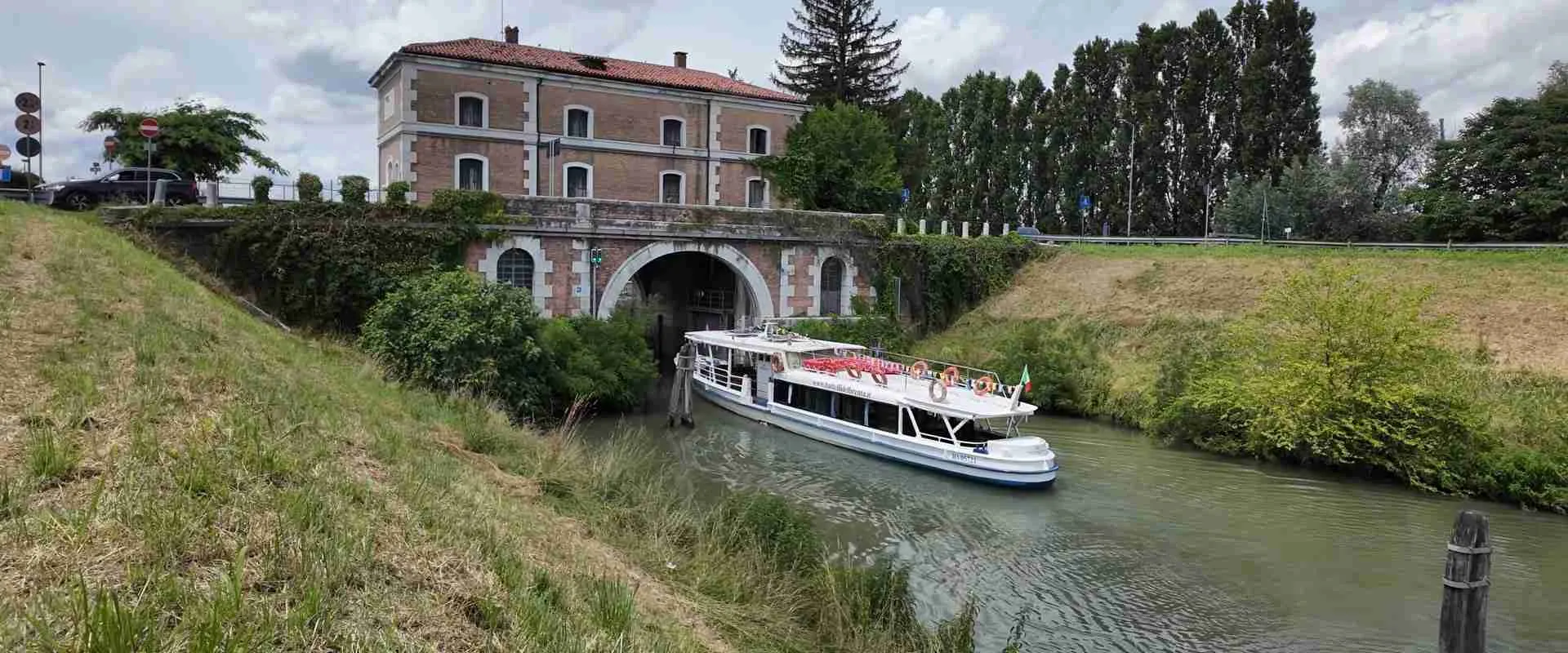
Public boat (the Burchiello circuit). The Burchiello service, operated by I Battelli del Brenta, is the most comprehensive single-day option. Boats are modern motorboats approximately 25 meters in length, equipped with a covered cabin fitted with sofas, a bar, toilets, and a panoramic open deck; they carry between 50 and 120 passengers. The service runs between March 14 and November 1, 2026, Tuesday through Sunday. Crucially, all tours are one-way: travelers departing Venice arrive in Padua, and those departing Padua arrive in Venice. The boat is not a return shuttle — the return leg must be organized independently by bus or train. Meeting points are the San Zaccaria A landing stage on Venice’s Riva degli Schiavoni (for Venice departures) and the Portello pier in Padua’s historic center (for Padua departures). Tickets must be booked in advance through ilburchiello.it or booking-on-line.com. The full-day adult fare is €147 and includes navigation, a multilingual guide, and entry to all three visited villas. Seats on board are not numbered; arriving early secures a better position on the panoramic deck.
Bike & Boat hybrid. The Burchiello also offers a Bike & Boat variant in which passengers complete the boat portion (typically Padua or Venice to Oriago) and then cycle the remaining section of the route using a rental bike provided at the Oriago landing. The Venice-to-Oriago Bike & Boat costs €89 per adult with bike rental included; the Padua-to-Oriago version costs €109. Bikes are collected at the restaurant landing in Oriago at the end of the boat segment and must be returned by 6:30 pm, giving approximately five hours of cycling time. GPS route files and suggested cycle routes are sent to ticket holders on booking. From Oriago, cyclists can follow the canal-side road toward Venice (approximately 13km) or in the opposite direction toward Strà and Padua (approximately 30km). The Bike & Boat also allows an optional add-on visit to Villa Foscari (La Malcontenta) at €12 per person, payable on the spot, if the villa is open that day.
Regional bus (ACTV line 53E). The ACTV bus 53E runs the full Venice–Padua corridor daily, stopping at every Riviera del Brenta town: Oriago, Mira, Dolo, Fiesso, and Strà. It is slower than both the train and the boat — the full Venice–Padua run takes approximately 90 minutes — but far cheaper and logistically flexible. Check actv.avmspa.it for current fares and timetables; the bus is the standard return option recommended by the Burchiello operators for passengers finishing in Oriago. Travelers planning an independent self-guided day can take the 53E to any town along the route and return from a different town, covering part of the canal on foot or by bicycle between bus stops.
Regional train. The Venice–Padua regional train takes 25–30 minutes and costs approximately €4–6 (check Trenitalia for current fares). Mira Buse station is the main access point to the central Riviera, served by some regional services on the Venice–Padua line; it places visitors within a short walk of the canal. The train is the fastest return option for those ending their Burchiello circuit in Padua or Venice.
Car and campervan. The SR11 state road follows the Brenta canal closely through the Riviera towns. Parking in Mira, Dolo, and Strà is available near the canal, typically free outside of town centers. Driving gives full flexibility over timing and access to smaller villas, farmstay accommodations, and countryside roads between canal towns. However, the canal itself — and the experience of seeing the villas from the waterline — is lost; the boat or bicycle perspectives are architecturally and experientially superior.
Self-Guided Exploration of Hydraulic Locks and Secret Villa Gardens in Dolo and Mira
The most technically distinctive feature of the Brenta Riviera — and the aspect least covered in standard tourist guides — is the system of five hydraulic locks, known locally as conche di navigazione, that allow boats to navigate the canal’s change in elevation between Padua and the Venice lagoon. The five locks are located at Noventa Padovana, Strà, Dolo, Mira (Porte di Mira), and Moranzani; together they manage a total height difference of approximately seven meters. Ten swing bridges of various types — some manual, some electric, some revolving, some retractable — complete the canal’s navigable infrastructure.
Watching a lock operation is a free and surprisingly compelling experience for visitors who encounter one on foot or by bicycle. The Dolo lock is the most accessible and historically layered: it sits at the point where the canal loops around the historic center of the town, forming what locals call the “Isola di Dolo” (Island of Dolo). This loop was partially created in the 1930s when the canal’s main course was cut short, leaving the older meander to encircle the town center. Within the loop sits a seventeenth-century squero — a traditional Venetian-style boatyard — that still stands intact alongside the ruins of sixteenth-century mills. The mills were working flour mills that processed grain arriving by barge from the Veneto plain; the water wheel at one of the mill sites has been restored and can be visited on foot. At the Dolo lock itself, visitors on the Burchiello experience the water rising or falling as gates open and close — a demonstration of technology developed by the Venetian Republic over several centuries to control river flow and protect the lagoon from silting.
The Venetian Senate ordered the construction of the first lock at Dolo in 1501, according to historical records; the lock at Moranzani followed in the same deliberation. Over subsequent centuries the Republic undertook progressive hydraulic interventions to divert the Brenta’s main channel away from the lagoon entirely — a project so complex that the Republic is said to have sought engineering counsel from Leonardo da Vinci, though the precise extent of his contribution to the Brenta works remains a matter of historical debate. The result of centuries of intervention was the Naviglio del Brenta as it exists today: a managed canal, no longer the river’s main channel, whose flow and navigation are sustained by the lock system.
For self-guided visitors in Dolo, the most productive approach is to walk from the bus stop along the towpath north of the canal, past the mills and the lock, and into the historic center around the squero. The route is flat, requires no equipment, and takes approximately 45 minutes at a relaxed pace. A bar and wine shop near the restored water wheel makes a natural stop. From Dolo it is approximately 8km by road or towpath to Mira.
Mira’s canal-side heritage is denser and partly hidden behind villa walls and private gardens. The town center on the north bank contains several public points where the canal can be approached on foot, including the landing used by Burchiello passengers during the Villa Widmann stop. Villa Widmann (officially Villa Widmann-Rezzonico-Foscari, currently a Province of Venice property managed by CoopCulture) sits directly on the canal at the locality of Mira Riscossa and is the most accessible of the mid-route villas for independent visitors: standard admission is approximately €5–€8 (check coopculture.it for current rates), and the villa is open Tuesday through Sunday in the main season. Its Rococo interior was remodeled in the eighteenth century to accommodate large-scale entertainments, which required raising the height of the main ballroom to accommodate an internal balcony where musicians could play overlooking the dancing floor. The frescoes of the main hall, depicting the glorification of the Widmann family, are attributed by Italian heritage sources to Giuseppe Angeli, a student of Giambattista Piazzetta, and to Gerolamo Mengozzi Colonna, a specialist in illusionistic architectural framing who worked extensively with Giambattista Tiepolo; the attribution appears consistently in official Italian tourism sources, though documentary confirmation of the commission has not been published in the sources consulted for this article. The park to the north of the villa extends to a greenhouse complex and includes several stone-carved figures along its allées.
Directly opposite Villa Widmann on the south bank of the canal, a set of surviving barchesse (the farm wing structures of a larger complex) from the sixteenth-century Villa Valmarana stand largely intact. The main body of that villa was demolished in the early twentieth century, reportedly to avoid a tax on luxury residences; only the barchesse remain, a visual reminder of how drastically the canal’s architecture has been edited over the past hundred years.
Combining Villa Pisani with Off-the-Beaten-Path Rural Oratories
Villa Pisani in Strà is the most celebrated individual destination on the Riviera del Brenta and serves as the anchor visit for most organized itineraries. It is a national museum administered by the Italian Ministry of Culture, and its scale alone distinguishes it from the other canal villas: the complex extends across approximately 11 hectares and encompasses a main villa building of more than 100 rooms, two stable complexes, a greenhouse, a canal-front facade nearly 90 meters wide, and a park of mature trees, a long reflecting pool, and the famous hedge labyrinth for which the property is widely known.
The villa was commissioned by the Pisani family of Santo Stefano, one of the most powerful dynasties in the Venetian Republic, and its construction began in 1721 on a design by Girolamo Frigimelica; the project was subsequently supervised and partially redesigned by Francesco Maria Preti. The works were completed in time to celebrate the election of Alvise Pisani as Doge of Venice in 1735, and the scale of the commission reflects that political moment: the villa was intended as a demonstration of dynastic power visible from the canal to every traveler between Venice and Padua. The interior rooms include frescoes by Giambattista Tiepolo, Giovanni Battista Crosato, Giuseppe Zais, Jacopo Guarana, and several other artists of the Venetian eighteenth century. The ballroom ceiling, a large double-height painted space, is among the most visited works in the building.
The villa’s subsequent history adds several layers of cultural interest. Napoleon Bonaparte is documented as having acquired Villa Pisani when the Veneto passed into French and then Italian control, and the property later served as a royal residence under successive nineteenth-century dynasties. In 1934 Mussolini and Hitler held their first official meeting at Villa Pisani, a historical footnote recorded in the official museum documentation. The villa became state property in 1866 on Italian unification and opened as a national museum in 1884.
2026 visitor note: The park and labyrinth are closed for PNRR-funded renovation works until approximately June 2026. For the remainder of 2026 from June onward, the park should be fully accessible again. The villa interior continues to admit visitors throughout the year (closed Mondays except holiday Mondays). Standard adult admission to the villa interior is €9; reduced admission is €6 for qualifying categories including Ville Card holders, local residents, and students aged 18–25; children under 18 enter free. Current hours should be confirmed at cultura.gov.it before visiting.
The standard approach to Villa Pisani treats it as an isolated monument: arrive, tour, depart. A more rewarding alternative combines the villa with a short itinerary through the rural lanes on the inland side of the canal, where a scattering of small private chapels and estate oratories occupy the margins of former villa properties. Several of the larger villa complexes along the Riviera incorporated private oratories as functional adjuncts to the main house — consecrated chapels used for daily worship by the household — and a number survive in various conditions. Villa Badoer Fattoretto in Mira, rebuilt on an older foundation in 1558 at the direction of Procurator Federico Contarini, includes a surviving oratory alongside the main villa body and its barchessa, which has been converted into the Mira Municipal Theatre. The oratory is not routinely open for tourism but can be viewed from the exterior as part of a walk through the villa grounds, which the municipality uses for exhibitions and public events. Visitors to this complex get a compact illustration of the full range of a functioning villa estate: the main house, the farm buildings repurposed into a public venue, and the religious structure that served the household’s spiritual needs.
Other minor oratories are embedded in the fabric of farmsteads set back from the canal, recognizable by their small facade porticoes and bell-less campaniles — structures that served individual families or tenant farming communities rather than the parish system. They are rarely marked on tourist maps and require local knowledge or a curiosity for unmarked gates and village lanes. For visitors with a bicycle and an afternoon free of organized touring, the inland roads between Strà and Dolo offer the most consistent concentration of these modest structures alongside working agricultural land, traditional country restaurants, and the quiet that the canal’s main road entirely lacks.
Getting to the Riviera del Brenta in 2026: Venice and Padua Connections
The Riviera del Brenta is positioned almost exactly midway between Venice and Padua, which means the question of access is really a question of which end to enter from and how to arrange the return.
From Venice. The main Burchiello boarding point in Venice is the San Zaccaria A landing stage on the Riva degli Schiavoni, in front of the Pietà Church — a ten-minute walk from St. Mark’s Square. The ACTV bus 53E to the Riviera departs from Piazzale Roma, the main bus terminal at the edge of the historic island, which is also the arrival point for the People Mover from the Venezia Santa Lucia rail station. Note that on certain dates the Venice day-visitor access fee of €5 applies to non-residents entering the historic island; the Riviera del Brenta itself is on the mainland and is entirely exempt from this charge. Travelers arriving at Venice Marco Polo Airport (VCE) can reach the ACTV bus network via the Alilaguna boat service to Venice or the ATVO airport express bus to Mestre, then connect onward to the 53E.
From Padua. The Burchiello’s Padua boarding point is the Portello pier in the historic center, accessible on foot from the main Padua rail station in approximately 20 minutes or by local bus. Padua is well connected by frequent regional trains from Venice (25–30 minutes), Verona, and Bologna; it is also served by the A4 motorway (exit Padova Est or Padova Ovest) for drivers. Most visitors based in Padua board the Burchiello at the Portello and arrive in Venice, making the day a natural sightseeing progression.
Within the Riviera. Between the canal towns, the ACTV 53E bus is the primary public connection. Taxis and rideshare are available in Dolo and Mira for short transfers. For cyclists, the canal-side road links all towns directly. Several hotels and agriturismo properties offer parking for guests arriving by car.
The Burchiello Boat Circuit 2026: Complete Route, Schedule, and Ticket Guide
The Burchiello service operates two full-day routes and four half-day routes in 2026, each running in one direction only.
Full-day circuits (€147 adult, €59 ages 6–17). The Venice-to-Padua full-day route runs on Tuesdays, Thursdays, and Saturdays, departing Venice at 9:00 am and arriving in Padua around 7:00 pm. The Padua-to-Venice full-day route runs on Wednesdays, Fridays, Saturdays, and Sundays, departing Padua at 8:00 am and arriving at Venice San Marco around 5:30 pm. Both routes include guided visits to three villas: Villa Pisani in Strà, Villa Widmann in Mira, and Villa Foscari (La Malcontenta) in Malcontenta, plus a stop in Oriago at the restaurant Il Burchiello for an optional lunch break. The guide commentary is delivered in Italian, English, and French throughout the journey. Children under six travel free.
Half-day circuits. The Venice-to-Oriago and Oriago-to-Venice half-day circuits cost €69 per adult and include one villa stop (Villa Foscari on the Venice-to-Oriago leg, Villa Widmann on the Oriago-to-Venice leg). The Padua-to-Oriago and Oriago-to-Padua half-day circuits cost €87 per adult and include two villa stops (Villa Pisani and Villa Widmann). Half-day circuits also run Tuesday through Sunday, depending on direction.
Optional lunch at Oriago. All circuits include a stop at the restaurant Il Burchiello in Oriago, where passengers can book an optional lunch add-on: the Tiepolo menu (fish, meat, or vegetarian options) costs €27 per person, and the Casanova fish menu costs €32 per person. A children’s menu for under-12s is available at €15. The restaurant supplies secure bicycle parking for Bike & Boat participants. The Burchiello organization notes that while the restaurant shares the organization’s name, it is managed independently, and the tour operator carries out quality checks.
Luggage policy. Passengers may bring small bags, handbags, and camera equipment without reservation. Suitcases, trolleys, large backpacks, and sports bags require advance booking at €20 per item and must not exceed 75×50×30 cm. Undeclared oversized luggage will be accepted only if space permits, with a €10 penalty added to the standard fee.
Cancellation. Cancellations made more than five days before the tour date incur a 50% penalty; cancellations within five days or no-shows are charged in full. The operator reserves the right to modify or cancel tours due to force majeure or lock-related navigation issues.
Booking. Advance booking is strongly recommended; the Burchiello reports an average booking lead time of 47 days for this route. Booking is available at www.ilburchiello.it or through booking-on-line.com. The full 2026 season runs from March 14 to November 1.
Best Villas Open to Visitors Along the Riviera del Brenta in 2026
Of the more than thirty surviving historic villas along the Naviglio del Brenta, a relatively small number are fully accessible to independent visitors in 2026. Most remain in private hands and can only be appreciated from the canal or the road. The four most reliably accessible are described below.
Villa Pisani, Strà. The largest and most institutionally established of the canal villas, Villa Pisani functions as a national museum with regular opening hours. The interior contains more than 100 rooms across multiple floors, of which a substantial number are open on the standard visit route. Frescoes by Tiepolo and his contemporaries are the primary artistic draw; the ground-floor loggia connecting the canal facade to the garden side gives a clear sense of the ceremonial axis the Pisani family intended. Villa admission: €9 adult, €6 reduced, free under 18. Closed Mondays except holiday Mondays. Park and labyrinth closed until approximately June 2026. Confirm current hours at cultura.gov.it.
Villa Foscari (La Malcontenta), Malcontenta. The only Palladian villa on the Riviera del Brenta and one of the most studied buildings in the history of European architecture, Villa Foscari was designed by Andrea Palladio around 1559 for the brothers Nicolò and Alvise Foscari, members of one of the Republic’s most powerful families. It is listed as a UNESCO World Heritage Site as part of the Palladian Villas of the Veneto, inscribed in 1996. The villa sits at the edge of the lagoon plain and was conceived as a suburban residence reached by boat from Venice — its canal-facing temple front with ionic portico remains one of the most compelling architectural images on the entire Riviera. The interior frescoes, concentrated on the piano nobile, are attributed to Battista Franco, a Venetian painter who had trained in Rome in the orbit of Michelangelo; the works show the influence of Roman Mannerism transposed to a villa setting. The curious name “La Malcontenta” has two proposed explanations: the first holds that the locality was called Malcontenta because of repeated flooding that made residents unhappy with their position; the second, apparently a nineteenth-century romantic legend, holds that a Foscari woman was sent here as a form of domestic exile as punishment for unspecified misconduct. No documentary evidence supports the second story.
Villa Foscari is privately owned and open only on Tuesdays and Saturdays from 9:00 am to 12:00 noon, from May 1 to October 30. Admission is €12 per adult; €10 for students aged 20 and under; €8 for ages 11–15; free for children 10 and under. The villa’s opening hours are also updated on its official Facebook page; check there and at lamalcontenta.com before visiting, as openings for special events are occasionally added outside standard hours.
Villa Widmann (Mira). An accessible and well-maintained mid-range example of canal villa architecture, Villa Widmann occupies a prominent canal-side position in Mira and is open Tuesday through Sunday in the main season. The Rococo interior is the primary attraction, particularly the ballroom and its frescoed ceiling. Standard adult admission is approximately €5–€8; check coopculture.it for current pricing. A combined ticket with the Barchessa Valmarana is also available. Saturday and Sunday visits require advance booking via the CoopCulture booking system.
Villa Foscarini Rossi, Strà. Located close to Villa Pisani, Villa Foscarini Rossi houses a footwear museum displaying historic and contemporary shoes that reflects the Riviera del Brenta’s role as one of Italy’s most important centers for high-quality shoe manufacturing. The Brenta footwear district, which developed across the canal towns through the twentieth century, still produces a significant proportion of Italy’s luxury footwear. The museum is relatively light in time commitment and makes a useful companion visit to Villa Pisani; check visitrivieradelbrentaterradeitiepolo.it for current hours and admission prices.
Cycling the Riviera del Brenta in 2026: Bike & Boat, E-Bike, and Riverside Routes
The Brenta Riviera is flat, the distances between canal towns are modest, and the roads along the towpaths carry relatively light traffic outside of summer weekends — conditions that make it an appealing cycling destination for riders of all levels. The Ciclovia del Brenta, part of a longer cycling route running from Trentino to the Venice lagoon, passes through the Riviera section, though current user reviews suggest the path is not a fully segregated cycle track throughout: much of the route runs on the secondary road alongside the canal, shared with local motor traffic. The road quality is generally good and the gradient is essentially flat, but cyclists expecting Dutch-style separated infrastructure will need to adjust expectations. E-bikes are particularly well suited to the terrain and the distances involved.
The Bike & Boat option remains the most logistically clean cycling experience on the Riviera. Participants take the Burchiello boat for the first half of the route, absorb the villa commentary from the water, and then pick up rental bikes at Oriago for a self-guided afternoon. The Padua-to-Oriago Bike & Boat costs €109 per adult with rental bike included; the Venice-to-Oriago option costs €89. Bikes are delivered to the Oriago restaurant at 1:15 pm and must be returned by 6:30 pm, giving approximately five hours of independent riding. The route documents provided on booking include GPS waypoints and notes on sight distances and road conditions. Participants can add an optional visit to Villa Foscari (€12, payable on arrival if open) or to Villa Widmann (entry is included as a gesture of goodwill by the Burchiello organization for Venice-to-Oriago Bike & Boat participants).
Independent bike rental is available from local operators in Mira. “Riviera del Brenta Bike,” run by Valentina, is a well-reviewed operation that delivers bikes directly to hotels and accommodation in Mira; standard and step-through e-bikes are available. Budget approximately €15–€25 per bike per day for a standard e-bike rental, though rates vary by operator and should be confirmed at booking.
Suggested cycling itinerary (one day, Padua to Oriago, approximately 30km). Depart Padua from the Portello pier area and follow the canal-side road northwest along the Piovego canal to Strà (approximately 15 minutes by bike), where Villa Pisani deserves a two-to-three-hour stop if the park has reopened. Continue on the SR11 road and canal towpaths through Fiesso d’Artico, Dolo (45 minutes from Strà), and Mira (a further 30 minutes), with stops at the squero and mills in Dolo and the Villa Widmann canal landing in Mira. The remaining section from Mira to Oriago covers approximately 8km and takes around 30 minutes on flat roads. At Oriago, the ACTV 53E bus connects back toward both Venice and Padua. Carrying food and water is advisable; the canal-side does not have a consistent supply of cafes or water points on the quieter sections between towns.
The Riviera del Brenta’s Hydraulic Heritage: Locks, Swing Bridges, and the Engineering of the Venetian Republic
The Naviglio del Brenta is not the Brenta river; it is a managed canal created through centuries of deliberate hydraulic intervention by the Venetian Republic. The original Brenta river reached the Venice lagoon near Fusina and was a persistent threat to the city: its silt load was gradually filling the shallow lagoon and risking the navigable channels that made Venice commercially viable. The Republic began systematically diverting the main course of the Brenta southward from the late fifteenth century onward, cutting new channels to redirect the bulk of the river’s flow away from the lagoon and into the Adriatic directly. The first major diversion, completed in 1488, redirected flow through a new cut from Dolo southward toward the sea; further modifications continued through the sixteenth and seventeenth centuries. The result was that the old natural channel of the Brenta — now the Naviglio del Brenta — was left as a partially managed canal, sustained by controlled inflows but no longer carrying the full force of the river.
Maintaining navigation on this canal required the lock system. The five conche — at Noventa Padovana, Strà, Dolo, Mira (Porte di Mira), and Moranzani — overcome a total height difference of approximately seven meters between Padua and the lagoon edge. Each lock consists of a chamber that fills or empties to raise or lower boats between the two adjacent water levels; the maximum differential at the Dolo lock alone is approximately 2.45 meters. The engineering principle is ancient — early designs for canal locks in northern Italy are documented from the fifteenth century — but the specific locks on the Brenta were built and rebuilt over several centuries as watercraft and traffic volumes changed. The deliberation to build the original Dolo lock dates to 1501 in the Venetian Senate records. The ten mobile bridges — some rotating, some retractable, some manual — complete the infrastructure and must open to allow taller vessels to pass, a spectacle that Burchiello passengers observe several times during the crossing.
The cultural significance of this hydraulic system extends beyond engineering. The canal and its controlled flows shaped the entire social geography of the Riviera: the mills at Dolo could operate because the canal maintained a consistent water gradient; the villa building boom of the sixteenth through eighteenth centuries was possible in part because the canal corridor was stable, navigable, and protected from the flooding that periodically devastated the natural riverbanks further south. The canal was also a commercial artery, carrying grain, timber, stone, and manufactured goods between the Veneto plain and the Venetian lagoon. The burchiello boats that gave the modern service its name were originally practical commercial and passenger vessels, horse-drawn upstream and current-assisted downstream. The playwright Carlo Goldoni captured the atmosphere of these journeys in his writings; the line “Gera in barca da Padoa, o sia Burchiello, che va via per la Brenta ogni mattina” (Going by boat from Padua, that is the Burchiello, which travels along the Brenta every morning) has been adopted by the modern service as its founding epigraph. Canaletto painted the canal at Dolo around 1725–1729 in a work now in the Ashmolean Museum in Oxford, showing the mills and the lock infrastructure against the water-colored landscape that visitors today would still recognize.
Dolo and Mira: The Heart of the Riviera del Brenta in 2026
Dolo and Mira are the two most substantial towns on the canal and the most rewarding for visitors staying multiple days rather than transiting on the Burchiello.
Dolo is the more compact and visually distinctive of the two. The historic center occupies an island formed by the natural canal loop and the 1930s cut, giving the town a waterside character on multiple sides simultaneously. The seventeenth-century squero in the island’s interior is one of very few surviving examples of a traditional Venetian-mainland boatbuilding yard outside the Venice Arsenal; it is not currently a working yard but can be viewed from the canal path as part of the island walk. The sixteenth-century mills along the inner bank, one of which has had its water wheel restored, are the most tangible remnant of Dolo’s role as the Riviera’s commercial processing center. The main canal-side street has a selection of cafes and small restaurants; the town has a weekly market and a relaxed pace well suited to an afternoon spent on foot between canal stops.
Mira is larger, more spread out, and architecturally denser along the canal. The locality of Mira Porte preserves the name of one of the five hydraulic structures (the Porte di Mira lock) and sits at the functional heart of the central Riviera. Villa Widmann, the most accessible major villa for independent visitors between Strà and Malcontenta, is in Mira Riscossa, a 15-minute walk along the canal from the main Mira bus stop. The Ecomuseo delle Terre del Brenta, a small heritage museum on the canal in Mira, documents the agricultural and industrial history of the canal district and is worth a one-hour visit for travelers interested in the territory beyond its aristocratic architecture. The canal promenade through Mira is the most consistently pleasant walking stretch on the Riviera: a sequence of villa facades, garden walls, stone landing stages, and canal-side trees creates a continuous landscape at a scale that rewards slow progress.
Between Dolo and Mira, the canal-side road passes through a section where multiple villas survive in varying states of use — some converted to hotels, restaurants, or event venues; others shuttered behind restoration scaffolding or still in private residential use. Villa Ducale in Dolo, a nineteenth-century building on earlier foundations, has been converted to an elegant hotel and restaurant and is a good base for exploring both towns; its garden and Italian-style formal grounds are open to dining guests.
Where to Stay Along the Riviera del Brenta in 2026
Accommodation on the Riviera del Brenta ranges from simple roadside B&Bs and agriturismo farmhouses to historic villa hotels with canal views. Prices are consistently lower than comparable accommodation in Venice or Padua, and the proximity to both cities makes the Riviera a practical base for day trips in either direction.
Budget (B&B and agriturismo): approximately €60–€90 per room per night. The canal towns host a scatter of family-run B&Bs and countryside agriturismo properties in the farmland between the canal and the inland villages. Most offer parking, local breakfasts, and basic but comfortable accommodation. Book directly with the property when possible to secure better rates. Bus access from budget properties can be a 10–20-minute walk to the nearest 53E stop.
Mid-range (3-star hotels): approximately €90–€150 per room per night. Villa Gasparini in Dolo is a well-reviewed 3-star property in an 18th-century Venetian villa on the canal, with spa, fitness center, restaurant, and canal-facing terrace. Hotel Riviera dei Dogi in Mira occupies a 16th-century building directly on the Brenta canal and is approximately a 5-minute walk from the Mira Porte bus stop; it has 31 rooms and receives consistently positive reviews for its historic character. Several smaller 3-star hotels in the canal towns, including Albergo Alla Campana in Dolo, offer straightforward accommodation with free parking — a practical advantage for drivers.
Upscale (4-star villa hotels): approximately €150–€250 per room per night. A small number of historic villa properties have been converted to upscale hotels. Villa Ducale in Dolo is the most centrally positioned, with a formal garden and restaurant in an elegant canal-side setting. Villa Margherita, near Mira, is a 17th-century building converted to a 4-star hotel with 15km of Venice, offering a genuinely historic atmosphere at rates significantly below comparable Venice city hotels. Relais Alcova del Doge in Mira sits in the historic district and offers boutique-style rooms in a restored canal-side building.
Booking advice for 2026. Spring and autumn weekends book out quickly for canal-view rooms; bookings made six or more weeks in advance consistently access better rates. The same dates that see peak Burchiello demand (late April through June) see parallel demand for accommodation — coordinating both in the same booking session avoids disappointment. Properties near the canal in Mira and Dolo are the most convenient for car-free visitors; properties further inland offer better value but require a bicycle or car for daily movement.
Food and Dining Along the Riviera del Brenta in 2026
The Riviera del Brenta sits within the broader Veneto culinary tradition, sharing its preference for river fish, freshwater crustaceans, polenta, and the wines of the Euganean Hills and Colli Berici to the west. Canal-side restaurants have historically specialized in freshwater and lagoon fish, reflecting the Brenta’s position between the Adriatic coast and the Veneto plain.
Venetian cicchetti (bar snacks) and risotto. The Brenta towns’ bars serve the same cicchetti tradition familiar from Venice: small preparations of salt cod (baccalà mantecato), sardines in saor (fried with onion, pine nuts, and raisins), marinated vegetables, and crostini. Most canal-town bars serve these from around noon. Risotto — particularly risotto with canal fish or freshwater shrimp — appears on almost every trattoria menu.
Bigoli in salsa. A thick whole-wheat pasta served with a slow-cooked sauce of salted anchovies and onions, bigoli in salsa is a classic of the Venetian canal tradition and appears regularly on lunch menus in Mira and Dolo. It is traditionally eaten on lean days in the old Venetian calendar and has a straightforward, deeply savory character well suited to a riverside lunch.
Fish from the lagoon and rivers. The proximity of the Venice lagoon means that canal-side restaurants have consistent access to sea bass (branzino), gilthead bream (orata), cuttlefish (seppia), and lagoon prawns. Eel (anguilla), historically abundant in the Brenta canal, continues to appear on menus in the form of risotto and grilled preparations. Canal-town trattorias are generally less expensive than comparable seafood restaurants in Venice proper: a fish-based lunch with house wine at a canal-side trattoria runs approximately €25–€40 per person.
Wines of the area. The hills of the Colli Euganei, 15km to the south, produce a range of DOC wines including Colli Euganei Rosso (primarily Merlot-based) and white wines from Garganega and Pinot Bianco grapes. Local restaurants typically carry a selection of these alongside Veneto-wide labels. The prosecco of the Treviso hills to the north is available everywhere, though purists note it is not a product of the Brenta valley.
Practical dining logistics. Dolo’s canal island has the highest concentration of cafes and casual dining for independent visitors. Mira has more options spread across its wider territory. Oriago’s Il Burchiello restaurant (not related to the boat service operator beyond the shared name) is the standard lunch stop on all boat circuits and is particularly well regarded for its freshwater and lagoon fish menus. Independent travelers should note that many canal-side restaurants close on Mondays in low season; confirming opening hours by phone or website before making a detour is advisable.
Budget Guide for the Riviera del Brenta in 2026
The Riviera del Brenta is a genuinely budget-flexible destination: it can be done for very little as an independent day trip or at significant cost if the full Burchiello service, villa admissions, and a canal-view hotel are all combined. The following breakdowns use pre-verified figures.
Day trip from Venice, Burchiello full circuit. The Burchiello full-day adult ticket is €147 and covers navigation, guide, and three villa entries — making it the only ticket needed for the main sightseeing program. Adding the optional onboard lunch raises the cost to approximately €174–€179. The regional train or ACTV bus back to Venice from Padua adds approximately €4–€6 by train. Total Burchiello day trip: approximately €150–€185 per person. Check ilburchiello.it for current availability before booking.
Independent day trip. Budget travelers taking the ACTV 53E bus from Venice, visiting Villa Pisani (€9) and Villa Foscari (€12, Tuesdays and Saturdays only), having a simple lunch (€12–€22), and returning by bus spend approximately €45–€60 per person for the full day. This requires more logistical planning — checking that Villa Foscari’s Tuesday or Saturday opening falls on the chosen travel day, confirming current bus fares at actv.avmspa.it, and organizing a return journey — but is a highly practical option for travelers on a tight budget or those who prefer self-directed exploration over guided circuits.
Two-night mid-range stay (per person, two sharing).
- Accommodation: 2 nights at €90–€150 per room → €90–€150 per person total
- Day 1 — Burchiello full day: €147 plus optional lunch €0–€27 plus dinner €25–€40 plus extras €5–€10
- Day 2 — Independent cycling: bike rental €15–€25, optional Villa Pisani €9, lunch €12–€22, dinner €25–€40, extras €5–€10
- Return transport (bus or train): €5–€10
- Total: approximately €330–€490 per person
Day 1 (Burchiello day including hotel share) costs approximately €220–€300 per person. Day 2 (independent cycling day including hotel share) costs approximately €100–€180 per person. These figures assume mid-range accommodation at €90–€150 per room, with the room cost divided by two for per-person calculation. All cost figures should be treated as planning guides; check all official sources for current rates before booking.
Money-saving strategies. Booking the Burchiello circuit in the opposite direction from your base (Padua-to-Venice if you start in Venice; Venice-to-Padua if you start in Padua) simplifies the logistics because the arriving end of the trip is your home base — meaning no extra return transport cost on the Burchiello day itself, only the cost of getting to the departure point. Staying in Dolo or Mira rather than in Venice or Padua saves 30–50% on accommodation costs and places visitors directly on the canal without daily commute. Packing a lunch for the cycling day eliminates the €20–€35 restaurant cost at midday. Using the ACTV 53E bus for transfers between canal towns keeps per-journey costs to a few euros rather than taxi prices.
Best Time to Travel the Riviera del Brenta Circuit in 2026
Spring (April–May). Vegetation along the canal towpaths is at its freshest; the villas’ gardens show ornamental plantings at their best; daytime temperatures are comfortable for cycling (typically 16–22°C). The Burchiello season begins March 14, so April and May are fully operational. Villa Foscari opens May 1. A key limitation for the first half of 2026: Villa Pisani’s park and labyrinth are closed for renovation until approximately June 2026, so spring visitors see the villa interior but not the famous outdoor spaces.
Early summer (June). From approximately June 2026, Villa Pisani’s park is expected to reopen, making early June the first window of the year when the complete Villa Pisani experience is available. Temperatures are rising (22–28°C) but not yet at peak summer heat; afternoon cycling remains pleasant. June is also when the canal vegetation is most visually dense — the overarching plane trees on some towpath sections create tunnel-like shade that makes cycling particularly pleasant.
High summer (July–August). The Burchiello is fully operational; villas keep extended hours; Riviera events (concerts, outdoor exhibitions, the Riviera Fiorita flower festival held in September in the Dolo area) add cultural programming. The trade-off is peak heat: temperatures regularly exceed 32°C on open canal stretches, and the Burchiello’s open deck becomes uncomfortable during the middle hours. Book accommodations and Burchiello tickets well in advance for July and August weekends; demand is highest during this period.
Autumn (September–October). The best combination of open facilities, manageable visitor numbers, and pleasant temperatures. September in particular offers harvest season foods and wines, the annual Riviera Fiorita event in the Dolo area (typically mid-September), and dramatically softened light on the canal facades in the late afternoon. Villa Foscari closes October 30; the Burchiello season runs to November 1. October visits are quieter still, with the added atmosphere of turning foliage along the towpaths.
Winter (November–February). The Burchiello does not operate; Villa Foscari is closed. Villa Pisani and Villa Widmann maintain reduced winter hours (Villa Widmann is open weekends and public holidays only in winter). The canal corridor in winter fog — a distinctive Veneto climatic feature — has its own austere visual appeal, and several canal-town restaurants are less crowded during this period. It is not an ideal time for the boat or cycling circuit but can work well for architecture enthusiasts visiting specific interiors.
Practical Tips for the Riviera del Brenta in 2026
Book the Burchiello early. The average booking lead time reported by Viator for this circuit is 47 days; summer weekends and the September sweet-spot sell out weeks ahead. The Burchiello’s own booking platform at booking-on-line.com is the most direct option and allows you to check calendar availability in real time.
Time Villa Foscari carefully. It opens only on Tuesdays and Saturdays from 9:00 am to noon, May through October. If visiting independently (not on the Burchiello), this requires planning your travel day around the villa’s schedule rather than the other way around. Arriving at 9:00 am gives the longest window before the 12:00 noon closing.
Check Villa Pisani’s park status. The park and labyrinth were closed for PNRR renovation as of early 2026, with completion projected for June 2026. Confirm the current status at cultura.gov.it or by calling the museum before visiting, particularly if the park is the primary reason for your visit.
Carry cash. Canal-town bars, small trattorias, and some villa ticket offices prefer cash or have minimum amounts for card transactions. Having €50–€100 in cash is advisable for a full day on the Riviera.
Wear layers on the Burchiello. The panoramic deck is fully exposed to weather; spring and autumn mornings on the canal can be cool even on sunny days. A light jacket makes the deck experience comfortable at any time of year except the height of summer.
Download offline maps. Mobile signal is generally reliable along the canal, but the towpath sections between towns are occasionally dead zones. Downloading an offline map of the Riviera del Brenta towns before departure is straightforward and eliminates navigation uncertainty during cycling segments.
Venice day visitor fee. On certain dates (peak periods), visitors to the Venice historic island must pay a €5 access fee on entering for the day. This applies to the Venice historic island only — not to the Riviera del Brenta, Mestre, or Padua. Check cda.ve.it before planning a same-day combination of Venice and the Riviera, as the fee date calendar is published on a rolling basis. Burchiello passengers departing from Venice’s San Zaccaria boarding point should account for this if the departure date falls on a fee day.
Photography from the boat. Photographic equipment may not be used inside the villas on the Burchiello circuit. Camera use is unrestricted on the open deck during navigation; the canal-side villa facades and the lock passages are among the most photographed moments of the trip. Morning circuits departing Venice benefit from frontal light on the villa facades along the first section; the afternoon light on the Padua-to-Venice direction favors the Malcontenta’s river facade.
Frequently Asked Questions
Is the Burchiello boat circuit suitable for children in 2026?
Yes. Children under six travel free on all Burchiello circuits; ages 6–17 pay the reduced fare of €49–€59 depending on the circuit. The boat’s covered cabin with comfortable seating, bar area, and toilets makes a full day manageable for most children, and the lock passages and swing bridges are inherently engaging. The guided villa visits require an attention span of 30–45 minutes per stop, which can be challenging for very young children. The half-day circuits (Venice to Oriago or Padua to Oriago) provide a shorter and more digestible version for families with young children. Children’s lunch menus are available at the Oriago restaurant for €15.
Can I embark or disembark at a specific point along the Burchiello route in 2026?
Yes, to a limited extent. The Burchiello allows passengers to board at Malcontenta (for the Villa Foscari stop) rather than in Venice on the Venice-to-Padua circuit; similarly, passengers can board at Strà (for the Villa Pisani stop) rather than in Padua on the Padua-to-Venice circuit. Passengers who wish to use these intermediate boarding points must book the full circuit and contact the Burchiello organization in advance. Disembarking early is not routinely available on scheduled circuits.
How do I get back to Venice after the Burchiello arrives in Padua in 2026?
The most practical option is the regional train from Padua station, approximately a 15-minute walk from the Portello pier (or a short local bus ride). Regional trains between Padua and Venice run frequently throughout the day and the journey takes 25–30 minutes; fares are approximately €4–€6. Check Trenitalia for current timetables and ticket prices. The ACTV bus 53E from the Padua bus terminal also serves the entire Riviera del Brenta corridor back toward Venice, stopping at every canal town en route, but the journey takes significantly longer. The Burchiello organization provides transfer information in its tour documentation.
What is Villa Pisani open for in 2026 while the park is closed?
The villa interior — including all the main frescoed rooms, the ballroom, the Tiepolo rooms, and the permanent collections — remains fully accessible throughout 2026. The park closure for PNRR works, projected to end approximately June 2026, affects the outdoor spaces: the grounds, the long reflecting pool, the greenhouse, the stables, and the labyrinth. From approximately June 2026 onward, the full complex should be open again. Standard interior admission is €9 adult, free under 18. Confirm current park status at cultura.gov.it before visiting.
What is the difference between the Burchiello and other boat tours on the Brenta in 2026?
The Burchiello (operated by I Battelli del Brenta) is the main scheduled service running fixed-date circuits with multilingual guides and guaranteed villa access. Other boat operators active on the Riviera offer private charter cruises, group tours, and shorter river excursions, typically from Padua’s Portello pier or from landing stages in Mira; these may not include villa entry fees or guaranteed guide commentary. The Burchiello is the only scheduled public service covering the full Venice-to-Padua circuit on fixed weekday timetables. For travelers without a group or private arrangement, it is the standard option and the one with the best infrastructure for independent travelers.
Is cycling the full Venice-to-Padua route feasible in one day in 2026?
Feasible for fit cyclists; comfortable for e-bike riders. The distance from Venice’s edge at Fusina to Padua’s center via the canal is approximately 50 kilometers by road, mostly flat. Fit cyclists on standard bikes typically complete this in 3.5–4.5 hours of pedaling time, not including stops. For riders using e-bikes or preferring a relaxed pace, allowing 6–7 hours of travel time plus stops produces a more enjoyable experience. The key practical issue is that the cycling infrastructure on the Riviera section is not a fully segregated cycle path: the route follows secondary roads alongside the canal, shared with light motor traffic. A good part of the stretch between Dolo and Mira has pleasant tree cover; the section closest to Venice, between Fusina and Malcontenta, is more industrial in character. The Bike & Boat circuit avoids the less scenic sections by covering part of the route on water.
Are there restaurants and cafes along the canal towpath in 2026?
Yes, though not uniformly distributed. The canal towns — Dolo, Mira, Oriago, Strà — all have cafes, bars, and restaurants within a few minutes’ walk of the canal. The stretches between towns, particularly the 8km section between Dolo and Mira, have very few options; carrying a water bottle and snacks is advisable on cycling days. The Il Burchiello restaurant in Oriago (independent of the boat operator) is the most prominent dining destination on the canal, serving a full fish and meat menu; booking is recommended for weekend lunches. Most canal-town bars operate from approximately 7:00 am and serve cicchetti from midday; many close on Mondays in low season.
What other villas can be seen from the water without stopping in 2026?
The Burchiello’s guided commentary covers more than a dozen villa facades viewable from the canal that are not included as stop visits: Villa Giovanelli at Noventa Padovana, Villa Soranzo Conestabile, Villa Borghese Lucrezia, Villa Grimani Valmarana, Villa Contarini degli Armeni, and several others are described from the boat as the circuit progresses. The official Riviera del Brenta tourism website (larivieradelbrenta.it) lists the full inventory of accessible and viewable villas with basic documentation. Independent visitors cycling the towpath can stop at their own pace to photograph any canal-facing facade; most are visible from the road without entering private property.
Is there an e-bike share system on the Riviera del Brenta in 2026?
No public dock-based e-bike share system operates on the Riviera del Brenta as of early 2026. Rental bikes are available from independent local operators (including “Riviera del Brenta Bike” in Mira, which delivers to accommodations) and as part of the Burchiello’s Bike & Boat packages. Several hotels in Mira and Dolo offer bikes for guest use, sometimes at no extra charge; confirm availability when booking. The absence of a shared system means planning bike access in advance is essential — particularly for independent travelers arriving by bus without a pre-arranged rental.
What happens to the Burchiello circuit if the canal is blocked or a villa is closed in 2026?
The Burchiello’s terms and conditions specify that if part of the route is closed due to force majeure or official navigation orders, the operator may arrange a bus transfer to continue the circuit without offering a refund. If a scheduled villa is unexpectedly closed on the day of the visit, an alternative villa may be substituted. During daylight saving time in March and late October, the afternoon Villa Widmann visit on the Venice-departing tours is omitted for technical navigation scheduling reasons; the ticket price remains unchanged in these periods. Passengers should read the full terms at ilburchiello.it before booking and contact the operator with specific questions about current canal conditions ahead of their travel date.