Normandy American Cemetery Guide: Colleville-sur-Mer
Key Takeaways
- The Normandy American Cemetery honors 9,388 American military dead, most killed during D-Day invasion and subsequent operations
- Located on a cliff overlooking Omaha Beach, the 172.5-acre cemetery represents the largest American World War II cemetery in Europe
- The memorial features classical architecture including the Memorial Chapel, Garden of the Missing, and Walls of the Missing with 1,557 names
- Free admission with visitor center, interpretive exhibits, and memorial programs providing comprehensive D-Day historical context
- Photography opportunities capture the solemn symmetry of white crosses and Stars of David against the Atlantic coastline backdrop
Understanding the Normandy American Cemetery
The Normandy American Cemetery stands as the permanent resting place for American servicemen who gave their lives during the D-Day landings and subsequent liberation of France. Positioned on a cliff overlooking Omaha Beach in Colleville-sur-Mer, this meticulously maintained memorial encompasses 172.5 acres of hallowed ground where 9,388 white marble headstones mark individual graves. The cemetery’s location carries profound significance—American soldiers fought their way up this very bluff on June 6, 1944, during the bloodiest of the five D-Day landing beaches.
The American Battle Monuments Commission maintains the cemetery as a permanent American territory granted by the French government in perpetuity. This sacred space represents not merely a burial ground but a monumental tribute to sacrifice, featuring classical memorial architecture that blends reverence with artistic excellence. The visitor center opened in 2007 adds educational depth through interpretive exhibits, personal stories, and historical context that bring the events of June 1944 to life for contemporary visitors.
The cemetery serves multiple purposes: memorial site, educational institution, and place of reflection. Families visit to honor fallen relatives, students study World War II history through primary sources, and travelers from around the world pay respects to those who fought for freedom. The pristine white headstones arranged in perfect rows create a powerful visual statement about sacrifice and loss, while the chapel and memorial structures provide spaces for contemplation and remembrance.
People Also Ask About Normandy American Cemetery
Why is the Normandy American Cemetery significant?
The Normandy American Cemetery holds unparalleled significance as the final resting place for American military personnel who died during the D-Day invasion and liberation of northwestern Europe. The cemetery’s location directly above Omaha Beach—where the bloodiest fighting of D-Day occurred—creates a direct physical connection between the memorial and the battlefield. The 9,388 graves represent servicemen from across the United States who sacrificed their lives between June 6, 1944, and the end of World War II in Europe.
Beyond its role as a burial ground, the cemetery functions as an educational memorial that preserves D-Day history for future generations. The Walls of the Missing commemorate 1,557 American servicemen whose remains were never recovered, ensuring their sacrifice remains recognized. The cemetery’s architectural design, featuring classical elements like the Memorial Chapel and reflecting pool, elevates the site from functional cemetery to artistic memorial that expresses American values of sacrifice, duty, and remembrance.
Who designed the Normandy American Cemetery architecture?
The American Battle Monuments Commission commissioned landscape architects and memorial designers to create the cemetery following World War II. The design incorporates classical American memorial architecture with influences from Arlington National Cemetery and other American war memorials. The layout features geometric precision with uniform rows of white crosses and Stars of David creating visual harmony across the landscape. The Memorial Chapel anchors the eastern end of the cemetery, constructed with limestone and featuring a bronze door depicting the landing operations.
The memorial colonnade surrounding the central mall area provides covered space for the Walls of the Missing, where bronze plaques list names of servicemen whose bodies were never recovered. The Garden of the Missing creates a contemplative space with landscaping that includes American and European plantings. The reflecting pool between the memorial structures mirrors the sky and provides a focal point for reflection. The entire design philosophy emphasizes dignity, permanence, and universal recognition of sacrifice.
What can visitors see at the memorial chapel?
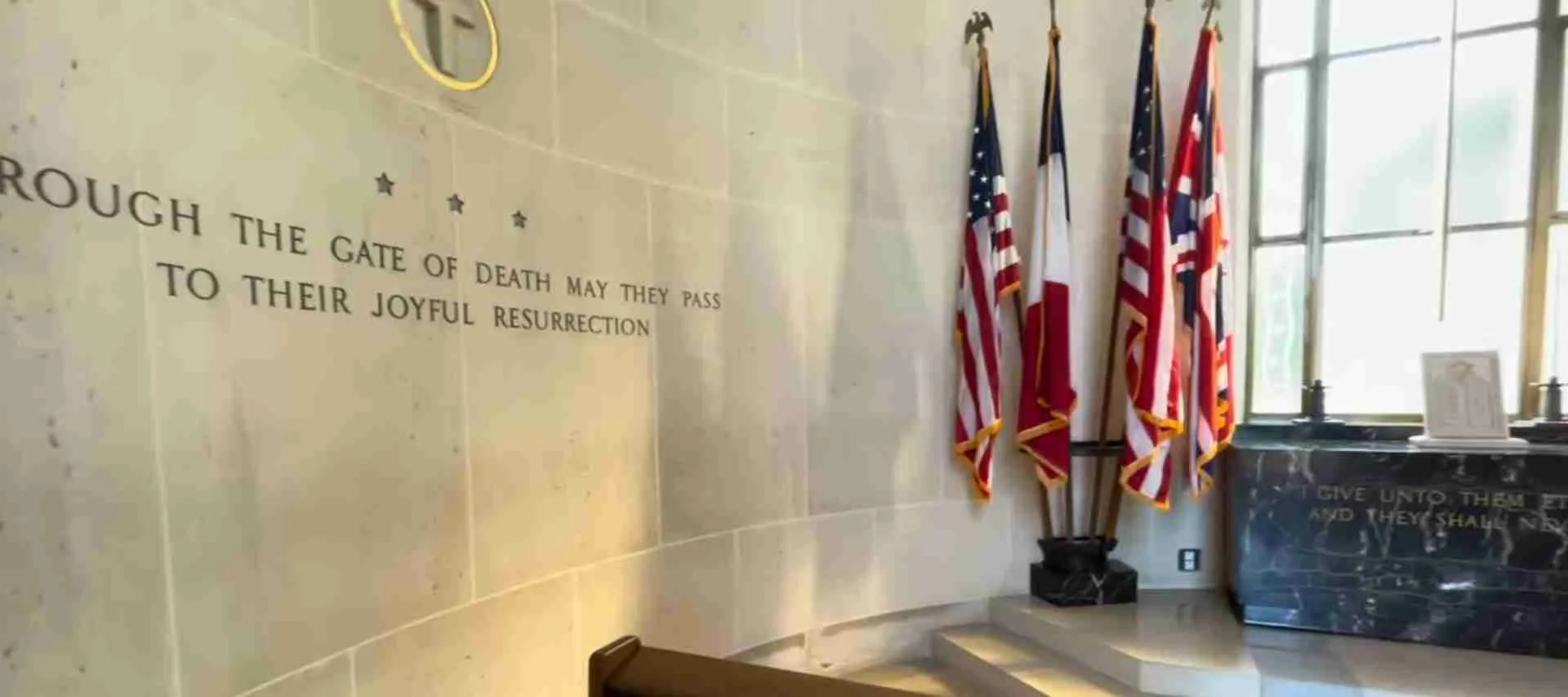
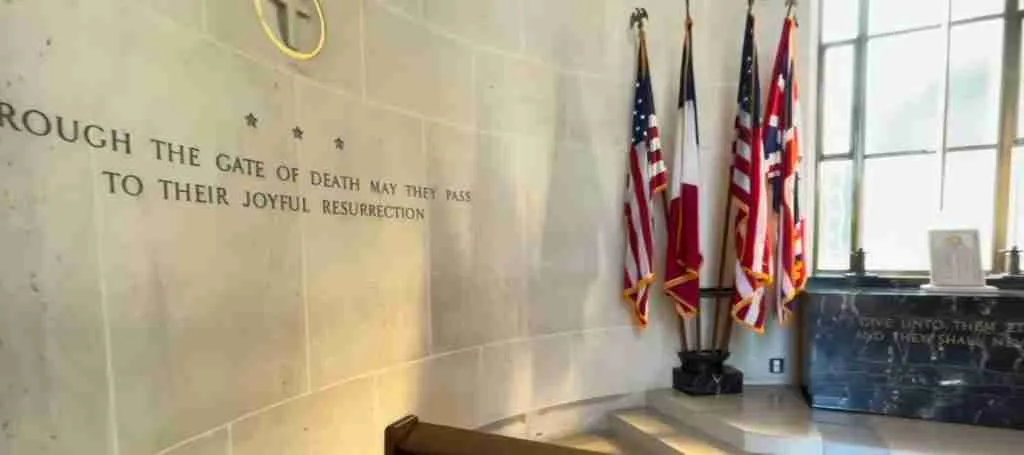
The Memorial Chapel represents the spiritual centerpiece of the cemetery, featuring American and European architectural elements that symbolize transatlantic bonds. The chapel interior displays mosaic artwork depicting military operations and symbolic imagery related to freedom and sacrifice. Stained glass windows filter natural light, creating contemplative atmosphere within the sacred space. The altar area includes inscriptions honoring the fallen and celebrating the ideals they fought to defend.
Bronze doors at the chapel entrance depict the D-Day landings with detailed relief sculpture showing naval vessels, landing craft, and troops advancing onto the beaches. The chapel roof design incorporates American architectural traditions while respecting French aesthetic sensibilities. Visitors can enter the chapel for quiet reflection regardless of religious affiliation, as the space welcomes all who come to honor the fallen. The chapel’s prominent position allows it to serve as a visual landmark visible from multiple vantage points throughout the cemetery grounds.
How does photography at the cemetery show respect?
Photography at the Normandy American Cemetery requires sensitivity to the sacred nature of the site while capturing its powerful visual elements. Photographers focus on compositional techniques that emphasize the memorial’s scale and symmetry—the rows of white crosses create natural leading lines that draw viewers toward the Atlantic horizon. Golden hour lighting during early morning or late afternoon bathes the marble headstones in warm light while creating long shadows that emphasize the three-dimensional quality of the memorial landscape.
Respectful photography avoids intrusive behavior near visiting families and maintains appropriate distance from individual graves unless photographing a specific family member’s memorial. The reflecting pool provides opportunities for mirror compositions that double the visual impact of the memorial structures. Telephoto lenses compress the perspective, making the rows of headstones appear to extend infinitely toward the horizon. Wide-angle perspectives capture the relationship between the cemetery and Omaha Beach below, showing the geographic context that makes this location so significant.
Extended multi-day tours – 5+ days
Featured Normandy Multi-Day Tour Packages
3 days
Normandy 3-Day Discovery Tour
- ✓ Comprehensive Normandy experience
- ✓ Expert local guides included
- ✓ All accommodation included
- ✓ Transportation provided
5 days
Normandy 5-Day Highlights Experience
- ✓ Comprehensive Normandy experience
- ✓ Expert local guides included
- ✓ All accommodation included
- ✓ Transportation provided
7 days
Normandy 7-Day Cultural Journey
- ✓ Comprehensive Normandy experience
- ✓ Expert local guides included
- ✓ All accommodation included
- ✓ Transportation provided
10 days
Normandy 10-Day Complete Adventure
- ✓ Comprehensive Normandy experience
- ✓ Expert local guides included
- ✓ All accommodation included
- ✓ Transportation provided
Multi-day tour packages powered by TourRadar. Prices and availability subject to change.
Historical Background and D-Day Context
The Normandy American Cemetery exists because of events that unfolded on June 6, 1944, when Allied forces launched Operation Overlord—the largest amphibious invasion in history. Omaha Beach, directly below the current cemetery location, became the site of the bloodiest D-Day fighting. American forces landing at Omaha faced withering German defensive fire from positions on the bluffs, resulting in approximately 2,400 American casualties on D-Day alone. The soldiers who survived fought their way up these cliffs, establishing the beachhead that would eventually lead to the liberation of France and Western Europe.
Immediately following D-Day, temporary military cemeteries appeared across Normandy as units buried their fallen comrades near the battlefields. The U.S. Army established numerous temporary burial sites, including one near the current cemetery location. After the war, the American Battle Monuments Commission worked with families of the deceased, offering the choice to repatriate remains to the United States or maintain burial in France. Approximately 60% of families chose repatriation, while the remaining 40% opted to leave their loved ones in French soil among their comrades.
The cemetery dedication occurred in 1956, though improvements and additions continued for decades afterward. The site represents the culmination of a vision to create a permanent memorial worthy of the sacrifice made on these grounds. The American Battle Monuments Commission chose this specific location for its direct connection to Omaha Beach and its prominent bluff position visible from the coastline. The cemetery design process involved extensive consultation with landscape architects, memorial artists, and military historians to ensure the final result would honor the fallen while educating future generations.
The broader historical context includes not just D-Day but the entire Normandy Campaign that followed. Many servicemen buried in the cemetery died during subsequent operations to break out of the Normandy hedgerows, capture Cherbourg, or advance toward Paris. The cemetery therefore commemorates not a single day but months of intense combat that cost thousands of American lives. Understanding this extended timeline helps visitors appreciate the full scope of sacrifice represented by the 9,388 graves.
The cemetery’s relationship with French civilians adds another historical dimension. Local French communities witnessed the D-Day landings and subsequent fighting, experiencing both German occupation and American liberation. The cemetery stands as a permanent reminder of the American contribution to French freedom, and local French citizens maintain deep respect for the American soldiers who died freeing their country. This Franco-American bond continues through ceremonies, memorial services, and ongoing maintenance cooperation between American and French authorities.
Memorial Architecture and Design Elements
The architectural design of the Normandy American Cemetery employs classical elements to create a timeless memorial that transcends any particular stylistic period. The Memorial Chapel forms the eastern terminus of the central mall, constructed from French limestone with a bronze door that serves as the primary artistic focal point. The chapel’s design draws inspiration from both American memorial traditions and European architectural heritage, creating a structure that belongs equally to both continents while maintaining distinctly American character.
The colonnade surrounding the memorial plaza features Doric columns supporting a classical entablature, providing covered walkways where the Walls of the Missing display bronze plaques with 1,557 names. The colonnade design creates a sense of enclosure and sanctity while maintaining visual connection to the broader cemetery landscape. The proportions follow classical architectural ratios that create harmony and balance, making the structure feel appropriately monumental without becoming oppressive or overwhelming.
The central reflecting pool measures approximately 200 feet long, creating a mirror surface that doubles the visual impact of the memorial structures and sky. The pool’s placement along the main axis draws the eye through the composition, creating a visual journey from the visitor center through the memorial plaza toward the chapel. The water’s reflective quality adds a contemplative element while providing a natural focal point for photography and quiet observation.
The Garden of the Missing surrounds the memorial structures with carefully planned landscaping that includes both American and European plant species. The garden design incorporates evergreen trees that maintain year-round greenery, symbolizing eternal remembrance. Seasonal flowers add color and life to the memorial landscape while providing habitat for local wildlife. The garden pathways allow visitors to explore the memorial area while reading names on the Walls of the Missing, creating intimate encounters with individual stories of sacrifice.
The cemetery’s overall layout follows geometric precision with the 9,388 graves arranged in perfect rows across ten burial plots. The uniform white marble headstones—Latin crosses and Stars of David—create visual rhythm and emphasize equality in death regardless of rank, religion, or background. The spacing between headstones allows for maintenance access while creating the distinctive appearance of endless rows extending toward the horizon. This geometric arrangement transforms individual graves into a collective statement about shared sacrifice and common purpose.
The view from the memorial plaza toward Omaha Beach provides crucial geographic context, allowing visitors to see the terrain American soldiers faced on D-Day. The cliff height and distance to the waterline make clear the difficulty of the assault—soldiers had to cross exposed beach under fire, then climb these cliffs while carrying equipment and weapons. This visual connection between memorial and battlefield creates powerful understanding that no amount of written description can match.
Cultural Significance and Memorial Traditions
The Normandy American Cemetery holds profound cultural significance as a symbol of American sacrifice for European freedom and as a manifestation of enduring Franco-American friendship. French citizens recognize that American soldiers died liberating France from Nazi occupation, creating a debt of gratitude that persists through generations. This recognition manifests in ongoing French support for the cemetery, cooperation with American memorial organizations, and participation in commemorative ceremonies that honor the fallen.
The cemetery serves as an educational site where French students learn about World War II history and the American role in liberation. School groups regularly visit the cemetery as part of history curriculum, ensuring young French citizens understand the sacrifice made on their behalf. This educational function extends beyond France to international visitors who come to understand World War II history through the lens of individual sacrifice. The cemetery transforms abstract historical events into personal stories of real people who died far from home.
Memorial Day and Veterans Day ceremonies at the cemetery bring together American veterans, military personnel, diplomatic officials, and French citizens for formal commemorations. These ceremonies include wreath layings, military honors, and speeches that connect past sacrifice to present values. The American flag flies permanently over the cemetery, a visual symbol of American presence and ongoing commitment to honor the fallen. French and American flags displayed together represent the alliance that defeated Nazi Germany and the friendship that continues today.
Families of the deceased maintain personal connections to the cemetery through visits, photographs, and correspondence with cemetery staff. The American Battle Monuments Commission assists families seeking information about relatives buried in the cemetery, providing grave locations, biographical information, and historical context. These family connections ensure the cemetery remains not just a historical site but a living memorial where personal grief and national remembrance intersect.
The cemetery’s cultural impact extends into popular culture through films like “Saving Private Ryan,” which used the cemetery as a framing device for its D-Day narrative. This media exposure introduced the cemetery to millions who might never visit in person, raising awareness of D-Day history and American sacrifice. The cemetery has become an iconic image representing World War II memory, instantly recognizable through its distinctive rows of white crosses overlooking the Atlantic.
The Visitor Center Experience
The visitor center opened in 2007 as a major enhancement to the cemetery experience, providing comprehensive educational resources that contextualize the memorial within broader D-Day history. The center features permanent exhibits covering the planning and execution of Operation Overlord, detailed explanations of the five D-Day landing beaches, and information about the broader Normandy Campaign. Interactive displays allow visitors to explore personal stories of servicemen buried in the cemetery, connecting individual graves to historical events.
The exhibits employ multimedia presentations including documentary footage, photographs, maps, and artifacts that bring D-Day history to life. Touch-screen displays provide access to cemetery records, allowing visitors to locate specific graves and learn about individual servicemen. The center includes a theater showing documentary films about D-Day and the cemetery’s history, providing emotional context that enhances understanding of the sacrifice commemorated outside.
Personal testimonies from D-Day veterans add human dimension to the historical narrative, allowing visitors to hear firsthand accounts of the landings and subsequent fighting. These recorded interviews capture veterans’ voices and memories before they are lost to time, preserving invaluable primary sources for future generations. The testimonies reveal the chaos, fear, courage, and determination that characterized D-Day, making abstract historical events concrete and personal.
The visitor center architecture complements the cemetery’s classical memorial structures while providing modern facilities including information desks, bookstores, and amenities. The building’s design respects the sacred nature of the cemetery by maintaining low profile and using materials that harmonize with the surrounding landscape. Large windows provide views of the cemetery and Omaha Beach, maintaining visual connection between interior exhibits and exterior memorial spaces.
Educational programs organized through the visitor center serve school groups, military units, and general visitors seeking deeper understanding of D-Day history. Staff historians provide guided tours that combine cemetery exploration with historical interpretation, explaining tactical decisions, unit actions, and individual acts of heroism. These programs transform cemetery visits from passive observation to active learning experiences that engage visitors with World War II history at multiple levels.
Legends, Stories, and Notable Burials
Among the 9,388 graves in the cemetery, several commemorate individuals whose stories represent broader themes of courage, sacrifice, and loss. The grave of Theodore Roosevelt Jr.—son of President Theodore Roosevelt—honors a 57-year-old general who landed with the first wave at Utah Beach and died of a heart attack weeks later. Roosevelt received the Medal of Honor for his D-Day leadership, making him the only general officer to land with first-wave troops. His grave lies near that of his brother Quentin Roosevelt, killed in World War I, whose remains were reinterred here so the brothers could rest together.
The Niland brothers’ story inspired the film “Saving Private Ryan,” though with significant fictional alterations. Fritz Niland’s three brothers all served in World War II; two died in the Normandy invasion period, leading to Fritz’s return home under the Sole Survivor Policy. While the movie took dramatic liberties, the underlying reality of families losing multiple sons highlights the widespread sacrifice that American families endured during World War II.
The Medal of Honor recipients buried in the cemetery represent the highest examples of valor under fire. These graves include servicemen who threw themselves on grenades to save comrades, held defensive positions against overwhelming odds, or led desperate assaults against fortified German positions. Reading their Medal of Honor citations provides insight into the extreme conditions and split-second decisions that characterized combat in Normandy.
Unknown soldiers rest among the identified dead, their headstones marked “Here Rests in Honored Glory A Comrade in Arms Known But to God.” These graves represent servicemen whose remains could not be identified through available means, ensuring they receive honorable burial even though their names remain unknown. The presence of unknown soldiers reminds visitors that some families never received definitive answers about their loved ones’ fates.
Local French stories tell of civilians who helped wounded American soldiers, hid evaders from German patrols, and provided intelligence to Allied forces. Some French civilians died assisting Americans, victims of German retaliation for their aid to liberating forces. The cemetery’s relationship with surrounding French communities includes recognition of this French civilian sacrifice, acknowledging that liberation cost French lives as well as American.
Photography Guide and Visual Documentation
Photographing the Normandy American Cemetery requires balancing technical excellence with respectful behavior appropriate to a sacred memorial site. The cemetery’s visual elements—white marble headstones, manicured lawns, memorial structures, and Atlantic coastline—create powerful compositional opportunities that communicate the scale and solemnity of the memorial. Understanding optimal lighting conditions, camera settings, and compositional techniques allows photographers to create meaningful images while maintaining appropriate decorum.
Golden hour provides the most dramatic lighting, with early morning and late afternoon sun creating warm tones that illuminate the marble headstones from low angles. The angled light creates shadows that emphasize the three-dimensional form of each headstone, making rows appear to march toward the horizon. Sunrise shoots the chapel from the east, backlighting the structure and creating silhouette opportunities. Sunset illuminates the memorial from the west, casting long shadows across the lawn and creating warm glows on limestone surfaces.
Compositional techniques should emphasize the cemetery’s geometric patterns and the relationship between individual graves and collective memorial. Using a normal to telephoto lens (50-200mm) compresses the rows of headstones, making them appear to extend infinitely toward the horizon. This compression effect communicates the vast number of graves more effectively than wide-angle shots that spread the headstones across the frame. Shooting from low angles emphasizes the height of the memorial structures against the sky.
The reflecting pool creates mirror compositions that double the visual impact of the memorial chapel and colonnade. Shooting at water level with the camera just inches above the pool surface captures perfect reflections that blur the boundary between real and reflected architecture. These mirror images create symmetry that emphasizes the memorial’s classical design principles. Wind can disrupt reflections, so calm morning or evening conditions produce the cleanest mirror effects.
Detail photography captures individual headstone inscriptions, revealing personal information about the deceased—names, ranks, units, home states, and death dates. These close-up images transform statistics into personal stories, showing that each grave represents an individual life cut short. Macro photography of carved letters, with careful depth-of-field control, creates striking images that emphasize the craftsmanship of the marble work and the permanence of the memorial.
The view from the memorial plaza toward Omaha Beach provides crucial geographic context shots that show the relationship between cemetery and battlefield. Using a wide-angle lens (16-35mm) captures both memorial structures in the foreground and beach/ocean in the background, creating layered compositions that tell the complete story. These images help viewers understand why this specific location was chosen for the cemetery—its direct connection to the landing beach where so many died.
Black and white photography suits the cemetery’s solemn character, stripping away color distractions to emphasize form, texture, and tonal gradations. The white marble headstones translate to bright tones against darker lawns, creating stark graphic compositions. Monochrome images evoke the historical period when the cemetery was established, creating timeless quality that transcends specific eras. Contrast control in post-processing allows photographers to emphasize the memorial’s geometric patterns and architectural details.
Conservation and Maintenance Practices
The American Battle Monuments Commission maintains the Normandy American Cemetery to exacting standards that preserve the memorial’s dignity and appearance. A permanent maintenance staff works daily on grounds keeping, monument cleaning, and facility upkeep. The manicured lawns require regular mowing, edging, and irrigation to maintain the pristine appearance that characterizes American military cemeteries. Groundskeepers operate on schedules designed to avoid disrupting visitor experiences while ensuring the cemetery always appears immaculate.
Each marble headstone receives individual cleaning and maintenance to preserve the carved inscriptions and prevent weathering damage. Specialized cleaning techniques remove biological growth without damaging the stone surface, ensuring headstones remain legible for future generations. The maintenance team monitors each headstone for stability, repairing or replacing damaged markers as necessary. This individual attention to thousands of headstones represents an enormous ongoing commitment that extends indefinitely into the future.
The memorial structures—chapel, colonnade, and walls—require specialized conservation techniques appropriate to limestone architecture. Regular inspections identify areas needing repair before minor damage becomes major deterioration. Stone conservation specialists address structural issues, water infiltration, and surface weathering using techniques that respect the original construction while ensuring long-term stability. The bronze plaques on the Walls of the Missing receive protective treatments that prevent corrosion while maintaining readability.
Landscaping conservation focuses on maintaining the original design intent while adapting to changing environmental conditions. The trees and plantings in the Garden of the Missing require pruning, replacement, and disease management to ensure the landscape remains healthy and attractive. Horticulturists select plant varieties that can withstand the coastal climate while maintaining the aesthetic character established in the original design. Seasonal planting programs add color without compromising the memorial’s dignified character.
The visitor center and supporting facilities require ongoing maintenance appropriate to modern institutional buildings. Climate control systems protect exhibits and artifacts from environmental damage, while regular updates keep multimedia displays current and functional. The commission balances preservation of historical character with necessary modernization of facilities to serve contemporary visitors. Accessibility improvements ensure all visitors can experience the cemetery regardless of physical limitations.
Long-term conservation planning addresses climate change impacts including sea-level rise, increased storm intensity, and changing precipitation patterns. The cemetery’s clifftop location exposes it to Atlantic weather systems, requiring proactive measures to protect against erosion and storm damage. Conservation specialists monitor coastal geology, implement erosion control measures, and develop contingency plans for extreme weather events. This forward-thinking approach ensures the cemetery will continue serving its memorial function for centuries to come.
UNESCO Recognition and International Significance
While the Normandy American Cemetery itself does not hold UNESCO World Heritage status, it exists within the broader context of D-Day landing beaches and associated sites that UNESCO recognizes for their outstanding universal value. The cemetery’s historical significance contributes to the narrative of World War II commemoration and the preservation of sites related to modern conflicts that shaped the twentieth century. The memorial represents international cooperation in preserving sites related to shared historical experiences that transcend national boundaries.
The cemetery embodies themes that UNESCO emphasizes in World Heritage designations: human rights, sacrifice for freedom, and international solidarity against tyranny. The D-Day invasion represented a multinational effort to defeat Nazi Germany, with American, British, Canadian, and other Allied forces coordinating the largest amphibious operation in history. The cemetery commemorates American participation in this broader Allied effort, serving as a permanent reminder of transatlantic cooperation in defense of democratic values.
International visitors to the cemetery come from dozens of countries, reflecting global interest in World War II history and the memorial’s role in preserving that history. Tour groups from Germany visit the cemetery as part of educational programs teaching about Nazi atrocities and the war their nation started. Japanese visitors come to understand American perspectives on World War II, while visitors from former Soviet republics learn about Western Allied contributions to defeating Nazi Germany. This international audience makes the cemetery a site of global historical education rather than purely national commemoration.
The cemetery participates in international memorial networks that connect World War II sites across Europe and the Pacific. These networks facilitate information exchange, coordinate commemorative activities, and promote historical research that advances understanding of the war’s global impact. The American Battle Monuments Commission works with European memorial organizations to maintain consistent standards for war grave sites and ensure comprehensive preservation of World War II heritage.
Academic researchers from international institutions study the cemetery and its archives as primary sources for World War II history. The commission’s records document individual servicemen’s military careers, battle casualties, and burial procedures, providing valuable data for military historians. The cemetery also serves as case study for memorial architecture, landscape design, and the cultural politics of war commemoration, attracting scholars from multiple disciplines who analyze how societies remember and honor military sacrifice.
Visiting Information and Practical Guidance
The Normandy American Cemetery opens daily to the public with free admission, providing unrestricted access to the graves, memorial structures, and visitor center. The cemetery maintains extended hours during summer months when visitor traffic peaks, typically opening at 9:00 AM and remaining accessible until evening. Winter hours may be reduced, and visitors should verify current hours before planning visits. The cemetery closes for Thanksgiving Day and December 25, the only days when the site is not accessible to the public.
The visitor center provides resources including cemetery maps, brochures, and assistance locating specific graves. Staff members can access the cemetery’s database to help visitors find relatives or search for servicemen by name, unit, or home state. The information desk answers questions about D-Day history, cemetery architecture, and visiting procedures. A bookstore offers publications about World War II, D-Day, and American military history, with proceeds supporting cemetery programs.
Cemetery etiquette requires respectful behavior appropriate to a memorial site where families visit to honor deceased relatives. Visitors should speak quietly, avoid intrusive photography near other visitors, and refrain from touching headstones or memorial structures. The cemetery welcomes photography for personal use, but commercial photography requires advance permission from the American Battle Monuments Commission. Drone photography is prohibited due to safety concerns and potential disturbance to other visitors.
Accessibility accommodations ensure visitors with mobility limitations can experience the cemetery fully. Paved pathways provide wheelchair access throughout the memorial area, including routes to the chapel, reflecting pool, and portions of the grave areas. The visitor center includes accessible restrooms, elevators, and exhibits designed for universal access. Visitors needing assistance can request staff support for cemetery navigation or grave location services.
Group visits require planning to avoid overwhelming the cemetery’s capacity and disturbing other visitors. Large tour groups should contact the cemetery administration in advance to coordinate visit timing and any special needs. School groups benefit from advance coordination that allows educational programs to be tailored to age-appropriate learning objectives. Military units visiting for commemorative purposes should arrange formal protocols through official channels to ensure ceremonies can be accommodated without disrupting general visitation.
Weather considerations affect visit planning, as the exposed clifftop location experiences strong winds, rain, and temperature variations. Summer visits offer pleasant weather but attract the highest visitor numbers, potentially creating crowding during peak hours. Spring and fall provide moderate temperatures and fewer crowds, making these seasons ideal for contemplative visits. Winter visits offer solitude and dramatic coastal weather, though visitors should dress appropriately for cold, wind, and potential rain.
Transportation to the cemetery requires personal vehicle or organized tour, as public transportation options to this rural location are limited. The cemetery provides parking areas for passenger vehicles and tour buses, with no parking fees. Visitors driving from Paris face approximately a three-hour journey, while those staying in Bayeux can reach the cemetery in 20-30 minutes. Tour operators offer organized day trips from Paris, Bayeux, and Caen that include the cemetery along with other D-Day sites.
Frequently Asked Questions
How many American soldiers are buried at Normandy American Cemetery?
The cemetery contains 9,388 American military graves, representing servicemen who died during the D-Day invasion and subsequent Normandy Campaign. These burials include soldiers from all branches of service who died between June 6, 1944, and the end of fighting in the European Theater. The Walls of the Missing commemorate an additional 1,557 American servicemen whose remains were never recovered or identified, bringing the total commemorated to over 10,900 individuals.
Is admission to the cemetery free?
Admission to Normandy American Cemetery is completely free, with no charges for entry, parking, or access to the visitor center and exhibits. The American Battle Monuments Commission maintains the cemetery using U.S. government funding, ensuring permanent free access to this memorial site. Visitors pay only for personal items like books from the gift shop or any commercial services like guided tours that they choose to purchase separately.
Can visitors locate specific graves?
The visitor center provides comprehensive grave location services, allowing visitors to search for specific servicemen by name, unit, home state, or other criteria. Staff can access the complete cemetery database to provide plot, row, and grave numbers for any individual buried in the cemetery. Detailed cemetery maps help visitors navigate to specific graves, and staff members can provide directions to grave locations. Families can also request information about specific relatives before visiting by contacting the American Battle Monuments Commission.
What makes the cemetery’s location significant?
The cemetery occupies a clifftop position directly above Omaha Beach, where the bloodiest D-Day fighting occurred on June 6, 1944. This location creates a direct physical and symbolic connection between the memorial and the battlefield where thousands of Americans died or were wounded. The view from the cemetery toward the beach allows visitors to understand the terrain American soldiers faced, making the geographic relationship between memorial and battlefield a crucial element of the site’s educational and commemorative power.
Are there any religious services held at the cemetery?
The Memorial Chapel welcomes visitors for personal prayer and reflection regardless of religious affiliation, though regular religious services are not conducted. Special memorial services occur on significant dates like Memorial Day, D-Day anniversaries, and Veterans Day, which may include religious elements as part of formal commemorations. Families can arrange private memorial services with advance coordination through the American Battle Monuments Commission, which accommodates various religious traditions in these personal ceremonies.
What is the best time of year to visit?
Spring (April-May) and fall (September-October) offer moderate weather, smaller crowds, and ideal conditions for contemplative visits. Summer provides the longest daylight hours and warmest temperatures but attracts peak visitor numbers, particularly around the June 6 D-Day anniversary when commemorative events occur. Winter visits offer solitude and powerful atmosphere as Atlantic storms create dramatic coastal conditions, though visitors should prepare for cold, wind, and rain. Each season provides distinct experiences that suit different visitor priorities.
How long should visitors plan to spend at the cemetery?
A thorough visit including the visitor center exhibits, cemetery grounds, and memorial structures requires 2-3 hours for most visitors. Those seeking to locate specific graves, attend educational programs, or spend extended time in reflection may need 3-4 hours. Visitors combining the cemetery with other D-Day sites like Omaha Beach, Pointe du Hoc, or the Utah Beach museums should plan full-day itineraries that allow adequate time at each location without feeling rushed.
What facilities are available for visitors?
The visitor center includes restrooms, information desks, exhibit halls, a theater, a bookstore, and climate-controlled spaces for comfort during extreme weather. Free WiFi allows visitors to access additional online resources about cemetery history and D-Day events. The grounds include benches for rest and reflection, though the cemetery does not include dining facilities. Visitors should plan to eat at nearby towns like Colleville-sur-Mer or Bayeux, which offer restaurants and cafes within short driving distance.
Are pets allowed in the cemetery?
Service animals assisting visitors with disabilities are welcome throughout the cemetery and visitor center. However, pets are not permitted in the cemetery grounds out of respect for the sacred nature of the memorial site and to avoid disturbing other visitors during their moments of reflection. Visitors traveling with pets should make alternative arrangements for their care during cemetery visits.
Can visitors take rubbings of headstones?
Headstone rubbings are not permitted as they risk damaging the marble surfaces and inscriptions. The American Battle Monuments Commission prohibits this practice to preserve the headstones for future generations. Visitors can photograph headstones for personal records, and the commission can provide official headstone photographs for families upon request. This policy balances family desires to memorialize their relatives with the need to protect the physical integrity of the memorials.