
Mystras Travel Guide 2026: An Off-The-Beaten-Path Journey Through the Byzantine Ghost City
Mystras rises from the slopes of Mount Taygetos in the Greek Peloponnese as one of Europe’s most extraordinary abandoned cities — a UNESCO World Heritage ghost town of Byzantine palaces, frescoed monasteries, and hilltop fortresses that receives a fraction of the visitor numbers Santorini absorbs in a single summer afternoon. This guide covers everything you need to plan a 2026 visit: reaching Mystras from Athens, choosing where to sleep beside the ruins, building a realistic daily budget, and stringing together the neighbouring Laconian wonders that transform a site visit into a full southern Greece itinerary.
Key Takeaways
- UNESCO status: The Archaeological Site of Mystras was inscribed on the UNESCO World Heritage List in 1989 under criteria ii, iii, and iv as an exceptionally well-preserved example of a Byzantine city and a testament to the flowering of Palaiologos-era art and culture (UNESCO Reference 511). The site covers 54.43 hectares with a buffer zone of 1,202.52 hectares.
- Entry costs 2026: Adult admission is €20 per person. EU citizens aged 25 and under enter free. EU citizens aged 65 and over receive a 50% reduction between 1 October and 31 May. Summer opening hours run 8:00 AM–8:00 PM (April–October); winter hours are 8:30 AM–3:30 PM (November–March). The museum inside the site is closed on Tuesdays.
- Daily budget 2026: Budget travelers need €60–100 per person daily (two sharing a guesthouse in Mystras village or Sparti). Mid-range visitors spend €125–195 per person daily. Luxury travellers staying at the area’s spa resorts invest €255–405 per person daily. All figures assume two people sharing accommodation.
- Best timing: April through June and September through October deliver mild temperatures of 18–26°C, blooming Taygetos wildflowers, and visitor numbers far below summer peaks. The site’s steep terrain makes July and August genuinely exhausting in the midday heat.
- Getting here: KTEL Lakonias buses connect Athens (Kifissos terminal) with Sparti roughly every four hours, covering 216 km in around 3.5 hours for €20–28 per person. Mystras lies 6 km west of Sparti, reached by a €10–15 taxi ride or a short local bus connection. Driving from Athens takes 2.5–3 hours.
- Hidden gem reality: Mystras is among the least-visited major UNESCO cultural sites in Greece. Even in July, the upper paths near the Kastro fall quiet by mid-afternoon, offering a solitude unimaginable at Delphi, Olympia, or the Acropolis.
People Also Ask About Mystras 2026
What are the must-see highlights inside the Mystras archaeological site in 2026?
The five essential stops inside Mystras are the Kastro (the 13th-century Frankish castle at the summit, offering panoramic views over Laconia), the Palace of the Despots (the only large-scale secular Byzantine palace to survive in Greece), the Metropolitan Church of Agios Dimitrios (where Constantine XI Palaiologos was crowned the last Byzantine emperor in 1449), the Perivleptos Monastery (whose 14th-century frescoes represent the finest surviving examples of the Palaiologos Renaissance style), and the Pantanassa Monastery (still inhabited by Orthodox nuns, with exceptional 15th-century frescoes and a garden terrace above the plain). A full exploration of both the Upper and Lower Town takes 3–5 hours depending on pace and the number of churches entered.
How much does it cost to visit Mystras in 2026?
Entry to the entire Mystras archaeological site and its museum costs €20 per adult in 2026. EU citizens under 25 enter free; EU seniors over 65 pay €10 between October and May. Beyond the gate, the main costs are accommodation and meals: budget travellers spend €60–100 per person daily (two sharing a room), mid-range visitors spend €125–195 daily, and luxury guests at the area’s resort properties spend €255–405 daily. Check the Hellenic Ministry of Culture website at odysseus.culture.gr for current official rates before your visit.
How do I get from Athens to Mystras in 2026?
The most practical public transport route runs Athens Kifissos KTEL bus terminal to Sparti (3.5 hours, €20–28 per person, roughly every four hours daily), followed by a short 15-minute local bus or €10–15 taxi to Mystras. Driving offers the most flexibility: the 216-km route via the A8/E65 motorway to Tripoli, then national road south to Sparti, takes 2.5–3 hours. There is no train service to Sparti — the rail line was discontinued. In summer, low-cost and charter flights operate to Kalamata Airport (KLX), 60 km west of Mystras, enabling a car hire approach from the western Peloponnese. Check ktel-lakonias.gr for current bus timetables.
When is the best time to visit Mystras in 2026?
April to early June and September to October are the optimal windows for visiting Mystras. Temperatures settle in the comfortable 18–26°C range, the hillside paths carry far fewer visitors than in July and August, and hotel rates drop 20–35% compared to peak summer. Spring brings wildflowers across the Taygetos slopes and allows the site’s frescoes to be viewed in softer, cooler light. Autumn adds the bonus of warm enough evenings for al fresco dining. Avoid the August midday hours if summer is your only option — the steep rocky paths at 35°C become genuinely arduous.
Extended multi-day tours – 5+ days
Featured Peloponnese Islands Multi-Day Tour Packages

3 days
Peloponnese Islands 3-Day Discovery Tour
- ✓ Comprehensive Peloponnese Islands experience
- ✓ Expert local guides included
- ✓ All accommodation included
- ✓ Transportation provided

5 days
Peloponnese Islands 5-Day Highlights Experience
- ✓ Comprehensive Peloponnese Islands experience
- ✓ Expert local guides included
- ✓ All accommodation included
- ✓ Transportation provided

7 days
Peloponnese Islands 7-Day Cultural Journey
- ✓ Comprehensive Peloponnese Islands experience
- ✓ Expert local guides included
- ✓ All accommodation included
- ✓ Transportation provided
10 days
Peloponnese Islands 10-Day Complete Adventure
- ✓ Comprehensive Peloponnese Islands experience
- ✓ Expert local guides included
- ✓ All accommodation included
- ✓ Transportation provided
Multi-day tour packages powered by TourRadar. Prices and availability subject to change.
Why Mystras Stands Apart: The Byzantine Ghost City of Greece
Most great ruins of ancient Greece lie flat — scattered marble columns on a plain, a theatre emptied of its audience, a sanctuary stripped to its foundations. Mystras defies this pattern entirely. Clinging to a steep spur of the Taygetos range at an elevation of 300–620 metres above sea level, it is a ghost city in three dimensions: a network of cobblestone streets, vaulted house fronts, palatial halls, and domed churches that rise, layer upon layer, from a lower gate near olive groves to a Frankish castle at the cloud-line. Walk into it and you do not peer at a distant past — you step inside one.
The story of Mystras begins not with Byzantines but with a Frankish crusader. In 1249, Guillaume II de Villehardouin, Prince of Achaia, constructed a castle on the rocky spur above the Laconian plain. The Villehardouin dynasty used it as an administrative centre, but after the Byzantine Emperor Michael VIII Palaiologos defeated and captured Guillaume at the Battle of Pelagonia in 1259, the Franks were forced to surrender their three most strategic Peloponnesian fortresses — Mystras, Monemvasia, and Great Maina — as ransom. The Byzantines took possession of Mystras in 1262 and began transforming it from a military outpost into a genuine city.
Over the next two centuries, Mystras grew into the capital of the Despotate of the Morea, a semi-autonomous Byzantine province administered by members of the Palaiologos imperial dynasty. The city attracted artists, scholars, and architects who brought the most sophisticated currents of late Byzantine culture to this mountain stronghold. The philosopher Gemistos Plethon established a school here that revived Platonic philosophy and pagan Greek thought; his ideas influenced Cosimo de’ Medici so profoundly that Cosimo founded the Platonic Academy in Florence in direct tribute. The frescoes commissioned for Mystras’s churches — particularly the painted programmes inside the Perivleptos and Pantanassa monasteries — represent the culmination of Byzantine art, prefiguring the naturalism that would emerge in early Italian Renaissance painting.
The political arc ended in 1460, seven years after the fall of Constantinople, when the Ottoman Sultan Mehmed II completed his conquest of the Peloponnese and Mystras surrendered. The city continued under Ottoman and briefly Venetian rule until 1832, when the new Greek state began building modern Sparti 6 km to the east. Inhabitants drifted away over the following century; the last families left in 1953. UNESCO recognized the site’s exceptional value in 1989, inscribing it under three criteria: as testimony to the development of late Byzantine and Post-Byzantine art (criterion ii), as an outstanding example of a Byzantine city (criterion iii), and as an illustration of a significant stage of human history through its palaces, fortifications, churches, and convents (criterion iv).
What makes Mystras peculiar among European ruins is precisely its completeness. Unlike Pompeii, which was buried and preserved by catastrophe, Mystras was simply walked away from. The departing population had no reason to demolish or dismantle; they left walls standing to their full height, frescoes intact on church vaults, marble-framed windows open to the Laconian sky. The result is a city you can read room by room, neighbourhood by neighbourhood — a palimpsest of Frankish, Byzantine, and Ottoman layers overlapping on the same hillside for 700 years.
Today Mystras sees far fewer visitors than Greece’s canonical ancient sites. The absence of a large cruise port nearby, the relative difficulty of the terrain, and the specialized nature of Byzantine art mean the site draws the genuinely curious rather than the tick-the-box tourist. On weekday mornings in spring, it is entirely possible to spend an hour inside the Perivleptos Monastery with no other visitor in sight — a privilege that would be unimaginable at the Parthenon.
The Archaeological Site of Mystras in 2026: Tickets, Hours, and Site Layout
Mystras operates as a single integrated site managed by the Hellenic Ministry of Culture and Sports. One combined ticket at €20 per adult covers access to both the Upper and Lower Town sections and the museum housed in the Palace of the Despots. EU citizens under 25 enter free with valid ID. EU citizens 65 and over pay €10 between 1 October and 31 May. Free admission applies to all visitors on certain national holidays; check odysseus.culture.gr for the current schedule. The museum within the site closes on Tuesdays, though the outdoor ruins remain accessible.
Summer opening hours (April–October) run from 8:00 AM to 8:00 PM, with last admission 20 minutes before closing. Winter hours (November–March) run from 8:30 AM to 3:30 PM. The site is genuinely large — 54.43 hectares of steep terrain — and a comprehensive visit takes 3–5 hours at minimum, with serious architectural explorers easily spending a full day. Carry water from the canteen near the lower entrance, as no facilities exist on the upper paths.
The site divides into three overlapping zones linked by a single road that winds up the hillside:
- Lower Town (Kato Chora): Accessible from the lower gate near the village of Mystras, this section holds the most important churches — the Metropolitan Church of Agios Dimitrios, the Brontochion Monastery, and the Perivleptos Monastery — along with the residential streets of Byzantine Mystras and the main museum.
- Upper Town (Ano Chora): Reached by continuing up the road from the lower section, this area contains the Palace of the Despots, the Church of Hagia Sophia, the Frankish Tower, the Laskaris Residence, and several ruined mansions. The streetscape here gives the strongest sense of the Byzantine city fabric.
- Kastro: The 13th-century Frankish castle at the summit, accessible by footpath from the upper town or by a separate parking area at the top of the access road. The views from the castle walls across the Laconian plain to the Parnon range and, on clear days, to the distant glimmer of the Laconian Gulf, are extraordinary.
Two practical strategies work for the site. The first is to enter from the lower gate, walk uphill through the Lower Town to the Upper Town and Kastro, then walk back down — good for those who prefer to tackle the hardest climbing early. The second, and generally superior, approach is to drive or take a taxi to the upper entrance near the Kastro, descend through the Upper Town, continue through the Lower Town, and exit at the lower gate — saving approximately 150 metres of net elevation gain over the alternative. If you choose the top-down approach, arrange for a taxi or return transportation from the lower exit before beginning.
What to See at Mystras in 2026: Key Monuments and Frescoes
The Kastro (Castle)
Built in 1249 by Guillaume de Villehardouin, the Kastro sits at 620 metres and commands a 360-degree panorama that encompasses the entire Laconian plain, the serpentine Eurotas River, the city of Sparti below, and the serrated wall of the Taygetos range to the west. The Byzantines significantly expanded the fortifications after 1262, adding curtain walls and towers that were reinforced again during the Palaiologos period. The castle is today largely accessible as open ruins — walls, towers, cisterns, and a small chapel survive — and the walk along the battlements in early morning light is one of the most atmospherically powerful experiences in Greece. Allow 45 minutes to explore the Kastro fully before descending.
The Palace of the Despots
The largest surviving secular building of the Byzantine world occupies a broad terrace midway up the hillside. The Palace of the Despots is actually a complex of five interconnected wings built across roughly two centuries of occupation, from a 13th-century Frankish hall at its northern end through successive Byzantine and Palaiologos additions to the south. The most imposing element is the great throne hall on the upper floor of the Palaiologos wing — a vast Gothic-Byzantine chamber with a surviving fireplace, pointed windows, and the decorative vocabulary of both Western and Eastern medieval architecture intertwined in a single structure. Parts of the palace have been under ongoing restoration; some sections may be fenced for conservation work in 2026, but the exterior and accessible interiors remain open. The museum occupying sections of the palace holds bronze coins, ceramic vessels, carved architectural fragments, and painted panels documenting the complex political and artistic world of Palaiologos Mystras.
The Metropolitan Church of Agios Dimitrios (Mitropolis)
Founded in 1291 as the seat of the Archbishop of Lacedaemonia, the Mitropolis is the oldest and most historically charged church in Mystras. Its three-aisled basilica plan, unusually combined with an upper-level gallery arcade on the exterior, reflects the composite architectural traditions of the late Byzantine Peloponnese. Two moments above all make the Mitropolis unforgettable. First, carved into the marble floor near the main entrance, a double-headed Byzantine eagle — the symbol of the last imperial dynasty — marks the exact spot where Constantine XI Palaiologos was crowned Emperor of Byzantium on 6 January 1449. He would hold that title for only four years before falling at the walls of Constantinople in 1453, the last emperor of a thousand-year state. Second, the frescoes across the church’s walls and vault represent several distinct campaigns of painting spanning the 14th and 15th centuries, with the later Palaiologos-period additions showing the most sophisticated handling of naturalistic drapery and individualized faces.
Perivleptos Monastery
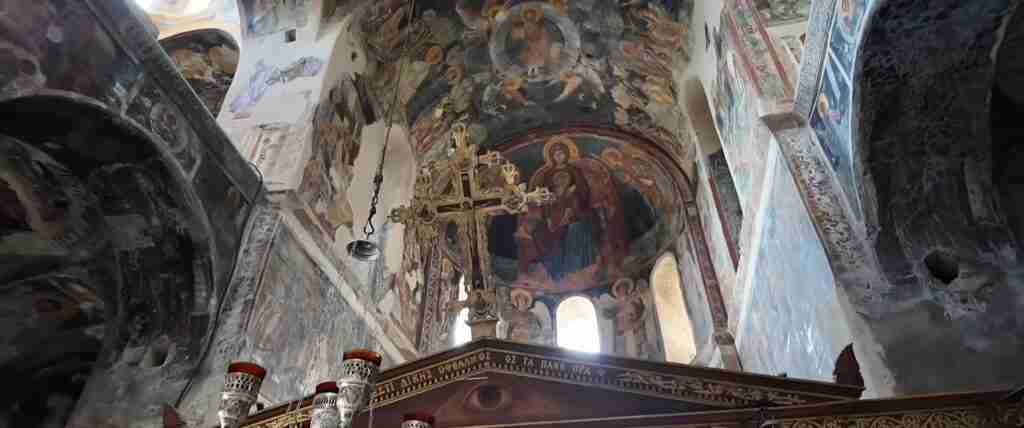
Carved partially into the living rock of the hillside, the Perivleptos Monastery presents a modest exterior that gives no warning of the visual intensity within. The single-nave catholicon — the main church — is entirely covered in frescoes executed around 1360–1370 that art historians regard as the peak achievement of the so-called Palaiologos Renaissance. The painters — probably members of a workshop associated with the Constantinople tradition — pushed Byzantine pictorial conventions toward an expressivity and spatial depth unprecedented in the style. The Nativity scene on the northern wall shows the Magi riding at full gallop down a hillside with a dynamism entirely absent from earlier Byzantine painting. The Dormition of the Virgin in the apse treats a crowd of apostles with individualized grief. The Entry into Jerusalem fills its arch with swaying figures caught mid-motion. Photography is allowed without flash, and the low natural light filtering through the small windows creates a viewing atmosphere that makes these paintings feel genuinely alive. Arrive early or late to have the monastery largely to yourself.
Pantanassa Monastery
The last major building constructed in Byzantine Mystras — completed in 1428, just 32 years before the Ottoman conquest — the Pantanassa Monastery is unique among the site’s monuments in being still inhabited. A small community of Orthodox nuns maintains the monastery, tends a garden filled with roses and citrus, and sells honey, herbal preparations, and embroidered textiles at a small table near the entrance. The church combines an exterior arcade of pointed arches (a Western Gothic influence brought to Mystras by craftsmen working simultaneously in both traditions) with a fully Byzantine interior programme of frescoes emphasizing the life of the Virgin. The bell tower, visible from below as you approach through the Lower Town, is the most photographed architectural detail in Mystras. Modest dress — covered shoulders and legs — is required for all visitors entering the active monastery.
Brontochion Monastery and the Church of Hodegetria
The Brontochion was the wealthiest monastery in medieval Mystras, recipient of imperial patronage and burial place of the Despot Theodore I Palaiologos. Two churches survive within the complex: the older Church of Saint Theodores (c.1295) and the larger Church of the Hodegetria (c.1310), whose exterior displays the most elaborate decorative brickwork in Mystras — a pattern of blind arcades, ceramic inlays, and carved marble string courses that draws heavily on the architectural language of Constantinople. The interior frescoes, though damaged, preserve episodes from the life of Christ rendered in a style transitional between the classical rigidity of earlier Byzantine painting and the expressive naturalism of Perivleptos. Gemistos Plethon is believed to have taught classes in the vicinity of the Brontochion; a commemorative plaque marks the traditional location of his school.
The Mystras Museum
Housed within the northernmost section of the Palace of the Despots, the Mystras Museum organizes its collection around the theme of Mystras’s role as a meeting point between the Byzantine East and the Latin West. Exhibits include late Byzantine ceramics, bronze coins from successive occupations (Byzantine, Venetian, Ottoman), marble architectural fragments of exceptional quality — including a carved tympanum with an eagle in high relief — and a small but important collection of painted icons and portable devotional objects. Carved sarcophagi recovered from the monastery churches occupy the central hall. The museum is closed on Tuesdays; combine your visit with the outdoor ruins on a non-Tuesday to avoid missing it.
Getting to Mystras in 2026: Transport Options from Athens and Beyond
Athens to Mystras by Bus
KTEL Lakonias operates the Athens–Sparti route from Kifissos Bus Terminal (also called Leoforou Kifisou KTEL) in Athens, with buses departing roughly every four hours throughout the day. The journey takes approximately 3.5 hours and tickets cost €20–28 per person one way; book in advance at ktel-lakonias.gr or at the terminal. To reach Kifissos from central Athens, take bus 051 from Omonoia Square; from Athens International Airport, take the X93 express bus directly to Kifissos. Once in Sparti, Mystras is 6 km to the west — a 15-minute local KTEL bus connection (route operates multiple times daily, fare under €2) or a €10–15 taxi ride.
Driving from Athens to Mystras
The drive covers 216 km and takes 2.5–3 hours in normal traffic. From Athens, take the Attiki Odos ring road west and join the A8/E65 motorway toward Corinth. After Corinth, continue on the E65 to the Tripoli junction and then follow the national road south to Sparti. The final section from Tripoli to Sparti is a single-carriageway road through mountain terrain — scenic but requiring steady attention. From Sparti, follow the brown heritage signs west to Mystras. Round-trip fuel and toll costs from Athens total approximately €75–90 for a small car, split between passengers.
Renting a car specifically for the Mystras region is strongly recommended for anyone planning day trips to Monemvasia, the Mani Peninsula, or Diros Caves — all of which are difficult or impossible to reach efficiently by public bus. Local car rental agencies in Sparti charge approximately €40–70 per day for a compact vehicle including basic insurance; book through an international platform for the best rates. A rental car unlocks the entire southern Peloponnese as a single coherent road trip.
Flying to Kalamata Airport
Kalamata International Airport (KLX), approximately 60 km west of Mystras, receives seasonal charter and low-cost flights from several European cities between May and October. Ryanair and other carriers serve Kalamata from London, Amsterdam, and various other hubs during peak season. From Kalamata Airport, the most practical onward connection to Mystras is a taxi (€50–70, approximately one hour) or a car rental from the airport arrivals hall. There is no direct KTEL bus between Kalamata Airport and Mystras, though a service between Kalamata city and Sparti exists with onward connection. Flying to Kalamata works particularly well if you plan to explore the southern Peloponnese circuit — Kalamata, Mani, Mystras, Monemvasia — as a loop rather than a return trip to Athens.
Local Transport: Navigating Between Mystras and Sparti
Within the Mystras–Sparti area, a local KTEL bus runs between Sparti city centre and Mystras village several times daily, departing from the Sparti bus station on Lykourgou Street. The fare is under €2. Taxis between Sparti and Mystras cost €10–15 one way and can be called from the main taxi stand near Leonidas Square in Sparti. Uber and ride-hailing apps do not operate reliably in Sparti; arrange returns with a local taxi driver in advance. Within the archaeological site itself, no internal transport exists — the site is explored on foot, with a paved road connecting the lower and upper entrance gates that can be driven in a private vehicle.
Where to Stay Near Mystras in 2026: Accommodation for Every Budget
The accommodation offer around Mystras concentrates in two locations: Mystras village itself (literally at the foot of the archaeological site, with several guesthouses within a few minutes’ walk of the lower gate) and Sparti, 6 km to the east (larger town, wider selection of hotels at lower prices). For visitors prioritizing atmospheric proximity to the ruins, Mystras village is the obvious choice. For those who want evening dining options and better transport connections, Sparti makes more sense as a base.
Budget Accommodation Near Mystras in 2026
Budget travelers find their best value in Sparti’s central guesthouses and simpler hotels, where double rooms start from €42–65 per night — equivalent to €21–33 per person for a couple sharing. The Christina Guest House in the Sparti area offers air-conditioned rooms with garden, WiFi, and an easy taxi ride to the site from €42/night. The Lakonia Hotel in Sparti provides functional mid-budget rooms at around €55–65/night (double). In Mystras village, the Mystras Inn offers double rooms from approximately €49–80/night depending on season, with the added advantage of an on-site restaurant serving good traditional grilled meats. Its central location in the village makes it a genuine base for those who want to walk to the site at opening time. For hostels or dormitory-style accommodation, no established hostel currently operates in Mystras or Sparti; travelers on very tight budgets find the nearest hostel options in Kalamata or Nafplio.
Mid-Range Hotels Near Mystras in 2026
The Acropolis Mystra Guesthouse, located in Mystras village with views toward the site, stands as the most consistently praised mid-range option in the area. Rooms start from €82/night with a full cooked-to-order breakfast included; the terrace is particularly pleasant for early morning coffees with the ruins lit in low sun. The Kyniska Palace Conference and Spa Hotel, approximately one kilometre from the site and 3.5 km from central Sparti, combines comfortable rooms (from €126/night) with a seasonal outdoor pool, fitness centre, and a breakfast buffet frequently highlighted by guests as exceptional. The Pyrgos of Mystra boutique guesthouse and the Despotato de Mystras Guesthouse offer charming village-centre rooms in the €80–120/night range with individual character uncommon in chain hotels. Mid-range double rooms across the area generally cost €82–140/night, equivalent to €41–70 per person for a couple sharing.
Luxury Stays Near Mystras in 2026
The Mystras Grand Palace Resort and Spa, positioned approximately 1.7 km from the archaeological site, is the area’s established luxury anchor — a five-star property with an outdoor pool, KARAM Spa offering facials and deep-tissue massage, two restaurants serving Mediterranean and Greek cuisine, and mountain-view rooms from approximately €151–190 per night. For travelers whose primary focus is wellness rather than sightseeing, the Euphoria Retreat, a high-end holistic destination spa set in a historic Ottoman mansion just 0.6 km from the lower entrance to the site, offers an entirely different experience: multi-day wellness programmes, a subterranean pool modelled on the Baptistery of San Giovanni in Florence, and treatments drawing from Byzantine, Chinese, and Ayurvedic traditions. Euphoria room rates are substantially higher than the Grand Palace — check directly for current nightly rates and minimum stay requirements. Luxury double rooms in the area range from €150–250+ per night, equivalent to €75–125 per person for a couple sharing.
Booking note: Mystras is a small destination with limited total room stock. In July and August and over Easter weekend, properties at all tiers fill completely weeks in advance. Book accommodation before finalizing transport arrangements, particularly for peak-season visits.
Dining Near Mystras in 2026: Where to Eat
Tavernas Near the Archaeological Site
The most beloved restaurant in the immediate Mystras area is Taverna Pikoulianika, located in the small village of Pikoulianika roughly five minutes’ drive from the lower entrance. A family-run grill taverna with no signage beyond a handwritten board, it serves lamb chops, moussaka, roast pork, and stuffed vine leaves using ingredients from the surrounding farms. Prices remain firmly in the budget-to-affordable range: a full meal with local wine runs approximately €11–15 per person. The outdoor deck shaded by plane trees makes it the natural post-Mystras lunch stop. Palaiologos Restaurant, closer to the lower entrance and directly accessible on foot, offers a wider menu including fresh grilled fish and a small souvenir shop; expect €14–20 per person for a full meal. The canteen near the lower entrance gate operates during site opening hours and sells basic sandwiches, cold drinks, and coffee — adequate for a mid-visit break but not a substitute for a proper taverna lunch.
For fine dining within Mystras village, Ktima Skreka occupies a serene hillside setting with mountain and valley views and serves modern Greek cuisine with elevated presentation and careful sourcing: grilled lamb with local herbs, seasonal vegetable dishes, and creative desserts. Expect €28–45 per person. Chromata, described by visitors as one of the best Greek restaurants they encountered across an entire Peloponnese road trip, offers a contemporary Mediterranean menu in a cosy indoor dining room with a wood-burning fireplace in cooler months. Budget €25–40 per person.
Dining in Sparti
Sparti’s central streets around Lykourgou and Paleologou avenues hold around 70 restaurants and cafés serving everything from traditional Greek tavernas to modern bistros. The larger town offers the widest choice for dietary restrictions, vegetarians, and those wanting a coffee-and-cake break at a café rather than a full meal. Standard taverna mains in Sparti run €10–18; a full dinner with wine at a mid-range restaurant costs €18–30 per person. The town’s commercial centre also holds a supermarket for self-catering supplies — budget travelers who prepare their own breakfasts from supermarket provisions (Greek yogurt, local honey, olives, bread) can cut daily food costs considerably.
Dining Costs by Tier in 2026
- Budget: Greek coffee or bakery breakfast €5–8, taverna lunch (souvlaki, salad, water) €10–15, affordable taverna dinner €12–18. Total daily food: approximately €27–41 per person.
- Mid-range: Guesthouse breakfast (often included) or café breakfast €8–12, taverna lunch with wine €15–22, good restaurant dinner €25–35. Total daily food: approximately €48–69 per person.
- Luxury: Resort breakfast (included) or contemporary café €15–20, upscale lunch €25–40, fine dinner with Greek wine pairing €50–80. Total daily food: approximately €90–140 per person.
Mystras 2026 Budget Breakdown: Daily Costs for Every Type of Traveler
The following daily cost figures represent per-person costs for two people travelling together and sharing accommodation. Hotel rates have been halved before inclusion in per-person totals. All amounts are in EUR.
Budget Travelers at Mystras 2026
Budget travel at Mystras clusters around Sparti’s simpler guesthouses, the most affordable tavernas, and public bus transport. Accommodation in a shared double room at a budget guesthouse runs €45–65 per room per night, equivalent to €22–33 per person. A budget daily food plan — bakery breakfast, taverna souvlaki lunch, affordable dinner — adds €27–41 per person. Local buses and occasional taxis for transit add €3–8. Attraction costs, centred on the €20 Mystras entry ticket spread across a multi-day stay alongside the free sites of ancient Sparta, average €10–20 per person per day. Budget travelers need approximately €60–100 per person daily (two sharing a budget guesthouse). A week at this level costs approximately €420–700 per person.
Mid-Range Travelers at Mystras 2026
Mid-range visitors staying at properties like the Acropolis Mystra Guesthouse or Kyniska Palace spend €82–140 per room per night (€41–70 per person sharing). Meals at quality tavernas and mid-range restaurants add €48–69 per person daily. Mixed transport — buses, taxis, and one or two car rental days for regional day trips — accounts for €15–25. Paid attractions including the Mystras site, museum, and neighbouring cultural sites add €20–30 per day averaged across the stay. Mid-range travelers spend approximately €125–195 per person daily (two sharing a mid-range hotel). A week at this level costs approximately €875–1,365 per person.
Luxury Travelers at Mystras 2026
Luxury visitors based at the Mystras Grand Palace Resort and Spa or the Euphoria Retreat pay €150–250 per room per night (€75–125 per person sharing). Fine dining at Ktima Skreka, Chromata, and resort restaurants adds €90–140 per person daily for all meals. Private car and driver for regional touring adds €50–80. Premium experiences — privately guided tours of the archaeological site with a licensed Greek Ministry of Culture guide, specialist fresco and Byzantine art commentary — add €40–60. Luxury travelers invest approximately €255–405 per person daily (two sharing a luxury resort). A week at this level costs approximately €1,785–2,835 per person.
Hidden Costs, Fees, and Practical Expenses at Mystras 2026
- Parking: Parking at both the upper and lower Mystras entrances is free. There is no parking charge at the site.
- Tolls: Driving from Athens, tolls on the Attiki Odos and the approach to Corinth add approximately €12–15 each way. Budget €25–30 for round-trip tolls from Athens.
- Licensed tour guide surcharge: Independent licensed tour guides for Mystras charge approximately €80–150 for a private group visit of 2–4 hours. This fee is separate from and in addition to the site entry ticket. Tour operators offering guided day trips from Athens charge €150–350+ per vehicle (not per person) for private transfer tours; licensed guide services within the site cost extra.
- Tipping: Greece has no mandatory tipping culture, but rounding up a restaurant bill or adding 5–10% at a good taverna is customary and warmly received.
- Cash: The Mystras site entry ticket is paid in cash. Carry at least €25 in cash per adult per day for smaller tavernas, local buses, and site admissions; larger hotels and restaurants in Sparti accept cards.
- Museum closures: The Mystras Museum closes every Tuesday. If your itinerary allows only one day at the site, ensure it falls on a non-Tuesday.
Seasonal Price Variations at Mystras 2026
Accommodation rates at Mystras follow a predictable seasonal curve. Summer peak prices (July–August) run 25–45% above the shoulder season, with the most sought-after guesthouses in Mystras village booking out weeks in advance. Spring (April–June) and autumn (September–October) offer the best combination of comfortable temperatures and reasonable rates: expect to pay 15–25% less than peak for equivalent rooms. Winter (November–March) brings the deepest discounts — budget hotels in Sparti drop to €42–55 per room, and mid-range properties in Mystras village fall to €60–90 — but winter hours at the site are shorter and some smaller guesthouses close entirely between December and February. Restaurant prices remain consistent year-round, as the local taverna economy serves a steady base of Greek visitors regardless of season.
Day Trips and Excursions from Mystras in 2026: The Laconian Circuit
The Laconia region that surrounds Mystras is among the most historically layered and visually dramatic corners of the Greek mainland, offering an itinerary of day trips that spans 2,500 years of civilization — ancient Spartan battlefields, Byzantine fortresses, subterranean lakes, and Venetian rock castles — within a 120-km radius.
Ancient Sparta: Free and Adjacent
Modern Sparti (built from scratch by the newly independent Greek state in 1834) stands on or near the terrain of the legendary ancient city, and a short taxi or bus ride from Mystras drops you into a collection of free archaeological remains scattered across the edges of town. The main archaeological zone includes the Acropolis of Sparta (with a ruined theatre partially excavated on the hillside), the Sanctuary of Artemis Orthia (where young Spartans endured ritual ordeals), and a scattering of Roman-era ruins including a semicircular exedra near the modern stadium. The Archaeological Museum of Sparta in the town centre (entry €4) holds a remarkable collection including the famous helmet-wearing funerary stele (commonly though inaccurately called the “Leonidas” stele), painted Roman-era mosaics, and Mycenaean finds from the Laconian plain. The Museum of the Olive and Greek Olive Oil, also in Sparti (entry €4, closed Tuesdays), traces the 50,000-year history of the olive from fossilized leaves through Byzantine oil presses to contemporary production. Both museums are walkable from the Sparti bus station.
Gytheio: The Port of Sparta
Gytheio, 46 km south of Sparti (45 minutes by car, roughly two hours by infrequent bus), serves as the historic seaport of ancient Sparta and the gateway to the Mani Peninsula. The town’s neoclassical harbour front, backed by painted 19th-century warehouses, is among the most photogenic townscapes in the southern Peloponnese. Cranae Island — now connected to the mainland by a short causeway — is where, according to myth, Paris and Helen first spent the night after eloping from Sparta, triggering the Trojan War. A small Venetian tower on the island contains a modest museum (entry €2). The harbour restaurants serve fresh seafood at prices lower than the touristic resort towns: grilled sea bream or red mullet with salad and house wine costs approximately €18–25 per person. Gytheio is a natural lunch and swimming stop when combining Mystras with a drive into the Mani.
Monemvasia: The Byzantine Rock Fortress
Monemvasia, 90 km southeast of Mystras (approximately 1.5 hours by car), is the Peloponnese’s most spectacular medieval site and a compelling destination in its own right. The entire lower town of this rock-island fortress is a living settlement — a labyrinth of Byzantine and Venetian-era stone buildings converted into hotels, restaurants, and private homes, connected to the mainland by a single causeway (the name means “single entrance”). Walking through the arched gate into the lower town is one of those rare moments when travel photography genuinely fails the subject: the stone streets, cascading bougainvillea, and domed 13th-century Church of Agios Nikolaos demand physical presence rather than images. A steep path from the lower town climbs to the upper citadel for panoramic views across the Laconian Sea. Monemvasia has no admission charge to walk through the town; the ruins of the upper citadel are freely accessible. Budget a full day for Monemvasia: arrive by 9:00 AM before the day-trip crowds from Athens, lunch in one of the restaurant courtyards, then visit the upper town in the cooler afternoon hours. Return to Mystras via the scenic coastal road through Molaoi.
The Mani Peninsula and Diros Caves
The Mani Peninsula, beginning 30–40 km south of Sparti, is one of Greece’s most dramatically austere landscapes: a barren limestone spine jutting into the Mediterranean, dotted with Byzantine churches, stone tower houses built for clan warfare, and villages seemingly untouched since the 17th century. The approach from Gytheio through Areopoli introduces the characteristic Maniot architecture — clusters of stone towers rising above whitewashed village churches — before the road descends to the extraordinary Diros Caves (Vlychada Cave), located near the village of Pyrgos Dirou, 75–80 km south of Sparti. The Diros complex is one of the largest subterranean lake systems in Europe, navigated partly by flat-bottomed boat along underground channels lit from below. Adult admission costs €17 per person (reduced rate €12 for EU seniors 65+). The guided boat tour lasts approximately 30 minutes, followed by a 10-minute walk through illuminated chambers. Queues at Diros are longest between 10:00 AM and 2:00 PM; arrive at opening or after 3:00 PM to minimize waiting time. The full Mani day trip — Gytheio, Areopoli, Diros Caves, and optional drive to the southern tip at Cape Tenaro (the mythological entrance to the Underworld) — requires a rental car and a full 8–10 hours from Mystras.
Nafplio and the Northern Peloponnese
Nafplio, 90–100 km north of Mystras and approximately 1.5–2 hours by car, served as the first capital of independent Greece and remains arguably the most beautiful neoclassical town in the country. Its Venetian fortress of Palamidi (entry €8), Bourtzi island castle in the harbour, and perfectly preserved old town make it an optional extension for travelers working northward through the Peloponnese. Combining a Nafplio visit with Mystras in a single trip creates a natural arc: Mystras for Byzantine depth, Nafplio for Venetian-Greek post-independence charm, and — further north — the UNESCO sites of Mycenae (Bronze Age palace complex, entry €12) and the Theatre of Epidaurus (entry €12) completing a sweep from the 13th century BC to the 15th century AD. This extended Peloponnese circuit is most efficiently done with a car over 5–7 days.
Best Time to Visit Mystras in 2026: Seasonal Planning Guide
Spring — April to June
April through early June is the optimal window for visiting Mystras. Temperatures on the hillside range from a comfortable 17–26°C, the Taygetos slopes above the ruins carry wildflowers including orchids and poppies, and the air carries the resinous scent of mountain thyme. Visitor numbers are moderate — enough to feel that the site is appreciated and alive, few enough to allow genuine solitude in the upper monastery gardens and the quieter Byzantine streets. Accommodation rates run 20–30% below August peaks. The site’s extended summer hours (8:00 AM–8:00 PM from April) begin on 1 April, allowing long morning or evening visits in excellent light for photography. Easter weekend is an exception: the entire Peloponnese fills with Greek domestic tourists for Holy Week, accommodation books out months in advance, and Mystras village is busier than at any other point in the year.
Summer — July and August
Peak summer brings 35–40°C temperatures to the lower Laconian plain, and the Mystras hillside, exposed and steep, feels every degree of that heat. The site opens at 8:00 AM and the first two hours — before 10:00 AM — offer the combination of manageable temperature, low crowds, and extraordinary morning light across the frescoed churches. After 11:00 AM, visiting the Kastro in full sun becomes a genuine physical challenge; the exposed stone radiates heat and the climb from the lower town to the summit takes substantially more effort than in spring. Hotels charge peak rates in July and August, and Mystras village’s limited room stock means availability disappears for weekends and the entire August bank holiday period. If summer is your only option, reserve accommodation at least six weeks ahead and plan your site visit for the first or last two hours of the day.
Autumn — September and October
The second-best window, matching spring in comfort and often surpassing it in light quality. September retains the warmth of summer (25–30°C) while losing the worst of the crowds as European school terms resume. October drops to 18–25°C, the Taygetos range begins to catch early snow on its upper peaks, and the afternoon light turns the stone of the Byzantine churches a deep amber. Hotel rates begin their post-peak decline in mid-September, reaching 15–25% below July levels by October. The EU senior discount on site entry (50% reduction for over 65s) kicks in on 1 October, making autumn the most economical time of year for that demographic. Some smaller guesthouses in Mystras village begin reducing services in November, so the October–early November window catches the best of the season before any contraction in facilities.
Winter — November to March
Winter Mystras is cold, quiet, and atmospheric in a way that few summer visitors experience. Snow falls on the Taygetos peaks above the site by December and occasionally dusts the ruins themselves, transforming the ghost city’s Byzantine domes and crumbling walls into a scene that looks like a 14th-century illuminated manuscript made three-dimensional. Site hours shrink to 8:30 AM–3:30 PM, and the lower visitor numbers mean genuinely private explorations of the churches. The reduced winter entry price is no longer structured as a separate lower rate; confirm the current winter pricing at odysseus.culture.gr. The practical limitations are real: some guesthouses in Mystras village close from December to February, the restaurant choice contracts significantly, and the shorter opening hours require efficient planning. Sparti functions normally year-round as a Greek provincial city and provides reliable accommodation and services throughout winter. Free admission applies to all visitors on certain national holidays — 25 March (Independence Day) and 28 October (Ochi Day) are the most reliably free entry days across Greek state archaeological sites; confirm the full list at the Ministry of Culture website.
Sample Itineraries for Mystras in 2026: One Day to One Week
One Day at Mystras: Essential Highlights
Arriving by car or taxi from Sparti, drive to the upper entrance at 8:00 AM sharp. Begin at the Kastro, spending 40 minutes on the battlements and towers before the sun climbs high. Descend to the Palace of the Despots (45 minutes including the museum in the northern wing), then continue downhill to the Hagia Sophia Church and the Frankish Tower. Cross through the Upper Town streets — pause at the Laskaris House for its beautifully preserved arched ground floor — and descend to the Lower Town. Enter the Brontochion Monastery and spend 30 minutes with the Hodegetria frescoes. The Perivleptos Monastery follows (30–40 minutes — take your time in the catholicon). Complete the circuit at the Metropolitan Church of Agios Dimitrios (30 minutes, find the imperial eagle in the floor) and exit through the lower gate. Lunch at Taverna Pikoulianika or Palaiologos Restaurant. Afternoon: drive to Sparti for the Archaeological Museum (one hour, €4 entry) and a stroll through the ancient acropolis remains. Dinner in Sparti. Estimated costs for a mid-range day: entry €20, museums €4, lunch €18–25, dinner €25–35, accommodation €41–70 per person (sharing mid-range double). Total approximately €108–154 per person, consistent with mid-range daily range.
Three Days: Mystras, Sparti, and the Laconian Coast
Day 1 — Arrival and Mystras: Travel from Athens by KTEL bus (€20–28 per person); check into Mystras village or Sparti accommodation. Afternoon visit to Mystras (€20 entry), focusing on the Perivleptos, Pantanassa, and Agios Dimitrios in the Lower Town. Dinner at Mystras Inn or Palaiologos Restaurant.
Day 2 — Ancient Sparta and Gytheio: Morning visit to the Sparti Archaeological Museum and Museum of the Olive Oil (€4 each) and a walk through the ancient acropolis remains (free). Midday drive (45 min by car, or taxi) to Gytheio for lunch at a harbour seafood restaurant (€20–28 per person). Afternoon swim at nearby Mavrovouni Beach or a walk across the Cranae Island causeway. Return to base for dinner.
Day 3 — Upper Town and Kastro, then depart: Early 8:00 AM visit to the Mystras Kastro and Palace of the Despots (both missed or rushed on Day 1). Midday check-out and KTEL bus return to Athens, or drive north toward Nafplio for an extended Peloponnese circuit.
Estimated mid-range costs for three days per person: bus Athens return €40–56, site entries and museums approximately €30–35, accommodation €123–210 (three nights sharing mid-range room), meals €144–207 (nine meals at mid-range taverna prices), local transport €40–60. Total approximately €375–570 per person (excluding international flights to Greece).
Five Days: The Southern Peloponnese Loop
Day 1 — Arrive at Kalamata, drive to Mystras: Fly to Kalamata Airport, collect rental car (approximately €40–55/day), drive 60 km to Mystras (1 hour). Afternoon Lower Town exploration. Dinner in Mystras village.
Day 2 — Full Mystras day: 8:00 AM opening to full site from Kastro down. Afternoon: Archaeological Museum of Sparta and town walk. Fine dinner at Ktima Skreka.
Day 3 — Mani Peninsula: Drive south through Gytheio, lunch at the harbour, afternoon Diros Caves (€17 entry). Continue along the western Mani coast through tower-house villages; overnight in Areopoli or Stoupa.
Day 4 — Monemvasia: Drive northeast 90 km. Morning arrival before day-trip crowds. Explore lower town, climb to upper citadel. Lunch in a Monemvasia courtyard restaurant. Afternoon drive to Gytheio or return toward Sparti. Overnight near Sparti or in Gytheio.
Day 5 — Departure via Kalamata: Morning drive back to Kalamata (60 km, 1 hour). Return rental car and fly home.
Five-day mid-range per-person costs: car rental €200–275 (5 days), fuel and tolls €60–85, accommodation €200–350 (5 nights), site entries €60–80, meals €240–345 (15 meals), miscellaneous €30–50. Total approximately €790–1,185 per person (excluding international flights).
Money-Saving Strategies for Mystras in 2026
- Visit in shoulder season: April–June and September–October save 20–35% on accommodation and deliver a far more comfortable site experience than summer.
- Use EU student and youth exemption: EU citizens under 25 enter Mystras free with valid EU identification. Keep your ID accessible throughout the Peloponnese — the same rule applies at most Greek state archaeological sites.
- Base yourself in Sparti rather than Mystras village: Budget accommodation in Sparti costs €42–65 per room versus €49–80 in Mystras village. The 6 km gap is easily covered by the local KTEL bus (under €2) or a €10–15 taxi, and Sparti’s larger restaurant scene cuts dining costs.
- Combine sites to justify the car rental: Renting a car for 2–3 days at €40–70/day unlocks free ancient Sparta, free Monemvasia town exploration, the Mani Peninsula, and Diros Caves — spreading the car cost across multiple activities reduces the per-attraction transport expense significantly versus separate taxis to each.
- Visit the Mystras museum on the same day as the ruins: The single €20 entry ticket covers both the outdoor ruins and the Palace of the Despots museum. Never buy separate museum admission — it is included.
- Eat lunch rather than dinner at fine restaurants: Ktima Skreka and Chromata offer lunch menus at lower prices than dinner service. The quality is identical; the savings can be 15–25%.
- Travel as a couple or small group: The largest single cost variable at Mystras is accommodation, priced per room rather than per person. Two people sharing a €90 room each pay €45; two solo travelers each paying €90 for single rooms double the accommodation cost. Group travel at a villa or apartment near Sparti can reduce per-person accommodation costs to €20–35 even at comfortable standard.
Practical Tips for Visiting Mystras in 2026
Physical Preparation: The Site’s Steep Terrain
Mystras is not an easy archaeological site. The path from the lower entrance to the Kastro involves roughly 300 metres of net elevation gain on rocky, uneven paths that can be slippery after rain. Visitors with limited mobility can access the Lower Town sites (Agios Dimitrios, Brontochion, Perivleptos) from the lower gate with moderate effort. The Upper Town and Kastro require surefootedness and steady pace. In summer, the exposed paths above the Upper Town can reach 40°C+ by midday; cardiovascular exertion in that heat is a serious consideration for older visitors and those with heart or respiratory conditions. Start early, move slowly, and rest in shade. The site provides no medical facilities; the nearest hospital is in Sparti.
What to Wear and Bring
- Footwear: Proper hiking or trail shoes are essential. Sandals, flip-flops, or smooth-soled trainers significantly increase the risk of slipping on the site’s wet stone surfaces in spring and autumn.
- Sun protection: Hat, sunscreen (SPF 50+), and sunglasses from April through October. The open areas around the Kastro and upper paths offer no shade.
- Water: Carry at least 1.5 litres per person on summer visits. The canteen near the lower gate sells drinks but no facilities exist within the upper site.
- Modest dress: The Pantanassa Monastery is an active place of worship. Visitors entering the monastery church must have covered shoulders and legs. Carry a light shawl or sarong if your clothing does not meet the standard.
- Cash: The site ticket booth operates as cash-only. Carry at least €25 per adult in EUR banknotes before arriving.
Photography Guidelines
Photography is permitted throughout the outdoor areas of the Mystras archaeological site. Inside the churches, photography is allowed but flash photography is strictly prohibited — the intense light of a flash degrades the mineral composition of centuries-old fresco pigments over repeated exposure. Use the existing natural light (which in the Perivleptos creates genuinely beautiful ambient conditions) or a tripod and high ISO settings in darker interiors. The Pantanassa nuns are sometimes willing to allow respectful photography of the exterior garden and bell tower but request that visitors ask permission before photographing the monastery interior.
Guided Tours versus Independent Visits
Mystras rewards informed visitors disproportionately. The iconographic programmes of the Perivleptos frescoes, the architectural evolution visible in the Palace of the Despots, and the role of Gemistos Plethon in linking Byzantine Mystras to the Italian Renaissance are genuinely enriching context that transforms a pleasant walk through ruins into something memorable. For independent visitors, Rick Steves covers Mystras in his Greece guidebook, and several specialist Byzantine art histories treat the site in depth. For guided visits, a licensed Greek Ministry of Culture tour guide can be hired at the site entrance (approximately €80–150 for a 2–4 hour private tour) or pre-arranged through operators in Sparti and Athens. Only licensed guides — those carrying Ministry of Culture certification — are legally permitted to lead tours within the site. Private transfer drivers, however knowledgeable and enthusiastic, are not authorized to accompany you inside the monuments.
Frequently Asked Questions About Mystras 2026
Is Mystras worth visiting if I only have one day?
Mystras absolutely justifies a single-day visit and often becomes the highlight of an entire Greek trip. The combination of the Kastro views, the frescoed churches, and the sheer completeness of the abandoned Byzantine city is unlike anything else in Greece. One full day — from opening at 8:00 AM to early afternoon — covers the essential monuments. If you can spend the previous or following night in Mystras village rather than day-tripping from Athens, you gain the gift of early access and the atmospheric experience of a morning spent in the ruins before any other visitors arrive.
Can I visit Mystras without a car?
Yes. The Athens–Sparti KTEL Lakonias bus (€20–28 per person, roughly 3.5 hours) runs multiple departures daily from Kifissos Bus Terminal. From Sparti, a local bus or €10–15 taxi covers the 6 km to Mystras. For the archaeological site itself, everything is on foot. The limitation without a car is that day trips to Monemvasia, the Mani Peninsula, and Diros Caves become difficult or impossible by public transport — these require either renting a car in Sparti or booking a private guided excursion.
How long should I plan to spend inside the Mystras site?
Plan a minimum of 3 hours for a thorough visit of the Lower Town (Agios Dimitrios, Brontochion, Perivleptos, Pantanassa). Add 1–2 hours to fully explore the Upper Town (Palace of the Despots, Hagia Sophia, Laskaris House) and a further 45–60 minutes for the Kastro. A complete visit at a deliberate pace takes 5–6 hours. The site is large enough that physically fit visitors can spend a full day exploring every alley, courtyard, and ruined house as well as the major monuments.
Are the Perivleptos frescoes better than those at the Pantanassa?
They are different in character and period. The Perivleptos frescoes (c.1360–1370) represent the earlier, more classicizing phase of the Palaiologos Renaissance — technically refined, spatially innovative, restrained in emotion. The Pantanassa frescoes (c.1428) represent the fully mature late Palaiologos style — warmer, more expressive, with more elaborate architectural backgrounds and a greater emphasis on narrative dynamism. Art historians generally rate the Perivleptos programme as the more revolutionary achievement; casual visitors often find the Pantanassa paintings more immediately accessible. Visit both and form your own judgment in situ.
Is the Palace of the Despots accessible in 2026?
The Palace of the Despots has been subject to ongoing restoration and conservation work since the 1990s. Sections of the exterior and interior have periodically been closed behind scaffolding or protective barriers. As of information available through late 2025, the palace exterior and significant portions of the interior — including the great hall of the Palaiologos wing — are accessible, with the museum occupying the northernmost section. Confirm current access conditions at odysseus.culture.gr or at the site ticket booth before planning your visit around specific interior sections.
Are there any free entry days at Mystras in 2026?
Greek state archaeological sites, including Mystras, offer free admission on several national holidays and cultural occasions throughout the year. The most reliably observed free days are 25 March (Greek Independence Day), 28 October (Ochi Day), and 18 April (International Day for Monuments and Sites). The last Sunday of each month between 1 November and 31 March also traditionally offers free access at many state sites, though confirm annually at odysseus.culture.gr as the programme can change. EU citizens under 25 enter free year-round.
What is the Pantanassa Monastery’s schedule for visitors in 2026?
The Pantanassa Monastery is accessible as part of the general Mystras site ticket during site opening hours. As an active Orthodox monastery, it follows a daily prayer schedule, and there may be brief periods during morning services (typically early morning) when the main church is temporarily closed to sightseers. The nuns who maintain the monastery generally welcome respectful visitors and sell honey, herbs, and embroidered textiles near the entrance. A small donation box near the church entrance supports the community’s conservation work. Modest dress — covered shoulders and legs — is required for all visitors inside the monastery precinct.
How does Mystras compare to other Peloponnese UNESCO sites?
The Peloponnese holds five UNESCO World Heritage Sites: Mystras (Byzantine), the Theatre and Sanctuary of Epidaurus (Classical Greek, primarily 4th century BC), Ancient Olympia (Classical and Hellenistic, site of the ancient Olympic Games), the Mycenae and Tiryns prehistoric citadels (Late Bronze Age), and Bassae — the Temple of Apollo Epicurius (5th century BC). Mystras is the only medieval Byzantine entry on this list and represents a completely different civilization and aesthetic world from the other four. For a visitor already familiar with ancient Greek architecture, Mystras delivers a genuinely fresh experience: domed churches, painted interiors, Gothic-Byzantine hybrid architecture, and the legible street plan of a medieval city rather than isolated monument fragments.
Is Mystras suitable for children?
Mystras works well for older children (10+) who can handle the steep terrain and maintain concentration during church visits. The castle at the summit is immediately appealing to younger visitors — battlements, towers, and sweeping views create a genuinely exciting experience. EU children under 25 enter free, which eliminates the admission cost for family groups. The physical demands of the site — 3–5 hours of walking on rocky uneven paths — make it challenging for toddlers and young children in strollers; the site is not pushchair-accessible above the lower gate. Bring more water than you think you need if visiting with children in warmer months.
What are the most common mistakes visitors make at Mystras?
The four most common errors are: arriving mid-morning in July and encountering the worst heat and the longest entry queues simultaneously; visiting on a Tuesday when the museum is closed; failing to carry cash for the entry ticket; and spending all available time in the Lower Town and running out of energy before seeing the Palace of the Despots and the Kastro. The solution to all four: arrive at 8:00 AM on a non-Tuesday with cash in hand and begin at the top — drive or taxi to the upper entrance, start at the Kastro, and work downhill through the Upper Town before reaching the Lower Town churches.