Mostar Day Trips 2026: Kravice Waterfalls, Pocitelj & Blagaj
Three of Herzegovina’s most captivating destinations lie within an hour of Mostar, each offering distinct experiences that together create one of Bosnia and Herzegovina’s finest day trips. The 25-meter Kravice Waterfalls cascade into emerald swimming pools, the 16th-century Blagaj Tekke monastery emerges from a limestone cliff at Europe’s most powerful karst spring, and Pocitelj’s Ottoman fortress village climbs a hillside frozen in medieval time. This circuit combines natural spectacle, spiritual heritage, and architectural history into a single unforgettable journey through the Herzegovina countryside.
Key Takeaways: Mostar Day Trips 2026
- Daily Cost Ranges 2026: Budget travelers spending €43-56 ($47-62) per person with self-drive car rental, mid-range visitors paying €86-110 ($95-121) on organized group tours, luxury travelers investing €173-223 ($190-245) for private guided experiences with premium dining
- Triple Destination Circuit: Blagaj Tekke 12 kilometers from Mostar requires 45-60 minutes, Pocitelj 30 kilometers away needs 45-60 minutes, Kravice Waterfalls 43 kilometers distant deserves 90-120 minutes, total circuit covering 2.5-3 hours driving with 4-5 hours exploration time
- Entrance Fee Structure 2026: Kravice charges €10 ($11) admission collected 8 AM-8 PM with free entry outside those hours, Blagaj Tekke costs €3 ($3.50) for monastery interior access, Pocitelj village completely free to explore with optional €3 ($3.50) tower climb
- Best Season Advantages: June and September deliver optimal conditions with 25-30°C temperatures, manageable crowds 50% below July-August peaks, water levels perfect for swimming at Kravice, spring wildflowers or autumn colors enhancing landscape photography
- Transportation Options 2026: Organized tours €50-60 ($55-66) including hotel pickup prove most convenient, car rental €30-40 ($33-44) daily offers maximum flexibility, private tours €120-150 ($132-165) per person provide personalized pacing and expert storytelling
- Swimming Season Strategy: Kravice swimming viable April-October with water temperatures 16-20°C year-round due to constant spring source, July-August weekends attracting 200,000+ visitors monthly making weekday mornings or late afternoons essential for enjoyable experience
People Also Ask About Mostar Day Trips 2026
How much does a day trip from Mostar to Kravice, Pocitelj, and Blagaj cost in 2026?
A day trip visiting all three destinations costs €43-56 ($47-62) per person for budget travelers sharing car rental expenses, €86-110 ($95-121) for mid-range visitors joining organized group tours, or €173-223 ($190-245) for luxury travelers booking private guided experiences. Budget costs include car rental €15-20 per person when two share, entrance fees €13 total for Kravice and Blagaj, and meals €15-23. Mid-range organized tours charge €50-60 for transport and guiding, plus €13 entrance fees and €23-37 for restaurant meals. Luxury private tours cost €120-150 per person including dedicated guide and vehicle, plus €13 entrance fees and €40-60 for premium dining at riverside restaurants.
What’s the best order to visit Kravice Waterfalls, Pocitelj, and Blagaj from Mostar in 2026?
The optimal sequence follows Mostar to Blagaj first at 8:30-9:00 AM for uncrowded monastery photography, Pocitelj second arriving 10:30-11:00 AM to climb the fortress before midday heat, and Kravice Waterfalls last reaching 1:00-2:00 PM for afternoon swimming in optimal light. This clockwise routing minimizes backtracking with 12 kilometers to Blagaj, 18 additional kilometers to Pocitelj, 25 more to Kravice, then 43 direct back to Mostar. Morning start at Blagaj captures misty spring photography and empty viewing platforms, Pocitelj’s fortress climb proves easier before temperatures peak, and Kravice benefits from afternoon sunshine illuminating the waterfall curtain for spectacular photos. Alternative counterclockwise routing starting with Kravice works for sunset waterfall photography but faces fortress heat and afternoon Blagaj crowds.
Can you visit Kravice Waterfalls, Pocitelj, and Blagaj in one day from Mostar without a car in 2026?
Yes, organized group tours departing Mostar 8:30-9:00 AM return 5:00-6:00 PM covering all three destinations for €50-60 ($55-66) per person in 2026, eliminating car rental necessity while providing English-speaking guides, hotel pickup, and optimized routing. Public transportation proves impractical as Kravice lacks bus service, Pocitelj sees only 2-3 daily buses, and Blagaj’s bus 10 runs hourly but prevents efficient multi-stop touring. Taxi combinations theoretically work but cost €80-120 total for full-day circuits versus €50-60 for comprehensive tours including cultural commentary. Tours typically allocate 45-60 minutes Blagaj, 45-60 minutes Pocitelj, 90-120 minutes Kravice with lunch break, providing adequate exploration time while managing logistics professionally.
When is the best time to visit Kravice Waterfalls for swimming in 2026?
June and September represent optimal swimming months at Kravice with air temperatures 25-30°C, water temperatures 18-20°C, and visitor numbers 50% below July-August peaks creating comfortable swimming conditions without overwhelming crowds. Swimming season technically runs April-October but April-May water temperatures 16-18°C feel cold for most swimmers, July-August weekends host 200,000+ monthly visitors creating beach-club density, and October weather grows unpredictable with occasional cool days. Water temperature remains relatively constant year-round at 18-20°C due to underground spring source 30 kilometers upstream maintaining consistent temperature regardless of air conditions. Best swimming windows occur weekday mornings 9:00-11:00 AM or late afternoons after 4:00 PM when tour groups depart, leaving the amphitheater to independent travelers and locals.
Extended multi-day tours – 5+ days
Featured Mostar Multi-Day Tour Packages

3 days
Mostar 3-Day Discovery Tour
- ✓ Comprehensive Mostar experience
- ✓ Expert local guides included
- ✓ All accommodation included
- ✓ Transportation provided

5 days
Mostar 5-Day Highlights Experience
- ✓ Comprehensive Mostar experience
- ✓ Expert local guides included
- ✓ All accommodation included
- ✓ Transportation provided
7 days
Mostar 7-Day Cultural Journey
- ✓ Comprehensive Mostar experience
- ✓ Expert local guides included
- ✓ All accommodation included
- ✓ Transportation provided

10 days
Mostar 10-Day Complete Adventure
- ✓ Comprehensive Mostar experience
- ✓ Expert local guides included
- ✓ All accommodation included
- ✓ Transportation provided
Multi-day tour packages powered by TourRadar. Prices and availability subject to change.
Introduction: Herzegovina’s Essential Day Trip Triangle 2026
Herzegovina’s compact geography creates one of the Balkans’ most rewarding day circuits, packing three UNESCO-caliber destinations into 85 total kilometers of scenic rural driving. The Kravice Waterfalls tumble 25 meters across a 120-meter travertine amphitheater where the Trebizat River plunges into emerald pools deep enough for cliff jumping and clear enough to see limestone bedrock. Blagaj Tekke clings to a karst cliff 200 meters high where Europe’s strongest underground spring erupts from cave darkness into the Buna River, creating a setting so dramatic that 16th-century Sufi dervishes chose it for spiritual retreat. Pocitelj preserves a complete Ottoman fortified village where stone lanes climb past hammam ruins and restored mosques to a hilltop fortress commanding views across the Neretva Valley.
These three destinations existed independently in travel guides for decades until Mostar’s tourism infrastructure matured enough to support efficient day touring. Kravice gained international attention after Croatian tourists from nearby Dubrovnik discovered it as a Plitvice alternative, Blagaj’s monastery became Instagram-famous for its cliff-face setting, and Pocitelj earned protection as a national monument after near-destruction during the 1990s Bosnian War. Today’s organized tours perfect a circuit that most independent travelers struggle to replicate efficiently without local knowledge.
The circuit’s popularity stems from diversity more than individual monuments. Visitors swim beneath waterfalls before lunch, explore Ottoman architecture in early afternoon heat when fortress stone feels coolest, and end with spiritual contemplation at a dervish monastery as late afternoon light gilds limestone cliffs. Each destination requires different physical engagement: passive waterfall observation from platforms, active fortress climbing on uneven stone stairs, meditative monastery wandering through prayer rooms facing the spring source. This variation prevents museum fatigue while maintaining cultural cohesion through shared Ottoman heritage and karst landscape geology.
Planning considerations for 2026 focus on crowd management more than logistical complexity. The circuit’s routes are paved and well-marked, entrance fees remain modest by European standards, and restaurant availability at all three sites eliminates packed lunch necessity. However, July-August weekends see Kravice parking lots fill by 11:00 AM, Blagaj viewing platforms crowd with selfie-takers, and Pocitelj’s narrow lanes jam with tour groups. Success requires either joining organized tours that secure morning arrival times, or planning independent visits for weekdays and shoulder months when Herzegovina’s landscapes shine without the masses.
Understanding the Three Destinations: What Makes Each Special 2026
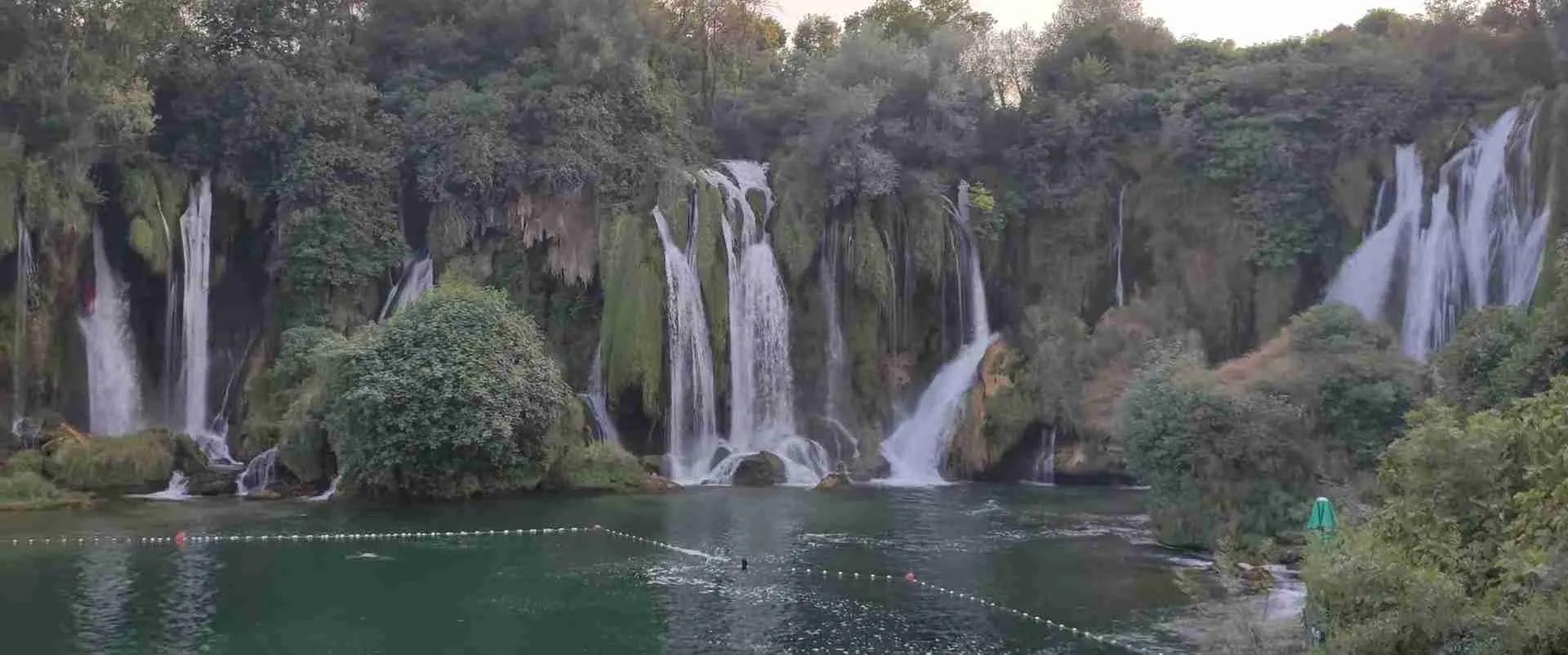
Kravice Waterfalls function as Bosnia and Herzegovina’s premier natural swimming destination, comparable to Croatia’s Plitvice Lakes but permitting direct water access that Croatia restricts. The waterfall formed through millennia of calcium carbonate deposition creating a crescent-shaped tufa barrier 120 meters wide that the Trebizat River now cascades over. Unlike single-drop waterfalls, Kravice presents a curtain effect with dozens of channels braiding across the travertine face, each creating its own microclimate of mist and rainbow light. The amphitheater pool beneath reaches 8-10 meters depth in the center, creating safe swimming zones near the falls while allowing boat tours to approach the curtain for photographs.
Geological uniqueness stems from the karst limestone that dominates Herzegovina. Rainwater dissolving calcium carbonate over millions of years carved underground river systems that occasionally surface at springs and waterfalls. Kravice represents the Trebizat’s largest surface expression, but the river flows underground for kilometers both upstream and downstream. The constant spring-fed source maintains water flow year-round even during summer droughts that dry most Balkan rivers, and keeps temperatures at 18-20°C regardless of air temperature. This makes Kravice uniquely swimmable throughout extended seasons when typical rivers grow too warm or too cold.
Blagaj Tekke occupies an incomparable natural setting where the Buna River emerges from a cave mouth in a 200-meter limestone cliff. The spring ranks among Europe’s strongest karst sources, discharging 43 cubic meters per second of water that traveled underground through the Velez and Prenj mountain ranges before surfacing here. Ottoman dervishes recognized the site’s spiritual power in the 15th century, establishing a tekke (gathering house) directly against the cliff face where meditation rooms cantilever over the spring pool. The current structure dates to 1520 with 2004-2010 reconstruction after 1993 war damage, but archaeological evidence suggests continuous Sufi presence since 1446.
The tekke’s architecture responds specifically to the microclimate created by the cave spring. Summer temperatures near the spring run 5-8°C cooler than surrounding countryside due to underground water at constant 10-12°C emerging from the cave. Winter sees similar temperature inversion with spring warmth preventing ice formation. This created ideal conditions for year-round monastic life in an era before modern heating and cooling. Interior rooms feature wooden mashrabiya screens that regulate natural ventilation, carpeted prayer halls that absorb sound from the roaring spring, and elevated terraces providing spring views from positions of spiritual contemplation.
Pocitelj preserves Ottoman military architecture from the 15th-17th centuries when this fortress controlled the Neretva River trade route connecting Adriatic ports to Sarajevo. The fortified village climbs 100 vertical meters from riverside gate to hilltop tower, with defensive walls, residential quarters, mosques, and commercial buildings arranged to resist siege while maintaining civilian life. Unlike many Balkan fortresses that sit as empty ruins, Pocitelj retains inhabited residential zones where families still live in restored Ottoman houses, creating living history rather than museum pieces.
Architectural significance centers on the Hajji Alija Mosque completed 1562-1563, one of Herzegovina’s finest Ottoman religious buildings with a standalone minaret, central dome, and covered prayer hall demonstrating classical Istanbul influence. The adjacent hammam (bathhouse) ruins show sophisticated hydraulic engineering that supplied hot and cold water through underground ceramic pipes heated by wood fires. The fortress tower at the summit represents earlier medieval construction predating Ottoman conquest, suggesting Pocitelj’s strategic value was recognized by multiple civilizations. This layering of architectural periods from 14th-17th centuries creates a complete timeline of Balkan fortification evolution.
Planning Your Day Trip Route 2026: Logistics and Timing
The standard clockwise circuit follows Mostar to Blagaj 12 kilometers southeast requiring 15-20 minutes, Blagaj to Pocitelj 18 kilometers south needing 25-30 minutes, Pocitelj to Kravice 25 kilometers west taking 35-40 minutes, and Kravice back to Mostar 43 kilometers north completing 50-55 minutes. Total driving time reaches 2-2.5 hours for the complete loop, with exploration time adding 4-5 hours for comprehensive visits to all three destinations. Most organized tours allocate 45-60 minutes at Blagaj, 45-60 minutes at Pocitelj, and 90-120 minutes at Kravice, returning to Mostar after 8-8.5 total hours.
Clockwise routing delivers optimal progression from spiritual to architectural to natural experiences. Blagaj’s monastery visit works best in morning coolness when spring mist creates atmospheric photography and viewing platforms remain empty of tour groups. Pocitelj’s fortress climb proves manageable before midday temperatures peak, as the stone stairs and exposed ramparts offer minimal shade. Kravice benefits from afternoon arrival when swimming appeals most after morning cultural touring, and afternoon light angles perfectly to illuminate the waterfall curtain for photographs. Arriving Kravice at 1:00-2:00 PM also aligns with restaurant lunch service and provides 2-3 hours swimming before 5:00-6:00 PM tour departures.
Counterclockwise routing starting with Kravice morning swimming works for travelers prioritizing waterfall time over cultural visits. Departing Mostar 8:30 AM reaches Kravice 9:30-10:00 AM when parking remains available and swimming platforms uncrowded, allowing 2-3 hours in cooler morning temperatures before departing for Pocitelj lunch and Blagaj afternoon visit. This sequence suffers from afternoon heat during Pocitelj fortress climbs and afternoon crowding at Blagaj when tour buses accumulate, but delivers superior Kravice swimming experience for travelers who view waterfalls as primary attraction and cultural sites as secondary.
Independent travelers with rental cars gain flexibility to adjust timing based on weather and crowds. A common pattern involves Blagaj morning visit 9:00-10:00 AM, Pocitelj 10:30-11:30 AM, lunch at Kravice restaurants 12:00-1:00 PM, then extended waterfall swimming 1:00-4:00 PM before returning to Mostar. This maximizes swimming time while completing cultural visits efficiently. Weather contingency plans should recognize that Blagaj and Pocitelj remain enjoyable in light rain with covered viewing areas and fortress exploration, while Kravice proves disappointing in rain when swimming becomes unappealing and waterfall photography suffers from gray overcast light.
Tour departure times from Mostar typically offer 8:30 AM, 9:00 AM, or 9:30 AM starts, with earlier departures securing better positioning at all three destinations before independent travelers and other tour groups arrive. Hotel pickup adds 15-30 minutes depending on accommodation location, so 8:30 AM departure means 8:00-8:15 AM actual pickup for hotels in Mostar’s Old Town. Return times cluster around 5:00-6:00 PM, providing full-day touring without extending into dinner hours. Private tours offer customizable timing but follow similar patterns since destination opening hours and optimal light conditions create natural scheduling constraints.
Transportation Options and Costs 2026
Organized group tours represent the most popular and cost-effective option for travelers without rental cars, priced €50-60 ($55-66) per person for full-day circuits including hotel pickup, English-speaking guide, and optimized routing to all three destinations. Tour operators provide air-conditioned minivans or small buses holding 8-15 passengers, creating small-group atmosphere while achieving economies of scale that individual travelers cannot match. Pricing typically excludes entrance fees at Kravice €10 and Blagaj €3, plus lunch costs €15-25 at waterfall restaurants, bringing total tour costs to €78-98 ($86-108) per person for complete day experiences.
Tour advantages extend beyond transportation to include cultural context that independent visits miss. Guides explain the Bosnian War’s impact on each destination, detail Ottoman architectural features in Pocitelj’s mosque and hammam, describe Sufi dervish practices at Blagaj Tekke, and share local legends about Kravice’s formation. This storytelling transforms simple sightseeing into cultural education, particularly valuable for first-time Balkans visitors unfamiliar with regional history. Guides also manage timing to avoid crowds, know alternative viewpoints at each destination, and handle restaurant reservations at Kravice where individual travelers face 30-45 minute waits for tables during peak lunch hours.
Car rental provides maximum flexibility for €30-40 ($33-44) daily rates through local Mostar agencies or international chains, with shared costs between two travelers reducing per-person expense to €15-20 ($17-22). Rental requirements include valid driver’s license, passport, and credit card, with minimum age typically 21-23 years depending on vehicle category. Comprehensive insurance adds €10-15 daily but proves essential given Herzegovina’s narrow rural roads and occasional livestock crossings. Fuel costs €15-20 for the complete circuit based on 85 total kilometers at average 7 liters/100km consumption and €1.30-1.40 per liter diesel or petrol pricing.
Self-drive advantages include ability to extend stays at preferred destinations, flexibility to add optional stops like Mogorjelo Roman ruins or Medjugorje pilgrimage site, and freedom to explore without group schedules. Travelers can depart Mostar at preferred times, spend 3 hours swimming at Kravice instead of tour-mandated 90 minutes, or skip destinations entirely if weather or personal interest suggests alternatives. Car access also enables evening returns to Blagaj or Kravice for sunset photography without tour constraints, and allows picnic lunches instead of restaurant costs. However, self-drive requires navigation confidence, parking knowledge at each destination, and comfort with left-side driving and metric road signs.
Parking costs remain modest with Kravice charging €1-2 for all-day lots, Blagaj offering free upper parking or €2 lower lot near monastery entrance, and Pocitelj providing free roadside parking along the main highway. Navigation follows well-marked roads with bilingual signage in Bosnian and English, though GPS or offline maps prove essential for locating specific parking areas at smaller destinations. Road quality varies from excellent four-lane motorway approaching Pocitelj to narrow two-lane rural roads around Kravice where passing requires patience and caution.
Private tours cost €120-150 ($132-165) per person for groups of 2-4 travelers, scaling down to €80-100 per person for groups of 6-8 as fixed costs distribute across more participants. Private tour advantages include personalized pacing where travelers dictate time allocation at each destination, ability to customize routing by adding or removing stops, and dedicated guide attention for questions and photography assistance. Premium private tours €180-220 per person add luxury vehicles, expert historian guides with advanced degrees, and gourmet lunch reservations at Herzegovina’s finest riverside restaurants instead of standard tourist cafeterias.
Taxi combinations theoretically work but prove impractical and expensive for full-day circuits. A Mostar taxi charging €15-20 to Blagaj, €20-25 Blagaj to Pocitelj, €25-30 Pocitelj to Kravice, and €35-40 Kravice return to Mostar totals €95-115 for transportation alone without guiding or cultural context. Wait time fees add €10-15 per hour if drivers wait at destinations instead of departing, pushing total costs to €150-200 for taxi-only touring. This pricing exceeds organized tour costs while delivering inferior experience through lack of guiding and constant time pressure to minimize wait fees.
Kravice Waterfalls Complete Guide 2026
Kravice Waterfalls form a 120-meter-wide travertine amphitheater where the Trebizat River drops 25 meters in a spectacular curtain of water that Bosnia and Herzegovina promotes as the country’s premier natural attraction. The waterfall’s crescent shape creates a protected swimming pool beneath the cascades, with depth varying from 1-2 meters near the shore to 8-10 meters in the center, allowing swimmers of all abilities to find comfortable zones. Unlike many European waterfalls restricted to viewing platforms, Kravice permits direct water access for swimming, wading, and even boat approaches to the waterfall curtain for close-up photography.
Entrance fees cost €10 ($11) for adults in 2026, collected at the main gate from 8:00 AM to 8:00 PM daily, check official website for current rates as pricing may vary. Children under 7 enter free, and students age 7-18 receive discounted €5 ($6) admission with identification. The fee includes access to both Kravice Waterfalls and the smaller Kocusa waterfall 2 kilometers upstream, plus the Humac monastery museum though most visitors skip these secondary attractions. Parking costs €1 per hour or €2 for all-day parking in the upper lot, with closer lower lot charging €3 hourly. Infrastructure includes changing rooms, restrooms, restaurants, and paved walkways to the main viewing platforms, though the final 15-meter descent to water level follows steep stairs that can be slippery when wet.
Swimming season runs April through October with water temperatures remaining remarkably constant at 18-20°C year-round due to underground spring source maintaining consistent temperature regardless of air conditions. April-May air temperatures 15-20°C make swimming feasible only for cold-tolerant visitors, June-September optimal months see 25-35°C air creating perfect swimming weather, and October proves hit-or-miss with warm days allowing pleasant swimming mixed with cool rainy days when swimming loses appeal. July-August weekends attract 200,000+ visitors monthly creating beach-resort density, so serious swimmers should target weekday mornings 9:00-11:00 AM or late afternoons after 4:00 PM when tour groups depart.
Waterfall photography benefits from afternoon light that illuminates the cascade from the side, creating rainbow effects in the mist and emphasizing the three-dimensional layering of water curtains. Morning light leaves the amphitheater in shadow, producing flat images without the drama afternoon angles deliver. The best viewpoint positions at the western edge of the amphitheater where the walkway curves to face the waterfall directly, allowing telephoto compression of the entire 120-meter width. Wide-angle shots work from the eastern shore where swimmers in the foreground provide scale reference against the waterfall backdrop, particularly effective for human-interest storytelling rather than pure landscape photography.
Facilities at Kravice include three restaurants serving traditional Bosnian grilled meats, fresh river trout, salads, and Balkan desserts like tufahija and baklava. Restaurant pricing runs €10-15 for main courses, €3-5 for salads, €2-4 for coffee or soft drinks, positioning meals as moderate expense rather than premium tourist pricing. Outdoor terraces face the waterfall creating spectacular lunch settings, but table waits during peak hours 12:00-2:00 PM can extend 30-45 minutes without reservations. Restaurants do not accept reservations for groups under 10, so independent travelers should either arrive early 11:30 AM or late 2:30 PM to secure tables without extended waits.
Swimming safety requires awareness that water depth increases rapidly from shoreline to center pool, and the waterfall curtain creates strong currents and underwater turbulence dangerous for weak swimmers. Lifeguards monitor the main swimming area but do not provide formal swimming lessons or water safety equipment beyond basic first aid. The riverbed consists of smooth travertine limestone that becomes slippery when algae-covered, requiring careful footing when entering and exiting water. Diving from rocks or platforms is prohibited and enforced through fines, as depth varies unpredictably and submerged rocks create injury hazards.
Equipment recommendations include closed-toe water shoes with rubber soles for navigating slippery approaches, swimwear and quick-dry clothing for comfort after swimming, waterproof phone cases or dry bags for electronics near the spray zone, and polarizing filters for cameras to reduce water surface glare in photographs. Bring cash for entrance fees and restaurant meals as credit card acceptance proves spotty at smaller vendors. Towels can be rented at changing facilities for €3-5 or brought from accommodations. Sunscreen and hats prove essential during summer months as the amphitheater provides limited natural shade, and midday sun reflects intensely off white limestone surroundings.
Blagaj Tekke Monastery Guide 2026
Blagaj Tekke occupies one of Europe’s most dramatic architectural settings, built directly into a 200-meter karst cliff where the Buna River explodes from a cave mouth in Europe’s strongest karst spring. The monastery complex includes the 16th-century tekke (Sufi gathering house) with its characteristic wooden overhangs and prayer rooms, restored residential quarters where dervishes lived in spiritual retreat, a small museum displaying Ottoman-era artifacts, and terraces cantilevered over the spring pool where visitors photograph the emerald water emerging from cave darkness. The setting combines natural wonder with spiritual architecture in ways that few European monuments match.
Entrance fees cost €3 ($3.50) for adults accessing the monastery interior, where visitors tour prayer rooms, residential chambers, a hammam with starred ceiling, and upper-level terraces overlooking the spring source. The exterior setting remains free to view from public walkways and restaurant terraces across the river, where many visitors photograph the tekke’s white facade against limestone cliffs without paying interior admission. This creates a budget-friendly option for travelers prioritizing photography over architectural details, though the interior tour adds valuable context about Sufi dervish practices and Ottoman daily life that exterior views cannot convey.
Dress code requires modest coverage with shoulders and knees covered for both men and women, plus headscarves for women entering prayer rooms. The monastery provides loaner scarves and wraps at the entrance free of charge for visitors without appropriate attire, though bringing personal scarves proves more convenient. Shoes must be removed before entering prayer halls, following Islamic tradition, with shoe racks provided at each entrance. These requirements reflect the tekke’s continued function as an active place of worship where local Sufis still gather for meditation and prayer, not merely a tourist museum.
The Buna spring itself forms the true natural wonder, discharging 43 cubic meters of water per second from the cave mouth in one of Europe’s most powerful karst sources. The spring water originates in the Velez and Prenj mountain ranges 30-40 kilometers distant, flowing underground through limestone channels before surfacing here after a journey that keeps water temperature constant at 10-12°C year-round. This creates a microclimate where air near the spring feels 5-8°C cooler than surrounding countryside in summer and warmer in winter, explaining why Ottoman dervishes chose this location for year-round monastic life before modern climate control existed.
Viewing platforms along the spring edge allow close approach to the cave mouth where water boils up from underground channels, creating impressive photographic compositions with the tekke reflected in the spring pool. The viewing area includes a metal cup attached to the monastery wall for drinking spring water, which local legend claims grants wishes if consumed while making a silent prayer. The water quality meets drinking standards as it emerges directly from underground aquifers without surface contamination, though visitors with sensitive stomachs should exercise normal precautions about unfamiliar water sources.
Restaurants across the river from the tekke provide outdoor terraces with postcard-perfect views of the monastery against its cliff backdrop, serving traditional Bosnian cuisine including fresh river trout from the Buna, cevapi grilled meat, pita pastries, and Bosnian coffee. Prices run €10-20 for main courses, €3-5 for appetizers, €2-3 for coffee, positioning meals as moderate expense. The restaurants operate year-round with reduced hours in winter, and summer terrace seating requires reservations during peak hours 12:00-2:00 PM when tour groups and independent travelers compete for limited tables. Off-peak dining 10:00-11:30 AM or 2:30-4:00 PM avoids waits while maintaining the same riverside ambiance.
Additional walking opportunities include the path behind Restaurant Vrelo that leads to alternative viewpoints photographing the tekke from different angles, particularly effective for sunset shots when western light gilds the monastery’s white walls. The walk requires 10-15 minutes each way on maintained gravel paths that remain accessible for moderate fitness levels. More ambitious hikers can climb to Stjepan Grad fortress ruins atop the cliff above Blagaj, a steep 45-minute ascent on serpentine paths that rewards effort with panoramic views across the Buna Valley and bird’s-eye perspective on the tekke 200 meters below. The fortress climb requires good fitness and sturdy footwear as the path includes loose rocks and minimal shade.
Pocitelj Fortress Village Guide 2026
Pocitelj preserves a complete Ottoman fortified village where limestone buildings climb 100 vertical meters from riverside gate to hilltop fortress tower, creating one of the Balkans’ finest examples of 15th-17th century military architecture still inhabited by resident families. The village served strategic purposes guarding the Neretva River trade route connecting Adriatic ports to Bosnia’s interior, with defensive walls, residential quarters, mosques, hammam ruins, and commercial buildings arranged to resist siege while maintaining civilian life. Unlike many fortress sites that survive only as empty ruins, Pocitelj retains living neighborhoods where families occupy restored Ottoman houses, creating authentic historic atmosphere rather than museum-piece preservation.
Entrance to Pocitelj village is completely free with no admission fees to walk the cobblestone lanes, explore residential quarters, photograph architectural details, or climb partway up the fortress slope. The defensive tower at the summit charges optional €3 ($3.50) for interior access and rampart walks, but many visitors skip this fee and enjoy spectacular valley views from the adjacent hilltop that reaches the same elevation without ticket requirement. This creates genuinely budget-friendly tourism where travelers can experience the complete village atmosphere, climb to high viewpoints, and photograph Ottoman architecture without spending anything beyond parking or refreshments.
The Hajji Alija Mosque represents Pocitelj’s architectural centerpiece, completed 1562-1563 during Herzegovina’s Ottoman golden age when Constantinople’s classical style influenced provincial mosque design throughout the empire. The mosque features a central dome supported by octagonal drum with arched windows, a detached stone minaret rising 35 meters in the Balkan style rather than attached to the prayer hall, and a covered portico where worshippers performed ritual ablutions before prayer. Interior decoration follows austere Islamic prohibition of figurative art, using geometric tile patterns, calligraphic Quranic verses, and carved woodwork to create visual richness without representational imagery.
The mosque courtyard provides shaded rest area with central fountain, marble paving, and stone benches offering respite from summer heat during the climb between lower village and upper fortress. The courtyard functions as social gathering space following Ottoman tradition where religious buildings served community purposes beyond worship, creating informal meeting areas where men discussed business and politics while women conducted separate social exchanges in adjacent residential courtyards. This integration of religious and civic functions characterized Ottoman urban planning throughout the Balkans, with Pocitelj preserving these spatial relationships better than cities where modern development erased historic patterns.
Hammam ruins adjacent to the mosque demonstrate sophisticated Ottoman hydraulic engineering, with underground ceramic pipes that supplied hot and cold water through wood-fired heating systems and gravity-fed aqueducts drawing from hillside springs. The hammam served both hygienic and social functions, providing weekly bathing opportunities in an era before home plumbing while creating gender-segregated social spaces where women could gather outside domestic contexts. Architectural remnants show the classic tripartite layout with changing room, warm room, and hot room that characterized bathhouses from Istanbul to Sarajevo, each dome-covered to create steam retention while providing natural light through star-shaped ceiling apertures.
The fortress tower at Pocitelj’s summit offers 360-degree panoramas across the Neretva Valley, with views extending 15-20 kilometers north toward Mostar, south toward the Croatian border, and west over agricultural plains to distant coastal mountains. The climb requires 20-30 minutes from village gate to tower, ascending steep cobblestone lanes and irregular stone stairs that demand moderate fitness and sturdy footwear. The path passes through residential zones where laundry hangs from Ottoman balconies and cats sun themselves on limestone doorsteps, creating incongruous juxtapositions of medieval architecture and contemporary domestic life.
Photography opportunities throughout Pocitelj emphasize the vertical village composition with white limestone buildings stacked up the hillside, creating graphic images of stairs and archways that architectural photographers particularly prize. The stone fortress tower provides foreground elements for wide-angle compositions that include the mosque minaret and river valley, while narrow lanes through residential quarters offer intimate details of wooden doors, wrought-iron window grilles, and climbing jasmine vines against weathered walls. Late afternoon light angles across the hillside creating dramatic shadows that emphasize architectural relief, though morning light works equally well for south-facing village perspectives.
Visitor facilities in Pocitelj include small restaurants and cafes serving traditional Bosnian coffee, fresh-squeezed pomegranate juice from local orchards, and light meals like burek pastry and pita. Prices reflect village rather than tourist pricing with coffee €1-2, juice €2-3, snacks €3-5, making Pocitelj the day trip’s most affordable refreshment stop. Artisan shops along the main lane sell hand-woven textiles, traditional copper coffee sets, miniature ceramics, and watercolor paintings of village scenes, providing authentic souvenirs at prices well below Mostar’s Old Bazaar tourist rates. These shops support families who maintained residence in Pocitelj through war destruction and subsequent reconstruction, making purchases direct contributions to the village’s continued vitality.
Day Trip Cost Breakdown by Budget Tier 2026
Budget travelers completing the Kravice-Pocitelj-Blagaj circuit independently with shared car rental spend €43-56 ($47-62) per person for comprehensive day trips in 2026. Car rental €30-40 daily divided between two travelers costs €15-20 per person, entrance fees total €13 with Kravice €10 and Blagaj €3, lunch at Kravice waterfall restaurants runs €10-15 for traditional grills or trout, and coffee or snacks at Pocitelj add €5-8. Fuel costs €8-10 per person when two share, and parking fees across three destinations total €3-4. This budget tier requires advance car reservation, comfort with self-navigation, and willingness to skip guided context in exchange for cost savings and scheduling flexibility.
Mid-range travelers joining organized group tours pay €86-110 ($95-121) per person for complete day experiences including professional guiding and cultural interpretation. Tour costs €50-60 cover transport, English-speaking guide, and hotel pickup, while entrance fees €13 for Kravice and Blagaj add to tour price. Restaurant lunch at Kravice costs €15-25 for main course plus appetizer and drink, coffee or snacks at Blagaj or Pocitelj run €8-12, and optional gratuities for guides typically €5-10 based on service quality. This tier delivers optimal value through expert logistics that maximize site time while minimizing transit delays, plus cultural storytelling that independent visits cannot replicate without advance research.
Luxury travelers booking private guides with customized itineraries invest €173-223 ($190-245) per person for premium day touring experiences. Private tour costs €120-150 per person for groups of 2-4 include dedicated guide, luxury vehicle, and flexible pacing allowing extended stays at preferred destinations, entrance fees €13 for Kravice and Blagaj, upscale restaurant lunch €30-45 at Herzegovina’s finest riverside establishments with reserved terrace seating and traditional meze appetizers, coffee and refreshments €10-15 at premium venues, and gratuities €10-20 for exceptional private guide service. This tier suits travelers valuing personalized attention, expert photography assistance, and freedom from group schedules.
Additional cost considerations include swimwear rental or towel rental €3-5 at Kravice for travelers without beach equipment, waterproof phone cases or dry bags €5-10 for electronics protection near waterfalls, bottled water €1-2 per person throughout the day, and afternoon ice cream or refreshments €3-5 per person. Souvenir purchases at Pocitelj’s artisan shops vary widely from €5 ceramics to €50 woven textiles depending on quality and size. Photography equipment rental is not available at any destination, so travelers should bring cameras from accommodations or rely on smartphones for image capture.
Sample Day Trip Itineraries 2026
Budget Self-Drive Itinerary (€43-56 per person)
08:00 AM – Depart Mostar in rental car, drive 12 kilometers to Blagaj arriving 8:20 AM for uncrowded monastery photography. Park in free upper lot and walk 5 minutes to tekke entrance.
08:30 AM – Tour Blagaj Tekke interior €3 entrance for 30 minutes, viewing prayer rooms, residential quarters, and spring-view terraces. Photograph monastery exterior from public walkways across river.
09:15 AM – Drive 18 kilometers to Pocitelj, arriving 9:45 AM. Park roadside free and climb village lanes to fortress viewpoint, exploring mosque courtyard and hammam ruins along ascent.
10:45 AM – Depart Pocitelj, drive 25 kilometers to Kravice Waterfalls arriving 11:30 AM. Pay €10 entrance and €2 all-day parking. Change into swimwear and claim waterfront position before lunch crowds.
12:00 PM – Lunch at waterfall restaurant €12 for grilled meats or fresh trout, €2 for soft drink. Reserve table early or face 30-minute waits during peak service.
01:00 PM – Extended swimming and waterfall photography through afternoon, taking advantage of optimal light angles 2:00-4:00 PM for rainbow effects in mist.
04:30 PM – Depart Kravice, drive 43 kilometers direct to Mostar arriving 5:30 PM. Total costs: car rental €15-20, fuel €8-10, entrance fees €13, lunch €12, snacks €5, parking €4. Total €43-56 per person.
Mid-Range Group Tour Itinerary (€86-110 per person)
08:00 AM – Hotel pickup in Mostar Old Town, join small group 8-12 travelers in air-conditioned minivan. Guide provides Herzegovina overview during 15-minute drive to Blagaj.
08:30 AM – Blagaj Tekke guided tour including monastery interior €3 entrance, spring source viewing, and cultural context about Sufi dervish practices. Guide explains war damage and reconstruction history.
09:30 AM – Drive to Pocitelj with guide commentary about Ottoman fortress strategy and village role in Neretva trade routes. Arrive 10:00 AM for guided village walk.
10:15 AM – Climb Pocitelj lanes to fortress viewpoint, learning about Hajji Alija Mosque architecture and hammam social functions. Guide manages timing to complete climb before midday heat.
11:15 AM – Drive to Kravice with lunch recommendations and swimming logistics explained. Arrive 12:00 PM for €10 entrance, changing facilities, and waterfall orientation.
12:30 PM – Group lunch at reserved restaurant tables €20 for main course and drink, avoiding waits that plague independent travelers. Guide arranges seating with optimal waterfall views.
01:30 PM – Free time for swimming, waterfall walks, and photography until 3:30 PM departure. Guide available for questions and photo assistance throughout.
04:00 PM – Return drive to Mostar with final questions and guide recommendations for evening dining. Hotel drop-off 5:00-5:30 PM. Total costs: tour €55, entrance fees €13, lunch €20, snacks €10, gratuity €8. Total €106 per person.
Luxury Private Tour Itinerary (€173-223 per person)
08:30 AM – Private guide and luxury SUV pickup at Mostar hotel. Flexible departure time based on guest preferences, route customizable throughout day.
09:00 AM – Blagaj arrival for uncrowded monastery tour with expert architectural commentary. Guide arranges private photography session at optimal spring viewpoints. Entrance €3 included.
10:00 AM – Coffee break at riverside cafe €5 with guide sharing local legends and historical context about Buna spring’s geological formation.
10:45 AM – Pocitelj arrival for private village tour emphasizing Ottoman military architecture and preservation challenges. Extended fortress time allows photography at multiple viewpoints.
12:00 PM – Drive to Kravice with optional stop at Mogorjelo Roman villa ruins if guests request archaeological addition. Arrive 12:45 PM for €10 entrance.
01:00 PM – Gourmet lunch at Herzegovina’s finest waterfall restaurant €40 with reserved terrace table, traditional meze appetizers, fresh grilled fish or lamb, house wine, and Bosnian coffee.
02:30 PM – Extended swimming and relaxation with guide available for questions but respecting guest privacy. Photography assistance for waterfall compositions and family portraits.
05:00 PM – Departure timing flexible based on guest energy, with option to extend Kravice stay or add sunset return to Blagaj for evening monastery photography.
06:30 PM – Mostar return with guide recommendations for evening activities and dinner reservations arranged at guest-requested restaurants. Total costs: private tour €140, entrance fees €13, lunch €40, refreshments €15, gratuity €15. Total €223 per person.
Best Time to Visit for Optimal Conditions 2026
June and September represent ideal months for the Kravice-Pocitelj-Blagaj circuit, combining excellent weather with manageable crowds and optimal photography light. June temperatures average 25-30°C with warm sunny days perfect for waterfall swimming, spring wildflowers blooming across Herzegovina hillsides, and tour group numbers 40-50% below July-August peaks. September delivers similar temperatures 23-28°C with autumn light creating golden hour warmth, grape harvest season filling Neretva Valley vineyards, and post-summer shoulder pricing reducing accommodation costs in Mostar by 20-30% while maintaining full operational hours at all three destinations.
July and August offer hottest swimming conditions with 30-35°C air temperatures making Kravice’s 18-20°C water feel refreshing rather than cold, but crowd levels reach annual peaks with 200,000+ monthly visitors at Kravice alone creating beach-resort density. Parking lots fill by 11:00 AM requiring backup parking 500+ meters from entrance, restaurant waits extend to 45-60 minutes without reservations, and viewing platforms at Blagaj jam with selfie-takers eliminating opportunities for clean architectural photographs. Travelers visiting July-August should join organized tours that secure morning arrival times, or plan weekday visits avoiding Saturday-Sunday weekend crowds when domestic tourists from Sarajevo and Croatian coastal resorts add to international visitor numbers.
April-May shoulder season delivers excellent value with mild temperatures 18-25°C suitable for active touring and fortress climbing, wildflower meadows at peak bloom creating spectacular photography foregrounds, and minimal crowds allowing relaxed exploration without time pressure. Swimming at Kravice proves marginal in April with 16-18°C water temperature that only cold-tolerant swimmers enjoy, improving to comfortable 18-20°C by mid-May. Some years see April rain showers 2-3 days weekly that dampen outdoor touring, but May weather stabilizes to reliable sunshine. Accommodation pricing in Mostar drops 30-40% below summer peaks, and restaurant service at all three destinations maintains quality without summer stress that affects staff during peak months.
October extends the season into autumn with 20-25°C temperatures remaining pleasant for touring and swimming, autumn foliage adding gold and orange tones to landscape photography, and crowds thinning to spring shoulder levels after school terms resume. Water temperature at Kravice maintains summer’s 18-20°C due to constant spring source, so swimming remains viable through early October before air temperatures drop enough to make post-swim drying uncomfortable. Weather reliability decreases after mid-October when Mediterranean storm systems bring multiday rain episodes, but early October generally provides stable conditions comparable to September.
November-March winter season sees Kravice attendance drop to local visitors only, Blagaj becomes atmospheric in misty conditions when spring steam creates dramatic photography, and Pocitelj’s fortress walks feel authentically medieval without tourist crowds. Swimming at Kravice becomes impractical as 18-20°C water feels too cold when air temperatures range 5-15°C, some waterfall restaurants close for winter season, and reduced daylight hours 9:00 AM-5:00 PM limit touring time. However, winter visits deliver budget advantages with Mostar accommodation 50-60% below summer rates, empty viewing platforms at all three destinations, and guides providing undivided attention on rare winter tours. Travelers should confirm restaurant operating hours before visiting as many Herzegovina establishments reduce to weekend-only winter service.
Practical Tips and Money-Saving Strategies 2026
Book organized tours through local Mostar operators rather than international booking platforms to save 15-20% on identical services. Mostar-based companies like Meet Bosnia Tours, Herzegovina Explorer, and local hostel tour programs charge €45-55 versus €65-75 through GetYourGuide or Viator for the same circuit. Local booking also enables direct communication for special requests, dietary restrictions, or pickup logistics that platform bookings handle through intermediaries. Pay cash in euros or Bosnian marks to avoid credit card processing fees that some small operators add, and inquire about multi-tour discounts if planning additional Mostar excursions during your stay.
Combine car rental among multiple travelers to distribute fixed costs across more participants. A €35 daily rental split four ways costs €8.75 per person versus €17.50 for couples, substantially reducing the budget tier threshold. Rental agencies typically permit 3-4 adult passengers in compact cars and 5-6 in larger vehicles, so hostels and hotels often facilitate cost-sharing among solo travelers planning identical routes. Verify insurance coverage before assuming passengers share liability, as some policies cover only the named driver for accident claims.
Pack picnic lunches from Mostar bakeries and markets to avoid €15-25 restaurant meals at Kravice. Fresh burek pastries cost €2-3, local cheese and prosciutto €5-8, seasonal fruit €3-5, and bottled water €1-2, creating €10-15 picnic meals for two versus €30-50 restaurant costs for identical food quality. Kravice permits outside food with designated picnic areas providing tables and waste bins, though purchasing drinks or coffee from waterfall cafes maintains basic courtesy toward businesses that maintain facilities. This strategy proves especially effective for families with children who consume expensive tourist-menu meals slowly while preferring familiar snack foods over traditional Bosnian cuisine.
Visit Kravice outside 8:00 AM-8:00 PM fee collection hours to save €10 per person admission. Early arrivals before 8:00 AM or late entries after 8:00 PM pay nothing as gate staff depart, though parking still costs €1-2 at automated lots. Early morning visits deliver the added benefit of empty swimming platforms and optimal wildlife viewing as birds and turtles frequent the amphitheater before human crowds arrive. Late entry works for sunset photography when waterfall lighting creates dramatic golden hour images, though swimming after dark proves dangerous without natural light to reveal underwater hazards. This loophole exists because Herzegovina tourism infrastructure lacks 24-hour staffing budgets, not as official policy encouraging free access.
Download offline Google Maps for Herzegovina region before departing Mostar to avoid mobile data charges for navigation. The complete 85-kilometer circuit including all three destinations fits within 50MB offline map download, providing turn-by-turn directions without cellular connection. This proves especially valuable in rural areas between Pocitelj and Kravice where mobile coverage becomes spotty and data speeds drop to 3G. Offline maps also enable navigation if rental car lacks GPS, saving €5-10 daily GPS rental fees that some agencies charge.
Bring refillable water bottles to fill at Blagaj’s monastery spring where legendary water flows free from the cave source, saving €1-2 per bottled water purchase throughout the day. The spring water meets drinking standards and tastes crisp from underground filtration, providing authentic local experience while eliminating plastic bottle waste. Multiple refills across a hot summer day save €5-8 per person in bottled water costs while accessing the same source that supplied Ottoman dervishes for five centuries.
Purchase entrance tickets with cash in Bosnian marks rather than euros to avoid unfavorable exchange rates. Kravice accepts both currencies but calculates euro prices at rounded exchange rates favoring the vendor, so €10 admission equals 20 marks at official 1.95 exchange versus the accurate 19.50 marks if paying euros. ATMs in Mostar provide marks at bank exchange rates, making currency withdrawal worthwhile for travelers planning multiple paid admissions. However, restaurants and shops increasingly prefer euros due to price stability, so maintaining both currencies proves most flexible.
What to Bring: Essential Packing List 2026
Swimwear and quick-dry towels rank as highest priority items for Kravice waterfall swimming, along with water shoes or closed-toe sandals with rubber soles for navigating slippery travertine approaches to the swimming pool. Standard flip-flops prove dangerously inadequate on wet limestone where algae creates ice-rink conditions, causing ankle sprains and falls that emergency services respond to weekly during peak season. Water shoes with drainage holes dry quickly between swimming sessions and protect feet from sharp rocks underwater, while also serving as walking shoes for riverside trails. Pack swimwear in carry-on bags rather than checked luggage to ensure availability if joining spontaneous day trips from Mostar hotels.
Sun protection becomes critical during summer touring when Herzegovina’s Mediterranean climate delivers intense ultraviolet radiation reflected off white limestone at all three destinations. Sunscreen SPF 30-50 should be reapplied every 2 hours during waterfall swimming as water washes product off skin, wide-brimmed hats provide head and face shade during fortress climbs at Pocitelj, and UV-blocking sunglasses reduce eye strain from bright reflections off water and stone. Lightweight long-sleeve shirts in moisture-wicking fabric offer chemical-free sun protection while maintaining comfort in 30-35°C temperatures, and convert to modest coverage for Blagaj monastery visits.
Modest clothing for Blagaj Tekke monastery visits requires shoulders and knees covered, with headscarves for women entering prayer rooms. While the monastery provides loaner scarves, bringing personal lightweight scarves proves more hygienic and allows color coordination for photographs. Men should wear long pants rather than shorts, and women need skirts below knee or full-length pants. These items double as sun protection and bus air-conditioning defense, making them practical additions beyond religious requirements. Pack modest clothing in day bags rather than wearing it all day, as Herzegovina heat makes long sleeves uncomfortable until Blagaj monastery access requires coverage.
Cash in a mix of euros and Bosnian marks enables payment flexibility across different vendors who prefer different currencies. Kravice and Blagaj entrance fees accept both currencies but offer better value paying marks, while restaurants increasingly price menus in euros for stability. ATMs in Mostar dispense marks at standard bank exchange rates, making currency withdrawal more efficient than exchanging euros at bureau de change booths that charge 3-5% commissions. Carry €50-100 cash per person to cover entrance fees, meals, parking, and emergency contingencies, as rural Herzegovina lacks credit card infrastructure that major cities provide.
Photography equipment should include waterproof camera or phone cases for spray-zone shooting near Kravice’s waterfall curtain, polarizing filters to reduce water surface glare and enhance underwater visibility, and backup batteries or power banks since waterfall photography depletes charge rapidly through constant LCD screen use. Telephoto lenses 70-200mm compress Kravice’s curtain effectively from safe viewing distance, while wide-angle 16-35mm captures the amphitheater’s scale including swimmers for foreground interest. Tripods prove awkward during group tours with limited time at each location, but monopods provide stabilization without setup delays. Memory cards should offer 32GB minimum capacity for day-long shooting, and backup storage prevents disaster if primary cards fail or get lost.
Small day packs or waterproof dry bags carry essentials between car or tour bus and swimming areas, protecting electronics and clothing from water damage. Look for bags with both shoulder straps and waist belts for hands-free carrying during fortress climbs, and external water bottle pockets for easy hydration access. Compression stuff sacks organize wet swimwear and damp towels separately from dry clothing and cameras, preventing moisture transfer that damages electronics. Total pack weight should remain under 5 kilograms for comfortable all-day carrying across three destinations with varied terrain.
Photography Guide: Capturing Each Destination 2026
Kravice Waterfalls photography succeeds through timing that exploits changing light angles throughout the day. Morning light 8:00-11:00 AM illuminates the amphitheater evenly but creates flat frontal lighting that lacks the drama landscape photographers seek. Afternoon light 2:00-5:00 PM angles from the west creating side illumination that emphasizes the waterfall’s three-dimensional curtain structure, produces rainbow effects in the mist, and creates depth through shadow gradients. The absolute optimal window runs 3:00-4:00 PM when sun elevation creates maximum rainbow visibility while maintaining enough intensity for fast shutter speeds that freeze water motion.
Waterfall photography techniques balance competing goals of freezing water droplets versus creating silky motion blur. Fast shutter speeds 1/500-1/1000 second freeze individual water streams creating dramatic texture detail, while slow speeds 1/4-1 second blur motion into smooth white curtains that emphasize flow over detail. Polarizing filters reduce surface glare allowing clearer underwater rock visibility and deeper color saturation in the swimming pool’s emerald tones. Neutral density filters enable long exposures even in bright afternoon light, creating ethereal mist effects around the waterfall base. Bracketing exposures captures both bright waterfall highlights and dark cave shadows in the cliff face, later combined through HDR processing for maximum dynamic range.
Compositional approaches at Kravice vary from wide-angle establishing shots that include the entire 120-meter curtain with swimmers providing scale reference, to telephoto compressed perspectives that stack multiple water channels creating curtain density, to human-interest scenes of children playing in the pools or families picnicking on the amphitheater shore. The western viewing platform provides optimal vantage for full-width shots, the eastern shore allows foreground swimmers against waterfall backdrops, and elevated positions above the main pool (accessed via side trails) deliver bird’s-eye angles showing the amphitheater’s crescent geometry.
Blagaj Tekke photography centers on the monastery’s impossible cliff-face position where white Ottoman architecture contrasts with dark limestone and emerald spring water. The classic viewpoint positions across the river on the public walkway behind Restaurant Vrelo, where the complete monastery reflects in the spring pool with cave mouth visible behind. Shoot this composition during golden hour 5:30-7:00 PM when warm evening light gilds the monastery’s white walls while the cliff face remains in blue shadow, creating maximum color separation. Wide-angle lenses 16-24mm capture the complete scene including cliff height, while standard 35-50mm focal lengths crop tighter on the monastery’s architectural details.
Alternative Blagaj perspectives include the spring source close-up showing water boiling from the cave mouth, the monastery’s overhanging wooden balconies shot from below emphasizing cantilever construction, and interior prayer room details highlighting geometric Islamic tile patterns and carved wooden screens. The hilltop Stjepan Grad fortress above Blagaj provides dramatic aerial perspective on the monastery 200 meters below, though the 45-minute steep climb deters most photographers. This elevated view works best during early morning when Blagaj village emerges from mist creating atmospheric layered composition.
Pocitelj fortress photography exploits the vertical village composition where white limestone buildings stack up the hillside creating graphic lines and geometric shapes. Shoot from the highway below for compressed telephoto perspectives that stack buildings into dense patterns, or from within the village for wide-angle architectural details emphasizing stone texture and age-worn surfaces. The fortress tower at the summit provides 360-degree panoramas, with the best single composition facing northeast over the mosque minaret toward Mostar direction framed by defensive ramparts in the foreground.
Architectural detail photography in Pocitelj focuses on weathered wooden doors with wrought-iron hardware, the mosque’s octagonal dome with arched windows creating light patterns, hammam star-ceiling apertures casting geometric shadows, and laundry hanging from Ottoman balconies creating contemporary-meets-historical juxtapositions. Narrow village lanes create natural framing for compositions that lead viewer eyes up staircases toward fortress, while archways and passages provide foreground elements that add depth to landscape shots of the Neretva Valley beyond. Late afternoon side-light emphasizes stone relief texture and creates dramatic shadows across building facades.
Family Travel Considerations 2026
The Kravice-Pocitelj-Blagaj circuit proves generally family-friendly for children age 6 and older who can manage moderate walking and stair climbing, though each destination presents specific challenges that parents should understand before booking. Kravice Waterfalls offers the most child-appropriate activities with safe swimming in supervised areas, playground equipment near the entrance, and restaurant menus including familiar foods like chicken nuggets and pizza alongside traditional Bosnian cuisine. Children under 7 enter Kravice free, and ages 7-18 receive €5 discounted admission with identification, creating family-friendly pricing that accommodates multi-child travel budgets.
Swimming safety at Kravice requires adult supervision as water depth increases rapidly from 1-2 meters near shore to 8-10 meters in the center pool where children cannot touch bottom. Lifeguards monitor the main swimming area but focus on emergency response rather than proactive child watching, so parents remain fully responsible for young swimmers. The waterfall curtain creates strong currents and turbulence dangerous for weak swimmers, making this area off-limits for children regardless of swimming ability. Non-swimming children enjoy wading in the shallow shore zones, walking riverside trails to smaller cascades, and feeding ducks that frequent the quieter pool margins.
Pocitelj presents the most challenging family destination due to steep cobblestone lanes and irregular stone stairs climbing 100 vertical meters from village entrance to fortress summit. Strollers prove completely impractical requiring baby-wearing for infants and toddlers, young children tire quickly during the ascent necessitating frequent rest breaks in shaded mosque courtyard or cafe terraces, and the fortress tower’s narrow interior stairs with limited railings create falls hazards for unattended children. Families with children under 8 should consider skipping the complete fortress climb and limiting Pocitelj visits to lower village exploration around the mosque and hammam ruins where walking remains manageable.
However, children who successfully summit Pocitelj’s fortress gain enormous satisfaction from the achievement and 360-degree panoramas that reward effort more tangibly than many cultural sites. Make the climb adventure-oriented rather than educational, setting modest goals like reaching the next archway or counting defensive arrow-slits in fortress walls. Pack trail snacks and water bottles to provide energy boosts at rest stops, and time the climb for late afternoon when temperatures moderate and the accomplishment of reaching the top can transition directly into dinner rather than forcing tired children through additional touring.
Blagaj Tekke requires modest dress and quiet behavior appropriate for an active place of worship, creating challenges for energetic young children who struggle with behavioral constraints. The monastery visit takes 30-45 minutes including interior tour and spring viewing, a duration most children tolerate if framed as brief spiritual experience before returning to outdoor activities. Shoes-off requirements in prayer rooms create logistical complications for families, so bring slip-on footwear that children can manage independently rather than tied shoes requiring adult assistance. The spring pool’s edge lacks safety barriers making young children falls hazards, so maintain hand-holding near water.
Restaurant dining across all three destinations accommodates families through outdoor terraces where children can move freely without disturbing other diners, menus including plain grilled meats and vegetables suitable for picky eaters, and tolerance for shared plates and special requests that formal restaurants sometimes resist. High chairs remain uncommon at Herzegovina establishments, so families with toddlers should plan to hold young children during meals or bring portable booster seats. Changing facilities at Kravice provide family-friendly infrastructure, but Blagaj and Pocitelj lack dedicated changing tables requiring improvisational solutions in restaurant bathrooms.
Organized family tours often prove superior to independent travel by managing logistics that drain parental energy. Guides entertain children with age-appropriate stories about fortress sieges and legendary spring creatures, handle restaurant reservations that eliminate waiting with hungry kids, and adjust pacing based on family energy levels rather than fixed schedules. Private family tours €120-180 total for a family of four cost only €30-45 per person while delivering complete flexibility to skip destinations if children melt down or extend swimming time if Kravice proves the hit activity. This represents excellent value compared to managing car rental, navigation, parking, and three destination logistics while simultaneously supervising active children.
Combining with Other Mostar Day Trips 2026
The Kravice-Pocitelj-Blagaj circuit pairs naturally with other Herzegovina excursions for travelers spending 3-4 days in Mostar region. The Neretva River rafting trip combines whitewater adventure with cultural touring, covering rapids sections north of Mostar where limestone canyons create class II-III whitewater suitable for beginners, passing medieval bridges and Ottoman watermills that illustrate traditional Herzegovina irrigation methods, and concluding at Mostar’s Stari Most bridge where raft trips traditionally end. Full-day rafting costs €40-60 per person including guide, equipment, and return transport, and works well as Day 2 after the Kravice circuit provides Day 1 introduction to Herzegovina landscape.
Medjugorje pilgrimage site draws 1-million+ annual Catholic visitors who report Virgin Mary apparitions beginning 1981 and continuing through present day according to local seers. The pilgrimage complex 30 kilometers from Mostar includes Apparition Hill where visions allegedly occurred, St. James Church where daily services accommodate thousands, and a Franciscan monastery housing religious artifacts. Organized tours €25-35 from Mostar combine Medjugorje with Kravice or Blagaj, creating half-day religious itineraries for Christian travelers. Non-religious visitors often find Medjugorje interesting for commercialization contrasts with Bosnia’s Islamic heritage sites, though the site proves less compelling without faith-based motivation.
Mogorjelo Roman villa ruins 5 kilometers from Pocitelj preserve one of the Balkans’ finest examples of late-empire country estates, with mosaic floors depicting mythological scenes, hypocaust underfloor heating systems demonstrating Roman engineering, and defensive walls showing the villa’s evolution from luxury retreat to fortified refuge during barbarian invasions. Archaeological significance rivals better-known Croatian sites like Diocletian’s Palace, but tourism infrastructure remains minimal with free admission, minimal signage, and no guided tours. Independent travelers with archaeological interest should allocate 45-60 minutes for Mogorjelo exploration, easily added to Kravice-Pocitelj-Blagaj circuits with minimal backtracking since the villa sits directly on the route between these destinations.
Sarajevo day trips from Mostar prove ambitious but feasible for travelers without time to overnight in Bosnia’s capital. The 130-kilometer drive takes 2-2.5 hours each way via excellent motorway, allowing 4-5 hours Sarajevo exploration if departing Mostar 7:00 AM and returning 7:00-8:00 PM. Sarajevo highlights include Bascarsija Ottoman bazaar rivaling Istanbul’s covered markets, Latin Bridge where Archduke Franz Ferdinand’s 1914 assassination triggered World War I, Tunnel Museum documenting the 1992-1995 siege, and panoramic views from surrounding mountains. This works best as Day 3 or 4 after the Kravice circuit and Neretva rafting provide relaxed introduction to Herzegovina, as Sarajevo’s heavier historical content requires fresh energy and emotional capacity.
Frequently Asked Questions About Mostar Day Trips 2026
Is one day enough to visit Kravice Waterfalls, Pocitelj, and Blagaj from Mostar?
Yes, one day provides adequate time to visit all three destinations with 45-60 minutes exploration at Blagaj Tekke, 45-60 minutes at Pocitelj fortress village, and 90-120 minutes at Kravice Waterfalls including swimming and lunch. Organized tours departing Mostar 8:30-9:00 AM return 5:00-6:00 PM, allocating sufficient time at each location without feeling rushed while managing 2.5 hours total driving between destinations. Independent travelers with rental cars can extend Kravice swimming to 3 hours if desired by reducing time at cultural sites to 30 minutes each, creating flexible schedules based on personal priorities. However, travelers attempting to add fourth destinations like Medjugorje or Mogorjelo create overly compressed schedules that reduce enjoyment at all locations through constant time pressure.
Do I need a tour guide or can I visit independently?
Independent visits work perfectly well for travelers comfortable with self-navigation and willing to skip cultural context that professional guides provide. The three destinations require no special access or insider knowledge to explore effectively, entrance procedures prove straightforward with clearly marked ticket booths, and restaurant availability at all locations eliminates meal planning complexity. However, organized tours deliver cultural storytelling about Sufi dervish practices at Blagaj, Ottoman military architecture at Pocitelj, and Herzegovina geology at Kravice that independent visits cannot replicate without extensive advance research. Tours also optimize timing to minimize crowds, handle restaurant reservations avoiding 30-45 minute waits, and provide transportation logistics that prove challenging in rural areas lacking reliable public transit.
What’s included in typical tour prices from Mostar?
Standard group tours priced €50-60 ($55-66) include round-trip transportation in air-conditioned vehicles, English-speaking guide throughout the day, hotel pickup and drop-off in central Mostar, and routing that visits all three destinations in optimal sequence. Tours typically exclude entrance fees at Kravice €10 and Blagaj €3, lunch costs €15-25 at waterfall restaurants, and optional gratuities €5-10 for guides based on service quality. Some premium tours €75-85 include entrance fees and lunch in all-inclusive pricing, while budget operators €40-50 use older vehicles with larger group sizes 15-20 passengers instead of premium small groups 8-12 travelers. Always verify exact inclusions before booking to avoid surprise costs at destination entrances.
Can I swim at Kravice Waterfalls year-round in 2026?
Swimming remains technically possible year-round as water temperature maintains constant 18-20°C from underground spring source regardless of season, but practical swimming season runs April through October when air temperatures make post-swim drying comfortable. April-May water feels cold for most swimmers at 16-18°C air temperatures, June-September delivers optimal swimming conditions with 25-35°C air creating refreshing contrast with cool water, and October extends the season into autumn with 20-25°C pleasant conditions. November-March sees water temperature unchanged at 18-20°C but air temperatures 5-15°C make swimming impractical as shivering begins immediately upon exiting water, and many waterfall facilities including changing rooms and restaurants close for winter season reducing infrastructure support.
Are the destinations wheelchair accessible?
Unfortunately none of the three destinations offers complete wheelchair accessibility due to historic infrastructure predating modern accessibility standards. Kravice Waterfalls requires steep staircase descent 15 meters to reach waterside viewing platforms, though upper parking areas provide distant waterfall views for mobility-limited visitors willing to forego swimming access. Blagaj Tekke monastery requires stair climbing to reach interior prayer rooms and upper terraces, though exterior viewing from riverside pathways across the spring proves accessible via relatively flat paved walks. Pocitelj fortress presents the greatest challenges with steep cobblestone lanes and irregular stone stairs climbing 100 vertical meters making wheelchair access impossible beyond the village entrance gate. Travelers with mobility limitations should consider organized tours that adjust itineraries based on individual capabilities rather than attempting independent visits.
What currency should I bring for the day trip?
Bring a mix of euros and Bosnian marks (BAM/KM) for optimal payment flexibility, as vendors accept both currencies but offer better exchange rates when paying in marks. Entrance fees at Kravice and Blagaj accept both currencies at roughly 2:1 exchange rate, so €10 equals 20 marks or €3 equals 6 marks, but exact mark pricing proves slightly favorable. Restaurants increasingly price menus in euros for stability though most also calculate mark equivalents, while small vendors and parking lots prefer marks. ATMs in Mostar dispense marks at standard bank rates making cash withdrawal worthwhile before departing on day trips, though carrying €50-100 provides backup for establishments preferring euro payment. Credit cards see limited acceptance in rural Herzegovina with many restaurants and all parking lots operating cash-only.
Is it safe to drink the water at Blagaj spring?
Yes, water emerging from Blagaj’s karst spring meets drinking safety standards as it flows directly from underground aquifers without surface contamination, and locals have consumed this spring water for centuries without health issues. The monastery provides a metal cup attached to the wall specifically for drinking spring water, following traditions where consuming the water while making silent wishes supposedly grants prayers. However, travelers with sensitive digestive systems should exercise normal precautions about unfamiliar water sources, as mineral content and bacterial flora differ from home tap water potentially causing temporary digestive adjustment. Bottled water remains available from monastery area vendors for travelers preferring commercially sealed options, though spring water provides authentic local experience while eliminating plastic waste.
Can I visit during Ramadan or other Islamic holidays?
Yes, all three destinations remain open during Ramadan and Islamic holidays, though Blagaj Tekke observes modified hours during prayer times when the monastery may close briefly for religious services. Ramadan creates unique visiting opportunities as breaking-fast meals at sunset feature traditional foods rarely available other months, and evening atmosphere at Blagaj becomes particularly spiritual when local Muslims gather for prayers. However, restaurant service may slow during daylight fasting hours as Muslim staff abstain from food preparation tastings, and some establishments reduce lunch service focusing on evening iftar meals instead. Travelers should research specific Islamic holiday dates for 2026 as calendar shifts annually based on lunar cycles, with major holidays like Eid al-Fitr and Eid al-Adha sometimes creating extra crowds as domestic tourism peaks.
How crowded do the destinations get in July and August 2026?
July-August represents peak season with Kravice Waterfalls hosting 200,000+ monthly visitors creating beach-resort density, parking lots filling by 11:00 AM requiring overflow parking 500+ meters from entrance, restaurant waits extending 45-60 minutes without reservations, and swimming platforms becoming crowded with limited personal space. Blagaj Tekke sees similar summer peaks though the monastery’s indoor spaces limit simultaneous visitors reducing crowding perception, while viewing platforms across the spring accumulate selfie-takers eliminating clean architectural photograph opportunities. Pocitelj manages crowds better through vertical village layout that disperses visitors across multiple elevation levels, though the single fortress tower creates bottlenecks during peak hours. Travelers visiting July-August should join organized tours securing morning arrival times, or plan weekday visits avoiding Saturday-Sunday when domestic tourists from Sarajevo and Croatian coastal resorts compound international visitor numbers.
What should I do if it rains during my day trip?
Light rain creates atmospheric photography opportunities at all three destinations with mist enhancing waterfall drama, spring steam increasing at Blagaj when cool rain meets warm spring water, and fewer crowds improving exploration comfort. Pack lightweight rain jackets rather than umbrellas as both hands remain needed for camera equipment and stair railings, and waterproof camera covers protect electronics during outdoor shooting. Heavy rain makes Kravice swimming unappealing and reduces waterfall visibility through thick mist, but Blagaj monastery interior and Pocitelj’s covered mosque areas provide rain shelters while maintaining cultural touring. Most organized tours operate rain-or-shine with itinerary adjustments reducing outdoor walking time and extending indoor cultural visits, while independent travelers gain flexibility to reverse routing visiting Blagaj and Pocitelj morning cultural sites before Kravice afternoon swimming if forecast shows improving conditions.