Montepulciano Museums, Galleries & Photography Guide 2026
Perched on a long ridge between the Val di Chiana and the Val d’Orcia, Montepulciano packs a concentration of High Renaissance architecture that rivals cities ten times its size. Its civic museum houses nearly 180 paintings alongside important Etruscan archaeology and Andrea della Robbia terracottas; the Sangallo-designed temple glows amber on a hillside meadow below the walls; and layered historic cellars descend to genuine Etruscan-era tombs. This 2026 guide covers verified hours, ticket prices, and the exact viewpoints that make Montepulciano one of the most rewarding cultural and photographic destinations in southern Tuscany.
Key Takeaways
- Museo Civico Pinacoteca Crociani (€6 full, €4 reduced) is housed in a rare surviving example of 14th-century Sienese civic architecture and holds approximately 180 paintings from the 14th to the 19th century, alongside an Etruscan and Roman archaeological section, an important grouping of Andrea della Robbia terracottas, and a portrait whose attribution to Caravaggio was proposed in a 2011 scholarly study — though that attribution has not reached consensus in the field.
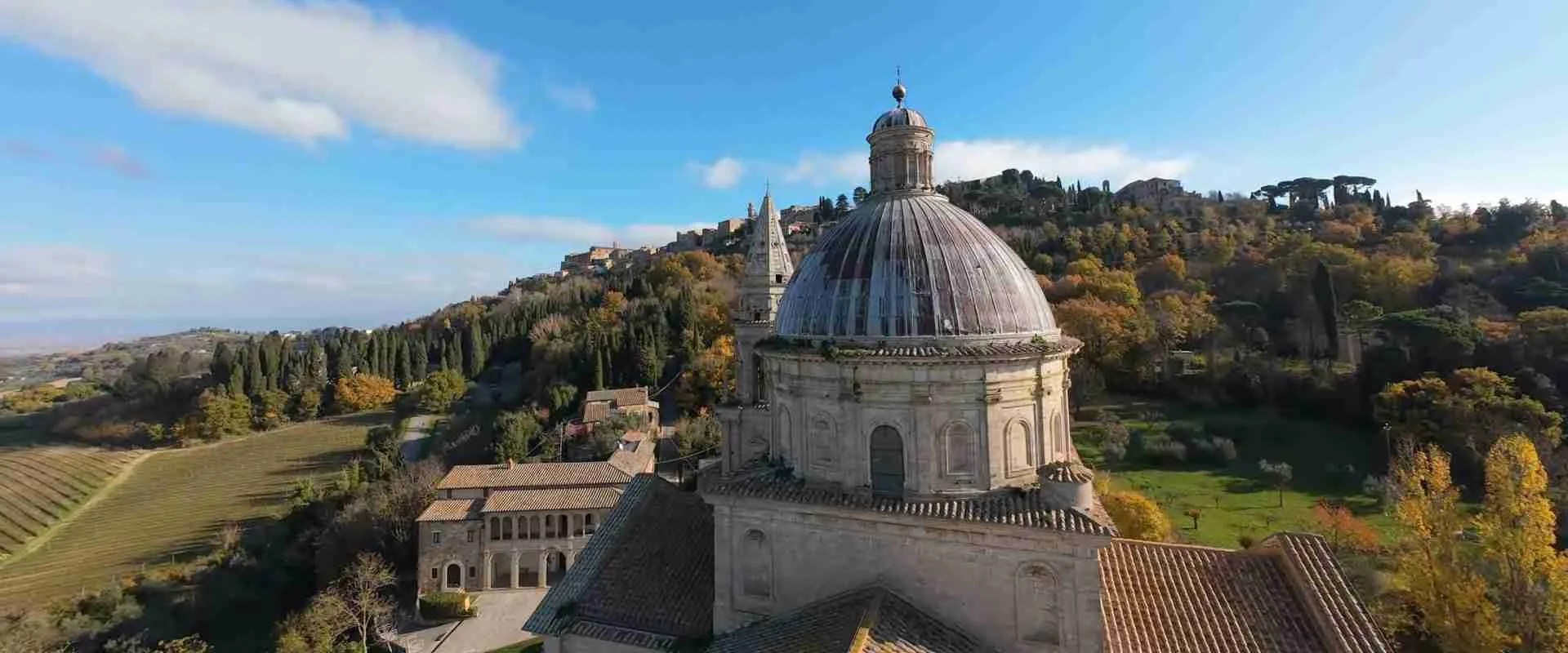
- The Tempio di San Biagio, designed by Antonio da Sangallo il Vecchio and built between 1518 and 1545, is widely regarded as one of the finest centralized Renaissance churches in Italy. The €5 admission includes a free multilingual audioguide and an introduction to the building’s remarkable construction history, including the campanile that Sangallo never saw completed.
- The Palazzo Comunale tower, whose façade was redesigned by Michelozzo in the 1440s, costs €5 to climb and rewards visitors with panoramic views reaching the Val d’Orcia, Lake Trasimeno, and the distant profile of Siena. A combined ticket with the Museo Civico is available for €8 (full) or €6 (reduced), saving €3 versus buying separately.
- Montepulciano’s historic wine cellars — particularly Cantina Talosa near Piazza Grande and the Contucci cellars on the square itself — descend into Etruscan-era underground spaces and are free to visit during regular opening hours, making them among the town’s most remarkable free cultural experiences.
- The best photography moment at the Tempio di San Biagio is late afternoon on a clear day, when the setting sun illuminates the amber travertine church in the foreground while the hilltop town rises behind it. This composition, achievable from the lay-by just below the temple, consistently ranks among the defining images of Tuscan travel photography.
- A full cultural day covering the Tempio di San Biagio, the Museo Civico, and the Palazzo Comunale tower costs approximately €13–16 per person depending on ticket choices — one of the most affordable comprehensive cultural experiences in the region, and free entry at the Cathedral, the main churches, and the open-air cellars brings the cost lower still.
People Also Ask About Montepulciano Museums and Photography 2026
How much does it cost to visit Montepulciano’s museums and cultural sites in 2026?
The three main paid cultural sites in Montepulciano cost between €5 and €8 per person in 2026. The Tempio di San Biagio charges €5 (full) for entry including a free audioguide. The Museo Civico Pinacoteca Crociani costs €6 (full) or €4 (reduced), while the Palazzo Comunale tower costs €5 to climb and €2.50 for the terrace only. A combined ticket covering both the tower and the Museo Civico is available for €8 full or €6 reduced. The Cathedral (Duomo), all the main churches, the Contucci cellars, and the Cantina Talosa cellar visit are free of charge, though wine tastings at the cantine carry their own separate costs. Across the full day, a culturally comprehensive visit to Montepulciano can cost as little as €13 per person. Check the official sites before visiting, as prices may be updated during the year.
What are the opening hours for Montepulciano’s museums in 2026?
Opening hours vary by site and season in 2026. The Museo Civico Pinacoteca Crociani is open daily except Tuesday from April through October, with hours from 10:00 to 19:00 (last entry 18:00); in winter (November to March), it opens Saturday and Sunday only from 10:00 to 18:00. The Palazzo Comunale tower is open daily from April to November with continuous hours from 10:00 to 18:00 (last entry 17:45), closed in winter except for the Christmas period. The Tempio di San Biagio is open daily from April 1 to September 30, from 10:00 to 13:30 and 14:00 to 18:30 (Sundays from 11:30), and on a reduced schedule in autumn and winter. Because hours are subject to seasonal adjustment, verify the current schedule at the relevant official websites — tempiosanbiagio.it, museocivicomontepulciano.it, and the Pro Loco Montepulciano site — before your visit.
What is the best time of year to visit Montepulciano for photography in 2026?
Late April through May and September through October offer the strongest combination of light, weather, and manageable visitor numbers for photography in Montepulciano. In spring, the hillside meadows around the Tempio di San Biagio show vivid green grass and wildflowers, providing a saturated foreground that contrasts powerfully with the amber travertine. In autumn, the surrounding vineyards turn through gold and copper, and morning mist in the Val di Chiana and Val d’Orcia frequently creates atmospheric layers in the valley views from the Palazzo Comunale tower. Summer (June–August) brings peak crowds and harsh midday light but extends golden hours into late evening; winter offers dramatically clear skies on dry days, though several sites reduce their hours significantly. For the single most sought-after shot — the Tempio di San Biagio at sunset with the town above — any clear afternoon from April to October works, with the sun at the right angle to illuminate the façade from approximately 17:00 onwards in summer.
Is the Tempio di San Biagio worth visiting in 2026?
The Tempio di San Biagio earns its €5 admission with very little difficulty. The church is regarded by architectural historians as one of the most resolved examples of centralized Renaissance design in Italy, standing comparison with the great experimental church designs of early 16th-century Florence and Rome. Antonio da Sangallo il Vecchio built it from 1518 entirely in local travertine, which gives the exterior and interior a unified amber warmth unusual among Renaissance churches of similar ambition. Beyond the architecture, the setting is exceptional: the building sits alone on a flat meadow below the town’s walls, surrounded by olive trees, and the approach along the cypress-lined lane produces one of the most photographed views in Tuscany. The included audioguide is available in five languages and runs approximately 25 minutes. For visitors combining a museum visit with a cultural day, the Tempio should be treated as equal in importance to the Museo Civico — not as an add-on.
Extended multi-day tours – 5+ days
Featured Montepulciano Multi-Day Tour Packages
3 days
Montepulciano 3-Day Discovery Tour
- ✓ Comprehensive Montepulciano experience
- ✓ Expert local guides included
- ✓ All accommodation included
- ✓ Transportation provided

5 days
Montepulciano 5-Day Highlights Experience
- ✓ Comprehensive Montepulciano experience
- ✓ Expert local guides included
- ✓ All accommodation included
- ✓ Transportation provided

7 days
Montepulciano 7-Day Cultural Journey
- ✓ Comprehensive Montepulciano experience
- ✓ Expert local guides included
- ✓ All accommodation included
- ✓ Transportation provided

10 days
Montepulciano 10-Day Complete Adventure
- ✓ Comprehensive Montepulciano experience
- ✓ Expert local guides included
- ✓ All accommodation included
- ✓ Transportation provided
Multi-day tour packages powered by TourRadar. Prices and availability subject to change.
What Makes Montepulciano a Cultural Destination Worth Planning For in 2026
Montepulciano occupies a long ridge at around 600 metres elevation between two of southern Tuscany’s most celebrated valleys — the Val di Chiana to the east and the Val d’Orcia to the southwest. This geography gave it strategic importance throughout the medieval period and a spectacular setting that civic ambition, from the 15th century onwards, filled with architecture of high quality. The town is sometimes referred to as the “Perla del Cinquecento” — the Pearl of the Sixteenth Century — a characterization that captures something real: while Montepulciano has medieval foundations, the buildings that define its visual identity were mostly conceived or remodelled between roughly 1420 and 1570, a compressed period of patronage during which the town allied itself politically and culturally with Florence and attracted architects of considerable reputation.
The leading figure in this transformation was Antonio da Sangallo il Vecchio (c.1455–1534), a Florentine architect primarily known for military engineering who made Montepulciano effectively the centre of his activity after 1518. He designed the Tempio di San Biagio — his most celebrated work — along with the Palazzo Contucci on Piazza Grande and the Pozzo dei Grifi e dei Leoni. The Palazzo Comunale’s elegant façade had been redesigned some decades earlier, in the 1440s, by Michelozzo di Bartolomeo, a Florentine architect who also remodelled the church of Sant’Agostino. The result is a town whose public spaces and major buildings form a coherent architectural ensemble of unusual quality for a settlement of this size.
The museum, the open-air monuments of Piazza Grande, and the freestanding Tempio di San Biagio are the cultural triangle that any visit should cover. Beneath them, a network of Etruscan-era underground spaces — repurposed as wine cellars from the Renaissance onwards and still in use by working wineries — adds an archaeological dimension that most visitors discover only on their second or third visit. For photographers, the town offers the internal discipline of Renaissance geometry alongside the external drama of its hilltop position, and the Tempio di San Biagio from below remains one of the most sought-after compositions in Tuscan travel photography. This guide works through all of these systematically: opening times, ticket prices, collection highlights, attributed works, photography locations, and seasonal advice for 2026.
Vino Nobile di Montepulciano is the DOCG wine produced exclusively from vineyards within the municipality, primarily from Sangiovese (locally called Prugnolo Gentile) with a minimum 70 per cent requirement. Understanding this is relevant to the cultural visit because the town’s underground geography — the 14th and 15th-century cellar systems excavated beneath the main palaces — is integral to both the archaeology and the living winery culture. Several of the most interesting cultural underground spaces are inside active wineries, which means the cultural and the culinary experiences of Montepulciano are genuinely intertwined. Wine tasting is thus not a digression from the cultural visit but, in several cases, the access mechanism to some of the town’s most interesting subterranean spaces.
Museo Civico Pinacoteca Crociani 2026: Tickets, Hours, and Collection Highlights
The Museo Civico Pinacoteca Crociani occupies the Palazzo Neri-Orselli at Via Ricci 10, a few minutes’ walk downhill from Piazza Grande. The palazzo itself is described by the museum as one of the few surviving examples in Montepulciano of 14th-century Sienese civic architecture — a three-storey brick façade on Via Ricci, with a courtyard behind featuring a loggia and a well. The current museum installation uses four floors, including one underground, and modern interventions within the building are deliberately visible in order to allow clear reading of the original fabric. The museum’s collection is divided into five sections.
The Archaeological Section and the Poliziana Section
The ground floor and basement introduce the area’s pre-medieval history. The archaeological section holds Etruscan grave goods dating from the sixth through the fourth centuries BC, found largely in the necropolis at Acquaviva di Montepulciano, near the important ancient road axis between Chiusi and Arezzo. Among the objects on display, the most visually striking are the bronze pieces from a named tomb grouping: a foculo (a type of brazier) and a candelabrum that demonstrate the refined metalwork associated with Etruscan aristocratic burial assemblages. The section also includes Etruscan cinerary urns from the collection assembled by Pietro Bucelli, a Montepulciano nobleman of the 17th and 18th centuries who gathered material from across the territory.
The adjacent Poliziana section holds artefacts specific to the town’s own history: a Marzocco (the heraldic Florentine lion, in a 16th-century version that originally stood outside the Palazzo Comunale), together with heraldic items bearing the arms of prominent Montepulciano families including the Cocconi and Cervini. This section provides orientation in the political and civic context that produced the architectural patronage discussed in the sections above.
The Della Robbia Section
On the upper floors, a dedicated section presents terracotta works by the Della Robbia workshop, in particular two large altarpieces and a lunette by Andrea della Robbia. According to documented records, these were commissioned between 1484 and the early 16th century for the Palazzo Comunale (the Dio Padre Beneficente altarpiece) and the Palazzo del Capitano del Popolo (the Madonna con Bambino lunette). Their transfer to the museum preserves works that would otherwise be vulnerable in their original civic locations. The glaze quality and compositional assurance of these pieces place them among the more significant Della Robbia works in public collections outside Florence.
The Pinacoteca Crociani
The Pinacoteca represents the core of the collection. It originates from the bequest of Francesco Crociani (1781–1861), Primicerio of the Montepulciano Cathedral, who left approximately 188 paintings to the town in 1859. The initial bequest consisted principally of 17th and 18th-century works in a Florentine, Bolognese, and Flemish orientation — the collecting taste of a cultivated early 19th-century ecclesiastic — which has since been supplemented by other donations and transfers from suppressed convents and ecclesiastical holdings.
The chronological range now extends from the 13th through the 19th century, with approximately 180 works on display. Among the earlier material, a panel of San Francesco by Margaritone d’Arezzo and an Incoronazione della Vergine now assigned to the Sienese painter Jacopo di Mino del Pellicciaio represent the collection’s medieval depth. A small Natività on panel attributed to the Sienese painter Benvenuto di Giovanni, and a Crocifissione derived from a composition by Filippino Lippi, anchor the 15th-century holdings.
The 16th century brings the most celebrated works. A large altarpiece with the Allegoria dell’Immacolata Concezione e Santi by the Aretine painter Giovanni Antonio Lappoli (a friend of Vasari’s) is one of the major works of the first floor. The Sacra Famiglia con San Giovannino by Antonio Bazzi, known as il Sodoma, has a particular provenance: it was stolen from the museum in 1970 and not recovered until 1994. A Madonna con bambino in trono by Luca Signorelli, originally in the church of Santa Lucia, and a Sant’Agnese Segni con il modello della città di Montepulciano attributed to Domenico Beccafumi following archival research at the Biblioteca Comunale, represent the Sienese-Florentine intersection that characterizes much of the collection’s quality.
Among the Flemish and Dutch works that came in with the Crociani bequest, I giovani che giocano con il gatto by Abraham Bloemaert (c.1620–1640) is a work of considerable visual energy, notable for a child gripping a cat’s tail while the animal in turn sinks its claws into the boy’s garment. A room is devoted entirely to a single portrait: a Ritratto di Gentiluomo, painted in the early 17th century, whose attribution to Caravaggio was proposed in 2011 by art historian Massimo Pulini, with the suggestion that the subject might be Scipione Caffarelli Borghese (later Cardinal Borghese). The attribution attracted scholarly attention and was discussed at a dedicated conference at Montepulciano in December 2011, with Mina Gregori — one of the foremost authorities on Caravaggio — noting the proposal with interest. However, the attribution has not yet achieved broad consensus in the field, and the museum presents the work alongside a touchscreen interpretation that documents the investigation. Visitors are advised to treat it as a genuinely fascinating open question rather than a settled fact.
Practical Information for the Museo Civico 2026
The museum is located at Via Ricci 10, a three-minute walk from Piazza Grande. Admission is €6 (full) or €4 (reduced — groups of ten or more, visitors aged 16–18 and over 65, students, and holders of EduMusei, Touring Club, or Unpli cards); free for children up to 16, disabled visitors, authorised tourist guides, and journalists. A combined ticket with the Palazzo Comunale tower is available for €8 full or €6 reduced. Opening hours from April 1 through October 31 are daily except Tuesday, 10:00–19:00 (last entry 18:00); from November through March, the museum opens on Saturday and Sunday only from 10:00–18:00, with full daily hours restored during the Christmas period. As hours and prices can be updated, verify current information at museocivicomontepulciano.it or by calling +39 0578 717300 before your visit.
Piazza Grande in 2026: Montepulciano’s Open-Air Renaissance Stage
Piazza Grande occupies the highest point of the ridge and has served as the political and religious centre of Montepulciano since the medieval period. What distinguishes it visually is the quality of the buildings on all four sides: a 13th-century civic palace with a 15th-century Florentine façade, a large unfinished Renaissance cathedral, two major noble palaces, and a 16th-century Gothic palace — all in travertine or bare medieval brick, with the elegant well marking the corner junction. No other square in a Tuscan hill town of this scale has quite the same combination of unified scale and architectural individuality. The piazza is open at all hours, and while it comes into its own photographically in the early morning and late afternoon, it rewards visitors at every time of day.
Palazzo Comunale and Its Tower
The Palazzo Comunale on the western side of the square is a 13th-century building whose appearance today reflects a renovation commissioned in 1440 from the Florentine architect and sculptor Michelozzo di Bartolomeo (1396–1472). A letter dated 16 October 1440, in the Montepulciano town archive, records the commission for a drawing of the façade; the renovation work continued until approximately 1469. Although no original Michelozzo drawings survive, the attribution, first established by Howard Saalman in the 1960s, is accepted in architectural scholarship. The result — rusticated bugnato at ground level, smooth travertine above, Guelph merlature at the summit — closely echoes the Palazzo della Signoria in Florence, and the resemblance was deliberate: it reflected Montepulciano’s close political and cultural alignment with Florence during the mid-15th century. The building continues to serve as the town hall.
The tower costs €5 to climb and delivers a genuinely exceptional 360-degree panorama. On clear days, looking east, the view extends across the Val di Chiana to Lakes Montepulciano and Chiusi, to Lake Trasimeno with its islands, and to the pre-Apennine ridges of Umbria, with Perugia and Monte Subasio visible on good days. Looking west and southwest, Monte Amiata dominates the skyline, with the Val d’Orcia spread below it, Pienza visible in the middle distance, and the towers of Siena identifiable on clear afternoons. The terrace (without the final climb to the merlature) costs €2.50. Children up to 10 years enter free. Hours from April through November are daily 10:00–18:00 (last entry 17:45). A combined ticket covering the tower and the Museo Civico costs €8 full or €6 reduced; note that the Museo Civico is closed on Tuesdays, so combined ticket holders who arrive on a Tuesday may do the tower but not the museum.
The Renaissance Palaces Around the Square
Three further palaces of considerable quality face Piazza Grande. On the north side stands the Palazzo Nobili-Tarugi, a travertine-fronted palace whose ground floor is occupied by a loggia of barrel-vaulted arches, giving it a strongly horizontal base before the tall upper storey rises above. The design attribution is contested: traditional sources assign it to Antonio da Sangallo il Vecchio, but more recent scholarship, noting certain anomalies in the proportioning and detailing, proposes Jacopo Barozzi da Vignola as the more likely designer. Both architects were active in Montepulciano, and the question remains open. The palace is in private ownership and is not accessible to visitors.
On the east side, the Palazzo del Capitano del Popolo (also known as the Palazzo della Pretura) is a 14th-century Gothic building faced entirely in travertine, whose pointed-arch windows and relatively plain surface offer a useful contrast to the Renaissance classicism of its neighbours. The Palazzo Contucci occupies the southeastern corner, constructed from 1519 with a design attributed to Antonio da Sangallo il Vecchio for the lower floors, and with the upper elevation possibly completed by Baldassarre Peruzzi. Today the Palazzo Contucci houses the active Contucci winery, whose historic cellars extend deep below the piazza and are free to visit during normal shop hours.
The Well of Gryphons and Lions
Standing in the small space between the Palazzo Nobili-Tarugi and the Palazzo del Capitano, the Pozzo dei Grifi e dei Leoni is one of the most precisely attributed works on the square: the well is documented as the work of Antonio da Sangallo il Vecchio, completed in 1520. Two Doric columns support an architrave at the centre of which the Medici coat of arms is held by two lions (the Florentine civic symbol) flanked by two gryphons (the symbol of Montepulciano). The combination of symbols is a clear visual statement of political allegiance, made in the same decade that Sangallo began work on the Tempio di San Biagio: Montepulciano was, in 1520, firmly within the Florentine sphere of influence. The well is entirely functional in design — there is no decorative excess — and its proportions reward close attention.
The Cathedral
The Duomo faces the Palazzo Nobili-Tarugi from the south side of the square and is distinguished by one of the most striking unfinished façades in Tuscany: bare dark brick, never veneered, which gives the church a severe, almost ancient appearance quite at odds with its Renaissance interior. Construction occupied the late 16th and early 17th centuries to a design attributed to Ippolito Scalza. The façade was intended to receive a stone cladding that was never applied, and the rough brick has been this way since the building was raised. Entry is free; the interior is covered in the Cathedral section below.
Tempio di San Biagio 2026: Visiting the Pearl of the Cinquecento
The Tempio di San Biagio stands on a flat meadow roughly 800 metres below and south of the town centre, reached from the southern gate along Via di San Biagio. Its situation — isolated on a gentle slope at the point where the Val d’Orcia meets the Val di Chiana, surrounded by olive trees and with the walled hilltop town rising behind it — is as much a part of the architectural experience as the building itself. Antonio da Sangallo il Vecchio placed it outside the walls deliberately, as a votive church on the site of an ancient pieve that was already in ruins at the beginning of the 16th century.
The origins of the construction are connected to a reported miraculous event of 23 April 1518, when, according to the founding narrative preserved in the church’s own documentation, two servants and a peasant witnessed movement in an image of the Virgin and Child displayed on the wall of the old pieve. Whether one approaches this as devotional history or as the catalyst for a major architectural commission, what is clear from documents is that the building was begun in 1518, that construction was promoted with support from Pope Leo X (who, the sources note, had been educated in classical letters by the Montepulciano-born poet Angelo Poliziano), and that the project gave Sangallo the opportunity to produce the work for which he is best remembered.
Sangallo died in 1534, at which point the structure was essentially in place though incomplete. The central dome was raised between 1543 and 1545 by other hands; the first of the two campanili was completed only in 1564, thirty years after the architect’s death; and the second campanile, on the right as you face the façade, remains incomplete today, rising only to the first level — a detail immediately visible from the approach and one that does not diminish the building’s power. The church was consecrated in 1537, before the dome was finished.
The plan is a Greek cross with a central dome over the crossing, a semicircular apse closing the main arm, and two campanili on the façade arm. The entire building — exterior and interior — is clad in travertine from the local quarries, which develops a warm amber colour that changes character dramatically across the day, from pale cream at midday to deep gold at sunset and almost terracotta in low-angle winter light. The interior is severe: the altars were stripped in a purifying 19th-century restoration, and only the first altar in the left arm, with an Annunciation painting, is held to follow a design approximating Sangallo’s original intention for the retable format. The effect of entering the travertine interior is of monumental calm — each arm of the cross a barrel-vaulted tunnel, the dome filtering light from above.
In front of the church, facing the meadow, stands the Canonica — the canon’s residence — a double-loggiaed building designed by Sangallo and built around 1550. It is harmonious with the church without copying it, completing the ensemble. The small information structure near the entrance was added following the significant growth of visitor numbers, partly attributed to the use of Montepulciano as a filming location for the 2009 film New Moon (the Twilight sequel), which was shot partly in Piazza Grande and in the area around the town.
Practical Information for San Biagio 2026
Admission is €5 per person (full price), with a free audioguide available in Italian, English, French, German, and Spanish (approximately 25 minutes). Free entry applies for children under 6, residents of the Montepulciano municipality, disabled visitors, clergy, journalists, and authorised tourist guides. From April 1 through September 30, the temple is open daily from 10:00 to 13:30 and from 14:00 to 18:30, with Sunday entry from 11:30 only. From October 1 to early November, the afternoon closing advances to 18:00; from November to mid-March, opening is reduced to weekends only. The official website tempiosanbiagio.it publishes the current schedule. The address is Via di San Biagio 14; there is a small lay-by for cars on the approach road just below the church. Advance booking is available by email at [email protected] or by telephone at +39 0577 286300 but is not required for individual visitors.
Underground Montepulciano 2026: Wine Cellars and Etruscan Heritage
Beneath the travertine streets and Renaissance palaces of Montepulciano runs a different kind of museum: a network of underground spaces excavated across two and a half millennia, beginning with Etruscan-era burials and storage chambers in the fifth and fourth centuries BC, extended by Roman construction, and then continuously adapted through the medieval and Renaissance periods into the wine cellars that several working wineries still use today. Visiting these underground spaces is not a peripheral activity; in several cases, it is the most historically layered experience the town offers, and the access cost is largely free.
Cantina Talosa
The Cantina Talosa at Via Talosa 8, a few steps from Piazza Grande, is the underground space most consistently praised by visitors for the combination of archaeological and viticultural interest. The cantina opened to the public in 2010, following a restoration that preserved the original barrel storage character of the cellars. Descending 61 steps brings visitors to approximately 15 metres below street level, into 1,000 square metres of underground space where brick-vaulted galleries alternate with narrow sections cut directly through the tufa. The temperature is a constant 14°C and humidity holds at around 70 per cent — natural conditions maintained by the geology. The cellars are attributed to Etruscan origins (5th century BC) and were subsequently used as a prison and, during the Second World War, as an air-raid shelter. At the deepest point, the remains of an Etruscan tomb are visible — not excavated and displayed in a museum sense but encountered within the working cellar environment, which gives the visit a different quality from a conventional archaeological site. The visit is free of charge; wine tasting packages with a sommelier are available and can be booked through the enoteca at the entrance. Check talosa.it for current tasting options.
Cantina Contucci
The Contucci cellars occupy the underground spaces beneath the Palazzo Contucci on Piazza Grande itself — which means, depending on the route taken, that visitors are walking beneath the square as they move through the barrels. The visit is free and informal: staff at the enoteca welcome visitors during shop hours. The cellars are large, featuring massive aging barrels in brick-vaulted rooms, and the combination of the working winery context with the evidence of successive historical construction phases makes it a complement to the more archaeological focus of the Talosa visit. The Contucci family has owned the palazzo since 1642, and the winery’s Vino Nobile DOCG production continues here.
Cantina Ercolani and Other Underground Spaces
Several further cantine along the main Corso and its side streets open their underground spaces to visitors during normal hours. The Cantina Ercolani is notable for incorporating a small museum of traditional viticultural equipment alongside its barrel-aging rooms and an Etruscan tomb area within the cellar complex. Many of the historic palaces on Via di Gracciano nel Corso and Via di Voltaia nel Corso have similarly complex underground foundations — the geology of the ridge is favourable for excavation, and the town’s depth of habitation means that any major building project typically reveals earlier material. Free visits to operating cantine are a normal part of the Montepulciano cultural experience; several are accessible without any purchase obligation, though tasting packages are available and represent genuine value given the quality of Vino Nobile DOCG and Rosso di Montepulciano DOC produced locally.
Photography in the Underground Spaces
The underground cellars offer a distinctive photography environment: dim tungsten lighting against brick vaults and wooden barrels, with the occasional shaft of daylight from a grating overhead. A camera or smartphone with good low-light capability manages this reasonably well, though a small portable light source helps if you want detail rather than silhouettes. Photography is generally welcomed in the cellars as it draws attention to the spaces; confirm with staff when you enter, as policies can vary.
The Cathedral and Its Art in 2026
The Duomo of Montepulciano (Cattedrale di Santa Maria Assunta) is free to enter and is sometimes overlooked by visitors focused on the ticket-bearing sites. This is a significant oversight. The interior is a large, airy, single-nave church with chapels opening from the main space, and it holds three works of considerable importance that deserve unhurried attention.
The most important is the triptych by the Sienese painter Taddeo di Bartolo, displayed at the high altar. A major work representing the Assumption of the Virgin with saints, it is among the significant Sienese panel paintings to survive in the region outside the major museum collections. The gold ground and the careful differentiation of expressions across the panel figures make it a work that rewards extended looking.
Distributed around the church — in several pieces, incorporated into frames, niches, and the architectural fabric — are the fragments of a monument by Michelozzo, commissioned to honour Bartolomeo Aragazzi (c.1386–1429), a humanist and papal secretary who served Pope Martin V. Michelozzo worked on this monument between approximately 1427 and 1436; it was subsequently dismantled and its components dispersed through the church, where they can be identified by their carved quality. A carved frieze section, figure reliefs, and inscribed elements are now distributed across the nave and chapels. This fragmented condition makes the monument harder to read than it would be in its original state, but the quality of the carving is high and the pieces are among the more important examples of early Florentine Renaissance sculpture outside Florence itself.
At the baptismal font end of the church, a polychrome terracotta Nativity and associated decorative elements in the style of the Della Robbia workshop add another layer to the terracotta tradition that runs through Montepulciano’s cultural holdings more broadly. The Cathedral is open for visits except during Mass; check posted notices for service times. Entry is free.
Contemporary Galleries, Cultural Events, and Hidden Artistic Spaces in 2026
Montepulciano’s artistic activity is not confined to the historic period. The town has maintained a significant contemporary cultural presence since 1976, when the German conductor Walter Savile founded the Cantiere Internazionale d’Arte — an annual arts and music festival that runs through late July, bringing together young professional musicians, composers, directors, and stage designers from across Europe and beyond. The Cantiere is notable for commissioning new work and for treating Montepulciano’s public spaces — the piazza, the churches, the theatre — as sites for performance rather than merely as scenery. In 2026, check the current programming at cantierearte.org, as the event typically runs mid-to-late July across approximately two weeks.
The Museo Civico Pinacoteca Crociani also hosts a regular programme of temporary exhibitions. In the summer of 2025, for example, the museum hosted “Porsenna tra storia e leggenda,” a major exhibition on the Etruscan king who figures in Montepulciano’s foundation mythology, which ran through January 2026. Check museocivicomontepulciano.it for whatever temporary programme is running during your visit in 2026, as the permanent collection is augmented by exhibitions that can add significant material — often bringing works from regional and national collections.
For artisan and contemporary studio work, Via Ricci (on which the museum sits) and Via di Gracciano nel Corso both support a number of studios, ceramicists, and jewellers whose work is available to view without obligation. These spaces are not gallery in the institutional sense but operate as working studios open to the street, and they add an informal but genuine artistic dimension to a walk through the town. Several also sell prints of photographs of local landscapes, which is relevant for visitors who want to bring photographic work home without carrying their own.
The church of Sant’Agostino on Piazza Michelozzo is free to enter and holds, in addition to its Michelozzo façade (early 15th century, confirmed attribution), notable interior paintings including a Resurrection of Lazarus by Alessandro Allori and a wooden Crucifix attributed to Antonio da Sangallo. The church of Santa Lucia on the lower slopes of the town contains Luca Signorelli’s Madonna della Misericordia, a work in the artist’s characteristic style of monumental figural composition that is displayed here away from the main museum circuit. Entry is by donation.
On Via di Gracciano nel Corso, the façade of the Palazzo Bucelli offers one of the most unusual details in any Tuscany hill town: Etruscan cinerary urns and inscribed stone fragments from the collector Pietro Bucelli’s acquisitions in the 18th century are embedded directly into the lower courses of the exterior wall, creating a kind of improvised lapidary display at street level. This is purely a viewing experience from the pavement and costs nothing; it is also an excellent subject for close-up or detail photography.
Photography Locations in Montepulciano 2026
Montepulciano offers two distinct photographic registers: interior and close-up work within the town, and wide landscape compositions from and around the hill. The first rewards patience and close attention to architecture, stone texture, and urban incident; the second rewards positioning and timing relative to light. Both are genuinely productive for photographers at all levels, and neither requires expensive equipment to yield strong results. This section works through the key locations in the order that suits a single-day visit.
Tempio di San Biagio: The Essential Composition
The canonical Tempio photograph is taken from a position below the church looking up toward it, with the hilltop town rising behind and to the right. The building occupies the middle distance, the foreground is open meadow or the approach lane, and the town’s walls and skyline form the background layer. This composition works throughout the day but reaches its greatest quality in the two hours before sunset, when the sun is low enough in the western sky to illuminate the travertine façade frontally while the town above is still in reasonable light. In summer, this puts the best light between approximately 17:00 and 19:30; in spring and autumn, from around 16:00 to 18:30.
The most useful parking area is the small lay-by on the Via di San Biagio, just below the church. From there, walk slightly back toward the town to find the angle where the building appears in full elevation with the town distinct behind it. The olive trees framing the meadow can be used as foreground elements in wider compositions. The cypress-lined section of the approach road, photographed from the town side looking down toward the church, is a secondary composition that works well in early morning light. Photographers seeking clean shots without pedestrians should aim for before 9:00 or after 18:00 in high season.
Piazza Grande at Different Hours
Piazza Grande is at its most photogenic in early morning, when the low eastern sun illuminates the Duomo’s brick façade directly and casts long shadows across the travertine paving. This is also the window when the square is quietest. The Pozzo dei Grifi e dei Leoni, in the north corner, is best photographed in the morning when it is front-lit; by midday it is in partial shade behind the Palazzo Nobili-Tarugi loggia. The Palazzo Comunale on the west side of the square receives direct afternoon light, making it better in the hours before sunset. A photographer willing to return twice to the square — once around 7:30–8:30 for the Duomo and well, and once around 17:00 for the Palazzo Comunale — will cover the principal compositions under optimum light.
From inside the Palazzo Comunale’s courtyard, which can be entered for free during business hours, the double loggias provide a compositional frame for interior shots. The 19th-century memorial tablets along the cloister walls offer unusual documentary subject matter for close-up work.
The Palazzo Comunale Tower View
The tower view at €5 is among the more cost-efficient panoramic platforms in all of Tuscany, in the sense that few other accessible high points offer such a complete 360-degree survey of such diverse landscapes in a single position. The photography requires a wide lens or a panoramic phone setting to do justice to the full arc of the view; a telephoto setting is useful for isolating distant details such as the Siena towers or the Monte Amiata profile. On hazy summer days, atmospheric perspective reduces the distant views to impressions. The clearest days occur in autumn and winter, when cold fronts from the north produce exceptional visibility. Spring mornings after overnight rain can also deliver outstandingly clear conditions. Avoid shooting at high noon in summer, when the light is vertical and the haze maximum.
Streets, Gates, and Architectural Detail
The main street — Via di Gracciano nel Corso, continuing as Via di Voltaia nel Corso and then Via dell’Opio and Via Poliziano — runs along the spine of the ridge from the Porta al Prato gate at the lower end to Piazza Grande at the top. This continuous street offers a progression of architectural subjects: the Porta al Prato itself (a powerful gateway with the town walls extending from it), the succession of Renaissance and late-medieval palace fronts, the Torre dell’Orologio with its Pulcinella clock figure, and the increasingly elevated viewpoints over the eastern valleys as the street climbs. Narrow side streets cut downhill at intervals, offering unexpected depth-of-field compositions with the valley landscape visible at the end of a stone-paved lane.
The Palazzo Bucelli façade, on the lower section of Via di Gracciano nel Corso, merits particular attention for macro or close-up photography: the Etruscan cinerary urns and inscribed fragments embedded in the lowest courses of the exterior wall create a textural and archaeological subject that is completely unusual and very difficult to find anywhere else in Tuscany. Wide shots of the façade show the integration of the ancient material into the Renaissance palace front; close-ups of individual urns reveal the carved surfaces and Etruscan epigraphy.
Countryside Viewpoints Around Montepulciano 2026
Several important landscape viewpoints are accessible within 15 minutes by car from the town centre. The most photographed is the La Foce zigzag cypress road on the SP146, approximately 10–12 kilometres southwest toward Pienza. This is the winding cypress-lined road that has become one of the defining images of Tuscany: multiple curves visible in a single frame, with rolling hills and farmland as background. The best vantage point is from a slightly elevated position on the road itself, where the successive bends can be compressed into a single view with a medium telephoto lens. Morning and late afternoon are both productive, though the morning light comes from the east and illuminates the road from the front. Autumn is considered the peak season for this location when the surrounding fields alternate gold and brown.
For a view of the town itself from the valley, the approach roads from the west (from Pienza/Montichello direction) and from the east (from the Valdichiana Bettolle motorway exit) both provide compositions where the long ridge of Montepulciano is seen entire. The western approach is generally cleaner visually. The town can be photographed from the valley floor with a telephoto lens that compresses the layers of olive groves, vineyard rows, and hilltop buildings into a layered composition. Early morning with mist in the valley, or late afternoon with the town lit against a darkening sky, are the most dramatic conditions.
Light, Timing, and Technique for Montepulciano Photography 2026
Montepulciano’s primary challenge for photographers is its east-west orientation: the town runs along a north-south ridge with the main street climbing from the southern gate to the piazza at the top. This means that the eastern and western faces of buildings receive the best light at opposite ends of the day. Early morning light — rising from the eastern Val di Chiana — illuminates the Duomo façade, the eastern portions of Piazza Grande, and the landscape views from the lower parts of the Corso looking down toward the valley. Afternoon and evening light — falling from the west — brings out the Palazzo Comunale, the western faces of the town walls, and most importantly the Tempio di San Biagio, which faces largely east and is front-lit by the setting sun.
For the Tempio di San Biagio, the golden hour timing shifts seasonally. In late April and September–October, the building begins to be warmly illuminated from around 16:00 to 16:30, with peak amber colour in the final 20–30 minutes before sunset. In July–August, the equivalent period shifts to 18:30–20:00, which is logistically convenient for anyone who has spent the morning on the museum circuit. Planning applications (PhotoPills, The Photographer’s Ephemeris, or equivalent) allow precise calculation of the exact sun direction on any given date, which matters when trying to place the sun behind you for a front-lit composition versus silhouette work.
For architectural detail photography inside the town — street views, decorative elements, portal details — overcast days with diffused light are in many respects preferable to direct sun, which creates harsh contrasts on stone textures. The warm grey of an overcast Tuscan morning removes the problem of blown highlights on travertine while retaining the stone’s natural colour. This is particularly relevant for close-up photography of the Palazzo Bucelli Etruscan fragments and for interior shots in the cloister of the Palazzo Comunale.
Equipment choice should be guided by what you intend to photograph. A wide-angle lens in the range of 16–24mm is appropriate for the Piazza Grande compositions and the tower panoramas, where getting everything into the frame is the primary challenge. A standard zoom (24–70mm) handles the street photography and interior museum shots. A short telephoto (70–135mm) is particularly useful for the Tempio di San Biagio compositions, allowing the church to be isolated from foreground clutter and the town to appear proportionally large in the background. For the landscape viewpoints — especially the La Foce zigzag road — a telephoto of 150–300mm compresses the perspective effectively and is worth having. Smartphone cameras with portrait or telephoto modes handle many of these situations well enough for travel photography, but a tripod or a stable surface improves tower and low-light results significantly.
For interior photography in the Museo Civico and similar spaces, note that museum lighting is typically warm tungsten or LED and that the colour balance of photographs will need adjustment in post-processing. Auto white balance performs inconsistently in mixed-lighting environments; setting a manual kelvin value around 3200K for tungsten, or shooting RAW and correcting afterwards, produces more reliable results. Flash photography is not permitted in the museum; a fast prime lens at f/1.8 or f/2 is the most practical solution for hand-held work in low-light gallery environments.
Photography Rules and Practical Etiquette in Montepulciano 2026
Non-commercial photography without flash is the standard permissible condition in Italian civic museums and is observed at the Museo Civico Pinacoteca Crociani. Tripods require advance authorisation and are generally not permitted in the museum galleries during normal opening hours. The audioguide touchscreen display in the Caravaggio room may reflect glare under direct camera flash — one further practical reason why flash is not permitted. Confirm the current photography policy at the museum entrance when you collect your ticket, as specific restrictions may apply to temporary exhibitions.
In the churches — the Cathedral, Sant’Agostino, Santa Lucia, and the Tempio di San Biagio — photography is generally welcomed outside of Mass times, following standard Italian church etiquette: no flash in front of altarpieces or frescoes, quiet and unobtrusive behaviour, and respect for any posted restrictions. The Tempio di San Biagio’s audioguide specifically references the building in relation to its visual experience, and staff are generally welcoming of photography as part of a visit.
On the public spaces — the streets, Piazza Grande, the approach to the Tempio di San Biagio — photography is entirely unrestricted as far as personal and travel photography is concerned. Commercial drone photography requires a permit under Italian CAA regulations; private recreational drone flight is subject to the rules of the Italian ENAC authority, which as of 2025 requires registration and specifies no-fly zones around inhabited areas and historical monuments. Montepulciano’s historic centre falls within a category where drone operations require prior authorisation. Visitors planning drone work should consult the ENAC DroneApp or equivalent tool for current airspace designations and obtain any required authorisations well in advance. Unregistered drone flights over the historic centre are not advised and may attract attention from local authorities.
In the underground cellars, photography is typically welcomed — it is good promotion for the wineries — but ask at the entrance to confirm, as some cellars may prefer not to have their aging areas photographed.
Seasonal Calendar for Culture and Photography in Montepulciano 2026
Montepulciano’s cultural and photographic calendar maps onto Tuscany’s broader seasonal rhythms, but with two specific events that define the high points of the local calendar.
Spring (April–May) is the most balanced season for first visits: mild temperatures (typically 12–22°C), flowering meadows around the Tempio di San Biagio, manageable visitor numbers, and extended golden hours that allow evening photography after a full cultural day. The Museo Civico opens daily from April 1, and the Tempio restores its full summer hours from the same date.
Summer (June–August) brings the Cantiere Internazionale d’Arte in late July — the best time to experience Montepulciano as a living cultural town rather than just a tourist destination, with performances and exhibitions in public spaces. Late August sees the Bravio delle Botti, the barrel-rolling race that takes place on the last Sunday of August: two teams from each of the town’s eight districts compete to roll a heavy barrel through the streets to Piazza Grande, preceded by a procession in Renaissance costume. This is an outstanding subject for documentary and action photography and generates strong crowd energy. The Museo Civico is noted as closing on the afternoon of the last Sunday in August for this event. Heat and crowds are at maximum in July and August; sunrise and late-evening photography are strongly recommended over midday work.
Autumn (September–October) is many photographers’ preferred season. The Vino Nobile harvest transforms the vineyards, and the wine-related cultural programming intensifies in the cantine. Morning mist in the Val di Chiana creates atmospheric layers in the eastern landscape views; the foliage colours around the town — olive silver, vine gold, cypress green — are at their most complex. The Tempio di San Biagio at sunset in October, with the harvest landscape behind it, is one of the great photographic subjects in Tuscany. October visitor numbers are lower than July–August, and accommodation prices typically drop by 20–30 per cent.
Winter (November–March) is quiet. Most of the museums reduce hours or close on weekdays; the Tempio di San Biagio operates weekends only through most of the winter period. The compensation is exceptional panoramic clarity — cold-front days in December and January can produce views from the tower that extend further than at any other season — and a calm, unpeopled quality to the streets that is difficult to find in peak season. The town’s Christmas programming includes a traditional market and special museum openings in the Christmas period, which partially restores access to the main cultural sites.
Planning Your Cultural Day in Montepulciano 2026
A full cultural day in Montepulciano is achievable within a single day trip from Siena (approximately 65 kilometres, just over an hour by road), Pienza (25 kilometres, 30 minutes), or Chianciano Terme (12 kilometres, 20 minutes). The following route covers the main paid sites, the Cathedral, the open-access palaces and cellars, and the Tempio di San Biagio, with time built in for the tower and for photography at golden hour.
Suggested Morning Route
Arrive early — before 9:00 if photography is a priority. Park at one of the free areas below the town walls (the Parcheggio della Fortezza near the northern end of town is well positioned) and enter via the Porta al Prato. The main Corso begins here; photograph the gate and the first section of the street in the morning light before the crowds arrive. Walk up the Corso, pausing at the Palazzo Bucelli (Etruscan urns in the façade, lower section of Via di Gracciano nel Corso) and at the Torre dell’Orologio. Arrive in Piazza Grande around 9:30–10:00 for the best morning light on the Duomo façade. Enter the Cathedral (free) and spend 20–30 minutes with the Taddeo di Bartolo triptych and the Michelozzo monument fragments.
From Piazza Grande, walk to the Palazzo Comunale tower (open from 10:00, €5 or €8 combined). Spend 30–40 minutes at the top and on the terrace for the morning panorama — the eastern views toward the Valdichiana are excellent in morning light. If purchasing the combined ticket, the Museo Civico is a few minutes walk away down Via Ricci.
Afternoon and Evening
The Museo Civico (open from 10:00, closed Tuesdays) requires at least 90 minutes for a thorough visit across its five sections. Plan to finish by around 13:00. After lunch, the afternoon is well suited to the underground cellars: the Cantina Contucci (free, on Piazza Grande) and the Cantina Talosa (free, Via Talosa 8) are both within easy walking distance. From approximately 15:00, begin moving toward the Tempio di San Biagio for the afternoon photography session.
Drive or walk down Via di San Biagio (about 1.5 kilometres from the southern gate) to the lay-by below the church. The temple opens its afternoon session at 14:00 and the last entry is at 18:30 (April–September). Allow 45–60 minutes inside the building, then position yourself in the meadow below for golden hour photography from approximately 16:30 onwards.
Ticket Cost Summary for 2026
At full adult prices, the main paid sites cost: Tempio di San Biagio €5; Palazzo Comunale tower €5; Museo Civico €6 — a total of €16 if purchased separately. The combined tower and museum ticket reduces this by €3 to a total of €13. Children under 10 enter the tower free; children under 16 enter the Museo Civico free. The Cathedral and all the churches, the open-access cellars, and all the outdoor monuments including Piazza Grande and the Palazzo Bucelli façade are free. A wine tasting at one of the cantine adds €10–25 per person depending on the package chosen. A full day including all paid sites, a wine tasting, and lunch in a local trattoria or wine bar can be planned comfortably within €40–60 per person at mid-range prices. Check all official sites for confirmed 2026 rates before visiting.
Getting to Montepulciano in 2026
Montepulciano is accessible by car, bus, and a combination of train and bus. By car from the north, the A1 motorway Valdichiana-Bettolle exit (between Florence and Arezzo) leads via Torrita di Siena to Montepulciano — approximately 1 hour 45 minutes from Florence. From the south, the Chiusi-Chianciano Terme exit (between Rome and Florence) leads via Chianciano Terme to Montepulciano — approximately 90 minutes from Rome by motorway, 30 minutes from Chianciano. From Siena, the route follows the SR2 to Bettolle and then northeast toward Torrita and Montepulciano, taking approximately 65 minutes. Parking is available at free car parks outside the ZTL restricted zone; the main free parking areas are below the town walls on the approach from the north (Parcheggio della Fortezza) and on the road from the south. The historic centre is a ZTL (limited traffic zone) and private vehicles without authorisation are not permitted on the Corso or in Piazza Grande.
By public transport, the nearest train station is Chiusi-Chianciano Terme, served by the Florence–Rome main line (approximately 1 hour 20 minutes from Florence, 1 hour 40 minutes from Rome). From Chiusi, Tiemme buses connect to Montepulciano approximately hourly, taking around 40–50 minutes. From Siena, Tiemme buses run directly to Montepulciano approximately four times daily except Sunday; the journey takes around 1 hour 20 minutes. Timetables are at tiemmespa.it and are subject to seasonal adjustment — verify before travel. There is no train station in Montepulciano itself. The Trenitalia Ferroviaria Toscana (TFT) line from Siena does stop at Montepulciano Stazione, but this station is in the valley approximately 12 kilometres from the town, requiring a connecting bus or taxi.
Frequently Asked Questions About Montepulciano Museums and Photography 2026
Does the Museo Civico Pinacoteca Crociani really have a Caravaggio?
The short answer is: the museum holds a portrait that has been attributed to Caravaggio following a scholarly study in 2011, but the attribution has not been confirmed and remains open to debate. Art historian Massimo Pulini proposed in 2011 that the painting — a Ritratto di Gentiluomo (Portrait of a Gentleman), possibly depicting Scipione Caffarelli Borghese — was by Caravaggio. A dedicated academic conference was held at Montepulciano in December 2011, during which Mina Gregori, one of the foremost Caravaggio scholars, noted the proposal with interest but did not definitively endorse it. The museum presents the painting in a dedicated room with a touchscreen installation explaining the attribution argument, the restoration, and the diagnostic evidence. Visitors should approach it as a fascinating unresolved scholarly question, not as a confirmed masterwork. The painting has considerable quality regardless of its attribution — it is a strong work in the Caravaggesque manner — and the room is worth visiting on those terms.
How long does it take to visit the Museo Civico Pinacoteca Crociani?
Allow 60–90 minutes for a thorough visit. The museum has four floors with five sections, each requiring a different pace: the archaeological basement is compact and well-labelled; the Poliziana section is brief; the Della Robbia room is moderate; the Pinacoteca on the upper floor is the most time-intensive, with around 180 works. An audioguide is not included in the ticket price (unlike at the Tempio di San Biagio) but staff are knowledgeable and the labelling is generally clear. Visitors with a strong interest in Sienese painting of the 14th and 15th centuries or in the Caravaggio attribution question may want to budget closer to two hours. The museum is small enough that it never feels overwhelming, and the quality of individual works justifies unhurried viewing.
Can you visit the Tempio di San Biagio without paying?
The exterior of the Tempio di San Biagio and the surrounding meadow are freely accessible at all times; there is no gate or fence around the church grounds, and the Canonica in front of it can be viewed from outside without charge. The exterior alone — including the approach along the cypress-lined lane, the full elevation of the façade, and the view of the incomplete second campanile — constitutes one of the primary photographic experiences of southern Tuscany and costs nothing. Entry into the church interior requires the €5 ticket, which includes the audioguide. Given that the interior is a significant part of the architectural experience, the paid entry is strongly recommended, but visitors on a tight schedule or budget will find that 30–45 minutes in the meadow approaching and circling the building yields exceptional photographic results without purchasing admission.
What is the Bravio delle Botti and when does it take place in 2026?
The Bravio delle Botti is Montepulciano’s signature historical event: a barrel-rolling race held on the last Sunday of August, which in 2026 falls on Sunday, August 30. Teams from each of the town’s eight traditional districts (contrade) compete to roll a heavy barrel weighing approximately 80 kilograms up the main Corso from Porta al Prato to Piazza Grande. The race follows an afternoon procession in which participants wear period Renaissance costume, and the event draws large crowds to the streets of the historic centre. From a photography perspective, the race offers strong action material — teams pushing the barrels uphill, crowds pressing in along the narrow Corso — and the preceding costumed procession in Piazza Grande provides excellent opportunity for portrait and detail photography. The Museo Civico closes on the afternoon of this day. Confirm the exact 2026 date at the official event page or the Pro Loco website, as the race is subject to local confirmation.
Are the wine cellars (cantine) in Montepulciano free to visit?
Several of the historic cantine in Montepulciano are free to visit during regular opening hours. Cantina Contucci on Piazza Grande allows free access to the cellars through the enoteca. Cantina Talosa at Via Talosa 8 offers a free independent visit to the underground spaces including the Etruscan tomb area. Cantina Ercolani similarly welcomes visitors at no charge. In each case, a wine tasting with a sommelier and a food pairing is available for a separate fee — typically €15–30 per person depending on the number and quality of wines selected — but a purchase is not required to see the cellars. Some smaller cantine along the Corso may operate informal visits subject to staff availability and may ask for a minimum purchase; this varies by establishment. As a general rule, arriving between 10:00 and 12:00 or 15:00 and 18:00 and simply asking to see the cantina is a perfectly normal thing to do in Montepulciano, and most producers are welcoming.
What is the Cantiere Internazionale d’Arte and how does it affect a July visit?
The Cantiere Internazionale d’Arte is an annual arts and music festival with an established history in Montepulciano since 1976. It runs for approximately two weeks in late July (typically weeks three and four), hosting young professional musicians, composers, stage directors, and visual artists in a programme that commissions new work and uses the town’s spaces — Piazza Grande, the Teatro Poliziano, the churches — as performance venues. For visitors in late July, the festival significantly enhances the cultural atmosphere of a stay: performances are held in the evenings, the town has an active night-time cultural life, and there are often exhibitions in public spaces that add to the regular museum circuit. The festival also means that accommodation fills up more than usual in late July; book well in advance if timing a visit to coincide with it. Programming and ticket information for 2026 will be available at cantierearte.org from spring of the year.
Is the Palazzo Comunale tower view better than the one from the Tempio di San Biagio meadow for photography?
The two viewpoints offer fundamentally different compositions and are not really in competition. The Palazzo Comunale tower (€5) gives an aerial 360-degree panorama looking out from the town over the surrounding valleys — it is the view of the landscape from within the town. The Tempio di San Biagio meadow gives the view from outside looking up at the town, with the Renaissance church in the foreground and the walled hilltop rising behind. Both are genuine photographic highlights, neither substitutable by the other. If forced to choose on a single short visit, most landscape and architectural photographers prioritise the San Biagio composition because it produces the strongest single image — the church against the town — and the exterior is free. The tower is the better choice for anyone interested in a comprehensive geographical overview or in the photography of distant landscapes. The combined ticket (€8) makes it straightforward to include both on a full day visit.
Are there any photography restrictions at the Tempio di San Biagio?
Interior photography at the Tempio di San Biagio is generally permitted for personal and non-commercial purposes during a visit, consistent with standard Italian ecclesiastical photography policy. Flash photography in front of artwork, altarpieces, and decorative elements should be avoided, both out of courtesy to other visitors and because it typically degrades the result compared with natural or available light. The audioguide experience inside the church specifically refers to the visual qualities of the travertine surfaces and the light, which gives an indication of how the building is intended to be experienced photographically as well as architecturally. During any special liturgical ceremonies, photography may not be appropriate; staff near the entrance will advise. Commercial drone photography over the church and grounds requires prior authorisation, as with all significant monuments in the ZTL area.
What do the Etruscan urns on the Palazzo Bucelli façade look like?
The Palazzo Bucelli at Via di Gracciano nel Corso 73 has a lower external wall into which Pietro Bucelli, the 18th-century collector, had Etruscan cinerary urns and inscribed stone fragments built directly into the masonry. Walking along the lower section of the Corso, these are visible at roughly ankle-to-shoulder height along the façade: carved rectangular stone boxes with relief decoration and Etruscan epigraphy, interspersed with plain Roman-era stone blocks and other ancient fragments. The effect is something between a lapidary and an archaeological display, embedded into a functional building wall. The urns are not glazed or protected — they are simply built into the wall and exposed to weather — which means their surfaces carry the accumulated patina of several centuries. This makes them particularly productive for close-up and macro photography, as the stone texture and incised lettering are very detailed at close range.
How do you get between the town centre and the Tempio di San Biagio without a car?
The Tempio di San Biagio is approximately 800 metres–1 kilometre from the southern town gate (Porta di Gracciano), descending a gentle slope along the Via di San Biagio. The walk takes 15–20 minutes in each direction, is not strenuous, and passes through a pleasant rural landscape with views toward the surrounding countryside. The road itself carries vehicle traffic, but there is a pedestrian path alongside much of the route. There is no bus service to the Tempio specifically; the route is designed to be walked. In hot summer conditions, the walk back uphill in the afternoon heat should be factored into timing — it is more demanding than the downhill approach, and water is advisable. Arriving at the Tempio by car (using the lay-by below the church) and then walking up to the town is a practical alternative for visitors whose primary purpose is the photography of the approach rather than the walk itself.